Blog Archives
Final Destination 3 (2006)
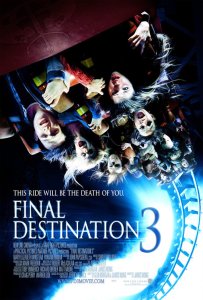 Isn’t the title Final Destination 3 itself problematic? How could it be final if it’s the third? It reminds me of 1998’s terrible I Still Know What You Did Last Summer, which wasn’t even correct with the film’s time setting (it must be stated that a 2006 sequel, and I’m not kidding, will be called I’ll Always Know What You Did Last Summer). Perhaps the best title comes from the worst movie of all time, Manos: The Hands of Fate, notoriously lampooned on Mystery Science Theater 3000. “Manos” is actually Spanish for “hands,” so the title is Hands: The Hands of Fate. Titles are fun. Oh yes. Final Destination 3, on the other hand, isn’t really fun.
A senior class is partying and enjoying the thrill rides of an amusement park. There’s an especially menacing looking roller coaster begging to be ridden by teenagers. There’s even a giant devil in front of the ride’s entrance. The ride fills up with your general high school characters (popular snots, Goth kids, cocky jocks, etc.) and then the safety bars become loose, flinging riders this way and that to splatter against broken rails and track. It’s all so horrifying … but it’s just a vision of Wendy (Mary Elizabeth Winstead). She goes into hysterics and gets off the coaster before it ships out. Other students follow her, including Kevin (Ryan Merriman), the boyfriend of Wendy’s best friend. Sure enough, the coaster crashes, those on it die, and death has been averted. For now. Just like previous installments, death seeks out the souls that escaped its cold clutches. Now death is taking out the survivors in the order they would have died and Wendy and Kevin must try and figure out a plan before it gets to them.
 Let’s not mince words, the true star of the Final Destination franchise is death itself. The appeal rests entirely on the fiendish, outlandishly complicated deaths and the misdirection over what will prove deadly. The audience is holding their breath for the next spectacular death. There’s a certain fatalism linked to this, knowing that the entertainment value is witnessing teens eventually get sliced and diced. But the franchise’s appeal also seems to be its downfall. The Final Destination films are stuck trying to out top themselves, and each film opens with a big centerpiece of disaster that inevitably serves as the film’s best moment. The rest of the movies never seem to match the opening melee, and it’s generally not a good idea for a movie to peek in the first reel.
Admirably, Final Destination 3 doesn’t even waste time with having its batch of characters theorize how to outfox the specter of death. We just watch, one after the other, the bloody, clever deaths like an assembly line of carnage. Final Destination 3 knows what its audience wants. Curiously, there’s no parental or police presence at all, even after the mounting coincidental deaths. Seriously, everywhere that Wendy and Kevin go, death is right beside them. Probably the funniest tidbit in Final Destination 3 is that shortly after another failed attempt to warn a doomed teen, Wendy and Kevin are in different, non-bloody clothes as they walk back to their car. They actually brought a change of clothes just in case. That’s hilarious. Little else seems amusing (the 9/11 reference is overwhelmingly tacky).
I once thought that the Final Destination concept could live forever in the annuls of horror, but the seams are definitely starting to show with this franchise. In 2000 it was fresh and unpredictable, and now it just seems exhausted and old hat. I thought the third film regaining the original writers and director would infuse Final Destination 3 with a bit more imagination. I was wrong. Glen Morgan and James Wong seem to go overboard to sate their blood-hungry audience, creating the most gruesome, torturous deaths yet. Seeing people eviscerated is one thing, but tantalizingly lingering on the sight of a busty teen being cooked alive, her skin boiling and exploding from the heat, is too much. It’s like this time death is really pissed, saying, “I gotta go through all this again!” The movie feels too mean-spirited, too vengeful, and a shade too cynical. I think the concept feels spent and even Morgan and Wong realize this, which is why they ratchet up the gore because the suspense is gone. The “gotcha” ending was pitch-perfect in the first Final Destination, but now it’s just another expectation feebly met.
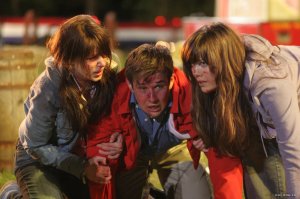 Of course, all the characters (with the possible exception of Kevin) are nitwits, horn dogs, jerks, and just plain unlikable, which make rooting for their demise easier. There’s no subtlety here either. The two shallow, popular girls are incredibly shallow and ridiculously stupid. The idiot pervert has a one-track mind that never takes a break. They’re all stock, they’re all one-note, and there’s even a moment where the token black character says, “That’s what I’m talkin’ about!” No wonder death is the star. At least in the previous Final Destination flicks you felt like the kids deserved a fighting chance.
There is one neat addition to the formula. On the night of the accident, Wendy took several pictures and each photograph predicts that person’s demise. This allows the audience to try to decode the clues they’re given and correctly guess the next horrific death. It’s the most fun aspect of the franchise.
Final Destination 3 knows exactly what its audience wants, which is more of the same preposterously complicated deaths. The concept once felt fresh but now it seems worn out. I doubt new blood could revive this franchise because audience expectation has become too demanding. We already know the rules and know the characters can’t really escape death, so the only lasting suspense is what will kill them, and even that is fleeting. The return of creators Glen Morgan and James Wong still can’t infuse the right touches of imagination. It’s more grisly teenage carnage, nothing more, nothing less, nothing special anymore. Fans of the previous Final Destination flicks will likely find some entertainment, but the movie feels creatively spent. It’s probably time for this sadistic peep show to bow out before things get even uglier.
Nate’s Grade: C
Share this:

Firewall (2006)
 I’ve seen commercials for Firewall, a new techno-thriller, attached to various TV programs. What’s peculiar is that the commercials are all centered on what Harrison Ford’s character drives in the film. The announcer even says, “See the new Chrysler in … Firewall.” The weird part is that I’ve seen more commercials pimping the movie’s car than the movie itself, like the film is an afterthought to the product placement. With such an inconsistent, stupid, cookie-cutter Hollywood thriller that Firewall is, I’d expect nothing less.
Jack Stanfield (Ford) is a bank security expert living in Seattle. He’s got a loving wife Beth (Virginia Madsen), a teenage daughter and young son, and his bank is about to merge with a larger conglomerate. Before it does, though, Jack takes a meeting with Bill Cox (Paul Bettany) who has a very important business proposition. Jack will waltz into the bank he’s been working at for 20 years and wire $100 million dollars to Cox’s offshore bank account. If Jack fails, the men currently holding his family hostage in Jack’s home will kill them. To secure their safety, Jack must work different sides, infiltrating his own bank and breaking his own system, all the while trying not to get caught and trying to save his family.
The film is so cookie-cutter and filled with obvious and/or useless plot details. In the opening minutes we’re introduced to a remote controlled car that disrupts video frequencies. Of course we know this will come into play later. The opening minutes of Firewall set up all the film’s subplots that will be tidily tied up but only after being ignored. So little of this film feels fleshed out. Firewall seems to think that just having its villain be British is enough. Beth is an architect and designed the family home they’re now held hostage in. Surely this plot point will have greater significance than a toy car. Nope, nothing ever happens as a result of this extraneous detail.
 Ford looks so bored and he does little to hide it. Once again he’s that reticent hero called into action in the name of his family. He really isn’t given much to do and his action sequences are short bursts that involve a lot of him falling down, even when he’s besting a bad guy. A perfect example of how bad the writing is, and how lame they’ve made Ford’s character, is an exchange between Jack and Henry (Robert Patrick) shortly after Ford has liquidated his company of millions. Henry confronts him and says, “You’re not going anywhere. You’re staying here!” And Jack says, like a whiny kid told to eat his vegetables, “No I’mmmm NOT!” Firewall, this is your hero.
The antagonists are another example of how poorly written Firewall is. The villains are incredibly inept on all levels. Their entire plan is kaput from minute one because they didn’t bother to check that the bank was merging and changing its security access panels. Bill basically points to Jack and says, “You come up with a plan now.” The villains need the hero to come up with their scheme, how rich. The bad guys come across like they just took night classes in How to Take Hostages and Extort Money 101. Somewhere Bill must have skipped a few classes because he makes some boneheaded decisions. He kills one of his own men for getting tricked by Jack during surveillance. I suppose he?s trying to make an example but why, if you’re holding people hostage, would you decrease your numbers from five to four? Now you have one less person to get things in line. Bill also must have missed a psychological review to screen out that old Hollywood favorite, the one reluctant kidnapper who’s nice. Did Bill put this thing together through an ad in a newspaper?
Then there’s the dog. Why on earth did the bad guys take the dog with them when they moved the family? It just so happens that the dog has a GPS tracking device on its collar. It’s a plot contrivance so Jack can find his family, but it makes no sense. These big bad men will kill one of their own but take the dog along too? Bill and the gang didn’t have to kill the dog but taking him doesn’t add up. It’s like a serial killer alphabetizing your CD collection.
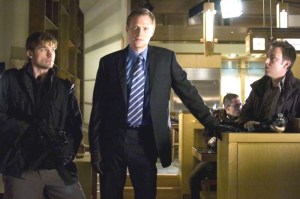 The whole hostage situation is laughable. Bill’s thugs turn a hostage situation into a bed and breakfast, implausibly letting the family roam around the house, watch TV, do whatever really. Bill even makes pancakes for Jack’s kids, that bastard. The most threatening Bill ever gets is when he offers a peanut butter cookie to Jack’s peanut-allergy kid. Dastardly and, oh yeah, the kid didn’t have to choose to eat what the bad guy gave him! This is the worst hostage siege ever. It is insultingly ridiculous. Madsen is annoying as she tries shaming her captors, proclaiming motherly advice. Firewall‘s chances of thrills are spoiled by inept bad guys and the family being in laughably staged peril.
The heist itself is given such lip-service that it almost becomes incidental. It plays for a total of maybe five minutes onscreen and lacks any thrills. Why should there be thrills if Jack came up with it? There no reversals, no setbacks, no complications, no nothing. Firewall needed to be run through a typewriter a few more times, work out a punchier screenplay that actually turns the heist into something tense.
Firewall should have played more like a cat and mouse game, with Jack and Bill battling for supremacy. Instead, Firewall feels emblematic of every other stupidly plotted thriller Hollywood feels it can feed to a mass audience because it slaps a star in it. This is shamefully mediocre, stupid, and, above all else, rather boring. Firewall is your typical disposable Hollywood thriller-of-the-week, just with more tech jargon that Ford looks pained to even speak. If you replaced Ford and Bettany with, say Mark-Paul Gosselaar and Corbin Bernsen, you’d have a movie fit to air late night on TV when the only people awake would be insomniacs. Finally, then, Firewall would have found its rightful audience.
Nate’s Grade: C-
Share this:

Crash (2005)
 A searing look at race relations and a powerful human drama at that. This flick has some of the sharpest memories I’ve had from any movie all year, particularly the relationship between a Hispanic locksmith (Michael Pena) and his daughter and a special invisible cloak. Their first scene, where he talks her out of hiding under her bed, is one of the most beautifully written short scenes I have ever witnessed. A late scene involving the two of them knocked the wind out of me completely and is the most vivid moviegoing moment of all 2005 for me. Every character has at least one great moment, though time is not spaced equally amongst this large ensemble. Crash has the intriguing practice of introducing near every character spouting some kind of racist diatribe, and then the movie spend the rest of its running time opening you up to these characters and getting to like them. Writer/director Paul Haggis has such a natural ear for terse, realistic dialogue that can really define characters with such brevity. A fine movie, despite the overarching coincidences.
Nate’s Grade: B+
Share this:

The Skeleton Key (2005)
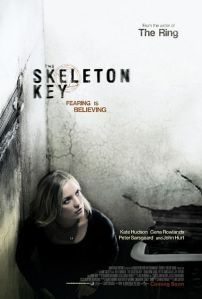 The marketing said it was horror (voodoo, creepy kids), but it’s less a horror movie and more a Twilight Zone tale. It has its share of jump scares and tries to draw out an atmosphere of dread. You see a lot of how doors work from inside locks. The Skeleton Key tries to be overly clever despite its plot holes, but at least the film runs its course. It wasn’t trying to throw out a contrived ending. Kate Hudson needs better roles than these do-nothing parts; she’s far too cute to languish. And how many times did she inspect late-night noises in her underwear? The most entertaining aspect of The Skeleton Key may be gazing at a pre-Katrina New Orleans.
Nate’s Grade: B-
Share this:

Hostel (2006)
 Eli Roth is a name that excites me. After watching his 2003 debut Cabin Fever, it was love at first sight. My friends were skeptical but one by one I convinced them that Cabin Fever was a campy, jaunty, unapologetically hilarious good time. I’ve made Roth disciples out of my fellow human beings. Naturally, I was looking forward to Roth’s follow-up, Hostel. I had heard the rumors that the flick was based on a true story of a South East Asian website, though said site can no longer be confirmed. Whatever the muse may have been, Hostel‘s got the added cache of Quentin Tarantino’s name slapped aboard as a “presenter” thus ensuring to the young male demographic that Hostel should be, “frickin’ sweet.” While not reaching the rapturous entertainment heights of his debut, with the grisly Hostel, Roth proves that he’s no flash in the pan.
Over in Amsterdam, Paxton (Jay Hernandez, Friday Night Lights) and his best friend Josh (Derek Richardson, Dumb and Dumberer) are living it up. They’re on the hunt for pot, poontang, and an endless array of good times and cheap thrills. They’ve got big wallets and big appetites. They’ve befriended Oli (Eythor Gudjonsson), an Icelandic horn dog willing to be their guide throughout their most excellent European adventure. While locked outside their stay, the trio learns of a mythical youth hostel all the way in Slovakia. The girls are buxom, beautiful, and go absolutely wild for boys with foreign accents, particularly Americans. This is an opportunity worth salivating over for our trio. They book a train for Slovakia and it looks like this hostel could be the Playboy Mansion of the former Soviet bloc. The women are frequently naked, open to most any suggestion, and eager to please the American visitors.
 Ah, but things are not what they seem. The young Americans check in but they don’t check out, at least in one cohesive piece. Our Slovakian sirens are leading their horny backpackers to their doom. Tied with the hostel is a large, empty warehouse that a lot of high-pitched, ear-splitting screams seem to waft out of. Inside is a dungeon where those willing to pay the right price can torture, mutilate, eviscerate, and kill a person. Can Paxton, Josh, and Oli even hope of surviving such a place?
Even for a horror movie, Hostel has a lot of nudity. Normally this wouldn’t bother me but the film does seem to be topped with an incredible amount of sex scenes and nudity during its sloshy build-up to the horrors that await. Many will cry “exploitation!” or “gratuitous!” and, though I’d agree with both, I must remind all fans of the genre that the bedrocks of horror are exploitation and voyeurism. Let me theorize why Hostel‘s first half is as it is. Sex and violence in horror movies are always linked, particularly the violence as retribution for wayward sexual indulgences. So then, if the second half of Hostel is a sickeningly display of cruelty, torture, and mankind at its most heartlessly gruesome, wouldn’t it make sense, in retrospect, to up the ante on the debauchery in the first half to even out the tone?
One of the most interesting elements of Hostel is how it makes you root for the ugly Americans. The first half of the film shows Paxton, Oli, and to a far lesser degree Josh, as booze hound backpackers interested in tasting the wares, be it through illicit drugs or illicit encounters with the local ladies. They?re stomping through Europe in an arrogant, obnoxious, near-reprehensible fashion trying to score some cheap thrills. Eli Roth doesn’t intend for an audience to align themselves with these tail-chasing characters, except for the more sympathetic Josh. And then once the boys enter Slovakia and become the cheap thrills themselves, Hostel turns on the surprise factor. After profoundly disliking these misogynistic party animals, we root for them to survive. This goes against most modern horror, particularly slasher flicks, where the audience is rooting for the grisly demise of its empty-headed horny teenage cast. The audience hungers for death and titillation. In Hostel, we’re presented with boorish backpackers and, despite everything prior, we really want them to succeed and get rescued from their dungeon of horrors. The last act only confirms this further. I don’t know about your theater, but mine was rollicking and roaring as they rooted for the home team to pull it out.
 Truth be told, the set-up is a bit overly long, though nowhere near as boring and comatose as Wolf Creek (maybe Roth was smart to put in the nudity). In Wolf Creek, we watched a group of uninteresting “characters” drive around and get lost for a whole friggin’ hour. That movie went from boring to “oh, is something happening?” to over. At least Hostel had movement and relevance to its set-up, including characters and situations that will be repeated later. Some of it is a bit heavy-handed, especially with the sex/violence link and a blowtorch torturer repeating, “Get your own room,” but Hostel finishes with a grand flourish. Roth weaves back different storylines and characters in clever ways and serves the audience vengeance on a platter, and we just gobble it up. I was jumping in my seat, pumping my fist, and, forgive me, shouting at the screen during Hostel‘s final act. It’s somewhat paradoxical for me to be disgusted by violent retribution so recently with Spielberg’s Munich and then a week later to be relishing it. I credit the tones of the films. While Munich is contemplative and realistic, Roth’s Hostel is a squirmy, over-the-top, dark comedy with some moments of cringe-worthy horror. Hostel‘s fabulous finish may erase any lingering doubts you had over the very Euro Trip opening.
Roth has a great sense of visual flavor with his shot arrangements but he also knows when to draw upon our dread. Hostel is really more of a survivalist thriller than a horror movie. Sure, torture and gore is prevalent but a lot of the violence and gruesome makeup is unexpectedly played down in limited appearances. This isn’t the shocking sadistic movie that outcries have made it to be. Without a doubt, I think Eli Roth is the most promising name in horror. Cabin Fever is one of my all-time favorite good-time flicks, and now with Hostel, Roth has proven that he can work miracles with a small budget and a giant, depraved imagination. Hostel is more disturbing than horrific but Roth knows exactly what chord to strike, what scenes to hit, and what sounds to echo to make you want to cover your eyes.
Roth’s best attribute, besides a pleasing visual sensibility, is his twisted sense of humor. Cabin Fever was more humor than horror, and also took an extended set-up before the gore was unleashed, but Hostel makes the flip and is more horror than humor. That’s not to say Hostel is without its dark, jovial jollies. Roth seems to approach his gore, outside of the torture sequences, with a macabre absurdity, like a character slipping on dismembered fingers only to chainsaw their leg off, or a character pretending to be dead and gets a severed hand placed on his face. Somewhere, Peter Jackson and Sam Raimi are nodding their heads in approval. Surely Tarantino is amused. Granted, Cabin Fever was more of a tongue-in-cheek fever dream homage to 70s horror, but Hostel has its share of twisted humor which elevates it far above most recent horror, either the boring and meandering (see: Wolf Creek) or the single-mindedly shocking (see: High Tension). This is what excites me about an Eli Roth horror movie: his lively, warped, depraved sense of humor. If people claim that Roth is one sick bastard, then I must also be one sick bastard for finding his movie funny and highly amusing in spurts.
 There are so many moments that I loved, from the opening cleaning-up, to seeing the Slovakian sirens on their day off sans make-up and totally trashed, to the Bubblegum kid gang, to the Takashi Miike (Audition) cameo, to knowing that killing an American is the most expensive option, to seeing the ins and outs of a facility dealing in murder for money, to seeing the equivalent of the Dunkin’ Donuts guy (“Time to chop up the bodies…”), to the madcap, fist-pumping race to the finish. There?s so much Hostel does right, not just as a horror movie but simply as a movie itself. I wouldn’t mind taking another trip to Hostel with a big group of my less-than-squeamish friends. Oh who am I kidding, horror movies are more fun when you see them with the squeamish.
Eli Roth has crafted a dirty, depraved, but highly amusing horror film. Hostel is full of surprises, from an overly long set-up that couldn’t have more female nudity if it tried, and actually making an audience root for the survival of the ugly Americans when things get dicey. The premise may be sickeningly realistic but the rest of the movie is on an overdrive of macabre fun. Roth’s twisted yet gleeful sense of humor is what makes him unique, and his attention to atmosphere and compounding dread is what will make him successful. There’s no faster rising horror name, in my mind, than Eli Roth. Hostel may not fully be the down-and-dirty horror film its ads have made it out to be; it’s certainly more of a thriller with a heaping helping of gore. This is one experience well-worth booking, especially if you have a strong stomach and a dark sense of humor. I can only imagine that the tourism industry for Slovakia is about to drop precipitously.
Nate’s Grade: B
Share this:

Munich (2005)
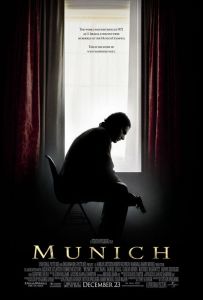 If 2005’s War of the Worlds was Steven Spielberg’s look at 9/11, then Munich should be considered his examination of the aftermath. What could be more relevant today than a film about combating terrorism, violent reprisals, and where a government leader says, “Every civilization finds it necessary to negotiate compromises with its own values?” Anyone seen the news lately? Spy eavesdropping, prison abuses, hemming and hawing on what the definition of torture is, it’s all compromised values in the name of security. This is our world and Spielberg analyzes the costs of war. Munich is visceral, haunting, thoughtful, and compelling as both an idea piece and as a mainstream thriller. It’s Spielberg’s most mature work in a decade.
In 1972, a group of Palestinian terrorists known as Black September took 11 Israeli athletes hostage during the Munich Olympics. The world watched as the standoff stretched for hours, finally ending in a firefight at the airport and the terrorists throwing grenades into helicopters housing their hostages. Every Israeli athlete and Black September member had been killed. “They’re all gone.”
But it doesn’t stop there. Israel Prime Minister Golda Meir (Lynne Cohen) recruits Mossad agent Avner (Eric Bana) to run a secretive counter strike. Avner is to assemble a team, track down the architects of the Munich massacre, and assassinate each one. Their mission is only known by a select few, and their only contact is via a handler (Geoffrey Rush) and a safety deposit box that fills up with money. Joining Avner are Steve (Daniel Craig), the South African with a hot-head, Robert (Mathieu Kassovitch), the toymaker turned bomb maker, Hans (Hanns Zischler), the document forger, and Carl (Ciarán Hinds), the clean-up man. The men crisscross the globe hunting down their targets, and with each successful kill there is escalating retaliation by Black September. Soon Avner’s group becomes a target themselves and he questions if the men they are snuffing out have any connection to Munich.
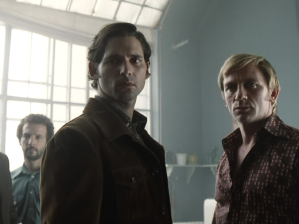 When I first heard about Munich I thought it would be a dramatization of the hostage situation, and Spielberg does revisit the sequence in horrifying and bloody flashbacks. The film’s focus is on the aftermath of Munich, though it does not pretend to be fact. This is a made up story based on rumors. As new evidence clears, it looks like the Munich retaliatory slayings were unrelated Palestinian men.
For events that began in 1972, Spielberg punctuates his drama with a gnawing sense of timeliness, closing his film with the very image of the World Trade Center in the New York skyline, connecting an invisible line from Munich to our world today. This is a mature, meditative examination on the retaliatory response to terror. Munich is even-handed in its views and dives into challenging territory where an easy answer is an insult. This isn’t a pro-Israeli movie or an anti-Palestine movie (though it’s already earned condemnation from fundamentalists on both sides), and every side gets a moment in the spotlight to effectively argue their case. The result is a movie that thoughtfully and reflectively looks at the cost of vengeance and compromising our values. Munich, even with its glut of important messages and mouth pieces, never forgets to be entertaining. The cameras are often handheld and Speilberg’s winding shot compositions give a visceral feeling to the events.
Bana (Troy) is the moral anchor of the film and gives a staggering performance. He begins proud and humbled, living in the shadow of his father’s name, an Israeli war hero. As the assassinations play out, each changes Avner and Bana expertly expresses his character’s turmoil, finally succumbing to paranoia and fear. The final act has relatives telling Avner he has done right, that his dead family is smiling with approval, and Bana’s sad, haunting eyes tell the full story of what he truly believes. He looks like he’s aged ten years in such a short time span. Each member of the hit squad fills out their role nicely, with Craig (Layer Cake) imparting tough, hip savvy, Kassovitch (the director of Gothika, oddly enough) is nebbish and the first to morally crack, Zischler is stoic button-lipped,and then there’s the fantastic Hinds (Julius Caesar on HBO’s Rome), an experienced man that?s so calm and knowing and wryly warm-hearted. He’s such a delightful onscreen presence. Rush is only onscreen in spurts but is brash, humorous, and unsentimental to the very end. He’s an actor that rarely misfires, if ever.
Too often we bandy about the term “evil;” our enemies are “evil,” atrocities are brought about by “evildoers,” but by painting in such broad, simplistic strokes, demonizing the enemy as “evil” (and conversely implying you are the side of good) you strip away the reality of the situation. The worst thing you could do in this war on terror is simplify the situation. These are not evildoers; these are people deciding to commit atrocious acts. If they are dubbed monsters or simply evil then we’ve reduced the argument to a kindergarten lesson. Munich doesn’t show the Palestinian targets as mustache-twirling evil doers (no one is spotted tying a damsel to railroad tracks). These are men with convictions, family, and humanity. “Evil” is too tidy a term, and Spielberg understands this. Are evil acts necessary to combat evil? Do we become our enemies when we resort to their ruthless tactics? Robert, shaken from a recent kill, pleads that Jews are supposed to be righteous, that’s what separates them from their persecutors. Assassination is not a righteous act, despite what Pat Robertson may spout off on TV. In the end, the only trustworthy people in the film may be a strange French family that sells information to the highest bidder, regardless of politics.
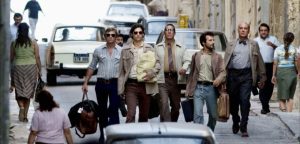 There’s one moment in the middle of Munich that will stick with me forever. There’s only one pure vengeance murder in the movie and it involves a female killer (Marie-Josée Croze). It’s a kill the audience is thirsting for and demanding; the other assassinations were murky, men unknown to have any involvement in terror other than being a name on a sheet. This is an instance where the audience wants revenge and then Spielberg gives exactly what we want and disgusts us. The kill is so sharp, so uncompromising that the violence is startling and, more importantly, it hurts. The reality of it is painful to watch. Spielberg has masterfully turned our quench for violence and shown the ugly reality.
Munich also succeeds as a thriller, pulsing with immediate danger and drawing the viewer in. There were key moments that I was chewing on my knuckles because of how taut the suspense was. As a thriller, Munich briefs us on these men’s mission like all good spy movies, brings us into their fraternal order, and then we watch each assassination play out, many never going according to plan. What elevates Munich is how real everything feels and how dangerous every moment comes across. This is a thriller that it makes the heart pound but also courses with subtext, and exquisite dialogue by Tony Kushner (Angles in America), who magnificently frames his characters with the tiniest details, who crafts deft symbolism in moments of doubt and paranoia, and who, channeled with the film’s masterful acting all around, creates a stirring study of the cost of violence and the broken bodies it leaves behind, even those that live to ponder another day. Kushner’s writing is a perfect match for Spielberg’s effortless artistry.
This is Spielberg maturing as a filmmaker, despite some missteps here and there, mostly with the length and a late sequence where he juxtaposes the final Munich hostage flashback with Avner climaxing in coitus with his wife. The characters are sharp, the acting is resonant, and the thrills are palpably engrossing, giving the film a refined sense of danger where anything could happen. Munich is more than a thriller and more than a think-piece. It’s a close examination of the cyclical nature of retaliation and reprisal, dooming both parties into an endless bloodbath. Don’t be frightened by all this heady talk because it’s also a very entertaining movie. Munich isn’t the best film of the year; it’s pretty good but it’s definitely one of the more important movies of the year and worth seeing.
Nate’s Grade: B
Share this:

Wolf Creek (2005)
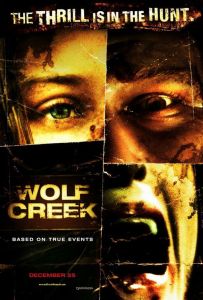 It comes across as choose-your-own-adventure horror, each with their own vignette and then starting back. Wolf Creek is very uninspired. The only thing it has going for it is the fleeting gimmick of an Australian take on American horror staples. In many horror flicks, there’s always that nation of creepy yokels waiting to take advantage of visitors off the beaten path. Now, this is Australia’s version. The film’s biggest sin is that it spends an agonizing 60 minutes before anything happens. The set-up is protracted and the characters are uninteresting, bland, and mostly just sketches of ideas. It takes forever to get the horror going and once it arrives I’ve already checked out of the movie into a coma. Wolf Creek lacks any subtext or commentary, some of the saving graces of the horror industry. The whole thing is an exercise in tedium, with some splashes of gore at the end. This movie takes too damn long to get to the goods. There’s nothing suspenseful in that 60 minutes and little has any meaning later (why do their watches and car stop?). Wolf Creek is derivative, possibly exploitative being based on a true story (what it shows is mostly speculation), and really boring. Casual horror fans should stay home.
Nate’s Grade: D+
Share this:

Syriana (2005)
 Written and directed by Stephen Gaghen, Syriana is very reminiscent of his Oscar-winning work with Traffic. It’s very dense, complex, and demanding of its audience, which is both its best and worst aspect. I needed a notepad to keep up with the multiple criss-crossing storylines. It’s similar to Traffic in scope and texture, but this film seems a whole lot angrier. Whereas Traffic felt like it was trying to hold a mirror up to society, show us the truth of the failing War on Drugs, this movie feels like a wake-up call as well as a call to arms. Syriana is desperate to shake people out of complacency and show them how the world is running. I love the fact that the “Free Iran” committee in the film that preach Iran’s desire for democracy are not backing the emir’s son that wants to educate his country, install democratic freedoms, put women on equal footing as men because … he wants to open the oil fields to China because they’re offering more money. They are backing the less-enlightened son because he’s willing to give America what it wants: oil. The movie is a mostly potent microcosm about questioning who has our best interests at hand. It’s a bit slow at parts and incredibly rushed at others, and your head will be left spinning trying to keep track of the wealth of information it throws at you. It is thought-provoking even without an emotional connection. This flick reminded me of The Constant Gardener, also a screed against the evils of big business though grounded in an evolving love story. This is a movie I admire more than I can say I enjoyed.
Nate’s Grade: B
Share this:

Derailed (2005)
 The Chicago train company featured in Derailed is regretting their involvement. It seems that this year a Metro train did in fact derail and a number of people died and scores more were injured. I suppose this would be akin to Enron being featured in a movie called Big Fat Lying Energy Thieves. Then again, maybe one of the company’s execs took a look at the script.
Charles (Clive Owen) is an ad ex who feels crushed by his life. His marriage is deteriorating, his adolescent daughter has a severe case of diabetes and is in need of a new kidney, and he’s been booted from a project at work. All he needs now is the film favorite car to drive in front of him and splash water. On a train ride to work, he’s helped by Lucinda (Jennifer Aniston), a dark beauty Charles can’t seem to resist. They share pictures of their kids, accounts of their spouses, and their saliva with some open-mouthed kissing. Both are conflicted about following through with an affair, but finally decide to act. They get a room at a motel, roll around on the bed, but are interrupted by a French intruder named Laroce (Vincent Cassel). He robs them, beats Charles into submission, and rapes Lucinda. She doesn’t want to go the cops and just wants the nightmare to end. If her husband ever finds out about the almost-affair she’ll never see her kid again. Charles adjusts but is now getting threatening phone calls, asking for increasingly large sums of money or else his wife will know the truth.
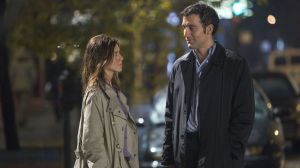 This is your prototypical thriller that survives due to the stupidity of its characters. Only in your rote thriller would characters ever dare to go about their infidelity in a seedy motel, leave the door unlocked, and then after being beaten, robbed, and raped, not go to the police. Only in your by-the-book thriller would the assailant return to implausibly blackmail our leads for money under the threat of exposing their affair. Only in your standard thriller would a character actually say, “It’s all over now. We’re safe. Everything’s fine,” without a hint of irony. It’s like these people had never seen a movie before. The villains are not exempt either. They repeat their scam at the exact same locations in the exact same manner, meaning anyone with a decent memory could trip up this criminal masterwork. (Spoilers follow) Like the preposterous Flightplan, this elaborate scheme to make money hinges on some pretty big assumptions: 1) that Charles will never go to the police at any turn, even when the other option involves draining $100,000 out of his own kid’s kidney fund, and 2) that Charles would never drop by Lucinda’s work and talk to anyone who remotely knew her. I just thought of another one: 3) that Charles would never question why they’re only blackmailing him for money when Lucinda has a higher paying job and much more at stake to lose (end spoilers). Derailed is too true of a title when it comes to the movie’s process of logic. Then again, thrillers typically spit in the face of logic and this is no different.
Derailed would like to strike the same vein that Fatal Attraction hit so well; in fact, there’s a scene in the middle that’s a direct rip-off where Charles rushes home to find his wife chatting with his antagonist. The first half-hour of Derailed is well done and pretty interesting, but the film really goes off the tracks when the blackmail plot starts mounting ridiculous, implausible plot turns. This film would have been so much better as a straightforward drama than a dime-a-dozen thriller. As a drama we’d witness Charles wrestle with guilt, the decision of whether not to tell his wife, and the moral quandary of wondering if their attack was somehow justified as a punishment (no, rape is NEVER justified). It could be a really strong character study. Derailed goes the far more conventional route and brings in an outside force of antagonism and some foreseeable twists.
Clive Owen is wasted in a role that mostly requires that he get his ass handed to him. He’s a fantastic actor, a natural badass, and he just smolders with charisma, menace, and intensity. He was one of the highlights of a stellar cast in Sin City and was my top candidate for the new James Bond. That’s why it’s so frustrating to see him beaten and bullied for almost the entire duration of the movie. For crying out loud, even a cop bullies him into paying a hooker he had nothing to do with. It reminds me of 2002’s Enough where Jennifer Lopez was beaten and antagonized for so long that the audience was practically feasting for blood. This might explain Derailed‘s tacked-on epilogue. Owen still gives a credible performance even though his accent slips from time to time.
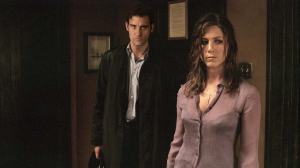 Despite what the marketing folks may have you believe, Jennifer Aniston is really a minor character in the film. I’m not that particularly taken with Aniston as an actress; I thought 2002’s The Good Girl could have been The Great Girl, or at least The Better Girl with a stronger lead. In Derailed you can tell she’s playing against type because her hair is darker. Aniston is effective at turns in Derailed, but really “at turns” is all she’s given to work with. This is Clive Owen’s movie.
Casell (Ocean’s Twelve) really relishes his creepy villain and can make your hair stand on edge. Xzibit pimps no rides but also does little to pimp his role, becoming nothing more than a gruff thug. Fellow rapper RZA (is it possible to spell that wrong?), in comparison, imbues Winston with a stronger personality than the meager role deserved. It’s also very convenient for a bourgeoisie white male to have a black mail room friend (with a criminal record, of course Hollywood) to fall back on when trouble strikes. Fans of TV’s Alias will recognize Owen’s wife played by Melissa George and instantly hate her. I should know, I watched Derailed with an Alias fan and she still hasn’t forgiven George for coming between Sydney and Vaughn.
It’s not that Derailed is particularly terrible, it’s just rather ordinary, predictable, and at turns lurid and trashy. Owen is wasted as a wimpy man with a guilty conscience that gets beaten and bullied for ¾ of a movie. There are worse ways to spend an afternoon at the movies and fans of the thriller genre should be relatively satisfied. Derailed isn’t a movie you’ll hate yourself in the morning over seeing, but then again it’s nothing too special. You could probably turn on TV right now and catch 3 or 4 thrillers with the same plot and similar twists. You could also watch Friends. Just go watch TV instead of seeing Derailed. Something’s got to be on. In a couple years it’ll be Derailed.
Nate’s Grade: C
Share this:

Flightplan (2005)
 Anyone else tired of seeing that damn trailer for Flightplan? Ever since maybe June, I’ve been seeing Jodie Foster freak out on an airplane. The trailer also had the misfortune of revealing way too much information about the film’s plot, seriously spoiling a key moment. This got me thinking about other movie trailers that spoil the movie. The worst offender I can fathom is 1998’s The Negotiator, where Samuel L. Jackson and Kevin Spacey are pitted against each other as hostage negotiators on opposite sides. The trailer had the nerve to reveal that Spacey and Jackson team up in the end to fight The Man collectively. Why does it seem that movie trailers these days spell out film twists? Are movie audiences demanding more investment before shelling out money? Do studios just not have faith in audiences anymore? With all this in mind, I ventured into Flightplan with my family thinking there might be more to the film than one poorly spoiled twist. I was wrong.
Kyle Pratt (Foster) is a very distraught woman. She’s returning from Berlin to the United States with the casket of her dead husband aboard. To make things worse, at 30,000 feet her daughter Julia goes missing. Kyle looks around the giant aircraft that she helped design, still not finding any trace of her absent little girl. Kyle becomes more frantic the more she looks and finds nothing, troubling an air marshal (Peter Sasrgaard) and the pilot (Sean Bean). No one remembers seeing Julia on board. She believes her daughter is somewhere and someone is definitely responsible. Kyle is dealt a crushing blow when word comes from a Berlin mortician that not only is the plane carrying the body of her dead husband but also her dead daughter. Is Kyle right or is she one crazy mamma? And so the drama unfolds.
 Flightplan is a rather boring trip. Well over half of this movie is spent watching Kyle wig out and search compartments for her missing kid. She’s frantic and possessed and it’s interesting to watch a woman come undone, especially of Foster’s talent, but after several searches and little progression, the film feels like it’s going nowhere. There’s very little story for very long stretches of time. Flightplan relies on its outlandish final twists to provide a story, because without them the film would just have been 60 minutes of a mother freaking out on a plane. You can see that with home movies.
The premise is a direct homage (or rip-off) of Hitchcock’s The Lady Vanishes, but Flightplan could have been something special if it wasn’t so afraid of going against convention. The film sets up our leading lady looking for her missing child, and as the hours tick away she becomes more and more undone, practically terrorizing the other passengers. In a bit of incisive bigotry, Kyle even unfairly blames a pair of Middle Eastern passengers, who then garner everyone’s suspicious eyes. Now, with all this set up, what if Flightplan took a different path and we remained in doubt whether Kyle ever had a living daughter, and then through her grief, confusion, frustration, and misplaced anger she became a terrorist and was the cause of the plane going down. Wouldn’t that be neat? A little thought-provoking about role reversals in a post-9/11 anxiety-riddled world? It’s not like I expected a dour, Twilight Zone-esque ending, but Flightplan presents Kyle as a crazy woman with the entire world against her, and yet the movie virtually winks at you to say, “Don’t worry, this is Hollywood, no matter how outlandish the conspiracy, our heroine will always be right.” At the end, the film even has the distasteful audacity to have a scene where Kyle walks past every airline passenger, shaming them for having ever doubted a crazy loud woman who had terrified them and jeopardizing their safety. Shame on you all, passengers. Don’t you know that she’s Jodie Foster? She has TWO OSCARS! Kyle doesn’t even offer an apology to the Middle Eastern passengers, and they even carry her bags for crying out loud!
 There’s suspension of disbelief and then there’s Flightplan. The missing-daughter scheme is so ridiculous, so convoluted, so rickety, that it makes Scooby-Doo schemes look downright like Hitchcock. For those who have seen the film, or just want to know the laundry list of variables to allow this plan to work, read on (massive spoilers ahead). Apparently, the ones behind everything are the helpful air marshal and one stewardess. They want to squeeze 50 million dollars from the airline. This is the best way they propose to do so: First, they locate an airline engineer living abroad and kill her husband and make it look like suicide. Then they pay off the mortician so they can stash explosives in her husband’s security sealed coffin. Then apparently they know when Kyle will want to fly again and it also happens to be a flight that the marshal and the stewardess will be scheduled aboard. Now, once the plane is in flight, the marshal somehow manages to steal the little girl, awakening no one, takes Kyle?s boarding pass and doesn’t awaken her, and stows the little girl away without being seen. They then let Kyle go nuts looking for her missing tyke so they can, get this, have a credible hijacker that they can accuse of plotting to blow up the plane unless … she gets 50 million wired into an account. Afterwards, the marshal will somehow get the Feds to kill Kyle and he’ll slip the detonator in her cold dead hand. Oh, and the stewardess changes the flight manifest twice too. What. The. Hell? Does this sound like the easiest way to make money? This plan also involves Kyle wiggling her way into the cargo hold and manually opening her hubby’s casket with the security code so that the marshal can get a hold of the hidden explosives. This entire tortuous plan revolves around a primary assumption that NO ONE will remember or interact with Kyle’s daughter the entire time. This assumes not a single person will remember little Julia, even though mother and daughter boarded first onto an empty plane. What would happen if Julia hit the call button for a pillow? Oops. What would happen if anyone next to them just said, “Hi?” Oops. What would happen if people on the plane contacted anyone at the airport? Oops. The entire conspiracy rests on 400 people’s bad memories. Those do not seem like good odds to me, but then again I’m not a movie villain. The entire heft of Flightplan is built around the revealing of this nefarious, fool-proof plot. The movie can’t help but crash and burn with such a laughable, preposterous Big Twist to give plausibility to the proceedings.
It’s a shame because Foster gives a real nail-biting performance. She’s splendidly rattled and lets the audience see the gears of fear turn in her eyes. The acting as a whole is the lone strength of Flightplan. Foster provides entertainment just from her sheer talent to be able to make a turkey like this flick even remotely watchable. The rest of the cast is okay to good and they all deserve pilot wings for keeping straight faces.
Flightplan is a timid, tedious, tiresome, and painfully preposterous thriller. Foster’s excellent performance is wasted in a film that spins its wheels before unleashing a dreaded torrent of illogical plot twists. You may be twisting your head around just to understand how any of this deeply flawed movie could be plausible. Flightplan should appeal to people that liked 2004’s The Forgotten, a very similar child-vanishes thriller. Another thing both movies have in common is that they’re utterly terrible.
Nate’s Grade: C-


You must be logged in to post a comment.