Blog Archives
Sanctimony (2000)

Sanctimony is the English-language introduction to the filmography of Dr. Uwe Boll and the very last movie I had yet to see for my first edition of my expansive column. Boll wrote and directed the movie about a clever serial killer that’s baffled law enforcement. It’s interesting coming into Sanctimony with all the Uwe Boll homework in the back of my head. I know what flaws I’m looking for, I pay attention to the retched line delivery from the actors, and I genuinely know what I’m getting into. It’s seems that Boll works somewhat in a bubble; almost all of his technical crew is the same from film to film, and Michael Paré, Jurgen Prochnow, Clint Howard, and Patrick Muldoon seem to be the stable Uwe Boll Players. Sanctimony is where it all began and where everything went so horribly awry for moviegoing audiences.
A killer is loose and terrorizing Seattle, cutting out the eyes, ears, and tongues of his victims. The media has dubbed him the “Monkey Maker killer” (think “speak no evil, hear no evil, etc.”). Detective Renart (Paré) and his partner Dorothy Smith (Jennifer Rubin) are assigned the case. After some investigation of a stabbed homeless girl, their initial suspect seems to be Tom (Casper Van Dien), a wealthy and cynical stockbroker. His lawyer balks at any charges and Tom goes free. Coincidentally, more bodies start piling up haphazardly. As Renart puts more pressure on Tom, he starts targeting those close to him, like his pregnant wife (Catherine Oxenberg, who seduced Van Dien in 1999’s The Omega Code). Tom has some master plan ready to shock the world, and only the dogged persistence of Renart can stop his wicked ways.
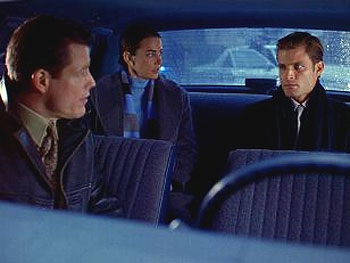 Sanctimony is really a crossbreeding of what Boll liked best about Seven and American Psycho. Like David Fincher’s masterpiece, Boll really wants his serial killer to be slicing and dicing with a message; this killer gets his kicks from cutting out different body parts. Tom eventually goes after his pursuer’s pregnant wife, just like Seven, and clumsily aims for some kind of myopic preaching. Tom sure does like to spit out a diatribe about the plague of humanity, even after he’s just dismembered a call girl. Boll seems very intent on crafting Tom into a Patrick Bateman-esque character, one whose soul has been lost to the bottom line of the business world (how many hotshot stockbrokers are based in Seattle?). But while American Psycho was complex, satirical, and deeply metaphorical, Sanctimony is stupid. Boll wants Tom’s speeches to have terrifying power to them, but instead they come across as theatrical and lifeless. Tom says, “Raping and pillaging have been the official government policy of any government that’s ever thrived.” If you’re impressed by this assertion, Sanctimony might just be the movie for you. If you yawn at this sub-standard Political Science 101 ejaculation, then you’re likely beyond the film’s short-armed reach. Boll’s writing has a vague inauthentic feel, like he learned everything about crime procedural from TV. In the year 2000, a character actually summarizes America with the words, “apple pie and baseball.” By now I think the only people that characterize America that way are conservative politicians and out-of-touch, disdainful foreigners.
Boll’s serial killer thriller plays all the genre clichés. First, naturally, there’s the clever serial killer who must torment his persecutors as a game. Then there’s the umpteenth example of a cop haunted by the lives he can’t save and his stalwart dedication to the case straining his marriage. When will these wives ever understand? Renart and Dorothy naturally get thrown off their case, thus finally allowing them to solve it as in every cops-and-robbers movie. Maybe movies should just begin with the cop thrown off their case; it would save everyone a hell of a lot of time as far as casework. Partners must always die to spurn our hero into action, though I’d have to assume Dorothy’s too young to be days away from a blissful retirement. Killing her seems ill advised too, especially since her last known whereabouts would be a dinner date with Tom. Way to be the number one suspect and give yourself borrowed time, dude.
I hate to admit it, but despite all its glaring simplicity and predictable bumps in the road, Sanctimony is passably entertaining, that is, until the ridiculous ending draws near. As with most serial killer films, the killer is practically a super being with an agenda. Except, in Sanctimony, Boll doesn’t even give his vengeful hand of God an agenda but just an inescapable rage. The film climaxes with Tom going on a shooting spree at his wedding party and then being gunned down by Renart. Boll uses lots of slow-mo and swelling dramatic music, but the scene had no set-up from earlier and makes little to no sense. What was his master plan? Was Tom trying to outlive his looming terminal illness and create a name that will long live on, likened to the horror he has wrought? He said he couldn’t stand the curse of people, so was his plan to just take out as many people as possible? If so, surely leaving the cops obvious tell-tale signs was not helpful, especially if he was just going to out himself on live TV as a murderer anyway. Sanctimony ends with far too many loose ends and unexplained motives that, in hindsight, seem to suggest Boll’s clever serial killer wasn’t so clever after all.
Since the heroes of Sanctimony are so rote and familiar, the only place for Boll to make artistic strides is in his depiction of his killer, Tom. This is where Sanctimony and Boll really drop the ball. Before we know anything about him, Boll has already introduced us to Tom’s office, which should more accurately be described as a lair. It’s gigantic, poorly lit, and surrounded by ominous rock faces. He even has an array of monitors at his super desk of villainy. The only thing missing is a desk full of files labeled, “Plan, Evil.” We never really understand what Tom’s motivations are, though Boll thinks he’s helping by lining up speeches about Tom’s views on people (hint: it’s not optimistic). Even his choices of murder have no lasting message; Tom just kills whoever is weak and available. If he’s an ordinary killer then what’s the point of even basing a flick around him?
Sanctimony presents a lot of Tom’s ire but never digs any deeper. He attends a laughable S&M club where they make snuff films in the back for your viewing pleasure. The leader of this demented boys club wants to harness male fury as motivation, for what I don’t know. So what does Tom do next? He goes home and chokes and attempts to rape his fiancé, clearly indicating that this unique support group is not working. She rejects him, so Tom walks the empty Seattle streets (!) with his knife openly drawn and stabs a homeless girl. Was he frustrated over his failed rape attempt? Is he reacting against a woman asserting power over him? We’ll never know, because Sanctimony is only interested in skirting the waters of characterization. In Boll’s movie, people fall into types and aren’t given anything else to work with. Tom is the killer. He kills. That’s all you’re going to get. Even though the movie is only 87 minutes long, Boll is disinterested in spending time with his characters. He’s rather just draw up a sketch from someone else’s work and move along.
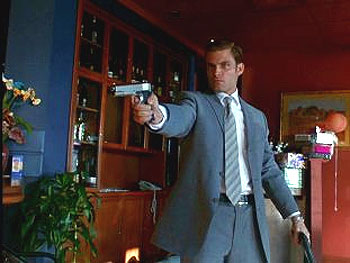 The acting is somewhat better than most Boll movies and yet still a degree below typical straight-to-video blandness. Van Dein (Starship Troopers) is amusingly believable as a stone-faced serial killer. His limited acting range actually strengthens the character’s sense of frustration. He’s got a menacing stare to boot. Paré (Hope Floats) phones in his performance but gets some points for being in the film’s most weirdly awkward moment, when Renart has to step in as nude model for his wife and her giggly photographer peers. Bizarre doesn’t go far enough in describing the scene. Rubin (Little Witches, Amazons and Gladiators) is the hard-nosed female cop trying to make it in a man’s world, and gives a decent if unmemorable performance. I was more intrigued by her ever-present striped scarf, which seems to follow her everywhere from the shooting range to inside her home. Roberts has very little screen time and is still third billed.
Sanctimony is Uwe Boll’s stab at the serial killer genre, so it shouldn’t be surprising that it’s formulaic and bereft of suspense and imagination. This is a generic rip-off of far better serial killer flicks. The characters are all brief sketches and genre clichés, and Boll can’t even come up with a compelling agenda for his killer. I kept waiting for Sanctimony to fully explain itself, but once the wedding shoot-out is complete the film leaves you addled and perturbed. Boll has castrated his drama, rendering it unimportant, lazy, and sloppy. Boll may have several ideas floating around his head but he never brings them in for a clarification. Whatever intellectual goals he may have intended for Sanctimony will be lost on an audience grasping for meaning and entertainment. How dumb is this movie? Well, it defines what “sanctimony” means in the opening credits via dictionary. It should be very ominous when a movie is forced to define its own title. Ominous, indeed.
Nate’s Grade: C-
Share this:

Poseidon (2006)
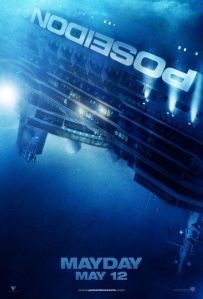 The Poseidon production design is rather fantastic and director Wolfgang Peterson (Troy) has a real handle on large-scale carnage, but Poseidon is a stripped down action flick that lacks the suspense and emotional involvement to bring strength to its attempts at harrowing survival. Some sequences, only some, are nail-biting, like a very claustrophobic escape through an air vent slowly filling with water. We’re presented a situation and then Peterson cranks up the tension and utilizes different characters working together. The sequence has the added benefit of utilizing the child to save them, unlike most films of this nature where irritating kids just become a liability to your own safety. The fact that this sequence, the film’s high point in my view, is also the least expensive of this $160 million dollar movie’s sequences is not lost on me. The film’s premise of working through the bowels of an underwater ship is filled with potential. The original Poseidon Adventure was cheesy, yes, but it was a lot of fun. This slick remake brings the action fairly early, having its “rouge wave” flip the ship at the 15-minute mark. Because of this decision the audience has no attachment to the film’s collection of characters, given fleeting seconds to establish some sense of personality. You really don’t care at all what happens to these people in the ensuing danger. The female characters add nothing to the story except to fall into the constant need of being rescued. Peterson paces his obstacles mercilessly right after the other, but he runs into the problem of killing off all his expendable (read: non-white) cast off too quickly. That lessens even the small amount of tension the film had going. Poseidon is way too big-budget and serious to go for camp. The special effects are above average and the pacing is swift. Frankly, you could do worse this summer for entertainment than spending 100 minutes watching this movie.
Nate’s Grade: C+
Share this:

The Da Vinci Code (2006)
 Dan Brown’s The Da Vinci Code has been a best selling novel for three years running. Continents of trees have been felled to produce the 50 million published copies worldwide. Brown’s novel details a centuries long cover-up of some crucial background on Jesus Christ, as well as certain omissions about the role of women in Jesus’ discipleship. The book has been condemned by Christian watchdog groups as heresy, never mind that it is clearly labeled “Fiction.” Debunking fiction is simply redundant. Now Hollywood has adapted The Da Vinci Code into a massive movie, directed by Ron Howard. I must be one of eight who have not read the book, so I entered the theater with little expectation and no idea where the story would take me. Is this a great threat to the Christian church, as some argue, or is it just another dime-store thriller that lucked into becoming a national phenomenon?
Robert Langdon (Tom Hanks) is a Harvard professor of symbolism lecturing in Paris. He’s called in by a police captain (Jean Reno) about a local murder. The curator for the famous Louvre museum has been killed and his death leads to a series of coded clues about a deeper conspiracy involving Leonardo Da Vinci. Sophie (Audrey Tautou) is an investigator, and the granddaughter of the museum curator. She helps Robert escape and the two of them set off on an adventure through France and England, finding clues that lead them closer to the location of the Holy Grail. They get help from Leigh Teabing (Ian McKellen), an old friend of Roberts that has his own theories about what the Catholic Church may be so desperate to keep hush-hush. All the while Silas (Paul Bettany), an albino monk, is on the warpath to dispatch all who know too much, including Robert and Sophie.
There are just so many harebrained, hokey moments in The Da Vinci Code that can rip you right from the movie. Why does Sophie have to pay someone to leave a park bench when she and Robert can just walk out of earshot? Why does a bank teller, with his own devious intentions, drive Sophie and Robert to safety and then threaten them at gunpoint? Surely letting them be captured by the police would have served his needs better. Oh, the bank also has a payable escape clause, like it was a Scooby-Doo mansion. But the hokiest moment comes in the opening minutes. The museum curator, an old man who couldn’t hobble away from his attacker, gets shot in the gut, a quite painful place for a bullet to lodge itself. So he’s fatally shot in the stomach, but the man still has time to scribble coded messages on three separate paintings at different points in the museum, strip down, pose, write a message on the floor and a symbol on his chest. And remember, he’s an old man on top of all this. It’s like he had a checklist he pulled out in case he was ever mortally wounded at the Louvre.
 The characters aren’t any better. There’s little to any depth to these people and most of them are irrational stock roles. The Jean Reno cop character is laughable in how doggedly he’s convinced Robert is his man. Apparently, a priest told the cop Robert confessed. Case closed? Perhaps the cop, in his furtive rush to judgment, should do some outside research. The museum curator?s time of death, something any crime scene tech could denote, would prove that Robert would be ruled out, given that the man was giving a lecture in front of hundreds of alibis. That’s verifiable science, but no matter. Would not a place as heavily trafficked as the Louvre, with so many priceless pieces of art, have security cameras? I think that alone would tell you who murdered the museum curator. These details make the Reno character stupid and unbelievable. The police work hasn’t been this sloppy since the Police Academy saga.
There’s a late scene where a character addresses another and more or less says, “No one will suspect us, my partner. Let us split our winnings together. I will take your identity to my grave. What? Yes I will take a drink from your flask you’re offering me but not drinking from yourself.” The film could not hit you over the head harder with what is to come. I’d expect these kinds of half-hearted character turns from a rote made-for-TV thriller, but The Da Vinci Code has too much intended intellectual prestige to wallow in this manner.
This is not a good film adaptation. This isn’t structured like a thriller, let alone a movie. There?s no sense of momentum and the story is really an ongoing series of mini-climaxes, sputtering out to no payoff. Puzzle-solving and word games can work on the page, with the reader feeling like they’re right along, but onscreen it cannot work in a story of images. Howard highlights certain letters a la A Beautiful Mind, but then it simply becomes less a puzzle and more just witnessing how a character’s mind breaks down the code, nothing more. As a thriller, Brown seems to do just enough to push his narrative further, but he frequently writes himself into a corner and relies on plot contrivances to save his ass. There’s a scene at Leigh Teabing’s mansion involving a gun standoff, and how does Brown get his characters out of it? By conveniently having a bird fly and distract the evil gun-bearing monk. Talk about a cheat. The Da Vinci Code‘s lame behavioral explanations and short cuts are expected in a rote thriller, but Da Vinci doesn’t want to be seen as one.
But that’s the fundamental error of The Da Vinci Code: it wants to have it both ways. The film, and I’d judge that the novel as well, wants you to shut your brain off and swallow these trite lapses in judgment and reality, forgiving the movie for zero character development and polluting the narrative with stupid genre stock roles, but then it also wants you to pay close attention and activate your brain to untangle the origins of symbols, conspiracies, and church doctrine. This flick was destined to fail at birth. You can’t be a brainy thriller and fill the story with hokey moments and lapses in thought, and likewise you can’t be an enjoyably straight forward thriller if you bookend all your action sequences with talky sit-downs to explain the minutia of your story. The Da Vinci Code is thusly pulled in two directions and grinds its gears to the very end.
 This is not a very entertaining flick, in fact is nearly put me to sleep a half dozen times. The Da Vinci Code has tiny bursts of action, and most are easily swept away before the viewer can get a grip. These moments are then succeeded by lengthy, ponderous sessions of heavy exposition. It’s like characters will breathe a sigh of relief at another ludicrous escape and then say, “Well, now let’s discuss in detail some more convoluted theories.” The dialogue reeks, and characters spout plot points whenever they’re needed. The conspiracy doesn’t even make sense. Why would the Church protect a secret that could supposedly destroy its hierarchy? If Jesus was not divine then what difference does it make to go after relatives 2000 years removed? And if Jesus did have heirs would there not be thousands in 2000 years time, not one convenient individual? Even The Da Vinci Code‘s ending seems to soft peddle its “dangerous” message, where Robert, after learning all he has, says it’s all about what you believe.
If it wasn’t for Bettany and McKellen I really would have nodded off. Silas is by far the most interesting character in the whole film, and the only one with a penetrable personality. A deeply religious albino killer monk is a great character, and Bettany makes him scary but also frightfully sympathetic. I was rooting for Silas to knock off the film’s heroes and go on a better adventure of his own. McKellen is handed most of the monologues and he gives his character all the gravitas needed. Thank God for these two actors, because Hanks is miscast and Tautou isn’t nearly as endearing as her work with Jean-Pierre Jeunet. There’s a really good international cast assembled for The Da Vinci Code and the movie manages to mishandle most of them.
The Da Vinci Code played out on the big screen is ponderous, talky, boring, poorly adapted and poorly written. Some things work better on a page than onscreen, and I guess if this is the final product than the whole damn things works better on the page. The story is brimming with lame, hokey moments you’d see in a lazy TV thriller, but then the story also wants to talk you to death with its convoluted storyline. The action sequences are brief, the dialogue is smothered by lengthy exposition, and the plot just isn’t that entertaining. The cast is mostly wasted in thankless stock roles. So let me get this straight. After seeing The Da Vinci Code, the biggest threat the Christian church is facing is … bad movies? I think they’ll be alright.
Nate’s Grade: C-
Share this:

Stay (2005)
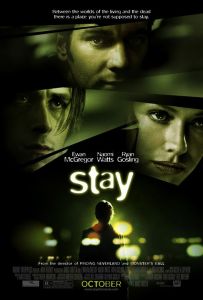 This is a movie that piles on the mystery and clues but once the finish does arrive I was left saying, “That’s all there is?” There’s so little to this film that, in retrospect, it’s simply blowing off the dust on An Occurrence at Owl Creek (I may have said too much). The trickery Stay throws at you is slightly intriguing but mostly confounding and, once the reveal tidies everything up, wholly unsatisfying. Part of the problem is that I didn’t care about any of the characters, so I didn’t really care about their plight. Yes I get it that there is a reason for how shallow they are, but the only thing Stay had to keep me going was my waning interest in what the hell is going on with everything. I’m not the biggest fan of Marc Forster (Finding Neverland) as a director, and he serves Stay to good and harmful effect. Forster gooses the film with all sorts of visual trickery like jump cuts, using twins and triplets as extras in backgrounds, repeating scenes, playing around with blocking, and lots and lots of spiral staircases (hello, Vertigo). And you do realize that most of these disorienting stylistic decisions have a seemingly coherent reason in retrospect, but it also effectively pushes the audience away from the story, aided by the fact that no one can get into the characters. The entire affair seems pointless and empty but it is pretty to look at. I’m sure I’d garner more from a second look, but I really just don’t want to see Stay again.
Nate’s Grade: C+
Share this:

United 93 (2006)
 I’ve heard a lot of talk about whether America was ready for United 93. Almost every magazine or newspaper article you’d read about director Paul Greengrass’ real time account of 9/11 began with the question, “Is it too soon?” That’s mostly a personal decision. My response: of course not. They were making World War II movies while Europe was still burning and while Pearl Harbor was still recovering. Speaking of which, doesn’t anyone feel that a 9/11 movie would be much more powerful and respectful now, five years removed from one of the worst days in American history? We can still remember that awful day, and most importantly, we can use art as a means of catharsis when the subject remains relevant. Does anyone seriously want to wait 20 years down the pipe for a 9/11 movie to be produced by Jerry Bruckheimer? Was 2001’s Pearl Harbor the kind of movie we’ll get when it’s “not too soon?” While I’d never insist people see United 93 if they weren’t ready, I will say it’s definitely a movie that demands to be seen sooner rather than later.
On September 11, 2001, four planes were hijacked in the sky by members of the terrorist group Al-Quaeda. Two crashed into New York’s World Trade Center building. Another crashed into the Pentagon in Washington, D.C. A fourth plane, United 93, was delayed on its initial takeoff, meaning the four hijackers on board were already behind schedule. After the hijackers had taken control of the plane and turned it back around, presumably headed toward the White House, the passengers started making phone calls from the flight and piecing together the scenario. They weren’t going to land at any airport; they were a bomb on wings. The passengers came together with a heroic plan to take back the plane and use a fellow passenger, with flying experience, to help them land. Their valiant effort ended in United 93 crashing in Shanksville, Pennsylvania.
 United 93 is one of the most nerve-racking movie going experiences I have ever seen. Because of our prior knowledge of the events, every little thing carries so much dread, from a man who just makes the plane to simple phone calls, unknowingly their last, that end so regularly in “I love you.” Hitchcock said tension was watching a happy couple unaware of a ticking bomb below their picnic table, and he was right. United 93 is grueling to sit through, but that doesn’t mean the film isn’t rewarding. We’re going through the same situation and harrowing steps of realization as the passengers. The final phone calls on board may be the most emotionally wrenching thing I’ve seen in a movie since 2000’s Requiem for a Dream. The final 30-minutes of the film, concentrating on the passengers retaking the plane, is some of the most intense cinema I’ve seen in years. My heart was beating outside of my chest and I was shaking, even after I got out of the theater. I spent the next hour at my house walking around trying to shake it off but I couldn’t. This is an incredibly powerful and sobering film that will stay with you like a bad dream.
Witnessing the unfolding events of United 93, a spellbinding example of you-are-there cinema verite, you really feel like you’re watching a living documentary. There’s nothing sensational or overly political that happens within United 93. Greengrass even has the temerity to present the hijackers as human beings, granted human beings capable of ferocious acts of horror. The first moments of the movie are the hijackers preparing, praying, reciting the Koran, and going about their plot. You see them sweat, get antsy, and the lead hijacker evens seems a bit hesitant about following through, especially since this coordinated attack was botched by United 93’s delay on the tarmac. Some would call such a portrayal ludicrous, citing a scene where a hijacker calls his girlfriend to say his last “I love you” as apologetic claptrap. Some would take offense that the hijackers are not demonized, have horns sprouting from their heads, or laugh maniacally at spilled blood. But just like Spielberg’s portrayal of Palestinians in Munich, human evil is much more nuanced than simply painting a mustache on. United 93 shows every side to 9/11 like what a good documentary should do. This isn’t propaganda, this isn’t exploitation, this is respectful filmmaking. Yes, we?ll never know what happened on flight 93, and much of the film is speculation, but it’s speculation built around research and reverence.
 Greengrass is in fine form, recreating the same sense of building desperation and terror that he so elegantly assembled in 2002’s Bloody Sunday. The antic handheld camerawork may give people some headaches, but no filmmaker does a better job of putting you in the moment than Greengrass. His decision to use real people portraying themselves, like FAA head Ben Sliney, creates a greater feel for authenticity, even having the film’s stewardesses played by real United stewardesses. None of it feels gimmicky, nor is Greengrass interested in telling a jingoistic, hyperbolic action adventure. The famous “Let’s roll” line is just another line said amongst many in the planning process for taking back the flight. The violence is sudden and shocking but never sensationalized. United 93 ends exactly as it should too. You?ll probably hear sobbing in your theater at that point; I did.
There have been complaints that the character development in United 93 is lacking. But really this is a story about 2 hours on one morning, told in real time, and how much talking do strangers do on a flight? Some, sure, but not a lot. To answer critics, if we’d gotten to know these characters extensively it would either break the fabric of reality and turn these people into eagerly sharing, easily emotive figures, not people, or would require extensive flashbacks which would remove us from the visceral feeling of the story. That’s why Greengrass cuts back to NORAD and the FAA, because there’s stuff happening there; the slow realization of fright, the disbelief, the staggering amount of confusion and miscommunication. They can’t even get anyone from the White House on the phone to even establish a chain of command. If we had staid onboard we would be watching people read magazines or eat peanuts for 30 minutes. I never once felt less for these people because of the characterization concerns.
 The “ordinariness” of the passengers is what works best, because it just as easily could have been you or me, but would we have reacted the same? Had it been “Tom Cruise starring in United 93″ then it never would have worked. This excels on how realistic everything comes across, and any Hollywood moment that would shatter that realism is absent (thank God there’s no product placement). One of the more amazing aspects of United 93‘s conclusion is just how fast everything came about. These people had little time to act, much less take stock of the waking nightmare the day was turning into and formulate a plan. The movie is a touching tribute to a group of ordinary people that became something more on one of our darkest days.
Naturally, United 93 is not going to be a film for everyone. It’s unflinching, grueling, and altogether hard to sit through. It does a stupendous job of recreating that tragic day and allowing our own knowledge of the events to build an overwhelming sense of dread. Greengrass excels in this arena of storytelling and he’s worked his docu-drama magic once more, painstakingly allowing the viewer feel like they are a participant, to the point where we even get a rush of hope that maybe the passengers could take back their plane and save themselves. The question of whether it’s too soon for a major 9/11 movie has to be decided on an individual level. I don’t recall anyone griping about the thousands of documentaries and the A&E Flight 93 TV movie, all of which, yes, made money off 9/11 too. I think for us as a society, we need this movie to remind ourselves of the heroism and sacrifice of a few. It’s very easy to get lulled back to complacency, but the masterful United 93 will not allow that. This is a powerful story told without a hint of melodrama and it will be guaranteed to be near my Best of the Year list when 2006 rolls to a close.
Nate’s Grade: A
Share this:

Match Point (2005)
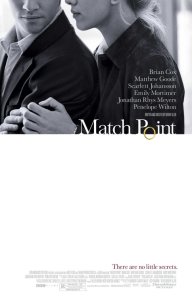 This is an excellent return to form for Woody Allen and his best film since 1987’s Crimes and Misdemeanors. The first half is deliberately slow, yes, but it is justified by the second half which more than makes up for it. The first half needed to be as slow as it is to set up the incredible minutia of this rich, elite world that former tennis pro Chris (Jonathon Rhys-Myers) has been adopted into. We need to see how comfortable this life is to understand why he doesn’t want to give it up and why he goes through the machinations he does in the second half. The characters and dialogue are spot-on and Allen has transported his world of the upper crust New York elite so well over to London, and the change of scenery has reawakened his writing. Allen knows the privileged world very well and their disconnected view point. However, he rightly centers his film not on the neurotic upper crust but on his social climbers Chris and Nola (Scarlett Johansson), a beauty engaged to Chris’ prospective brother-in-law. It is the second half of Match Point that makes it great. Allen tightens the screws on his social climbers and the tension is superbly taut. The dark turns and in the final act are greatly entertaining, as Allen delves further into his look at a universe built around chance and disorder. The returning imagery of the ball hitting the tennis net elicited gasps from my audience, and I was one of them. I love that Allen lets his story continue to unfold after the dark twists. The film’s biggest flaw is anchoring the entire point of view on Rhys-Myers, a somewhat limited actor that reminded me of Jude Law’s character in Closer. Johansson is an excellent noir femme fatale, her husky voice perfectly suited. Frankly, if ever there was a Scarlett Johansson nude scene, this movie was crying out for it. She has her tawdry affair with Chris and there’s even a sequence where we see her laying on her stomach nude while he applies baby oil to her. Their sex is supposed to be so impassioned and carnal, in contrast to his boring but stable relationship with Chloe (Emily Mortimer). And yet no nudity? Woody Allen, you’ve let me down. Your film, on the other hand, is intelligent, sharp, dark, taut, and wonderfully entertaining.
Nate’s Grade: A
Share this:

Freedomland (2006)
 There’s one thing I’m going to remember about Freedomland more than anything — seeing this movie cost me about $300. Allow me to explain. Upon returning home from seeing this terrible film, I received an e-mail from a friend alerting me that a secret code had been floating around the Internet. This code was to be used at Amazon.com, and when punched in at the check-out, your order would be free as long as it totaled over 80 dollars. Just as I was about to check out with over $300 of goods the window closed and the code was no longer working. If I had not seen Freedomland then I would have gotten this news earlier and would have been able to obtain my booty. Alas, I did see Freedomland, a drama that attempts to shed light on racial woes. Movie mogul Joe Roth, the head of Revolutions Studios, doesn’t direct movies fairly often and when he does they’re not great (America’s Sweethearts, Christmas with the Kranks). I knew exactly what I was getting into when I entered the theater; I just didn’t know it was going to cost me $300.
In 1999 New Jersey , Brenda (Julianne Moore) walked dazed and bloodies through an urban neighborhood to a hospital. She tells detective Lorenzo Council (Samuel L. Jackson) that she was the victim of a car jacking while she was traveling through an urban area. She says a black man threw her from her car and drove off. Brenda’s four-year-old son Cody is still in the car. This sets the neighboring communities abuzz. Brenda’s hot-headed cop brother (Ron Eldard) is ready to turn the black projects and high rises upside down, unafraid of whom he may harass. The black community is in an uproar over the treatment, succinctly pointing out that many black children go missing but the news vans and police cars only come out when the missing happens to be white (for further proof, look to the still ongoing coverage of Natalee Halloway). Karen (Edie Falco) runs a team of mothers who volunteer nationwide to help find missing children. Lorenzo has his own doubts about Brenda and the details of her story.
 Plain and simple, Freedomland just does not have enough story to justify its existence. It goes nowhere and practically drifts to its long-awaited conclusion. You’ll see the light at the end of the tunnel around the halfway mark, and then Freedomland limps to its foreseeable ending, devoid of any twists and turns that aren’t telegraphed a mile away. It got so pathetic that I was actually hoping, against all odds, there’d be some gonzo M. Night Shyamalan-esque twist at the very end to jar me out of my complacency. No such luck. The marketing folks of Freedomland seemed to advertise a twist ending, which is hard to believe since everything plays out exactly like you?d first suspect. Moore’s overacting hysteria makes the audience doubt her from the start; plus the fact that Brenda’s like, “Oh yeah, I almost forgot, my SON is in the hijacked car.”
This is a movie so mishandled by Roth that every moment feels false, and when it doesn’t feel false it feels trite and awkward. Take a moment when Lorenzo takes Brenda to an empty urban high-rise. He?s got her pinned in a corner, very literally, and is pressing to know if she killed her kid. The framing of the scene would almost suggest something quasi-romantic, with Lorenzo leaning very closely into Brenda and his arm against the wall beside her. At the very least, it?s really intrusive. And then at the end of Brenda’s “he was all I got” monologue the two actors seem to just stare at each other, like they’re mentally waiting to hear the word “Cut.” The weird framing and the editing make the scene feel amateurish.
But Roth doesn’t stop there. Freedomland itself is a gigantic mislead, and the old abandoned building has about five minutes of total screen time. It’s not enough to even qualify as a red herring, let alone justify it as a movie title. Apparently, this building has been rotting in the woods for decades, and yet Lorenzo lets a large volunteer search party just trounce around inside. I’m pretty sure any policeman worth their salt would need to get a team to make sure the building was structurally sound before letting civilians snoop around in a potential crime scene. That’s not enough stupidity. Later while the people are exploring the Freedomland building, Karen says the floorboards may give way at any moment, and then she leaves Brenda by herself with said unreliable floorboards. Do these people even understand what they’re doing?
Freedomland seems so message-hungry and preoccupied with making some Big Statement that it forgets to be entertaining. Roth is clueless how to juggle all his plot elements, letting the racial tensions turn both sides into offensive stereotypes. The white cops have short fuses and have no hesitation to assault innocent black people (they’d be suspended and then reviewed). The black community in Freedomland, while seeming to have nothing better to do than assemble and shout at the police, stir up their community ills whenever the plot deems it necessary. Some black people are seen setting the community’s own property on fire, swept up in the rising air of a riot. Rafik, a youth given a lot of foreshadowing, instigates the riot and an entire wall of angry black faces proceeds, never mind that this brash decision results in many innocent people being beaten. The movie seems to say that all blacks are victims or instigators. Freedomland is so earnest to be earnest that it misses the mark when it comes to all the details. How else to explain why the film is inexplicably set in 1999. Someone didn’t tell the film’s costume designer, because Rafik is wearing a “G-Unit” shirt, a rap group that didn’t come into light until after 50 Cent’s commercial rise in 2003.
 Perhaps the film’s ending is Roth?s biggest misfire. Lorenzo visits Cody?s shallow grave, now festooned with flowers and personal messages. He reads one that says, basically, “Cody’s death made us all look beyond our differences and realize what we have in common, the ability to feel sad.” What? Is Roth actually justifying the death of a child and subsequent racial fallout as being medicine for society’s ills? This seems ridiculous to me, especially after sitting through two hours of a movie where no one came together, unless you’re talking about the human connection of fist-to-face.
The acting in Freedomland is so unrestrained and shows another of Roth?s directorial weaknesses. Moore, always so reliable a performer, goes out of her mind and gives what should be the worst performance of her career. She’s so over the top, so Looney tunes, so wildly out of control with no bearing, she’s practically bouncing off the walls; it’s kind of embarrassing to watch. Her hysterical theatrics provide several moments of unintentional laughter, particularly a moment where Lorenzo is interrogating her and she just blurts out, “I love you.” Freedomland does her no service by handing her some dreadful dialogue and drawn out monologues. I think it may be time for Moore to star in something a little happier instead of more movies where she’s predominantly crying or grieving. And is it me, or does it seem like Moore has a habit of losing her kids in movies (maybe she should start tethering them to her waist)? Note to Julianne Moore: just because you get to cry and scream doesn’t mean you should take the role. Did you actually read the script to Freedomland?
Jackson, left directionless with an underdeveloped character, reverts to his standard operating procedure when it comes to authority figures … namely staring and yelling. Lorenzo has some character traits (asthma, a son in prison) that are either dropped or have no payoff or insight toward his character. He?s a cop in the middle of it all, and yet Freedomland feels like just having Jackson as an actor should cover the characterization part. At this point, Jackson can do these roles in his sleep.
Falco, far more subdued than everyone else in a very yell-heavy movie, leaves the biggest impression and gives the movie life when she’s onscreen. Falco’s character is what Freedomland should have been based around, not Moore’s shrieking loon of a mother. Falco has the film’s only great moment, effortlessly shifting a story about her own loss and need for closure back to Brenda. The patience and control Falco has in that scene only reminds me how much I need The Sopranos back on the air.
Freedomland is so starved to say something grandiose about racial tensions that it neglects being entertaining. When the movie is entertaining, it’s mainly because of the wild, embarrassing overacting and the nonsensical human behavior. At its worst, Freedomland is offensive to cops and blacks and moviegoers in general with working grey matter, at its best Freedomland is a muddled, incompetently directed movie that drifts unchallenged toward its expected and welcomed end. Roth should leave directing to people that have a better feel for taking control of actors, material, and editing. For those that said the racially-charged Crash lacked tact, I invite them to take a trip to Freedomland. It’s trite, it’s dull, it’s funny when it’s not meant to be, and it’s one of the worst films of 2006.
Nate’s Grade: D+
Share this:

Final Destination 3 (2006)
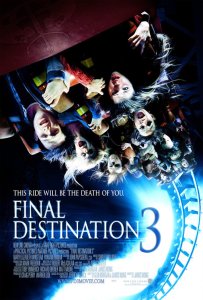 Isn’t the title Final Destination 3 itself problematic? How could it be final if it’s the third? It reminds me of 1998’s terrible I Still Know What You Did Last Summer, which wasn’t even correct with the film’s time setting (it must be stated that a 2006 sequel, and I’m not kidding, will be called I’ll Always Know What You Did Last Summer). Perhaps the best title comes from the worst movie of all time, Manos: The Hands of Fate, notoriously lampooned on Mystery Science Theater 3000. “Manos” is actually Spanish for “hands,” so the title is Hands: The Hands of Fate. Titles are fun. Oh yes. Final Destination 3, on the other hand, isn’t really fun.
A senior class is partying and enjoying the thrill rides of an amusement park. There’s an especially menacing looking roller coaster begging to be ridden by teenagers. There’s even a giant devil in front of the ride’s entrance. The ride fills up with your general high school characters (popular snots, Goth kids, cocky jocks, etc.) and then the safety bars become loose, flinging riders this way and that to splatter against broken rails and track. It’s all so horrifying … but it’s just a vision of Wendy (Mary Elizabeth Winstead). She goes into hysterics and gets off the coaster before it ships out. Other students follow her, including Kevin (Ryan Merriman), the boyfriend of Wendy’s best friend. Sure enough, the coaster crashes, those on it die, and death has been averted. For now. Just like previous installments, death seeks out the souls that escaped its cold clutches. Now death is taking out the survivors in the order they would have died and Wendy and Kevin must try and figure out a plan before it gets to them.
 Let’s not mince words, the true star of the Final Destination franchise is death itself. The appeal rests entirely on the fiendish, outlandishly complicated deaths and the misdirection over what will prove deadly. The audience is holding their breath for the next spectacular death. There’s a certain fatalism linked to this, knowing that the entertainment value is witnessing teens eventually get sliced and diced. But the franchise’s appeal also seems to be its downfall. The Final Destination films are stuck trying to out top themselves, and each film opens with a big centerpiece of disaster that inevitably serves as the film’s best moment. The rest of the movies never seem to match the opening melee, and it’s generally not a good idea for a movie to peek in the first reel.
Admirably, Final Destination 3 doesn’t even waste time with having its batch of characters theorize how to outfox the specter of death. We just watch, one after the other, the bloody, clever deaths like an assembly line of carnage. Final Destination 3 knows what its audience wants. Curiously, there’s no parental or police presence at all, even after the mounting coincidental deaths. Seriously, everywhere that Wendy and Kevin go, death is right beside them. Probably the funniest tidbit in Final Destination 3 is that shortly after another failed attempt to warn a doomed teen, Wendy and Kevin are in different, non-bloody clothes as they walk back to their car. They actually brought a change of clothes just in case. That’s hilarious. Little else seems amusing (the 9/11 reference is overwhelmingly tacky).
I once thought that the Final Destination concept could live forever in the annuls of horror, but the seams are definitely starting to show with this franchise. In 2000 it was fresh and unpredictable, and now it just seems exhausted and old hat. I thought the third film regaining the original writers and director would infuse Final Destination 3 with a bit more imagination. I was wrong. Glen Morgan and James Wong seem to go overboard to sate their blood-hungry audience, creating the most gruesome, torturous deaths yet. Seeing people eviscerated is one thing, but tantalizingly lingering on the sight of a busty teen being cooked alive, her skin boiling and exploding from the heat, is too much. It’s like this time death is really pissed, saying, “I gotta go through all this again!” The movie feels too mean-spirited, too vengeful, and a shade too cynical. I think the concept feels spent and even Morgan and Wong realize this, which is why they ratchet up the gore because the suspense is gone. The “gotcha” ending was pitch-perfect in the first Final Destination, but now it’s just another expectation feebly met.
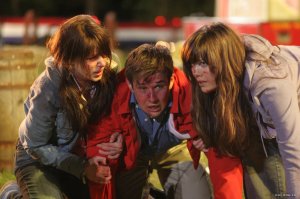 Of course, all the characters (with the possible exception of Kevin) are nitwits, horn dogs, jerks, and just plain unlikable, which make rooting for their demise easier. There’s no subtlety here either. The two shallow, popular girls are incredibly shallow and ridiculously stupid. The idiot pervert has a one-track mind that never takes a break. They’re all stock, they’re all one-note, and there’s even a moment where the token black character says, “That’s what I’m talkin’ about!” No wonder death is the star. At least in the previous Final Destination flicks you felt like the kids deserved a fighting chance.
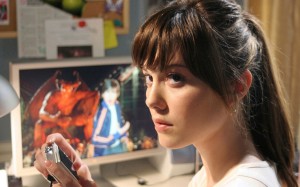
There is one neat addition to the formula. On the night of the accident, Wendy took several pictures and each photograph predicts that person’s demise. This allows the audience to try to decode the clues they’re given and correctly guess the next horrific death. It’s the most fun aspect of the franchise.
Final Destination 3 knows exactly what its audience wants, which is more of the same preposterously complicated deaths. The concept once felt fresh but now it seems worn out. I doubt new blood could revive this franchise because audience expectation has become too demanding. We already know the rules and know the characters can’t really escape death, so the only lasting suspense is what will kill them, and even that is fleeting. The return of creators Glen Morgan and James Wong still can’t infuse the right touches of imagination. It’s more grisly teenage carnage, nothing more, nothing less, nothing special anymore. Fans of the previous Final Destination flicks will likely find some entertainment, but the movie feels creatively spent. It’s probably time for this sadistic peep show to bow out before things get even uglier.
Nate’s Grade: C
Share this:

Firewall (2006)
 I’ve seen commercials for Firewall, a new techno-thriller, attached to various TV programs. What’s peculiar is that the commercials are all centered on what Harrison Ford’s character drives in the film. The announcer even says, “See the new Chrysler in … Firewall.” The weird part is that I’ve seen more commercials pimping the movie’s car than the movie itself, like the film is an afterthought to the product placement. With such an inconsistent, stupid, cookie-cutter Hollywood thriller that Firewall is, I’d expect nothing less.
Jack Stanfield (Ford) is a bank security expert living in Seattle. He’s got a loving wife Beth (Virginia Madsen), a teenage daughter and young son, and his bank is about to merge with a larger conglomerate. Before it does, though, Jack takes a meeting with Bill Cox (Paul Bettany) who has a very important business proposition. Jack will waltz into the bank he’s been working at for 20 years and wire $100 million dollars to Cox’s offshore bank account. If Jack fails, the men currently holding his family hostage in Jack’s home will kill them. To secure their safety, Jack must work different sides, infiltrating his own bank and breaking his own system, all the while trying not to get caught and trying to save his family.
The film is so cookie-cutter and filled with obvious and/or useless plot details. In the opening minutes we’re introduced to a remote controlled car that disrupts video frequencies. Of course we know this will come into play later. The opening minutes of Firewall set up all the film’s subplots that will be tidily tied up but only after being ignored. So little of this film feels fleshed out. Firewall seems to think that just having its villain be British is enough. Beth is an architect and designed the family home they’re now held hostage in. Surely this plot point will have greater significance than a toy car. Nope, nothing ever happens as a result of this extraneous detail.
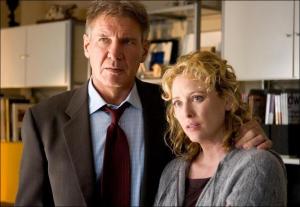 Ford looks so bored and he does little to hide it. Once again he’s that reticent hero called into action in the name of his family. He really isn’t given much to do and his action sequences are short bursts that involve a lot of him falling down, even when he’s besting a bad guy. A perfect example of how bad the writing is, and how lame they’ve made Ford’s character, is an exchange between Jack and Henry (Robert Patrick) shortly after Ford has liquidated his company of millions. Henry confronts him and says, “You’re not going anywhere. You’re staying here!” And Jack says, like a whiny kid told to eat his vegetables, “No I’mmmm NOT!” Firewall, this is your hero.
The antagonists are another example of how poorly written Firewall is. The villains are incredibly inept on all levels. Their entire plan is kaput from minute one because they didn’t bother to check that the bank was merging and changing its security access panels. Bill basically points to Jack and says, “You come up with a plan now.” The villains need the hero to come up with their scheme, how rich. The bad guys come across like they just took night classes in How to Take Hostages and Extort Money 101. Somewhere Bill must have skipped a few classes because he makes some boneheaded decisions. He kills one of his own men for getting tricked by Jack during surveillance. I suppose he?s trying to make an example but why, if you’re holding people hostage, would you decrease your numbers from five to four? Now you have one less person to get things in line. Bill also must have missed a psychological review to screen out that old Hollywood favorite, the one reluctant kidnapper who’s nice. Did Bill put this thing together through an ad in a newspaper?
Then there’s the dog. Why on earth did the bad guys take the dog with them when they moved the family? It just so happens that the dog has a GPS tracking device on its collar. It’s a plot contrivance so Jack can find his family, but it makes no sense. These big bad men will kill one of their own but take the dog along too? Bill and the gang didn’t have to kill the dog but taking him doesn’t add up. It’s like a serial killer alphabetizing your CD collection.
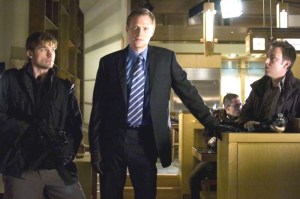 The whole hostage situation is laughable. Bill’s thugs turn a hostage situation into a bed and breakfast, implausibly letting the family roam around the house, watch TV, do whatever really. Bill even makes pancakes for Jack’s kids, that bastard. The most threatening Bill ever gets is when he offers a peanut butter cookie to Jack’s peanut-allergy kid. Dastardly and, oh yeah, the kid didn’t have to choose to eat what the bad guy gave him! This is the worst hostage siege ever. It is insultingly ridiculous. Madsen is annoying as she tries shaming her captors, proclaiming motherly advice. Firewall‘s chances of thrills are spoiled by inept bad guys and the family being in laughably staged peril.
The heist itself is given such lip-service that it almost becomes incidental. It plays for a total of maybe five minutes onscreen and lacks any thrills. Why should there be thrills if Jack came up with it? There no reversals, no setbacks, no complications, no nothing. Firewall needed to be run through a typewriter a few more times, work out a punchier screenplay that actually turns the heist into something tense.
Firewall should have played more like a cat and mouse game, with Jack and Bill battling for supremacy. Instead, Firewall feels emblematic of every other stupidly plotted thriller Hollywood feels it can feed to a mass audience because it slaps a star in it. This is shamefully mediocre, stupid, and, above all else, rather boring. Firewall is your typical disposable Hollywood thriller-of-the-week, just with more tech jargon that Ford looks pained to even speak. If you replaced Ford and Bettany with, say Mark-Paul Gosselaar and Corbin Bernsen, you’d have a movie fit to air late night on TV when the only people awake would be insomniacs. Finally, then, Firewall would have found its rightful audience.
Nate’s Grade: C-
Share this:

Crash (2005)
 A searing look at race relations and a powerful human drama at that. This flick has some of the sharpest memories I’ve had from any movie all year, particularly the relationship between a Hispanic locksmith (Michael Pena) and his daughter and a special invisible cloak. Their first scene, where he talks her out of hiding under her bed, is one of the most beautifully written short scenes I have ever witnessed. A late scene involving the two of them knocked the wind out of me completely and is the most vivid moviegoing moment of all 2005 for me. Every character has at least one great moment, though time is not spaced equally amongst this large ensemble. Crash has the intriguing practice of introducing near every character spouting some kind of racist diatribe, and then the movie spend the rest of its running time opening you up to these characters and getting to like them. Writer/director Paul Haggis has such a natural ear for terse, realistic dialogue that can really define characters with such brevity. A fine movie, despite the overarching coincidences.
Nate’s Grade: B+


 nathanzoebl
You must be logged in to post a comment.