Blog Archives
Annabelle (2014)
 The Conjuring was one of the breakout hits of 2013, so it’s no surprise that Hollywood fast-tracked a spin-off to take advantage of Conjurin’ fever. Enter John R. Leonetti, the accomplished cinematographer on The Conjuring and director of bad sequels like Butterfly Effect 2 and Mortal Kombat: Annihilation. Now in the spotlight, little Annabelle is proving to be a star of her own as far as box-office grosses are concerned. It’s too bad her new movie is about as lifeless as she is.
In the late 1960s, Mia (Annabelle Wallis) is pregnant with her first child when murderous cultists terrorize her home. They are dispatched but not before one young woman slices her own throat holding one of Mia’s expensive porcelain dolls, the Annabelle one. Her husband (Ward Horton, who looks like a living Ken doll) is afraid to leave her alone and reaches out to the church to help his wife. Strange things are going on in their home, mostly concerning the infamous Annabelle doll.
 The impact of Annabelle will depend directly upon your good will concerning The Conjuring and what your law of diminishing returns is with a creepy doll. To be abundantly clear, the Annabelle doll is one creepy looking thing. But how much can an audience take of a creepy looking doll that doesn’t have any articulation or expression? The character, and it feels like a stretch to label the doll as such, worked effectively as a prologue to The Conjuring due to the relative brief appearance. The doll was creepy enough for ten minutes and then the audience moved on. Now in a starring vehicle all to herself, Annabelle risks overexposure and the realization of just how limited this little demonic figure might be. A killer doll that comes to life is a genuinely unsettling proposition, one richly explored in a classic Twilight Zone episode that’s still spooky to this day. However, Annabelle doesn’t really do anything, and I suppose that’s the point. The doll is a conduit for the larger, invisible demonic force at play. We already know that it’s not the doll or a ghost but a demon posing as such. Ultimately, the doll isn’t anything more than a device to go back to again and again, a horror staple in place of true unnerving tension and dread. Hey, it’s hard to carefully manufacture and ratchet suspense, so why not just keep going back to a creepy looking doll instead?
With a lackluster antagonist, it’s no surprise then that Annabelle has to rely on all the hoary tropes of horror just to fill out its running time. The plot by writer Gary Dauberman plays out like the filmmakers watched Rosemary’s Baby, a documentary special on Sharon Tate, and said, “That’s it, we got out movie.” The Manson family-like cult is a plot element cast aside too quickly. They bring the demon to the doll, but the followers of this demonic presence never terrorize the couple again. It seems like one of many missed opportunities. Instead we get a slow series of events of the doll/demon messing around with Mia. There’s the kindly older priest that’s called into service, who does nothing. There’s a helpful neighbor mourning the loss of her own child who ends up an insulting plot device (more on this later with spoilers). And oh are there characters behaving stupidly, chief among them our heroine. She’s rather slow to realize the danger she is in and often leaves her baby alone to investigate said supernatural shenanigans. You know, the baby that is the object of desire for this demonic force. Rather than be proactive and have any sense of agency, Mia is that older type of horror heroine who runs around screaming and cowering in corners. It gets tired. There’s one scene where she’s trying to escape via an elevator that keeps opening on the same haunted floor. She literally hits the elevator button four times each time expecting something different, and the camera angle remains the same, leading to titters from my audience.
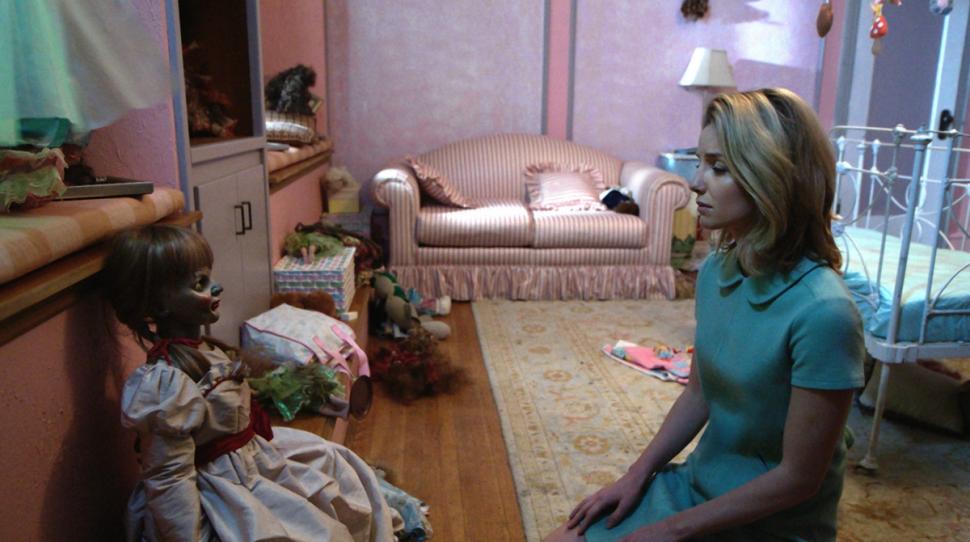 While The Conjuring certainly wasn’t a brave new direction in the realm of cinematic horror, it was skillfully executed and masterfully setup its scares. Annabelle does have a few decent boo moments, many of which were showcased in the trailer, but it cannot overcome the burden of all its clichés and wooden characters. Audiences are used to characters making poor decisions in horror films, but you still should have some level of believability or internal logic to their decision-making that doesn’t make your brain hurt. Sadly, Annabelle cannot rise above the limitations of its titular “monster” and so it has to rely upon an assemblage of familiar horror tropes to make due.
This paragraph is going into spoilers concerning the ending so I’d advise any reader wishing to remain pure to skip to the next paragraph. The great actress Alfre Woodard plays that grieving neighbor lady, the one who is joyously buying Mia baby clothes for her little one. During a climactic confrontation, Mia demands to know what the demon entity wants. It communicates via crayon scrawls on the ceiling: “Her soul.” One of the film’s creepier moments. Then the baby disappears and she wants to know what it will take to save her child. Mia looks to a window and written on it is, “Your soul,” just as it gently pushes itself open. Again, a creepy moment. I was starting to get the impression the film was picking up momentum. She’s about to sacrifice herself when she’s pulled back inside. This is where the film goes from bad to insultingly bad. I kept repeating under my breath, “Don’t do it, don’t do it,” and wouldn’t you know, they did it. Woodard realizes her purpose: she must sacrifice herself so this nice white couple will be safe. She dives out the window and evil is vanquished… sort of. It’s a stupid character arc made all the more unpleasant by the racial casting choices. I’d rather Woodard just save herself.
This small prequel has proven to be a smash at the box-office, so where does Annabelle go from here? Another prequel seems unlikely considering the events of this movie cover the birth of the demonic doll and lead directly to the prologue of The Conjuring, where this spunky little doll met her match with the married paranormal investigators played by Vera Farmiga and Patrick Wilson. The real Annabelle is encased in a glass prison. The only direction seems to be forward, with Annabelle breaking free of her prison and having a night on the town. Maybe she can locate Chucky and that Twilight Zone doll. I just hope future adventures with Annabelle, and its box-office grosses almost assure there will be, veer away from the overload of uninspired genre clichés. There’s not enough effort on display to warrant this solo side project for a creepy doll that mostly just remains creepy. Annabelle the film could have used less of Annabelle the doll. Then again an unblinking and silent doll was still the most interesting character on screen.
Nate’s Grade: C-
Share this:

The Equalizer (2014)
 If your idea of a fine time at the movies is watching Denzel Washington be a badass and murder people in grisly fashion for two hours, then The Equalizer is right up your alley. There’s not much to the plot of this loose remake of the 1980s TV show of the same name; Denzel plays a man with a mysterious past who works at a large Home Depot-esque hardware store. He sees injustice transpiring against his pals, and he fixes it in a violent fashion. The movie is two storylines that don’t converge until the final act, namely the Russian crime syndicate trying to ascertain who this vengeful badass just might be, and Denzel doing his episodic vigilante good deeds. The climactic act is a drawn out showdown where Denzel uses every part of the hardware store to deadly results. There’s definitely a pleasure in watching Denzel dispatch tough-talking baddies, and that’s what the film delivers, no more, no less. The confrontations are generally well written and ratchet tension nicely, especially when Denzel has some chilly conversations with his soon-to-be-victims before they inevitably make their bad decisions. The tense sit-downs were more entertaining for me than the bloody violence. Director Antoine Fuqua (Training Day, Olympus Has Fallen) goes about his business in a more than competent manner; the technical qualities are above average, though the film has moments where it seems too infatuated with its slick sense of style (slow-mo rain gun battles?). With a stream of bad guys to be toppled at a steady interval, The Equalizer can start to feel like an assembly line of cocksure carnage, a ready-made vehicle for audience blood lust. Still, watching Denzel be a badass and kill a whole lot of bad people is enough for a movie. Just don’t expect much more than that scenario and you may be satisfied if you’re not too squeamish when it comes to bloodshed.
Nate’s Grade: B
Share this:

Gone Girl (2014)
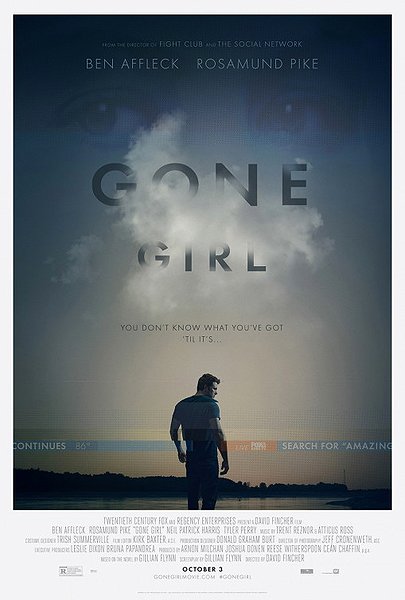 Rest easy fans of Gillian Flynn’s runaway bestseller, because Gone Girl the movie is pretty much exactly Gone Girl the novel. There were rumors that Flynn and director David Fincher had drastically retooled the controversial ending, but this was only premature speculation. Fun fact: it’s easy to tell the people who didn’t read the book in your audience because they will more than likely be the ones who groan once the end credits kick in. The fealty to the book is a relief because, as we book readers know from those late nights compulsively turning Flynn’s pages, the real star of the movie is the story, which was ready-made for a grand, pulpy thriller, and that is Gone Girl the movie. Whether it’s anything more than an exceptionally well made thriller is up for debate
Amy Dunne (Rosamund Pike) has gone missing from her supposedly perfect life. Her husband, Nick Dunne (Ben Affleck), starts off as the tortured, grieving husband. He comes home one day to find his home wrecked and his wife missing. The police (Kim Dickens, Patrick Fugit) are worrisome about Nick’s abnormal reaction to his wife’s disappearance. He doesn’t seem to know much about his wife. He seems like he’s hiding something. Even Nick’s twin sister Margo (Carrie Coon) has her doubts that Nick is telling the full truth. Amy’s diary paints a different portrait of her husband, a man prone to increasing anger, mostly stemming from the loss of his job and a relocation from New York City to Missouri. Most of Nick’s anger is focused squarely on Amy, enough that she fears for her life. As various clues keep piling up and Nick’s public behavior appears suspicious, the media spotlight transforms him from victim to prime suspect.
 No question having an artist of Fincher’s caliber raises the quality level to its highest degree, but it’s the perfect marriage of filmmaker and material that allows this movie to soar. Both Fincher and Flynn have a cold manipulative streak that twists an audience into knots. It’s a terrific whodunit with several booby-trapped surprises that only make you dig in more. It seems like every few minutes we’re learning more about Nick and what he’s been hiding from others. Flynn, who also adapted the screenplay, does a terrific job of playing with our loyalties, getting us to doubt what we see and who these people really are, and she does this even to the final minute, leaving us with no clear-cut answers to wash away our reservations. Flynn’s strengths as a writer are how she reveals her tale over time, how she makes us rethink the past and the characters and their sincerity. It’s a patient film, and just under two and a half hours perhaps too patient, but it’s not the least bit lackadaisical. Flynn’s story is wrapping a web around Nick and watching him get caught, and every perfectly timed reveal only widens that web. Gone Girl is a film bursting with intrigue. It snares you and then fiendishly plays with your expectations.
Affleck (Argo) was an obvious choice for the role of Nick Dunne, the charming man whose self-effacing smile rubs people the wrong way. He’s rarely been better onscreen, giving strong life to all the conflicting parts of Nick, from his calm aloofness at his wife’s disappearance to his cunning way with his own truths. He gets way in over his head, and watching Affleck navigate the tenuous situation is one of the film’s many twisted pleasures. Pike (The World’s End, Pride and Prejudice) is going to be an unfamiliar face to most American audiences but not for much longer. This is the biggest role of Pike’s career and much like Fincher’s other “find” Rooney Mara in Dragon Tattoo, she knocks it out of the park. In just a look she conveys Amy’s upper-class upbringing, her icy demeanor being interpreted as disdain. Through Amy’s journals, the character opens up to us, becoming better defined, making us fear for her, and Pike sells it. Hers is a performance of layers; it’s like she gets to play several Amy’s in this movie. Her demeanor is always so composed, so modulated and controlled, so the big moments that draw out her anger and horror register even more. It’s too early to determine what kind of awards buzz Gone Girl will have through the season, but if anyone has a chance, it’s her.
From top to bottom, the supporting cast adds great value to the film. Most surprising is Tyler Perry (yes, that Tyler Perry) as Nick’s high profile, slick, morally flexible defense attorney. It is no stretch to say this is Perry’s finest acting ever put to film, in or outside a dress. I wanted more of him, and that’s not something I’ve ever said before. Dickens (TV’s Treme, Footloose) would ordinarily be the best performance in most movies; smart, empathetic but no-nonsense, and wryly funny. In an ordinary crime thriller, she’d be our lead character. Coon (the breakout actress from HBO’s The Leftovers) is the audience’s voice of sanity, providing necessary gallows humor to punctuate all the discomforting dread. Casey Wilson (TV’s Marry Me) is a suburban housewife send-up and provides some laughs too. Even Emily Ratajkowski, otherwise known as one of the topless models in the “Blurred Lines” video, is pretty good as a naive coed. Thus is the power Fincher wields as a director of actors, a quality often overlooked by his technical prowess. The one casting question is Neill Patrick Harris (TV’s How I Met Your Mother) as Desi, Amy’s creepy ex-boyfriend who still very much clings to the notion they should be together. Harris tries too hard to be creepy, concentrating too much that his style becomes mannered and halting.
 With Fincher’s name attached it’s almost redundant to talk about the technical superlatives of the movie; it goes without saying. One of the finest visual stylists of his generation, Fincher impeccably composes his shots. The man finds a kindred spirit with Amy and her color-coded meticulous organization. The cinematography is crisp and suitably eerie and dreamlike (or nightmarish), the mood always pulsating with a beautiful dread to tap into the unsettling unease of Nick’s dire situation. The editing is rock-solid, keeping the audience guessing with the balance of Amy and Nick perspectives. There is a chilling sequence late that involves a mass amount of blood, but it’s made even more unnerving thanks to the judicious edits and fade outs, heightening the horror. The only technical aspect I found wanting is the same with Fincher’s Dragon Tattoo, namely the score by Atticus Ross and Trent Reznor. Twice now I’ve labored through musical scores of theirs that could best be described as ominous ambient noise. You keep expecting it to build but it doesn’t. Perhaps it’s just the change of material, as it’s also been two films in a row based upon dark and grisly crime paperbacks, but consider me disappointed yet again. There’s nothing memorable here and that’s a shame considering how buoyant their Oscar-winning score was for the still amazing Social Network.
But even with that Fincher polish and the sinister snap of Flynn’s plot, I can’t say that Gone Girl the movie rises to the level of its lofty ambitions. Much like Dragon Tattoo, this is a skillfully made crime thriller, but is it anything beyond that description? That’s not to say there’s anything particularly wrong with being a skillfully made thriller; Fincher’s Seven is one of my favorite films of all time, and yet despite its end-of-times philosophy about the dark hearts of man, it’s really nothing more than a exceptionally made thriller, and that’s fine because that movie is near perfect. With Gone Girl, the stabs at deeper analysis and social commentary feel just out of grasp. The tabloid news fixation, a landscape littered with missing wives and presumably guilty husbands, is ripe for satire, but it feels always on the peripheral, like Fincher is checking in to take the temperature and then going back to the muck. There’s much more that could have been done, but that’s fine. The larger missed commentary is with marital relationships. This is not, as some critics have labeled, a How We Live Now kind of film, a jarring wake-up call that human beings more or less suck. Nick and Amy are far from being relatable analogues for the masses, and that’s fine. They are allowed to just be interesting characters, which they are, rather than stand-ins for searing social commentary. The fact that five years into their marriage they’re both still strangers says something about them, but does it say something novel about marriage itself or human relationships in the twenty-first century? The idea of people wearing false masks isn’t exactly new. The average couple is not probably going to go to bed thinking, “Who is the real person I’m with?” The average couple is just going to go along for the ride and think, “Wow, these are some messed up characters.”
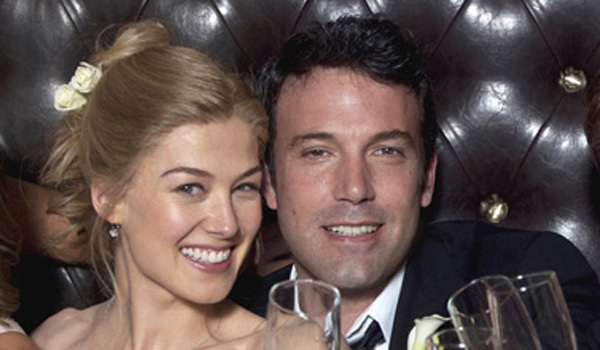 And now some spoilers as I delve into Gone Girl’s ending, so if you choose to remain clean please skip to the next paragraph. The ending is unsettling and disappointing for people because the only person who gets what she wants is our main antagonist, Amy. The final shot, a replay of the opening image but with clarifying context, is her triumph, staring coldly, head atop her husband, as if she were a cat purring. She has won. And this ending pisses people off. For my money, this is the absolute perfect ending for a story about toxic relationships and a morass of a marriage. Nick is rescued by Amy’s reappearance, engineered through some canny media manipulation by Nick, but now he’s stuck, and stuck with his lovely psychopathic wife. The police know she’s guilty but won’t proceed further thanks to looking inept on a national stage. Nick can’t leave because then his child will be raised by Amy, twisting him or her into mommy’s little psychopath. The only way he saves that child is by staying, by sacrificing his own freedom, to become prisoner to his wife, to play the part she has wanted him to play, and he does it. He is condemned. I find that to be poetic and darkly satisfying, and it’s very true tonally for this sort of sordid tale, but I understand why people hate it. I just think a happy ending or one where the villain is vanquished would feel trite.
Gone Girl is a toxic relationship movie, an involving and pulpy suspense thriller, a rewarding character study that plumbs some pretty dark depths, and most of all a sickly entertaining movie with excellent craftsmanship. It is everything fans of the novel could have hoped for with Fincher attached. As our tormented husband and wife, Affleck and Pike deliver career-best and career-making, in her case, performances. The ending will divide audiences sharply just as it did readers but I consider it the correct denouement. The movie doesn’t provide much in the way of stinging, applicable social commentary or media satire that hasn’t already been covered by the likes of Jon Stewart and Stephen Colbert. But does it have to be anything more than a terrific thriller? An exceptional thriller can be entertainment enough, and Gone Girl is definitely that.
Nate’s Grade: A-
Share this:

A Walk Among the Tombstones (2014)
 Scott Frank has only directed one movie, The Lookout, but as a screenwriter his fingerprints are everywhere in Hollywood. The man’s name is all over projects such as Out of Sight, Minority Report, Get Shorty, The Wolverine, Marley & Me, and those are just the ones that made it across the finish line. As any aspiring screenwriter knows, Hollywood is built upon an ever-amassing burial ground of unproduced screenplays. A Walk Among the Tombstones is only his second directing feature, which tells me it must have had significant personal value for this famous scribe. You can definitely tell Frank has an affinity for hard-boiled film noir of old, though the splashes of in-your-face sadism may be too much for certain audiences. It’s a genre movie all right, but it’s also a grisly one that bothers to take its time setting up character, plot, and resolution.
It’s New York City on the cusp of Y2K, and retired cop Matt Scudder (Liam Neeson) is just trying to enjoy his dinner. He’s pulled into a complex kidnapping scenario at the behest of one of his AA peers. Two men have been targeting the city’s drug traffickers, men with big pockets who cannot go to the police. These psychopaths enjoy abducting the trafficker’s wives, ransoming them for hundreds of thousands, and then slicing and dicing their victims anyway. Matt initially turns down the offer, working around the edges f the law, but the viciousness is too much to ignore. He reawakens his old detective habbits, falling back into a routine, and tracking down those responsible.
 Those expecting a regular Liam Neeson afternoon of top-draw face punching may be in for a slight disappointment, because A Walk Among the Tombstones is a gritty detective tale that swims amidst an ocean of moral decay and queasy sexual violence. It’s a detective yarn that unwinds at a casual pace but one that feels like a natural connecting of plot points. Thankfully, this isn’t a movie that treats the identity of the killers as a mystery that needs to be dragged out as long as possible, with the ultimate pained reveal being one of the otherwise harmless characters we’ve previously been introduced. We know who these two psychopaths are after about twenty minutes, so there’s no prolonged guessing game. Rather than linger on who they are we now await the ultimate satisfaction of Matt Scuder finally facing off against our two psychopathic killers, and they are indeed psychopaths. These two are very wicked men, gathering sadistic pleasure from torturing their captive women. The two men are kept as unsettling ciphers; we don’t know much about them except they have an addiction to killing. It’s not about the hundreds of thousands they scam from the drug traffickers; it’s really about the thrill of the hunt. While I wish there was more depth, they were menacing enough. I was itchy with anticipation for them to get some comeuppance. I’ve read reviews indicating that our two remorseless killers are a gay couple; if this is true it’s kept very vague for interpretation. In the age of equality, it could be homophobic to declare, in absolutes, that psychopathic killers couldn’t also be gay or lesbian. That would be… wrong?
With two strong villains, you need a strong hero to bring them down, and Neeson fits the part like a natural. To be fair, the role is somewhat stock from a passing description: the loner former cop with the tragic past, a drinking problem, the gruff style, the over-the-hill age, the man trying to adapt to a new and changing world, sometimes not for the better. It’s a role that feels ripped from the tropes of crime thrillers, a world we’ve also become accustomed to seeing Neeson. The detective role is familiar but, like most within Frank’s film, it’s given more time to breath and a surprising degree of attention. This doesn’t come close to last year’s Prisoners in the realm of character work, but it’s still an above-average entry for a genre too often ignored when it comes to realistic and satisfying characterization. Matt Scudder exists in a New York City that owes a debt to the pulpy noir page-turners of old, but it’s not exactly stylized, and neither is he. The man still uses microfilm and needs the assistance of a street-smart homeless teenager to assist him with this newfangled Internet thing. While it feels somewhat forced, the relationship with Matt Scuder and his young protégée is the strongest in the film, opening up the character’s redemptive arc. It’s always appreciated to watch Neeson get to flex his acting muscles rather than just being given action choreography and trite tough guy bravado.
There’s one other actor I’d like to single out, and I’ll thank my mother for this. Fans of Downton Abbey (like dear old mom) may recall Dan Stevens as the dashing and departed Matt Crawley, but he is almost unrecognizable as the grieving husband/drug trafficker that kicks off our story. For one, the guy lost a decent amount of weight and his gaunt face makes him seem all the more mercurial and intense. The characters plays against type with our expectations for a drug dealer, and you may find yourself, like I did, warming to him and yearning for the man’s vengeance for his wife.
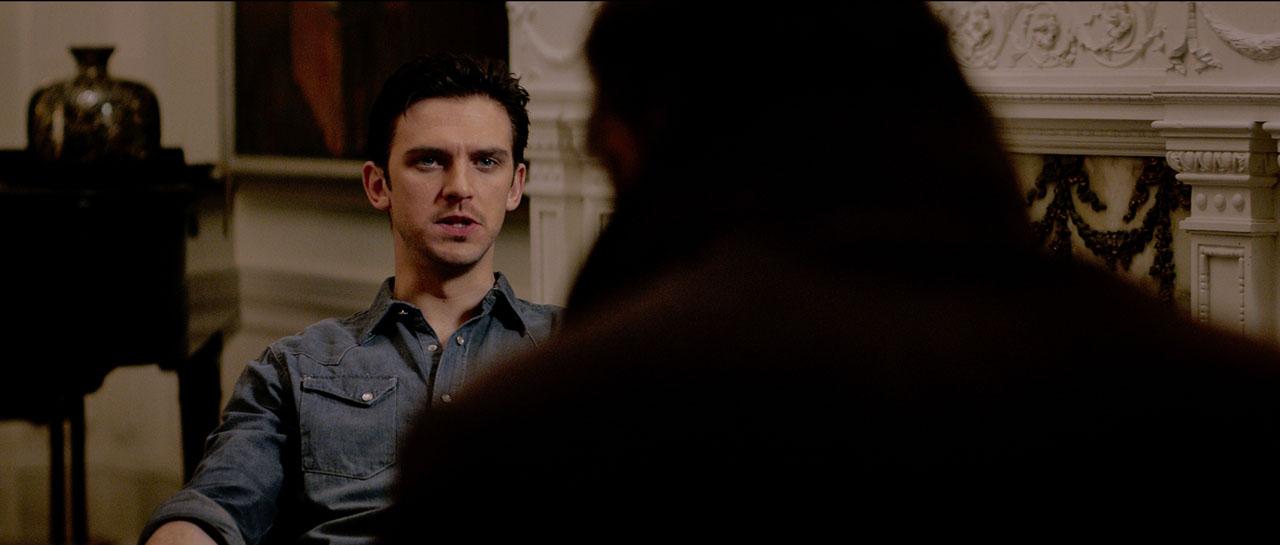 Frank’s direction is awash in the grime and seediness of New York City, with dark shadows washing over his troubled characters, and a sense of style that, while omnipresent in tone, doesn’t distract from the story. The rich cinematography by Mihai Malaimare Jr. (The Master, Tetro) is a great asset. The film noir elements are here in abundance and with due diligence. It rains in just about every scene. Why? All the better for a moody and eerier atmosphere, though the rain does actually factor into a character-based conflict for Matt’s protégée. It’s a moody thriller that is assuredly above average for its genre. Not everything quite works (the third act is too drawn out; a montage of AA 12 steps narration over sequences of violence is more than a little heavy-handed; the explicit Y2K setting doesn’t really have a purpose other than to limit certain technological advances not becoming of the genre) but Frank knows how to draw out the strengths of the genre.
A Walk Among the Tombstones is a gritty genre throwback, but what really jumped out to me was the hook of the premise. Neeson plays a man on the outer edges of the law but a man who still bends toward the justice system he once worked for. What makes this character unique, or at least the promise of, is that he ends up becoming the private detective for the criminal world, and that I find to be fascinating. We think of criminals, especially drug traffickers, are tough men who can handle their own problems with extreme authority. But they are also just people and can get in over their head as well, and when they need someone with private eye skills, who knows how to operate inside the bounds of the law and out of them, that’s where Neeson comes in. He does such a good job that he gets recommended around the New York ring of drug traffickers. He’s like a Michael Clayton-style fix-it guy but for the criminal underworld, and I think this concept it rife with juicy potential. Tombstones is based upon a series of books by Lawrence Block, so there could be further adventures, and I would welcome them, especially if the finished product is as entertaining as this first foray.
Nate’s Grade: B
Share this:

No Good Deed (2014)
 Truthfully, I likely never would have seen No Good Deed in the theater if it weren’t for two events. It’s not that it looked especially heinous, just ordinary and not worth rushing out to see. The first event was my father’s newfound love of Idris Elba (Pacific Rim, Mandela) as an actor, an appreciation I too share for the charismatic leading man. The other event is a tad uncommon. Being part of a critics group, I regularly get e-mails from publicists about upcoming screenings. At the last minute, I received an e-mail informing me that an advanced screening was canceled, but what piqued my curiosity was the stated reason: there was a late twist/reveal that the studio did not want getting out. Really? What appeared on the surface like an ordinary home invasion thriller suddenly became a tad more intriguing, tempting my mind with possibilities. And so, with all of this achieved, I watched No Good Deed waiting to be surprised. My lack of surprise was the only real surprise, because just as I believed, this is your standard home invasion thriller that wastes the talents and time of just about everyone on screen.
Colin Evans (Elba) is a very bad man serving a five-year prison sentence for assault, though it’s believed he’s responsible for several missing women and former girlfriends. During his parole hearing he escapes and heads to his ex-girlfriend’s (Kate del Castillo) home. Colin doesn’t appreciate that she’s moved on to another man, and so he strangles her to death. He then leaves and drives off the road, an accident as the result of a powerful thunderstorm rolling through Atlanta. He comes to the door of Terri (Taraji P. Henson), a mother and wife whose husband is away. He asks to use her phone and then take shelter from the storm. She lets him inside. Big mistake.
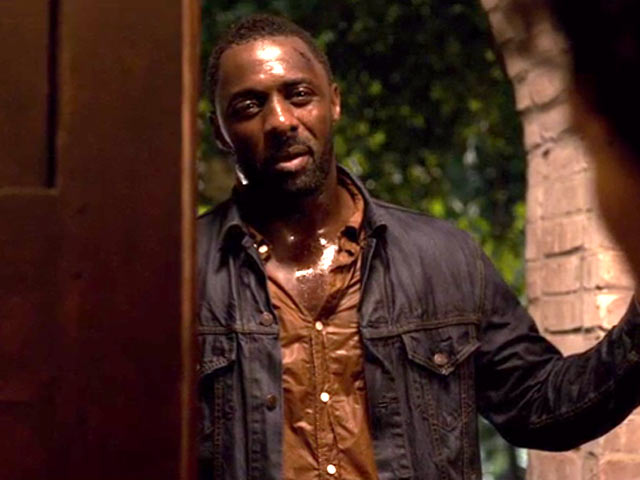 Doggedly formulaic, there is nothing about this story that separates it from the rest of the tired, dim-witted thrillers that prey upon fears of home invaders. If you removed the high-wattage stars from the film it would be completely at home on the quality-starved Lifetime Network, another poorly made suspense thriller about a bad man stalking a woman with subtle allusions to punishment for viewing the man as a sensual, dangerous opportunity. I was able to accurately guess every step of this story and I imagine you will have no problem with it as well (more on that “twist” later). How come there are no news stories about an escaped and violent convict? Colin severs the phone cords… but does nobody have cell phones in the neighborhood? In the opening credits, both Elba and Henson are listed as executive producers, which means that they attached themselves to this project because they wanted it to get made. They used their collective power to ensure this story would leap ahead of the thousands of other notable and compelling scripts in Hollywood (ahem). And the big question is why? I suppose there may be some fun from an acting standpoint to play such stock thriller roles as brooding boogeyman and bewildered ingénue. Except there’s nothing to these one-note characters. The screenplay does the minimal amount of effort to establish them as victim and victimizer, but you’ll never care about them or find them slightly interesting. Terri keeps making dumb decision after dumb decision; when you bash the bad guy in the head, you don’t stop after one blow. She’s a former prosecutor who worked in the homicide division, and yet she seems absentminded when interacting with mysterious strangers that appear in the dead of night at her doorstep. She’s lacking all street smarts. There’s nothing that sets apart Colin either (that name is a non-starter as far as striking fear). For a supposedly charismatic and brilliant narcissist, he doesn’t do anything that smart.
I’ll highlight the small handful of moments that stood out to me, which will include the ending and that presaged “twist.” Henson is 44 years old and a very good-looking woman, though it’s a tad odd when the movie contorts to place her in a T&A scenario. Colin, covered in fire hydrant discharge, insists she get in the shower with him so he can get clean. For the remainder of the sequence, the terrified Henson is shaking in her white tank top, her body alerting us to her cold. When was the last time a woman six years away from 50 was purposely squeezed into a moment of gratuitous titillation, let alone a non-white actress? Another part about Terri is that she’s a mother, a fact that Colin routinely relies upon with veiled threats of harm to her little ones. The funny part about all of this is when she has to sneak around the house that Terri has to grab her 4-year-old with one arm and the baby carriage with another, creating an awkwardly comical image. And it happens again and again. She sets the kids down, then goes back to carry them out, and then repeats. It made me laugh every time because it’s just so unwieldy. Another example of the botched screenwriting: Terri has a baby and at no point in the film does the conflict of keeping the baby quiet surface. She has to quiet the child or else Colin will find them. It’s a natural setup with such a young baby. Instead the baby is completely silent for the entire movie, peacefully sleeping though lots of physical activity, screaming, gunshots, a thunderstorm, and tree branches smashing through windows. This baby is unreal. How could this never be utilized? Again, more wasted potential, whatever slight potential there was to start with.
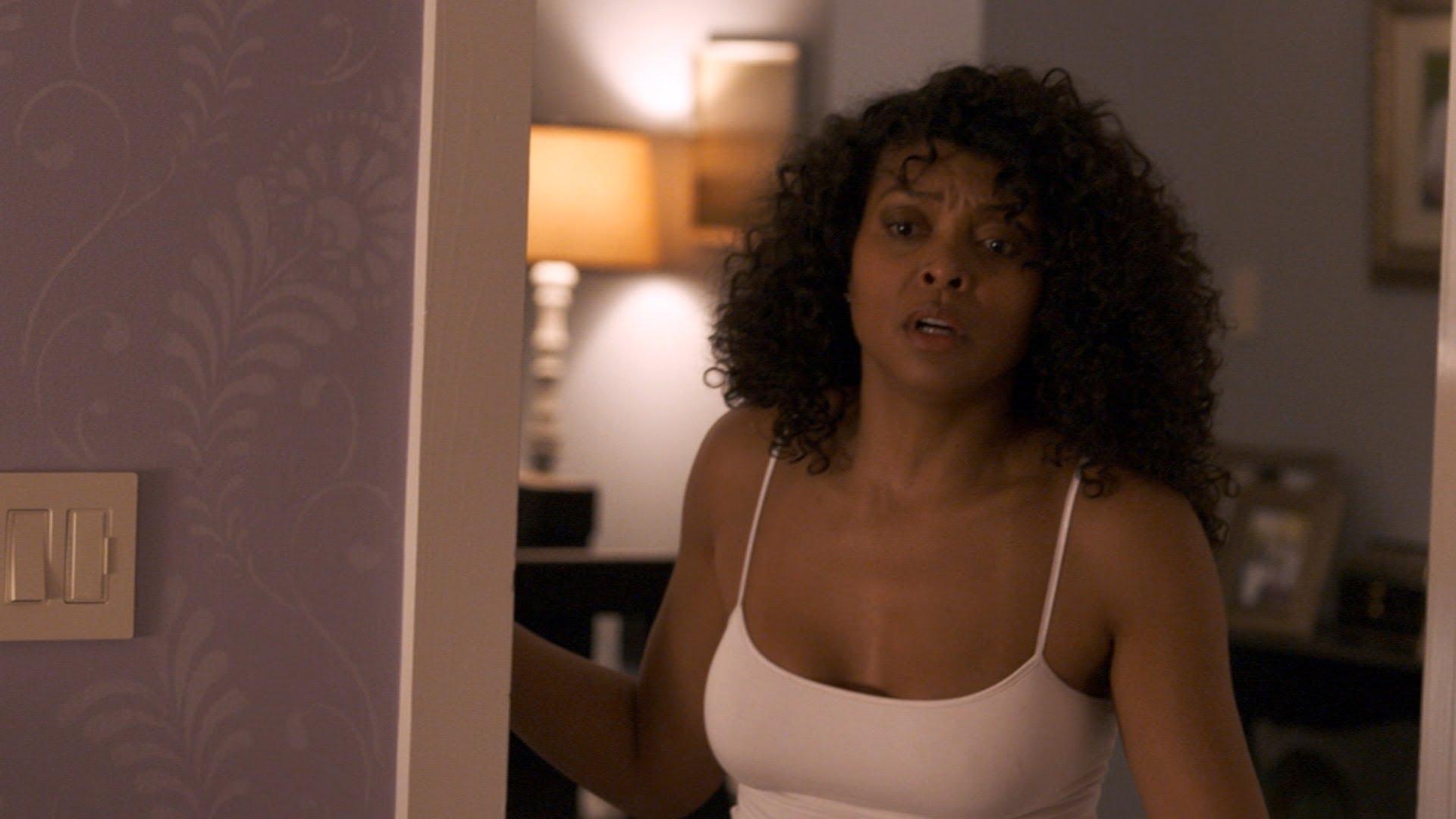 But this brings us to the so-called twist, which I will obligingly refer to with spoilers but rest assured, if this is the working definition of twists nowawadays, we’re all getting a little too carried away. When Colin takes Terri and her kids back to his dead ex-girlfriend’s home, the recently murdered woman’s phone rings. Who’s on the other end? Shocker, it’s Terri’s husband, who has been having an affair with this same woman. And… that’s it. That’s the twist, which is really more of a plot reveal but nothing along the magnitude of a “Bruce Willis is dead” revelation. As it happened, I thought, “Okay, that can’t be it, can it?” Oh, it was. What’s even more frustrating is that No Good Deed doesn’t build off this reveal. Colin was headed over to Terri’s address to make her husband suffer, but then what? Afterwards, Terri runs around the house and eventually dispatches Colin, and the movie ends with her moving out on her own, essentially the least complicated and most boring ending it could formulate. My father had a far more morbid rewrite that I’ll share with you, dear reader. His version would climax with the husband coming home and Colin casually murdering Terri and both of her young children, leaving bad hubby to forever suffer with guilt over the repercussions of his infidelity. While this ending would be controversial, it makes more sense in connecting the plot beats and at least stands on its own. At least it would be memorable.
No Good Deed isn’t a horrendous movie. It’s just dull from start to finish, never attempting to be anything beyond a mediocre thriller. Its complete lack of ambition is even more upsetting with the quality of actors who helped to get this film made. The direction is hackneyed, the visuals are poorly lit and clumsy, and the thrills are too generic and often stupid to be entertaining. The characters are dumb, the story is dumb, and the movie is dumb. Worst of all, it’s boring, the ultimate sin for a thriller. Unless you’re hard up for some precious Taraji P. Henson T&A (and no judgment, she’s a very beautiful woman), there’s no good reason to venture out and catch No Good Deed.
Nate’s Grade: C-
Share this:

Suddenly (2013)
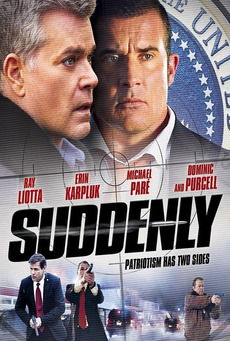 I can genuinely say that director Uwe Boll pleasantly surprised me with the last film I watched that had his imprint, Attack on Wall Street. It almost worked. It felt like Boll had maybe gotten over the hump of mediocrity, and sub-sub-mediocrity, that has become synonymous with his career writing and directing movies. Then one day, Suddenly suddenly popped up on Netflix, available for consumption, and 90 very tepid minutes later, my renewed hopes for a turnaround had been dashed and trashed once more.
The President of the United States of America is stopping by the sleepy mountain town of Suddenly. The secret service is canvassing the neighborhood to secure locations. Officer Todd Shaw (Ray Liotta) is working off another bender and may just get suspended. Ellen (Erin Karpluk) and her teenage son Pidge (Cole Corker) are living up on the mountain with a great view of the town. Agents Baron (Dominic Purcell), Conklin (Michael Pare), and Wheeler (Tyron Leitso, though he’s referred to as “Agent Young” several times) come knocking on her door to inspect. Except they aren’t real secret service agents. They’re posing to coordinate an assassination on the president, a hit ordered by the “Committee” that they work for. The assassins in suits lock Ellen, her son, and her elderly father (Don MacKay) in the basement, and wait for the president to arrive. There’s just the problem of keeping their cover and making sure Todd doesn’t intervene. Oh, and the town has a shop that advertises “fetish” in its name. So there’s that.
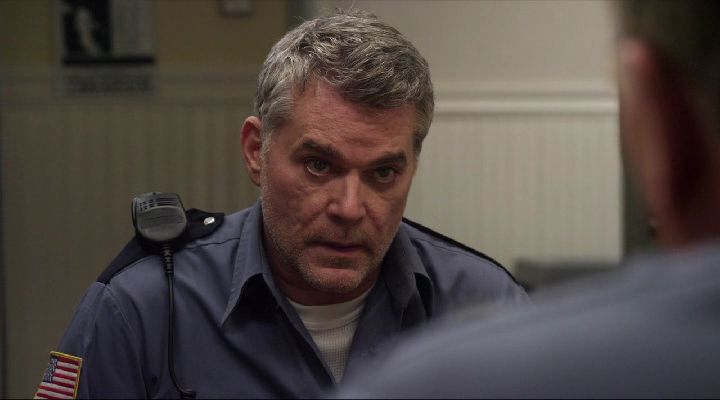 Given the assassination premise, Suddenly is shocking in just how overwhelmingly boring it is. There’s a noticeable lack of urgency in just about every scene despite the stakes of men with guns threatening people’s lives. A solid majority of the movie is an almost comically low-key hostage situation where we watch Ellen’s family bumble around the basement as captives and try to outsmart the relatively dimwitted assassins. It’s nothing quite along the lines of, say, Home Alone, but it feels comically off in tone, aided by an inappropriate musical score. These people don’t ever feel scared or panicked, and their conversations show it. The stupid grandfather character in this feels like he was plucked from a different, more broadly comical movie. Oh look, he’s fussing about with things; oh look, now he’s going to tell one of his old stories. In the context of a hostage thriller, it doesn’t work. Grandpa half-heartedly relates a tale about being snowed in with grandma where, surprise, they got out (the man is standing there after all). “See, it all works out in the end,” he reasons with no convincing evidence. And then (spoilers) he dies in the most idiotic way possible. During a light scuffle, he gets shoved and falls over. “He has a heart condition,” Ellen screams, informing us for the first time of this malady. I’m thinking he’s faking, so as to strike when the attacker draws near. Nope, he just lies there and dies in the most pathetic way possible, as if the plot had just decided it didn’t need him after all. One of the armed men actually tries to revive him, how nice.
Suddenly literally takes its sweet time getting to that presidential moment, saving that for the last few minutes of the film. Almost all of Raul Inglis’ (The Killing Machine) screenplay revolves around one scenario: will the bad guys’ cover be blown as different people keep finding their way back to Ellen’s secluded home. Oh no, the deputy will spoil things! Oh wait, he’s easily fooled. Well thank goodness that problem was solved in a not interesting manner. This takes up an hour of the movie, and it’s rather repetitious without any escalation. The entire setup feels like a series of lame stalling techniques to save the good stuff for the very end, rather than dealing with reversals and rising action. Then there’s the nature of the ending, which is so abrupt and without a single trace of resolution. As soon as that shot’s fired, the film ends a minute later. We learn via the news that the gunman shot himself… in the chest? At a distance? None of this holds together and the ending does not justify the time it took, and wasted, to get to that point.
There is exactly one point where this movie flashes the kind of quality story it could have been and it happens 70 minutes into the picture. Baron miraculously deduces how Ellen’s husband was killed: friendly fire, and Todd was the culprit. It was naturally an accident, one that haunted Todd deeply, but he returned home and everyone started throwing around the word “hero.” So he kept the truth to himself. Now, right there is an interesting premise that could produce a flurry of intriguing and complicated drama. Todd would live his day feeling like a fraud but also not wanting to disappoint his loved ones, the people he cares about, and so hiding the truth could be a justifiable evil, or could it? This little reveal of character backstory is only intended to explain Todd’s penchant for drinking, and the movie just skirts along a few minutes later, already over this revelation. Suddenly should have dropped all of the cheesy and half-baked thriller aspects and gone in this other direction.
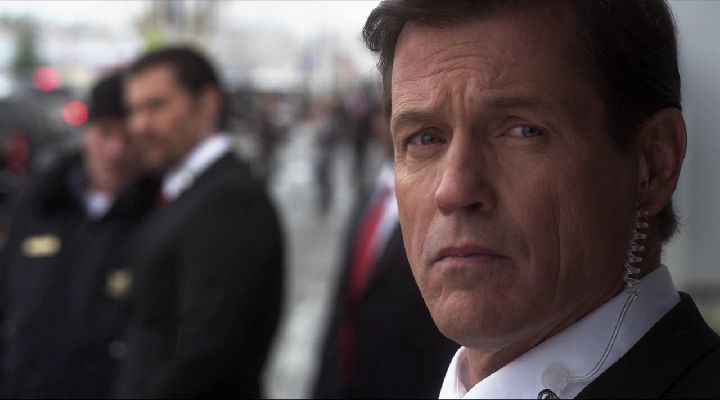 The villains in this movie lack conviction and competency. First of all, they just leave Ellen and her son and father unattended in the basement rather than tying them up. Then there’s just their general unconvincing nature when speaking with locals. They pose as secret service agents but there are actual secret service agents still in their midst. These turncoats are plotting to murder the president because the “Committee” they work for has demanded such. This phantom “Committee” is only known through one agent, Baron, and each man is selected for duty. They have a cause, though none of them can articulate exactly what that would be. At one point Conklin insists not killing the hostages because it would be bad PR and dissuade the public to the merits of their unexplained cause. Are these guys thick enough to think that killing the United States president will win over the public, just as long as they have good reasons for killing the president? It seemed obvious that Baron was going to be the lone person of this “Committee,” and yet the film doesn’t even tie up this loose end. We never know whether Baron was making it all up or whether there is a clandestine organization that has its sights set on the president.
Boll’s diffident direction mirrors the lack of enthusiasm throughout the production. This just doesn’t come across as a story that separates itself from your bargain basement, straight-to-DVD action flick. In fact there isn’t any action in the movie short of a few tidy scenes. And as far as thrills and suspense, they’re undercut at just about every turn, thanks to the lack of urgency and the comical misuses of Ellen and her family. At no point will you be watching Suddenly and get the sensation that anybody really cared about making this movie as best it could be. Usually Boll’s movies feel pasted together and derivative of other, better movies and visual influences; this movie is too dull to even be derivative. The movie even has the temerity to reuse that trite cliché, having the villain remark, “Under other circumstances you and I could have been friends.” The dumb villains, the dumb characters, the lackluster pacing and suspense, the lack of resolution, it all contributes to making what is easily the most boring movie in Boll’s filmography.
Usually these kinds of thrillers are churned out into the straight-to-DVD market, a glut of recycled plots and tortured/reluctant action heroes. There’s a formula that works and there’s been a proven audience that enjoys something cheesy, thoughtless, and familiar. And that’s what puzzles me even more about Suddenly because every somnambulist second of the film leaves you with the stark impression that nobody cared. The tale of a hostage thriller mixed with a presidential assassination, with some war drama thrown in, could work as far as the genre goes. All you need is a solid premise and some gung-ho execution, which explains why we had two Die–Hard-in-a-White-House films last year. Suddenly is nothing special, which we all suspected from the particulars involved, but it’s not even worthwhile or workable genre pap, which is even more insulting. From the wacky grandfather to the idiot villains who blindly trust their leader to the abrupt ending, or how about the fact that a kid is named Pidge, this is just one bad movie.
Nate’s Grade: D
Share this:

The Raid 2 (2014)
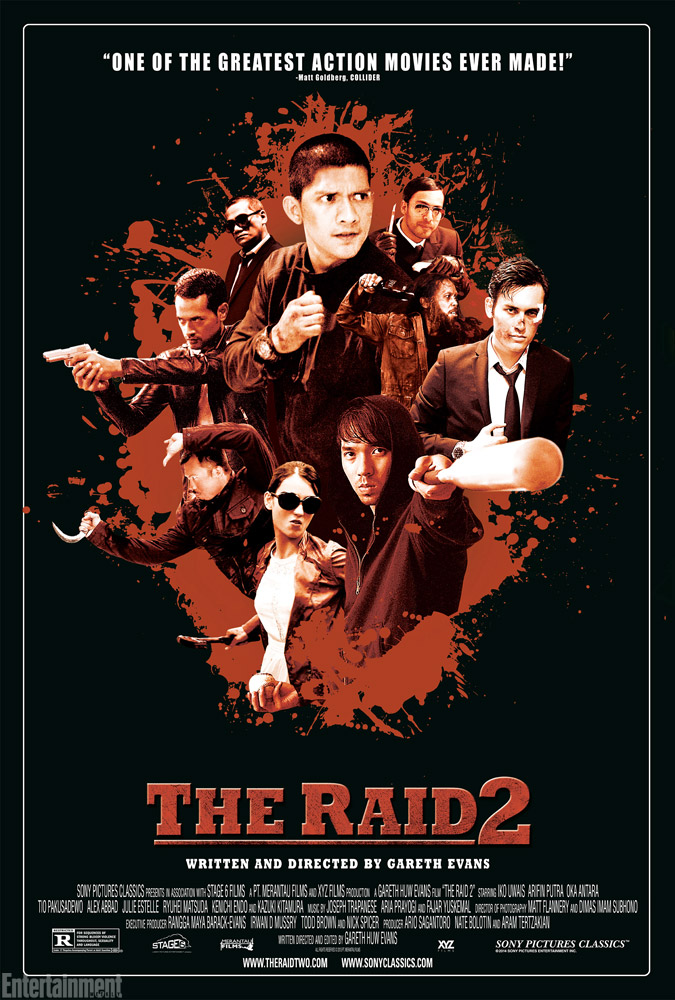 Rare is the movie that I feel I don’t even need to go into great detail rather than just scream, in a fashion suiting madness, “See this! See it!” Such is the case for The Raid 2, the sequel to the 2012 Indonesian action film that melted faces with its inventive and brutal action. The original movie had a confined location, a gang-run tenement building, and a simple premise of reaching the top and nabbing the bad guy. When people weren’t punching or shooting each other, the original Raid lagged, but director/writer Gareth Evans has solved the problem with his action-packed sequel. The world expands greatly, establishing the uneasy peace kept by powerful and warring criminal organizations. The plot ends up becoming something akin to The Departed meets A Prophet, following our hero cop from the first movie now placed undercover to gain the trust of the criminal overlords and work his way up the food chain. When the action isn’t cooking, you’re still engaged with the story and the suspense simmers in clever ways. But getting back to the film’s calling card, the action sequences are impeccably choreographed and edited, have a wide variety of locations for fun, and are bloody intoxicating. This is a movie soaked in adrenaline, and the action sequences will be hard to beat for the rest of the year. Evans finds ways to provide flair for his supporting characters, including a family duo that involves a deaf woman whose weapon of choice is hammers and a guy who prefers a baseball and a bat. The Raid 2 fires on all cylinders so well, so brilliantly filmed, that it puts just about every American action thriller to shame. It doesn’t need to be as long as it is (pushing two and a half hours), and it takes a little while to set up the players, but this is even more of an entertaining rush than the original, because now we get a sense of what Evans and his team can do with fewer restrictions. When Evans gets to Hollywood, and he will, just make sure you give him all the money to do whatever he wants.
Nate’s Grade: A-
Share this:

Non-Stop (2014)
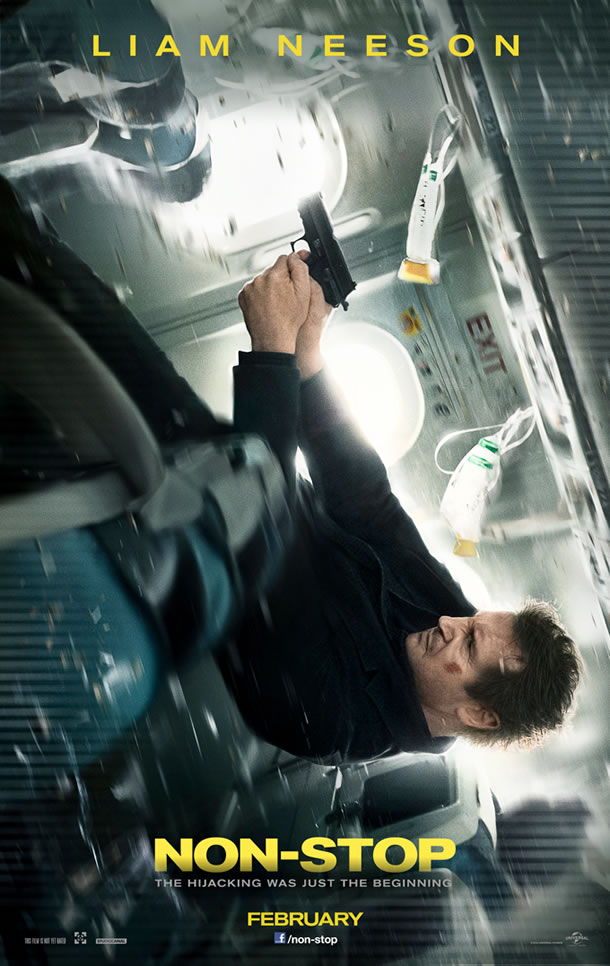 Know that I love contained thrillers, and I love suspense stories where we think alongside the characters step for step, and know that I love Liam Neeson in his career’s second life as our buttkicker in chief, and it looks like Non-Stop was the kind of film made exactly for me and my ilk. And until the final twenty minutes or so, Non-Stop kept me in the throes of entertainment.
Bill Marks (Liam Neeson) is an Air Marshal still getting over a lingering personal tragedy. On a flight from New York to London, he receives a text message on his secure Blackberry. Someone onboard is threatening to kill a passenger every 20 minutes unless $150 million dollars is deposited into an offshore account. When the bodies start piling up, Bill must find the killer but first he has to discover whom we can trust onboard.
Nobody is going to mistake this as a groundbreaking movie of any sort, but it sets about a very specific mission and executes it with vigor. You would be surprised all the different ways the film is able to squeeze out suspense in the meager confines of one airplane cabin. Just when you think you got the film figured out, it throws another twist and complicates matters in a way that is nicely escalating. I loved the fact that the killer essentially uses Bill to commit the first murder. It’s in self-defense, yes, but it also directly ties to his actions, which leaves an air of uncertainty attached to Bill. He now has to keep his own deadly actions a secret, lest he lose more trust with the airplane crew he so desperately needs to assist him. As the passengers start to become suspicious and unruly, it’s a rather plausible scenario that Bill will be subdued and arrested, if not worse. It finds ways to make the outlandish conceivably plausible, at least during the confines of the movie theater before you pick apart the plot holes.
 And let’s talk about that for just a moment. I’ve said before that plot holes only really matter when you’re not enjoying the movie, because then they consume your attention rather than the story and the whole thing falls apart. As long as I’m satisfied, I can excuse the stuff that doesn’t make sense to an extent. With Non-Stop, the movie contorts its mystery in such a way that you know it will never fully deliver on an ending that will perfectly snap together all the pieces and clues as well as satisfy. I went along for the ride already accepting the ending would more or less blow it, but beforehand I just wanted to be ably entertained, and I was thusly. In the end, without delving into too murky with spoilers, the evil plot by our onboard killer relies on such a perfect execution of so many variables that there’s no way this money grab would work. Well, there’s a reason for that, but I won’t elucidate on the details, but suffice to say it is a plan that does not make sense, would not have the intended impact, and you question exactly how somebody got parachutes onto an airplane as their carryon. Does that not strike TSA security as weird?
The screenplay by John M. Richardson, Christopher Roach, and Ryan Engle (two of those gents are an editor and executive producer for the reality show, Big Brother) does just enough right to please without offending when it gives in to the inevitably stupid reveal. In fact, this screenplay could be a prime example of the “Save the Cat” plot formula that has arisen to prominence in Hollywood: the opening scene/image tells us about the character’s metaphorical journey, he does something kindly early, this time helping a child who lost her stuffed animal, and the plot beats are all there in lockstep. The key scenario where a death emerges every 20 minutes provides a potent sense of urgency, with a payoff that comes fast. Each escalates the stakes, adding a personal element with Bill being pinned with the blame and the news leaking to the passengers via rumor and the media. Then Bill’s supervisor adds another level of conflict, and it’s enjoyable to watch all the screws turn against our hero. It’s also fun to watch Bill have to use what limited means he has to suss out the killer, and each makes him more vunerable to a passenger revolt. It’s a well-constructed thrill ride that produces enough jolts, twists, and payoffs to wholly condemn it after the third act crash and burn.
 Neeson (The LEGO Movie) has been carving out a niche for himself ever since the first Taken movie, and as my friend George would say, a movie with Neeson punching things equals his ticket bought. While the man has other great acting skills, it’s just a pleasure to watch someone of his dignity and stature, as well as with his natural sense of gravitas, bark at bad guys and punch them into unconsciousness. Would you rather watch the aging class of 1980s action stars still doing their thing, or Neeson? America has spoken. With Non-Stop, Neeson is again a solid anchor for the film and our interests. I like that his character isn’t portrayed so starkly heroic, like his concealing of personally harmful information. It gives a sense of fear to the character that we don’t ordinarily see. Then there’s the fact that Neeson has to act a third of the movie against nifty floating text subtitles, and the man still outshines others. It’s also nice to have a supporting cast of solid actors like Julianne Moore (Carrie), Corey Stoll (TV’s House of Cards), Scoot McNairy (Argo), Nate Parker (Ain’t Them Bodies Saints), Shea Whigham (American Hustle), Michelle Dockery (TV’s Downton Abbey), and a blink and you’ll miss her role for new Oscar winner, Lupita Nyong’o (12 Years a Slave).
Packed with twists, escalation, and squeezing as much suspense out of its premise as possible, Non-Stop is a contained thriller that invites you to play along for fun. It’s an entertaining ride that weaves its various characters and conflicts together in a satisfying manner that simmers with rising tension. The great supporting cast, and the unbeatable Neeson, sell the silliness, up until the end. By that time, I’ve already been having too much fun to quarrel much, though I’m sure you at home can figure out a dozen more probable and better endings. Non-Stop is an above-average thriller that makes great use of its unique location and the realities of this space to up the stakes. Premise-alone, you already know whether or not this movie is going to be your kind of film. Action fans should find enough to whet their whistle, and there are enough surprises and well-wrought suspense that I would recommend Non-Stop as the perfect antidote to a rainy day. Idea for a new action film… Liam Neeson versus the weather. Just wait.
Nate’s Grade: B
Share this:

Assault on Wall Street (2013)
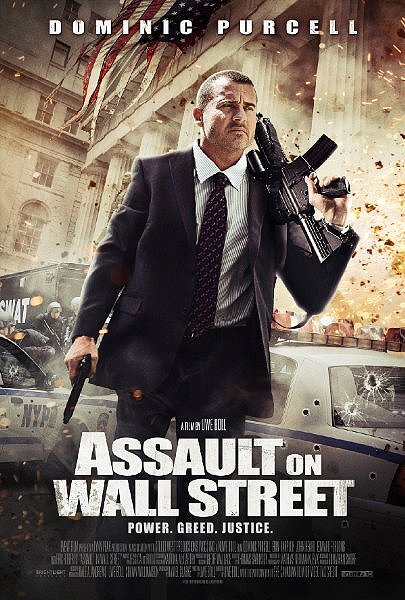 When it comes to notorious German director Uwe Boll, many are still waiting for what could be the man’s first genuinely good movie. The man has been prolific over the past ten years but sure-fire candidates for First Good Film, like Max Schmeling or Attack on Darfur, inevitably have some tragic flaw or approach that places them back in mediocrity, the company of many of Boll’s other movies. After reviewing more Boll films than a human should be allowed to willingly, I feel like I’ve been beaten down enough that when I find something that genuinely works, be it an actor or a sequence or plot turn, that I should be just as vocal as with the contingent of failure. So allow me to refreshingly applaud Boll for Assault on Wall Street, on coming up with a topic and a story structure that… actually… works. It not just works, it succeeds, and if a more polished professional screenwriter got a hold of this, I think it could actually impress the masses. If it weren’t for the surprisingly effective war drama, Tunnel Rats, I’d say without a doubt that Assault on Wall Street is the best work of Boll’s much-maligned career. And yet… it has just enough minor faults that hold it back.
Jim (Dominic Purcell) is a regular guy working as an armored security transport. His wife Rosie (Erin Karpluk) suffers from a rare tumor that requires an expensive series of injections to keep it at bay. Their insurance company won’t pay, and so they have to rely on Jim’s savings. Except those are gone as well. Jeremy Stancroft (John Heard) has ordered all his brokers to dump toxic assets, eliminating most investor savings but profiting the shareholders. Jim and Rosie are broke. Vowing vengeance, especially after some drastic decision-making by Rosie, Jim sets off to make the high-priced traders and corporate raiders on Wall Street feel the pain of what they have wrought.
 The setup is concise and Boll does a nifty job of compounding Jim’s problems and showing how all the industries are interconnected to put the squeeze on. Because of unscrupulous health insurers, his wife’s medical treatment, deemed experimental, is quite expensive and they’ve reached a cap. With the brokers pushing their clients assets into junk stocks, at the behest of the betters and for commissions, Jim loses his entire financial cushion. He hires a lawyer (Eric Roberts) but has to pay $10,000 just to retain him to fight the $60,000 penalty his broker says is owed. He goes into debt and refinances his skyrocketing mortgage (variable rate) to pay for his wife’s treatments. His employer takes notice of his perilous situation and is uncomfortable with enlisting someone in deep financial woes with guarding money. He loses his job. The bank is poised to foreclose on the house. His wife won’t get her treatments to save her life. All of this leads to a drastic and completely understood decision of desperation and sacrifice. Admittedly, Boll does a compelling job of connecting all the dots, making each new pitfall a result of the previous, each compounding the misery of Jim. It takes a little long to go through all these points, and I think Boll could have trimmed it down so that a key event happens at the Act One break point, but I was flabbergasted that the man found a story structure that succeeds.
The second half of the film is Jim planning his vengeance, and after all of the callous movers and shakers have bled him dry, you’re onboard for some sort of righteous payback. Boll takes on Wall Street and the healthcare industry (double the populist outrage). Jim as a character could be made much more compelling, but he’s really serving as a symbol for how the forces are ganged up against the little guy, how the fix is in. When confronted, the big CEO of the brokerage firm barks that it’s always the same old story, that the titans of industry were all crooks and manipulated the system to their advantage, and he’s no different. In short, the little guy always loses.
What holds back Assault on Wall Street, beside the fact that the titular assault is reserved for the last fifteen minutes of the film, is its too slick ending and Boll’s obvious transparency when it comes to his political message. After Jim suffers loss after loss, he puts together a plan pretty quickly, utilizing that Army training we’ve heard about. It’s actually too easy with little complications that can’t be solved in a David Fincher-style montage of death. It’s a full 70 minutes before he takes out his first Wall Street fat cat, and that’s just way too much dawdling. And then from there the climax involves Jim just going on a rampage in an office building, shooting several faceless employees who could very well be innocent for all we know. I think Boll is satisfied with a guilt-by-association catch-all for Jim’s fury, but it would be more satisfying just from a payoff standpoint if we saw these people in villainous lights prior, kind of like what Saw 6 did with its insurance characters before turning the tables on them. The last thing we need in our populist screed is to worry that the wrong people were dispatched. And what kind of office building fails to evacuate after a confirmed shooter has attacked?
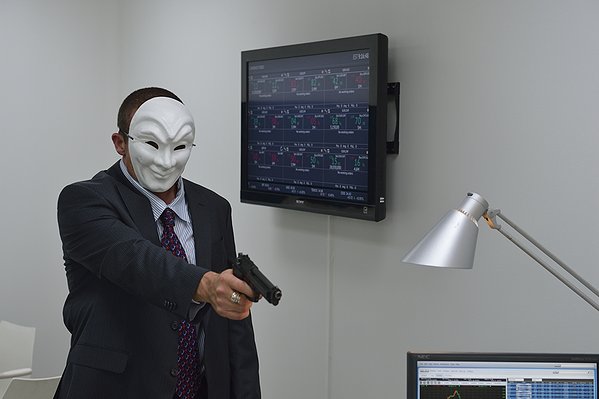 This storyline could have also worked in a Falling Down turn, where a man consumed with evening the scales of a system broken loses his moral bearing and lumps all guilty parties together and condemns them all. Perhaps it was meant to examine the slippery slope of vigilante justice and how this too can decay one’s sense of self, sort of like what Jodie Foster went through in 2007’s The Brave One. However, I don’t think Boll was intending this direction because he’s not very subtle about anything in the movie. Oftentimes the characters just become mouthpieces for ideological talking points: “We’re busy busting some homeless guy when the real criminals are on Wall Street.” The bad guys actually say, with no hint of self-awareness, “We all took a loss. When I told my wife we couldn’t vacation in Barbados any longer…” It’s all just a little too on-the-nose to remind you of the overall intent rather than the story. Therefore, I think Boll is just going for a sense of (misplaced?) justice in the end, in a ludicrous plan that somehow invalidates witnesses, forensic evidence, and security footage to pin the blame on someone else. It’s too clever by half that it undercuts the final payoff. It gets even worse with the Batman-esque voice over to close out the film with a promise to all evildoers.
With such a tight focus on the plot, the acting is a marked step up from previous Boll outings. Purcell (TV’s Prison Break, Killer Elite) doesn’t exactly come across as a regular Joe but he has enough onscreen presence to pull off his character’s anguish as well as the requisite badass stuff. And apparently Boll has become fond of him because Purcell is scheduled to appear in future Boll films. Karpluk, a Canadian actress best known for the TV show Being Erica, has a natural grace to her, forgoing big moments to concentrate on the gnawing guilt and concern her character feels. While she’s a bit too willfully ignorant early on, Karpluk makes you care and provides whatever depth can be applied to Jim. I’m actually curious to see her comic skills since she has a face tailor-made for romantic comedies. Heard (Sharknado, Home Alone) doesn’t seem to embrace his duplicitous CEO role with enough gusto, appearing to be annoyed when he should be menacing. This is not the kind of movie to hold back.
There are plenty of other Boll Players, including Edward Furlong (3 appearances), Lochlyn Munro (2 appearances), Tyron Leitso (5 appearances, also stars in Being Erica), Michael Eklund (8 appearances), Natassia Malthe (4 appearances), and the stalwarts of Clint Howard (6 appearances) and Michael Pare (13 appearances). It’s been 13 years since Eric Roberts (The Dark Knight) last appearance in a Boll film. Most of these are blink-and-you’ll-miss-them, but then there’s Keith David (The Thing, Cloud Atlas) in a thankless role that didn’t need to exist. But hey, I’ll take Keith David in anything.
A welcome surprise, for the most part, Assault on Wall Street is a finely structured revenge tale with clear and precise plot points and a natural buildup. It’s Boll on a soapbox and the naked transparency of his ire and populist messages limits the effectiveness of his storytelling, but you might not mind, especially if you are a person who has slogged through far less competent Boll ventures. There is a marked improvement in just about every facet of filming. It genuinely works, that is, until the pacing becomes lopsided and the end just reverts to celebratory action mode. A more professional writer could take this film and whip it into a crowd-pleasing populist thriller. It’s got so much that works, and genuinely works well, that I feel like a buzzkill to keep harping on the elements that do not succeed. But if Boll wants to earn an undisputed victory, he’s got to earn it without lowered standards. Assault on Wall Street is so tantalizingly close to being Boll’s First Good Film but it doesn’t capitalize enough.
Nate’s Grade: C+
Share this:

Out of the Furnace (2013)
 The last time writer/director Scott Cooper looked at a rural, low-income, hand-to-mouth existence, he helped lead Jeff Bridges to Oscar gold with Crazy Heart. It would make sense then for Cooper’s follow-up, Out of the Furnace, to populate those same hills. It also makes sense why actors would flock to Cooper’s next project. It’s a film that strives to be a little of everything, a slow burn and artful revenge thriller, but ultimately will please few, the actors wasted here included.
In rural Pennsylvania, Russell Baze (Christian Bale) is a diligent steelworker who always has to be on the lookout for his younger brother, Rodney (Casey Affleck). Prone to impulsive decisions, Rodney routinely finds himself in debt to bad people. The situation magnifies when Russell is sent to prison for a few years due to a fatal car accident he was responsible for. When he leaves the penitentiary, life has only gotten worse. Russell’s ailing father passed away while he was locked up. His girlfriend, Lena (Zoe Saldana), has moved on with police chief Wesley Barnes (Forest Whitaker). Most distressing, Rodney has gone through four tours of Iraq and is deeply troubled. He’s fallen into old habits and gotten involved in an underground bare-knuckle fighting ring run by the ferocious Harlan DeGroat (Woody Harrelson). Rodney runs afoul of Harlan and disappears, and Russell goes on the warpath for vengeance.
 The problem is that Out of the Furnace doesn’t do enough to separate itself from the pack. We get little insight into the hard lives of these men. Both brothers are haunted by guilt and trauma, squeezed by few economic opportunities, and feeling like life itself is trapping them in corners. However, their path is already predetermined. Russell is destined to stay on the narrow path of responsibility, suffering slings and arrows, but striving to do the right thing. We see this time and again. And Rodney is destined to make poor decisions, desperately getting in over his head and reaching out to all the wrong people. We see this time and again. Each part is solidly locked in, and so we wait because we know their exact trajectory. We know something bad will happen to Rodney and we know Russell will be driven to seek justice his own way. Likewise, Harlan is a scary psycho without complexity. He’s just a drug-addled, violent, scary dude, but he’s so one-note. Lena, once she briefly reunites with Russell, is completely absent in the film, as if her unrequited position is all she serves for our purposes. Cooper displayed a terrific ear for lived-in characters with Crazy Heart, and the details of this world feel honest, it’s just that there aren’t enough of them. The storyline is engraved with little variation, and Cooper doesn’t take full advantage of his great cast, relying upon familiar scenes and elements to establish his loosely drawn characters. We’ve seen these burnouts and lowlifes and dignified blue-collar workers all before. This is a film that wants to be challenging but too often seems to take the easy road.
The very plot structure also seems amiss. As stated above, the journey seems set in stone, so then when something bad does happen to Rodney, it feels overdue. Rodney doesn’t meet his ultimate bind until halfway through Act II, and then when the plot shifts to vengeance, it becomes an uncomplicated straight line. And a streamlined plot with little variation or surprise, with characters that are customary, can get boring. Once Russell is on the warpath, there is little complications or obstacles, or even moments to contemplate the full extent of his actions. And then the movie is done. Because the final act plays out exactly as you anticipate, the movie leaves you feeling anticlimactic. The payoff is unsatisfying. Plot reorganization would have benefited the Russell vs. Harlan storyline. Rather than draw out Rodney’s ultimate screw-up, which everyone is just waiting for from minute one, why not have his screw-up be the Act I break, coming around the half-hour mark rather than more than an hour into the film? That sets the story forward and provides enough space for Russell to work upwards toward Harlan as well as examine what kind of man he is becoming. As it plays out, Harlan is crazy but also easy to access despite the threats of what the rural hill people will do to visitors. If a revenge story was the method that was going to test Russell’s character and redemption, then we needed to get to this crossroads sooner, especially since everyone is waiting for it to happen.
 The power of the acting goes a decent way to compensate for the film’s unresolved investment. Bale (The Dark Knight Rises) internalizes most of his character’s emotions, always trying to hold back a swell of anger and guilt, to just keep going one day at a time. He delivers another strong performance as a man struggling to do the right thing. In this day and age, even a passable Bale performance is going to be above average. Affleck (Ain’t Them Bodies Saints) is a go-to actor when you have a desperate character that is clearly outmatched. His volatile performance is laced with sadness, as you understand how cursed Rodney feels, how the universe hands him bad break after bad break. Affleck tinges his hopelessness with a resigned weariness, as if he’s just seeking a final release. Harrelson (Now You See Me) stews villainously, erupting with extreme violence. He’s a scary guide helped by Harrelson’s flicker of madness he imbues the character with. It’s too bad he doesn’t do anything memorable outside the opening minute. Whitaker (Lee Dainels’ The Butler) probably gets the worst of it, and I think he knows it, which is why the actor adopts a gravely speaking voice that sounds like he has a frog in his throat. Beyond the fact that he’s linked with Russell’s old flame, there isn’t anything important to mention about the character, nor is there anything for Whitaker to do other than make limp threats about letting the police focus on Harlan.
Out of the Furnace is one of those movies that gets details right but loses sense of the big picture. Its blue collar, working class characters are given the right clothes, posture, look, but they’re not given enough material to breathe as characters. The people in this movie end up becoming dispensable parts of the background, serving their strict plot purposes and then dissolving again, lacking complexity and personality. The characters aren’t strong enough for this to be character-driven; the plot isn’t given sufficient structure for this to be a searching moral exploration; the pacing and direction don’t provide enough thrills for the film to work as a revenge thriller. And so Out of the Furnace, while not being a bad film, falls short of truly working as a character study, as a moral examination, as a traditional pulpy revenge thriller. It’s got a great cast and some wonderful production values that convey the weight of low income America, but the movie just lacks an engaging story to justify the talent in use. A few more revisions would have helped, but Out of the Furnace ultimately comes up short because it lacks any sort of lasting heat.
Nate’s Grade: C+


You must be logged in to post a comment.