Blog Archives
It Follows (2015)
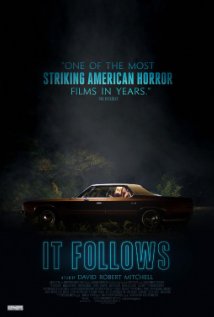 Indie horror is always looking for the Next Big Thing, and at the start of 2015, that movie was It Follows. Coming out of relatively nowhere, the second film by writer/director David Robert Mitchell was dubbed the real deal, and audiences flocked to see what all fuss was over. I would have been intrigued before the positive word-of-mouth namely because Mitchell made one of my favorite films of 2011, the understated and perfectly yearning ode to adolescence, The Myth of the American Sleepover. I dearly hoped that Mitchell was not another flash in the pan. In retrospect, I did not have need to fear. It Follows is unsettling, suspenseful, and borderline ingenious with its concept, but it also has some faults that mitigate its concluding power.
Jay (Maika Monroe) is a normal 19-year-old girl going to college in Michigan until the night she sleeps with her object of desire, Hugh (Jake Weary). In her post-coital mediation, he drugs her, ties her to a wheelchair, and then waits. He wants to show her something, or more accurately someone (perhaps something is actually more appropriate). A woman slowly trudges toward them, the embodiment of a curse he passed on to Jay through sex. It will keep following her until it gets her and kills her. The only way she can protect herself is to sleep with someone else, to pass the curse onto a new recipient. Then the monster goes after them; however, once this newest curse-holder is murdered, the monster moves back up the ladder, attacking the next curse-holder. Once you have it, there’s no getting rid of this curse, only delaying it.
 The top question with a horror movie is whether it provides enough suspense, spooks, and scares to jolt an audience, and in this regard It Follows is quite good; not as unsettling as last year’s Babadook but still plenty unnerving and extremely well executed and developed. The opening hooks you, with a teen girl constantly looking in the direction of the camera and clearly scared out of her mind. The camera has adopted the identity of the monster. The central premise is wonderful, rich with thematic potential about the alienation and anxiety of being a teenager navigating the world, but also intriguing enough that I always wanted a large expository info dump scene just to learn more about the rules or its history. Rare is the film, let alone a horror film, where I’m left desiring lengthy exposition. One of the clever developments of its monster is that it can adopt the appearance of anyone, including people close to you (though it rarely does this for an unexplained reason). That means anyone can be your doom and the only way to know is to double-check whether other people can see this menacing phantom as well. Imagine going the rest of your life always having to look over your shoulder, always having a little nagging doubt in your mind about whether or not this person or that person is real. The premise is well developed with sequences that draw out the tension and make us dread what’s coming next or what may or may not be real. Now, slow-trotting fully naked people might not be a scarier monster than, say, Leatherface, but it’s still alarming.
The premise also allows the audience to imagine what course of action they would do if they were stuck in this situation. Would you doom an innocent human being to protect yourself? If so, would you be upfront about it and the ensuing danger? Would you formulate a plan like Hugh and drive long distances to provide further distance? If you thought you were being followed, would you immediately find a sexual partner? The clever premise gets your brain thinking of what you would do to survive and at what cost.
There’s a distinct Stanley Kubrick and John Carpenter vibe with the filmmaking, which will enhance the overall mood of the film or drive certain viewers crazy. The camera movements fall into very few selections, mostly slow pans, slow zooms, or long tracking shots with the subject routinely framed in the center. It’s hard not to evoke feelings with The Shining, an all-time great horror film that likewise built a sense of foreboding terror, and Halloween. You’re conditioned to feel that something bad is about to happen as the camera turns or hovers, waiting for the creepy thing to pop around the corner. It plays into second-guessing everything you see, taking away the illusions of safety, and the steady and controlled camerawork enhances this mood. The entire movie feels vaguely out of time, notably a capsule from the 1980s save for one strange inclusion of a wireless reading device. The musical score by Disasterpeace (nee Rick Vreeland) is another throwback to the 80s, and its fuzzy synth-drenched soundtrack smoothly blends in and enhances the atmosphere.
 If anyone caught Mitchell’s previous film, you’ll know that besides a wonderful eye for framing visual compositions, the guy has a very natural feel for developing realistic teenage characters milling about their relatable existences. It Follows is no different, and while I would stop short of saying that the characters have depth to them, they are realistically drawn and portrayed by actors who look and act like scared teenagers. The relatablility of unrequited feelings, or going out on a limb and getting your heart broken, of trusting the wrong people who have ulterior motives, are universal pains that makes it all the easier to put ourselves in these unfortunate character’s shoes. It also helps that, up until the final act, the characters defy the arc of rampant stupidity in horror. After realizing the danger she’s trapped in, Jay actually seeks out the one person who she can get answers from, even if he’s the same person who doomed her with the curse.
It’s unfortunate that the movie loses steam when it creeps into its third act and forces a solution and showdown with the monster that makes no sense whatsoever. I understand the need to feel like the teens can regain the upper hand or somehow outsmart the curse that doggedly follows them, but with everything presented, it’s just not believable. For the entire movie, we’ve seen that this supernatural force doesn’t really have a loophole in its system of rules. The only way to stave off annihilation is to pass it along and create a series of firewalls as protection with other sexual partners. Otherwise, it’s relentless and like zombies the eventuality is what helps magnify the sense of dread. We even see it get shot in a hasty defense from the teens and the gunshots do nothing. And yet, this vital information doesn’t seem to register with our band of teenagers. Their third act solution (spoilers): they’re going to lure the following terror into a pool and… electrocute it. Huh? Why would a supernatural entity that has not shown any weakness to electricity, or any mortal dangers, be able to be killed? This plan makes no sense and not one character voices a counter-argument to what is proven to be a very bad plan. Maybe the point is that it’s supposed to be bad, that it’s an example of how desperate these characters have become that they would hold out hope for something that is completely inaccurate. After this failed plan, Jay does exactly what you’d expect with the boy who’s been itching to jump her bones for the entire movie. He gets what he wants (physical copulation, being the white knight), she gets what she wants (flimsy security), and then the movie just kind of peters out and ends. I understand that Mitchell’s extended point is that there is no happy ending possible and the characters will have to uneasily look over their shoulders for the rest of their lives. However, the point could have been made even without the third act. I wish It Follows could have found a better landing than just shrugging and saying, “Well, what are you gonna do with curses, you know?”
 Before the movie hits the skids in the third act, I was pondering the greater implications and logistics of its sexually transmitted curse. Does “passing” it along require some form of genital contact? Does it require fluid exchange? If you wear a condom, does the prophylactic also protect your sexual partner from the transmission? Does the curse function relatively the same for same sex couples? What about people with non-functioning parts below the waste? Can someone who suffers from erectile dysfunction pass the curse along? Can it be transferred onto inanimate objects? Can men ejaculate into some sort of container and then send the container into space via the space shuttle and be protected? Actually, banging an astronaut who’s about to live on the space station or go to Mars might be the smartest move. I enjoyed thinking of a stratagem to best protect myself if I was caught in this scenario; even after passing it along and providing a buffer, you still always have to be on guard for the curse to move back up the ladder. My solution: have relations with a prostitute. This is probably a guarantee that the curse will be passed on within a 24-hour period, and even if that john is found and killed, chances are this prostitute may have already passed the curse along to a new client. If one cannot inoculate themselves from a supernatural STD-like curse with the aid of prostitutes, then there’s no hope for the rest of us poor mortals. Anyway, my mind wandered a tad.
It Follows may suffer due to the hype, the inconclusive resolution, and a third act that deflates, but it’s still an extremely well executed horror thriller with a terrific concept at heart. The sense of dread is stark and the camerawork and storytelling draw out the tension until you feel you’re about to break. It’s more unnerving than traditionally scary, but it has a power that does stay with you, particularly its fascinating premise and the natural relatability of the characters and their choices. I don’t know if this premise could sustain a sequel, especially with a villain that appears to be unstoppable, but that hasn’t thwarted the horror genre before in its stampede at cashing in on success. It Follows is a solidly entertaining and creepy movie, but it’s even more confirmation for me that David Robert Mitchell is going to be a filmmaker who has staying power. I’ll be following him.
Nate’s Grade: B+
Share this:

Child 44 (2015)
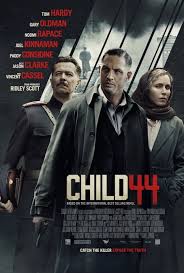 Unfairly cast out like some unwanted vermin, Child 44 is a police procedural based on a best-selling novel that the studio simply wanted to get rid of quietly. It was “dumped” into theaters and, as expected, began its disappearing act. That’s a shame, because it’s actually a rather involving mystery and an especially fascinating perspective into a little known world of being a cop on the other side of the Iron Curtain. Tom Hardy plays Leo, a member of the Soviet state police who is tracking a serial murderer preying upon orphaned children across the countryside in 1953. His wife (Noomi Rapace) is terrified of him and secretly a rebel informer. The two of them get banished to a Soviet outpost when Leo refuses to turn her in; he also refuses to accept the state’s conclusion over the dead children. In a weirdly perplexing turn, the Soviet Union believed murder was a Western byproduct. “There is no murder in paradise,” we are told several times, and since the U.S.S.R. is a communist worker’s “paradise,” whatever reality that doesn’t jibe with the party line is swept away. The murder mystery itself is fairly well developed and suspenseful, but it’s really the glimpse into this bleak and paranoid world that I found so intriguing. Child 44 is a slowly paced film thick with the details of establishing the dour existence of Soviet Union life. You truly get a sense of how wearying and beaten down these people’s lives were, how trapped they felt, how justifiable their paranoia was. The husband and wife relationship grows as they’re forced to reevaluate their sense of one another, and it genuinely becomes a meaty dramatic addition. Child 44 is a slow movie but the pacing serves the deliberate and oppressive tone of the film. It’s a film with some problems and missteps (certain antagonists make little sense in their motivations), including some incoherent action/fight scenes (fighting in the mud? Way to visually obscure everybody, guys). However, this is a better movie than the studio, and a majority of critics, would have you believe. It’s engrossing and taut and ambiguous and consistently interesting, with another standout performance by Hardy. Like many of the characters, this movie deserved a better fate.
Nate’s Grade: B
Share this:

Ex Machina (2015)
 Alex Garland is a screenwriting staple in Hollywood. He’s a science fiction specialist, adapting everything from Kazuo Ishiguro’s wrenching Never Let Me Go to the Halo movie. He’s worked with Danny Boyle, adapting his novel The Beach, and then on 28 Days Later and Sunshine. If you’ve noticed a theme with the titles, Garland tends to subscribe to a pessimistic view of human nature. And yet each film is grounded by the humanity of its characters no matter the extreme circumstances. Garland’s gift is making the fantastic grounded on a recognizable human level. Ex Machina is his latest and his directorial debut but you’d never have guessed it with how controlled and polished the film comes across. It’s a cerebral sci-fi film that haunts, enchants, and consistently engaged the imagination.
Caleb (Domhnall Gleeson) wins a corporate contest to spend a week’s vacation in the home of a reclusive Google-esque tech billionaire, Nathan (Oscar Isaac). Caleb is here to test out Nathan’s newest invention – artificial intelligence. He’s built an android woman named Ava (Alicia Vikander) and he wants Caleb to interview her.
Ex Machina throws you right into the hook within minutes, and it was mere minutes for me to get hooked. Garland does a glorious job of teasing an audience with his story and unlocking further mysteries that develop intrigue. At the start, knowing the Turing test, we’re just as interested in Ava as Caleb is, trying to figure her out and how lifelike she may be. But then the conversations start to linger and, during a brief power outage that cuts the feed to the omnipresent cameras, Ava warns Caleb that his host is not whom he thinks. As soon as the power is back and running, it’s as if the comment never happened. The pristine underground quarters have an eerie tranquility to them, almost as if Apple is designing high-end prisons. Garland’s movie becomes consumed in paranoia. Is Ava being honest? Is Nathan being honest or underhanded? What’s in some of those “off limits” rooms? What is the true test at hand? Who is the silent Asian assistant? At one point, Caleb slices open his own arm to search for circuitry, and you completely understand his reasoning. This mounting sense of paranoia and dread, tagged with Garland’s mysterious and well-developed storyline, are enough to keep your eyes glued to the screen and rapidly second-guessing and triple-guessing your shifting loyalties.
 Garland also smartly doesn’t dance around the obvious plot device of having a beautiful robotic woman, namely the inevitability of romance to bloom. What is it about android women that science fiction seems to love so much? From Blade Runner to Fritz Lang’s Metropolis, the genre loves the concept of robotic women. Perhaps this is merely a byproduct of a genre written by a majority of men, or perhaps it taps into something more unconscious about the desire to control women, or a fear of women, but that’s a conversation for another day. Ava is certainly a stunning creature, thanks to Vikander, but also from the sleek production design that makes her feel like the world’s most gorgeous Mr. Potato Head with her lycra-like skin for easy detachment. Her exposed stomach of bolts and bulbs is also a constant reminder of her “other-ness.” There’s an obviously sexual dynamic to the character, and while she’s technically nude for most of the film, watching her slip out of stockings and a dress has a strange erotic quality. Thankfully, the percolating would-be romance between man and machine actually plays a vital part throughout the script and especially with the end. There’s even a darkly comic yet disconcerting reveal about why Ava looks as she does. Is Ava capable of feelings? Is she falling for Caleb, or does she merely view him as a means to an end?
It’s essentially a sci-fi play with limited locations and three primary actors. The power is on Garland’s effortlessly engaging script, which is far more cerebral and philosophical and nuanced than you might expect from its premise. This is a film that allows its characters to breathe, to organically develop relationships and doubts. The concept of A.I. has been explored in many sci-fi stories before but Garland finds fresh resonance by paring down his story to a manageable trio. Nathan’s reclusive home is like a twenty-first century version of the haunted house and full of fun detours begging to be explored. Garland’s cinematography and production design are reminiscent of the cool artifice of David Fincher’s films. The world feels like a small step into the future but constantly unsettling. Garland’s story always has another mystery to unlock, always driving the story further as Caleb’s weeklong stay is coming to a close. Garland has a natural eye for images and composes several startling sequences that can equally evoke beauty as well as disquiet. There’s a moment where Ava passes a wall of faces as if they were simply a row of hats. Simple moments like Ava “dressing up” are given a gentle poignancy that isn’t overplayed for effect. Garland’s film is what I wanted 2014’s Under the Skin to be. Both of them are unsettling, moody, and atmospheric with striking Kubrickian imagery, but Garland’s film is less purposely oblique.
The trio of actors provides strong work, especially Swedish actress Vikander (Seventh Son, A Royal Affair). As the film is told from Caleb’s perspective, she has to find a very exact balance with her performance with elements of innocence, uncertainty, and ethereal curiosity. She’s rather placid but you always feel like there’s more just under the surface, whether it’s the ache of sentient realization or something more sinister. She’s a test subject, a captive, and a possible romantic interest. Vikander hits every right note to remain mystifying and beguiling. Gleeson (Unbroken) is becoming a go-to young actor for Hollywood. His awkwardness and enthusiasm to be part of history is an easy channel for the audience, but as Garland’s script spins along, Gleeson’s enthusiasm ebbs to concern, for Ava and then himself. The source of Ex Machina’s surprising font of humor is Isaac (A Most Violent Year) as a too cavalier tech genius. He’s so nonchalant and chummy, usually soused, that you start distrusting his amiable nature.
 It’s a shame then that the film couldn’t quite hold onto these ambiguities to the end. Garland has had third act missteps in many of his films, some tone-altering and simply losing momentum like 28 Days Later, and some as disastrous as Sunshine’s blurry slasher killer, which ruins a perfectly good-to-great sci-fi thriller. Ex Machina too exhibits its own share of third act issues, namely a confluence of contrivances with the characters. There are certain revelations you should already be suspecting giving the nature of the film, and if you’ve watched other movies before. Those reveals work in relation to Garland’s plot; however, the climax feels a bit too forced and obvious for a movie that has been, up to that point, expertly keeping the audience on its toes. Nathan spilling the beans on all the different levels of the experiment comes across not as an outlet of his character’s blasé narcissism and more a need for the script to force a confrontation. The different levels of intrigue fade away to what is a rather conventional climax that feels poorly developed and woefully inadequate for the story being told. I will credit Garland with the courage of his resolution, though, which provides deliberate decisions that cast the rest of the film in another dimension. It also feels completely right, while still allowing for Garland to work his Kubrick fetish fully to its eerie erotic ends.
Ex Machina is a hard movie to pin down because it balances various genres with delicacy, providing a little something for every sci-fi fan. It’s a well-developed mystery that constantly unravels new layers that only hooked me further, but then I was hooked from the immediacy. The relationship between the main three characters is enough to hold an entire film thanks to Garland’s scripting. I started doubting my own senses and that is a testament to Garland’s artistic vision. It’s a nice antidote to the louder bombast of Hollywood, especially with science fiction films that confuse shrill and busy with appealing and satisfying. Here is a film that doesn’t forget to entertain but respects an audience enough to take its time to properly develop its mysteries, tension, and characters. Ex Machina is a stellar debut for Garland as a director and I wouldn’t be surprised if he starts shifting more of his attention to getting back into the director’s chair. It’s not a perfect film, as it too suffers from Garland’s streak of third act troubles, but it’s a remarkably assured, sleek, and absorbing movie that gets under your skin.
Nate’s Grade: B+
Share this:

Run All Night (2015)
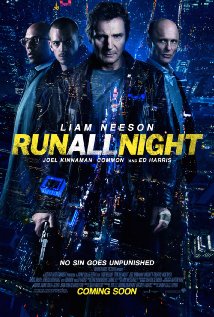 Nobody quite expected the second act that Liam Neeson is currently having. Before 2009, he was seen a dramatic leading man best known for portraying the titular businessman in Schindler’s List. And then Taken came out, and the world decided they liked their action stars with a dash of actorly gravitas, the kind of which was all too lacking from the likes of your Van Dammes. After so many films of Neeson pointing guns and barking at people, you forget that the man can act. That’s because, with few exceptions, the Neeson canon of action vehicles have been found enjoyable but insubstantial, momentary pleasures to be forgotten. The same can be said of Run All Night, a promising urban jungle thriller that’s a step above in several areas but ultimately another mildly entertaining film where Neeson points guns and barks at people.
Jimmy (Neeson) is a man haunted by his memories of his life as a hired gun for his pal, mob boss Shawn Maguire (Ed Harris). Jimmy is a drunk who is living off of Shawn, holed up in a crummy home, and eking out his lonely days. He walked out on his son, Mike (Joel Kinnaman), when he was young because he wanted him to have a better life. Jimmy thought his misdeeds would create a bad influence. Shawn is also experiencing his own problems with fatherhood. His son, Danny (Boyd Holbrook) is ambitious, dangerous, and addicted to drugs. He agrees to a business arrangement with Armenian mobsters before dad gives him the A-okay; when dad balks, Danny is on the hook. He murders the two Armenian mobsters who are looking for their money back. Unfortunately, Mike just happened to witness this execution. Jimmy defends his son, shooting and killing Danny. For the rest of a very fraught night, Jimmy tries to protect his son from the many forces of violence that Shawn has sent for vengeance. 
The premise of Run All Night is strong unless you say it out loud and examine it. I admire the film’s manner of weaving together storylines in a way that they feel like they’re crashing into one another and yet you could see their trajectory coming. That’s not to mean it’s predictable, which it is of course, but that the conflicts are properly established and set in motion. However, when you analyze the revenge-laden intricacies, it can seem like self-parody: “You murdered my son before he could murder your son. So I’m going to murder you.” “Oh yeah? Well I’m gonna murder you before you murder me for murdering your son before he murdered my son.” Gentlemen, commence your murdering. It reminded me of 2002’s Road to Perdition where a crime lord who readily admitted that his son was a dangerous hotheaded screw-up and had made a mess of things… and yet, he had to stick by him because… family. It’s a frustrating contradiction but it’s believable enough to hold onto. I just wish these crime guys could objectively calculate how guilty and irresponsible their kids are and cut them loose. Seriously, what exactly was Danny thinking when he killed the Armenian mobsters? Did he not think they were going to retaliate? Danny is the kind of irritating screw-up you want to strangle because he endangers others with his constant failures.
Screenwriter Brad Ingelsby (Out of the Furnace) has done his genre homework, and Run All Night is a slightly above average thriller that finds ways to flesh out its tropes amidst the urban jungle. After a steady first act, the majority of the movie is a series of chase scenes, several of which are shot and edited well by Neeson’s favorite director of his run and gun pictures, Juame Collet-Sera (Non-Stop, Unknown). The chase scenes make smart use of geography and the way Collet-Sera cuts back and forth with his parallel lines of action does a nice job of quickening pulses. A chase through a train terminal is well choreographed with Jimmy having to out run and out muscle goons and Mike ducking from encroaching police presence on the platform. Ingelsby has a knack for setting up organic suspense pieces and letting them loose. The final act feels a little pat from an action standpoint as well as a moral climax, but it does work. While the characters are birthed from familiar genre archetypes, the film adds interesting shadings to them. Jimmy’s loyalties are tested and he has a strong personal revelation that ties into this theme. The movies finest moment is likely a tense sit-down between Shawn and Jimmy shortly after the events of the night has been set in motion. It’s like Harris and Neeson are competing to see who can be more intimidating Oscar-nominated actor. Bonus: Bruce McGill (Lincoln) plays Harris’ number two and I love some Bruce McGill.
 And yet, I kept wishing for Run All Night to go back to the power of its possibilities. There’s a segment where the movie truly feels like it’s being taken to the next level, namely after the crooked cops have been taken out. Instead of just Maguire’s muscle coming after them, now Jimmy and Mike have the NYPD hot on their tail and none too happy about cop killers. That’s another category of antagonists, another chase participant. I also wanted the movie to keep going, bringing in the Armenian mob, which would be incensed and seeking vengeance after their ambassadors were killed. This movie could have had three categories of antagonists (Shawn’s goons, NYPD, Armenian mob) chasing after Jimmy and his son, and the ongoing conflict would have been terrific. The more people that are on the hunt, for their varied reasons, the more possibilities there are for strong and escalating suspense pieces. It could have easily gotten too complicated and convoluted for a mass audience, which is probably why the movie doesn’t reach its true suspenseful potential and follows a conventional route. The NYPD angle is only really incorporated during a building-wide search of an apartment complex where Jimmy and son are hiding. Likewise, the addition of a contract killer played by now Oscar-winner Common (Selma) is a wasted antagonist that doesn’t add much more to the group of bad guys. He’s better at killing, sure, but he doesn’t offer anything new except some hardware. He’s essentially an elevated heavy. He’s meant to serve as the threat after the threat, and no surprise, he does. I wish the character had more personality because he’s just too rote to separate himself. He’s just another ho hum killer in the mix.
There’s a plot point that annoys me to the point that I need to talk about it in more detail, though to do so requires some spoilers, so tread carefully, reader. At one point, Jimmy insists his son does not pull the trigger and kill Common. His wish is that his son would turn out better, and so he doesn’t want him to be forced to commit murder. They leave the contract killer who, you guessed it, continues to try and hunt them down and kills innocent people in the way. I understand the moral imperative Jimmy is going for, but let’s analyze this. It’s self-defense, he’s determined to come back and kill you, and you know innocent lives will suffer if he stays alive and well, whether on this job or future jobs. If ever there was a situation where maybe Mike isn’t going to be racked with guilt into the odd hours of the night debating the descent of his soul into moral decay, this might be the one. It’s one of those moments where the characters have to behave this way because the plot demands it and we need, as stated above, a threat after the main threat. Again, I’m reminded of Road to Perdition, which had a much better additional hitman.
Some things are better enjoyed at your leisure, and Liam Neeson’s action ouvere fits into that category. With few exceptions, a Neeson action film checks the boxes of what you’re looking for in genre entertainment, and with a strong Neeson finish, but rarely will you be surprised or elated. Entertained, sure, for the time being. Run All Night is an action thriller that has its moments and some well-drawn suspense sequences, and I appreciate that it tries to provide more depth to the main characters besides their preferred killing weapon of choice. However, there’s just too much squandered potential, underwritten supporting characters, and heavy-handed messages about the sins of the father. Run All Night is a solid genre thriller that does enough well to be worth your time, though you certainly don’t need to exert any energy to run out and see it.
Nate’s Grade: B-
Share this:

Focus (2015)
 The appeal and drawback of con artist films is that you know you’re being conned. You want to be fooled, but at the same time you’re conditioned to never take anything you see at face value, to be waiting for the turns and reveals and twists, and because of this fact it is rare for a con artist film to deserve more than one viewing. Focus fits this description. Will Smith is a smooth con artist who takes Margot Robbie (The Wolf of Wall Street) as his apprentice, but then he dumps her just as their feelings for one another get too real. It’s a shame then that the film peaks during its first act, when Smith and Robbie are first working together to shake down a gloriously irresponsible gambler played by B.D. Wong. The two lovebirds meet again in Argentina as they’re both circling the same rich mark. It’s fun to watch them mess around with one another and spar, and Robbie really shines, but the plot is just too formulaic to be anything more substantial. It’s fun and entertaining in spots, but the end is a cascade of twists that further muddle and complicate an already convoluted con caper involving secret race car fuel. The problem is you’re never engaged enough to forget you’re watching a con, and so you’re always suspecting every angle and doubting every character, which Focus eventually does confirm your suspicions. It’s nice to watch Smith transition into a less flashy role, though his effortless charisma still shines. It’s the kind of role he should be taking more often. You won’t have a bad time watching Focus but you won’t remember much in the morning.
Nate’s Grade: B-
Share this:

Project Almanac (2015)
 I’m going to take a stand right now and declare that Hollywood should simply stop making found footage movies. I don’t hate the subgenre itself, and in fact a found footage approach can be rather interesting if given proper attention and care, but that is just not happening nearly enough. Too often Hollywood execs view found footage as a hook and slap it onto a story that does not need to be told in this limited style. There’s no reason that a perfectly fine buddy cop movie like End of Watch needed a found footage angle, except that’s probably how it was sold. If you’re going to do found footage you better have a god reason why your characters are recording every moment, and most do not. You better stick to the principle that the only viewpoint is from the camera, and most do not. And you better stick to the limitations of this viewpoint, meaning who is editing these things after the fact and adding popular music to make montages? Found footage is too often underdeveloped in approach, a lazy selling point because “the kids” today like documenting themselves doing everything. But really, can you name the last found footage hit? The Paranormal Activity franchise is on the downturn and the last critically lauded one was 2012’s Chronicle. Don’t just stop making found footage movies because they’re too often lackluster; stop making them because the public has grown indifferent. Now, with all that being said, the time travel flick Project Almanac proves once again to be a film that never needed to be found footage to work. As far as January releases go (usually a dumping ground for studio bombs) it’s better than most, but the poorly titled sci-fi drama wastes its premise on the myopic doldrums of youth.
 David Raskin (Johnny Weston) wants to get into M.I.T. but his hard-working mother doesn’t have the money to make this happen. He discovers an old video of his seventh birthday party and is shocked to see an image in the background that resembles him as a teenager. He and his friends, Quinn and Adam, investigate the video. They enter the basement lab that used to belong to David’s father, until he died in a car accident shortly after that birthday recording. There they find plans for a time machine and the boys busily go to work assembling it, perfecting it, and charging it. Jessie (Sophia Black-D’Elia), a popular girl at school, stumbles into their first experiment and becomes part of the group. They have to keep this a secret and they must only travel back as a group. The freedom and possibilities are exhilarating, but soon enough David discovers a spiral of consequences that are difficult to correct without scrapping everything.
From a structural standpoint, this movie gets pretty lopsided and completely misuses the possibilities it established even as it arbitrarily throws its own rules out the window. Project Almanac takes far too long to get the time machine working. The teens discover the manual but it takes almost the complete first act before they successfully travel in time. Why do we have to wait a full 30 minutes and watch trial after trial? It’s not exactly like the audience demands a sense of scientific accuracy. Once the teens do travel through time, they set their sights very low: pass a test, get revenge on a bully, win the local lottery, and go to Lolapalooza. There is the limitation of only going back three weeks into the past, which eventually disappears, but could these kids not aim higher in their goals? When they do go to Lolapalooza, the movie drags and drags, and it’s here where I started to theorize what became of this film (more on that below). Once we come back from the festival, David decides to jump back alone to stop himself from blowing his opening with his crush, Jessie. However, there are disastrous consequences stemming from this and he has to debate whether to undo his good fortune with Jessie. Want to know what those consequences include? Seventy-seven people dying in a plane crash. Our main character seriously agonizes about keeping his new girl or the lives of seventy-seven people. And what would he lose? It’s not like he can’t be suave around Jessie ANY OTHER TIME. All he has to do is say something and kiss her. The hesitation and struggle over this is comically absurd, but the struggle illuminates where Almanac could have gone. These teens could have used time travel to save lives, but I guess that’s not as fun as seeing Imagine Dragons backstage and dancing.
Another problem is that, from a time travel standpoint, this stuff doesn’t really follow its own rules. The gang goes back at several points to repeat the same goal, but at no point do they run into different iterations of themselves. If they keep going back to fix things, and fail, and then go back again, that’s a continuation of one ongoing timeline, not a do-over. Time doesn’t reset. With every time travel story there’s the nagging nature of paradoxes but Project Almanac just ignores them, hence the lack of doppelgangers. At one point, Quinn even seeks out his past self to pull a prank, which sounds really stupidly dangerous from a space-time continuum standpoint to me. The movie ignores paradoxes… until it doesn’t. The entire third act is about the consequences of paradoxes, and now all of a sudden it matters. That doesn’t work. The main third act conflict is David not wanting to lose his girlfriend. He keeps jumping back to fix this and fix that but it’s all to save his girlfriend, which is pretty dumb, as I‘ve pointed out already that Jessie could still decide on her own at any point in the future to be his gal. Then there’s the conclusion, as we all know that we have to get back to that birthday party at some point. I consider myself a smart man but the end doesn’t make any sense because (spoilers to follow) it invalidates the timeline that we witnessed. David makes it so the events will not happen and the machine will not be constructed. But why is there evidence? Why is there still a tape detailing this whole process? It should be wiped.
Requisite found footage griping: why do they record every damn thing in this movie? The gang even breaks into their high school to steal hydrogen canisters from a locked science lab. Why would you record your crime spree? Why would you record people just driving in cars or walking up to school? Why would you record any of this? How do you clearly pick up audio from two people at a distance, mind you, at a freaking outdoor concert with lots of noise to cancel out any discernible dialogue?
 There are moments that I really liked, flashes that show how much fun or even clever Almanac could have been under other circumstances. One of these moments involves Quinn going back to save his grade. Originally he failed his chemistry presentation, so he thinks he’ll easily pass thanks to the foreknowledge that time travel offers. He goes back, lists the first ten elements on the periodic table, and then his teacher asks him another question he wasn’t prepared for. He goes back, prepared for the two, and then the teacher asks another he wasn’t prepared for. Over the course of going back, he is actually forced to study to prepare for this presentation, and so even though he thought he would use time travel to be lazy, it forced him into doing what he should have done in the first place. When they go back to win the lottery, they accidentally write down one wrong number, so their first jackpot prize isn’t the full amount. They bicker about going back, whose fault it was, and then the film cuts immediately to them holding the full amount in a novelty check. All the characters are devoid of excitement, because that excited moment of revelry already happened, and now this is just an exercise to get over. The photographer chides them to be more excited. That is a fun moment. The characters are rather likeable. There’s another moment where Jessie realizes that David went back to fix a slip-up so they would end up together. And she reacts exactly how she should, wounded and mistrusting. How can she trust what he says now? How can she not doubt every moment being carefully pre-programmed for a desired result? She was manipulated. This confrontation was missing from About Time where Rachel McAdams would have learned that her charming husband traveled back in time dozens of times to perfect his courtship, thus manipulating her own sense of choice. Poor Rachel McAdams never finds out, which seems like a completely blown dramatic development, and lives in cherished ignorance instead. At least Jessie gets to know the truth and behaves naturally. There are other little moments that are fun but they are distractions from what could have been.
Allow me to do some serious speculation about Project Almanac’s own past. This film was originally supposed to come out a year prior hence why every date is referenced as 2014. MTV Films expressed some interest in the movie and it was shelved and likely retooled. Except with time travel films, retooling can be pretty monstrous with its carefully placed plot beats. Here’s what I think happened. Originally, the third act was all about David going back to save his father from dying in that car crash. He likely does but there are dire consequences, and so he keeps going back to try and mitigate the negative repercussions while still keeping his father. Doesn’t that sound like a much more emotionally involving storyline? He’s got far more personal stakes in this scenario than simply losing his girlfriend who he can regain. He can’t regain dear old dead dad. It seems preposterous to me from a screenwriting standpoint that they would introduce a deceased parent and not use time travel to save said parent. It’s the ultimate setup. Instead, with MTV attached, we got to keep things lighter and more appealing to the carefree fun of youth, and so the gang goes to Lolapalooza instead where they can watch rock bands. I think MTV came in and jettisoned the third act and the direction of the script, imposing the festival, and reminding people how music is essential to being young and free and alive. I can’t say whether it’s MTV’s influence or producer Michael Bay, but there’s a slew of product placement from start to finish as well. I have no proof of any of this but I think there’s something to my conspiracy theory.
If you needed any other example of how close Project Almanac would uphold to its own sci-fi rule system, a character asks a good question about how they can understand something, and David says, “I’ll tell you later.” Hey, you want to know something important, just wait, where it won’t be answered. The found footage aspect brings nothing to the film, is poorly integrated throughout, and just plain unnecessary. The plot is too underdeveloped and lacking ambition, using the miracle of time travel to party in such limited ways. The concluding half feels too low in stakes and obvious in conclusion. Time travel is all about the untold possibilities, and Project Almanac will ultimately fall in that territory, a somewhat amusing but mostly unfulfilled sci-fi film that should have gone back to the writing stage a few more times.
Nate’s Grade: C+
Share this:

John Wick (2014)
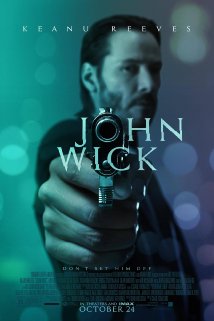 John Wick hits you like a breath of fresh air. The plot isn’t anything new. Once again a semi-retired hitman (Keanu Reeves) is pulled back into the fray. Once again Russian mobsters are the primary villains, a popular adversarial force in the fall of 2014. What makes Wick an enjoyable throwback is its dedication to action staging that is crisp, balletic, but most importantly, clear and engrossing action. Reeves may not be as agile as he once was when he first learned kung-fu, but the man still has some serious moves, and the action choreography and stuntwork of Wick allows him to display them in long takes with lots of decisive movement. It’s no Raid 2, but it’s well ahead of most American action films of late. There’s a nice variety of action along with lots of casual headshots, which seems only natural for a trained hitman. Then there are the small touches that add intrigue and help it stand from the pack, notably a hotel with an exclusive clientele of hitmen and women who must abide by a set of rules while on “safe ground.” It’s just enough to make a well-worn genre start to feel different again. The problem with John Wick, however, is that it runs out of steam too quickly, peaking right at the beginning of Act Three. There’s a whole other twenty minutes where the film has to establish a new antagonist to get us to the finish line. It just feels like John Wick accomplishes his goal too quickly and the movie doesn’t know exactly what to do after. The conclusion of several storylines feel clumsy, drawn out, and anticlimactic. But when it’s working, John Wick is a stylish and bloody action thriller that is fun and with the right sense of macabre humor to halt it from ever getting too laboriously serious.
Nate’s Grade: B
Share this:

American Sniper (2014)
 When killing is a man’s gift, what effect does that have on the man? American Sniper follows the real-life heroics of the most prolific sniper in United States history. With director Clint Eastwood attached and awards buzz building, you’d expect that the film would get at the heart of a complex man who placed himself back into danger by choice. For a biopic on Chris Kyle, the man seems to get lost in the fog of war (movies).
Chris Kyle (Bradley Cooper) enlisted in the military right before 9/11 and served four tours of duty in Iraq. He served as cover for many missions, protecting thousands of soldiers. The troops just felt better knowing that Kyle had their back. Kyle got married and had several kids with his wife (Sienna Miller) but he kept leaping back into the fight, the place he felt he belonged.
 From the opening sequence on, American Sniper is often a gripping suspense piece. The opening moral dilemma sucks you right in. Should Chris shoot the mother and child? Are they a threat or is there just a misunderstanding? Will they change their minds and turn away? Is there time to debate all this with advancing U.S. troops? Eastwood does a great job of drawing out the tension with shot selections and the precise editing. The bulk of the movie hews closer to a conventional action movie, with Chris and his team clearing out Iraqi insurgents. We get to know a bit about the mechanics of sniper warfare. But Kyle gets restless being the guardian angel of death for the ground troops, and he goes down to their level and clears neighborhoods. This causes some conflict with his superiors because Kyle is far more valuable as a sniper. His reputation for killing is also getting him notoriety with his enemies. There is a price on Kyle’s head and skilled snipers are seeking him out for the prize. This is a natural way to build suspense as Kyle keeps returning back into Iraq with multiple tours, every tour increasing his personal danger. It allows for real consequences for the increasing prowess of our super sniper. There’s a sense of collateral damage to every kill, as every dead body creates more enemies and those enemies grow more incensed to take him out. Even if you know how exactly Kyle met his untimely end, there’s still plenty of suspense and well-orchestrated action sequences to please casual fans of the genre and true-life military thrillers.
It does feel like the complex story of Kyle, as well as the Iraq War, are being simplified into action movie fodder. There’s a steady supply of interchangeable supporting players, soldiers and spotters and the like, all of them without much to distinguish them as characters. They’re here to be sacrificed, to watch the splatter of red, and to increase the sense of loss because we know that Chris Kyle will not be taken down so we need other expendables. As expected, Miller gets rather short shrift as Kyle’s wife who gets to alternate between worry and unease. The screenplay by Jason Hall sets up some excellently harrowing suspense sequences but seems better engineered like its establishing video game stages of combat than complex people. As a result, when we lose characters it doesn’t feel like we’ve lost people we care about. It doesn’t have an impact beyond sudden shock, and even that is tempered in time with the sniper angle. You start expecting characters to get popped in mid-sentence.
 Where the film leaves you lacking is at its center with the man who is supposed to be the focal point of American Sniper. At the start we’re told that Kyle is the deadliest sniper in U.S. history and by the end that’s about all we know about the guy. He’s an ace killer. The movie has some top-notch suspense sequences with Kyle killing people. The early scenes with Kyle’s family do the bare minimum to establish a sense of pride in not backing down from a fight. There’s a scene where his girlfriend explains to him and the audience exactly why he’s difficult. It’s pretty transparent exposition but it’s also the last bout of clear characterization you’ll get until the end. There’s a slight nod to the mounting PTSD that is transforming Kyle into a man who feels whole only on the battlefield, but these are notes of characterization that are only cursory. It’s only at the very end does the movie remember to flesh out Kyle as a person rather than as an action hero, and by then there’s only enough time to hint at elements we’ve seen explored better in other war movies, particularly The Hurt Locker. As an action film, the movie works and works quite ably, but as a biopic on Chris Kyle it forgets what makes him human, instead focusing on his superhuman killing ability.
Cooper (American Hustle) bulked up a considerable amount of muscle to portray Kyle. He fits the part well and has the acting ability to communicate the troubled psychology of a man making sense of his old world after the trauma of war. It’s then a shame that he’s not given more opportunities to use those acting muscles. There is one phone call where Cooper wordlessly finally breaks down, allowing all the scar tissue to finally be seen on his haunted character, but it’s a moment rather than a culmination.
If you go into American Sniper hoping for an elevated thriller with some well-wrought suspense, then you’ll mostly be pleased with the film as a slice of entertainment. As a war commentary or a psychological study of the horrors of war, it comes up lacking, falling back on the action tropes of its genre and neglecting to properly build around its characters. The action is often biting, and a late sequence involving an oncoming sandstorm is an intense climax. However, it’s also emblematic of the shortfalls of the film. While it’s a sequence of action entertainment, it also reduces war into a video game and reminds you that the characters onscreen are not so much portrayed as people but holders of weapons. Kyle was a complex man who was more than his uncanny ability to kill, but you won’t get more in American Sniper. The nature of his death demands a more insightful exploration of the lasting effects of PTSD and what kind of treatment, or failure of treatment, many servicemen receive once they come home.
Nate’s Grade: C+
Share this:

Unbroken (2014)
 Angelina Jolie is one of the biggest stars on the planet but as a director she’s still a mystery. Jolie was so enamored with Lauren Hillenbrand’s best-selling novel Unbroken that she felt like she was the only person who could translate this story to the big screen. Somehow that passion got lost in translation.
Louis Zamperini (Jack O’Connell) is a man who ran for his country in the Olympics. He fought on a bomber plane over the Pacific. He was shot down and survived in a raft for over 40 days at sea. He was taken to a Japanese P.O.W. camp and endured harsh and cruel treatment, and he still persevered and returned home a hero.
It’s hard not to feel a general calculation about the entire film. I’m not trying to say that Jolie or her crew had any sort of nefarious ulterior motives, but the entire product seems like it was made in an Oscar Bait factory. This is the kind of movie that the Academy typically salivates for, and it’s based on a true story, and it’s set during World War II! There’s a reason that, sight unseen, Unbroken was often at the top of the prediction lists for Oscar pundits. It is those same Oscar-friendly elements, though, that act as a detriment to the story, because the thematic elements stand in for the story and sense of commentary. The movie is so caught up with Louis’ dilemma that it forgets that it needs to make you care about him as a person rather than a martyr. The biggest hindrance for Unbroken is just how little it develops its protagonist. The only emotion he seems to exhibit in the two-plus hours is suffering. The guy ends up being a human punching bag with the movie clobbering the audience with the same message again and again as well, the will to survive. Unlike other war stories or concentration camp survival tales, Louis doesn’t survive through any great networking of allies, skill, scheming, or prescient decision-making. We do not see him adapt and outsmart his adversaries. He merely outlasts them as he wastes away. Like what I wrote in my review of last year’s Best Picture winner 12 Years a Slave, I need more characterization than suffering. It’s a frustrating experience because you know there has to be more to this character.
 The danger with any film that purports to tell a true story of a hero is making sure the audience doesn’t lose sense of the person beneath the hero. We glorify their positive qualities and what we admire but when placed upon a pedestal, our heroes can start to become otherworldly, separate from the rest of us mortals. A biography that idealizes its subject is called a hagiography, and that is where Unbroken falls. Louis Zamperini is lost in this story, instead replaced with Louis the Survivor or, occasionally, Louis the Runner. Amidst the swelling music, the pretty cinematography, and the supporting characters channeling the audience with their encouraging mutterings of, “Come on,” and the like, Louis is painted more saint than man, which is a shame. Considering all of the peril he survived, it would make sense for him to struggle with his own doubts and fears. The most we get a sense of him and his internal struggle is when he prays aloud to God during a thunderstorm at sea and Louis promises to serve Him somehow if he survives. The movie forgets about this moment until the end credits text. If Louis Zamperini is going to be the focal point for a true story of heroism, then the movie needs to do better to make him human rather than resorting to having him only bleed.
The entire first act flashbacks could likely have been jettisoned. Watching Louis as a young man learn to run and then eventually compete in Berlin’s Olympics (way to take all of his luster away, Jesse Owens), we expect these moments to have relevance again, pointing toward some kind of grit or training regiment or lesson learned that will become useful or comforting solace during his internment. It all boils down to one skill, endurance, and that’s all we keep coming back to. We don’t need to see the Olympics or his younger life to establish as back-story in the P.O.W. camp, just as we didn’t get back-story for the prisoner who was revealed in the moment to be a concert musician. The flashbacks do little to flesh out Louis as a character. He was a troubled son of immigrants and found popularity and purpose with running, which he did to the Olympics, and then… the war. Too bad running doesn’t really come into play during his torment in Japan. I understand that we’re working with a true story but what has been added by including 20-30 minutes of flashbacks, particularly when they fail to illuminate our main character? Skipping right to the war, with perhaps a smattering of brief memories during physically and mentally fraught times, would have been preferable and more useful.
The other aspect that makes Unbroken frustrating is the potential it does flash in sparse moments. For the majority of its running time, the film is a perfectly decent war drama with an extra glossy sheen to it provided by expert cinematographer Roger Deakens (Skyfall). When adrift at sea, there’s an inherently interesting survival story there. Louis and his comrades are still in an active war zone. In one scene, a plane approaches and the guys realize late it’s no rescue but a Japanese fighter plane. They leap into the ocean as the plane fires bullets after them. This scene is made all the worse by the fact that sharks are swimming below. There’s an extra kick of dread worrying what will happen next if anyone gets wounded or killed by that gunfire. It’s a great sequence, but then it’s over and the film goes back to autopilot glorifying the resolute nature of Louis. Likewise the opening with Louis crawling along and having to manually close the bomber plane’s doors during a dogfight is great. Unbroken does get a lift when it introduces its main antagonist, Watanabe (played by rock star Takamasa Ishihara), nicknamed “The Bird.” The film now has a sense of direction and a renewed sense of danger with “The Bird” eager to break down his Olympic prize runner. The story feels more personal and interesting and it feels like this fresh antagonism will allow us to develop Louis more as a character. Sadly, he remains the same film martyr.
 This is Jolie’s second film as a director and she’s revealing some pretty old-fashioned tastes and instincts. Actors are judged at a somewhat harsher standard when they turn to directing, but the audience must simply ask if this person elevated the performances of their actors and whether they found an incisive and insightful way of telling a story. The jury’s still out on Jolie as a directing talent. The direction is more than adequate and quite fine, especially aided by having a team of gifted technicians. If you had taken Jolie’s name off the film I wouldn’t be any more or less effusive. Perhaps a more experienced director would have insisted on fixing the screenplay’s development, but then again, perhaps that director wasn’t going to get the gig of a major Oscar bait film for a studio.
I’ve spent the majority of this review criticizing Unbroken and may have given the impression that it’s a bad movie. It isn’t. It is a perfectly fine film by all accounts and a movie that will likely find a welcoming audience this holiday season. It’s got emotions and survival and danger and all set to a rousing score. It looks the part of an Oscar contender and that will be enough for many ticket-buyers. Unbroken is a perfectly good-looking tale of survival that unravels upon reflection. The necessary work of building up strong, complex, interesting characters takes a backseat to setting up a series of punishing obstacles for our protagonist. It’s like the filmmakers wanted to make an inspirational tale but didn’t want to complicate that with ambiguity and nuance and doubts. Louis is canonized in the movie’s flattering glow, and his suffering is shrugged off as “character-building.” Cogent or potent commentary on war, man’s capability for evil and good, or the nature of forgiveness, are absent, which means the film can only go as far as the immediate impact of its plot beats. Supposedly the whole movie was about forgiveness but I got no sense of that until the end credits. Unbroken is a by-the-book rendition on how to make a movie that looks good and about Important Things. It just lacks the deft storytelling, characterization, and subtext to make it important on its own.
Nate’s Grade: B-
Share this:

Nightcrawler (2014)
 The surprise of Nightcrawler is that it works well on different levels: as a psychological descent with a deranged lead, as a media critique on sensationalism, and as a genre thriller. Jake Gyllenhaal (Prisoners) gives a truly transfixing performance as Leo Bloom, an ambitious sociopath who will stop at nothing to become the best at what he does. It so happens he films accident and crime footage to sell to the local news stations, and he’s not beyond getting his hands dirty if it means a better camera angle or a better payday. The actor reportedly lost 30 pounds and he appears otherworldly, his lanky frame and gaunt face making his bulging eyes pop. There’s a hypnotic intensity to his performance and a darkly comic irony that he speaks almost entirely in business buzzwords and jargon. The film chronicles his rise to power and how he uses his leverage to manipulate the people around him. The media satire is a little heavy-handed but still makes its points, especially in an age of scandal and hysteria. Rene Russo is also great as the desperate and bloodthirsty news producer who is charmed by Bloom but then gets too far in. Writer/director Dan Gilroy (brother of Tony) has crafted a haunting central figure that is morally repulsive yet entirely engaging, especially with a career-best performance from Gyllenhaal. He’s a fascinating psychological case, even if he remains relatively the same character from the start. He makes every moment an opportunity in suspense. Gilroy has a natural sense for visuals and especially how to pace his tension, drawing it out with precision in the final act as Bloom’s arrangements cause disaster. The nighttime Los Angeles setting and swirling tension remind me of Michael Mann’s Collateral. This is a movie that sticks with you long after thanks especially to the power of Gyllenhaal.
Nate’s Grade: B+


You must be logged in to post a comment.