Blog Archives
American Beauty (1999)
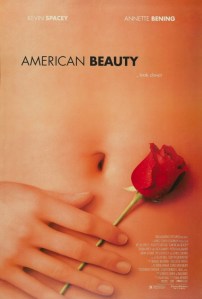 American Beauty balances between dark comedy and moving drama not only well but tremendously on target. It’s a slice of life showing the dark side of a faceless and cold suburban life. The deterioration of a family and the escape of one man as he realizes the trivial nature of the things that get in the way of seizing life. American Beauty is not a rose for everyone but it’s one standing out from the pack screaming to be picked.
Kevin Spacey plays Lester Burnham, the husband and father of our story’s family. Life has been sucked dry from his system and he’s lost interest in everything he holds around him.
Annette Benning plays Carolyn Burnham, mother and wife. She breaths the mantra, “To be successful one must present an image of success at all times.” like she was beating a Bible until it bled. She’s a woman whom image is everything, and looking good is all that matters. She has become so detached from her family and life that she has actually lost her humanity in the hunt for success while waving her cheerful smile as a mask that eludes to the superficial inside. Carolyn is a woman who refuses to let herself fail or have weakness, and those around her to make her seem weak.
 Thora Birch, of Alaska and Now and Then fame, is the estranged daughter to Spacey and Bening. She feels alienated from her parents, and despises them from easily seeing through each. Thora discovers new ways to feel contempt for her parents with each day. She is a repressed child who is looking for an outlet of understanding and help. Enter pot dealing creepy new neighbor Wes Bentley. He sees true beauty where no one could, and is the escape and shoulder that young Thora has needed all her life from her monstrously neglectful parents. Wes videotapes everything in an effort to keep the memories of beauty alive to venture back and relive the moments. He shares his prized image with Thora one day, that of a plastic bag inflating and deflating with the autumn breeze as it swirls around almost balletic dancing. The image is mesmerizingly hypnotic and you understand that Wes is a character who looks beneath the surface and most likely the most noble in the entire movie.
Mena Suvari switches from sweet choirgirl from American Pie to ditzy teen vamp. She is a person who feels such insecurity for herself that the only happiness she can arrive is from being wanted by other people. She must have acceptance in some form or another, and “ordinary” to her is a worse word than “ugly.” She acts like a teen nympho but in the end reveals that she is really an innocent young girl desperately wanting to be liked and wanted.
There are other characters that round out the cast; a brief appearance with Scott Bakula who makes a quantum leap into a gay neighbor, Allison Janney as the mother to Wes and the silent hollow image of a wife she has become to socially hide her husband’s secret, Chris Cooper again as an abusive father who’s maliciously homophobic but hiding a devastating secret deep within, even Peter Gallagher with the biggest eyebrows you’ve ever seen as a suave real estate mogul that knows how to cater to Carolyn’s thematic problems.
 The basis of the story hinges on Lester’s reawakening. He is a man going through the motions of life like a walking dead man. A man who tells people that even he wouldn’t remember himself. Lester is an unhappy cog until viewing his daughter’s friend Angela (Suvari) at a high school basketball game. At first glimpse she becomes the intense object of his desire and obsession, and his focus on life centers around this young gal. But with that moment Lester’s life is broken, and his eyes are opened for the first time in a very long time. He sees the trite redundancy with the day-to-day grind of ordinary suburbanite life. Lester breaks free and does what he wishes, he is a free man. Free of his job, his nagging ice queen of a wife, free of all worries and fears.
As far as Oscar races go, all others don’t even bother filling out an application for an invitation – Spacey has Best Actor locked. He might as well start clearing a space on his shelf next to the one he got for The Usual Suspects. Spacey is so wonderfully wry and self degrading that he transforms into an actually likeable almost laid back hero for the audience. They know his tragic fate and feel good when he gets the most he can with each day, and not letting himself be pushed around anymore. Benning is also delightful and wickedly hilarious in her materially overzealous soccer mom. Birch is excellent showing the pains of alienation and showing that despite what her character thinks she is really the last person on earth who needs a boob job. Director Sam Mendes’ first feature after touring the theater circuit shows his devotion to characters and actors with subdued symbolism layered between every frame of film. I say Oscars should go all around and this movie deserves a good swapping of gold statuettes.
I could go on talking about the depth and characters for hours but I’ll just stop here and say that you won’t see a more engaging, compelling, and brutally honest and sadly funny film in the entire year of 1999. One of the best films not only of this year but of the entire decade.
Nate’s Grade: A
Share this:

Fight Club (1999)
 Fight Club is a movie that will kick you in your teeth. It’s the adaptation of a sort of anarchist handbook by David Fincher, the man who gave us the grisly masterpiece Se7en. Fincher’s latest re-teaming with Brad Pitt is a disturbingly gritty tale of politics and violence.
Ed Norton plays our un-billed narrator through the harrowing tale of fascist propaganda and anti-social behavior. Norton dwells in a world of cubicles and consumerism. He meets Brad Pitt’s Tyler Durden on a flight and the two instantly connect. Norton moves in with Pitt into something resembling the Munster’s house once his own apartment has exploded. Pitt and Norton find the therapeutic realization through fighting. These fights grow larger and build up into clubs where all the guys are fighting to get in to get their head slammed on concrete. These clubs start turning into neo-fascist soldiers of fortune as they try to ambitiously grow and destroy the reality of consumerism. It kind of spins out from there and never returns back.
David Fincher’s direction is ultra slick and highly stylized. He is one of the most lavish and intriguing visual artists of this decade. He really knows how to pump out excitement and vivid hypnotism from striking images and tones strewn apart every inch of letter-boxed form. Norton has the same commanding presence and magnetic performance that he flashed so brilliantly in last year’s American History X. Norton is the one that runs the emotional gambit and shows just how it should be done. Brad Pitt takes on a role none have seen (Does anyone remember Pitt splicing porn images into children’s films with Legends of the Fall?) and once again proves there’s a calculating and superb actor behind the pretty face. Helena Bonham Carter goes leaping against type to play the bumbling Goth love interest with such charm and humor. And Meat Loaf will really surprise as a pathetic breast enhanced friend to Norton.
Fight Club speaks to a world where men feel they have been robbed of what has historically defined them; a world with Oprah, The English Patient, and self-help groups telling them to cry, be kind, rewind. All of the social consciousness has made some men feel less like their upright ancestors. So Fight Club‘s proposition is that to freely express your emotions you need to either be pummeled into ground round or be the one doing the pummeling. The notion is a tad laughable. Fight Club is a flick with so much on its mind to say that it brisks from topic to topic sometimes not dwelling as much as it could. The twist ending is unnecessary and is something that truly comes out from left field.
Fight Club has been criticized for its promotion of violence, but if anyone actually sees the film the violence is gruesomely repellent. No kid is going to walk out of this and think it would be cool to start a Fight Club in their local suburb. The movie is an interesting mirror to our always-on-the brink commercial society, and its push toward a kinder gentler civilization and its effects on the male psyche. Despite some oddities at the end and some fascistic rhetoric, Fight Club is an exciting blend of suspense, action, and dark humor. Go ahead and break the first rule of Fight Club – tell your friends about the adrenaline kick this movie is.
Nate’s Grade: A
Share this:

Dick (1999)
 What should have been a biting satire on the whole Watergate mess and Nixon’s resignation comes off as hackneyed and clumsily written. The jokes are stale and moronic, the script is sophomoric, and the satire is not even close to biting. It all appears like it was written by a freshman that got the Cliff Notes on Watergate then decided to watch an episode of Charlie’s Angels.
Kirsten Dunst once again manages to make me question when I will ever enjoy her in a performance. The ditzy girls idea grows thin by the opening sequence let alone stretched to the rest of the movie. There are some bright spots like Dan Hedaya playing Nixon uncannily, and some former SNL and Kids in the Hall alums having fun with the material and parodying their characters. So why didn’t they feature more of them?! Please tell me! The movie is lame and unfunny, and even more so when you account all the double entendres using the name “Dick.” I could very easily use the title of the movie in some sexually inuendous reference to how bad this movie sucks, but I’m above that. For now.
Nate’s Grade: C
Share this:

South Park: Bigger, Longer, and Uncut (1999)
I ‘ll start off and say I had fallen out of favor with the show at the time and really wasn’t interested in seeing the movie. But after being dragged along by a group of friends against my will I’m very glad I did.
I don’t fall into hysterics by hearing eight-year-old cartoons use the F-word profusely like many in my theater, but luckily for me there was plenty of wit to go around. The movie is riotously funny and I often found myself at times having to grip the armrest so I wouldn’t tumble out of my seat.
The movie could have been easily re-titled South Park: The Musical with the batch of 14 original songs they have that parody the Disney formula tunes and classic Broadway renditions. The songs are dead-on perfect at parodying their designed targets. The music is so brilliant and catchy that it deserves to be nominated for an Oscar for Best Original Comedy or Musical score if there is any justice in the film community. Never thought you’d see the words South Park and Oscar in the same sentence did you? Well neither did I.
The movie even plays witness to issues circling our country today like knee-jerk reaction to assess blame, responsible parenting, and blaming Hollywood media. This is a true piece of comic brilliance as they satirize anything and everything and so damn well. There are those that might take offense to some of the racial jokes but take it with a grain of salt because pretty much every person of race, creed, culture, and what not will be a source of humor. After all, that’s what Brian Boitono would do.
Nate’s Grade: A


You must be logged in to post a comment.