Blog Archives
Hit Man (2024)
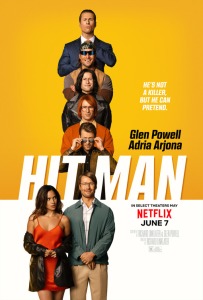
Hit Man is a movie that is wonderfully hard to describe. The premise has an easy-to-grasp hook that promises fun and hijinks, but where it goes from there takes on as many transformations as its protagonist, Gary Johnson (Glen Powell). It transforms from a fun game of undercover conning with wigs and silly accents into an unexpected rom-com hinging upon mistaken identity, maintaining assumed appearances, and secrets that then transforms into full film noir without losing its unique identity and the stakes of the character relationships. If you’d expect any filmmaker to pull off that trick, writer/director Richard Linklater has to be one of the best to keep things running smoothly, and that he does, as Hit Man is a crowd-pleasing comedy with some unexpected directions to keep everyone guessing until it lands on its own morally gray terms.
The movie is also, chiefly, a showcase of star and co-writer Powell, a handsome young actor hitting a new ascent of his career with last year’s Anyone But You and the upcoming Twisters. Powell is probably best known as the smirking guy you loved to hate in Top Gun: Maverick, but he’s also played memorable supporting roles in Scream Queens and three other Linklater film projects, notably 2016’s Everybody Wants Some!!, a pseudo-spiritual sequel to the seminal Dazed and Confused. This is Powell’s acting showcase and he’s utterly terrific. He has great infectious fun getting into the various hitman characters, which mostly exist in montages, and trying on different personas and voices. I cackled when he was doing his impression of Christian Bale’s Patrick Bateman, and I smiled throughout most of the other personas. It’s easy to see the network TV version of this premise, where every week Gary adopts a new persona and disguise to bust the next possible criminal from hiring a hitman, like an edgier Quantum Leap). The culprits are played like nitwits but then again the police are also played as nitwits (are there THIS many attempted hitman hirings in one city for the police to have a full-time unit?).

But before this acting experiment can get too broad or too redundant, Linklater and Powell switch things up. Around the Act One break is where Gary meets Madison (Adria Arjona), and that’s when everything changes for him and the audience. Now we have emotional stakes, because Gary intervenes to save Madison. While the circumstances of their first meeting involve her wanting to kill her husband and believing Gary as the professional to do such a job, the scene plays as a disarming first date you’d find in another charming romantic comedy, where it’s clear to anyone with a pulse that these two have something together. Instead of busting her for the solicitation, he pushes her to change her mind, take the money and leave her no-good husband rather than finding a questionable man to eliminate him. From there, they form a romantic relationship that fluctuates wildly. She thinks Gary is “Ron,” the suave and confidant persona Gary adopted for their sit-down. So the nerdy tech nerd who teaches philosophy must pretend to be the daring and dangerous man of mystery he wishes he could be. The script doesn’t get carried away with its farcical elements in play, juggling multiple identities for multiple specific audiences, but it asks the question, “Why can’t the milquetoast Gary simply be Ron? Is this an unexpected means of self-actualization for the nerd to win the girl?” Through this extreme exercise, Gary can mold himself into the man he would like to be. The rom-com is flirty, funny, and just as enjoyable as the earlier wacky comedy of being a versatile master of disguise.
It also really helps things when your two lead actors have such strong chemistry. Powell and Arjona (Father of the Bride, Andor) are smoldering together, like full on “get a room already” territory. This lends even more credence when Hit Man makes its next transformation into film noir thriller. I won’t divulge the specific plot elements but it all works with what Linklater has already established. There’s trouble for the both of them, and the question becomes how far is each participant willing to go to stay above the fray. The transition from silly costume comedy to sundry noir thriller is handled so naturally, as if the characters, already existing under such unique circumstances, found themselves in the elevated movie-movie version of their crazy relationship. Rather than feel contrived, Linklater and Powell have put in the work to make these twists and turns credible and exciting. The shifting nature of the movie is a wonderful reflection of its fake hitman hero. There’s a scene late in the film, where all of our principal players have come together, and you have characters saying one thing, intimating another, for different versions of different audiences, and it’s such a masterful tonal dance that feels satisfying as a climactic turning point as well as genuinely impressive for all the myriad subtext in play.

This is a clear-cut case of a movie being “inspired by” a true story rather than being “based on” a true story. Generally, we expect the “based on” stories to have some voracity to reality. We accept that there will be alterations for dramatic purposes, externalizing the internal, condensing timelines and characters into a more accessible structure, etc. If you go to a movie about Jackie Robinson, you don’t expect to see the famous baseball slugger fighting space monsters (“Racism was the real giant monster all along”). Hit Man is based upon a 2001 long-form news article by Texas Monthly journalist Skip Hollandsworth, the same author of the source material for Linklater’s fascinating true crime dark comedy gem, 2011’s Bernie, which I highly recommend (a career-best Jack Black). The real Gary Johnson really did pose as a fake hitman for the purposes of catching real criminals, but the rest of the movie exists in its own fictional universe of dramatic complications. Usually we want our film stories to have more fidelity with the truth and reality, but I’m glad Linklater and Powell recognized the sheer storytelling potential of this quirky premise. Sticking to the facts could have told an amusing story, but feeling confident to take bold leaps with well-worn genre motifs, when called for, is the right call for making the most of this tale.
The shame of Hit Man is how quickly it will likely be subsumed by Netflix’s suffocating tidal waves of content. Here is a fun, likable, and surprising indie comedy with definite mass appeal buoyed by great performances, clever writing, and a tonally shifting narrative to keep things fresh. Powell gets the breakout showcase he deserves and we get one of the most unexpected and amusing rom-coms of recent years. Hit Man is a movie that deserves to be seen, to be enjoyed with a crowd, but I worry it will get lost in the shuffle of streaming titles. I suppose this might just be the current reality for fans of mid-level adult dramas and comedies. At least they have a home on the streaming networks even if these movies would have been theatrical breakouts years ago. Regardless, Hit Man is a good time with good people pretending to be bad, or is it bad people pretending to be good, but whatever pretense, it’s a charming winner worth your two hours.
Nate’s Grade: B+
Share this:

The Last Stop in Yuma County (2024)

As a general rule of thumb, if some movie is described as “Coen-esque,” I must watch it. The Last Stop in Yuma County is a blend of Coen darkly comic malevolence, as well as Tarantino’s knack for the menace of dramatic irony and boiling tension waiting to explode, and it’s a firecracker of a debut for writer/director Francis Gallupi. It’s a relatively contained tale, sticking mostly to one rustic roadside diner and gas station along the dusty Arizona byways. On this day, two of its patrons happen to be recent bank robbers on the run, and they’re holding the other diner patrons captive until the gas pumps get fixed to fuel up and escape. The first hour then becomes a dread-filled game of waiting for things to go very badly. Our two main characters, a traveling knife salesman (Jim Cummings) and a waitress (Joceline Donahue) who happens to be the wife of the town sheriff, are working together to try and elicit help without endangering their lives, all the time more people keep entering the diner and inadvertently joining the simmering hostage situation. The way Gallupi writes his different characters is sharp and efficient, and the dread compounds in such organic complications, showing how fiendishly well-developed he’s made his potboiler. It also has a clear eye for style. Around the Act Two break, the movie becomes something else, which it intimated through a very specific film reference in conjunction with a specific character reference. It still proves compelling, but the overall sense of darkness and tragedy wore me down a little by the end. By the conclusion of its 90 minutes, I was hearing the saintly voice of Marge Gunderson in my head, shaking her head at the preventable body count and bad choices (“And all for a little bit of money. There’s more to life than money, don’cha know?”). The Last Stop in Yuma County is a twisty and twisted little macabre morality play in the guise of familiar Coen-esque capers. Welcome to the big leagues, Gallupi.
Nate’s Grade: B+
Share this:

Late Night with the Devil (2024)/ Immaculate (2024)
 Late Nigh with the Devil is an intriguing novelty, a found footage item of 1970s late night talk show fame reportedly documenting the last show of Night Owls, a talk show hosted by a man who recently lost his wife to cancer and is also slipping in the ratings and losing his traction in the industry. So Jack Delroy (David Dastmalchian, best known as Polka Dot Man in 2021’s The Suicide Squad) gets the great idea to hold an exorcism live on stage or his big spooky Halloween show. What could go wrong, right? The movie is dedicated to upholding the style and awkward tone of 1970s talk show, and its commitment is by far its most interesting aspect to the found footage sub-genre. I wouldn’t classify the movie as necessarily scary, but it held my attention and I appreciated the corny little nuances of recreating an older form of television and comedy schtick, with a growing sense of foreboding as things start to get progressively worse and Jack pressures his new girlfriend, an occult writer, to bring out her possessed pupil. It takes a little long to get going, and the overall conspiracy of Jack’s connection to an Ilumminati-esque showbiz cult feels so tangential to be important, but I was objectively impressed with the overall recreation of an archaic form of TV. The conclusion, once all chaos is finally unleashed, breaks the rules of the found footage setup but at that point it’s welcomed and things can get a little more weird and visually audacious. Late Night with the Devil works more as a late-night curiosity than a boo-style horror thriller. I appreciated the committed efforts and artistry, as well as the game actors and some wicked gross-out makeup prosthetics, more than the overall movie.
 Nuns in Distress has long been a horror genre staple, as the mixture of Catholic imagery and overwrought religious themes proves an unbeatable mix with classic exploitation elements, the depraved and the sanctity. To this we have Immaculate with rising starlet Sydney Sweeney (HBO’s Euphoria) as an American nun traveling to a remote Italian convent and becoming an unwitting victim in a sinister ploy to gestate a new potential messiah. While very serious and broody in presentation, Immaculate is a pretty by-the-numbers mystery that goes to its most obvious route and becomes an overextended hostage thriller for Sweeney. The movie is at its best when it gets crazy, and that includes Sweeney, when she’s allowed to be all-out histrionic. For too long, the movie is too somber and simmering, which works best if the mystery is at least involving and surprising or we build to a great gonzo finish. I wish the movie was more wild. The ending is the best part of Immaculate, where Sweeney is pushed to the point of intense madness, while splattered in blood as per genre rules, and is forced to make extreme and personal choices. In that regard, perhaps Immaculate best operates on a metaphorical level about the horrors of pregnancy, more forced birth from oppressive leaders, and restricting women’s autonomy in a post-Roe v. Wade world. It’s a long wait to that worthwhile finale, and you might get restless from your unholy wait.
Nate’s Grades:
Late Night with the Devil: B-
Immaculate: C
Share this:

The Passion of the Christ (2004) [Review Re-View]

Originally released February 25, 2004:
The Passion of the Christ is a retelling of the last 12 hours of Jesus Christ’s life (perhaps you’ve heard of him?). In these final hours we witness his betrayal at the hands of Judas, his trial by Jewish leaders, his sentencing by Pontius Pilate, his subsequent whippings and torture and finally his crucifixion. Throughout the film Jesus is tempted by Satan, who is pictured as a pasty figure in a black hood (kind of resembling Jeremy Irons from The Time Machine if anyone can remember). The Passion spares no expense to stage the most authentic portrayal of what Jesus of Nazareth endured in his final 12 hours of life.
For all the hullabaloo about being the most controversial film in years (and forgive me for even using the term “hullabaloo”), I can’t help but feel a smidgen of disappointment about the final product. The Passion is aptly passionate and full of striking images, beautiful photography and production values, and stirring performances all set to a rousing score. But what makes The Passion disappointing to me is the characters. You see, Mel Gibson’s epic does not devote any time to fleshing out the central characters. They are merely ciphers and the audience is expected to plug their feelings and opinions into these walking, bleeding symbols to give them life. Now, you could argue this is what religion is all about, but as far as a movie’s story goes it is weak. The Passion turns into a well-meaning and slick spectacle where character is not an issue. And as a spectacle The Passion is first-rate; the production is amazing and the violence is graphic and gasp-inducing. Do I think the majority of people will leave the theater moved and satisfied? Yes I do. But I can’t stop this nagging concern that The Passion was devoid of character and tried covering it up with enough violence to possibly twist its message into a Sunday school snuff film.

For my money, the best Biblical film is Martin Scorsese’s 1987 The Last Temptation of Christ (also a film mired in controversy). Last Temptation, unlike Gibson’s spectacle, was all about Jesus as a character and not simply as a physical martyr. Scorsese’s film dealt with a Christ consumed by doubt and fear and the frailties of being human. But the best part is the final 20 minutes when Jesus is tempted, by Satan, to step down from the cross and live out a normal life. Jesus walks away from the cross, marries Mary Magdalene, fathers children (this is where the controversy stemmed from but they were married) and dies at an old age. Jesus is then confronted by his aging apostles who chastise him for not living up to what he was supposed to do to save mankind. Jesus wakes up from the illusion and fulfills his mission and dies on the cross. Now, with the story of Last Temptation an audience has a greater appreciation for the sacrifice of Jesus because they witness his fears and they witness the normal life he forgoes to die for man’s sins. There is a sense of gravity about what Jesus is sacrificing.
With The Passion Gibson figures if he can build a sense of grand sacrifice by gruesomely portraying the tortures Jesus endured. Even if it is Jesus, and this may sound blasphemous, torturing a character to create sympathy and likeability is the weakest writing trick you can do. Yes Jesus suffered a lot, yes we should all be horrified and grateful, and yes people will likely be moved at the unrelenting violence he endured, but in regards to telling a story, I cannot feel as much for characters whose only characterization is their suffering. Sure, The Passion flashes back to some happier moments of Jesus’ life, which I like to call the Jesus Greatest Hits collection, but the movie does not show us who Jesus was, what he felt (beyond agonizing pain) or the turmoil he went through in finally deciding to give up his own life for people that despised him. The Passion is not about character but about spectacle.
So let’s talk about the violence now, shall we? Gibson’s camera lovingly lingers on the gut-churning, harrowing, merciless level of violence. But this is his only message. It’s like Gibson is standing behind the camera and saying to the audience, “You see what Jesus suffered? Do you feel bad now? FLAY HIM MORE! How about now?” What was only three sentences of description in the Gospels takes up ten minutes of flogging screen time. Mad Mel has the urge to scourge. After an insane amount of time spent watching Jesus get flayed and beaten the violence starts to not just kill whatever spiritual message Gibson may have had in mind, but the violence becomes the message. The Passion does give an audience a fair understanding of the physical torture Jesus was subjected to, but the movie does not display Christ as fully human, enjoying life and love, or fully divine. The only thing The Passion shows us about Jesus is that the son of God sure knew how to take a whuppin’. For Gibson, the violence is the message and the point is to witness what Jesus endured. Some would call that sadistic.

The actors all do a fine job and it’s impressive that everyones’ lines is in two dead languages (Latin and Aramaic, though for the life of me I can’t tell them apart). But the acting is limited because of the nature of the film. Had there been more moments of character the acting would come across better. As it stands, the acting in The Passion is relegated to looks of anguish or looks of horror, interspersed with weeping. Monica Bellucci (The Matrix sequels) really has nothing to do as Mary Magdalene but run around in the background a lot. Jim Caviezel (Frequency, Angel Eyes) gives everything he has in the mighty big shoes he tries to fill. It’s too bad that his Jesus spends most of the screen time being beaten, which kind of hampers his acting range.
Now let’s address the anti-Semitic concerns. The Passion does portray a handful of Jewish religious leaders as instigators for Jesus’ eventual crucifixion, but there are also Jewish leaders who denounce their actions and just as many people bemoaning the torture of Jesus as there are calling for it. Who really comes off looking bad are the Romans. Excluding the efforts to make Pilate look apprehensive, the Roman soldiers are always seen kicking, punching, whipping, spitting on Jesus and laughing manically with their yellow teeth.
And like I said before, most people will be extremely satisfied with the film because it’s hard to find a person who doesn’t have an opinion on Jesus. Gibson is counting on audiences to walk in and fill in the holes of the character so that The Passion is more affecting. Gibson’s film is worthy spectacle, and despite the vacuum of character I did get choked up four separate times, mostly involving Jesus and his mother. The Passion is a well-made and well-intentioned film that will hit the right notes for many. I just wish there were more to it than spectacle. I really do.
Nate’s Grade: C
——————————————————
WRITER REFLECTIONS 20 YEARS LATER

In 2004, Mel Gibson made an R-rated foreign film that was two hours of savage brutality against Jesus, and it wound up being one of the biggest box-office hits of the decade and forged a trail for other Hollywood execs to chase after a “faith-based audience.” It could be said that this grisly movie gave the people what they wanted, and apparently what they wanted was to watch their messiah suffer physical feats that should have killed any mortal five times over. Twenty years later, The Passion of the Christ is still a curiosity, a movie with so much technical quality and devotion to a specific purpose, but that purpose is so narrow: make people feel bad. If you were being charitable, you could argue that the sacrifice of Jesus is felt stronger when every whipping, beating, scourging, and blood-letting is endured from the audience. Except I don’t believe this, because that assumes that more time spent on visual carnage equals more appreciation earned, as if our empathy has an equation. The emphasis on the death of Jesus feels like a telling insight into certain elements within mainstream American religious culture, where the focus is on violence and loss and less so the resurrection of Jesus, wherein the man conquers death and preaches forgiveness of sin for all mankind. It’s the preoccupation with grievance and brutish power over the helping of others different and less fortunate from ourselves. I’m not going to say the hard-core fans of The Passion of the Christ are valuing the wrong spiritual ideals, but it was this Jesus guy who did say everyone should love thy neighbor as thyself.

This is going to be a rarity for my twenty-year re-review series, but I agree almost one hundred percent with everything I wrote in 2004. I can’t really improve upon that analysis and my explanation for the faults of the movie and its spiritual shortcomings. Some of these lines are still terrific: “…Twist its message into a Sunday school snuff film,” “The only thing The Passion shows us about the Son of God is that he sure knew how to take a whippin’,” and, “Mad Mel has the urge to scourge.” More time is spent obsessing over the blood of Jesus than any of his words. I’m still debating the exact legacy of this movie besides as a harbinger of a wider Christian marketplace as well as Jim Caviezel’s own god complex. Gibson only directed two other movies after, 2006’s Apocalypto and 2016’s Hacksaw Ridge. His personal failings also became hard for many to ignore after his anti-semetic drunken ramblings and allegations of abuse, relegating him chiefly to direct-to-streaming (13 films from 2020-2023). In many ways, The Passion of the Christ represents Gibson at his height of powers within Hollywood, and it was accomplished outside the studio system who thought he was crazy, though he proved them right for different reasons.
Some strange Passion facts lost to history. 1) This movie actually killed a viewer. During the crucifixion scene, a man suffered a fatal heart attack and later died. Sure, the man’s genetics and life-style choices are more likely at fault here, but had this man not seen Gibson’s movie he might have survived or at least been in a better capacity to deal with his eventual heart attack symptoms. 2) Gibson attempted to re-edit the movie for a PG-13 theatrical re-release in 2005, trimming five minutes of some of the more gruesome violence, yet the MPAA still said the movie was keeping its R-rating. 3) During filming, Caviezel was literally struck by lightning. 4) A sequel has been in development for almost twenty years, confirmed by Gibson’s Braveheart screenwriter Randall Wallace in 2016. In 2023, Gibson revealed he has multiple versions of the sequel script in the works, including one that visits hell. Caveizel has predicted the possible sequel would be the “biggest film in history,” but this is the same guy who declared Donald Trump as the modern-day Noah, so maybe let’s not regard this guy too credibly with his opinions.

The challenge with any on-screen depiction of Jesus is fleshing him out as man and god. Only focusing on one obscures the complexity of characterization, denying filmgoers a more engaging examination of the key figure of Christianity. I’d still advise everyone to watch Martin Scorsese’s The Last Temptation of Christ for all the important elements that The Passion of the Christ lacks. This is a movie designed only for brutal spectacle and nothing more, and it’s just as tedious and empty now as it was twenty years ago. Apparently, Scorsese feels like he still has more to say on the subject and is planning another Jesus movie based on a 2016 book by Shūsaku Endō, the same author of the source material for Silence. While I would maintain that Scorsese has already made the greatest movie about Jesus, as well as the greatest movie about the exploration and challenge of reckoning with faith (2016’s Silence), who am I to deny one of our living legends another bite from the apple? It’ll certainly be more spiritually meaningful than watching an execution of Jesus for two miserable hours designed as enlightenment.
Re-Review Grade: C-
Share this:

It Lives Inside (2023)
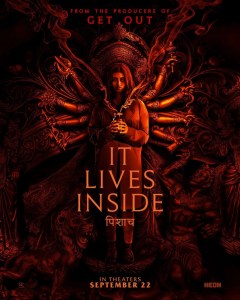 It’s a horror movie as examination on assimilation from an Indian-American standpoint and giving a different culture its own big screen boogeyman. It Lives Inside is about Samidha, a teenage Indian-American girl trying to fit in her suburban high school, which often involves her downplaying or abandoning her cultural roots and practices. She’s all but abandoned her childhood friend Tamira as an impediment to her social acceptance by the cool Caucasian kids. She then feels even more guilt when her friend goes missing and might be possessed by a demon of Hindu lore that feeds off negative energy (no wonder it’s targeting high school girls). This is the latest movie that uses the vehicle of horror to examine more personal themes, bringing a specific culture into the forefront and allowing wider audiences to learn from the horrors of trying to fit in when you feel different and ashamed for being different. As Samidha searches for her missing friend, she’s also forced to seek out help from her disapproving and more conservative mother, a woman steeped in her heritage. Where the movie left me wanting was in the exploration of its specific mythology as well as the development of the divide between mother and first-generation daughter. That’s the core of what can make this movie special, and yet what we get are more scenes of jump scare PG-13 terror and canoodling. It’s not a terribly scary movie, though the eventual creature design has some nicely unsettling angles. There’s one moment of hair floating that really unnerved me, but most of the movie falls on generic atmosphere effects. There are so many sequences of one high school English teacher working alone in the school (where is anyone else? Does this woman do nothing else?) and running through corridors as lights flicker and sinister sounds linger. By the end, It Lives Inside is an acceptable horror movie that would have benefited from spending more of its time on the perosnal elements that would have made it stand out rather than fit in with the horror crowd.
Nate’s Grade: B-
Share this:

The Iron Claw (2023)
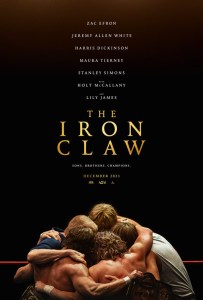 The true story of a wrestling family that was beset by so much tragedy it might as well be a lost Shakespearean drama. The Iron Claw follows the Von Erich brothers, lead by oldest brother Kevin (Zac Efron). They’re all competing for their father’s approval, the same man who gives them updated son rankings at the breakfast table. Kevin and his three brothers (Jeremy Allen White, Harris Dickinson, Stanley Simons) are living out their old man’s dream of being a professional wrestler of significant renown, and the appeal of the brothers is as a fighting family of wrestlers rather than as single entities. In essence, they don’t seem to matter unless as a collective. This leads to plenty of misguided attempts to curry favor with their toxic parent and a pile-up of tragedies that would be absurd if it wasn’t actually true. The issue for me was that I didn’t see the other brothers as fully dimensional characters, and side stories like Kevin’s romantic escapades felt lacking as illumination. It felt for much of its running time like a good movie but one going about its business with a little too much expediency. I was interested but felt like the brothers were more reflections on Kevin than their own separate characters. However, the film’s last twenty minutes are by far the best part and finally find a way to elevate the drama as well as better personalize it through Kevin’s grief and survivor’s guilt. “It’s okay dad, we’ll be your brothers,” spoken with the innocent yearning of a child, pretty much broke me and caused me to sob. If you’re a fan of 1980s professional wrestling, or meaty dramas about the suffering of strong men from strong men, I’m here to assure you that it’s okay to cry here. The Iron Claw is a fine drama that comes together by its end for an off-the-ropes wallop, and the lingering sadness is one that will be hard to shake for hours.
Nate’s Grade: B
Share this:

Dream Scenario (2023)
 Imagine being the most famous person in the world for doing absolutely nothing, where every person can see you every night, each of them feeling like they own a little piece of you. Now imagine that person being a balding, middle-aged father and professor of evolutionary biology, a man so dull that nobody would likely remember him except that he keeps popping up in everyone’s dreams on a nightly basis. The man in question is Paul Matthews (Nicolas Cage), a man so boring that his literal dream is to publish a book on the evolutionary biology of ants. Dream Scenario begins as a sci-fi curiosity and then becomes an intriguing expose on sudden fame as well as the most cogent argument yet on the hazards of a “cancel culture” that too many comedians cling to as an excuse for not being funny. I kept thinking back more and more on the movie, rolling over sequences and choices, as it refused to leave my waking thoughts.
There’s an obvious and easy parallel between what Paul is experiencing and general celebrity, where members of the public have an individual relationship to a person but divorced from the reality of who that person may or may not be, as well as one-sided. These are strangers to Paul but so many feel like they know him, like a neighbor, or a lover, or a threat to someone’s mental stability. It’s an ongoing struggle of rationalizing different perceptions of a person, where so many project what they want onto this smiling bald man who has become a national figure of fascination. Given the premise, I completely understand. I can only fleetingly remember my own dreams maybe once every two weeks, but if a real person, who I’ve never met, continued to make strange cameo appearances, I would definitely investigate further. That’s a genuine mystery that could break through even our jaded media culture. The big question would be why is this happening but the more interesting question is why this guy? What makes him special? I was always engaged with the movie and impressed by the turns the screenplay made, providing insightful glimpses into human nature that felt relatable as well as realistic in response to this phenomenon. Of course there are certain people that view him as some angel, whereas others a devil needing to be stopped, and some an unknown being they’ve projected sexual feelings onto. There’s a very funny and also deeply uncomfortable sequence where a young woman tries to recreate her erotic dream with the real Paul, and of course the real Paul fails to measure up to the fantasy mystique. I was also intrigued by the question of why Paul does not appear in his wife’s dreams. The screenplay by director Kristoffer Borgli is consistently well-developed and full of changes and challenges that had me glued, though I should warn you, dear reader, that you will never be given a concrete reason why the dreams began.
 The first half of the movie is Paul’s ascension, enjoying his notoriety and the new access he has to getting published and achieving his dreams that felt stalled for too long. It’s the positivity of the fame and untapped desire of the general public, with the assorted weirdo from time to time. Then there is a significant turn, and the movie gives a clear theory as to why, and the dreams all of a sudden now become nightmares. Instead of Paul just being in the background of everyone’s dreams, acting as an observer rarely doing much of anything, now he’s become a malevolent force, a stalker, a killer, or worse. Now the general public fears this man and fears going to sleep with the certainty that Paul will be waiting for them to perform any manner of terrors. Paul is placed on sabbatical after his very presence on campus drives students away into hyperventilating. Paul is genuinely pained by this but also painfully annoyed, as he argues he cannot be responsible for the dreams of others and what happens inside every individual subconscious. He hasn’t really done anything in physical reality, and yet he’s kicked out of restaurants, shunned by his colleagues, and his endorsement deals are drying up with the exception of the alt-right.
The premise also allows for plenty of beguiling and funny and creative imagery. Since we’re dealing with a wealth of dreams, this allows the filmmakers a near limitless opportunity to hit whatever themes or oddities they desire under the pretense of retelling a dream. We get the mundane, we get the horrifying, which plays out with some effective jump scares, and we get plenty of surreal moments. This artistic choice allows for an ending that feels ambiguously bittersweet but also tragically fitting and satisfying. It felt exactly how it should have been. It reminded me of Being John Malkovich, and truthfully this movie feels like a lost Charlie Kaufman story. The consumerism satire is also right on target, from Paul’s initial agency meeting trying to get him to endorse Sprite in the dreams of millions, to the application of harnessing people’s dreams to sell products or further one’s social media branding. It feels topical while also a sadly logical extension.
For me, this is the most interesting satirical broadside yet exploring the concept of “cancel culture,” a term often so overblown to the point of being a nonsensical catch-all for consequences. Paul’s sense of grievance is real, but the movie doesn’t present him as a martyr and instead chooses to use this transition, from curiosity to pariah and national nightmare, to better satirize people’s attempts to manipulate their own flailing narratives (see: ukulele apology videos, self-imposed exile for “listening,” late-night Ambien usage, etc.). After Paul has a nightmare of his own, starring himself, he records a manic tear-filled self-pittying apology to appeal to his detractors saying he now too has those “lived experiences” with transparent insincerity, and of course it doesn’t appeal to anyone and he’s even more ridiculed and despised. I enjoy that the movie doesn’t want to dwell in the tragedy or general unfairness of this turn of events with Paul becoming the world’s most hated man. Paul also refuses to accommodate or acknowledge other people’s discomfort, overriding security concerns and repeatedly placing his family and children in uncomfortable if not humiliating positions because dear old dad just refuses to accept mollifying his behavior for their social benefit. Paul was riding high on the ego trips of the unexpected attention and adoration, and occasional starry-eyed groupie, and he’s fighting to regain that same level of credibility and status before he retreats back to being a punchline, an asterisk in history, a trivia answer on a game card.
 Dream Scenario tackles the rise-and-fall of overnight celebrity and sudden fame and adds an intriguing sci-fi spin as well as some arty yet accessible meditation and fun satirical social commentary. It asks us to contemplate the nature of our dreams and how we might behave under this extraordinary scenario, whether as one of the people befuddled by the dreams or the even larger befuddlement of the person appearing in all those millions of dreams. It asks us to reconsider perception, as well as how well others may know us, as well as what we look for with our own dreams. When Paul’s wife (Julianne Nicholson) admits her own fantasy and it involves him wearing an old 80s costume that she found to be surprisingly sexy, he’s a little let down that this is all she has for her dreams, and that to me seems like a fine central theme to ground this movie. It’s easy to go crazy with limitless possibilities, but we often return to what matters most, and that’s often idiosyncratic, personal, and perhaps underwhelming to an outsider who lacks the context and, sorry, lived experiences. Our dreams can help define us but not necessarily as extravagant escapism. It can also be the ordinary, the unusual, the moments and people we just want to revisit a little longer. Now imagine this hijacked, weaponized, and then hacked into ad space, and you have Dream Scenario, a peculiar yet arresting little movie that has lots of intriguing ideas to share.
Nate’s Grade: A-
Share this:

Bottoms (2023)

I really wanted to like Bottoms, a sex comedy told from the perspective of a marginalized group literally learning how to defend themselves and develop a sisterhood of support and violence. It’s a high school comedy with two very winning leads, Rachel Sennot (also co-writer) and Ayo Edebiri, and it’s from the same director as Sennot’s breakout 2020 indie, Shiva Baby. It’s just that the comedy is working so hard, the energy level is cranked up so high, but the results tipped more into the realm of obnoxious characters overselling lackluster material. The two main characters create a school fight club under the guise of teaching their fellow female students how to defend themselves, though the real reason is to impress and then sleep with the hot cheerleaders that they’re crushing over. This also leads to them soaking up all the physical tumbles and sweaty wrestling contact with their crushes. The sleaze of the premise feels a little too easily excused in a misplaced “girls can do it too” sentiment. The explosions of real violence, including actual literal bloody deaths, doesn’t feel properly integrated into the tone of this heightened universe. There’s so much aggressive exaggeration that it’s hard to find a baseline here. It almost feels one or two jokes away from a spoof movie. There are no straight characters (not hetero-normative) characters to better play off the stilted silliness. I just don’t think the jokes and callbacks are there. The banter is occasionally amusing but it tapers off too often like an improv jag slowly running out of steam. It’s not a good sign during the end credit blooper reels when the outtakes prove that only one or two actors may actually be skilled at improv, one of them perplexingly retired NFL athlete Marshawn Lynch who is actually quite funny as a laid back teacher learning about feminism. The ensemble is filled with good actors having real fun playing such arch spins on high school movie stereotypes, and I applaud reclaiming the high school sex comedy from a modern lesbian perspective, but unfortunately Bottoms didn’t work up that many genuine laughs from me.
Nate’s Grade: C
Share this:

Aporia (2023)
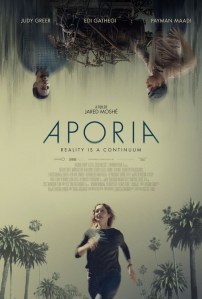
In writer/director Jared Moshe’s low-budget indie film Aporia, the Trolley Debate, killing one person in order to spare the lives of, presumably, more people or a greater number of people, gets its own movie in a thoughtful and provocative little indie. The thorny ethical questions are given their rightful due, and this is where Aporia really shines for me, as a small-scale sci-fi story with Big Ideas bursting forth and the understanding to give them adequate space for satisfying contemplation. It bowled me over.
Sophie (Judy Greer) is still very much not over the death of her husband, Malcolm (Ed Gathegi). He was killed by a drunk driver months ago and that driver also seems to have escaped justice. Sophie is left alone to raise their pre-teen daughter Riley. That’s where Jabir (Payman Maadi) comes in. He was a friend of Malcolm and reveals they had been working on a prototype for a time machine in secret. The machine has its own limits. It sends a photon particle back in time, which will kill any living creature that it materializes inside. All you need are the time, place, and coordinates and you could kill anyone. The further in time you need to go the more power the machine will have to draw. Sophie is beside herself but taken over with the excitement of possibly bringing her husband back to life. All it takes is murder.

What the characters have created is essentially a magic gun that can shoot into the past, which means the only use for this time travel device is to take life. They will only ever be murderers if they decide to use it, and so it becomes a question over under what circumstances would it be permissible to utilize this weapon. The first victim is obvious, the man responsible for the death of Sophie’s husband, and like magic he returns good as new without any memory of ever having been gone. It’s an important rule introduced that only the people in the room with the machine will still have memories of the previous timelines before the space-time revisions. This is a good move for an obvious dramatic one, so that the characters will be able to be impacted by the changes because they can recall a life without them, but it also sneakily supplies another complication. Each one of them has the potential to use the machine alone and thus never having the others realize what they had done. It’s one more tricky ethical question, asking whether you would betray the trust of someone close to you if you could get away with it. Naturally, the characters debate the merits of when to use the machine and when not to, with each new use further complicating matters because the next change can always destabilize the state of things, and then it’s a chain of changes to try and find the right order, and that leaves a trail of bodies littering the past.
It wouldn’t be a compelling time travel narrative without the ole’ favorite of unintended consequences. By removing the drunk driver before he could ever fatefully get behind the wheel, Sophie has brought back her husband and felt like the cost was negligible, as that driver in present-day is an abusive husband who gets drunk and yells at his family while he escapes justice for manslaughter. However, once you start pulling at the knots of the human timeline, some interesting and unexpected results can happen. That same man has been removed but his family isn’t necessarily better off. Kara (Whitney Morgan Cox), the widowed wife, is struggling to make ends meet as a single mom with a daughter (Veda Cienfuegos) suffering from multiple sclerosis (MS). They are deep in medical debt. It seems that the least this man did was help provide a financial cushion. Without his presence, they’ve had to go it alone and they’re broke and likely unable to continue paying the costly medical treatment for this adolescent girl. Because of Sophie’s desire to bring back her husband, she has doomed this innocent victim. Sophie’s guilt causes her to seek out the family, check up on them, and upon the discovery of their hardships, befriend mother and daughter and find a way to make things right as the unknowing perpetrator of their dilemma. From there it becomes a game of thinking how she can erase their misfortune while keeping her own husband.

I will discuss one significant turn because I think it’s an evocative example of the thought-provoking nature of the screenplay, but I will warn you there will be significant spoilers. If you wish to remain pure, dear reader, then skip to the next paragraph. The team comes up with a new name to eliminate to solve the fortunes for Kara and her daughter, a man who swindled her, a Ponzi scam artist who left her penniless and forced to close her bakery. Seems open and shut with an obvious bad person, thus an easy solution. But you should recognize there are no easy solutions in stories untangling timeline interference. All of a sudden, Sophie and Malcolm come home to discover that they have a completely different child. Their teen daughter is now a teenage boy with a different personality and different interests. How? How could eliminating one bad man in a completely different state change the course of history enough that their child has been affected? They debate the possibilities, perhaps something as small as a different sperm winning out or conceiving her on a different day or month, but the results are irrefutable. While their child is alive in this timeline, in a very real sense they have both now lost their daughter. The person they raised together, loved, and helped shape has been eliminated and the grief is palatable. This new child is a stranger, but they too are strangers to this child. They are absent formative memories and do not have the shared connections and history to draw upon. When Sophie tries to comfort this new Riley, she doesn’t know what may work because she doesn’t know anything about this child. I don’t think the filmmakers are making negative commentary on adoption, which is essentially what this scenario mirrors, but the grief goes two ways. They mourn the child blinked from existence, and this child also had his parents blinked from existence and replaced with lookalikes, they just don’t understand it yet. It’s this escalation that personalizes the unintended harm of what they’re doing and sets the stage for the final decision.
The ending is going to divide people but it felt note-perfect for me. It ends on an emotional high of coming to terms with their culpability but also on accepting uncertainty. We end on an ambiguous note, absent a resolution about the final extension of the final decision. I think it works very well not just in trying to have it multiple ways but because after being in the know, it puts the characters, and vicariously the viewer, in a state of vulnerability and the acceptance of staying there. It’s an uplifting conclusion thematically because it’s about accepting loss but also accepting our limitations. The final conversations are inadequate because how can you summarize a life with another person, whether a lover or a friend or a spouse, into just a handful of clumsy words. Our vocabulary does us a disservice when it comes to expressing the glorious debt we feel having had these people in our lives. That is why the movie ends on an emotional high for me and really comes together, personalizing the ethical conundrums.

Greer (Halloween Kills) has had a long career as a supporting actress, usually the funny but supportive best friend to the lead, and as an outstanding voice actress (Archer, Let’s Go Luna), but rarely does she get a meaty dramatic lead role. She’s terrific here and serves as our dramatic anchor through the turbulent changes and moral soul-searching. She is our reflection, and Greer’s emotional journey is well encapsulated in a performance that doesn’t go big into histrionics but is more carefully grounded and natural. I don’t think the movie would work as well, at least on an emotional level, without her.
Is Aporia a perfect film? Well, very few are, and the movie could have even more development, leaving possibilities behind given its tantalizing premise. I’m glad the movie didn’t go overboard into some slapdash thriller territory and instead grounded its science fiction timeline wonkiness into engaging human drama about loss, sacrifice, and acceptance. As my pal Eric Muller said, Aporia likely works better as a screenplay than a finished film, though this discounts the heavy-hearted contributions of Greer. I’m glad this movie emphasized its ideas and provided the time to really dwell in them, even if the movie is only about 90 minutes altogether. Aporia is a deeply engaging movie that worked on all levels for me, enriching emotions and satisfying intellect, and is definitely worth the discovery.
Nate’s Grade: A-
Share this:

Love Again (2023)/ Rye Lane (2023)
 Romantic comedies used to be a powerhouse of Hollywood and now it feels like they’ve all disappeared from your local multiplex. Rom-coms gave us industry stars, careers, and household names, the likes of modern rom-com royalty including Nora Ephron, Cameron Crowe, Nancy Myers, and Richard Curtis, and two of which have screenwriting Oscars. It’s a subgenre that is quite often dismissed, usually by condescending men, let’s be honest, as empty-headed maudlin wish-fulfillment. It’s no coincidence that rom-coms are looked at as more of a female-driven genre aimed at a more female-centric audience, so the contemptuous pile-ons from men can often seem like insights into masculine social allowances for empathy. I’ve long been a fan of romantic comedies, even written a few, because they’re just so damn likable. It’s a foundational principle of the genre, to get you to like the characters, their interactions, their courtships. The movie is romancing its audience at the same time the characters are romancing one another, and who doesn’t like to be swooned? Two 2023 rom-coms, Love Again and Rye Lane, showcase directly how appealing and heartwarming and swoon-worthy that excellent rom-coms can prove, and how middling when its genre is taken for granted.
With Love Again, we follow Mira (Priyanka Chopra Jonas) who is mourning the loss of her deceased boyfriend. She continues to send texts to his old phone number explaining the depth of her grief and confused feelings trying to get her life back on track. It just so happens that her dead boyfriend’s old number has been given to the work phone for Rob (Sam Heughan), a journalist who is getting over his own recent heartbreak. He takes a curiosity to this stranger sending him such heartfelt texts, and after meeting her from afar, decides to try to get to know her better, resulting in the two of them romancing but with the Big Awful Dreadful Secret always waiting to be discovered for the unfortunate Act Two break.
 I don’t understand Love Again, like at all. I understand what happened on screen in a literal sense but the reasoning behind it, the storytelling choices, are so bizarre and foreign to me that it feels like a group of aliens who only learned human behavior through the worst direct-to-streaming rom-coms tried their hand at recreating human interactions and falling in love. The very premise seems almost like an afterthought, so why even go through the trouble of this labored conceit? The fact that Rob has been receiving this sad woman’s grief texts could present a real ethical conundrum, beyond the fact that he knows her private thoughts and feelings and he doesn’t even know who she is. The natural angle would be for him to take it upon herself to do small things to make her feel better, maybe from the outside perspective of a secret admirer, a position he never intends to go beyond. The issue becomes when he starts to transition to romance, because now he has a head start that she didn’t even realize was happening. Also, he could make use of the information that she’s been unknowingly feeding him, about favorite foods or interests, to better sweep her off her feet, but that also places us in an ethically dubious scenario of emotional manipulation, akin to what Bill Murray tries to get away with the loops of Groundhog Day. It’s a borderline stalker situation that can easily go too far. The fact that Love Again doesn’t even cover these most obvious plot scenarios makes the entire premise feel perfunctory; it could have been anything that accidentally drew Rob to Mira because it’s so unimaginative and, simply, bad at its own inept storytelling. It’s so baffling and feels like it was made with contempt for its audience, believing that they would accept anything as long as the genre parts were covered, so Love Again’s story is the barest of pained efforts.
Love Again is bad in ways that are despairing while also being mind-numbing. You get a sense early on how little feel for the material the filmmakers have, at how poorly the scenes are at disguising their creaky plot mechanics from the viewer. It’s the kind of movie where a kindly bartender introduces himself and seconds later is all, “I sure feel bad about your dead boyfriend.” It’s that kind of movie, the kind with supportive friends and work colleagues who are only there to provide words of encouragement or set the scene in the most transparent and lazy way, “You know you haven’t been the same since…” to better tee up the audience as far as what is important. All movies do this but the exposition needs to be masked with character details or comedic exploits, and the better to visualize a person’s life.
 This is also the kind of comedy where the jokes amount to the first idea of every scene, where there is never a subversion or even an escalation or a comedic situation. In this world, Nick Jonas makes a cameo as a bad date who is vainly obsessed with bodybuilding and that is the only joke you’ll get with that appearance to the end. It’s the kind of movie where Mira’s “quirk” is asking dates would you rather scenarios that aren’t even raunchy or extreme or even that telling of her own personality. Her other personality trait is that she likes, get this, putting her French fries on her cheeseburger (what a crazy bohemian!). It’s the kind of movie that has Mira as a children’s book author and doesn’t even bother to provide a scene of her demonstrating her storytelling prowess and insight for creating metaphorical-heavy stories to impart important lessons for children. This technique could have been a greater insight into her emotional state without having to rely upon the character just spouting out her feelings. Even worse, the movie doesn’t use her texts to her beloved as a means of getting to know her better. It’s the very premise of this movie, supposedly. These details meant to give the movie its definition, what separates it from the rom-com pack, but what it produces feels so insufficient and haphazard that you wonder if this was a failed genre MadLibs.
It’s also bad that Chopra Jonas (The Citadel) and Heughan (Outlander) have a remarkable lack of chemistry. They’re both good-looking human beings who have previously shown to be quite capable and appealing actors. I do not blame them for the lack of feeling in this movie. They could only do so much with the poorly written characters and the clunky dialogue. Watching them attempt to flirt with this material is like watching two cats try and recreate the H.M.S. Titanic. It’s just not going to work well.
 Here’s another example of how poor the filmmakers have developed the elements of their tale. Rob is still mending his broken heart from a fiance that left him a week before their wedding. He is a cynic, although like everything else in this movie, if you push too hard it’s only there as a shallow fixture for story. But if you’re going to make him the cynic, make him believe that love is impossible, it’s a chemical condition of the brain, some delusion, and that this drives his contempt for having to interview Celine Dion, a pop star best known for her soaring ballads about love and sunken ships and hearts going on. He thinks her songs are cheesy and silly, and over the course of the movie, of course he becomes a believer (at least this the movie understands the arc to follow). Again, the most obvious route would be to make him a music critic, someone who decries silly love songs and thinks of them as a destructive drug for the masses. This would make more sense why he’s so irritated at having to cover Dion, and why he would be covering Dion, and it would also make more sense then for his reconsideration. The movie, instead, makes Rob a big fan of… basketball. He loves to watch basketball. Why is this man covering Celine Dion then? If he was going to cover basketball, why not bring his passion for it more into focus, at least as something he can learn from and share with Mira? They share a quick game where she basically says, “I like this game too,” and that’s the rest of this completely underdeveloped characteristic that doesn’t tie back in thematically at all. Again, if you’re going to make this much of Dion’s multiple appearances, including devoting your end credits to having your cast and crew enthusiastically lip sync to her songs, then at least tie her better to your plot.
Ms. Dion doesn’t need me to defend her. She’s a grown woman and can make her own decisions, and I’m sure she was handsomely paid for her contributions in Love Again whose soundtrack features five new songs and six of her past tunes (why not go the jukebox musical route at that volume?), but I need to further explain the awfulness of Love Again’s choices. Late into the movie, Dion discusses her own personal loss, mourning her husband of twenty-plus years who died in 2016. The fact that this real woman is mining her own real tragedy to provide the emotional boost to our bad protagonist in a bad rom-com just feels morally queasy to me. It just feels wrong, especially in the name of such an undeserving character in an undeserving movie for her to have to rehash her own personal grief.
 On the other end of the quality spectrum is Rye Lane, a smaller British indie that follows Dom (David Johnsson) and Yas (Vivian Oparah) through a crazy day and night together across the bounds of South London. She discovers him crying in a toilet stall, a meet-cute so intentionally un-cute. They’re both nursing mixed feelings and unchecked anger over being dumped by their respective exes. Dom discovered his girlfriend cheating on him with his best mate and now he’s scheduled to meet with them both to better clear the air. Yas finally stood up to her neglectful and self-centered sculptor boyfriend but she wants to recollect her favorite record in his flat before she can bid goodbye to him forever. Together, they will help each other through their respective relationship detritus and plot their next steps forward.
What an immensely charming movie Rye Lane is and it’s one that reminds you about the innate pleasure of the rom-com genre when paired with characters we want to get to know better. Thank goodness the screenwriters keenly understand how to develop our protagonists but also make them imminently winning. By establishing both Dom and Yas as reeling from recent breakups, and from such awful people, it makes us want to root for them to regain their sense of composure, dignity, and personal joy. We want them to show up these people who have made them feel so low, and it just so happens that one another will serve as the ultimate and unexpected wingman. I loved it when Yas buddied up next to Dom and pretended to be his very doting and very sexual new paramour as well as press Dom’s former flame on her own cheating ways, shifting the power dynamic. It supercharges the growing friendship between the two of them as well as reconfirm their need to find a partner who can and will go out of their way for them. Watching each of them encourage and aid the other during a time of need and insecurity serves as a reliable provider of satisfaction and a clear path for us to also fall in love with these unique people.
 The writing is so quick-witted and charming that simply listening to these revealing and often hilarious conversations is a pleasure. I’m reminded of Richard Linklater’s famously talkative Before trilogy, another all-in-one-day whirlwind romance of two characters exploring a locale while also exploring one another under a limited period of time. It’s a natural structure because it provides a looming urgency but the drama also unfolds more or less in real time with the characters learning about one another at the same pace that the viewer is, and so our emotions feel better attuned as the characters change their perceptions of one another. This is the joy of rom-coms, finding characters you simply want to spend time with because they’re so charming, interesting, and deserving of finding happiness of their own making. Dom and Yas are wonderful characters separately but the right combination together. He’s more nerdy and awkward and she pushes him to be more assertive and confident. She’s less sure of her worth and sets herself up for sabotage in landing a job she might love, and he refuses to let her let herself down. It’s genuinely amusing and heartwarming to watch these two help one another in their time of need.
Rye Lane is also peppered with playful and, at times, chaotic visuals to goose up the talky proceedings. Debut director Raine Allen-Miller will often use quick inserts and playful visual framing to add more pizazz to the presentation, like when Yas and Dom present their recollection of events like narrators to a stage play of their own lives. It’s lively and fun but occasionally the visual inserts and sound design, or perhaps the score itself, felt like added distractions to the appealing core elements of the movie. It was the only annoyance I felt in such an otherwise funny and charming movie boasting such winning performances. It felt a little unnecessary at times and seemed like the filmmakers had doubts that the material and the performances themselves were enough to sell the entertainment of the movie.
 Romantic comedies remind me of the old saying, “it’s not the singer, it’s the song.” They’re like many other sub-genres of movies and storytelling itself, complete with expectations and formulas and rules and recognizable parts and pieces that add up to, hopefully, entertainment. In this regard, movies are like a meal, and two people can follow the same recipe with the same ingredients and concoct two totally different final creations. Fans of rom-coms are like fans of any other genre, looking for good storytellers to value their time and give them an escape. It’s not just that the familiar elements are included, it’s what is done with them, the care and affection from the storytellers, chiefly creating characters that you can fall in love with and root for their own happiness and fortuitous fortunes.
Love Again is based on the 2016 German film Text For You, itself based on a 2009 German novel (I watched the trailer on YouTube, and it’s weird having actors refer to text messages as “SMS-es”). It’s a reminder of how soulless the worst of these lazy rom-coms can feel when producers look to check boxes to fulfill some list of genre requirements that they think will satisfy the lowest expectations of a gullible fan base they can exploit. Rye Lane is the latest example of the real pleasures of a finely developed rom-com that understands the essential appeal of what makes these movies more than “chick flicks.” Skip Love Again and its ilk and instead feel the pitter-patter of your heart renewed with Rye Lane.
Nate’s Grades:
Love Again: D+
Rye Lane: A-


 nathanzoebl
You must be logged in to post a comment.