Blog Archives
Final Destination 3 (2006)
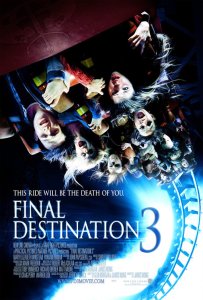 Isn’t the title Final Destination 3 itself problematic? How could it be final if it’s the third? It reminds me of 1998’s terrible I Still Know What You Did Last Summer, which wasn’t even correct with the film’s time setting (it must be stated that a 2006 sequel, and I’m not kidding, will be called I’ll Always Know What You Did Last Summer). Perhaps the best title comes from the worst movie of all time, Manos: The Hands of Fate, notoriously lampooned on Mystery Science Theater 3000. “Manos” is actually Spanish for “hands,” so the title is Hands: The Hands of Fate. Titles are fun. Oh yes. Final Destination 3, on the other hand, isn’t really fun.
A senior class is partying and enjoying the thrill rides of an amusement park. There’s an especially menacing looking roller coaster begging to be ridden by teenagers. There’s even a giant devil in front of the ride’s entrance. The ride fills up with your general high school characters (popular snots, Goth kids, cocky jocks, etc.) and then the safety bars become loose, flinging riders this way and that to splatter against broken rails and track. It’s all so horrifying … but it’s just a vision of Wendy (Mary Elizabeth Winstead). She goes into hysterics and gets off the coaster before it ships out. Other students follow her, including Kevin (Ryan Merriman), the boyfriend of Wendy’s best friend. Sure enough, the coaster crashes, those on it die, and death has been averted. For now. Just like previous installments, death seeks out the souls that escaped its cold clutches. Now death is taking out the survivors in the order they would have died and Wendy and Kevin must try and figure out a plan before it gets to them.
 Let’s not mince words, the true star of the Final Destination franchise is death itself. The appeal rests entirely on the fiendish, outlandishly complicated deaths and the misdirection over what will prove deadly. The audience is holding their breath for the next spectacular death. There’s a certain fatalism linked to this, knowing that the entertainment value is witnessing teens eventually get sliced and diced. But the franchise’s appeal also seems to be its downfall. The Final Destination films are stuck trying to out top themselves, and each film opens with a big centerpiece of disaster that inevitably serves as the film’s best moment. The rest of the movies never seem to match the opening melee, and it’s generally not a good idea for a movie to peek in the first reel.
Admirably, Final Destination 3 doesn’t even waste time with having its batch of characters theorize how to outfox the specter of death. We just watch, one after the other, the bloody, clever deaths like an assembly line of carnage. Final Destination 3 knows what its audience wants. Curiously, there’s no parental or police presence at all, even after the mounting coincidental deaths. Seriously, everywhere that Wendy and Kevin go, death is right beside them. Probably the funniest tidbit in Final Destination 3 is that shortly after another failed attempt to warn a doomed teen, Wendy and Kevin are in different, non-bloody clothes as they walk back to their car. They actually brought a change of clothes just in case. That’s hilarious. Little else seems amusing (the 9/11 reference is overwhelmingly tacky).
I once thought that the Final Destination concept could live forever in the annuls of horror, but the seams are definitely starting to show with this franchise. In 2000 it was fresh and unpredictable, and now it just seems exhausted and old hat. I thought the third film regaining the original writers and director would infuse Final Destination 3 with a bit more imagination. I was wrong. Glen Morgan and James Wong seem to go overboard to sate their blood-hungry audience, creating the most gruesome, torturous deaths yet. Seeing people eviscerated is one thing, but tantalizingly lingering on the sight of a busty teen being cooked alive, her skin boiling and exploding from the heat, is too much. It’s like this time death is really pissed, saying, “I gotta go through all this again!” The movie feels too mean-spirited, too vengeful, and a shade too cynical. I think the concept feels spent and even Morgan and Wong realize this, which is why they ratchet up the gore because the suspense is gone. The “gotcha” ending was pitch-perfect in the first Final Destination, but now it’s just another expectation feebly met.
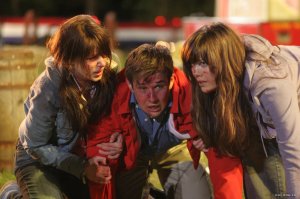 Of course, all the characters (with the possible exception of Kevin) are nitwits, horn dogs, jerks, and just plain unlikable, which make rooting for their demise easier. There’s no subtlety here either. The two shallow, popular girls are incredibly shallow and ridiculously stupid. The idiot pervert has a one-track mind that never takes a break. They’re all stock, they’re all one-note, and there’s even a moment where the token black character says, “That’s what I’m talkin’ about!” No wonder death is the star. At least in the previous Final Destination flicks you felt like the kids deserved a fighting chance.
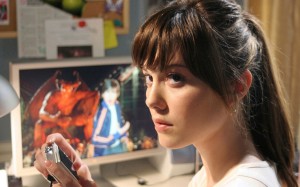
There is one neat addition to the formula. On the night of the accident, Wendy took several pictures and each photograph predicts that person’s demise. This allows the audience to try to decode the clues they’re given and correctly guess the next horrific death. It’s the most fun aspect of the franchise.
Final Destination 3 knows exactly what its audience wants, which is more of the same preposterously complicated deaths. The concept once felt fresh but now it seems worn out. I doubt new blood could revive this franchise because audience expectation has become too demanding. We already know the rules and know the characters can’t really escape death, so the only lasting suspense is what will kill them, and even that is fleeting. The return of creators Glen Morgan and James Wong still can’t infuse the right touches of imagination. It’s more grisly teenage carnage, nothing more, nothing less, nothing special anymore. Fans of the previous Final Destination flicks will likely find some entertainment, but the movie feels creatively spent. It’s probably time for this sadistic peep show to bow out before things get even uglier.
Nate’s Grade: C
Share this:

The Skeleton Key (2005)
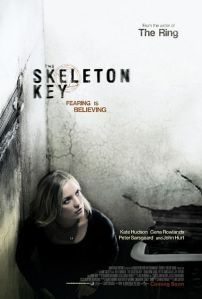 The marketing said it was horror (voodoo, creepy kids), but it’s less a horror movie and more a Twilight Zone tale. It has its share of jump scares and tries to draw out an atmosphere of dread. You see a lot of how doors work from inside locks. The Skeleton Key tries to be overly clever despite its plot holes, but at least the film runs its course. It wasn’t trying to throw out a contrived ending. Kate Hudson needs better roles than these do-nothing parts; she’s far too cute to languish. And how many times did she inspect late-night noises in her underwear? The most entertaining aspect of The Skeleton Key may be gazing at a pre-Katrina New Orleans.
Nate’s Grade: B-
Share this:

Hostel (2006)
 Eli Roth is a name that excites me. After watching his 2003 debut Cabin Fever, it was love at first sight. My friends were skeptical but one by one I convinced them that Cabin Fever was a campy, jaunty, unapologetically hilarious good time. I’ve made Roth disciples out of my fellow human beings. Naturally, I was looking forward to Roth’s follow-up, Hostel. I had heard the rumors that the flick was based on a true story of a South East Asian website, though said site can no longer be confirmed. Whatever the muse may have been, Hostel‘s got the added cache of Quentin Tarantino’s name slapped aboard as a “presenter” thus ensuring to the young male demographic that Hostel should be, “frickin’ sweet.” While not reaching the rapturous entertainment heights of his debut, with the grisly Hostel, Roth proves that he’s no flash in the pan.
Over in Amsterdam, Paxton (Jay Hernandez, Friday Night Lights) and his best friend Josh (Derek Richardson, Dumb and Dumberer) are living it up. They’re on the hunt for pot, poontang, and an endless array of good times and cheap thrills. They’ve got big wallets and big appetites. They’ve befriended Oli (Eythor Gudjonsson), an Icelandic horn dog willing to be their guide throughout their most excellent European adventure. While locked outside their stay, the trio learns of a mythical youth hostel all the way in Slovakia. The girls are buxom, beautiful, and go absolutely wild for boys with foreign accents, particularly Americans. This is an opportunity worth salivating over for our trio. They book a train for Slovakia and it looks like this hostel could be the Playboy Mansion of the former Soviet bloc. The women are frequently naked, open to most any suggestion, and eager to please the American visitors.
 Ah, but things are not what they seem. The young Americans check in but they don’t check out, at least in one cohesive piece. Our Slovakian sirens are leading their horny backpackers to their doom. Tied with the hostel is a large, empty warehouse that a lot of high-pitched, ear-splitting screams seem to waft out of. Inside is a dungeon where those willing to pay the right price can torture, mutilate, eviscerate, and kill a person. Can Paxton, Josh, and Oli even hope of surviving such a place?
Even for a horror movie, Hostel has a lot of nudity. Normally this wouldn’t bother me but the film does seem to be topped with an incredible amount of sex scenes and nudity during its sloshy build-up to the horrors that await. Many will cry “exploitation!” or “gratuitous!” and, though I’d agree with both, I must remind all fans of the genre that the bedrocks of horror are exploitation and voyeurism. Let me theorize why Hostel‘s first half is as it is. Sex and violence in horror movies are always linked, particularly the violence as retribution for wayward sexual indulgences. So then, if the second half of Hostel is a sickeningly display of cruelty, torture, and mankind at its most heartlessly gruesome, wouldn’t it make sense, in retrospect, to up the ante on the debauchery in the first half to even out the tone?
One of the most interesting elements of Hostel is how it makes you root for the ugly Americans. The first half of the film shows Paxton, Oli, and to a far lesser degree Josh, as booze hound backpackers interested in tasting the wares, be it through illicit drugs or illicit encounters with the local ladies. They?re stomping through Europe in an arrogant, obnoxious, near-reprehensible fashion trying to score some cheap thrills. Eli Roth doesn’t intend for an audience to align themselves with these tail-chasing characters, except for the more sympathetic Josh. And then once the boys enter Slovakia and become the cheap thrills themselves, Hostel turns on the surprise factor. After profoundly disliking these misogynistic party animals, we root for them to survive. This goes against most modern horror, particularly slasher flicks, where the audience is rooting for the grisly demise of its empty-headed horny teenage cast. The audience hungers for death and titillation. In Hostel, we’re presented with boorish backpackers and, despite everything prior, we really want them to succeed and get rescued from their dungeon of horrors. The last act only confirms this further. I don’t know about your theater, but mine was rollicking and roaring as they rooted for the home team to pull it out.
 Truth be told, the set-up is a bit overly long, though nowhere near as boring and comatose as Wolf Creek (maybe Roth was smart to put in the nudity). In Wolf Creek, we watched a group of uninteresting “characters” drive around and get lost for a whole friggin’ hour. That movie went from boring to “oh, is something happening?” to over. At least Hostel had movement and relevance to its set-up, including characters and situations that will be repeated later. Some of it is a bit heavy-handed, especially with the sex/violence link and a blowtorch torturer repeating, “Get your own room,” but Hostel finishes with a grand flourish. Roth weaves back different storylines and characters in clever ways and serves the audience vengeance on a platter, and we just gobble it up. I was jumping in my seat, pumping my fist, and, forgive me, shouting at the screen during Hostel‘s final act. It’s somewhat paradoxical for me to be disgusted by violent retribution so recently with Spielberg’s Munich and then a week later to be relishing it. I credit the tones of the films. While Munich is contemplative and realistic, Roth’s Hostel is a squirmy, over-the-top, dark comedy with some moments of cringe-worthy horror. Hostel‘s fabulous finish may erase any lingering doubts you had over the very Euro Trip opening.
Roth has a great sense of visual flavor with his shot arrangements but he also knows when to draw upon our dread. Hostel is really more of a survivalist thriller than a horror movie. Sure, torture and gore is prevalent but a lot of the violence and gruesome makeup is unexpectedly played down in limited appearances. This isn’t the shocking sadistic movie that outcries have made it to be. Without a doubt, I think Eli Roth is the most promising name in horror. Cabin Fever is one of my all-time favorite good-time flicks, and now with Hostel, Roth has proven that he can work miracles with a small budget and a giant, depraved imagination. Hostel is more disturbing than horrific but Roth knows exactly what chord to strike, what scenes to hit, and what sounds to echo to make you want to cover your eyes.
Roth’s best attribute, besides a pleasing visual sensibility, is his twisted sense of humor. Cabin Fever was more humor than horror, and also took an extended set-up before the gore was unleashed, but Hostel makes the flip and is more horror than humor. That’s not to say Hostel is without its dark, jovial jollies. Roth seems to approach his gore, outside of the torture sequences, with a macabre absurdity, like a character slipping on dismembered fingers only to chainsaw their leg off, or a character pretending to be dead and gets a severed hand placed on his face. Somewhere, Peter Jackson and Sam Raimi are nodding their heads in approval. Surely Tarantino is amused. Granted, Cabin Fever was more of a tongue-in-cheek fever dream homage to 70s horror, but Hostel has its share of twisted humor which elevates it far above most recent horror, either the boring and meandering (see: Wolf Creek) or the single-mindedly shocking (see: High Tension). This is what excites me about an Eli Roth horror movie: his lively, warped, depraved sense of humor. If people claim that Roth is one sick bastard, then I must also be one sick bastard for finding his movie funny and highly amusing in spurts.
 There are so many moments that I loved, from the opening cleaning-up, to seeing the Slovakian sirens on their day off sans make-up and totally trashed, to the Bubblegum kid gang, to the Takashi Miike (Audition) cameo, to knowing that killing an American is the most expensive option, to seeing the ins and outs of a facility dealing in murder for money, to seeing the equivalent of the Dunkin’ Donuts guy (“Time to chop up the bodies…”), to the madcap, fist-pumping race to the finish. There?s so much Hostel does right, not just as a horror movie but simply as a movie itself. I wouldn’t mind taking another trip to Hostel with a big group of my less-than-squeamish friends. Oh who am I kidding, horror movies are more fun when you see them with the squeamish.
Eli Roth has crafted a dirty, depraved, but highly amusing horror film. Hostel is full of surprises, from an overly long set-up that couldn’t have more female nudity if it tried, and actually making an audience root for the survival of the ugly Americans when things get dicey. The premise may be sickeningly realistic but the rest of the movie is on an overdrive of macabre fun. Roth’s twisted yet gleeful sense of humor is what makes him unique, and his attention to atmosphere and compounding dread is what will make him successful. There’s no faster rising horror name, in my mind, than Eli Roth. Hostel may not fully be the down-and-dirty horror film its ads have made it out to be; it’s certainly more of a thriller with a heaping helping of gore. This is one experience well-worth booking, especially if you have a strong stomach and a dark sense of humor. I can only imagine that the tourism industry for Slovakia is about to drop precipitously.
Nate’s Grade: B
Share this:

Wolf Creek (2005)
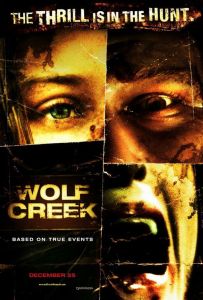 It comes across as choose-your-own-adventure horror, each with their own vignette and then starting back. Wolf Creek is very uninspired. The only thing it has going for it is the fleeting gimmick of an Australian take on American horror staples. In many horror flicks, there’s always that nation of creepy yokels waiting to take advantage of visitors off the beaten path. Now, this is Australia’s version. The film’s biggest sin is that it spends an agonizing 60 minutes before anything happens. The set-up is protracted and the characters are uninteresting, bland, and mostly just sketches of ideas. It takes forever to get the horror going and once it arrives I’ve already checked out of the movie into a coma. Wolf Creek lacks any subtext or commentary, some of the saving graces of the horror industry. The whole thing is an exercise in tedium, with some splashes of gore at the end. This movie takes too damn long to get to the goods. There’s nothing suspenseful in that 60 minutes and little has any meaning later (why do their watches and car stop?). Wolf Creek is derivative, possibly exploitative being based on a true story (what it shows is mostly speculation), and really boring. Casual horror fans should stay home.
Nate’s Grade: D+
Share this:

War of the Worlds (2005)
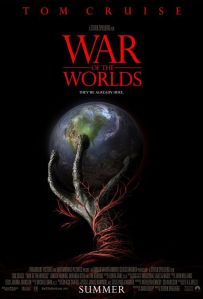 Steven Spielberg is America’s favorite director. He’s made films about alien encounters before (hell, it was most of the title of one movie), but Spielberg has never tackled evil aliens. Alien movies either involve cuddly little green men or the kind that want to destroy our planet. The latter is usually more interesting and finally Spielberg takes the trip with War of the Worlds.
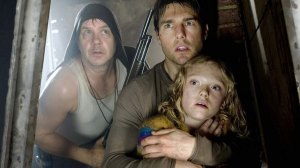
Instead of focusing on high-ranking government officials, War of the Worlds concentrates on an everyday man just trying to save his family. Ray (Tom Cruise) is a New Jersey dock worker and a divorced pop. His ex-wife (Miranda Otto) has dropped off the kids (Dakota Fanning, Justin Chatwin) for the weekend. Ray isn’t exactly father of the year and his sullen kids remind him of this fact. Meanwhile, there seems to be a series of lightning storms hitting the world that then leave an electronic magnetic field that eliminates all the electricity in the area. A storm hovers over New Jersey and lightning strikes not once but over twenty times in the same spot. Ray goes to investigate the site. The ground beneath trembles and caves in. A giant machine with three tentacle-like legs emerges from the earth and starts zapping any humans it can find. Ray escapes, packs up the kids in the only working car in town, and runs, runs, runs, all with the aliens just a step behind ready and waiting for a people zappin’.
 There are three things an audience will have to put behind them in order to enjoy what War of the Worlds has to offer.
1) The film has no plot. War of the Worlds spends the first 15 minutes setting up its handful of characters and their misery with each other. After that, it’s nothing but all-out alien attacks. That’s really it. Ray and the kids run to one place and think they’re safe. The aliens come and attack. Ray and the kids escape to a new place. The aliens come and attack. Lather, rinse, repeat. There is little more to War of the Worlds.
2) Spielberg has pretty much forgotten how to make good endings. I think A.I. was the nail in the coffin. Routinely Spielberg films seem to run out of gas or end rather anticlimactically, but A.I. really cemented the glaring fact that Spielberg cannot sit still with an unhappy ending. So, yes, War of the Worlds both ends anticlimactically and with an abrupt happy ending. Of course the H.G. Wells novel ends in the same fashion so there’s less to gripe about, until, that is, until you reach the implausible reunion. Spielberg can’t keep well enough alone and forces the story to be even happier at the cost of logic.
3) Ignore whatever feelings you hold about Tom Cruise. Off-screen, many feel that Cruise is becoming an obnoxious, pampered, self-involved, couch-jumping cretin. No matter what your feelings about Cruise and his self-taught knowledge about the history of psychiatry, that is not who is in War of the Worlds. He is playing a character. I never understood the argument that because you dislike an actor as a person it invalidates all their acting. I’ve read magazines that actually say people are staying away from Cinderella Man because people think Russell Crowe is a grump. In War of the Worlds, Cruise plays a deadbeat dad who finds his paternal instincts during the end of the world. The character isn’t deep and acts as a cipher for the audience to put themselves in the scary story. Plus it’s not like Cruise is a bad actor; he has been nominated for three Oscars.
 Since this is a large Hollywood horror film, the acting consists mainly or healthy lungs and frightful, big-eyed expressions. So it seems natural that little Dakota Fanning would play the role of Child in Danger. Cruise somehow finds some points in the story to exhibit good acting. There’s a moment right after Ray and his kids escape to their mother’s home. He tries making them food out of whatever they saved which amounts to little more than condiments and bread. His kids rebuff his offer and he throws the sandwiches against a window and repeats to himself to breathe. In lesser hands this moment would just be some light comedy, but Cruise turns it into an opportunity to see the character’s desperation. Tim Robbins shows up late playing a nutball going through some self-induced cabin fever.
War of the Worlds, at its core, is a post-9/11 horror film on a mass scale. Spielberg plays with our paranoia and anxiety and creates a movie that is fraught with tension and an overriding sense of inevitable annihilation. The aliens are so advanced and so powerful. The deck definitely seems to be stacked against Earth. I felt great amounts of dread throughout the film knowing that the aliens will find you, they will get you, and it’s only a matter of time. And that’s the recipe for a perfectly moody horror film. War of the Worlds is chilling in its depiction of worldly destruction, and yet it becomes even more terrifying by how realistic everything seems as the world falls apart when its under attack. The introduction of huge, human-zapping aliens is expected to be scary, but who knew human beings at their wit?s end could be just as scary? A crowd of people turns into a violent mob fighting for any last bit of space in Ray’s working car. A man sitting on top of the hood is actually ripping away chunks of windshield with his bare, bloody hands.
War of the Worlds really benefits from awesome special effects. As stated before, we live in a jaded age where most special effects have lost feeling special. Computer advancements have also created a more advanced audience able to point out the big screen fakery at a faster pace. If you don’t believe me, look back at some movies from 1995 or so and see if you’re still wowed. War of the Worlds marvelously displays destruction on such an incredible scale. City streets ripped apart, houses blown up, cars flipping through the air, ferries plunged into the water, and it all looks as real as can be. There are moments I know that have to be computer assisted, like seeing miles and miles of stranded vehicles and people on the side, but it looks like they filmed it for real. The only thing that seemed hokey was people being vaporized by alien ray guns and having their clothes remain. I don’t know if Spielberg was going for a veiled Schindler’s List reference or they thought anything more grim could rock their PG-13 rating.
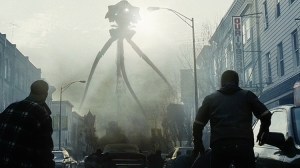 Due to all of this realism, War of the Worlds is not a film to take young children to see. The startling realism and suffocating sense of dread will keep kids up for weeks with nightmares, maybe some adults too. There’s more than a passing reference to 9/11, and that may be a wound too fresh for some. Thousands of people walk the streets as homeless refugees. There are large tack boards with hopeful missing fliers of relatives. One of the most horrifying images consists of a flowing river filled with floating corpses. There’s also a grand set built around the remains of a downed airplane. When Ray is trying to explain the situation at first, his son interjects, “Were they terrorists?” Spielberg calculatingly uses our memories of 9/11 to create a true-to-life horror story that doesn’t feel exploitative. “War” implies some kind of even ground. This is a massacre, and one parents should be wise not to bring youngsters to.
With War of the Worlds, Spielberg has crafted a chilling, realistic, post-9/11 horror movie. The action is big, the destruction is bigger, and the dread is at a near breaking point. Sure the movie is plotless and the ending is anticlimactic and forcibly happy, but War of the Worlds should appeal to those looking for the safe way to witness the end of the world. Spielberg invented the big summer movie and War of the Worlds is a taught return to form. It’s not much more than watching aliens destroy things but for many that will be plenty for a summer movie.
Nate’s Grade: B
Share this:

The Ring Two (2005)
 I loved The Ring. Loved it. So I had some trepidation when I found out they were making a sequel. Surely it wouldn’t have the punch of the first film. To see Ring Two I went to a theater frequented by somewhat affluent teenagers and pre-teens. Big. Mistake. People were chattering away the entire time, laughing stupidly, and shouting ridiculously lame jokes: (on seeing a damp bed: “Oops, somebody wet the bed”). There were two managers that had to patrol the theater to keep order. Worst of all was a team of easily riled prepubescent girls that sat behind me, shrieking like banshees even during movie trailers. The same thing happened to me when I went to see The Village at the same theater. I must attract the most annoying people in the crowd. The sound quality in my theater was also very poor. Now, I can’t help but think that this was some divine act to warn me how bad Ring Two was going to be.
Rachel (Naomi Watts) has taken her son Aidan (the creepy David Dorfman) to a new town to start a new life. It’s been years since the incident with the videotape, and Rachel feels guilt about her role in spreading the killer tape. She’s got a new job at a small town newspaper but yet she can’t escape her past. A teen has been found with a contorted face, soggy floor, and a certain videotape. Rachel finds the tape and burns it. Samara, the evil young girl who started the evil tape, is none too pleased. Seems the evil tyke wants to be a real girl with a real mommy, and is slowly taking over Aidan. His temperature is dropping, he’s not sleeping, and bad things are happening. Rachel confronts more of Samara’s history to learn what it takes to stop her and get her son back.
 Everything that worked in the first film feels forced and meaningless when rehashed in Ring Two. In the previous film, there was context for the image of a tree on fire and Rachel yanking a fly right out of a TV screen. In Ring Two, these plot points are now reduced to being contrived signs of doom. There’s a scene where we’re supposed to be scared because a single fly comes out of a faucet. Huh? The fly and the tree made sense in The Ring, but in the sequel they are stripped of their context and seem alien. And dumb. After everything fit so tightly together in The Ring, it’s disappointing that little makes sense in the sequel.
Watts is such an enormously appealing actress that even in dreck like this she can come off as luminescent. With the two Ring films and Peter Jackson’s upcoming King Kong, Watts could establish herself as the scream queen of her generation. She’s a gifted actress and melts into whatever role she plays.
Ring Two‘s director, Hideo Nakata, knows a thing or two about the territory. He did direct the original Japanese Ringu films, which the American remakes are based upon. Nakata generates a fun sense of anticipatory dread. He also lucks into the occasional eye-opener like a bathtub whose water flows up and fills the ceiling. Nakata has a confidant touch but I miss the sheen of Gore Verbinsky’s direction.
What’s sorely missing is a killer premise like in The Ring. The premise was razor sharp, presenting a videotape as a virus and human nature’s willingness to taste forbidden fruit as the vehicle for its spreading. There was a sense of urgency because of the looming seven-day death deadline. In Ring Two there is no sense of urgency at all. In fact, the film takes an overly leisurely pace. It’s quite awfully boring. Samara wants a mommy and can?t really be stopped until a late revelation. This leads to a lot of impotent pacing and waiting. Except for a snappy opening, Ring Two completely ditches the videotape virus storyline that made its predecessor so compelling. As a result, it also ditches suspense and most of its intelligence.
 The Ring had a strong central mystery and a sense of urgency, which both blended to create tightly wound tension. Ring Two sputters around and relies on gimmicky jump scares as its main source of spooks. We see a character look into a mirror, look away, and then look back and something else is right there! Does this really work for anyone still? I just assume when a character ducks out of the way of a mirror that something’s coming. It’s these kinds of creaky, transparent tricks that Ring Two goes back to over and over to goose an audience. Because the story isn’t engaging the filmmakers have to resort to gimmicks. Since we’ve seen the results of Samara’s murders (the grotesque facial distortion) is it even scary to see it again when we know exactly what we’re about to see? The essence of horror is the unexpected. Finding the expected is about as scary as looking at leftovers in the fridge.
There’s a great moment early in Ring Two. Rachel and Aidan are driving through a forest and are followed and then attacked by a horde of deer. It’s the lone sequence in this sequel that feels different and exciting. It’s somewhat crazy, somewhat marvelous, and very weird. Too bad Ring Two relapses from there on into a turgid horror flick.
The Ring was a smart, tense, expertly crafted film that rose beyond genre conventions. Ring Two is nothing but genre conventions and repeatedly goes back to the well to drub up scares that aren’t there anymore (unless you’re the prepubescent girls that sat behind me). Watts is still in fine form and there are some visually striking moments. However, Ring Two is bereft of excitement and scares and has become just another tired, languished sequel. When I walk out of a horror moving saying, “I guess the best thing about that film was either Sissy Spaceck’s crazy cameo or deer,” then you are in a world of bad. Ring Two is meek, dumb, and boring. Let this one go straight to video.
Nate’s Grade: C-
Share this:

Shaun of the Dead (2004)
 This British import was described as a “rom-zom-com” (something tells me that genre is rather spare). Director Edgar Wright and star/co-writer Simon Pegg plunk down an assortment of typical British sitcom characters and then throw zombies into the mix. Shaun of the Dead is hilarious from start to finish. Pegg and his batch of survivors go through the strange scenario with wit, grit, and a genial sense of irrelevance. It’s as if even flesh-eating zombies can’t ruin their day (Shaun devises a plan that involves killing his zombie step-dad and drinking a cup of tea). Shaun of the Dead gives a knowing wink to the Romero films but also tweaks the zombie genre’s rules and clichés. Wright has a clever sense of visuals and the film does provide some sticky, gory goods for horror fans. If more films were this much fun I’d probably never see natural light again.
Nate’s Grade: A-
Share this:

Dawn of the Dead (2004)
 For many, any notion of a remake of George Romero’s 1978 zombie classic Dawn of the Dead would be heresy. There are only two things this remake has in common with its predecessor: 1) The characters are holed up in a mall for survival, and 2) There are zombies. Thats it. The social commentary of Romero’s Dawn is stripped away, and in its place is a slick, lean action film with lots of very effective and suspenseful set pieces. Instead of thoughtless and lumbering zombies of Romero’s film, these zombies have taken a cue from Danny Boyle’s 28 Days Later brood and run, dont walk, to nibble their meat. First time director Zack Snyder creates a movie rich in gruesome thrills and dark comedy but overloaded with characters, some of which you dont even remember until they are eventually picked off. Indie stalwarts Sarah Polley and Ving Rhames nicely anchor the cast. Dawn of the Dead is light on characters (except in numbers) and plot, but it starts with a cataclysmic bang and doesn’t let up until the lights go back on. If you want the film to end optimistically leave immediately upon the end credits, and if not, then stick around for some more goodies.
Nate’s Grade: B+
Share this:

The Passion of the Christ (2004)
 The Passion of the Christ is a retelling of the last 12 hours of Jesus Christ’s life (perhaps you’ve heard of him?). In these final hours we witness his betrayal at the hands of Judas, his trial by Jewish leaders, his sentencing by Pontius Pilate, his subsequent whippings and torture and finally his crucifixion. Throughout the film Jesus is tempted by Satan, who is pictured as a pasty figure in a black hood (kind of resembling Jeremy Irons from The Time Machine if anyone can remember). The Passion spares no expense to stage the most authentic portrayal of what Jesus of Nazareth endured in his final 12 hours of life.
For all the hullabaloo about being the most controversial film in years (and forgive me for even using the term “hullabaloo”), I can’t help but feel a smidgen of disappointment about the final product. The Passion is aptly passionate and full of striking images, beautiful photography and production values, and stirring performances all set to a rousing score. But what makes The Passion disappointing to me is the characters. You see, Mel Gibson’s epic does not devote any time to fleshing out the central characters. They are merely ciphers and the audience is expected to plug their feelings and opinions into these walking, bleeding symbols to give them life. Now, you could argue this is what religion is all about, but as far as a movie’s story goes it is weak. The Passion turns into a well-meaning and slick spectacle where character is not an issue. And as a spectacle The Passion is first-rate; the production is amazing and the violence is graphic and gasp-inducing. Do I think the majority of people will leave the theater moved and satisfied? Yes I do. But I can’t stop this nagging concern that The Passion was devoid of character and tried covering it up with enough violence to possibly twist its message into a Sunday school snuff film.
 For my money, the best Biblical film is Martin Scorsese’s 1987 The Last Temptation of Christ (also a film mired in controversy). Last Temptation, unlike Gibson’s spectacle, was all about Jesus as a character and not simply as a physical martyr. Scorsese’s film dealt with a Christ consumed by doubt and fear and the frailties of being human. But the best part is the final 20 minutes when Jesus is tempted, by Satan, to step down from the cross and live out a normal life. Jesus walks away from the cross, marries Mary Magdalene, fathers children (this is where the controversy stemmed from but they were married) and dies at an old age. Jesus is then confronted by his aging apostles who chastise him for not living up to what he was supposed to do to save mankind. Jesus wakes up from the illusion and fulfills his mission and dies on the cross. Now, with the story of Last Temptation an audience has a greater appreciation for the sacrifice of Jesus because they witness his fears and they witness the normal life he forgoes to die for man’s sins. There is a sense of gravity about what Jesus is sacrificing.
With The Passion Gibson figures if he can build a sense of grand sacrifice by gruesomely portraying the tortures Jesus endured. Even if it is Jesus, and this may sound blasphemous, torturing a character to create sympathy and likeability is the weakest writing trick you can do. Yes Jesus suffered a lot, yes we should all be horrified and grateful, and yes people will likely be moved at the unrelenting violence he endured, but in regards to telling a story, I cannot feel as much for characters whose only characterization is their suffering. Sure, The Passion flashes back to some happier moments of Jesus’ life, which I like to call the Jesus Greatest Hits collection, but the movie does not show us who Jesus was, what he felt (beyond agonizing pain) or the turmoil he went through in finally deciding to give up his own life for people that despised him. The Passion is not about character but about spectacle.
So let’s talk about the violence now, shall we? Gibson’s camera lovingly lingers on the gut-churning, harrowing, merciless level of violence. But this is his only message. It’s like Gibson is standing behind the camera and saying to the audience, “You see what Jesus suffered? Do you feel bad now? FLAY HIM MORE! How about now?” What was only three sentences of description in the Gospels takes up ten minutes of flogging screen time. Mad Mel has the urge to scourge. After an insane amount of time spent watching Jesus get flayed and beaten the violence starts to not just kill whatever spiritual message Gibson may have had in mind, but the violence becomes the message. The Passion does give an audience a fair understanding of the physical torture Jesus was subjected to, but the movie does not display Christ as fully human, enjoying life and love, or fully divine. The only thing The Passion shows us about Jesus is that the son of God sure knew how to take a whuppin’. For Gibson, the violence is the message and the point is to witness what Jesus endured. Some would call that sadistic.
 The actors all do a fine job and it’s impressive that everyones’ lines is in two dead languages (Latin and Aramaic, though for the life of me I can’t tell them apart). But the acting is limited because of the nature of the film. Had there been more moments of character the acting would come across better. As it stands, the acting in The Passion is relegated to looks of aguish or looks of horror, interspersed with weeping. Monica Bellucci (The Matrix sequels) really has nothing to do as Mary Magdalene but run around in the background a lot. Jim Caviezel (Frequency, Angel Eyes) gives everything he has in the mighty big shoes he tries to fill. It’s too bad that his Jesus spends most of the screen time being beaten, which kind of hampers his acting range.
Now let’s address the anti-Semitic concerns. Let’s face facts; you are not going to have a film about the crucifixion of Jesus and have some Jews coming off in a good light. Just as you would not have a film about the Holocaust and have some Germans coming off in a good light. It is unavoidable. The Passion does portray a handful of Jewish religious leaders as instigators for Jesus’ eventual crucifixion, but there are also Jewish leaders who denounce their actions and just as many people bemoaning the torture of Jesus as there are calling for it. Who really comes off looking bad are the Romans. Excluding the efforts to make Pilate look apprehensive, the Roman soldiers are always seen kicking, punching, whipping, spitting on Jesus and laughing manically with their yellow teeth. How anyone could watch The Passion and come away anti-Semitic and not anti-Italian is beyond me.
And like I said before, most people will be extremely satisfied with the film because it’s hard to find a person who doesn’t have an opinion on Jesus. Gibson is counting on audiences to walk in and fill in the holes of the character so that The Passion is more affecting. Gibson’s film is worthy spectacle, and despite the vacuum of character I did get choked up four separate times, mostly involving Jesus and his mother. The Passion is a well-made and well-intentioned film that will hit the right notes for many. I just wish there were more to it than spectacle. I really do.
Nate’s Grade: C
Share this:

Scary Movie 3 (2003)
 Spoofs can be done well (Airplane, The Naked Gun films) or they can be embarrassing and wretched to sit through (Not Another Teen Movie). Where does Scary Movie 3 fit in, especially when the creators of the first two installments of the series are absent this time around?
Scary Movie 3 starts off with a preacher (Charlie Sheen) finding mysterious crop circles in his fields of wheat. Elsewhere, Cindy (Anna Farris, once again the Scary Movie ingénue), a bubbling reporter, is investigating a mysterious tape that kills whoever watches it. The plots for Signs and The Ring are thrown into a blender, and the ensuing mush is the shaky plot for Scary Movie 3 to stage its jokes within.
But instead of swinging for the stars, Scary Movie 3 often settles for countless swings to the head or crotch. I swear, I saw more people getting hit in the crotch in Scary Movie 3 than if I had spent a weekend strapped to a chair, Clockwork Orange-style, and been forced to watch an endless loop of America’s Funniest Home Videos. It’s almost like sixth graders wrote the script, and their creative process revolved around the question, ”Will someone getting hit in a sensitive body area ever not be funny?” And of course, the answer was, ”Never, dude. Let’s go look at your dad’s nudie magazines now.”
Despite the scattershot nature of spoofs, Scary Movie 3 is a noticeable step up from its predecessor. Scary Movie 2 was comedy lost in the woods as if it were in search of a Blair Witch of comedic sensibility , unsure of any direction and falling back on lame gross-out gags and scatological humor. When you have to go to the giant geyser of semen more than once, you’ve got some dire script problems. Credit new director David Zucker (Airplane, Naked Gun) with classing up the place after the absence of the Wayans’ brothers, who wrote and directed the previous Scary Movie films.
 Scary Movie 3 has more of a steady footing for its comedy, but its parodies can seem flat. A Matrix: Reloaded parody with George Carlin as the uppity Architect only serves to make you remember that Will Ferrell did it better for the 2003 MTV Movie Awards. The lengthy subplot supposedly spoofing 8 Mile is dead on arrival. Hes white, get it? No, really, get it? Hey, didn’t Eminem actually rap about this at the end of 8 Mile? So then Scary Movie 3 isn’t even parodying 8 Mile so much as repeating it in inferiority. There are several times that Scary Movie 3 seems like its struggling to lampoon anything popular at the time, no matter if it has anything funny to say about it.
What redeems Scary Movie 3 is what made the original Scary Movie so enjoyable: several scenes of laugh-out-loud, tears-in-you-eyes comedy. Some personal favorites of mine are scenes that go bizarrely over-the-top, like the funeral of Regina Hall, or the more clever jabs at pop culture, like the origin of the evil videotape having something to do with Pootie Tang. Faris is also a very talented comedic actress that proves game for whatever is thrown at her (usually at her head).
So while some of the topical parodies may not work, Scary Movie 3 seems to hit its stride when touching on others. Characters get battered, bruised, flattened, smacked, and thrown all around like the film was a living cartoon. Many of the films jokes are juvenile, but not the puerile juvenile demeanor the Wayans dealt in. Scary Movie 3 is the first film of the franchise to be rated PG-13, and in some lights it liberates the comedy. Instead of trying to out-do sex gags, the filmmakers turn toward the more universal art of slapstick and a slyer pop culture commentary. The comedy may only be there in spurts but it is there.
With any comedy there are hits and misses, and Scary Movie 3 has plenty of misses (a kid being beaten repeatedly does not get funnier as it goes), but when it hits its targets it strikes hard. And when it doesn’t? Well, I do so hope you like people getting hit in the crotch. Scary Movie 3 is worth a rental price and best enjoyed with large quantities of popcorn, friends, and alcoholic beverages. Fans of slapstick will be tickled pink, people who left the franchise after Scary Movie 2 may rejoin the flock.
Nate’s Grade: B-


You must be logged in to post a comment.