Blog Archives
Seeking a Friend for the End of the World (2012)
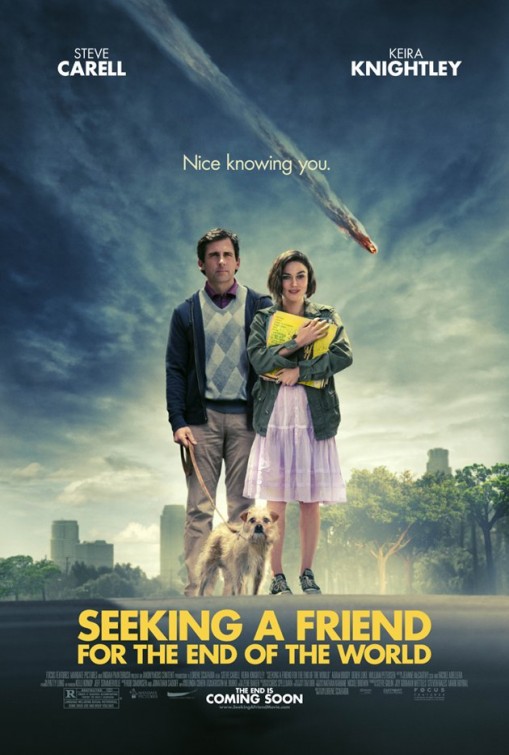 It’s the end of the world as we know it and I oddly felt fine… which is not a good sign for your apocalyptic movie. Seeking a Friend for the End of the World is a peculiar thing, all right. It takes place in the last three weeks of the human race. And lest you think the film wimps out on the promise of its title, think again. I was bemused for the first forty minutes, where writer/director Lorene Scafaria indulges in a series of one-scene vignettes of how humanity comes to terms with the certainty of annihilation. There’s an adult party where people joyfully try heroin, a hit man-for-hire service to bring back some of the mystery of death, and a restaurant where all the workers are spaced out on Ecstasy. I found each of these moments to be funny and a well though-out extension of the premise. But then the film’s diversions give way to the rom-com of our main characters, played by Steve Carell and Keira Knightley as your standard manic pixie girl. And the more time I spent with them the more I found myself not getting engaged. My emotional empathy was kept to a minimum; they’re nice people and all but I didn’t find them that interesting. The resulting movie feels like one of the weakest avenues given the premise. I credit Scafaria for not wimping out in the end, but as these characters faced oblivion together, I felt little emotional stirrings in my chest.
Nate’s Grade: C+
Share this:

Melancholia (2011)
 Melancholia opens with a bang. Literally. Lars von Trier, film’s most polarizing and famous sadist, begins his movie with the ultimate spoiler alert, destroying the entire planet. Lars von Trier’s grandiose exploration of annihilation, both personal and species-level, can be maddening in how tedious the whole affair can become for long stretches. What’s even more maddening is that the movie flirts with being magnificent for other, regrettably smaller, stretches.
We open with the wedding of Justine (Kirsten Dunst) and Michael (True Blood’s Alexander Skarsgard). Hours late, the couple arrives at their reception at the palatial estate that belongs to her sister, Claire (Charlotte Gainsbourg), and her husband, amateur astronomer John (Kiefer Sutherland). Over the course of one very late night, Justine will quit her job, sleep with a random wedding guest, alienate her family, and end her brief marriage, putting Kim Kardashian to shame. Several months later, Justine has been released from a hospital for clinical depression and is now living with Claire and John’s along with their young son, Leo. A tiny star in the sky has gotten larger over the ensuing months, and scientists have determined that this new planet is heading straight for Earth. Named Melancholia, this rogue space rock is predicted to pass by, but the calculations are getting closer and closer. Eventually, the truth is evident and Melancholia is on a cataclysmic collision course with Earth.
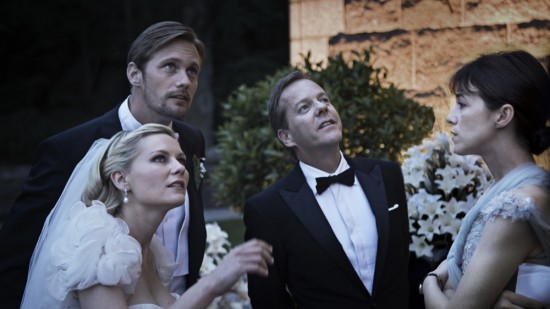 From a plot standpoint, the movie is completely lopsided. Melancholia opens with beautiful images that…. just…. keep…. going…. on…. and… on… set to thunderous Wagnerian overtures. It lets us know right away that von Trier is performing at an operatic level of melodrama. After this spoiler sequence, we jump back to the last months of Earth. The first hour of this movie is a boring wedding sequence that just seems to stretch for an eternity. You may wish that the rogue planet would show up and smash everyone to bits so we could get on with it. Justine and her groom are already several hours late because of the precarious route their limo had to take, so the fact that Justine takes frequent breaks and needs to be constantly retrieved can be draining. The hour of wedding blahs would be better time spent if I felt von Trier was laying the groundwork for characters. Little of the first hour seems to matter at all or has any lingering ramifications, which is bizarre considering the amount of personal nosedives Justine takes. It’s plain to see that Justine is unhappy and going through the motions, pretending to be happy for everyone’s benefit and maybe, just maybe, she can trick herself. What’s not plain to see is why we have to spend so much time on a room full of characters that will never be seen again. We learn so little about the characters, their relationships, and why any of this matters. The first half of this movie could have easily been condensed to 20 minutes. If the point was to test the audience’s patience, much like Justine does to her family, then bravo.
It’s that second hour where Melancholia flirts with the profound. The second half only concerns four principal characters. Unlike the first monotonous hour, there are events that actually matter and have substance to them, namely the encroaching obliteration of Earth. Having seen the pre-credit preview, we already know every life on the planet is doomed, but that doesn’t stop us from feeling the same pangs of anxiety as Claire discovers what we already know. Depression may be an elusive personal experience that not everybody can empathize with, especially when the depressed individual becomes overly taxing, but coming to terms with the end, not just your own, but of all of human history? That’s something every person can identify with. This confrontation of the inevitable can lead to some thoughtful soul-searching. This is an extinction event. There is no escape, unless you’re an astronaut (it’s now or never, lunar colonists).
Like most of us would be, Claire is terrified to die, to have all her loved ones die, but Justine is eerily placid. She feels that the Earth is evil and that “nobody will miss it.” To further drive von Trier’s bleak pessimism, Justine says there is no other life elsewhere in the universe. This is it, and it’ll all be over soon. “I just know,” she adds, unhelpfully. We watch Claire go through different stages of grief, fighting for some sense of closure, but von Trier will not allow any comforts. Gainsbourg was put through Trier’s typical emotional wringer in 2009’s unpleasant Antichrist, and here she’s really the entry point for the audience, and as such we sympathize the most with her since her reactions are so believable. It’s hard to feel like there’s any bond between these two sisters, which limits the impact of the end. Still, the end is fittingly devastating and makes me wish I had seen the beautiful destruction on the big screen, bathing in its apocalyptic splendor.
 The dread of that final hour is extremely palpable, with the presence of Melancholia in the sky played almost like an art-house existential horror movie. At first we’re told by John that the scientists predict it will fly-by at roughly 60,000 miles per hour, but slowly the realization becomes clear that Melancholia is coming back with a vengeance. There’s a terrific plot point where John introduces a way to judge the planet’s movement. A wire circle is held out at arm’s reach, designed to trace around the perimeter of Melancholia. Then five minutes later the wire ring goes back up and, voila, the rogue planet has shrunken in size or gained. It’s a smart device that helps establish the momentum of doom, and it’s practical enough for the characters to perform. As Melancholia comes closer to collision, it gives off an unnerving blue glow. I started joking with my friend Alan that the movie was going to descend into a slasher-style stalker movie, with Melancholia chasing to get you like a spurned and dangerous lover (“We’ve traced the phone call. The planet is calling from inside the house!”). These attempts at levity are inevitable when the subject matter is so depressing and the nature of von Trier’s film lends itself to operatic pomposity.
von Trier’s film is quite a departure from the most disaster cinema, but sometimes its Big Statements can seem inartful and obvious. The very idea that the planet of doom in this dance of death is called Melancholia… come on. Maybe this whole thing would have been avoided had those egghead astronomers had given this rogue planet a happier name (My suggestion: “Doug.”). The metaphorical connection to Justine’s own melancholy is just inane. The planet is but a tiny speck in the sky at her wedding, and Justine is desperately trying to hold it together, and then in the second half the planet is much bigger and, surprise, so is Justine’s melancholy.
I found it hard to care about Justine and her personal demons. Depression and mental illness can be exasperating conditions, but that doesn’t mean I sympathized with her any more than the other seven billion souls destined to be incinerated. Her rejection of niceties can seem cold when all her sister wants to do is find some level of reassurance before the end is near. Dunst (Marie Antoinette) won an acting award at the Cannes Film Festival for her performance, and it’s hard for me to see why. It’s a darker, somber, more serious role for the actress, but looking tired, sullen, and impassive doesn’t come across as a fully rendered performance, more of a bad mood swing. My feelings are likely tempered by the fact that I found her character to be unbearable and agonizingly opaque
Melancholia is half of a great movie, but only half. The movie can feel a little too isolated, a little too leisurely paced, a little too pretentious. The beginning wedding sequence is like a minor endurance test, but rewards await those who carry on to the bitter end. This uneven art-house disaster movie has stunning imagery, numbing dread, and an apocalyptic grandeur, the likes of which could only come from the perverse mind of Lars von Trier. It’s beautiful and lyrical in its best moments, a cold, surrealist nightmare. The boldness of von Trier’s vision is inescapable, but I only wished he had fashioned a better story and sharper characters for his experiment in nihilism. If we’re going to spend the last few hours on Earth, I’d rather it be with people I gave a damn about.
Nate’s Grade: B-
Share this:

The Final Storm (2009)

Famously detested film director Uwe Boll finally tackles a subject that many film fans, and video game aficionados, felt he could possibly be the harbinger for – the apocalypse. Yes, in our apocalypse-drenched times with the bottoms falling out of economic markets and civil unrest, it was only a matter of time before Boll decided to put his unique German stamp on the end of the world. Usually we associate a feeling of dread with the apocalypse, akin to the feeling of dread whenever somebody turns on a Boll movie. Except Boll’s apocalyptic entry, The Final Storm, is a direct-to-DVD oddity that actually works for a while but ultimately fails like other Boll movies. But here’s the funny thing – it’s not Boll’s fault.
Tom (Steve Bacic) and Gillian Grady (Lauren Holly) ditched their big city lives to raise live on a farm out in the country. The TV is filled with apocalyptic flair: riots, fires, strange weather, radiation leaks, power outages, etc. Over the night, a ferocious storm knocks out the family’s power. Their dog runs off into the night and a mysterious stranger collapses on their doorstep. Silas (Luke Perry) says his family used to live on the Grady farm, but he can’t remember much else. Tom is convinced (somehow) that Silas is no good, whereas Tom’s wife is happy to accept a guest that will agree to do housework. When the Grady clan, plus Silas, enters into town they find it deserted. People seemed to have vanished overnight, except for the violent gang roaming the town. Silas, a man of faith, is pretty confidant that God’s Rapture is upon mankind, but Tom goes back into town once more to seek answers about the world and about Silas’ family past.
 For a while there, The Final Storm actually presents a pair of intriguing mysteries that keep the mind occupied: 1) Who is Silas, and 2) What has happened to the outside world? The world has pretty much disappeared; neighbors are gone, the police station has half-drunk cups of coffee and half-eaten donuts. Tom keeps trying to find a rational explanation for what is happening, arguing that the empty town was evacuated as a precaution. But a precaution against what exactly? Something major is underway or has already taken place. Ever since the heavy storm, there have been no birds singing or circkets chirping, no real noises of any kind. Silas is pretty confidant that it’s the end of the world and says that all they have to do is “stack up the chairs and turn out the lights.” Boll places us in the family’s camp; we only know as much as the beleaguered family trying to make sense out of the unexplainable. Canadian screenwriter Tim McGregor (Bitten) is telling a worldly event from a small perspective, trying to personalize the apocalypse. There are no big special effects sequences a la 2012 where the earth swallows cities whole. There is only uncertainty and an overall dread that something is coming but must be waited for. It’s an unsettling thought and played out with enough Twilight Zone –level ambiguity to keep the audience guessing and sticking around for answers.
A general complaint is that nobody seems to react about, you know, the End of Days. Animals and people disappeared over night. Certain townspeople are left behind. Why? Why were others taken and others not? How exactly does that one get explained (in the Left Behind movies, they comically tried to explain the Rapture as “radiation”)? The only one who shows any sign of concern is Gillian, probably because she’s slotted into the thriller female role and thus needs to express concern and eventually need saving. Tom is too preoccupied with his paranoia over Silas, and Silas is supposed to be mysterious so he reacts like he always knew the apocalypse was right around the corner. Even Graham (Cole Heppell), the Grady’s son, seems to be more concerned with his missing dog than the end of all existence. If only everybody was this blasé about the End of Days.
But then there’s that other mystery. Silas shows up at the Grady family home the night of the intense thunderstorm. He says he can’t recall how he got there, per se, and his body is covered in Biblical tattoos. Silas also appears to have some sort of insight into what’s happening in the world. He even tells Graham that his dog, which ran away during the storm, is dead. He’s so certain and preoccupied with making a nice grave marker for the dog that I almost started guessing that Silas was the dead dog incarnate. Seriously, the movie really tries hard to present the illusion that Silas has some sort of ephemeral connection to what is happening, some sort of understanding that goes beyond knowledge of Scripture.
And then the last 20 minutes of the movie reveal that Silas is … (spoiler alert) just some dude who killed his dad and escaped from prison. The Grady home is Silas’ old family home. So the guy who Tom kept saying was dangerous, who showed no real signs of being unbalanced or anything other than courtly and helpful, is revealed to be your standard killer on the loose. This is where The Final Storm utterly falls apart. These characters should be reacting with more alarm about the end of the world. Perhaps McGregor was trying to illustrate how extreme situations affect us, and how jealousy and paranoia can take hold as a means of comfort and survival. But I don’t buy that. First off, it rewards Tom for his unchecked paranoia that had no basis in reality. Silas fixes the roof, helps fend off attackers in town, and chops wood, but it all just makes Tom angry. The last 20 minutes is Silas fully embracing his villainy, the stuff that didn’t show any previous signs of existing. Silas is one big red herring and the movie shifts gears so quickly and absurdly to fit in “super able killer terrorizes family clan” mode. Silas gets frisky with Gillian, asking her to bring in hot water for his bath while he’s in the tub (it’s like an Amish Body Heat). Then he goes full crazy and tries to hang Tom in a tree. Eventually, Silas is set on fire and stabbed with a pitchfork. Then the family stares into the sky and watches as stars get blotted out and the universe collapses. Where is the connection to the apocalypse? The two storylines don’t seem to mix when there is no greater connection. It feels like an ordinary “dangerous drifter” story weirdly set against the backdrop of the apocalypse. Why connect these stories if there is no relevancy, McGregor? It seems like an awfully big waste of time.
Luke Perry (TV’s first Beverly Hills 90210) and Lauren Holly (Dumb and Dumber) don’t seem too shocking to star in a Boll movie when you remind yourself that this isn’t 1996 and neither star has exactly been in high demand since their zeniths. That’s the Boll casting way: catch a falling star. Perry is actually pretty good. He has this serene nature to him that regrettably makes him seem knowledgeable, until you realize that his secret he’s hiding is mundane. He has a slight creepiness brought out through his serenity, but then he gives in fully to malice when his character indulges the dark side. Holly’s character is mostly the worried mother figure, the concerned type who widens her eyes and dribbles her lips to denote said worry. There’s little else to her character, though McGregor tries to come up with some weak back-story. Holly goes in and out of a Southern accent but is generally decent at being wary. What is perhaps the most perplexing is that Holly agrees to get naked for a Uwe Boll movie. Anyway, it’s a point of excitement for any NCIS fans out there that can still feel something below the waist.
 As for Boll, this is one movie that I can honestly say is not his fault. His direction doesn’t exactly elevate the material but at the same time he doesn’t get in the way of the mysteries. I was genuinely interested in discovering what has happened. I figured a religious explanation was going to be the climax, especially after we witness a blood-red moon. But it’s not Boll’s fault that the movie collapses at the end when it feels the need to endanger the family by cribbing from slasher movie rules. Boll’s direction is fairly invisible, though a few shots seem to go on much longer than necessary. The entire production feels like a TV-movie just with a few more naughty words. I feel like Boll is getting a better command of how to direct actors because Holly, Perry, and Bacic (TV’s Big Love), who actually is the best actor of the bunch, all give decent if underwhelming performances. But it wouldn’t be a Boll movie without some form of imitation. I think McGregor and Boll were trying to create their own version of Cormac McCarthy’s widely revered, The Road. There’s an unidentifiable apocalypse, a father and son, roaming bands of desperate gangs, and the general unease of futility creeping up. Too bad that Boll’s movie
The Final Storm isn’t necessarily a good movie by most standards but by Boll’s standards it rises to the top of the junk heap. The supernatural apocalyptic mystery is clearly the most interesting aspect, far more interesting than Silas becoming your standard movie maniac terrorizing a family. Has he no consideration? It’s the end of the world, man. Leave land squabbles for the day after the apocalypse. This unrelated side story pretty much derails the movie during the last act, jettisoning the apocalypse for lousy thriller fare. Boll’s direction lets the story play out to its potential and we feel the pull of the mystery, the longing for discovery and answers, and then the answers end up being far less than satisfying. The Final Storm is probably a little too slow for its own good, which furthers my hypothesis that McGregor had half a story about a crazy drifter and thought, “Well, I can’t finish this. I’ll throw together some end of the world stuff and call it a day.” Boll seems to be advancing as a director; the last few movies have become more capable. This is the first of his thirteen movies (and counting) that I’ve reviewed that I can say, without a hint of seething irony, that this movie sucks and it’s not Boll’s fault. Of course, you’re still left with a movie that sucks.
Nate’s Grade: C
Share this:

Knowing (2009)
 Knowing is a movie about the consequences of seeing the Eternal Plan. If you could know the exact day of your death, would you want to know? How would that impact your life? Would you feel motivated to live every other day to its fullest, or would it cast a pall over the rest of your time? One character in Knowing is told the day of her death and it destroys the rest of her life. I think this topic is interesting but perhaps I’m in the minority. Knowing has been savaged by film critics, and I can certainly see the validity of some of their complaints. It’s not a flawless movie by any means, but I found Knowing to be an effective and suspenseful B-movie.
In 1959, a Massachusetts school buried a time capsule with drawn predictions of what students though the world would be like in 2009 (lots of robots and rockets, how we’ve let them down). One girl, Lucinda Embry, wrote a series of numbers. Flash forward 50 years. MIT professor John Koestler (Nicolas Cage) is a widower raising his eight-year-old son, Caleb (Chandler Canterbury). When the school reopens the time capsule, the schoolteachers pass out the individual letters to students. Naturally Caleb is given the envelope with the number code. He brings it home to show his father, who becomes intrigued and looks for patterns. John reasons that the string of numbers is an eerie predictor for major disasters around the world. They predict the date, the number that die, and the location via longitude and latitude. All of the numbered disasters have already taken place (including the hotel fire that killed John’s wife), but there are three more numbered disasters that have yet to happen. It?s about this time that Caleb is visited by mysterious thin men in long black trench coats. John seeks out assistance from Lucinda’s daughter (Rose Byrne), whose daughter also hears the same voices that Caleb does about an impending doom.
 Count me genuinely surprised at how taut I found Knowing. This movie builds a good head of steam and I dreaded what was to follow (in the good sense). When John figures out the exact design of the numbers, pinpointing date and location of disasters, he feels compelled to try and prevent the loss of life. Would you do the same? I think if I had been given a secret celestial code that predicted cataclysmic disasters that I would make sure to steer clear from those locales, rather than running to them. Director Alex Proyas (Dark City, I, Robot) expertly stages the carnage, to the point that I was grimacing and wincing. The plane crash, all shown in one unending shot, is a realistic nightmare that gets more and more disturbing. John hops through the wreckage to attempt to save people and encounters one burning victims after another, all screaming in terror. There are subsequent explosions amongst the wreckage that engulf more people in flames. The scene is spellbinding and unflinchingly horrific. The same can be said about the second disaster sequence in New York City, indelicately evoking some 9/11 memories. After these sequences I was dreading every moment leading up to the next, yet I was also perversely interested to see what would happen next.
I?m glad that the screenwriters tackled the fallacy of numerology early. One of John’s MIT colleagues says that people see what they want to see in the numbers, and surprise then they find them. This was completely the case with the ridiculous 2007 thriller, The Number 23. Jim Carrey went crazy deducing everything to one number, but it was the human mind projecting what it desired to see. The same thing goes for psychics who express vague statements so that the poor saps paying can fill in the details and make it personally relevant (“I’m thinking of a grandfather who died… He was a man?”). I had less of a logic gap with the numbers in Knowing. Granted, I have no idea which set of numbers the code is going with. For example, it lists a set number of deaths for the 2004 tsunami that killed over 250,000 people. But with such a massive event, how do we calculate the dead? There could be loads of people missing and presumed killed by the tsunami. Do people that die as a result of injuries count as direct victims, or are they victims of infection? My point is either the number code is going by the reported estimate on the news or has the exact number, which would be different than what the estimate was in the press. Either way, it presents a mild discrepancy for John.
The movie paints itself into a corner and the astute viewer will realize that it?s only a matter of time before one of the two supernatural A-words gets dropped as the force behind the strange occurrences (or a hybrid of both options). While the movie gets somewhat silly toward the end with its apocalyptic resolution, Knowing refrains from getting stupid. Yes it’s weird that John somehow lives in a giant house decorated to look like some peeling haunted mansion. Yes it’s weird that some supernatural force could predict every man-made disaster yet decide not to intervene in the biggest one. Yes it’s weird when Cage screams, “We have to go where the numbers want us to go.” But here’s the thing, Knowing is packed with ideas, some of them derivative (the ending borrows liberally from Arthur C. Clarke’s novel, Childhood’s End), but there is an ongoing discussion over the nature of science, religion, destiny and free will, and this discussion does not pander. I would have expected a conventional movie to transform John back into a man of faith over the amazing course of events, but it never fully happens. The movie never deduces that religious faith is the right prescription for our ailing times, and it even questions the ideas of divine intervention, namely that we live in a universe of determination rather than randomness, though it won’t specify what that determination is. The movie adheres to its pessimistic viewpoint right down to the end, which result in some ballsy choices for a mainstream Hollywood thriller. The heavy-handed ending didn’t break the enjoyment of the movie for me, though I expect it will for many.
 Not that it was needed but Knowing offers some nice little moments of characterization. I really enjoyed John’s monologue about his wife’s passing. He laments what he was doing at the time of her death, mainly blowing leaves off the lawn. He thought you were supposed to know, to feel something when your loved ones are in peril. He was just tending to the leaves, unaware of his wife’s fiery death. I really appreciated this insight into John and also how realistic the scenario felt: the depressing realization that the universe let you down. This seems like a much more believable reason for John’s scientific atheism than anything Mel Gibson went through in Signs.
The acting is cranked up to an exaggerated level of screaming. Cage spends a good portion of the movie with his mouth agape. The rest of the time he’s frantically screaming, which could account for most of the acting. It alternates between catatonic and hysterical. Cage is rather decent as his life is consumed by mysteries. I must say though that the acting only made me raise my eyebrow a few times and never pulled me out of the movie. This is no Wicker Man embarrassment of monumental proportions.
[Knowing is a solid B-movie with some super special effects to go along with its haunting scenes of disaster. It?s a step above your average sci-fi flick thanks to a lack of pandering to easy answers. I’m somewhat amazed that a movie this fatalistic and bleak would be greenlighted and given the budget it has. Proyas make sure the movie doesn’t succumb to numerology hokum, though the movie does tilt a bit toward the silly by its conclusion. I went into Knowing knowing little beyond the fact that the movie was ripped apart by other critics. Perhaps my positive reaction is born completely out of low expectations, but I found Knowing to be a juicy bit of sci-fi escapism that diverted the time nicely
Nate’s Grade: B
Share this:

I Am Legend (2007)
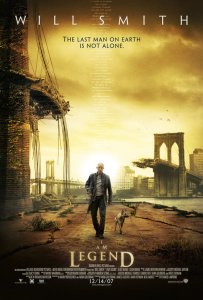 Ever wanted true and ever-lasting quiet? Be careful what you wish for. Super buff scientist Robert Neville (Will Smith) is the last known survivor of a virus that swept throughout the world in 2009. The U.S. government quarantined Manhattan and military jets blew up the bridges leading out from the island. Now in 2012, he and his lone companion, a German Shepard, must seek out supplies by day, because at night is when the “dark seekers” come out. These mutated creatures are what are left of those that fell prey to the virus; they can only come out at night and feed on blood. Smith has been capturing the creatures to run tests to see if he can crack the virus and offer a cure, except that the emerging creature hierarchy doesn’t exactly like having their members captured for scientific experiments.
Deeply unsettling, I Am Legend comes across like a post-apocalyptic Cast Away? but with vampires. I think they’re vampires, they kind of unhook their jaw like from The Mummy and have goopy gelatinous skin like from The X-Files Movie; they’re attracted to blood and burn in sunlight, therefore through my non-scientific analysis of fictional creatures, they’re vampires. Case closed. The movie shrouds the details of the end of the world in mystery that it doles out via flashbacks, and it works very well at keeping an audience intrigued without opening the door for distracting nit-picky questions. Being the last man to walk the planet presents all kinds of interesting scenarios, and simply watching Robert Neville go through his daily routine is entertaining. He picks up DVDs to watch, many of which he has seen so often he can recite line by line. He drives through the empty streets of New York trying to hunt stray deer. He tests his newest serums on infected rats. He sends out a radio message looking for survivors. The man even pumps his own gas. And then night comes and he barricades his home and sleeps in a bathtub listening to the voluminous howls of the creatures he now shares this world with. There’s a pleasing rhythm for an audience with routine, but it also helps answer the biggest question of adaptability. How would someone go about his or her daily life without another human (key word there) soul? The adjustment is part of the enjoyment. Many films and TV shows have walked this path before, hell half of the Twilight Zone episodes cover this scenario, but I Am Legend presents an awe-inspiring sight of desolation. Seeing birds-eye view angles of deserted Manhattan streets, overcome with encroaching grass and plants, is chilling and morbidly effective. The eerie quiet of the day may be even scarier than the dangers that lurk by nightfall.
 This is pretty heavy stuff for a Hollywood movie. After a taped TV interview that sets up how the virus began it immediately cuts to three years later and complete desolation. While there aren’t bodies strewn about, the lasting remnants of humanity are visible be it lines of empty automobiles or houses stockpiled with food and decorated for a new baby to arrive that never will. Death permeates every frame, and Neville dismisses the idea of “God’s plan” by declaring 90 percent of the population died immediately, 12 million proved immune and healthy, and 588 million turned into the “dark seekers.” Understandably, I Am Legend may be a bit too intense for younger kids and there are some late plot turns that will make animal lovers cringe.
Besides being an interesting what-if scenario, the movie is also a skillful, tense, and occasionally harrowing thriller filled with scares. The aforementioned moments of quiet are definitely eerie when presented on such a mass scale, and for a place as naturally noisy as New York City, but I Am Legend still has some classic spook moments that can still tingle a spine. When Neville’s dog runs into a dark building he follows, and every step becomes a great addition in terror. It’s your classic afraid-of-what-you-can’t-see scenario that horror milks, but I Am Legend invests the audience in Neville, and yes his furry companion, so that there’s genuine apprehension as we plunge into darkness. The CGI vampires won’t quicken the pulse alone, but add in the idea that every human being on the planet, your friends and family, has turned into a predatory creature and then the situation becomes more disturbing. When the vampires trick Neville and wait for the trickle of daylight to expire, the movie is downright nerve-wracking in the best way. The scene plays out at an agonizingly slow length that pins the viewer to the chair.
Smith gives a fabulous unnerved performance as, seemingly, the last man on Earth. Smith is an actor known for his wide grin and intense charisma, so plopping him down in a post-apocalyptic world doesn’t seem naturally ideal. There are long stretches where he is only acting alongside a German shepherd for companionship. Neville is dramatically lonely and befriending mannequins, including one female mannequin that he is working up the nerve to talk to in the video store. Smith is slowly breaking down from the void of human contact and he showcases how weary extreme loneliness can become. When he sees “Fred” the mannequin in an unexpected place, Smith just loses it. After such isolation, he has forgotten how to act around human beings and he is very much a casualty even as he survives. His strong relationship with his dog is occasionally touching and very reminiscent of Cast Away with Wilson the volleyball; I was more emotionally attached to this dog than I have been for entire slates of movie characters. Smith and the dog carry this movie and they both do outstanding work.
 I Am Legend is about 3/4 of an awesome movie, and then it takes a step into a more conventional direction with some new additions. The ending is satisfying and a ray of hope amongst a thoroughly bleak tale. I Am Legend flirts with the profound perspective shift of Richard Matheson’s original work but then opts for something a tad more redemptive and familiar to anyone that watched 2002’s Signs, and yet the ending still relatively works for the material. I didn’t feel cheated and I suppose that’s what counts the most when it comes to a big budget blockbuster action thriller.
I wasn’t expecting a sturdy survivalist parable mixed in with some semi-smart sci-fi and chills, so I Am Legend is a futuristic thrill ride that satisfies on different levels. Sure the last act change-up causes the movie to lose focus, and it’s not nearly as entertaining as watching Smith just go about his post-apocalyptic business. Director Francis Lawrence (Constantine) steers the movie away from camp and ramps up eerie set pieces and a strong visual command even if the CGI zombie-vampire-people look a little cheesy. The movie becomes a one-man-show and Smith, in all his quiet rage and mounting despair, is the key that holds this entire entertaining enterprise together. I Am Legend is short of legendary but it’s most certainly worth your time.
Nate’s Grade: B+
Share this:

Dawn of the Dead (2004)
 For many, any notion of a remake of George Romero’s 1978 zombie classic Dawn of the Dead would be heresy. There are only two things this remake has in common with its predecessor: 1) The characters are holed up in a mall for survival, and 2) There are zombies. Thats it. The social commentary of Romero’s Dawn is stripped away, and in its place is a slick, lean action film with lots of very effective and suspenseful set pieces. Instead of thoughtless and lumbering zombies of Romero’s film, these zombies have taken a cue from Danny Boyle’s 28 Days Later brood and run, dont walk, to nibble their meat. First time director Zack Snyder creates a movie rich in gruesome thrills and dark comedy but overloaded with characters, some of which you dont even remember until they are eventually picked off. Indie stalwarts Sarah Polley and Ving Rhames nicely anchor the cast. Dawn of the Dead is light on characters (except in numbers) and plot, but it starts with a cataclysmic bang and doesn’t let up until the lights go back on. If you want the film to end optimistically leave immediately upon the end credits, and if not, then stick around for some more goodies.
Nate’s Grade: B+
Share this:

Terminator 3: Rise of the Machines (2003)
 Arnold is indeed back and it appears that the 55-year-old action star and seven-time Mr. Olympia has saved our summer with the refreshingly retro retread, Terminator 3: Rise of the Machines. Twelve years have passed since the ending of Terminator 2. John Conner (Nick Stahl, replacing Edward Furlong) battles paranoia that at any second the machines of the future could send yet another android assassin back in time (And hes right, because if I was a machine and interested in proficiency, I would just keep doing this every year and eventually one would get it right). So because of these fears, the future hero of the human race is living his life right now like a drifter. He has no phones, no paper trails, and works from place to place never getting too comfortable.
John acting like a bum actually works. The machines cannot find him so they send a slinky new model, the T-X (Kristanna Loken), back in time to off his eventual lieutenants. This new version of the Terminator has the same silvery shape-shifting finish of Robert Patricks T-1000 (as well as the vacant emotionless staring) but now can turn her limbs into an arsenal of weapons at no extra cost. T-X, or Terminatirx, even appears in the window display of a posh clothing store. She appears alongside other manikins and struts her naked stuff along the night streets. So the killing machine of T3 is a blonde woman in red leather so tight it could have been painted on. She looks to be 115 lbs. soaking wet and made of metal. Nevertheless, the T-X is a suitable villain.
 One of the names on the T-X list is Kate Brewster (Claire Danes), a vet with a dad in very secretive military projects. Which projects? Well only the creation and operation of sentient computer program SKYNET. Kate meets up with John at her vet office. They also meet the T-X, though why this killing machine would check the vet office and not Kates home is an oddity. But wait, another Terminator (Schwarzenegger) is sent back in time to protect the Conner clan for the third time (It’s becoming so familiar that the Conner family might as well have a T-100 stocking on their fireplace for Christmas). And like that Arnold rescues Kate and John from the evil robotic runway model and the chase is on. Meanwhile a computer virus is crippling the nations electronics and the military is pushing Kates father into making SKYNET operational. But to do so would give full control over the nation’s nuclear instruments to a machine. Can you see some things brewing on the horizon?
T3 is basically a retread of the story of T2 with Arnold’s obsolete model trying to save John on the run from a faster and deadlier Terminator. And you know what? So what I say. T2 was an incredible film brimming with great action sequences beautifully captured. So what better action film to emulate than quite possibly the best action film ever? And T3 fills in quite well. It is so marvelously refreshing to see an action film that doesn’t involve wires, kung-fu, and extensively obvious CGI. CGI should be used to enhance an action sequence, but when it becomes the sole reason an action sequence exists its harder to be drawn in. So when I see Arnold and the T-X rumble in a bathroom, knocking heads through doors and broken porcelain, it’s a total blast because of the sense of realism.
I think part of me would have had a slightly different reaction to T3 if I had not seen the humorless pretension of The Matrix: Reloaded and Hulk. And unlike the earlier summer fare, T3 is an action movie that -are you listening Ang Lee?- ENTERTAINS the audience without boring them. Since when did we enter some parallel realm where our action films were trying to deconstruct the works of Nietzsche and use words like “concordantly” and “ergo”? Where was the turning point when the action fell out of the action film? These statements are not to say that action films would be better brainless (see The Mummy films, go on) but they would certainly be better if they had some humor and a lack of heady posturing. And for all of these reasons, and more, T3 is a solid action film, the kind we need to remind us what action films are and the fun they can bring. Did anyone, and I mean ANYONE have any fun with Hulk? I think a trip to the dentist would have been more exhilarating. Especially if he gassed you and touched your nipples like mine did. This is pure speculation though.
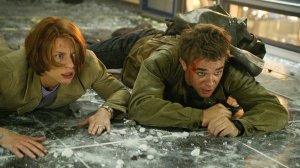 The Terminator franchise took a hit with departing director, and all around King of the World, James Cameron (the only director this franchise has ever known) and stars Linda Hamilton and Furlong opting out. Stahl and Danes are great choices and provide credible weight to their roles and suitable heroics. It’s personally wonderful to see Danes growing up into a confidant and lovely adult actress. I swear she looks older and more mature in this than The Hours even though that art crap was filmed later. Stahl seems to have a habit of getting killed in his films (In the Bedroom, Bully), so that might keep a few more film savvy people on their guard.
The biggest addition is from director Jonathon Mostow (Breakdown, U-571). One of the things Mostow does so effectively is play up humor like no previous Terminator film. The naked entrance of Arnold is a great example of Mostow acknowledging the iconic nature of the films. Mostow also stages incredible action scenes. Thats good too.
What does it say that Arnold is at his best when acting like a machine? I didn’t realize until seeing T3 how welcome it is to watch Arnold strut around in his familiar leather jacket and sunglasses. We might not have known we could use another Terminator flick but while you’ll watching you may think, ”Man it’s been too long, welcome back.” T3 isn’t going to be the benchmark of action like its predecessor is, but the film is a good time.
Nate’s Grade: B-
Share this:

28 Days Later (2003)
 Zombies have generally seemed one of the little brothers of the horror genre. Certainly not as complicated or Freudian as Frankenstein or Jekyll and Hyde, and no where near as seductive as vampires and werewolves. Zombies are stumbling, bumbling cement-shoe wearing monsters. Theyre usually conduits for some kind of social message, like George Romeros classic Night of the Living Dead and Dawn of the Dead. The scary part of zombies is the methodical eventuality they exhibit. They may be stupid, they may be slow, and they may be really stupid, but theyll keep coming. They’re dead and they got no where to be. And there’s the pull – that they will eventually get you. You’ll give in, something will happen, and they’ll seize upon that unfortunate misstep (I did an extensive paper on the symbolism of zombies in Romero’s films and the connections between religion and horror. I think I deleted it though, so this is the best analysis you’re gonna get). Now there’s director Danny Boyle’s indie horror flick, 28 Days Later, which gives the zombie genre a few good shocks to the system.
We open up with stark television clips of violence, genocide, and all around mayhem around the world. Its basically what the cable news stations are now, except in this case, the viewership of these broadcasts are monkeys. Yes, it seems that the British government is experimenting on the nature of rage by strapping monkeys onto slabs and forcing them, A Clockwork Orange style, to watch all kinds of icky video. Animal rights activists break into the facility and plan on freeing the primate prisoners. A lab assistant tries to deter the monkey theft. He says alarmingly that the animals are infected with rage (as are most drivers it seems), and that this infection is highly contagious. The animal rights activists scoff at his concern and open the cages to the primates. For their altruistic virtues the activists are instantly attacked, bitten, mauled (can one be mauled by monkeys? It just seems like bears and lions have a monopoly on this verb) and infected with this deadly rage disease. This is likely the worst PR set-back for the animal rights activists since PETA clubbed baby seals. Look it up.
 Flash to the titular 28 days later. Jim (Cillian Murphy) comes to in a hospital bed, and like previous films, Boyle finds an outlet to shoehorn in some full-frontal male nudity. Its almost like a directors trademark. Jims a bike messenger and has been in a coma for about, oh, lets just say for the sake of it, 28 days. Jim wanders through the vacant hospital calling out for anyone. He hits the streets of London to find them startlingly empty, like some Twilight Zone episode. City kiosks are papered with numerous pictures for missing relatives or good-bye letters. A scattered newspaper says London has been evacuated. Jim meets two other survivors, Mark (Noah Huntley) and Selena (Naomie Harris). They wax chunky exposition to tell us what we already know: the virus got out, spread rapidly, is transmitted through the blood. Selena does have more unsettling news about the nature of the disease. It turns out that once infected a person has about 10-20 seconds of rational thought left before they fully turn into the rabid, crazed not-dead zombies. Jim demands to see his parents and the two agree to lead him to his home in the morning.
The next morning the surviving trio trek through the empty streets and residential areas. Jim enters his home calling out for his parents. He immediately has to cover his nose with his shirt sleeve. He walks into his parents bedroom to find both curled up next to each other long dead. On the nightstand are a bottle of wine and a slew of pills. His mother holds a picture of Jim as a child. On the back Jim reads: “We left you sleeping. Now we’ll be with you again.” At the bottom it says, ”Don’t wake up.” Jim is devastated.
They find refuge in the apartment building of a Frank (Brendan Gleeson) and his daughter Hannah (Megan Burns). The two have been surviving since the outbreak. Frank is delighted to find other survivors. He shares a radio message he picked up. The message, though slightly garbled, is from a military base a ways away. They say they have discovered the answer for infection and will provide shelter for any survivors. The foursome pack up their belongings in Franks car and head for the military base with a new sense of hope.
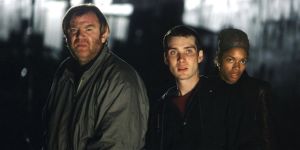 The cinematography of 28 Days Later is wonderful. It’s the best I’ve ever seen digital video. The choice of shooting on that medium also amplifies the horror and creates a more immediate sense of danger. The musical score could have been written by one of those popular Brit-rock bands. It’s propulsive, effectively building, and wonderfully sonic.
Harris is the star of the film, whether the makers know this or not. Shes one tough cookie but also reflects great moments of vulnerability as she opens up to the group and starts kindling some feelings for Jim. Gleeson is one of the best character actors out there, as evidence by a great turn in Scorsese’s Gangs of New York. Acting is never the strongest suit for horror flicks but 28 Days Later has some nice exceptions to this norm.
28 Days Later has a resonating sense of truth to it, if that can be said about apocalyptic cinema. When one character regrettably becomes infected they order their fellows to stand back, but before succumbing they say, Just know that I love you. This felt so genuine to me. Like if a comet was hurtling to decimate the planet within seconds, and your loved ones were around you, would you not act the same way? How does one compress all their feelings and appreciation and love in closing seconds? Something tells me its something like what is displayed in 28 Days Later.
Boyle, as has been ingrained into me from the blurb-heavy ads, has indeed reinvented zombie horror. However, what you may not know is that zombie horror doesn’t exactly have many titles to it. I think I’ve already mentioned most of them. Boyles zombies aren’t dead, just infected human beings. They don’t move at that lumbering drag-your-feet speed of classic zombie lore, no these not-so-undead move with great velocity and ferocity, like rabid junkyard dogs. The new touches here and there provide some interesting dynamics to the genre.
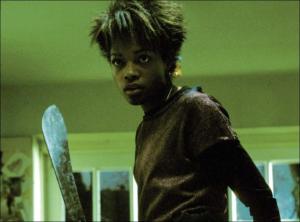 Perhaps what is different than most zombie films is that the audience grows to like the characters and root for their survival. In most horror films the characters are either too stupid or sketchy that it allows the audience to wait in amusement for their eventual horrific deaths. Its simple: we want to see these people die because its titillating (Maybe I was wrong about all the zombie analysis I still had in my head).
Boyle does service a slight message in his zombie film when the group gets to the military base. Perhaps, he muses, our military and trusted leaders are no better than those rabidly wandering the streets. The idea of a thriller set against a biological pandemic also feels very timely and relevant. The film kind of drags in the middle during the stretch between London and the military base. And the end was a bit too much Die Hard for my taste, but is suitably climactic.
Boyle has crafted a creepy, smart, and engrossing piece of entertainment. I hope people dont confuse this film with that Sandra Bullock clunker, 28 Days. They may be spending the entire time wondering where shirtless Viggo is and when Bullock will start her endless pratfalls (You knew I was going to talk about that movie somewhere).
Nate’s Grade: B
Share this:

Donnie Darko (2001)
 Donnie Darko (Jake Gyllenhaal) is your normal malcontent teenager in late 1980s Reagan America. He bickers with his older sister, worries over the right moment he’ll kiss his new girlfriend, and tries to ignore the advice of many imprudent adults. Donnie’s your typical teenager, except for his imaginary friend Frank. Frank is a sinister looking six-foot tall rabbit that encourages Donnie into mischief and gives a countdown to the impending apocalypse. And I haven’t even gotten to the time travel yet.
One night as Donnie wanders from his home at the behest of Frank, an airline engine mysteriously crashes through the Darko home and lands directly in Donnie’s room. The airlines are all at a loss for explanation, as it seems no one will take responsibility for the engine or knows where it came from. Donnie becomes a mild celebrity at school and initiates a relationship with a new girl, Gretchen Ross (Jena Malone). One of his classes consists of watching videos of self-help guru and new age enlightenment pitchman Jim Cunningham (Patrick Swayze). His school has even, under the persistence of self-righteous pain Kitty Farmer, persuaded Cunningham to speak and try to help students conquer their “fears.”
 Donnie is also seeing a therapist for his emotional problems and taking medication for borderline schizophrenia. Around this time is when Donnie starts to inquire about a strange old woman, obsess over the possibilities of time travel, as well as see weird phosphorescent pools extend from people’s chests. He also floods his school at the urging of Frank. This is no Harvey type rabbit.
The longer Donnie Darko goes on the more tightly complex and imaginative the story gets. First time writer-director Richard Kelly has forged an excitingly original film that is incredibly engaging with charm and wit. He masterfully mixes themes of alienation, dark comedy, romance, science fiction, and a sublime satire of high school. Donnie Darko is the most unique, head-trip of a movie unleashed on the public since Being John Malkovich. Kelly has a created an astonishing breakthrough for himself and has ensured he is a talent to look out for in the future.
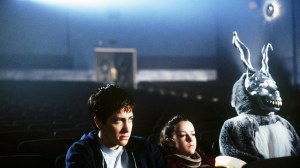 Gyllenhaal (October Sky) is superb as disenchanted Donnie, a Holden Caulfield for middle suburbia. His ghastly stare conveys the darkness of Donnie but his laid-back nature allows the audience to care about what could have merely been another angst-ridden teenager. Swayze is hysterical as the scenery-chewing Cunningham. The rest of the cast is mainly underwritten in their roles, including stars Drew Barrymore (who was executive producer) and ER‘s Noah Wyle, but all perform admirably with the amount they are given. Not every plot thread is exactly tidied up but this can easily be forgiven.
Donnie Darko is a film that demands your intelligence and requires you to stay on your toes, so you can forget any bathroom breaks. The film is one of the best of 2001 but also one of the funniest. You’ll be honestly surprised the amount of times you laugh out loud with this flick. The theater I saw this in erupted every half a minute or so with boisterous laughter.
Donnie Darko is a film of daring skill and great imagination. You don’t see too many of these around anymore.
Nate’s Grade: A
Reviewed 20 years later as part of the “Reviews Re-View: 2001” article.
Share this:

Dogma (1999)
 In a time where simply having faith in anything, let alone religion, is scoffed at, Kevin Smith daringly and passionately expresses his personal search for answers and understanding. But while the zealots decree Dogma as blasphemy, what they truly miss is the biggest commercial for faith and God that American audiences have seen in decades of cinema.
The story of the religious epic causing all the hubbub begins with a pair of fallen angels (Ben Affleck and Matt Damon) spurned from the pearly gates of Heaven and banished to Wisconsin. One discovers a re-dedication of a church imploring a little used Catholic practice of plenary indulgence allowing whoever to enter through the church’s arches to have their slate cleaned of all sin. The two seize this opportunity of a dogmatic loophole to sneak back into heaven. The only slight problem is that by doing so they reverse a decree of God and disprove the Almighty’s unfallability, and thus will wipe out all of existence. The voice of God (Alan Rickman) recruits a lapsed Catholic named Bethany (Linda Fiorentino) for a Holy Crusade to halt the scheming angel’s plans for the good of the universe. Along the way she is aided by two unlikely prophets (the dynamic duo of Jay and Silent Bob), an racially discredited 13th Apostle (Chris Rock), and a shapely strip-teasing muse (Salma Hayek) as they engage with demons, seraphims, angles, and all sorts of celestial “who’s who” to stop the end of existence.
 Smith’s direction has taken strides since the point-and-click days of his earlier works; however, there’s still an awkward flatness to his framing and action. Fiorentino plays the role of a grounded character well. Rickman as the bitter Brit shows why he can still take anyone toe-to-toe for acting chops. Affleck and Damon have terrific chemistry together and play off one another for great comedy. Jason Mewes has never been funnier as the terminally stoned and foul mouthed Jay. Rock shows he can restrain his abrasive personality. Salma shows… well she shows she can dance. Jason Lee as an air conditioning-adoring demon and George Carlin as a used car salesman type Catholic Cardinal are so commanding in their presence and excellent in their performances that it’s a sin most of their scenes were cut during editing. Even Alanis Morrisette works as a humanly childish God. She’s given no lines but expresses great feeling and humor anyway.
Dogma is rambunctiously hilarious and a never ending joyride of fun as it jumps from jokes about demons made of excrement to “Buddy Christs” to insightful and sensitive thoughts on religion. Rarely does it bore even with the large plot it must always keep in successive movement. The only drawback Dogma suffers from is the amount of religious points it desires to make. The characters will reach a subject, chat, then directly move on to the next. The sporadic nature can easily keep an audience’s head spinning, but is brought back down to gentle rest from Smith’s Divine wit and sharp writing. Some of the opus’ many characters appear for only brief stretches as Hollywood’s A-list battle for valid screen time among each other.
 Smith is not one to shy away from controversy, or his quota of sexual innuendos and profanity. But the protestors for this film attacking its vulgarity are beyond missing the point; Dogma is reaching people the church hasn’t and can’t. It may be an audacious tweaker of a flick, but ultimately it’s bringing up religion into open debate and discussion amongst the masses where there was none before. And isn’t that in itself glorifying some type of achievement?
It would do well the opponents of Dogma to venture into a darkened theater sometime to see the movie and realize it is a humorous affirmation of faith and beliefs. The story of a crisis of faith is relatable to a society too jaded and cynical. Smith’s wrestle with theology is the public’s gain, and his halo only glows a little brighter for having the courage to do so.
Nate’s Grade: A-


 nathanzoebl
You must be logged in to post a comment.