Blog Archives
Memento (2001) [Review Re-View]
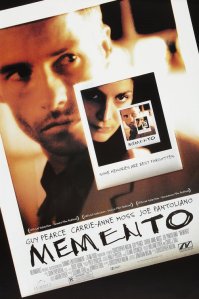 Released March 16, 2001:
A film is taking the nation by storm and it isn’t anything from a big studio. In fact it’s the first release of a new indie production house called New Market, and these people have lassoed a real winner. Memento is a murder mystery bubbling with perfect elements of noir, suspense, and trickery. Memento is the tale of Leonard Shelby (Guy Pearce) who is searching desperately for John G., the culprit he believes that raped and murdered his wife. Along the way Leonard gets assistance from his friend Teddy (Joe Pantoliano) and Natalie (Carrie Anne-Moss), a down on her luck bartender.
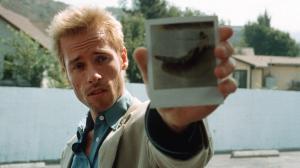 Except Leonard has a peculiar problem plaguing his one-man investigation for justice. After the attack on his wife the assailant knocked him out, and Leonard was left with no short-term memory whatsoever. Leonard cannot develop new memories. So if something happens to him, he is liable to immediately forget it within five minutes. To aid himself he write on small post-its telling him which car is his, what hotel he’s at, etc. all over his body are tattoos of clues he has amassed. He takes Polaroids of people and writes their names on them to remind him of the faces he sees that he won’t remember. Leonard’s investigation is about what his notes tell him. He doesn’t know whom he can trust and whom he cannot.
If this wasn’t enough to make Memento interesting the entire tale is told out of sequence and run from end to beginning. The entire film is told backwards. This action robs the audience of the same information that escapes Leonard. We too know neither who to trust. The effect could fall into gimmick territory but makes the movie fresh and adds for some great comic situations as well, like when Leonard awakens with a bottle of champagne in his hand and tells himself he doesn’t feel drunk.
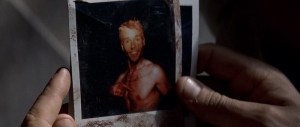 Pearce is gripping as the emotionally shattered and fractured Leonard. He is a man that can trust nothing and must live from repetition but is intent on bringing his wife’s killer to bloody justice. Pantoliano and Moss provide good support as the weary characters that weave into Leonard’s plight. The acting it excellent all around. They leave us guessing and reassembling our perceptions as more of the puzzle unravels.
Memento is top-notch film noir. It’s a breathless thriller of a first rate caliber. The direction given by Christopher Nolan from his screenplay is tight and highly effective. The character of Leonard is fleshed out in all his paranoia, pain, and frustration. Nolan has delivered a gift to movie audiences always hungry for fresh material. One has to see the film a second time just to see how well the segments play together.
Memento is the coolest movie around. Rush out and see it, then see it again, and then again. It’s the best movie of 2001 by far as of now and has the Best Original Screenplay Oscar locked [Editor’s note: it lost to Gosford Park of all things.] It’s destined to be a cinematic classic people will talk about for years.
Nate’s Grade: A
——————————————————
WRITER REFLECTIONS 20 YEARS LATER

Without a doubt, there has been no filmmaker that has had the meteoric rise over the last twenty years than Christopher Nolan. The man has entered that rare, hallowed upper echelon of the Steven Spielbergs and Quentin Tarantinos where his name alone is the selling point. You go to see a Nolan movie because you know it will be an experience that no other filmmaker can quite deliver, and from 2005’s Batman Begins onward, he’s been given immense studio resources and unchecked creative control to make his big dreams come true on the biggest stage. It’s thus very fun to go back to the little 2001 indie movie where it all started for the future box-office titan. It has many of the hallmarks that have followed the director’s ascendant career, like dead wives as back-story, cool emotions, an unreliable protagonist, and especially its crackerjack, air-tight narrative. Memento already had a dynamite premise, an amateur investigator seeking justice who couldn’t hold new memories because of a mental condition. It was based on an unpublished short story by his brother Jonathan (future frequent collaborator and creator of HBO’s Westworld), which is why it qualified as an original screenplay at the Oscars, to which it would eventually lose out to Gosford Park (go figure). Nolan deliberately made the story even harder to follow in a gambit that would come to define his screenwriting experimentation. He told the entire movie backwards, so that the story began at its ending and finished at its beginning. Every few minutes, we, like our memory-challenged lead Leonard Shelby (Guy Pearce), are left to ask, “How did we get here?” It puts you in the stark position of the lead’s perplexed and scrambling sensibility. It’s a raised bet of a storytelling check, one that Nolan delivers with incredible panache, but twenty years later, is Memento more than a brilliantly executed magic trick?
 Even after watching Memento likely half a dozen times in my life, this is still one very confusing movie to follow. There are two current storylines that crisscross and eventually overlap, like tributaries reconnecting to a source. The black-and-white segments of Leonard narrating his rules, tattoos of key clues, practices, and investigative successes as he narrows his search for the mysterious “John G.,” the man he claims assaulted him and his wife, are filmed more objectively, playing out in linear fashion, given to rampant exposition to better orient the audience to the tricks of the movie. The color segments are the main action, watching Leonard go from murdering a confidant to then explaining how we got here, roping in scummy drug dealers, violent men, sad-eyed barmaids, and people looking to take advantage of Leonard and his unique disability (the motel owner rents him multiple rooms). These sequences are played in the backwards trajectory that drives the movie, so every pit stop essentially resets the movie as we know it. It’s an amazing device because it makes every scene its own little movie with its own little payoff, with a dopamine reward for seeing how the opening of the last image came to be. Some of these are played for laughs but many are extremely well thought out to keep an audience guessing. Leonard opens a closet to find a beaten and gagged man who swears it was Leonard who did this to him. Leonard begins in mid-chase, seeing a man running parallel to him. “Oh, I must be chasing this guy,” he comments in voice over, until seeing the man’s gun in hand and his advance. “No, he’s chasing me,” he corrects, and runs in the other direction. Then there’s the question of who Leonard can trust, and your assessment of the supporting characters in his orbit will shift. You’ll feel bamboozled just like Leonard, that is, if he could remember. The backwards-narrative allows Nolan to make his revenge thriller so much more mysterious and audacious and playful, and the director takes full advantage of the possibility. It’s a rare screenplay of near genius quality.
On a later DVD release, there was a hidden special feature that could be unlocked that would play the movie in chronological order, and I feel like this would be like watching a magic performance with X-ray vision. It would completely take away the appeal. While I think the level of details and continuity and thematic connections would be even more apparent with more traditional, linear plotting, it would seriously negate much of the fun and potential of the movie. That’s not to say that Memento is only effective because of its narrative shuffling. It’s still a lean thriller with a brimming confidence that can give you an artistic contact high. The character of Leonard Shelby is a fascinating and tragic figure worth exploration, which the movie allows for deeper discussion off-board. However, when you’re witnessing a thoroughly thought-out magic trick that is performed at such a heightened degree of excellence, why blow it up with asking for convention?
It’s also fun to revisit the 2001 movie and see many of Nolan’s staples of creative collaborators. There’s his brother, who he’s co-wrote a very successful Batman trilogy with, along with Doddy Dorn as the editor (Insomnia), David Julyan (The Prestige, Insomnia) as the composer, and especially Wally Phister as the cinematographer who helmed every Nolan movie from 2001 to 2012, winning an Oscar for 2010’s Inception.
 I’ll preface these next two paragraphs with a spoiler warning, which I acknowledge is perhaps overdoing it for a movie that’s been available for twenty years, but I’m going to discuss the ending (beginning) of Memento and its implications, so if you’d prefer to be surprised and are one of the people on the planet who hasn’t seen this movie, or been spoiled, then go watch it and then come back to this review. The through line of Memento is Leonard’s murder of “John G,” a.k.a. Teddy (Joe Pantoliano), a supposed ally that may work in law enforcement. The movie becomes a question over whether Teddy was guilty or whether Leonard was manipulated from beyond, and this proves to be the case, though the culprit is rather unexpected. It’s not Natalie (Carrie Anne-Moss) seeking vengeance for her dead drug-dealing boyfriend, though she plays her part, but the real manipulator is none other than Leonard himself. Teddy has set up a fall guy for Leonard to take out to get his long-sought vengeance, and maybe he can remember to be satisfied, but as Teddy recounts, it always fades. They’re always back repeating their old loops. Given the circumstances, Teddy sets up his pal to take out local lowlifes and figures why not profit from the experience (his warnings to ditch the drug dealer’s car go unheeded by Leonard, who instead chooses to drive it around town and even wear the clothes of his victim, a nice visual cue that leads to the big sucker punch reveal Nolan has coiled).
Teddy’s real offense, however, is telling Leonard a truth he does not want to accept. The back-story that has driven him is deemed fictional, conflated with an ongoing anecdotal analogy about Sammy Jankis (Stephen Tobolowsky), a memory-impaired man whose wife tests him that results in her overdose on insulin. Leonard’s wife survived the assault. It was she who overdosed on insulin to test her husband’s condition. This truth runs counter to everything Leonard has defined himself by and he rejects it, and through that hostile rejection, he sets Teddy up for a cruel fate. He ensures Teddy will be hunted down as the next “John G.” suspect, and thus Leonard actively chooses to live the fiction than deal with truth. In 2021, especially after four years of a pungent presidency that shamelessly warped reality to whatever was deemed preferable, and with millions of gullible Americans still falling for the fantasy, the story of a man choosing the comforts of self-delusion over uncomfortable accountability is striking for its topicality. It’s about the lies we tell one another. Leonard says he deals with facts because memory can be fickle, it’s unreliable, and then the script proves this to be exactly the case, having hidden the answer right in front of your face. I love that the implications can be deliberated even twenty years later and the question of whether Leonard is a secret villain. He believes he’s doing righteous work, but he also proves he can never be satisfied and will very likely continue to hurt others to sustain his preferred reality. Because of the narrative trickery, or limitations of building from a foundation, it’s hard to say that Leonard is a deep character rather than a blunt force instrument. It’s in the revelation and lingering implications where the depth of Leonard Shelby emerges, and I think it’s a depth that often gets overlooked by those trying to keep up with the admittedly confusing storyline.
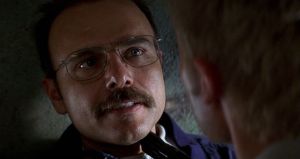 Revisiting Memento, there’s a definite nostalgia quality, watching two stars from The Matrix and the young upstart from L.A. Confidential bouncing around a Polaroid-snapping L.A. noir mystery from the man who would come to redefine blockbuster cinema. It’s not an understatement to say Nolan is in a class of his own, and his critical and commercial success seems to have convinced him that every movie needs his narrative sleight-of-hand. Some of those films didn’t really benefit from the extra complications. I thought the three timelines compressed on top of one another in 2017’s Dunkirk was entirely unnecessary and distracting. It got even worse in 2020’s deliberately palindromic Tenet, which was a puzzle box from Nolan I felt no desire to solve. Nolan has told movies with just about every construction of linear and non-linear plotting imaginable, and it’s hard not to feel like he’s struggling to find some new fix to hold his interest. Maybe the appeal of the Nolan signature magic trick is wearing off for me; I’ve been relatively disappointed with every Nolan movie since 2012’s Dark Knight Rises, which gets a bad rap for not being the zeitgeist-tapping flick that was The Dark Knight. Maybe he’s getting bored. It certainly felt like Tenet was more an intellectual exercise than an accessible entertainment for the masses. It would explain his experiments with indecipherable sound design. You don’t go to a Nolan movie to turn your brain off. There is an explicit demand that you will need to pay close attention. It just feels like the later films haven’t quite been worthy of the extra efforts.
Back in 2001, I recall being blown away by the narrative trickery of Memento. It was my top movie of that year, tying with Moulin Rouge! before I decided my heart was more aligned with Baz Luhrmann’s glitzy extravaganza (I’m looking forward to revisiting this one in two months). I didn’t have much in the way of critical analysis in 2001 beyond my exaltation of its greatness, declaring it a new classic that people would talk about for years. That’s partially true, but mainly because of the huge career that Nolan has undertaken since. My original review was also certain it would win that Best Original Screenplay Oscar and, honestly, this one still befuddles me (Gosford Park?). Twenty years later, Memento is still a daring and confusing movie, one that rewards close reading and invites deliberation and deconstruction. It’s a top-grade magic trick from an excellent illusionist and sometimes even that is enough. While I would argue it is more than its famous gimmick, it’s still enough to warrant two viewings for everyone’s lifetime.
Re-Review Grade: A
Share this:

Raya and the Last Dragon (2021)
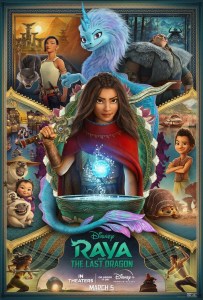
Disney’s new animated feature, Raya and the Last Dragon, is coming at an opportune time and in some ways it’s a movie of the moment. It’s all about a divided nation learning to heal and learning to trust one another despite bitter disputes. I can only hope the ensuring months and years of political dispute in this country can end as fortunately as Disney’s fantasy fable.
We follow Raya (voiced by Kelly Marie Tran) as she embarks on a quest to save her people and the divided lands of Kumandra from a mythical evil that has returned to the land. Dragons gave their lives to fight this monstrous force known as the Druun that turns life into stone. The world has been divided into separate nations surrounding a dragon-shaped body of water. There is Tail, Claw, Heart, Fang, and Spine, Raya ventures to uncover the last dragon, Sisu (Awkwafina), the dragon that originally thwarted the Druun, except Sisu says she’s not exactly the best at magic and dragon stuff. Together, Sisu and Raya are chased by Raya’s childhood nemesis Namaari (Gemma Chan), the next-in line with Fang, the nation blamed for the new outbreak of the Druun. Raya must find a broken piece of Sisu’s dragon stone from each nation to level up her powers and banish the Druun once and for all and return everyone who has turned to stone, including her father.

In many ways, Raya feels like Disney trying to do its own fantasy universe akin to the Last Airbender series. The world building is tantalizing and feels lived-in, the lands distinct and with personalities and different cultures, and those cultures are respective of their environments. I was pleased to continue with the movie and discover more well laid details that built out this world and its inhabitants, the relationships to the dragons, and the veneration of magic. The stone statues each represent a person succumbed to the evil, itself a byproduct of the inability of the splintered nations to unify and trust one another (more on theme later). I appreciated the respect and reverence given to the fallen and to the dragon statues as well. There’s a scene where Namaari and her crew are walking through a field of overgrown dragon statues and they treat it with such reverence like it was a war memorial. For Namaari personally and for Fang especially, the sacrifice of these creatures is one that humanity has been struggling to live up to. I also appreciated that the magic and lore is presented as we need it, so that the audience is overloaded early with an onslaught of new information needed to orient this make-believe world. The filmmakers do a fine job of building from previous established information and expanding naturally to complicate their world and the larger conflict. The plot through line is left pretty simple, collect the pieces of the magic rock, but because of the accessible formula it also builds anticipation we can attune to. It gets me to wonder what new power Sisu will inherit, how that new nation has dealt in the ensuing time with the power and influence of the magic shard, and what new fun character we’ll pick up along the way.
Raya is also an exciting edition to the Disney animated collection. I’ve watched the movie twice, and would watch again, but I really honed in on the action during my second viewing. The fight choreography is impressive and not simple standard kicks, punches, and sword slashes. There are specific moves and countermoves here, and the long takes with the action allow the audience to appreciate the complexity of the brawls as if we were watching The Raid. There were some moments that genuinely gave me goosebumps. I also appreciated that the action isn’t gratuitous; each scene has an emotional connection to a character and their conflict, even the many run-ins between Raya and Namaari trying to prove themselves against one another. This is also a movie where we are replete with strong female characters, diversity, and women in positions of power, and nobody makes a big deal out of it. It’s accepted as the norm and I think that’s smart. It’s nice to add another kick-ass Disney “princess” and for there to be not a single mention of romance throughout the movie. There are bigger issues and the ladies aren’t fighting over a boy’s attention but over their personal rivalry and anger. For a briskly paced 100-minute movie, Raya and the Last Dragon has enough action and awe to provide satisfying thrills for all ages.

Where Raya admirably succeeds is with its adherence and execution of theme. The characterization can be limited at times for anyone beyond our protagonist, but that doesn’t mean that the supporting players are without charm and resonance and importance. They contribute nicely, just in other ways. The screenplay does an excellent job of supporting the theme of trust and unity, a topic that is in short supply today in a turbulent time of social and political upheaval. The different clans of this fantasy land have resentment, animosity, and decades of score-settling to make it even harder to trust, especially anyone from the Fang nation, the people blamed for the current epidemic. It’s much easier to project anger on an outward force rather to blame than look at our own culpability, and it’s even harder to take that first step to repair the damage done from broken trust and manipulation. Still, the entire journey of Raya, both film and character, is on the importance of taking that step regardless of whether or not it works. Each character from a different nation represents another factor in dealing with grief, and each has reasons not to trust the others, to only think about themselves and their interests, to perpetuate a failing cycle.
The movie articulates the dangers of holding onto grudges and distrust with every moment, so when the climax happens it’s a small yet very meaningful payoff, where the characters don’t make grand final stands and showcase amazing powers against an overwhelming force. No, instead it’s about demonstrating faith in the possible goodness of another person and taking a leap. Sisu suggests offering a friendly gift to make amends and it becomes a running joke but it’s also indicative of her character and personal experiences, how she differs from the contemporary and more nihilistic world, and the larger theme. The movie mentions several points how empowering trust can be, to be valued and believed in, regardless of mistakes and misgivings, and Raya embodies this with every decision, meaning even the small moments and silly side characters have a larger purpose and contribution to the overall message of this tale.
There are some elements that hold Raya and the Last Dragon back from true greatness, joining the ranks of Disney’s recent epic 2010s run of Wreck-It Ralph, Zootopia, Moana, and yes, Frozen (sorry haters, it’s still great). As I said before, the supporting characters are kept more at the idea level than multi-dimensional. They each represent a facet of loss, but I would have liked a little more attention given to them to have more tiny character moments and maybe even some realized arcs. As it stands, they support Raya on her arc and they become subsumed by her arc, and it works, but there was an opportunity to deepen these cute supporting players into more meaningful members. There are some elements that feel like holdovers or clues about earlier drafts, little remnants of scrubbed storylines. Repeatedly Sisu will remind us what an excellent swimmer she is as her special dragon power and we witness this once to use in a minor escape. With the build-up given, you’d expect the movie would make more with this in a climactic manner.

Raya and the Last Dragon is a worthy and exciting entry into the Disney animated canon and presents a fantasy world of its own making with detail, ingenuity, and care, supporting a central theme with every primary creative decision, even if some of them hinder what could have expanded the film into an ever bigger and more diverse ensemble. As it is, it’s all about Raya, who is an engaging and compelling figure trying to prove herself and atone for her own guilt. Her rival is given consideration as well from the pressure she’s under to serve her people. However, this is the Raya show (her name is in the title after all) and that’s plenty for 100-plus minutes of entertainment. Raya and the Last Dragon is a good-to-great animated fantasy film and one I think could support further exploration. This could be the start of Disney’s own Airbender world if they wanted. The animation is fluid and colorful and gorgeous and the character designs are easy to distinguish without placing undue emphasis on exaggerated features to characterize this as a Chinese fable. The vocal acting is great, and by the end of the movie, as its theme comes full circle, I don’t mind admitting I was even tearing up a bit. It’s a well-designed and well-developed fantasy with a secure emotional foundation to build upon.
Nate’s Grade: B+
Share this:

Cherry (2021)
 Between 2014 and 2019, the Russo brothers directed four Marvel movies with a combined worldwide box-office of over six billion dollars, so for their first foray from the world of super heroes and magic space gems, the brothers had carte blanche to pick whatever project they desired and Cherry was it. Watching all 140 minutes of this true-life tale, you get the feeling it’s less a story about loss and redemption and more an overly extended excuse for Joe and Anthony Russo to use every stylistic trick they’ve ever wanted to employ to make their own inferior Goodfellas (or Casino). Free of MCU oversight, these guys are practically going full Tony Scott or Darren Aronofsky with the multitude of their visuals tricks and gimmicks. We’re talking different aspect ratios, color washes and spotlights, heightened fade outs, fourth wall breaks and freeze frames, chapter titles complete with prologue and epilogue, in-your-face subtitles, tracking shots, and even oblique angles such as a point of view from inside Tom Holland’s inspected rectum. Cherry is aggressively flashy to compensate for how little substance there is with its story and humdrum characters. It’s based on a true story about Nico Walker (Holland), an Iraq War veteran coming back to Ohio, getting hooked on drugs, and resorting to robbing banks The trauma of his war experiences leads him to seek help and the system fails him and pushes opioids on him, turning him into another addict among too many who is desperate to do anything for cash. On paper, that sounds like it would be interesting, and the shocking part is that for all these identifiable dramatic elements and stylistic flourishes, Cherry is kind of dull. Everything feels like it’s kept at a surface-only level. Walker is just not that interesting even though interesting things happen to him. You would think it’s about PTSD, the opioid crisis, economic anxiety, and while these elements are present they are not really explored with any sustained nuance or theme. The level of social commentary stops at Fight Club-level snarky sight gags, like the names of the banks being “The Bank” and “Shitty Bank.” There’s too much bloat with the plot and running time. By far the most interesting section of the movie was his descent into addiction and the criminal excursion, but Walker doesn’t even exit the war until over an hour in. We did not need all the fluff before the war to properly set up this limited character. The real drama of the movie is post-war, and there’s an hour of setup that could have been cleaved away. You leave this stuff in as “texture” if you’re building something rich in atmosphere and character but I can only tell you what has happened to Walker externally. He’s perfectly unremarkable. The movie is too shallow for its own possible ambitions, and it ultimately feels like cribbed notes and homages to other movies the Russos enjoyed, like Goodfellas or Requiem for a Dream or Boogie Nights. It only reminds you of other, better movies, and one I was reminded of was Roger Avary’s Rules of Attraction. I appreciated the flash and style of that 2002 movie because it was about empty characters living empty lives striving for something they were incapable of, so the excessive and prioritized visual artifice worked. With Cherry, the visual trickery is distraction from the underwritten characters who the movie very much wants us to see favorably through their struggles. I enjoy Holland (Spider-Man: Far From Home) as an actor immensely but he is miscast here. He’s too boyish and charming and genial to ably perform dark and gritty antiheroes. You sense he’s eager to try these “darker roles” to prove himself but he doesn’t need to. Ciaria Bravo (Wayne) plays the girlfriend/infatuation object/junkie partner and she looks so young that see feels like an unsupervised child onscreen. Maybe that works with her as a symbol of innocence. Cherry is a movie that left me indifferent and shrugging throughout all its excesses and meandering. It feels like a movie the Russos needed to get out of their system, one of creative indulgence charging into familiar territory when more restraint, nuance, and contemplation would have sufficed, and maybe their next movie will be more mature and fulfilling and worthy of 140 minutes.
Nate’s Grade: C
Share this:

Ride or Die (2021)
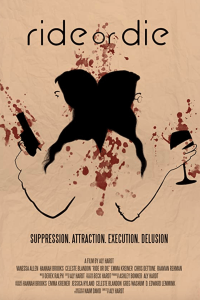 As I’ve been tackling more Ohio-made indies recently, I’ve gotten to know local filmmakers and started having films suggested for me by people within he local film industry, and as I’ve watched more and more that do not work, I’ve begun to dread writing these reviews. Nobody wants to be the killjoy after so many people have sacrificed time and money to bring a movie to life. It’s hard work. Ride or Die is a low-budget indie written and directed and edited by Aly Hardt (Lilith) and filmed in Cincinnati. It’s currently available on Amazon streaming but I wouldn’t advise a casual viewing. It’s confused and meandering and hard to process what is happening frequently without attachment to compelling characters.
Ashley (Vanessa Allen) is willing to do whatever it takes to protect her bestie, Mandy (Hannah Brooks). When a boyfriend mistreats Mandy, that’s when Ashley takes matters into her own hands. She kills an abusive (ex?)boyfriend (Raavian Rehman) and the witness, a girl he was dating called Lemonade (Celeste Blandon) too. Ashley hides the bodies and learns shocking secrets from Mandy that make her reconsider everything she knew about her BFF.
 Ride or Die could support a hasty drinking game because scene-to-scene you have no idea what to expect. That can be a bonus if your tone allows for it like a mystery that keeps you upended or a wacky comedy, and for a short period of time I thought that this indie was headed in a black comedy direction. After our protagonist has killed two people within ten minutes, she’s beset by another interloper, a woman who works at a café delivering food (without a car?) and needing a ride. Ashley, who has just stashed bodies in her trunk, reluctantly agrees to help, and as this new woman is yammering away about any topic that enters her brain, I started to wonder if this was what the rest of the movie would be like, a series of outrageous pile-ups that result from the opening murder, becoming harder and harder to cover-up. Nope. After this scene, and the “comedy” of mistaking the blood on Ashley’s fingertips as a sign of her menstruation (“It must be a bad period. I just finished mine.”), we will never see this self-involved whipped cream-loving woman again, and we will never really cover the tone of intentional comedy again short of a no-nonsense Uber driver. Ride or Die wobbles severely from tone to tone, never settling down, and feeling inauthentic whatever the current tonal footing featured. As things were getting serious, I knew it was only a matter of minutes before something ridiculous would happen to ruin it. As things were crazy, I knew it was only a matter of minutes before something self-serious and disjointed would happen to ruin it. If you’re expecting constant tonal self-sabotage, then you won’t be disappointed with the results of this wildly messy 76-minute experiment. Tone switches can work, even serious to darkly funny as demonstrated so skillfully in Promising Young Woman. This movie just can’t manage the abrupt shifts.
The worst part for me was how these tonal shifts and creative decision-making harmed the thematic implications around domestic violence. There are serious subjects at play with Ride or Die and I don’t want to say that humor cannot be found in even the most uncomfortable of topics. It just requires a deft touch, a touch sorely lacking from this movie. In the first TEN MINUTES alone, we endure watching Mandy get assaulted by her bad boyfriend, Ashley gets assaulted by her bad father or step-father (Chris Dettone, Confiend), and then Ashley murders two people, one of whom admits to being a victim of rape from high school before inexplicably falling head-over-heels for Ashley. The first three women introduced onscreen are all victims of sexual abuse. It’s a lot to handle, and I was worried this path was going to continue and every female character introduced would have their own story, not because this would be unlikely from a statistical standpoint of unreported assaults but because it would possibly approach self-parody through blunt overuse.
 However, the good intentions of highlighting the struggle to reclaim your identity after sexual abuse is seriously compromised by a late revelation (spoilers to follow, you are warned). After getting drunk, Mandy reveals that she really appreciated the ferocity of protection from her bestie, so she would lie about past abuse from past boyfriends so that Ashley would “take care of her.” She even admits to giving herself the black eye she sports for most of the movie. In a post-Me Too era where victims are fighting to be heard, it’s morally queasy to have a main character falsify numerous assaults for attention. Any good feelings I had for this movie vanished after that point. I don’t know if Mandy fully understood what Ashley would do in response but she had to pick up some disconcerting theory considering all these people went mysteriously absent after Mandy’s accusations. Either her selfish ignorance has led to all these supposedly innocent people being harmed and/or killed or she knew what the consequences would be and set them up for deadly retribution. Whatever the scenario, Mandy is an irredeemably bad person and I couldn’t care about her whatsoever, not that the prior development meaningfully rounded her out. This happens at the halfway mark and the movie cannot sustain itself with 40 minutes after to spend. For a movie that features so many victims of sexual abuse dealing with the long-term effects, it seems very irresponsible to go this route while also trying to treat the topic with reverence.
Another ongoing problem that really tears apart Ride or Die is that there are so many moments that well and truly make no sense. The entire character of Lemonade is getting her own paragraph of confusion. Why does Lemonade respond at all like she does? Ashley has a gun against her head and threatening her if she doesn’t forget her face, providing an out, and Lemonade chooses this moment to come onto her attacker (“What if I don’t want to forget your face?” she coos). I accepted her confessing her own abuse as a means of eliciting sympathy from her attacker, but to get a horny case of Stockholm syndrome instantaneously is beyond bizarre. The kiss triggers Ashley to think about her father (or stepfather) and she kills Lemonade. This scene made me scream “what?” to my TV screen for several prolonged utterances. The entire Lemonade character makes no sense to me. Ashley is haunted by Lemonade’s pale ghost because, we’re told much later, she was her first innocent she killed. However, this confession is occurring directly after she learns about Mandy’s secret, meaning this is entirely false. Maybe beforehand she thought she was an innocent, fine, but why does this woman who spent exactly two minutes on camera before being killed merit such attention? Lemonade then becomes a personification of Ashley’s guilt or self-destruction, or maybe she is a ghost and looking for payback, either would be credible here. I laughed when ghost Lemonade brings it to Ashley’s attention that driving around in the stolen car of the person she may have just killed might not be the best decision. In this moment, the literal ghost trying to murder Ashley is also trying to be the voice of reason, because inexplicably Ashley needs to go dancing and find herself a companion at this exact moment. “I need this for me,” she says, trying to guilt the ghost whose job it is to guilt her. What is going on?
 I kept expecting there to be, you know, consequences for the trail of bodies, but apparently the police in this universe can’t be bothered to investigate crimes with scads of physical evidence. I guess no detective has bothered to put together the coincidental nature of all of the men who Mandy goes on dates with or forms relationships with winding up missing. No worried family member? No nosy neighbor? If Ashley were like a professional at murder and body disposal, maybe I’d give her more leeway because she’s demonstrated that she knows what she’s doing after a wealth of experience. This is not the case. She chooses to store the dead bodies in her home, and not buried in the yard but in an accessible space where it’s only a matter of time before the smell spreads. The conflict of covering up the dead bodies feels resolved far too easily and without necessary tension. Because of this, the girl time spent between Mandy and Ashley can become insufferable and filled with awkward dialogue exchanges like, “Why don’t you ever talk about why your parents left you behind?” and, “Maybe this question’s more for me because I don’t know how to deal with losing my mom, and I know it’s not the same thing, but when my mom died, I was just crushed. I mean, your parents might as well be dead with what happened.” Characters explain things they obviously would already know with their years of BFF-ing, like asking to talk about your happiest childhood memory, which happens to be when they first met. The inauthentic, overly expositional dialogue is often a bad sign that a screenplay needs a few more drafts of work.
So much of this movie is built upon a friendship we’re repeatedly told is super close, but they interact less like friends who have known one another since the fourth grade and more like sorority sisters who have shared the same floor for a couple of weeks. The writing just isn’t there to sustain anything character-centric with Ride or Die, which is why the characters seem to flip flop at random in frustrating and annoying ways, when they too aren’t being frustrating and annoying. It’s a clear case of being told relationship importance and bonds rather than witnessing them. There are no real supporting characters. The off-screen grandmother is always heard and never seen and a one-joke character where the joke was never even funny. There are propagators of trauma, like the bad men of the past, and there are victims, like the all-purpose ghost, but it’s the story of these two women and they are so boring together even with repeated murder and cover-ups.
 Ride or Die is unlikely to win over any fans who aren’t already personally connected with the indie production. There are definite technical limitations given the budget was only $16,000. The sets never seem to feel lived in. The dialogue often sounds like it was dubbed over. The music drones on and on and at a volume that needs to be dialed back. The acting is flat across the board, with Allen (Girl/Girl Scene) sounding overwhelmingly monotone no matter the intensity of the scene. Scrolling through the end credits, I noticed the same names appearing over and over. Most everyone on this crew worked four or five jobs to see Ride or Die get made. That’s commendable, but I have to ask what about this story deserved all their hard work and dedication? It’s the script that sinks this movie. We get stuff like a ten-second “in media res” opening when we simply get caught up within eight minutes. That’s not how that should work. Likewise, why even bother with a three months earlier/three months later timeline that only muddles things? Was it Ashley’s stepfather or father who committed her abuse? The movie needs clarity but it really needs a driving plot to tie things together. The confusing fantasies, the wildly fluctuating characters and tone, the meandering plot, the overwrought dramatic elements, it all starts to coalesce into a sporadically baffling example of modern camp. I hope everyone involved enjoyed working on this. I don’t think many others will find much to enjoy on the merits of its storytelling and execution. Unfortunately, it’s best left in the rear view.
Nate’s Grade: D
Share this:

Space Sweepers (2021)
 Luc Besson sci-fi opera by way of South Korea, the unfortunately named Space Sweepers is a wonderful surprise of a movie that could unfairly get lost amid the glut of Netflix. It’s immediately engaging and filled with intriguing world-building. In 2093, Earth is a garbage dump and the rich (and primarily white people) have migrated to an orbiting space station that needs protecting from space debris. That’s where the space sweepers come into play, ragtag teams competing to claim space junk to sell back to The Company, though never able to escape their crushing debt. The Company is looking to colonize Mars and put more effort into making it habitable than salvaging Earth. A little girl might be the key to a flourishing Mars or resurgent Earth. She finds her way into the custody of a colorful group of malcontents, each with a clearly defined personality, motivation, and character arc, including the snippy robot who likes to harpoon ships in space. Spending time with this world and these characters is such an enjoyable experience because it just uncovers more and more layers to the hefty world-building and history. The story itself isn’t revolutionary, and the villain is a megalomaniacal CEO (Richard Armitage), and you’ll fully anticipate that the same space scrappers that want to sell off this little girl will eventually grow close to her and will be willing to die for her. The plot itself, at least in broad strokes, might be familiar, but it’s the level of detail and imagination and especially execution that sets Space Sweepers apart. I enjoyed how diverse the depiction of this future was, where people from different languages would simply speak their native tongues and be perfectly understood thanks to in-ear translators. The action sequences are exiting and visually immersive. I’ve never seen a harpoon in space battles before. It feels like a living anime moment. The special effects are consistently impressive. The set designs are large and lived-in. The small details all manage to add up, and small character moments still resonate, like one character’s constant loss of his shoes for greater sacrifices or a robot that feels seen for the first time as they are. A late twist had me nearly applauding for the emotional impact it altered with a big standard doomsday scenario. It’s a supremely fun and imaginative setting, enough that I thought it would have sustained a whole series on Netflix. I was happy it was a movie, though, because then I got all the payoffs and climaxes in one slightly two-hour setting. I’m impressed every year at the sheer high quality of the genre movies that South Korean filmmakers have been delivering. I highly advise fans of frothy, fun sci-fi like The Fifth Element to find this movie on Netflix and give it a watch. It’s a surprise treat and proof positive that old concepts can still shine with the right effort and careful development.
Nate’s Grade: A-
Share this:

Music (2021)
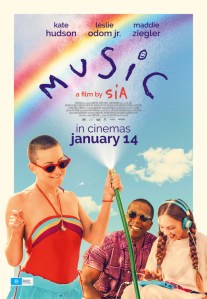
I didn’t even know Music existed until a couple weeks ago. The musical was nominated for two Golden Globes, including Best Comedy or Musical, and a passion project for the pop singer Sia. She wrote, directed, and cast her music video muse, Maddie Ziegler, as the titular figure Music and filmed back in 2017. Then I read about the backlash from the autism community for the film’s portrayal of autism and I became more intrigued. Currently, Music rates even lower on Rotten Tomatoes than Cats, and the reviews have been equally as baffling and unkind. Sia has responded defensively on social media to her film’s critics, and the brewing controversy has given the movie a fascinating rubberneck quality of, “You have to see this.” It is with that morbid curiosity that I sat and watched Sia’s Music, a movie awash in misguided decisions.
Music (Ziegler) is a teenager living in Los Angeles who is severely autistic and in need of care. She needs eggs in the morning, insists on a walk around the neighborhood, loves dogs, and has her headphones on to shield her from being overwhelmed by exterior noise. Music escapes into elaborate fantasies where she dances along to soaring pop songs. Her grandmother dies early and the only living relative is Zu (Kate Hudson), a recovering drug addict who doesn’t want to play mom to her demanding younger sister. Eventually, Zu begins to see her sister differently and bonds with her neighbor, Ebo (Leslie Odom Jr.), who teaches boxing classes to the neighborhood youth. Zu is getting her life straightened out and learning responsibility, though she might ultimately still decide Music is too much for even her.

Let’s tackle the biggest issue of contention, the film’s portrayal of autism. Ziegler is not autistic or, to my knowledge, neurodivergent. This fact alone doesn’t necessarily mean the movie was doomed to insincere failure. It may well become the norm that neurodivergent actors play neurodivergent characters, much as it seems has happened with trans characters and firmly established for ethnicity. However, I think much of the response to a person outside of a community portraying that community comes from the intent and the depiction. Are they coming from a good place? Are they trying to portray this life in an honest fashion? And is the portrayal harmful, derogatory, or trading in negative stereotypes? With Music, I have no doubt that Sia was coming from a good place. She has spoken about the autobiographical elements of the movie and basing the character of Music on someone that she knew personally. I know there are people like Music on the autism spectrum. It’s a spectrum for a reason. The problem comes with the depiction of a person this severely autistic from an outsider. I’ll explain in a comparison.
In 2001’s I Am Sam, Sean Penn played a mentally challenged man fighting for custody rights. He was nominated for a Best Actor Oscar. In the film, Sam had a group of friends, all of whom were similarly mentally challenged, and some of them were played by actors who were genuinely living with that same condition and others were played by actors only pretending. It was very apparent who was who, and it made the entire movie feel uncomfortable because it felt like the real people were being caricatured in literal proximity. It didn’t feel right, and I can’t imagine twenty years later that filmmakers would make that same choice. On the other hand, with the Netflix series Atypical, the lead character is played by a neurotypical actor but the portrayal of a character on the spectrum is done with great empathy and consideration, with an outreach toward those within the autism community. Intent and depiction are the keys.
The onscreen depiction of autism in Music is pretty galling and potentially harmful for those within the community. It’s all negative stereotypes. Ziegler is constantly contorting her body, making silly putty faces, side-eye glances, hitting herself in the head, and playing to the most abrasive and controversial cliches of those living with autism. She can barely mutter more than a few words, usually in imitation. Because this is the depiction of the character, having a neurotypical actor in this role can feel plenty insulting to many viewers. Music is less a character and presented more as a burden because of her needs and challenges. She gets Zu into trouble and lashes out in public. At no point does Music come across as more than an assembly of tics and ugly stereotypes.

It’s not just that the depiction in unflattering, as all characters do not need to be unerring shining examples for their individual communities, it’s that the movie doesn’t bother to give her any inner life. There are a few of passing comments about how Music sees the world, like a savant too pure to take in all the majesty at once, but these are merely gestures. The biggest opportunity into the mind of the character would have been through the numerous musical numbers but these are, by far, the most confusing artistic choice by Sia. I was expecting the musical numbers to provide insight with Music, to give voice to a character who has trouble communicating. Someone would ask how she was feeling and we’d zoom into her mind and the singing would be her way of expressing that answer or her complicated emotions about any topic. The use of singing and music would be her voice. Alas, this doesn’t happen at all. Like at all. This is shocking to me and the movie never really recovers from this misstep. The musicals are confusing because they often seem to be from the perspective of Zu instead and communicating her own struggles. Is Music just imagining her own sister’s inner turmoil through dance? There are also musical numbers devoted to exploring Ebo’s inner turmoil. That means two other characters are given primacy over Music in her own personal imaginary musical interludes.
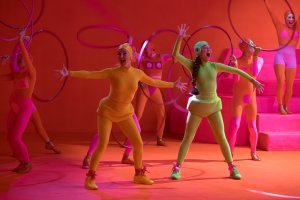
What is the point of the musical numbers then, besides squeezing in ten or so Sia music videos into a dramatic narrative that doesn’t appear to be connected to them? The music videos themselves are very reminiscent of Sia’s recent output, largely single takes and bursting with bright pastel colors and goofy costumes that look like a children’s TV show. The dancing is interpretative, which means a lot of emphasis through the body movement and facial expressions, and you may find it slightly lacking or perhaps too goofy that it takes away from the emotional content or attempted investment. I enjoy musicals and I even like the approach, in theory, that Sia would have been articulating, shedding light on a personal experience that re-sees the world as a more whimsical, wholesome, and friendly environment. This approach succeeded in Lars von Trier’s 2000 film Dancer in the Dark, where Bjork’s love of old musicals shaped the way she chose to escape from the world and highlighted the discrepancies between fantasy and reality. That’s not what Music does or even attempts to do. You could remove the musical numbers completely or just serve them on their own. The only direct story connection comes with a side character, a Chinese teenager who is pushed into being a boxer by his belligerent father. He secretly wants to be a dancer. In his lone appearance in the musical numbers, he gets to indulge in his dream and dance and sing (or lip synch) and it has emotional resonance because it’s an expression of his inner desires and the longing is felt. Why is this one supporting character, who could have easily been removed entirely from the narrative, the only one that fits with the approach to the musical interludes providing actual insight? As far as the quality of music, it sounds very much like Sia’s pop ditties and there are a couple winners. “Together” has a buoyant bounce and swooping, cheerful melodic hook that is hard to resist.
Hudson (Bride Wars) is the real main character of the movie and her struggle with responsibility is a familiar arc, from screw-up on the margins to matured adult with goals and a found family. She’s trying to stay clean though she’s really just looking to skip out on life and enjoy a permanent vacation in Costa Rica. This is even her stated goal after inheriting the guardianship over Music. There are plans late to transfer her sister into a group home but this deliberation isn’t really given the attention it’s due, in fact I don’t think I can recall even the mention of it prior to the potential move-in day. The character of Zu is completely stock, a neo-hippie wild child that needs to learn to slow down and accept responsibility. I don’t know what that looks like because for most of the movie she’s just having her sister tag along while Ebo explains things about autism in a delicate fashion (including physical restraints, which have met with plenty of disagreements from the autism community who cite the danger they pose). You would think Zu might have a better handle on this stuff, or that her grandmother would have been more helpful with that instruction book she left behind for the care of Music. This is more a movie about a recovering addict getting her life together and bearing with her burdensome younger sister. Seriously, the character of Music could have been a coat rack for all the impact and agency displayed. Hudson does an admirable job with what she’s given even if grungy and strung out are hard for such a naturally sunny and charming actress more prone to breezy rom-coms. Odom Jr. (One Night in Miami) is wasted as the kindly neighbor harboring a secret and mending a broken heart. At least he gets to sing too.
While watching Music, I kept thinking of an obvious creative choice that would have sidestepped a majority of the mushrooming controversy and spared Sia. Why not just make the character of Music someone with a different condition? Why not make her suffer from post-traumatic stress, or an anxiety disorder, something keeping her from living the life she desires and communicating all that goes on inside her person? Automatically, it eliminates the controversy over the negative depiction of autistic stereotypes from a neurotypical actress and it makes the character more a central figure in her own story that can be developed and examined. Frankly, in 2021, we don’t need portrayals like Music to better understand life with autism. This kind of movie might have been met more charitably in the 1990s but now it’s instantly problematic, and I feel like much could have been avoided by removing the autistic aspect to Music’s character, especially since it does so little to the story other than create havoc and challenge. Beyond that, Music falters because the many musical sequences fail to tie back to the characters in meaningful ways. I’m confused over the shifting perspective as well. From a technical standpoint, the movie looks and sounds like a professional movie with a polished Sia soundtrack. However, it’s the poor thinking behind these decisions that dooms the project. While it’s no Cats-level disaster, at least nobody was living with human-feline creatures at home. Music is not a good movie but it’s the kind of rare artistic flop that might be worth viewing just for its audacious missteps, like 2018’s Welcome to Marwen. I don’t think we’ll be getting a second feature film from Sia any time soon.
Nate’s Grade: C
Share this:

The Turn Out (2018)
 Indie drama The Turn Out frustrated me because I got excited by its premise and thought, “Here might be the first truly great Ohio indie I’ve watched for review,” and alas it let me down. It’s not a bad movie but it has such promising storytelling elements and to see them misused feels like a bigger regret than if the movie had never even had those important building blocks.
Jeff (James J. Gagne Jr.), a.k.a. “Crowbar,” is a hard-living truck driver also addicted to crack. He’s got a teen daughter, Amanda (Katie Stotllemire), and an exasperated wife, Kelly (Heather Caldwell), back home in southern Ohio. Crowbar is no stranger to the prostitutes that call truck stops their corner, but one young lady makes him reconsider his assumptions. He learns that Neveah (Regina Westerviller) is still in high school as well as in his own daughter’s class, and this revelation makes him contemplate whether he should get involved and help her.
Let’s take the central story of Crowbar and his relationship to the teenage prostitute, Neveah. If I were to tell you the movie was about a truck driver addicted to drugs who wrestles with what to do when he stumbles upon the reality of sex trafficking connected to truck stops, your mind already starts putting that movie together with clear arcs. It becomes something like a modern-day Western, where Crowbar is a man of the road, a contemporary high-plains drifter, and he makes the decision to reject his isolation in order to help this one girl. I asked my girlfriend, after describing the basic premise, what kind of relationship that Crowbar would have with his own teenaged daughter. “Oh, it’s got to be bad or non-existent, right?” she commented. You would think that but nope. He actually has a great relationship with his daughter, who is constantly trying to call and talk with dear old dad. See, if his relationship was poor and perhaps he had even elected to a life on the road rather than being a present father, this would force the character to confront his own life choices and legacies and see Neveah as a surrogate daughter he can save. You could argue it’s cliché and been portrayed in other neo-Westerns, but it works. The same confusion applies to Crowbar’s relationship with his wife. Our introduction to her is with the local police imposing a restraining order, which nobody throughout the movie takes seriously. The daughter frequently breaks it. The uncle who admonishes Crowbar about the restraining order will then enable Crowbar to break it to see his daughter at choir practice. He even meets up with his wife in a bar to reminisce about their relationship, which means even she is breaking her own restraining order. If everyone is going to be this flippant then why even bother with including it? A strained relationship between husband and wife can be communicated through other means. These are the kind of things that pecked away at the consistency, coherency, and natural dramatic potential.
 As it stands, I don’t really know what the motivation is for Crowbar throughout The Turn Out. What is his motivation for getting better? He already has a positive relationship with his daughter and apparently a workable relationship with her mother, and that’s while he’s smoking crack. He is already in a good place with the people that he cares about, so now what? You could say his motivation is to save this girl he comes into contact with through chance, but this is hard to argue as well considering the amount of time he takes to take fledgling steps to intervene. For a solid hour of the 74-minute movie (pre-end credits), Crowbar meets with Neveah and even visits her home but her situation isn’t any different from the start. It should be obvious that her family knows about her and is supporting her prostitution or forcing her to turn tricks. Even that description is a disservice because it’s not like Neveah has much of a choice in these matters. She’s a victim too, and the fact that our protagonist just kind of hangs around until the very end when the bad people get even more obvious about being bad, it questions his thinking. Why does he take so long to call the police? Is it because of his own personal fear of getting caught as a drug user? Well, that could be avoided with an anonymous tip. When he eventually elects to kick his drug habit, your guess is as good as mine why this is the moment for him. It feels too arbitrary, like any of these events could have happened earlier as they lack direct cause-effect connectivity.
It takes far too long for Crowbar to actually assert himself and try and make a difference but we’re absent the inner turmoil to justify the delay. I think there was a character arc here where Crowbar had to reconcile with his own contribution to a culture that has allowed truck stop prostitution to flourish. He’s partaken with these woman (all adults, mind you, but did they start as adults?) and he even argues, “They make good money.” His own guilt could be a worthy exploration but it takes a vision of his daughter in a predator’s van and the entreaty of child prostitution to finally shake him from his doldrums, and then the movie is pretty much over (again, only 74 minutes total). Otherwise, it feels like we spend a lot of redundant time watching the man drift through his life, smoking plenty of crack, and occasionally running into Neveah and conversing with her. There are points that prove he’s changing, like brandishing his fellow drivers over the CB radio for their gross demeaning chatter, and he even gets that Big Movie Moment of Symbolic Torment, sitting in a shower. The problem with The Turn Out is that these momentary glimpses don’t feel consistent enough to matter. As a character, Crowbar is too dependent on his substance abuse as a defining characteristic, and yet it feels less like a burden or addiction to the man and more like a hobby to pass the time. It doesn’t feel consequential.
 Again, the storytelling possibility was right there within reach, with his decision to save this young woman as the Act One break and not the climax of a relatively short movie. Then Act Two would have been them bonding and finding parallels and a genuine surrogate father-daughter affection over the course of a long road trip as Crowbar attempts to return her to the last vestige of her family that she left. Then, upon leaving her with this family in Act Three, Crowbar learns it’s just not as easy as that and that Neveah’s family might not be icky sex traffickers but they’re not helpful, and so he helps her set up an independent life and realizes he must now return home to mend his own relationship with the daughter he has left behind. Amanda should want nothing to do with her father rather than try and call him every chance she gets. Crowbar has nothing really to repair on this front, and the daughter is portrayed as a fawning fan who only jogs, tries to call dad, and sings in the choir. The same shrift characterization is given to every supporting player. Neveah wants to be an artist. She goes out looking for johns as a means of protecting her younger sister. That’s all we get as far as her inner life. It seems like a disservice to make this character so blank. I don’t understand Crowbar’s wife at all. I don’t understand why Amanda jealously cyber bullies Neveah because she sees her in a diner one time with her father, especially when dad hasn’t been playing favorites. I don’t understand why Crowbar seems to only be at the same local truck stop despite the nature of his job taking him all over.
The acting is a highlight of the movie and Gagne Jr. (When Skies Are Gray) delivers a convincing, lived-in performance. The very look of his hangdog face is enough to communicate what the screenplay doesn’t, the past years weighing on him, the accumulation of good times coming due. He’s also simply just got a great face for the part. He has some moments that test his resolve and I wish he had even more to push his acting prowess further. Stottlemire (Tragedy Girls) has plenty of talent which is why I wish her character had some actual anguish to her relationship with her father. Caldwell (After) likewise gives a solidly conflicted performance that made me wish she factored more into Crowbar’s interaction and turmoil. My favorite actors ended up the one-scene characters that provided a dose of vibrant local color, the tweakers and addicts and vagabonds, the diner owners, the other truckers, the people that feel genuinely authentic and well chosen. Unfortunately, I was not as big a fan of Westerviller in her debut film role. I can’t tell if her performance is very monotone and inexpressive because of the actress’ limited range or as a directing note from director Pearl Gluck (Divan) to convey the numbness that Neveah felt. Either way, it presents a dilemma as her relationship is the most essential.

Director Pearl Gluck on set.
From a technical standpoint, The Turn Out is a very professional looking and sounding movie. The usual sound design headaches I find with local low-budget indies are nowhere to be found here, and the frequent introspective, country-styled songs by Chris Rattie add a really nice impression that makes the whole enterprise feels accomplished. The reported $200,000 budget might be the highest of all the Ohio indies I’ve reviewed. There are some beautiful shots from the cinematography of Stephen Balhut, Jon Coy, and Daniel Garee, especially at sunset and twilight. The look of the movie is rich with details, like the run-down stores, and the dilapidated Rust Belt small towns providing a broader sense of economic desperation. I was expecting the movie to tap into its own Hillbilly Elegy-style social commentary on the decline of the American worker through the reality of this truck stop and the women who work it. Gluck handles her directorial duties with sensitivity but without flinching from harsh truths either.
It may sound like I’m more negative than intended with The Turn Out, and this is merely because I’m disappointed by the squandered potential. A truck driver deciding to do right and help a young girl, the victim of sex trafficking, has so much dramatic potential it hurts. Even if you wanted to avoid a more traditional thriller route, this could have been a powerful character study of two lonely, hurt souls finding a comfort with one another over a long journey and being able to start a healing process to pick up the pieces of their lives. It would be the kind of character examination that thrives in indie film, and from a topic I cannot recall other movies touching, namely the rings of prostitution trapping women along truck stops. I’m sure everyone involved was coming from a good place and wanting to highlight and not exploit the reality of sex trafficking. Gluck even based her script on her extensive research with trafficking survivors. Alas, the storytelling miscues and dawdling pacing make the movie feel like an overextended news article. This is still a decent movie with authentic details, good intentions, and solid acting with some exceptions. However, it’s the screenwriting shortcomings that drag down The Turn Out from its real potential and turn it into a message in search of a stronger narrative.
Nate’s Grade: C+
Share this:

Judas and the Black Messiah (2021)

Fred Hampton was the deputy chairman of the Black Panthers in Chicago and was only 21 years old when he was murdered in 1969 by federal agents. Judas and the Black Messiah is about Hampton and his life in political activism cut short, but it’s also another tragedy, one far less known. Bill O’Neal was a federal informant who was manipulated into betraying Hampton to the FBI and ultimately setting up the man’s execution. Both men are given consideration and brought to life by great actors, Laketih Stanfield as O’Neal and Daniel Kaluuya as Hampton. O’Neal is tasked with getting into the trusted inner circle of Hampton and the Black Panthers without blowing his cover, or else he’ll be going to jail for years on potentially pending charges. The FBI agent in charge (Jesse Plemons) is under pressure by J. Edgar Hoover (Martin Sheen), and this all provides even more pressure onto O’Neal, who is a pawn of the higher-ups who only care about neutralizing the growing power of the Black Panthers. The film plays out similar to an undercover mob movie, like The Departed, and much of the drama follows whether O’Neal will get caught, how he will navigate the tenuous territory he is in, and the paranoia of being in danger at all times and from multiple sides if he succeeds or fails. I appreciated the attention given to O’Neal and the consideration that he too is another victim. He is eager to succeed and thinks he might use his service as an introduction into the Bureau for legit work, but he also very much wants to be accepted by the Panthers because he agrees with their philosophies and is looking for a community that welcomes him and provides a sense of direction. If I had a complaint, it is simply that we get a lot more Judas here than we do the Black Messiah. It feels like we’re getting a rather simplified summation of Hampton and scrubbing clean some of his personal leanings (having him identity as a socialist rather than a Marxist) that would make him more controversial. By all definitions, Hampton was executed by agents of the state to pacify institutionally racist fears about powerful and gun-owning black Americans, but putting so much emphasis of the story on the man who betrayed him creates an imbalance in presentation and risks mitigating the depth of Hampton. After Hampton returns from prison, the movement he’s been so heavily involved with seems to dissolve onscreen, focusing solely on setting up our deadly climax. He is seen as a martyr first and foremost. There are two extended shootouts in the second half that don’t feel at all in keeping with the first half of the movie. Kaluuya (Get Out) is electric in public and awkward and sweet in private with his beloved girlfriend. It hints at much more that could have been explored away from his fiery public persona. Stanfield (Knives Out) has the more multi-dimensional role and yet even given the grand Shakespearean tragic proportions of his position, I can’t help but feel like O’Neal feels a tad underdeveloped. There’s a subtle ambiguity that follows his character’s motivations but many of his moments revolve around whether he will be accepted, fool someone, or get caught. There are greater questions of whether the mask he wears is real. The characterization gets a little lost because of the nature of the subterfuge. This movie is over two hours but has the potential to be an epic tragedy and could have sustained a limited series of storytelling. As it is, it’s a tense and powerful movie with great acting and an ending that will rightfully outrage and disquiet. Judas and the Black Messiah is stirring but I feel like it had lost potential by transposing its story and conflicts into two hours and with two central underwritten figures of tragedy. It’s quite good but man this could have been amazing.
Nate’s Grade: B+
Share this:

Hannibal (2001) [Review Re-View]
 Released February 9, 2001:
Trying to sequelize Silence of the Lambs is surely harder than trying to sequelize The Blair Witch Project. The novel Hannibal by Thomas Harris I don’t think will be confused as a necessary burst of creative ambition and more of a chance to cash in on the love of Hannibal Lector. Though I’ve not read a line from the book from what I’m told the movie is faithful until the much hated ending. Starting a film off a so-so book isn’t a good way to begin, especially when you lose four of the components that made it shine Oscar gold.
 The element that Silence of the Lambs carried with it was stealthily gripping psychological horror. It hung with you in every closed breath you would take, surrounding you and blanketing your mind. I mean, there aren’t many serial killer movies that win a slew of Oscars. Lambs excelled at psychological horror, but with Hannibal the horror turns into a slasher film more or less. What Lambs held back and left us terrified, Hannibal joyfully bathes in excess and gore.
Julianne Moore, a competent actress, takes over from the ditching Jodie Foster to fill the shoes of FBI agent Clarice Starling. Throughout the picture you know she’s trying her damndest to get that Foster backwoods drawl she used on the original down. The problem for poor Moore though is that her character spends half of the film in the FBI basement being ogled by higher-up Ray Liotta. She doesn’t even meet Hannibal Lector until 3/4 through. Then again, the title of the film isn’t Starling.
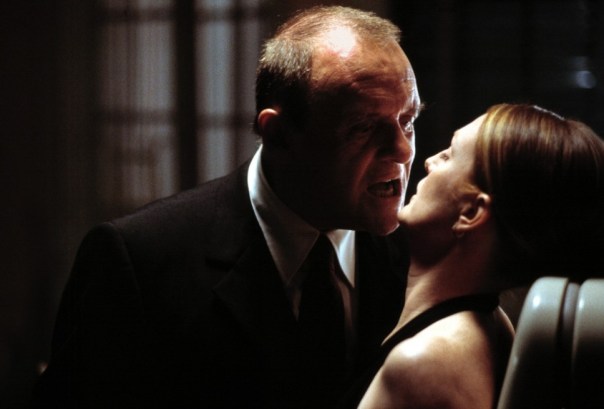
Anthony Hopkins returns back to the devil in the flesh and seems to have a grand old time de-boweling everyone. Lector worked in Lambs because he was caged up, like a wild animal not meant for four glass walls, and you never knew what would happen. He’d get in your head and he would know what to do with your grey matter – not that he doesn’t have a culinary degree in that department in this film. Lector on the loose is no better than a man with a chainsaw and a hockey mask, though he has a better knowledge of Dante and Florentine romantic literature. Lector worked bottled up, staring at you with dead unblinking calm. He doesn’t work saying goofy “goody-goody” lines and popping out of the shadows.
Since the director, screenwriter, and female lead didn’t show up for the Lambs rehash, it feels a tad chilled with Ridley Scott’s fluid and smooth direction. The cinematography is lush and very warm. Gary Oldman steals the show as the horribly disfigured former client of Lector’s seeking out revenge. His make-up is utterly magnificent and the best part of the film; he is made to look like a human peeled grape. Oldman instills a Texan drawl into the character yet making him the Meryl Streep of villainy.
Hannibal is nowhere near the landmark in excellence that Silence of the Lambs was but it’s not too bad. It might even be good if it wasn’t the sequel to a great film. As it is, it stands as it stands.
Nate’s Grade: B-
——————————————————
WRITER REFLECTIONS 20 YEARS LATER
Serial killer culture dominated the 1990s and oddly enough it’s only gotten more highbrow since. Oh, that’s not to say that you won’t have any shortage of hacky, exploitative movies featuring elaborate murderers with gimmicky calling cards (The Hangman, a killer who literally stages his crime scenes like an ongoing game of hangman). However, the dark obsession with dangerous men (it’s almost always men) has given life to thousands of prestige cable documentaries, true-crime books, and high-profile podcasts like Serial and My Favorite Murder. We still very much have an unchecked fascination for these real and fictitious serial killers and what that may say about our society. In 1992, a serial killer thriller swept the Oscars, one of only three movies to win Best Picture, Actress, Actor, Director, and Screenplay (the others: It Happened One Night, One Flew Over the Cuckoo’s Nest, and American Beauty came close if it hadn’t been for Hilary Swank). That’s how good The Silence of the Lambs was as a movie to overcome the genre biases of older Academy membership (it also helped that there were other genre biases at play for the other Best Picture nominees like Beauty and the Beast, Bugsy, and JFK). It was special.
All of this is to say that Silence of the Lambs was a near impossible project to follow, and author Thomas Harris proved it with the middling-yet-best-selling sequel novel in 1999. It was obvious that it would be adapted into a major feature film, but the only returning Oscar winner from that first foray was Anthony Hopkins, which is kind of important considering his character is the title. The sequel was directed by Ridley Scott (Gladiator), adapted by none other than screenwriting titans David Mamet (The Untouchables) and Steven Zallian (Schindler’s List), and the movie made over $350 million worldwide at the box-office. By all accounts, it was a hit, but was it any good, or was it simply coasting from the acclaim and good will of its predecessor and the A-list cast and crew?
 The first thing that becomes immediately apparent while watching Hannibal is that this is not Silence of the Lambs and not in a sense of its accomplishments but more in its chosen ambitions. This is not a psychological thriller in the slightest. It’s a boogeyman monster movie. Nobody here is given to intense introspection about man’s inhumanity to man and other such Topics of Grand Weight. Scott’s sequel is more a Gothic B-movie content to spill stomachs rather than quicken pulses. The opening botched FBI raid is chaotic, action-packed, and the flimsy excuse for why Clarice Starling (Julianne Moore taking over for Jodie Foster) is shelved for most of the movie. It feels like the filmmakers know they need to delay the reunion of our favorite cannibal therapist and FBI agent as long as possible, so the 130-minute film feels like a protracted setup to tease how far audience anticipation can possibly be sustained.
In the meantime, the plot alternates between Dr. Hannibal Lector living it up in Florence, Italy and Starling slumming it in the FBI basement. Slowly, oh so slowly, she picks up the pieces to track Lector’s whereabouts, but until then we indulge a lot of narrative bloat. Do we need to follow an Italian inspector who suspects “Dr. Fell” is not who he says he is and then enact plans to prove his identity and eventually cash in? This man is literally on screen longer than Clarice Starling. We’re introduced to a rich villain, Mason Verger (Gary Oldman), but he’s more plot device than character, an all-expenses bank account to track and apprehend Lector for his bloody violence. I wish there was more to Oldman’s character given the actor and the impressive practical make-up application. He’s a symbol of rot, of vengeance, of obsession. Likewise, Ray Liotta’s lecherous FBI superior to Starling is less a character and more a plot device. He’s the stand-in for the harassment and dismissal Starling receives from her male colleagues, but a little of him goes a long way. His scenes where every other word is some creepy come-on, some sexual entreaty, or some off-color joke (he refers to Lector in homophobic slurs) are excessive. He’s an awful person but every line doesn’t have to be eye-rolling in how obviously terrible he can be. Spending extended time with all of these supporting characters is just a reminder that the movie is looking for excuses to keep its chief participants as far away for as long as possible. It’s frustrating.
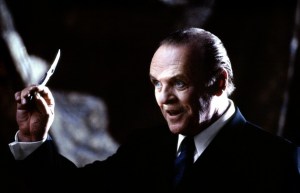 The depiction of Hannibal Lector in Silence versus Hannibal is also quite noticeably different. Like most things in this sequel, the character is baser, key characteristics heightened and broadened, and bordering on farce. He’s less a scary intellectual opponent and master manipulator and more a well-read serial killer on vacation. He is profoundly less interesting in Hannibal. That doesn’t mean there isn’t a pleasure to be had watching Hopkins slice and dice his way through Italy and elude capture. Hopkins seems to relish the amplification of the campy and grand Guignol tone of the sequel. He looks to be having a blast as an unleashed beast. His performance is fun but teeters over into self-parody at times. Hearing the erudite man spout ironic catchphrases meant for incongruous comedy de-fangs some of his mystique and intensity.
And yet there are things I still starkly remember even twenty years later. Hannibal is no Oscar-winning thriller operating at an ascendant technical level with engrossing multi-dimensional characters. It’s a boogeyman movie with a scary old man. The ambitions are just lower, but that doesn’t mean that Hannibal is subpar by those lowered goals. It’s still entertaining even when it’s getting silly or overly long. Scott’s visual presentation keeps things engaging and the lovely Italian art and locales are a definite benefit to establishing the gory, Gothic atmosphere. The makeup is outstanding and, as I said back in 2001, Verger resembles a human peeled grape. Feeding a man to wild boars is also quite memorable. The conclusion still has its squirm-worthy high-point with serving Liotta’s fresh brains to himself. It’s a gory comeuppance that feels fitting. In the original book, apparently Starling then bares her breast to Lector, and he goes down on one knee, and they run off together as fugitive lovers. Needless to say, this ending was met with controversy. The film smartly nixes this, especially since I never for one second felt a romantic coupling between these two embittered characters. The movie doesn’t kill the allure of the Hannibal character but it also positions him on the same level as Michael Myers instead of, say, John Doe (Seven). It’s like a Halloween mask version of a real serial killer, dulled and magnified in some ways, but still leaving a fair impression of its source.
 The Hannibal Lector incarnation had two more big screen ventures, the 2002 prequel Red Dragon and 2007’s even-further prequel, Hannibal Rising. Neither was terrific, neither was awful, though the answers that Rising offered as to what made Lector the man he is would inevitably prove disappointing (hello, childhood trauma). Arguably the best incarnation of the character, more so than Hopkins or Brian Cox (Succession) as the first big-screen Lector in 1986’s Manhunter, was from NBC’s television series from 2013-2015. Developed by Bryan Fuller (Pushing Daisies, American Gods), and starring Mads Mikkelsen (Casino Royale, Doctor Strange) as America’s favorite high-class cannibal, the series found a way to make a weekly crime procedural operatic and hypnotic and disgustingly beautiful. It’s like the artistic sensibilities from Silence and Hannibal were perfectly blended into a strange lovechild that deserved an even longer time to shine. Recently, just the week of this writing, CBS has begun a 2021 Clarice Starling TV series, though because of rights issues they cannot even reference Hannibal Lector. They have the rights to the senator and her daughter who was kidnapped by Buffalo Bill, as if those characters were what the fanbase was really clamoring for more time with. It looks like any other grisly CBS crime procedural just with a different name. I fully expect it to be canceled after one season.
Looking back at my review from 2001, I found myself nodding in agreement with my younger self from the past. I try not to read my earlier reviews before re-watching the films in question and perhaps might surprise myself by coming up with the same critiques independently. I also quite enjoy this line: “Lector on the loose is no better than a man with a chainsaw and a hockey mask, though he has a better knowledge of Dante and Florentine romantic literature.” I would even keep my grade the same. Twenty years later, the Hannibal Lector character still captures our intrigue and fascination even if he’s deposited in a lesser escapade not fully worth his full abilities.
Re-View Grade: B-
Share this:

The Father (2020)
 The Father is the kind of movie I’ve been clamoring for years from Hollywood, an Alzheimer’s empathy experiment using the rigors of a visual medium to place a viewer inside the mind of someone haunted by this debilitating mental illness. Film is inherently an immersive experience with a defined point of view, and I always thought it could be helpful in illuminating what it would be like to lose a sense of time, memory, and place as memories blend together and fragment. The Father is based on a play by director Florian Zeller. It’s a deeply empathetic and heartbreaking experience that works as a puzzle to decode but also as a character piece on the end of one ordinary man’s life.
Not much is known about Anthony (Anthony Hopkins) before his gradual mental decline. He had an apartment he lived in for thirty years, there’s definitely hints that a younger daughter had an accident and is no longer alive, and he listens to opera quite frequently. I think there’s a benefit to the audience knowing so little of Anthony before his illness; we do not know what variation of this man is the honest, lucid version from before. We’re only getting impressions and glimmers and some of them are non-linear, where we’ll get the context of a scene after the start of a scene, so it challenges a viewer to be constantly trying to contextualize what we’re seeing with what we know, and it’s an ongoing puzzle to determine a slippery orientation. It makes for an engaging and constantly changing environment and one tailored to engrossing empathy.
 It sounds like the movie might be an overwhelming downer, and most assuredly it will leave an emotional devastation, but it’s also a very fascinating experience. From the beginning, you’re dropped into a scenario that announces to you not to fully trust your eyes and ears. You’re trying to assess character relationships. Who is this woman? Is she Anthony’s adult daughter Anne (Olivia Colman)? Is she a figment of his imagination? Is she the possibly dead daughter? Sometimes characters will be referred to by the same name but be played by different actors, and you must question which version was real, or whether either of them was? Is he projecting his dead daughter onto the face of another woman? Is he projecting an antagonistic man (Mark Gattis) onto the face of a former son-in-law (Rufus Sewell)? Which home is he in at this time? There is much to unpack here and I’m positive that additional viewings would unveil even more clues hiding in plain sight. I’m certain that the paintings on walls in backgrounds are regularly changing with the timeline, and this small detail of set design is never even emphasized. It’s just one aspect of the presentation that has been thoughtfully developed to support its artistic vision.
As one would expect from the premise and its beginnings as a play, this is an actor’s showcase. Hopkins (The Two Popes) delivers one of the best performances of his storied career. We’re so used to seeing Hopkins play men in control, dominating others. I even just re-watched him killing people in the shadows from 2001’s Hannibal sequel. This is the most vulnerable the actor has ever been on screen, and I’ll freely admit that by the end tears were streaming down my face as Anthony has descended into a childish state of need. Hopkins goes through a gamut of emotions and shifts rapidly. In one moment, he can be gregarious and charming, another cold and paranoid, cruel and cutting, but often he’s confused and afraid. He’s trying to maintain his dignity throughout. By being our focal point, we feel the same feelings that this elderly man is experiencing in this moment out of time. Colman (The Favourite) is also terrific as Anthony’s put-upon daughter trying her best but reaching her limits. The accumulation of this man’s experiences, and the weight of the burden on his family, is a devastating conclusion that reminds you what millions of families are going through every day.
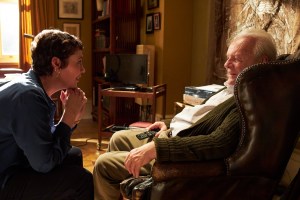 The trappings of plays adapted to film is the struggle to make them feel bigger than potent conversations happening in confined spaces. Zeller’s debut as a director does a fine job of using the techniques of filmmaking to his advantage. With editing and camera placement, he can better orient or disorient an audience, and the impact of character changes has more intensity with our proximity to the actors themselves. The attention toward the visual parallels like hallway shots and people being confined to shadows present an extra layer of symbolism to be decoded. Zeller has clearly thought out how to transcend the stage and to use the immersion of film and freedom of being non-linear with editing to shape the presentation and make it even more effective.
I’ll be honest with you, dear reader, and that is that Alzheimer’s terrifies me. We’re all the accumulation of our memories and experiences, and to think those could be stripped away, muddled and tainted, and change your conception of self, well that is absolutely haunting. It’s the kind of stuff that keeps me up at night, and while my maternal grandfather went through a spell of dementia before passing away at 92 years old, fortunately this illness does not run in my family. I have friends that are dealing with it currently with grandparents and it’s like approaching death before the actual death, watching that version of the person you love shrink to the point where they have been replaced by a stranger, all the while you are helpless to thwart this process. For those people, The Father will hit close to home and might even be too much to handle. It’s such an open-hearted and empathetic portrayal that puts you in the position of having to live with the ravages of Alzheimer’s. It’s so frustrating and confounding and sad, and yet film can open us all to the experiences of others like few other mediums, and The Father might be the closest any of us ever get to understanding what this terrible illness is like for those caught in its snare. It’s a fantastic movie with fantastic performances but even more than that it’s a wonderful experiment in empathy and understanding.
Nate’s Grade: A-


You must be logged in to post a comment.