Blog Archives
Ocean’s 13 (2007)
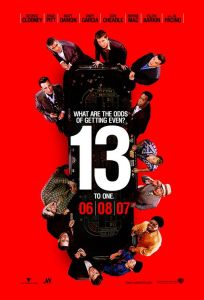 Much more like 11 than 12, this latest Ocean’s caper is just as preposterous as all the others but remembers that the audience needs to have fun too. Danny (George Clooney) and his baker’s dozen are plotting revenge on Willie Bank (Al Pacino, looking like a leather couch), a ruthless casino mogul who pushed old friend Rueben (Elliot Gould) out of a business agreement. The boys must outwit casino workers, modern technology, and a super computer able to detect pupil dilation in order to fleece Bank’s Vegas eyesore. Thankfully, all of the players are back and given tasks to do, and some of the means of their scheme are ingenious. How do you pass a lie detector tests? Place a tack in your shoe so that all your truthful answers match the intensity of your false ones. How do you get your hands on rigging dice? You send a couple guys to work in the Mexican factory and, why not, start a worker’s revolt. Ocean’s Thirteen glides along almost too smoothly, barely stopping to enjoy the crazy amount of absurd machinations before they fly by. The dialogue is packed with coded terms and the film doesn’t even stop to explain them. The movie works on the contact high of cool it luxuriates in, but unlike Ocean’s Twelve, this time the gang is given an objective, allows the audience in on their plot, and then we sit back and watch the execution. Steven Soderbergh and the gang have created a slick and amusing sequel. It lacks the freshness of the first go-round in 2001, but Ocean’s Thirteen is the most satisfying three-quel so far in a summer already weighed down by them.
Nate’s Grade: B
Share this:

Knocked Up (2007)
 Judd Apatow scores again. The man has a long history of creating memorable and heartwarming character-based comedy, and Knocked Up is another winner. This man creates thoroughly human and engaging stories that focus on our own foibles and triumphs. Apatow wrote and directed yet another poignant, clever, and uproarious comedy that has so much more below the surface and becomes universally appealing.
Alison (Katherine Heigl) is out on the town celebrating her promotion at the E! Entertainment Channel. She’s going to go from behind the camera to in front of the camera. It’s at this Los Angeles club where she meets Ben Stone (Seth Rogen), a doughy Jewish slob of a man content to drift through life penniless and high. Their night of partying leads to a drunken one-night stand. Eight weeks later Alison is going through extreme nausea and can’t figure out what kind of flu bug she has, that is, until she remembers her one night out. She locates Ben and informs him that she is pregnant and, yes, he is the father. The two decide to try and make it work, forging a relationship as they plan on becoming parents. Alison’s sister Debbie (Leslie Mann) and her husband Pete (Paul Rudd) and their two kids are a potential glimpse into the future. Pete and Ben hit it off real well, to the point that Alison feels like her mate might not be the one for her even if his DNA is growing inside.
 Naturally, this is a comedy where sex is at its very inception. The humor is ribald and playfully profane. I believe one of the greatest compliments you can give a comedy is when you cannot single out a single set piece or moment as an instant standout. Knocked Up is packed with many wildly funny scenes but it also has killer one-liners from start to finish and sharp pop-culture references (Ben on an exercise bike: “Matthew Fox? From Lost? You know what’s interesting about that guy? Absolutely nothing.”). Ben credits the flick Munich for the ability to get Jews laid. Ben watches the 2003 version of Cheaper by the Dozen with horror, saying that 12 kids is no laughing matter. The roommates are plotting a flesh-friendly website that notes the time and location of celebrity nudity in films. This commercial venture plays right into the frat house lifestyle for this band of stoners that bet their friend not to shave his beard for a year for free rent.
Knocked Up is bawdy and hilarious, sure, but it’s also far more realistic and a lot more emotionally involving than any romantic comedy Hollywood has offered in years. Apatow seems to have mined his personal parental experiences for a lot of hard-earned truths. The film is most natural when it showcases the male perspective of prolonged adolescence and an unplanned pregnancy, but Knocked Up also has a mature and thoughtful view on marriage and feminism. We see the array of personal challenges a woman would go through but the movie still manage to slip in humor amidst the uncertainty. There’s a montage looking for the right gynecologist. The gauntlet of sexual positions is explored while pregnant, with Ben afraid that his child’s first impression will be daddy’s manhood constantly poking it. When Alison and Debbie go shopping for pregnancy tests we see them fill their cart with every kind of tests, and then test after test comes back positive. “Hey this one has a smiley face,” says Debbie, before realizing, “Oh, that’s not a good thing.” Debbie then tests the reliability of the tests herself and for a brief moment panics when she thinks she may be pregnant for a third time. She then calms down and says, sarcasm-free, “Whoa, that would have sucked.” The inclusion of Debbie and Pete offers a whole other relationship viewpoint, something that Alison and Ben can learn from. She’s paranoid and blunt, and he’s apathetic and passive-aggressive, and Alison is terrified that she and Ben are doomed to a similar fate. The insights into marriage and secrecy are realistic and give the film so much more meat to its bones. This isn’t just a movie about what to do with an unplanned pregnancy; it’s fully about male-female dynamics and what it takes to make a family work.
 In the end, you really care about these characters because Knocked Up is a raunch-fest that has a sweet gooey center of sentiment. Ben is pushed into adulthood by this unexpected development and, as they say, puts away childish things after a lot of trial and error. There’s an undercurrent of emotional vexation under most of the comedy, like when Pete confesses that he doesn’t know if he can accept love, and Ben cannot pity this because he sees his love being rejected. Alison doesn’t quite have as big of an arc, but she never gets callously cast to the side and forgotten. She too has a lot of growing up to do very quickly, and when both characters welcome their newborn into this world it’s rather moving and exciting to experience it alongside them. Ben’s confesses to his child that not putting a condom on was the best decision he ever made. In any other movie this ending conversation might seem trite or hokey, but Apatow has paid so close attention to his characters that the emotional payoff is earned and rewarding.
Another hallmark of an Apatow production is how perfect the cast seems with one another. There’s a real camaraderie with the actors and it produces natural onscreen chemistry and amusing improvisation. Rogen and Rudd, teaming again after 40-Year Old Virgin, can riff off one another for a whole movie and I would gladly pay to watch. I loved when the two boys go to Vegas, take mushrooms, see Cirque Solei, and then freak out in their hotel room (“There are five different kinds of chairs in this room”). I was laughing so hard I had tears in my eyes, and I’m sure the crux of this moment was born from the freestyle exchange between the actors. Ben’s roommates have a believable kinship to them as a collection of amicable oddballs and stoners. Mann and Heigl also seem believable as sisters, much more so than would Anne Hathaway, who was originally cast as Alison but left due to creative differences (I guess the difference was she didn’t wish to be apart of a good movie). The Knocked Up cast work together like a truly wonderful team that appreciates the material and each other.
Rogen is destined for stardom after this movie. He can make anything funny with exceptional comic timing and line delivery that never feels forced. Hearing his unique giggle at the end of jokes, you can sense that this sweet and amiable guy would crack himself up and for good reason. Rogen was great in 40-Year Old Virgin and is even better in a bigger dose. Heigl gets to play more familiar notes, from stressing that work will discover her little bun in the oven to the expected birthing scream session. She has a good rapport with Rogen and brings a lot of warmth to her role. Rudd is so effortlessly charming and easy going. Mann plays a perfect bitch, but she also has a nice scene where she explodes at the realization that her days of youth are finally behind her. Special mention must go out to Kristen Wiig. She steals every scene she’s in as an E! Channel employee that makes plenty off-the-cuff passive insults against Alison during two staffer meetings.
 I’ve read online that several leftist bloggers are angry and flabbergasted that Alison does not get an abortion. They argue Ben is a fat and unappealing slob, she’s an attractive career woman, and not having an abortion in this situation is, as one put it, “stupid.” Excuse me, but this may be the first mainstream comedy that actually discusses the prospects of an abortion (or as one character deems it, a “smashortion,” as not to offend the delicate sensibilities of his roommate). I also take umbrage to anyone saying 1) choosing not to have an abortion is a bad decision, and 2) that these critics would be so daft to miss the point that if Alison had an abortion there would be NO MOVIE.
Knocked Up is a very funny and very wonderful sex comedy for adults, but it also happens to be an endearing and heartfelt romance. The cast is excellent, the comedy rarely misses a beat, and Apatow is a instant classic hitmaker. Just like The 40-Year Old Virgin, Apatow has explored a deeply personal topic for all the comedy and pathos he could wring from the material. Knocked Up is nothing short of a knockout. I hope you’re happy with your decision Anne Hathaway. I know I am.
Nate’s Grade: A
Share this:

The Good German (2006)
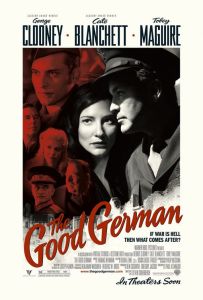 Steven Soderbergh has always seemed uncomfortable with his success and thus tried to stretch his creative wings with experimental gambles. They’re certainly ambitious but many times Soderbergh seems to be giving himself busy work. Did anyone see Bubble? I didn’t think so. The Good German is a film that wants to be seen as a forgotten relic from the 1940s, and Soderbergh went so far for period accuracy that he filmed with equipment from the same bygone era. That kind of artistic integrity is great, but what does it do to make the movie any better? The Good German aspires to be a cinematic cousin to Casablanca, even aping the iconic ending to that famous film. You’ll also get Chinatown déjà vu, especially when characters say, “Hey Jake, it’s Berlin.” The plot hinges on a murder around the Berlin conference with the Allied powers that will decide the fate of Europe and reshape the map. The story is too muddled and confusing and seems to amount to little to nothing after flirting with intrigue. The actors give hammy performances that may be true to the stagy, well-articulated acting styles of old Hollywood, but it does little in the realm of being enjoyable. Cate Blanchett is intended to be Marlena Dietrich, and George Clooney is intended to be Cary Grant, but neither manages to escape being a second-rate impression of their film noir forbears. There’s an interesting post-war story buried under all this period homage and Method-style artifice, but Soderbergh only seems interested in pleasing himself with these experimental errands, and this is coming from someone that loved Schitzopolis.
Nate’s Grade: C+
Share this:

Spider-Man 3 (2007)
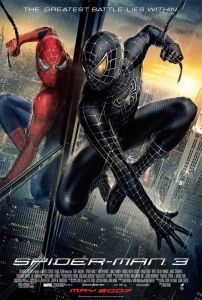 Who the hell are you Spider-Man 3 and what have you done with the franchise I loved? After the massive commercial success of first two Spider-Man chapters, my expectations had been raised fairly high. The more time that passes the more I reflect on how disappointing Spider-Man 3 sadly is. Part of my dashed hopes are because the 2004 Spider-Man sequel was a wonderful follow-up to a pretty swell introduction, and I placed that movie in my Top Ten list for the year and consider it one of the best comic book movies of all time. There’s some great popcorn entertainment to be had with Spider-Man 3, but man is this film just beside itself in wasted potential, a lack of focus, and some really poor choices.
Things are going pretty well for Peter Parker (Tobey Maguire). He plans on asking Mary Jane (Kirsten Dunst) to marry him and New York City is planning a parade out of appreciation for Spider-Man. But the good times can’t last long. Harry Osborn (James Franco) has accepted his fate and become a second generation Green Goblin villain, out to avenge his father’s death at the hands of Spider-Man. But Peter also has to be on the lookout for his job at the newspaper. Eddie Brock (Topher Grace) is an unscrupulous photographer out to replace Parker and nab a picture of Spider-Man caught in a bad light. An alien substance has also hitched a ride to Earth via meteorite and sought out Peter Parker. The black goo attaches itself to Peter and forms a black Spidey suit, one that gives him intoxicating power and a slimy menace. The new Peter cavalierly flirts with bouncy lab partner Gwen Stacy (Bryce Dallas Howard), hurts his friends, and loses his do-gooder ways.
Meanwhile Flint Marko (Thomas Haden Church) has escaped from prison. It seems the police got it wrong and now inform Peter that Marko confessed to being the one who killed Peter’s uncle. While on the run Marko happens to tumble into an open pit that is a science experiment and becomes fused at a molecular level with sand. He uses this new power to rob banks in order to save his sick daughter at home. Peter, with the power of the alien suit, hunts the Sandman to get his own slice of sticky vengeance.
 The film has way too much on its plate. There are too many characters, too many undeveloped storylines, too many coincidences, too many contrivances (Amnesia? Really? Really?), and too many aborted moments of drama. Spider-Man 3 is an undisciplined mess. The film practically stumbles from one scene to the next and lacks the coherency and intelligence of the earlier entries in the series. The third film tries to do too much and please too many interests, and as a result it may end up pleasing few fans. I had some trepidation when I learned that there was going to be upwards of three villains for this movie, but I swore that it could work since Batman Begins confidently worked around a trio of big bads. Three villains do not work in Spider-Man 3. Let me dissect this rogue’s gallery and where they fall short.
1) The Sandman is kind of a lame idea from the start. His power seems to limit his available locations, and I’m surprised that he wouldn’t stick to beach areas as a means of playing to his sandy strengths. Regardless, the character plays no part in almost anything that happens, and the Sandman is given one note to play. He’s got a sick daughter and he robs to try and pay for her medicine. That’s great on paper but it never really seems to give the character any sense of urgency or frustration. If he got special sand powers why not sneak into banks through cracks in walls instead of forming as a giant sand monster? Church attempts to imbue the character with a sad soul but he just comes across as being wooden. If he was really on the hunt for money to save his daughter then why does he just slouch around all the time? Wouldn’t it be easier to rob a city not patrolled by a web slinging super hero? How can he say he’s a misunderstood victim of luck just minutes after he tried killing Peter? He seems like a dull lunkhead. The Sandman is given a tiny wisp of character detail (sick kid!) and that’s it. He doesn’t get any other characterization and is kept on the run and pops up whenever the film needs him. He becomes a token character until the very end where Church is given 2 minutes to pour his heart out to Peter. Two minutes of character at the start, two minutes at the end, and a gaping center. The Sandman isn’t so much a character as the ideal of some issue that the filmmakers want to have Peter work through.
And what is that issue? Why vengeance and forgiveness. You see, Spider-Man 3 foolishly rewrites its own history and now it was the Sandman hat killed Peter’s Uncle Ben. This revision does not work at all and actually legitimately damages Spider-Man. Just like Bruce Wayne is tackling crime to alleviate his guilt, so too is Spider-Man, who can never shake the fact that he could have prevented his uncle’s death had he done the right thing moments before. By introducing a new killer it means that Peter has no responsibility for his uncle’s death. This completely strips away the character’s guilt and rationale for what compels him to swing from building to building to fight crime.
 2) Eddie Brock/Venom is wasted as well. Director Sam Raimi has said before he’s not a fan of Venom and doesn’t get the character, and I feel that his contempt carried over into the film. Venom and the black alien goo are given about the same abysmal care as other half-baked plot points. Eddie Brock has about three total scenes before he gets to transform into Venom thanks to the alien substance, and none of these scenes fully flesh out who the character is or justify his relationship with Peter Parker. When we do see Venom in the finale its all too rushed and hokey. The effects make him look less like alien and more like a wax figurine (I suppose there could be intelligent wax life amongst the stars). For whatever dumb reason the alien suit has to retreat so we can see Grace’s face while he taunts and mocks with bad vampire teeth that are meant to inspire what exactly? The character is rushed and underdeveloped and should have been saved for the next sequel instead of being given lip service in this one. Venom is supposed to be the evil doppelganger to Spider-Man, not some smart-alleck with frosted hair that gets about 15 minutes of screen time. I like Grace, I really like him a lot and envision him as his generation’s Tom Hanks, but he does not work in this movie. He could, but I get the sneaking suspicion that Raimi sabotaged the Venom role on purpose or at least subconsciously. The villain goes out with a whimper and it feels like a giant, foolish wasted opportunity that becomes more maddening the more I discuss it. The presence of Venom feels like a shallow attempt to placate a younger generation of comic fans and to sell more action figures.
The alien goo suit is supposed to tempt Peter and bring out his wicked wild side. So what does he do? He acts like he’s auditioning for the lead in The Mask. This embarrassing sequence is painfully goofy and will make you cringe and shield your eyes. Peter flirts with girls and dances at a jazz club, and this is supposed to be the dark side of Spider-Man? What the hell? I acknowledge that Peter has always been an unpopular dork and would be a dork even if he ventured to the dark side, but how does this square with the more serious and edgier tone the film is grasping for? Evil Peter seems more like a broody emo kid, with shocks of black hair in his eyes and traces of eyeliner. The dark side of Spider-Man, much like the rest of the film, is given little time or thought. Peter’s trials with the symbiotic suit last about a reel or two and then it’s abruptly finished.
 3) Harry should have been the main focus of this sequel and it?s a shame the filmmakers had to cram so much crap into a story already heavy with plot leftovers. Harry has the most obvious arc through the three movies and deserves better than to be knocked out of commission by amnesia. The conflict between Peter and Harry is where the film finds its emotional core and it would have been wise to expand this section and eliminate one of the other underutilized villains (my vote: both Venom and Sandman). Harry’s vow to avenge his father is far more interesting than what the other two villains have as motivation, and plus Harry requires no extra time-consuming setup to slow the pacing down. I’m glad the final battle encouraged Harry to come out and play; the film finally gives Franco the screen time he deserves, but it should have been more. The worst plot device in the film involves Harry’s all-knowing butler who has some vital information he most certainly should have shared years ago. So much time is spent on storylines that go absolutely nowhere, and the musical chairs of villains, that the film resorts to having a freakin’ butler tap someone on the shoulder and say, “Excuse me sir,” just to tie things up in the most awkwardly shrift way possible. And even if what the man says is true, how does his perspective add any clarity to the situation? Think about it. I have.
The romance between Peter and Mary Jane feels awfully trite and meandering. Spider-Man 3 lacks the tight focus of the second film. It throws contrivances to place a wedge in their relationship, like the fact that Mary Jane is fired from her Broadway gig but doesn’t tell Peter, or the fact that they never seem to answer the phone on time when the other person is apologetic. Gwen Stacy is less a character than simply a dimwitted blond tool to make Mary Jane jealous and sulk. The ups and downs in this relationship feel pretty forced and some moments defy all human understanding. At one point Mary Jane is forced by Harry to break up with Peter to spare both their lives. So she breaks the news in a park, and Peter is devastated, but why in the world does she never say anything again? Why would she not clear things up after time had passed to explain her actions? Spider-Man 2 ended with Peter finally getting the girl but also on a hint of doubt, and it was marvelous. Spider-Man 3 just sort of ends with everyone presumably in the same place they started.
Spider-Man 2 really succeeded on how focused it was and how it related its action with character. Spider-Man 3 has to resort to cheap and lazy devices to cover its storytelling pitfalls. Don’t even get me started on the fact that the film has to resort to a newscaster narrating our final battle where he actually asks, “Is this the end of Spider-Man?” This might be the end of the quality associated with Spider-Man.
 After having spent a whole slew of words detailing in length where the film goes wrong, allow me to illustrate some of what the film does right. Whenever it sticks to action, that’s when Spider-Man 3 works, and Raimi has cooked up some wonderful whiplash-inducing action sequences. The first battle between Peter and Harry is intense and sets the film on the right path, but the action as a whole isn’t as closely tied to Peter’s domestic life and emotional troubles as it was in the other films. A high-rise rescue from a crumbling office building will stir some 9/11 memories but it is awesome to behold. The effects have improved and the swinging shots through New York look the best they ever have. The greatest moment in the film is perhaps the birth of the Sandman as he rises grain by grain from a pile of sand and attempts to reform himself. Aided by some lovely music, the moment takes on a beautiful and unexpected poignancy. This is where Raimi and the CGI wizards hit it out of the park. Nothing rivals the train sequence in Spider-Man 2, though.
It might be dangerous to say, but I feel jilted from this film and either new blood needs to be brought in or the filmmakers need more time and control to make a Spider-Man sequel worthy of its name. This is the gold standard for super hero movies and its been tarnished and sullied. Spider-Man 3 has moments to dazzle and excite but it also feels battle fatigued from carrying the dead weight of extraneous characters and half-baked storylines. There are too many balls in the air for Raimi to juggle. This Spidey chapter squeezes too many ideas in too short a space. After obliterating box-office records, Sony has stated that they plan on three more Spider-Man sequels. If this film is the tipping point, then I’m afraid of what will be swinging down the pipe in years to come.
Nate’s Grade: C+
Share this:

Black Book (2006)
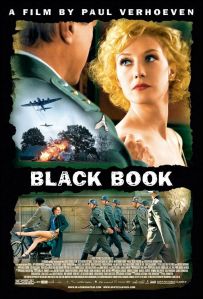 If there’s one thing you can say about Dutch filmmaker Paul Verhoeven, it’s that his films are never boring. He’s shameless when it comes to the amounts of sex and violence he squeezes into his films, and this isn’t typical bouncy violence but cold, serious violence that manage to have whiffs of dark comedy to it. The sex is sleazy and ridiculous, often outpacing the late-night flesh peddlers on Cinemax. I don’t think Verhoeven knows how to do anything subtle, and frankly I wouldn’t want him to. The man is responsible for brawny sci-fi (Total Recall, Robocop), killer lesbians (Basic Instinct), the most subversive mainstream Hollywood movie of the modern era (Starship Troopers is pro-fascism, people), and the most surreal visual effect I have seen in my life – a breast groping itself (Hollow Man). Verhoeven even shows up in person to accept his Razzie award for Worst Director for 1995’s camp classic, Showgirls. This man doesn’t have an off switch. The man makes enjoyable movies, both intentionally and unintentionally.
It’s been a long six years since Verhoeven’s last film and in that time off he’s settled back into his homeland. Black Book (Zwartboek) is a tale loosely based around true stories involving the Dutch resistance in the Nazi-occupied occupied Netherlands. And if there is anyone that can throw in some sex with our good old-fashioned WWII violence, it is Paul Verhoeven.
Rachel (Carice van Houten) is a Jew hiding out in the Netherlands. She and her family is trying to pass out of the country by river when they are ambushed by the guns of a Nazi boat. Rachel is the lone survivor and watches all of her family members get mowed down. She joins the underground resistance movement to find out who betrayed her family. She dyes her hair blonde, both above and below the waist to be thorough, and cuddles up to a stamp-collecting S.S. leader, Ludwig Muntz (Sebastian Koch). She works her way into his trust and along the way uncovers a twisty conspiracy to trick rich Jews into ambushed escapes.
 Black Book is skillfully made and pulpy enough to keep the viewer’s enjoyment level in a good place. From start to finish the movie presents enough trials and setbacks to keep an audience satisfied, and enough sex and violence to meet out the standard Verhoeven quota. Nazi occupation hasn’t been deeply explored from the Dutch point of view, and Verhoeven decides not to make everything so black and white. Muntz is a compassionate S.S. officer that wants to work negotiations with resistance fighters to stop further bloodshed. Rachel deeply falls for him, at the disgust of some of her fellow men at arms. On the other side of the coin, once the Nazis have been toppled there are several Dutch civilians and bureaucrats that can behave just as cruel. Those now with power strike out against those deemed to have sympathized and collaborated with German rule. Verhoeven is making a point that there was good and bad on both sides, which is admirable, though this point has been made better elsewhere. Black Book is filled with various twists and double-crosses, so the audience is involved until the very end. Plus, the sex and violence help too.
There’s terribly little below the surface when it comes to Black Book. It’s a thrilling, unabashedly entertaining movie but nothing beyond a sexed-up, suped-up version of a 1940s behind-enemy-lines potboiler. The characters have little to them beyond basic motivations like greed and lust and revenge, so it all can seem like an empty but high-spirited, fun-filled time at the movies. Verhoeven has never imbued his female roles with much characterization, more often showcasing them as ass-kicking vaginas on legs (whoa, now there’s a mental image for you). Another flaw is how Black Book is structured. We open on a tourist trip to Israel in 1954 and see Rachel teaching a class of schoolchildren. This colossal misstep drains the tension from whenever Rachel is in danger; we already know she has to survive to teach our little ones. [I]Black Book[/I] is a largely fictional take, a collection of various historical pieces and figures, so that means that the outcome for our heroine is not preordained. Rachel very well could die amidst her undercover infiltration, but alas the movie opening in flashback erases this threat.
Van Houten is an enticing screen beauty that brings to mind Hollywood stars of old. She has a very simple, prim, elegant look to her, and a presence that is coy and sensual but far from trashy or vulgar. This helps add traces of believability to a figure that does some incredible acts in the name of God and country. Hollywood would have cast Rachel as a tall, buxom bombshell, but it would all be wrong. If this girl turned heads she would be dead. Van Houten gets thrown through the wringer, and at one point literally shit upon, and she handles it with steely grit. The best moments are when we see how Rachel rebounds from setbacks, when she is forced to break from her resolve and think. Her first encounter with Muntz in a train car is a good example, but even better is how she reacts when Muntz accuses her of dying her hair and being a Jew. She grabs his hands and places them on her hips and finally rests them on her exposed breasts. “Are these Jewish?” she asks. She defuses the situation and lives another day, and it’s perfectly played by a nervous but nervy Van Houten. She makes two plus enjoyable hours even more enjoyable.
 Black Book is clearly and fairly rated R, but part of its rating piqued my curiosity. One of the items that help push the film into the restricted rating is “graphic nudity.” Now, what exactly is graphic nudity? I recall last year’s Babel also getting an R-rating for what was deemed “graphic nudity.” One thing the two films have in common is that they both show quick glimpses of exposed female genitalia. I suppose that the MPAA feels that nudity becomes graphic when we see pubic hair. This confounds me. What about pubic hair turns nudity into an extra, more offensive category of nudity? At the end of the day, it’s just hair, people. I did some quick research and [I]Basic Instinct[/I], infamous for Sharon Stone’s career-making leg crossing, is rated R for mere “strong sexuality.” For the record, when Stone flashes her naughty bits they were bare. So let the record show that hair seems to be the qualifier between what is nudity and what is graphic nudity. Maybe I’ll write a dissertation on this some day.
As for another aside, how freaking cool is the name Zwartboek? It sounds like some fun term I’d come across in the pages of Douglas Adams’ The Hitchhiker’s Guide to the Galaxy. The Dutch language is a tad bizarre for my American ears; it’s sounds like a mixture of English and German, and sometimes it seems like a subtitled sentence is actually direct English. I know I can’t stop saying “zwatboek” around my home in place of gasps and curses.
Black Book is Verhoeven’s first Dutch language film in over 25 years, and it also feels like he’s enjoying movies again after his bad experiences across the Atlantic. I welcome more entertaining Dutch films from their favorite filmmaking son. He may not be he most subtle man behind a camera, but we already have plenty Terrence Mallicks and Gus van Sants to bring confounding contemplation to movies. We need more people like Vanhoeven who know how to please the sense, kick you in the balls, and make you grateful for the experience.
Nate’s Grade: B
Share this:

In the Land of Women (2007)
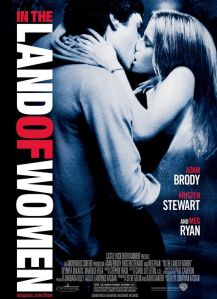 Nepotism is about as prevalent in Hollywood as venereal diseases. Plenty of people get their foot in the door because they just so happen to share genetic material with successful filmmakers. It happens all the time in the world of business, and movies rake in the cash, so the Kasdan clan isn’t any exception to the rule. Papa Lawrence has a storied pedigree. He’s responsible for Body Heat, Raiders of the Lost Ark, The Big Chill, The Accidental Tourist, and two, count ’em, two Star Wars movies (the good ones). His oldest son Jake has directed Zero Effect and Orange County. Now younger son Jon Kasdan is taking the leap into the family business with In the Land of Women.
Carter (Adam Brody) is a Los Angeles writer for soft-core pornography. He?s just been dumped by an up and coming Spanish actress (Elena Anaya). He feels lost and comes up with a plan that will help inspire him to write his serious novel that’s been gestating for ten years. He heads out to a small Michigan suburb to live with his crabby hypochondriac grandmother (Olympia Dukakis). Across the street is a glum family. Sarah (Meg Ryan) is coping with raising a family and undergoing chemotherapy for the lump in her breast. Her teen daughter Lucy (Kristen Stewart) is full of angst and hates her mom. Carter inserts himself into the family’s life and may just heal longstanding wounds.
 In the Land of Women is a strange experience because it feels like the entire movie is cobbled together by subplots. There doesn’t seem to be a strong central storyline, a strong central character, or any real connective tissue. You start to feel the lack of direction and discipline from Kasdan. The characters are all underdeveloped when they aren’t behaving in unbelievable manners. This is another drama where the characters take long strolls and wax introspectively about their life, spelling everything out with rare clarity to strangers. This would be more permissible had the film presented any other avenue for character development. Ryan gets the sick mom storyline, Stewart gets the awkward and angry teen storyline, and Dukakis gets the crazy grandma storyline. It may be a land of women but these aren’t very well constructed women, and I’m uncertain what exactly Carter has learned from this supposedly life-changing experience. He met some women, he listened; in fact, I think that’s where the film takes its first wrong turn. Carter is a self-described great listener, so guess what happens when he meets women who have bottled up their secrets and true feelings? Yep, he listens. And we watch him listen for most of the movie. This allows characters to unload dramatic monologues that do the major work for characterization, but it still keeps our main character, the traveler to the titular land of women, as nothing more than a low-key cipher. He’s a handsome couch for the female characters to unwind. When Carter is typing his Big Serious Novel I’m clueless as to how he has changed as a person and how he reached his point of enlightenment.
I get the unmistakable feeling that Kasdan is really trying to make his own Garden State. This is another story of personal maturation and it takes places with a visit home to a simpler life with comic oddballs. He’s taken the elements that made Garden State click, including a hip and frequently heard soundtrack, but Kasdan must have missed the part where Garden State benefits from strong, likeable characters and a plot. Just like Carter, Kasdan is striving for something grandiose to say about the world, but the end results are no better, and no worse, than something you could catch on a nondescript cable channel. The movie is stuffed with familiar moments, like the bustling teen party, the precocious teen wise beyond her years, the feeble love triangles, and the asshole jock boyfriend. The handful of new wrinkles that Kasdan does explore is easily forgotten; Carter’s job deserves far more discussion. When the Hollywood life butts back in Kasdan doesn’t push the juxtaposition as hard as he should, so Carter’s troubles feel puny, especially compared with cancer. In the Land of Women has some touching moments to it and an occasional wise bit of dialogue, and they stand out amongst an otherwise underwhelming panorama.
 In the Land of Women reaches its awkward peaks when it treats Carter?s mother-daughter interaction like two choices for romance. Carter is supposed to be 25, making him about 20 years younger than mom and 10 years older than daughter. In my book, that’s an “ick” on both accounts. Carter gets to smooch both women (hell, one of the kisses is the poster) and the audience gets to squirm both times. Our sense of guilt is alleviated by multiple characters telling us that Sarah’s father is having an affair, so then it shouldn’t matter if she finds understanding and warmth in the arms of a young emo pup. But what makes these sidesteps so awful is how clumsy and meaningless they prove to be.
The acting in the movie is well done. Brody is apt for a romantic comedy leading man. He’s got oodles of laid back charisma and a winning sense of humor that made him the breakout star of a prime time soap. He’s affable and enjoyable to watch, but his relaxed acting style doesn’t help an undefined character. Stewart is a wonderfully natural actress and largely communicates with her gangly physicality. She has the teen contempt down perfect and looks like an average teenager, which compounds how icky it seems to see her kiss Carter. Ryan hasn’t been onscreen in 3 years, and to tell the truth, I kind of missed her. She gets some standard emotional scenes as an afflicted, underappreciated mother and sells them well.
Jon Kasdan’s filmmaking debut isn’t going to do much to redefine his artistic image other than that of a lucky genetic benefactor. In the Land of Women is earnest and well acted, but the movie is just far too underdeveloped and shapeless to succeed. The film is a collection of non-starting subplots and familiar elements; you just feel that the movie needs a kick in the ass to get on track. The soundtrack is pleasant, the production is competently made, but the story is ultimately lacking and underwhelming. The land of women and men deserves better.
Nate’s Grade: B-
Share this:

Reign Over Me (2007)
 Adam Sandler in a serious drama? Well it worked in 2002’s Punch-Drunk Love, but that was aided by Paul Thomas Anderson deconstructing the typical Sandler goofball in his glut of crude yet successful comedies. Can Sandler work his thespian skills in a story not tailor-made for him? I think writer/director Mike Binder’s 9/11 human drama, Reign Over Me, is proof that Sandler can step outside his popular persona for a worthy cause. But this movie isn’t it.
Alan Johnson (Don Cheadle) is an ordinary dentist living his family life in Manhattan. Then one day he spots his old college roommate, Charlie Fineman (Sandler), zipping along on an electric scooter. He looks drastically different than Alan remembers, and this is because Charlie’s wife and children, and even his dog, were on one of the hijacked planes that crashed into the World Trade Center on 9/11. Charlie’s life now consists of a new adolescence where he does what he wants because of the insurance money, so he plays video games late at night, goes to see Mel Brooks retrospectives, and keeps remodeling his kitchen over and over. He is without friends and refuses to even think about any painful memories. Alan takes it upon himself to help his former dentist school pal confront his grief and get back on his feet.
 The varying elements never truly mesh, and Reign Over Me has a very haphazard, clumsy feel as it never comes to a firm landing. There’s a mixture of the serious and the sitcom, and both elements go together as well as vodka and motor oil — sure it may work in the immediate but couldn’t it be much better? Many of the connections feel tenuous and it’s hard to care about certain storylines, especially the film’s preoccupation with Alan’s midlife malaise. Are we supposed to be in Alan’s corner as he argues his adult life sucks because women at the office throw themselves at him and his wife wants him to open up? Am I really supposed to believe the film’s assertion that he covets the freedom of a 9/11 widower? Reign Over Me never shifts gears smoothly when it comes to tone. The audience is left to question why this story needs to be told through the prism of a bored dentist. It never truly feels right.
Charlie isn’t just bummed out, he is severely damaged from the shock of 9/11; this is far beyond post-traumatic. At several points he just freaks into violent fits out for no discernible reason, but people still tolerate him and don’t call for greater help. It would be naive to think that one friend could fix all of the psychological horrors of one man, but then you remember this is a movie. Charlie could use some serious meds. Friendship is important, but Reign Over Me toys with the object of abject loss without delving too deep, instead feeling that one good crying confessional and a terribly manipulative and unbelievable court battle will sum everything up.
I think that feeling was pervasive for me while watching Reign Over Me was that I felt toyed with. The drama takes a long time to wind down and even then it settles on surface-level solutions that always seem so easy in movies. Many of the comedic elements feel too dependent on sitcom generalizations. Charlie comes to Alan’s apartment late at night and asks his wife if he can go out and play. Alan chastises his friend, saying he’s an adult and doesn’t need his wife’s permission to go outside. Can anyone guess what the next moment will entail? That’s right, he asks his wife if he can go out and play. You’ll be forgiven if you hold for expectations of a laugh track. Reign Over Me even is also filled with the usual suspects like the brassy receptionist, the shyster lawyer, and the hilarious misunderstandings between the sexes that bring about sexual harassment lawsuits.
 Let me stop and illuminate on that last bit. Alan’s patient is obsessed with wanting to orally pleasure the good doctor, enough that she sues when he declines a second time. For whatever reason, he sees her again and she apologizes in some ham-handed back-story about how her husband dumping her left her devastated (and if you can figure out what Binder has in store for the film’s broken female and broken male, then you too deserve a lollipop). This storyline is beyond tacky, a bit humiliating for the actress, and a prime example of how poorly the all the female roles are written. It’s shocking that Reign Over Me can examine male adult male bonding so well but completely drop the ball with every single female character. Alan’s wife seems nice and responsible but the film tries to convince us she’s sucking the life out of him because she likes jigsaw puzzles, quiet nights at the home, and knowing where her husband is when he’s out odd hours of the night. It’s appalling how this movie treats its female characters. They are either seen as flighty beings at the control of their sexual desires or as cold, non-sexual wet blankets. After the hour mark you can almost forget about seeing anything about Alan’s family except for an implausibly tidy “I’m sorry/No I’m sorry” phone call.
Sandler can be a fine actor when given the right material, and a character that retreats into an infantile existence seems like a plum role for him. He effectively channels Charlie’s disconnect from reality, but a lot of his grief tics will start to remind you of Rain Man-style autism, like repeating phrases, obsessive behavior, and moaning and rocking while upset. He gets lots in his Bob Dylan bird’s nest of hair.
Cheadle is always dependable as an actor and proves to be a stable center the film needs because of its narrative shortcomings. He’s doing primarily a lot of reaction but still manages to work above his material and build sympathy to a character that really deserves less. Sandler bounces around like a ping-pong ball and Cheadle holds steady, and the two men form a rather strong acting unit that just makes me wish the material were up to their task.
Ultimately Reign Over Me is hard to pile on because of its wealth of good intentions and fleeting moments of dramatic heft. It’s a messy film that somehow believes all its disjointed elements fit together, when in reality the movie never settles on a cohesive tone. The acing is generally strong and there’s some mature and realistic writing regarding male relationships, however, there are just as many frustrating moments. The film skims the surface of Big Issues like 9/11 grieving but never wants to develop into something more thoughtful. Instead, the film retreats much like Charlie into an easier existence where the questions are only momentary. Reign Over Me is a fine if unremarkable drama, but good intentions can only take you so far. At some point, to be memorable, you have to actually be good.
Nate?s Grade: B-
Share this:

Zodiac (2007)
 Zodiac is something altogether different from a genre best known for cannibalism, skin suits, and express shipping of human heads. It has more in common with All the President’s Men than director David Fincher’s 1995 masterpiece, Seven. This is a serial killer thriller steeped in police procedural, closed door deliberations, and the slow drip of a decades long investigation into the Zodiac killings that terrorized California from the 1960s and 70s. Watching close to 3 hours of procedure with nary a car chase or a shoot-out may not sit right for fans of the genre, but I enjoyed the film for the same reasons people will decry it — the details. I loved how methodical this film is, how dogged and stubborn it is, and I found myself being enveloped into the minutia of the case.
It all began with a young couple looking for a bit of privacy in 1968. They park at a lover’s lane and nervously engage in a bit of the old “neckin.” A passing car interrupts them, and then that car returns with its headlights blasting into the couple’s faces. This man then takes out a gun and starts firing, killing the woman and badly injuring the young man. Robert Graysmith (Jake Gyllenhaal) is a political cartoonist for the San Francisco Chronicle when a curious letter has stirred up a lot of discussion. It’s a cryptic message with a puzzle attached made up of symbols and codes. The author demands his puzzle run in the newspaper, and if not, more will suffer at his hands. There are further attacks along the California coast and the mysterious figure finally gives himself a name at the end of one of his letters: Zodiac.
 San Francisco detectives David Toschi (a great, raspy Mark Ruffalo) and William Armstrong (Anthony Edwards) are called in after Zodiac executes a cab driver in the city. The Chronicle‘s star crime reporter, Paul Avery (Robert Downey Jr.), pesters the police for details and eventually gets under Zodiac?s skin. Graysmith becomes obsessed with the case through a life-long love of puzzles and the case eventually consumes him, dooming his marriage to a pretty girl (Chloe Sevigny). Thanks to the tutelage of Avery, Graymsith becomes an amateur detective of his own, and his zeal to solve the case outlasts the actual police.
The Zodiac killer was really the first mass media serial killer. As the news of brutal attacks spreads, the media ate it all up and enlarged the figure of Zodiac to grand heights. And he was eager to help inflate his image, taking credit for crimes and slayings that were not his doing. The killer used the media age to terrorize the populace and increase his notoriety, similar tactics used by today’s stream of terrorists. The detectives didn’t just have to navigate all the shifting evidence but the formation of an urban legend.
This is before the day of DNA and super computers, so all progress comes from good old-fashioned police work. Long hours are spent pouring over mounting evidence while coordinating around bureaucracy; because Zodiac has struck in several different small communities it can take a saint’s patience to figure out the correct jurisdiction and compile the various parts in various offices. The film packs a lot in its running time introducing scores of information, suspects, witnesses, and varying theories, but the film cannot be faulted for pace; nearly every scene takes place weeks, months, even years after the last.
 Zodiac is Fincher’s most restrained work even at a gargantuan running length. Fincher is a master tactician with slick visuals but has a penchant for getting too dazzled by needless visual flourishes (did the camera really need to zoom through the handle of a coffee pot in Panic Room?). He tones down the excess but still maintains a refined visual palate that makes the film feel fluid. The period detail is incredibly reconstructed, giving an authentic feel for a very serious story. But Fincher knows that with Zodiac the impetus lies with the story, and he devotes his considerable style to the service of the story. The mood balances nicely with intrigue, humor (after Zodiac singles out Avery fellow journalists start wearing “I’m Not Avery” buttons), and some truly terrifying moments involving the Zodiac attacks. The violence is sparse but when it does occur it is shocking, particularly watching a knife plunge repeatedly into the writhing body of a woman at a lake. One key element of sustaining such an ominous mood is fabulous song selection. Very often pop songs can be counter-productive to a movie, coming across as a lazy attempt to cobble together a soundtrack to shill. With Zodiac, “Hurdy Gurdy Man” becomes a powerfully haunting medley for the killer and the sonic linchpin for the film.
Fincher does an excellent job of transporting us back in time and recreating the sense of paranoia that grappled many. There is a great scene late in the film where Graysmith comes to the sudden realization that he may have walked right into the spider’s parlor. The scene plays out to an agonizingly uncomfortable length, and you too feel like running out the door as fast as your legs can take you. By not knowing definitively who the Zodiac may be, the film gets a boost of suspense from a multitude of creepy suspects. In an interesting decision, Fincher uses different actors of different shape during the Zodiac attacks, playing against the varying reports from witnesses and survivors.
There?s a sizeable danger trying to find a climax to a case that remains open to this day and where no one has been officially charged. Zodiac does as good a job as possible to present a fitting, mostly satisfying conclusion. The movie presents the best theory and points a convincing finger at who Zodiac perhaps really was.
 Zodiac is expertly crafted but has a handful of minor flaws that hold it back. The overall script is rather nimble with how it dishes new information to digest, however the intricacies can amass and become too great, and some scenes congest too much without needed forward momentum which causes the flow to get caught up in an expository pile-up. Still, the film is demanding but not overwhelming and not without reward. The film follows the ups and downs of the Zodiac investigation, and that means characterization runs short and simple. I fear the only false note amongst a vastly talented cast is Gyllenhaal, an actor I adore. He works fine in the portrayal of a young kid in the newsroom trying his hand at crime solving, but it’s the film’s second half where the actor falters. He fails to sell the obsession and desperation that dominates his life, instead looking wiped out but no worse for wear, like the temporary results of an all-nighter before a big test.
It was five years since Fincher’s last film, and he wasn’t sitting on his laurels when he crafted Zodiac, an exceptionally intelligent and demanding movie. Decades pass, suspects weave in and out, evidence and testimony contradict one another, it’s all a lot to keep track of but I found myself absorbed in the case just like Graysmith. This is a serial killer movie that could bring the smarts back and redefine the genre, that is, if fans are willing to sit through 3 hours of police work. If not, well they might get their kicks out of the more genre loyal The Zodiac, released in 2006. And that movie’s only 97 minutes long.
Nate’s Grade: A-
Share this:

The Prestige (2006)
 Christopher Nolan can do no wrong in my book. The director of Memento, Insomnia, and Batman Begins has bewitched me with his clever non-linear storylines and artistic vision. The Prestige is 2006’s second period set magician movie, and in my opinion it’s the better of the two. Nolan’s film lacks the magic of The Illusionist, instead focusing more on the bitter realities of obsession, self-destruction, and the lengths that men will travel for vengeance. The script centers on a pair of dueling magicians (Christian Bale, Hugh Jackman) that are each trying to discover the other’s trick and top them. The storyline is as twisty as a pretzel and told in Nolan’s familiar non-linear fashion, building to a very dark reveal. Whereas The Illusionist sweeps viewers up with the wonder of magic, The Prestige is all about how tricks are orchestrated both on and offstage. The results are a tad cold; you don’t really feel for either magician. The movie is itself a trick but one grandly told with excellent slight of hand. The final act takes a step outside of the film’s tone but it works for me, and it’s been weeks since I last saw the haunting final images and I still cannot get them out of my mind. The Prestige is another notch on my Nolan love meter.
Nate’s Grade: A
Share this:

Shortbus (2006)
 How do we define pornography? John Cameron Mitchell (creator of Hedwig and the Angry Inch) wrote and directed an examination on human relationships that also employs hardcore sex. Yes, the actors are really having sex and we really see, among other things, a man fellate himself to climax. There’s hetero sex, homo sex, masturbation, and, in small flashes, a whole sweaty orgy of people of all shapes, sizes, colors, and tastes. This movie celebrates the sheer possibilities and enjoyment of sex. Mitchell isn’t the first serious filmmaker to show people really doing it, and the movie shows sex in a realistic fashion that is rarely seen, with all the humor, playfulness, and stumbles that can arise. It?s refreshing and a great window into the depths of human interaction. That’s the deal: everyone in this film is reaching out to feel something. The script mostly follows the pursuit of a sex therapist who has never had an orgasm. The sex will get the headlines but it’s the quiet reflections on human connection that really sneaks up on you and can hit hard. The movie doesn’t cover every facet with ease, like a stalker-esque character, and some of the acting is a bit amateurish; however, it’s a daring film that has a disarming sweetness to it and an open-hearted message that’s rather romantic after all. And no, it’s not porn.
Nate?s Grade: B


You must be logged in to post a comment.