Blog Archives
Little Children (2006)
 Director Todd Field (In the Bedroom) and author Tom Perotta (Election) have created the most incisive, mordant, and entertaining peek into suburban life since 1999’s American Beauty. You really feel the carnal yearning that Kate Winslet and Patrick Wilson have as they inch their way to an affair. I’ve never felt the raw appeal of an affair perhaps like this before. Even more amazing, the film explores an entire neighborhood of characters and breathes life into them. Little Children feels like a great novel, with a scalpel-sharp narrator offering glimpses into the inner workings of these people. You get a great sense of worth in the film and it’s easy to fall under its spell. Little Children is a wonderful movie that looks at the complexities of people without judgment but with plenty of sly humor. It’s a fine work of satire and sensuality, and Winslet is becoming so good at delivering powerful performances that she’s being taken for granted as perhaps the best actress of her generation.
Nate?s Grade: A
Share this:

Half Nelson (2006)
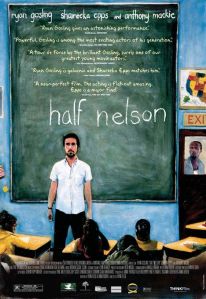 Ryan Gosling gives a devastating performance as an inner city schoolteacher addicted to crack. This is a thoughtful look at friendship and vice as Gosling befriends one of his female students and becomes something of a mentor, trying to steer her in a good direction. The film is refreshing because of how awkward and authentic it is, and it does not pull punches; there are no happy endings or storylines wrapped with bows. The biggest drawback from this powerful film is that it’s too insular and doesn’t get much of an outside perspective. Scenes have a tendency to drag, but the movie is set ablaze by the troubled yet hopeful turn by Gosling, already firmly established as the most astonishing talent of his age. Who ever would have guessed a former Mousekateer would be our next Marlon Brando?
Nate’s Grade: B+
Share this:

Hard Candy (2006)
 Pedophilia is all the rage these days in the media spotlight, though people are misusing the term most of the time. Pedophilia denotes an attraction to pre-pubescent kids, not, say, a 16 year-old girl. But anyway, this is a nasty little firecracker of a film that pushes the audience into increasingly uncomfortable moral quagmires. I enjoyed being made uncomfortable, being forced to question who was in the right, when the truth of the matter is neither party, the accused pedophile or the vengeful 14 year-old girl, is totally justified in their actions. Ellen Page gives a shocking and intense performance, one of the year’s biggest surprises. She’s a skinny coil of rage, deception, and questionable ethics. Most of the film is just watching two actors argue back and forth, each vying for dominance, and the results are pretty absorbing. The movie trips up late by spelling things out when it should have remained a nagging mystery. Sure it’s not entirely believable but damn if it doesn’t put you into a tight spot.
Nate’s Grade: B+
Share this:

Catch and Release (2007)
 Catch and Release may in fact have the most bizarre meet-cute in movie history. Gray (Jennifer Garner) is mourning the loss of Grady, the man that would have been her husband. She seeks a refuge from all the well-wishers and lies down in a bathtub with the shower curtain drawn. Fritz (Timothy Olyphant), one of the deceased’s best friends, enters the room with a female caterer. They position themselves against a wall and engage in some opportune sex. Gray is trapped and forced to hear the whole thing. The caterer keeps screaming, “Sock it to me” in increasing orgiastic pleasure. I was waiting for some more 1950s hipster dirty talk, like, “Lay it in me, Daddy-O.” Eventually the sex comes to an end and Fritz lights up a post-coital cigarette. But then Gray flings the shower curtain back. Aha! It’s boy meets girl in the most preposterous fashion, but that’s Catch and Release for you, a romantic comedy with enough to be different but still too limited to become anything other than a lukewarm date movie.
Now absent one less earner, Gray is forced to move into a house occupied by Sam (Kevin Smith) and Dennis (Sam Jaeger). They were friends of Gray’s ex as well. Then life proceeds to give Gray a series of curve balls. She discovers that her dead fiancé had over a million dollars in the bank and an 8-year-old son with another woman (Juliet Lewis), a flighty New Age massage therapist. Grady might not have been the same man Gray thought she was set to have and to hold (her married name would have been Gray Grady?).
 Things get off to an interesting start. The proposed wedding party has been transformed into a wake. Then as she is trying to cope with loss and put the pieces of her life together she’s further undone by revelation after revelation of secrets her ex kept from her. That’s pretty dark for a usual airy genre but also a pretty interesting setup for something different. Catch and Release flirts with being unconventional but then is on a fairly predictable trajectory once its promise settles down and completely dissolves.
Thankfully, despite all the doom and gloom there isn’t any grating sense of whininess. The perspective feels knowing and in search of wisdom through life’s unexpected calamities. Writer/director Susannah Grant (Erin Brockovich, Ever After) has a worthy adult sensibility that helps make the film feel a bit more credible and less like an inane melodrama. Catch and Release feels less pre-programmed and unlike most paint-by-numbers romantic comedies, and yet it still wears the weight of its genre around its neck and can never take a step forward without taking two backwards. There’s ample opportunity for a romantic comedy that begins at the literal end of a relationship, with the widow discovering more than she ever knew about her dearly departed (a rom-com version of The Constant Gardener? Call me, Hollywood). However, the movie seems too content to walk the same beaten path many have before it. It may be nothing more than a throwaway genre movie but it got my hopes up that it could have been something more. I feel spurned and betrayed, somewhat like Gray must have felt.
Catch and Release is a hit-and-miss date movie that can never really reel in what it wants to do. The film has some somewhat inspired moments but is also dominated by romantic comedy clichés and sitcom generalizations when it comes to its characters and setting. Of course the nice guy has had a lifelong crush on Gray. Of course the fat guy is also funny and rude. And of course we’re going to house all of these people under one roof so it will produce plenty of Gray-Fritz interactions that will lead to their eventual coupling. Plus, who could forget the classic eleventh hour misunderstanding followed by the pursuit that ends in a glib line like, “What took you so long?” The movie seems to be trying too hard to make Fritz seem like a suitable replacement when we never really know much about him. He’s kind of sleazy and he knows it, but when exactly does he become likeably sleazy? Their union feels forced and unrealistic, even by romantic comedy standards. It also feels like Grant named Garner’s character Gray just so she could include this passage:
Gray: “What’s your favorite color?”
Fritz: “Gray.”
 This prompted an entire row of teenage girls to go “ahhhhh” in my theater. I wanted to laugh, but then I was grossly outnumbered in my theater.
Catch and Release is mostly a grab bag of other romantic comedies. It doesn’t even know what to do with the fly fishing metaphor it valiantly tries to lift into some deeper meaning. I don’t get it myself. Gray says that her dead ex was always a “catch and release” man; does this mean he never had the heart to finish off his prey, or that he was too sympathetic with struggling creatures? It doesn’t matter what the metaphor attempts are because it allows for the cast to put on their rubber boots and wade in the cool waters of predictability. At least only one character works in the usual romantic comedy job pool (publishing, advertising, theater). Though Sam does come up with quotes for boxes.
Garner is such a winning actress but still finding her stride. She’s being positioned to fill the void of Meg Ryan and Julia Roberts, which is fine, but when I see her more as a modern Sigourney Weaver, someone who can excel in light comedy but also kick your ass when the time came. Gray’s world goes into upheaval and Garner is up to the task balancing emotion and wry life observations, but too often there’s little else for her to do but pout or crinkle her eyebrows. Her cheekbones certainly get quite a workout in Catch and Release but I wouldn’t exactly call that dramatic acting. I have been a fan of Olyphant since 1999’s Go. He’s always had a scary sexiness to him, and works best playing assholes you just can’t help but love. Grant totally drops the ball on his character. Fritz is behind the eight ball early and never really recovers when it comes to audience loyalty. Olyphant is also given a problematic shaggy haircut that manages to neutralize his natural alluring danger and still make him seem aloof. His role is a stock role and nothing more.
 Thank God for Kevin Smith. Grant wisely chose Silent Bob as her comic relief and Smith has such natural laid back charm and great timing that he should get more acting gigs full time. His presence is deeply missed when he steps offstage and the film returns back to its familiar roots. I don?t know why Grant has Sam eating or making food, or talking about eating in almost every scene. After the fourth scene in a row where Sam has a chicken leg in his fist, it gets tiresome, like she defined a character by hunger. Smith has the best scenes and the best chemistry, whether it’s with Garner, Lewis, or a little kid. I think someone should cast Kevin Smith as the lead of a romantic comedy. Now that’s an unconventional date movie I’d pay to see.
Catch and Release has some glimmers of promise before succumbing to the weight of the romantic comedy genre. The movie just cannot get past mounting clichés and shallow characters, plus some fairly contrived situations like the bizarre meet-cute. Garner and her dimples will survive to enchant another day. At the end of the day, Catch and Release is just like any other romantic comedy movie, and there’s plenty more of those in the sea.
Nate’s Grade: C+
Share this:

The Queen (2006)
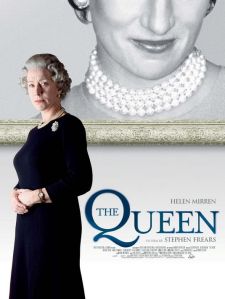
Long live the queen. In this instance Helen Mirren. After giving a majestic performance of Queen Elisabeth on HBO?s 2006 miniseries, here she is at it again this time as Queen Elisabeth II. Mirren is utterly magnificent in the role and burrows her way deep into her character, completely losing herself. Director Stephen Frears’ The Queen is a docu-drama examining the royals’ response to the tragedy of Princess Di’s death. It’s both a comedy of culture clash between the tradition-oriented world of the royals and the modern world that has moved beyond figureheads and symbols of monarchy and a drama exploring the grieving process. Frears and screenwriter Peter Morgan build great sympathy for the queen and the rest of these nutty royals, all stuck in a different age and hesitant and confused about mounting outcries for change. The royal family doesn’t understand the public’s demand to fly the flag over the palace at half mast in honor of Di’s passing; it hasn’t flown at half mast for over 400 years for anybody, kings and queens, let alone someone no longer part of that family. Even Prince Charles comes across remorseful, heartfelt, a little strange, but very identifiable. Plus, the actor looks a lot better than his real-life counterpart. It’s funny but also sad when the Queen Mum is hurt when her own funeral arrangements, the ones she picked out, will be used in a hurry for Di. The film pays equal attention to the rise of the new Prime Minister Tony Blair (Michael Sheen) and his frustrated relationship trying to save the royal family in a PR nightmare. Mirren, though, is absolute royalty. She plays a character prided in her decades-long approach to shielding emotion, to stoicism, to stiff upper lips, and Mirren displays the flashes of grief, befuddlement, and tenderness that register through that tricky prism. Queen Elisabeth II figures the public doesn’t want someone all weepy. She did, after all, begin her service around World War II when Winston Churchill was her first Prime Minister. The world has changed, she fears, and wonders if she’s fit to lead her people when she doesn’t even know what they want. The Queen is a sterling character piece with excellent direction and great performances. It’s quiet and moving but also a deeply fascinating behind the curtain view at a moment in time. And yet… I cannot help but feel some distance to the movie; I cannot put my arms around it just quite yet. The Queen is a very good film, of course, with an Oscar shoo-in performance by Mirren, but the free-floating plot and the intentional repetition and disconnect kept me from embracing this movie totally.
Nate?s Grade: B+
Share this:

Pan’s Labyrinth (2006)
 Fantasy has a naturally cheerful tone. Someone did not tell that to Mexican writer/director Guillermo del Toro. The Hellboy director is obsessed with all things creepy, crawly, and gooey, and his films all seem to revel in the things that go squish in the night. Pan’s Labyrinth is a children’s tale not intended for children. It’s more in line with the fairy tales of old that were violent, sickening, and something to strike fear in disobedient kids.
Ofelia (Ivana Baquero) travels with her pregnant mother to live in a cottage along the Spanish countryside. Her mother has remarried The Captain (Sergi Lopez), a brutal officer in the ruling fascist government. He’s a stern and unforgiving man and plotting to eliminate the remaining scattered resistance soldiers. Ofelia discovers a series of stone stairs that lead to an underground labyrinth. Inside is a faun (the titular Pan) who recognizes the spirit of his world’s missing princess inside Ofelia. He gives her tasks to complete that will prove whether or not she can return to the other world.
This is a fabulously dark Alice in Wonderland for a more mature set. Pan’s Labyrinth is very similar to del Toro’s 2002 The Devil’s Backbone, a smart and affecting ghost story set against Spain’s bloody civil war. del Toro has set his supernatural fantasies against some very real and very dangerous backdrops. The Devil’s Backbone was more than just a ghost story, and now Pan’s Labyrinth is more than just a fairy tale. The real world is a violent and cruel place and worthy of a magical escape. However, the fairy tale creatures are not from the Disney school of kinder, gentler folklore. The faun is evasive and prone to outbursts when he/it does not get his hooved way. The other creatures, like a giant slimy toad, are all after their own gain and don’t much care for a little girl’s interference. There is no escape to safety.
 There are plenty of staples commonly found in fairy tales. Ofelia has to complete three tasks before the cycle of the moon. She has to complete trials of courage and prove her purity of heart. The characters look familiar but they definitely don?t behave the same. Pan’s Labyrinth has a continuing sense of dread. People die vicious deaths and the threat of violence is ever present.
The real world segments are just as engaging as the grander flights of fantasy. del Toro spins a very worthy tale of secrecy and suspicion at the dawn of Franco’s Spain. Several members of The Captain’s quarters are aiding the remaining resistance officers and risking their lives to hide their allegiance. It also draws the viewer in because these characters are the kind ones that look after Ofelia, who accidentally stumbles upon their secrets. The Captain is an earthly monster equal to the horrors of the fairy tale world. He has a deadly fixation with wasted time and punctuality (another Alice in Wonderland homage – the ticking pocket watch). Whether he’s torturing or shaving, the man seems peeved in all that he does. He tells the doctor that if a choice must be made, save the baby over the mother. His legacy demands an heir.
del Toro straddles differing genre lines like few artists out there. He has a great love for monster movies and horror but he also has great feel for human drama and a child’s wide-eyed point of view. Ofelia rests her head on her mother’s pregnant belly and speaks to her unborn brother. When her mother is experiencing complications she implores her brother to be gentle. It’s a little action but comes across as so honest and heartfelt from a child. The film is touching and exciting and pretty scary when it wants to be. Pan’s Labyrinth is a genre-bending gem that?s exceptionally well executed. The production design and make-up effects are terrific and lend to the otherworldly feel. The special effects are mostly a mix of practical designs and creepy make-up work, especially with the “Pale Man.” I especially enjoyed how the fawn moved and sounded, all clicks and creaks like he hadn’t moved his bones in ages. del Toro and his movie magicians do an excellent job of transporting you to two distinct worlds.
I could have used more labyrinth in my Pan’s Labyrinth. As it stands, the movie is divided as 15% fantasy world and 85% real world. That?s not enough for me. Maybe I just loved the fantasy elements too much or was expecting more of a live-action Spirited Away. Then again, del Toro has his mind set on an ambiguous ending that will divide the skeptics from the believers. Are there opposing worlds? Is Ofelia just making it up to escape reality? Whether what’s happening is real or not is irrelevant; Ofelia believes it is real. I feel that the movie could have been even greater had it utilized its fantasy side more.
 Take for instance the “Pale Man,” a grotesque monster that has to place its eyeballs in the palms of its hands to see. When Ofelia enters his realm its covered in ancient art showing this faceless creature devouring children. A giant pile of shoes sits in a corner as a constant reminder of the creature’s appetites. However, the creature sits at the head of a table motionless, unless some irresponsible child takes a bite from the illustrious feast of food at the table. Then the “Pale Man” springs to life. The imagery is horrifying but beautifully sickening, and it’s just too regrettable that Pan’s Labyrinth only gives such a memorable monster one single scene. I kept hoping that the movie would revisit the world it had begun establishing, all for not. I thought at least del Toro would have a fascist officer chasing after Ofelia and she would trace a portal back into the “Pale Man’s” world. Then she would escape but the officer would be trapped. He’s take a bite from the feast and then our occularly-challenged friend would go, “Well, you’re a little older than I like, but hey, beggars can’t be choosers.” CRUNCH! You must judge a movie for what it is, not what it could be, but I am certain Pan’s Labyrinth would have been even more remarkable had it just done more with its wild imagination. Oh well.
2006 has been something of a revelatory year for Mexican directors working within the Hollywood system. Alejandro Gonzalez Inarritu released Babel (bleh); Alfonso Curaon released Children of Men (wonderful), and now del Toro’s dark fantasy Pan’s Labyrinth is just starting to get a wider release. The film straddles the lines of genre, touching upon horror, human drama, fairy tale, historical action, and still finds time to be invigorating and moving. The production design and make-up effects do wonders to bring del Toro’s mordant imagination to chilling life. del Toro reigns supreme in the realm of sticky and icky things. Had the film actually spent more time interacting with its twisted fantasy creatures, I would gladly call Pan’s Labyrinth the best film of 2006. But alas we can’t all have our wishes comes true no matter how many fauns we encounter.
Nate’s Grade: A
Share this:

Rocky Balboa (2006)
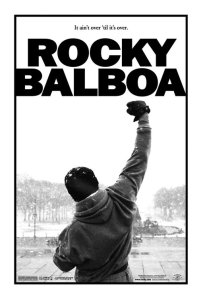 The idea of another Rocky movie, already 16 years since the last installment, sounded as good an idea as a punch to the face. Sylvester Stallone is an actor bottoming out after tons of high profile shit-for-hire jobs, and it looked like the industry was ready to yawn and put him to bed for a long winter?s nap. The idea of a Rocky 6 seemed like a thinly veiled vanity project for Stallone, going back to his bread and butter to try and resurrect some kind of acting pulse. Well, I reasoned, it couldn’t be any worse than Rocky V. I figured we were entering Godfather III territory and that is a scary place. But then I saw Rocky Balboa and realized what Stallone had in mind, and that is a proper sendoff to wipe the acid taste of Rocky V from the collective mouth of the populace. The great big lug can hang up his gloves and rest easy with a job well done.
Rocky (Stallone) has settled into a comfortable retirement. He owns a restaurant named after his deceased wife Adrian, and he regales diners with boxing tales and poses for pictures. His son (Milo Ventimiglia) is trying to make it as a businessman and distance himself from dad. Rocky rediscovers “Little Marie” (Geraldine Hughes), the same girl in 1976 he advised against smoking. She’s got a kid, a lousy job, and a weary perspective. Rocky reconnects with her and gets her to work in his own restaurant. She’s hesitant but he assures her that good ole Rock isn’t expecting anything in return for his kindness.
 Then one day ESPN runs a computer simulation pitting fighters of different eras. Rocky in his prime is paired against the current heavyweight champ Mason “The Line” Dixon (real-life boxer Antonio Tarver). Computer simulation Rocky KO’s computer simulation Dixon and the debate starts. The knock on Dixon is that he has no heart and the current level of boxing competition is beyond barrel scraping. Could an aging fighter from the past last 10 rounds with the current untested champ? Boxing promoters visit Rocky’s restaurant to convince him to an exhibition bout. Rocky mulls over the decision, not wanting “to get mangled and embarrassed.” Ultimately, he feels that he still has something to prove and decides to step back into the ring one more time.
The story is much like past Rocky installments. He spends a lot of time mulling over whether to fight or not, then trains, then we get the fight, though usually it’s some rematch of a Rocky setback. Rocky Balboa doesn’t stray far from the well-worn formula. The character has actually benefited with time and become an underdog once more, one with all sorts of new issues like calcified joints and arthritis. I would have loved a longer training sequence to show how a, presumably, 60-year-old man gets back into shape and how he plans to utilize his strengths (“hurtin’ bombs”). I agree with my friend George Bailey, somewhere along the line Stallone perfected the montage, and Rocky Balboa has an excellent training montage set to the same bom-bom horn theme that will still get your blood pumping.
The film presents some interesting characters but doesn’t spend much time with them. Rocky’s son has to deal with the long shadow his father casts and the idea that, no matter what he accomplishes, he?ll still be seen more as scion than individual. There’s a lot of meat there but Rocky Jr. only gets to huff at dad and then joins the team. Once everyone officially joins the Rocky team they essentially blend into the background of various faces shouting things like, “Come on!” and “Go Rocky!” The biggest supporting player is Hughes who gives a stirring speech for Rocky to confirm that this old man still matters. She has a great sadness to her and the character is played with non-threatening sexuality. Rocky isn’t about to jump anyone’s bones just yet, even years after Adrian’s passing.
 The only reasoning I have for why a so-so plot works as well as it does is because of our warm attachment to Rocky. Arguably the greatest movie figure in the last 30 years, Rocky could do it all, even get a Soviet crowd in Moscow to cheer for the American during the Cold War (don’t neglect to give Rocky his due for the breakup of the Soviet Union). Rocky Balboa, the character, is an old shoe that fits Stallone exceedingly well. Stallone has always been a mumble-heavy droopy dog of an actor, best described like Rocky’s new pet as a “cute ugly.” In short, the man never seemed to fit whatever character he played, and you don’t need to see Stop or My Mom Will Shoot for proof. But Rocky is his masterpiece, and after five sequels and 30 years, America loves its prized prizefighter. When you see the good soul trying to do right you forget all of Stallone’s many cinematic transgressions and you simply fall in love with the character all over again. Old feelings are reawakened and Stallone works his big-hearted, optimistic palooka charm. I watched Rocky Balboa and got swept up. Finally, the great American character can step away with the proper and fitting sendoff he deserves. In some ways, Rocky Balboa feels like a eulogy, as we reflect back on old times and how much these people have meant to us through the years, and the desire to see a lasting legacy intact.
It’s that sense of history that gives this new Rocky movie its heart. It is quite invigorating to see characters in new stations in life when we’ve seen glimpses of these characters for decades. It’s like a high school reunion that can include turtles. Stallone, who also wrote and directed this new movie, really has a strong shopworn affection for his blue-collar characters and a love of Philadelphia. It’s easy to feel the same warm and fuzzy feelings.
Rocky Balboa is a welcomed and surprisingly emotional end for one of American film’s greatest characters. Stallone puts the gloves back on and, like Rocky, still has “stuff in the basement” he needs to get done before he can rest. This is probably the best Rocky movie since the original and time has only made the characters more resonant and endearing. In 1976, Rocky defined the underdog and became well woven into our culture. Who would have guessed that 30 years and countless parodies later Rocky would still pack a punch? Stallone has earned his sendoff. Now about the idea for a Rambo 4.
Nate’s Grade: B
Share this:

Apocalypto (2006)
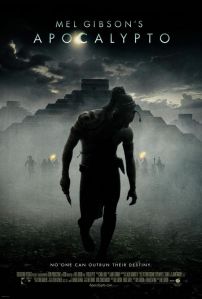 Apocalypto is an action movie set 500 years in the past with a cast of entirely unknown actors, some of who have never acted before. But what does everyone want to talk about? Mel Gibson hates Jews. He’s been in a heap of trouble ever since a DUI where he said some very unkind things about God’s chosen people. He’s made the apology tour and checked into alcohol rehab, the new go-to defense whenever a celebrity screws up. The public finds it hard to separate art from the artist; Frank “It’s a Wonderful Life” Capra was anti-Semitic but few seem to bring that up. Some people have sworn off Gibson thanks to this disgraceful incident. That’s a shame because Apocalypto is brilliantly filmed and Gibson’s finest directing effort yet.
The Mayans seem pretty at ease 500 years ago. We open on a hunting party dividing up a recent kill and playing a prank on one of their members that is having trouble making little Mayans with the wife. Jaguar Paw (Rudy Youngblood) is the son of the tribe?s leader. In the forest they encounter a group of survivors from a different village. They warn of a group of mercenaries that razed their town, killed their people, and took the rest. Jaguar Paw?s father warns not to speak of what they have seen to their people. Fear is contagious, we?re told. That night the same mercenaries attack Jaguar Paw?s village. He scrambles to lower his pregnant wife and young son into a cavern for safety. The surviving men and women are tied up and sent marching. The village?s children are left to fend for themselves and most likely perish without any adults.
 Jaguar Paw and his fellow captives are headed for a Mayan temple. The women are sold into slavery. The men are painted blue and guided to the top of the temple to become sacrifices to an unhappy god. The men are held on a slab, have their hearts cut out, finally then have their heads sliced off and kicked down the stairs. Through a fortunate set of circumstances Jaguar Paw breaks free and races into the forest to return to his family, who is in danger of drowning if the cavern fills with rain water. The mercenaries are not far behind and willing to go to any length to kill Jaguar Paw.
From an anthropological standpoint, Apocalypto is fascinating. Gibson has turned back time and immerses the viewer in a world unseen for 500 years. The details are astounding, and whether they are note-for-note historically accurate or not is inconsequential. You are seeing a living, breathing world right before your eyes. I loved soaking in the new-ness of the experience, seeing how this forgotten world operates, and the power struggles within. These people have great faces, great hulking muscular frames, and great expressions needing to be seen. Gibson has crafted a film that you’ve never seen before, at least with this kind of budget and filmmaking prowess. Apocalypto can quite often be breathtaking to behold. The production design and costumes (yes, there are more than just loin cloths) are incredibly rendered and add greatly to the authenticity and mood. I loved visiting the Mayan temple city (“down town” I guess you could call it) and seeing the different factions intersect, like green painted upper-class harpies being carried around the crowd.
The parallels Gibson puts out there seem tenuous at best. The Mayans have lived beyond their resources, experiencing plague, and feel that the need to pacify the masses, and turnaround their bad luck, is a whole slew of human sacrifices. There’s an Iraq War reference in there if you want to go looking for it and perhaps an ecological one as well. I don’t know if Gibson is using the Mayans as a cautionary example of a society that crumbled. We are treated to an opening quote detailing that no great society can be conquered from outside until it has become corrupt from within. Maybe this is Gibson’s way of telling America to sit up and fly right. Or maybe it’s just an intellectual glob toweled over the blood and guts to make everything seem more meaningful.
The acting is a surprise. Many of these people are really good, especially Youngblood who has a soulful face and a terrific presence onscreen. Gibson creates a great sense of community in the early moments. People feel natural and in touch with their surroundings. Their interaction and the visual shorthand feel like storytelling tricks from classic silent movies. Gibson manages to tell us a lot with little. There are some gut-churning moments, and some of them are because of character. A man from Jaguar Paw’s village hopes his wife did not give up fighting before she perished, because if she did then she will be sent to hell. He pleads that when he dies he might endure the tortures of hell, just so he can be with her again. That hits hard. A cranky mother-in-law also provides a shining emotional moment completely played in solemn silence. A little girl surrounded by crying children tries to assure the adult captives, “They are mine now. I will take care of them.”
 The last hour of the movie is a non-stop foot race as Jaguar Paw valiantly attempts to escape his enemies and return to his swatch of the jungle. There are some fantastic escapes and imagery, like Jaguar Paw outrunning an actual jaguar. The ending is fantastic and a fitting climax for the title. I would have enjoyed just a little shove further, like a new character marveling at some gold trinket Jaguar Paw had gotten from the Mayan temple. “This is gold. Can you tell me where there is more?” he would say. “Tell you?” Jaguar Paw would say in a hearty laugh. “I’ll SHOW you where to get more. Follow me.” The resolution is pretty obvious but left to the imagination. I guess after much derring-do I just prefer more finality with my comeuppance.
This may be about a dead culture and spoken entirely in a dead language, but Gibson’s bloody art house flick is a lively macho action movie at its core. It’s structured exactly like a typical Hollywood action movie, and I don’t know if this adds another level of brilliance to the final product or makes it seem more ordinary taken apart from its historical context. Gibson’s trade is misery. He’s been a martyr onscreen and he prefers to tell stories about the anguished and tortured. Jaguar Paw is beaten, wronged, and has to race against time to save his family. When Jaguar Paw moves onto his own turf he turns his knowledge of the land to turn the tables on his enemies. The movie presents familiar archetypes like the wise father, well-meaning oaf, and impetuous hothead villain, Super Biggest Bad Guy (he does wear the most skull trophies, that has to count for something). The villains are larger than life and have great menace to them. Even better, they’re highly memorable and despicable, and yet they seem to operate within a tribal code of their own honor. They scowl with the best of them.
This familiarity makes viewing Apocalypto less jarring, This is an independent movie high school jocks could enjoy. That may sound dismissive but it’s a compliment. Gibson has great technical skill and after decades of shoot-em-up pictures, he definitely knows how to build and sustain exciting and rewarding action sequences. You know when the bad guys with personality are going to have big deaths, and you know when you see a hunting weapon in Act One that it is going to be put to awesome use in Act Three. The lines of action are well structured and smartly played. When you boil it down, it may just be an action movie, but because of Gibson it’s a good action movie.
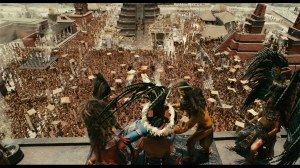 With The Passion of the Christ, I was appalled by the violence, more so how Gibson fell in love with the blood and gore, turning it into pornography. That was the message of The Passion — Jesus sure knew how to take a lickin?. But with Apocalypto, the violence is savage but the appeal of this project is on recreating a world, not sadism. Apocalypto is more interested in opening eyes than shutting them because of nauseating and relentless gore. This isn’t exactly a movie fit for nuns and missionaries, though. Gibson embraces the cruelty of man and showcases some real horrors. The temple sacrifices are fitting and gruesome, but never seem exploitative. There are moments that I wish Gibson would have pulled back, like an extended scene of a jaguar chewing a man’s head or a gusher of blood spritzing out of a man’s temple like a broken sprinkler. I think Gibson loses control of his story and gives in to his own bloodlust in these moments, which serve to take you out of the movie and go, “Ick.”
The violence is also easier to stomach because the audience is more invested in story and character. Everyone that paid a ticket in 2004 knew Jesus was going to die in the end, at least, I really hope they did. That might have been a shocker to a remote few. It was all about witnessing suffering and testing how much you could watch. You felt the pain, all right. Apocalypto, in contrast, is tame and more focused on escape than futility.
After The Passion of the Christ made heaven and earth move at the box office, Gibson can afford to make any movie he wants. If he wants to make a movie about Mayans in Mayan, so be it. At least Gibson knows how to tell a good action story. Apocalypto is beguiling and often breathtaking to behold. The details create a rich environment that feels wholly alive. It’s a typical action movie plucked down in a different historical setting, creating the most unique movie experience of the year. It’s a man’s man independent movie but also manages to hit key emotional notes. I don’t care what he thinks of Jews or anyone else. His art speaks for itself, and Apocalypto is fascinating. It’s an art film for jocks, it’s an action movie for science geeks. Bless you Mel Gibson, you’ve brought us all together in the weirdest way possible.
Nate’s Grade: B+
Share this:

Babel (2006)/ Blood Diamond (2006)
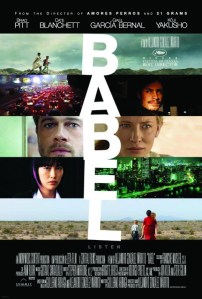 The world is a global community. It is increasingly difficult to shut out unpleasant news just because it happens to an unfortunate few we’ll never know. Hollywood has reminded us through the years that our actions do have sound repercussions, including our indifference. Babel is Mexican-director Alejandro Gonzalez Inarritu’s examination on the fragility of human relationships in the world. Blood Diamond wishes to shine the spotlight on America’s love of diamonds fanning the flames of genocide in Africa. Both movies wish to convince the public that they matter, and not just in box-office, though that would be appreciated. Both of these films have good intentions but the results are sloppy and leaden.
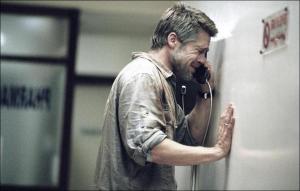
In typical Inarritu fashion, the different storylines of Babel converge, blend, criss-cross, and crash together. The timeline isn’t as disruptive as it was in 21 Grams, so that is a welcome relief. The storylines offer wide-eyed views into different worlds and cultures. A Morocco goat herder purchases a riffle for his sons to protect the herd. The two brothers turn sharp-shooting into a competition, with the one betting the other he cannot hit a bus far in the distance. On that bus is Richard (Brad Pitt) and Susan (Cate Blanchett), a married couple at odds with each other. Suddenly a shot whizzes through the window and into Susan’s neck. Richard panics and struggles with his options being far removed from advanced medical care and being unable to speak with the natives.
 The incident becomes the shot heard round the world. The U.S. government is quick to suggest a terrorist link (who didn’t see that one coming?) but caught up in red tape to rescue the couple. Their nanny, Amelia (Adriana Barraza), cannot find someone to watch the kids so she can attend her son’s wedding in Mexico. Santiago (Gael Garcia Bernal) agrees to drive her and the kids south of the border where the blonde moffetts can learn things like how to kill a chicken. Things take a sour note when reentering the United States at a border crossing manned by suspicious patrolmen.
And half a world away, a deaf-mute Japanese schoolgirl (Rinko Kikuchi) deals in the aftermath of her mother’s suicide by flashing her vagina at boys and throwing herself at older men. Therapy might also be a workable alternative.
The strong ensemble acting is what kept me watching. Babel is filled with many talented actors that each get a turn to look pained, incredulous, and helpless. This is a movie primarily built around sadness and misfortune, and actors jump at those chances. Exhibit A: Brad Pitt. I’ve always thought his serious acting credentials get cast aside because of his good looks (the man even played a Greek god), but he’s into his 40s now and weathering some grown-up gray and wrinkles that, I don’t know how, add a mature sexiness to the man, much like George Clooney. Pitt was serviceable in Babel but failed to impress. He gets to pace a lot and look haggard but he still seems like a distant character. The whole American tourist storyline cannot outrun the sense of pointlessness it seems to be circling. The greatest moments of acting come from the extreme anxiety of Barraza and the dissatisfied yearning of Kikuchi. I expect both women to get nominated for many awards.
The most frustrating aspect of Babel is how little it matters. It’s hard to connect with the characters. And in the end, nothing all that tragic happens to reach anything profound. Most characters leave their shadowy places and only a small number are changed for the worst, mostly the victims of some very bad decision making. But when the movie concludes there is only one dead body and one displaced person. That’s it, and Babel doesn’t even hang on to let us feel that pain. It just skips from story to story never settling in and never evoking any human emotion except for that of morbid curiosity. These people are victims of fate and not much else. Babel is a letdown of a letdown.
 The Japanese schoolgirl storyline has no place in this film. The other three storylines all have a pertinent relationship, but the only thing that ties the schoolgirl into this web of international kerfuffle is that her father once owned the gun in question. Wow. It might have made better drama, and more sense, had this riffle had some significance, like it was the weapon of choice for her suicidal mother. Nope, it’s just another object with no more bearing to this family than a stapler. I think the deaf-mute Japanese schoolgirl is a terrific character and intensely intriguing, especially as she battles the trials of teenage life and feeling like even more of an outcast than usual, but this story needs its own separate movie. It has no business being here and, like much of Babel, adds little understanding or significance. So much of the movie isn’t even told to the audience, like character back-stories and written catharsis, so any distraction feels like a waste of time for a 140-minute movie.
The ending is symptomatic of the film in general; it just kind of peters out and thinks its message has been well-received. What message? What the hell is Babel saying? Stop, look, and listen? The world stage is at such a precarious time and is, for better or worse, unified; someone else’s problem has ripples that will become our problem. Isolationism is dead. But Babel squanders any attempts at a deeper message by playing it safe; never pushing further than the scene descriptions it has confined itself to. The title refers to the Biblical story where God punished man’s arrogance by creating multiple languages. Most of the conflicts revolve around communication issues, but they really only seem like a small portion of the story. When Amelia takes the kids to Mexico, there really aren’t any communication problems. When the car is stopped by the Border Patrol there aren’t any slip-ups in communication, but Santiago freaks out and bolts. The central idea of Babel, lost communication, never really feels properly executed except with the Japanese schoolgirl, who, like I said, doesn’t even belong here.
When Babel does have something political to dwell upon it is usually very lazy. Law enforcement treats illegal immigrants like crap. The U.S. government is more interested in punishing perceived threats than medically helping those in need. American tourists are boorish and see dusty places like Morocco as a place to be alone, despite all the impoverished people shuffling about. Give me a break. There’s nothing within Babel that makes it worth more than one viewing. Once you know the outcome for characters than the film ceases to have a point. This is a true surprise and disappointment from the team that had so much emotional vitality and open humanity with Amores Perros and 21 Grams. I guess a lot must have gotten lot in translation.
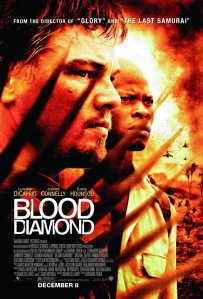 On the flip side, while Babel is a mildly interesting movie desperately needing a message, Blood Diamond is a message in desperate need of an interesting movie. The message rings loud and clear in the film?s opening moments: conflict diamonds are bad. They account for 15 percent of all diamond sales and help finance genocide, civil war, and child brainwashing in Africa. The diamond industry says they cannot decipher which diamonds are which, but come on, they know. They use their market share to control world prices, thus creating a windfall for African rebels. They come up with more diamonds, and the diamond industry purchases them to take them off the market. Got it. But now what?
The short answer is, “‘Just say no’ to conflict diamonds, that is.” The long answer is one very trite movie that wears its liberal idealism on its sleeve with a bit too much fondness. Africa has become the cause celebre of recent films, but have any of them really made a difference? Did The Constant Gardener make us think twice about why drugs are so cheap (because Africans are exploited)? Did Syriana make us think twice why oil was comparatively cheap for Americans (because Africans AND Middle Easterners are exploited)? I doubt it. I may sound a pinch too cynical but I believe that the Unites States of America just generally doesn’t care as long as prices stay nice and low. I applaud filmmakers for attempting to open eyes and change hearts and minds, especially for many thought-provoking and worthy causes. But if you’re going to sponsor a message movie than you need a spoonful of sugar to help the medicine go down.
 Blood Diamond will make you gag, that’s how heavy the message is. It displays a depressing showcase of Africa recycling violence, but it always manages to stay on point. The movie is supposed to be concerned with the well being of Africa, but yet it hangs its attention on a pair of white people. Danny (Leonardo DiCaprio) is a South African diamond smuggler who gets the classic Hollywood redemption arc, courtesy of Solomon (Djimon Hounsou) an enslaved mine-worker that has found a pink diamond the size of a bird egg. Danny and Solomon form a reluctant partnership to get recover the diamond, rescue Solomon’s lost son, and get everyone out of the raging gunfire. But the film is focused on Danny’s arc as he goes from scoundrel to savior, with all those black faces in the background just becoming that — background. The film’s climax involves Danny running through a mining camp looking to rescue Solomon’s lost son. However, Danny shoots and kills all the other kids holding weapons as he dances in between explosions. You cannot root for that as a moral audience member, can you? Danny may save one child but he’ll blow away all the rest, and to the pounding score of Hollywood glory. If this was meant to seem meditative than God help us all.
Jennifer Connelly plays a photo journalist that?s a self-described action junkie. She says she just can’t go through her day sipping lattes and reading Ziggy in the funny papers, not with knowing how cruel the world is to one another. Did she just become aware of this? The world has always had people getting treated poorly and will forever. Her character is an outlet to the Western world, a lens that can capture and broadcast the horrors of Africa which she flippantly predicts will be a minute on CNN “between sports and weather.” She’s your prototypical bleeding heart and the not-so-subtle outlet for the righteous indignation of the filmmakers. There’s nothing to her character except a camera for proof, an unyielding moral compass, and a pair of breasts for Danny to improbably snuggle up to.
 The message of Blood Diamond is what we’re reminded of time and again, including tidbits to clue us in on how it all began (where did Africa learn some brutality? Why white colonists of course). The movie is built as an action vehicle, but it’s an action vehicle going in the wrong direction. The bursts of action are frequent but never anything well imagined or exciting. Usually the film follows two, or more, characters talking and then they’re interrupted by bouts of gunfire. Danny starts uttering “GO!” and “MOVE!” every other breath and they escape. This formula is repeated for the rest of the movie. It hampers getting to know and feel for the characters and sure as hell doesn’t amount to a lot of interesting action. There’s the main problem: we can’t feel for the characters because the movie doesn’t spend enough time with them, and yet we can’t get excited because the movie doesn’t spend enough time to build effective suspense. Blood Diamond finds its way into a balancing act it is hopelessly ill-prepared for.
Director Edward Zwick (Glory, The Last Samurai) is used to fashioning mass-friendly entertainment with cultural issues bubbling to the surface. Perhaps, though, he should have taken a cue from Andrew Niccol’s Lord of War. That film had an easily identifiable message (guns can be bad) but found ways to engage an audience. It had a lot of political ire and troubling statistics to dish, but Niccol knew that an audience must be entertained first and foremost. He found inventive camera angles, stirring monologues, and fascinating true-life anecdotes about arms trading. The main character wasn’t likeable but you just wanted a longer peek into this world behind the curtain. Blood Diamond lacks the biting insights that made Lord of War powerful and enjoyable. Even Lord of War handled the subject of turning children into a blood-thirsty army better. Zwick seems adrift and too close to his message to care about sharpening a good movie.
The movie has a handful of odd moments. In our introduction to Danny he is negotiating a weapons deal. He speaks to the head of a militia in a highly accented speech and subtitles pop up on the screen. Naturally, you would assume the language currently being spoken is not English. Danny is actually just impersonating an African’s English speaking voice. If you listen to what they’re saying they speak English the entire time. And the line, “In America, it’s bling-bling, but over here it’s bling-bang?” No. A thousand times no.
 DiCaprio is muscling his way into a riveting and meaty actor of prominence. His accent is near flawless, just like his Bah-stun accent was in The Departed. He gives more simmer to his role than deserved. Hounsou is a great actor but his most emotive scenes involve a lot of yelling that just seems like yelling. A lot of high-volume yelling doesn’t work when the character is so flimsy. Both of these actors are victims of playing characters with little else to them besides the title of Victim and Victimizer. Connelly and DiCaprio have no chemistry to them, not that the film’s neutered sensuality and agitated story help much. It’s as if Blood Diamond expects that by smashing the two characters together long enough their romance will be plausible. It isn’t. The romance is a distraction at best and eye-rolling at worst.
Babel and Blood Diamond are both pieces of misguided Oscar-bait. Innaritu and his writer for three films, Guillermo Arriaga, have said to have clashed since Babel‘s release and may no longer work again together in the near future. I welcome this trial separation because their film collaborations seem to be dulling. Babel has all the technical skills evident in 21 Grams and Amores Perros, but nothing substantial or contemplative. Conversely, Blood Diamond is a message movie posing as an action flick. It can’t succeed with poorly constructed action sequences and archetypal characters posing as openings for outrage and shameful finger-wagging. The movie is crushed to death by a message. Blood Diamond is a message movie that’s so weighted down it never gets very far. Both films are marginally interesting but nothing transcendent or demanding. Hollywood has its heart in the right place. They just need to make better movies.
Nate’s Grades:
Babel: B-
Blood Diamond: C
Share this:

Casino Royale (2006)
 This is very different James Bond and it’s about time. The Bond film franchise began all the way back in 1962, and it essentially became the blueprint for the modern action movie. Quips, alluring women, exotic locations, car chases, colorful villains, and spoiled plans for greed or world domination. But even if Bond got the ball rolling, the action movie became its own insatiable beast, thanks to the likes of studio bean counters and the ubiquitous uber-producer Jerry Bruckheimer. The 90s Bond revival followed suit. The movies became more about extravagant fireballs, throwaway characters, and preposterous scenarios. After 2002’s Die Another Day, where Pierce Brosnan’s Bond drives an invisible car through a melting ice palace caused by a solar laser from space run by a yuppie playboy who really had the DNA of a North Korean dictator… well, you don’t need to be an expert to figure out that something was rotten in that state of Bond.
The Bond films have great history to them, but let’s not get overly romantic here; a majority of the James Bond movies are outright crap, especially the ones with Roger Moore. There were jaunts into space, men with metal teeth, Timothy Dalton, a title called Octopussy, and Christopher Walken trying to have California fall into the ocean. Let’s face it, half the movies are rubbish. Someone, anyone try and tell me the redeeming qualities of Moonraker. The last good-to-great Bond movie was Brosnan’s debut, 1995’s Goldeneye. The Bond franchise has been in desperate need for a makeover. This is it.
 The producers went back to Bond basics. The long-time producers had the rights to every Ian Fleming novel, except for Casino Royale, which was turned into a cheesy comedy lampooning Bond instead of competing with the franchise. Several decades later, we’re given a serious adaptation of Royale, Fleming’s introductory book about the secret agent that rewrote movie rules. The new Bond has a splash of Jason Bourne in him and seems more tightly wound and hard-boiled. He doesn’t have time for trivial decisions like shaken or stirred. “Does it look like I give a damn?” he barks at the bartender.
Bond (Daniel Craig) is more thug with a badge than a suave secret agent. He’s just risen to double-O status and his boss, M (the incomparable Judi Dench), doesn’t feel that he’s ready or can be trusted. But then, he is the best poker player MI5 has. Le Chiffre (Mads Mikkelsen) is entering into a high stakes poker game worth millions of dollars. He’s playing with the money of African warlords and terrorists and has promised them a great return on their investment. Bond is assigned to gather information and stop Le Chiffre from financing terrorism. Vesper Lynd (Eva Green) is a representative of the bank that will be sponsoring Bond in the card game. It’s up to her to keep tabs on Bond and make sure her bank?s money is wisely invested.
Now this is what action movies should be like. Casino Royale is a terrific ride with great action sequences, great intrigue, strong acting, and some wonderfully exotic locations. The movie, like Bond to Vesper, sure feels the need to prove money was well spent. The story is smart and filled with sharp dialogue, perhaps thanks to co-writer Paul Haggis (Million Dollar Baby, Crash). This is Bond dialed back, stripped of fancy gimmicks and gadgets and left to battle with his wits and his brutality. This is a meat-and-potatoes action movie without irony or frills. It’s serious about its business and business, let me tell you, is good. Casino Royale is monstrously entertaining.
 There was a lot of grumbling when Craig was selected as the next actor to fill the 007 shoes. Some scoffed at the idea of a blonde Bond, as if hair color had shot to the top of the list of important qualifiers. I wrote this about Craig after seeing 2005’s Layer Cake: “This man is a modern day Steve McQueen with those piercing blue eyes, cheekbones that could cut glass, and the casual swagger of coolness. We may never see Craig sweat but he still expresses a remarkable slow burn of fear so effectively through those baby blues.” This man is the perfect candidate for a Bond reboot. He has a boxer’s face, those wonderful eyes, and a sculpted body that will take many a breath away. But even better, Craig is likely the best actor that has even been tapped for 007. Connery will always be the sentimental favorite, and rightfully so, but Craig imbues his Bond with startling amounts of emotion and vulnerability. In the dramatic black and white opening, his first kill isn’t clean and quick, it’s long, drawn out, messy, and leaves Bond shaken, not stirred. His relationship with Vesper gives him even more opportunities to feel and be tortured, sometimes literally (Note: a naked torture sequence is far too intense for children, especially those with their genitals on the outside). Craig gives a rich performance. When he’s chasing bad guys you see the determination of his running, the anguish on his face. When he’s flirting with women you can practically feel the smolder. This is a far more pragmatic Bond and Craig is the right actor for the job.
Green leaves her mark as one of the best Bond girls in the franchise. Usually the Bond women are either respites for fine-tuned lovemaking, or damsels wronged by the eminent domain of evil. She has a nice moment where she sits in the shower in shock after being witness to the reality of murder. She showed a lot of promise and gives a commanding performance on her biggest stage.
Director Martin Campbell has some history with the Bond franchise, restarting it with Goldeneye. He’s a pro at orchestrating action sequences, and there are some doozies in Casino Royale. The beginning sequence is a thrilling foot chase inside a construction zone. Bond’s target, a bomb maker, bounces off walls, swings along ledges, and motors around beams and ladders like he was a trained monkey. It’s an exciting French style of acrobatics called Parkour, and it was used to dizzying effect in this year?s District B13. The chase just goes from one level to another, and the stunts are brutal and of the death-defying variety. It’s a showstopper opening. An airport sequence is also quite memorable, as Bond races to stop a bomb from reaching an airplane. Campbell has taken a hint from the Jason Bourne spy movies and made Bond more reactionary to his surroundings. Many fight sequences feel tense and un-choreographed, even though we know that isn’t the case. When this Bond gets into scuffles you don’t know whether he’ll make it out unscathed. Campbell keeps the pace steady and the visuals crisp. Best of all, Campbell allows the audience to fully see what’s taking place. There’s no MTV-style edits. The film feels totally in control like the best action movies do. You’ll feel battered, bruised, but exhilarated all the same.
 However, Casino Royale is not a perfect action movie. It feels way too front-loaded; all the big action sequences seem to occur within the first hour. The film then settles in for a climactic game of… cards? I’m not one who fell into the spell over Poker on TV the last few years. It just doesn’t seem that thrilling to me to watch one guy turn over his cards and then wait for another to turn over their cards. There are only so many combinations to be had, and hoping for Bond to have a flush to beat out four of a kind is just not high drama. It’s luck. The poker scenes seem to last longer than they should, as does the film as a whole. This is on record the longest Bond movie ever, clocking in at 144 minutes. It’s a whole hell of a lot of fun, but the tacked on ending in Venice seems like an entirely different movie slapped together for closure. The villain is somewhat weak. He’s given a nifty visual item, weeping tears of blood, but it is meaningless. The plot also gets too convoluted for its own good, with double-crosses, triple-crosses, and finally a reveal as to who the Big Bad in Charge was and I could not for the life of me remember who he was. Seriously, there are so many characters and faces shoved in that the producers could throw us a bone. All I’m asking for is some clarity while I chow down on my popcorn.
Casino Royale is the Bond movie Ian Fleming would have paid to see. Craig and Campbell have given new life to a teetering franchise. This Bond is much scrappier and more cunning. The action sequences are slick and the movie is fun and engrossing, plain and simple. In the closing seconds, when the familiar notes of the James Bond musical theme come alive you will feel like the journey has been earned.
Nate’s Grade: A-


You must be logged in to post a comment.