Blog Archives
Pan’s Labyrinth (2006)
 Fantasy has a naturally cheerful tone. Someone did not tell that to Mexican writer/director Guillermo del Toro. The Hellboy director is obsessed with all things creepy, crawly, and gooey, and his films all seem to revel in the things that go squish in the night. Pan’s Labyrinth is a children’s tale not intended for children. It’s more in line with the fairy tales of old that were violent, sickening, and something to strike fear in disobedient kids.
Ofelia (Ivana Baquero) travels with her pregnant mother to live in a cottage along the Spanish countryside. Her mother has remarried The Captain (Sergi Lopez), a brutal officer in the ruling fascist government. He’s a stern and unforgiving man and plotting to eliminate the remaining scattered resistance soldiers. Ofelia discovers a series of stone stairs that lead to an underground labyrinth. Inside is a faun (the titular Pan) who recognizes the spirit of his world’s missing princess inside Ofelia. He gives her tasks to complete that will prove whether or not she can return to the other world.
This is a fabulously dark Alice in Wonderland for a more mature set. Pan’s Labyrinth is very similar to del Toro’s 2002 The Devil’s Backbone, a smart and affecting ghost story set against Spain’s bloody civil war. del Toro has set his supernatural fantasies against some very real and very dangerous backdrops. The Devil’s Backbone was more than just a ghost story, and now Pan’s Labyrinth is more than just a fairy tale. The real world is a violent and cruel place and worthy of a magical escape. However, the fairy tale creatures are not from the Disney school of kinder, gentler folklore. The faun is evasive and prone to outbursts when he/it does not get his hooved way. The other creatures, like a giant slimy toad, are all after their own gain and don’t much care for a little girl’s interference. There is no escape to safety.
 There are plenty of staples commonly found in fairy tales. Ofelia has to complete three tasks before the cycle of the moon. She has to complete trials of courage and prove her purity of heart. The characters look familiar but they definitely don?t behave the same. Pan’s Labyrinth has a continuing sense of dread. People die vicious deaths and the threat of violence is ever present.
The real world segments are just as engaging as the grander flights of fantasy. del Toro spins a very worthy tale of secrecy and suspicion at the dawn of Franco’s Spain. Several members of The Captain’s quarters are aiding the remaining resistance officers and risking their lives to hide their allegiance. It also draws the viewer in because these characters are the kind ones that look after Ofelia, who accidentally stumbles upon their secrets. The Captain is an earthly monster equal to the horrors of the fairy tale world. He has a deadly fixation with wasted time and punctuality (another Alice in Wonderland homage – the ticking pocket watch). Whether he’s torturing or shaving, the man seems peeved in all that he does. He tells the doctor that if a choice must be made, save the baby over the mother. His legacy demands an heir.
del Toro straddles differing genre lines like few artists out there. He has a great love for monster movies and horror but he also has great feel for human drama and a child’s wide-eyed point of view. Ofelia rests her head on her mother’s pregnant belly and speaks to her unborn brother. When her mother is experiencing complications she implores her brother to be gentle. It’s a little action but comes across as so honest and heartfelt from a child. The film is touching and exciting and pretty scary when it wants to be. Pan’s Labyrinth is a genre-bending gem that?s exceptionally well executed. The production design and make-up effects are terrific and lend to the otherworldly feel. The special effects are mostly a mix of practical designs and creepy make-up work, especially with the “Pale Man.” I especially enjoyed how the fawn moved and sounded, all clicks and creaks like he hadn’t moved his bones in ages. del Toro and his movie magicians do an excellent job of transporting you to two distinct worlds.
I could have used more labyrinth in my Pan’s Labyrinth. As it stands, the movie is divided as 15% fantasy world and 85% real world. That?s not enough for me. Maybe I just loved the fantasy elements too much or was expecting more of a live-action Spirited Away. Then again, del Toro has his mind set on an ambiguous ending that will divide the skeptics from the believers. Are there opposing worlds? Is Ofelia just making it up to escape reality? Whether what’s happening is real or not is irrelevant; Ofelia believes it is real. I feel that the movie could have been even greater had it utilized its fantasy side more.
 Take for instance the “Pale Man,” a grotesque monster that has to place its eyeballs in the palms of its hands to see. When Ofelia enters his realm its covered in ancient art showing this faceless creature devouring children. A giant pile of shoes sits in a corner as a constant reminder of the creature’s appetites. However, the creature sits at the head of a table motionless, unless some irresponsible child takes a bite from the illustrious feast of food at the table. Then the “Pale Man” springs to life. The imagery is horrifying but beautifully sickening, and it’s just too regrettable that Pan’s Labyrinth only gives such a memorable monster one single scene. I kept hoping that the movie would revisit the world it had begun establishing, all for not. I thought at least del Toro would have a fascist officer chasing after Ofelia and she would trace a portal back into the “Pale Man’s” world. Then she would escape but the officer would be trapped. He’s take a bite from the feast and then our occularly-challenged friend would go, “Well, you’re a little older than I like, but hey, beggars can’t be choosers.” CRUNCH! You must judge a movie for what it is, not what it could be, but I am certain Pan’s Labyrinth would have been even more remarkable had it just done more with its wild imagination. Oh well.
2006 has been something of a revelatory year for Mexican directors working within the Hollywood system. Alejandro Gonzalez Inarritu released Babel (bleh); Alfonso Curaon released Children of Men (wonderful), and now del Toro’s dark fantasy Pan’s Labyrinth is just starting to get a wider release. The film straddles the lines of genre, touching upon horror, human drama, fairy tale, historical action, and still finds time to be invigorating and moving. The production design and make-up effects do wonders to bring del Toro’s mordant imagination to chilling life. del Toro reigns supreme in the realm of sticky and icky things. Had the film actually spent more time interacting with its twisted fantasy creatures, I would gladly call Pan’s Labyrinth the best film of 2006. But alas we can’t all have our wishes comes true no matter how many fauns we encounter.
Nate’s Grade: A
Share this:

Rocky Balboa (2006)
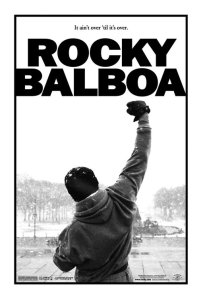 The idea of another Rocky movie, already 16 years since the last installment, sounded as good an idea as a punch to the face. Sylvester Stallone is an actor bottoming out after tons of high profile shit-for-hire jobs, and it looked like the industry was ready to yawn and put him to bed for a long winter?s nap. The idea of a Rocky 6 seemed like a thinly veiled vanity project for Stallone, going back to his bread and butter to try and resurrect some kind of acting pulse. Well, I reasoned, it couldn’t be any worse than Rocky V. I figured we were entering Godfather III territory and that is a scary place. But then I saw Rocky Balboa and realized what Stallone had in mind, and that is a proper sendoff to wipe the acid taste of Rocky V from the collective mouth of the populace. The great big lug can hang up his gloves and rest easy with a job well done.
Rocky (Stallone) has settled into a comfortable retirement. He owns a restaurant named after his deceased wife Adrian, and he regales diners with boxing tales and poses for pictures. His son (Milo Ventimiglia) is trying to make it as a businessman and distance himself from dad. Rocky rediscovers “Little Marie” (Geraldine Hughes), the same girl in 1976 he advised against smoking. She’s got a kid, a lousy job, and a weary perspective. Rocky reconnects with her and gets her to work in his own restaurant. She’s hesitant but he assures her that good ole Rock isn’t expecting anything in return for his kindness.
 Then one day ESPN runs a computer simulation pitting fighters of different eras. Rocky in his prime is paired against the current heavyweight champ Mason “The Line” Dixon (real-life boxer Antonio Tarver). Computer simulation Rocky KO’s computer simulation Dixon and the debate starts. The knock on Dixon is that he has no heart and the current level of boxing competition is beyond barrel scraping. Could an aging fighter from the past last 10 rounds with the current untested champ? Boxing promoters visit Rocky’s restaurant to convince him to an exhibition bout. Rocky mulls over the decision, not wanting “to get mangled and embarrassed.” Ultimately, he feels that he still has something to prove and decides to step back into the ring one more time.
The story is much like past Rocky installments. He spends a lot of time mulling over whether to fight or not, then trains, then we get the fight, though usually it’s some rematch of a Rocky setback. Rocky Balboa doesn’t stray far from the well-worn formula. The character has actually benefited with time and become an underdog once more, one with all sorts of new issues like calcified joints and arthritis. I would have loved a longer training sequence to show how a, presumably, 60-year-old man gets back into shape and how he plans to utilize his strengths (“hurtin’ bombs”). I agree with my friend George Bailey, somewhere along the line Stallone perfected the montage, and Rocky Balboa has an excellent training montage set to the same bom-bom horn theme that will still get your blood pumping.
The film presents some interesting characters but doesn’t spend much time with them. Rocky’s son has to deal with the long shadow his father casts and the idea that, no matter what he accomplishes, he?ll still be seen more as scion than individual. There’s a lot of meat there but Rocky Jr. only gets to huff at dad and then joins the team. Once everyone officially joins the Rocky team they essentially blend into the background of various faces shouting things like, “Come on!” and “Go Rocky!” The biggest supporting player is Hughes who gives a stirring speech for Rocky to confirm that this old man still matters. She has a great sadness to her and the character is played with non-threatening sexuality. Rocky isn’t about to jump anyone’s bones just yet, even years after Adrian’s passing.
 The only reasoning I have for why a so-so plot works as well as it does is because of our warm attachment to Rocky. Arguably the greatest movie figure in the last 30 years, Rocky could do it all, even get a Soviet crowd in Moscow to cheer for the American during the Cold War (don’t neglect to give Rocky his due for the breakup of the Soviet Union). Rocky Balboa, the character, is an old shoe that fits Stallone exceedingly well. Stallone has always been a mumble-heavy droopy dog of an actor, best described like Rocky’s new pet as a “cute ugly.” In short, the man never seemed to fit whatever character he played, and you don’t need to see Stop or My Mom Will Shoot for proof. But Rocky is his masterpiece, and after five sequels and 30 years, America loves its prized prizefighter. When you see the good soul trying to do right you forget all of Stallone’s many cinematic transgressions and you simply fall in love with the character all over again. Old feelings are reawakened and Stallone works his big-hearted, optimistic palooka charm. I watched Rocky Balboa and got swept up. Finally, the great American character can step away with the proper and fitting sendoff he deserves. In some ways, Rocky Balboa feels like a eulogy, as we reflect back on old times and how much these people have meant to us through the years, and the desire to see a lasting legacy intact.
It’s that sense of history that gives this new Rocky movie its heart. It is quite invigorating to see characters in new stations in life when we’ve seen glimpses of these characters for decades. It’s like a high school reunion that can include turtles. Stallone, who also wrote and directed this new movie, really has a strong shopworn affection for his blue-collar characters and a love of Philadelphia. It’s easy to feel the same warm and fuzzy feelings.
Rocky Balboa is a welcomed and surprisingly emotional end for one of American film’s greatest characters. Stallone puts the gloves back on and, like Rocky, still has “stuff in the basement” he needs to get done before he can rest. This is probably the best Rocky movie since the original and time has only made the characters more resonant and endearing. In 1976, Rocky defined the underdog and became well woven into our culture. Who would have guessed that 30 years and countless parodies later Rocky would still pack a punch? Stallone has earned his sendoff. Now about the idea for a Rambo 4.
Nate’s Grade: B
Share this:

Apocalypto (2006)
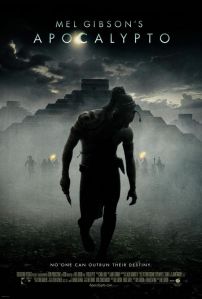 Apocalypto is an action movie set 500 years in the past with a cast of entirely unknown actors, some of who have never acted before. But what does everyone want to talk about? Mel Gibson hates Jews. He’s been in a heap of trouble ever since a DUI where he said some very unkind things about God’s chosen people. He’s made the apology tour and checked into alcohol rehab, the new go-to defense whenever a celebrity screws up. The public finds it hard to separate art from the artist; Frank “It’s a Wonderful Life” Capra was anti-Semitic but few seem to bring that up. Some people have sworn off Gibson thanks to this disgraceful incident. That’s a shame because Apocalypto is brilliantly filmed and Gibson’s finest directing effort yet.
The Mayans seem pretty at ease 500 years ago. We open on a hunting party dividing up a recent kill and playing a prank on one of their members that is having trouble making little Mayans with the wife. Jaguar Paw (Rudy Youngblood) is the son of the tribe?s leader. In the forest they encounter a group of survivors from a different village. They warn of a group of mercenaries that razed their town, killed their people, and took the rest. Jaguar Paw?s father warns not to speak of what they have seen to their people. Fear is contagious, we?re told. That night the same mercenaries attack Jaguar Paw?s village. He scrambles to lower his pregnant wife and young son into a cavern for safety. The surviving men and women are tied up and sent marching. The village?s children are left to fend for themselves and most likely perish without any adults.
 Jaguar Paw and his fellow captives are headed for a Mayan temple. The women are sold into slavery. The men are painted blue and guided to the top of the temple to become sacrifices to an unhappy god. The men are held on a slab, have their hearts cut out, finally then have their heads sliced off and kicked down the stairs. Through a fortunate set of circumstances Jaguar Paw breaks free and races into the forest to return to his family, who is in danger of drowning if the cavern fills with rain water. The mercenaries are not far behind and willing to go to any length to kill Jaguar Paw.
From an anthropological standpoint, Apocalypto is fascinating. Gibson has turned back time and immerses the viewer in a world unseen for 500 years. The details are astounding, and whether they are note-for-note historically accurate or not is inconsequential. You are seeing a living, breathing world right before your eyes. I loved soaking in the new-ness of the experience, seeing how this forgotten world operates, and the power struggles within. These people have great faces, great hulking muscular frames, and great expressions needing to be seen. Gibson has crafted a film that you’ve never seen before, at least with this kind of budget and filmmaking prowess. Apocalypto can quite often be breathtaking to behold. The production design and costumes (yes, there are more than just loin cloths) are incredibly rendered and add greatly to the authenticity and mood. I loved visiting the Mayan temple city (“down town” I guess you could call it) and seeing the different factions intersect, like green painted upper-class harpies being carried around the crowd.
The parallels Gibson puts out there seem tenuous at best. The Mayans have lived beyond their resources, experiencing plague, and feel that the need to pacify the masses, and turnaround their bad luck, is a whole slew of human sacrifices. There’s an Iraq War reference in there if you want to go looking for it and perhaps an ecological one as well. I don’t know if Gibson is using the Mayans as a cautionary example of a society that crumbled. We are treated to an opening quote detailing that no great society can be conquered from outside until it has become corrupt from within. Maybe this is Gibson’s way of telling America to sit up and fly right. Or maybe it’s just an intellectual glob toweled over the blood and guts to make everything seem more meaningful.
The acting is a surprise. Many of these people are really good, especially Youngblood who has a soulful face and a terrific presence onscreen. Gibson creates a great sense of community in the early moments. People feel natural and in touch with their surroundings. Their interaction and the visual shorthand feel like storytelling tricks from classic silent movies. Gibson manages to tell us a lot with little. There are some gut-churning moments, and some of them are because of character. A man from Jaguar Paw’s village hopes his wife did not give up fighting before she perished, because if she did then she will be sent to hell. He pleads that when he dies he might endure the tortures of hell, just so he can be with her again. That hits hard. A cranky mother-in-law also provides a shining emotional moment completely played in solemn silence. A little girl surrounded by crying children tries to assure the adult captives, “They are mine now. I will take care of them.”
 The last hour of the movie is a non-stop foot race as Jaguar Paw valiantly attempts to escape his enemies and return to his swatch of the jungle. There are some fantastic escapes and imagery, like Jaguar Paw outrunning an actual jaguar. The ending is fantastic and a fitting climax for the title. I would have enjoyed just a little shove further, like a new character marveling at some gold trinket Jaguar Paw had gotten from the Mayan temple. “This is gold. Can you tell me where there is more?” he would say. “Tell you?” Jaguar Paw would say in a hearty laugh. “I’ll SHOW you where to get more. Follow me.” The resolution is pretty obvious but left to the imagination. I guess after much derring-do I just prefer more finality with my comeuppance.
This may be about a dead culture and spoken entirely in a dead language, but Gibson’s bloody art house flick is a lively macho action movie at its core. It’s structured exactly like a typical Hollywood action movie, and I don’t know if this adds another level of brilliance to the final product or makes it seem more ordinary taken apart from its historical context. Gibson’s trade is misery. He’s been a martyr onscreen and he prefers to tell stories about the anguished and tortured. Jaguar Paw is beaten, wronged, and has to race against time to save his family. When Jaguar Paw moves onto his own turf he turns his knowledge of the land to turn the tables on his enemies. The movie presents familiar archetypes like the wise father, well-meaning oaf, and impetuous hothead villain, Super Biggest Bad Guy (he does wear the most skull trophies, that has to count for something). The villains are larger than life and have great menace to them. Even better, they’re highly memorable and despicable, and yet they seem to operate within a tribal code of their own honor. They scowl with the best of them.
This familiarity makes viewing Apocalypto less jarring, This is an independent movie high school jocks could enjoy. That may sound dismissive but it’s a compliment. Gibson has great technical skill and after decades of shoot-em-up pictures, he definitely knows how to build and sustain exciting and rewarding action sequences. You know when the bad guys with personality are going to have big deaths, and you know when you see a hunting weapon in Act One that it is going to be put to awesome use in Act Three. The lines of action are well structured and smartly played. When you boil it down, it may just be an action movie, but because of Gibson it’s a good action movie.
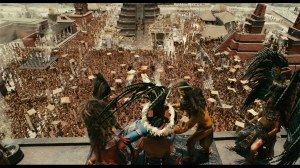 With The Passion of the Christ, I was appalled by the violence, more so how Gibson fell in love with the blood and gore, turning it into pornography. That was the message of The Passion — Jesus sure knew how to take a lickin?. But with Apocalypto, the violence is savage but the appeal of this project is on recreating a world, not sadism. Apocalypto is more interested in opening eyes than shutting them because of nauseating and relentless gore. This isn’t exactly a movie fit for nuns and missionaries, though. Gibson embraces the cruelty of man and showcases some real horrors. The temple sacrifices are fitting and gruesome, but never seem exploitative. There are moments that I wish Gibson would have pulled back, like an extended scene of a jaguar chewing a man’s head or a gusher of blood spritzing out of a man’s temple like a broken sprinkler. I think Gibson loses control of his story and gives in to his own bloodlust in these moments, which serve to take you out of the movie and go, “Ick.”
The violence is also easier to stomach because the audience is more invested in story and character. Everyone that paid a ticket in 2004 knew Jesus was going to die in the end, at least, I really hope they did. That might have been a shocker to a remote few. It was all about witnessing suffering and testing how much you could watch. You felt the pain, all right. Apocalypto, in contrast, is tame and more focused on escape than futility.
After The Passion of the Christ made heaven and earth move at the box office, Gibson can afford to make any movie he wants. If he wants to make a movie about Mayans in Mayan, so be it. At least Gibson knows how to tell a good action story. Apocalypto is beguiling and often breathtaking to behold. The details create a rich environment that feels wholly alive. It’s a typical action movie plucked down in a different historical setting, creating the most unique movie experience of the year. It’s a man’s man independent movie but also manages to hit key emotional notes. I don’t care what he thinks of Jews or anyone else. His art speaks for itself, and Apocalypto is fascinating. It’s an art film for jocks, it’s an action movie for science geeks. Bless you Mel Gibson, you’ve brought us all together in the weirdest way possible.
Nate’s Grade: B+
Share this:

Babel (2006)/ Blood Diamond (2006)
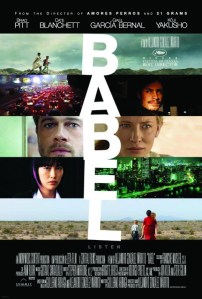 The world is a global community. It is increasingly difficult to shut out unpleasant news just because it happens to an unfortunate few we’ll never know. Hollywood has reminded us through the years that our actions do have sound repercussions, including our indifference. Babel is Mexican-director Alejandro Gonzalez Inarritu’s examination on the fragility of human relationships in the world. Blood Diamond wishes to shine the spotlight on America’s love of diamonds fanning the flames of genocide in Africa. Both movies wish to convince the public that they matter, and not just in box-office, though that would be appreciated. Both of these films have good intentions but the results are sloppy and leaden.
In typical Inarritu fashion, the different storylines of Babel converge, blend, criss-cross, and crash together. The timeline isn’t as disruptive as it was in 21 Grams, so that is a welcome relief. The storylines offer wide-eyed views into different worlds and cultures. A Morocco goat herder purchases a riffle for his sons to protect the herd. The two brothers turn sharp-shooting into a competition, with the one betting the other he cannot hit a bus far in the distance. On that bus is Richard (Brad Pitt) and Susan (Cate Blanchett), a married couple at odds with each other. Suddenly a shot whizzes through the window and into Susan’s neck. Richard panics and struggles with his options being far removed from advanced medical care and being unable to speak with the natives.
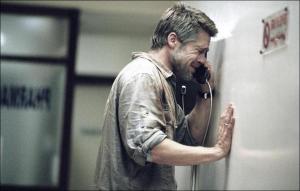 The incident becomes the shot heard round the world. The U.S. government is quick to suggest a terrorist link (who didn’t see that one coming?) but caught up in red tape to rescue the couple. Their nanny, Amelia (Adriana Barraza), cannot find someone to watch the kids so she can attend her son’s wedding in Mexico. Santiago (Gael Garcia Bernal) agrees to drive her and the kids south of the border where the blonde moffetts can learn things like how to kill a chicken. Things take a sour note when reentering the United States at a border crossing manned by suspicious patrolmen.
And half a world away, a deaf-mute Japanese schoolgirl (Rinko Kikuchi) deals in the aftermath of her mother’s suicide by flashing her vagina at boys and throwing herself at older men. Therapy might also be a workable alternative.
The strong ensemble acting is what kept me watching. Babel is filled with many talented actors that each get a turn to look pained, incredulous, and helpless. This is a movie primarily built around sadness and misfortune, and actors jump at those chances. Exhibit A: Brad Pitt. I’ve always thought his serious acting credentials get cast aside because of his good looks (the man even played a Greek god), but he’s into his 40s now and weathering some grown-up gray and wrinkles that, I don’t know how, add a mature sexiness to the man, much like George Clooney. Pitt was serviceable in Babel but failed to impress. He gets to pace a lot and look haggard but he still seems like a distant character. The whole American tourist storyline cannot outrun the sense of pointlessness it seems to be circling. The greatest moments of acting come from the extreme anxiety of Barraza and the dissatisfied yearning of Kikuchi. I expect both women to get nominated for many awards.
The most frustrating aspect of Babel is how little it matters. It’s hard to connect with the characters. And in the end, nothing all that tragic happens to reach anything profound. Most characters leave their shadowy places and only a small number are changed for the worst, mostly the victims of some very bad decision making. But when the movie concludes there is only one dead body and one displaced person. That’s it, and Babel doesn’t even hang on to let us feel that pain. It just skips from story to story never settling in and never evoking any human emotion except for that of morbid curiosity. These people are victims of fate and not much else. Babel is a letdown of a letdown.
 The Japanese schoolgirl storyline has no place in this film. The other three storylines all have a pertinent relationship, but the only thing that ties the schoolgirl into this web of international kerfuffle is that her father once owned the gun in question. Wow. It might have made better drama, and more sense, had this riffle had some significance, like it was the weapon of choice for her suicidal mother. Nope, it’s just another object with no more bearing to this family than a stapler. I think the deaf-mute Japanese schoolgirl is a terrific character and intensely intriguing, especially as she battles the trials of teenage life and feeling like even more of an outcast than usual, but this story needs its own separate movie. It has no business being here and, like much of Babel, adds little understanding or significance. So much of the movie isn’t even told to the audience, like character back-stories and written catharsis, so any distraction feels like a waste of time for a 140-minute movie.
The ending is symptomatic of the film in general; it just kind of peters out and thinks its message has been well-received. What message? What the hell is Babel saying? Stop, look, and listen? The world stage is at such a precarious time and is, for better or worse, unified; someone else’s problem has ripples that will become our problem. Isolationism is dead. But Babel squanders any attempts at a deeper message by playing it safe; never pushing further than the scene descriptions it has confined itself to. The title refers to the Biblical story where God punished man’s arrogance by creating multiple languages. Most of the conflicts revolve around communication issues, but they really only seem like a small portion of the story. When Amelia takes the kids to Mexico, there really aren’t any communication problems. When the car is stopped by the Border Patrol there aren’t any slip-ups in communication, but Santiago freaks out and bolts. The central idea of Babel, lost communication, never really feels properly executed except with the Japanese schoolgirl, who, like I said, doesn’t even belong here.
When Babel does have something political to dwell upon it is usually very lazy. Law enforcement treats illegal immigrants like crap. The U.S. government is more interested in punishing perceived threats than medically helping those in need. American tourists are boorish and see dusty places like Morocco as a place to be alone, despite all the impoverished people shuffling about. Give me a break. There’s nothing within Babel that makes it worth more than one viewing. Once you know the outcome for characters than the film ceases to have a point. This is a true surprise and disappointment from the team that had so much emotional vitality and open humanity with Amores Perros and 21 Grams. I guess a lot must have gotten lot in translation.
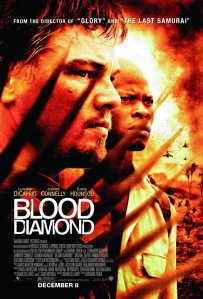 On the flip side, while Babel is a mildly interesting movie desperately needing a message, Blood Diamond is a message in desperate need of an interesting movie. The message rings loud and clear in the film?s opening moments: conflict diamonds are bad. They account for 15 percent of all diamond sales and help finance genocide, civil war, and child brainwashing in Africa. The diamond industry says they cannot decipher which diamonds are which, but come on, they know. They use their market share to control world prices, thus creating a windfall for African rebels. They come up with more diamonds, and the diamond industry purchases them to take them off the market. Got it. But now what?
The short answer is, “‘Just say no’ to conflict diamonds, that is.” The long answer is one very trite movie that wears its liberal idealism on its sleeve with a bit too much fondness. Africa has become the cause celebre of recent films, but have any of them really made a difference? Did The Constant Gardener make us think twice about why drugs are so cheap (because Africans are exploited)? Did Syriana make us think twice why oil was comparatively cheap for Americans (because Africans AND Middle Easterners are exploited)? I doubt it. I may sound a pinch too cynical but I believe that the Unites States of America just generally doesn’t care as long as prices stay nice and low. I applaud filmmakers for attempting to open eyes and change hearts and minds, especially for many thought-provoking and worthy causes. But if you’re going to sponsor a message movie than you need a spoonful of sugar to help the medicine go down.
 Blood Diamond will make you gag, that’s how heavy the message is. It displays a depressing showcase of Africa recycling violence, but it always manages to stay on point. The movie is supposed to be concerned with the well being of Africa, but yet it hangs its attention on a pair of white people. Danny (Leonardo DiCaprio) is a South African diamond smuggler who gets the classic Hollywood redemption arc, courtesy of Solomon (Djimon Hounsou) an enslaved mine-worker that has found a pink diamond the size of a bird egg. Danny and Solomon form a reluctant partnership to get recover the diamond, rescue Solomon’s lost son, and get everyone out of the raging gunfire. But the film is focused on Danny’s arc as he goes from scoundrel to savior, with all those black faces in the background just becoming that — background. The film’s climax involves Danny running through a mining camp looking to rescue Solomon’s lost son. However, Danny shoots and kills all the other kids holding weapons as he dances in between explosions. You cannot root for that as a moral audience member, can you? Danny may save one child but he’ll blow away all the rest, and to the pounding score of Hollywood glory. If this was meant to seem meditative than God help us all.
Jennifer Connelly plays a photo journalist that?s a self-described action junkie. She says she just can’t go through her day sipping lattes and reading Ziggy in the funny papers, not with knowing how cruel the world is to one another. Did she just become aware of this? The world has always had people getting treated poorly and will forever. Her character is an outlet to the Western world, a lens that can capture and broadcast the horrors of Africa which she flippantly predicts will be a minute on CNN “between sports and weather.” She’s your prototypical bleeding heart and the not-so-subtle outlet for the righteous indignation of the filmmakers. There’s nothing to her character except a camera for proof, an unyielding moral compass, and a pair of breasts for Danny to improbably snuggle up to.
 The message of Blood Diamond is what we’re reminded of time and again, including tidbits to clue us in on how it all began (where did Africa learn some brutality? Why white colonists of course). The movie is built as an action vehicle, but it’s an action vehicle going in the wrong direction. The bursts of action are frequent but never anything well imagined or exciting. Usually the film follows two, or more, characters talking and then they’re interrupted by bouts of gunfire. Danny starts uttering “GO!” and “MOVE!” every other breath and they escape. This formula is repeated for the rest of the movie. It hampers getting to know and feel for the characters and sure as hell doesn’t amount to a lot of interesting action. There’s the main problem: we can’t feel for the characters because the movie doesn’t spend enough time with them, and yet we can’t get excited because the movie doesn’t spend enough time to build effective suspense. Blood Diamond finds its way into a balancing act it is hopelessly ill-prepared for.
Director Edward Zwick (Glory, The Last Samurai) is used to fashioning mass-friendly entertainment with cultural issues bubbling to the surface. Perhaps, though, he should have taken a cue from Andrew Niccol’s Lord of War. That film had an easily identifiable message (guns can be bad) but found ways to engage an audience. It had a lot of political ire and troubling statistics to dish, but Niccol knew that an audience must be entertained first and foremost. He found inventive camera angles, stirring monologues, and fascinating true-life anecdotes about arms trading. The main character wasn’t likeable but you just wanted a longer peek into this world behind the curtain. Blood Diamond lacks the biting insights that made Lord of War powerful and enjoyable. Even Lord of War handled the subject of turning children into a blood-thirsty army better. Zwick seems adrift and too close to his message to care about sharpening a good movie.
The movie has a handful of odd moments. In our introduction to Danny he is negotiating a weapons deal. He speaks to the head of a militia in a highly accented speech and subtitles pop up on the screen. Naturally, you would assume the language currently being spoken is not English. Danny is actually just impersonating an African’s English speaking voice. If you listen to what they’re saying they speak English the entire time. And the line, “In America, it’s bling-bling, but over here it’s bling-bang?” No. A thousand times no.
 DiCaprio is muscling his way into a riveting and meaty actor of prominence. His accent is near flawless, just like his Bah-stun accent was in The Departed. He gives more simmer to his role than deserved. Hounsou is a great actor but his most emotive scenes involve a lot of yelling that just seems like yelling. A lot of high-volume yelling doesn’t work when the character is so flimsy. Both of these actors are victims of playing characters with little else to them besides the title of Victim and Victimizer. Connelly and DiCaprio have no chemistry to them, not that the film’s neutered sensuality and agitated story help much. It’s as if Blood Diamond expects that by smashing the two characters together long enough their romance will be plausible. It isn’t. The romance is a distraction at best and eye-rolling at worst.
Babel and Blood Diamond are both pieces of misguided Oscar-bait. Innaritu and his writer for three films, Guillermo Arriaga, have said to have clashed since Babel‘s release and may no longer work again together in the near future. I welcome this trial separation because their film collaborations seem to be dulling. Babel has all the technical skills evident in 21 Grams and Amores Perros, but nothing substantial or contemplative. Conversely, Blood Diamond is a message movie posing as an action flick. It can’t succeed with poorly constructed action sequences and archetypal characters posing as openings for outrage and shameful finger-wagging. The movie is crushed to death by a message. Blood Diamond is a message movie that’s so weighted down it never gets very far. Both films are marginally interesting but nothing transcendent or demanding. Hollywood has its heart in the right place. They just need to make better movies.
Nate’s Grades:
Babel: B-
Blood Diamond: C
Share this:

Casino Royale (2006)
 This is very different James Bond and it’s about time. The Bond film franchise began all the way back in 1962, and it essentially became the blueprint for the modern action movie. Quips, alluring women, exotic locations, car chases, colorful villains, and spoiled plans for greed or world domination. But even if Bond got the ball rolling, the action movie became its own insatiable beast, thanks to the likes of studio bean counters and the ubiquitous uber-producer Jerry Bruckheimer. The 90s Bond revival followed suit. The movies became more about extravagant fireballs, throwaway characters, and preposterous scenarios. After 2002’s Die Another Day, where Pierce Brosnan’s Bond drives an invisible car through a melting ice palace caused by a solar laser from space run by a yuppie playboy who really had the DNA of a North Korean dictator… well, you don’t need to be an expert to figure out that something was rotten in that state of Bond.
The Bond films have great history to them, but let’s not get overly romantic here; a majority of the James Bond movies are outright crap, especially the ones with Roger Moore. There were jaunts into space, men with metal teeth, Timothy Dalton, a title called Octopussy, and Christopher Walken trying to have California fall into the ocean. Let’s face it, half the movies are rubbish. Someone, anyone try and tell me the redeeming qualities of Moonraker. The last good-to-great Bond movie was Brosnan’s debut, 1995’s Goldeneye. The Bond franchise has been in desperate need for a makeover. This is it.
 The producers went back to Bond basics. The long-time producers had the rights to every Ian Fleming novel, except for Casino Royale, which was turned into a cheesy comedy lampooning Bond instead of competing with the franchise. Several decades later, we’re given a serious adaptation of Royale, Fleming’s introductory book about the secret agent that rewrote movie rules. The new Bond has a splash of Jason Bourne in him and seems more tightly wound and hard-boiled. He doesn’t have time for trivial decisions like shaken or stirred. “Does it look like I give a damn?” he barks at the bartender.
Bond (Daniel Craig) is more thug with a badge than a suave secret agent. He’s just risen to double-O status and his boss, M (the incomparable Judi Dench), doesn’t feel that he’s ready or can be trusted. But then, he is the best poker player MI5 has. Le Chiffre (Mads Mikkelsen) is entering into a high stakes poker game worth millions of dollars. He’s playing with the money of African warlords and terrorists and has promised them a great return on their investment. Bond is assigned to gather information and stop Le Chiffre from financing terrorism. Vesper Lynd (Eva Green) is a representative of the bank that will be sponsoring Bond in the card game. It’s up to her to keep tabs on Bond and make sure her bank?s money is wisely invested.
Now this is what action movies should be like. Casino Royale is a terrific ride with great action sequences, great intrigue, strong acting, and some wonderfully exotic locations. The movie, like Bond to Vesper, sure feels the need to prove money was well spent. The story is smart and filled with sharp dialogue, perhaps thanks to co-writer Paul Haggis (Million Dollar Baby, Crash). This is Bond dialed back, stripped of fancy gimmicks and gadgets and left to battle with his wits and his brutality. This is a meat-and-potatoes action movie without irony or frills. It’s serious about its business and business, let me tell you, is good. Casino Royale is monstrously entertaining.
 There was a lot of grumbling when Craig was selected as the next actor to fill the 007 shoes. Some scoffed at the idea of a blonde Bond, as if hair color had shot to the top of the list of important qualifiers. I wrote this about Craig after seeing 2005’s Layer Cake: “This man is a modern day Steve McQueen with those piercing blue eyes, cheekbones that could cut glass, and the casual swagger of coolness. We may never see Craig sweat but he still expresses a remarkable slow burn of fear so effectively through those baby blues.” This man is the perfect candidate for a Bond reboot. He has a boxer’s face, those wonderful eyes, and a sculpted body that will take many a breath away. But even better, Craig is likely the best actor that has even been tapped for 007. Connery will always be the sentimental favorite, and rightfully so, but Craig imbues his Bond with startling amounts of emotion and vulnerability. In the dramatic black and white opening, his first kill isn’t clean and quick, it’s long, drawn out, messy, and leaves Bond shaken, not stirred. His relationship with Vesper gives him even more opportunities to feel and be tortured, sometimes literally (Note: a naked torture sequence is far too intense for children, especially those with their genitals on the outside). Craig gives a rich performance. When he’s chasing bad guys you see the determination of his running, the anguish on his face. When he’s flirting with women you can practically feel the smolder. This is a far more pragmatic Bond and Craig is the right actor for the job.
Green leaves her mark as one of the best Bond girls in the franchise. Usually the Bond women are either respites for fine-tuned lovemaking, or damsels wronged by the eminent domain of evil. She has a nice moment where she sits in the shower in shock after being witness to the reality of murder. She showed a lot of promise and gives a commanding performance on her biggest stage.
Director Martin Campbell has some history with the Bond franchise, restarting it with Goldeneye. He’s a pro at orchestrating action sequences, and there are some doozies in Casino Royale. The beginning sequence is a thrilling foot chase inside a construction zone. Bond’s target, a bomb maker, bounces off walls, swings along ledges, and motors around beams and ladders like he was a trained monkey. It’s an exciting French style of acrobatics called Parkour, and it was used to dizzying effect in this year?s District B13. The chase just goes from one level to another, and the stunts are brutal and of the death-defying variety. It’s a showstopper opening. An airport sequence is also quite memorable, as Bond races to stop a bomb from reaching an airplane. Campbell has taken a hint from the Jason Bourne spy movies and made Bond more reactionary to his surroundings. Many fight sequences feel tense and un-choreographed, even though we know that isn’t the case. When this Bond gets into scuffles you don’t know whether he’ll make it out unscathed. Campbell keeps the pace steady and the visuals crisp. Best of all, Campbell allows the audience to fully see what’s taking place. There’s no MTV-style edits. The film feels totally in control like the best action movies do. You’ll feel battered, bruised, but exhilarated all the same.
 However, Casino Royale is not a perfect action movie. It feels way too front-loaded; all the big action sequences seem to occur within the first hour. The film then settles in for a climactic game of… cards? I’m not one who fell into the spell over Poker on TV the last few years. It just doesn’t seem that thrilling to me to watch one guy turn over his cards and then wait for another to turn over their cards. There are only so many combinations to be had, and hoping for Bond to have a flush to beat out four of a kind is just not high drama. It’s luck. The poker scenes seem to last longer than they should, as does the film as a whole. This is on record the longest Bond movie ever, clocking in at 144 minutes. It’s a whole hell of a lot of fun, but the tacked on ending in Venice seems like an entirely different movie slapped together for closure. The villain is somewhat weak. He’s given a nifty visual item, weeping tears of blood, but it is meaningless. The plot also gets too convoluted for its own good, with double-crosses, triple-crosses, and finally a reveal as to who the Big Bad in Charge was and I could not for the life of me remember who he was. Seriously, there are so many characters and faces shoved in that the producers could throw us a bone. All I’m asking for is some clarity while I chow down on my popcorn.
Casino Royale is the Bond movie Ian Fleming would have paid to see. Craig and Campbell have given new life to a teetering franchise. This Bond is much scrappier and more cunning. The action sequences are slick and the movie is fun and engrossing, plain and simple. In the closing seconds, when the familiar notes of the James Bond musical theme come alive you will feel like the journey has been earned.
Nate’s Grade: A-
Share this:

Akeelah and the Bee (2006)
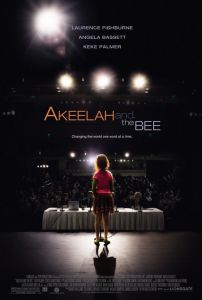 It’s a familiar story and it may be predictable at every turn, but this movie shines when it comes to performances. Young Keke Parker plays the title super speller with equal parts fire, heartbreak, shyness, and pure glee. You easily fall in love with her and it makes her rise among the spelling ranks worth watching. Laurence Fishburne and Angela Bassett give stirring performances to compliment a strong cast. The new angle Akeelah has going for it is its urban education perspective, seeing Akeelah have to hide her smarts out of fear of her peers. The movie is fun, and Akeelah’s budding relationship with a fellow speller is cute as can be. Akeelah and the Bee is a smartly written and uplifting family film with a lot of heart and a dash of schmaltz. Look for “Booger” (a.k.a. Curtis Armstrong) as the inner city school principal that pins his hopes on Akeelah.
Nate’s Grade: B+
Share this:

Flags of Our Fathers (2006)
 Clint Eastwood’s WWII epic is all about scaling down legend, deconstructing myths, and illustrating how truth can become hazy in the name of the greater good. It’s very well made, noble, reverent, intelligently written but somewhat empty at its center, feeling far too mechanical to become one of the great war movies of modern times. The structure is needlessly scattered into three interconnected storylines: 1) the ongoing battle of Iwo Jima between Japan and the United States, 2) the stateside bond tour by three of the six men responsible for raising the flag in the iconic photograph, and 3) a son in present day writing a book about his father’s war experiences in the Pacific. I really don’t feel that splintering the narrative added anything to the story; in fact, there’s a late segment that’s a barrage of character deaths that would have been far more powerful had it not been assembled into an afterthought of a montage. The battle moments are tense and bloody, with just a tinge of Saving Private Ryan familiarity (shaky cam POV, washed out colors, chaotic editing, graphic gore). I would have actually preferred more battle action but oh well.
Most of the film focuses on our three soldiers (Ryan Phillippe, Jesse Bradford, Adam Beach) dealing with the pressure of a spotlight they feel is undeserved. You see, the raising-the-flag picture, perhaps the most famous war photograph of all time, was a group of men replacing a flag. There were no bullets buzzing over heads, no bombs blasting; it isn’t even the first flag. The men wince at being called heroes. They’re made to become U.S. military shills, encouraging the nation to keep buying those war bonds. This segment provides lots of moments of interest by illuminating a chapter few know — the story behind the story. These moments of insider info have some juice to them, led by a suave SOB performance by John Slattery as the man in charge of drumming up dollar signs.
Phillippe is an actor I’ve been keeping tabs on ever since 2000’s Way of the Gun, and he is the moral center of the movie, showing grit and humility. It’s mostly a performance of stoic silence, but he has a very strong scene when he confronts a war widow wanting the truth and he lies between his teeth to comfort her. Beach (Wind Talkers) gets the best role as a solider of Native American blood that is still seen as a second citizen in his own nation. There are plenty of revealing moments of casual racism (people call him “chief” more than his actual name) that explain why he took to the bottle with such ferocity. Beach is an emotional wreck and deeply haunted by the disturbing memories of war. He has to be practically pried off of a widow he is clinging to and crying uncontrollably. The cast is full of young Hollywood actors and it might due some good to become acquainted with their faces before stepping into a theater. It can get confusing. Yet another reason a disjointed narrative is a bad idea.
Where Flags of our Fathers cannot make the leap from good to great is in the area of character. After two hours, you don’t really feel like you know anyone better. There’s a distance that stops the audience from fully investing. I think Eastwood and the film have such noble aims that the movie becomes more of a statement than entertainment. There isn’t any conclusive climax; the film seems to directly go right into a voice-over heavy resolution. On a technical front, Flags is very impressive and Eastwood has created his most visually lush film to date. From a human standpoint, it falters and flags. It’s admirable and attractive but I doubt come Oscar time that this war-weary ode to heroism will have many followers.
Nate’s Grade: B
Share this:

Stranger than Fiction (2006)
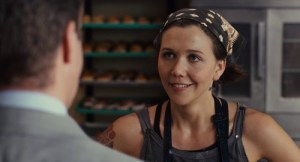
 Ever think your life would make for a good story? Be careful what you wish for. Harold Crick (Will Ferrell) is hearing voices. They aren’t telling him to kill or do anything subversive. In fact it’s just one voice, an English woman, and she isn’t instructing Crick to do anything. No, she’s more so just… narrating. She comes in and out and expresses the doldrums of Crick?s life. He’s an IRS agent whose life revolves around order, repetition, and numbers. We can even see his inner tabulations thanks to some snazzy onscreen visual effects. Crick is sent to audit Anna (Maggie Gyllenhaal), a baker with a disdain for civil servants and authority. Crick is stricken by this shrewd beauty and finds himself wanting her, something the Narrator affirms for him. Crick’s life takes a dour turn when the Narrator lets on that Harold Crick had set in motion his “imminent death.” Crick is confused and seeks advice from Professor Hilbert (Dustin Hoffman) an expert on literature. Then they figure out the Narrator is Kay Eiffel (Emma Thompson), a famous writer who has the unfortunate habit of bumping off every one of her main characters.
Make no mistake, Stranger than Fiction is funny, but it’s a different kind of funny than most people are accustomed to with Ferrell. In my theater, I kept an eye on a gaggle of teenagers sitting several rows in front of me. I just wanted to observe their body language and what I saw was a lot of fidgeting, getting up for trips to bathrooms and popcorn, and lots of whispery talk. I can only imagine the disappointment of those teenagers expecting Ferrell to rip his clothes off and run around like a buffoon. They were likely busily thumbing away at their ever-present cell phones, text messaging their friends. People that are looking for a wild, sidesplitting, slapstick comedy are going to shaking their head. Stranger than Fiction is funny, but it’s in a very dry, witty way, much like British humor; it’s a humor you can admire for being clever but might not make you roll in any aisle.
 The biggest fans of Stranger than Fiction will be bookworms. This is a very literate movie that works better for those with an appreciation or outright love of literature and storytelling. Professor Hilbert doesn’t initially believe Crick until he learns that Crick’s narrator said, “Little did he know.” That, ladies and gents, is all a professor of literature needs. He has to rule out what kind of story Crick may be apart of, so he subjects Crick to a series of hilarious questions along the lines of treasure-inheriting, nemesis-making, and magical-creature befriending. Crick keeps a notebook to tally examples in his life that may point to whether he is part of a Comedy or a Tragedy. Professor Hilton even explains the difference: in grand Shakespearean tradition, a comedy ends with people getting hitched and a tragedy ends with people getting snuffed. This is all fabulously witty and extremely fun, but I can think you’ll see why hard-core fans of Old School and Talladega Nights might be heading for the exits.
Writer Zach Helm has created a wonderfully whimsical tale that’s trippy but manages to still have warmth and a firm heart. It’s far more embraceable a movie than, say, Adaptation, and less smug. He has a smart sense of humor and loves deconstructing literature, like the Jasper Fforde (The Thursday Next books) of screenwriting. We are really sucked into the movie from the moment we can hear Thompson. The story has an innocence to it and this existential comedy feels out there but still grounded; it’s surprisingly poignant and full of dramatic revelations. Even better, Helm has done something that few have achieved: he wrote a story-within-a-story that works. Kay’s narrative voice is highly droll in her observations on Harold Crick’s life. It sounds like a genuine novel, and on top of that, a novel I would enjoy reading. Stranger than Fiction is all the proof I need that Helm is a talent to keep track of.
 The performers all seem to have the same affection for the material. Ferrell is making that leap from funnyman into leading man, the same dramatic territory Robin Williams first tiptoed in Good Morning Vietnam and, likewise, Jim Carrey approached in The Truman Show. Ferrell won’t turn any heads but he underplays his performance maturely, playing a sad but sweet drone of a human being finally taking charge of his life under very insane circumstances. There’s a quiet moment toward the end where Ferrell is told he must accept his fate and he sits, shell-shocked, tearing up, his voice getting softer with every word. It’s only a moment but it piques my interest in what Ferrell may have in the tank. The comedy he can do in spades, including a desperate moment when he tries narrating his own life to coax his Narrator out of hiding.
Who will turn heads, however, is Gyllenhaal. I can already see a nation of teen boys falling in love with her tattooed, punky baker. To them I say, get in line pals, Gyllenhaal has made me dot my I’s with hearts ever since her star-making performance in 2002’s kinky romantic comedy, Secretary. She’s easy to fall in love with and expresses a fragile compassion to her role. The romance between Anna and Crick is unexpected but these two people need each other, and you feel that need as you watch their eyes light up as their relationship blossoms. Late moments between them add to the tenderness of the film and you will be on your knees pleading Crick is spared so he can return to loving Anna. I think Wreckless Eric’s “Whole Wide World” will become a potential staple on romantic teenage mix CDs sent to their sweethearts from now on.
Thompson and Hoffman have appealing supporting performances. Thompson has marvelous fun thinking of different grisly outcomes in store for Crick. Her interaction with the hospital staff to see the “not gonna make it people” is a howl. But Thompson is too good of an actress to play it straight. Once she discovers the life-altering implications of her writing she is crushed by guilt, obsessed over killing good people cruelly. Frankly, if I had anyone narrating my life, Thompson’s voice would definitely rank high. Hoffman plays a dedicated literary professor like a straight man, and everything seems on the level for him, even the fantastic. It’s a nice touch for a film that doesn’t require broad strokes.
 The movie doesn’t have the depth of feeling or dark turnarounds that I know Charlie Kaufman would have done. Stranger than Fiction has a lot of fun with a very ripe premise, and is very intellectually stimulating, but you do feel like it could have gone further, exploring the reaches and implications of its metaphysical setup. What if someone who read Kay’s manuscript thought it was such a masterpiece, a shining light of literature that could move mountains, that they knew Crick must die, and that they must kill him to make certain of it. Or what about the relationship between author and character, and the role each has over the other and perhaps a battle over the future, a typewriter, and a happy ending at the end of a tunnel. However, while all of these options would further explore the novel premise, it would betray the movie’s whimsical tone. This isn’t a very dark movie. It has an authentic sweetness to it, and Crick is a gentle and kind man, and to do anything too heavy would work against the film’s tone. The movie explores existential queries and the topics can be grim, but ultimately Stranger than Fiction is life affirming.
Stranger than fiction also has a buoyant, unexpectedly pleasing romance to it. Again, it doesn’t show the depth of love and human feeling that Kaufman’s Eternal Sunshine could, but this is an unfair comparison. This romance is more a subplot that carries increasing weight thanks to heartwarming performances and the winsomely adorable Gyllenhaal. The romance in Eternal Sunshine was the story, and everything else was outside variable coming into contact. It might sound dismissive to call Stranger than Fiction as decaf Charlie Kaufman, but it really is a compliment. Kaufman is the most exciting, brilliant, creative, insightful, and whacked out screenwriter working today. I would give one of my kidneys to write even one story that could be described as decaf Kaufman. Stranger than Fiction may not examine as many themes, conflicts, or relationships as Kaufman might with the material, but this movie is a sweet fable that floats by like a fluffy cloud on a sunny day. It’s just so damn pleasant you sort of soak it in and fall in love, not wanting to leave.
Stranger than Fiction is strange, all right, but gloriously so. Scribe Zach Helm has concocted an existential fairy tale aimed for bookworms and outsiders. The premise is clever but the film doesn’t stop there, and Helm explores the implications of his premise with whimsy, charm, and a sweetness that is hard to rebuke. The wacky story seems reminiscent of Kaufman’s works, but it has a more heartwarming and embraceable appeal. Great performances from a game cast help to push the material even further into excellence. It has a small handful of flaws, perhaps a too limited scope, but that doesn’t stop Stranger than Fiction from being one of the best stories of 2006 and one of the best movies too.
Nate?s Grade: A-
Share this:

Running with Scissors (2006)
 Ever since author James Frey imploded into a million little pieces, the memoir has come under intense scrutiny. At issue is the validity of the written word, whether these people are being honest as they recount their tortured yet inevitably redemptive lives. What is the difference between nonfiction and memoir, and does it implicitly imply personal bias? Running with Scissors is the 2002 best-selling book detailing the bizarre childhood of Augusten Burroughs. It’s a book with lots of out-there claims but they’re all held in check by Burroughs’ tart observation and witty writing. When translated to the silver screen, Running with Scissors loses credibility without the author’s voice. I doubt many people going in cold will even believe what they’re seeing.
In the 1970s, Augusten (Joseph Cross) is a gay teen growing up in the care of his alcoholic father (Alec Baldwin) and his deeply delusional, bipolar, wannabe poet mother (Annette Benning). When their marriage hits one of its many slags they seek out a therapist, Dr. Finch (Bryan Cox). He has a room he dubs his “masturbatorium,” a resemblance to Santa Claus, and a family just as whacked as he is. His oldest daughter, Hope (Gwyneth Paltrow), helps him in his practice and thinks that pets talk to her, even from beyond the grave. Natalie (Evan Rachel Wood) is the rebellious daughter who likes to play doctor via electric shock therapy. Agnes Finch (Jill Clayburgh) is the matriarch of this cracked family that also enjoys eating some dog kibble here and there. When Augusten’s mother signs over adoption papers he becomes the reluctant newest member of this dysfunctional family.
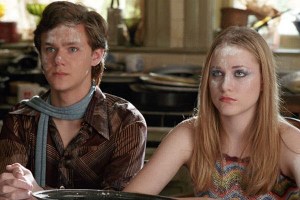 The trouble with translating a book is that you lose the author’s voice and commentary. Running with Scissors maintains the horrifying living conditions for Augusten and the stable of oddballs, but lost is the author’s snappy humor that carried him through this tumultuous time. It’s definitely weird but it’s far from engaging. Without the wit and dark humor from Augusten’s voice we’re left with a series of loosely bandaged scenes about crazy characters and crazy anecdotes, little of which contains further importance. This is a fan of the book talking here, and I’m afraid that the film adaptation has heightened some of the weaknesses of the book, namely the loose storyline. When pieced together as a film, Running with Scissors can become slightly tiresome and overly reliant on background details. The film treats its wild, kitschy production design and 70s nostalgia as a character on par with anyone. It makes for great production design, true to the spirit of the book, but also serves as a narrative distraction. Too much attention seems to be put on getting things to look right than getting the screenplay to feel right.
Without the author’s voice the results lose credibility. It’s funny to see a Christmas tree up year round, and it’s funny when Dr. Finch is convinced God is communicating to him through his bowel movements, but it all just comes off as another joke like the art direction and nothing more. When fully added together without any sense of pathos, it all seems like a joke. The subplot involving Augusten’s sexual relationship with a much older schizophrenic patient (Joseph Fiennes) seems mishandled without much insight. Running with Scissors presents all examples of dangerous, sometimes illegal, behavior and doesn’t bat an eye, nor does it pass judgment. While this may irk some and seem irresponsible it’s just another case of little mattering. Running with Scissors, as an adaptation, presents little of consequence.
Director Ryan Murphy also adapted the screenplay and knows a thing or two about dysfunction and trashiness, having created the risky TV show Nip/Tuck. His adaptation has a blunted feel, but it also seems too broad. Then again, maybe only fans of the book would notice. He has a good feel for his actors and can stage some nice shot selections, but man, someone needs to slap his hand away from the AM radio. Running with Scissors is crammed with so many popular 70s tunes that it becomes a crutch, with Murphy hitting the soundtrack button whenever he needs some kind of character catharsis. It doesn’t work and comes across as indulgent and simplistic. There are so many zippy classic pop songs you may think Elton John is owed a writing credit.
 The acting is one of the elements that help give life to this adaptation. Benning has been generating Oscar buzz for her deeply self-involved portrayal of a mom held hostage by her illness. Benning digs deep and displays a comic range of absurd behavior and wild paranoia. She’s all over the place and you can’t help but loathe her, that is, if you ever take her seriously. But then, once overly medicated, she gives an entirely secondary performance as an emotionless zombie, and we feel a sliver of sympathy, a true surprise. It’s a good, meaty role, however, I actually think Clayburgh gives the more Oscar-worthy performance. In a lot of ways she’s resigned to her fate and yet manages to be the gauzy heart of the picture. She tells me more with her wrinkles than Benning does in her gesticulating outbursts.
The rest of the cast work admirably. Cross is our focal point of the story and does a fine job of, essentially, gawking and looking perplexed. He’s like a blank, gangly canvas, and I wonder what else Cross is capable of than a performance built around indignant reactions. Wood is developing into a lovely adult actress and has some of the best foul-mouthed lines. It’s just nice to see Paltrow in a movie again. Baldwin has transformed from leading man into incredibly versatile supporting actor that excels as comedic lunkheads. Cox remains one of my favorite character actors of all time. There’s nothing this man cannot do. The actors all do a good job of filling out their zany characters while leaving their own imprint.
The issue with Running with Scissors is that when you strip away the author’s caustic voice, then the movie strains credibility, even with the knowledge that it?s based on a personal memoir. The movie gets all the wackiness but misses out on some of the finer points and humor that helped save Augusten from his unorthodox housing. The story feels dulled and stretched too broad, and yet it still manages to be intermittently entertaining despite these flaws. The actors range from good to great and the art direction is fantastic, even if Murphy expects it to do more work than his screenplay. Running with Scissors isn’t as nervy, engaging, or provocative as its source material. Then again little else is. Consider the film Running with Safety Scissors.
Nate’s Grade: B-
Share this:

Marie Antoinette (2006)
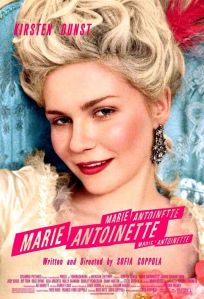 From its opening 80s New Wave soundtrack, you know Sophia Coppola’s Marie Antoinette is a period piece like none other. The famous daughter of Francis Ford Coppola has long been planning a movie around the famous queen that lost her head during the French Revolution. She premiered it at the Cannes film festival where it was booed by the homeland critics. This cast a shadow of doubt over Coppola’s dreamy pop confection of a biopic. Maybe the French don’t like having one of their most iconic historical individuals turned into a bouncing, troubled teenager. Too bad because this is the most interesting and, later, the most frustrating accomplishment Coppola achieves.
Marie (Kirsten Dunst) is a young Austrian girl married away by her family with the hopes of strengthening an alliance between France and Austria. She’s intended to wed Louie August (Jason Schwatzman, Coppola’s cousin), a rather goofy young man more comfortable with hunting than women. Their marriage is arranged by Louis XV (Rip Torn) with the intent on keeping the family line with a male heir. Trouble is, Marie’s husband is more interested in locks than her in a nightie. She’s warned in letters by her family at home, and by a caring ambassador (Steve Coogan), that her only leverage is a child. Without a child her marriage could be annulled. Life at the Versailles palace is a vortex of gossip and attention, and the idea that the queen cannot interest the king is most stressing.
 Marie Antoinette is a feast for the eyes, and that’s saying nothing about Dunst. The costumes are gorgeous, the multitudes of food look delectable, and the sets are the real deal, filmed at the actual Versailles palace for that extra oomph. I’d let them eat cake too if I got the stuff she had. Expect Marie Antoinette to at least get several Oscar nominations for its lavish technical merits; it very well might win too. There’s a really neat sequence that informs the audience through a series of family portraits about a death in the family.
Anyone looking for a strict biography on the famous queen will be left scratching their head. Coppola has thrown historical accuracy to the wind and produced a movie less about plot and character and more about an impression. She really nails the insular palace life, from its ridiculous and rigid traditions to the importance placed on blind formality. There’s a very amusing scene where Marie has to be dressed by handlers, and her clothes must keep getting swapped to the current highest-ranking person in the room. Coppola also smoothly handles this extravagant, opulent world from the point of view of her young teenage girl, betrothed by the age of 14. The world of royals and Versailles was one of constant gossip where everyone’s eyes were glued to the new girl. In many ways, Coppola’s world mirrors high school existence, just with far better clothes. When Marie is ignored yet again by her clammy husband, she goes on a wild shopping spree with fabulous shoes and fabrics in bright, sticky colors. She stays up late with a close circle of friends to watch the sun rise over the palace. Coppola firmly reminds us that Marie Antoinette was still a teenage girl and perhaps was still fighting to be one. The movie is good at stripping away the context of history and showing us the awkward lives of two kids selected to be leaders of their country. Better yet, the film is good at exploring what it?s like for teenagers to have the world at their fingertips and have no clue what to do with it. Besides shoe shopping, that is. The film is an excellent mosaic that reiterates the breezy sensation of being young and trapped in the world that never seemed big enough.
But, alas, the trouble with establishing an impression is that we get the idea pretty quickly, and yet the movie keeps going on and on without anything else to interest us. You can watch Marie lay in the field, host a tea party in her garden, marvel at sumptuous food, try on different clothes, play with her puppies, and, hell, the woman even sings an opera in one moment. I don’t know if Coppola intended to establish the tedium of life in Versailles but the audience will definitely start to feel suffocated by it. At least she never steers into a Terrence Mallick danger zone (the man would have sat in a forest with a camera in his lap and called the results a “movie”). That’s the issue with the movie. Like her 2003 Oscar-winner Lost in Translation, Coppola is more interested in mood and silence than character and plot. This approach worked splendidly in the sparely beautiful and moving Translation, but it cannot fully save this film. After a while it just all gets too repetitious and feels slight, like Lizzie McGuire’s Fabulous Versailles Vacation.
The figure of Marie Antoinette is too big to just be dressed up and put in a room. Coppola doesn’t seem to care about the politics or historical anxieties of the time. That’s a shame since France was going through one of the most amazing turnarounds in all of history. There’s no social commentary and the last quarter of the film seems to go off track. When the peasant mob does appear at the very end it feels like a misplaced subplot instead of a world-changing event. Likewise, the affair Marie Antoinette embarks on feels all too shrift and meaningless, like a high school crush of the week (might she doodle his name on her diamond-encrusted notebook?). Marie Antoinette is an interesting, ambitious period drama trying to be a youthful fantasy turned nightmare. It just doesn’t have enough going on to justify a prolonged experience.
Dunst is an actress I’ve been really hot and cold with. Sometimes she dazzles me but more often she bores me. As the title monarch, Dunst totally comes across like a vibrant teen girl still feeling out the world. She seems impetuous, sensual, and naive, all hallmarks of a growing girl that just so happens to be the queen of France. She does a lot of communication with her face. Sometimes she comes across like a silly, vapid little girl playing dress-up, but then that seems within the scope of Coppola’s aim.
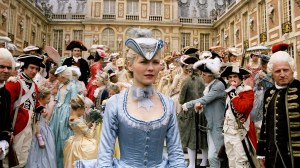 Schwartzman’s portrayal makes the king look like an aloof adolescent, but he make me laugh very easily at his pained awkwardness. Judy Davis is a hoot as the palace’s liaison of policy and manners, tsk-tsk-ing whenever etiquette is broken. The rest of the cast mostly have moments but it’s surprising to me that I’d see Marianne Faithfull, Rip Torn, Molly Shannon (!), and Asia Argento in a period piece movie. Like I said, Marie Antoinette is a costume drama like none other.
Much was made about the anachronistic soundtrack of 1980s tunes set amongst the pomp and circumstance of 18th century France. I like it because it works in engineering the breezy, bubbly youthful impression Coppola wants. It shouldn’t be that big of a deal because the music is not incorporated into the story unlike 2001’s tandem Moulin Rouge and A Knight’s Tale. It provides some of the more fun moments in the movie, though at times the lyrics become all too transparent; “I Want Candy” during a spending spree, “Fools Rush In” when Marie goes to her affair, The Strokes screaming “I want to be forgotten,” as Marie runs off.
Coppola’s luscious period piece feels more like a dreamscape in a daze. Her focus relies less on linear storytelling and character than on creating an impression of youthful decadence and emptiness. Marie Antoinette manages to simultaneously be fluffy and vague. After a while it all just gets repetitious and a bit dull watching scene after scene of Marie being indulged and bored. Perhaps some of that boredom will translate over to the audience. Coppola reminds us that Marie Antoinette was still a teenage girl beneath her powdered wig and bustle, but after two hours you might wish Coppola had more on her agenda.
Nate’s Grade: C+


 nathanzoebl
You must be logged in to post a comment.