Blog Archives
Dune: Part Two (2024)
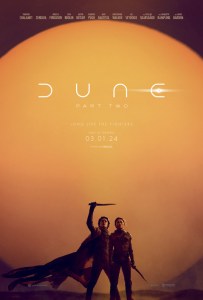 I wasn’t fully taken with the first Dune movie when it arrived in 2021. It was visually sweeping, with dense world building and careful development of characters and themes, but then it just hit the pause button without any certainty there would be a conclusion. Thankfully, director Denis Villanueuve was able to complete his vision, and what a spectacular science fiction landscape this man has fashioned, visually resplendent but also with a story that deepens and improves on all the promise and setup from 2021. The triumphant of Paul (Timothee Chalamet) becoming a hero and avenging his father from their betrayers is tempered by the tragedy of Paul, becoming the false messiah that will bring about mass genocide. The movie doesn’t hold back in its criticisms of its hero while also providing complexity that makes us root for him but uneasily dread what might become. The narrative structure is easy to follow with Paul ingratiating himself with the native culture, rising to power and influence, and organizing a resistance against the well-funded imperial overlords of Arakis. This is the kind of sumptuous, big screen spectacle with intelligence that is so rare in the Hollywood system, and Villaneuve once again shows his ability to perform artful blockbusters that put him in a rarefied class with hew others. After the first Dune, I was hopeful but a little wary. After the second Dune, I feel like all of my concerns were wiped away.
Nate’s Grade: A-
Share this:

Guardians of the Galaxy vol. 3 (2023)
 It’s taken me longer to review the third, and reportedly final, installment of the Guardians of the Galaxy trilogy because I didn’t think that I nor my family had the emotional bandwidth when the movie was originally released to herald the summer. I’ve been a big fan of writer/director James Gunn’s comic book escapade efforts with the Marvel Cinematic Universe (MCU), as well as his first DC entry, 2021’s The Suicide Squad, the best DC film of the new era, so I’ve been highly anticipating a third Gaurdians ever since the second ended six years ago. Of course all fans have had to wait a little longer after Disney fired Gunn in 2019 for offensive social media posts they already knew about before the first Guardians film in 2014, and then they came to their senses and re-hired one of the most unique voices working within their giant sandbox of superheroes. The reason I decided to wait even longer is because I had been warned by many of my critical colleagues about the heavy thematic nature of the third entry, namely the frequent sequences of animal abuse. My family had to put down their household dog of over ten years in late April, and having to re-open that wound by watching pretend animals get abused was not the best for any of our emotional states. And so I waited until it was available on digital and in the comfortable sanctity of my home, and I alone in my family watched Volume Three, partly as a harbinger of future warning over what scenes to skip over for them. It’s a fitting end to a strange and funky series of movies that taught us to feel real emotions over racoons and trees, and even though I’d rate this as last in its respective Guardians standing, it’s still a winner and a topical reminder that these big-budget blockbusters are only ever as good as when the passion is evident.
The Guardians are on a mission to save their friend, Rocket (voiced by Bradley Cooper). He’s been incapacitated and is sought after by his creator, The High Evolutionary (Chukwudi Iwuji), a maniacal man with a god complex who is trying to create a perfect life form. This forces the Guardians to learn more about Rocket’s tragic past as a cruel science experiment, and it brings back Gomorrah (Zoe Saldana), though she’s not the same woman who fell in love with Peter Quill (Christ Pratt), and he’s having a hard time reconciling the different green girls. They’ll have to work together to rescue Rocket and stop the High Evolutionary from further harm.
 This is a movie built around the back-story and emotional connections of Rocket, a character that, prior to Gunn’s first film, had fewer than a dozen comic appearances but has had an outsized influence over the movies. If the first movie was about the formation of our team, and the second was deepening the supporting characters, as well as exploring Quill’s daddy issues, then the last movie is all about how we say goodbye to the ones we love. Volume Three is clearly structured like Gunn’s fond farewell for these characters rather than merely a pause in their contractually obligated appearances (whether Marvel overrules Gunn is another matter). It makes the interaction more meaningful and also more emotionally rich, not just because certain characters might perish, but because of the journey we’ve been privileged to hop along for, how far they’ve come and how much they matter to others, and by extension us, the audience.
Case in point: the emotional evolution of Rocket Racoon. He began as a surly visual joke, a teeny mammal with a big gun and a big attitude. It wasn’t until a drunken outburst in Volume One that you got a glimpse of the trauma and pain beneath that antisocial demeanor. With Volume Three, he gets sidelined pretty early, which means the majority of the time we spend with Rocket is through a series of flashbacks with baby Rocket and his cute pals, all ongoing science experiments (one needs only to recognize the absence of these childhood friends as grown-ups to anticipate where this is inevitably heading). In some ways, it is cheap and manipulative. It’s not hard to make an audience feel extreme emotions by introducing a slew of adorable animals as well as a villain who hurts them and sees them as expendable experiments undeserving of sympathy. I wish Gunn hadn’t gone so hard in this direction because it feels excessive in the ideas that the film bluntly communicates. Yes, a storyteller will need time to establish a baseline of relationships, conflicts, and looming change, but do we need six or seven flashbacks to settle the concept of animal testing and animal cruelty being a bad thing? I credit Gunn with making his thematic intent unambiguous; this is wrong, and you will feel it explicitly. However, sidelining Rocket for a majority of the movie and having characters project onto his unconscious body, while providing more insight through a system of excessive and heavy-handed flashbacks, might not be the best model for ensuring this character gets his due when it comes to this showcase. Quill keeps calling Rocket his “best friend” and I’m trying to remember when this happened. I re-watched Volume Two this summer, and now consider it the best of the trilogy, and I cannot recall the specific events that bonded these two bickering alphas into inter-species BFFs.
 Another facet of Gunn’s relevant themes is personified in the romantic realizations of Quill. Not to get too complicated, the current Gomorrah is a past version of herself and not the one who joined the Guardians, fell in love with Quill, and died in Infinity War. She’s back, but from her perspective she never left, and this moon-eyed dolt keeps projecting his feelings onto her. I respect that Gunn doesn’t try and wave away this complication, nor does he mitigate the agency and importance of this Gomorrah not having to follow the same path as her predecessor. The easy thing would have been for Quill to wait and for this new/old Gamorrah to see the same qualities that made the old/dead Gomorrah fall in love. It would be like one of those soapy romances where a person suffers amnesia and gets to fall in love with their spouse all over again. Gunn doesn’t do that. These are different people, and despite the aching desire of Quill to rekindle what he had, it has been lost, and this needs to be acknowledged and accepted. “I bet we were fun,” she says, and it’s a bittersweet summation that extends beyond the Guardians.
There is still Gunn’s signature sense of style and humor while checking the boxes of a big-screen action blockbuster. There’s an infiltration set piece that plays like a goofier Mission: Impossible setup but in a squishy bio-mechanical facility that reminded me of the eccentric and schlocky sci-fi diversions personified in the Lexx movies and TV series. There’s an entire planet of animal-human hybrids that feels wasted as further proof of the High Evolutionary’s already established evil. The entire character of Adam Warlock (a beefed up Will Poulter) is a himbo that definitely feels lacking in larger purpose now that the Infinity Era is over. There is one signature action scene involving a protracted fight through a crowded hallway, and it’s exciting and fun. The jokes are mostly contained to sardonic banter, which can be hilarious depending upon the combination of characters, though it also can be grating when it feels forced, like Mantis (Pom Klementieff) and Nebula (Karen Gillan) butting heads. The celebrated dad rock soundtrack has moved onto 90s and early 2000s music, and as a 90s kid, it gave me a personal nostalgic lift watching scenes jamming to dreamy whoo-hoo alt-rock acts like Radiohead and Spacehog and The Flaming Lips.
 This also might be the grossest MCU movie yet, and not just from the animal abuse but a face-peeling scene that will startle most. I had to pause the screen and drag my 12-year-old stepdaughter into the room with the promise, “Want to see the grossest thing ever in a Marvel movie?” She agreed that it was indeed that. It’s reassuring that no matter the budget, Gunn’s sensibilities that make him the unique storyteller he is, the same man who began with Troma, will be there. Though this point also concerns several of my friends wondering if Gunn can abandon these silly and schlocky tendencies to tell an earnest and tonally appropriate tale for his 2025 Superman reboot.
Guardians of the Galaxy volume 3 is the end of an era for Gunn and for the MCU. As the new head of the DC film and TV universe, it’s unlikely he’ll be lending his talents to Marvel any time soon, although the characters he made us fall in love with could carry on. Gunn clearly loves these characters, and especially identifies with Rocket, the angry malcontent lashing out in pain, so it’s fitting to give this character the big stage for a final outing, and if he can throw in some animal cruelty messaging along with silly humor and pathos, then so be it. This practically feels like Marvel is giving Gunn even more leeway as an apology for firing him. The Guardians trilogy stands out from the prolific MCU assembly because of how much Gunn has personalized these movies to make them special. They have permission to be weird, to be heartfelt, and to be reflections of their idiosyncratic creator, a much more benevolent force than the High Evolutionary. Perhaps there’s even a parallel to be drawn there, a filmmaker trying to endlessly tinker with their creation in the futile pursuit of perfecting it whereas the imperfections and rough edges are often the lasting appeal of a movie. I don’t know if the MCU will contain a series quite like this again, and that adds to the feeling of this serving as a farewell. It was a fun, messy, ridiculous ride, and it was all Gunn.
Nate’s Grade: B
Share this:

Knock at the Cabin (2023)
 Knock at the Cabin continues M. Night Shyamalan’s more streamlined, single-location focus of late, and while it still has some of his trademark miscues, it’s surprisingly intense throughout and Shyamalan continues improving as a director. The premise, based off the novel by Paul Tremblay, is about four strangers (Dave Bautista, Nikki Amuka-Bird, Rupert Grint, Abby Quinn) knocking on the door of a gay couple’s (Jonathan Groff, Ben Aldridge) cabin. These strangers, which couldn’t be any more different from one another, say they have come with a dire mission to see through. Each of them has a prophetic vision of an apocalypse that can only be avoided if one of the family members within the cabin is chosen to be sacrificed. Given this scenario, you would imagine there is only two ways this can go, either 1) the crazy people are just crazy, or 2) the crazy people are right (if you’ve unfortunately watched the trailers for the movie, this will already have been spoiled for you). I figured with only two real story options, though I guess crazy people can be independently crazy and also wrong, that tension would be minimal. I was pleasantly surprised how fraught with suspense the movie comes across, with Shyamalan really making the most of his limited spaces in consistently visually engaging ways. His writing still has issues. Characters will still talk in flat, declarative statements that feel phony (“disquietude”?), the news footage-as-exposition device opens plenty of plot hole questions, and his instincts to over-explain plot or metaphor are still here though thankfully not as bad as the finale of Old, and yet the movie’s simplicity also allows the sinister thought exercise to always stay in the forefront. Even though it’s Shyamalan’s second career R-rating, there’s little emphasis on gore and the violence is more implied and restrained. I don’t think Shyamalan knows what to do with the extra allowance of an R-rating. The chosen couple, and their adopted daughter, are told that if they do not choose a sacrifice, they will all live but walk the Earth as the only survivors. It’s an intriguing alternative, reminding me a bit of The Rapture, an apocalyptic movie where our protagonist refuses to forgive God and literally sits out of heaven (sill worth watching). The stabs at social commentary are a bit weaker here, struggling to make connections with mass delusions and confirmation bias bubbles. I really thought more was going to be made about one of the couple being a reformed believer himself, with the apocalyptic setup tapping into old religious programming. It’s a bit of an over-extended Twilight Zone episode but I found myself nodding along for most of it, excusing the missteps chiefly because of the power of Bautista. This is a very different kind of role for the man, and he brings a quiet intensity to his performance that is unnerving without going into campy self-parody. He can genuinely be great as an actor, and Knock at the Cabin is the best example yet of the man’s range. For me, it’s a ramshackle moral quandary thriller that overcomes Shyamalan’s bad writing impulses and made me actually feel some earned emotion by the end, which is more than I was expecting for an apocalyptic thriller under 100 minutes. What a twist.
Nate’s Grade: B-
Share this:

Glass Onion (2022)
 When writer/director Rian Johnson wanted to take a breather after his polarizing Star Wars movie, he tried his hand at updating the dusty-old Agatha Christie mystery genre, and in doing so created a highly-acclaimed and high-grossing film franchise. The man was just trying to do something different and at a smaller-scale with 2019’s Knives Out, and then it hit big and Netflix agreed to pay $400 million dollars for exclusive rights to two sequels. Now as Johnson has reinvented his career as a mystery writer the big question is: can he pull it all off again?
Renowned detective Benoit Blanc (Daniel Craig) has been invited to the world’s most exclusive dinner party. Miles Bron (Edward Norton) has invited all his closest friends to his Greek island soiree, setting up a murder mystery game his friends must spend the weekend solving. Except there are two interlopers: Andi Brand (Janelle Monae), the former partner of Miles who was betrayed by Miles and his cronies and… Benoit Blanc himself. Why was the detective invited to the murder dinner party unless someone planned on using it as an excuse to actually kill Miles?
 Knives Out was a clever deconstruction of drawing room mysteries and did something remarkable, it told you who the murderer was early and changed the entire audience participation. Instead of intellectually trying to parse clues and narrow down the gallery of suspects, Johnson cast that aside and said it didn’t matter as much as your emotional investment for this character now trying to cover up her tracks while working alongside the “world’s greatest detective.” It made the movie so much more engaging and fun, and for his twisty efforts, Johnson was nominated for a Best Original Screenplay Oscar. Now, every viewer vested in this growing franchise is coming into Glass Onion with a level of expectations, looking for the twists, looking for the clever deconstruction, and this time It feels like Johnson is deconstructing the very concept of the genius iconoclast and including himself in the mix. The movie takes square aim at the wealthy and famous who subscribe to the idea of their deserved privilege, in particular quirky billionaires whose branding involves their innate genius (many have made quick connections to Elon Musk in particular). The movie’s first half is taken with whether or not Miles Bron’s murder mystery retreat will become a legitimate murder mystery, but by the midpoint realignment, Glass Onion switches into pinning down the bastard. It makes for a greatly satisfying conclusion as Blanc exposes the empty center of Miles’ calculated genius mystique.
 As Blanc repeatedly says, the answers are hiding in plain sight, and this also speaks to Johnson’s meta-commentary of his own clever screenwriting. This is Johnson speaking to the audience that he cannot simply copy the formula of Knives Out. This is a bigger movie with more broadly written characters, but each one of them feels more integrated in the central mystery and given flamboyant distinction; it’s more like Clue than Christie. Through Miles’ influence, we have a neurotic politician (Kathryn Hahn), a block-headed streamer (Dave Bautista) pandering to fragile men on the Internet, a fashionista (Kate Hudson) who built an empire on sweatpants and has a habit of insensitive remarks, and a business exec (Leslie Odom Jr.) who admits to sitting on his hands until given orders from on high by Miles. All of these so-called friends are really bottom-feeders propped up by Miles’ money. It would have been easy to simply replay his old tricks, but Johnson takes the heightened atmosphere of the characters and plays with wilder plot elements of the mystery genre, such as identical twins and secret missions and celebrity cameos (R.I.P. two of them) and corporate espionage. The very Mona Lisa itself plays significantly into the plot (fun fact: Ms. Mona was not the universally revered epitome of art we know it to be until its 1911 theft). This is a bigger, broader movie but the larger stage suits Johnson just fine. He adjusts to his new setting, veers into wackier comedy bits with aplomb, and has fun with all the false leads and many payoffs. You never know when something will just be a throwaway idea, like the hourly chime on the island, or have an unexpected development, like Jeremy Renner’s hot sauce. Glass Onion is about puncturing the mirage of cleverness, and by the end, it felt like Johnson was also playfully commenting on his own meta-clever storytelling needs as well.
It’s so nice to watch Craig have the time of his life. You can clearly feel the passion he has for the character and how freeing this role is for an actor best remembered for his grimaced mug drifting through the James Bond movies. Craig makes a feast of this outsized character, luxuriating in the Southern drawl, the loquaciousness, and his befuddled mannerisms. After Knives Out, I begged for more Benoit Blanc adventures, and now with a successful sequel, that urge has only become more rapacious. Johnson has proven he can port his detective into any new mystery. Netflix has already paid for a third Knives Out mystery movie, and I’d be happy for another Blanc mystery every so many years as long as Craig and Johnson are willing. These are fabulous ensemble showcases as well with eclectic casts cutting loose and having fun. Norton (Motherless Brooklyn) is hilariously pompous, especially as Blanc deflates his overgrown ego. Bautista (Dune) is the exact right kind of blowhard. Hudson (Music) is the right kind of ditzy princess with a persecution complex. Her joke about sweatshops is gold. Jessica Henwick (The Gray Man) has a small role as the beleaguered assistant to Hudson’s socialite, but she delivers a masterclass in making the most of reaction shots. She made me laugh out loud just from her pained or bewildered reactions, adding history to her boss’ routine foot-in-mouth PR blunders.
 There is one big thing missing from Glass Onion that holds it back from replicating the surprise success of its predecessor, and that’s the emotional lead supplied by Ana de Armas. She unexpectedly became the center of the 2019 movie and it was better for it. Glass Onion tries something similar with Andi Brand, and while she’s the easiest new character to root for among a den of phonies and sycophants, it’s not the same immediate level of emotional engagement. That’s the biggest missing piece for Glass Onion; it’s unable to replicate that same emotional engagement because the crusade of Andi Brand isn’t as compelling alone.
Glass Onion is a grand time at the movies, or as Netflix insisted, a grand time at home on your streaming device. It’s proof that Johnson can handle the rigors of living up to increased expectations, making a sequel that can stand on its own but has the strong, recognizable DNA of its potent predecessor. It’s not quite as immediate and layered and emotionally engaging, but the results are still colorful, twisty, and above all else, immensely fun and satisfying. I’m sure I’ll only think better of Glass Onion upon further re-watching as I did with Knives Out. Johnson once again artfully plays around with misdirects and whodunnit elements like a seasoned professional, and Glass Onion is confirmation that Benoit Blanc can be the greatest film detective of our modern age.
Nate’s Grade: A-
Share this:

Dune (2021)
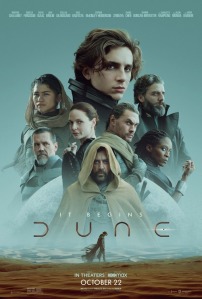
I attempted to read Frank Herbert’s novel Dune when I was in the seventh grade. I had begun to read more fantasy literature and was looking at older, heralded novels. I can still recall my frustration of reading those first five pages and having to repeatedly flip back and forth to a twenty-five-page glossary of terms so that I could even start to comprehend what was happening on the page. After those five excruciating pages, I gave up. Maybe I was too rash, and maybe my older present self would be more accommodating to the struggle, or maybe it just wasn’t worth the effort. I never watched the 1984 David Lynch adaptation that was met with great derision from critics and fans alike, although it does have its vocal defenders (Hindsight alert: Lynch turned down directing Return of the Jedi to helm Dune). So when acclaimed filmmaker Denis Villeneuve (Arrival, Blade Runner 2049) became attached to direct a big-budget, large-scale adaptation of Herbert’s novel, I was finally interested for the first time in my life. It was originally slated to be released in 2020, and after the studio planned to release Dune onto its HBO Max streaming service, Villeneuve and the production company negotiated to make sure a theatrical release would still be an important part of the plan. Alas, I watched the 2021 Dune at home, and I found myself enjoying the experience and development of the world building. However, it’s unlikely to watch this version of Dune and feel like you got a full movie for your money.
In the distant future, like 10,000 A.D., mankind has colonized worlds and the most important planet of them all is Arrakis. It’s a desert world inhabited by poor natives, Freeman, who live a moisture-preserving life mining the natural “spice,” a special substance that makes space travel capable as well as prolonging human life. The top family houses are vying for dominance and House Atreides has been assigned by the unseen Emperor to rule over Arrakis and bring it and its spice production back in line. Duke Leto Atreides (Oscar Isaac) sees great opportunity but also great danger. The other houses will scheme to engineer the failure and desolation of House Atreides, especially House Harkonnen, led by the Baron (Stellan Skarsgard), who is like a mixture between Marlon Brando from Apocalypse Now and Marlon Brando from The Island of Doctor Moreau (plus with levitation powers?). Paul Atriedes (Timothee Chalamet) is his family’s heir and much is expected of him, especially from his mother, Lady Jessica (Rebecca Ferguson), who believes he may be long-prophesied messiah. On Arrakis, Paul and his father must tackle this very delicate new mission while keeping the many adversaries at bay.

As anticipated, Dune is yet another visually stunning and gorgeously immersive visual experience from one of the greatest visual filmmakers working today. If you can watch the movie on a big screen, or at least a bigger screen, then you owe it to yourself to do so. The sweeping vistas and startling science fiction imagery have so much power and grandeur to them. If Lynch’s movie inspired a generation of devotees and impressionable children, I imagine that this superior modern version will do likewise. The production design and costumes are terrific and perfectly in keeping with the larger scope of the expansive visuals. You really feel the size of this world and its imposing weight. Villeneuve has such a natural keen eye for pleasing visual compositions, but he also has the patience many famous big screen stylists lack. He allows the moments to linger and to let scenes breathe in a way that feels more transporting and immersive. If you were simply looking for a visually resplendent movie-going experience, then Dune is the ticket. The sound design is also very smartly aligned and makes use of unconventional and alien sounds to make the movie feel even more like its own thing. When Dune came out in 1965, this was before much of the modern building blocks of our sci-fi pop-culture, so in a way while Dune was the influence it feels partially like an odd after-effect rather than a predecessor. The same thing happened with 2012’s John Carter, based upon a novel a hundred years old that influenced many sci-fi adventure serials and now seems derivative even though it came before the many imitations. I was happy with the first 90 minutes of Dune and felt like the slow pace of the first hour, and its heft of needed but spaced-out exposition, was paying off with a thrilling assault. The concept of the protective shields is a smart way to communicate the casualties of battle, where “kill shots” are illuminated in red, informing the audience of a mortal wound. It makes for an easy to read visual to keep up with the development of battle and stay in a safer PG-13 realm. The whole rescue sequence on the mining station is thrilling at every step.
The cast is another major credit to the success of Dune. Chalament (Little Women) has a soulful yearning to him, to learn, to be his own man, to prove his father wrong and then prove worthy of his father’s faith. Surprisingly, the next biggest role isn’t Zendaya (Malcolm and Marie), the woman that Paul dreams about (prophetically?); it’s Rebecca Ferguson (Doctor Sleep) as Paul’s mother. She’s a woman with deep secrets belonging to a powerful religious sect that might be the real power behind the throne. Lady Jessica is more Paul’s mentor than any man. She teaches him to hone and focus his mind, to use the “Voice” to impart his will, and to prepare for the hardships to come. With every new exposition dump, and she has many, we learn about her growing concern for the fate of her son and her possible culpability for that fate. There’s a genuine warmth between them that serves as the film’s emotional core. I enjoyed watching Jason Momoa (Aquaman) and Dave Bautista (Army of the Dead) as opposite ends of Super Good Fighter Guy, though Momoa looked unsettling without a beard. Needless to say, the 2021 movie is far more diverse than the 1984 movie. It makes space feel more lived in when it’s reflective of a diversity of people that we already have at this point in our history.
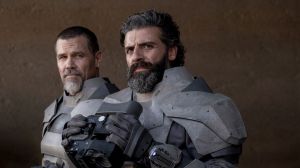
And then, after the hallway mark, Dune became a protracted sequence of chases and then I started to worry that things were just going to end in an unsatisfying manner, relegating the 150 minutes as setup for the as-yet-unplanned sequel, and that’s exactly what happened. My mood began to deflate somewhat during the last hour of Dune. I was still interested and the visuals were still mighty captivating, but the events had the unmistakable feeling of being stretched out to meet a frustrating stopping point, a pause that didn’t produce a satisfying endpoint. I just kept thinking, “Oh, they’re not going to resolve this,” and, “Oh, Zendaya is barely going to be in this movie,” and the movie proved my predictions correct. It’s hard to judge the movie as its own entity since it’s so dependent on a Part Two that has yet to be greenlighted (though its strong opening box-office returns are hopeful). This is an expensive movie, possibly pushing $200 million, so it’s quite a gamble to declare you would only be adapting roughly half of the story. Villeneuve’s Blade Runner sequel, a movie I loved, had a budget of $150 million and a worldwide gross that didn’t make the producers comfortable going forward with a Blade Runner 2050. To be fair, that was an original story, a sequel, and rather well contained. Still, it’s an expensive sci-fi movie that has as much in common with dry art house fare as it does blockbuster adventures, like Villeneuve’s Dune. The promise of a second movie is not secured. If Dune doesn’t do well enough, we’ll forever be left with a movie that feels designed to only be a teaser. It reminds me of the hubris of 2007’s The Golden Compass where the filmmakers had a whole 20-minute finale that they carved out with the intention of having it be the opening for the assumed sequel (welp). Even when designing a multi-movie arc, it’s necessary to plan each entry so that it can exist as its own beginning-middle-end and with a suitable intermediary climax. The Lord of the Rings movies each had their own climax, each moving the larger picture forward, and each had storylines and subplots that came to a head by film’s conclusion. Dune doesn’t. There are more dead characters by the end and certain characters are displaced, but it feels less like the end of the big-budget Dune movie and more like the conclusion of episode two of the Dune mini-series.
My resonance with the source material is minimal, but the world of Dune feels stuffed with stuff and not as deep in the realm of commentary. Fans of the book series will likely thrill at the level of minutia the 2021 movie luxuriates in, allowing fans to lap up the lore. For those of us uninitiated into the fandom, it feels like there could be more going on behind the scenes. The book was released in 1965 and has clear parallels to Middle East occupations and quagmires, a subject even more relevant in the first quarter of this new century. There’s the occupying force coming in to manage the supposedly primitive natives on a desert planet, replacing the last occupier who made bold promises that were unable to be met by the reality on the ground. The parallels of colonialism are there and obvious, but that’s because everything in Dune seems obvious to me. The bad guys are corpse-white and dressed in all black. They look like the alien zombies from 1998’s Dark City (itself referencing the silent sci-fi classic, Metropolis). The leader of House Harkonnen is this noxious man who bathes in black goo and sucks the life force from others. I don’t need my sci-fi to be ambiguous about its heroes and villains. We clearly recognize the bad guys because they’re grotesque. However, the lessons learned by the heroes seem a bit stilted. Its attacks on capitalism are a little more nuanced but not much. The planet of Arrakis could produce water but that’s not in the interest of the power brokers of the galaxy. They need the spice for the economy and thus keep the exploitative status quo. The parallels are there but there’s not much more to be had other than direct summations. The movie has more to say with religion and messiah figures but at this point we’re grading on a curve, and the more complex commentary attached to messiah figures seems reserved for a Part Two.
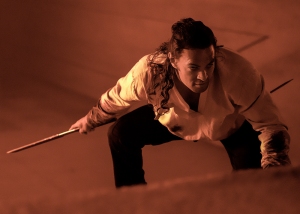
Another aspect I want to highlight that seems trivial but no less intriguing to me is how Herbert chooses his character names. We’re eight thousand years into the future, spanning multiple planets with names like Arrakis and Giedi Prime and Salusa Secondus, and then we have such anodyne twentieth-century names like… Paul and Jessica? It’s funny to me that Herbert goes to the trouble of coming up with so much jargon and terminology and alien-sounding names and then he says, “Hey, this guy’s name is… Duncan Idaho,” like he’s a supporting character in Point Break. I realize this is a very dubious criticism, and there are other character names to conflict with this assertion, but it made me laugh at the different levels of effort Herbert put into his world-building and universe than selecting character names for that same far away land.
After watching the new Dune, I went and watched the 1984 David Lynch version for the first time and was, quite simply, dumbfounded. I’ll credit Lynch for many of the weird choices in style and how it never stoops to even be accessible for a mass audience, despite having characters explicitly narrate their schemes and motivations out in the open (by scene one, the power play that took up 90 minutes of Dune 2021 is awkwardly explained in full). By the end of Lynch’s movie, it is an incomprehensible campy mess. I only have more appreciation for the 2021 Dune after watching the goofy (those eyebrows!) 1980s version that Lynch has disowned entirely, although that stirring guitar riff from the score still rocks thirty years later. The new Dune is only intended as Part One as its presumptive title promises, and because of this key artistic decision, there’s a feeling of padding and wear by the end. I found myself reflecting back on the first 90 minutes more fondly. It’s not that the last hour is absent great moments or audacious style, but it’s hard to fully judge this Dune when its last line is its own conditioning of expectations: “This is only the beginning.” The 2021 Dune is a visually remarkable movie experience with fantastic artists executing at some of the highest points of their talent. I’m eager to see if a Part Two can provide the satisfaction lacking in this beginning half. It’s a hell of a start but it feels too incomplete and in need of an ending.
Nate’s Grade: B
Share this:

Army of the Dead (2021)
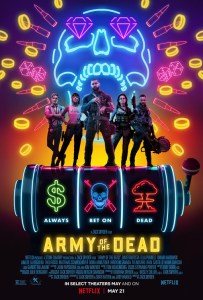 Despite an expensive redo into the editing bay for the supersized Justice League 2.0, this is director Zack Snyder’s first movie in four years and the aftermath of his family tragedy, and it’s the first with that sweet sweet Netflix money. Army of the Dead has an easy concept that seems silly as well as questionable why we haven’t seen this kind of movie before. The world loves zombies movies. The world loves heist movies. Why have we waited until 2021, in the year of our Lord, for a zombie heist flick? Our long drought is finally over and Netflix has answered our collective prayers. When I watch a movie described as “zombie Vegas heist” then I know what I’m hoping for, chiefly a fun, goofy, and well-developed action thriller, and that’s what Army of the Dead provides.
Las Vegas is ground zero for a zombie outbreak. The U.S. government has cordoned off the Vegas strip and contained the zombie virus. The president plans to drop a nuclear bomb and eradicate the zombie plague once and for all. That means there’s still time for one last score. A wealthy businessman wants to hire Scott Ward (Dave Bautista) to put together a crack team to break into a casino vault and steal $200 million before everything gets nuked. Scott gathers a crew of Zombie War vets, specialists, a guide to sneak them into the quarantine zone, and his estranged adult daughter who watched dad out mom down after she became a zombie. Together they’ll venture into certain danger to hit a jackpot.
 It’s easily Snyder’s most laid back and straightforwardly enjoyable movie since his debut feature, 2004’s Dawn of the Dead remake. It’s a movie that knows what we’re here for and provides a colorful band of characters with big personalities and over-the-top bloody violence. I can’t say that I genuinely cared about whether anyone lived or died in the movie, as many are so disposable that I forgot they were in the group, but I missed their presence when the time came to say goodbye. I enjoyed that two characters as outwardly different as Vanderohe (Omari Hardwick) and Dieter (Matthias Schweighöfer) could become best bros, and their chummy dynamic became one of my favorite aspects of the movie. The actual heist component of the movie amounts to less than the perilous journey to get to the giant vault, and the exaggerated booby traps reminded me of Indiana Jones temples. It was just the right splash of ridiculous to make me laugh. This is a movie designed to simply push the right buttons for a schlocky good time. Its opening montage sets the tone with famous Vegas staples falling victim to zombie mayhem. Early on, it’s Snyder assuring you that he’s not taking anything too seriously and that neither should you. There are moments where Snyder just throws out nonsense just to mess with the viewer, like a scene where Vanderohe theorizes that the skeletal corpses might actually be them and they are trapped in a loop, complete with matching edits to link up their clothing and jewelry to make you wonder. I turned to my girlfriend in disbelief; could this actually be happening? It doesn’t at all, but just the fact that Snyder devoted time for this throwaway sci-fi head fake amused me. I almost wished Snyder had given us more of these throwaway joke exit ramps. At one point, a character gets locked in a vault, and I hoped for a brief moment Snyder would frame the film like it’s suddenly evolved into the zombie’s own Ocean 11, where now the zombies need to put together a crack zombie team to break into the vault for some delicious brains. I appreciate that Army of the Dead prioritizes entertainment on all of its fronts.
Snyder and company have also put more deliberation into their world building. Most zombie movies just present a wasteland of the undead, a sea of hands and teeth that serve as a swarming obstacle but without any more thought. In Army of the Dead, the movie presents the beginning of a zombie civilization with a hierarchy. There are zombie alphas and zombie drones and the potential for zombie babies, maybe, but there is the beginning of something we fully do not understand. It reminded me a lot of the 2007 I Am Legend. I liked that the zombies weren’t as dumb as we often see them, and I also liked that the movie presented the possibility of the zombies being open to collaboration. In order to travel through the territory, the zombies demand a payment from the traveling parties, and this understanding and begrudging truce makes these creatures far more interesting than an army of drooling brutes. I liked that even the leader has learned he should be protecting his head from projectiles. There are some solidly constructed suspense sequences here, like where the team has to slowly creep through rooms filled with “hibernating” zombies, taking great pains not to touch them as they pass. It’s immediately accessible and different, as well as working with further world building. I also appreciated that one character who was left for dead went down fighting like a champion. It almost becomes a joke just how far this character keeps fighting, like they’re pushing against being just another disposable stock character in a genre movie. It’s impressive. The action set pieces are fun and well developed and make use of the different expertise from our assorted heist team.
 As a zombie movie, the violence is impressively gory and fun in its visceral splatter effects. With one big exception, there is a clear emphasis on practical effects and physical makeup prosthetics. The zombies at their different states of decay look great, as do their alpha higher-ups, enough to distinguish an easily recognizable class system that also portends further analysis. The deaths can also be gruesomely entertaining. Watching the sticky expertise of the gore wizards makes it even more perversely pleasurable and it’s often played for dark laughs. Two characters having to clear through the smashed remains of a smooshed zombie is gross and grossly funny. While I acknowledge that the recreation of a desolate and desiccated Las Vegas strip is an obvious computer effect, the major CGI addition to the movie is the zombie tiger (that used to belong to Siegfried and Roy) and it doesn’t look terribly great. Part of this is how unnatural it’s destined to fatefully appear, but the zombie horses looked great, though that was a practical costume placed upon a real horse. At least Snyder and company recognize that if you introduce a zombie tiger, you better guarantee it eats somebody and somebody we really don’t like so we can fully enjoy the experience.
There are a few issues that detract from the overall enjoyment of Snyder’s escapist entertainment. When the movie goes sentimental between daddy and daughter, it doesn’t really gibe with the rest of the film. I’m not upset that the movie ever attempted an emotional core to ground our investment in these characters, but there’s a reason you don’t see a tearful heart-to-heart in heist movies, let alone in movies with undead Elvises. I found the daughter character to be a nuisance. She falls under that character mold of the person who insists on tagging along to fulfill some personal goal and who inevitably gets people killed for no reason. The daughter’s goal is to rescue this one stubborn lady who ventured into the zombie quarantine, but this comes to nothing and, infuriatingly, gets many of our group killed trying to save her. Had she never tagged along, many of these people could have better survived, especially since her “expertise” did not save the day at any juncture. Therefore, her very presence was a net negative to the group, which helped drag down my opinion of the whole father-daughter drama.
I also found the overall style of the photography to be distracting. Working for the first time as his own director of photography in a movie, pitting himself in the middle of the action and manning his own camera, Snyder is more directly involved in making sure you see what he wants. However, he utilizes a very shallow depth of field, which obliterates much of the background as a blur. This can work in moments of suspense where seeing beyond waves of zombies can make them feel immense and overwhelming, but when it’s everything including people standing shoulder-to-shoulder exchanging exposition in a warehouse? Not as helpful. This singular focus, or limited focus, can get annoying and feel like an artifice that Snyder simply cannot let go of. It feels like the cameras got stuck on this mode and the filmmakers just said, “Oh well.” While Snyder has deigned that color shall exist in this movie (unlike in Justice League), the color palate is still drained and resembling an overused Instagram filter that cannot be undone.
 As a side note, originally this movie featured comedian Chris D’Elia as the helicopter pilot of the crew and then Netflix spent millions to digitally erase and replace him with comedian Tig Notaro after it was revealed D’Elia was the latest in a long line of sexual abusers in Hollywood. Notaro filmed all her scenes sans one in front of a green screen and if you never were told otherwise you wouldn’t have known. Bravo to Snyder and company for going the All the Money in the World route and replacing a creep with a beloved actor that should have been hired in the first place. Notaro, it must be said, is also sarcastically great in the film. Her scene where she openly discusses arranging for their corporate babysitter to get axed is a highlight.
Netflix has big plans for Army of the Dead. A prequel starring the Dieter character, and directed by the actor playing him, has already been filmed, and an animated series is also in the works. The studio sees this franchise as a creative well they want to tap dry, and I’m sure the movie will prove popular on the streaming giant and only lead to further network expansion. I think Snyder feels somewhat liberated by making his first movie without superheroes in a decade. He’s always been a first-class visual stylist but his command of narrative and character can be sketchy, hence 2011’s woefully miscalculated “feminist” passion project, Sucker Punch. I think Snyder is best when he keeps things lighter, sillier, schlockier, and absent larger themes and messages meant to make people think deeper about the human condition. Being a filmmaker who understands they work best in the land of shallow blockbusters isn’t some acceptance of limitation or failure. It’s an acknowledgement of where one’s skill set best matches up. I don’t begrudge Snyder as a filmmaker, though I question whether his interpretation of superheroes can escape the shadow of his love for Objectivist philosophy. I think it’s no coincidence that his two best movies, and least problematic, are both his zombie action movies. So bring me more of the Army of the Dead universe. Bring me more Zack Snyder at the helm. It keeps him busy, it keeps me entertained, and it keeps him away from making more four-hour long superhero movies.
Nate’s Grade: B
Share this:

My Spy (2020)
 This was a movie that intrigued me because of the number of release delays and because, by the trailers, it just looked like it was going to be fairly bad. It’s not actually bad, simply mediocre family fare (with an extra dose of Cardi B. swearing in song repeatedly). It’s Dave Bautista trying on the Kindergarten Cop formula, and the plot is pretty much what you would expect, with Bautista (Guardians of the Galaxy) having to watch a family and befriending the little daughter in danger, schooling her in the ways of spycraft before having to be rescued during the big finale. As far as children’s films go, it’s pretty standard and inoffensive stuff. It coasts on Bautista and the little girl (Chloe Coleman) having a fun chemistry that rises above the obvious and under-developed comedy set pieces. However, there are flashes that point to what My Spy could have been, a more spy and satirical tweak of spy hijinks and action movie cliches. The little girl wants to learn how to be a spy action hero, so she asks about walking away with her back to an explosion and trying out other tropes. She even sizes up all the “tragic backstory” options for Bautista’s character we expect. The finale even involves throwing a grenade into a burning oil truck just to achieve an explosion worthy of walking away from. These little moments are enough to convince me there was a superior draft of this script before it was dulled and softened in the rewrite process for mass consumption. It’s not going to be a great film experience but as formulas go, Bautista plus precocious kid is winning enough to satisfy for 90 minutes.
Nate’s Grade: C
Share this:

Stuber (2019)
 The problem with the alchemy of action comedies is that once the action starts too often they forget to be comedies. Stuber (a portmanteau of our title character and “Uber”) follows the exploits of Stu (Kumail Nanjiani) as a passive, awkward, insecure retail employee and Uber driver and his newest fare, Vic (Dave Bautista), an aggressive police officer who just had Lasik eye surgery. The opposites-attract setup is a comedy staple and Nanjiani (The Big Sick) and Bautista (Guardians of the Galaxy) are well chosen for their roles. The problem with the movie is that only one of them gets to do or say anything funny. Nanjiani is entrusted with all the film’s humor, relegated to his riffing while under duress or sardonic detachment. I laughed here and there but Stuber is missing inspired set pieces and larger payoffs. Too many of the jokes seem obvious or lazy. There’s one genuine gut-busting gag involving a can of propane in a high-speed chase, but this seems like the only application of tweaking action movie cliches. There are some disposable storylines about finding a mole in the police department, tracking down a Very Bad Guy (one of The Raid actors, curiously kept from doing martial arts after the opening segment), Stu telling his unrequited love how he feels, and Vic making it on time to appear to his adult daughter’s art gallery show. It doesn’t matter. What matters is the enjoyable oil-water chemistry between the two male leads. The majority of the jokes occur just from their frantic interactions, enough so that I wish the exterior storylines had been shaved away. The film’s tone is too uneven, and when in doubt it falls upon action beats over comedy beats, and some times the violence is just a bit too harsh for the material. It can kill the good vibes quickly. This is more Pineapple Express to me than 21 Jump Street, and while I don’t regret having watched Stuber, it’s a movie that is hardly deserving of a five-star rating. Three stars, at best.
Nate’s Grade: C+
Share this:

Avengers: Endgame (2019)
 This may prove to be the most difficult review I’ve ever written in my twenty years (!) of reviewing movies. How do I ever begin to describe the events of Marvel’s culminating blockbuster Avengers: Endgame without stepping too far into the dark and dangerous territory of the accursed spoilers? I thought it would be difficult talking about last year’s Infinity War considering the shocking plot events and general secrecy, but this concluding chapter to a 22-movie journey is even more secretive (the trailer accounts for only footage roughly from the first twenty minutes). I’ll do my best, dear reader, to give you the clearest impression I can of this unique experience while respecting your need to be un-spoiled. In short, Avengers: Endgame is unparalleled in our history of modern popular blockbusters because it needs to work as a clincher to a decade-plus of hugely popular blockbusters for the Marvel Cinematic Universe (MCU), and boy do they ever stick the landing.
The film picks up with our surviving Avengers picking up the pieces following the events of Infinity War, namely Thanos (Josh Brolin) eliminating half of life throughout the universe. The original six Avengers are all suffering through guilt, depression, and degrees of PTSD following their failure to defeat Thanos. Scott Lang a.k.a. Ant-Man (Paul Rudd) arrives after having spent time in the quantum realm and has a potential solution that will involve traveling through time to correct the mistakes of the past and bring everyone who vanished back to life. The remaining teammates assemble at the behest of Steve Rogers a.k.a. Captain America (Chris Evans), including Bruce Banner a.k.a. Hulk (Mark Ruffalo), Black Widow (Scarlet Johannson), Thor (Chris Hemsworth), Hawkeye (Jeremy Renner), Rocket Racoon (voiced by Bradley Cooper), Nebula (Karen Gillan), and War Machine (Don Cheadle). However Tony Stark a.k.a. Iron Man (Robert Downey Jr.) needs the most convincing, as he is most afraid of making things even worse and losing more people he feels are too precious to be casualties to their failures once again.
 The thing to know ahead of time is that Endgame is not for the casual fan. This is a long love letter to the fans that have pored over all 22 preceding films, not just a scant one or two. Infinity War was accessible to relative newcomers because of the structure and focus on Thanos as the main character, providing a self-contained arc that lead up to his finger-snapping triumph. It also benefited from the fun factor of simply watching a bunch of popular characters interact and team up for the first time in MCU history. Now that a majority of those characters have turned to dust, the emphasis falls back on the original core of the Avengers, bringing things full circle. In several ways, Endgame is about bringing to a close this mammoth project that began with Iron Man, this decade of storytelling ambition that has stretched out into multiple inter-connected franchises. If you love these characters, then Endgame is a movie made specifically for you. There is a long stretch in Act Two that relies upon a decent amount of fan service and sentimentality, but I don’t think either is an automatically negative attribute. Before we reach the finish line it’s important to take stock of how far we’ve come and this goes for the essential characters and their long arcs. There are several fun cameos strewn throughout and the filmmakers even take an interesting tack of trying to reclaim and re-contextualize the MCU movies that fewer people enjoyed. It makes for a filmgoing experience that is heavy in references, in-jokes, Easter eggs, and cozy nostalgia, which will confuse and frustrate those not well versed in this big world.
The other thing to know, especially if you’re a long-standing fan, is that there will be tears. Oh will there be tears. I lost count of the amount of times I was crying, which was pretty much on and off nonstop for the final twenty minutes. I was even tearing up for supporting characters that I didn’t know I had that kind of emotional attachment for. The film is done so well that the first third actually could play as the MCU equivalent of HBO’s The Leftovers, an undervalued and elegant series about the long-term recovery of those that remain in a post-rapture world. The opening scene involves a character having to go through the loss of loved ones via Thanos’ snap, and it’s brutal as we wait for what we know is coming, dread welling up in the pit of your stomach. The Russo brothers, the returning directing team from Infinity War, know what scenes to play for laughs (the line “That’s America’s ass” had me in stitches), what scenes to play for thrills, what scenes to play for fist-pumping cheers, and what scenes to play for gut-wrenching drama. They allow the movie to be an existential mood piece when it needs to be, actually dwelling on the repercussions of a life post-universe culling. There’s a character who frantically searches to see if a loved one was among the missing, and that eventual reunion had me in tears. With the three-hour running time, the Russos have the luxury of allowing scenes to naturally breathe. This might be the most human many of these characters have ever seemed, and it’s after recovery and grief. Needless to say, the conclusion feels very much fitting but also unabashedly emotional, unafraid of diving deep into its feelings. I sobbed.
 I was worried once the film introduced the time travel plot device that everything was simply going to be erased and invalidate the struggles that came before. The worst use of time travel is when it eliminates any urgency or danger, allowing an endless series of do-overs to correct the past. Fortunately, returning screenwriters Christopher Markus and Stephen McFeely (Civil War, Winter Soldier) realize that in order for there to be a reversal, a glint of a happy ending, there must be a cost or else it all meant little to nothing. There are finite events in the movie that cannot change (as of now) and losses that will be permanent (as of now, if they don’t want to cheapen the journey). People died with Infinity War but we all knew, at least when it came to its dreary conclusion, that it wasn’t going to be too long lasting, which allowed the communal grief to be short-lived. After all, there’s a new Spider-Man film coming down the pike two months from now, so it’s highly unlikely the teenage web-head will remain dead. However, with Endgame, the deaths serve as the cost for resurrecting the MCU, and they will be felt for years. The screenplay provides limitations to the time travel mechanics, though I don’t think the collective hand-wave to the nagging paradoxes was as successful as the movie thinks it was. The film barrels ahead, essentially telling you to forget about the paradoxes and enjoy the ride, focusing on the characters and remembering what is really important.
Suffice to say Downey Jr. is once again his charming, self-effacing, and enormously entertaining self. The MCU began with this man and his contributions cannot be overstated. He is the soul of this universe. Evans is compelling as the straight-laced inspirational figure who takes stock of what he’s sacrificed over the years, Hemsworth showcases a potent mixture of comedic and dramatic chops, Johannson is definitely the Avenger going through the “bargaining” phase to try and make things right and she has some subtle emotional moments that belie her desperation and guilt, and Renner makes a welcomed return in a way that made me appreciate Hawkeye like I never had before. Brie Larson does reappear as Captain Marvel but the movie smartly puts her back on the sidelines protecting the many other worlds in the universe needing assistance because of how overwhelmingly powerful she can become. Larson filmed her scenes for Endgame before her own solo movie, released a month prior, so forgive the different hair and makeup, Twitter nit-pickers. I will say there is one scene that is a bit convoluted how it gets there but is destined to make women in the audience cheer with excitement as the MCU says, “Hey, that whole ‘strong female character’ thing? Yeah, we’ve had all that for years, and here you go.”
 How does one properly assess a movie like Avengers: Endgame, a conclusion not just to an Infinity War cliffhanger but to a twenty-two movie prelude over the course of eleven years? The emotional investment in these characters, their journeys, has to come to something to be ultimately meaningful when it’s time to close the chapter on one massively ambitious story before starting the next. And there will be a next chapter; the MCU’s unparalleled financial success assures the fanbase they’ll have plenty more high-flying and wild adventures to come in the years, and more than likely, decades to come. Marvel had the unenviable task of wrapping up a major narrative in a way that would prove satisfying without devaluing the individual films and overall time investment. Hollywood is filled with trilogies that messed up their conclusions. Nailing the ending is just as important as getting things going right, because without a satisfying conclusion it can feel like that level of emotional investment was all for naught. Endgame reminds you how much you’ve grown to love these characters, what fun you’ve had, and genuinely how much you’ll miss these characters when they depart for good. It’s hard not to reflect upon your own passage of time with the ensuing eleven years, how you’ve changed and grown from the MCU’s humble beginnings in the summer of 2008. These heroes and anti-heroes can begin to feel like an extended family for many, and so fans desperately need the ending to do them justice. Avengers: Endgame is the ultimate fan experience.
Nate’s Grade: A
Share this:

Avengers: Infinity War (2018)
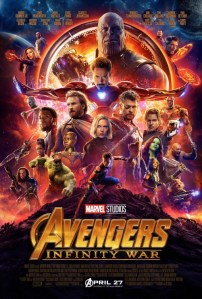 It’s hard to draw comparisons to the major commitment to long-form storytelling that the Marvel Cinematic Universe (MCU) has dabbled with over the course of ten record-shattering years of success. I can think of movie franchises that have been popular over long periods of time, like James Bond, but rarely do they keep to continuity. It’s been 18 movies and ten years since the caddish Robert Downey Jr. first stole our hearts in the original Iron Man, and its stable of heroes and villains has grown exponentially. Looking at the poster for Avengers: Infinity War, it’s hard to believe there’s even enough space just for all of the actors’ names. Infinity War feels like a massive, culminating years-in-the-making film event and it reminded me most of Peter Jackson’s concluding Lord of the Rings chapter, Return of the King. After so long, we’re privy to several separate story threads finally being braided as one and several dispirit characters finally coming together. This is a blockbuster a full decade in the making and it tends to feel overloaded and burdened with the responsibility of being everything to everyone. It’s an epic, entertaining, and enjoyable movie, but Infinity War can also leave you hanging.
Thanos (Josh Brolin) has finally come to collect the six infinity stones stashed around the universe. With their power, he will be able to achieve his ultimate goal of wiping out half of all life in the universe. Standing in his murderous way is a divided Avengers squad, with Tony Stark (Downey Jr.) still on the outs with a wanted-at-large Captain America (Chris Evans) and Black Widow (Scarlett Johansson). One of the in-demand infinity stones resides in the head of the Vision (Paul Bettany), who is in hiding with his romantic partner, Scarlet Witch (Elizabeth Olsen). They know Thanos will be coming for Vision eventually. On the other side are the Guardians of the Galaxy who have a few personal scores to settle with Thanos, the adopted father of Gomora (Zoe Saldana) and Nebula (Karen Gillan). Elsewhere, Thor (Chris Hemsworth) strikes out looking for the key to defeating the big purple menace. Thanos’ loyal lieutenants attack Earth to gather the remaining infinity stones, drawing the attention and push-back of Doctor Strange (Benedict Cumberbatch) and Peter Parker (Tom Holland). The various heroes of Earth and space unite to eliminate the greatest threat the universe has ever known.
 Avengers: Infinity War serves not as much a series of payoffs as it is climaxes, with climactic event right after another, and this time it’s for keeps (more on that below). There are moments that feel like major payoffs and moments that feel like shrug-worthy Last Jedi-style payoffs. Infinity War is the longest MCU movie yet at 149 minutes but it has no downtime. That’s because it has to find room for dozens of heroes across the cosmos. With the exception of three super heroes, everyone is in this movie, and I mean everyone. This is an overstuffed buffet of comic book spectacle, and whether it feels like overindulgence will be determined by the viewer’s prior investment with this cinematic universe. If this is your first trip to the MCU, I’d advise holding off until later. Any newcomer will be very lost. I’ve deduced the seven MCU movies that are the most essential to see to successfully comprehend the totality of the Infinity War dramatics, and they are Iron Man, The Avengers, Captain America: Winter Soldier, Guardians of the Galaxy, Captain America: Civil War, Doctor Strange, and Thor: Ragnarok. Naturally, being intimately familiar with the previous 18 movies will be best, but if you don’t have thirty hours to spare then please follow my seven-film lineup and you’ll be solid.
As far as the stakes, the MCU has been notoriously reluctant about killing off its characters, but Infinity War is completely different. I won’t spoil circumstances or names, of course, but the march of death happens shockingly early and carries on throughout. There are significant losses that will make fans equally gasp and cry. This is a summer blockbuster that leaves behind an impressive body count across the known universe and ends in a downbeat manner that will naturally trigger reflexive Empire Strikes Back comparisons. It’s hard to feel the full impact of the drastic decisions, and the grief over their losses because I know there is a Part Two coming summer 2019, and with that comes the almost certainty that several important events will be diminished or straight-out reversed. After all, in comics, nobody is ever really dead, though with movies the heroes have the nagging habit of aging. With that said, you better believe I was holding my breath during some standoffs, tearing up at some sudden goodbyes, and reflecting upon journeys shared.
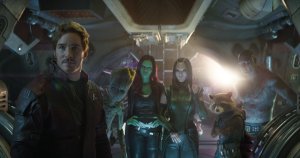 This is very much Thanos’ movie, which was one of the bigger surprises for me. Beforehand, our exposure to the big purple guy has been relatively minor, a brief moment here or a cameo there during a post-credit scene. Considering Thanos is supposed to be the universe’s biggest bad, it makes sense to finally give him his due, and that is what Infinity War does. Thanos gets the most screen time of any character and is given an honest-to-God character arc. He’s a villain who goes on an actual emotional journey as he follows a path that he feels compelled to even as it tests him personally. He finally opens up as a character rather than some malevolent force that is oft referred to in apocalyptic terms. We get his back-story and motivation, which is less a romantic appeal to Death like in the comics and more a prevention of the apocalypse reminiscent of the Reapers in the Mass Effect series. Thanos sees himself as a necessary corrective force and not as a villain. He’s never portrayed in a maniacal, gleeful sense of wickedness. Instead he seems to carry the heaviness of his mission and looks at the Avengers and other heroes sympathetically. He understands their struggle and defiance. Having an actor the caliber of Brolin (Deadpool 2) is a necessity to make this character work and effectively sell the emotions. Thanos is the most significant addition to the MCU appearing the latest, so there’s a lot of heavy lifting to do, and Infinity War fleshes him out as a worthy foe.
 As an action spectacle, however, Infinity War is good but not great. The action sequences are interesting enough but there’s nothing special and little development. There’s nothing that rivals the delirious nerdgasm of the airport battle in Civil War pitting hero-against-hero to dizzying degree. The characters are separated into units with their own goals leading to a final confrontation that feels more climactic conceptually than in execution. That’s because this is an Avengers film that falls into some of the trappings of the glut of super hero cinema, namely the army of faceless foot soldiers for easy slaughtering, the over exaggerated sense of scale of battle, the apocalyptic stakes that can feel a bit like a bell rung too many times, and even minor things like the lackluster supporting villains. Thanos’ team of lieutenants are all the same kind of sneering heavy with the exception of one, a sort of alien cleric heralding the honor of death from Thanos. Carrie Coon (HBO’s The Leftovers) is generally wasted providing the mo-cap for the Lady Lieutenant That Sounds Like a Band Fronted by Jared Leto, a.k.a. Proxima Midnight. There are far too many scenes where characters reluctantly strike a deal to give up an infinity stone if Thanos will spare the life of a beloved comrade. The film’s greatest point of entertainment isn’t with its action but the character dynamics. The fun is watching years-in-the-making character interactions and seeing the sparks fly. There’s more joy in watching Downey Jr. and Cumberbatch try and out smarm one another than with any CGI collision of a faceless army of monsters. There are so many characters that few are given fully defined arcs. Most are given beginnings and stopping places. Though the eventual sequel will have fewer characters needing to share precious screen time.
The standouts on screen are Hemsworth (12 Strong) carrying a large portion of the movie and not missing a beat of his well-honed comic rhythms from Ragnarok, Bettany (Solo) brings a sad soulfulness to Vision as a man who knows fate is likely unavoidable, and Dave Bautista (Blade Runner 2049) is perfectly deadpan as Drax and has the funniest lines in the movie followed closely by the exuberant Holland (Lost City of Z). To even say which characters deal with more complex emotions might be a spoiler in itself but there are several actors showing an emotive level unseen so far in the bustling MCU.
 Avengers: Infinity War marks a significant concluding chapter for one of cinema’s most popular series, until at least the next movie possibly makes it feel less conclusive. I pity Marvel because expectations are going to be astronomical for this climactic showdown. There are so many characters, so many crossovers, and so much to still establish, like Thanos as a character more than a spooky force of annihilation, that it feels rather breathless even at nearly two-and-a-half hours. You may be feeling a rush of exhilaration on your way out or an equally compelling sense of exhaustion. Infinity War doesn’t have the imaginative highs of a Dcotor Strange, the funky personality and style of a Guardians of the Galaxy, the wonderfully thought-out structure of a Spider-Man: Homecoming, the adroit weirdness of a Thor: Ragnarok, or even the hero-against-hero catharsis of a Civil War (still my favorite). What it does have is a sense of long-gestating finality, of real stakes and dire consequences. It’s not all pervading doom and gloom; this is still a fun movie, buoyed by crackling character team-ups and interactions. While, Infinity War won’t be all things to all people, myself included, it will please many fans, casual and diehard alike.
Nate’s Grade: B


 nathanzoebl
You must be logged in to post a comment.