Blog Archives
The Flash (2023)/ Spider-Man: Across the Spider-Verse (2023)
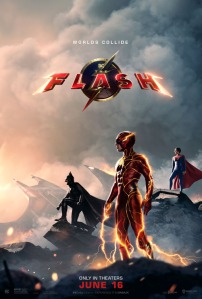
Released within two weeks of one another, two big summer movies take the concept of a multiverse, now becoming the norm in comic book cinema, and explore the imaginative possibilities and wish-fulfillment that it proposes, but only one of them does it well. Spider-Man: Across the Spider-Verse is the sequel to the Oscar-winning 2018 revolutionary animated film, and it’s a glorious and thrilling and visually sumptuous experience, whereas DC’s much-hyped and much-troubled movie The Flash feels like a deflated project running in place and coming apart. Let this be a lesson to any studio executive, that multiverses are harder than they look.
Barry Allen (Ezra Miller) has the ability to travel at fantastic speeds as his superhero alter ego, The Flash. He’s tired of being the Justice League’s errand boy and still fighting to prove his father is innocent of the crime of killing Barry’s mother. Then Barry discovers he can run fast enough to actually travel back in time, so he returns with the intention of trying to save his mother. Except now he’s an extra Flash and has to train his alternate self (also Miller) how to control his powers. In this different timeline, there is no Justice League to combat General Zod (Michael Shannon, so thoroughly bored) from destroying the planet for Kryptonians.
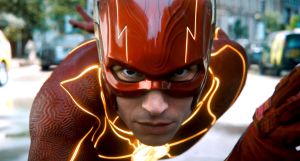
This is the first big screen solo outing for The Flash, and after none other than Tom Cruise, Stephen King, and James Gunn calling it one of the best superhero movies of all time, it’s hard to square how trifling and mediocre so much plays out as an example of a creative enterprise being pulled in too many directions. Miller was cast as the speedster almost ten years ago, and this tale has gone through so much tortured development, leaping through numerous filmmakers and writers, that its purpose has now gone from being a pillar of the expanding DC cinematic universe began with Zack Snyder’s Man of Steel in 2013 to becoming the Snyderverse’s death knell. The premise of traveling back in time is meant for Barry to learn important lessons about grief and responsibility and the limits of his powers, but it’s also intended as the reboot option for the future of these cross-connected comic franchises. It allows Gunn, now the co-head of the new way forward for DC movies and TV, to keep what they want (presumably Margot Robbie and Jason Momoa) and ditch the rest (Henry Cavill, Ben Affleck, Black Adam, Shazam, and Zack Snyder’s overall creative influence). So reviewing The Flash as only a movie is inadequate; it’s also a larger ploy by its corporate overlords to reset their comic book universe. In that regard, the quality level of the movie is secondary to its mission of wiping the creative slate clean.
Where the movie works best is with its personal stakes and the strange but appealing chemistry between the two Millers. It’s an easy starting point to understand why Barry does what he does, to save his mother. This provides a sturdy foundation to build a character arc, with Barry coming to terms with accepting his grief rather than trying to eradicate it. That stuff works, and the final talk he has to wrap up this storyline has an emotional pull that none of the other DCU movies have exhibited. Who wouldn’t want one last conversation with a departed loved one, one last opportunity to say how you feel or to even tell them goodbye? This search for closure is a relatable and an effective vehicle for Barry to learn, and it’s through his tutelage of the other Barry that he gets to see beyond himself. The movie is at its best not with all its assorted cameos and goofy action (more on both later) but when it’s a buddy comedy between the two Barrys. The older Barry becomes a mentor to himself and has to teach this inexperienced version how to hone and control his powers as well as their limits. It puts the hyper-charged character into a teaching position where he has to deal with a student just like him (or just him). It serves as a soft re-education for the audience alongside the other Barry without being a full origin story. The impetuous young Barry wanting to have everything, and the elation he feels about his powers, can be fun, but it’s even more fun with the older Barry having to corral his pupil. It also allows the character an interactive checkpoint for his own maturity and mental growth. Miller’s exuberant performances are quite entertaining and never fail to hit the comedy beats.
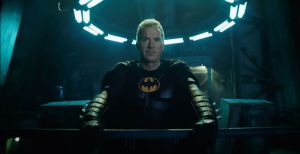
The problem is that the movie puts so much emphasis on too many things outside of its titular hero. Much was made of bringing back Keaton to reprise his Batman after 30 years. I just wish he came back for a better reason and had legitimate things to add. His role is that of the retired gunslinger being called back into action, and there’s an innate understanding with Barry wanting to go back in time and save his family, but too much of this character’s inclusion feels like a stab at stoking audience nostalgia (the callback lines all made me groan). I highly enjoyed Keaton as Batman and appreciated how weird he could make the billionaire-turned-vigilante, but he’s no more formed here than a hologram. The same thing happens with the inclusion of Super Girl a.k.a. Kara Zor-El (Sasha Callie). In this universe, there is no Superman, so she’s our requisite super-powered alien that Zod is hunting to complete his plans for terraforming Earth. She’s an intriguing character as a tortured refugee who has lingering doubts about whether humanity is worth the sacrifice, but much of her usage is meant only to make us think about Superman. She’s not given material to make her own impression, so she simply becomes the imitation of the familiar, the shadow to the archetype already being left behind. But these character additions aren’t even the worst of the nostalgia nods, as the final climactic sequence involves a collision of worlds that harkens to just about every iteration of the famous DC heroes, resurrecting several with dodgy CGI and uncomfortable implications (spoilers… the inclusion of George Reeves, when he felt so typecast as TV’s Superman that he supposedly killed himself because he thought his acting career was over, can be galling).
The action of The Flash is mostly fine but with one exceptional example that boggles my mind. In the opening sequence, no less, Barry is trying to help clean up a crumbling hospital when it collapses and literally sends a reign of babies falling through the air. I was beside myself when this happened, horrified and then stupefied that this absurd action sequence was actually happening. Barry goes into super speed to save the day, which more or less reverts the world into super slow-mo, though he needs to power up first, so we get a quick edit of him stuffing food into his face to load up on calories. We go from Barry breaking into a falling vending machine, stuffing himself in the face with snacks, getting the green light from his suit which I guess measures his caloric intake, and then grab a baby and literally put it in a microwave to shield it from danger. Just describing this event makes me feel insane. I figure the filmmakers were going for an over-the-top approach that also provides light-hearted goofiness to separate the movie from the oppressively dark grist of Snyder’s movies. However, this goes so far into the direction of absurdity that it destroys its credibility. It’s hard for me to fathom many watching this misguided and horrifying CGI baby-juggling sequence and say, “Yes, more please,” rather than scoff and shake their head. It’s not like the rest of the movie keeps to this tone either, which makes the sequence all the more baffling. There are Flash rules that are inconsistently applied to the action; Barry’s caloric intake is never a worry again, and the effects of moving a person during super speed don’t ever seem to be a problem except for one spewing gross-out gag.
While not being an unmitigated disaster, it’s hard for me to see the movie that got so many figures in the entertainment industry raving. The Flash has some notable emotional stakes, some amusing buddy comedy, and some goofy special effects sequences that run the gamut from amusing to confounding, but it’s also quite a mess of a movie, and too many of its nods to the fandom feel like empty gestures of nostalgia compensating for imagination. For all it gets right, or at least keeps interesting, it seems like another cog in a multi-billion-dollar machine, a stopping point also intended to be a reset and starting point. It feels like the character wasn’t trusted enough by the studio to lead his own solo movie even after years of buildup with Miller, nine seasons of the popular TV series, and 80-plus years of prominent placement in DC comics.
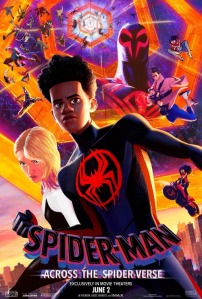
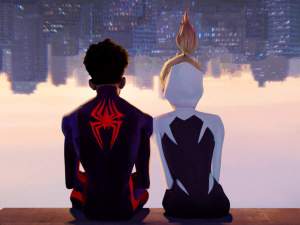
Conversely, Across the Spider-Verse is a sequel that expands an already stuffed story but knows what stories and themes to elevate so they don’t get lost amidst the fast-paced lunacy. Taking place a year later, Miles Morales (voiced by Shameik Moore) has grown into his role as the new Spider-Man for his world. He strains to meet the expectations of his parents, and keep up his grades, while fulfilling the duties of a superhero jumping into danger. When Gwen Stacey (voiced by Hailee Steinfeld) reappears to discuss joining the multiverse police, Miles jumps at the chance, having genuinely missed his other Spider friends, especially Gwen. There are countless Spider people in countless worlds, even including a Spider-T. Rex and a Spider-Car (Peter Parked Car, I believe the name was). Miguel O’Hara (voiced by Oscar Isaac) is the Spider-Man tasked with keeping order across the many interconnected multiverses, and he insists that sacrifice is essential to maintain balance, one that hits too close to home for Miles to abide.
The 2018 original is a hard act to follow, and while Across the Spider-Verse doesn’t quite overrule its predecessor it is a more than worthy sequel that has everything fans loved about the first trip. The visual inventiveness has been taken even higher, with the mixture of even more different animation and art styles. I loved seeing each Spider person and how they fit into their unique art style of their world, like the living water colors of Gwen’s world and the punky paper collage style of Spider-Punk (voiced by Daniel Kaluuya). There’s a villain that comes from a paper universe, so he resembles a three-dimensional paper construction with hand-scribbled notes appearing around him like Da Vinci’s commentary. There is something to dazzle your senses in every second of this movie. The visuals are colorful, creative, and groundbreaking with the level of detail and development. There’s probably even too much to fully take in with just one viewing. I want to see the movie again not just because it’s outstanding but so I can catch the split-second vernacular asterisk boxes that pop up throughout the movie. Going further into living comic book aesthetics, new characters will be introduced with boxes citing their comics issue reference point, and certain names and vocab will get their own citations as well. These are split-second additions, nothing meant to distract from the larger narrative. Simply put, this is one of the most gorgeous looking movies of all time, animated or live action. It’s bursting, thrumming, nearly vibrating with life and love stuffed into every nook and cranny, and it’s exhilarating to just experience a vivid, thriving world with animators operating at peak talent.
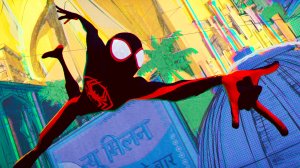
However, the movie has an engrossing story to better position all those eye-popping visuals. The worry with any modern multiverse story is that the unlimited possibilities of variations and opportunities for characters to do just about anything will overwhelm a narrative, or like The Flash, become a checklist of overburdened and empty fan service. The screenplay by Phil Lord, Christopher Miller, and Dave Callaham is all about relationships. If Miles’ relationship with his stern police lieutenant father (voiced by Brian Tyree Henry) wasn’t such an important focal point, then the emotional stakes of the movie would be meaningless. We see a relatable struggle from both sides, the parents trying to connect with their growing child and give him enough space to find himself, and the child who clearly loves his parents but doesn’t fully appreciate or understand their concerns. They worry about Miles leaving them and whether others will love and support him like his parents. Miles has to experience a wider world of possibility, but these experiences make him appreciate what he has at home, and what could be permanently lost. I don’t mind saying there were more than a few moments that caused me to tear up. I found Gwen’s storyline equally compelling, and her turmoil over keeping her secret identity and then coming out to her father was rather moving. The family bond resurfacing will get me every time, and the simple action of a hug can be as heartwarming and fulfilling as any romantic ode. Across the Spider-Verse makes sure we care about the characters and their personal journeys.
At a towering 140 minutes, this is the longest (American) animated movie ever, and it’s still only one half of a larger story. I knew ahead of time this was only the first part so as soon as we entered Act Three I kept gearing up for the cliffhanger ending. Every five or so minutes I thought, “Okay, this is going to be the end,” and then it kept going, and I was relieved. Not just because I got to spend more time in this unique universe but each new moment added even more to raise the stakes, twist the intrigue, and make me excited for what could happen next. I was shaking in my seat at different points, from the excitement of different sequences to the emotional catharsis of other moments. I cannot wait to experience this same feeling when the story picks back up reportedly in March 2024, though I fear it will get delayed to late 2024.
Even with the unlimited possibility of jokes and silly mayhem, the filmmakers keenly understand that it doesn’t matter unless we care about the characters and their fates. I am shocked that a goofy character I thought was going to be a one-scene joke, The Spot (voiced by Jason Schwartzman), could end up becoming the ultimate destroyer of worlds. I think this reflection nicely summarizes the impeccable artistry of Across the Spider-Verse, where even the moments or characters misjudged as fleeting or inconsequential can be of great power. It’s a movie that is full of surprises and thrills and laughs, all in equal measure, and a blessed experience for a movie fan. In the crush of comic book multiverse madness, Across the Spider-Verse is a refreshing and rejuvenating creative enterprise, one that builds off the formidable talent of its predecessor and carries it even further into artistic excellence that reminds us how transporting movies can be. If you see one superhero multiverse movie this summer, the choice should be as obvious as an inter-dimensional spider bite.
Nate’s Grades:
The Flash: C
Across the Spider-Verse: A
Share this:

Ant-Man and the Wasp in Quantumania (2023)
 Phase Four of the Marvel Cinematic Universe (MCU) has had a bumpy ride, coming after the significant climax of 2019’s Avengers Endgame and releases shifting thanks to COVID, with plenty of think pieces and pundits waiting to seize upon the possible decline of the MCU’s box-office and pop-culture dominance. This was still a phase with several enjoyable blockbusters with stars of old (Black Widow, Loki, Black Panther 2, Spider-Man No Way Home) and stars of new (Shang-Chi, Ms. Marvel), but it’s been defined by movies and series that have not engendered the same level of passion with fans and audiences, and left many questioning whether audiences are finally suffering from dreaded Marvel Fatigue. I cannot say, because even movies people were so-so on have generated tons of money, and it’s not like I even have to travel far in the past for a good-to-great Marvel movie with Wakanda Forever last November. However, after the muddled response to a third Ant-Man movie, as well as a bland Shazam sequel within weeks, then the old media narrative reignites the Marvel Fatigue question. I think the better question is aimed at the studio and whether we’re entering into Marvel Complacency.
Scott Lang (Paul Rudd) is trying to live a normal life, at least for a superhero that helped save the world. His adult daughter Cassie (recast as Kathryn Newton) is a social activist and a burgeoning scientific genius, and with the help of her grandad, Hank (Michael Douglas), they’ve developed a way to communicate into the Quantum Realm, the metaphysical world of subspace where Janet (Michelle Pfeiffer) was lost for decades. The entire family gets sucked into the Quantum Realm and separated, fighting to make their way in a strange new land. Among all the unorthodox beings is Kang (Jonathan Chambers), a banished interdimensional conqueror. He’s looking to break free of his prison and thinks Scott can be persuaded to help under the right pressure.
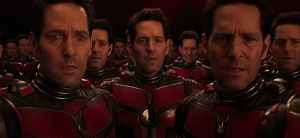 Ant-Man and the Wasp in Quantumania is blatantly weird and shapeless, which allows for some of the most silly character designs in the MCU yet, and it also adds up to so precious little. From a character standpoint, we get minimal forward progress, which is strange considering Scott was deprived of years from his daughter, missing out on her growing up into an adult. When you have a villain who can manipulate space and time, and this scenario, wouldn’t you think that the ultimate appeal would be to regain that lost time? Maybe Scott feels like this older Cassie is a version of his daughter he doesn’t recognize, and he misses the innocence of her younger self, and therefore he wishes to experience those moments he had missed. Mysteriously, this doesn’t factor in at all with Ant-Man 3. I suppose it’s referenced in vague terms, but you would think the thematic heft of this movie would revolve around lessons learned about thinking in the past, of trying to recapture what is gone, of moving onward and trying to be present for those we love, you know, something meaningful for the characters besides victory. Nope, as far as Cassie is concerned, she serves two story purposes: 1) being a plot device for how we got into this crazy world, and 2) being a damsel in distress. Kang’s threats to withhold Cassie or harm her are the motivating factor for him to collaborate with the villain. How truly underwhelming. I did enjoy a sequence where a plethora of Scotts across multiple timelines come to work together with a common goal, with every one of the many Scott’s love for Cassie being their top ambition.
As for the universe existing between space, the Quantum Verse of our title, it’s the highlight of the movie, so if the characters and their personal conflicts aren’t hitting for you, like me, then at least there’s some fun diversions to be had with every new locale and introduction. There’s an enjoyable sense of discovery like a new alien world where the possibilities seem endless. The strange quirks were my favorite. I adored the exuberant goo creature Veb (David Dastmalchian) fascinated by other creatures having orifices. There’s also a mind reader played by William Jackson Harper, who was comically brilliant on The Good Place, and just repeating the same lazy joke here about people’s minds being gross. There’s even Bill Freakin’ Murray as a lord. I enjoyed how many of the new characters, many of them strange aliens, had prior relationships with Janet, and her hand-waving it away explaining that over thirty years she had certain needs. This subplot itself could have been given more. time, with Janet having to deflect Hank’s sexual inadequacies in the face of so many virile lovers (“How can I compete with a guy with broccoli for a head?”). I think this reunited couple confronting their discomfort would be far more entertaining than yet another massive CGI face-off with thousands of soulless robots. There are interesting moments and characters in this strange new world, but they’re all so fleeting, meant to be a goofy supporting character or cameo or simply a one-off joke and not what matters.
 Like Multiverse of Madness and Love and Thunder, this feels very much like a table-setting MCU movie, meant to move the pieces along and set up other movies, chiefly the next Thanos-level big bad with Kang, first portrayed in Loki’s season one finale in 2021. I found this character version underwhelming. Part of this is that Kang’s first appearance was so memorable, spirited, anarchic, but also subversive, going against the audience expectations of what the final confrontation with the puppetmaster was going to involve. With Ant-Man 3, this version of Kang is an overly serious, well-poised castoff in a secondary Shakespeare play, which would work if the screenplay gave the guy anything interesting or memorable or even really threatening to play. He’s just another authoritarian who speaks in grand speeches of their greatness and then proves not to live up to his much-hyped billing. I worry that the next few years of the MCU will feature a rotating set of Kangs to topple with every film, which will make the villain feel less overwhelming and powerful and more like a reoccurring Scooby Doo villain (“I would have gotten away with it too, if it wasn’t for you meddlin’ heroes, and YOUR ANTS!”). This isn’t to say that Majors (Creed III) gives a poor performance. It’s just so stubbornly stern and shouty and rather boring in comparison to He Who Remains from his Loki appearance. Note to Marvel: given the serious charges that have surfaced against Majors, if you do wish to recast the role, a character who is different in many universes should be a pretty easy explanation for any change.
Is Ant-Man and the Wasp in Quantumania the beginning of the end of the country’s love affair with the MCU? Well… probably not. Just three months later, Guardians of the Galaxy vol. 3 hit it big, so maybe it’s less fatigue with big screen superhero escapades and more fatigue with mediocre movies. Maybe the public won’t be so forgiving of less-than-stellar efforts, but at this point the MCU in a moving train and some movies seem to get caught in the churning wheels of “progress.” After thirty movies and counting, some of the novelty is gone, that means just delivering the same old won’t deliver the same old results. Too much of Ant-Man 3 feels like the characters are inhabiting a large and empty sound stage. The visuals are murky and gunky and less than inspiring, and while some of the special effects are occasionally dodgy, they aren’t the travesty that others have made them out to be (though MODOK is… something, I suppose). It’s such a dank-looking movie that it feels like somebody put the light settings on power saving. There were things I enjoyed but most of Quantumania left me indifferent, and that’s the feeling I got from the cast and crew as well. I dearly missed Michael Pena’s Luis, who should have gone along for the ride just for his commentary for all the weirdness. At this point, you’re along for the MCU ride or not, and this won’t deter your 15-year investment, but coasting on its laurels will also not satisfy anyone. Not every MCU entry will be great, but they can at least try harder.
Nate’s Grade: C+
Share this:

Bulletproof Monk (2003) [Review Re-View]
 Originally released April 16, 2003:
This is one of the dumbest movies you will ever see. I don’t mean to sound overly sensational or alarmist, but this is the honest truth if you sit and watch all of Bulletproof Monk. Item #1: The bad guys in the film are –get this– the grandchildren of Nazis. Yes, that’s right, Nazis. We had to have Nazis as the bad guys. There’s actually a scene where a blonde-haired blue-eyed granddaughter wheels her decrepit Nazi grandpa around. Oh yeah, and one of the Nazis runs the –get this– Museum of Tolerance. Oh stop it, you’re killing me. Item #2: The titular monk (Chow-Yun Fat, pray for him) recruits pick-pocket Kar (Seann William Scott) to be his apprentice. Kar is an idiot. The Monk doesn’t help. His big mystery is –get this– why hot dogs and hot dog buns come in different numbers? Man, haven’t heard that one since the third grade. That would heartily explain why a character is called “Mr. Funktastic.” Item 3#: The monk teaches in stupid opposite talk (“You cannot be free until you have been taken. You cannot be cold until you are hot. You cannot die until you have lived,” you try some). One of the monk’s lessons is that the laws of physics, mind you the LAWS of physics, can be bent just by putting your mind to it. He says gravity can be overcome if you just don’t believe in it. This is insane. At least in The Matrix it had some plausibility. Item #4: The movie is a complete rip-off of The Matrix. I’m not just talking style, no, I’m talking everything. There is a scene where the monk and Kar run through a street and building, defying gravity, being chased by men in suits and sunglasses, and they get to a roof where they must combat a helicopter. What movie does this sound like, hmmm? Item #5: The visual effects are done by –get this– Burt Ward’s effects house. Yes, that’s right, the guy who played Robin on the campy 60s Batman show has an effects company. And they did the horrible work on Bulletproof Monk. This movie is so terrible at every level of filmmaking that it becomes enjoyable to watch, in the same vein as 2001’s stinker Dungeons and Dragons. I defy anyone to find merit in any of it. Sometimes you have to wonder what Hollywood was thinking.
Nate’s Grade: F
——————————————————
WRITER REFLECTIONS 20 YEARS LATER
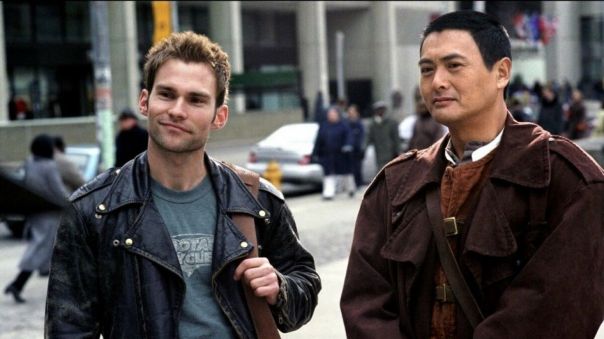
This is, without a doubt, one of the worst movies I have ever seen, and I was entertained for every bizarre, outlandish, and awful second of it. Bulletproof Monk is based on a comic book series but it’s really an incompetently designed and executed $50-million mock version of The Matrix. Within seconds of the movie, I was already laughing out loud, and I need to go into detail just for the first ten minutes, which I highly recommend to everyone as a taste setter. We open with two monks battling atop a rope bridge and, even accounting for the poor aging of special effects two decades later, it is some of the hokiest green screen I’ve ever seen. The way both characters leap, the way the movie haphazardly edits around the fight, the speedy levitating like a video game glitch, the duel spinning that goes on and on without orienting the audience, and then it all concludes with the apprentice grabbing the elder monk’s incongruous rubber sneaker before he falls. In just a short couple of minutes, we already have a clear indication what a mess this will be. Then the Nazis show up and kill the Tibetan monks and search for a mystical scroll that has the power to destroy all life on the planet, which is a good enough reason not to leave it easily accessible to Nazis. The lead Nazi massacres the monks with the exception of Chow Yun-Fat’s nameless monk who has just recently been dubbed the supreme monk in charge of scroll security. The main Nazi shoots him and the monk falls off a cliff, but not before the Nazi says “monk” a dozen times, including screaming it to the heavens to conclude the scene when he cannot find the fallen body. I defy anyone to watch and appreciate the opening on an intentional level.
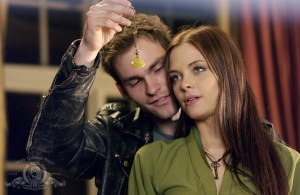
The action goes from incomprehensible to boring. It’s the kind of movie where the bad guys will just show up with a helicopter with attached Gatling guns and fire into a warehouse even though there’s been no established reason they know our characters are inside or where inside they should start firing. It doesn’t matter because all the movie wants is a sudden burst of action with a vroom-vroom going pew-pew-pew until there’s a big boom. These same goons are also perhaps the dumbest hired goons in memory, as they’ll miraculously get the jump on our heroes, complete with helicopter action, but not check behind doors when coming onto a roof. There’s a moment where Sean William Scott is overpowering a man six inches taller than him and clearly with a hundred more pounds on him. This isn’t through some ingenious example of outsmarting the competition or using torque to your advantage, it’s just Scott out-pulling this guy, and this is before he even adopts the fantasy-blurring superpowers the monk will teach him.
The action scenes are all chopped up with jumbled edits. The choreography can be passable at points but seems to emphasize the exact wrong moments, like the duel spinning monks that twirl needlessly forever in the opening or Fat leaning forward and spinning around the floor while casually eating a bowl of noodles to clown Scott. It’s badly composed and badly edited. The action scenes are so silly and stupid and then you throw in the willful distortion of gravity because, as we’re told, physics are only real if you believe in them. The world of bending reality worked in The Matrix because reality was an illusion (or, as the Merovingian would say, “an eloooschean”) and a virtual reality setting where rules could be bent. What we’re entering here is a realm closer to 2008’s Wanted, where the tried-and-true laws of nature are merely suggestions, and all the cool kids can curve bullets if they really put their mind to it. It’s not like action movies don’t already exist in a heightened world of expectations and genre pyrotechnics, and then you add martial arts mysticism on top of it with wire-fu and we’re already stretching the bounds. I think what rubs me the wrong way thoroughly with Bulletproof Monk is how lazy it is. It’s not like this monk has some special power that allows him to overcome physics, some master knowledge that will educate his protégé. He just tells him that belief is stronger than physics, like this was a sentimental children’s movie about Santa Claus. If that’s the level of explanation that’s acceptable, it’s a bad sign how much more effort will be put into any storytelling or entertainment factor in this ridiculous mess.
Let’s also zero in on the apprentice character played by Scott, an actor I’ve generally enjoyed and who was hitting his commercial heights circa 2003. He plays Kar, though when the monk informs him that he is mispronouncing the Cantonese word for “family,” the American pickpocket brushes away the cultural correction from the native speaker. Here is a man who lives and works in an old Chinese movie theater with a crotchety old Japanese owner (Mako) and where he watches classic kung-fu movies and teaches himself martial arts. I suppose Kar could be a self-taught genius but he displays little dedication or skill beyond pickpocketing, which has always been a nagging movie cheat to me where people can just barely bump into you and magically gone inside your coat pocket and lifted a wallet all without your awareness. He’s the wise-cracking sidekick-slash-protégé learning about the wider world and breaking the rules, like Neo. Except he’s mostly obnoxious and useless, that is, whenever he isn’t inexplicably taking out professionally trained mercenaries with moves he learned from Bruce Lee marathons. Kar is not even an enjoyable annoying role for Scott like in 2003’s The Rundown.
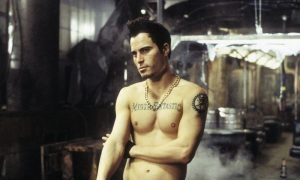
Another ridiculous character and storyline involves the leader of the underground street gang and his name is Mr. Funktastic. I know this because Marcus Jean Pirae (Girl Next) literally has “Mister Funktastic” tattooed on his bare chest (though it looks like he might be missing a well-placed “N” as well). He’s British and the leader of a gang of would-be street toughs and orphans, and it’s like the movie has dipped into something downright Dickensian, or maybe the 1991 Teenage Mutant Ninja Turtles movie. These guys are upset that Kar is stealing on their turf and challenge him to prove his mettle. I don’t know what this idiot character adds to this universe besides further making it incredulous. He and “his girl” even party in the underground raves in old subway cars, and all of this just makes me wonder what adults think goes on in subway systems. Oh, and that’s right, the female love interest is named Jade, played by Jaimie King (Sin City, Pearl Harbor), and this plays into one of the most stupid yet hyper specific ancient prophecies that tips off the monk to Kar’s potential. All you need to know about the supporting characters in this movie is that there are multiple generations of Nazis and they are running a Holocaust museum secretly to hold onto their trophies under the cover of enlightening the world about anti-Semitism and white supremacy.
Bulletproof Monk is the only movie directed by Paul Hunter, a respected music video director who has worked for decades and is responsible for Aaliyah’s “One in a Million,” Mariah Carey’s “Honey,” the “Lady Marmalade” remake from Moulin Rouge, and the unfortunately titled duet by Jay-Z and convicted rapist R. Kelly, “Guilty Until Proven Innocent.” This experience must have been so bad that Hunter swore off ever helming another feature-length movie again. The nature of music video direction attracts stylists, but this movie is so overburdened with trying to ape The Matrix on a scaled-down budget, with janky bullet-time effects and wire work (our heroes are even on the run from men in suits and sunglasses). The wire work doesn’t add grandeur and majesty to the movie because it doesn’t have the understanding of how to present it so that it looks cool; it always just seems goofy and inferior to better references. I think Hunter’s personal vision and style were just swallowed whole by the demands of making this silly movie, encroaching studio pressure, and it feels like he just gave up and the movie was benignly born by committee. I don’t blame Hunter for giving up on this movie and I guess on all movies.

Can you enjoy Bulletproof Monk on a so-bad-it’s-good level? Do hotdogs come in packages of ten and hotdog buns come in packages of eight? The answer is an enthusiastic yes. This movie is ridiculous in every moment, only forming a somehow more ridiculous whole that defies not just the laws of physics but conventional storytelling and good taste. It’s a movie that has no idea what to do with Chow Yun-Fat and his abilities, instead coasting on the idea of the man’s involvement like the geezer teasers of recent memory that don’t so much challenge their famous stars as advertise they could afford them for a weekend or two of un-taxing demands. It’s a movie that begs to exist on a dumbed-down level of action movie junk science but doesn’t understand how to, properly, have fun within that setting. It’s so transparently indifferent or lazy or ripping off its many action/sci-fi inspirations, chiefly The Matrix. John Woo is a producer on the movie and it’s not hard to see how a Woo-directed Monk would have played to its outlandish peaks. Instead, everything is an inferior version of the better reference point. It’s silly and worthy of a night with friends, adult beverages, and lots of boorish and increasingly incoherent commentary.
Looking back at my initial review from 2003, I think my criticisms still hold but I would elevate the grade simply from its unintentional entertainment value. This is pure unintended camp, and as such Bulletproof Monk might be one of the worst movies I’ve watched and still undeserving of a failing grade, and so I will charitably raise it a letter to a D grade (on a curve, a bullet curve).
Nate’s Grade: D
Share this:

Daredevil (2003) [Review Re-View]
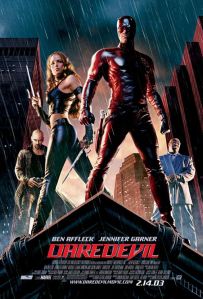 Originally released February 14, 2003:
Not as bad as it could have been. That’s the best way to sum up Ben Affleck in tights.
Nate’s Grade: B-
——————————————————
WRITER REFLECTIONS 20 YEARS LATER

For many years, 2003’s Daredevil has become my handy threshold for assessing superhero cinema: if I liked the movie better than Daredevil, it was likely a good movie, and if I liked it worse than Daredevil, then it was a bad movie. It’s also fascinating to think back to a time after X-Men but before the behemoth of the Marvel Cinematic Universe, where superheroes could be cheesy while trying to be edgy and cool. This is a time before Ben Affleck was Batman, before Jon Favreau kickstarted the MCU by directing 2008’s Iron Man, before the gritty Netflix TV series of the same character, and before Colin Farrell became a widely respected actor. Behold the cheesefest that is the big screen Daredevil, written and directed by Mark Steven Johnson, previously best known as the writer of Simon Birch and Grumpy Old Men. Johnson is an avowed superfan of the comics and blind crime-fighter from Hell’s Kitchen, but in a recent 2023 interview on Yahoo, even Johnson admits his fandom sank the movie. The director admits to trying to cram in too much to appease fans and hook new audiences, and then there’s the obvious studio notes trying to make Daredevil into more popular and well-known super folk.
In the age of dour, gloomy superheroes that are held to unreasonable standards of gritty realism, or the creative control of the MCU, it’s fun to look back and see something stand out, even for some of the wrong reasons. Daredevil is still, to this day, a cheesy delight that you can have fun with or you can laugh yourself silly. Early into my re-watch, I settled into the kind of movie I was in for, with a smile on my face and the knowledge that things were going to be goofy. Young Matt Murdock is looking for his dad when he comes across him shaking down someone for money. Oh no, his dad really is a mob goon, and after he swore to his son it wasn’t so. Matt runs away from this traumatic realization only to get magic toxic waste sprayed into his eyes, but before he does so, he drops a paper in the alleyway, and it just so happens to be his report card with straight As that he couldn’t wait to show his not-a-goon dad. I laughed out loud. Daredevil cannot be taken seriously and that’s okay. He leaves a calling card of two criss-crossed D’s written in flammable liquid on the ground, which is a mystery how someone would discover this and even funnier thinking of Daredevil writing this signature after his work. Another fine example is the entire introduction to Elektra (Jennifer Garner) where adult Matt smells her before she arrives, becomes infatuated with her enough to use his blind status as an excuse to hit on her, then grabs her hand and refuses to let her go, which corresponds to the two of them flirt-fighting on a playground. It is an absurd, and occasionally creepy, sequence from start to finish, and that’s not even accounting for the blood-thirsty children chanting against the fences for the adults to fight. I was smirking or chuckling throughout Daredevil, and while I doubt that was Johnson’s artistic intention, it’s his movie’s best selling point from an entertainment standpoint.
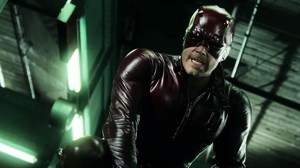 There is too much going on here, which makes all the storylines feel clipped, underdeveloped, and ultimately also worthy of derisive entertainment. We get two scenes with Elektra before she’s fallen in love with her blind man in shining leather, and then the next moment she blames Daredevil for her father’s death, and then the next moment she’s seeking vengeance, and then she’s dead, but she’s not really dead because she’s been resurrected… somehow… and spun off into her own solo movie that will be released in 2005. In this regard, being over crammed with side characters and storylines with the intent on setting up later movies, conflicts, and commercial chains of characters is very in-keeping with today’s overburdened, interconnected IP universe. It’s the same with the villains. We have two; Kingpin, the hulking crime boss played by Michael Clarke Duncan, and Bullseye, a hired killer with killer aim played with gusto by Farrell. It’s not enough to make the Kingpin the big boss of crime, the movie has to also make him literally the one responsible for the death of Matt’s father in Act One. Jack Murdock (David Keith, not to be confused with Keith David) is a washed-up boxer who wants to try again but be legit, so he ignores the warning to take a dive and is murdered for his pride. Seriously, I know his kid wanted him to win, but I think Matt would rather have an alive father with wounded pride. Bullseye is a contract killer from Ireland but why would Kingpin hire him and fly him across the Atlantic to just bump off one of the man’s subordinates? Surely there are any number of more efficient and less time-wasting manners to eliminate an underling. I guess he’s another of those comic book villains that just gets so involved in their overly complex schemes. Maybe it’s really the schemes that bring him to life (Evanescence nod) and keep the big guy from getting bored.
The action vacillates greatly from decent to ridiculous. I am absolutely positive that the Fox executives saw those 2002 Spider-Man box-office records and said, “Hey, put some of that building jumping stuff in there too.” This is a Daredevil where he just dives face-first off of buildings and plummets to the ground. Remember, he has advanced hearing and other senses, but he’s still supposed to be a human being, not a mutant, not a meta human, not a god. Diving face-first off of high buildings seems like a sound way to practice your eventual suicide. He also leaps and kicks like he’s in The Matrix, including dodging bullets too, which seems like his skills are pushing the “faster than a speeding bullet” realm of other heroes. In fact, Daredevil’s abilities seem to rival that of Superman with his intense hearing. Apparently, the man can lock in on a specific conversation blocks away. It’s these heightened moments of super impunity that make him less vulnerable even though the movie also wants to highlight his scars and bruises. This is the guy that needs to sleep in a water-filled sensory deprivation chamber (so pruny) but will throw himself into battles with multiple points of competing gunfire. The fight choreography has some slick moves but is also fairly mediocre, and it’s worse when the rubbery CGI Affleck is slotted into action to make even more preposterous moves (never dodge when a glorious backflip could do). I was beside myself when Bullseye collected broken stained glass, that he plucked from the air like snowflakes, and then piled into his hands like a server balancing stacks of plates, and then he started hurling them at Daredevil. For a guy whose notoriety is not missing, you think he would readjust or figure out that a guy flipping backwards is always going to have a turning middle of mass.
 The movie is struggling to juggle all these characters, all these storylines, and all of its would-be brooding themes and Catholic imagery of sacrificial bloodshed. It makes the movie feel like you’ve accidentally sat on the remote, speeding up the process of its 105 minutes. Johnson had a longer cut of the movie with a whole subplot of lawyer Matt Murdock, but that’s not what the people come to see. The character arc of Matt finding love and losing love is rushed and feels insufficient, more of a checkbox for the studio. Given the material, it’s surprising that Affleck and Garner would fall in love in real life and get married in 2005 (and then divorced in 2018). The arc of him learning restraint, to not be “the bad guy,” is laughably simplified to the point where just not killing the big crime lord is supposed to qualify as applause-worthy character growth. It’s enough that the crusading journalist (Joe Pantoliano) trying to bring light to this case decides to become part of the conspiracy and withhold information, enough so that he stares out of his home, jacket slung over his shoulder, and sees Daredevil watching from atop the street (how would he know?) and says, “Go get ‘em,” like he’s Mary Jane Watson cheering on her web-slinging beaux. It’s moments like this that you can’t take seriously but can appreciate as goofy mid-level supes entertainment. Daredevil is not great but it could have been much worse.
After the reception of this movie, it’s surprising that Affleck would want a second chance to suit up as a superhero, but then again being Batman is like playing Hamlet in our modern society. With Daredevil, he does seem uniquely qualified as a handsome man staring blankly. Garner was ascending thanks to her breakout role in J.J. Abrams’ Alias, and Farrell was becoming a Hollywood It boy in 2003 before finding a higher artistic ceiling with 2008’s In Bruges. He’s a hoot in the movie but he might have twenty total spoken words. It’s more a performance of grunts and scornful growling. Duncan was a controversial casting but an early example of race-blind casting traditionally white comics characters. It’s rare to find an actor of imposing size and stature that can still, you know, act well. With respect to Vincent D’Onofrio, who was my favorite part of the Netflix Daredevil series, but if the Kingpin were cast today, it would be Dave Bautista (Knock at the Cabin) hands down. Johnson was given another chance at superhero franchise-making with 2007’s Ghost Rider, which was also enjoyably goofy but also bad. I feel for the guy because he was fighting battles for genre credibility and superhero universe logic that most of the filmmakers in the MCU today take for granted. He walked so that James Gunn could run.
Twenty years later, Daredevil still kind of works as my superhero movie grading threshold. It’s not traditionally good but it has a nostalgic charm, an artifact of a time before the eventual boom. It’s so goofy and so early 2000s-edgy (the hard rock soundtrack is its own contribution of hilarity). With the right mindset, I think Daredevil can be fine albeit dated and cheesy passing enjoyment.
Re-View Grade: C+
Share this:

Black Panther: Wakanda Forever (2022)
 It’s hard to talk about Black Panther: Wakanda Forever without first discussing its missing whole, namely Chadwick Boseman. It was a shock when Boseman died during the summer of 2020 of terminal cancer, which he had kept hidden except for a small number of close confidants. I remember hearing the news and being in disbelief, figuring this must be another celebrity death hoax, but then the terrible news was confirmed. It’s one of those celebrity deaths that you remember when you found out, mostly I think because here was an actor in his prime and headlining Oscar-nominated movies and precedent-setting blockbusters. It felt too soon to be gone. It felt wrong. It’s that grief that the characters of Wakanda Forever are also wrestling over. Reflecting real life, the sequel to 2018’s hit Marvel Cinematic Universe (MCU) entry elects to have T’Challa (Boseman) pass away in the movie as well, off screen, and from a cause more human than super, dying from a disease. The movie is knowingly channeling our grief for the loss of Boseman into a story about characters also mourning the loss of this good man. This loss hangs over the entire movie and provides it more gravitas and emotional depth it would have had otherwise. Wakanda Forever is a suitably exciting and expansive sequel, especially following the empowering cultural model writer/director Ryan Coogler followed with the first film, but it’s hard not to feel the loss of Boseman, both in presence and in storytelling.
We open with Shuri (Letitia Wright) diligently trying to save her brother’s life only to be out of time. The nation of Wakanda is in full mourning, losing their champion and king. In the wake of this loss, the outside world sees opportunity. Having come out of hiding, Wakanda is being pressured to share its valuable vibranium mineral resources with other nations, and some are eager to take them by force if necessary. This has inadvertently created a gold rush for vibranium, and the C.I.A. has discovered traces of the rare mineral on the ocean floor. This undersea incursion has provoked a heretofore unknown underwater community into action. Namor (Tenoch Huerta) is a super-powered mere mutant, able to fly with tiny wings on his heels, and able to breathe under the sea just like the inhabitants of Talochan. Namor has declared war on the surface world and seeks Wakanda to be an ally, and if not that, then their first conquest.
This is a movie dominated by the women of Wakanda, and they bring the fury. Everyone is processing the loss of T’Challa in different ways. Shuri is rededicating herself to her scientific research, as she blames her brother’s death on her inability to solve his ailment in time. T’Challa’s mother, Ramonda (Angela Bassett), has been appointed leader of Wakanda and must represent her nation’s interests while still grieving for her son. Nakia (Lupita Nyong’o) has retreated from the larger world of spycraft to open a school in Haiti. Okoye (Danai Gurira) is supposed to be the chief security officer for Wakanda, and she busies herself with new threats and armor rather than dwell on being unable to save her king. Each character feels the weight of the loss and opens up reflections of grief, as each knew T’Challa on a different level: mother, sister, lover, protector. The attention that Coogler allows for their and our grief allows the movie to work on a communal cathartic level (I teared up a few times myself). Wright (Death on the Nile) has some heavyweight emotional moments, and the movie is structured around her path of healing as well as the wayward detour of vengeance and hate. It’s a conclusion that hits upon the expected spectacle of superhero action but hinges upon, foremost, an emotional arc.
Coogler is two-for-two when it comes to creating dynamic, engaging villains who have strong perspectives that cause the heroes to better reflect upon their own roles. Killmonger (Michael B. Jordan) is one of the MCU’s best villains, and I think it’s interesting that the first Black Panther ends with the hero realizing the villain’s perspective is right and adjusts from there. With Wakanda Forever, we get Namor protecting his people, and his reasoning sounds a lot like the Wakandan leaders who wished to remain separate from the larger world in the earlier film. The background for Namor is completely rewritten by Coogler and co-writer Joe Robert Cole and for the better. They’ve invigorated the character by attaching a rich Mesoamerican culture to Namor’s people and history. We have another hidden world of minorities that are super-powered and developed beyond the reach of colonialism. The flashback for Namor, dating back to the sixteenth century, is startlingly effective, establishing his strange origins, the great change for his tribe to being sea-dwelling, and what happens when he returns to the surface world to honor his late mother’s funeral wish. When he returns, the Spanish have built plantations and have captured the indigenous into being their chattel. Namor sees this exploitation in the name of a foreign God and swears off the surface world. This cultural angle imbues the character’s focal point but it’s also just plain neat to watch an ancient Mesoamerican culture given the big screen superhero treatment with reverence and awe. By providing a compelling villain, it also makes the emotional stakes more compelling. We’ll likely side with the women of Wakanda, but you might also be rooting for Namor too. I also think it’s fun that the underwater Atlantean prince character for DC and Marvel is portrayed by a Mexican-American actor and a Polynesian actor. 
Where the movie doesn’t work as well is with its introduction of Riri Williams (Dominique Thorn, Judas and the Black Messiah) who is the human McGuffin. She’s a brilliant engineer who accidentally discovers a vibranium detection device, but why does nabbing her matter to Namor? With the device already created, the proverbial horse has left the barn. Kidnapping the inventor after her technology has already been utilized seems too late. There’s no real reason she could not be replaced with an inanimate flash drive except that this establishes the character up for her 2023 Disney Plus TV series. It’s this larger corporate portfolio push that I’ve always worried about with each new MCU edition, now 39 in total, that they will be forced to set up future movies and shows at the detriment of telling a focused and satisfying movie. The MCU movies I’ve generally liked the least are the ones that fall under this pressure the most, like Age of Ultron, Iron Man 2, and Multiverse of Madness. I found the character of Riri Williams to be fun, but her inclusion always seemed like a distraction to the larger story. I’m sure you can make thematic connections, a young brilliant black woman finding solace in Wakanda, but if you were looking to trim down an already overlong movie, I think Riri is the easiest to eliminate.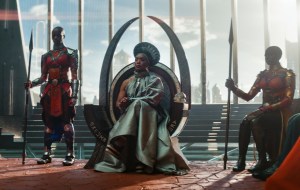
With Black Panther: Wakanda Forever, Phase Four of the MCU has officially closed and Phase Five will begin shortly with Ant-Man 3 in February, 2023. In the wake of the conclusion of the multi-phase Infinity series and 2019’s Endgame, this phase felt dominated by closure and exploration. The Disney Plus series provided little conclusive offshoots for many of the original Avengers characters. It’s also been a period of experimentation, with Marvel broadening its tone and scope from martial arts movies, spy thrillers, romantic epics, and familiarizing audiences to the concept of the multiverse with good movies (Spider-Man: No Way Home) and not-so good movies (Doctor Strange 2). And of course Wakanda Forever is the biggest edition yet on fulfilling a sense of closure, though it had never been intended to be before Boseman’s passing. It’s a sturdy sequel with a palpable emotional undercurrent and an engaging villain to boot. I called 2018’s Black Panther as agreeable, mid-tier Marvel entertainment, and I’d say the same for its sequel. However, with Boseman’s passing, it’s naturally elevated. Wakanda Forever is long and overstuffed but also emotional and engrossing and satisfying.
Nate’s Grade: B+
Share this:

Black Adam (2022)
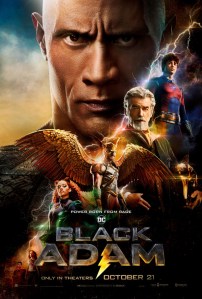 Dwayne “The Rock” Johnson has been eyeing a superhero costume for over eight years. He’s been attached to a Black Adam project since 2014. The character is best known in DC comics as a villain for Shazam, although the mythology and rules of that universe get some revisions under this new vehicle. Johnson plays a Middle Eastern godlike figure who shuns being a selfless champion of the little people. If you’re an easy sell for superhero movies, there’s enough visual bravura and smash-em-ups to at least sate your appetite for CGI fisticuffs. By the lowered standards of the DCU, this is a thoroughly average movie. It has a certain childlike Saturday morning cartoon appeal that doesn’t try too hard to be taken seriously and goes about its business with a workmanlike degree of efficiency. The action is easy to follow and the obsessive slow-mo style feel like comics splash pages come to vivid life. I liked the warm, golden color palate and Mid-East setting as distinguishing features. There is an audience for Black Adam, I am certain, but it’s also getting harder to just accept average superhero movies given the glut of superhero cinema. The hero’s journey of this would-be villain becoming more a grumpy antihero is rote and predictable, including a really lame villain to make Black Adam look less bad in comparison. I didn’t care about big CGI demon goon fighting for control of a magic throne. The character arc is supposed to be about agency and responsibility, but it gets reduced down to a morally simplistic “I guess I won’t kill all the bad guys all the time” re-evaluation. The plotting and structure is also misshapen; the entire first half of the movie feels like the second half of some earlier movie we missed out on. The fighting can also get annoyingly repetitious. The Justice Society has two major members, Pierce Brosnan as Dr. Fate and Aldis Hodge as Hawkman, and the rest are afterthoughts, as if the producers leveraged including more big screen debuts in case the central character wasn’t enough of a draw. Anyway, the Justice Society and Black Adam go through half a dozen fights and I just got bored by their bickering. The premise of a Middle Eastern superhero, a champion for the Muslim world, would be a radical idea worth exploring the geopolitical ramifications, especially the fears this could raise in conservative and twitchy Western societies that this could be seen as akin to a superhero arms race. That direction might veer away from the intent of the character but that’s also the far more interesting story. Still, it’s The Rock as a superhero, and his enormous charisma can carry even an ordinary action movie to greater heights.
Nate’s Grade: B-
Share this:

Thor: Love and Thunder (2022)
 Thor: Love and Thunder reminds me a lot of Guardians of the Galaxy vol. 2, admittedly a film I’ve come more around on since my initial viewing in 2017. When Ragnarok was released later that same year, it was an irreverent blast, a breath of fresh air for a franchise that didn’t really know what to do with its hero, and under director Taika Waititi’s sensibility, the character had new, witty life. A similar response occurred with the original Guardians of the Galaxy as the world fell in love with the offbeat characters and storytelling and style from writer/director James Gunn. Before 2014, we didn’t know what to expect with a Guardians movie. When the sequel was released, we had a template of expectations, and the follow-up didn’t feel quite so fresh, quite so lively, and falling back on repeating too many of the same moments or jokes because it’s what was expected. It felt a bit burdened with the creative shackles of upholding these expectations. The same feeling of same-ness permeates Love and Thunder, and to be fair that’s also because the success of Ragnarok raised our expectations for a Waititi MCU movie.
Thor (Chris Hemsworth) is trying to find his way after the events of 2019’s Endgame. He’s gotten in shape, spent some time palling around with the Guardians of the Galaxy (returning in 2023!), and reconnected with the love of his life, Jane Foster (Natalie Portman). She’s been chosen by Thor’s old broken hammer to be its new wielder, granting her superhero status. Except in her human status, she’s dying from stage four cancer. Just as Jane comes back into his life, Thor might have to come to terms with losing her all over again.
 This movie just doesn’t feel like it has the same natural prankish energy of Ragnarok, though part of this again might be myself acclimating to Waititi as a filmmaker and storyteller. Prior to Ragnarok I had only known him for the delightful vampire mockumentary What We Do in the Shadows, and since Ragnarok Waititi has become his own industry, winning a screenwriting Oscar, lending his name and acting to hit TV shows, including a version of What We Do in the Shadows, and even Disney wants his mark on Star Wars. In short, the man is everywhere. In 2022, we now have a much better idea of what to expect from a typical Waititi project. Love and Thunder is recognizable to the man’s omnipresent brand, and still a fun movie with some solid gags, but it also feels a bit sloppy and repetitive.
I kept thinking about all the powerful dramatic potential in the different storylines that are barely explored because the driving plot is a universe-hopping caper to save a bunch of kidnapped children (yes, the children represent something, the next generation, renewal, legacy, but let’s carry on). Tackle the pathos of Jane Foster, who in her normal human state has her body betraying her. She feels weak and incapable of the greatness she feels burdened to still accomplish with her declining time. With the power of Thor, she becomes a superhero, and with super swole arms. However, this power trip also has its own ironic downside. Every time she powers up, the magic hammer is actually draining more of her life force, meaning she’s actually speeding up her terminal illness. Here is a character given a dire situation and an escape and yet that escape only worsens the illness. There’s such powerful drama there to explore as she comes to terms with how to spend her final moments, among them reconnecting with her super ex-boyfriend. This could have sufficed as the entire movie and told from her perspective.
Then there’s Gorr the God Butcher, gloriously played by Christian Bale like he’s in a James Wan horror movie. Here is another example where the villain doesn’t just have a sympathetic back-story but where they are correct in their aims, though maybe not in their methods (think Killmonger arguing Wakanda should do more). Gorr is tired of the gods crushing the little guy with their general entitlement, indifference, and selfishness. These fancy deities aren’t worthy of worship. The power structure needs upending. It’s easy to get behind Gorr’s plight and see connections to our own imbalanced world. This too could have sufficed as the entire movie and told from his perspective. Now, things could have gotten even more interesting and complicated for Jane, because she’s not officially a god unless she’s yielding Thor’s hammer and joins those rarefied ranks. It would pose another question of whether wielding this power would be worth her remaining time, especially with a heat-seeking missile coming for her on a righteous quest of vengeance that is slowly eating him alive. Both are dying but can they fulfill their goals?
 If these storylines had been given careful development and the necessary time to breathe, Love and Thunder could have been one of the most interesting movies in the ever-expanding MCU cannon. Instead, it’s galloping to work so hard to stick to the Waititi brand expectations, to reignite our feelings of Ragnarok, and so these promising elements ultimately get shortchanged by hit-or-miss comedy bits. I liked several of them even despite myself. The set piece where Thor and Jane and friends travel to Omnipotence City has such imaginative heights. Russell Crowe is having a grand time as a hilarious Greek caricature of Zeus that is more concerned about the upcoming company orgy and brushing feta crumbles from his beard. I loved the almost Lego Movie-esque zany sight gags of the cohabitation of gods from different religions (Korg’s god sits on an iron throne of scissors, its own visual joke). It’s such a fascinating concept that I wish we could have spent even more time here. Let’s see the Egyptian gods mingling with the Sumerian gods while pranking some weird alien deity. The set piece serves two narrative purposes: gathering a powerful magic weapon, and learning the gods are sitting out the battle with Gorr for their own short-sighted self-preservation. It’s mostly a pit stop. Again, there was more pathos that could have been explored here as people meet gods, but this is my cross to bear. The general banter is amusing and has more hits than misses even if the hit percentage is lower. I laughed every time the magic axe would silently pop onscreen in jealous judgement. I even enjoyed the screaming goats even though from their first moment they are the exact same joke. Regardless, whenever Thor and company would travel to a new place and I heard that familiar goat scream, it would make me giggle despite my reservations.
I also had my qualms with the concept of Eternity, a magical place located at the center of the universe but destined to grant a wish to whomever gets there first. It’s too transparent as a plot device and its very existence this far into the MCU creates too many nagging questions. In the history of the universe, no other creature successfully reached this wish-granting locale? And if this existed at least to Thor’s understanding, then why didn’t the characters think about this as an option to thwart Thanos and his universe-halving finger snap? I know the answer, because it wasn’t written into a movie until now, but this is the drawback of throwing ultimate power plot devices without more careful context. Eternity could have been a secret just to the inner circle of the famous gods, unknown to all but a few, but even that strains some credulity. If Zeus is such a carousing hedonist of legendary status, I’m sure he would have either blabber-mouthed its existence or sought it ought for his own gain. I genuinely liked the set piece at Eternity, a small planet that sucks all color from existence, making the imagery even more striking like the inky panels of a comic. The same question happens when Thor shares his power late in the movie. Couldn’t the Avengers have used this too?
I fully acknowledge that my criticisms are butting against the movie Waititi wanted to tell. I’m pushing for its inherent dramatic potential while it wants to be a more comic and romantic adventure about the power of love. I think by the end it gets there, and the dramatic confrontations have some emotional weight to them, especially about the idea of what we leave behind for others after we’re gone. Although, even this is mitigated by the general stakes-lowering reality that death never seems so permanent in the world of comics and monetarily useful IP. It’s a joke how many times Loki has been brought back from the dead and Thor doesn’t even know that his trickster brother has been brought back from the dead again (again again). We’ve now established time travel and an emphasis on the multiverse of alternate universes, which means at a moment’s notice, any meaningful death or sacrifice has the possibility of being undone. This is also the reality of a moneymaking machine that has dominated the movies and pop-culture landscape for 14 years. No death is ever going to be for real in this environment so why should I put so much emphasis on the dramatic potential of what losing a loved one, or your sense of self, can have? I can sit back and enjoy the lesser, but still enjoyable, Waititi quirk on display for two hours of silly.
 Hemsworth (Spiderhead) is so sharply skilled at comedy that I feign to remember his previous existence as a dramatic actor. He’s still on the same sublime, charismatic yet blithely self-effacing vibe he was with Ragnarok. Portman (Annihilation) comes back after close to a decade for a clear reason to leave her mark on what had been an otherwise forgettable character and giving her a renewed sense of power and direction and agency. Bale (Ford v. Ferrari), as mentioned, is fantastic. I appreciate that his character isn’t physically huge and bulky. He looks quite the opposite, like he’s wasting away, like somebody slathered an ashy coat of paint from living-skeleton Bale after The Machinist (yes, also the obvious Voldermort comparison). He is relishing every teeth-stained syllable as a nightmare creature living from the shadows. The prologue with his character is heartbreaking and yet understated (and truth be told, having young children in my household, it hit me more personally), and I turned to my fiancé and said, “I’m supposed to not like this guy?” I wish the opening credits were then a montage of Gorr seeking and slaying wicked gods. Bale is playing his role like he’s definitely not in a Waititi movie about goofy screaming goats; he’s playing Gorr like a tragic hero of myth. This is why I would have been happy had the whole movie been told from his perspective. The new characters from Ragnarok suffer the most and become sidelined as “Others Along on the Quest.” For Korg, this is fine, but for Tessa Thompson’s Valkyrie, I mourn her absence. Also, both characters are definitively queer now, though Korg might be more a question, making Love and Thunder the gayest movie in the MCU, and just after Pride Month, so take that for what you will, folks.
As a fun matinee, Love and Thunder will amuse and brighten, even if its comedy highs don’t quite hit as high this time under the burden of franchise expectations. Love and Thunder is a movie that will be best known for Portman and Bale, both of whom elevate the scattershot material with their dedication and professionalism. It might even be known for Crowe’s hammy scene-stealing, or the super-powered cadre of cute kiddos, or even the screaming goats. It’s a movie more of moments and ideas, too many underdeveloped or lacking the gravitas they deserve, especially concerning Jane and Gorr. I feel like a grump bemoaning that the big superhero movie should have more time spent on a woman contemplating her own existential demise as well as man’s relationship and fealty to our gods. Still, it’s Waititi doing his signature brand of quirk with $200 million of house money from Disney. Thor: Love and Thunder is a lesson in diminished returns but when you have Ragnarok as your starting point, it’s at least guaranteed to still be worth your two hours once and deliver some chuckles and smiles.
Nate’s Grade: B-
Share this:

Morbius (2022)
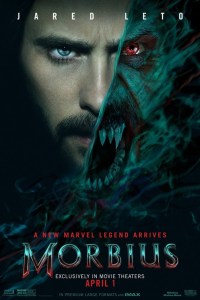 Not the train wreck the advertising made it seem, Morbius is merely a bland superhero retread that reminded me of the early 2000s superhero output like Daredevil and the Tim Story Fantastic Four. Having been delayed almost two years thanks to COVID-19, the film was released on April 1 for full unintended irony, and it’s a silly mess but also nothing worth getting too worked up over. Method actor extraordinaire Jared Leto (Suicide Squad) plays Dr. Michael Morbius who is suffering from a rare disease and finds a solution via a serum mixing vampire bat DNA but it has some consequences. He has super powers but needs to feast on blood every six hours and is dreading the point where he may not be able to resist the allure of feeding on humans. It’s a very Jekyll/Hyde concept, man trying to control his inner demons made literal, and once again we have a villain that essentially has the same powers as the hero. Matt Smith (Doctor Who) play’s Morbius’ childhood friend who also suffers from the same rare blood disease, but Dr. Morbius refused to share the cure because he explains it’s a “curse,” although maybe let the man suffering make that personal health choice. Bless you, Matt Smith, because you’re the only one having any fun with this movie, and that includes in the audience. Leto is actually fine though not much about the Morbius character is really imparted. The action sequences are erratic and the stylistic flourishes, like the “look at me” slow-mo ramps and the inexplicable wispy colorful smoke clouds trailing Morbius in action, hamper the ability to even discern what is happening onscreen. Maybe that’s on purpose after two years delay. The movie establishes a basic structure, series of goals, antagonist, and problems efficiently enough to make it to the end credits after 90 minutes. It’s just that we’ve come to expect better from our super hero cinema by now. As a disposable monster B-movie, Morbius is okay. It’s not recognizably campy, it’s not so-bad-it’s-good, it’s just a generic origin story/Dr. Jekyll and Mr. Hyde territory with a lot of dropped subplots and subpar CGI. I have my serious doubts about Sony’s plan to hatch solo movies for all these different Spider-Man villains, and the creakiness of this plan is even more evident with their contrived post-credit scenes trying to awkwardly establish their retinue of villains to confront Spider-Man. Does Morbius know who Spider-Man even is? Morbius the movie and character just feels too half-hearted for anyone to care.
Nate’s Grade: C
Share this:

Doctor Strange in the Multiverse of Madness (2022)
 The first Doctor Strange is one of my favorite movies in the ever-expanding and incredibly popular Marvel Cinematic Universe (MCU). It was a visually audacious and imaginative sci-fi action movie that just had one standout set piece after another. The original director, Scott Derickson, departed over creative differences with the MCU brass, and having now seen Doctor Strange in the Multiverse of Madness, I might have the same stark differences of opinion.
Dr. Stephen Strange (Benedict Cumberbatch) is still nursing his regret over his former flame, Dr. Christine Palmer (Rachel McAdams), who is now getting married to another man. During their wedding reception, Strange helps a young woman being chased by a giant one-eyed monster. America Chavez (Xochitil Gomez) is from another universe and has the power to open portals to other dimensions. Unfortunately, she doesn’t know how to control these powers and they only seem to activate when she’s reached a level of fear. Strange protects America Chavez from a malevolent force that wants to gain her unique power and open the multiverse for conquest.

It’s been almost ten years since Sam Raimi directed a movie and Multiverse of Madness is at its best when it feels most like a Raimi picture. The man’s beginnings in low-budget horror comedy are still evident, and it’s that campy combination that entertained me the most in Multiverse of Madness. There are some creepy, goofy moments that definitely reminded me of Evil Dead 2 and Army of Darkness. If you’re not a fan of these heightened levels of horror that incorporate slapstick and camp, then you might roll your eyes and find these moments to be too goofy for the MCU. As much attention as this movie has gotten for being darker, which is a tad overblown, it’s also one of the goofier Marvel movies. The MCU has a relatively breezy, wiseacre sense of humor that can occasionally undercut some of its more serious or sentimental moments of drama, but with Multiverse of Madness, Raimi is inviting the audience to laugh and cringe in equal measure. A horror sequence where reflections are a vulnerable point has both laughs and creeps. It’s a different kind of tone for a Marvel movie, which propelled my entertainment level when it occurred. Raimi getting to play once again in the superhero sandbox and still retain his signature style and impulses, which is exactly what I would want from this man as a blockbuster filmmaker. I loved the match cuts of Wanda experiencing two different universes in one smooth camera move. I cackled when Doctor Strange took his final form for the finale, and how ridiculous it looked, and that screenwriter Michael Waldron (creator of Loki) set it up with Chekov’s corpse.
For a movie with “multiverse” in its title, we don’t really get much of an exploration of the alternate universes. The concept of a multiverse is mostly kept at a thematic level and as a delivery system for wishes. The villain views the prospect of a multiverse as their means of fulfilling a vision of their life that is unrealized in their present reality. Strange thinks of an alternate version of himself where he got the girl. Beyond these reflections, that’s really about it. We jump to about two alternate realms and the only real exploration we have is that, hey, in this version of the universe people walk on red lights. It’s a bit trifling considering that there are endless imaginative possibilities, some of which are showcased during some stylish visual transition sequences crashing through different realms. It feels far too small for a concept with boundless possibility. Strange was already in another multiverse movie six months earlier with 2021’s Spider-Man: No Way Home. That movie also explored the idea of second chances, redemption, and sacrifice but far better. For a better multiverse movie that really lets loose on the wild possibilities of alternate realities, as well as grounding the feats of imagination in relatable human drama enriched by its theme, see the amazing Everything Everywhere All At Once.

I’m not just disappointed because the movie doesn’t take full advantage of its plot possibility, it’s because what it settles for is so much more predictable and disposable as fan service. This current phase of the MCU is setting up a dilemma of multiverse proportions, so things are getting very expansive and their slate of Disney Plus TV series are becoming more incorporated into the direction they’re heading. The danger starts to become whether the entire process is becoming more and more specialized, insular, and directed for the most hardcore of hardcore fans, and whether or not such a heavy undertaking, across platforms and franchises, can be done well. Marvel has earned some faith from me with how they’ve handled their interconnected franchises and film universe, but my main complaint with 2010’s Iron Man 2 and 2015’s Age of Ultron was that they were spread too thin trying to set up other movies and offshoot franchises, so this still remains a danger. As the MCU gets more and more successful, and integrates more characters, this is always a risk, the balancing of the spinning plates, making the movies their own but fitting into a larger whole. With Multiverse of Madness, it feels like the mighty gears of the Marvel machine are a little too forceful and crushing for this endeavor. This doesn’t feel like an essential next chapter in Doctor Strange’s ongoing cinematic journey. The first film was already about him regretting what his life could have been, an expert surgeon, and learning to accept his new role as a sorcerer and ultimately sacrificing his ego and old sense of self. We’re running through the same motions this time but instead of lamenting he could have been a great surgeon he’s lamenting he could have gotten the girl. It’s again coming to terms with his personal regrets.
The other notable aspect of the multiverse is the inclusion of fun but diverting cameos that don’t so much as serve this story as provide winks and nods of what is down the line. I won’t spoil who shows up in the middle portion of the movie but there are a few alternate version characters and a few characters that have yet to be fully integrated in the MCU, meaning these early appearances also serve as confirmation of the intention to bring these characters, stories, and worlds into the ever-expanding reach of their storytelling. This sequence is best as throwaway fun and has some neat visual moments including a disturbing death played for effective gallows humor. Ultimately though, it’s meaningless because it’s one other universe of characters who only serve as reflections of the past and coming attractions for the future. Even the mid-credits sequence is just more of this (and it’s becoming a trend). It’s disposable fan service and no more meaningful than serving as a tacit promise of what’s to come.
But the biggest problem I have with Multiverse of Madness is also its biggest storyline, which concerns a certain character making a big villainous turn and becoming the primary antagonist. I was getting a lot of Game of Thrones season 8 vibes from this plotting insofar as the end result is not out of the question but it sure feels like we skipped a lot of necessary stops along the way. I won’t be able to go into greater detail without delving into spoilers, so dear reader now is the time to skip to the last paragraph if you wish to remain pure. I like the concept of a friend becoming a foe because we already have an investment in that relationship and therefore there’s more at stake with the fights and possible consequences. That’s the kind of drama that lends itself to heartache and tragedy. When it feels forced, that’s a tragedy of characterization.

I have to imagine that fans of Wanda Maximoff (Elizabeth Olsen) a.k.a. The Scarlet Witch are going to be let down from this movie’s calamitous turn of events. I wasn’t the biggest fan of the character prior to the WandaVision TV series, which I also found to be pastiche that wore thin before finally settling on what the show’s core would examine, the messy process of one woman dealing with her powerful grief. I liked that they didn’t excuse Wanda’s misdeeds, namely holding an entire town of people hostage to her reality-bending whims. However, by the end, the show had her come to terms with letting go of Vision and her fake life with him she had manifested. To then have her next film appearance revolve around her universe-destroying mission to get her fake kids back doesn’t just feel like backtracking, it feels like we’ve erased the character journey and growth from her TV series. If you hadn’t watched the series, then this villainous turn would feel especially jarring. The whole “You’re a monster’/”No, I’m a mother” hysterical villain lady is tiresome. This is why I was making the Game of Thrones season 8 comparisons. It’s cool to see Wanda fully unleashed and how formidable she can be, but it’s at the expense of wiping out her character’s growth for a single-minded crazy momma. It’s reductive. If she can assume the life of her multiverse self, why not just do that? Also, what’s the great urgency? Wanda wants to kill America Chavez and absorb her power so she can jump through multiverses. Why can’t she just wait a matter of months to allow America to learn how best to control her powers? The movie never explains why the villain can’t just work with her magic MacGuffin rather than kill her. And then it all comes to Wanda realizing, “Oh no, what have I become?” and allowing herself to die as penance for the hundreds if not thousands she has killed over the multiverses. It’s all just a rather dispiriting development and questionable end for a character that I feel deserved better.
Walking away from Doctor Strange in the Multiverse of Madness, I feel like there’s a better movie buried under everything (everywhere all at once). This movie was originally supposed to come out before Spider-Man: No Way Home, and America Chavez was the original reason for Spider-Man’s multiverse dilemma, but it was delayed because of COVID. Raimi has gone on record that they figured out the plot of the movie while filming and conceived of the ending halfway through the film shoot. That’s not a great place to be for creativity, but then again, neither is being the twenty-eighth film in an ongoing interconnected chain of franchises. I won’t harp on that too much because plenty other MCU movies have excelled under such conditions and requirements, but every now and then one of Marvel’s movies just feels like a sacrificial offering to the greater altar of the MCU’s need to keep progressing with its multiple projects. Doctor Strange in the Multiverse of Madness isn’t a good Doctor Strange sequel, it isn’t a good multiverse movie, and it could have even used a little more madness, as those were my favorite moments, excluding the sharp villainous turn. I’d consider this film in the bottom tier of the MCU, among the likes of Iron Man 2 and Age of Ultron, other similar altar offerings.
Nate’s Grade: C+
Share this:

Spider-Man (2002) [Review Re-View]
 Originally released May 3, 2002:
Hollywood take note, Spider-Man is the prototype for a summer popcorn movie. It has all the necessary elements. It has exciting action, great effects used effectively, characters an audience can care for, a well toned story that gives shades of humanity to those onscreen, fine acting and proper and expert direction. I recommend movie execs take several note pads and go see Spider-Man (if they can get in one of the many sold out shows). What summer needs are more movies in the same vein as Spider-Man, and less Tomb Raider’s and Planet of the Apes.
Peter Parker (Tobey Maguire) is a dweebish photographer for his school yearbook clinging to the lowest rung of the popularity ladder. He lives with his loving Aunt and Uncle who treat him like a son. Peter has been smitten with girl-next-door Mary Jane Watson (Kirsten Dunst) ever since he can remember, but he’s been too timid to say anything.
At a field trip to the genetically altered spider place (there’s one in every town) Peter is snapping pictures when he is bitten by one of the eight-legged creatures. He thinks nothing of it and awakes the next day to a startling change. He has no need for his rimmed glasses anymore and has a physique that diet ads would kill for. He also discovers he can cling to surfaces, jump tall building in a single bound and shoot a sticky rope-like substance from his wrists. Hairs on his palms and shooting a sticky substance from his body? Hello puberty allusion! Peter tries to use his new abilities to win the girl and when that doesn’t work out he turns to profiting from them. He enters a wrestling contest in a homemade costume and proceeds to whup Randy Savage. Following the fight Peter’s Uncle Ben is dying after being involved in a car jacking Peter inadvertently let happen. Haunted by grief Peter becomes Spider-Man and swings from building to building as an amazing arachnid crime stopper.
 But every hero needs a villain, and that is personified in the Norman Osborn (Willem Dafoe), scientist and businessman. Osborn is experimenting with an aerial rocket glider and a dangerous growth serum. When the military threatens to cut his funding and shop elsewhere Osborn haphazardly undergoes the serum himself. What it creates is a duality of personalities; one is Norman, the other is a sinister and pragmatic one. The evil alter ego dons the glider and an exoskeleton suit and calls himself the Green Goblin. The Goblin destroys all that are in his way, and has his yellow eyes set on the pesky Spider-Man.
The casting of mopey-eyed indie actor Tobey Maguire over more commercial names like a DiCaprio or a Prinze Jr. (I shudder to think of a Freddie Prinze Jr. Spider-Man) left some people scratching their heads. Of course the casting of Mr. Mom to portray the Dark Knight likely got the same reaction in the 80s. Maguire plays the nerdish and nervous Peter Parker to a perfected awkwardness with his sensitive passivity. When he explores his new powers with exuberant abandon then begins crime fighting, we as an audience are with him every step of the way pulling for Peter.
Kirsten Dunst was also a surprising casting choice but works out very well. She allows the audience to fall for her along with Peter. Her chemistry with Maguire is great and could be a major reason why rumors have surfaced about the two leads taking the onscreen romance off screen.
Willem Dafoe is one of the creepiest actors in the business (though he made an effective creepy-free Jesus) and delves deliciously headfirst into the cackling menace of Spider-Man’s nemesis. Dafoe, with a face that looks like hardened silly putty and jutting rows of teeth, relishes every maniacal glare and endless evil grin. But instead of being one-note he adds certain amounts of sympathy and understanding as Norman Obsorn. No one could have done this role better than Dafoe.
 Director Sam Raimi was most known for his cult splatter house Evil Dead series, but he’s got a new resume topper now. Raimi was chosen over a field of directors because of his passion for the character and story. Raimi brings along integrity but with a joyous gluttony of spectacular action sequences. He expertly handles the action and daring-do all the while smoothly transitioning to the sweet love story. He has created the movie Spidey fans have been dreaming of for 40 years.
Spider-Man swings because of the respect the source material has been given, much like 2000’s X-Men. The story follows the exploits of the comic fairly well but has some stable legs of its own. The multitudes of characters are filled with life and roundness to them, as well as definite elements of humanity. You can feel the sweet romance budding between the two young stars, the tension and affection between Osborn and son, but also the struggle with Norman and his new sinister alter ego.We all know villains are the coolest part anyway. Isn’t that the only reason the last two Batman films were made?
There’s the occasional cheesy dialogue piece but there is that one standard groaner line. In X-Men it was Halle Berry’s query about what happens when lightening hits a toad. In Spider-Manit was the response to the Green Goblin’s offer to join him, to which he asked “Are you in or are you out?” (Obviously channeling George Clooney). The dreaded response: “You’re the one who’s out Goblin. Out of his mind!” Sigh. Maybe a well placed “freaking” before “mind” would have made the line better.
Spider-Man is the best kind of popcorn film: one that leaves me anxiously anticipating the sequel (which will come out two years to the day the first one was released).
Nate’s Grade: A-
——————————————————
WRITER REFLECTIONS 20 YEARS LATER
Twenty years ago, 2002’s Spider-Man changed the landscape of studio blockbusters. Since swinging into theaters twenty years ago, we’ve gone through three different actors playing three different Spider-Men in three different franchises, plus an Oscar-winning animated movie, and oodles of toys. If X-Men’s success in 2000 made Spider-Man possible, then Spider-Man’s record-breaking success, the first film to earn more than $100 million in a weekend, made the Marvel Cinematic Universe, the defining chain of blockbusters for our age, possible. X-Men provided a template and Spider-Man was the confirmation for those curious bean counters in studio offices. From there, it was a gold rush to secure their own superhero franchise. Universal launched Hulk. Fox launched Daredevil and the Fantastic Four. Warner Brothers started trying to reboot Batman and Superman again. It was an IP scramble and not every property proved worthy (see: 2004’s Catwoman, or better yet don’t see it). For better or worse, 2002’s Spider-Man ushered in the modern era of superhero mega blockbusters. Now with twenty years of hindsight and influence, it’s interesting to go back to the OG Spider-Man, especially after the nostalgic revisit with 2021’s Spider-Man: No Way Home, and see why this movie was so successful.
Created in 1962 by Steve Ditko and Stan Lee, the friendly neighborhood Spider-Man took a circuitous path toward big screen stardom. He had a popular cartoon in the 1970s, a cheesy U.S. tv show, and Lee even licensed the character into a 1978 television series in Japan that is well and truly insane. The main character is a racer injected with alien blood, from planet Spider no less, who leaps into a giant robot to fight giant monsters (it’s basically Power Rangers before Power Rangers). Legendary genre house Cannon Films bought the film rights and then sold them to Carolco, the studio killed by Cutthroat Island’s bombing in 1995. Carolco reached out to reported king of the (blockbuster) world James Cameron to rewrite an existing draft with Peter in college. He envisioned Edward Furlong as Perter Parker and Arnold Schwarzenegger as Doctor Octopus. Later, his new Spider-Man script was reset in high school, brought back in a previously absent Mary Jane, and involved Electro and Sandman as the primary villains, and apparently was going for an R-rating with language and an intended sex scene between Peter and Mary Jane on the Brooklyn Bridge, which brings into further question his organic web-shooting inclusion.
 It all fell apart when it was revealed Carolco didn’t actually own the full rights to Spider-Man. After Carolco’s bankruptcy and the ensuing legal wrangling, Sony eventually ended up with the rights for a deal that is absolutely brutal in retrospect: a mere $7 million plus five percent of film grosses and half of merchandising. That’s it. For a character that earns over a literal billion dollars a year in merchandise even when there are no movies being released. As of this writing, No Way Home has made almost two billion dollars world-wide at the box-office.
Sam Raimi was picked as director because he was so passionate for the project, owning over 20,000 comic books and knowing the character and his universe inside and out. It’s not like Raimi was some schlub that Sony just drafted from the street in a contest either. The man was a genre visionary from the beginning with the chaotically kinetic Evil Dead movies. When the studios were unsure about tapping him for comic book movies, Raimi decided to make his own with 1991’s Darkman, a gloriously fun, weird, and gory Phantom of the Opera-esque action movie with Liam Neeson and Frances McDormand. After that, Raimi expanded his style by directing four very different movies in different genres (The Quick and the Dead, A Simple Plan, For Love of the Game, The Gift), and by that time the studios had come around to embracing Raimi as their trusted shepherd of coveted comic book IP. Director Chris Columbus also turned down the job first, instead opting for the Harry Potter cinematic universe. I don’t know if Spider-Man would have been as successful with anyone else at the helm. Let’s not pretend that the movie would have been a commercial failure with some other director attached (I’m sure, prior to Cutthroat Island, there was a very real chance of “Renny Harlan’s Spider-Man” – that’s right, the hits just keep on coming, Cutthroat Island). But Sam Raimi perfectly encapsulates the combination that has worked so well for other later superhero directors: passion and peculiarity.
Raimi is a first-rate visual stylist with the comedy of The Three Stooges, and I don’t mean this as a negative. He has a rare, instinctive sense, much like Cameron and Steven Spielberg, about what will play best on the big screen with a packed crowd, those kinds of blockbuster moments. The one thing you can say about any Raimi feature is that they are exploding with verve and energy. The man nailed a camera to a plank of wood and chased after Bruce Campbell in 1980, and he’s been running wild ever since. That gleeful, childlike sense of entertainment exists in a Raimi picture. His horror instincts and influences are readily apparent in his editing, tone, and setup, across all pictures and genres. Horror is such a precise genre, and Raimi knows the ins and outs of developing scares, tension, and payoffs, and he also knows that editing can make everything sing. A Raimi film might be more self-conscious with its antic camera angles, movements, and editing, but this man is a natural conductor of the chaos of moviemaking. He is a natural for big stages and has only made one movie for less than a hundred million in the last twenty years (2009’s throwback, Drag Me to Hell). It’s also a little disappointing that Raimi has only directed one movie in the last 13 years (2013’s failed franchise-starter, Oz: The Great and Powerful).
 Raimi’s movies also have a deep sense of humor, twisted and loony, not afraid to get gross or goofy. When I watched Drag Me to Hell, his first film after leaving Peter Parker’s orbit, I was busting a gut as often as my stomach was churning. Raimi’s Spider-Man 2 sequence where Doctor Octopus (Alfred Molina) awakens and his cybernetic arms slaughter the doctors has been repeatedly re-evaluated in social media circles as a nigh perfect sequence. Raimi isn’t afraid to veer to the edges of what is considered conventional; he’s not afraid to be goofy just as he’s not afraid to be sincere. This is a director who embraces his peculiarities but also has a reverence for visual storytelling and blockbusters. With the exception of Oz, I cannot recall a Raimi film that just felt like a slapdash work-for-hire job. The man has a signature style. It was what Marvel insisted they wanted when they hired him to direct the Doctor Strange sequel (now in theaters!). Finding auteurs with peculiar sensibilities, zany humor, and new ideas for studio projects is what has allowed directors such as Joss Whedon (Avengers), James Gunn (Guardians of the Galaxy), Taika Waititi (Thor: Ragnarok), and Jon Watts (the Tom Holland Spidey films) to flourish.
Revisiting OG Spider-Man, we have two more versions of this universe to compare with, three if you count the animated escapades of 2018’s Into the Spider-Verse, so some things just seem a little more quaint, like an old story from your childhood. Part of this is because the character and his lore have become as familiar in popular culture as Batman or Superman. That’s why the Holland version skipped the origin part of how Peter Parker got his super powers and lost his dear old dead Uncle Ben (just like we don’t need to ever see Batman’s parents die onscreen again). The first two Spider-Man films still hold up; I re-watched Spider-Man 2 shortly after 2017’s Homecoming to see which was the overall best Spider-Man film, and it was still very good. They’re earnest and cheesy but easily transporting and you feel the passion for those involved. Raimi clearly loves this character and wants you to love him as well, and we do. There are a few moments that just speak to the dated nature of culture from twenty years hence, like Peter Parker cracking an unfortunate homophobic joke about his wrestling opponent. The special effects are still strong throughout and benefit from Spider-Man’s costume lacking exposed skin. The action sequences are a bit tame and especially lacking compared to even later Spider-Man films.
Maguire might even be regarded as the least favorite Spider-Man actor at this time after the successful revamping of Andrew Garfield’s version from No Way Home. He stands out from Garfield and forever boyish Holland. He was 26 when he began playing Peter the high schooler. His prior indie film roles would make him seem more likely to be cast as a moody school shooter than as a clean-cut superhero (I guess it worked for Ezra Miller), and the fact that he pulled it off is a credit to both Maguire and Raimi. Maguire hasn’t been able to escape the long shadow of Spider-Man and he seems to be fine with that, having only appeared in one movie since 2014. The conniving celebrity poker player that Michael Cera played in Molly’s Game is believed to be Maguire in real life. Dunst was maligned throughout the original trilogy and you can clearly see her disinterest in the character. To her credit, this iteration of Mary Jane is fairly one-dimensional. She’s little more than the object of Peter’s desires and a damsel to be saved. Dunst has become a much more interesting actress after shedding the Spider-Man universe with Melancholia, season 2 of Fargo, and The Power of the Dog, earning her first Oscar nomination.
 Dafoe had to beat out many actors for the role that seems perfected by him. Raimi intended for Billy Crudup (Almost Famous) to be his Norman Osbourn but the producers worried Crudup was too young to portray a middle-aged scientist. Dafoe’s normal face already resembles the Goblin mask. He demanded to do as many of his stunts as possible, and apparently he was a natural learner with the Green Goblin’s winged glider. Dafoe loved the part so much he begged Raimi to find ways to include him again even after his character died. I grew to love him even more after No Way Home reminded everyone of the mental anguish of Norman, a man torn apart by his demons. Dafoe is so maniacal and vulnerable and indispensable in this role. It’s no wonder they even bent space and time to have him generously visit us once more.
I was worried that my older review from 2002 was going to be overly flattering, gushing about what the filmmakers had gotten right and a little too pleased with results that haven’t aged as well with so many others running with what Raimi and company established. It’s still a solidly enjoyable movie that moves along at a steady pace and still finds time to have important character moments so that the quiet still matters paired with the spectacle. We’ve had a generation grow up with the Maguire Spider-Man trilogy and for many of us these early superhero films have a special place in our hearts. There’s a nostalgic factor. The first Spider-Man was more successful in creating an exciting kickoff than X-Men, though that film had bigger hurdles in adaptation, and it still has a lasting appeal at its core because of the skill and passion of the filmmakers involved. I’m very curious about revisiting 2007’s Spider-Man 3, where it all fell apart and seeing if it’s due some begrudging respect, though I doubt it (I know what I’ll be watching in 2027). Spider-Man is a little dated but still swings mighty high.
Re-View Grade: B+


You must be logged in to post a comment.