Blog Archives
Mercy (2026)
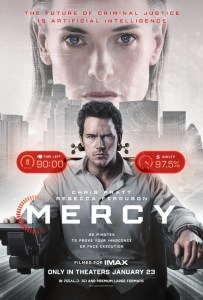 Detective Chris Raven (Chris Pratt) wakes up strapped to a chair. An A.I. judge (Rebecca Ferguson) informs him that he has been changed with the murder of his wife, and thanks to the new Mercy program instituted by the Los Angeles justice system, he will have 90 minutes to prove his innocence to a “reasonable doubt” level of 91% guilty (is that all a “reasonable doubt” is going for these days?). If he fails to convince the A.I. judge, then he will be terminated at the end of those 90 minutes. Start the clock.
Mercy is essentially a screen life movie with a high-concept twist, but at no time was I captivated with the mystery or intellectually satisfied by the application of its storytelling angle. We’ve seen similar movies recently, notably 2018’s Searching and far far less notably the 2025 War of the Worlds, where the movie screen is an extension of a computer screen that holds the borders and tools of our storytelling. In a way it reminds me of the found footage boom of the early 2010s, a hot gimmick that could get studio execs to say yes to projects that they would otherwise have passed on. However, there still needs to be careful ingenuity about how to incorporate these elements and, even more importantly, how to work within the limitations of your gimmick. With Mercy, our main character is basically trying to prove his innocence in real time with an A.I. judge who really functions more like an A.I. assistant, granting him access to people and databases even his police position would not have immediate access to. The recreation of the crime scene with the clues and evidence has a very Detroit Become Human feel (that’s a sci-fi video game that plays more like a movie). The A.I. judge is willing to help out this convicted man as long as he doesn’t admit guilt, because then it’s straight to execution time. For ninety minutes, Chris Raven has to crack his own murder case. The real-time element is meant to provide a sense of urgency, a literal ticking clock, but it’s also quite the misstep when your movie isn’t very good. This allows the audience to mentally count down how much time is left before your movie is finally over. The screen life aspects are pretty superficial and visually dull even if the graphics as being pulled around like interactive three-dimensional objects. The fact that this movie was shot for IMAX is astounding.
 The problem is that the plot is too predictable at every turn. We have a future criminal justice system made for automation and expediency, so it’s not going to be too much of a leap to suspect it might not be operating at the level of success its proponents profess. There’s a long history of stories presenting a new technological leap that is meant to be fool-proof that, shocker, is proven to be anything but. Right away, the audience is already going to be suspecting that the Mercy system is compromised or at least prone to errors like our present criminal justice system. We can safely assume that our protagonist is innocent, and if that’s the case then the implicit question is how many others who were tried and convicted were also ultimately innocent? Some might call it a death row metaphor but it’s literally the same thing just with a high-tech A.I. spin. The next question becomes is the potential error a sign of the limitations of assigning such power to seemingly infallible computers, or is it being deliberately compromised and manipulated? Are certain powers-that-be using this as an excuse to eliminate undesirable peoples and populations? The case of Chris Raven is meant to unveil a larger, systemic problem of justice not being served. And yet, the movie doesn’t exactly explore this obvious implication.
I’m going to dive into spoilers with this next paragraph because I think it’s worthwhile and also I don’t think you’re missing anything with Mercy. If you already assume that Chris is innocent or set up, there’s only so many other places you can go as a story. So with that warning addressed, the Mercy system is really easy to trick, as evidenced by our eventual culprit who has the know-how to digitally erase and alter security footage. Didn’t know this guy had those kinds of skills but, hey, people can surprise you or, more accurately, when the screenplay calls upon enough coincidences. However, there’s another layer of conspiracy afoot. This one guy is responsible for setting Chris Raven up because his own brother was accused and executed by Mercy even after he gave the police an alibi that was ignored. He wants vengeance for the injustice done to his family. This means there’s also the unraveling of who was responsible for this other guy’s wrongful arrest and execution, and wouldn’t you know it happens to be Chris Raven’s own partner, who needed the Mercy program to be seen as trustworthy. The movie never deals with the implications of this. It doesn’t really confront the moral turpitude of killing an innocent man, and it doesn’t think big picture to ask how many other innocent people have been sacrificed as cover. Amazingly, the last line of the movie involves Chris Raven saying, “Humans and A.I., we all make mistakes. And we learn.” What? Technology shouldn’t make mistakes. Alexander Pope didn’t say, “To err is human, and also these new contraptions. Have you seen these textile factories? Wild.” We don’t expect technology to fail us, especially if we are putting judgement over life and death as one of its tasks. This sounds like dubious excuse-making for a system literally killing innocents in the name of the law, and yet our hero treats the whole revelation like, “Well, you gotta break some eggs for an omelette.” It’s such a callous, incompetent response to an immediate problem that his own police force is exploiting. Yet the movie doesn’t blame the faulty A.I. system, which I repeat even some random guy was able to hack and manipulate, and instead looks at it as a tool, like when people try to separate guns from gun violence. However, in this case, the gun is making its own calculations on who deserves to die, and, again, being manipulated by randos. This gets a little more unseemly when you realize that the movie studio’s release is from Amazon, which would very much like you, dear citizen, to stop villainizing A.I. and accept its omnipresence in your new digital life.
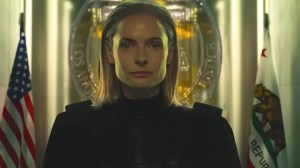 Mercifully, Mercy holds to its countdown, though there’s an extra period of “stoppage time” with an action sequence outside of the chair as climax. The mystery is dull, the plot is predictable (if you don’t suspect who the real killer is after 30 minutes, this might be your first movie, so I’ll tell you now – they get better), the world building is underwritten (who needs an exploration of the large-ranging moral implications of this system when we get police on drone cycles!), and the fun of its creative ingenuity is gasping. It’s forever going to be the Chris-Pratt-stuck-in-a-death-chair movie. This concept could have worked but there needed to be significant revisions, especially unpacking the larger implications for this new system of justice outsourcing justice to all-knowing machines. That’s not this movie. Mercy isn’t even overtly critical of artificial intelligence, instead excusing its faults as “user error” from bad actors. It’s a film too afraid to have any strong sentiments, which makes for a pretty lifeless time at the movies. The machines have won.
Nate’s Grade: D+
Share this:

The Electric State (2025)

The fire hose that has been the Netflix cash flow may be reigning in, but that didn’t stop the streaming giant from making another attempt at a huge blockbuster to rival those Hollywood designs for the big screen. The Electric State is a $320-million sci-fi adventure spectacle from the Russo brothers, Anthony and Joe, the team that gave us the highs of the Marvel Cinematic Universe (MCU) later Avengers movies, and the lows of, well, everything after their MCU movies. Netflix is actively trying to compete with the theatrical experience brought to you at home, so they take these big expensive swings on large-scale, quippy, action vehicles like Red Notice and 6 Underground every so often to mixed results. Netflix has become the go-to place for a kind of movie that has altogether vanished in the studio sphere, the mid-tier movie for adults. We need those stories. What Netflix hasn’t done as effectively is compete with the big studios for comparable expensive action spectacle. The Electric State is further proof.
In an alternate America, robots were created and given menial tasks by mankind. Naturally, they grew tired of this and attempted a revolution for their equal rights. Mankind was on the brink when an unlikely savior emerged. Tech CEO Ethan Skate (Stanley Tucci) created an army of humanoid drones controlled via VR helmets. This disposable army of avatars was able to beat back the robots and forced their leader, literally an animatronic Mr. Peanut (voiced by Woody Harrelson), to sign a “peace treaty.” The results exiled the robots into a walled off wasteland in the American southwest, and humanity went on its merry way, now with VR-controlled avatars that allowed every American the luxury of staying on their duff. Michelle (Millie Bobby Brown, contractually obligated to be in every Netflix original not starring Joey King) is an orphan WITH AN ATTITUDE. One day she’s greeted by a pint-sized robot looking like the Cosmo cartoon character her younger brother was obsessed with. The little robot says he is her brother and Michelle realizes that maybe she has some family left after all. She and the Cosmo bot are on the run from scavengers and bounty hunters trying to stop their fateful face-to-face reunion.

The Electric State is lacking such vital creative sparks to feel anything more than the ramshackle sum of its derivative sci-fi parts. It began as a melancholy mixed media book from the same Swedish author behind Tales From the Loop and it’s become a giant lumbering mess of mediocre and familiar elements. It kind of feels like the newer Ready Player One-era Steven Spielberg trying to emulate early E.T.-era Spielberg, but then that would give us an artist on the level of Spielberg, and that’s not what we have here. It’s standard adventure fare with a brother and sister crossing the country to save the day and thwart a big evil corporation along with scrappy, rakish rogues joining them along the way for fun and life lessons. Chris Pratt’s character is so transparently a Han Solo clone but he’s an empty vest with eye-rolling quips. This is an alternate history story with a literal robot uprising but it devotes so little interest in its own world building and history. The movie essentially castigates all the robots to a forbidden zone that naturally will be visited by our plucky heroes. The majority of the movie is watching these robotic avatars (reminded me of the Geth from Mass Effect) for people who can’t be bothered to leave their VR helmets. If this new world has devolved human interaction into a series of screens (commentary!) then maybe let’s explore that with meaning. If robots are going to be an exploited labor class (commentary!) then maybe let’s explore that too. If this is a future world where robots have been exiled and feared as an Other (commentary!) then let’s explore that too. There’s one moment where Evil Steve Jobs enjoys a VR recreation of his deceased mother, except he admits that this version is the version he wishes he had, and the real figure was far less doting and far more abusive. That’s an interesting concept, that VR offers users the ability to live in a reality of their own desires. But this isn’t a movie that wants to take time to explore interesting and relevant themes, because that would get in the way of action set pieces and goofy robot action. Seriously, there’s one fight where a U.S. postal service robot is literally hurling undelivered mail at a killer robot avatar and succeeds. Because this isn’t a deep movie, we have essentially good robots and bad robots, and if you’re shocked that the robots may have been misunderstood, well congratulations on seeing your first movie. I assure you, they mostly get better from here if you give them a chance.
The inclusion of robots is so underutilized, tapped for ready sidekicks and villains, that you could have replaced them with aliens or clones or any other disposable science fiction element. In this parallel world, Walt Disney created the robots for Disney World, so wouldn’t it be worthy of exploring that history and the sense of Victor Frankenstein-style paternal obligation? Wouldn’t the robots retreat to their ancestral home of Disney World? Or perhaps they view this as the birth of their enslavement? What about different generations of robots, especially older models being replaced with newer ones, thus creating class warfare within an exploited secondary class? What about looking at robots having to subsist off junk to continue with their meager existences? What about robots still living in forbidden zones that are hunted by the government and its armada of robot drones? There are so many possible ideas and stories and characters that are open through the inclusion of robots, but the movie doesn’t have the interest or drive to make them matter. As a result, it’s mostly a swift-moving travelogue with some ugly-looking or cranky guests riding shotgun. Occasionally The Electric State will remember, oh yeah, robots can do stuff people cannot, like having one of them hack into a server or having a smaller robot inside like a high-tech Russian nesting doll.
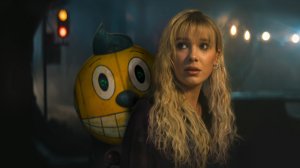
I think it was a combination of the uninvolved storytelling as well as the character design that left my emotional attachment to be null and void. I hated the Cosmo character design. He’s this big spherical head with little skinny limbs, but the head might as well be an un-moving mask. A giant toothy smile is drawn on the front and it’s so inexpressive. Also, the fact that the kid has to exclusively rely upon only using sound bytes from this canceled cartoon series makes for a quickly annoying little brother. I didn’t care about this kid, human or robot, and I didn’t care if Michelle ever reunited with her brother. Then the fact that the movie’s climax involves such a serious and emotional choice seems absurd considering what has been underdeveloped up until this abrupt shift in intended emotional stakes. It’s such an out-of-left field escalation that I almost laughed out loud at what the movie was asking me to feel, as well as what it was asking its protagonist to decide. Likewise, the betterment of robot-kind is given such little recognition, culminating in a showdown between the avatar of good robots and evil robots essentially going to revise a treaty that we don’t know much about. For a movie about how easy it can be to distance ourselves via technology, it sure fails to reasonably make the viewer care about robot equality.
Then there’s the fact that this whole enterprise cost an astounding $320 million for Netflix to platform it as its next hit movie to doze off to while in the middle of doing laundry. The Russo brothers have retreated back to Marvel to handle the next two Avengers movies, and it seems like at a time where both parties have missed and could use one another. Outside of Marvel, the Russos have delivered one super expensive action movie (The Grey Man), a super expensive spy action series (The Citadel), and one lackluster biopic that used every Scorsese stylistic trick they’ve been saving up (Cherry). With The Electric State, we have the brothers’ more familiar mixture of large-scale action and special effects in a mass appeal studio blockbuster space. However, every movie outside of Marvel has made me question their capabilities of handling these big movies. I know the Russos can be fantastic with comedy, as some of their TV episodes are the best of recent memory, and their stewardship of the big MCU movies in the wake of Joss Whedon’s departure was undeniably successful. So why isn’t The Electric State successful? It comes down to the screenplay which is so disinterested in its own ideas, world, and characters, held together by the familiarity of other adventure blockbuster staples like loose chewing gum. It’s a movie replete with famous faces and big effects but feels so devoid of life and creativity, a blockbuster automaton intended to hold the attention but rarely engage one’s imagination and emotions.
Nate’s Grade: C
Share this:

Guardians of the Galaxy vol. 3 (2023)
 It’s taken me longer to review the third, and reportedly final, installment of the Guardians of the Galaxy trilogy because I didn’t think that I nor my family had the emotional bandwidth when the movie was originally released to herald the summer. I’ve been a big fan of writer/director James Gunn’s comic book escapade efforts with the Marvel Cinematic Universe (MCU), as well as his first DC entry, 2021’s The Suicide Squad, the best DC film of the new era, so I’ve been highly anticipating a third Gaurdians ever since the second ended six years ago. Of course all fans have had to wait a little longer after Disney fired Gunn in 2019 for offensive social media posts they already knew about before the first Guardians film in 2014, and then they came to their senses and re-hired one of the most unique voices working within their giant sandbox of superheroes. The reason I decided to wait even longer is because I had been warned by many of my critical colleagues about the heavy thematic nature of the third entry, namely the frequent sequences of animal abuse. My family had to put down their household dog of over ten years in late April, and having to re-open that wound by watching pretend animals get abused was not the best for any of our emotional states. And so I waited until it was available on digital and in the comfortable sanctity of my home, and I alone in my family watched Volume Three, partly as a harbinger of future warning over what scenes to skip over for them. It’s a fitting end to a strange and funky series of movies that taught us to feel real emotions over racoons and trees, and even though I’d rate this as last in its respective Guardians standing, it’s still a winner and a topical reminder that these big-budget blockbusters are only ever as good as when the passion is evident.
The Guardians are on a mission to save their friend, Rocket (voiced by Bradley Cooper). He’s been incapacitated and is sought after by his creator, The High Evolutionary (Chukwudi Iwuji), a maniacal man with a god complex who is trying to create a perfect life form. This forces the Guardians to learn more about Rocket’s tragic past as a cruel science experiment, and it brings back Gomorrah (Zoe Saldana), though she’s not the same woman who fell in love with Peter Quill (Christ Pratt), and he’s having a hard time reconciling the different green girls. They’ll have to work together to rescue Rocket and stop the High Evolutionary from further harm.
 This is a movie built around the back-story and emotional connections of Rocket, a character that, prior to Gunn’s first film, had fewer than a dozen comic appearances but has had an outsized influence over the movies. If the first movie was about the formation of our team, and the second was deepening the supporting characters, as well as exploring Quill’s daddy issues, then the last movie is all about how we say goodbye to the ones we love. Volume Three is clearly structured like Gunn’s fond farewell for these characters rather than merely a pause in their contractually obligated appearances (whether Marvel overrules Gunn is another matter). It makes the interaction more meaningful and also more emotionally rich, not just because certain characters might perish, but because of the journey we’ve been privileged to hop along for, how far they’ve come and how much they matter to others, and by extension us, the audience.
Case in point: the emotional evolution of Rocket Racoon. He began as a surly visual joke, a teeny mammal with a big gun and a big attitude. It wasn’t until a drunken outburst in Volume One that you got a glimpse of the trauma and pain beneath that antisocial demeanor. With Volume Three, he gets sidelined pretty early, which means the majority of the time we spend with Rocket is through a series of flashbacks with baby Rocket and his cute pals, all ongoing science experiments (one needs only to recognize the absence of these childhood friends as grown-ups to anticipate where this is inevitably heading). In some ways, it is cheap and manipulative. It’s not hard to make an audience feel extreme emotions by introducing a slew of adorable animals as well as a villain who hurts them and sees them as expendable experiments undeserving of sympathy. I wish Gunn hadn’t gone so hard in this direction because it feels excessive in the ideas that the film bluntly communicates. Yes, a storyteller will need time to establish a baseline of relationships, conflicts, and looming change, but do we need six or seven flashbacks to settle the concept of animal testing and animal cruelty being a bad thing? I credit Gunn with making his thematic intent unambiguous; this is wrong, and you will feel it explicitly. However, sidelining Rocket for a majority of the movie and having characters project onto his unconscious body, while providing more insight through a system of excessive and heavy-handed flashbacks, might not be the best model for ensuring this character gets his due when it comes to this showcase. Quill keeps calling Rocket his “best friend” and I’m trying to remember when this happened. I re-watched Volume Two this summer, and now consider it the best of the trilogy, and I cannot recall the specific events that bonded these two bickering alphas into inter-species BFFs.
 Another facet of Gunn’s relevant themes is personified in the romantic realizations of Quill. Not to get too complicated, the current Gomorrah is a past version of herself and not the one who joined the Guardians, fell in love with Quill, and died in Infinity War. She’s back, but from her perspective she never left, and this moon-eyed dolt keeps projecting his feelings onto her. I respect that Gunn doesn’t try and wave away this complication, nor does he mitigate the agency and importance of this Gomorrah not having to follow the same path as her predecessor. The easy thing would have been for Quill to wait and for this new/old Gamorrah to see the same qualities that made the old/dead Gomorrah fall in love. It would be like one of those soapy romances where a person suffers amnesia and gets to fall in love with their spouse all over again. Gunn doesn’t do that. These are different people, and despite the aching desire of Quill to rekindle what he had, it has been lost, and this needs to be acknowledged and accepted. “I bet we were fun,” she says, and it’s a bittersweet summation that extends beyond the Guardians.
There is still Gunn’s signature sense of style and humor while checking the boxes of a big-screen action blockbuster. There’s an infiltration set piece that plays like a goofier Mission: Impossible setup but in a squishy bio-mechanical facility that reminded me of the eccentric and schlocky sci-fi diversions personified in the Lexx movies and TV series. There’s an entire planet of animal-human hybrids that feels wasted as further proof of the High Evolutionary’s already established evil. The entire character of Adam Warlock (a beefed up Will Poulter) is a himbo that definitely feels lacking in larger purpose now that the Infinity Era is over. There is one signature action scene involving a protracted fight through a crowded hallway, and it’s exciting and fun. The jokes are mostly contained to sardonic banter, which can be hilarious depending upon the combination of characters, though it also can be grating when it feels forced, like Mantis (Pom Klementieff) and Nebula (Karen Gillan) butting heads. The celebrated dad rock soundtrack has moved onto 90s and early 2000s music, and as a 90s kid, it gave me a personal nostalgic lift watching scenes jamming to dreamy whoo-hoo alt-rock acts like Radiohead and Spacehog and The Flaming Lips.
 This also might be the grossest MCU movie yet, and not just from the animal abuse but a face-peeling scene that will startle most. I had to pause the screen and drag my 12-year-old stepdaughter into the room with the promise, “Want to see the grossest thing ever in a Marvel movie?” She agreed that it was indeed that. It’s reassuring that no matter the budget, Gunn’s sensibilities that make him the unique storyteller he is, the same man who began with Troma, will be there. Though this point also concerns several of my friends wondering if Gunn can abandon these silly and schlocky tendencies to tell an earnest and tonally appropriate tale for his 2025 Superman reboot.
Guardians of the Galaxy volume 3 is the end of an era for Gunn and for the MCU. As the new head of the DC film and TV universe, it’s unlikely he’ll be lending his talents to Marvel any time soon, although the characters he made us fall in love with could carry on. Gunn clearly loves these characters, and especially identifies with Rocket, the angry malcontent lashing out in pain, so it’s fitting to give this character the big stage for a final outing, and if he can throw in some animal cruelty messaging along with silly humor and pathos, then so be it. This practically feels like Marvel is giving Gunn even more leeway as an apology for firing him. The Guardians trilogy stands out from the prolific MCU assembly because of how much Gunn has personalized these movies to make them special. They have permission to be weird, to be heartfelt, and to be reflections of their idiosyncratic creator, a much more benevolent force than the High Evolutionary. Perhaps there’s even a parallel to be drawn there, a filmmaker trying to endlessly tinker with their creation in the futile pursuit of perfecting it whereas the imperfections and rough edges are often the lasting appeal of a movie. I don’t know if the MCU will contain a series quite like this again, and that adds to the feeling of this serving as a farewell. It was a fun, messy, ridiculous ride, and it was all Gunn.
Nate’s Grade: B
Share this:

Jurassic World: Dominion (2022)
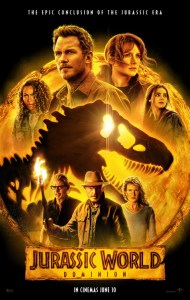 Jurassic World: Dominion has received, by far, the worst reviews and reception of the six-film franchise that has taught us the valuable life lesson that dinosaurs will eat people. Director Colin Trevorrow (Jurassic World) is back though he remained a screenwriter for the entire World trilogy along with Derek Connolly (Safety Not Guaranteed). It’s also bringing the band back together by including Sam Neill, Laura Dern, and Jeff Goldblum as their beloved original trilogy characters (there’s also B.D. Wong, again, if that does anything for ya). I’ve delayed seeing the movie because of my own sense of caution and resignation. Is it as bad as feared?
It’s years after dinosaurs have become reintegrated into the human world. Owen (Chris Pratt) and Claire (Bryce Dallas Howard) are living out West together with the clone girl from 2018’s Fallen Kingdom. He’s lassoing wild dinos and she’s breaking them out of illegal testing sites. The BioSyn CEO (modeled after Apple’s Tim Cook, here played by Campbell Scott) has big plans for… world domination? It’s actually unclear besides general profit. The evil businessman hires kidnappers to abscond with the little clone girl, the baby dinosaur to Blue, America’s favorite family-friendly raptor, and for good measure, he’s also unleashing swarms of killer locusts. Owen and Claire are hopping the world to find their missing family (Owen promises the raptor he will return her baby) and uncover yet another evil scheme from an evil rich person.
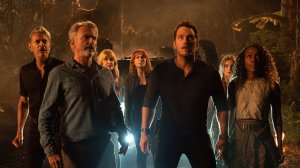 There is a lot going on with Jurassic World: Dominion and yet so little is happening, at least from an intellectual standpoint. This feels like three different movies inartly slammed together and it is overstuffed with subplots all competing for screen time, so every few minutes feels like a possible off-ramp for another episode of what the opening concept portends. The concept of a world where humans are forced to co-exist with dinosaurs is a genuinely exciting starting point, and it’s a Jurassic movie I would want to see, and I do… for a montage to open and close the movie. It’s a shame that the most interesting part of this movie, the global acclimation of creatures of an older millennium rejoining our ecosystem, is kept as literal background. I suppose by the end nature just took care of itself. Instead, the majority of the movie is split between two less engaging stories: giant locusts and a rich guy’s private dino enclosure. Yes, dear reader, you read that correctly. After five movies of dinosaurs in parks, where we begin with dinosaurs in the real world, it’s back to spending time in another glorified dino park, and would you believe that something goes wrong at this park too? Why even bother setting up an exciting premise if it’s abandoned so completely? The movie we do get is a lesson in diminished returns and accepting disappointment. This feels more like a giant locust movie for half, about a villainous corporation weaponizing genetically modified plagues to kill their competitors’ stock. It’s certainly something that seems plausible for a massive corporation, but what is this doing in my Jurassic World movie? Why did we need another blankly evil CEO, this time the guy who appeared in one scene in Jurassic Park, as if that mattered? Why do we need more extraneous characters taking away oxygen from the legacy characters returning especially when they seem too similar to the already established characters? Why should I care about three dinosaurs fighting at the end like I’m personally invested in any of these creatures? My sadness manifested watching this franchise descend into even more farcical dumb blockbuster nonsense.
The best part of this movie might actually be its most ridiculous. There’s a mid-movie set piece where our heroes infiltrate an underground dinosaur fighting ring in Malta. That’s cool, and we’re introduced into new secondary villains we can enjoy get their just desserts once the dinosaurs inevitably get set loose. The lead trafficking lady says the raptors have been trained to kill anything that she shines a laser pointer on, which was also introduced in the last film. She targets Claire and then it becomes a foot chase between Claire and a determined raptor. It’s a silly excuse for a chase but it has an extra sense of urgency. It’s also completely ridiculous and ridiculously fun. Claire transforms immediately into Jason Bourne and is leaping from rooftop to rooftop and crashing through windows. Owen is riding a motorcycle through the narrow streets while being chased himself. It’s all action movie pablum and it works for what it is in the moment. Treverrow’s action set pieces have some moments that pop, especially Claire cautiously slipping into a pond to escape a supposedly blind dinosaur. There are even dinosaurs with feathers now. Alas, the movie can only work as dumb fun for so long before it just becomes infinitely more of the latter.
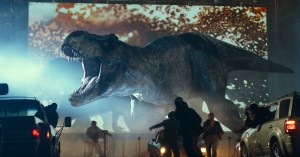 There are so many moments on repeat here that Dominion feels like it’s stitched together like another genetically modified dinosaur clumsily patched with parts of the franchise’s past. Oh, and you better believe we’re going three movies in a row with a new genetically-modified super monster to better sell toys (at least this one isn’t stated as being part raptor). The appeal of this movie, besides the concept abandoned above that I mentioned, is the old characters coming back together, even though Goldblum and Neill each headlined a Jurassic sequel. This action is also a tacit condemnation of the investment in the new trilogy’s main characters. I doubt anyone is going to say, “Wait, Owen Grady and Claire Dearing are back for another movie? Count me in.” I bet most people didn’t even remember either of their names. But if we’re bringing back important characters of franchise past, let’s give them something important to do. They get into danger and scrapes but it’s also always with a wink and a nod that is grating. Goldblum gets to wave his arms around to distract like he did in Jurassic Park. Dern gets to cuddle a triceratops like she did in Jurassic Park. Even Neill features in a dangerous teetering automobile like he did in Jurassic Park. The contrivances to get them all in the movie were already there, but then you give them little to do other than go through the motions of their past (I will always demand more Goldblum time). There are certain dinosaurs reappearing to hit that nostalgia button. It’s the poison-spewing dinos, the ones that blinded and killed Nedry (Wayne Knight), and they’re back, except they can also have their mouth grabbed shut in the most unintentionally hilarious moment. Why even bring back an evil CEO barely mentioned in 1993? Do we need that strained connection for a role recast because the original actor is in jail for assaulting a minor? It’s an excellent example of losing track of the appeal of nostalgia by metric volume.
As far as I’m concerned, that little clone girl, a.k.a. Maisie (Isabella Sermon), is responsible for all the pain and suffering in the world because of deadly dinosaurs. At the end of Fallen Kingdom, this little kid single-handedly rescues the dinosaurs from extinction because, as she said, “They’re alive, like me.” I guess her reasoning is they weren’t supposed to exist, but they do, so we should value life. The problem with that occurs when that creature also happens to be a predator. I would have loved Dominion to explain why Maisie is living in an isolated cabin is because she’s the world’s most wanted person, as mobs of victims blame her for their loved ones dying at the hands, feet, and claws of dinosaur mayhem. The world is in chaos because of this little kid’s rash decision. This cloned girl storyline was the worst part of Fallen Kingdom and now she gets to be the worst part of Dominion as well. Her entire presence is once again as a plot device. I guess she served a purpose as her realization over her identity lead to her decision to save the poor dinosaurs, but here she’s a literal savior cure with legs. Apparently, the reason why the big bad corporation kidnaps her, along with baby Blue, is because her DNA is the key to eradicating genetic disorders. Fortunately, you only need some blood or saliva for a DNA sample and kidnapping seems like overkill. You could have just asked her nicely for a sample, fellas.

Why would this gesture work on other dinosaurs?
However, the dumbest aspect of this requires some sticky spoilers discussion, so you have been warned. Maisie was the grandchild of Benjamin Lockwood (James Cromwell), a retcon character to elbow in another rich co-founder of Jurassic Park that we just never heard about until the fifth movie. Except she was really his daughter but as a clone. Well now we get even more retconning because Maisie’s mom, herself, gave birth to her… self. The adult Maisie impregnated herself with her own clone (because this was the easiest way to have a child?) but she’s also genetically modified her DNA to exclude a terminal disorder killing the adult Maisie. If adult Maisie wanted to save others from having her genetic disorder, why not publicize this valuable information? Why not tell her colleagues? Why leave her clone as the lone evidence? This new info makes me kind of hate the adult Maisie. She brought her clone into the world and made her a target. This seems cruel and unnecessary. It also doesn’t make sense for a person supposedly valuing life or the larger scientific community or even her own child. I’ll say it: she’s a bad mom.
The wild swings and retcons reminded me of what happened with the newer Star Wars trilogy. In 2015, both The Force Awakens and Jurassic World are released to massive success and kickoff reboots of their respective franchises. Both of the movies purposely leaned onto nostalgia for their originals, even repeating similar plot beats and reminders to trigger positive association. Then both directors, J.J. Abrams and Treverrow, left the franchise and the second movies, 2017’s The Last Jedi and Fallen Kingdom, took big swings, tried to be something different from the mold, and were met with divisive responses from the larger fanbase. I appreciate both of these movies attempting to do something different with something so entrenched in formula. Then for the concluding movie, both franchises had the original director return to essentially retcon the retcons, to bring the movies back to what was familiar and ultimately dull. It’s even more interesting when you take into account that Treverrow left the Jurassic series to spend a year of his life developing Episode 9 before being fired and hastily replaced with Abrams.
 I remember the meta-commentary in Jurassic World about modern audiences becoming jaded and complacent to scientific wonders mirroring movie audiences becoming blasé to what used to marvel us in the realm of special effects extravaganzas. As it leaned into its considerable nostalgia, it was doing so in a thinly veiled satirical criticism of, “Is this what you want?” Now all the meta-commentary and irony have been stripped clean and it’s simply a big, dumb, lumbering beast awaiting its own creative extinction as it meets an end. The franchise is still a colossal moneymaker and Dominion has a chance of topping one billion in box-office, so there will be more adventures cannibalizing the past for inevitably diminished returns, and then we’ll get the special reappearances of, like, Jake Johnson’s character or Guy at Computer #4 to the celebration of few if any. None of the Jurassic movies have ever come close to capturing that certain magic from the first movie but they have all been, in some way, serviceably entertaining even at their worst. Dominion is the worst of the franchise and feels devoid of passion and awe and curiosity. To paraphrase a clever man, the studio execs were too busy thinking about whether they could and less busy worrying about whether they should. I guess you could shut off your brain and possibly enjoy it but that’s admitting defeat. Jurassic World: Dominion makes dinosaurs dull and that’s a disservice of imagination.
Nate’s Grade: D+
Share this:

The Tomorrow War (2021)
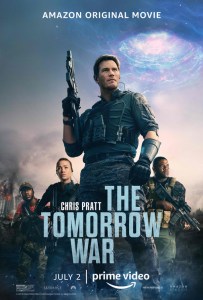 Amazon’s new movie, The Tomorrow War, is the costliest original blockbuster of the summer, and it’s skipping theaters entirely. The $200 million-dollar sci-fi movie was originally slated for theatrical release in December 2020, then pushed to summer 2021, then sold to Amazon streaming for the cost of its production budget. It’s easy to grasp the excitement of its premise and how it could translate into engrossing escapism. At the 2022 World Cup, a flash of light transports a team of future soldiers who need enlistments. In a matter of months, the world will be facing a war between alien monsters, and by 2050 we will be on the verge of losing for good. Dan Forrester (Chris Pratt) is a science teacher/ex-veteran who is conscripted into the future war, along with some other unlikely soldiers, and thrown into the future. His tour will last one week and then he’ll be sent back to 2022, if he survives, and only twenty percent come back.
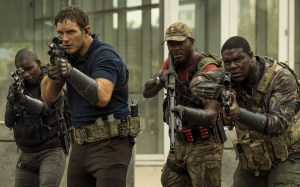 Perhaps it was the allusions or homages to Starship Troopers, but I found the first act and the action before the action to be the most interesting part of The Tomorrow War. I was hoping with its time travel premise of a future war fought by the past that there would be some attention paid to the world building and implications of its premise, at least before it became hunting down monsters and shooting in corridors, and thankfully the movie actually takes some sweet time to lay its foundations before being conscripted itself into action movie spectacle. Much like Starship Troopers, we have people unprepared for a war against an alien species and essentially being tossed into basic training as cannon fodder for the military industrial complex. I enjoyed that the screenplay by Zach Dean (Deadfall) actually plays out some of the larger effects that its future confirmation would stir. Effectively, humanity knows that in thirty years it’s all over. There is a definitive end date. Knowing that thirty years is all civilization has remaining would cause all sorts of global, social, and psychological upheavals. Why bother going to school if it’s all over in thirty years? Why try and start that business if it’s all over in thirty years? Why start a family if your children will be doomed in thirty years or less? Society would be irrevocably changed, and sectors and populations would refuse to go back to the way things were, and instability would flare up with generations sore over their lack of Earthly inheritance.
That’s just one factor that gets attention during this first 45-minute section. The nature of the future conscripting people of the past to fight their war has plenty of political commentary about generational conflict, proxy wars, and how the poor are disproportionately affected with less choice. The soldiers being taken from the past are older and an unorthodox pool of candidates that wouldn’t meet contemporary military recruitment standards. This is because the people being sent to fight are already dead by the time 2050 rolls around to avoid any time paradox concerns. There are interesting implications here. It’s like their own governments are saying, “Well, you’ll be dead anyway, so you might as well die now rather than much later and maybe you’ll provide a more immediate need other than taxes. Thank you for your service, now die.” Again, the psychology and ripples of that can be fascinating. I’m skeptical why more 2022 Americans are not disputing why they should fight 2050’s war with their own flesh and blood. I suppose I wanted this intriguing premise to be played out more in the span of an ongoing TV series, something along the lines of the elegant existential bummer of HBO’s The Leftovers. As a feature, The Tomorrow War gets beaten into blockbuster shape to become another noisy sci-fi spectacle, but the potential of its premise and the bombshells of its world-building deserved even more deliberate consideration.
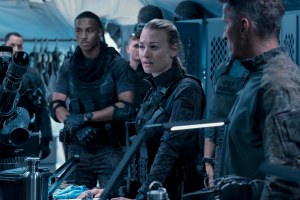 When the action picks up, The Tomorrow War follows a predictable path of alien invasion military thrillers. Dan’s unit must go into enemy territory and retrieve an important thing before the aliens overrun the facility as well as before the Army firebombs the block. There are many ticking clocks built into the plot mechanisms, from Dan’s week-long sojourn into the future ticking clock, the overall “humanity’s last stand” ticking clock, the ticking clock of getting needed lab components before destruction, the ticking clock of synthesizing a magic alien cure, and there’s likely others I haven’t even noticed. That cluttering of urgency extends also to its personal exploration of two sets of frayed familial relationships, father/daughter and father/son across three generations. It’s simply too much and detracts from more time and attention being given to the elements that demand the most development. The father/daughter relationship has the most meaningful drama considering it covers multiple periods of time and pushes Dan into thinking more critically about sacrifice and legacy. The broken father/son relationship between Dan and his absentee dad (a buff J.K. Simmons) is unnecessary and put on hold for too long and then hastily tied together. The Tomorrow War is an unlikely candidate of having too many conflict elements and points of urgency that they can dilute one another.
This also gets into an extended third act that feels entirely tacked on. After a critical climax, I grabbed my remote to pause the movie with the belief that things were wrapping up shortly. I was shocked to see I still had another 30 minutes left to go. The mountain-set final action set piece feels like a late studio addition rather than an outgrowth of what was established in the screenplay. Strangely, the characters don’t seem to be acknowledging the reality of cancelling out the alien-invasion nightmare future with their actions. If Dan has the magic elixir to thwart aliens, and goes back to 2022, then he can prevent the billions of eventual deaths. I suppose that does nothing for those in 2022 that got zapped into 2050 and died in the line of duty, but it spares everyone else from 2023 onward. I started yelling at the screen that preventing the terrible future meant good things.
 As far as the quality of action, it’s a cut above thanks to director Chris McKay (The Lego Batman Movie), making his live-action film debut. I’ve noticed with other directors who primarily got their start in the realm of animation that they have such a great command of filling up the screen. Brad Bird, Travis Knight, Phil Lord and Christopher Miller, and Tim Burton, all of them have an extra artistic sense of how to use the space of the frame to immerse the viewer. I greatly appreciated that many of the sequences where the soldiers fight the alien monsters use long takes and clear editing. There’s one scene where soldiers are trying to wrangle a monster as a hostage and all the fighting and buckling is impressively presented with sufficient distance so we can see the soldiers react and go flying. The introduction of the alien monsters is drawn out of the shadows, but from that moment onward the movie presents the monsters clearly, and I enjoyed the squid-meets-feline creature design enough that I welcomed more closeups. There’s also a horrifying and darkly comic tech mishap where the future accidentally zaps its new recruits into 2050, but instead of re-materializing five feet above the ground it’s 100-plus feet high, so we watch people hurtle to their awful deaths. McKay can replicate standard studio action movie grist seen in plenty of other big-budget blowouts (there are multiple examples of characters slow-motion jumping out of the way of explosions), but more often McKay has a natural eye for visual compositions and how to bring out more with his sci-fi spectacle.
One of the bigger miscues of the movie was the hiring and prominence of Pratt (Jurassic World) as the lead. He’s got the presence and build to be convincingly ex-military, but he’s not a good fit for an everyman, let alone a family man everyman scientist. He’s a high school science teacher going through personal malaise because he feels like he’s meant for something bigger (what’s bigger than saving humanity, guy?) and this ordinary life just ain’t cutting it. Except Pratt can do charming and affable, he can even do heroic, but this part does not play to the actor’s strengths, so Dan often comes across as plain and bland. He’s stuck as the square-jawed straight man for the movie and is boring once he goes into action or thinking mode.
 I wished the movie had been retold from the point of view of Charlie, played by reliable comic Sam Richardson (Veep, Werewolves Within). He’s a welcomed voice of panic and reason among the avalanche of sci-fi, science, and military jargon. He’s a widower, losing his wife on her own tour of duty, and he feels greatly out of place. The actor is so amusing and the character so unexpectedly entertaining that I wish Pratt’s hero had bit the dust early as a meta head-fake (think of Seagal getting killed off early in 1996’s Executive Decision) and we were left to follow Charlie as humanity’s unexpected savior. Along the conversation of waste, Betty Gilpin (The Hunt) is shortchanged as Dan’s wife in 2022 world. They introduce a plot point that family members can be conscripted in place, and then there’s the transport glitch that kills all but a few, so I assumed that an actress of Gilpin’s kick-ass capability would find herself in the future fighting too. Alas, dear reader, Gilpin is just here to be the concerned wife at home waiting for her man to return.
The Tomorrow War is an original story though it’s built from older, recognizable parts, a little Independence Day here, a little Alien there, and a dash of Edge of Tomorrow. It’s derivative but it still has its own points of interest, chief for me is the world building and premise. The action is solid and filmed well. The scope of the special effects fits comfortably in the blockbuster studio range. It’s a good-looking movie with plenty of action and enough time travel quirks, though your attention may also flag as the movie lurches to a protracted close with its extended third act. It does more right than wrong as blockbuster spectacle. I think it had offshoots of better potential that could have been tapped, but as a big screen entertainment ported to your smaller home screen, The Tomorrow War is destined to win fans with lowered expectations and 140 minutes of free time.
Nate’s Grade: B-
Share this:

Onward (2020)
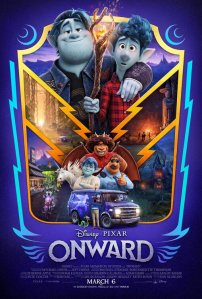 In a modern fantasy suburbia, Ian Lightfoot (voiced by Tom Holland) and older brother Barley (Chris Pratt) have been gifted with a magic staff from their long-departed father. Barley was only a young child when their father died, and Ian never knew him, and now both are granted an opportunity via magic to bring their dear old man back for one more day. The magic spell is interrupted and, as a result, only one half of their father is brought back to life, the lower half, chiefly his legs. The boys must travel on an epic quest in order to bring the rest of their father back to life before all of him disappears again.
Onward is the first time Pixar has ventured into a fantasy realm and the mixture of the modern with the high-fantasy setting allows for some fun juxtaposition. The teenage worries about fitting in, testing your boundaries, and finding out your sense of self can be very relatable, even in a world of trolls and elves. I enjoyed the combative and compassionate brotherly dynamic between Ian and Barley, and Holland (Spider-Man: Far From Home) and Pratt (Avengers: Endgame) are terrific together and really do feel like feuding family members. Their high energy performances translate well to animation. The Pixar creative team does enough to provide little distinguishing character touches for both, enough to provide some extra shading so they don’t quite feel like cartoon versions of their more famous Marvel counterparts. Ian is all awkward and lacking in confidence whereas Barley is overloaded with self-confidence and an unshakable sense of arrested development. I enjoyed the small number of memories relating to their father that Barley holds onto, and I enjoyed how Ian listens to a brief, ordinary test recording of his father on a cassette tape and creates a dialogue between father and son. It’s such a sweet moment that also demonstrates Ian’s ache. I enjoyed how the screenplay connects the external to the internal, namely the obstacles on this quest to the personal trials for Ian and Barley. It allows more meaningful payoffs and more rewarding character growth for our duo. I enjoyed spending time with both boys and was glad their quest was more about them than magical ephemera.
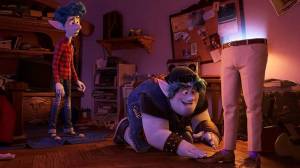 Amazingly, what works best in this movie is its emotional core, which sounds slightly bizarre considering it’s a road trip with a pair of legs. As Onward progresses and settles down with its better honed second half, it puts more emphasis on the relationship between the brothers, their hopes and worries for one another, their sacrifices and shames, and ultimately it becomes a movie about two boys trying to find closure with the memory of their dearly departed dad. The genuine emotion of the brothers is enough to pave over most of the undeveloped elements of the world and storytelling (more on that below). I would have thought, going in, that Onward would present a so-so story with an intriguing world of possibility. I’m surprised that my experience was the exact opposite. The story and central relationships are what kept me going, and it’s what ultimately earned some teary eyed responses from me late in the movie. The topic of seeking closure is a personal one for me and something I value highly, so it was very easy for me to plug my own yearning and vulnerability into these characters. They’re going through all this dangerous trouble not just to see their departed father one last time but also to say goodbye, and that got me big time. It gave the entire movie a new weight that I wasn’t expecting. Who wouldn’t want another chance to tell a loved one how much they miss and appreciate them?
The whole concept of being stuck with a loved one’s lower torso allowed me many moments of contemplation. First, I wondered what their father must be going through to only experience the world through his legs. It felt limited. How do you communicate to others? The film finds its ways. How do you express emotions simply from a pair of disembodied legs? The film finds its ways. As Ian and Barley drag him along on a zipline leash, I kept thinking about the dad. What is he thinking in this moment? Is he waiting for some kind of comforting confirmation from his sons to tell him where he is and what is happening? I kept thinking how confused he must be. To the filmmakers’ credit, they don’t ever emphasize the potential hell of this half-existence. He’s presented often as a figure of comic relief, especially as his upper torso pile of clothes sloshes around and tumbles off. In a way, the pair of legs reminded me of the visual metaphor of the floating house in 2009’s Up, the manifestation of the protagonist’s heavy grief. They’re tethered to this half-formed memory of their father, unable to fully interact with him and let him go. I was worried that Onward was going to be the Pixar equivalent of Weekend at Bernie’s and it is not.
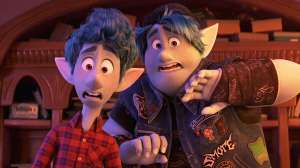 There are some issues with the movie, nothing major, but enough to make it feel under developed, especially in comparison to the Pixar movies of past. The imagination is there, however, the world-building of this fantasy world is decidedly lacking. There are some cute asides like unicorns as the equivalent of trash-eating raccoons, but as a whole the fantasy world feels underdeveloped to its full potential. There’s a significant story point where the current world has forgotten its magic roots thanks to the ease of technology and its inoculating effects, which seems like a pretty straightforward message for our own lazy world. Again, though, Onward doesn’t dig deeper into this theme or what it could mean for the larger mythology of its own world and its history and the rules governing its magical creatures. I started to wonder whether Pixar could just have set this story anywhere.
Likewise, the supporting characters don’t amount to much and feel like leftovers from earlier drafts where they had richer involvement. The ongoing subplot with their mother (Julia Louis-Dreyfus) teaming up with the fabled beast-turned small business owner Manticore (Octavia Spencer) offered little other than occasional exposition. The Manticore is supposed to best represent how the new world has traded its culture and history for comforts and safety, but it’s not clearly realized and integrated. My pal Ben Bailey reflected that the Manticore seemed like a one-scene character that the filmmakers didn’t want to drop, and so she was stretched through the rest of the film to diminished returns. The last act has a sudden and arbitrary monster to defeat that feels like the kind of thing expected in these sorts of movies, which is a rarity for Pixar and thus a slight disappointment.
Lastly, much of the humor just doesn’t work. The jokes can be stale, safe, or one-note, like a team of very tiny pixie bikers. It’s often silly without exactly being clever. There’s more fleeting visual humor with the incongruous nature of fantasy in a modern setting. There’s less slapstick than you would think considering one of the main characters lacks a torso. I chuckled a few times but, much like the fantasy setting, felt the humor was kept at an superficial level of thought.
Onward isn’t top-tier Pixar but it’s a solid mid-tier entry, an enjoyable adventure with a resonant emotional core that makes me forgive many of the film’s other aspects that don’t quite work. The brothers are the best part, their interactions are the most interesting, and their heartfelt journey and hopeful desire for closure is what ultimately left me emotionally satisfied. The jokes and world and supporting characters don’t feel as developed, but it hits with its core relationship and its emotional center, so Onward works where it counts the most with its storytelling. Mid-tier Pixar is much like mid-tier pizza — still satisfying and better than a lot of other options.
Nate’s Grade: B+
Share this:

Avengers: Endgame (2019)
 This may prove to be the most difficult review I’ve ever written in my twenty years (!) of reviewing movies. How do I ever begin to describe the events of Marvel’s culminating blockbuster Avengers: Endgame without stepping too far into the dark and dangerous territory of the accursed spoilers? I thought it would be difficult talking about last year’s Infinity War considering the shocking plot events and general secrecy, but this concluding chapter to a 22-movie journey is even more secretive (the trailer accounts for only footage roughly from the first twenty minutes). I’ll do my best, dear reader, to give you the clearest impression I can of this unique experience while respecting your need to be un-spoiled. In short, Avengers: Endgame is unparalleled in our history of modern popular blockbusters because it needs to work as a clincher to a decade-plus of hugely popular blockbusters for the Marvel Cinematic Universe (MCU), and boy do they ever stick the landing.
The film picks up with our surviving Avengers picking up the pieces following the events of Infinity War, namely Thanos (Josh Brolin) eliminating half of life throughout the universe. The original six Avengers are all suffering through guilt, depression, and degrees of PTSD following their failure to defeat Thanos. Scott Lang a.k.a. Ant-Man (Paul Rudd) arrives after having spent time in the quantum realm and has a potential solution that will involve traveling through time to correct the mistakes of the past and bring everyone who vanished back to life. The remaining teammates assemble at the behest of Steve Rogers a.k.a. Captain America (Chris Evans), including Bruce Banner a.k.a. Hulk (Mark Ruffalo), Black Widow (Scarlet Johannson), Thor (Chris Hemsworth), Hawkeye (Jeremy Renner), Rocket Racoon (voiced by Bradley Cooper), Nebula (Karen Gillan), and War Machine (Don Cheadle). However Tony Stark a.k.a. Iron Man (Robert Downey Jr.) needs the most convincing, as he is most afraid of making things even worse and losing more people he feels are too precious to be casualties to their failures once again.
 The thing to know ahead of time is that Endgame is not for the casual fan. This is a long love letter to the fans that have pored over all 22 preceding films, not just a scant one or two. Infinity War was accessible to relative newcomers because of the structure and focus on Thanos as the main character, providing a self-contained arc that lead up to his finger-snapping triumph. It also benefited from the fun factor of simply watching a bunch of popular characters interact and team up for the first time in MCU history. Now that a majority of those characters have turned to dust, the emphasis falls back on the original core of the Avengers, bringing things full circle. In several ways, Endgame is about bringing to a close this mammoth project that began with Iron Man, this decade of storytelling ambition that has stretched out into multiple inter-connected franchises. If you love these characters, then Endgame is a movie made specifically for you. There is a long stretch in Act Two that relies upon a decent amount of fan service and sentimentality, but I don’t think either is an automatically negative attribute. Before we reach the finish line it’s important to take stock of how far we’ve come and this goes for the essential characters and their long arcs. There are several fun cameos strewn throughout and the filmmakers even take an interesting tack of trying to reclaim and re-contextualize the MCU movies that fewer people enjoyed. It makes for a filmgoing experience that is heavy in references, in-jokes, Easter eggs, and cozy nostalgia, which will confuse and frustrate those not well versed in this big world.
The other thing to know, especially if you’re a long-standing fan, is that there will be tears. Oh will there be tears. I lost count of the amount of times I was crying, which was pretty much on and off nonstop for the final twenty minutes. I was even tearing up for supporting characters that I didn’t know I had that kind of emotional attachment for. The film is done so well that the first third actually could play as the MCU equivalent of HBO’s The Leftovers, an undervalued and elegant series about the long-term recovery of those that remain in a post-rapture world. The opening scene involves a character having to go through the loss of loved ones via Thanos’ snap, and it’s brutal as we wait for what we know is coming, dread welling up in the pit of your stomach. The Russo brothers, the returning directing team from Infinity War, know what scenes to play for laughs (the line “That’s America’s ass” had me in stitches), what scenes to play for thrills, what scenes to play for fist-pumping cheers, and what scenes to play for gut-wrenching drama. They allow the movie to be an existential mood piece when it needs to be, actually dwelling on the repercussions of a life post-universe culling. There’s a character who frantically searches to see if a loved one was among the missing, and that eventual reunion had me in tears. With the three-hour running time, the Russos have the luxury of allowing scenes to naturally breathe. This might be the most human many of these characters have ever seemed, and it’s after recovery and grief. Needless to say, the conclusion feels very much fitting but also unabashedly emotional, unafraid of diving deep into its feelings. I sobbed.
 I was worried once the film introduced the time travel plot device that everything was simply going to be erased and invalidate the struggles that came before. The worst use of time travel is when it eliminates any urgency or danger, allowing an endless series of do-overs to correct the past. Fortunately, returning screenwriters Christopher Markus and Stephen McFeely (Civil War, Winter Soldier) realize that in order for there to be a reversal, a glint of a happy ending, there must be a cost or else it all meant little to nothing. There are finite events in the movie that cannot change (as of now) and losses that will be permanent (as of now, if they don’t want to cheapen the journey). People died with Infinity War but we all knew, at least when it came to its dreary conclusion, that it wasn’t going to be too long lasting, which allowed the communal grief to be short-lived. After all, there’s a new Spider-Man film coming down the pike two months from now, so it’s highly unlikely the teenage web-head will remain dead. However, with Endgame, the deaths serve as the cost for resurrecting the MCU, and they will be felt for years. The screenplay provides limitations to the time travel mechanics, though I don’t think the collective hand-wave to the nagging paradoxes was as successful as the movie thinks it was. The film barrels ahead, essentially telling you to forget about the paradoxes and enjoy the ride, focusing on the characters and remembering what is really important.
Suffice to say Downey Jr. is once again his charming, self-effacing, and enormously entertaining self. The MCU began with this man and his contributions cannot be overstated. He is the soul of this universe. Evans is compelling as the straight-laced inspirational figure who takes stock of what he’s sacrificed over the years, Hemsworth showcases a potent mixture of comedic and dramatic chops, Johannson is definitely the Avenger going through the “bargaining” phase to try and make things right and she has some subtle emotional moments that belie her desperation and guilt, and Renner makes a welcomed return in a way that made me appreciate Hawkeye like I never had before. Brie Larson does reappear as Captain Marvel but the movie smartly puts her back on the sidelines protecting the many other worlds in the universe needing assistance because of how overwhelmingly powerful she can become. Larson filmed her scenes for Endgame before her own solo movie, released a month prior, so forgive the different hair and makeup, Twitter nit-pickers. I will say there is one scene that is a bit convoluted how it gets there but is destined to make women in the audience cheer with excitement as the MCU says, “Hey, that whole ‘strong female character’ thing? Yeah, we’ve had all that for years, and here you go.”
 How does one properly assess a movie like Avengers: Endgame, a conclusion not just to an Infinity War cliffhanger but to a twenty-two movie prelude over the course of eleven years? The emotional investment in these characters, their journeys, has to come to something to be ultimately meaningful when it’s time to close the chapter on one massively ambitious story before starting the next. And there will be a next chapter; the MCU’s unparalleled financial success assures the fanbase they’ll have plenty more high-flying and wild adventures to come in the years, and more than likely, decades to come. Marvel had the unenviable task of wrapping up a major narrative in a way that would prove satisfying without devaluing the individual films and overall time investment. Hollywood is filled with trilogies that messed up their conclusions. Nailing the ending is just as important as getting things going right, because without a satisfying conclusion it can feel like that level of emotional investment was all for naught. Endgame reminds you how much you’ve grown to love these characters, what fun you’ve had, and genuinely how much you’ll miss these characters when they depart for good. It’s hard not to reflect upon your own passage of time with the ensuing eleven years, how you’ve changed and grown from the MCU’s humble beginnings in the summer of 2008. These heroes and anti-heroes can begin to feel like an extended family for many, and so fans desperately need the ending to do them justice. Avengers: Endgame is the ultimate fan experience.
Nate’s Grade: A
Share this:

The Lego Movie 2: The Second Part (2019)
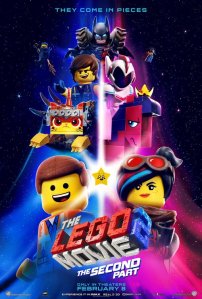 Everything might not be awesome but it’s still pretty great for this creative, heartfelt, and hyperactive family franchise that is better than it has any right to be thanks in part to returning writers Phil Lord and Chris Miller. It’s not quite as fresh and clever as the first go-round but it manages to better its predecessor in some key ways. Now that we know the colorful and zany antics of the animated Lego characters are also simultaneously the imaginative play of a real-world family, it provides a deeper thematic subtext with the unseen nature of siblings in conflict. I remember my own younger sister wanting to play with me and my toys, and me rebuffing her, and the film struck home some key emotional points about the inclusion of cooperative play. The different styles of play are on display as our characters are abducted by a shape-shifting space queen (voiced by Tiffany Haddish) who is determined to marry Batman and possibly rule the universe. A fantastic running joke is how transparently malevolent the queen is, which leads to an even better payoff. There are more songs and each is pretty well constructed, relevant to the story, and assuredly catchy, like “Catchy Song” used to brainwash people through pop, and a mournful version of “Everything’s Not Awesome” that becomes genuinely inspirational and uplifting by its climax. The life lessons are easily digestible and the sense of breezy fun is still alive and well. I was laughing throughout, sometimes quite hard, and the brother/sister subtext had me wondering if I owed my younger sister a decades-late apology for my behavior (sorry, Natalie). Lego Movie 2 is a worthy sequel that finds new and interesting ways to build off the irreverent original’s model. Bring on the Toy Story 3-style ending where our grown-up owner says goodbye to his childhood toys and friends. At this point, Lord and Miller can do anything and imbue it with wild wit, whimsy, and unparalleled mass entertainment (except Star Wars, I suppose).
Nate’s Grade: B+
Share this:

Jurassic World: Fallen Kingdom (2018)
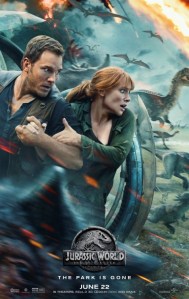 There has always been an element of suspension of disbelief with the Jurassic Park films even with the hubris-pushing premise, but the sequels specifically have had to manage a rising tide of incredulity and sense of dumb. You can only keep going back to a dinosaur-infested island or thinking this time mucking with the DNA of large, extinct, highly advanced killing machines will be different. Jurassic World: Fallen Kingdom may be the dumbest yet, and while it does have moments of fun and excitement, the dumb outweighs all else.
Years after the deadly attacks at Jurassic World, the volcano on the island has reactivated and the remaining dinosaurs are in imminent danger of another extinction (except for the flying ones, but whatever). Claire (Bryce Dallas Howard), with sensible footwear this go-round, is looking to raise money and awareness to save the thunder lizards. A wealthy magnate (James Cromwell) wants to save the dinosaurs and whisk them to a wildlife preserve far from mankind, but first they must secure the raptor Blue, and in order for that to happen Claire needs to convince her former flame and co-worker Owen (Chris Pratt) to go back. They venture back to the endangered island only to run into more trouble from stampeding dinosaurs, new super predators, and a plot to house and sell the creatures off the island.
 Maybe it’s just a side effect of being the fifth movie in a generation-spanning franchise, or maybe it’s a holdover effect of the 2015 film’s meta-commentary about audiences becoming complacent with what used to inspire awe, but it feels like returning screenwriters Colin Trevorrow (The Book of Henry) and Derek Connolly (Safety Not Guaranteed) couldn’t be bothered picking a tone or developing their plot. It reminds me of the seventh season of HBO’s Game of Thrones, specifically the back half of episodes. It felt like the creators had certain conclusions in mind and rather than smartly develop storylines that would naturally reach those conclusions, the “how” of the narrative became jumbled, confounding, and frustrating. I felt the same way while watching Fallen Kingdom; the stylish set pieces were likely established first and foremost and the stuff in between, you know the story and characters and their interaction, was given far less attention. It didn’t matter how we got from one set piece to another. This lack of consideration leads to many moments that keep you from fully engaging with the movie, namely dumb and/or awful characters doing dumb things for dumb reasons. The conclusion of Fallen Kingdom seems meant to leverage interest in a third movie, which is already scheduled for release in 2021. Was this 128 minutes the best way to get there?
When people repeatedly do stupid things, it tests your limits of empathy. This happens to me with horror movies and it happened for me with Fallen Kingdom. It’s the kind of movie where a little girl runs into her bedroom and hides under her covers from an approaching hungry dinosaur. The ensuing image of the stalking beast entering the bed with the claws is a killer image, but what did we lose getting here? This little girl was not established as some dumb kid either. The preceding hour showed her as resourceful and plucky, so this just erases all that. There’s another moment where characters have to choose between escaping through an ordinary door or an open window and crawling along the edge of the roof… and guess what they choose. This is the kind of movie where characters will be in danger and then, hooray, another character arrived in time to save the day, and then another character arrived to save the shortly-after next day. Then there’s a bad guy who enters a dinosaur cage simply to retrieve a dino tooth for his personal necklace of dinosaur teeth. I’ll repeat that. He’s not extracting them to sell to another bio-engineering company for its DNA (the opening scene presents this very example). He’s removing dinosaur teeth for his own personal decorative hobby. My preview screening groaned in unison loudly at how stupid all of this was. How am I supposed to even enjoy this dumb character’s inevitable death when they’re this dumb and undefined?
 The dumbest action of all is tied to its central premise of saving the dinosaurs. When Jeff Goldblum’s Ian Malcolm (relegated to a two-minute cameo, don’t expect much) was championing letting the dinosaurs go extinct again and the folly of mankind playing God in the realm of genetics, I was right with him, and I’m no GMO spook. Bringing gigantic, killing machines back to life was clearly a mistake as five movies have now shown in great, bloody detail. At some point a lesson must be learned. I know that Fallen Kingdom is meant to imbue the dinosaurs in an animal rights lens, with Claire trying to atone for her time shaping and selling these creatures for public consumption. The animal rights angle never clicked for me. There are moments the film really tries, wanting you to shed a few tears for the fate of these gigantic creatures. Maybe you will, and there are a few shameless sequences to make you (the child sitting next to me was losing it at points). That’s why it’s not enough to have the bad guys have bad guy plans but they also have to be cruel and abusive in their treatment of the dinosaurs. The multi-million dollar ploy to weaponize the dinos also baffled me. Are they going to be that much better than firepower? There’s a reason we don’t just drop hungry lions into our war zones.
The new characters fail to add anything of merit to the story and larger Jurassic world. Cromwell’s Benjamin Lockwood is basically just a John Hammond stand-in (“Oh, there were TWO super rich dudes who funded the research and park now”). He’s confined to a bed for most of the movie and adds little besides his bank account. Then there are the two main team members, computer whiz Franklin Webb (Justice Smith) and med vet Zia Rodriguez (Daniella Pineda). He’s only here for comic relief and to do computer magic whenever called upon, and she’s only here for spiky attitude (she gets called a “nasty woman” for commentary?) and to do medical magic when called upon. Each of these characters is less a person than a handy plot resolution. When the movie transitions into its second half, both of them are kept on the sidelines. Then there’s little Maisie (Isabella Sermon) who has her own secret that really doesn’t come to much of anything and begs further examination. I suppose her perspective relates to a difficult moral choice at the end over the value of life, but she still felt underdeveloped. Even the villains are disappointing with the exception of Toby Jones (Atomic Blonde) as a slimy, one percent businessman looking for new thrills. I wish the screenplay had devoted more time to establishing the rich’s entitled sense of privilege even as it comes to a new world with living dinosaurs as the next big, commoditized play thing to buy and sell.
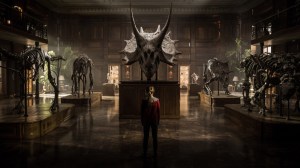 With all that said, there are moments of enjoyment and excitement to be had with Fallen Kingdom. Director J.A. Bayona (A Monster Calls) has a great gift for finding the right image and holding onto it for maximum impact. He showcased this in his crafty, brooding, and highly effective ghost story The Orphanage and in his emotionally uplifting and harrowing tsunami survival drama The Impossible. With his first crack at a major studio movie, Bayona comes most alive in its second half when the movie transitions into a haunted house thriller in a mansion of secrets. His command of visuals and mood comes into sharper focus and there are some tense, delightful sequences. As much as I wrote about Fallen Kingdom being a movie of set pieces and little else, those set pieces are actually pretty entertaining. The island material only lasts about a half hour, wasting little time in getting the important pieces in play. There’s one long take inside a submerged capsule taking on water that keeps spinning and ratcheting up the tension that reminded me a bit of Alfonso Cuaron’s Children of Men. There’s another sequence involving a blood transfusion that I thought married comedy and tension better than anything else in the film, and it served a purpose that was credible.
If you can shut off your brain and stuff your mouth with a steady supply of popcorn to thwart your incredulous grumbling, there might be enough to enjoy with Jurassic World: Fallen Kingdom. It’s technically well made and the special effects are pretty good, the photography is evocative, and there are potent set pieces and imagery to stimulate the pulse. It’s loud, dumb fun, but for me, this time, the dumb outweighed the fun.
Nate’s Grade: C
Share this:

Avengers: Infinity War (2018)
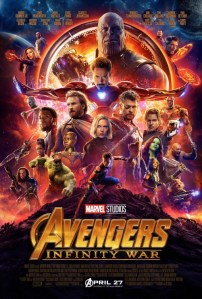 It’s hard to draw comparisons to the major commitment to long-form storytelling that the Marvel Cinematic Universe (MCU) has dabbled with over the course of ten record-shattering years of success. I can think of movie franchises that have been popular over long periods of time, like James Bond, but rarely do they keep to continuity. It’s been 18 movies and ten years since the caddish Robert Downey Jr. first stole our hearts in the original Iron Man, and its stable of heroes and villains has grown exponentially. Looking at the poster for Avengers: Infinity War, it’s hard to believe there’s even enough space just for all of the actors’ names. Infinity War feels like a massive, culminating years-in-the-making film event and it reminded me most of Peter Jackson’s concluding Lord of the Rings chapter, Return of the King. After so long, we’re privy to several separate story threads finally being braided as one and several dispirit characters finally coming together. This is a blockbuster a full decade in the making and it tends to feel overloaded and burdened with the responsibility of being everything to everyone. It’s an epic, entertaining, and enjoyable movie, but Infinity War can also leave you hanging.
Thanos (Josh Brolin) has finally come to collect the six infinity stones stashed around the universe. With their power, he will be able to achieve his ultimate goal of wiping out half of all life in the universe. Standing in his murderous way is a divided Avengers squad, with Tony Stark (Downey Jr.) still on the outs with a wanted-at-large Captain America (Chris Evans) and Black Widow (Scarlett Johansson). One of the in-demand infinity stones resides in the head of the Vision (Paul Bettany), who is in hiding with his romantic partner, Scarlet Witch (Elizabeth Olsen). They know Thanos will be coming for Vision eventually. On the other side are the Guardians of the Galaxy who have a few personal scores to settle with Thanos, the adopted father of Gomora (Zoe Saldana) and Nebula (Karen Gillan). Elsewhere, Thor (Chris Hemsworth) strikes out looking for the key to defeating the big purple menace. Thanos’ loyal lieutenants attack Earth to gather the remaining infinity stones, drawing the attention and push-back of Doctor Strange (Benedict Cumberbatch) and Peter Parker (Tom Holland). The various heroes of Earth and space unite to eliminate the greatest threat the universe has ever known.
 Avengers: Infinity War serves not as much a series of payoffs as it is climaxes, with climactic event right after another, and this time it’s for keeps (more on that below). There are moments that feel like major payoffs and moments that feel like shrug-worthy Last Jedi-style payoffs. Infinity War is the longest MCU movie yet at 149 minutes but it has no downtime. That’s because it has to find room for dozens of heroes across the cosmos. With the exception of three super heroes, everyone is in this movie, and I mean everyone. This is an overstuffed buffet of comic book spectacle, and whether it feels like overindulgence will be determined by the viewer’s prior investment with this cinematic universe. If this is your first trip to the MCU, I’d advise holding off until later. Any newcomer will be very lost. I’ve deduced the seven MCU movies that are the most essential to see to successfully comprehend the totality of the Infinity War dramatics, and they are Iron Man, The Avengers, Captain America: Winter Soldier, Guardians of the Galaxy, Captain America: Civil War, Doctor Strange, and Thor: Ragnarok. Naturally, being intimately familiar with the previous 18 movies will be best, but if you don’t have thirty hours to spare then please follow my seven-film lineup and you’ll be solid.
As far as the stakes, the MCU has been notoriously reluctant about killing off its characters, but Infinity War is completely different. I won’t spoil circumstances or names, of course, but the march of death happens shockingly early and carries on throughout. There are significant losses that will make fans equally gasp and cry. This is a summer blockbuster that leaves behind an impressive body count across the known universe and ends in a downbeat manner that will naturally trigger reflexive Empire Strikes Back comparisons. It’s hard to feel the full impact of the drastic decisions, and the grief over their losses because I know there is a Part Two coming summer 2019, and with that comes the almost certainty that several important events will be diminished or straight-out reversed. After all, in comics, nobody is ever really dead, though with movies the heroes have the nagging habit of aging. With that said, you better believe I was holding my breath during some standoffs, tearing up at some sudden goodbyes, and reflecting upon journeys shared.
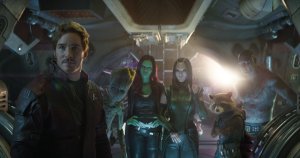 This is very much Thanos’ movie, which was one of the bigger surprises for me. Beforehand, our exposure to the big purple guy has been relatively minor, a brief moment here or a cameo there during a post-credit scene. Considering Thanos is supposed to be the universe’s biggest bad, it makes sense to finally give him his due, and that is what Infinity War does. Thanos gets the most screen time of any character and is given an honest-to-God character arc. He’s a villain who goes on an actual emotional journey as he follows a path that he feels compelled to even as it tests him personally. He finally opens up as a character rather than some malevolent force that is oft referred to in apocalyptic terms. We get his back-story and motivation, which is less a romantic appeal to Death like in the comics and more a prevention of the apocalypse reminiscent of the Reapers in the Mass Effect series. Thanos sees himself as a necessary corrective force and not as a villain. He’s never portrayed in a maniacal, gleeful sense of wickedness. Instead he seems to carry the heaviness of his mission and looks at the Avengers and other heroes sympathetically. He understands their struggle and defiance. Having an actor the caliber of Brolin (Deadpool 2) is a necessity to make this character work and effectively sell the emotions. Thanos is the most significant addition to the MCU appearing the latest, so there’s a lot of heavy lifting to do, and Infinity War fleshes him out as a worthy foe.
 As an action spectacle, however, Infinity War is good but not great. The action sequences are interesting enough but there’s nothing special and little development. There’s nothing that rivals the delirious nerdgasm of the airport battle in Civil War pitting hero-against-hero to dizzying degree. The characters are separated into units with their own goals leading to a final confrontation that feels more climactic conceptually than in execution. That’s because this is an Avengers film that falls into some of the trappings of the glut of super hero cinema, namely the army of faceless foot soldiers for easy slaughtering, the over exaggerated sense of scale of battle, the apocalyptic stakes that can feel a bit like a bell rung too many times, and even minor things like the lackluster supporting villains. Thanos’ team of lieutenants are all the same kind of sneering heavy with the exception of one, a sort of alien cleric heralding the honor of death from Thanos. Carrie Coon (HBO’s The Leftovers) is generally wasted providing the mo-cap for the Lady Lieutenant That Sounds Like a Band Fronted by Jared Leto, a.k.a. Proxima Midnight. There are far too many scenes where characters reluctantly strike a deal to give up an infinity stone if Thanos will spare the life of a beloved comrade. The film’s greatest point of entertainment isn’t with its action but the character dynamics. The fun is watching years-in-the-making character interactions and seeing the sparks fly. There’s more joy in watching Downey Jr. and Cumberbatch try and out smarm one another than with any CGI collision of a faceless army of monsters. There are so many characters that few are given fully defined arcs. Most are given beginnings and stopping places. Though the eventual sequel will have fewer characters needing to share precious screen time.
The standouts on screen are Hemsworth (12 Strong) carrying a large portion of the movie and not missing a beat of his well-honed comic rhythms from Ragnarok, Bettany (Solo) brings a sad soulfulness to Vision as a man who knows fate is likely unavoidable, and Dave Bautista (Blade Runner 2049) is perfectly deadpan as Drax and has the funniest lines in the movie followed closely by the exuberant Holland (Lost City of Z). To even say which characters deal with more complex emotions might be a spoiler in itself but there are several actors showing an emotive level unseen so far in the bustling MCU.
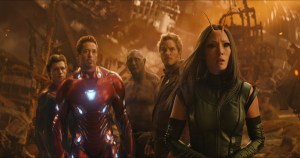 Avengers: Infinity War marks a significant concluding chapter for one of cinema’s most popular series, until at least the next movie possibly makes it feel less conclusive. I pity Marvel because expectations are going to be astronomical for this climactic showdown. There are so many characters, so many crossovers, and so much to still establish, like Thanos as a character more than a spooky force of annihilation, that it feels rather breathless even at nearly two-and-a-half hours. You may be feeling a rush of exhilaration on your way out or an equally compelling sense of exhaustion. Infinity War doesn’t have the imaginative highs of a Dcotor Strange, the funky personality and style of a Guardians of the Galaxy, the wonderfully thought-out structure of a Spider-Man: Homecoming, the adroit weirdness of a Thor: Ragnarok, or even the hero-against-hero catharsis of a Civil War (still my favorite). What it does have is a sense of long-gestating finality, of real stakes and dire consequences. It’s not all pervading doom and gloom; this is still a fun movie, buoyed by crackling character team-ups and interactions. While, Infinity War won’t be all things to all people, myself included, it will please many fans, casual and diehard alike.
Nate’s Grade: B


 nathanzoebl
You must be logged in to post a comment.