Blog Archives
Breaking Dawn: Part One (2011)
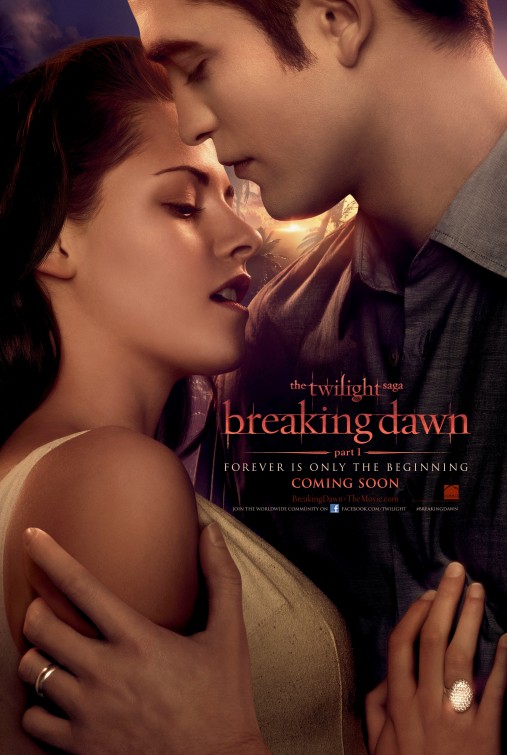 Taking a cue from the blockbuster film franchise of our age, the Harry Potter series, the producers and studio heads decided to split the final Twilight film into two separate movies. Yes, for you cheerless, unfortunate males dragged along to author Stefenie Meyer’s estrogen-drenched soap opera, hoping to be done with Bella Swan and her sparkly vampire boyfriend, well your pain soldiers onward another year. If Breaking Dawn: Part One is any indication, we’re all in for a world of hurt come November 2012.
Wedding bells are ringing for Bella Swan (Kristen Stewart) and her undead boyfriend, noble vampire/undead heartthrob, Edward Cullen (Robert Pattinson). Bella’s persistent demand to be turned into a vampire is finely about to come true. She wants to stay human a bit longer, to savor her last days on Earth before sipping blood through a bendy straw. Her always-in-second best bud, Jacob (Taylor Lautner), is worried for Bella’s well being. The wedding is like a fairy tale and Edward sweeps his new bride away to a tiny island off of Rio de Janeiro, where the housekeepers illogically speak Spanish. The couple makes the most of their time alone, and by this I mean they have sex (I refuse to believe this couple would play chess in their newlywed downtime). Edward withholds any second rounds of sex, fearing he’ll seriously harm his bride (he destroyed the bed in mid-copulation). No matter because Bella gets pregnant right out of the gate. We’re told this is impossible, yet her half-human/half-vampire fetus is rapidly growing inside momma’s belly. The baby is also destroying its host, eating away Bella’s body. Edward demands to kill the baby but Bella will have none of it. She’s going to deliver this baby even if it kills her. If it does kill her, then the truce between the werewolves and vampires will be broken, and Jacob’s feistier tribe mates will be knocking down the Cullen doors looking for some tasty vampires to chomp.
 Director Bill Condon, he of Dreamgirls fame and an Oscar-winner for 1998’s Gods and Monsters, goes hog-wild with the emotions, fittingly reminiscent of the life-and-death swings of emotional polarity that orient a teenager’s life. Condon plays all of the ridiculous melodrama straight. It successfully channels the feelings of teenage angst and obsession, much like the first Twilight film. This Teutonic exhibit of buzzy hormones is like catnip to the Twilight faithful. Finally, they get what they’ve been waiting for, and Condon and screenwriter Melissa Rosenberg delay that gratification even longer. This is the longest wedding I’ve seen on screen since The Godfather. It takes up about 45 minutes of the movie. The protracted walk down the aisle literally takes longer than the rest of the ceremony combined. I can already envision thousands of young girls asking for the “Bella dress” when their time down the aisle comes. At no point does the movie address the fact that the “groom’s side” probably are all absent a heartbeat (“Hmm, extreme paleness? Are you with the bride or the groom? I’m at a loss.”). That’s a missed comedic opportunity. What’s with the wedding guests played by name actors like Maggie Grace (TV’s Lost, Taken)? Did they hire recognizable actors for one-line bit parts? They better have larger roles in the second feature. Under Condon’s direction, the film looks marvelous, and even the long-awaited love scene has some discernible heat to it that will give teen girls “funny” dreams for the next few months. Condon’s also helming the next and final film, so I can at least say it’ll look swell.
This last film was broken into two parts due to the mountains of money the studio would make. It surely wasn’t for some sort of artistic necessity. The plot of BD: Part One is stretched mighty thin. It’s no joke that the wedding and honeymoon takes up half the running time. The baby drama is handled so amateurishly, and the plot ramps up the incubation time so that everything happens too fast for the audience to adjust to how stupid everything truly is. The first half of the movie is free of meaningful conflict. It’s just concerned with payoffs. From everything I’ve read online, and from female friends who have partaken of the series, BD: Part One pretty much covers most of the plot of the 400-page book. What’s left? I would totally give the series a pass if the second movie started with Bella, hair a knotted mess, holding a shrieking baby. Edward sits at the table, drinking. “When are you gonna get a job?” she yells. “When are you gonna stop being a bitch?” he retorts, then gulps down a swig of booze. This domestic downer of an ending would almost make the whole series worth sitting through. Truthfully, as the teaser during the end credits advertises, if Michael Sheen (Frost/Nixon) has a larger part in BD: Part Two, it automatically becomes, sight unseen, the best movie of the series. Thus is the awe-inspiring power of Michael Sheen.
This has long been a silly franchise filled with poorly veiled messages that seem less empowering to teenage girls than reassuring to their parents. Long a heavy-handed message about abstinence, the characters finally get to have sex, after they’re properly married of course (does God really object more to vampire-human relations or when it occurs?). And you better believe the moment Edward and Bella eventually do the deed is a moment that teen girls, and their mothers, around the nation have been anticipating for three long, hard years. The buildup to the carnal climax is a rapturous release for the audience of Twi-hards; my theater felt like it exploded in pubescent hormones and giggling as soon as the proverbial train entered the station. Speaking of euphemisms, I find it telling that not a single character ever refers to sex as, well, “sex.” They keep dancing around the term, referring to it as indistinct pronouns like “this” or “that” or the slightly more specific “honeymoon activities.” It’s like the characters can’t talk about a mature topic without a case of the giggles. There’s even a scene where Jacob talks about Bella’s forthcoming tangle between the sheets, openly, and with alarm: “You’ll kill her,” he tells Edward. He doesn’t kill her but he does leave bruises all over her body. Bella assures her new husband that he’s not to blame, arguing, “You just couldn’t control yourself.” What kind of irresponsible message is that sending to teenage girls? But after enduring three movies of “save it until marriage,” the message is made even clearer when Bella, after one bout of sex, gets pregnant. Boom. Bella breaks the news by saying, “The wedding was 14 days ago, and my period’s late.” Edward stares dumbfounded and replies, “What does that mean?” Apparently, after graduating from high school 200 times just for kicks, Edward must have been absent every damn time for sexual education (“Condoms go OVER? Oh! This whole time I thought they went UNDER, you know, to hold everything in.”).
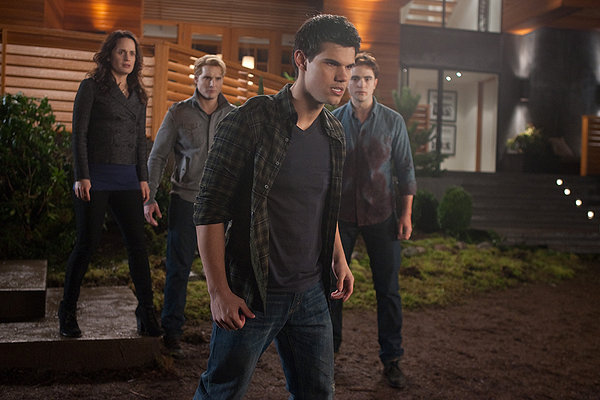 It’s here where the movie awkwardly shifts into a relentlessly pro-life message on legs. I’m not against movies presenting messages, but when a movie is as narratively empty and transparently padded as BD: Part 1, then the movie just gets swallowed up by the clumsy message. It doesn’t matter that Bella’s unborn hell spawn is literally killing her, sucking her dry from the inside out, she’s going to have this baby no matter what, even if she dies in the process. Okay, Meyer, we get it. Here’s a question for the world: can anyone really tell that much difference between emaciated Kristen Stewart and her normal self? She always appears a little sickly and hollow-eyed, but maybe that’s just me. The baby is basically the only conflict the movie presents and it happens so late in the film. Thanks to a fast gestation period, the demon fetus is determined not to wait until Part Two to make its grand entrance. Now that Bella is preggers, she’s become instant buddies with Rosalie (Nikki Reed, a long way from Thirteen), and the two of them begin a war against non-gender pronouns (its vs. he/her). The baby conflict would be more interesting if it was a tad more ambiguous, but the fact that it literally is killing Bella, not to mention its monstrous possibilities, and yet she persists to give birth is less characterization and more stubbornness. If Bella’s worried she’ll never have another chance to have a flesh-and-blood daughter, then explore this. Otherwise it makes Bella look blithely cavalier with her own life.
It’s here where Meyer and the Twilight franchise, already deliriously high on teen angst, goes off the charts into weirdo territory (some spoilers will follow). Never mind where the werewolf boys (and a girl) manage to find new clothes after they destroy them after each beastly transformation, we’ve got far weirder moments to process. There’s a vampire C-section via biting. There are giant wolves communicating via growling telepathy and bad CGI. There are Bella’s completely batshit names for her child; if it’s a boy she wants to combine Edward and Jacob’s names because that’s not awkward (“See, son, you’re named after the other guy I could have slept with but decided to just string along instead.”). And if it’s a girl she wants to combine her mother’s name and Edward’s mother’s name forming the atrocious “Reneesmee.” Excuse me? That makes “Apple” seem as traditional as apple pie. No one tells Bella these names are horrific because she’s pregnant, naturally. I imagine all the characters broke out into laughter as soon as Bella left the room to go puke into a bucket. Easily the weirdest and dumbest thing in the history of the Twilight franchise occurs as a contrived deus ex machina and a tidy solution to Jacob’s eternal, annoying pining. Jacob is determined to slay the monster he believes responsible for killing his unrequited love, Bella, but then he looks into those cute little baby eyes and… swears devotion to this newborn babe. He “imprints” on her, which means that they are meant to be together, and thus the werewolf/vampire truce holds. “Of course,” Edward intones, “Imprinting is their number one law. They cannot break it.” Of course! This reminded me of the scene at the end of the second Harry Potter movie where a phoenix comes from nowhere and cries into a wound (“Of course, phoenix tears can heal anything,” Harry informs while I was physically smacking myself in the head). Doesn’t anyone else find this whole plot development creepy? Jacob can’t have the mother, so he’s going to have the baby? And he’s got to wait 18 years if he wants their coupling to be legal on top of that. I think a messed up name is the least of this kid’s worries.

- Does she look like a healthy person? This is pre-baby succubus.
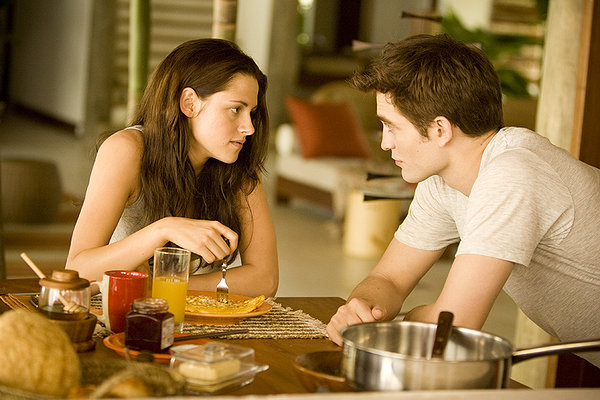
It all comes down to the heroine of the franchise, Miss Bella Swan (sorry, Bella Cullen now). I just don’t get what all the fuss is about. To me, Bella isn’t worth the effort. She’s never really been anything close to a fully formed character. Bella Swan has always defined herself by having a boyfriend, and when he was gone it was about pushing her friends away and moping until she finally found a new guy. She has zero self-identity, no center, she is an empty shell, there is no there there. She’s a cipher, meant for the teenage readership to plug themselves into her place. I won’t restate my theory that the Twilight series is glossed-up pre-teen wish fulfillment, but there you have it. Yet there are sneaking moments where Bella seems almost shockingly… human. Her anxious montage of preparation before her first night of sex is relatable and sympathetic (what outfit to wear? Shave the legs? What kinds of makeup?). Too bad this relatable side of her character vanishes all too quickly. Before Bella defined herself by her boyfriend and now she defines herself by her baby. She’s still the same whiny, selfish, morose, and cruelly manipulative Bella, though. She can’t let Jacob alone; she has to continue stringing him along, bringing him into inappropriate personal matters. Jacob’s always been a bit of a control freak who seems to spout quasi-rapist dialogue (the classic “You love me, you just don’t know it yet.”), but the guy’s always gotten a raw deal as far as I’m concerned. Betrothed to a baby is not a worthwhile parting gift. I worry that young, impressionable girls are going to look at Bella as an influential figure. If these same gals want a literary heroine they could truly look up to, they should feast their eyes on Katniss Everdeen, proactive and laudable star of the Hunger Games and forthcoming movie of the same name.
The three actors have been playing the same character notes for so long that they could all just go on autopilot and collect their paychecks. Stewart (Adventureland) is less annoying than she has been in previous films. I’m trying not to take out my disdain of her character on the actress, who I’ve genuinely liked in pre-Twilight projects (even her Joan Jett performance was pretty decent). Pattinson (Water for Elephants) seems to shrink into the background for this movie. There are a lot of long, ponderous, somehow meaningful stares between the two, with the soundtrack trying to communicate emotions that the screenplay has failed to do (a little more variety on the soundtrack next time, fellas? I think I tuned out after the twelfth melancholy piano ballad). Luckily, Pattinson does have something of a screen presence to go with those abs. Unfortunately, the same could not be said for Lauthner (Abduction). The young buck, formerly of Shardkboy fame, just cannot act. He has a nostril-heavy manner of expressing emotion that makes you wonder if he’s about to blow your house down. It’s telling that within mere seconds of the film beginning, the guy rips off his shirt, the peak of his acting abilities. I suspect it will not be long before Lautner and his six-pack and sitting at home, unemployed, and indulging in a different six-pack.
 Breaking Dawn: Part One is certainly not intended for critics of the book and film series or really any audience member lacking ovaries. But I think that even the most ardent Twi-hards will walk away giggling at the silliness of the overripe melodrama. I try not to be out rightly dismissive of the whole series, but the bad characters, bad plotting, and questionable messages make it hard to continue bending over backwards to find slivers of quality to support. I get the appeal of the series, the fact that Bella Swan is a cipher to exercise frothing teenage wish fulfillment, but that doesn’t excuse the movies from being so bad. This isn’t the painful abomination that was 2009’s New Moon, but it’s come the closest. Only the promise of more Michael Sheen makes me hopeful that BD: Part Two will be better than its predecessors. When you’re talking about an obscenely popular moneymaker, quality becomes secondary to delivering a product that is recognizable to the demands of the screaming fans. BD: Part One is less a payoff than a warning. There is more to come, and if you thought Bella was intolerable before just wait until her vampire growing pains.
Nate’s Grade: C-
Share this:

The Help (2011)
 Kathryn Stockett’s bestselling publishing phenomenon has now become a box-office smash. In 1963, Jackson, Mississippi, Eugenia “Skeeter” Phelan (Emma Stone) is coming home after graduating from college. Her ailing mother (Allison Janney) is convinced that she will die without any grandchildren and pressures Skeeter to find herself a man. Instead, she finds herself a job writing for the city newspaper. She answers reader household and cleaning questions as “Miss Mryna.” She seeks help from Aibileen Clark (Viola Davis), a middle-aged woman who’s worked as a maid to rich white people her whole life. Skeeter soon changes her focus and wants to interview other maids about the indignities they experience. She wants to get their story out there. This is a time where it was actual Mississippi law that anyone working against segregation could be imprisoned. They try reaching out to Minnie (Octavia Spencer), a maid recently fired from the services of Mrs. Hilly Holbrook (Bryce Dallas Howard), the queen bee of the Southern belles. Minnie is much more outspoken and her mouth causes her to get into trouble. The only job she can find is in the household of Celia Foote (Jessica Chastain, The Debt), a woman ostracized by Hilly’s forces. Skeeter transcribes the life stories of a dozen maids and the results become an anonymous bestseller that sets Jackson tongues a waggin’.
The Help enlists a colorful cast of characters (no pun intended) and tells a familiar story about people taking a stand during a tumultuous time in history. This is traditional classic Hollywood storytelling with the respective characters banding together, leaning upon one another, building camaraderie and victory, and then finally able to stand up to their antagonists, which in this case is really just Howard’s snooty racist character. It’s well told, well directed (both credits to Terry Tate, childhood friend of the author), very well acted by every member of the cast, and watching all 145 minutes is like being fed a heaping helping of home cooking. You leave feeling full and sated, and some may even feel nourished. You feel good about yourself. I tried to resist but resistance was futile. I can’t help but enjoy The Help. And even though I walked away liking the film, something stuck in my craw. It felt a little too prefabricated, too eager to be liked, to go down easy, gentle, a sweet Southern story about women taking a moral stand and finding their voices. But what is the film’s real focus when it comes to race relations?
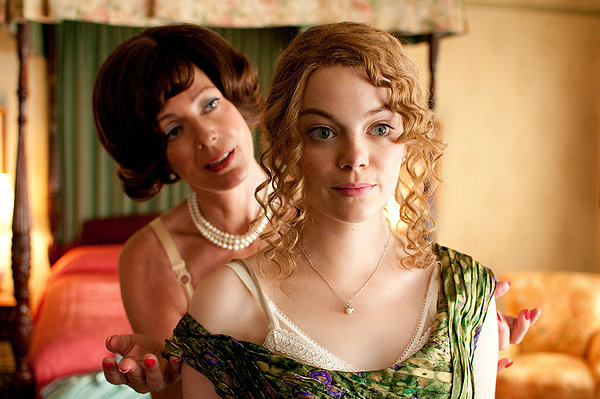 Naturally nobody is going to look as The Help as an exhaustive document of the Civil Rights era, but the movie seems to seriously downplay the intensity of that struggle. Sure it pays lip service to Medgar Evans assassination but by this time there were riots, churches being bombed, children being killed, open collusion between law enforcement and the Ku Klux Klan, and the Freedom Riders were being met by violent mobs. There are a lot of bigger things going on than black maids sitting down for interviews with a college girl. Come on, this is Mississippi we’re talking about here, the home of racism. I understand that the Civil Rights movement had thousands of anonymous acts of courage and the actions of these (fictional) women should not be out rightly discounted. However, the parting message of the film seems to be not about the courage of the black maids but the tenacity of Skeeter, a middleclass white woman who herself grew up with “help.” The Help’s mixed message on race relations reminds me of a similar situation with 2009’s beloved The Blind Side. That movie wasn’t so much about the triumph of a black athlete so much as a glowing picture to how great rich white people can be. And Sandra Bullock got an Oscar for it; that’s how great a white lady she was. The Help is another example of Hollywood taking a story primarily about minorities and having white people necessary to tell that story. Why are white people always necessary to tell some other race’s stories? Skeeter is an open-minded gal that speaks her mind and stands up to the Jim Crow South. That’s how she starts. By the film’s end, she’s now… an open-minded gal that speaks her mind and stands up to the Jim Crow South and now she has a publishing career. Good for her! Good for heroic white people! They had so much to lose back then.
I guess my main fault is that this is not Skeeter’s movie. I don’t even think she’s needed. Yes she provides the outlet for the stories and secrets of an undervalued class of people. But did she need to be the co-lead? Does she need her own storyline where she stands up to her mother cowing to racist social norms? She had her own maid (Cicely Tyson) unceremoniously dumped while she was at school. Surprisingly this does not give too many insights to Skeeter’s character. Do we need any scenes of her going out on dates so that we can forever be reminded how ahead of her time she was, how liberal and progressive she was and destined to be unappreciated by a pool of men who were looking for only pretty housewives? As my friend China Gentry said, we’d all like to think we’d be the forward-thinking progressive voice of change in these historical dramas, to make ourselves feel better, but we’d most likely just be another silent face in the background. The boyfriend storyline is a complete waste of time. Skeeter goes out with a drunk jerk, he comes back and apologizes, they go out again, then after she gets published he freaks out and storms out. And that is the last we see of this guy. That’s the end of his story. He apparently puts his foot down when it comes to dating a female author. This storyline adds nothing to the overall narrative or to the character of Skeeter. There’s entirely too much Skeeter in the movie, and I say this as a gigantic fan of Emma Stone (Easy A). It’s not the actress’ fault either because she performs well in her first dramatic film role. This is just not her movie. This is not a movie about heroic white people; at least it shouldn’t be. This is a movie about the help, so let’s devote more time to them, notably Minnie and Aibileen. The movie opens and closes with Aibileen’s voice over. She is the star of this story. Why do I need another character just to coax out her story? Yes, I understand the limitations to a woman in Aibileen’s position in those days, but that’s no excuse. She deserves to be the focus.
Davis crushes in this movie. She is a one-woman force of devastation. You can just see the wear on her face, the tremor in her eyes, the sadness etched into her face. This is a woman beaten down by her position, and Davis is excellent. How good is this woman? She’s so good she got nominated for an Oscar for a single eight-minute scene in 2008’s Doubt. That’s Judi Dench territory right there (Dench famously won a Best Supporting Actress trophy despite only appearing onscreen for about nine minutes in Shakespeare in Love). She has a few big acting moments but mostly she’s not an outspoken woman. She’s more a downtrodden woman used to the many disappointments of her lot in life. She raises other people’s children while seeing very little of her own son. She develops close relationships with those kids, and the kids feel more attached to their maids than their mommies. And there’s the shattering disillusionment that these children, who once loved their maids, will transform into spitting images of their parents. The help gets treated less like family and more like a disposable, impersonal employee. The ease of severing ties can be heartbreaking. And Davis lets you feel all that without even having to speak. Spencer (Dinner for Schmucks), in easily her biggest role of her career, is enjoyable with the more outspoken role. She’s more the mouthpiece for the audience.
 As I admitted in my review of 50/50, I don’t think there’s any role that Howard (fun fact: both Howard and Stone will play film versions of Gwen Stacy) can play where I won’t fall in love with her somewhat. This is more a hypothesis than a theory at this point. Hilly is a social queen, the Southern belle who likes things just the way they are. She has influence over the other middleclass wives in Jackson, but she does make for a pretty marginal main antagonist given the time period. She can threaten the livelihoods of the maids, so she is a threat, and her worldview is decidedly racist (she thinks using the same toilets will spread “black diseases”). She’s built up enough to be a threat but not enough to be unstoppable. She’s defeatable, unlike the intolerant ideology so prevalent in the South. We can’t defeat racism but we can topple one racist white lady. Well, we can laugh at her and bring up the fact that she ate something very gross once. I won’t go into spoilers, but this plot point where Minnie gets wreaks personal vengeance on Hilly via baked goods feels out of place for the tone of the film. It doesn’t fit.
I resisted seeing The Help for so long, believing it would be a painful experience with mushy emotions and many life lessons served up on an easy platter. And to some degree, the movie is exactly that. But it’s also hard to dislike the sweep of the old fashioned storytelling. The Help is a nice movie, extremely well acted, and filled with period details that will make the audience sense its authenticity. It’s easy to get caught up in the writing and the acting, so it’s easy to ignore the otherwise somewhat questionable examination on race relations. I don’t know why we still need white people to tell “their story.” The Help is a well-crafted movie but it fails to move the conversation forward. Perhaps that’s an unfair expectation. Not every Civil Rights era story is required to properly educate the public, let alone a work of historical fiction. Maybe I should just sit back and enjoy the story like so many million readers have. But the power of Davis’ performance claws at my memory, telling me she deserves a better movie focused on her character. For once, I’d like to see a Hollywood movie about race relations that doesn’t require white people as a framing device. Let’s let the right people tell “their story” for once.
Nate’s Grade: B
Share this:

Limitless (2011)
 With a dream premise for a pill-popping culture, Limitless is a visually fervent thriller that manages to stay a step ahead of the pack. Bradley Cooper takes a pill and can unlock full potential of his brain, which involves, obviously, scoring big paydays and women. It’s a silly fantasy but a universal curiosity of what we could do if given full access to our noodle. Director Neil Burger (The Illusionist) uses every visual trick in the book to represent the new brainpowers, as we watch words, numbers, and memories drift through a colorful explosion of imagery. It’s all very pretty to look at. Burger’s visual prowess elevates the more pedestrian moments of Limitless, but the film has a way of surprising you. The Mob takes an interest in this wonder pill, operating at a new peak of production. A woman being hunted down takes the magic pill and is able to quickly formulate an escape. So what if the profound existential questions regarding human capacity and possibility are thrown aside, we got some nifty visual flourishes and foot chases here people. The pacing is relentless and the plot manages to find intriguing ways to keep a superbrainiac in danger. Limitless is a perfectly enjoyable movie with enough juice to forgive its lamer moments and contrived ending.
Nate’s Grade: B
Share this:

Water for Elephants (2011)
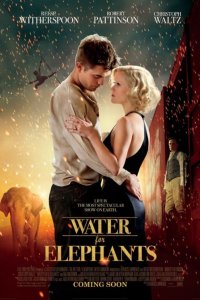 Would you believe at no point does the film Water for Elephants come close to explaining its title? I have never read the best-selling 2007 novel, where I’m sure it’s given some glancing explanation; so allow me to thus pontificate. Rosie the elephant is given tubs of whiskey at several points in the movie, which she happily laps up thanks to her prominent proboscis. So does that mean that the “water” for elephants is whiskey? If that’s the case, then this is really a tale of dangerous enabling. But then again, how do you tell a four-ton pachyderm that she’s cut off?
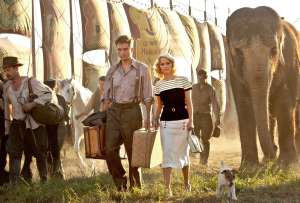
Jacob (Robert Pattinson) is one exam away from becoming a licensed vet from Cornell in 1931 when he’s delivered some tragic news. His Polish immigrant parents died in a car accident. Distraught, Jacob runs away and hops onto a passing train, stumbling upon a crew of circus performers. The train belongs to the Benzini Brothers circus, led by the fiery August (Christoph Waltz). He’s about to be thrown off the train when he panics and screams that he’s a vet. August hires the kid as the team’s newest vet and Jacob finds animals that are in bad shape and pushed to their limits. He recommends a mercy killing for the main attraction, a white horse that the boss’s wife, Marlena (Reese Witherspoon), performs upon. He takes some initiative and puts the horse out, despite August’s wishes. Lucky for them all, they find a new star attraction – Rosie the elephant. Robert doesn’t know the first thing about elephants, or “bulls” as they’re referred to by performers, but he’s tasked with getting the creature ready to perform or else everyone will be destitute. The man has a way with pachyderms, and the Benzini Brothers experience a windfall of new business, looking to take on Ringling Brothers. But the whole time, Jacob is making moon eyes at the boss’s wife, despite everyone telling him at every turn not to.
 The biggest issue this movie has is that the trio of main characters all feel like they exist in separate movies. There is zero chemistry between Pattinson and Witherspoon, further dampening their lukewarm romance. Robert is a character defined by being young and having a moral center. He’s not a person so much as an alternative. Marlena is the damsel very distressed, and Witherspoon plays her part all in all slow cock-eyed glances. If I had to pick one of the three, I’d choose to go with August’s version of the story just because he’s a more interesting character than our do-gooding Jacob. August is a huckster who needs to take care of a caravan of drifters and sell them to the public as the stuff of dream and legend. He has some charisma, he’s constantly leveraged against debts, and he is pressured to keep things afloat and to keep people from mutinying. This is beyond the heyday of circuses, so he knows that too many shows with too few people means that his troupe will be picked apart by circus carpetbaggers. You actually start to empathize with him at turns, and then he goes off and beats animals or his wife and that’s that. August is an interesting, vulnerable, flawed character, and he’s given the thankless role of being setup as sneering villain. I would have rather watched August try and keep his deteriorating circus together than watch another tired romantic triangle.
The romance that so much rides on is about as sure-footed as a drunken elephant. Part of this is the failure of Pattinson to deliver a performance that doesn’t feel wooden and artificial, as if he’s posing more than acting. But the romance, which dominates the film’s narrative, is given such scant reasoning that it expects the audience to simply fill in the blanks. He’s a young, good-looking guy who loves animals. She loves animals. Her husband is a jerk, so what’s the problem? Naturally, she’d just run to whatever available catch she could find to escape her hell so anything that delves into more character detail would be a waste of time, right? The movie seems to think so. The love triangle all inhabit very rigidly defined parts. Just because a woman is married to a nasty guy doesn’t mean I instantly want her to get together with just any alternative. Sure this lady deserves to be treated better, but just because a film presents “Option B,” and that option happens to set teenage girls aflutter, doesn’t mean I’m rooting for “Option B” just because it’s not “Option A.” That’s not enough for me to make a satisfying romance, but that’s all Water for Elephants has its aim set on. I need more effort, movie. It’s no surprise that the romantic moments are the weakest parts of the film.
 The real star of the movie is Rosie the elephant. She’s a natural performer and she’s got more presence than Witherspoon. I needed more moments with Rosie. After a somewhat boring first act, I started wishing that Rosie would replace someone in this dull love triangle. Imagine how much more interesting this movie would be if it was the heartbreaking story of one man, on woman, and one elephant. Maybe Jacob likes fat-bottomed girls. For animal lovers, there are some wince-inducing sequences of animal cruelty, mostly at the hands of the temperamental August.
The very opening sets the story up for a colossal disaster in the end, and the fact that we are not delivered disaster is a disaster of storytelling (too much?). I’ll try and keep the spoilers in a general sense without going into specifics. The film is bookended by the framing device of Old Jacob (Hal Holbrook) leaving his nursing home to see a circus and tell his life’s story. During his conversation with a circus leader (Paul Schneider), the young man is taken aback when Old Jacob reveals he was apart of the Benzini Brothers troupe when “it” happened. We’re told that it’s like the third biggest circus disaster in history and it has reverberated through decades. I’m set up for something memorable. I’m set up for a tragic ending, likely involving Marlena so that their love will forever have that tinge of unrequited longing. Then when we do eventually head to our big moment in the big top, well it’s far from memorable. Once you assess the ending, you realize that there is very little to make it number three on history’s lists of circus-related mayhem. If this stuff registered as number three, what the hell was number four? A clown catching his hair on fire? And then the movie carries on to some ludicrously happy ending, which seemed tonally inappropriate given the mood of the film and the poorly written romance between Jacob and Marlena. I was prepared for something operatic and terrible, and skimping out on that after an exasperated setup makes me feel hoodwinked, like listening to August bark about the greatest sights and sounds imaginable when they’re all just a trick. Something tells me that screenwriter Richard LaGravenese (Freedom Writers, P.S. I Love You) was not intending to add some meta commentary on how his story is built for dissatisfaction.
 Water for Elephants is a watered-down romance that flounders thanks to three different actors acting like they’re in three different movies. Also, it doesn’t help your romance when so little work is put into making young people fall in love. There are fascinating circus-related tidbits that make me wish the movie was more Depression era circus drama than Depression era circus romance. It’s a handsome enough movie from a technical standpoint, and it has some points of interest and some interesting characters, but its shackled to such a weightless and naïve love story. This movie was described by many as an “old fashioned” kind of film, and generally that can be construed as a warning signal. When people dub something “old fashioned” it can tend to mean “boring except to older people.” It just so happens that my screening of the film was an open caption screening, which attracted dozens of our nation’s elderly and hearing impaired. I didn’t so much mind having grown up with subtitled foreign films. But one delightful accident of seeing this open captioned screening was that they captioned everything. Every sound, every offhand piece of dialogue that would ordinarily go unnoticed and undetected. So now I got to see, as subtitle form, such discoveries as Guy in Background saying, “Hey pick that up,” and Other Guy in Background responding, “Okay. Put it where?” It was more exciting than what was going on between Jacob and Marlena. Now let’s get that elephant drunk!
Nate’s Grade: C
Share this:

Legend of the Guardians: The Owls of Ga’Hoole (2010)
 This lushly animated tale about good owls, and bad owls, but mostly owls feels indebted to Don Bluth’s The Secret of NIHM. There’s a legendary story about the guardians who would save the… remaining owls? The plot doesn’t ever really leap beyond the basic fantasy concepts of good and evil, heroic and manipulative. It’s hard for the tale’s drama to reach grandiose heights because, well, it’s owls. Not anthropomorphic owls, pretty much plain old owls. Some characters were just hard to distinguish between. I can firmly say that some things work better on page than screen, and descriptions of grand owl societies and owl-on-owl combat are definitely items that, when fully realized in such a literal fashion, just come across as goofy. Being directed by Zack Snyder (300, Watchmen), the movie looks gorgeously rendered but fails to leave any emotional mark for anybody who has ever seen a scrappy band of misfits topple the mean bad guys. The action follows the Snyder fast-slow-fast visual motif, which allows the audience opportunities to drink in the visual effects work. The mostly Australian vocal cast, plus Helen Mirren, provides some levels of amusement, but it’s the story that ultimately disappoints. Legends of the Guardians looks fantastic, but it’s story is far from legendary. And they needed to have a pop song by Owl City because the man has “owl” in his name, apparently.
Nate’s Grade: C+
Share this:

The Eagle (2011)
 In 140 AD, the Roman Empire has spread its reach across the European continent. Commander Marcus Aquila (Channing Tatum) is stationed in northern Britain. 20 years earlier, Marcus’ father led a legion of Romans into the northern British territory. The natives attacked them and Rome’s golden eagle, a significant idol under the guidance of Marcus Senior, was lost to history. Marcus has endured shame and vowed to redeem his family name. After surviving a nightly attack at the fort, Marcus displays great bravery but is injured. He’s honorably discharged from the Roman military. While he regains his strength, Marcus plans on venturing into the northern British highlands and finding that missing eagle. He teams up with Esca (Jamie Bell), a slave whose life he saved, and the duo goes beyond the wall that separates civilization (Rome) for the wilderness (native Britons).
Too often The Eagle feels like its wings were clipped. With such life and death stakes, the movie feels curiously adrift and prosaic. It never feels like it has any rush to go anywhere. In some regard, that makes the film feel like a product of the Hollywood of old, where a plot was allowed to meander and marinate to build to something worthwhile. But The Eagle is hardly worthwhile. It begins with some amount of excitement but that quickly dissipates with an interminable middle that feels like it’s still going on even as I write this. The plot is far too lean to cover a wide canvas, and the characters are far too shallow and incurious. They say so little, and what they do say means so little. It’s general variations on the idea of honor and sacrifice. They’re just focused on retrieving the prize. Meaningful conversation would just get in the way of things. The character dynamics between Marcus and Esca is stilted and kept at a distance. The class struggle and history of foreign occupation is never really addressed beyond a superficial nod. It’s like being stuck with two boring guys on a long, uninteresting road trip. Director Kevin Macdonald (State of Play, Last King of Scotland) gives the proceedings a docudrama touch thanks to his background in nonfiction films; too often this means he goes on half-baked Terrence Malick-like asides to admire a grain of wheat or some old artifact. The docudrama approach seems to conflict with the relatively old fashioned feel for this film, like Macdonald is trying to do his best to lift up material in want. There’s just so little at the core of this movie.
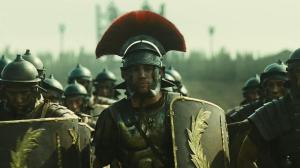 Tatum (G.I. Joe, Step Up) tries some form of an accent, though I’m not exactly sure what region of the Roman Empire the man is hailing from. He still has an imposing presence that manages to fill in the gaps of his acting ability, much in classic Hollywood tradition. And yet the man seemed more masculine in a Nicholas Sparks movie from last year. Bell (King Kong, Jumper) takes his haunted, submissive character to heart and gives a performance that confuses submission with understatement. He main mode of acting is the power of serious staring. The two actors don’t ever develop any onscreen sense of camaraderie or warmth. Even during the climax, you never feel like these guys have anything more than a civil employer/employee relationship. That’s why the laugh-out-loud, tonally jarring ending seems so out of place. Instead, Marcus and Esca strut through the halls of Rome, music triumphantly rocking out, and says, “What do you want to do now?” like they’re lining up weekly wacky adventures to be had. You’ll be surprised to see actors like Donald Sutherland, Mark Strong, Denis O’Hare, and even A Prophet‘s Tahar Rahim littered among the cast. Why are they in this movie when they have such insignificant parts compared to their bland leads?
The colonial perspective also started rubbing me the wrong way. Now colonial tales have long been featured in pop culture. I don’t on the surface have an issue with a storyteller utilizing a massive horde of natives to stand in as an antagonistic force. But sometimes that dynamic creates a skewed rather culturally tactless portrayal. Are the overpowered, conquering empires always blameless? Do the natives, who have been displaced and killed, not have a respectable grievance? Do they not have a right to fight for the lands that have been taken? Too often, the natives are viewed as blunt brutes (just watch the “cowboys and Indian” pictures from the 1950s) and the figures of expansion are viewed as heroic pioneers. The Britons come across as, essentially, the Indians. The filmmakers always want us to side with our hunky hero Marcus and his quest for honor at every turn, but the movie takes great turns to make the natives seem extra villainous. For a while they just come across like another culture. They have community, customs, and the like; it’s just not the dominant culture’s community and customs. And then, in an appalling moment of cheap melodrama, the Briton chief kills a child to send a message to Marcus and his Romans. This material is handled so indelicately that an unsettling undercurrent emerges and gains steady traction.
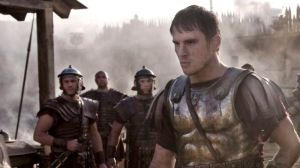 So what if the Britons stole one gold eagle 20 years ago? “It’s not just a piece of metal. The eagle is Rome,” we are reminded by Marcus. Symbols are great, but a one-man search in a land as large as Scotland seems impractical so many years hence. And then you have to take into account the time passage. It’s been two decades seen this beloved bauble went M.I.A., and damn near anything could have happened to it. It could have been thrown into the ocean. It could have been buried. It could have been smashed to smithereens. It could have been taken to another land. It could have been melted down into smaller, gift-shop sized eagles on sale to the general public. I’m just saying that in the ensuing 20 years anything could have happened to this bird. The fact that one guy can traipse on foot through Scotland and the first group of natives he runs into happen to possess the artifact that went missing 20 years prior is just insulting. First chance and he lucks in? I was eagerly waiting for an ending where Marcus, brimming with pride at having returned the eagle to Rome, is informed by one of the politicians that it’s the wrong eagle (“Here we go again!”).
The Eagle is dressed up to be an old time adventure story, but it’s just too slovenly paced and generically plotted to work. The lead characters are bland, distant, and noble to the point of annoyance. When a character is defined entirely as forward thinking, exceptionally lucky, ethically straight figure of honor, excuse me when I start to yawn. And when all he’s tasked with is finding an old relic that miraculously happens to be with the first freaking group of people he finds, then excuse me for eyeing my watch. The Eagle has some workmanlike action and suspense to it, brief moments of activity over what is in essence two hours of silent walking (it’s like somebody cut out the middle of a Lord of the Rings movie and sold it). The Eagle, both the film and the titular hunk of metal, are simply not worth the effort.
Nate’s Grade: C
Share this:

I Am Number Four (2011)
 Despite being based upon a young adult book series, I Am Number Four is an unfortunate title. What do you call the sequel? I Am Number Four 2? I Remain Number Four? Let’s not even mention the obvious pan that is begging to be covered by that title (“I Am Number Four? More like I Am Number Two!”).
Number Four, a.k.a. “John” (Alex Pettyfer), is your normal teenage alien hiding on Planet Earth and trying to live a regular life while eluding intergalactic mercenaries. Numero Quatro has relocated to the town of Paradise, Ohio with Henri (Timothy Olyphant), his alien guardian who poses as dear old dad. The two are trying to keep a low profile because Number Four is one of the last nine super-powered aliens from a dead planet. The aliens develop different special abilities as they mature and Number Four has begun to notice that his hands glow in the dark. Number Four catches the attention of Sarah (Dianna Agron), a pretty gal whose ex-boyfriend happens to be the super jealous quarterback. Number Four also befriends the school’s nerd (Callan McAuliffe) who thinks his father was taken by aliens. He’s not exactly keeping the desire low profile. Numbers 1-3 have been killed by a pack of alien mercenaries who intend to dominate Earth, and now Number Four is next.
While neither special nor afflicting, I Am Number Four is a pretty mundane, mediocre, special effects driven goof aimed primarily at young teen males. The plot lacks any trace of nuance and seems fantastical in what should even be ordinary. The Ohio town is one of those small towns that exist in the minds of west coast studio executives, where everyone gathers round for a carnival and the roads are mostly of the dirt variety. Sarah’s family is one of those ideal, chatty families that exist primarily in the minds of nostalgia. They don’t just sit around and chew their food; they are actively involved in dinner cutesy dinnertime games and cutesy embarrassing interactivity. But the movie never lets you think about these inauthentic tidbits for long before more explosions or colorful special effects rattle you. The plot follows an almost mechanical process, supplying some PG-13 skin (ladies in low rise jeans! Cleavage!) or some rudimentary chase scenes at a fairly brisk pace. The story borrows liberally from many sources, including a dash of super powered loner Spiderman stuff, angsty teen romance from Twilight, and a sprinkle of whatever is playing on TV right now as you sit reading this.
 The action is never really takes off beyond the general concept of Things Exploding and People Running. Director D.J. Caruso (Eagle Eye, Disturbia) can string together a series of pleasing visuals but they never amount to much. The film lacks real suspense and any risible sense of excitement. The action sequences are disposable but at least Caruso makes sure that the audience can follow along. I thought with all the sci-fi elements that the film would make more interesting choices, but alas I Am Number Four relies all too easily along commonplace action tropes like it’s an accomplishment. Number Six (Teresa Palmer) gets to walk away from an explosion in slow-motion (while she wears sunglasses). Nobody in town seems to ever pick up on the mounting collateral damage of this interstellar spat. Caruso and the screenwriters are too content to just be happy playing with the special effects toolbox, emulating the favorite moments of the sci-fi action genre. And one of those tropes is that ANIMALS CAN NEVER DIE. Number 4 has a shape-shifting guardian pet that decides to take the form of a dog. Then when things get rough, this dog mutates into a hulking CGI creature, which still looks like a dog. And when he gets wounded fighting another CGI monster, it’s not enough that we get the pained dog cry but the filmmakers decide that he also has to transform back into a regular Earth dog at this point to hammer home the image of pooch in trouble. Shameless to the very end. And then, during our resolution this space dog has to come hobbling out.
Fortunately for the audience, the actors are all rather beautiful. Pettyfer (Alex Rider) isn’t much when it comes to this thing called acting, but he’s got abs you could scrub laundry with and really that’s half the part of playing a hunk from outer space. I give the guy more credit just for having to be saddled with the lame superpower of glowy hands. It’s a long wait for those glowy hands to become instruments that launch glowy fireballs. For most of their screen time, Pettyfer’s power just looks like he’s clenching two very powerfully charged indigo-glowing cell phones. Olyphant (Deadwood, Hitman) is too young for me to be covering as the dad to a 17-year-old kid. I still remember Olyphant in 1999’s Go. Maybe that’s just my hang-up. The ladies are all gorgeous are all in the flawless skin and teeth variety, you know, the ones that populate every small town. No one truly makes much of an impression but they’re easy on the eyes. It’s like an Abercrombie and Fitch catalogue come to life with extra explosions (and more clothes).
 The only actor that stands out is Kevin Durand and he’s under pounds of makeup as the chief villain. Durand first came to serious attention as a season-long villain on TV’s Lost as Martin Keamy. He has a real distinct menace that doesn’t come across as self-satisfying or ironic. He’s got a real presence and it seems like casting directors have caught on to this former Canadian standup comedian. From there Durand has become something of a go-to guy when it comes to large intimidating men and men with some kind of mild speech impediment; his characters in X-Men Origins: Wolverine, Legion, and even Robin Hood all sounded like they had their mouths stuffed with cotton. Durand always has a good time with his bad guy roles, whether they are flinty or over-the-top. I enjoy watching this man onscreen even if he’s under some fairly lackluster creature makeup that makes him look like a tattooed shark man.
The point that caught my attention, and was scantily mentioned but once without nary a rejoinder from any character, was the fact that the big bad evil aliens are killing the alien teens in order. No reason is ever attempted. There are nine super alien teens but for some reason these interstellar killers are uncontrollably anal-retentive (“We may be vicious monsters, but we respect the value of numerology”). It makes little strategic sense to stick to the doctrine of taking out your enemy one at a time and in a predetermined order that everyone knows about. It also means that presumably Number 9 will be the hardest to vanquish since they will have the longest time to master their super power. Later on, Number 4 gets an added boost from a sexy, slinky Aussie who happens to be Number 6. My first thought: “What the hell happened to Number 5?” Then I figured that Number 5 has to be locked away somewhere in a protective safe house at an unknown location. Because that affords Number 6 to do whatever the hell she wants; the evil aliens would just have to stop and say, “Look Number 6, we’d really, truly love to vaporize you right now, but first we gotta go find and kill Number 5 first. See ya later.” If that’s the case then Number’s 7-9 need to get off the bench and team up. Number 4 can’t keep this up forever, guys.
I Am Number Four is tailor-made for a young male audience that doesn’t have the urge to see something harder or edgier. It’s got superfluous jet-ski stunts, girls with flat tummies, explosions, cool space weaponry, CGI monsters, villains in long black trench coats, failed attempts at romance, a dog, and even a reference to famous Cleveland Browns quarterback Bernie Kosar. It’s not an incoherent cacophony of light and sound like you’d find in a Michael Bay film; director D.J. Caruso is like Bay lite with more self-discipline. I Am Number Four is fairly derivative stuff but nothing worth getting upset about. After you see derivatives of derivatives, you start forgiving the final product for lacking any discernible flavor. All of the elements come together in rather harmless fashion making a rather empty but harmless sci-fi action flick.
Nate’s Grade: C
Share this:

Percy Jackson & the Olympians: The Lightning Thief (2010)
 If you’re looking for a pristine example of mediocrity, then let Percy Jackson serve as the new definition. From the acting to the special effects to the story, this movie barely registers anything other than a disinterested shrug. Based on a series of young adult books, clearly the producers were eyeing a potential lucrative franchise, which may explain why they hire Chris Columbus as director. The modern-day scions of ancient Greek gods is an intriguing starting point, until you realize that the film is just going to become one big, dumb retread through Greek mythology without a hint of wit. It’s Greek mythology turned into a kid’s book report who never read deeply into the source material. The film’s best asset is its collection of adult actors (Pierce Brosnan, Uma Thurman, Steve Coogan, Catherine Keener, Rosario Dawson), which take your mind off the fairly bland teen actors in the lead. Percy Jackson would be a more forgivable drag if it presented any moments of wonder that didn’t feel trite. The plot has the maddening habit of making characters stupid for plot reasons (hey Lightning Thief who wants to start a God-on-God war, when you have Zeus’s lightning bolt, thus sealing an impending war, don’t stop and monologue!). Yet the film has enough going on that you can follow it with ease and a minimal commitment. Consider putting on Percy Jackson when you need to do some household chores; it deserves that kind of attention.
Nate’s Grade: C
Share this:

127 Hours (2010)
 So would you give your right arm for a good movie? 127 Hours is the true-life tale of a man trapped between a rock and a hard place. Hiking in dusty canyons, James Franco gets his arm pinned under a rock. And that’s about it from the plot standpoint. That’s because everything is leading up to the grisly inevitability that he will be forced to cut his own arm off for survival. And director Danny Boyle (Slumdog Millionaire) does not let you off the hook. You will see every gruesome second of a man hacking away his own arm, slicing nerve-by-nerve, crushing bones, etc. It’s not the uplifting experience that Boyle and the producers mistakenly believe. The film’s true success is that it still manages to be entertaining and exciting, despite having a central character unable to move more than inches. It’s fascinating to watch Franco use the tools at his disposal to survive for five days before, well, you know. Boyle does a terrific job of making an intimate almost claustrophobic plot feel much more open. Nobody probably could have done this movie better than Boyle, taking his kinetic trademark style and allowing us to enter the mind of Franco’s fallen hiker. 127 Hours isn’t so much an inspirational tale as it is a morbid curiosity that entertains in spurts. But all the visual tricks in the world can’t get people to want to pay to see a man cut off his own arm.
Nate’s Grade: B
Share this:

The Killer Inside Me (2010)
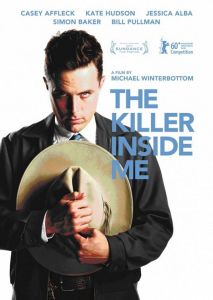 This is an unsettling thriller that takes us into the mind of a psychologically dangerous deputy policeman (Casey Affleck). He patrols the small Texas city by day and kills for pleasure by night. The movie runs into a problem because the character doesn’t have a semblance of any moral code, which sounds contradictory for a serial murderer. He doesn’t kill for profit or to cover a secret or anything that would come across as identifiably rational. He kills because he feels he has to; he’ll even kill the mistress he loves because he can’t control himself. It’s an upsetting premise that keeps the audience at a controlled distance throughout the film. There’s an ongoing theme of extreme sexual brutality, and director Michael Winterbottom (A Mighty Heart) seems to linger on extended sequences of sadomasochistic sex and ugly violence against women. There’s some ugly stuff here, like watching Jessica Alba get her face pummeled for a solid two minutes. You just feel sorry for what Alba and Kate Hudson go through (“voiding a full bladder” is amazingly low on the list of awful these women endure). Eventually Affleck has to keep killing to cover his tracks, and the threat of getting caught provides some moderate tension, a relief from wallowing in cruelty. All of this ickiness would seem worthwhile if it felt like we were learning something about our disturbed lead. Affleck plays his opaque character rather flatly, making him free of charisma, empathy, and sadly, insight. He’s just the same as a masked killer in a slasher movie. That’s the worst disappointment in a film with so much ugliness.
Nate’s Grade: C


 nathanzoebl
You must be logged in to post a comment.