Blog Archives
We Need to Talk About Kevin (2011)
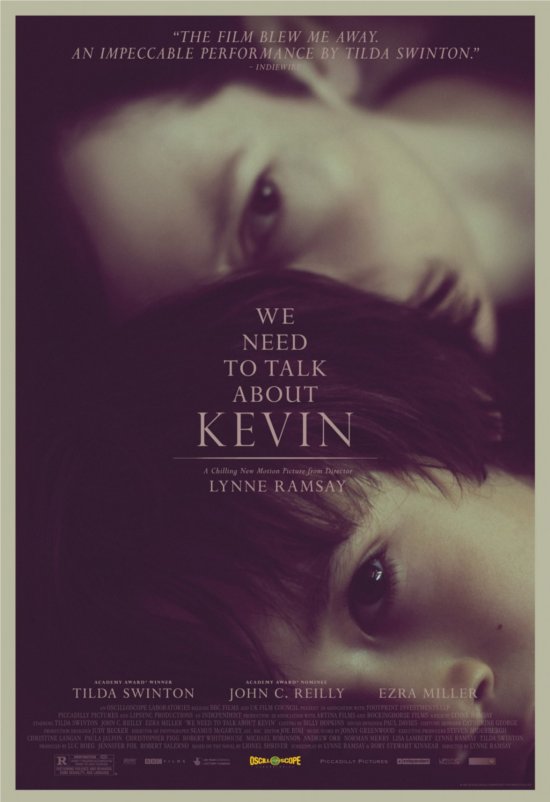 If you’re contemplating having children, then We Need to Talk About Kevin may not be the movie for you at this moment. It takes a stab at the nature/nurture debate and proposes that some children are just born broken and beyond the reach of even the most dedicated parent. It’s not exactly the cuddly message we get from most stories about the joys of parenting, but We Need to Talk About Kevin is a startling, provocative, and powerful portrait of grief, aggravation, and slowly dawning horror. Can even a mother love her monster?
Motherhood has not been the rewarding venture as promised for Eva (Tilda Swinton). Kevin (Jasper Newell at a child; Ezra Miller as a teen) wails so incessantly as a baby that she seeks out the sweet sounds of a jackhammer to drown out her shrieking babe. Even as a toddler, she knows there’s something just not right about her sullen, uncommunicative son. He seems to deprive her of any affection or attention she might find gratifying. Truly it seems much of Kevin’s motivation in life is to humiliate and torment his mother. It starts with being deliberately unresponsive as a child, and turning on a dime when in the presence of his father, then to delayed toilet training because he seems to enjoy making his mother clean up his mess (metaphor?), to the unexplainable massacre at her son’s hands. We Need to Talk About Kevin is an immersive experience, occasionally piling on how irredeemable Kevin is as a character. It also speaks to the unreliable nature of our shell-shocked point of view. It’s a disquieting film to say the least but I found it riveting and compelling at every second, artfully exploring a form of grief and social isolation that few will ever be able to fully understand.
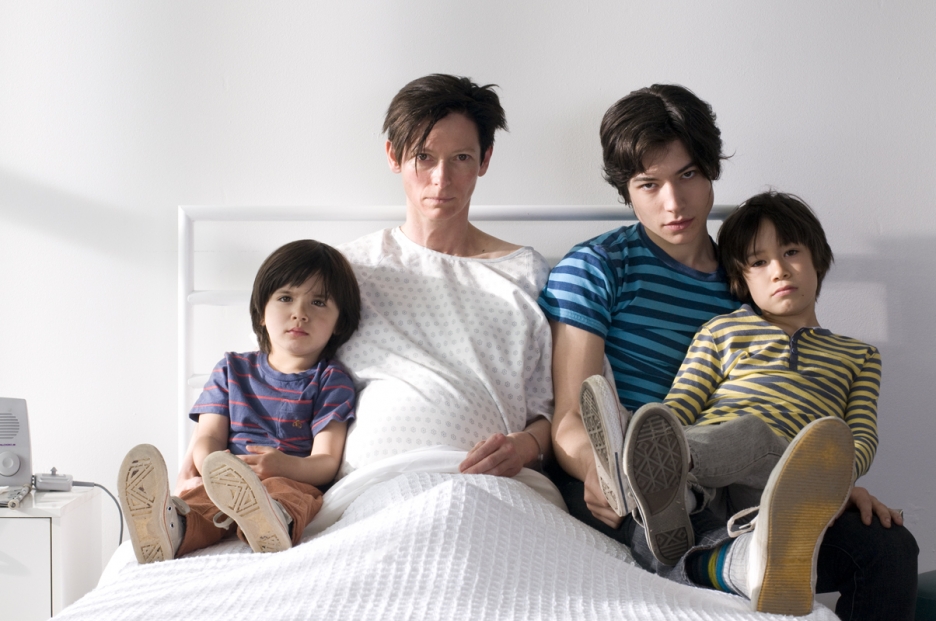 There’s tremendous psychological detail to this nightmarish parenting tale, and it’s those details that make the film feel eerily authentic and not exploitative. I found it fascinating to be drawn into this world, like I was watching an intimate, illustrated case study come alive. I found it very telling that after Eva accidentally injures her son in a fit of frustration, she apologizes but can only bring herself to do so under the shield of third person, saying, “Mommy shouldn’t have done that,” rather than, “I shouldn’t have done that.” And then when they get home, little Kevin unspools a perfectly believable story to cover-up what really happened. Even at six this kid is a shockingly adept liar, possibly because he’s a budding sociopath. Horror movies have been bringing us little pint-sized terrors for decades, from Bad Seed to the Village of the Damned, but those wicked kids seem like child’s play compared to Kevin, a startling, vacant child who is the scariest of the bunch exactly because he feels completely real. No Satanic imagery, glowing red eyes, or over-the-top associations needed; this is one messed up kid.
Watching this tumultuous and combative struggle for domination is equal turns compelling and terrifying. In many ways Eva adopts the role of Cassandra, the Greek figure cursed with visions of the future that nobody believed; Eva warns the people in her life that Kevin isn’t right, that he’s entirely capable of great evil, yet everyone ignores her dire warnings, and even Eva is culpable to some degree of enabling. Rather than discipline Kevin or stick to her principles, she passively accepts the situation and carries on with full knowledge that Kevin is going unchallenged. To everyone else he seems like a bright, helpful, normal teenage boy, which is why dear old dad (John C. Reilly) is so condescending and dismissive when Eva voices concern. Parenting is supposed to be instinctive, right? Eva feels like a failure, that this young soul has been steered to the dark side under her watch, and I think her hesitation to continue ringing alarm can be summed up by the fact that she’s just exhausted, tired of fighting a fight that everyone else ignores. I think she may also be desperately hopeful that she can ride this out, that it’s only a phase for her son, that somehow he’ll grow up to be a normal, loving child through some miracle, like a switch will be flipped. The only time Kevin ever shows his mother compassion is when she reads him a bedtime story involving archery, a hobby that would prove deadly.
The film is told non-linearly as we observe the fragmented memory of Eva. We have to pick up the pieces of life much like Eva recovering from her son’s destruction. It’s interesting to discover the symbolic connections between scenes, the connective tissue binding the memories together, and director/co-writer Lynne Ramsay (Ratcatcher) does an exceptional job of filling in key details to enrich this woman’s horrid life. The scenes don’t seem to last long, but Ramsay and her team provide all the meaning and weight we need so that the scenes matter. There’s a heavy amount of dread suffused into every scene in this movie, as the totality of events starts to become clear. The metaphors aren’t subtle but they are effective. Prepare for a lot of red in the color palate: squashed tomatoes, strawberry jam, splattered paint across Eva’s front porch as an act of vandalism. She spends the rest of the movie trying to clean away the red stains on her home (see what I mean about subtlety?). The splintered narrative also serves as a statement on Eva’s frame of mind, trying to move forward but haunted by a tragedy that goes down to the marrow.
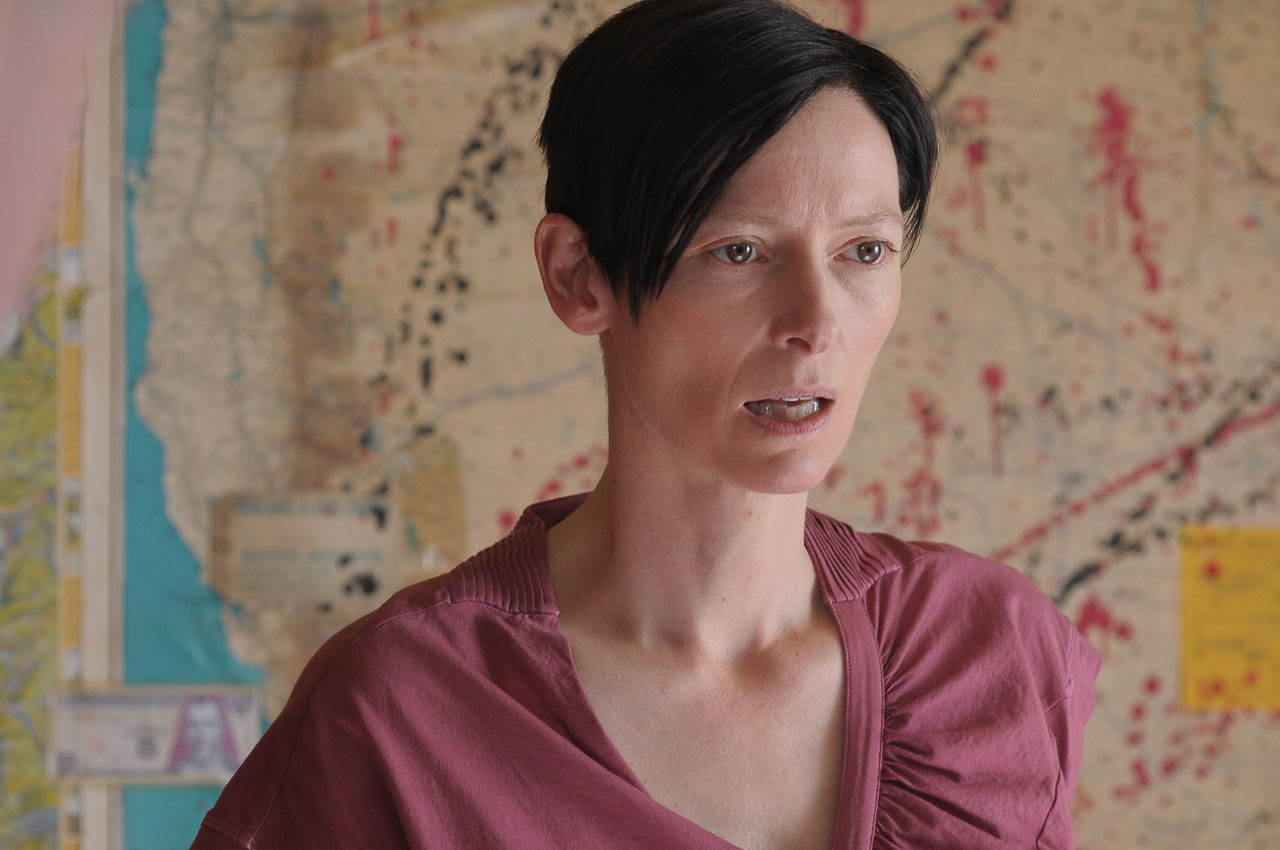 And of course all praise of the film needs to also be placed at he feet of versatile actress Tilda Swinton (Michael Clayton). She’s not given many lines of dialogue but what she is able to do to make her character feel fully lived-in is astonishing. There are so many different points of her life to play, from young exuberance to growing disdain to zombie-like pariah, and Swinton doesn’t strike one false note. Even during her grief and guilt she doesn’t go into hysterics. This is a woman that simply wants to waste away and be forgotten. Even when it looks like she might find some small measure of satisfaction or affection from another person, the movie sucker punches you. You realize that her son may be in jail but she’s serving a sentence all her own. Swinton is heartbreaking and subtle and nuanced even when it appears she’s simply staring off into space. You don’t really want to be in this woman’s head, and yet Swinton’s performance puts us there, hence all of my analytical assessment above. She’s a mixture of self-loathing, denial, bitterness, and penitence, and Swinton gives us telling glimpses of the storm below the surface. Her guilt is eating her away from the inside out. I’ll go on record and say it’s a crime that Swinton wasn’t nominated for a Best Actress Oscar (I personally apologize for not nominating her for the PSP Silver Cines).
I feel the need to talk and talk about We Need to Talk About Kevin, to sing its despairing praises, to encourage lovers of challenging, complex, and emotionally devastating film to experience this exceptional movie. It’s psychologically rich, bold, and revealing with even the smallest details to round out this hellish family scenario. It’s not an easy two hours to sit through, not by a long shot, but there are certain rewards for those who choose to wade through the darkness, Swinton’s haunting performance among them. This is a difficult subject and it’s produced a difficult film, but sometimes we need to be put in uncomfortable circumstances to get at a greater truth. What is the greater truth of the film? Maybe that parenting is really, when it’s all said and done, a leap of faith, maybe that avoidance of hard decisions is no solution, and maybe that some people are just beyond redemption. A movie that makes you think? Somebody ought to talk about this one.
Nate’s Grade: A
Share this:

The Hunger Games (2012)
 Suzanne Collins’ smash novel The Hunger Games isn’t your normal young adult reading material. Dystopian future, corrupt government, oppressive forces, twisted media culture, and then there’s the whole inhumane concept of children murdering each other for sport. The book trilogy has been consumed by millions of readers, young and old, and inspired rabid devotion reminiscent of other successful publishing franchises like Twilight and Harry Potter. Yes, Battle Royale fans, the premise is not original, but Collins’ book could just as well cite inspiration from The Most Dangerous Game, Lord of the Flies, The Running Man, or even an Outer Limits episode known as “Fun and Games.” Producers are hoping those legions of fans will turn up in droves and start a new lucrative film franchise. Reliably squishy filmmaker Gary Ross (Seabiscuit) was tapped to shepherd the book to the big screen. The Hunger Games movie doesn’t commit any major blunders to screw up a good story, which is good enough for many.
Set in a distant future, the ashes of North America have given way to the country of Panem. It is lead by a Capitol government and ringed by 12 mostly poor districts. Every year the Capitol commemorates the failed revolution of the districts by holding the nation’s favorite televised sport, the Hunger Games. Each district holds a reaping, which randomly draws one boy and one girl aged 12-18 years. These lucky chosen children, known as tributes, are then whisked to the Capitol where they will be placed into an arena and fight to the death. 24 tributes go in and there can be only one winner. In the outlying District 12, day-to-day life is a struggle, and Katniss Everdeen (Jennifer Lawrence) is burdened with providing for her family. She hunts illegally to provide food for her family and to trade for goods that they need. She’s excellent with a bow and arrow. Her hunting partner, Gale (Liam Hemsworth), suggests that they could run away. “We’d never make it more than five miles,” Katniss reasons. The two of them have too many responsibilities to ignore. Then Reaping Day comes, and Katniss’ 12-year-old younger sister Prim (Willow Shields) is chosen as the female tribute. Katniss volunteers to take her place, saving her sister, but throwing herself into a sport where the odds will not be in her favor. Joining Katniss as the male tribute is Peeta Melark (Josh Hutcherson), the baker’s son who has some history with Katniss.
 The tributes are paired with mentors, the oblivious Effie Trinket (Elizabeth Banks) and former District 12 Hunger Games winner Haymitch Abernathy (Woody Harrelson) whose helpfulness is tempered by the fact that he’s drunk often. He advises his newest tributes that they must make the audience like them to earn sponsors, people willing to pay big money to supply the tributes necessary supplies in the middle of the game. The Capitol is full of lush excess, the people donned in cartoonish and colorful garb. Katniss is dolled up and paraded around. She showcases her skills to the Game makers, who will give each tribute a rating that bettors will use. She’s interviewed by TV host Caesar Flickerman (Stanley Tucci) to make an impression. While with Caesar, Peeta reveals that there is a girl he’s had a crush on back home for the longest time – Katniss. The star-crossed lover angle hooks the audience and immediately transforms the dynamic of the games. Katniss is upset, but Haymitch rationalizes that Peeta’s confession has made them more marketable.
Then the dreaded day arrives and the 24 tributes are gathered up, injected with tracking devices, and launched into the outdoor arena to fight to the death. Katniss’ biggest threats will be the tributes from District 1, Glimmer (Leven Rambin) and Marvel (Jack Quaid), and District 2, Clove (Isabelle Fuhman) and Cato (Alexander Lutig). These tributes have trained their whole lives in the deadly arts so that they could volunteer to enter the games, hence why they are dubbed the Career tributes. And they usually win. Once the games begin, Katniss must survive the Careers, whatever surprises the Game makers have, the elements, and win over the affections of the TV audience. Let the games begin.
Firstly, fans can breathe a sigh of relief because The Hunger Games movie is a mostly successful venture brought to visual life. The legions of Collins’ fans celebrating the movie of their beloved book will mostly be satisfied. Collins’ story is still a good story no matter the medium. It establishes its alternative world and the stakes quickly and then it’s off to the killing fields. This is dark and disturbing stuff, far darker than even the darkest days of Harry Potter, and fans will be relived that the movie does not go soft. It’s not the exploitation-vehicle that Battle Royale was. This is trying to tell a story and not revel in the geysers of teenage bloodshed. This is a movie that satirizes reality TV and media culture as much class warfare. Katniss is primed and prepped to manufacture an impressionable image to TV audiences. It’s all about calculation, image control, and the manipulations of the media and audience to produce a star. Here’s a world where the 1% literally celebrate and toast the deaths of the 99%. Here’s a world that takes it cues from the Romans concerning spectator sports. I do wish the movie had channeled more of the book’s accusatory tone against the Capitol citizens, the silent majority complicit in villainy. And of course it was Collins’ point that we, too, the audience could be accountable in our own YA bloodlust.
 This is a story that grabs you and rarely lets go, centered on a heroine that is refreshingly a strong female role model for girls. Bella Swan has nothing on Katniss Everdeen. Here is a heroine that is proactive, resourceful, resolute, compassionate, and she doesn’t need a man to complete her. Sorry Ms. Swan, but Katniss has a lot more important things on her mind than getting a boyfriend. She’s got to provide for her impoverished family and shoulder plenty of responsibility, and that’s before she’s plucked into a death sport. In short, Bella Swan sucks. Katniss Everdeen rules 4-ever.
Since the book was written in first person, we were inside Katniss’ head the whole time. There are disadvantages of leaving that POV, namely that Katniss’ survival skills and cunning can be brushed over. She’s not just fighting the other tributes, she’s trying to think how best to play certain moments, how to appeal to the viewers at home. During the games, the movie jumps back and forth between the action and what I’d like to call Mission Control from Hell, the game makers HQ. This is a smart move that provides a greater antagonistic sense with the book’s unseen game makers. The exposition, mostly handled by Tucci as color commentary throughout the games, is presented in a way that doesn’t feel clunky. I also enjoyed the two sit-downs we get with President Snow (Donald Sutherland), the autocratic ruler of the Capitol, who sees early on the danger of Katniss. He explains that the games are meant to give hope to the poor citizens. “Hope is the only thing more powerful than fear. A little hope is good. A lot of hope is not,” he explains while pruning flowers. It’s nice to have a villain who understands the calculations needed for a proper oppression. It’s also nice to see Sutherland sink his teeth into a role that will only get more enjoyably evil as the films progress. I felt that the tracker jacker sequence, the interviews with Caesar, and the time in the caves were the best-adapted sequences.
Lawrence (X-Men: First Class) is a star, pure and simple. She was the perfect choice to play Katniss Everdeen. The Oscar-nominated young actress brings great steely determination and grit to the Girl on Fire. Katniss isn’t supposed to be a teenage warrior (that would be the Careers), even though she is thrust into that role. She doesn’t celebrate killing. This is not fun for her. Lawrence can play an array of emotions silently, deftly, like her hoarse, wild panic at Prim being chosen, her shell-shocked disorientation at going into the games, her quiet fury at her irresponsible mother and others like the game makers, her budding warmth for Peeta while he rubs a salve over her facial cut. Pages of description can be consolidated in just one pensive, conflicted expression on Lawrence’s lovely face. Lawrence is the heart of the movie and a tremendous presence to ground our sympathy and emotions.
Katniss is a dangerous competitor but she’s also vulnerable. She’s emotionally guarded and thrust into a situation where she has to “pretend” to be in love. Now the romance angle, and the self-awareness on Katniss’ part to give a good show, was a far bigger storyline in the book. In the book, she begins by playing a part and by the end doesn’t know if her feelings are false or genuine. It’s strange that in the movie their this-is-love kiss, meant to make the audience swoon on Katniss’ part, is followed up with nothing but hugs. Maybe the filmmakers thought a romantic angle was in poor taste given the kill-or-be-killed scenario, except that the romance angle is what keeps Katniss and Peeta alive. Want to know the best way to irk a Hunger Games fan? Start comparing the complicated romantic triangle of Peeta and Gale to dismissive terms like Team Jacob and Team Edward.
 The supporting cast performs ably, some better than others. Hutcherson (The Kids Are All Right) is given the most material to work with. He’s a nice kid, strong, but worried about his humanity, and the filmmakers never portray him as anything close to a badass or a helpless baby. Hutcherson shines in the moments where he comes clean with his emotions, like admitting that he has no chance of winning (his mom thinks so too). Peeta’s much easier at charm than bravado, and Hutcherson is a charming guy. I think Banks (Zack and Miri Make a Porno) actually gives the best performance, short of our lead heroine, as the maniacally bent Effie Trinket. Half the performance is the garish outfits, wigs, and makeup, but Banks nails the affluent insensitivity and ignorance of her character. Her forced enthusiasm is good for a few laughs. Harrelson (Zombieland) gives hints about the demons behind his character, a man who has to watch a pair of children under his tutelage die every year as his “prize” for winning. He’s a colorful character in a movie filled with colorful characters, but his sauced sarcasm can sting. Tucci (Easy A) hams it up with great pleasure as the smarmy, inauthentic, over-the-top TV host, Caesar Flickerman. They dolled up actor Toby Jones (Tinker, Tailor, Soldier, Spy) in a bouffant wig and sit him beside Caesar for commentary, but, and I literally counted, he has three lines where he speaks onscreen. Still, I love his oily voice as the games’ announcer.
The movie distills just about everything from the book, plot-wise, so the fans will be sure to see just about every plot event that they’ve developed a mental checklist for. However, this narrative approach, an attempt to satiate the fans that bristle when the movies of their favorite books deviate too much from the source material, blunts the impact of the material. I was astounded at how overwhelmingly rushed and hurried the movie is, spending little time on those variety of plot events, rarely allowing the movie enough room to breathe. With this brisk and brusque pacing, it stops the movie’s vitality. The context and history of important items and people feel clipped, becoming just set decoration. Ross has not done an adequate job of making his movie universe feel richly realized. The significance of the mockingjay, a symbol of perseverance under the oppression of the Capitol, is left unexplained. It just becomes a dinky pin that makes Katniss think about home. The ghoulish mutts have been turned into just a bunch of vicious dogs that eerily resemble the dog demons from Ghostbusters (actually, I’m relieved the mutts were toned down). The contrasts between the impoverished outer districts and the lavish Capitol denizens are nicely showcased thanks to luxurious and weird art direction and costume design; these people took fashion advice from Marie Antoinette and maybe their political outlooks as well (“Let them eat cake… or death”). There are also some passing moments of dark satire as far as the Capitol’s overall stance with the games, and their blasé attitude about the value of human life, though the movie could have and should have pushed harder with its class warfare.
The Hunger Games reminded me of the first two Harry Potter films where the producers crammed in all the plot points they felt fans wanted to see rather than just, you know, adapting it into a good movie. If they wanted to keep everything from the book, plot wise, then they should have followed their convictions and produced a three-hour movie. Imagine The Godfather being cut down to two hours and twenty minutes. Imagine rushing through all that drama. Now I’m not in any way comparing The Hunger Games to The Godfather in terms of quality, but movies need sufficient time to establish their worlds and develop characters. They need time to breathe. The fact that a 142-minute long movie doesn’t have time to breathe is plain inexcusable.
 The characterization, beyond Katniss and Peeta, is extremely limited, and so when he deaths do occur the impact is minimal; only one tribute’s death is given time for mourning, and even this character’s death is limited due to superficial characterization and about two minutes of screen time. I’m not saying that every one of these 24 tributes needs a detailed back-story, but they’ve got to have some personality to them and the movie has to devote some time to develop that; good writing can tell a lot with little. Otherwise they just become somewhat recognizable faces and not characters. Cinna (Lenny Kravitz), Katniss’ stylist for the pre-game publicity in the Capitol, is reduced to being a bland companion. Let me single out the villains, our group of Career tributes. The movies have a long tradition of villains who aren’t given much characterization but are given personality. I need my bad guys to be given an opportunity to make an impression, and no, weapon distinction is not enough. With The Hunger Games, the bad guys just become a series of sneering faces, and these kids (Ludig, Rambin, Quaid, Fuhman) have got some good sneer faces. True, the movie’s entire twisted premise lays enough overwrought tragedy to the entire setup, turning children into killers, and President Snow is the ultimate villain, but the movie should be agonizing, terrifying, devastating, upsetting, and not merely inferential and rushed. I want to feel the deaths. Instead, the movie can’t even be bothered to briefly show the faces of the dead kids during the game’s daily death montage. There are all sorts of kids who were hired to be tributes from districts and I question if they ever got a second onscreen.
I also feel that Ross is, at times, completely wrong for this material. The man behind Pleasantville and Seabiscuit is not the first name you’d think of to tackle a dystopian sci-fi survival thriller built upon the premise of dead children. I almost wish they had hired Paul Verhoeven (Robocop, Starship Troopers), an artist well versed in sci-fi spectacle and subversion. Ross’ misguided visual approach, borrowing a page from the Bourne franchise, can make it hard to enjoy the film. During the opening segment in District 12, as well as the games themselves, Ross will attempt to up the visceral ante with his bobbing handheld camera. Now I’m not one of the people who loudly decry the use of “shaky cam” during action sequences, but before the second minute was over, I turned to my friend and said, “I already hate the shaky cam.” There’s a difference between handheld camerawork, which has some jostle to it, and a deliberately inauthentic docu-drama approach that makes exaggerated and distracting camera bobbling. There are long segments of this movie that is nothing but shaky close-ups cut together. There’s a climactic battle atop a metal structure that is completely incomprehensible to follow. It’s all just a blur of flashes save for two wide shots to thankfully attempt to orient the viewer. When an audience can’t follow the action, it not only kills tension but it also kills investment. The docu-drama visual approach is completely wrong for this movie. When was the last time you saw a dystopian sci-fi movie that had a docu-drama aesthetic? Try never.
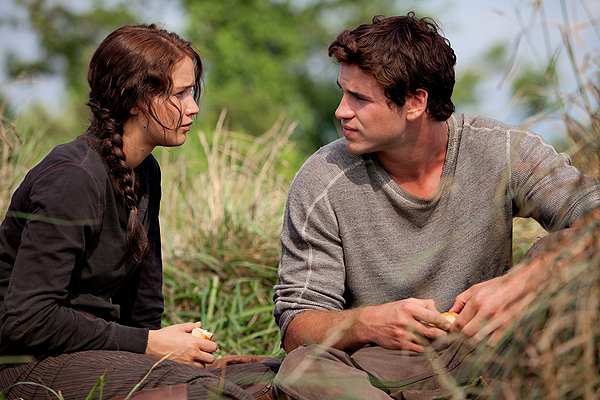 Likewise, to achieve the all-important PG-13 rating, Ross sanitizes the blood sport, utilizing lots of implied violence. The jangly aesthetic works for the duration of the race to the Cornucopia to start the games, as tributes turn a fight over supplies into a bloodbath, communicating the chaotic frenzy. I’m not clamoring for explicit carnage to get its message across, but just seeing children as far-off lifeless heaps is a disservice to the power of the story. Also, I don’t feel like Ross properly takes full advantage of the visual medium. Instead of being told, twice, about mines that will explode if any tribute steps off their platform before the conclusion of the countdown, let’s see it. Since half of these kids are about to become faceless corpses anyway, why can’t one of them lose their balance, fall out of the ring, and blow up? And then we cut to a nearby tribute dusted with pieces of dirt and blood, trying to keep their cool and failing. It would have kicked up the tension and shown the immediate danger that awaits. I don’t want the one-minute countdown to cut around the globe, seeing the different districts watching TV. I want that entire minute spent in the arena, hearing every second counted down, seeing every face of the tributes sick with anxiety and unease, gritting themselves for combat. I want to feel the same sense of doom that they do, not cut around the globe and then have the audio drop out. That’s a sorry way to start the games, even with a PG-13 mandate.
There are heavy expectations for The Hunger Games on all fronts, from studio execs to the millions of eager fans. I consider myself one of their legion. I voraciously read through the trilogy, getting hooked early, and have even helped teach the book as part of an American Literature curriculum. It’s a thrill to watch reluctant readers get excited about the book. The Hunger Games succeeds mostly as the pilot to an exciting film franchise. But having seen the Hunger Games movie twice in 14 hours, and being a huge fan of the book, here are my chief criticisms: the movie is far too rushed, speeding over so many plot points and characters, never getting time to breathe; nascent characterization for supporting characters; the context of so many things is missing; shaky cam overuse to the point of incomprehensible action sequences; dodgy CGI; not taking full advantage of visual medium; intensity a bit muted; and finally, a forgettable score. But, hey, good movie. It just frustrates me because it could have been a great movie, a searing, powerful, provocative, thrilling movie. Good movie will be good enough, especially when it makes more money opening weekend than the citizens of District 12 will ever see in their lifetimes. When you got a fan base as large as this series, the odds will usually be in your favor.
Nate’s Grade: B
Share this:

Extremely Loud & Incredibly Close (2011)
 The biggest surprise on the morning of the Academy Award nominations was the inclusion of Extremely Loud & Incredibly Close in the nine nominees for Best Picture. Critics have universally derided the 9/11 drama, becoming the lowest critically rated Best Picture nominee in the last 30 years, according to some awards pundits. The second lowest rated Best Picture nominee in that same span of time? The Reader, also directed by Stephen Daldry. Under new Academy voting rules, a nominee has to garner at least five percent of first place votes on members’ ballots. That means that at least 250 Academy members voted this crass, manipulative, off-putting, wrongheaded, exploitative movie as the best film of the year, thereby voluntarily divulging they must not have seen a single other movie for 2011.
Oskar Schell (Thomas Horn) was nine years old when his father, Thomas Schell (Tom Hanks), was killed on September 11, 2001. He was in one of the World Trade Center buildings and left six frantic phone messages before perishing. In the ensuing months after the disaster, Oskar is lashing out against his mother (Sandra Bullock) who spends all day in bed. Then one day he discovers a mysterious key in his father’s closet inside an envelope labeled “Black.” Oskar’s father used to send his son on a series of adventures around New York, looking for a fabled “sixth borough,” forcing Oskar to confront his numerous fears and insecurities. Oskar looks through the New York phone book and catalogs over 400 separate people with the last name of Black in the five boroughs. He’s convinced that his father has left one last hidden message somewhere in the city.
 My main sticking point was that I found Oskar to be an insufferable, bratty, little jerk. I understand he’s hurting and he’s trying to work through his pain. I understand he is gripped by irrational fears and has a hard time relating to others. I understand that Oskar’s father even tested him for Asperger’s, though the results were negative. Some people will try and explain away Oskar’s callous behavior in sweeping generalizations having to do with the ignorance of children or some undiagnosed medical problem. I’ve known people with Asperger’s syndrome and while Oskar fits a few of the superficial tics, being a jerk is not a symptom, sorry. He’s so mean to his grieving mother and indifferent about other people that I wanted to slap him. I found him to be unsympathetic and wholly irritating. I found his unsupervised journeys for cutesy quests throughout New York City to be dubious. His parents just let their ten-year-old socially awkward kid run around New York City by himself at all hours? The movie goes in a bad direction when it partners this talky nuisance up with a silent old man, played by the wonderful Max von Sydow (the movie’s only other Oscar nomination; another stretch I’d say).
Here’s a breakdown of my thought process: Oskar comes home on 9/11 to find the last recorded messages of his father, including an admission of love for his family. Oskar runs out and buys an identical answering machine and sneakily hides the original, denying his mother, a grieving widow, the chance to hear her husband’s voice one last time. Screw that kid. I’m sorry but that’s what went through my mind and to me he never recovered. His actions are inexcusable. Then he gets mad because his mom sleeps all day. She’s grieving you little snot! And then he has the gall to tell her, “I wish it was you instead!” It’s a moment intended to draw gasps, ripping the scab clear off whatever pretensions mother and son have with one another. But it just made me dislike the kid even more. The fact that even by the film’s ending emotional catharsis Oskar still hasn’t shared the answering machine messages with his mother is reprehensible.
The other factor that caused me to despise the main character was how Horn proves to be a dreadful actor. This is the first acting role for the former teen Jeopardy champ. He’s able to spit the rapid-fire, idiosyncratic dialogue burdened with cumbersome detail. However, Horn gives a terribly mannered performance. He has this annoying manner of over enunciating every single word, getting lost in a character affectation, always stagy and artificial. You combine a bad actor with an aggravating character and make them the lead of the story, and I’m already daydreaming possible murder scenarios (I don’t condone child murder mind you — I’d make it look like an accident). As for Oskar’s parents, Hanks is hardly in the movie and Bullock does shockingly well, nailing her most emotional moments. I’d rather see this movie from her point of view, trying to make sense of the insensible to her challenging son who hates her.
 Daldry wishes to use the backdrop of 9/11 to talk about important items. It’s too bad that his movie has nothing legitimate to say about healing. I was assuming that over the course of the film Oskar was going to run into a diverse collection of people, all healing, all with their own stories of pain, and then he would learn that the real treasure was the community of strangers he had brought together. Nope! Oskar runs into a gamut of fine actors, including Viola Davis, John Goodman, and Jeffrey Wright, but they all become mere baton-passers to a self-involved kid. They and their stories don’t matter. The lock to our missing key doesn’t matter. There’s a final revelation concerning Oskar’s mother and her activities to benefit her son that seems entirely implausible. Daldry and screenwriter Eric Roth (Forrest Gump, Curious Case of Benjamin Button) have transformed Jonathan Safran Foer’s novel about collective grief into a strangely myopic narrative given the scale of the suffering.
The movie is so transparently manipulative, shamelessly exploiting 9/11 anxieties and trauma to tell its intolerable little quest. In no way is 9/11 meaningfully connected with the overall story of loss. Oskar’s father could just have readily died in a war or had a brain aneurism. What 9/11 is used for, however, is an easy device to stir the audience’s emotions. Daldry will flash back to it at seemingly random moments in the narrative, to goose the audience into feeling gloomy. I’m sure many people will sit through this movie and feel moments of genuine sadness, but that’s because the filmmakers are shamelessly manipulating the raw feelings we have over a national tragedy. It’s hard not to feel a lump in your throat seeing the towers smoking, frantic calls to missing or doomed loved ones, and final recordings bearing the weight of compounded dread. It’s not too soon to talk about the psychic wounds of that terrible day but I strongly resent people who exploit those memories. There are moments that are so misguided and yet given the Hollywood gloss of an awards-bait picture. The very opening image is of Tom Hanks free-falling to his death. Oskar’s little picture book he constructs at the end of his journey includes a final page with the World Trade Center. And there’s a little slip that when pulled creates a picture of a man falling up back into the tower. What? Is that supposed to be a good thing?
Extremely Loud & Incredibly Close is such a misguided, crass venture that’s also extremely shameless and incredibly cloying. The main character is unlikable, exasperating, and portrayed by a rather amateurish child actor. Daldry’s hackneyed direction will settle on treacle and contrived sentiment whenever possible, but the emotions never feel properly earned. He’s pressing buttons and forcing tears, and several viewers will be unaware of how efficiently they were manipulated into having a moving experience at the theater. I know I can’t be alone is seeing through the manipulation and feeling indignant about the ordeal. I’m not against tackling the difficult subject of 9/11 in movies (I declared United 93 the best film of 2006). Here’s a good question for you filmgoers out there: is there that big of a difference between this movie and 2010’s unpleasant teen drama, Remember Me? Both use the 9/11 attacks to cover narrative and characterization deficiencies, vulgarly exploiting our feelings of the events to engender feeling, and both don’t belong anywhere near an awards stage.
Nate’s Grade: C-
Share this:

Tinker, Tailor, Soldier, Spy (2011)
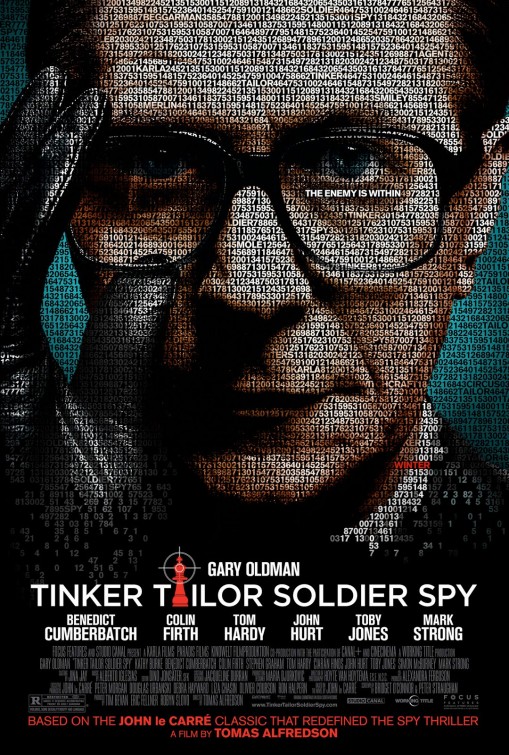 Billed as one of the most dense films of the holiday season, I was startled to discover that Tinker, Tailor, Soldier, Spy is not nearly as puzzling as people have protested. The adaptation of John le Carre’s famous novel follows retired British spy George Smiley (Gary Oldman) performing a clandestine investigation to flesh out a mole in the highest level of the agency. Directed by Tomas Alfredson (Let the Right One In), condensed form a 7-hour BBC miniseries, and stuffed with a wealth of terrific Brits, the movie is tricky, clever, and rather brainy, ultimately coming to the conclusion that these little communities of intelligence knew little. The movie has a rich array of characters and teases out back-story in flashbacks, meaning the film hops around time wise and will also take turns with different perspectives. It demands your attention but, honestly, I found it easy enough to follow. But in the end, what does all that narrative trickery and obfuscation get you? It’s a fairly dispassionate film about dispassionate people played out in a dispassionate manner. For some this will be hailed as a virtue, communicating the duty-first sacrifices and compartmentalization of these secret spies. For me, that just sounds like a cop out. Beyond the mystery, it’s hard to get involved in the movie. The reveal of the mole is anti-climactic, though the resolution, set to the tones of Julio Iglesias, is aces. The meticulous production design is stellar, including an agency meeting room that looks like it was wallpapered with checkerboards. The details of the ins and outs of the agency are absorbing. I’m debating whether I should watch the movie again, looking for nuance I must have missed. Tinker, Tailor, Soldier, Spy is an espionage thriller with a bit too many stiff upper lips.
Nate’s Grade: B
Share this:

War Horse (2011)
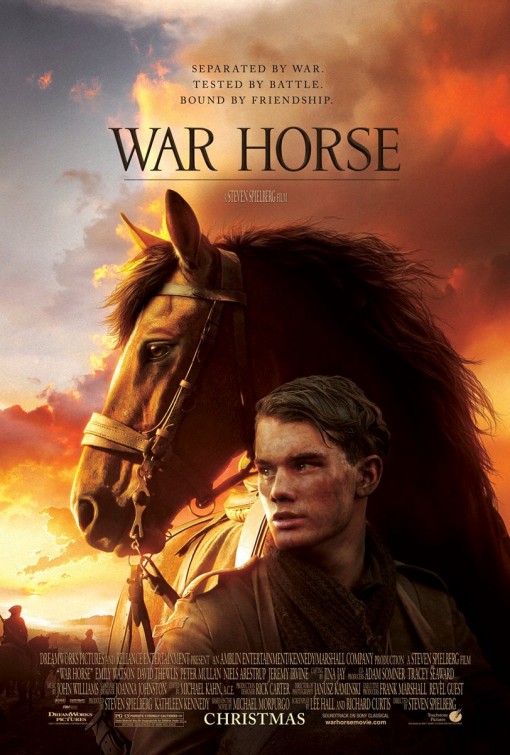 Steven Spielberg and war seem like a dynamite combination. The popular director puts away his childish things and becomes a much more mature, thoughtful artist, with the obvious exception of 1979’s 1941. War Horse is the adaptation of a children’s book-turned-Tony-Award-winning play, where the title star was brought to life on stage via skilled puppeteers. And lo, did people weep for that puppet horse on stage, and lo will they likely weep for the flesh-and-blood version on the big screen. However, I’d hardly call this movie a mature examination on the horrors of World War I. It’s more of a touchy-feely, stodgy, vignette-heavy drama that brings out the worst in Spielberg’s sentimental side.
We’re introduced to our young horse early on, where young Albert (Jeremy Irvine) spies the colt and forms an instant bond. Albert’s father Ted (Peter Mullen) buys the horse on a whim, even though the family could really use a plow horse. Albert names the horse Joey and is determined to prove everybody wrong who doubts the both of them. Together they indeed plow that rocky field and Albert’s family keeps their farm. Then World War I breaks out across Europe and the family ends up losing the horse. Joey is confiscated by the English cavalry and goes on a fantastic journey, switching sides over the course of the war (and allegiances?). Albert enlists in the military so that he can find his long-lost horse. I guess they’ll be no “Dear John” letter when your beloved only has hooves.
 War Horse is a throwback to old-fashioned Hollywood epics. It’s like John Ford took control of this movie from beyond the grave (note to self: premise for a supernatural comedy). My theater was filled to the rafters with old people. It was like the nursing home emptied out for the Greatest generation’s couples night. It’s easy to see why the movie would appeal to such an older crowd. It’s a simple story told with its emotions squarely on its sleeve like a badge of honor (mixed metaphors!). It’s so unflappably earnest and sentimental that it can occasionally fall into cornball territory. There’s the greedy landlord who wants to kick the poor family off their farm. Being a Spielberg movie, no expense is spared in milking as many emotions as possible. Spielberg demands tears and you will deliver them, or so help him. It’s all about Joey the horse prancing through people’s lives, touching hearts, bringing enemies together. The movie is primed for mass (older) audience appeal; for God’s sake there is a sassy goose that Spielberg can’t help himself but continue to include. Sassy goose equals money in the bank. This is the only movie I can imagine where plowing is treated as a point of dramatic catharsis. Suffice to say, War Horse is a stodgy war drama that won’t offend anyone with delicate sensibilities.
I wasn’t expecting War Horse to be the equine version of The Red Violin (if you unfamiliar with the masterful 1999 film The Red Violin, go see it immediately instead of watching this flick). We see the horrors of war through a series of vignettes as Joey passes from owner to owner, each befalling some unfortunate fate, though I don’t think the horse is to blame (or is he…?). The vignettes run about 15-20 minutes or so apiece and because the one constant is the horse, that means we have to feature characters talking out loud explaining everything they do and feel. The horse just kind of takes in everyone’s secrets, probably wishing these people would stop their yapping. The characters are drawn rather broad so we get the German brothers who desert their posts, a French girl wanting to learn to ride a horse, and a noble English cavalry marshal, amongst others. It’s hard to get attached to such disposable characters that fail to leave a modest dent. I thought maybe all these characters would converge in the end for an emotional climax, but then I remembered that many of them were dead, so nope. It’s a strange screenwriting shortcoming when the most engaging character for most of the movie is on four legs and never says a word.
It’s hard not to emote when Spielberg lathers on the sentimentality with aplomb. But if you took away John Williams’ earnest score, Spielberg’s sappy staging, and all those close-ups of animals, would you feel anything for this story or these characters; would you feel anything without all the reminders to feel? I doubt it. Don’t count me heartless, for I’ll have you know I bawled like a baby who just watched another baby hit with a shovel at Marley & Me, but does the life of one horse matter so much more than the millions of lives lost at war? We watch all those boys, many not old enough to be called men, run into the unforgiving gauntlet of war, but someone the life of one horse is supposed to outweigh the countless death. I understand a tight narrative focus so that large, unfathomable horrors can feel personable and better felt. Shindler’s List is that kind of movie. War Horse is not. This isn’t even Black Beauty or National Velvet. One of the English soldiers chides the sobbing Albert with a sharp quip: “It’s not a dog, boy, it’s just a horse.” I felt sad when the horse was in danger; I’m not a heartless bastard.
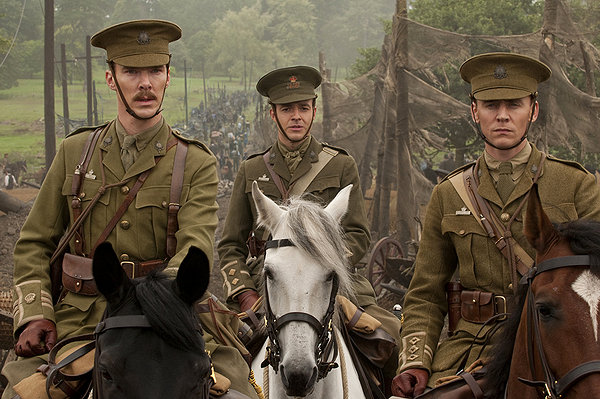 And oh does this horse seem to be Spielberg’s symbol of purity, mankind’s ultimate accomplishment, or, you know, something Big and Important. At one point, Joey gets tangled in a mess of barbed wire and the English and Germans all come to some sort of uneasy truce to work together to free this beautiful animal (if only more hapless horses had gotten lost in No Man’s Land maybe the war would’ve been over sooner – now I sound heartless). The horse is supposed to represent some messianic cost of war, where we destroy nature, turning majestic creatures into weapons of war, etc. I don’t really know what the message/symbolism is striving for but it’s constantly grappling, looking for a suitable sticking point. Honestly, if Joey was supposed to represent purity, goodness, nature, then that filly needed to get turned into glue by film’s end (spoiler alert). I erroneously predicted War Horse to be the “Marley & Me of war pictures.” The horse lives, rejoice America. Never mind the millions of people who died horribly. You can’t have a messianic symbol without martyrdom. If Spielberg wants to drive home the loss of innocence that many underwent thanks to the War to End All Wars (oh, if only), then the horse, a symbol of innocence and nature, needed to die at the machines of war. Otherwise the movie becomes an episodic journey of a single horse, an equine Forrest Gump. I can’t imagine that’s what Spielberg had in mind. I envisioned an M. Night Shyamalan-esque ending wherein the horse does eventually die, get turned into glue, and that glue is sued to construct a bomber plane for World War II. That plane? The Enola Gay. Cut to end credits. War Horse!
This movie has deteriorate in my mind the more I think back, picking away its cornball earnestness and stodgy sensibilities. When the horse is your greatest character then your war drama has some problems. War Horse is not a bad movie by most counts. It looks swell, the emotions are big, and hey horses are pretty aren’t they? But for any discerning moviegoer looking for a strong narrative, incisive commentary on the war, or even moderately appealing characters, well I hope you like looking at horses.
Nate’s Grade: B-
Share this:

The Girl with the Dragon Tattoo (2011)
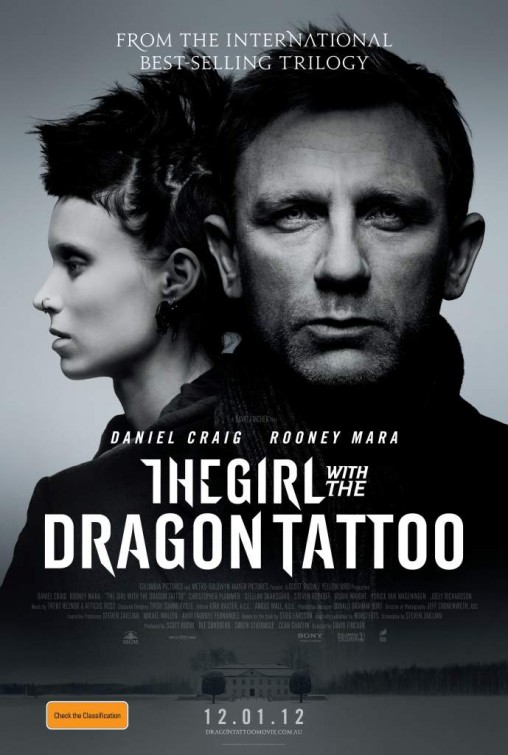 Nothing says holiday treat for the whole family like a nearly three-hour movie about rape. Late author Stieg Larsson’s best-selling trilogy made three very successful Swedish films, all released last year in indie theaters. It was only a matter of time before Hollywood optioned The Girl with the Dragon Tattoo, benefiting those averse to reading subtitles. At least they hired the right director in David Fincher, a man used to plumbing the depths of human depravity in films like Seven, Fight Club, and Zodiac. Fincher’s take is pretty dark and hardcore, but once you wash all that perfectionist grime off, I prefer the Swedish film in just about every way.
Crusading journalist Mikael Blomkvist (Daniel Craig) is smarting from a court case that found him guilty of libel. He’s commissioned by a wealthy businessman Henrik Vagner (Christopher Plummer) to investigate the 40-year-old disappearance of his granddaughter, Harriet. Henrik strongly believes she was murdered by one of the sinister members of his extended family, a group of shady characters with some allegiance to Nazism. Mikael is assisted by the unorthodox computer hacker Lisbeth Salander (Rooney Mara), a rail-thin Gothic gal clad in tattoos and piercings. Their partnership sometimes gets blurry as they grow closer over the course of the investigation. Together the pair investigates a series of grisly, ritualistic murders related to Harriet’s disappearance, and the closer they get to discover the truth the more dangerous things get.
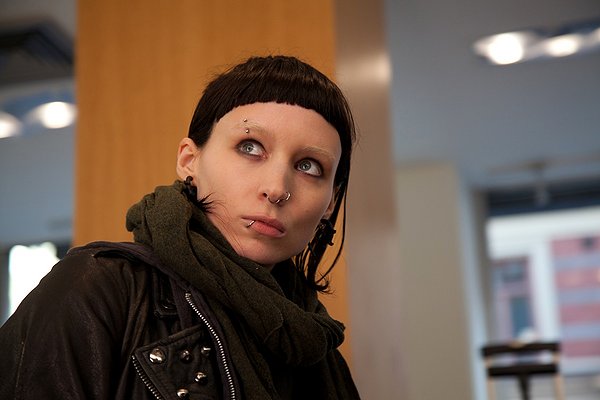 So the burning question: is Fincher’s take better than the original Swedish version? Well, in some areas yes but in many areas I’d have to say no, that I prefer the lower budget, no-name Swedish version. Obviously a director of Fincher’s caliber is going to significantly raise the quality of a production, and the technical merits of Fincher’s Dragon Tattoo are without question. This is a seedy, grimy, prurient, and very dark (in both lighting and thematic material) little movie. There’s always been an eerie beauty to Fincher’s cool aesthetics, and it’s on display here as well. Many of Fincher’s Social Network crew carried right over to Dragon Tattoo, so the editing is crisp, the cinematography sleek, and Trent Reznor and Atticus Ross’ score is a storm of ominous tones. Their plaintive score is actually a fairly unmemorable muddle, never approaching the energy, intricacy, or diversity of their Oscar-winning score for The Social Network. However, the extra polish and the glut of familiar actors takes away from the intrigue of the movie. When something meant to be gritty is too artistically stunning, it detracts from the thematic intent of the story. That sounds like a contrary way to insult Fincher for making his movie look too good, but perhaps that’s the best way of stating the point. Niels Arden Oplev is nowhere near the filmmaker that Fincher is, nor did he have the budget or creative freedom afforded Fincher, but perhaps someone of lesser talents was better suited to best tell this tale. By all means, the American Dragon Tattoo is a more visually alluring film, but Oplev’s film is more fully felt. I recently rewatched the Swedish version again for points of comparison and found myself much more involved in the characters, the story, and the actors, even though I had already seen the movie. Fincher’s version may be the better-looking movie, but surprisingly Oplev’s is just the better movie, period.
The adaptation by Steven Zallian (Schindler’s List) actually hews closer to Larsson’s book than the Swedish film, though Zallian redirects the film into a new ending. But the additions don’t seem to add anything of substance to the narrative (Blomkvist’s teenage daughter; dead cat), and the new ending feels more confused than helpful. Most of all, Zallian’s script devotes less time to the characters of Lisbeth and Blomkvist. I had a better understanding of these characters and their complicated, shifting relationship in the Swedish film. That narrative was much cleaner with helpful, clarifying procedural details and a dose of ambiguity. Simply put, the story just flowed better in the Swedish film. The personal connection Blomkvist had to Harriet (she was his babysitter long ago) has also been severed. Many of the story’s problems are still the same regardless of language or adapter. There is a clear disparity when it comes to audience interest in the two leads. What’s more interesting, a punky, bisexual, computer hacker or a disgraced, somewhat bland journalist? Exactly. Also, the story takes far too long to put our lead characters together, over an hour at that. The murder mystery is filled with murky plot points, pieces that seem like they might be integral but then turn out to be incidental. It takes a good while to process and familiarize oneself with the expository details of the case, but under Zallian’s draft, the mystery is given less room to breath. For a movie clocking in at 150 minutes, things feel untidy and rushed. The resolution feels drawn out to ungodly Lord of the Rings-lengths; I swear there must be a solid 20 minutes after the eventual serial killer is dealt with. It just feels like it goes on forever. Still, the characters are what ultimately makes Dragon Tattoo engaging, and Zallian’s efforts cannot dampen the captivating, curious nature of Lisbeth Salander.
Both Craig and Mara give fine performances but I prefer both Swedish actors to the A-listers. Craig is certainly a better actor than his Swedish counterpart, but the role is a middle-aged journalist and not James Bond, and thus a better fit for the unknown Swedish actor, Michael Nyqvist (Mission: impossible: Ghosts Protocol). Blomkvist isn’t supposed to be an ass-kicker. As a result, you don’t feel his terror as he gets in deeper and lands in serious physical jeopardy. Likewise, following in Noomi Rapace’s (Sherlock Holmes: A Game of Shadows) shoes was going to be a difficult feat for any actress, but Fincher got the girl he wanted, Mara, who tore down Mark Zuckerberg with precision in The Social Network. Mara commits herself completely to the role and undergoes a severe physical transformation (bleached eyebrows, wiry frame, nipple piercings), but she lacks the intensity of Rapace, the spiteful attitude, the recklessness and the resourcefulness. Rapace felt like a caged animal that could explode at any moment; Mara feels more like a lost puppy. I’m being intentionally cavalier with my word choice. Mara is quite good as Lisbeth; it’s just that Mara can’t quite measure up to the preceding tattooed girl. It feels like there’s a lot more going on with the Swedish Salander, whereas the American (still Swedish) Salander is waiting for her cue. It’s like Mara has dressed the part and waits for the character to just click over.
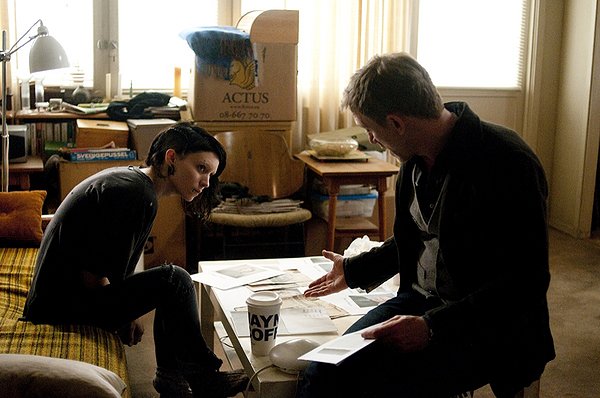 I’m not one for lazy analysis, but I feel like the uncomfortable issue of sexual violence/ voyeurism needs to be addressed, and I find that everything I wrote a year ago in my original Girl with the Dragon Tattoo review could readily apply to its Hollywood counterpart. So here goes: “The book’s original title was ‘Men Who Hate Women’ and that seems apt given what occurs on screen. Sure there’s a serial murderer on the loose but that’s par for the course. Even the grisly ritualistic killing stuff. But Lisbeth encounters a lot of malice and hostile male aggression, some of it very sickening. There’s a startlingly extended rape sequence, followed by some sadistic, if justifiable, revenge. It all contributes to an overall tone of queasy misogyny that seems to waver between intentional and unintentional. I’m not sure tone-wise whether the movie ever creeps into unsettling voyeurism at the behest of women in explicit sexual peril, but it certainly is a distraction. It can get pretty hard to watch at times in this disturbing thriller. I hope the eventual sequels don’t follow this same queasy, upsetting tone but I also worry that this may be unfortunately part of the books/movies’ appeal.”
For those new to Lisbeth and Larsson’s sordid saga, The Girl with the Dragon Tattoo will more than likely play well, a squalid thriller with the nicest coat of gloss you could ever hope for given the material. This is dark, rape-heavy stuff, and an odd adult drama to position as a Christmas release, but the collective appeal of the best-selling books should guarantee so many butts in the seats. It’s likely a safe bet that a high majority of those paying customers are unfamiliar with the Swedish version of the same story, which is a shame because, short of a few technical advances, I believe the Swedish film to be the superior movie. It had better acting, more appropriate casting, a rounder narrative that fleshed out the characters, their relationships, and their histories better, and a better score (sorry Trent, better luck next time). It’s still a movie that registers a “good” on most critical accounts, and Lisbeth Salander is still a fascinating person, a wounded warrior that catches the imagination. I’ll be curious to see if the subtitle-free Girl with the Dragon Tattoo does well enough at the box-office to warrant filming the next two decidedly lesser books. Whatever the case, there will always be the Swedish films and Ms. Rapace’s star-making performance.
Nate’s Grade: B
Share this:

Atlas Shrugged: Part One (2011)
 Billing itself as part one of an intended trilogy, Atlas Shrugged is an adaptation of Ayn Rand’s famous 1200-page book on the merits of self-interest. Rand has become resurgent in the last few years, a favorite author of the Tea Party, as her anti-government, anti-regulation, anti-union, and anti-poor perspective has found a new legion of fuming followers. I can’t imagine anyone else buying a ticket to the big screen version of Atlas Shrugged, a resoundingly tiresome and didactic enterprise. If this is what Part One brings, I can already predict the extensive yawning exercises I’ll have to do to get in shape for Parts Two and Three.
In the not too distant future, America’s airline industry has ground to a halt due to rising gas prices ($35 a gallon we’re told). The country has gone back to rail and leading that charge is Taggart Railway, lead by Dagny Taggart (Taylor Schilling). She’s trying to save her company from her lazy brother, James (Matthew Marsden), who wants to rely on bribery and his Washington friends to get by. Dagny wants to join forces with steel tycoon Henry Reardon (Grant Bowler), who has staked his company’s future on special new extra shiny steel. Other companies want to block Dagny and Reardon’s efforts, relying on Washington to write strict laws penalizing the rich and successful and spreading the wealth around to those less unfortunate. At the same time, powerful businessmen seem to be vanishing and the only connection seems to be the identity of John Galt, a mysterious capitalist with an offer no rugged man of industry will refuse.
 Maybe Atlas shrugged because he got tired of how unbelievably boring this movie is. Oh my goodness, I was rolling my eyes and checking my watch every five minutes. The vast majority of this film involves ideologues disguised as characters talking about esoteric business practices. A full 80 percent of the dialogue has to be about railways and steel and this manufacturing and ore mines and… I’m sorry I fell asleep in the middle of writing that sentence. Seriously, this movie could be a cure for insomnia. It’s so crushingly boring that it makes you wonder how anyone could ever pick up Rand’s novel and think, “This deserves to be a film.” There are segments where characters will talk this corporate gobblety-gook in unbroken reams, the actors behaving like androids. Now technical talk is not necessarily a one-way ticket to snoozeville, as political and corporate dramas can be quite invigorating in the right hands (see: Margin Call). It helps when you have a story, but with Atlas Shrugged all we have are mouthpieces for a political ideology. Regardless of political opinion, the movie fails because it never makes the story feel like it matters. The dialogue is perfunctory, labored, and inert, bogged down with lazy philosophical jabs. It’s all tedious expository dialogue with no room for character. Who wouldn’t want to watch a movie completely around the conflict of whether a train will get its steel tracks? That’s it. You wouldn’t know any of this mattered without the helpful inclusion of an overly enthusiastic dramatic score. Who cares about any of this junk? If you’re looking for the most high-profile movie of 2011 to talk about the infrastructure dynamics of railways, your long wait ends here.
Dagny and Reardon are supposed to be our heroes, the champions of the not-so-little guy, and thus we’re intended to root for their romantic coupling. Never mind that Reardon is married because, in that age-old point of rom/com rationalization, his wife is a bitch. The two have one of the most robotic lovemaking scenes I’ve seen in recent memory, and this flash of sexuality and a few dirty words are the sole reason this film earned a PG-13 rating. These characters remain one-note and vacant, including icy heroine Dagny casually admitting, “I don’t know how to feel.” And then there’s Reardon, who admits, “My only goal is to make money.” What better antagonists than unfeeling heads of huge corporations who just want to be left alone so they can make their untold millions? What a great entry point for the empathy of the audience. None of these characters grow, change, learn, or even seem to reflect recognizable emotions beyond venom-filled anger. The villainous government stooges act shady, plotting the downfall of those laudable titans of industry, but it all just becomes indistinguishable chatter, villains clucking to themselves.
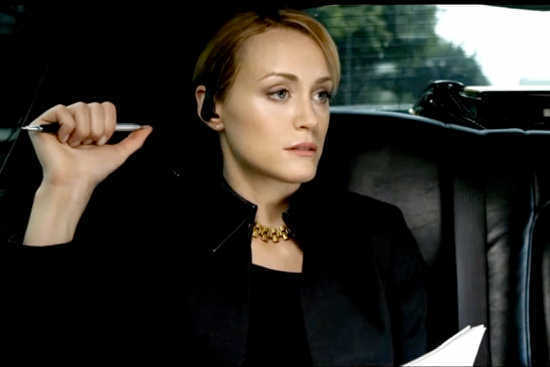 Set in the near future of 2016, this adaptation feels strangely dated, most notably in its ascent of railroads. There’s some ham-handed throwaway line about the cost of gas being so high so America just reverted back to the good old locomotive. I find this deeply implausible. It would have made more sense to actually make this a 1950s period piece, the original setting of Rand’s novel. We’re constantly told about the instability in the world via newscasters and announcers, but we don’t ever see the effects of this world in crisis. Mostly that’s because we’re hobnobbing with the rich in their boardrooms and cocktail parties, but there’s a scene where Dagny exits her limo and walks in a huff down the streets, which are empty of those dirty hordes of bottom-dwellers we’ve been hearing about. Apparently a world in crisis has done little to upset the disadvantaged, or the cities have just been very adamant about cleaning up the riffraff. The world depicted does not seem realistic. Would the country so easily go back to train travel where Dagny’s super train can cross 200 miles in a single hour? What about international freight and travel? I guess that still has to run on all that precious petrol. I’d assume that by 2016 the world will still be an interdependent, globalized economy, so I would think that the United States would face more dramatic tension than the oversight over a railroad company.
I’ve noticed that when it comes to a mostly conservative, mostly Christian fan base, the quality of movies is almost irrelevant. Movies like Left Behind, The Omega Code, Fireproof, or the recent Courageous are not expected to be good movies by traditional standards. They are sermons packaged in the guise of popular entertainment, which means that the artistic particulars come second to the message, and often do. Atlas Shrugged seems to fall into this same category. The production is very low budget, hence all those conversations in offices, and the CGI that is utilized looks pretty chintzy. The acting is profoundly bad, with Schilling (TV’s Mercy) giving a flat, monotone performance throughout, closer resembling a well-dressed mannequin than a human being. And naturally subtlety goes out the window in favor of reconfirming the belief system of the people buying the tickets. I have no issue with movies that adhere to an ideology, whatever that may be, as long as the message doesn’t get in the way of telling a good story. Atlas Shrugged is not a good story, not even close, and the message can be all too bludgeoning at times, like when Dagny incredulously remarks, “What’s with all these foolish altruistic notions?” The movie seems to be bristling with anger and many a character spits venom at the very idea of government involvement, unions demanding safe working conditions, and regulation in any form, red meat for the Tea Party faithful. Without that red meat, or the film’s strident message, there would be no reason to watch this mess.
 And now I’ll shed my objective reviewer cap briefly to get on my own little soapbox and denounce the dangers of Randian politics. To be fair, I’ve never read an Ayn Rand book and honestly have no inclination of ever reading one of this woman’s polemics. I just feel I have better uses of my time than reading a justification for sociopathic greed. Rand’s extreme philosophy has been described as reverse Marxism, wherein the social elite is being sucked dry by the lechers of the world, those who do not contribute to the value of society. And for Rand the only value is money. The world, Rand posits, would be a better place if man would only think of himself. I fundamentally disagree with this notion. Remember that part in the bible where Jesus gives money to the rich and tells the poor to suck it up? Rand’s self-involved philosophy seems like a round of consumerist Calvanism, rehashing a skewed religious perspective that was popular with the upper classes because it provided celestial reasoning why the rich were so rich and the poor were so poor. You see God wanted you to be rich, that is why you were born into a wealthy family, and he wanted all those miserable poor people to suffer. To help out the poor would therefore be blaspheming God’s infinitely unknowable plan. The basic plotline of Atlas Shrugged, though only teased in Part One, is that the rich will get tired of being burdened by societal constraints and up and leave us all. Here’s a good question: if all the billionaires in the world were to vanish, do you think everything would grind to a halt? Would we all be so out of luck without the super wealthy telling us what to buy? It’s like the reverse of 2006’s social satire A Day Without a Mexican, proposing that the American economic engine would be severely stalled if all the undocumented workers were to vanish. Under Rand’s narrow line of thinking, the rich are that way because they are the best and brightest, the innovators. Nowhere in that equation does Rand leave room for the rich being rich due to lies, cheating, nepotism, and rigging the system for the continued benefit of a select few. I’m not meaning to begin a screed here, but I think the 2008 economic meltdown proved what happens when business is left to regulate itself. The economic collapse also proved that just because you’ve got some letters in your title (CEO, CFO, etc.) does not mean you’re the smartest egg. Cronyism and a scoiopathic desire to look out for one’s self-interest above all else is what brought the world on the brink of economic collapse. For me, recent history is a rejection of Rand’s theories, not corroboration. Okay, soapbox put away.
Atlas Shrugged the film seems almost like an unintended ironic statement on Ayn Rand’s belief of the superiority of the individual. That’s because movies are a profoundly collaborative medium, where many hands toil away to create a work of art. It is not the result of one man or woman but the results of hundreds of men and women working together, each knowing their role, playing their part, and working toward something greater than individual self-interest. Huh, how about that? It pretty much doesn’t matter that Atlas Shrugged is a powerfully boring, braying, incoherent, tedious chore that is merely a message disguised as a movie. The intended audiences will more than likely hail the final product, ignoring “details” like the talky exposition-heavy dialogue, horrible acting, laughable special effects, and plodding pacing, and overall poor production. The Rand faithful are not going to this movie to be entertained, they are going to see their beliefs reflected upon the big screen. The overall quality of Atlas Shrugged is an afterthought to them. I just wish it wasn’t an afterthought to the people making the movie.
Nate’s Grade: D
Share this:

Harry Potter and the Deathly Hallows: Part Two (2011)
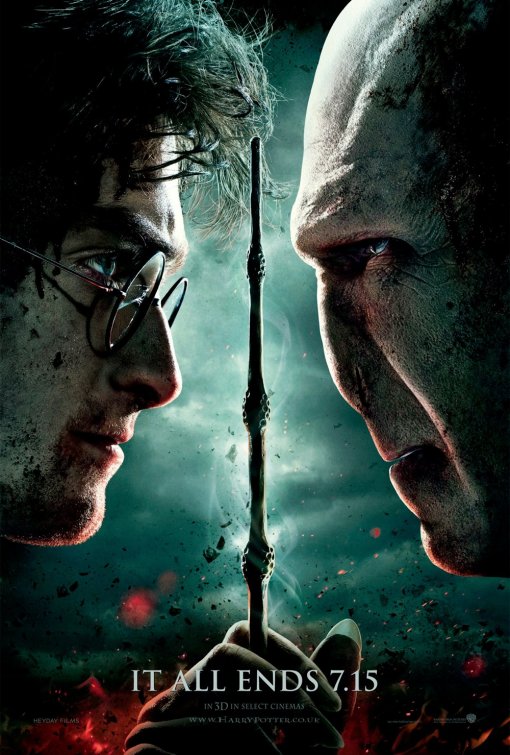 While not the best film in a series spanning ten years, part two of the final chapter of Harry Potter is a solid, satisfying close that’s fittingly grandiose but also sneakily emotional at points. The plot finally gets simplified once all those silly magic items are found, and what we have is a war at the Hogwarts School of Magic between good vs. evil. The action sequences are the best in the film’s series and some very dark events take place, including the deaths of many characters, some children, though too many critical deaths occur off camera. Harry (Daniel Radcliffe) faces off against Voldermort (Ralph Fiennes) for the fate of the world, and after the protracted, wearisome setup of Part One, it’s a relief to say that the final film moves like it’s on fire. There’s very little downtime and a great pull of urgency to the flick. So what if Ron (Rupert Grint) and Hermoine (Emma Watson), Harry’s best pals since the start, are completely forgotten and useless in the movie’s final hour. The focus is all on Harry and his messianic sacrifices. Alan Rickman shines again, showing a depth of emotions not available to Snape until the character’s final revelations. In fact, there needed to be more Rickman, but I can lay this same charge with every film. I wish the resolution, spanning forward 19 years, would have slowed down a bit and accept the paternal/maternal changing-of-the-guard as the emotional payoff billions of people have been waiting for. Harry Potter and the Deathly Hallows: Part Two is a thrilling, gratifying capper to a series that, while to me was never as magical as the Potter die-hards have claimed, was, over eight movies and almost 20 hours, an enchanting franchise that stayed consistent in quality and entertainment. Here’s to you, Potter. Now maybe I can finally stop hearing people badgering me about how the books were better.
Nate’s Grade: B+
Share this:

Hugo (2011)
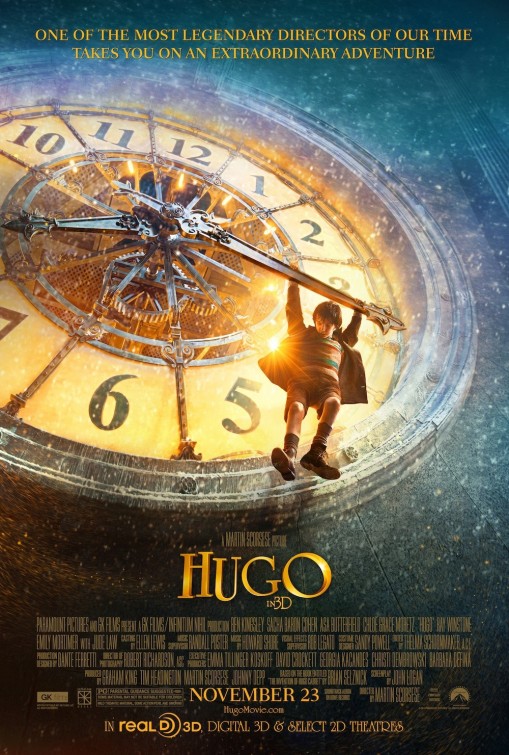 Martin Scorsese tackling a children’s film feels like an odd fit for the man responsible for classic gangster epics and symphonies of violence. But if David Lynch, Kevin Smith, Tim Burton, and Danny Boyle can all make family films that don’t make your brain rot, then why not the greatest living director? Maybe notorious sadist Lars von Trier will be next. Adapted from the award-winning children’s book, Hugo is, as my pal Eric Muller put it, a family film for film historians.
Hugo (Asa Butterfield) is an orphan boy living beneath the walls of the Paris train station. He’s secretly the one responsible for winding up all the clocks and keeping time. He has to stay one step ahead of the Station Inspector (Sacha Baron Cohen), who snatches wayward boys and sends them off to an orphanage. Hugo has been swiping clock pieces from the booth of a mysterious toy collector, George (Ben Kingsley). He needs the tiny pieces to fix a metallic man that Hugo and his late father (Jude Law) had been working on together. Hugo is convinced that if he fixes the metal man the automaton will write out one last message from his father. Hugo befriends George’s niece, Isabelle (Chloe Grace Moretz), and the two of them explore the various shops and shopkeepers of the station. As they uncover more clues, the kids realize that George is actually George Méliès, the filmmaking pioneer best known for the 1902 fantasy, A Trip to the Moon (the one where the moon gets a bullet in its eye).
 Scorsese’s first foray into 3D filmmaking is a rousing sensation for the eyes. The images pop without superfluous objects flying at the camera. The depth of field is nicely and creatively toyed with by Scorsese. Best of all, the 3D enhances the story rather than distracting you. Hugo is a celebration of the advances in moviemaking, and 3D is the latest advancement meant to make the theatergoing experience special. Of course the theatergoing experience has always been special, as the movie indicates. Where else but a theater can we collectively bond with a group of strangers, laughing collectively, feeling the pangs of emotion in unison? There’s a thematic rationale for Scorsese’s use of the third dimension. He masterfully fills the screen with wonderful images, like the massive inner working of clock towers. Scorsese’s signature tracking shots zoom in through the wintry 1930s Paris landscape and train station. A visual highlight is when a trunk of sketches busts open, the papers scattered all over the screen, some moving like flip books, creating the illusion of animation. I can honestly advise people to seek out a 3D showing of Hugo if given the option. For once, it’s worth the extra dough. I only anticipate making this same recommendation for the upcoming Piranha 3DD.
It’s the second half where the movie shows its true intentions, becoming a love letter to the power of cinema and the early pioneers of the art form. Scrosese has long been a historian of the movies, and Hugo is his celebration of the early cinematic dream makers, notably Méliès and his surreal theatrical landscapes. Arthur C. Clark famously said that “any sufficiently advanced technology is indistinguishable from magic.” That’s what early cinema was to a populace that had never seen the likes of moving pictures (we see an early audience fearing for their lives watching a film of a train arriving). It was like a new magic. The turn-of-the century filmmakers like Méliès were charting new terrain as visual storytellers, opening the public to new wonders of the imagination. Simple tricks of editing substitution, dissolves, and visual arrangement could help foster the ongoing illusion. It may be low-rent, like hand painting individual film frames, but it was the special effects of their day. D.W. Griffith once said of Méliès, “I owe him everything.” Scorsese is sharing his passion for the history of the movies and it’s hard not to feel the power of the movies.
But when Hugo gets swallowed whole by Scorsese’s nostalgia, the rest of the plot becomes incidental. The characters, which were not strong to begin with, are given pat resolutions that make you realize how flimsy the characterization is. The movie takes a sub-Amelie route, letting Hugo bring together disparate couples, but you don’t really know anything about these people. Emily Mortimer’s female florist has maybe two lines in the movie, so why should I root for her to get with the Station Inspector? There’s an older couple whose romance is sabotaged by an aggressive pooch. You can imagine the scintillating resolution that awaits. The film history section is honestly the best part of the movie, but it means that everything leading up to that point was just in service to prop up the academic nostalgia. It means that the characters and their mysteries were really unimportant, and they feel that way by film’s end. The movie just grinds to a halt. The mystery of the metal man is that he’s a MacGuffin, a means to discover Méliès’ past. The whole clockwork symbolism can be clumsy, instructing us time and again that people are broken and Hugo feels the need to fix things. Too bad he couldn’t fix the disjointed story.
 The actors manage to make favorable impressions when they can fight free of the movie’s educational pull. Butterfield (The Boy in the Striped Pajamas) is a strong lead actor who rises above the sniveling preface of his character. He makes you root for the kid even when we don’t really know much about him beyond his Dickensian conditions. The kid has some pretty piercing Paul Newman-esque blue eyes too. Moretz (Let Me In, Kick-Ass) is showing the poise and grace to make it long term in this business. Kinglsey (Shutter Island) is effectively curt with his poorly veiled pain and regret. Cohen (Borat) expands his dramatic range noticeably, adding touches of empathy for a character that could mostly have been arch and cartoonish. He’s still the film’s best source for comedy. Michael Stuhlbarg (A Serious Man) makes a welcomed appearance as an expert on early filmmaking, Méliès especially. He serves as the mouthpiece for Scorsese’s passion.
Hugo is a family film that ultimately gets swallowed whole by the filmmakers’ passion. It makes for an entertaining and informative essay on the skill and vision of turn-of-the-century filmmakers, but if people are anticipating a fun story about a scrappy kid and his mischievous adventures, then this is not that movie. Hugo benefits from terrific visuals, strong acting, and Scorsese’s blend of whimsy and innocence without stooping to anything crass or lowbrow. Hugo aspires for the rich, romantic experience of a Jean-Pierre Jeunet film (Amelie, A Very Long Engagement) but comes up short. Hugo is at turns charming and magical but as a narrative it is too often flimsy, a wispy thing meant to lead to Scorsese’s love letter. It’s a fine and fitting tribute but even the best and most powerful love letter can only go so far, never mind the hassle of special 3D glasses.
Nate’s Grade: B
Share this:

The Descendants (2011)
 We’re so used to seeing George Clooney as a smooth operator, a guy who coasts on his suave charm and chiseled-from-granite good looks. But in The Descendants, Clooney is more vulnerable than he’s ever been, trying to keep his family together, and as the film plays out we realize just how mighty a task this goal is. His character is ill equipped to take the lead of his family, especially a family of growing girls he is consistently confused with. His journey is much more than just becoming a better father. That lesson would be far too pat for director/co-writer Alexander Payne. It’s been a good while since Payne’s last film, 2004’s Sideways, but in that time away he has shaped another outstanding human comedy that manages to squeeze in more emotion than most Hollywood movies could ever hope for.
Matt King (George Clooney) is a self-described “backup parent” who has been thrust into the lead role. His wife, Elizabeth, is in a coma after suffering a traumatic head injury from a Jet Ski accident. The doctors say that she has no hope of waking up and she will die in a matter of days. Matt must break the news to his 10-year-old daughter Scottie (Amara Miller) and his rebellious older daughter, Alexandra (Shailene Woodley). The headstrong Alexandra clashes with her faltering father, finally revealing the reason why she blew up at mom months ago. She found out that Elizabeth was having an affair. Matt is reeling and searching for answers from friends, family, and his two daughters.
 Payne’s specializes in pitch-perfect bittersweet character-based comedies, ones that seem to unfurl over a journey of self-awakening. His fictional worlds feel exquisitely rendered, where every character beat and every line of dialogue feels genuine. That’s quite an achievement for a filmmaker of any scope. Even when dealing with caricatures (like in 2002’s About Schmidt), somehow Payne gets away with it. With The Descendants, the sunny setting of Hawaii is just an exotic backdrop for some wonderful, and wonderfully relatable, family drama. It’s hardly the worry-free paradise. Uncovering his wife’s secrets has lead Matt to reassess the woman he loved. The movie completely upends the standard deathbed goodbye trope. Instead of characters openly bawling about the loss of a saintly soul taken far too soon, we have characters dealing with real conflicted emotions, particularly anger, directed at the indisposed and unfaithful mother. Every character is approaching grief differently, and every character is trying to make sense of their feelings before Elizabeth’s inevitable passing. Matt’s father-in-law (Robert Forster) is harsh with accusations at the ready, blaming Elizabeth’s tragedy on Matt’s shortcomings as a husband. His pain is raw but al too recognizable. Matt and Alexandra are plotting how much info to reveal to young Scottie, trying not to ruin her image of her mother, a tremendous challenge with no easy answer.
This is the stuff of grand drama, and Payne doesn’t skimp on the heart-tugging moments. The Descendants is also a great comedy, naturally finding humor drawn from the situation and characters. The advertising has made The Descendants appear like a broad family comedy, with Clooney flapping around in his noisy flip-flops. This is not the case. The comedy doesn’t feel insensitive or too macabre, instead it adds another enlightening level to these people and their pain. We try and make sense of our world, to cope with our struggles and failures, with comedy, and so too does Matt and his family. You’ll probably be surprised how often you laugh and then in the next moment feel a lump in your throat. The character of Sid (Nick Krause) starts off as a questionable plot tagalong, a doofus for some easy laughs. His reaction to an elderly woman with Alzheimer’s is the movie’s one point of questionable validity. As the film progresses, this laid-back guy is revealed to have more layers, just like the rest of the clan. The second half of the film becomes something of a minor key detective story as Matt and Alexandra search for the elusive “other man.” As Alexandra eggs him on, the two bond over this manhunt and Matt becomes bolder, more confident, and clear-headed about the hard decisions that are necessary for his new life. The emotional rewards of the film are nourishing. Watching Matt and his daughters sit on the couch watching a movie together (March of the Penguins no less. Draw your own connections about parental turmoil), you’ll feel satisfied that this broken family has begin to heal itself.
The Descendants takes an interesting turn when we learn more about the other man’s background. Matthew Lillard (Without a Paddle) is actually respectable as Brain Speer, the real estate titan having the aforementioned affair with Elizabeth. Matt’s confrontation is subdued, sidestepping righteous grandstanding for a better attempt to seek understanding. Instead of lecturing Brian, he wants to know more about what his wife was after that Matt could not offer. Sure he’s still angry and doesn’t let the guy off easy. Complicating matters is the fact that Brian has a wife, Julie (Judy Greer), and two children. Matt is trying to find answers without willfully harming Brain’s family. Greer (Love Happens) has an outstanding sequence where she feels beholden to forgive rather than hate, a note of grace that feels rather profound.
Clooney at one point says he’s just trying to keep his head above water, and you can see why. The man shows a great deal of range as his character confronts his grief. There is no “right” way when it comes to grieving, something deeply personal. Matt’s dilemma is given an unlikely situational twist, but the feelings of betrayal and confusion are all too believable. Matt is looking for answers when the person who holds them all lies sleeping. As he develops a lager picture of his wife and her unhappiness, Clooney expertly flashes through a multitude of thoughts. While arguably not as textured as his performance in Up in the Air, Clooney is in fine form, showcasing a deeper sense of loss and anxiety. Matt is trying to find his footing while his world radically adjusts, and nothing has adjusted more than his feelings toward his wife. Clooney doesn’t have any Big Moments of Great Emotion, though lashing out at his comatose wife comes close, but the man’s nuanced portrayal of a life in flux is the stuff that award ceremonies were made for.
 Woodley is a remarkable discovery, more than holding her own with Clooney. She is excellent in her portrayal of an aggressive, mouthy, rebellious teenager. It’s all the more astonishing because Woodley’s long-running TV show, The Secret Life of the American Teenager, is one of the worst shows still running on television. The show is so inartful, the dialogue is so tin-eared, and the acting is wooden like the actors have been imprisoned. Where has this actress been the whole time? Woodley’s performance is so alive with genuine feeling, stripping away any reservations of the too typical bratty teen role. She’s much more than a troubled teen sent off to boarding school. Her every inflection, hesitation, motion feels completely natural for her character, and when Woodley gets her big dramatic scenes she is a force to witness. Upon the sudden news that her mother will die soon, she plunges underwater in the family pool and screams as loud as she can, tears squeezing out of those sorrowful eyes. For goodness’ sake, this girl cries underwater. An Oscar nomination is assured for the 20-year-old young actress. Maybe she can quit her crummy TV show after the wave of good press and fawning praise that await her.
The Descendants is an incredibly observed human drama, a humane and touching comedy, a movie so engaged and plugged in to the messiness of human emotions, eschewing the bitterness of some of Payne’s earlier works. This is a thoughtful and nuanced flick that is elevated to even grander heights due to the excellent performances of father/daughter team Clooney and Woodley. The film hits all those traditional emotional notes but on its own terms. The movie approaches a graceful resolution by accepting the incomprehensible disarray of life. The Descendants is just about everything you’d want in a movie: supreme acting, strong characters, an affecting story, and emotions that are completely earned. Payne’s mature and tender movie is, by the end, rather hopeful, a celebration of family overcoming adversity. It’s not schmaltzy in the slightest but a powerful antidote to simple cynicism. This holiday season, be a good movie citizen and spread the word of The Descendants.
Nate’s Grade: A


 nathanzoebl
You must be logged in to post a comment.