Blog Archives
Super 8 (2011)
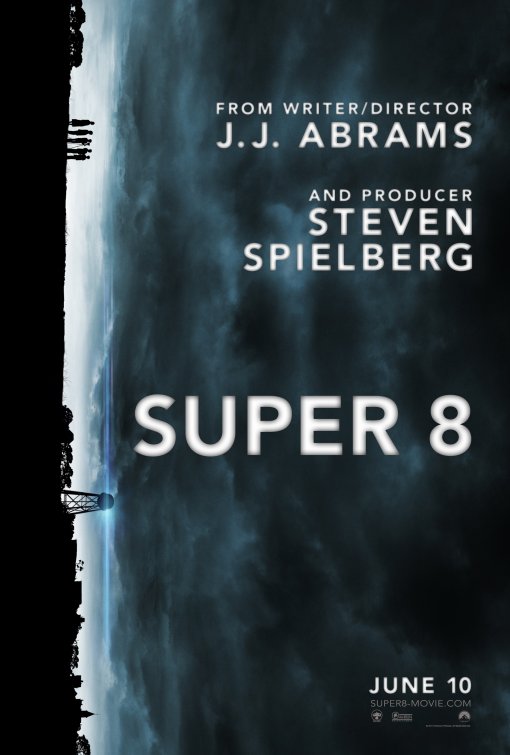 Super 8 is writer/director J.J. Abrams’ reverent homage to early Spielberg movies. For some, it will be too reverent to the point of being a slobbery love letter.
In 1979, a small Ohio town, 13-year-old Joe Lamb (Joel Courtney) is reeling from the death of his mother in a factory accident. His father, Jackson (Kyle Chandler), is a police officer who doesn’t know how to raise his boy. He even tries to convince his son to spend the summer at a baseball camp. “It’ll be good for you to spend some time with kids who don’t run around with cameras and monster makeup,” he says. That kid is Charles (Riley Griffiths), a self-possessed amateur filmmaker. Charles is writing and directing a short Super 8 film and all his friends are helping. Joe’s specialty is makeup, given his attention to delicately painting models. Being the makeup guy comes in handy when the gang invites the local pretty girl, Alice (Elle Fanning), to be in their movie. Joe gets to apply her zombie makeup. One night, the gang sneaks out to a train yard to film a scene in their movie. A U.S. Air Force cargo train is passing by and suddenly derails, in grand apocalyptic fashion. Strange things start happening all over town shortly after the train crash. Car motors and electrical equipment go missing, dogs run away to neighboring communities, and people start to go missing. The Air Force comes into town and takes charge. It seems that train was carrying something and that something has escaped.
What Super 8 does best is replicate a time, place, and mood. The movie is successfully awash in nostalgia, and that childhood nostalgia is the best aspect of an otherwise ordinary film. Abrams has fashioned the greatest film tribute to Spielberg in history. But its limited ambition makes it feel like the greatest cover band of all time. You’ve assembled al your talent and energy into replicating someone else’s original work. Congratulations, Super 8 is a glossy tribute to Spielberg. Now what? Well, the movie works well at finding that unique, infectious spirit of being young and full of ideas. Filmmaking, and movies in general, has a magic to it, the synergistic creativity and the sheer possibilities that can abound. Translating the imagination into a communal artistic experience. I’m sure Abrams was just as excited about the possibilities of a camera in his childhood as Spielberg was. That feeling of discovery, that rambunctious creativity, and the endearing clumsiness of amateur productions, it all rings completely true. I made silly movies with a camera and my friends when I was younger; my group of friends and I became known for our video projects in high school. So I could have readily watched an entire movie about kids and cameras and their artistic aspirations (as long as it was better than Son of Rambo). The highpoint of Super 8 for me was, surprisingly, the children’s short film “The Case” that plays over the closing credits. It’s funny and charming and sweetly affable. Finally seeing Charles’ finished film is the ultimate payoff.
Abrams as a director is quite capable of delivering big summer moments. He’s a genre specialist and a geek’s best friend. I’ve even compared his style to that of a young Spielberg in my review of 2006’s Mission: Impossible III. Abrams has a natural feel for putting his camera in the right placement. While Abrams can do exciting action with the best of them, crafting compelling screen compositions to ignite the senses, it’s the smaller touches that connect to his storytelling that impress me most. The very opening shot tells you so much and grabs you. It’s a slow zoom into a factory’s sign proclaiming how many days have gone by without an accident. A man takes down the number plates and the count drops from 750 to 1. There’s a small moment where alice imitates a zombie, cocking her head, lurching, going in to bite Joe. And you see her, in that moment, as Joe does: a lovely young woman who makes your heart melt. With the aid of Michael Giacchino’s very John Williams-esque score, you effectively feel Joe’s burgeoning young love. Then when we pull back there’s a trace of Alice’s red lipstick along Joe’s neck, indicating she made actual contact. It’s a small detail that makes you smile all over. It’s these small details that often play to plot or character that affirm for me that Abrams is a director of fantastic promise, a true Spielberg protégé. Now if Abrams could lay off his excessive use of lens flairs (though it’s not as prevalent as Star Trek; you could make a drinking game into every time there was a lens flair).
The young actors are pretty good despite the somewhat hollow characterization by Abrams. These kids are defined by one-note traits (the kid obsessed with explosives, the wuss, etc.). I was going to be more upset by this until I remembered that movies like The Goonies, deemed a nostalgic classic by my generation, also had flimsy, one-note characterization (the fat kid is fat, the Asian kid has funny gadgets!). The scenes where all the kids are assembled make for some of the best entertainment. The young actors have a great rapport with one another and feel like a true makeshift band of friends. Their camaraderie, uncertainty, and hopes seem entirely genuine. They seem like real kids with real kid problems and worries. Courtney is a strong emotional center for the film. It’s hard to believe this is his first role on the big screen. Fanning (Somewhere, Curious Case of Benjamin Button) has been acting ever since she was the two-year-old version of her famous big sister in I Am Sam. I’m on the record as saying that Elle is a superior actress to her sister, and I feel like that claim bears fruit with Super 8. There’s a scene where Fanning’s character is asked to practice some feeble dialogue. Her cohorts think of her as a pretty girl and a source of transportation. But in this one scene, she turns on a dime, bringing out real emotions that leave the boys breathless and the audience too. It’s reminiscent of the audition scene in Mulholland Drive where Naomi Watts, at the flip of a switch, transformed into a different person, coursing with vibrant life. Consider it the toned-down kiddie version.
 Truthfully, the monster stuff is actually the weakest part of the film. Super 8 works best as an endearing, nostalgic trip about being young. It works best as a coming-of-age tale and a somewhat touching first romance between teenagers. It does not work well as a sci-fi monster movie. You can tell that the monster/alien stuff has been grafted on to a separate storyline; the plots have little to no bearing on one another. If the kids happened to never go to that train stop that one night, their storyline would be almost entirely unaffected. It’s like parallel movies that pass each other occasionally but have little shared resonance. I found the human stuff, about being young and hurt and with your friends, to be affecting and interesting. The big-budget explosions, the monster mystery teased far too long, the subterranean third act that ends in a gob smack of logic issues, the heavy-handed metaphor about “letting go” (after only fours months? I think you’re still allowed to be sad four months after your mom dies) – that stuff plays well in trailers, but it’s far less interesting. The monster/alien conspiracy fails to lead to anything ripe in the narrative; the Air Force antagonists are more furtively empty than menacing. They don’t seem to care so much about a group of kids filming around the crash site. They’re pretty ineffective antagonists. The monster is hidden for so long, the film builds to an expectation level that it could never meet. The creature design of the monster/alien looks exactly like a smaller version of the Cloverfield creature (also produced by Abrams). When Super 8 is a poorly mimicking other B-movies, trying to wring tears by the film’s somewhat forced ending, I kept thinking, “The Iron Giant did this much better.” I guess once again aliens or a supernatural encounter helps people heal their family strife, which is something M. Night Shyamalan has been selling for years. This is one monster movie that would have been infinitely better without its monster.
Super 8 is obviously a personal film for Abrams, harking back to his boyhood days of monster movies, amateur filmmaking, and young love. This nostalgic time warp will likely succeed with many audience members. Nostalgia is a powerful narrative weapon. It taps into our warm memories of old. But nostalgia is easy to pattern. What’s difficult is creating a work of art that people will be nostalgic over a generation hence. Super 8 is not going to be an inspiration to a new generation of budding young filmmakers; it reconfirms the joy of monsters, movies, and creative possibility. But the elements don’t gel. The monster stuff feels tacked on to an affecting coming-of-age tale about a group of kids working together to make a movie. Rarely will the two plots really have much traction with one another. I think Super 8 would have been an even better movie had the “summer movie” elements been stripped. No monster. No sci-fi thrills. No military intervention. No train crash. Just kids, a camera, and the emotions of growing up.
Nate’s Grade: B
Share this:

Skyline (2010)
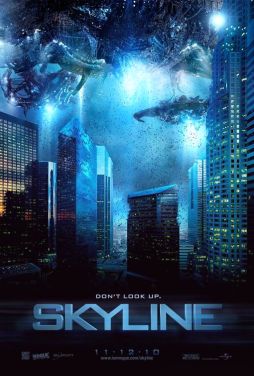 This movie is out-of-this-world terrible. Who wouldn’t want to spend an alien invasion stuck in some L.A. condo with a load of insufferable Los Angelinos? From a storytelling standpoint, watching characters I don’t care about talk about amazing and horrible things happening off camera is not the best use of anyone’s time. Skyline is a movie that keeps surprising you with the depths of its stupidity; just when you think it couldn’t plumb any deeper, the aliens have invaded to eat our brains. Yes, they’re after our brains. So that explains why gigantic monsters will claw away at a building, scrounging for the tiniest morsel of human (that still doesn’t explain it, really). That does not explain why they targeted L.A. if they’re after brains. The special effects are notable for a $10 million dollar movie, but due to the budget restraints, that’s probably why most of this alien invasion is spent indoors and behind trusty sets of Venetian blinds. The pacing is as shoddy as the character work. I kept waiting for these nitwits to step into the light and be vacuumed up into the alien mothership. The end almost looks like it might redeem part of this monstrosity, with our survivors accepting a doomed fate together. But then… I can’t even put into words how shocking, dreadful, and groan-inducing the true ending is for this junk. Suffice to say, it ends with zero resolution, a jagged plot left turn, and setup for a sequel that I’m absolutely positive not one person will be demanding.
Nate’s Grade: D
Share this:

Battle: Los Angeles (2011)
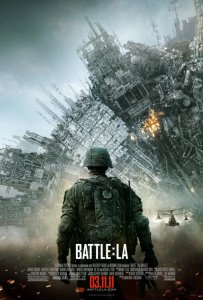 It’s just your typical sunny, Southern California day. Blue skies, good vibes, and aliens wiping out the indigenous species (read: us) for our bountiful resources. Staff Sergeant Michael Nantz (Aaron Eckhart), literally a morning away from retirement, is pulled back into combat to be apart of a Marine platoon that must hold up in the city and fight back against our otherworldly intruders.
Well there is a battle, and it is set in Los Angeles, but that’s about all you’re going to get from this movie. If you were looking for something approximating character, you’re looking in the wrong place. The characters are purely defined by one-note superficial differences, like this guy’s a doctor from Nigeria, this guy has a pregnant wife, this guy has… glasses, etc. The characters were so powerfully indistinct that there were three separate times that a person appeared onscreen and I said aloud, “Hey, I thought that guy died.” Battle: Los Angeles is a military movie, a grunts-eye-view to an alien invasion. And we keep that limiting POV for the entire movie. Battle: Los Angeles has more in common with Black Hawk Down than it does with Independence Day. Replace the depiction of angry, faceless Africans with aliens and there you go. We move from house to house, rubble-filled street after another, shooting wildly, barking commands, and trying to make sense of the urban battles. I’m doing the film too much of a favor because that makes it sound thrilling, which it is not. While there is plenty of action kept at a fairly frenetic pace, that action consistently stays at the same level of intensity. Nothing truly builds or develops to add extra levels of tension. The action is consistent, shooting through one neighborhood after the next, and when the action is plentiful but fails to develop, then the entire movie feels stagnant. Sure it develops from a “We have to go here now” assembly of plot dominoes, but advancing from one location to another with fewer characters each time is not the same as a plot.
 These have got to be some of the dumbest aliens in the universe. These are the aliens that the other aliens pick on. Some scientist/exposition device pontificates that the aliens are after our water, which is a better reason than invading a planet to harvest our tasty brains (Skyline, I’m looking in your direction). The talking head says it’s a rarity to find a planet with liquid water and thus Earth is so attractive to outsiders. Okay, so you’re going to tell me that aliens lack the ability to take ice melt it? There’s an awful lot of ice in the universe that could be more easily obtained. That seems like a better solution than an interstellar road trip for a drink. The creature design is decidedly lacking as well. The aliens look like a cross between squids and a hardware store shelf; they have metallic weapons forged to their skin. At one point Nantz and his crew is dissecting an alien POW to look for vulnerable spots (this might violate some sort of treaty somewhere) and find a lone sack underneath about five layers of armor and exoskeleton. Then they relay the news about this “delicate” spot to all the troops and miraculously all of the aliens start to now go down easily by being shot at a great distance and having the bullets penetrate layers to hit one spot a half a foot in diameter on a moving target. Makes perfect sense now that they know. That info didn’t seem any more helpful than just blindly shooting at the area below the head, which was the previous method for killing. These alien spaceships look like someone attached rockets to the shantytowns from District 9. These ships look like something assembled over at a junkyard and I thought to myself, “You traveled through space in this heap?” It’s like an invasion from an impoverished alien race that also happens to be ignorant and uneducated, which might explain the whole coveting water thing. Battle: Los Angeles might secretly be a metaphor for class warfare. Or not. Probably not.
The movie transforms into a two-hour commercial for the Marines. Battle: Los Angeles espouses the selfless bravery and honor of our servicemen, which is commendable, but it should have been done in the ame of recognizable human characters. It does the honor of good men no justice when they are turned into statues. These aren’t people, they’re recruitment figures spouting poster slogans through gritted teeth. The valor turns just this side of jingoism, and that does a disservice to the sacrifice of the men and women of the armed services. It’s hard to watch Battle: Los Angeles and not come away with the impression that the Marines are superhuman badasses and let’s fight some aliens! What compounds this messy association is that the Marines have long featured TV ads where their square-jawed recruits battle fantastical monsters (I recall one of them being made of lava).
 Director Jonathan Liebesman (Texas Chainsaw Massacre: The Beginning, most famous for Jordana Brewster’s gravity-defying low-rise pants) is no great lensman. He gives shrift attention to the significance of geography in action composition, but he makes up in quantity what he lacks in quality. There is plenty of loud noises and the like, so you’ll be kept awake, that is until you heard the stilted dialogue and wish you could fall asleep. The film packs enough stuff into an overlong 110 minutes but it’s not terribly interesting stuff, which is saying something for an alien invasion movie.
Disappointingly, the movie makes no usage of its titular location. Los Angeles may be the battlefield in name, but this movie could have been set anywhere. It does not take advantage of any of the geographic features that are unique to Los Angeles, or even California. Why bother establishing a specific location in the title and premise when the execution means you could have set the story anywhere (Battle: Cleveland?). It’s a crumbling city; it could be Libya for all that matters. Some of this is likely due to the fact that the movie was almost entirely filmed in Louisiana, which seems like a rather unnatural double for Los Angeles pre and post-alien invasions.
Battle: Los Angeles is a studio film that gets its job in an efficiently empty-headed manner. The space invaders are dumb, the action is too limited and erratically framed, and the story exists only in a theoretical state. Eckhart grunts in his raspy Two-Face voice from The Dark Knight for the entire film. I suppose if you have low expectations and just want to fill up on special effects, Battle: Los Angeles should sate your desire for straight-forward shoot-em-up entertainment. It’s not brainless but it’s close to it. Near as I can tell, Battle: Los Angeles is devoid of political or topical commentary on contemporary conflict because that would just get in the way of its straight-laced heroics. Sorry District 9, what were you thinking?
Nate’s Grade: C
Share this:

I Am Number Four (2011)
 Despite being based upon a young adult book series, I Am Number Four is an unfortunate title. What do you call the sequel? I Am Number Four 2? I Remain Number Four? Let’s not even mention the obvious pan that is begging to be covered by that title (“I Am Number Four? More like I Am Number Two!”).
Number Four, a.k.a. “John” (Alex Pettyfer), is your normal teenage alien hiding on Planet Earth and trying to live a regular life while eluding intergalactic mercenaries. Numero Quatro has relocated to the town of Paradise, Ohio with Henri (Timothy Olyphant), his alien guardian who poses as dear old dad. The two are trying to keep a low profile because Number Four is one of the last nine super-powered aliens from a dead planet. The aliens develop different special abilities as they mature and Number Four has begun to notice that his hands glow in the dark. Number Four catches the attention of Sarah (Dianna Agron), a pretty gal whose ex-boyfriend happens to be the super jealous quarterback. Number Four also befriends the school’s nerd (Callan McAuliffe) who thinks his father was taken by aliens. He’s not exactly keeping the desire low profile. Numbers 1-3 have been killed by a pack of alien mercenaries who intend to dominate Earth, and now Number Four is next.
While neither special nor afflicting, I Am Number Four is a pretty mundane, mediocre, special effects driven goof aimed primarily at young teen males. The plot lacks any trace of nuance and seems fantastical in what should even be ordinary. The Ohio town is one of those small towns that exist in the minds of west coast studio executives, where everyone gathers round for a carnival and the roads are mostly of the dirt variety. Sarah’s family is one of those ideal, chatty families that exist primarily in the minds of nostalgia. They don’t just sit around and chew their food; they are actively involved in dinner cutesy dinnertime games and cutesy embarrassing interactivity. But the movie never lets you think about these inauthentic tidbits for long before more explosions or colorful special effects rattle you. The plot follows an almost mechanical process, supplying some PG-13 skin (ladies in low rise jeans! Cleavage!) or some rudimentary chase scenes at a fairly brisk pace. The story borrows liberally from many sources, including a dash of super powered loner Spiderman stuff, angsty teen romance from Twilight, and a sprinkle of whatever is playing on TV right now as you sit reading this.
 The action is never really takes off beyond the general concept of Things Exploding and People Running. Director D.J. Caruso (Eagle Eye, Disturbia) can string together a series of pleasing visuals but they never amount to much. The film lacks real suspense and any risible sense of excitement. The action sequences are disposable but at least Caruso makes sure that the audience can follow along. I thought with all the sci-fi elements that the film would make more interesting choices, but alas I Am Number Four relies all too easily along commonplace action tropes like it’s an accomplishment. Number Six (Teresa Palmer) gets to walk away from an explosion in slow-motion (while she wears sunglasses). Nobody in town seems to ever pick up on the mounting collateral damage of this interstellar spat. Caruso and the screenwriters are too content to just be happy playing with the special effects toolbox, emulating the favorite moments of the sci-fi action genre. And one of those tropes is that ANIMALS CAN NEVER DIE. Number 4 has a shape-shifting guardian pet that decides to take the form of a dog. Then when things get rough, this dog mutates into a hulking CGI creature, which still looks like a dog. And when he gets wounded fighting another CGI monster, it’s not enough that we get the pained dog cry but the filmmakers decide that he also has to transform back into a regular Earth dog at this point to hammer home the image of pooch in trouble. Shameless to the very end. And then, during our resolution this space dog has to come hobbling out.
Fortunately for the audience, the actors are all rather beautiful. Pettyfer (Alex Rider) isn’t much when it comes to this thing called acting, but he’s got abs you could scrub laundry with and really that’s half the part of playing a hunk from outer space. I give the guy more credit just for having to be saddled with the lame superpower of glowy hands. It’s a long wait for those glowy hands to become instruments that launch glowy fireballs. For most of their screen time, Pettyfer’s power just looks like he’s clenching two very powerfully charged indigo-glowing cell phones. Olyphant (Deadwood, Hitman) is too young for me to be covering as the dad to a 17-year-old kid. I still remember Olyphant in 1999’s Go. Maybe that’s just my hang-up. The ladies are all gorgeous are all in the flawless skin and teeth variety, you know, the ones that populate every small town. No one truly makes much of an impression but they’re easy on the eyes. It’s like an Abercrombie and Fitch catalogue come to life with extra explosions (and more clothes).
 The only actor that stands out is Kevin Durand and he’s under pounds of makeup as the chief villain. Durand first came to serious attention as a season-long villain on TV’s Lost as Martin Keamy. He has a real distinct menace that doesn’t come across as self-satisfying or ironic. He’s got a real presence and it seems like casting directors have caught on to this former Canadian standup comedian. From there Durand has become something of a go-to guy when it comes to large intimidating men and men with some kind of mild speech impediment; his characters in X-Men Origins: Wolverine, Legion, and even Robin Hood all sounded like they had their mouths stuffed with cotton. Durand always has a good time with his bad guy roles, whether they are flinty or over-the-top. I enjoy watching this man onscreen even if he’s under some fairly lackluster creature makeup that makes him look like a tattooed shark man.
The point that caught my attention, and was scantily mentioned but once without nary a rejoinder from any character, was the fact that the big bad evil aliens are killing the alien teens in order. No reason is ever attempted. There are nine super alien teens but for some reason these interstellar killers are uncontrollably anal-retentive (“We may be vicious monsters, but we respect the value of numerology”). It makes little strategic sense to stick to the doctrine of taking out your enemy one at a time and in a predetermined order that everyone knows about. It also means that presumably Number 9 will be the hardest to vanquish since they will have the longest time to master their super power. Later on, Number 4 gets an added boost from a sexy, slinky Aussie who happens to be Number 6. My first thought: “What the hell happened to Number 5?” Then I figured that Number 5 has to be locked away somewhere in a protective safe house at an unknown location. Because that affords Number 6 to do whatever the hell she wants; the evil aliens would just have to stop and say, “Look Number 6, we’d really, truly love to vaporize you right now, but first we gotta go find and kill Number 5 first. See ya later.” If that’s the case then Number’s 7-9 need to get off the bench and team up. Number 4 can’t keep this up forever, guys.
I Am Number Four is tailor-made for a young male audience that doesn’t have the urge to see something harder or edgier. It’s got superfluous jet-ski stunts, girls with flat tummies, explosions, cool space weaponry, CGI monsters, villains in long black trench coats, failed attempts at romance, a dog, and even a reference to famous Cleveland Browns quarterback Bernie Kosar. It’s not an incoherent cacophony of light and sound like you’d find in a Michael Bay film; director D.J. Caruso is like Bay lite with more self-discipline. I Am Number Four is fairly derivative stuff but nothing worth getting upset about. After you see derivatives of derivatives, you start forgiving the final product for lacking any discernible flavor. All of the elements come together in rather harmless fashion making a rather empty but harmless sci-fi action flick.
Nate’s Grade: C
Share this:

Predators (2010)
 For a solid 45 minutes, Predators is a fairly good genre movie. No, it’s a very good genre movie. We snap awake in freefall with a ripped Adrien Brody. A group of deadly warriors from all cultures find themselves stranded in some strange jungle. For that 45-minutes of goodness, the assembled killers (and Topher Grace as a doctor?) try and piece together their circumstances while exploring the foreign terrain. It’s a setup straight out of the Twilight Zone catalogue. And then, at minute 46, they find out they’re on a game preserve planet for the notorious alien bounty hunters, the Predators. The characters get picked off one-by-one and the patient buildup unwinds in a familiar and depressing bloodbath. Predators will work as a quick fix of junk food, but it teased a promising alternative that never came to fruition. The action is bloody but listless. The plot twists are seen from miles away (Topher Grace as a doctor?) and after all that badass macho posturing, the end credits blast the song… “Long Tall Sally” by Little Richard? It’s the most bizarre element in a movie with killer space monsters in dreadlocks.
Nate’s Grade: C+
Share this:

District 9 (2009)
 I can’t believe I forgot to review this some how. The sleeper hit of the summer, District 9 is an intelligent, and rather obvious, apartheid metaphor, and a grandly executed action thriller with a strong moral compass. Aliens crammed into ghettos and being mistreated and abused? Sounds like Alien Nation to those with longer memories, however, writer/director Neill Blomkamp forges a docu-drama that manages to be bristling with ethical questions and kick-ass action. It’s very easy to get wrapped up in all the excitement, so much so that I was trying to will the characters onscreen to take certain precautions. Blomkamp manages to take shots at some easy targets, like shady corporations and mercenaries, but that doesn’t make the movie any less affecting. The movie belongs to actor Sharlto Copley, who begins the film as a dithering bureaucrat and ends as a truly unlikely action hero, and you buy every single step of this man’s satisfying emotional arc. While the Academy is picky when it comes to genre films, Copley deserves Oscar consideration; I haven’t seen a more compelling performance by an actor all year. The special effects are astounding, and they were accomplished on a scant budget of 30 million, which is probably what Transformers 2 spent on one explosion. District 9 makes you feel that movies can still surprise you, as long as we have visionary, intelligent life working outside the studio system.
Nate’s Grade: A
Share this:

Race to Witch Mountain (2009)
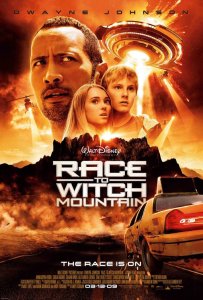 Does anyone ever fondly recall, let alone even recall, the 1975 original children’s film, Escape to Witch Mountain? This remake is Disney-fied in all places. It’s a lackluster kiddie adventure with more special effects, car crashes, and one-liners. Dwayne “The Rock” Johnson cements his tight grip on the family film genre; I really like this guy as an action hero and as a charismatic comedic actor, but being a wisecracking chauffeur to monotone yet strikingly Aryan-looking space aliens isn’t cutting it. The little green pre-teens need to get back to their ship and escape the clutches of government agents and an alien killer. This is one of those movies were everyone leaves their brain at home. This is the kind of movie where everybody is profoundly stupid and easily tricked. You’d think space aliens and intergalactic travel and psychic abilities would be met with more than incredulous jokes. Regardless, Race to Witch Mountain is devoid of fun, wonder, and excitement despite a decent effort by the assorted cast. This is lazy, by-the-numbers stuff masquerading as quality family entertainment. Families and children deserve coherent stories with actual characters and action sequences that feel like they matter. The only thing that really matters in Race to Witch Mountain is the fact that nobody will remember this movie in 35 years time, allowing Disney (or whatever alien/robot/alien robot overlords run the show at the time) to follow through with another thoughtless, mechanical remake.
Nate’s Grade: C
Share this:

The Box (2009)/ Capitalism: A Love Story (2009)
 Both films on the surface seem so radically different and yet I found lots of common ground between a sci-fi conspiracy and a muckraking documentary about the biggest financial meltdown of the modern era. Both are centered around the concept of greed and whether humanity can forgo selfishness for empathy of their fellow man. Would you kill a stranger for a million bucks? Would you rig a financial system so that the richest one percent can gamble the life of a nation? Both movies also bite off more than they can chew and both movies exist as interesting yet dispirit elements that could use more cohesion and resolution.
You have been given a box with a button. If you press the button tow things happen: somebody you do not know will die and you will receive a million dollars. Do you press it? That’s the hook of writer/director Richard Kelly’s sci-fi morality tale based upon a short story by Richard Matheson. The Box is a messy and outlandish conspiracy sandwiched between two moral tests, the second a consequence of the first and a means to wipe the slate clean. There’s plenty of weird unsettling moments, including the horrendous wallpaper of the 1970s, but not everything really hangs together. Kelly’s intergalactic conspiracy can get readily outlandish with all the variables and needed participants, but like in Donnie Darko, he lays out enough tantalizing info to keep your attention and then keeps the narrative vague enough for personal interpretation. However, unlike Darko, this movie needed to cleanup its loose storylines. It just sort of ends in perplexing rush, and I sat in silence through the end credits waiting for some kind of scene to help tie together dangling storylines that were left to dangle for an eternity. The Box has a nicely tuned foreboding atmosphere, and it certainly keeps you guessing, but it will also keep you scratching your head to try and make sense of everything from button boxes to teleportation pools to Mars probes to sudden nosebleeds to Satre’s No Exit. Kelly, as he has done with his previous movies, packs a lot in two hours. Whether or not it all formulates is up to the viewer’s wearying patience. I’d rather have more movies like The Box than more thoughtless drivel from the Hollywood assembly line.
 After 20 years, you pretty much know at this point what you’re going to get from a Michael Moore documentary. There’s the anecdotal evidence, emotional interviews of the downtrodden, the one-sided arguments, the nods to the depressive state of Flint, Michigan, and Moore trying to bully his way to see the powers that be that have no interest seeing him. In a way, Capitalism: A Love Story is like a greatest hits collection for Moore that reminds you of his better moments and better films. Despite all the outrage, Moore wants to throw the baby out with the bath water. He cites capitalism as an evil that needs to be eradicated. His thesis isn’t very cohesive and consists of a series of related and unrelated anecdotes, some of them grossly offensive like companies profiting from the death of employees thanks to “Dead Peasant” life insurance policies. But at no point do you walk away thinking, “Let’s start from scratch. What has capitalism gotten us?” Several of his points are easy to agree with. There is a flagrant disregard for the well being of others on Wall Street, who carelessly gambled the nation’s fortunes and then got the taxpayers to cover the loss. The bailout is a crime of pure capitalism and in a true capitalistic society there is no such thing as “too big to fail,” there is only fail. It’s not following an ideology built upon greed that has hurt the U.S., it’s unchecked greed, capitalism run amok without any oversight or regulation that has endangered the nation’s livelihood, and I’m surprised Moore didn’t emphasize the process of deregulation from Reagan to Bush more. The story of our financial meltdown is too large for a confined two-hour narrative window, and it’s too important a lesson for a man like Moore to use it as fire to ignite a people’s revolution.
Both movies: C+
Share this:

Transformers: Revenge of the Fallen (2009)
 Transformers: Revenge of the Fallen pretty much sells itself. More giant freaking robots. That was enough to make the first movie a worldwide blockbuster. My own teenaged brother-in-law, when he first saw the first Transformers movie, declared it his favorite live action film. Director Michael Bay completely empties his creative cupboard into a bladder-unfriendly two and a half hour endurance test. It’s too bad that that cupboard was bare when it came to story.
Sam (Shia LaBeouf) is headed off to college, and he’s leaving behind his girlfriend Mikaela (Megan Fox) and robot guardian, Bumblebee. Optimus Prime and the other Autobots have been working with the U.S. government to hunt down Decepticons around the globe. There?s a war on the horizon, and weasely U.S. bureaucrats want the Autobots to take a hike. Sam discovers a tiny shard from the super Cube, which was the source of life for the alien robots. His brain is zapped with an alien language that will lead him to a secret location to a secret ancient machine. The Decepticons want this info and chase after Sam and Mikaela. The biggest bad of them all, The Fallen, is sitting at home waiting to return to Earth and exact interstellar vengeance. The Fallen was foiled in 17,000 B.C. by the Prime family line, and only a Prime can kill him. The Decepticons resurrect their leader Megatron and go about trying to snatch Sam, kill Optimus Prime, and destroy man’s planet.
Bay has been condemned for his erratic ADD-shooting style, and this was the first film where I really felt pounded and punished. To contest that this movie is just “a popcorn summer movie” is just making excuses. What the hell was going on? The movie is simply a blur of colors and noise. Transformers 2 is entirely incoherent, both from a story standpoint and simply from a visual standpoint. Bay at least pulls back his camera so that the audience can identify the fighting robots easier this time; this time it’s not like deciphering scrambled porn. It’s the rest of Bay’s characteristically bombastic display of carnage that suffers. Bay is a man that doesn’t know the meaning of the word “small,” and so nonstop explosions and massive destruction litter the movie. Sam is always running or riding in his car to escape. At one point, Sam and his posse hide in a campus library only to have the building turned into cinders (showing Bay’s opinion on what books are really good for). But what exactly is happening? Why does it matter? What are the obstacles? Everything is way too busy and accomplishing so little. Half of the movie consists of the human character running and screaming. It’s excessively excessive and taxingly so.
 A strong example of the film’s incoherence is the 40-minute climax set amidst the pyramids of Egypt. At no point does Bay establish the geography or bother to let the audience follow along. The stakes and parameters have not been made adequately understandable. Ordinarily, in large action sequences there will be different groups of segments and we’ll watch each progress. Here we disjointedly cut back and forth between the groups but I have no idea what?s going on, where the characters are, where they need to be, and what is stopping them. Megatron calls down 13 different evil Decepticon robots to take part in the climactic battle but Bay never introduces these new figures; they get no setup to explain each of their unique weapons systems or general appearance. We see them only at a distance walk through wafting smoke clouds. So when they do pop into battle in quick blurs it’s just another point to be confused about. If you’re like me, you can only endure so much confusion before your brain just gives up. Bay is a fantastic visual stylist, but his action sequences are poorly developed and poorly staged. He needs to check out The Hurt Locker and take notes. Transformers 2 is nothing but non-stop careless mayhem. For what it?s worth, the special effects are incredible at every stop.
The highly ramped-up action would have been acceptable if we knew what the hell was going on and we actually cared about the story. Transformers 2 makes the first film look like poetry in comparison. The story for this movie is simply atrocious and it’s made worse by the merciless attempts at comedy. This movie is stuffed with tin-eared exposition, so our only break to try and assess what the hell we just saw is when the characters take a breather and rapidly spout more plot vomit. It’s like listening to a homeless man shout nonsense for an hour. After a while you just tune out the crazy. If the Decepticons can construct a robot that has the ability to take human form, why the hell aren’t they doing this all the time? Why aren’t they infiltrating government offices instead of prancing around colleges in hot pants? Why in the world would an 18-year-old boy leave the mega hot Megan Fox and his TALKING ROBOT CAR? Why would anyone leave these two to live in a dorm and shower in flip flops? What universe does this college that Sam attends exist in? The place is crawling with leggy, waif-thin bombshells. The movie doesn’t even resort to college stereotypes; there isn’t a single gal that doesn’t look like a magazine cover girl. The Fallen is kind of like the evil leader of the Decepticons and he’s, what, confined to sitting in his robo La-Z-Boy on his home world like Archie Bunker? Get up and do something. The Transformers fought ages ago amidst man?s loin-clothed hunter and gatherer ancestors but leave no record? You’d think some caveman type might consider that worthy of painting on a wall. Why is Megatron even in this movie? What was the point of bringing him back alive if he’s just another lackey to The Fallen guy? Why does no one consider turning over Sam to the Decepticons if it could save the planet? In the big Egyptian battle sequence, where is the Fallen the whole time? He just kind of lazily shows up at the end. Also, ancient robots made a special key to jumpstart an ancient planet-destroying machine, but then we are informed when Sam visits, no joke, Transformers heaven that this key does not work unless the holder has earned the right to use it. It’s like some high tech moral barometer. Why didn’t these alien robots say anything about this? It would have spared a lot of time and energy trying to make sure the Decepticons never got a hold of it. How does a dead human end up going to robot heaven anyway? Does that mean there’s a robot God? Was robot God created by our God? Is there a robot Devil? Does Bay do the work of the robot Devil?
 This time the comedy is puerile and embarrassing. The jokes make this movie tonally feel like a cartoon strictly for snickering adolescents. In the span of 150 minutes we’re given dogs humping twice, a tiny Transformer humping Megan Fox’s leg, Sam’s mother going berserk from ingesting pot brownies, a Transformer testicle joke (why would a robot even need genitals?), and let us not forget John Turturro in a thong. The humor aims low and still finds a way to be even worse. To save you the trouble, I am going to spoil the only two good jokes in this self-indulgent, bloated mess. Here there are, enjoy:
1) Sam is at a frat party, and it’s a frat party unlike anything ever seen unless modern fraternities can afford expensive interior decorators. One unamused frat guy asks Sam what he’s doing. Sam responds, “Going out to get you a tighter shirt.” The frat guy’s flunky clarifies: “There isn’t a tighter shirt. We checked.” I laughed. Sue me.
2) Sam and the gang at one point talk to a Transformer that’s thousands of years old. Apparently the guy is being housed at the Smithsonian Museum, which means that this is the second summer movie that is trying to inform the public that there’s something weird over at the Smithsonian. The old Transformer even has a robot cane, which is too bizarre. He rambles about the old days like Grandpa Simpson, and then finally gave this gem: “My father was a wheel. The first wheel. You know what he could transform into? Nothing! And he did so with honor.” This made me want to think about a period Transformers costume drama, where they exist as textile steam engines and phonographs and Model Ts. Would that not be a vastly more entertaining movie?
Despite all the painfully juvenile attempts at comedy, by far the biggest eyesore would have to be Bay’s Sambot twins, Mudflap and Skids. To say that these two irritating robots are politically incorrect does not go far enough. It’s one thing to reflect a cultural or ethnic stereotype, and it’s another thing entirely to keep digging deeper and deeper. These robots talk in eye-rolling faux gangster street talk, one of them has a big gold tooth, and these robots admit to being illiterate. It’s practically breathtaking to watch how racially insensitive and appalling these characters become. It’s essentially a robotic minstrel show. I’m surprised Bay stopped short of having Mudflap and Skids eat a big bowl of watermelon. This got me thinking about what other highly insensitive Transformers characters that didn’t make the cut over these two. Was there an Asian bot that turned into a car that didn’t drive well? Was there a Jewish bot that chided Optimis Prime to settle down and quit running around with those shiksa sports cars (“You know those aren’t her original parts?”). Bay can dismiss these characters as merely dumb robotic comic relief, except for the fact that these two bumbling, detestable heaps of scrap metal are never, ever funny.
 The actors have little impact in this type of movie. I like LaBeouf (Eagle Eye) but he’s got little to do but stretch his legs. Fox became a star thanks to the previous Transformers flick, and she hasn’t gotten any less attractive. Amazingly enough, she manages to lose more clothes the more she runs in slow-mo, allowing the male audience members to follow the nuance of her bouncing breasts. She’s clearly not the next Meryl Streep but this girl deserves more than being wordless arm candy. Many words have been spilled about the quasi-racist twin robots, but I’m disappointed that people aren’t as equally up in arms over the film’s blatant misogyny. Women don’t seem to exist in the Michael Bay world, only parts and pieces of women. They are all like Alice, the robot programmed to do nothing else but seduce the men. All of the special effects and noise just overwhelm the other actors. The robots themselves have no personality to offer, good or bad.
Transformers: Revenge of the Fallen is an obnoxious block-headed mess that feels like it’s being made up as it goes along. It’s sensory overload without a lick of sense, clarity, wit, and general entertainment. This sequel takes everything that was good about the first Transformers film and undermines it, and it takes everything that was awful and magnifies that awfulness. The first Transformers movie was fun. This is just work to sit through. Apologists will try and rationalize their disappointment, decrying anyone who hoped for something more than a big dumb summer blockbuster about rock’em, sock’em robots. Bay wants to show you everything and as a result you rarely get a chance to process little in this movie. There is absolutely nothing more than meets the eye here. It’s all arbitrary and tedious and it goes on for what feels like an eternity. It’ll make a gazillion dollars at the box office but will anyone remember a single moment from this exhausting junk? Make sure to bring the earplugs and aspirin in abundance.
Nate’s Grade: C-
Share this:

Star Trek (2009)
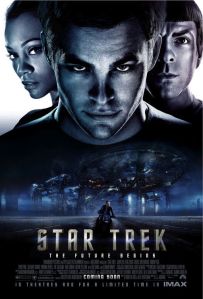 Star Trek has a hold on geek culture like no other franchise. It’s lasted over forty years, sustained five television series, and ten feature films (about four of them good), and let’s not forget the plethora of fanatical merchandise that includes everything from Trek cologne to Trek coffins. Star Wars has all the box office clout, but Trek has followers so devoted that they will create and learn a separate language, Klingon, that almost assuredly will never be spoken by anyone else outside of the festival circuit (you will never see a written Klingon exam that asks you “Where the library is?”). The Star Trek fans have been a foundation of geek culture for over four decades. People take this stuff very seriously. Trek has always been a headier brand of sci-fi, more devoted to ideas and moral dilemmas than shoot-outs and space chases, though Captain Kirk did teach the universe how to love, one green-skinned buxom alien babe at a time. 2002’s abominable Star Trek: Nemesis was meant to open up the franchise to a wider audience, but the film was the low-point for a franchise that also included William Shatner writing and directing the fifth flick (Nemesis also broke the odd/even movie curse).
When director J.J. Abrams approached Star Trek with the purpose of reinvigorating the flagging film series, you would think the man would wade into such a storied franchise with trepidation. Nope. He openly said he was making a “Star Trek movie for people who weren’t fans of Star Trek.” He was even going to change Trek canon. I imagine Trekkies (and no, I will never use the preferred nomenclature “Trekkers”) were nervous about an outsider, the author of the cinematic classic Gone Fishin’, meddling with hallowed ground. As I suspected, these fears were unfounded. The newest Star Trek does more than put a new coat of paint on an old franchise. This movie boldly goes where none of the Trek movies have gone before — turning reverent geek culture into a grand populist entertainment smash.
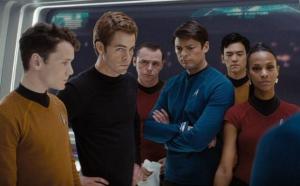 This new incarnation looks backwards, explaining how the crew of the U.S.S. Enterprise came together. The movie shows the path of Jim Kirk (Chris Pine), from troubled youth to eventual starship captain. Kirk’s father captained a starship for about 10 minutes, but he managed to save 800 lives under attack, including the birth of his son. Captain Pike (Bruce Greenwood) recruits Kirk to Starfleet Academy with the promise of doing something more with life. We also witness the boyhood of Spock (Zachary Quinto), who is teased for being half-Vulcan and half-human. His human mother (Winona Ryder) encouraged Spock to embrace his human emotions instead of cutting them off, Vulcan-style. Kirk and Spock clash at the Academy, and then an emergency requires all the recruits to saddle up for their first mission in space. Nero (Eric Bana) is a dastardly Romulan who has traveled back in time. In the future, he blames an older Spock (Leonard Nimoy) for the destruction of his home planet and the deaths of billions of Romulans. To ensure this does not happen, Nero is going to eradicate Starfleet home planets, starting with Vulcan and then Earth.
J.J. Abrams is a geek’s best friend. He understands geek culture, and yet the man is able to take genre concepts and make them easily accessible to the unconverted while still making a finished product that is respectful, playful, and awesome. Abrams is an expert on the pop culture catalogue, and he knows how to make genuinely entertaining productions that succeed on brains as well as brawn. He brought tired spy conventions into the twenty-first century with the cool, twisty Alias and Mission: Impossible III, which was really an extravagant two-hour episode of Alias, and I mean this in the best way. He has an innate understanding of action sequences and knows well enough that an audience needs to be engaged emotionally, so he makes the action as character-based as much as possible. Abrams has a terrific imagination behind the camera, and he reminds me of a young Steven Spielberg in his ability to marry artistic integrity with big-budget crowd pleasers. Abrams and his screenwriters Alex Kurtzman and Roberto Orci (Transformers, TV’s Fringe) have crafted a stellar Trek that will appeal to die-hards and those who couldn’t tell a Romulan from a Vulcan (I fall somewhere in between).
 The time travel storyline could have used more juice, however, it serves its purpose by establishing a parallel Trek universe to work with. Beforehand, Trek had established so many previous stories that it hamstrung writing new stories because they had to be extensively researched to make sure they did not conflict with 40 years of canon. Abrams and company wrestled free from the grip of the established history and can now play around unencumbered to a degree. I mean, fans don’t want to see something radically inauthentic, but Uhura and Spock as a couple? Sure, why not? The fan favorite character catch-phrases (“She’s givin’ it all she’s got,” “Dammit Jim, I’m a doctor?,” etc.) are organically worked into the story so that they don’t become falling anvils.
Star Trek‘s pacing can be whiplash inducing. It speeds through two hours of action and setup while still maintaining an emotional connection to the characters involved. The movie has a boyish enthusiasm for adventure and it’s fun watching well-known characters assemble and amble into new and interesting directions. The action is routinely thrilling and I enjoyed Abram’s small touches, like watching a crew member get sucked out into space and cutting all sound to illustrate the cold, empty vacuum. The amount of humor injected into the movie can be distracting at times, not because it isn’t funny but because of the brisk tone breaking. One second it’s a life-or-death scenario and the next Kirk is running around with giant goofy hands. Still, it’s good to see some humor in the Trek universe that isn’t related to alien culture clashes.
The young ensemble is amazingly well cast. I didn’t think a younger generation of actors would be able to step right in and play such lived-in characters, but they pull it off. The hardest shoes to fill are unquestionably Kirk’s, and Pine (Smokin’ Aces, Just My Luck) carries that same cocksure bravado without stooping to a stilted Shatner impersonation. His performance feels at times like Han Solo and Luke Skywalker rolled into one, and he’s an appealing presence that captures the essence of a dashing and rebellious scrapper. This Kirk is still an adventure-seeking, skirt-chasing 1960s kid at play. Quinto (TV’s Heroes) is blessed to look remarkably similar to Nimoy, but the actor also gets to explore the human side of Spock. He feels compelled to harness emotion, like all Vulcans, yet it’s intriguing when certain emotions slip out and build a bigger picture about what’s going inside the mind of a being dominated by logic. Quinto has less to work with by design and yet the man finds interesting ways to ensure Spock can be recognizable. Each of the supporting actors has their moment, but my biggest surprise was Karl Urban as Dr. Leonard “Bones” McCoy. Urban has mostly been confined to lame action movies as of late, like Doom and Pathfinder. But he’s really funny and his performance captures DeForest Kelly’s mannerisms down without turning into a caricature.
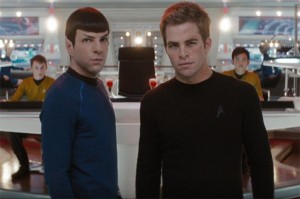 If there is a main weakness to Abrams’ Trek outing it’s that it feels far more like the opening act of a larger movie. Nero is a fairly weak villain, though Bana gives him a nicely polished glower. The villain is really just a tie-in for the time travel storyline, which is also a narrative quirk to secure an open field for further stories. Meaning, that much of the movie can be seen as assembling the pieces to simply move forward on their own. It’s an expensive set-up movie, and Abrams makes sure that the audience sees every dollar of the splashy visuals onscreen. Personally, I was also getting tired of the cinematography decision to fill the screen with as many light flares as possible. It seemed like every other moment had a blast of light beam in from some direction. After a while it sort of felt like an eye exam where the optometrist shines a flashlight back and forth. And it takes far too long for Scotty (Simon Pegg) to appear in the movie.
J.J. Abrams does more than hit the restart button. He has made a Star Trek that manages to be respectfully reverent but at the same time plays along to the mainstream visual sensibilities of modern cinema. It’s fun without being campy, reverent without being slavish, and this Trek never forgets to entertain from the opening assault on a starship to the Michale Giacchino’s closing credits score. This is an enjoyable rush of sci-fi escapism. The Star Trek series was always deeply hopeful and humanistic, believing in the best for humanity and that man, in cooperation, could achieve greatness. I think further escapades with this cast and Abrams at the helm could reach greatness. For now, I’ll be happy with this rollicking first entry into a franchise that seemed adrift in space. Bring on more of the green-skinned women.
Nate’s Grade: A-


 nathanzoebl
You must be logged in to post a comment.