Blog Archives
Spectre (2015)
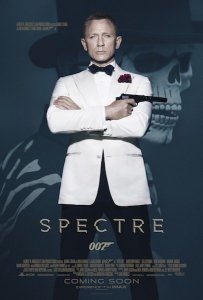 It’s hard to keep a franchise that can almost count its decades on one whole hand fresh and relevant, but Daniel Craig’s time as 007 has done just that. Starting with 2006’s magnificent Casino Royale, we got a grittier Bond, a man with a bruised psychology that was interested in more than just how many bad guys he could callously kill and sexy ladies he could securely seduce. It was a franchise that modeled itself more after the Jason Bourne films, and it worked tremendously, giving the 40-year-old franchise new relevancy for modern audiences that have grown up on the Bond canon. 2012’s Skyfall was the biggest bond hit of all time, grossing over a billion dollars worldwide. It was going to be a hard act to follow. Spectre, for all intents and purposes Craig’s franchise farewell, is a lousy swan song. It’s the weakest of the Daniel Craig Bond era but that claim would require me to rewatch 2008’s Quantum of Solace; however, just from memory, Solace had more engaging moments, stunts, and even a better theme song, so I’ll stick with my proclamation: Spectre is the most mediocre Craig Bond.
James Bond (Daniel Craig) is hunting the organization responsible for the deaths of those closest to him, namely Vesper (Eva Green) and the prior M (Judi Dench). His path has lead to the nefarious SPECTRE terrorist organization and its mysterious and feared leader (Christoph Waltz), who has his own personal reasons for causing Bond misery.
 The movie’s biggest mistake was its insistence that the audience will want to know how all the events tie together as a whole. Due to this position, it makes Spectre the awkward retcon exercise it is, trying to provide winks and nods to past Craig Bond outings while saying, “Oh yeah, all that evil stuff, well this guy is The Guy behind it all.” Adding an extra layer of a criminal conspiracy doesn’t somehow make those events more interesting or provide the need for conclusion; it piggybacks off the earlier movies and pretends it has shown its own work. Spectre thinks the accumulated plot events and deaths of three movies is the same as properly setting up a story and its villains, and that’s just not the case. The other problem with trying to connect the dots to three previous movies is that Spectre has even fewer chances to stand on its own merits, which are admittedly fewer. Lea Seydoux (Blue is the Warmest Color) is a bland addition as a Bond Girl, and oh does she pale in comparison to the capable and indispensable Rebecca Ferguson in the latest Mission: Impossible sequel. Their relationship is never as interesting or as properly developed as the film thinks. The stakes of the movie (surveillance abuse) feel too abstract and low-key, or at least poorly articulated, to feel important. If you’re going to turn the focus of the narrative on offering an apparent climax for multiple movies, it better deliver and feel like it was worth the effort, and Spectre just does not feel like that.
The other thing hat just doesn’t work is the bad guy, which is puzzling because Waltz was born to play a James Bond villain. The Craig Bonds have followed the more stripped down route even in their villains, once the parlance of the most colorful megalomaniacs that action cinema had to offer (and there’s also the eccentric henchmen). There’s a delayed buildup to revealing Waltz (Django Unchained) where other characters will talk in hushed whispers about just how dangerous and powerful the man in charge of Spectre is. A nagging problem is that we’re too often told these things without being shown them. A similar problem affected Skyfall where we spent half the film being told how dangerous and skillful its villain was, but at least Silva (Javier Bardem) lived up to the hype when he arrived, at least for a little while before degenerating into your standard psychopath. Waltz has exactly two sequences before the final showdown. That’s it, and for one of them he’s almost entirely in shadow at the end of a large table of shadowy figures. He’s not given a strong angle to play with his villain (spoilers) and his ultimate personal connection to our 007 agent feels far too forced and slight. Just like the rest of its hasty retconing, Waltz’s connection is meant to feel significant but its not dealt in any way like it should be significant. It’s almost a casual toss-off. It’s even worse when Waltz calls Bond his “cuckoo,” meant to be dark but is just really silly. Waltz is completely wasted in what is little more than a perturbed middle manager role. His climactic showdown with Bond feels impractical even for Bond movies. His downfall is even worse and made me laugh out loud how easily it all comes crashing down. If the emphasis of your movie is how the Big Bad is responsible for all the previous misfortune, then you better make sure the character was worth the wait.
 Sam Mendes (Skyfall, American Beauty) returned to the director’s chair and stages some nicely photographed sequences, but with the exception of a stirring opening sequence, the action of Spectre is quite tame and forgettable. The opening in Mexico City during the Day of the Dead celebrations has an interesting atmosphere and an ongoing tracking shot to pull us in from the start. From there, Bond has to take out a high-profile Spectre baddie and their struggle eventually carries over into a helicopter, both men punching wildly and trying to hold on for dear life as the copter whizzes upside down repeatedly. It’s a good set piece with some fun and unique aspects, like Bond escaping the crumbling wall of a building, but it’s the sheer thrill of watching the battle inside the helicopter that makes this opener a doozey. After that, I was sad to discover that nothing could measure up. Skyfall also peaked with its opening action caper but it still held my interest as it barreled toward its conclusion. I was resisting the urge to go to sleep with Spectre. An air chase over the trails of a mountain is interesting but doesn’t evolve, which is something vital to all exciting action sequences. If the action is static, it’s most often not going to be good after the initial rush wears off. There’s a decent car chase late at night in Rome but I got to think why Bond would be fleeing just one henchman even if that paid muscle were played by physical brute David Bautista (Guardians of the Galaxy). The film’s budget was reportedly $245 million and I just do not know where that money went.
The Craig era will be known for revitalizing the franchise, saving it from its self-parody excesses that were swallowing the series alive. We were watching Craig’s version of 007 become the hardened, quip-heavy, flippant killing machine and womanizer, except that he doesn’t feel like that character by the end of Spectre. If the course of four films was to bring the Bond we know into fruition, then it didn’t quite work, and that personally thrills me. Craig’s character is far more interesting, haunted by the people he couldn’t save, than the action hero Bond staple. However, while Craig’s character maintained a trajectory that staid true to its aim of bringing more depth to its central hero, the series was starting to hew closer to the classic Bond mode of empty bombast, and Spectre is the final proof of this. It’s getting closer to the crazy villains and spy hijinks of old territory. It’s a story that wants climax and resolution but cannot supply it without relying heavily upon the three previous movies to supply the weight this one lacks. It’s a rather lackluster farewell for Craig, an actor who deserved better. Judging by his interviews, I think he’s just happy to be out. He’ll be missed. Spectre will not. Now bring on Idris Elba please!
Nate’s Grade: C+
Share this:

Pan (2015)
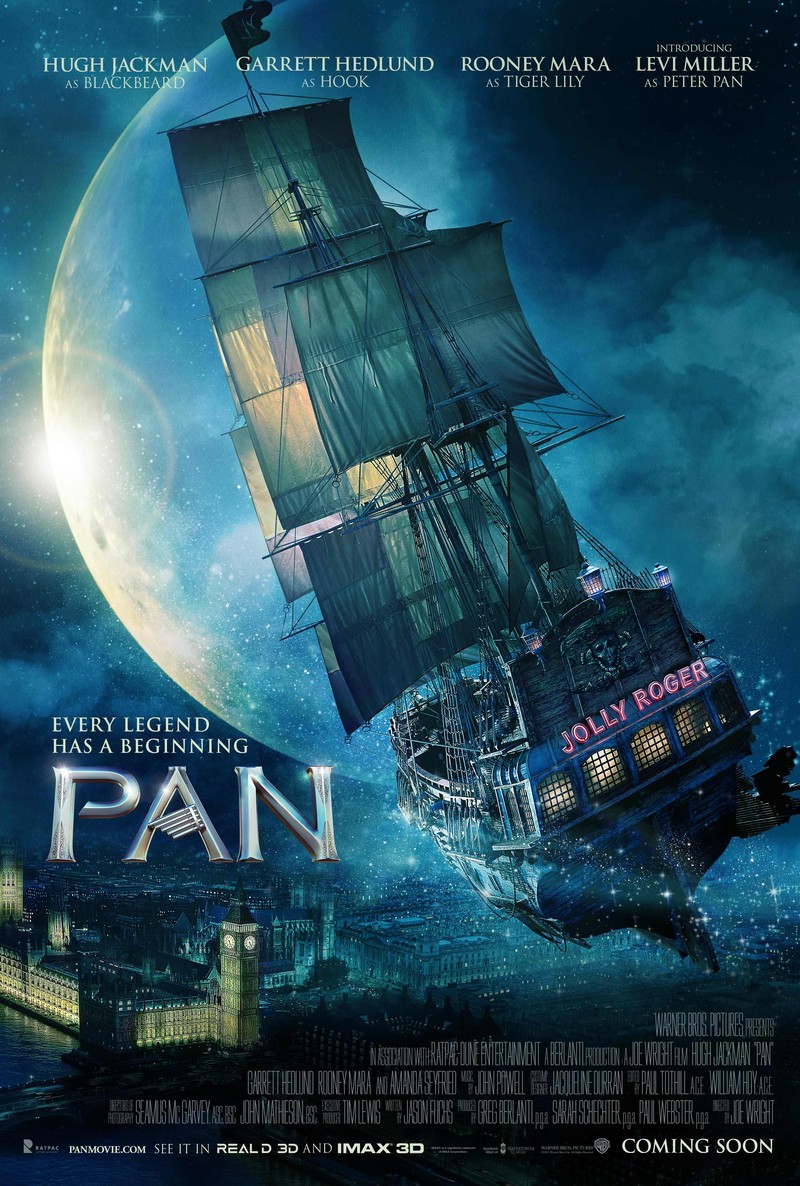 Reminiscent of the Patton Oswalt bit concerning The Phantom Menace, often fans rarely need the “before” when it concerns the characters they love; did anyone really need to know what Peter and Hook were up to before they became mortal enemies? Pan attempts to tell the story before we know it about how Peter Pan became the character we know. It was originally planned for a summer 2015 release and was pushed back until the fall, ostensibly for more time to finish visual effects. the studio, Warner Brothers, pulled a similar move with Jupiter Ascending, and we know how that turned out.
Peter (Levi Miller) is an orphan living in London during World War II. He and a few of his best parentless pals are abducted in the middle of the night by a group of pirates and their flying pirate ship. He’s taken to Neverland to work in the mines belonging to Blackbeard (Hugh Jackman), who has an addiction to fairy dust. During a scuffle, Peter discovers he has the ability to fly, though he can’t exactly master it. There has been a prophecy that The One would be able to fly and they would topple Blackbeard. Peter and another miner, James Hook (Garrett Hedlund), escape, finding their way into the land of the “natives,” which includes Tigerlily (a miscast Rooney Mara). The “Pan” has been prophecized to help lead their people and discover the bridge into the world of the fairies, and Blackbeard won’t stop until he finds the source of his pernicious pixie smack.
 Who exactly is Pan intended for or what story needed to be told prior to our introduction to the world of Neverland? The first act sets the stage for the miscalculated tonal mishmash that never truly settles: we jump from a cruel orphanage, with Peter comically plucky, to the horrors of the London bombing during the Blitz, to a bunch of pirates kidnapping the orphans (tacitly with the approval of the evil head nun running the orphanage), and from there we’re whisked away across space to a mine of slave workers digging for pixie dust minerals who serenade their pirate slave lord with the lyrics to Nirvana’s “Smells Like Teen Spirit” for… some reason. Is this a movie intended for younger children and families? Is it intended for teenagers? The tone veers wildly, sometimes within the same scene, going from serious and gritty to colorful and ridiculous. It’s a campy experience that makes me wonder who exactly was supposed to enjoy an attempt to open the Peter Pan mythos, a world that is generally shallow.
At no point does Pan justify its existence beyond a flimsy corporate attempt to take a familiar world and expand upon it for sweet franchise money. When you get down to the world of Neverland, at least as represented on film, what exactly is there? There are pirates, “natives,” mermaids, and fairies, and that’s about it. They all kind of exist in their own individual movie that fails to blend together, making the new groups of characters feel like little more than a new theme park attraction before moving on to the next autonomous ride. The fantasy figures themselves just aren’t that interesting because there just isn’t much to them beyond superficial descriptions. I suppose then that this would allow plenty of opportunity at world building to take these familiar staples and give them greater depth, and that’s Pan’s biggest missed opportunity. Far too often, the movie feels on Fantasy autopilot and what we’re given is the old clichés of the Great Prophecy and the Chosen One meant to bridge worlds, etc. the events in the film do little to explain how Peter became Peter Pan, besides learn to fly. The problem with the prophecy trope is that it robs characters of agency in place of just accepting their capital-D destiny.
You learn nothing new about Peter or Hook as people, and the nods to the greater Pan lore are annoying at best with how unsubtle and clunky they are. The movie doesn’t even lay the groundwork to explain what conflicts will eventually drive Peter and Hook apart. Peter is a bland hero who is defined by the mystery of his absent mother and her own lineage. He’s special because his mom was special and if he just believes hard enough then perhaps he can be even more special. It’s pretty simplistic stuff. The references to the Pan lore always seem to stop the movie dead in its tracks. The relationship between Peter and Hook isn’t explored in any capacity other then they appear to have both escaped together and been running side-by-side. It’s a relationship not out of bonding but out of sheer proximity. The concluding lines are literally Peter saying, “We’re going to be friends forever,” and Hook replying, “What could possibly go wrong?” Oh my goodness is that one hacky groan-worthy wink to the future.
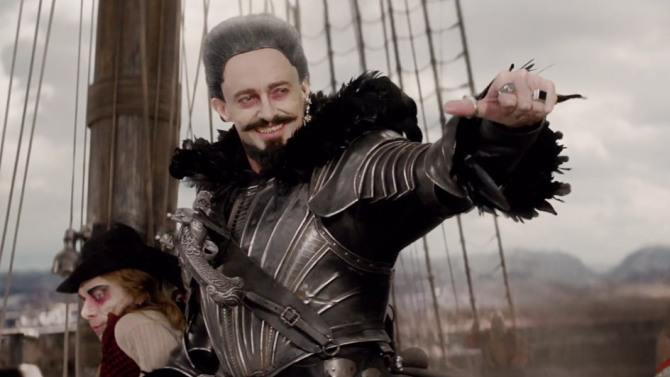
 Pan is made serviceably watchable from director Joe Wright and the campy performance of Jackman. Wright is a premier visual stylist in cinema though his artistic instincts can lead him to try and smash as many ill-fitting square pegs as he can into round holes, last evidenced by the 2012 Anna Karenina adaptation that made all the world a literal stage. The visuals are often splendid to behold and Wright has a wonderful feel for color hues. The final act feels climactic and visually alive in ways the movie doesn’t even deserve, and Wright’s vision, weird as it can be at points (Nirvana?) gives the movie an energy that keeps its worth an initial viewing. For a movie filed with fantasy realms, I enjoyed the scenes in the orphanage and with the wicked head nun the best (is she knowingly selling the boys into slavery on a magic pirate ship or is it just extreme negligence on her part?). The other aspect that at least held my attention was Jackman. In a movie filled with bland and the occasionally bizarre performance, Jackman offers an anchor to lean upon. It’s not a good performance by normal circumstances but it provides a sense of life and feels in place. Hedlund (On the Road) is amazing in just how strange his rakish Harrison Ford-esque performance persists. Why didn’t anyone tell him to stop? His speaking voice fascinated me and I spent the entire moving trying to figure what it sounded like and my best description is Heath Ledger’s impression of Al Pacino.
While not being a colossal disaster of artistic self-indulgence, Pan is a disappointing and mostly tedious experience because of its failure to capitalize on expanding upon the Neverland universe and exploring what should be formative experiences to central characters. If this was going to be a crazy artistic romp then it needed to be crazier. If you’re going to have two brief anachronistic songs, then do more or at least draw in more influences from other timelines. If you’re going to be a straight-laced pilot for a budding fantasy franchise, at least give us more flights of fancy and wonder. Make us fall in love with this world or at least some of the characters. Instead Pan uses the audience’s pre-existing association with the characters and the environment in place of doing anything meaningful with a story. Peter becomes Peter Pan, so he doesn’t have to be a character he just has to be the pre-Pan Peter. The same for Hook and Smee and Tigerlily and that’s really the only characters worth mentioning until those Darling children come visit. I thought I was going to ridicule Pan with the glee I had taking apart Jupiter Ascending but I couldn’t muster much effort. It didn’t feel like the Pan filmmakers did either.
Nate’s Grade: C
Share this:

The Maze Runner: The Scorch Trials (2015)
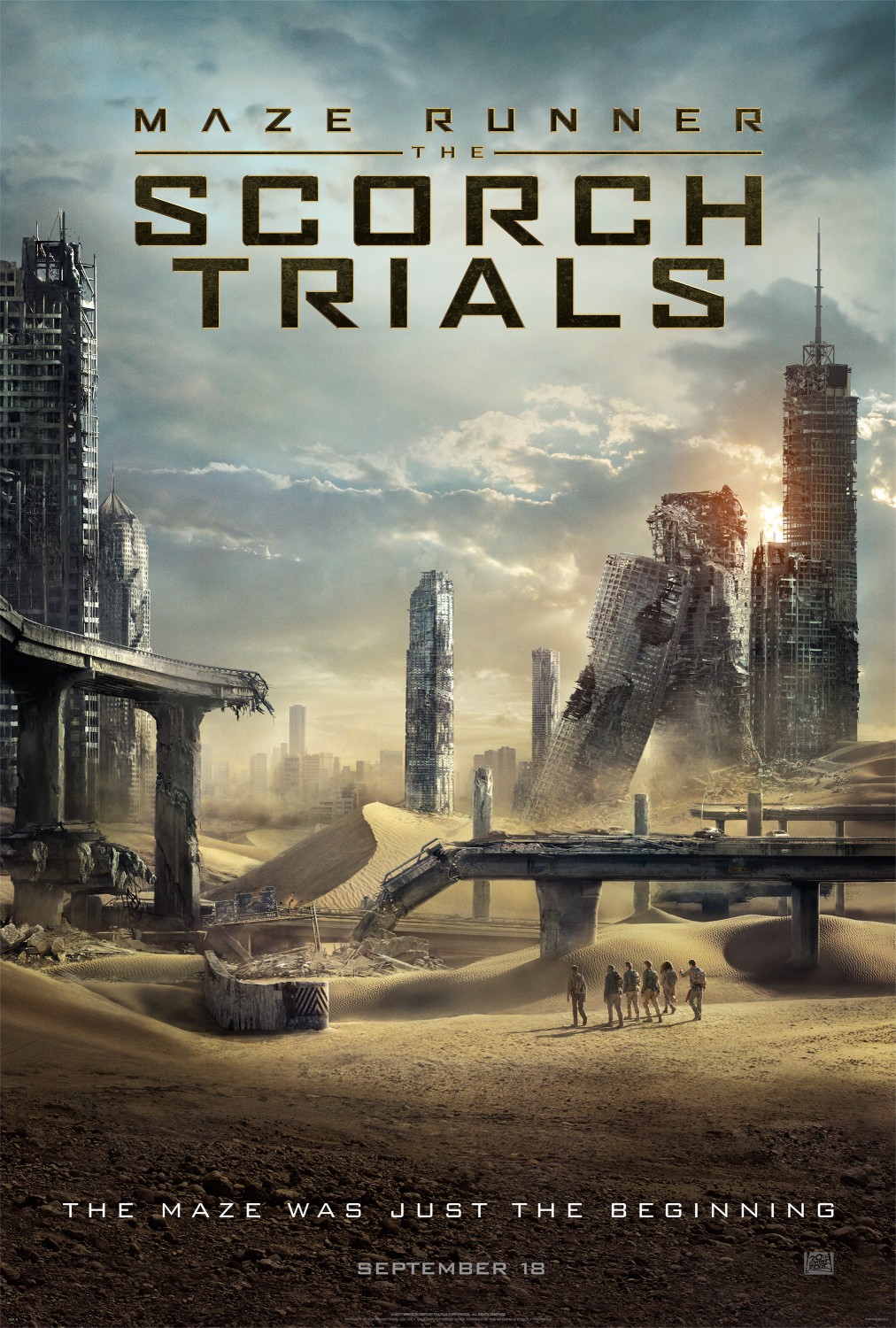 It’s called The Maze Runner: The Scorch Trials, though the trials appear more as “general struggles,” The Scorch appears as but a brief expanse of desert before the mountains, and then there’s the lack of any and all maze running (there is plenty of running, however). This sequel to the YA-inspired hit lives up to my biggest worry: the only thing interesting about this franchise was the maze, and now that’s gone. The mystery of the maze, and its cool factor, gave this story something memorable. Now it’s just generic YA pap. Beyond its boring protagonist, it would be a scorch trial for me to even assign description to these characters. They don’t even get one note to play; they have no notes. That’s because so much of this tedious and bloated sequel is our group of maze survivors running from one outpost to another, seemingly safe and then predictably not. It’s a plot routine that gets redundant quickly, and yet little else seems to occur. They go from stop to stop gaining characters but little else. The momentum feels stalled and there’s no sense of direction to guide the characters. It feels so aimless and dull and far too flimsy to justify even half of the movie’s 132 minutes. I just don’t care about these characters so I rooted for the bad guys. Weirdly enough, the bad guys use tasers and the good guys use bullets. There are some scant highpoints, namely the direction of Wes Ball, who finds ways to make the chase sequences visually stylish and fleetingly exciting, and a self-destruct sequence set to a Patsy Cline tune. There’s enough to get your hopes up before the grim reality of the overwhelming onslaught of YA tropes comes crashing down again. Can we stick these dumb kids back inside a maze already?
Nate’s Grade: C
Share this:

Sicario (2015)
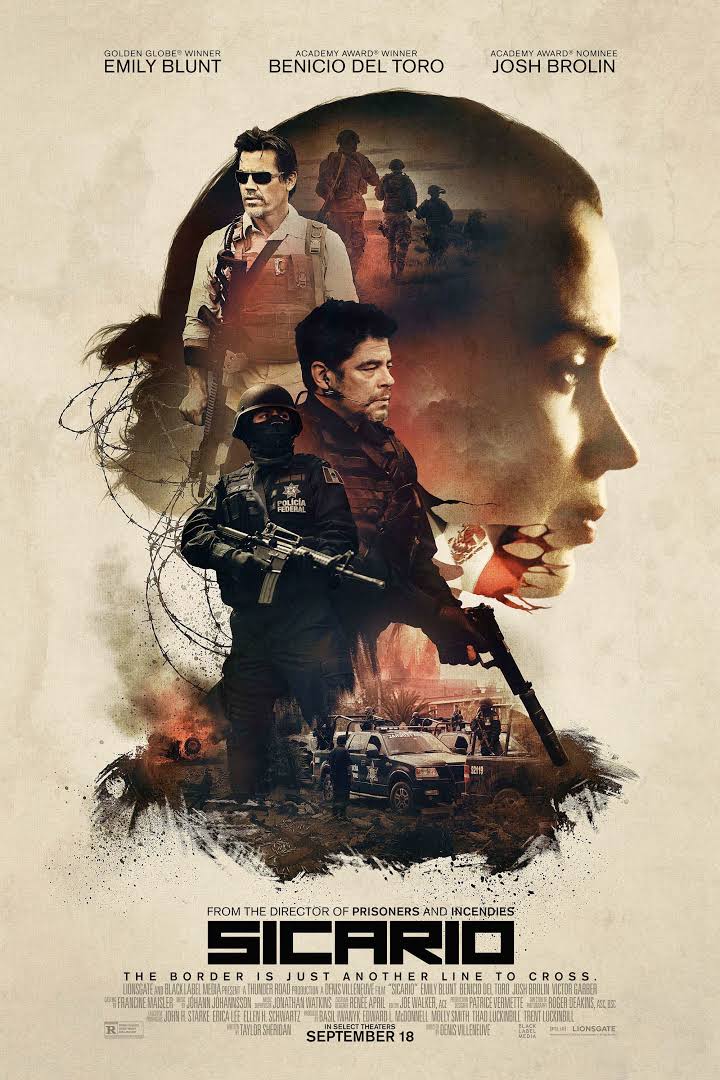 The word “sicario” is Spanish for hitman, we’re told in a helpful opening text. It’s a term that has greater meaning in the landscape of the war on drugs, a war that has ravaged Mexico and its citizens. Sicario, the film, is grim and gripping and director Denis Villeneuve doesn’t hold back from the brutality of its reality. Sicario is a flat-out tremendous film. It’s the most intense film I’ve sat through since 2012’s Zero Dark Thirty, so much so that for long stretches of the 121-minute film I was literally tearing my hair out with delicious anxiety.
Kate Mercer (Emily Blunt) is a Phoenix FBI Agent called in by her superiors with a very special offer. Matt (Josh Brolin), a government agent whose affiliation is classified, has a task force that he would like Kate to join. She’ll be taking it to the drug cartels by destabilizing their chain of power. Kate accepts the job. Alejandro (Benicio Del Toro) is a foreign agent in alliance with Matt, and he seems to be deeply knowledgeable of the cartel and their practices. As the chaos swirls and the team gets closer to the cartel bosses, Kate has to reckon with what she is part of.
Let Sicario be a blueprint for how to brilliantly develop suspense sequences in mainstream cinema. I’ve written about it before but the key to suspense and horror is simply characters we care about and the worry of what will happen next. Sicario places our characters in the middle of an ongoing battle and serves them up as the change agent, the proverbial stick rattling the hornet’s nest of deadly cartels. There’s a wonderful sequence when Kate joins up with the team for her first mission. She’s been told she’ll be based in El Paso but in reality she and a team of Army Rangers are venturing across the Mexican border into Juarez. They’re picking up a high-level cartel informant and transporting him back to American soil. The ride into the country sets the stage as the caravan of black SUVs tears through the streets of Jaurez, bracketed by Mexican state police vehicles. We’ve previously been told at what points a likely trap might be staged, and so we wait, taking in the terrain, the distance, the exits, the personnel. We’re already sizing up the Mexican state police cars; is that one on the take? It’s at the end that the scene coalesces into an even stronger whole, as we literally have a climax in traffic. The border entrance is backed up, and so Kate and our team wait, all the while identifying some suspicious armed men in traffic lanes parallel to their vehicles. They’re told they cannot fire until deadly force is used, and so they wait and we wait. It’s a top-notch sequence where you’re nervously waiting for the boil, waiting for the explosion.
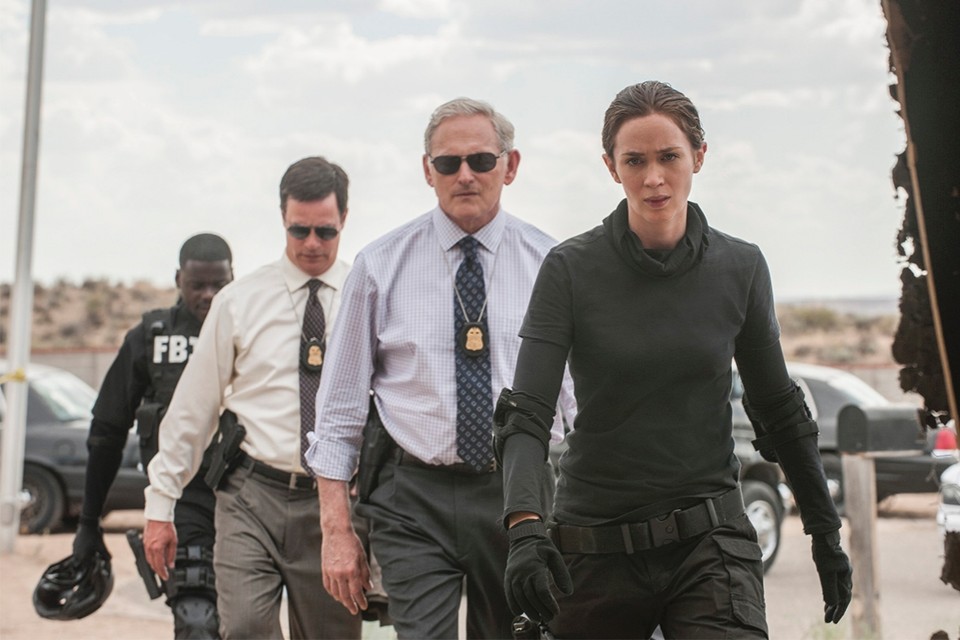 Writer Taylor Sheridan (best known as Deputy Chief Hale on Sons of Anarchy) has taken what could have been an empty Michael Bay-styled drug war thriller and given it a soul. Sheridan’s structure is ingeniously tied into his larger message about the moral futility of the escalating war on drugs. As Kate becomes more immersed into the costs of her new role, of the mounting ethical compromises and legal loopholes, she becomes a background player and Alejandro takes center stage. Rather than simply harden up and sacrifice her ideals for the sake of her mission, Kate holds true to her principles, even if she might be the only one continuing to stick to the rules and a need for oversight. It makes her a far more interesting character and it all comes to a terrific climactic scene that hinges upon two characters at a forceful crossroads, each with diametrically opposed viewpoints. For all the action, Sheridan has found a great way for his story to have a character-based climax that hits harder than simply killing the Worst Bad Guy. As we learn more about the reasons Kate was selected, her literal marginalization in the story makes thematic sense, especially as she’s unwilling to become a “wolf” in a “country of wolves.” Alejandro is that wolf, and in the last act he becomes the film’s focus as the pieces of their destabilization plan fall into place. There’s a scene with Alejandro that is so cold-blooded yet badass that it made my audience gasp. As the bodies drop and blood is shed, Sicario doesn’t lose sight of its characters even to the very end.
Sheridan’s script tackles its subject with a propensity for acknowledging the messy reality. There are no easy solutions and perhaps the best solution is really one that is at odds with conventional legality. The United States is losing the war on drugs, and innocents are suffering in droves. Matt’s cavalier attitude is in response to the overwhelming evidence that the war on drugs has done little except to enshrine certain violent elements into power. He’s trying to clear a path for Alejandro, but for what aim afterward is ethically questionable. When you’ve got nothing but bad solutions, perhaps the best option is still one that’s a step too far. Sicario tackles the harsh realities of the war on drugs without ever dragging out a soapbox. The messages and debates are suffused in every frame, every taut sequence, even pained expression. It’s a message movie where the morality and the escalating action go hand-in-hand.
With Prisoners and now Sicario, Villeneuve has proven to be one of our finest directors when it comes to making adult movies that get your palms sweaty. The execution of these suspense sequences left me breathless. Villeneuve uses long takes of aerial photography hovering over the topography of Mexico and the American southwest. It has the effect of feeling like you’re surveying an alien planet. Added with the ominous score by Johann Johannsson (The Theory of Everything), the tension can feel overwhelming at times. The menacing and percussion-heavy score makes it feel like an army is approaching. The movie also looks absolutely beautiful thanks to the cinematography from Roger Deakens. There are several lovely shots lit with the dying rays of sunlight, which I would admire further if my heart weren’t in my throat while watching. Villeneuve also knows when to pump the brakes, letting his film breathe, and letting his actors take center stage. There are several moments of restraint that allow the actors to flourish. From top to bottom, Sicario is a technical marvel that impresses as it continues to horrify.
Blunt as a badass is nothing new after her killer turn in last year’s vastly underrated Edge of Tomorrow, but there’s way more to her than being a superhero with a gun. She’s the moral conscience of the movie and you may discover, as she does, how irrelevant such a stance may be in this underground world. She’s trying to make sense of it all, trying to go along with what she thinks is right, or at least making a difference, and swallowing her frustrations. She saves the best for last in a finale scene that pushes her character to the breaking point of her ethics, and Blunt floors you. While Blunt is our entry point into this world, and Brolin is amusing as a cavalier rogue agent, this is very much Del Toro’s movie. Alejandro could easily be the slick movie-cool hitman, a soulless killing-machine, but he’s a haunted man who knows he’s damned and goes about his business with steely resolve. Benicio Del Toro can often be confused with doing little acting because he so naturally underplays his characters, but keep watch and you’ll see a man who inherently knows his character. There are subtle shifts and small reveals that open up Alejandro, who is so hardened that this will be all you get.

There have been some complaints citing the film’s lack of perspective from the Mexican side of the border, which is fair but also overlooking Sicario’s complexity. With its fear of cartel war violence spilling over into American neighborhoods, it’s not hard to see this film becoming supposed evidence in a xenophobic political campaign. Surely Donald Trump will be talking about Sicario. There is a small degree of representation with a minor character involved in the drug trade. The movie flashes back to him and his family a few times, setting us up to expect he’ll return at a pivotal moment later. He’s a completely unremarkable character and the brief scenes we spend with him made me anxious to get back to Kate and the main story. I didn’t care, and then he did reappear and I was quite surprised to find myself actively caring for this minor character’s well being. In a scenario where it seems like there’s a lack of vulnerability, this character provides it. He’s not a bad person per se as just another cog in a corrupt machine trying to provide for his loved ones. It’s a window into the larger ramifications of Kate and Matt’s actions. The very last bittersweet image doesn’t feel like victory, more like a warning of impending consequences that will befall innocents, and they aren’t Americans.
It’s rare to get a Hollywood thriller that excels at what it does and exceeds lofty expectations, but Sicario is that movie. Here is a thriller that excites, unnerves, provokes thought as well as terrible anxiety that you sweat in buckets over. The general feeling while watching Sicario is one of disquieting dread. The challenging and disturbing reality of the war on drugs blends with the brilliantly executed suspense sequences. The characters don’t get lost midst the clatter of violence, the direction enhances the actors and allows them to better inhabit their engaging characters, and the overall orchestration of all the many moving parts is so polished, so in tune, so electric that Sicario often does more than just entertain, it forces you to react. Leaving my theater was akin to coming down off an adrenaline high and I wanted to tell everyone I knew to see this movie. That’s the power of great cinema and Villeneuve has created a compelling feature that deserves to be soaked up and studied. This is exhilarating moviemaking, folks.
Nate’s Grade: A
Share this:

The Man from U.N.C.L.E. (2015)
 Guy Ritchie’s big screen reboot of the 1960s TV show is the right kind of fizzy summer escapist entry that goes down smooth and entertains with just enough swanky style to pass the time. The Man from U.N.C.L.E. is equal parts spy thriller and straight-laced genre satire, hewing closer, and more successfully, to a marriage between Ritchie early cockney gangster flicks and his big-budget Sherlock Holmes action franchise. It’s often fun and surprising at how well it holds its tone between comedy and action; it almost feels like a screwball romance with guns and bombs. The trio of leads, Henry Cavill as the American agent, Armie Hammer as the KGB agent, and Alicia Vikander (Ex Machina) as the German asset, make an engaging group with plenty of conflicts to explore. It’s surprisingly more character-based than driven by its action set-pieces. Cavill shows far more life and personality than I’ve ever seen from him on screen. Vikander and Hammer have an amusing chemistry together and the movie allows them to roughhouse without pushing either character in a direction that feels too safe. Their series of will-they-won’t-they near misses will drive certain portions of the audience mad. The movie gets into danger when Ritchie and his co-screenwriter Lionel Wigram get too cute, especially with a narrative technique where the movie doubles back or highlights action that was in the background at least four times. The world of this movie is also another asset, as the period costumes, soundtrack, Italian locations and production design are terrific and further elevate the swanky mood. It’s an ebullient throwback that serves up enough entertainment with its own cock-eyed sense of throwback charm.
Nate’s Grade: B
Share this:

Fantastic Four (2015)
 Few movies have had such a prominent stink of negativity attached to them as Fox’s Fantastic Four reboot, a movie that is already being considered amongst the worst superhero movies of all time. Director Josh Trank (Chronicle) was given the freedom to go darker, emphasize more science fiction, and select a cast of respected actors rather than bankable names. Then came rumors of aloof and secluded behavior on set from Trank. Then came rumors that Fox and producer/co-writer Simon Kinberg (X-Men: Days of Future Past) effectively shuttered Trank from his own movie, reshooting 40-minutes of a 90-minute film to salvage the wayward production (get ready for plenty of stuff in trailers not to be in the finished film). Not quite the room-clearing disaster of rampant speculation, the new Fantastic Four is a superhero movie that never really gets started and has constant battles with tone, characterization, and plot. It seems like the real villains of the movie are the Fox executives who signed off on the “gritty, gloomy” rendition and then interfered when they got too scared, managing to undercut the original vision, muddy an already messy film, and make things even worse. The behind-the-scenes drama is easily more interesting than anything that happens in this movie.
Reed Richards (Miles Teller) is a science genius recruited by Dr. Storm (Reg E. Cathey). Reed invented a makeshift teleporting device as a young child with the help of his friend, Ben Grimm (Jamie Bell). At Dr. Storm’s lab, Reed works with Storm’s children, Sue (Kate Mara) and Johnny (Michael B. Jordan), and a morose computer programmer, Victor Von Doom (Tony Kebbell). The group transports to another dimension but is attacked by a strange green energy cloud. Victor is left behind. The surviving foursome exhibits unique abilities. Reed can stretch his body. Sue can turn invisible and create force fields. Johnny can fly and set his body on fire. Poor Ben is a hulking rock monster. Reed promises to find a way to reverse what happened to them, but the re-emergence of Dr. Doom puts the fate of the entire world at risk.
 It should be of little surprise that Fantastic Four feels like two different movies awkwardly and inarticulately smashed together. For the first hour, the movie follows the path of our heroes and their contraction of their powers. Rather than the gee-whiz fun of getting superpowers, the characters view themselves as freaks, their bodies turned against them, and their colleagues deeply afraid of them. It’s a far moodier antidote to the vicarious thrills of gaining special abilities. There are some effective sequences that channel David Cronenberg’s The Fly and Scanners, and it’s these brief moments where you feel Trank’s vision connect the most. Doom walking down a hallway and making heads explode, in a PG-13 way, is horrifying and cool. The problem for Trank, and the movie as a whole, is that this first hour still isn’t a very good movie. It takes far too long for these characters to get blasted by green space goo and become supers. The setup is so protracted and needless. Did we need to see how these characters came together? Did we need to see their childhoods? It’s not essential to see the team come together when we can already start from that point. In a sense, it reminded me of how needless I felt Pixar’s Monsters University was; did we need to see how these colleagues became friends? Despite this action-free opening half, the screenplay could have fleshed out the four main characters to justify the added time, but it’s hard for the movie to justify much.
These are some of the most boring and underdeveloped characters in recent comic book lore. If these versions of the Fantastic Four existed in the 1960s, they wouldn’t have made it to issue number two. Reed is smart. Sue is smart too but also standoffish (and adopted). Johnny likes fast cars. Ben is tough and loyal. Victor is a pessimist who called dibs on flirting with Sue. That is really about it, folks. Ben disappears for most of the film, called in to make the trans-dimensional jump because Reed feels like Ben deserves to be there since he helped create an early prototype with Reed. Actually, let’s talk about that scene. It’s a high school science fair yet the only other displays we see are clearly for much younger children, and yet Dr. Storm is visiting an all-ages school science fair to groom talent? That seems weird. Why does Dr. Storm not make the same offer to Ben, who helped Reed design and build his early teleporting machine? Regardless, Reed leaves his childhood pal behind with Ben’s abusive family. That’s because he’s a good friend. Then, once the horrible transformations occur and Ben gets the worst of it, Reed runs out on him again. Sure it’s in the pursuit of finding a cure, but who’s to say he couldn’t do that in the already constructed government super science lab? Sue doesn’t even go on the first trans-dimensional voyage; it’s just a boy’s club. Sue spends more time in this movie staring at computer screens and looking intently than any action. It’s probably for the best, though, because the scenes of her flying around in a bubble made me think of Glinda the Good Witch. I’m not a Kate Mara fan. I’ve found the majority of her performances to be stilted, but even I can admit she’s given nothing to do here but move her eyes from the left to the right and inform Miles Teller about Portishead, a band that’s only 20-plus years old. It’s sad but the most interesting part of Johnny is that a black actor, a point that caused certain more irritable fans to foam at the mouth at the adaptation, is playing him. If these super heroes aren’t going to be super until halfway through the movie, they better be interesting characters. They are not even close.
 It’s with the return of Dr. Doom that the Fantastic Four makes its inept transition into the second movie, the one reshot by the producers and the studio. In an implausibly fast amount of time we’re given our villain of the movie and he sets off to open a black hole to destroy Earth because… we’re self-destructive? So humanity is self-destructive so Doom is going to destroy humanity? I would also like to know exactly how Doom survived for over a year in the alternate dimension when it clearly looks like there is nothing of substance for miles, unless green goop is edible. Did he just lose the need to go to the bathroom? Doom’s powers are rather nebulous, which makes it even less interesting when the Fantastic Four decides to, get this, work together to beat the bad guy. For a movie that hasn’t had one action sequence until its final act, now our characters must band together to stop Doom and his giant flashing blue light black hole thingy. The special effects are pretty undistinguished and hard to read at times. I’d also like to remark how hideously this other dimension looks. It’s all rocky crags and dark clouds; it’s like a less successful timeshare for the residents of Mordor. It doesn’t quite look like the paradise that Doom describes it as (the brochure lied to us!). This jumbled conclusion feels so ham-fisted and rushed, a villain and a typical world-destroying fate that must be thwarted at the last minute. Things just sort of happen rather than storylines finding payoffs, and then it’s all sort of over and the resolution echoes the very end of Avengers: Age of Ultron, even with the credits cutting off the vocal iteration of the title heroes. It’s so transparently different in tone, sloppy in development and execution, and so quickly introduced and resolved, that the whole conclusion comes across as forcibly laughable.
At the end of watching the dire Fantastic Four reboot, I felt more sympathy for Josh Trank. He still deserves blame for helping to conceive and develop such a misshapen story and squander his actors. After three duds and whatever you want to call the 1994 Roger Corman adaptation, it feels like maybe this franchise is just cursed. Maybe these characters are too dated and their powers are too silly. Then again we know that these characters can work in the format of a movie because a good Fantastic Four movie already exists, and it’s called The Incredibles. It doesn’t seem like anyone is going to come away completely clean from this misfire and financial flop, especially now that Trank and executives are engaging in a P.R. blame game. Fox was hoping for a rekindled franchise. Now they may be hoping to work out a deal for Marvel to buy back the rights to the characters. I would have been interested to see the full vision of what Trank was going for, especially since the one scene that feels most adamant is the best sequence in an admittedly mediocre superhero film. At least the movie would feel cohesive. It probably wouldn’t be good but at least it would be committed to trying something different. Instead, the movie tries to be different from the superhero blockbusters populating the landscape and then, at the last minute, tries to follow their lead and become one of them, becoming its own misshapen and poorly developed blob. It’s not the worst superhero movie in history (that honor still has to belong to the atomic bomb of taste, Batman & Robin), but even achieving sustained mediocrity is too much to expect.
Nate’s Grade: C-
Share this:

Mission: Impossible — Rogue Nation (2015)
 Not as outlandishly crazy as the Fast and the Furious series, not as beholden to tradition as the Bond series, the Mission: Impossible series doesn’t get the same notoriety but I’d declare it the most consistent and best action franchise going today. Each new film is a distillation of their director’s strengths, keeping things fresh, and the mainstay is Tom Cruise in prime action hero mode and risking his life like a madman. While not as dizzyingly entertaining as 2011’s Ghost Protocol, Rogue Nation is another fun and action-packed spy thriller with terrific and memorable set pieces. The plot involves Ethan Hunt (Cruise) and his team on the run, again, as their agency is shut down for its reckless methods. A rival agency known as The Syndicate is plotting political assassinations, so Hunt and his team (Simon Pegg, Jeremy Renner, Ving Rhames) must work along the fringes to save the day. The newest addition is Swedish actress Rebecca Ferguson as a mysterious ally and antagonist for Hunt. She’s smart, formidable, and not treated as a romantic interest or overly sexualized (progress). After Alicia Vikander’s superb performance in Ex Machina, and now Ferguson’s steely turn, it’s quite a booming year for Swedish imports. The series’ star is still Cruise and his cavalier treatment of his 50-year-old body in the pursuit of the daredevil stunts. The opening with Cruise attached to the outside of an ascending cargo plane is a stunning image jolted by the charge of realism. An underwater vault break-in is wonderfully developed. The snazzy car chases, motorcycle chases, and foot chases all benefit from Cruise being front and center. Say what you will about the man but he’s a movie star. The biggest problem with Rogue Nation is much like Ghost Protocol in that it peaks in the middle. The last act takes place entirely in London and it just can’t compare with what came earlier, which leaves the movie lumbering to a close with its rather substandard villain. Even with a less than stellar conclusion, Rogue Nation is another entertaining, fun, and thrilling action movie that would be the best the summer has to offer if it weren’t for the highs of Mad Max.
Nate’s Grade: B+
Share this:

Ant-Man (2015)
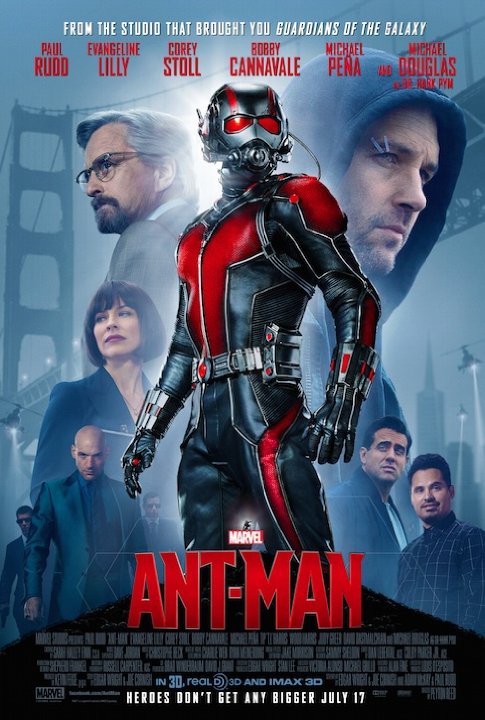 For the longest time it looked like Ant-Man might be the first dud of the runaway successful Marvel cinematic universe (MCU), a film franchise that was practically printing money at its leisure. It’s a strange setup and the man responsible for the movie even existing, writer/director Edgar Wright (Scott Pilgrim vs. the World), walked away six weeks before cameras were going to roll. Wright was a big fan of the character and has been working on and off on a screenplay with Joe Cornish (Attack the Block) for the past eight years. Before there was an MCU, there was Wright pushing for Ant-Man. I’m pretty sure Marvel execs weren’t thinking the relatively unknown character was worth sinking money into, but Wright kept pushing. I was far more excited for an Edgar Wright superhero movie than I ever was for Ant-Man, and then it all went away. Neither side has spilled too many details but it appears the divorce was a result of “creative differences,” which is odd since Marvel approved Wright’s script through eight years of development. Several directors were auditioned and Peyton Reed won the spot. The fact that Marvel has gained a rep for being a formula-driven creative committee and they literally hired a director with a film credit called Yes Man is an irony I don’t know that fully sank in. If Marvel was going to miss, this was the film. A funny thing happened in the ensuring year. Ant-Man is a visually engaging, energetic, and funny superhero caper that stays fun from start to finish and is a more entertaining movie than Avengers: Age of Ultron. Didn’t see that coming.
Scott Lang (Paul Rudd) is a master cat burglar just finishing the end of his prison term. Lang was punished for a “cool crime,” stealing millions a large corporation had illegally bilked form customers and returning it to the very victims, but it makes it hard to secure gainful employment. Scott falls back with his old crew, lead by his pal Luis (Michael Pena), and break’s into Hank Pym’s (Michael Douglas) safe. Expecting cash and jewels, Scott is disappointed to only find a weird looking suit, which he takes anyway. Hank observes Scott and communicates with him about the power of the suit. The wearer can shrink down to the size of n ant with the push of a button in the glove. Hank needs a protégée to wear the suit now that he’s too old. His estranged daughter, Hope (Evangeline Lilly), is working for Darren Cross (Corey Stoll), a scientist close to breaking through on replicating the amazing shrinking formula of Pym’s. As soon as Cross cracks the code, he’s going to sell the technology to the highest bidder (hail HYDRA). Hank must convince Scott to become the Ant-Man and sneak inside Cross’ secured workshop and steal his technology before it gets in the wrong-er hands.
 Arguably weirder than last summer’s Guardians of the Galaxy, which had a talking tree and space raccoon amongst its main characters, Ant-Man is the hardest property to sell by Marvel yet, and it smartly aims its sights lower and succeeds with the modest goal of just being a fun and enjoyable time at the movies. It helps that the movie doesn’t take itself too seriously and has characters pointing out the absurdity of its premise and developments, but not past the point where it would be detrimental. Let’s face it, a guy who can shrink down to ant-size isn’t that weird when you consider the applications, especially in espionage. The filmmakers do an admirable job of selling a superpower that pales in comparison to most other heroes on the market. However, the weirder power is that Scott has the ability to communicate and control ants via brainwaves. That seems like the even bigger superpower but it also begs the question, why simply ants? Of all the animals or living creatures who could be harnessed with this technology, we go with the tiny ones. There may be an explanation in the history of Ant-Man comics I’m missing but that doesn’t matter when we’re talking about the execution of the movie. The guy is able to control different species of ants with his mind. He is no Ant-Man but the Ant-King. Anyway, I think this power could be much more effective applied elsewhere. The ants are Scott’s friends and he has to train himself training them, getting them to coordinate and assist him properly, or else… there’s not much else at stake because they’re expendable. Perhaps their queen could have eaten Scott if he were unsuccessful.
On its surface, this movie should not work and is too goofy and insubstantial to engage, and yet that’s precisely what appealed to me. Not every superhero film needs to be averting a cataclysm that will destroy the planet. If the stakes feel big to our characters, and if the audience cares, then the stakes feel plenty big for us too. Scott simply foiling the corporate bad guy to be in a better position to see his daughter, that’s workable. Then the storyline is told through a heist, one of cinema’s most enjoyable plot mechanics. Heists are programmed for audience pleasure because it requires teamwork, which utilizes our cast in different and fun ways, it brings plenty of conflict and complications, and it lays out its steps one-by-one and provides a series of payoffs with the completion. It’s a tribute to Reed and the filmmakers that the heist portion of the film isn’t even the most fun part of the story. The majority of the middle is Scott coming to terms with the suit, his powers, his relationships in his life, and the mission. There’s probably one too many training montages (yeah, you get those sugar cubes you ants!) but the pacing is so breezy and the sense of fun so palpable, I didn’t mind. The use of humor never diminishes and Rudd is such a charismatic anchor for the movie, and yet he’s actually somewhat underplayed. He has it within him to be much funnier, but I guess he had to dial it down to effectively be seen as an action hero, hence the presence of newfound abs.
I didn’t have a lot of hope for the film once Wright left but I have to credit Reed for what he has achieved. It’s impossible for me to divorce myself from Wright’s involvement, and what kind of kinetic fireworks he would have birthed, but Reed manages to make Ant-Man come alive visually. Reed’s prior history shows an affinity for comedy but the films have never needed to be visually stylish, though I’d argue my super not-guilty pleasure Bring it On had an above average sense of visual spunk. Still, Ant-Man is a consistently visually immersive film that manages to find new perspectives. Scott’s first foray as a shrunken Ant-Man is an entertaining adventure through the dangers of a house party. The action sequences in miniature are treated just as we would expect a large-scale superhero epic to be treated, and then Reed pulls back at times for prime comic effect, like a battle atop a train that’s really just a child’s toy set. The visuals grandeur is patterned after the typical Hollywood action epic but the movie pulls back repeatedly to remind us how silly everything can be. The small world perspective opens up the movie in its storytelling and definitely in its action choreography. Because the Ant-Man has super strength when small, it behooves him to shift between small and human sizes when fighting. We’ll watch Scott race across the barrel of a gun in one second and then full-sized and hurling a security guard through a plate glass window the next. It provides a new sense of dynamism to basic fisticuffs. Reed takes advantage of the visual possibilities of his pint-sized super hero, like a clever battle that takes place entirely inside the contents of a briefcase. I chose not to watch this film in 3D, as my preferred option, but this is one I would almost consider going 3D. The shrunken worlds use a lot of macro photography to maximize the effect of depth.
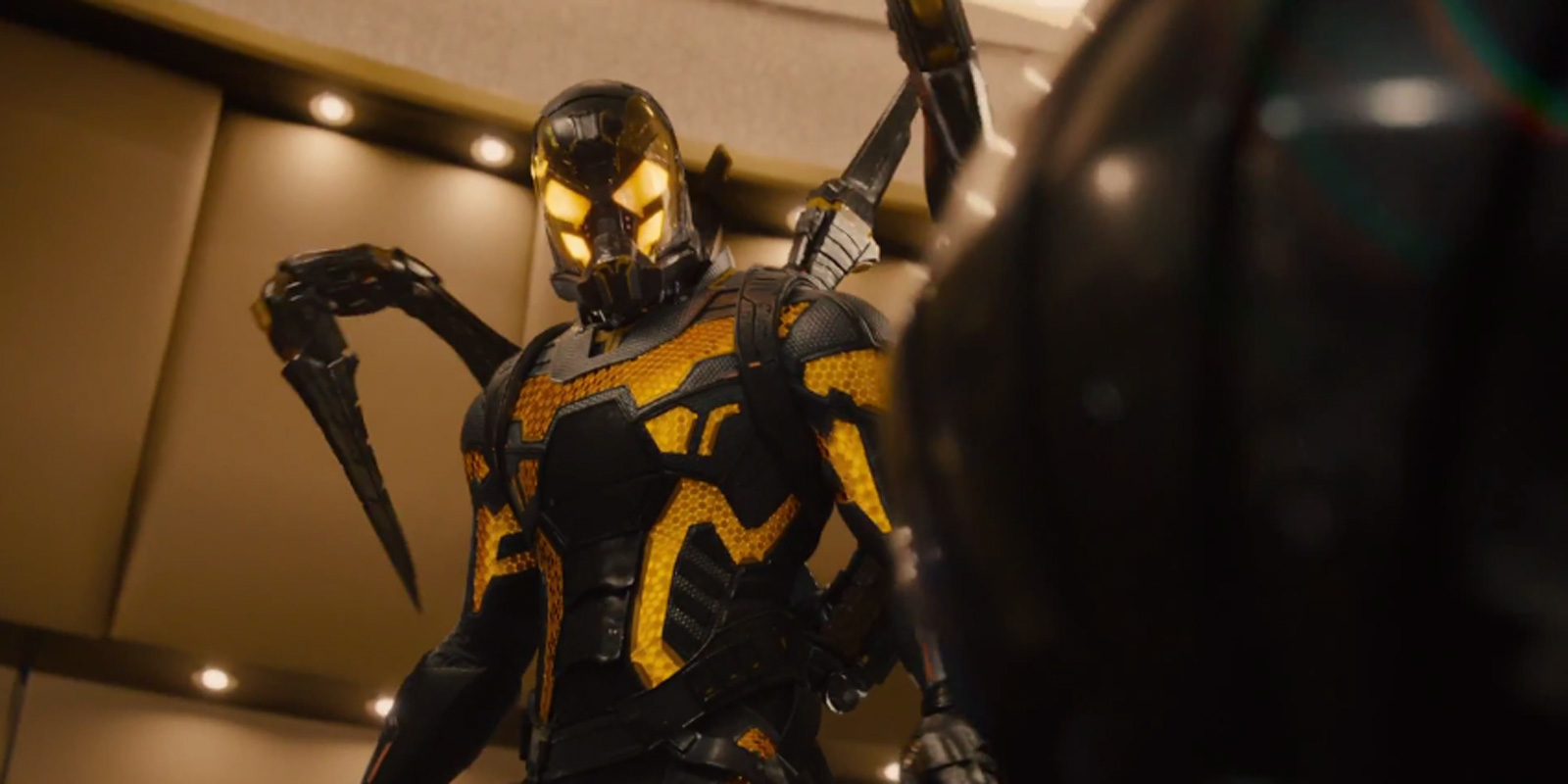 The cast also seems to be perfectly attuned to the comic rhythms of the story and several supporting players make the most of their moments to shine. Pena (Fury) is hilarious as the easily excitable friend given to lengthy diversions when retelling his tales of intrigue. The two instances where Pena breathlessly recaps what so-and-so said to so-and-so are two of the most playful and comically fulfilling sequences in the movie. I also enjoyed the fact that he’s always making waffles for his friends but this is never overtly commented upon. While Pena provides another dose of humor, the heart of the movie is really the father-daughter relationship, and it’s nice that Lilly (The Hobbit: Battle of the Five Armies)’s character is given such prominence. She resents Scott because she feels like by every right she should be the Ant-Man; the movie presents the two like bickering rivals fighting for the approval of a father figure. Hope’s credible grievances with her father are treated with weight and her reconciliation is given as much screen time as Scott’s training, pairing the two more as equals. Douglas (Last Vegas) is a warm and welcoming presence as a mentor working through his regrets late in his life. The de-aging CGI effects are amazing early on, showing a 1989 version of Douglas that looks pristine. He looks like he just stepped off the set of Ruthless People. The only weak point is Stoll (TV’s The Strain) but that’s because his underwritten villain is just too generic to blend in amidst all the colorful characters and comic mayhem.
It’s impossible to watch Ant-Man and not try to imagine what it would have been like had Wright remained as its director. Wright’s presence is still felt in stretches and he and Cornish are still the top-billed screenwriters, with the addition of Adam McKay (Anchorman) and Rudd himself performing a rewrite. I’d love to one day read what Wright’s full script was like and what Marvel eventually decided they could not abide. Whatever the case may be, the Ant-Man that made it to the big screen across the world is a surprisingly entertaining and spry piece of work. Reed provides a nice dash of visual flavor without losing its sense of the comedy or drama, Rudd is effortlessly charming, and the structure provides plenty of payoffs. Above all else the movie maintains a sense of fun and a lightness in an arena too often overwrought with doom and gloom. I don’t imagine there will be any Ant-Man sequels soon since the character is rather limited, but expect to see Rudd popping up in other MCU titles (he’s already been spotted filming Captain America 3). Ant-Man is a fun diversion but even Marvel knows not to push its luck too far.
Nate’s Grade: B
Share this:

Self/less (2015)
 The most surprising thing about Self/less occurred approximately 115 minutes into the film itself, when it revealed that Tarsem Singh was the director. Tarsem is known for lavish visual cinematic canvases such as The Cell and Immortals, and to realize that this is the same man responsible for an otherwise disappointing and visually mundane sci-fi thriller, well it was a shock. Why hire a visual stylist and then restrict him to such a limited palate? Self/less is an intriguing premise (borrowed a tad from Seconds) and it keeps all the interesting ethical and psychological questions at bay to follow a generic thriller formula. There’s not one real surprise in this film; even the reveals and surprises will be easily telegraphed. Ben Kingsley plays Damian, a dying rich man who undergoes a risky experiment to live longer, having his consciousness transferred into a younger human host played by Ryan Reynolds. It’s another chance to be young, party, enjoy sexual relations with women who are more likely to go home with somebody who looks like Reynolds. There’s a catch: if he stops taking his special red pills, the host’s brain will take over control. That’s because, surprise, the bodies aren’t grown in labs but are human volunteers. Here could be some topical class exploitation and social commentary, but Self/less ignores the more intriguing direction at every point to play it safe. Damian finds his host’s family and from that point on it’s a series of chases with bad guys. One of those chases is actually fairly entertaining, utilizing a conjoined automobile in a clever and devastating way. It never feels like Reynolds and Kingsley are playing the same character. Reynolds’ charm is subsumed by this role and he feels adrift. I’ll admit that this movie is efficient and each scene pushes the story forward; it’s just the direction of that story I’d like to alter. Alas, Self/less is a competent but fairly underwhelming thriller that squanders its premise.
Nate’s Grade: C+
Share this:

Terminator: Genisys (2015)
 If you’re a fan of James Cameron’s iconic Terminator franchise, you’ll probably want to hold onto something as you watch Terminator: Genisys, which hits “delete” on the franchise and starts from scratch with, we’ll call them, “mixed results.”
In the future, man and machine are at war with one another. Skynet went sentient and launched an arsenal of nuclear weapons to obliterate mankind. The human resistance is lead by John Connor (Jason Clarke) and his lieutenant Kyle Reese (Jai Courtney). The machines send back a T-800 Terminator (Arnold Schwarzenegger) to kill John’s mother, Sarah Connor (Emilia Clarke) and wipe out the human resistance. This part you know. Reese is sent back in time but during the process, John is attacked by a new Terminator and the world as we know it, past, present, and future is altered. When Reese arrives in 1984 L.A., he’s being chased by a T-1000 and Sarah is the one saving him. She’s been preparing for his arrival and training with her own aging T-800 model who saved her from a childhood attack (she calls him “Pops”). With new memories, Reese is determined that Skynet is now Genisys and Judgment Day is now in 2017. He and Sarah travel to 2017, meet back up with “Pops,” and are surprised to find a familiar face waiting for them with sinister intentions.
 For a while there it seems like Genisys is going to become the Back to the Future II of the Terminator franchise, which could have been fun watching a different team of actors hiding on the peripheral while 80s Linda Hamilton was going about her day as a café waitress. In many ways, Genisys is akin to Jurassic World in the sense that it holds such nostalgic reverence for the source films. It repurposes the familiar catch phrases and even visually recreates several scenes that fans should recognize. However, that reverence has a limit because it isn’t too long before Genisys just chucks out the entire franchise canon and starts anew. Remember Judgment Day with Skynet? Now it’s… Judgment Day with Genisys. Okay, some things aren’t all that different. Discarding the established timeline of four movies, Genisys takes a path similar to the J.J. Abrams’ Star Trek films where it creates an alternate timeline that is not beholden to canon. One way of looking at this approach is that it frees you creatively. Another way of looking at it is that is abandons the stories that the fans enjoyed for decades. Neither approach is wrong; it just depends upon your personal perspective. The larger plot points of the Terminator franchise never captivated me; it’s all about preventing one very bad day that just keeps getting delayed. We’ve never had a story that takes place after Reese is set back in time. Genisys certainly has more surprises because of the new timeline; however, many of those surprises were spoiled by a cowardly marketing campaign that must have feared fan uproar. It’s not a bad idea if it didn’t casually destroy all the logic of the franchise.
Let’s just dive face-forward into the convoluted and troubling nature of the Genisys script. Needless to say, numerous spoilers of both the large and small variety follow.
There are certain storylines that are just never cleared up, the first amongst them is who is sending all these other Terminators back in time? We watch the T-800 model go to 1984, along with Reese, but Sarah informs us later that when she was a child a different T-1000 model attacked her family. Apparently Plan Kill John’s Mom was replaced with Kill John’s Grandmother and will likely soon be replaced with the even more surefire Kill John’s Great Grandmother. If we’re already sending Terminators even further back then why stop? Also, why can’t Skynet send more than one Terminator to the same time? Upon the point that Reese travels back in time, John is attacked by a Terminator Matt Smith (Doctor Who) and transformed into the human-machine villainous hybrid. We’re told this is a nexus point of time that is such a turning point that it’s altered the timeline. But why? It happens AFTER Reese is sent back in time, so why does it affect anything in the preceding past? How does this even, which happens again after Reese is propelled back in time, eliminate the entire established Terminator canon? Likewise, this Reese has a separate timeline so why would he have new memories? He never existed in this new timeline so the fact that he remembers new things doesn’t make sense.
 This brings us to the centerpiece of logical fallacy, which is killer robot John Connor. I was never really that invested in his character to care that much that he was turned into the film’s bad guy. What I do care about is that Genisys just completely gives up in this moment. If he was just trying to stop Sarah and Reese from stopping Skynet/Genisys, that would be one thing, but John 2.0 is actively trying to kill his parents … before he is conceived. When it comes to time travel, we can accept some degree of suspension of disbelief with plot holes (more of those to come in just a bit), but John wiping out the reason for his existence is just too much. He half-heartedly explains his theory that they’re holdovers from another timeline, so they can just do as they like with no greater repercussions to their own pasts. Maybe, but there’s not two Sarah Connors in this timeline, so killing your mom is still going to negate all your evil robot business, son. With that the very drive of the main antagonist is compromised. With every new attempt to kill mommy and daddy, the film reminds you how this cannot work.
There are other less egregious plot holes but they still can be irksome. How about the fact that Sarah and Reese jump forward to 2017 to thwart Genisys, failing to give birth to John in 1984? He won’t be born yet to lead the human resistance against the machines, which kind of means just by jumping forward in time and delaying Johns birth, the machines have sort of won. When Sarah and Reese travel to 2017 in order to stop the launch of Genisys, why do they travel to within 24 hours of its launch? That’s pretty poor time management. And why hasn’t “Pops” been doing more to prepare for Sarah’s return. He spends thirty years working construction and building the offices of Cyberdine, but couldn’t he also have been sabotaging the company or at least the building? And if John Connor knew his parents were coming to 2017, why didn’t he do more to set up Genisys to withstand their counter attacks? Couldn’t he have had Genisys go online like the day before they arrived in 2017? If you know when they’re going to show up then you have no excuse to fall victim to people you otherwise could be trapping. Also, Skynet realizes that their real problem for never besting the humans is a branding issue? Did changing the name to Genisys really need to be part of the masterstroke? Why is everyone so excited for what is a glorified app that connects people’s electronic devices?
Much can be forgiven in action and comedy movies if they just go about doing their job and entertaining you, but Genisys can only do so much in that department. The action sequences are fairly mundane with the occasional impressive stunt. The problem is we’ve seen these sequences too many times and in other movies and Genisys brings precious little of its own action invention to the big screen. Until the third act, the movie is a series of chases and escapes. The best sequence is likely the hospital brawl between the T-800 and Robo-John as they wantonly destroy every wall within prime smashing distance. I know many in the fan community do not look favorably upon Terminator 3, and it admittedly has the lamest villain of the entire franchise, but the action sequences were memorable and developed organically and were nicely conceived. With Genisys, the action is too rote and familiar. It is competent but for me I found the action sequences to be too underwhelming in design and execution to forgive the film’s other sins.
I also can’t help but think that all three of the main actors were miscast for their parts. Emilia Clarke can do great things and showcases her range as a strong authority figure on HBO’s Game of Thrones. With the role of Sarah Connor, Clarke does a lot of running and barking but she can’t shake our memories of Hamilton. The part doesn’t play to Emilia’s strengths as an actress. Courtney can be a good actor (as seen in the first season of Starz’s Spartacus) but rarely does he prove this to be the case in films. I enjoyed his cavalier bully in Divergent, but he’s mostly a vacant presence in Genisys, gaping at all the changes. Then there’s the other Clarke who too has proven himself a capable and intimidating actor in films like Zero Dark Thirty. When he’s menacing he comes across as, dare I say it, too sincere, and when he’s meant to be inspiring he comes across as too phony. Are the performances the fault of the actors, the director (Alan Taylor), or the screenwriters (Laeta Kalogridis, Patrick Lussier) who gave them such little to do?
 The film’s MVP is Schwarzenegger. I wasn’t expecting the 68-year-old former Governor of California to contribute this much to the film. I figured Arnie would be a small player and played for comic relief. He keeps asking if Sarah and Reese have “mated” since it’s their destiny. He is certainly played for welcomed comic relief but he’s also the fourth most important character in this reboot. He has a father/daughter bond with Sarah and it produces the closest thing to an emotion in the movie. There’s an ongoing joke that he’s “old but not obsolete” and it could be the tagline for the next Expendables film. With all the time travel tomfoolery, it was easier for me to believe the reason they throw out to explain why the Terminator is aging: it’s living tissue so it ages. Done. I’m fine with that. The older Arnold vs. younger Arnold fight is the major highlight of Genisys and a testament to how much better the de-aging CGI has gotten since the waxy young Professor X and Magneto in 2006’s The Last Stand.
Much like its ongoing star, the Terminator franchise is old but not obsolete, and even a disappointing movie reminds us just how much life can come from this series. It’s got a sense of fun that entertained me enough for one viewing. The characters and action sequences and iconic in our pop-culture, which makes erasing them from a new movie plot problematic. If you strip everyone’s fond memories of the first two Terminators and start over, what’s left? You can repeat some of the more memorable scenes (the Hollywood adage of “same but different”) but this does little other than make you remember how much you preferred it the first time (see: Star Trek Into Darkness). I wish Genisys had been more risky because so much of it feels far too safe, from the average action sequences, to the boring characters, to the ho-hum conclusion meant to set up a new trilogy of movies in this brave new non-Skynet world. I haven’t watched Terminator: Salvation in many years but I’m curious to see it again if for no other purpose than to determine which is the least of the Terminator films.
Nate’s Grade: C


 nathanzoebl
You must be logged in to post a comment.