Blog Archives
Kubo and the Two Strings (2016)
 At this point the Laiki studio (ParaNorman, The Box Trolls) has earned as much good will and credibility as Pixar in their pre-Cars 2 prime. I almost was going to write off their latest, Kubo and the Two Strings. For the first forty minutes or so I was somewhat indifferent to it. Sure the stop-motion animation was stunningly realized and the creation of the environments was very meticulous, but I just couldn’t connect with the movie’s story of a young boy, Kubo, and his quest to claim magic items to thwart the advances of his dangerous and estranged mystical family. Then the first big set piece happened and then the next, and then the plot made some deft reveals and provided a strong emotional foundation, and I was hooked. This is Laika’s first real action film and the wide shots and long takes do plenty to serve the action and allow you to further marvel at the painstaking brilliance of these hard-working animators. It’s a full-fledged fantasy epic that tickles the imagination and provides a poignant undercurrent of emotion especially during the final act. As Kubo declares his real strength are his memories of loved ones past, I was starting to get teary. It’s a lovely message to top off an exciting and involving action movie with creepy villains and side characters that do more than throwaway one-liners. Art Parkinson (Game of Thrones) gives a very expressive and emotive performance as our lead. Charlize Theron is outstanding as Kubo’s maternal protector who just happens to be a monkey. Rooney Mara is also genuinely eerie as an ethereal pair of flying sisters trying to snatch Kubo. Matthew McConaughey isn’t the best vocal actor due to the limited range of his vocal register but he’s still enjoyably daft. The Japanese setting and culture are recreated with loving touches that celebrate rather than appropriate. I still regard the arch silliness of The Box Trolls as my favorite film but Kubo is more than a worthy follow-up. The slow start is worth it by film’s end, so stick with it if you start to doubt yourself, because the emotional wallop of Kubo and the Two Strings, not to mention its creative high points, is well worth the invested effort.
Nate’s Grade: A-
Share this:

Hacksaw Ridge (2016)
 Mel Gibson needs to direct more movies. End of statement. It’s been a decade since Gibson last helmed a movie, 2006’s visceral art film for jocks, Apocalypto, and he’s been in “movie jail” ever since a string of controversial drunken statements. His new movie is a completely earnest, classical example of storytelling that you just as easily could see faces of old appear (say John Wayne in place of curmudgeonly Vince Vaughn), and Hacksaw Ridge is a stirring war movie and a stirring character study. Andrew Garfield plays Desmond Doss, a conscientious objector who wanted to go to war but refused to touch a gun. The first half of the movie is the U.S. Army trying to make sense of this inherent conflict, looking for ways to intimidate him, make him compromise, or kick him out of service. Yet, he endures, and it’s in the second half that Doss single-handedly saves 75 wounded men as a medic left alone on a deserted battlefield in the Pacific. Garfield (Amazing Spider-Man) is a solid lead performance, though his cornpone West Virginia accent irritated me… until the real Desmond Doss is showcased in archival footage and he sounds exactly alike. The supporting characters are rich and have more depth than I was expecting, including Hugo Weaving as Doss’ father, a drunken shell from his WWI survivor’s guilt. There’s much more complexity to what otherwise could be a hateful drunk and one-note character foil. The one miss I felt was the courtship between Doss and his future wife (Teresa Palmer). It felt like an outdated perspective where a man’s insistence overrode a woman’s agency and he was rewarded for it. Admittedly, that’s a modern perspective applied to a generational relationship from long ago. The movie is naturally graphic but the bloody violence is stylized in a way that communicates the ugliness and chaos of war. The action develops and is grisly and engaging without losing sense of the characters and without falling into redundancy. When Doss is rescuing survivors in the final act, the movie finds new challenges that he has to overcome to keep things interesting and raise the stakes. Gibson’s images can be frightfully beautiful; his command of visual storytelling and its evocative power is too good for only one movie a decade. It may be impossible to make an anti-war movie without in some way glamorizing war, so even though Hacksaw Ridge celebrates the heroism of one man’s anti-violence values it finds a mainstream sense of entertainment in the carnage. It’s like a tentpole Oscar movie and I hope I don’t have to wait until 2026 for the next Gibson-directed vehicle.
Nate’s Grade: B+
Share this:

Doctor Strange (2016)
 After eight years and over a dozen movies, the unstoppable box-office juggernaut that is the Marvel Cinematic Universe (MCU) seems like it could successfully sell the public on any concept, no matter how undeniably bizarre. This is the same studio that made us weep over the death of a tree that said three words. At this point, I think I can argue that the MCU has a higher film-to-film consistent quality of excellence than Pixar, the other most trusted brand in cinema (Pixar’s creative/emotional highs are certainly higher but they’ve had their share of misses). Marvel has earned the benefit of the doubt. The common complaint is that their movies feel too formulaic and insubstantial. I would definitely argue against the latter and the former needs no real defense. Marvel has built an empire on a system that works because it delivers crowd-pleasing and character-oriented blockbusters that are packed with payoffs for fans and newcomers. The alternative, chiefly the dour bombast of the fledgling DC film universe, isn’t much more appealing, but then again I have been labeled a “Marvel shill” by those infuriated from my inconceivable pan of the very conceivably terrible Suicide Squad, so take my word with some skepticism. For any other brand, Doctor Strange could be too weird. With the MCU, it’s another comforting sign they really know what they’re doing.
Stephen Strange (Benedict Cumberbatch) is a brilliant New York neurosurgeon who loses full control over his hands after a horrible car accident. He travels to Nepal to seek out holistic remedies to aid his recovery and instead finds the Ancient One (Tilda Swinton), a powerful mystic. She takes a liking to Strange and invites him into their temple to train as a pupil of powerful sorcerers (Chiwetel Ejiofor, Benedict Wong). Former sorcerer, Kaecilius (Mads Mikkelsen), has gone rogue and believes the only way to survive the oncoming cosmic giant Dormammu is to join him. Doctor Strange must summon all the skills of multiple dimensions in order to save the day.
 Doctor Strange is at its core an origin tale and one that feels somewhat familiar at least for its first half. It’s likely not an accident that Stephen Strange bears more than a passing resemblance to Marvel’s other egotistical, arrogant charmer, Mr. Tony Stark. He’s a man who has to be humbled and learn the error of his ways and his outsized hubris, which makes for an effective character arc to structure an introductory movie around. It also makes fine work of Cumberbatch’s otherworldly sense of haughty superiority (I can’t wait to watch future Strange and Stark banter). The first half is essentially Training Montage: The Movie. Strange learns about the ancient mystic arts and, more importantly, super powers. The movie doesn’t follow Thor’s lead and argue that magic is another form of science. It declares magic as its own thing. Strange learns how to open portals, how to shift reality, how to astral project, and even how to stop time. Each new power is given proper attention and the learning curve adjusts as needed, allowing an audience to process the various rules and dramatic stakes. It’s a structurally smart assembly of mini-goals to keep an audience secure in what otherwise could be overwhelming for its New Age mumbo jumbo.
After the origin heavy lifting is taken care of that’s when Doctor Strange becomes everything I could hope for, namely a highly imaginative action movie with a breakneck pace and a boundless sense of imagination. This movie feels kinetically alive and unpredictable in ways that few Marvel movies even approach. Once Strange and Kaecilius meet at the halfway mark it becomes a gallop to the finish line with one highly entertaining action set piece after another, and even better they are wildly different. We don’t have battles about running and firing weapons or just punching bad guys extra hard; instead, it’s reality itself that bends to the will of the fighters. Characters walk on walls, shift the state of architecture, create teleportation portals to hop in and out of, shift the entire gravity of the world to force people away from said portals, and turn New York City into a kaleidoscopic playground. There’s an extended chase scene that literally feels like a series of M. C. Escher paintings come to starling life. The sequence is eye-popping in the best way and, shocking enough, it’s not even the climax of the movie. There are so many fun possibilities for crazy action sequences. There are other sequences that stand out, such as an out-of-body fight between two warring astral projection foes. The real climax of the movie is something I’ve never seen before, a battle that takes place as time resets. The smoldering ruins of a cataclysm are put together brick-by-brick and characters dodge the debris as it rapidly reforms. It’s visually thrilling to watch but it’s also a clever sequence because there are continuous opportunities for danger and in many ways that your brain cannot naturally suspect, like when a wall reforms and traps someone within. Whatever your feeling on the general MCU and its blockbuster formula calibrations, Doctor Strange is a great leap into something different, momentously exhilarating, and inventive.
Director Scott Derrickson (Sinister) was an intriguing choice considering his background in supernatural horror, but, as should be obvious, the MCU overlords score again with their foresight and risk-taking. Derrickson’s visual influences hew much closer to Christopher Nolan and the Wachowski Siblings than the greatest hits of the MCU, and that’s exactly what this world needed to stand out on its own. I cannot overstate just how enjoyable the last hour of the movie can be, though this isn’t meant as a backhanded slight against that first half. The action-packed hour only works because of the setup from before and laying a careful foundation for the characters, their dynamics, and the rules of this trippy universe that bends conventional physics. All the careful world-building and training montages set up the sprint through a fireworks factory of fun, and I had a smile plastered to my face the whole time, eagerly anticipating the next detour into crazy.
I’m even going to impart you, dear reader, with some advice I haven’t given since 2013: if possible, see this movie in 3D. The hypnotic visuals and elusively shifting reality demand to be seen with the added help of the third dimension. The movie will still obviously work in a non-3D format but why deny yourself the full impact of these incredible visual experiences? New York City contorting is worth the extra few bucks alone.
 The acting is another highlight for such an enjoyable movie. Cumberbatch (The Imitation Game) easily makes for a terrific lead actor, someone who can bring a sense of gravitas or dry sarcasm when called upon. His sense of comedy is underrated and this Sorcery Supreme gets his fair share of punctuating the weird and wild with a perfectly delivered joke. A bit with a sentient cape allows for great physical comedy. His American accent is also much improved from earlier far spottier efforts in 2013’s August: Osage County and 2015’s Black Mass, which featured perhaps the worst “Baustun” accent in recent memory. Cumberbatch is the charming smartass, the know-it-all who realizes how much he still has yet to learn, and his final showdown with the Big Bad Evil sheds large-scale disaster for something much more personal (no giant portal in the sky or faceless army of monsters/aliens, hooray!). His character arc of learning that it’s not about himself culminates in a brilliantly conceived sequence that satisfies. The other standout is Swinton (Snowpiercer) who once again melds with her character, who happens to be a mysterious Celtic mystic who may not even be human. The early half is instantly elevated when Swinton is on screen. She presents a matter-of-fact sense of the preposterous that is downright serene. It’s also a role that is more than just a requisite mentor as The Ancient One has some secrets that will be revealed. I was also genuinely pleased with how much screen time Mikkelsen (TV’s Hannibal, Rogue One) gets for his villain, who has a wicked deadpan. I pity Rachel McAdams (Spotlight) who plays the underwritten love interest role we’ve seen similar to Natalie Portman prior performances. She at least gets a few good scenes before being forgotten.
With each additional entry into the ever-expanding Marvel Cinematic Universe, the fan in me gets to reexamine and realign the pecking order of quality. In my own subjective rankings I would say that Doctor Strange is just below the top tier of the MCU (Guardians of the Galaxy, Civil War, Iron Man) and on par with Winter Soldier. This is a highly enjoyable and highly imaginative action movie teeming with eye-popping visuals. Many of the visual set pieces are stunning and demand to be witnessed on the largest screen possible. The movie never loses its sense of fun and wonder while still respecting the dramatic stakes of the cataclysmic events, and when it goes big it makes it matter. I have no previous attachment to this character and Doctor Strange was just about everything I wanted the film to be and then some. It’s another sign that Marvel can take any property and find the formula to make it a satisfying smash. I enjoyed Doctor Strange enough that I want to see it again, and this time even bigger to better soak up the strange.
Nate’s Grade: A-
Share this:

The Accountant (2016)
 How much do I have to pay for Ben Affleck to do my taxes?
Christian Wolff (Affleck) is autistic and one of the top accountants in the world, able to quickly penetrate stacks and stacks of numbers to analyze trends and problems. His clientele varies from an older couple trying to save their family farm to the mob. He’s also a very dangerous assassin who takes out bad guys with exacting precision. As a young boy, Christian’s autism caused great anxiety within his family, and his father was determined that his son would be able to fight back against a world that didn’t accept him. Ray King (J.K. Simmons) is a retiring Treasury agent trying to track down the identity of Christian and possibly bring him to justice for his vigilante status. On the run from hired guns, Christian decides to stay and fight rather than flee and start a new identity because a co-worker, Dana (Anna Kendrick), is also targeted. Together they must stay one step ahead of killers and the ensnaring investigation of Ray King.
 It would be easy to dismiss the movie as an autistic Bourne imitation, except that The Accountant is exactly that and takes ownership over its more ridiculous plot turns. The major problem with the Bourne series, which I believe is only now fully coming to light now that Jason Bourne has run out of legitimate past memories to remember, is that its lead character is a bore. Jason Bourne is a pragmatic and resourceful killing machine, but you wouldn’t want to talk to him at a party. He’s a boring character who is only interesting when he’s moving forward and inflicting damage. The Accountant has a lead character with the same set of skills but it also makes sure that he’s compelling even when he’s not killing the bad guys. Christian Wolff is a compelling lead character because he doesn’t fit in, he doesn’t relate easily to others, and he has social and emotional vulnerabilities that make him easy to root for while also serving to ground him. I’m not saying that those on the autism spectrum would make the world’s greatest assassins, though the job does require a dispassionate, detail-oriented mind. I was amused just watching Christian talk to others because I didn’t know how he would respond or how others would respond to him. He acts differently and it makes regular interactions interesting, and that’s before he becomes a superhuman assassin later. He’s leading a double life, and that provides just about every scene with an extra layer of irony, mystery, and intrigue. Christian is an intelligent warrior, working through strategy and improvisation but also luring his opponents into traps. He’s deadly but also efficient. He goes for headshots and dutifully moves along. He doesn’t play around and neither does the movie. When Dana is trapped in her bathroom with a hired killer on the other side, she takes the toilet lid and smashes the guy’s hand. That’s exactly what a thinking person should do in this life-or-death scenario. I appreciated that even with the action thriller heroics that the actions of the characters were still credible to their behavior.
The larger world is also populated with interesting characters and a complex story structure to match. I’ll readily admit that the screenplay by Bill Dubuque (The Judge) doesn’t need to utilize all of the subterfuge it does. We open on one perspective, circle back later with a richer understanding, jump around in time, and then we even sit down with Ray King and the movie takes a 10-15 minute pit stop to explain everything. It’s a strange moment where Ray gives us his full back-story, which is unexpected and unnecessary in the overall big picture but I enjoyed the commitment to larger world building. Another great addition was Brax (Jon Bernthal), treated as a parallel storyline for the first half of the film. In two very effective scenes he’s introduced with menacing efficiency and he’s a memorable foil we know will have to be faced later. I recently watched the atrocious revenge thriller I Am Wrath that was filmed in my city of Columbus, Ohio. There wasn’t one enjoyable moment, memorable villain, or even memorable death. In one scene with The Accountant, where Brax convinces his target the reasons why he should kill himself with an insulin overdose, I had an interesting and intimidating foe. The impression is immediate and unmistakable and in one scene you establish his danger. There’s a level of detail that isn’t seen that often in these kinds of films. There are several storylines and timelines and lingering questions but by the film’s end they’re all reasonably put back together and the audience is left satisfied. There will be some twists that a quick-witted viewer will be able to anticipate knowing the economy of characters but that doesn’t take away from their impact.
Affleck has rightfully earned serious acclaim as a director and screenwriter during his career rebirth but the man deserves his due for his acting as well. By most accounts, he was the best thing about the steaming pile that was Batman vs. Superman, and this is after the Internet exploded in apoplectic fits over his casting. With The Accountant, he gets to play a superhero and a socially challenged outcast, which must seem like the best of both worlds for an actor. Affleck is wonderfully dry and matter-of-fact as Christian. When he jumps into action he has a disciplined sense of purpose that can be fascinating. It’s a great lead role for Affleck and he finds interesting ways to demonstrate various emotions through an unorthodox lens. Christian doesn’t break down and blab his feelings, nor does he necessarily process emotions in the same conventional sense. He commands the screen whether he’s talking or running and shooting bad guys, and that’s all I can ask for.
 After leaving The Accountant, I desperately wanted more adventures with this lead character and this world, and I was even dreaming up the idea of adapting this concept into a weekly TV crime procedural. It’s rare that a movie leaves me wanting more, and it’s even more rare when a movie leaves me wanting to watch a weekly variation of Christian Wolff living as whiz kid accountant by day and enforcer of justice by night. Director Gavin O’Connor (Jane Got a Gun) has given me a glimpse of a world that has plenty of shades of moral ambiguity but still dishes out the action thriller goods. It begins like A Beautiful Mind, shifts into a Bourne adventure, and then concludes like a mixture of Haywire and O’Connor’s own Warrior. There is far more action than I thought there would be. It blends the influences and tones without losing its own sense of identity as well as its pinpoint sense of what an audience craves for entertainment value. The movie doesn’t treat those on the autism spectrum as freaks or as “others.” It feels far less exploitative or borderline manipulative with its inclusive message than, say, Rain Man. The reason he’s a super assassin isn’t because he has autism but because his insane father trained him to be Batman to combat his autism. The non-linear narrative doesn’t need to be as purposely hard to follow but it does keep the audience guessing until the climax. The Accountant is a character study, a twisty thriller, an exciting action movie, an overall satisfying slice of good vs. evil, and a world that I need weekly adventures, please.
Nate’s Grade: B+
Share this:

Shin Godzilla (2016)
 Shin Godzilla is unlike just about any monster movie you’ve ever seen, and I don’t know if that’s a good thing. The newest rebirth of the famous giant monster takes a new approach to large-scale destruction: bureaucratic minutia. This feels like a state department underling’s doctoral thesis that was adapted into a feature film. We get a team of different intelligent operatives talking Aaron Sorkin-level fast and trying to work through the red tape of government to address the pressing needs of a giant fire-breathing lizard. It’s like 80% government bureaucratic milieu and 20% monster movie. We get treated to just about every meeting room in Japan as the majority of scenes last a whopping 10-15 seconds. The pacing is so clipped, the satire is so understated, and the characters so numerous, that I was easily lost in the weeds and that was before Godzilla made its less than auspicious debut on screen. It’s nothing short of what one of my friends described as a “turkey snake,” and the googly eyes aren’t helping. I’ll make the same demand that I made with the 2014 American Godzilla movie: I need more Godzilla in my Godzilla movie, please. For fans of the series, they’ll likely connect more with the social conscience platform and political critiques, but I couldn’t engage at all. I was eagerly waiting for this movie to just be over so I could shake it from my head. It felt like being talked at in the corner of a party by someone who just read a book on a topic that you couldn’t care less about. I’ll grant the filmmakers credit for finding a different approach and one seeped in the realistic details of government disaster response coordination, but if you’re like me, by the fifteenth conference room your eyes will glaze over. I don’t think this was the best approach for a film narrative and it completely drains the fun from giant monsters.
Nate’s Grade: C
Share this:

The Magnificent Seven (2016)
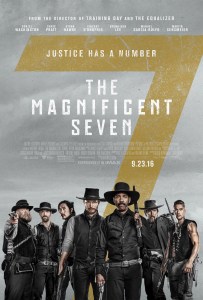 Obviously the new Magnificent Seven remake was never going to be as good a Western as the 1960 original, or as good an action movie as its source material, Akira Kurosawa’s legendary Seven Samurai. Once you accept that, the question becomes whether simply being an enjoyable Western action movie qualifies as a success given its storied pedigree. If you can’t do better than the original, why bother making it as my friend Ben Bailey would question. The answer is of course blunt (money) but the conundrum is how does one improve on classic film masterpieces? I think the new Magnificent Seven found its footing by accepting its unquestioned ceiling and instead going down a different path, instilling the essence of what made the older films so superb, and just trying to be the best B-student it can be with its new set of guidelines for broad entertainment.
The dusty town of Rose Creek falls under attack by ruthless industrialist Bartholomew Bogue (Peter Sarsgaard), who wants the land for his mining company. He installs loyal toadies as lawmen for the town and to ensure any troublemakers are put to “justice.” Emma Cullen (Haley Bennett) wishes to avenge her fallen husband and recruits a famous outlaw, Chisolm (Denzel Washington). He agrees to help and rustles up a powerful posse of gunslingers to defend the town from Bogue and his cruel forces.
There’s a reason this story still works as well as it does and that’s because the structure is ready-made for payoffs and audience satisfaction if the director and actors are capable. Act One establishes the threat and our two main roguish heroes, and then Act Two starts off with the gathering of the team, routinely one of the greatest sequences in screenwriting, and then the Act Two midpoint involves toppling the corrupt thugs controlling the town, and Act Three is the culmination between the forces of anti-hero good versus evil over the ultimate battle for the town. It’s an against-all-odds underdog tale with good but possibly doomed forces against a villain used to steamrolling through vulnerable citizens. I don’t care whom you are, that story structure worked then and it still works now. Fuqua and company don’t break a winning formula and know what strengths they have and how best to maximize them for top entertainment value.
 The biggest asset is this glorious cast, headlined by Washington and Chris Pratt (Guardians of the Galaxy). There isn’t admittedly much to these characters from a development standpoint. They’re given back-stories, though some of them are fairly airy and provide a bare minimum of effort. Red Harvest (Martin Sensmeier) in particular just kind of shows up and everybody shrugs and says, “Why not?” more or less. Also, while on this subject, it’s a bit contrived that when the bad side has their own villainous Native American that the script has to conspire for the only two Native Americans to face-off, especially when we’ve been given no history or connection between them prior to this climactic showdown. Back to the main cast, Washington settles into his suave badass persona we’ve come to expect from the man. He even fades into the background at times, ceding space for the other characters to have their moments. Make no mistake, though, because Washington’s character is a strong central anchor for this movie and even on autopilot this actor still produces attitude with style and gravitas. There’s also the simple pleasure of just watching Washington in a Western. The man was made for this setting of taciturn badasses. The brightest star of the picture is Pratt, expertly cast as a charming rogue with a big personality. What the characters lack in development they make up for in colorful personalities, which is acceptable in a genre that rewards memorably outsized figures of entertainment. Pratt is a fun rascal with a penchant for sarcasm and playing around with his prey. Every minute Pratt commanded the screen was a minute that captured my full attention.
The rest of the cast is solid and make the most of their screen time, putting in memorable supporting performances to compliment the stars. Vincent D’Onofrio (Jurassic World) is basically like a human equivalent of a bear or yeti. He’s this massive and animalistic creature and I appreciated D’Onofrio’s gusto in embracing the peculiarities. In a film of great casting and memorable characters, he nearly steals the movie. Ethan Hawke (Boyhood) has one of the more credible character arcs in the film as well as the best name (Goodnight Robicheaux). He’s haunted by a lifetime accumulation of killing. His flinty co-star Byung-hun Lee (RED 2) is the strong silent type and the two of them have a nice gunslinger chemistry, nicely contrasting but still a believable brotherhood in arms. Bennett (Hardcore Henry) is going to break out in a big way in 2016. She has a very arresting face (it’s her eyes) and an instant screen presence, which is hard to do with these guys soaking up much of the oxygen. She also gets to prove her mettle and not be treated as a romantic object, so hooray. My one concern with Bennett was that the costume designer had let her down, as it seemed the top of her gown was dangerously close to slipping off her shoulders at several key points. I understand this is designed to squeeze in a slight surge of sensuality for what is very much a PG-13 action flick but it became distracting with its obviousness. Bennett deserved better, though she might be another figure of T&A with her role in The Girl on the Train. We shall see (maybe much). The only sore spot is the villain, a wasted Sarsgaard (Black Mass) who never quite lives up to a diabolical nature worthy of the attention of our colorful cadre of anti-heroes. He’s a bully but he doesn’t seem formidable enough or that interesting.
 Fuqua (The Equalizer) hasn’t been the most consistent stager of action with his up-and-down career but he puts out all the stops with The Magnificent Seven to great effect. The action sequences are robust and shot with great attention to geography and escalation. I knew exactly what the stakes were with each sequence and gun battle, and I knew the different people and their placement and the goals. With a crew of seven and counting, it can be difficult to adequately find room for each of the fighters to be well utilized and have at least a moment that matters (just look at what happened with Suicide Squad). The second half of Act Two is our team plotting how to compensate for the overwhelming forces coming down their way, and the plotting produces plenty of opportunities as the audience watches the setups and waits for the payoff jamboree. There are little payoffs, big payoffs, crowd-pleasing payoffs, character arc pleasing payoffs; it’s an action movie that knows the climax should be the best part, and it doesn’t disappoint. The town may be in rubble and strewn with corpses by film’s end, but you’ll be happy and content from the wealth of tense and smartly directed action. Helping things along, Fuqua’s Wild West photography is often strikingly beautiful with its use of natural light.
The Magnificent Seven makes up for its lack of originality and rich characters in colorful personality and the sheer scope and intensity of its action. It can’t contend with John Sturgis and Akira Kurosawa, but what modern movie can? I don’t fault the movie for failing to live up to the standards of two classics in two different genres. I instead credit the movie for knowing its strengths and knowing how best to develop and deliver them for maximum mass appeal enjoyment. The cast is wonderfully selected and given fun characters to dig into, and the onscreen camaraderie of our seven might not rise to the level of magnificence but it’s pretty good by all accounts. That’s a rather keen summary of the movie writ large; with modestly recalculated expectations, the movie may not be magnificent but it’s plenty good and plenty entertaining. Washington and Pratt are stars making full use of their broad star appeal. The action sequences are well staged and peppered with payoffs, and it’s worth congratulating the team on having several parallel lines of action and keeping all of the shifting particulars understandable for its audience. The Magnificent Seven is about as good as I expected any remake to be, and while it doesn’t rise to those storied heights it does achieve its goals with vigor and style.
Nate’s Grade: B
Share this:

Rampage: President Down (2016)
 In the close for my review of the awful 2014 hostage thriller Rampage: Capital Punishment, I was fairly prescient with a concern that sat in the pit of my stomach:
“I fear Uwe Boll thinks that there is a level of audience attachment to his spree killer that simply doesn’t exist. He’s not an anti-hero, he’s not a revolutionary, he’s not even an engaging character by any generous metric and that’s because he’s just a stand-in for tedious ideology. He’s a mouth and a trigger finger, and that’s all Bill (Brendan Fletcher) is, in no compelling manner. I worry that Boll will continue to insert Bill into new settings, have him round up some innocent people, and then we’ll watch him sputter for an hour about whatever cultural and political misdeeds are currently bugging Boll. I worry that the promise of “Capital Punishment” inherent in the title will really just lead to a third Rampage film with this promise actually, finally, followed through. Generally, I just worry that the world will have to suffer more abuse from further appearances by Bill, the world’s most irritating psychopath who loves to hear himself talk.”
Flash to 2015, and Boll and Fletcher are pushing a Kickstarter to raise funds in order to make a third (and final?) Rampage movie that will be guaranteed to be “the film we want to make, and you will want to see.” It seems that the requested $56,000 was to fund a climactic action sequence that would “leave the streets of Washington ruined, in a sequence more explosive than anything scene before in the Rampage trilogy.” It did not meet its target goal, and Boll’s response was titled, “F you all.” Those discerning folks of the Internet couldn’t stop Boll and his ridiculously misapplied love and devotion to the Rampage series, and so my dire warning has come true. The only good thing about Rampage: President Down is it might be the merciful end of this merciless franchise.
 Bill Williamson (Fletcher) has come out of hiding and made big news. He assassinates the United States’ president, vice president, and Secretary of Defense, and inexplicably goes back into hiding in the woods. FBI agents Vincent Jones (Ryan McDonell), James Molokai (Steve Baran), and Murray (Scott Patey) are on the hunt to find out who is responsible, and they’re shocked to discover Bill is alive and well. Not only that he’s a new father, sneaking in visits with his child and baby mama (Crystal Lowe, a Boll acting reappearance stretching all the way back to 2000’s Sanctuary). Bill is making one final stand and has deadly plans for the government agents looking to bring him to justice.
As much as the subtitle was misleading from 2014’s Capital Punishment, with a picture of the U.S. Capitol building that was never featured, this one may prove to be even more of a misleading promise. President Down makes it sound like the president is under immediate threat, and he was, at the ten-minute mark. At that point Bill has taken out the president, the vice president, and even the secretary of defense, which means they must have had the absolute least qualifies team of Secret Service agents. It’s never explained how exactly he accomplishes this feat or whether suspicions creep toward the Speaker of the House (line of succession, folks). You would expect the entire nation to be on high alert, that a manhunt would be under full swing with every agency utilizing very even means to capture the culprit and bring them to justice. If you worried about the NSA spying on people and the defense department’s predilection for of drone warfare, just imagine after a wave of high-profile assassinations at the top of the executive branch. And yet the frantic world of political instability is manifested by two or three mediocre FBI agents who then, when successfully identifying THE U.S. PRESIDENT’S KILLER, go at it alone and miserably. This world lacks any sense of urgency and any sense of reality. The only reason a writer would bump off the U.S. president in the story is to deal with the consequences, and weirdly the consequences almost feel entirely unrelated. The FBI is tracking Bill but they could have been doing that already after he murdered over 100 people. Oh, I’m sorry, he was so remarkably clever that he faked his own death. There is no real chaos at least as it pertains to the movie’s plot. We hear offhand news broadcasts about the world spiraling out of control, possibly nuclear attacks on ISIS. It’s all pretty vague. However, our characters just go about their duty like it was a boring Tuesday. What’s the point of toppling the president if it isn’t significant to the story?
The movie suffers from a plot that struggles to fill out a feature-length running time, stretching this manhunt and then providing a climactic confrontation that doesn’t so much feel climactic as it does a relief from the prior crushing monotony. The first hour is built around the FBI agents getting tracking down Bill but there’s no reason this manhunt even needs to be as long as it is, and that’s because of the contrivance of the magic facial recognition software. If you’re going to through in that device, it might as well find him immediately rather than stretch out this storyline and have to reboot the system to reach the inevitable recognition. It’s delaying what everyone already anticipates, so why wait? The manhunt isn’t even that interesting because it’s watching three stock FBI characters stare at computer screens and occasionally engage in their own political debate. I think one of them might have been a mole who was sympathetic to Bill, but I can’t say for certain because the copy I watched had German subtitles for the onscreen texts. If this is the case, and it might not be, then revealing this mole at the half-hour mark is far too early and robs the film of greater mystery and suspense. This isn’t The Departed. There’s far too little that happens for the first hour. Finally, once the FBI agents raid Bill’s cabin, something does happen, and it’s slow-mo combat and explosions. Why did only two agents try and take down America’s most prolific murderer? Why does the FBI not send out a drone and just blow up the entire area? The ensuing action is pretty pointless. Boll also opens the movie with a flash-forward of this cabin assault, which confuses the timeline of events but also pads out his otherwise meager running time. There’s not enough plot here to justify a feature film and adding more Bill rants is not the answer.
 The biggest problem with this series has been twofold: the empty void of its central protagonist and the lack of cohesive or, at times, even existent commentary. I reiterate what I said in my Capital Punishment review: “Bill is no different than your garden-variety college freshman that thinks they have suddenly come across amazing psychic insights into the rotten core of humanity after one political science class. I do find Bill’s moral championing of stricter gun control laws to be somewhat comically disingenuous.” Boll thinks he’s really saying deep things through his mouthpiece but his sputtering diatribes lack direction and articulation. It’s like making a trilogy of movies about the guy who yells at passing cars. Bill chastises the media and his online followers for losing sight: “You’re obsessed with violence. You focus on my body count rather than what I was telling you.” Gee, has there ever been a spree killer that enacted radical social change? I’m fairly certain Martin Luther King Jr. wasn’t gunning down innocent people for trivial crimes as practicing yoga (that freaking happened in Capital Punishment! — not the MLK part).
Bill is an attention-seeking hypocrite with a healthy martyr complex and an oversized ego, but where is he really fails is that he’s boring. There’s not one interesting thing about this guy even after three full movies. Boll tries to give him depth through the hackneyed addition of Bill becoming a father with a… fan? It’s not really explained, and Bill does fall into what comedian Paul F. Tompkins dubbed “new dad” sotto voice. Does having a child in this world cause him to reflect? Does it change his perspective? Does it make him think of the hundreds of fathers and mothers that he took from this Earth? There are no insights provided at all except that he occasionally cries. The entire baby mama storyline is a pathetic attempt to humanize a remorseless killer, but it’s even more pathetic as a last-ditch attempt to inject some semblance of life into this empty vessel.
The other major issue that goes directly back to the start of this terrible film franchise is that the violence lacks any sort of relevant commentary. The movie isn’t bereft of social commentary but it’s a messy shotgun blast without a clear direction. Boll has a lot of anger directed at government overreach with modern surveillance and he also takes time to re-litigate the Iraq War and ethically murky War on Terror. There are points to be made here, relevant, searing, and eye-opening points, but Boll cannot focus his thoughts beyond ire and brimstone. I think he wants Bill to be a wake-up call but for what exactly? He points to vague things about income inequality and the rights of the people being taken away, but there’s a dangerous opaque quality to these charges, especially when the end result is that The People are stirred to take up arms and become spree killers. Is random murder of innocent human beings the solution to income inequality? At the conclusion of the movie, a news anchor informs us that George W. Bush, the CEOs of Microsoft, GE, and Facebook have been murdered by The People, along with the likes of singers Rihanna, Taylor Swift, and Britney Spears (hey girl, you still got it). Regardless of what you think about their music, do these people deserve to be the first against the wall in a revolution? That seems pretty petty and a wasted grievance.
 Boll’s misguided view of his lead character can best be summarized by Bill’s baby mama. She’s tear-stricken to discover news that her man has been declared dead by authorities, and she takes great umbrage at their choice of vocabulary: “He wasn’t a terrorist! He was just doing what needed to be done!” It’s fortunate I wasn’t drinking something at the time of this dialogue line because it would have been spat all over my computer screen. What an immensely asinine rationalization. Of course this dude is a terrorist! He literally terrorizes the nation, mowing down dozens and dozens of innocent people, rising in infamy with a record-breaking body count of wreckage. This guy is a definition of a terrorist, although I guess he’s not Middle Eastern of Muslim and so might not fit the profile for some. The revolution was only one yoga-practitioner away from being realized, we just never knew about it before (non-terrorist) St. Bill.
I’ll never understand why Boll hitched his wagon to such a depraved and empty central figure. With the first Rampage film I wondered if Boll was trying to understand the disaffected angry male voice out there, to try and put the audience in the shoes of a human being who would commit horrifying acts of butchery as a means of lashing out against a system that made him feel inconsequential. That wasn’t Rampage, a nihilistic and tiresome exercise in shock value that was mistaken as commentary. The 2014 sequel only reinforced the flaws of Bill and his rise-up manifesto, and once again Boll’s story dawdled with contrived false tension until an explosive climax that lingered on the violence, celebrating the carnage. If Bill wants to complain about the people’s love of violence he might want to direct his fury at his own director. With President Down, Bill is dead and his message has inspired the populace to take control of their lives via the conduit of indiscriminate murder and terrorism. I think the message may have gotten a tad lost along the way. The Rampage films were never good movies but they were even worse intellectual exercises, and I worry about people who charitably refer to them as the “good Boll movies.” They’re not, and as one of the world’s foremost experts on the catalogue of Boll, I can legitimately say he has made some almost-good movies (Attack on Wall Street and Tunnel Rats). I beg audiences not to give Boll an easy pass. If this is the end of the franchise, it goes out with a whimper and no lasting impression beyond angry, misplaced rhetoric and violent nihilism masquerading as social commentary. Follow the lead of the Kickstarter folks and steer clear of this mighty mess.
Nate’s Grade: D
Share this:

Ben-Hur (2016)
 How can one review the 2016 version of Ben-Hur without bringing up its multitude of predecessors, chiefly the 1959 Best Picture winner with one of the greatest sequences in all of cinematic history? I try and judge each movie on its own merits but remakes are difficult by nature because without the fame and hopefully good will of the original, they wouldn’t ever exist, and yet they have to find their own voice and purpose in order to justify why we even need another version of the movie. I understand some of the excuses why even tackling a new Ben-Hur would be advisable, mostly coming down to a more audience-friendly running time that’s half of the 1959 classic. Of course truncating a four-hour biblical epic has its own problems too, and while this newest Ben-Hur isn’t a three-chariot pileup of a misguided mess, it certainly pales in comparison and comes across mostly as a jazzed up yet mediocre imitation of something immutably great.
Judah Ben-Hur (Jack Huston) is a wealthy first century Jewish man who is sold into slavery as punishment from his adopted brother Mesalla (Toby Kebbel), a Roman soldier. Messala is also one of the greatest chariot racers for the Roman Empire, and so Ben-Hur, after surviving a slave ship shipwreck, rises to the top of the chariot ranks to confront Messala, seek vengeance, humiliate him, and find his family once more.
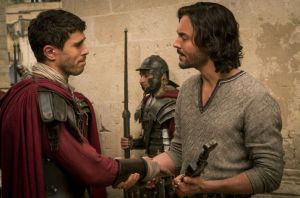 It’s obvious that this new remake wasn’t going to banish any cinephile’s memories of the 1959 version, but some of the decision-making handicaps the overall impact of the 2016 version, chiefly among them the characterization and casting of its lead. Judah Ben-Hur is definitely lacking when it comes to being a strong and engaging hero. The casting of Huston does not abate this. For fans of TV’s Boardwalk Empire, it’s clear that Huston can be a very capable and intriguing character actor, and he has an easy handsomeness that might slide him readily into mainstream big-budget projects. The problem is that Huston lacks the gravitas the role requires and this is further hampered by the limited characterization, and the two negative qualities twist together, lessening and lessening the quality of the picture. He’s certainly no Charlton Heston (unfair comparison, I grant you).
Here’s how bland it got: I was feeling more sympathy for the character presented to be the central antagonist. In the first act, I felt more for Messala and his plight than I did for Ben-Hur, and I’ll explain why. Ben-Hur comes from a wealthy Jewish family and a life of privilege, yet Messala did not want to fall back on this and wanted to make his own path, joining the Roman army. He returns several years later and connects with Ben-Hur, asking him to help root out zealots that would jeopardize a peace with Rome and incite violence against innocents. It so happens Ben-Hur is secretly harboring a zealot and, surprise, the guy stupidly tries to assassinate Pontius Pilate in full view of the Middle Eastern world. Ben-Hur allows the zealot to flee for his own safety. Messala has little choice in bringing some consequences but he’s asking for the zealot’s name, you know the guilty party, or else he knows that Ben-Hur’s family, Messala’s adopted family, will suffer in place as punishment. He’s begging his brother, pleading with him, and yet Ben-Hur refuses even though it may cost his own family members their lives. This plot point, by the way, is new. In no other version of Ben-Hur does a zealot jeopardize the Ben-Hur family. It’s always been an overreaction to the accidental coincidence of falling tiles from the family roof that doomed Judah Ben-Hur to slavery. This change makes the protagonist more culpable. It was here that I felt I was on Messala’s side. My friend Ben Bailey likens this to siding with a “kind Nazi” and says Rome was the Evil Authority that should be bucked at every opportunity and burnt to the ground. I don’t know what this says about me but I think it shows that the writing failed to make me root for our hero.
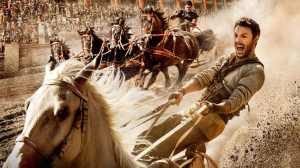
The movie gets slightly better once Morgan Freeman enters, as most movies do, and from there the plot streamlines into training to be a world-class chariot driver to take away from the glory of Messala and thus the roman overlords. The story follows familiar underdog plot beats seen in other sports genre movies from hob-knobbing with the disdainful and overconfident elites to training montages; it’s all here. It’s all marching toward that climactic brother vs. brother chariot race, and I’ll give the filmmakers credit that it’s respectable. There are some genuinely exciting moments and some great camera angles to communicate the danger and thrills of the action. The editing is a tad too choppy and the camera setups strangely favor far too many close-ups for a large-scale competition. Nothing could compare to the 1959 chariot race, which still holds up as one of cinema’s greatest sequences, more so with the renewed appreciation for practical effects. It’s not CGI horses and chariots and people in the stands cheering along. All of that is real and all of it is stunning to witness play out to tremendous realistic heights.
Director Timur Bekmambetov (Abraham Lincoln: Vampire Hunter) is not exactly the first name you might think of tackling a biblical epic. His sensibilities seem, at first glance, a bit lowbrow for such a venture, but the man is a gifted visual stylist, as he’s shown to perverse degrees in the perversely watchable Wanted. If you’re trying to bring the story of Ben-Hur to a new audience for a new century, Bekmambetov will at least ensure that it looks pretty, and most certainly it does. The biggest fault is with the challenges of the adaptation and the shortcuts and alterations that hamper the development of the characters and their ultimate arcs. Bekmambetov has one virtuoso sequence, and no it’s not the chariot race. It’s when Ben-Hur is chained in the galley of a slave ship and becomes one of the rowers. We’re trapped in his limited perspective during an attack sequence and it’s a terrific sequence. The confusion, the adrenaline, the fear are all accurately portrayed, and as the battle escalates and the ship is under attack and eventually sinks, it’s a race to escape his chains that is visually striking and exhilarating to watch. I don’t blame the director for this movie not working well.
 Another side effect of the overall truncating of the Ben-Hur saga is that the religious elements, namely the inclusion of Jesus Christ, feel really tacked on and obvious, reaching for a faith-based audience but doing so clumsily. Jesus (Rodrigo Santoro) is on the outskirts of the events of the movie, just enough to clue you in to his parallel presence (“Oh look, it must be Palm Sunday”), but he’s really another means to an end. The purpose of Jesus is to (spoiler alert) help facilitate Ben-Hur to abandon his anger and vengeance and instead adopt a position of forgiveness for Messala. The problem is that at a little over two hours long, and with the Jesus stuff fully feeling flimsy and tacked on, this big turning point for our protagonist also feels flimsy. Why would he be moved by the sacrifice of Jesus when his knowledge of the guy is primarily a helpful carpenter who fetched him water when he was thirsty? It doesn’t add up the way the movie wants.
Was a Ben-Hur remake doomed to fail considering the parameters it was fighting against? Not necessarily. While no remake will ever displace the majesty of the 1959 classic, a new movie doesn’t have to, merely opening up a new angle on a familiar story (the novel was originally published in 1880) and providing something of substance. It doesn’t have to cancel out one good movie to be its own good movie. There are enjoyable aspects of this newest Ben-Hur but all they end up becoming are aspects, frayed bits that fail to become a satisfying whole. It was a mistake to cast the blandly effective Huston in the lead and leave the character underdeveloped; a protagonist can survive one of these sins, not both. It was a mistake to coast for as long as it does with its second act. It was a mistake to provide more significant supporting characters, and Jesus doesn’t count. It was a mistake to film much of a chariot race in tight close-ups. This is not a disaster despite the money that will likely be lost. It’s easy enough to watch but hard to fully connect, and those memories of the 1959 film keep creeping back, providing unflattering comparisons.
Nate’s Grade: C+
Share this:

Suicide Squad (2016)
 After watching the debacle that was Batman vs. Superman, I said it had killed my hope for the larger DC film brand. Thanks to writer/director David Ayer, and by extension Zack Snyder’s ongoing influence, Suicide Squad reconfirms every bad step they’re down on this bad road of anti-entertainment.
Amanda Waller (Viola Davis) is worried about national security in a world where a certain Kryptonian has upended our sense of priority. She wants to assemble a team of bad guys who can do some good. Rick Flag (Joel Kinnaman) is placed as the commander of a “suicide squad,” a black ops team of super villains that are injected with devices to make their heads go kablooey if they disobey. Among the ranks is Deadshot (Will Smith), a paid assassin who never misses, Harley Quinn (Margot Robbie), the former psychiatrist and lover to The Joker (Jared Leto), an Aussie named Boomerang (Jai Courtney), Diablo (Jay Hernandez), a guy with the ability to control fire, a human-crocodile hybrid named appropriately Killer Croc (Adewale Akinnuoye-Agbaje), and the Enchantress (Carla Delevigne), a thousands-year-old spirit inhabiting the body of Dr. June Moone, who also happens to be Flag’s girlfriend. Assisting Flag is Katana (Karen Fukuhara), a masked swordfighter with a tragic and mystical past. The Squad is thrown into harms way and have to work together as a group if they plan on surviving.
The tone and structure of the movie is like an unholy marriage of Stephen Sommers’ (The Mummy) sense of careless plotting and archetypes, mish mashing tones, and Joe Carnahan’s (Smokin’ Aces) sense of wanton violence, killer cool killers, and militaristic fetishism. It’s a problematic pairing of tone that almost sort of works in the opening twenty minutes as it sets up the various bad guys with their requisite little slices of backstory. Primarily Deadshot and Harley Quinn are the spotlight characters, and it helps that the two most charismatic actors play them. The first twenty minutes doesn’t exactly push the narrative forward in a meaningful way as it involves Davis digressing with an armada of high-energy flashbacks, but it’s almost forgivable. Her pitch to the government for a black ops team of super villains seems credible enough in this anxiety-ridden world, so Ayer has at least started off not quite well but well enough. And then it all goes downhill so fast into a vortex of suck and cannot recover.
 It was at the first act break that I knew this movie wasn’t going to recover and get better. You see the advertising has been very secretive about who the true antagonist is for this movie, which is none other than the Enchantress. The introduction of this Jekyll/Hyde character and her power is initially interesting, though she certainly stands out in a world of meta-humans. The problem is that this character is obviously far more powerful than everyone else in the movie, as evidenced by Waller’s “show off” moment having the Enchantress teleport and bring back nuclear secrets from a hostile foreign nation. I think Ayer realizes this and so he quickly, and I mean quickly, positions the character as the Big Bad of the film. Dr. June Moone whispers the word “Enchantress” and she appears, and then she whispers it in her sleep and, oh no, the wicked witch lady is out and nobody seems to have any contingency for this. How has nobody thought about the risk of her accidentally saying this one word? Should she be sleeping with some sort of gag?
Enchantress steals the other ancient idol containing the spirit of her brother, which is just hanging around for some unknown reason, and the two of them are distraught that mankind, which once worshiped them, has moved on. They’re going to destroy the world by making a vague world-destroying machine, which basically comes across as a giant energy portal. The brother becomes the primary villain, a giant heavy with dumb tentacle weapons, and the two of them take human beings and turn them into a faceless army of disposable soldiers thank to the power of Enchantress kissing them. It’s at this point that the movie reminded me of Sommers’ Mummy Returns sequel where the goofy tone and careless development swallowed the movie whole, shrugging and saying, “What more did you want from us?” The villains are quasi-Egyptian gods who want to destroy the world. The last act finally positions the Enchantress as the one to topple, and our anti-heroes are attacking her with guns and baseball bats. It’s just laughable and not in the good way. The entire Enchantress as villain storyline is a swirling CGI mess and her army of faceless henchmen inspire no interest or dread.
You would rightfully think that a movie about a ragtag team of kooky anti-heroes would be darkly comic and have a whimsical sense of fun, much like what James Gunn achieved with Guardians of the Galaxy. I walked out of Suicide Squad dumbfounded and muttering to myself, “How… how do you screw this up?” I think the movie has confused snark with humor. There is precious little that comes across as funny. The characters have some one-liners but that’s about it, and they grow tiresome after a while. Suicide Squad is a classic example of trying too hard; it’s all empty posturing and posing, asking for plaudits about how edgy this cut-and-dry PG-13 movie must be with its mall Goth aesthetic and irreverent sense of good and evil. It tries so hard to be edgy that you can see the onscreen flop sweat. Case in point: the avalanche of music selections. In the first ten minutes or so it feels like there is one needle-drop music selection mere seconds after another, and Ayer chooses a mixture of artists for their on-the-nose lyrics. “You Don’t Own Me” for Harley Quinn especially, “Come Baby Come” just for a scene involving a bat with the choice lyrics, “swing batter batter batter,” a cover of Nirvana’s “Lithium” because it has “friends in my head” as a lyric, “Sympathy for the Devil” for many obvious reasons, “Spirit in the Sky” when the gang is airborne, “Seven Nation Army” when the gang is put together, and so on. If there were a handful of on-the-nose music selections, it would be passable, but it’s almost like the overzealous music director worked overtime to provide as many selections as possible to cover-up the movie’s empty sense of fun.
 No character symbolizes the film’s ethic of trying too hard more than Leto’s (Dallas Buyers Club) rendition of the Joker. Admittedly Heath Ledger’s performance was iconic and cannot be replicated, but Ayer’s script doesn’t even justify the character’s presence. There is no standout or memorable scene with the Joker to help signify just what kind of character he is, how he’s far different and more dangerous than your everyday psychopath. If you called this guy a different name you would swear it’s a different character because they fail to make his inclusion meaningful. We see Joker in flashbacks relating to Harley Quinn, and it’s in these short moments that the character plays best, in particular a high dive into a vat of chemicals all in the name of twisted love. Through Harley, we get a fleeting sense of a Sid and Nancy sort of courtship that could be interesting. However, alone, Leto’s Joker is a wash, intimidating guards with lackluster “crazy talk” and maniacal giggles. There’s a shot of him lying on the ground surrounded by a carefully constructed circle of weapons. It’s a small moment but it makes him seem more OCD than scary.
Joker’s storyline is trying to free his girl from prison, but the larger problem is that Harley Quinn is a worse character when she’s with her “puddin'” Mr. J. She loses her independence and just becomes arm candy and settles into The Girlfriend in Short Shorts. She elevates him and he drags her down. That’s a direct problem with characterization. The Joker is a distraction to the other characters and his small scenes tracking her down do not excuse the detour. Leto snarls and struts but it feels over conscious and dull. There is a better way to use the Joker: make him the target of the Squad. That pushes Harley Quinn directly into the center of the story and provides plenty of internal conflict for her to wrestle with her tortured psyche and sense of adoration for a man who had tortured her and abandoned her. That would be more interesting. In the Snyder universe, we have a Batman who has no compulsion against killing his enemies, so why the hell is the Joker still alive to terrorize? It seems bizarre that Affleck’s Batman would let this guy go unless the fan conspiracy theory that the Joker is secretly a disturbed Jason Todd, a former Robin, was accurate. That would make the character instantly more intriguing and provide some needed depth to what is a shallow character that is all exaggerated attitude. He’s the worst modern Joker but not the worst part of the movie.
The characters are just not that interesting and the far majority of the Squad teammates are meaningless background players. Killer Croc, Boomerang, Slipknot, and Katana are utterly useless in this movie. They fill out space and kill some faceless bad guys, but their plots could just as easily been attached to the other Squad members. Katana in particular is another one that feels like she’s been pulled in from a different movie entirely. She’s introduced as this killer assassin and Flag says, offhand to the point of hilarity, that her sword captures the souls of the men it kills. There’s a later moment where she’s swearing her love to the trapped soul of her husband in the glowing blade, and I just couldn’t hold back and started laughing. I’m sure this point is directly taken from the comics, but it’s thrown in without any care, any setup, and its tone is directly conflicting with the snarky nogoodniks. Diablo is given a boring and predictable arc but he at least has a dollop of characterization outside “zany” or “menacing” because he wants to not use his fire-starting powers. These characters just don’t matter to the story, and the actors aren’t given anything close to resonant character moments to make them matter to us. The Batman cameos are completely superfluous as well. There’s no reason that our criminals couldn’t have been brought in from other circumstances. Batman also has a creepy moment where it seems like he’s forcing himself on Harley Quinn to give her mouth-to-mouth resuscitation. It’s such an off-putting and curious moment I kept waiting for Bruce Wayne to wake from another dream sequence.
I think back on Captain America: Civil War again and how the filmmakers were able to deftly integrate a bevy of heroes and make them matter, giving each one a small moment to be fleshed out, providing arcs, and incorporating them in exciting and satisfying ways into combat that would let them show off their stuff. Suicide Squad is not that.
 There isn’t one good action sequence in this whole movie, and with the Enchantress army of monster goons, it starts to feel like an extended episode of the Power Rangers but with an oversight of firearms. What’s the point of bringing in a bunch of weird characters with super powers if all they get to do is one gunfight after another? Once the Squad lands in Raccoon City, er, I mean whatever city ground zero is, the movie is one long slog to eventually confront the Enchantress. It’s one abandoned street filled with goons to get shot down after another. Repetition settles in and Ayer doesn’t use the opportunity to have his characters do something fun or different. The action doesn’t excite and the characters don’t excite, and everyone trudges, head down, to their dire destination in the sky. It feels like a shadowy warzone without a clear objective, direction, or understanding of the threat. There is one interesting aspect of the action that’s never developed as it should be, and it’s the Squad’s vulnerability to losing Flag. Not only does he have the control to make their heads burst, if he is killed in action then the Squad dies too. Deadshot realizes that the team has to defend Flag and out-rightly rescue him a couple of times. It reminds me of a video game escort mission but Ayer never really does much more than having his characters recognize this dynamic. As much thought is put into the action as put into the antagonists, which is to say little. Some of the action is so poorly edited and choreographed that I just hit my head against the back of my chair and waited for it to be over.
There are a few bright spots in the film, mostly provided by the lead actors. Smith (Focus) is still one of the world’s most charismatic actors even if he’s saddled with the rote “I wanna see my daughter” storyline to humanize his remorseless assassin. Smith relishes his anti-authority figure and settles into a comfortable and appealing groove. Robbie (The Wolf of Wall Street) is delightful and her character’s zany non-sequiturs are more often funny than grating. You can tell Ayer is also a fan, as his camera lovingly oogles her body. It’s a performance that whets your appetite for more Harley Quinn that the movie doesn’t seem to be able to deliver, especially when it starts to go down a route that presents her almost sentimentally. Davis (The Help) does a fine job selling her badass tough guy moments as the leader of the program. I don’t quite buy the “government/jailers are the real bad guys” angle the movie consistently presents to elevate its Dirty Dozen. The “worst of the worst” can’t be all that bad considering we’re working under the mandate of a mainstream PG-13 rating. They’re villains with gooey centers and moral codes.
It’s not at the punishing level of disaster that Batman vs. Superman wrecked, but this is a movie that is plenty bad, and not in the good way, or the fun way, just in the bad way. Even things that should be saving graces for a comic book movie about antiheroes, the fun personalities and visuals, are lacking. Ayer doesn’t know what to do with his overabundance of characters once he gets them assembled and he doesn’t have the visual dynamism of a Snyder. Ayer has talent with writing machismo characters and can even be a fine director of action as he proved with the sturdy WWII tank movie, Fury. It certainly feels like this movie got away from him. If this is trying to be an over-the-top B movie, it fails. If it’s trying to be a flashy and stylish diversion, it fails. If it’s trying to be a subversive take on super heroes, it fails. It just doesn’t work. It wants to thumb its nose at super hero movies and dance to its own anarchic, nihilistic beat, but you never believe the movie’s own convictions. It feels like empty posturing, confusing attitude and costuming for edge. It felt like some film exec pointed at Guardians of the Galaxy and said, “Make us one of those.” The sad thing is that Batman vs. Superman wasn’t good but it was at least ambitious, having to set up multiple franchises, serve as a sequel and reintroduce Batman. Suicide Squad had to do considerably less with the easy task of making a group of crazy anti-heroes as popular entertainment, and it flounders. It’s going to be a long wait until 2017’s Wonder Woman, the next DC movie in their larger plan to compete with the Marvel big boys, and the howls from dissatisfied moviegoers will echo until then, providing a pessimistic landscape for every new scrap of footage and trailer. Remember that the Suicide Squad trailer looked mighty good too and the actual movie is well and truly awful. Sometimes the packaging is the best part and sometimes it’s the only part.
Nate’s Grade: C-
Share this:

Star Trek Beyond (2016)
 With J. J. Abrams’ departure from the franchise for the greener space pastures of Star Wars, there was a creative void to fill, and in stepped director Justin Lin (Fast and Furious series) and co-writer/star Simon Pegg, acclimating to the established new movie universe and providing a Trek movie that proves to be the most “recognizably Trek” in the series thus far. The crew of the Enterprise is stranded on an alien world after being attacked by a hive-like armada of ships. It’s a somewhat familiar formula, a distress call that ends up being a trap, from an unknown entity that is harboring vengeance against the Federation. This allows for several dispirit storylines to explore the surroundings but also the enjoyable character dynamics of the crew; the casting department hit the jackpot with this franchise, and it’s just satisfying to watch the actors deliver solid, satisfying character moments. The new character Jaylah (Kingmen’s blade-legged Sofia Boutella) is interesting, kickass, and a source of deadpan comedy conflicts with others. There’s a genuine sense of discovery that’s patiently paced, not so much the set-piece-every-ten-minutes of the Abrams films. Idris Elba (The Jungle Book) makes for an intimidating villain and I’m happy to report he doesn’t get lost under gobs of makeup. He becomes more Elba as it goes, and he’s given a credible motivation and back-story to explain his actions. The action is a bit less exciting than I was hoping for from Lin, whose special blend of crazy has been somewhat dampened as he adopts the house visual style of the franchise. Pegg and co-writer Doug Jung have steered the franchise into safer territory but also put the focus on the crew and their bonds, which is the secret weapon of Trek. You sense that Pegg and Jung are fans, and they even provide greater context and justification for the new Trek elements that drew earlier complaints, like the use of the Beastie Boys song which now becomes a fun moment of fist-pumping triumph. Star Trek Beyond (no colons necessary, apparently) doesn’t quite hit the same highs as the previous two films, but it’s a solid movie overall and might be the best movie for the most ardent fans of classic Trek. My last piece of advice: go into space construction in the future. The way they go through starships, you’ll always have a job.
Nate’s Grade: B


 nathanzoebl
You must be logged in to post a comment.