Blog Archives
Eternals (2021)

Chloe Zhao is the biggest name Marvel has gotten yet for its cinematic universe (MCU). Sure, they’ve had major directing names before like Kenneth Branagh and Ryan Coogler, and successful populist genre filmmakers like Jon Favreau and Joe Johnston and Joss Whedon and Shane Black, and quirky auteurs like James Gunn and Taika Watiti. However, Zhao is the first Academy Award-winning director to jump into the Marvel sandbox. Zhao seems like an odd fit for something as mainstream and successful as the MCU, but she was excited to tell a big story with the biggest studio operating in Hollywood. Eternals (no “The”) is just as much about the question over what it means to be human as Zhao’s Best Picture-winning Nomadland, and it’s a lot easier to watch with one hundred percent less Frances McDormand pooping in a bucket in her van (granted, she did win an Oscar for that performance). Eternals has received the lowest critical rating of any MCU film in its thirteen-year history and I’m trying to figure out why.
Thousands of years ago, the Eternals were created by the Celestials, powerful beings that are responsible for birthing new galaxies into the universe. The Eternals were sent to protect the inhabitants of Earth from the Deviants, terrifying tendril-heavy monsters that will consume and overrun a world. The Eternals are instructed by their masters not to intervene in human conflicts; only to intervene to save them from Deviants. Now that the last Deviant has been dead for over 500 years, the Eternals have settled into comfortable lives among present-day humans. Then the Deviants return, evolving with added powers and posing a new threat to humanity and the Eternals, but the real threat might be outside the confines of Earth.

Eternals feels like a different kind of Marvel movie in that stretches feel like it’s a Stanley Kubrick movie, or a Terrence Malick movie, or a DC movie. The plot structure and tone even reminded me of Watchmen. Don’t get me wrong, the standard Marvel elements are recognizable, but this is a much slower, more methodical, more cerebral, and more challenging movie that really feels like a distillation of Zhao’s humanist indie naturalism and the crazy cosmos from Jack Kirby’s trippy source material. I can understand why some people would find this movie to be boring and poorly paced. There are extensive flashbacks and setup. It definitely doesn’t need to be a staggering 157 minutes long, second only to the three-plus hours of Endgame. Granted the movie is introducing a dozen characters, their relationships, their powers, their histories, as well as a new history for the universe that doesn’t relate to anything that came before it. There are assorted references to Thanos and the events of Endgame, bringing half the population back, but this is more a standalone movie that can serve as an introduction for those less well-versed in two dozen movies’ previously on’s. I knew going into Eternals it was going to be slow, and I knew several friends that outright hated it, but I think pacing is more to its benefit and detriment. The scenes feel like Denis Villenueve (Dune) is pacing them, where moments are given more time to breathe and where characters are given space to reflect and absorb. Like a Villenueve film, Zhao wants her audience to take in the grandeur of the moment, but she also wants the characters to be able to take in the drama of their circumstances. Some people will find it all too boring, and while there were points that could be trimmed, I was enjoying myself because of the attention to character perspectives that are given precedence over splashy beat-‘em-ups.
I was drawn in by the character reveals, their conflicts, and the time Zhao allows to examine their emotional and philosophical states. Look, it’s still a big, action-packed Marvel movie with plenty of monster fights and a world-saving cataclysm climax, and while those are agreeably executed, I was more taken by letting the characters pontificate on their problems. There’s Sprite (Lia McHugh), an eternally looking child who can never live an adult life she craves. There’s Druid (Barry Keoghan), a man with the power to control the minds of all humans on Earth but is explicitly instructed to remain hands-off with their conflicts. He is severely torn and emotionally wrecked over watching them slaughter one another and knowing he has the power to intervene and resolve genocide, prejudice, and poverty. That’s the eternal question over why a loving God seemingly chooses to be hands-off, all rolled into one character. There’s Thena (Angelina Jolie), a legendary warrior of physical renown but whose mental state is fracturing and who poses a potential lethal threat to her family. There’s her partner, Gilgamesh (Don Lee), who would rather watch over his love as she suffers and potentially declines than have her lose her identity and erase herself. There’s Phastos (Brian Tyree Henry), a man who only wants to help the humans with his technological skills but regrets his contributions and declares humans as unworthy of their keep after Hiroshima. Then there’s a reveal halfway through the Eternals that loads a needs-of-the-many sacrificial debate that positions different characters on different sides of the divide for the final act. I enjoyed that even the villains are presented with their rationale and are tortured over their choices they deem to be necessary for the greater good.

I’ve written a lengthy paragraph all on the meaty character conflicts, and none of them revolve around the goal to gather a magic item or learn a special power. I didn’t mind Zhao’s movie taking its sweet time to allow these conflicts and struggles to be felt because they were evocative, and Zhao’s storytelling shines when she focuses on the noble and often tragic struggles of people being complicated, contradictory, and confusing. Even the big dumb beasts evolve and have a perspective that has an understandable complaint. The final confrontation doesn’t come down to a giant sky beam and an endless army of disposable CGI brutes. It rests upon character conflicts and a romance that spans thousands of years where empathy is the secret weapon. Early on, you think it’s going to be a love triangle, and the movie just teleports out of that trope. I found myself more invested in the ending, even if I could already predict the conclusion. I was more interested in what the conflict was doing to the Eternals as a family fracturing under the weight of their destinies and the consequences of defiance. The film ends on a cliffhanger with significant fallout, and I don’t know how the rest of the MCU is going to square what we learned and accomplished here. This seems in sharp contrast to everything down the road.
Eternals is also an often beautiful-looking movie with Zhao’s penchant for natural landscapes and magic hour lighting. The editing and photography feel nicely matched and allow the viewer to really soak up the natural splendor and the impact of the battles. The action is kept at a human level with the camera tethered to the characters even when in flight. There is the occasionally eye-opening shot of a landscape, or Zhao’s use of visual framing, or the special effects revelations that reminded me of 2001: A Space Odyssey. It’s certainly not the most breezy, action-packed movie in Marvel’s lengthy canon of blockbusters, but it’s not devoid of spectacle.

So then why has Eternals scored so low with film critics and a significant portion of general audiences? Some wonder if the level of diversity and inclusivity of the movie is a factor; we have many non-white characters including a deaf character and a gay male character in a committed relationship, with a genuine and loving onscreen kiss no less (your turn, Star Wars franchise), and that seems like a trigger point for certain fans that grumble about “woke culture.” I’m sure for some that’s a factor. I think the length will be a factor too. I think the elevated emphasis on emotional stakes and philosophical conflicts might be another factor. This doesn’t feel like any Marvel movie that has come before. It’s much more comfortable with silences, with patience, and with cerebral matters (again, not to say the dozens of other MCU entries were absent these). This one is just different, encompassing the directing style and humanist attentions of Zhao and looking at a far larger scope of drama than toppling one super-powered being. I saw this in theaters with my girlfriend’s ten-year-old daughter and her friend and they both said they enjoyed it, so I won’t say it’s too mature or impenetrable for younger viewers. Eternals might be too boring for some, too long, and too different, but I was happy to endure it all.
Nate’s Grade: B
Share this:

Escape from Death Block 13 (2021)

Gary Jones is no stranger to schlock. The writer and director’s feature debut was 1994’s Mosquito about killer mosquitos that have fed on the blood of dying aliens. His filmography also includes such amusing titles as Crocodile 2: Death Swamp, Jolly Roger: Massacre at Cutter’s Cove, Planet Raptor, and 2013’s Axe Giant: The Wrath of Paul Bunyan, which was filmed in Ohio and featured several actors that have appeared in other Ohio indies I’ve reviewed, like Dan Kiely (Bong of the Living Dead), Kristina Kopf (The Street Where We Live), and Thomas Downey (Evil Takes Root). Jones knows his schlock. Escape from Death Block 13 is the man’s ode to the prison escape thrillers of the 1970s, and it even stars a lead actor who looks remarkably like Charles Bronson. I hoped that Death Block 13 was going to be the good kind of low-budget indie, the one that swerves into its schlocky genre trappings and limitations. However, too many of its creative limitations felt more notable, from limited actors, the limited location shoot, and especially the limited plot development for payoffs and action goodness.
Mick (Robert Bronzi) is a recent immigrant trying to set right his brother’s fate. He visits his dead brother’s boss, Renda (Nicholas Turturro), and demands the money cheated from his brother. Renda’s goons rough up Mick, and in the scuffle, Mick shoots a gun in defense and he’s the one arrested and charged with attempted murder. Inside the deadly prison, life is rough that the guards will let the prisoners fight to grievous harm because they have bets on who will win. Mick becomes a favorite of Warden Jack (Debbie Scaletta) who pressures him to go along and assist with her lucrative smuggling business of guns and drugs. Mick refuses and makes himself a target. He’ll need to adjust to life behind bars, stand up to the bullies, and plot his escape with the secret tunnels located under the grounds of the prison.

The question arises how far a Charles Bronson lookalike can get you as far as entertainment value, and that’s going to be a question for the soul of every viewer. The movie feels like it was a Cannon production, where the poster and title were the selling point and the rest, well we’ll get to that when we need to. The central image of a man that looks like Charles Bronson, holding a gun, looking grimaced, with a title about a prison break, it all feels meant to target a certain audience’s favorable memories of Bronson and his own popular action filmography. Low-budget exploitation genre movies have been made for less, so it’s not a damnable sin, but it sure means that the movie’s transparent intention to rest on its familiar elements needs to be overcome with story, characters, and most importantly, memorable action and ridiculous moments to satiate an audience’s genre appetites. Escape from Death Block 13 mostly gets there when the escape part happens, but beforehand, it’s a sloppy action movie that can test your patience because there are too many reminders of its own scaled-down shortcomings.
Chief among them is casting Bronzi as the lead. It feels like the mere casting of this Hungarian acrobat, stuntman, and Judo player, as per his bio, was the starting and ending point for his character. He’s an immigrant looking to avenge his brother and immediately gets thrown into the middle of a conflict as everyone seems to be incorrectly judging him (subtle commentary on the audience expectations?) based on his appearance. The gang thinks he’s up to no good, the other prisoners and the warden think he’s a troublemaker, and the law thinks he could be their missing piece and assist to bring down the corrupt warden. It could almost be self-parody the way every new batch of characters project an identity onto this blank hulk of a man. I think even Bronzi is leaning into this helpful projection and association with Charles Bronson. His real name is Charles Kovacs, but Bronzi sure sounds closer to Bronson. He also starred in Once Upon a Time in Deadwood, working to associate Bronson’s Once Upon a Time in the West, as well as the HBO Western series, and Death Kiss, working to associate Bronson’s Death Wish. Again, congrats to Bronzi for finding himself a career as a Charles Bronson stand-in. I look forward to the man’s continued career of kind of reminding people of the departed Bronson.

However, Bronzi is not a terribly good actor. His line readings are resolutely stiff, and his accent is thick, so it can be hard to understand what he’s saying with his flat affect. There’s one joke where he makes fun of another prisoner for not understanding his accent, but I didn’t quite understand the joke because I was having trouble with his vocal articulation. To the man’s credit he definitely has a presence and can convincingly strike an intimidating pose. He’s comfortable with the fight choreography though it’s nothing too complex to be strenuous. His emotional acting range and vocal delivery is another matter. I think the limited nature of Bronzi’s ability forced the filmmakers to minimize the number of lines and dramatic scenes for his character, thus making him even less distinct and relying more on his passing impression.
I legitimately think the movie could have been improved had everyone been dubbed. Bronzi is not the only actor of limited range in the movie, he’s just the one with the most screen time. There are many supporting actors who were clearly hired for their physical prowess rather than thespian abilities. These actors would say lines and it would make me giggle at points. There are other actors who take one note, like the police officer in an interrogation scene trying to go full intense exasperation mode, and then deliver every line in this narrow acting space. It’s moments like this where the movie feels destined to willfully drift into unintentional self-parody. I think having a purposely dubbed audio track would provide two benefits: 1) it would allow better vocal actors to lift some of the lackluster performances, and 2) it would further cement the movie’s silly schlock factor and give the audience permission to laugh along with. The best actor in the entire movie is the prison doctor and just for the one scene where he dies. After being injected with a deadly dosage, he goes into cardiac arrest and the actor is so dedicated, so over-the-top, and so prolonged in his death throes that I had to celebrate the man’s gumption. Here was a guy who took what was handed to him and found a way to make it delightful. I wish every actor was on this same tonal wavelength of good-bad rather than just dull-bad.
Once the titular escape happens, the movie jolts to a new life, enough so that I wish we could have gotten things moving faster. The last twenty minutes of the movie is replete with chaotic violence and over-the-top blood shots. The action is adequately choreographed and fast-paced enough to offer several different set pieces and cross-action to keep your attention. It’s all over the place, it’s more whole-heartedly schlocky, and the frantic pacing is a definite bonus. The problem is that as a prison break movie there wasn’t really any definite reasons why the characters had to wait until this late moment to stage their escape. Usually, these kinds of movies introduce the system of the prison so we understand the routines so that they can then be exploited, like a con or a heist job. We need to know the particular steps for the payoff to feel rewarding. Otherwise, like in Death Block 13, it just feels arbitrary. The evil warden doesn’t come across as too formidable. The guards are not too formidable. These people are not the smartest criminals in the world of smuggling. And the inmates could have banded together at any point and easily overthrown this weak power dynamic. Even the heavy-duty Gatling gun attached to the lookout tower isn’t too hard to overcome. The obstacles are vague or weak, thus making it feel like the big escape could have happened as soon as Mick was thrown into this pokey.
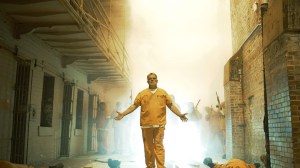
The movie was filmed in the Mansfield Reformatory, the same famously depicted in 1994’s Shawshank Redemption, but at points it sure doesn’t feel that way. I don’t know the exact budget-conscious decisions of the production or the shortcuts they had to work through, but there are several sequences inside and outside the prison that are obviously green screen. It made me start to meticulously examine the visuals and see if it was indeed the famous penitentiary or some other set meant to be stitched together through the power of editing. It’s possible the movie had a very limited availability to shoot inside the prison, so they took extensive pictures to recreate as a more convenient green screen background. I’m uncertain. The green screen work isn’t bad by any means but pretty obvious to the eye and limits the potential visual arrangements for staging the action, which can often resort to shot-reverse shot redundancy.
If the rest of the movie was like its concluding act, I would be recommending Escape from Death Block 13 to fans of low-budget schlocky action and fans of Charles Bronson. It’s strange to think part of the major appeal of this movie is that it stars a guy who strongly resembles another guy that was in movies decades ago that people mostly remember liking. The general association of other, better movies seems to be much of the creative backbone of this movie. The story isn’t packed with careful setups and payoffs, built upon a foundation of obstacles and mini-goals that need to be accomplished before the big escape finish. It relies too heavily on cliched genre moments, like multiple prison yard fights, and the riot ends in a hostage negotiation that could have been its own movie itself rather than a pat conclusion. The movie is weighed down by the acting limitations of its lead who looks the part but fails to do much more on screen. It’s an action movie that, even with caveats and understanding of its limits, manages to disappoint. I wish this had been crazier, or better plotted, or filled with more colorful and arresting characters, or bigger villains, or anything really. It’s an action movie that feels like the ghosts of other, better action movies starring a man who might as well be the living ghost of Charles Bronson.
Nate’s Grade: C
Share this:

Army of Thieves (2021)

So were you ready for the feature-length back-story for the safe-cracker character in Zack Snyder’s Army of the Dead so that you could feel more emotional involvement and understanding why he was so obsessed with cracking that special super vault in Vegas? Oh, you didn’t, well Netflix decided to spin off the goofy, energetic German character, once again played by Matthias Schweighöfer, who also directs the movie too, and now here it is. The character is too goofy to justify anything terribly dramatic, so the prequel becomes about how he was roped into a heist gang after becoming a star in the… underground safe-cracking betting ring. I would say that seems far-fetched but Netflix’s Squid Games pretty much explained its existence with, “Eh, the rich are bored and will bet on anything.” The most fun part for me was when the movie would take a few self-aware winks, as if it knew it was a movie, and characters would express how, if this were a Hollywood heist movie, this would happen, or that would happen, and then it inevitable does. It’s a small thing but it was something that slightly gave the movie its own identity because everything else is so rote and without charm or intrigue. The requisite gang has their requisite tensions and requisite betrayals and requisite unrequited romances. I just didn’t care much and the set pieces never elevated the suspense or interest level. The heist movie formula is ready-made for enjoyable setups and payoffs, as long as you see it through and hopefully give us fun characters and unexpected complications to overcome and improvise. Army of Thieves feels like a slapped-together action thriller that would have served as the years-later direct-to-DVD franchise ripoff except we got it the same year as its zombie franchise launch. And that’s the thing, this movie is literally taking place during a time there is a zombie outbreak and we’re just shrugging and going along with a standard heist that could have existed in any non-zombie outbreak universe? When even your supporting police characters say, “Hey, shouldn’t we pay more attention to that, you know, zombie apocalypse thing?” then maybe you heed their advice.
Nate’s Grade: C
Share this:

Dune (2021)
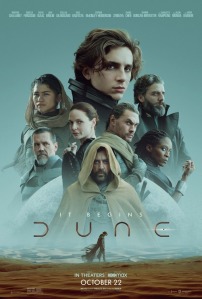
I attempted to read Frank Herbert’s novel Dune when I was in the seventh grade. I had begun to read more fantasy literature and was looking at older, heralded novels. I can still recall my frustration of reading those first five pages and having to repeatedly flip back and forth to a twenty-five-page glossary of terms so that I could even start to comprehend what was happening on the page. After those five excruciating pages, I gave up. Maybe I was too rash, and maybe my older present self would be more accommodating to the struggle, or maybe it just wasn’t worth the effort. I never watched the 1984 David Lynch adaptation that was met with great derision from critics and fans alike, although it does have its vocal defenders (Hindsight alert: Lynch turned down directing Return of the Jedi to helm Dune). So when acclaimed filmmaker Denis Villeneuve (Arrival, Blade Runner 2049) became attached to direct a big-budget, large-scale adaptation of Herbert’s novel, I was finally interested for the first time in my life. It was originally slated to be released in 2020, and after the studio planned to release Dune onto its HBO Max streaming service, Villeneuve and the production company negotiated to make sure a theatrical release would still be an important part of the plan. Alas, I watched the 2021 Dune at home, and I found myself enjoying the experience and development of the world building. However, it’s unlikely to watch this version of Dune and feel like you got a full movie for your money.
In the distant future, like 10,000 A.D., mankind has colonized worlds and the most important planet of them all is Arrakis. It’s a desert world inhabited by poor natives, Freeman, who live a moisture-preserving life mining the natural “spice,” a special substance that makes space travel capable as well as prolonging human life. The top family houses are vying for dominance and House Atreides has been assigned by the unseen Emperor to rule over Arrakis and bring it and its spice production back in line. Duke Leto Atreides (Oscar Isaac) sees great opportunity but also great danger. The other houses will scheme to engineer the failure and desolation of House Atreides, especially House Harkonnen, led by the Baron (Stellan Skarsgard), who is like a mixture between Marlon Brando from Apocalypse Now and Marlon Brando from The Island of Doctor Moreau (plus with levitation powers?). Paul Atriedes (Timothee Chalamet) is his family’s heir and much is expected of him, especially from his mother, Lady Jessica (Rebecca Ferguson), who believes he may be long-prophesied messiah. On Arrakis, Paul and his father must tackle this very delicate new mission while keeping the many adversaries at bay.
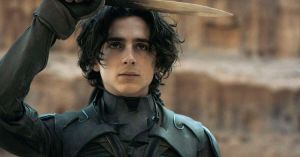
As anticipated, Dune is yet another visually stunning and gorgeously immersive visual experience from one of the greatest visual filmmakers working today. If you can watch the movie on a big screen, or at least a bigger screen, then you owe it to yourself to do so. The sweeping vistas and startling science fiction imagery have so much power and grandeur to them. If Lynch’s movie inspired a generation of devotees and impressionable children, I imagine that this superior modern version will do likewise. The production design and costumes are terrific and perfectly in keeping with the larger scope of the expansive visuals. You really feel the size of this world and its imposing weight. Villeneuve has such a natural keen eye for pleasing visual compositions, but he also has the patience many famous big screen stylists lack. He allows the moments to linger and to let scenes breathe in a way that feels more transporting and immersive. If you were simply looking for a visually resplendent movie-going experience, then Dune is the ticket. The sound design is also very smartly aligned and makes use of unconventional and alien sounds to make the movie feel even more like its own thing. When Dune came out in 1965, this was before much of the modern building blocks of our sci-fi pop-culture, so in a way while Dune was the influence it feels partially like an odd after-effect rather than a predecessor. The same thing happened with 2012’s John Carter, based upon a novel a hundred years old that influenced many sci-fi adventure serials and now seems derivative even though it came before the many imitations. I was happy with the first 90 minutes of Dune and felt like the slow pace of the first hour, and its heft of needed but spaced-out exposition, was paying off with a thrilling assault. The concept of the protective shields is a smart way to communicate the casualties of battle, where “kill shots” are illuminated in red, informing the audience of a mortal wound. It makes for an easy to read visual to keep up with the development of battle and stay in a safer PG-13 realm. The whole rescue sequence on the mining station is thrilling at every step.
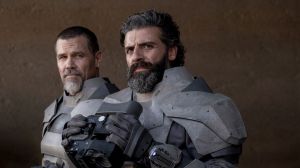
The cast is another major credit to the success of Dune. Chalament (Little Women) has a soulful yearning to him, to learn, to be his own man, to prove his father wrong and then prove worthy of his father’s faith. Surprisingly, the next biggest role isn’t Zendaya (Malcolm and Marie), the woman that Paul dreams about (prophetically?); it’s Rebecca Ferguson (Doctor Sleep) as Paul’s mother. She’s a woman with deep secrets belonging to a powerful religious sect that might be the real power behind the throne. Lady Jessica is more Paul’s mentor than any man. She teaches him to hone and focus his mind, to use the “Voice” to impart his will, and to prepare for the hardships to come. With every new exposition dump, and she has many, we learn about her growing concern for the fate of her son and her possible culpability for that fate. There’s a genuine warmth between them that serves as the film’s emotional core. I enjoyed watching Jason Momoa (Aquaman) and Dave Bautista (Army of the Dead) as opposite ends of Super Good Fighter Guy, though Momoa looked unsettling without a beard. Needless to say, the 2021 movie is far more diverse than the 1984 movie. It makes space feel more lived in when it’s reflective of a diversity of people that we already have at this point in our history.
And then, after the hallway mark, Dune became a protracted sequence of chases and then I started to worry that things were just going to end in an unsatisfying manner, relegating the 150 minutes as setup for the as-yet-unplanned sequel, and that’s exactly what happened. My mood began to deflate somewhat during the last hour of Dune. I was still interested and the visuals were still mighty captivating, but the events had the unmistakable feeling of being stretched out to meet a frustrating stopping point, a pause that didn’t produce a satisfying endpoint. I just kept thinking, “Oh, they’re not going to resolve this,” and, “Oh, Zendaya is barely going to be in this movie,” and the movie proved my predictions correct. It’s hard to judge the movie as its own entity since it’s so dependent on a Part Two that has yet to be greenlighted (though its strong opening box-office returns are hopeful). This is an expensive movie, possibly pushing $200 million, so it’s quite a gamble to declare you would only be adapting roughly half of the story. Villeneuve’s Blade Runner sequel, a movie I loved, had a budget of $150 million and a worldwide gross that didn’t make the producers comfortable going forward with a Blade Runner 2050. To be fair, that was an original story, a sequel, and rather well contained. Still, it’s an expensive sci-fi movie that has as much in common with dry art house fare as it does blockbuster adventures, like Villeneuve’s Dune. The promise of a second movie is not secured. If Dune doesn’t do well enough, we’ll forever be left with a movie that feels designed to only be a teaser. It reminds me of the hubris of 2007’s The Golden Compass where the filmmakers had a whole 20-minute finale that they carved out with the intention of having it be the opening for the assumed sequel (welp). Even when designing a multi-movie arc, it’s necessary to plan each entry so that it can exist as its own beginning-middle-end and with a suitable intermediary climax. The Lord of the Rings movies each had their own climax, each moving the larger picture forward, and each had storylines and subplots that came to a head by film’s conclusion. Dune doesn’t. There are more dead characters by the end and certain characters are displaced, but it feels less like the end of the big-budget Dune movie and more like the conclusion of episode two of the Dune mini-series.
My resonance with the source material is minimal, but the world of Dune feels stuffed with stuff and not as deep in the realm of commentary. Fans of the book series will likely thrill at the level of minutia the 2021 movie luxuriates in, allowing fans to lap up the lore. For those of us uninitiated into the fandom, it feels like there could be more going on behind the scenes. The book was released in 1965 and has clear parallels to Middle East occupations and quagmires, a subject even more relevant in the first quarter of this new century. There’s the occupying force coming in to manage the supposedly primitive natives on a desert planet, replacing the last occupier who made bold promises that were unable to be met by the reality on the ground. The parallels of colonialism are there and obvious, but that’s because everything in Dune seems obvious to me. The bad guys are corpse-white and dressed in all black. They look like the alien zombies from 1998’s Dark City (itself referencing the silent sci-fi classic, Metropolis). The leader of House Harkonnen is this noxious man who bathes in black goo and sucks the life force from others. I don’t need my sci-fi to be ambiguous about its heroes and villains. We clearly recognize the bad guys because they’re grotesque. However, the lessons learned by the heroes seem a bit stilted. Its attacks on capitalism are a little more nuanced but not much. The planet of Arrakis could produce water but that’s not in the interest of the power brokers of the galaxy. They need the spice for the economy and thus keep the exploitative status quo. The parallels are there but there’s not much more to be had other than direct summations. The movie has more to say with religion and messiah figures but at this point we’re grading on a curve, and the more complex commentary attached to messiah figures seems reserved for a Part Two.
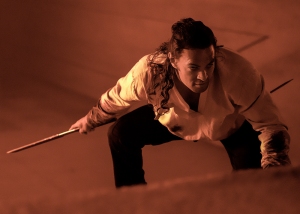
Another aspect I want to highlight that seems trivial but no less intriguing to me is how Herbert chooses his character names. We’re eight thousand years into the future, spanning multiple planets with names like Arrakis and Giedi Prime and Salusa Secondus, and then we have such anodyne twentieth-century names like… Paul and Jessica? It’s funny to me that Herbert goes to the trouble of coming up with so much jargon and terminology and alien-sounding names and then he says, “Hey, this guy’s name is… Duncan Idaho,” like he’s a supporting character in Point Break. I realize this is a very dubious criticism, and there are other character names to conflict with this assertion, but it made me laugh at the different levels of effort Herbert put into his world-building and universe than selecting character names for that same far away land.
After watching the new Dune, I went and watched the 1984 David Lynch version for the first time and was, quite simply, dumbfounded. I’ll credit Lynch for many of the weird choices in style and how it never stoops to even be accessible for a mass audience, despite having characters explicitly narrate their schemes and motivations out in the open (by scene one, the power play that took up 90 minutes of Dune 2021 is awkwardly explained in full). By the end of Lynch’s movie, it is an incomprehensible campy mess. I only have more appreciation for the 2021 Dune after watching the goofy (those eyebrows!) 1980s version that Lynch has disowned entirely, although that stirring guitar riff from the score still rocks thirty years later. The new Dune is only intended as Part One as its presumptive title promises, and because of this key artistic decision, there’s a feeling of padding and wear by the end. I found myself reflecting back on the first 90 minutes more fondly. It’s not that the last hour is absent great moments or audacious style, but it’s hard to fully judge this Dune when its last line is its own conditioning of expectations: “This is only the beginning.” The 2021 Dune is a visually remarkable movie experience with fantastic artists executing at some of the highest points of their talent. I’m eager to see if a Part Two can provide the satisfaction lacking in this beginning half. It’s a hell of a start but it feels too incomplete and in need of an ending.
Nate’s Grade: B
Share this:

Shang-Chi and the Legend of the Ten Rings (2021)
 After dominating the cinemas for over the last decade, Marvel took 2020 off thanks to that great menace even its own superheroes couldn’t overpower. Now in 2021, we’re eager for those big popcorn thrills of old, of a time before lockdowns and denials and vaccine misinformation. There’s a gauntlet of Marvel Cinematic Universe (MCU) movies coming down the chute, including The Eternals (November), Spider-Man 3 (December), Doctor Strange 2 (March), Thor 4 (May), Black Panther 2 (July), and Captain Marvel 2 (November). That’s eight movies from July 2021 to November 2022, and Shang-Chi and the Legend of the Ten Rings might just be the one that has the least recognition with the general public (I had never heard of him, sorry). And yet, I entered a theater for the first time in two months to see Marvel’s latest superhero blockbuster on the big screen, and as the MCU’s first foray into the fantastical world of martial arts epics, Shang-Chi is a mostly agreeable success in the realm of expert face punching.
Shang-Chi (Simu Lei) is the son of a very dangerous and powerful man, Xu Wenwu (Tony Leung), who has lived for thousands of years thanks to the power of ten magic rings that give him tremendous power to annihilate armies. Shang-Chi ran away as a teenager, leaving his sister Xialing (Meng-er Zhang) behind. She sends word requesting her brother’s assistance; dear old dad is on the warpath, and the two siblings might be the only ones who can stop him. Shang-Chi, living as Shawn in San Francisco, is trying to avoid larger responsibility as a valet with his good pal Katy (Awkwafina). However, he cannot ignore the assassins his father has sent, and so he and Katy travel back to China to regroup with Shang-Chi’s sister and face his destiny.
 This is the most fantasy-heavy movie of a universe that previously defined the magic from the Thor universe as just another advanced form of science. The entire third act looks like it’s taking place in Narnia itself; legitimately, the color palate and overly lit, CGI-assisted green landscapes reminded me so much of the 2005 adaptation of C.S. Lewis’ novel. Within the extended prologue over the history of the ten rings, the movie is acclimating you toward its larger-than-life universe that it treats with sincerity and graceful appreciation. The courtship of Shang-Chi’s parents is handled in that flirt-fight style reminiscent in classic martial arts films, and the balletic wire work and dreamy slow-motion, set to the soothing flute-heavy musical score, evokes romantic memories of Crouching Tiger, Hidden Dragon. Very early on, the work goes into convincing you that Marvel is taking this assignment seriously, and I appreciated that assurance and the follow-through. From a pure filmmaking standpoint, Shang-Chi works as a martial arts action film because it’s filmed and edited like one should be. The camerawork is vividly fluid and consistently roaming around the space of battle to better showcase the choreography and effort of the performers. The editing is also likewise very smooth and patient, with lots of longer takes blending together so that we can see multiple moves and counter moves, and if there are throws, we’ll travel with the fighters to continue the fight. I enjoyed a fight taking place on multiple levels of scaffolding. It all made my girlfriend nauseated in our theater, so you might be affected as well if you have a susceptibility to cinematic motion sickness. This movie allows you in on the martial arts fun.
I wasn’t expecting this kind of leap from co-writer/director Destin Daniel Cretton. This man was responsible for one of the best films of 2013, and the 2010s-decade, Short Term 12, which starred (drumroll please) future Oscar-winner Brie Larson, future Oscar-winner Rami Malek, future Oscar-nominee LaKeith Stanfield, Kaitlyn Dever (Booksmart), Stephanie Beatriz (Brooklyn 99, In the Heights) and the best-known actor at the time of release, John Gallagher Jr. (HBO’s The Newsroom). Wow that cast is an all-timer. This is like the Millennial Outsiders with a cast of up-and-coming actors who have gone on to ascendant and award-winning careers. It’s also a hard-hitting, deeply emotional and upending movie worth your time. Cretton has stuck to adult dramas based upon real stories of people struggling through the justice system (Just Mercy) and parental dysfunction (The Glass Castle). A big-budget martial arts epic I wasn’t expecting, and perhaps the Marvel Machine makes it easy for indie auteurs to plug right in, but it feels like Cretton clearly has an affection and at least a tacit understanding of favorable stylistic genre choices. At this point I shouldn’t discount what filmmakers can make those big artistic leaps with a studio project. James Gunn can go from Super to the Guardians of the Galaxy, and so Cretton can go from Short Term 12 to helming a large-scale, CGI-heavy martial arts fantasy.
 Another aspect I found pleasantly surprising was the amount of work put into its primary villain and the ensuring father/son dynamic. I’m not going to say that Xu Wenwu, a.k.a. The Real Mandarin, is one of the more complicated or nuanced villains in MCU history, but he’s given more dimension than a simple “destroy and/or conquer the world” motivation. In fact, that was the motivation for the man before he met Jiang Li (Fela Chen), Shang-Chi’s eventual mother. Real Mandarin (or RN as I’ll refer to him because I’m lazy) was going about the whole conquer and raze kingdoms thing for thousands of years, establishing another one of those all-powerful yet still clandestine and very vague shadow societies pulling the levers of power. He found a person who made him want to reform, to put his old ways of violence behind, and it’s her death that spurs him back to his views of power absolving all conflicts, so the most powerful is the one who can have the most say and protect the people close to him or her. If he had the full power of those ten rings, ordinary gangsters wouldn’t have dared to threaten or harm his loved ones. He trained his son to follow by example, and despite the fact that he sent trained killers after his son rather than a more constructive and clearer message, RN declares his love for his children. He is moving forward to return his beloved back to the land of the living. Being motivated by grief and wanting to see a departed loved one no matter the cost is a relatable struggle and one that brings degrees of nuance that Leung can imbue with his great pained, hangdog expressions. Having a father be the villain but still love his children and be primarily motivated by bringing back his dead wife and honestly assessing how she made him a better person is a breath of fresh-ish air.
Liu (Kim’s Convenience) is easily charming and demonstrates a sharp affinity for the martial arts training and choreography. With the longer takes and clean edits, it’s clear that Liu is performing many of the moves, and he moves with great skill and balance to believably crack some skulls. A fight aboard a city bus is our real intro into seeing this man as he’s avoided, as a well-trained fighting machine, the identity of his father that he’s been attempting to run away from. Liu has a self-effacing charm to him that doesn’t cross over into smug. Awkwafina (The Farewell) is her reliable comic relief asset, though too often the movie resorts to just spotlighting her for a riff or one-liner when the context doesn’t provide the opportunity. It’s rather mystifying why her supporting character, a normal human, would accompany her pal into the word of underground martial arts ninja conspiracy fantasy, let alone that she could take up a bow and arrow and becomes a valuable member of a fighting force. Leung (2046, The Grandmaster) is just movie royalty, so getting him to read the phone book would have been an acceptable start. He sits out for long periods and his absence is noted. He brings such a heaviness, a quiet yet dignified despondency to the character, and there are several instances where he undersells his character’s danger and power, which just makes him so much more intimidating. I feel like Leung is finding connections with the somber, brooding heartache of his War Kong Wai roles, and yes film nerds, I just made that connection for a Marvel movie.
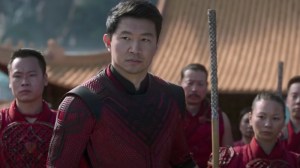 Not everything quite works in this MCU outing. There are several jumps in the screenplay that feel like further revision or clarity were necessary. I don’t really know why Shang-Chi is finally able to take on his father at the end except for some abstract concept of, I guess, believing in himself more. The power of the rings feels a little too unexplored for deserving of the movie’s subtitle. The rings come almost as an afterthought for much of the movie. There are a few moments where I was trying to connect how characters understood what they were supposed to do in any given moment, and I just gave up, which is kind of what the film also feels like it’s doing. There are clear characters included with the sole decision to sell merchandise. I don’t know if the nation’s children will be screaming for a faceless winged furry ottoman but that’s the gamble Marvel execs took and by God, you’re going to get many appearances. The sister addition to the movie feels decidedly undernourished, like she’s drafting from the father/son relationship that’s getting all the narrative attention. It feels like occasionally the movie pans to her to nod and go, “Oh yeah, me too.” The visual color palate is so brightly colored for so long, and then once the big splashy Act Three battle commences between CGI good and CGI evil, the visuals become so grey and murky and definitely hard to keep track of in the scrum. I wish the fantasy rules were more streamlined and explored rather than feeling grafted on when needed and forgotten when inconvenient, but this is their first foray into this sub-genre of action and while Marvel doesn’t need a sliding scale at this point, it’s still a moderate achievement.
Look, this isn’t exactly The Raid or Ip Man or anything that will challenge the most heart-pounding, intense, acrobatic heights of the crossover martial arts epic. Consider it a solid effort at watering down a Hero or House of Flying Daggers and switching over to the typical Marvel formula final act complete with onslaught of weightless CGI. Shang-Chi and the Legend of the Ten Rings is a fun action movie that does just enough right to land it in the cushy middle-of-the-middle for the annuls of the MCU (I would rank it around the level of Black Panther). The fight choreography and presentation, as well as the exploration of the father/son dynamics, are surprisingly refined, which is good considering one provides the entertainment value for the eyes and the other the emotional connection for everything to matter more than flashes of punches and kicks and fireballs. It doesn’t transcend its genre or the tried-and-true Marvel formula, but it’s packed with enough to even keep a casual fan entertained for most of its 130 minutes. It’s more of a one-off that doesn’t require extensive knowledge of the two dozen other MCU titles, so Shang-Chi might be just the right Saturday morning cartoon of a movie to introduce new people to the larger world of Marvel movies.
Nate’s Grade: B
Share this:

F9: The Fast Saga (2021)
 Has a multi-billion-dollar franchise ever had this much confusion and inconsistency with a name? The Fast and Furious saga, which is what we’re now calling it I suppose, began twenty years ago in 2001 and has undergone all sorts of titular irregularity. We’ve had different adjectives favored (Fast Five, Furious 7) and even gone the route of number-related wordplay, like 2018’s very soap opera-sounding The Fate of the Furious (spelled F8 in some incarnations). The ninth entry is titled F9, and by the logic of the previous sequel, I would assume that was intended to stand for “Fff-nine,” or likely “Fine,” and at this point an implicit admission of the franchise just not even trying to be relatable to any kind of recognizable pattern or order or even coherency. Alas, the title is apparently only supposed to be read as F-9, followed by the also soap opera-sounding The Fast Saga subtitle (sorry, “Furious,” maybe you’ll regain credit billing in the tenth movie in 2023). Maybe that will include the soap opera-sounding subtitle, “As the Wheels Spin.” It’s all just a curious way to handle name recognition for a twenty-year blockbuster franchise. F9 was delayed a year from COVID, a phrase that will be repeated a lot with upcoming fall releases, and after watching the 130-minute sequel, I think the franchise has finally exhausted its general appeal for me.
 I’ll begin by stating my own apologist stance on the Fast saga. I’ve never been invested in this franchise for the characters (with the exception of The Rock because he is The Rock) or for the stories, and I doubt few others who even consider themselves fans would differ. I watch these movies for their ridiculous stunts and action set pieces that don’t just defy the laws of physics but make the ghost of Isaac Newton vomit. As long as those action set pieces delivered the goods, I was able to forgive much. And I have had to ignore or forgive a lot but until now I have found those set pieces able to clear an increasingly elevating hurdle, the baggage of these characters and trying to make me care even as they become impervious superheroes that have long left the earthbound trappings of a scrappy team of underground street racers lead by Vin Diesel back in 2001. Now Diesel is 54, every member of his beloved crew/family will never die even after they appear to die, and the filmmakers have decided to introduce a long-lost adult brother played by John Cena, never mind the fact that these two muscle men don’t look like they share a single shred of DNA. It doesn’t matter, and the question remains what even matters any longer for a franchise defined by its brain-melting excess? It’s a soap opera with spy missions. It’s dumb fun to eat popcorn to. That’s all.
I acknowledge the inherent absurdity in bemoaning the over-the-top nature of a franchise whose very appeal was its over-the-top nature. It’s hard to define but every movie universe has a line of sustainable believability. Once that line is crossed, you feel it. The Fast saga has played with this tenuous tonal demarcation line for over a decade. In the eighth movie, the cars were outracing a nuclear submarine and cracking ice floes and The Rock redirected a torpedo with his biceps. That’s crazy, but remember The Rock is a superhero among us mere mortals. In the seventh movie, the cars parachuted out of a cargo plane and drove through skyscrapers. In the sixth movie, they faced off against a tank. And yet, I happily accepted those flights of fancy because they kept me entertained ahead of that nagging sense of incredulity that they were able to somehow outrace. With F9, even with the return of director Justin Lin (Fast 3-6), it feels like the franchise finally crossed that line for me. I completely understand any reader that wants to point and shout “hypocrisy.” In the arms race of action imagination where the producers have had to come up with bigger and more wild set pieces, I think they have inevitably gone from self-parody into ironic self-aware self-parody and back into self-parody again. The best way I can describe it is with the two Expendables movies. The first was amusing action bravado self-parody but then the second film tried to be in on the joke, and all the winking “we get it too” meta commentary just sapped all the enjoyment out of it. The same thing happened with the two so-bad-they’re-good Birdemic disaster movies, with the first a sincere bad movie, and the second trying to be an ironic bad movie, and it just wasn’t the same. The appeal was gone. For me, F9 is the signal that this franchise has begun its descent into Birdemic 2 range and yes, they go to space in a space car and isn’t that what all us irony-drenched fans wanted? It’s like the disappointing be-careful-what-you-wish-for warning of Snakes on a Plane all over again.
 Another factor that sank the movie for me was the inclusion of the long-lost brother storyline, especially considering the Diesel character is all about the vague platitude of family. In order to justify this significant oversight, the storyline has to resort to numerous flashbacks to fill in the sordid family details between the feuding brothers. I cannot overstate just how much I do not care about the characters in this franchise, so devoting more time to introducing complicated family histories with melodramatic flashbacks is not what I want to experience during the downtime in between the next explosion. By trying to take these characters and their relationships seriously, or seriously enough, we’re forced to slog through personal drama nobody asked for or actively desires. Better to embrace the soap opera absurdity and just have Cena show up and then every other set piece another long-lost brother shows up, and then we keep cutting back to the same singular flashback but now it’s revealed that another brother was there too previously unseen on the peripheral of the camera. The same thing goes for having to bend over backwards to explain the re-emergence of Han (Sun Kang), a character killed in the sixth/third movie by the-then bad guy (Jason Statham) that we like too much now to be the bad guy. I don’t care that he’s alive again, and the convoluted yet still unsatisfying vague plot to explain his fake death is unwanted as well. Apparently, the only character who will remain legitimately dead in this series is Gal Gadot (for now).
For the hard-core fans, there may be enough nitro juice in F9 to still provide a satisfying jolt of high-octane entertainment. Lin still has a nice command on action sequence visuals and there’s some large-scale carnage that tickles even while it’s undermining every concept of magnetism. Unfortunately, the joy I felt with previous action incarnations from the series was not recaptured this time. It just doesn’t feel as memorable, at least in a positive way. Going to space is memorable, but not in a positive way, unless they had to race a universe of aliens on the moon to save the Earth. I genuinely like Cena as an actor, but he’s far too strait-laced and dull here. Watch the recent Suicide Squad reboot to be reminded just how charming and comically talented he can be in the right role. Diesel seems to be putting less and less effort into every performance almost like a dare to the audience on how little they will accept. There were a few shots I watched where I felt like he was on the verge of going to sleep. The villain is lame, the movie has too many competing comic relief characters, and it’s all too long. I’ve been a defender of the blockbuster bombast of the Fast saga. I’ve considered myself a fan of its outlandish set pieces and ludicrous stunts. I’ve been able to ignore what didn’t work. Alas, the time has come where I can no longer do that. I just felt mostly indifferent and bored for much of F9, and its action highlights couldn’t save the extra emphasis on convoluted soap opera melodrama. Your mileage will vary as far as what you can forgive, but F9 feels like the appropriate off-ramp for me.
Nate’s Grade: C
Share this:

The Suicide Squad (2021)
 When Disney foolishly fired writer/director James Gunn for offensive past tweets, tweets the studio had already known about before hiring him to helm the first Guardians of the Galaxy Marvel movie, the brass at DC was more than happy to pounce. They offered Gunn the opportunity to tackle any of their many superhero properties. Gunn had earned a reputation as a blockbuster filmmaker whose bizarre sense of humor and style made him just as much as selling point as the property itself. Gunn gravitated to the Suicide Squad, though he didn’t want to be beholden to the 2016 film from writer/director David Ayer. The studio gave Gunn free reign. He could do whatever he wanted creatively, which just happened to be an extremely violent, R-rated sequel that also serves as a soft reboot. Gunn was the perfect person to tackle a project like The Suicide Squad and even with all his goofy humor, gallons of gore, and slapdash dispatching of numerous big names, there’s a real affection for these scruffy characters. Not that there was a big hurdle to clear, but this is clearly the superior big screen Suicide Squad.
Amanda Waller (Viola Davis) has assembled another team of criminals and has-beens and tasked them with a mission. If they fail, or deviate from their orders, she will detonate an explosive placed within the skulls of Task Force X a.k.a. the Suicide Squad. Skilled marksman Bloodsport (Idris Elba) is extorted into being the defacto leader of a band of squabbling misfits that includes Harley Quinn (Margot Robbie), the patriotic warrior Peacemaker (John Cena), the vermin-controlling Ratcatcher (Daniela Melchior), and even a giant living shark, King Shark (voiced by Sylvester Stallone), with a voracious appetite. The squad must destroy a scientific station on an island nation that has undergone a military coup and great political instability. Within that station, run by mad scientist The Thinker (Peter Capaldi), is a threat that could doom the world. Enter the Suicide Squad, but can they even be bothered to save the day?
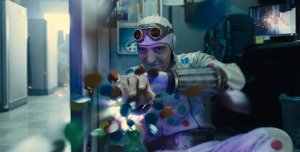
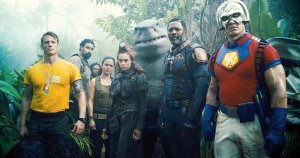 It feels like Gunn wanted to take the most ridiculous, pathetic characters in DC cannon and then find a way to make them appealing and worth rooting for. There is a strategy to take the scraps of the comic book universe and to make gold out of them. Case in point, Polka Dot Man (David Dastmalchian), a figure easily ridiculed by fans and populating just about every list of the worst villains of comic book lore. Gunn takes the maligned character and says, “Yeah, I’m going to keep his dumb power of flinging polka dots, and by the end, you’re going to care,” and you do care, or at least I did over the course of the film’s 132 minutes. Gunn is drawn to strange, dysfunctional found families, the misfits of society who find an unexpected kinship with one another. You can tell that even when Gunn is at his most irreverent, he still has an acute sense of reverence. The team-comes-together aspect of these sort of movies plays as a predictable but satisfying formula, and while I wouldn’t say anything took hold of my emotions like the best of the Guardians entries, I did come to care about the core of the team. I cared about the father/daughter dynamic between Bloodsport and Ratcatcher. I cared about Polka Dot Man coming into his own as a hero. I cared about King Shark feeling like he had a group of friends. The fact that I typed those last two sentences, which would sound insane absent context, is a testament to Gunn’s strengths.
The climactic villain, whom I will not spoil, is the greatest example of making the most with the least. It is immediately goofy to the point of laughter but still threatening and creepy. Gunn has taken one of the weirdest characters in comics and given it its due. Even by the end, as this villain is vanquished (not a spoiler), the movie finds a small moment to re-contextualize this absurd character as another victim. It was happier before being kidnapped and experimented upon by its devious captors. Even that extra passing consideration is impressive.
The movie also lets its weirdos have their fun. Watching bad guys, who are somewhat bad at being bad guys, try their hand at being good guys, but badly, or at least not as well, has plenty of comedic possibility as well as setting up the redemption and community payoff. The opening beach assault sets the sardonic and sloppy tone. I consistently enjoyed the contentious banter between the different members of the Squad and the jockeying for position. The gag about Polk Dot Man envisioning every enemy as his abusive mother is enjoyably goofy when visualized from his perspective (Elba’s line reading for “It’s YOUR MOM!” is a delight). King Shark’s dullard nature is a routine source of comedy that almost wears out its welcome. Nothing seems out of bound for him to say or do, whereas the others have more defined comedy boundaries. I laughed out loud frequently though some of the comedy bits feel a bit too stale and juvenile even for Gunn (a 69 joke?). This all feels very much like this is Gunn’s $180-million-dollar Troma movie he miraculously got to make with a studio blessing. The violence is over-the-top, occasionally gasp-inducing and occasionally beautiful. That’s an odd but an adept combination for Gunn as a filmmaker, a man who digs into the grimy bins of exploitation cinema and elevates it upon a bigger stage while still managing to stay true to his own silly style.
 Gunn hasn’t dulled the darker reality of his rogue’s gallery either. Bloodsport and Peacemaker get into a macho contest of killing foot soldiers in increasingly theatrical and flamboyant ways where their flippancy and hostility toward one another is the joke. King Shark is portrayed as a dumb brute who also tries to eat team members. Many, many characters have similar back-stories where their parent or guardian or captor experimented on them and live with the lingering trauma, trying not to have their pain define them. The 2016 movie wanted you to see the Squad as PG-13-approved antiheroes. The 2021 movie wants you to remember that they are indeed crazy, demented, dangerous, and murderers. Even Peacemaker, meant to evoke shades of the patriotic Captain America, says he will ensure peace “no matter how many men, women, and children I have to kill.” Harley isn’t fetishized as a punky pinup in short shorts like in 2016 (digitally shortened), but she’s still a psychopath who makes impulsive decisions. Her recognition about always falling for the wrong kind of man is a mixture of sadness, character growth, and a clear reminder that you should not let down your guard around this woman.
Spending time with these characters is made even better from the superb casting. Elba (Hobbes and Shaw) is the biggest welcomed addition; his character was likely initially intended to be the continuation of Will Smith’s Deadshot. Elba is charismatic and self-effacing and handles the comedy and action with equal measures of confidence. When he loses his patience, or opens up about his hidden phobia, it’s even more amusing because of how it contrasts with how naturally suave he is as a default setting. I wasn’t missing Will Smith at all with Elba and his natural accent. Robbie (Bombshell) was born to play Harley Quinn and should hopefully get many more opportunities. Cena (Fast and Furious 9) is so natural at comedy and slides comfortably into a macho blowhard coming into conflict with the other alpha males on the Squad. I loved the simple visual of him strutting around in vacation shorts for a long period of the second act. Viola Davis (Ma Rainey’s Black Bottom) is always excellent and might be the scariest character of them all. There are many joke characters played by actors firmly in on the tongue-in-cheek game.
 As a second chance at franchise-making, The Suicide Squad is a brash, bloody, and irreverent retake and the best DCU movie yet from a studio that seems to be throwing anything at the wall to see what potentially sticks. That has its benefits, like allowing Gunn the creative freedom to make a movie this crazy and schlocky and entertaining. It’s a shame, then, that this Squad movie looks like it will make a whopping hundred million less in its opening weekend at the box-office compared to its 2016 predecessor. It’s a sign that the traditional theatrical market hasn’t quite rebounded from COVID-19 (even Marvel’s own doesn’t look like it will crack $200 million domestic). It may also be a sign that audiences are not terribly interested about a sequel to a movie they didn’t really care for five years prior. Beforehand, I would have bet even money that the studio would give a blank check to bring Gunn back for more after he fulfills Guardians of the Galaxy volume 3 for Marvel, but maybe that’s not the case. Maybe The Suicide Squad will be more of an entertaining one-off than the start of a new direction for this lagging franchise. Regardless, if anything good came of Disney firing Gunn on dubious terms, it’s the existence of this movie in the interim for the in-demand filmmaker. While not everything works in The Suicide Squad, and the emotional depth is sacrificed for giddy gory bombast, it’s what you would hope for with the combination of James Gunn, wacky superheroes, and a commitment to an R-rating.
Nate’s Grade: B+
Share this:

Jungle Cruise (2021)
 Disney turned a theme park ride that mostly involved sitting into a billion-dollar supernatural adventure franchise, so why not try another swing at reshaping its existing park properties into would-be blockbuster tentpoles? Jungle Cruise owes a lot to the Pirates of the Caribbean franchise, and actually owes a little too much for its own good. For the first half of the movie, it coasts on the charms of stars Dwayne Johnson and Emily Blunt and some light-footed visual misadventures. Then the second half turn involves a significant personal revelation, and that’s where the movie felt like it was being folded and crushed into form to closely resemble the Pirates franchise. It gets quite convoluted and littered with lackluster villains, too many and too stock to ever establish as intriguing or memorable (one of them is a man made of honey, so that’s a thing). I found myself also pulling away in the second half because of the inevitable romance. Their screwball combative banter between Johnson and Blunt gave me some smiles and entertainment and then, as they warm to one another, it sadly dissipated, as did my interest. The comedy is really labored at points. Johnson keeps referring to Blunt as “Pants” because she’s a woman and she wears pants in the twentieth century. It was not funny the first time and it’s not funny or endearing after the 80th rendition. The supernatural elements and curses feel extraneous and tacked on. With the Pirates films, at least the good ones, there are a lot of plot elements they need to keep in the air and you assume they’re be able to land them as needed. The competing character goals were so well established and developed in those movies and served as an anchor even amid the chaos of plot complications and double and triple crosses. With Jungle Cruise, it feels like a lot of effort but also a lot of dropped or mishandled story and thematic elements. This feels more creatively by committee and the heavily green screen action is harder to fully immerse with. As a wacky adventure serial, there may be enough to keep a viewer casually entertained, but Jungle Cruise feels too beholden to the Pirates formula without bringing anything exciting or fresh on its own imagination merits.
Nate’s Grade: C
Share this:

Gunpowder Milkshake (2021)
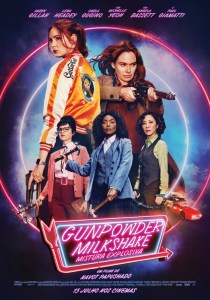 The reason we typically watch crime/action movies is for the slick style, the gonzo action, and the over-the-top characters cutting loose in the most violent of manners. We watch these movies to capture that whiff of cool, something flashy and entertaining with its eye-popping combo of sight and sound. Think Snatch, and Drive, and Atomic Blonde, and what appears to be the upcoming James Gunn Suicide Squad sequel. By these standards of stylized violence and colorful anti-heroes, Netflix’s Gunpowder Milkshake falls too flat to be duly satisfying.
Sam (Karen Gillan) is a hired killer working for the secretive order, The Firm. Her handler (Paul Giamatti) has accidentally assigned her the son of a commanding mobster who now demands vengeance. Her lone way to keep the protection of her employers is to kill a man who robbed them, which she does, but then regrets her actions. The troubled man had stolen the money to pay the kidnappers ransoming his daughter, Emily (Chloe Coleman). Sam decides to get involved and save this girl, and in doing so loses protection. The scornful mobster sends teams of goons to track Sam and kill her, forcing her to find refuge with her absentee mother (Lena Headey).
 The problem with playing in this stylized sandbox is having little to back up the attitude and style. Admittedly, those two aspects go far in a sub-genre dominated by appearances, but if you just have tough-looking shells of characters posturing and acting tough, it doesn’t matter how much style you dump onto the screen, it will only distract for only so long. The characters in Gunpowder Milkshake are so powerfully bland and all adhere to the same lone character trait. They’re all glib and badass and brusque and smug and fairly boring. It’s like somebody took the John Wick universe of clandestine killers and copied and pasted the same default personality.
If everyone is super cool, and super deadly, and super nonchalant, then you need to put even more work into making the characters stand apart. They’ll need specific quirks, competing goals, faults and obsessions, some key nub of characterization even if its superficial (a guy with one eye he’s insecure about it, etc.). With Gunpowder Milkshake, there’s nothing to work with. The screenwriters made this so much harder on themselves. I guess we’re merely supposed to be won over by the casting and the imagery of these bad ladies holding powerful weaponry. The protagonist is boring. She is the familiar hired killer who grows an inconvenient conscience. That’s an acceptable starting point but the moral growth is hindered when her young charge, the little girl that forces her paradigm shift, wants to be her apprentice to learn to kill people. The fraught mother/daughter relationship resorts to a lot of “I didn’t want this life for you,” “It’s the only life I’ve known” roundabout conversations, and neither furthers our understanding of either side.
With all that being said, there are moments of bloody fun that can be enjoyed. There’s a middle portion of the movie that gave me hope the film had transformed. At one point, Sam is indisposed and unable to use her arms, which dangle without any muscle control. She’s about to be beset by angry if bruised bad guys and must plan what to do. The resulting clash is a burst of creative choreography and an excellent demonstration of Sam’s resourcefulness and drive. Watching her dispatch a dozen armed men so indifferently, always knowing where and when to turn and dodge is not nearly as entertaining or engaging as watching her struggle and solve a problem. This sequence is extended and makes clever use of its location and the elements that would be available. Then we go a step further, as Sam and her youngster must drive a car to flee except the uncontrollable arm problem persists. Sam will pump the pedals and give directions while Emily sits on her lap and turns the steering wheel. This made me excited. We had organic complications and potential solutions that involved both characters having to rely upon one another. That is solid screenwriting and finding a way to spice up an ordinary parking garage chase sequence. By the end of this sequence, my hopes started to dwindle because Sam reverted to her earlier super cool, impervious version. She knew every exact move to make, and the small-scale car chase started losing my interest even with the extra driving dynamic. I wish the filmmakers could analyze how these sequences differed to better harness that creative surge.
 The concluding act of Gunpowder Milkshake is a deluge of false climaxes and waves of bad guys that never pose any discernible threat. It all feels too repetitive and like a video game. This group of people need to be killed, and then this next group of people need to be killed, and then this next next group of people need to be killed, and I just started getting bored. There is the occasional fun burst of violence and style, but the enemies are stock and dispensable, so it doesn’t feel like it matters what the numbers are. Whether it’s a dozen or a thousand, nothing really seems to matter because our super team of badass women will never be stopped. If you’re going to establish the protagonists as so far ahead of their competition, then work needs to be done to provide another outlet for audience interest. Use that time to explore the peculiarities of the cracked-universe world, like in the John Wick franchise. Use that time to meaningfully push the characters toward personal confrontations with one another. Alas, it’s all slapdash style with the same dead-eyed cool stare from start to finish (with the noted exception above). The entire final act could have been five minutes or fifty. It’s filler violence until the director tires out.
The cast is blameless and eminently watchable. I’ve been a fan of Gillan’s since her early Doctor Who days, and it’s been fun to watch her come into her own with the major spotlight afforded from franchises like Guardians of the Galaxy and Jumanji. She’s more than capable of kicking ass and looking cool doing so but this is the thinnest of characters. Once Sam chooses to put her safety at risk to save an innocent girl, it’s the end of her character growth. I suppose you can argue everything she does from there further proves the lengths she will go to solidify this important choice. Gillan deserves a worthy star vehicle. It’s fun to watch Angela Bassett, Michell Yeoh, Carla Gugino, and Headey push back with a grin against the misogyny of the overconfident wicked men who wish to do them harm. I wish they were better integrated into the world to have more significance other than as old allies who double as a weapons depot. There’s only so many guns-in-books jokes you can have before it too feels overdone.
 For fans of stylized violence, there may be enough cooking with Gunpowder Milkshake to meet out its near two-hour investment. The neon-infused, candy-colored production design and cinematography can enliven moments. The actors are fun to watch. Some of the fighting is brutally choreographed and cleverly executed, like the sequence where Gillan has no control over her arms. It’s got slow-mo violence set to wailing pop music tracks. If you’re looking for a pretty movie with some style, then it might be enough. If, however, you’re looking for a movie with interesting characters with memorable personalities, well-developed action with variance, and a story with a nice array of twists and turns and payoffs, then maybe look elsewhere.
Nate’s Grade: C+
Share this:

Black Widow (2021)
 If you ask anyone who their least favorite Avenger is, every one of those participants will have the same exact answer: Hawkeye. If you ask that same group who is their second least favorite Avenger, chances are that a clear majority are going to next say Black Widow. The character has been part of the Marvel Cinematic Universe (MCU) since 2010 in Iron Man 2, a full decade of idling to gain her solo movie to the point it became a long-running question in the fanbase. Then they killed the character in 2019’s Avengers: Endgame and then also announced she would be getting her solo movie, and the fanbase said, “Wait, now?” Delayed a full year thanks to COVID-19, Black Widow is Marvel’s first theatrical release in almost two years and will likely benefit from some low expectations and eagerness to get back to the big screen spectacle of summer movies.
It’s not Black Widow’s fault that she’s paired with a super soldier, essentially Batman in a flying suit, a nigh indestructible god, and a giant raging id monster. There’s a significant gap between that upper tier of the super powered Avengers and the two non-powered members, Lady with Guns and Guy with Bow and Arrow. It’s hard to compete with all of that, and the glimpses we’ve been given with previous MCU movies haven’t exactly been the most nuanced or dimensional for Black Widow (remember her dubbing herself a “monster” because the state took away her ability to bear children?). We’ve had hints about past troubles and regrets, but it’s never been explored with any significance… until now.
 Taking place shortly after the events of 2016’s Civil War, Natasha Romanoff (Scarlett Johansson) is on the run from American authorities. She reunites abroad with her estranged sister, Yelena (Florence Pugh), who has recently broken free of the chemical mind control of the sinister Widows program. Yelena and Natasha were living as sisters for three years as a cover family of Russian agents, with Alexei (David Harbour) and Melina (Rachel Weisz) as their parents. They were whisked back to Russia, separated, and thrown back into the Widow program where they were trained to be elite assassins by Dreykov (Ray Winstone, barely flirting with a Russian accent). The combative sisters are being chased by S.H.I.E.L.D. agents, other killer Widows still under the chemical-induced mind control, and Dreykov’s best hunter, the ruthless Taskmaster, a masked warrior who can learn and mimic the moves from other fighters. Natasha and Yelena decide the only way to stop Dreykov is to reunite their old family once again.
I’m a little confused by the general indifference Black Widow seems to have generated from critics and fans because I thought, while with some flaws, that this is still a good movie that I would say is on the cusp of being above average for the MCU’s already high bar. Perhaps, again, this movie is benefiting from lowered expectations. I wasn’t going in with too many demands considering my personal investment with the Black Widow character was minimal prior to her sacrificial death. I wanted a fun movie that provided further insight into her character, considering this would likely be the last time we see Natasha in the MCU. I was surprised how emotionally engaged I became with her movie. While the action is fine, it was the dramatic parts that really grabbed me. This is the first MCU movie where I was looking forward to the breaks in action more than the actual action. The pre-credits flashback (to mid-90s Ohio no less) sets up this fractured family dynamic that serves as the core of the movie, the question over whether these relationships ever really mattered on a deeper level or whether each person was simply playing their assignment. It makes for intriguing drama about vulnerable characters sifting through the small measures of happiness they’ve had and the difficulty of reaching out to people that are important to you. Natasha is in a delicate yet reflective place considering her isolation. The movie is structured like a Jason Bourne-style spy caper, jumping from one locale to the next, but it’s more of a family drama about hurt people reconciling and reconnecting. On its own terms, it’s a real family movie.
 There are some major themes and some serious subjects with Black Widow and they are well handled and tied to the character journeys. The opening titles, set to a melancholy cover of Nirvana’s “Smells Like Teen Spirit,” covers human trafficking. This is a story about the systems of abuse, primarily abusive men demanding control from throngs of women, and it’s about overcoming abuse and establishing support systems. For Natasha, she made some hard choices to defect to S.H.I.E.L.D., and many others have suffered because of her decision to escape. Many women could not escape their tormentors, and the level of control only became more methodical. Yelena talks about being conscious of everything but unsure what parts of you are really your own doing, and this seems eminently relatable about victimhood. The movie is about breaking free of unhealthy relationships, coming into your own control, and finding healthy families even if they are troubled and a work in progress. That’s why the family moments resonated as much for me. Real attention was given to the supporting characters in Natasha’s orbit.
To that end, the villains exemplify the themes by design, especially Taskmaster serving as a literalization of Natasha facing off against the sins of her past, much like in 2017’s Logan where Old Logan fought young Logan. Fans of Taskmaster from the comics may well be disappointed by the adaptation because the character was very sardonic and, in here, never utters a word (there is a certain Deadpool-in-X-Men Origins: Wolverine reminiscence). More could have been done but the villain represents the consequences of abandonment. I appreciated that even until the final moment, the villain could be redeemed and meant something more than simply another masked heavy to be blown apart. Dreykov, on the other hand, is just a typically awful abuser and his lack of definition fits. He’s a general stand-in for the toxic control of men accustomed to power and the dismissal of female agency. He’s dull but more a designated symbol.
The traveling Black Widow family van is the real draw of this movie. I have been a Florence Pugh fan since her star making turn in 2017’s emotionally disquieting Lady Macbeth, and I welcome her and Yelena into the MCU with open arms. Pugh (Midsommar) is terrific and full of sarcastic wit, at one point criticizing Natasha’s familiar three-point “superhero landing.” She’s also convincing in all the action and gunplay. Even better, there are several dramatic scenes that allow the talented actress to tap into her prowess. She could make me cackle, then the next minute impress me with the finesse of her leg-swinging attack movements, and then the next make me feel something as she tearfully reflects that her cover family was the best years of her life (as the youngest, Yelena had no idea until they ran off that they were all Russian agents). Her combustible yet affectionate relationship with Johansson imbued so much more emotional investment into the Black Widow character for me. Harbour (Hellboy, Stranger Things) is inhaling any available scenery as a past-his-prime Russian super soldier still holding onto his glory days as a communist answer to Captain America (he eagerly asks Natasha if Cap ever mentions him, so hopeful it’s adorable). He’s a regular source of comedy but also has a credible paternal warmth to him as he tries to don the mantle of fatherhood like a costume that no longer fits quite as well. Unfortunately, Weisz (The Favourite) isn’t on screen as much as the other members of the family unit but I still greatly enjoyed watching her finely attuned deadpan delivery.
 From an action standpoint, Black Widow will mostly suffice but there is little to really get the blood pumping. The chases and fights are entertaining without delivering anything new. The third act involves an extended set piece with characters plummeting from the sky amid fiery debris. It’s at least visually interesting and the action high-point of the movie. Under director Cate Shortland (Lore, Berlin Syndrome), the action is easy to follow even as it escalates into big video game carnage and explosions. The lack of development in the action would be more of an issue for me if the non-action elements, the story and acting, weren’t as involving. I feel like Shortland was hired for the dramatics and performances and character moments, less so the explosions.
It took eleven years, one more thanks to COVID, but Black Widow finally has her starring vehicle and the MCU is finally back on the big screen (or your home screen via Disney Plus and thirty additional dollars). I watched the movie with my girlfriend and cheerfully noted it would be the first theatrical Marvel movie we watched during our year-plus courtship, thus a real milestone in modern geek dating (we’ll have many opportunities ahead as there are six more Marvel movies scheduled between now and summer 2022). I was surprised how much I enjoyed Black Widow once it had reassembled its family dynamic and I hope to see the extended Romanoff family members in future MCU editions. It’s a late but welcomed swan song for Natasha Romanoff and her checkered past. For the first time, I felt for her character, and part of that was the result of enjoying her family nucleus and the pathos they brought. Black Widow is a serviceable action movie with fun characters and potent dramatic interactions with heavy, well-realized themes. I’m baffled by the general critical indifference (I have a lot fewer qualms than I did with 2019’s Captain Marvel). It’s the rare big movie where the quiet moments are the high-points, and twenty-plus movies in, that’s at least something new from the juggernaut that is the MCU.
Nate’s Grade: B+


 nathanzoebl
You must be logged in to post a comment.