Eternals (2021)

Chloe Zhao is the biggest name Marvel has gotten yet for its cinematic universe (MCU). Sure, they’ve had major directing names before like Kenneth Branagh and Ryan Coogler, and successful populist genre filmmakers like Jon Favreau and Joe Johnston and Joss Whedon and Shane Black, and quirky auteurs like James Gunn and Taika Watiti. However, Zhao is the first Academy Award-winning director to jump into the Marvel sandbox. Zhao seems like an odd fit for something as mainstream and successful as the MCU, but she was excited to tell a big story with the biggest studio operating in Hollywood. Eternals (no “The”) is just as much about the question over what it means to be human as Zhao’s Best Picture-winning Nomadland, and it’s a lot easier to watch with one hundred percent less Frances McDormand pooping in a bucket in her van (granted, she did win an Oscar for that performance). Eternals has received the lowest critical rating of any MCU film in its thirteen-year history and I’m trying to figure out why.
Thousands of years ago, the Eternals were created by the Celestials, powerful beings that are responsible for birthing new galaxies into the universe. The Eternals were sent to protect the inhabitants of Earth from the Deviants, terrifying tendril-heavy monsters that will consume and overrun a world. The Eternals are instructed by their masters not to intervene in human conflicts; only to intervene to save them from Deviants. Now that the last Deviant has been dead for over 500 years, the Eternals have settled into comfortable lives among present-day humans. Then the Deviants return, evolving with added powers and posing a new threat to humanity and the Eternals, but the real threat might be outside the confines of Earth.

Eternals feels like a different kind of Marvel movie in that stretches feel like it’s a Stanley Kubrick movie, or a Terrence Malick movie, or a DC movie. The plot structure and tone even reminded me of Watchmen. Don’t get me wrong, the standard Marvel elements are recognizable, but this is a much slower, more methodical, more cerebral, and more challenging movie that really feels like a distillation of Zhao’s humanist indie naturalism and the crazy cosmos from Jack Kirby’s trippy source material. I can understand why some people would find this movie to be boring and poorly paced. There are extensive flashbacks and setup. It definitely doesn’t need to be a staggering 157 minutes long, second only to the three-plus hours of Endgame. Granted the movie is introducing a dozen characters, their relationships, their powers, their histories, as well as a new history for the universe that doesn’t relate to anything that came before it. There are assorted references to Thanos and the events of Endgame, bringing half the population back, but this is more a standalone movie that can serve as an introduction for those less well-versed in two dozen movies’ previously on’s. I knew going into Eternals it was going to be slow, and I knew several friends that outright hated it, but I think pacing is more to its benefit and detriment. The scenes feel like Denis Villenueve (Dune) is pacing them, where moments are given more time to breathe and where characters are given space to reflect and absorb. Like a Villenueve film, Zhao wants her audience to take in the grandeur of the moment, but she also wants the characters to be able to take in the drama of their circumstances. Some people will find it all too boring, and while there were points that could be trimmed, I was enjoying myself because of the attention to character perspectives that are given precedence over splashy beat-‘em-ups.
I was drawn in by the character reveals, their conflicts, and the time Zhao allows to examine their emotional and philosophical states. Look, it’s still a big, action-packed Marvel movie with plenty of monster fights and a world-saving cataclysm climax, and while those are agreeably executed, I was more taken by letting the characters pontificate on their problems. There’s Sprite (Lia McHugh), an eternally looking child who can never live an adult life she craves. There’s Druid (Barry Keoghan), a man with the power to control the minds of all humans on Earth but is explicitly instructed to remain hands-off with their conflicts. He is severely torn and emotionally wrecked over watching them slaughter one another and knowing he has the power to intervene and resolve genocide, prejudice, and poverty. That’s the eternal question over why a loving God seemingly chooses to be hands-off, all rolled into one character. There’s Thena (Angelina Jolie), a legendary warrior of physical renown but whose mental state is fracturing and who poses a potential lethal threat to her family. There’s her partner, Gilgamesh (Don Lee), who would rather watch over his love as she suffers and potentially declines than have her lose her identity and erase herself. There’s Phastos (Brian Tyree Henry), a man who only wants to help the humans with his technological skills but regrets his contributions and declares humans as unworthy of their keep after Hiroshima. Then there’s a reveal halfway through the Eternals that loads a needs-of-the-many sacrificial debate that positions different characters on different sides of the divide for the final act. I enjoyed that even the villains are presented with their rationale and are tortured over their choices they deem to be necessary for the greater good.

I’ve written a lengthy paragraph all on the meaty character conflicts, and none of them revolve around the goal to gather a magic item or learn a special power. I didn’t mind Zhao’s movie taking its sweet time to allow these conflicts and struggles to be felt because they were evocative, and Zhao’s storytelling shines when she focuses on the noble and often tragic struggles of people being complicated, contradictory, and confusing. Even the big dumb beasts evolve and have a perspective that has an understandable complaint. The final confrontation doesn’t come down to a giant sky beam and an endless army of disposable CGI brutes. It rests upon character conflicts and a romance that spans thousands of years where empathy is the secret weapon. Early on, you think it’s going to be a love triangle, and the movie just teleports out of that trope. I found myself more invested in the ending, even if I could already predict the conclusion. I was more interested in what the conflict was doing to the Eternals as a family fracturing under the weight of their destinies and the consequences of defiance. The film ends on a cliffhanger with significant fallout, and I don’t know how the rest of the MCU is going to square what we learned and accomplished here. This seems in sharp contrast to everything down the road.
Eternals is also an often beautiful-looking movie with Zhao’s penchant for natural landscapes and magic hour lighting. The editing and photography feel nicely matched and allow the viewer to really soak up the natural splendor and the impact of the battles. The action is kept at a human level with the camera tethered to the characters even when in flight. There is the occasionally eye-opening shot of a landscape, or Zhao’s use of visual framing, or the special effects revelations that reminded me of 2001: A Space Odyssey. It’s certainly not the most breezy, action-packed movie in Marvel’s lengthy canon of blockbusters, but it’s not devoid of spectacle.

So then why has Eternals scored so low with film critics and a significant portion of general audiences? Some wonder if the level of diversity and inclusivity of the movie is a factor; we have many non-white characters including a deaf character and a gay male character in a committed relationship, with a genuine and loving onscreen kiss no less (your turn, Star Wars franchise), and that seems like a trigger point for certain fans that grumble about “woke culture.” I’m sure for some that’s a factor. I think the length will be a factor too. I think the elevated emphasis on emotional stakes and philosophical conflicts might be another factor. This doesn’t feel like any Marvel movie that has come before. It’s much more comfortable with silences, with patience, and with cerebral matters (again, not to say the dozens of other MCU entries were absent these). This one is just different, encompassing the directing style and humanist attentions of Zhao and looking at a far larger scope of drama than toppling one super-powered being. I saw this in theaters with my girlfriend’s ten-year-old daughter and her friend and they both said they enjoyed it, so I won’t say it’s too mature or impenetrable for younger viewers. Eternals might be too boring for some, too long, and too different, but I was happy to endure it all.
Nate’s Grade: B
Share this:

Escape from Death Block 13 (2021)

Gary Jones is no stranger to schlock. The writer and director’s feature debut was 1994’s Mosquito about killer mosquitos that have fed on the blood of dying aliens. His filmography also includes such amusing titles as Crocodile 2: Death Swamp, Jolly Roger: Massacre at Cutter’s Cove, Planet Raptor, and 2013’s Axe Giant: The Wrath of Paul Bunyan, which was filmed in Ohio and featured several actors that have appeared in other Ohio indies I’ve reviewed, like Dan Kiely (Bong of the Living Dead), Kristina Kopf (The Street Where We Live), and Thomas Downey (Evil Takes Root). Jones knows his schlock. Escape from Death Block 13 is the man’s ode to the prison escape thrillers of the 1970s, and it even stars a lead actor who looks remarkably like Charles Bronson. I hoped that Death Block 13 was going to be the good kind of low-budget indie, the one that swerves into its schlocky genre trappings and limitations. However, too many of its creative limitations felt more notable, from limited actors, the limited location shoot, and especially the limited plot development for payoffs and action goodness.
Mick (Robert Bronzi) is a recent immigrant trying to set right his brother’s fate. He visits his dead brother’s boss, Renda (Nicholas Turturro), and demands the money cheated from his brother. Renda’s goons rough up Mick, and in the scuffle, Mick shoots a gun in defense and he’s the one arrested and charged with attempted murder. Inside the deadly prison, life is rough that the guards will let the prisoners fight to grievous harm because they have bets on who will win. Mick becomes a favorite of Warden Jack (Debbie Scaletta) who pressures him to go along and assist with her lucrative smuggling business of guns and drugs. Mick refuses and makes himself a target. He’ll need to adjust to life behind bars, stand up to the bullies, and plot his escape with the secret tunnels located under the grounds of the prison.

The question arises how far a Charles Bronson lookalike can get you as far as entertainment value, and that’s going to be a question for the soul of every viewer. The movie feels like it was a Cannon production, where the poster and title were the selling point and the rest, well we’ll get to that when we need to. The central image of a man that looks like Charles Bronson, holding a gun, looking grimaced, with a title about a prison break, it all feels meant to target a certain audience’s favorable memories of Bronson and his own popular action filmography. Low-budget exploitation genre movies have been made for less, so it’s not a damnable sin, but it sure means that the movie’s transparent intention to rest on its familiar elements needs to be overcome with story, characters, and most importantly, memorable action and ridiculous moments to satiate an audience’s genre appetites. Escape from Death Block 13 mostly gets there when the escape part happens, but beforehand, it’s a sloppy action movie that can test your patience because there are too many reminders of its own scaled-down shortcomings.
Chief among them is casting Bronzi as the lead. It feels like the mere casting of this Hungarian acrobat, stuntman, and Judo player, as per his bio, was the starting and ending point for his character. He’s an immigrant looking to avenge his brother and immediately gets thrown into the middle of a conflict as everyone seems to be incorrectly judging him (subtle commentary on the audience expectations?) based on his appearance. The gang thinks he’s up to no good, the other prisoners and the warden think he’s a troublemaker, and the law thinks he could be their missing piece and assist to bring down the corrupt warden. It could almost be self-parody the way every new batch of characters project an identity onto this blank hulk of a man. I think even Bronzi is leaning into this helpful projection and association with Charles Bronson. His real name is Charles Kovacs, but Bronzi sure sounds closer to Bronson. He also starred in Once Upon a Time in Deadwood, working to associate Bronson’s Once Upon a Time in the West, as well as the HBO Western series, and Death Kiss, working to associate Bronson’s Death Wish. Again, congrats to Bronzi for finding himself a career as a Charles Bronson stand-in. I look forward to the man’s continued career of kind of reminding people of the departed Bronson.

However, Bronzi is not a terribly good actor. His line readings are resolutely stiff, and his accent is thick, so it can be hard to understand what he’s saying with his flat affect. There’s one joke where he makes fun of another prisoner for not understanding his accent, but I didn’t quite understand the joke because I was having trouble with his vocal articulation. To the man’s credit he definitely has a presence and can convincingly strike an intimidating pose. He’s comfortable with the fight choreography though it’s nothing too complex to be strenuous. His emotional acting range and vocal delivery is another matter. I think the limited nature of Bronzi’s ability forced the filmmakers to minimize the number of lines and dramatic scenes for his character, thus making him even less distinct and relying more on his passing impression.
I legitimately think the movie could have been improved had everyone been dubbed. Bronzi is not the only actor of limited range in the movie, he’s just the one with the most screen time. There are many supporting actors who were clearly hired for their physical prowess rather than thespian abilities. These actors would say lines and it would make me giggle at points. There are other actors who take one note, like the police officer in an interrogation scene trying to go full intense exasperation mode, and then deliver every line in this narrow acting space. It’s moments like this where the movie feels destined to willfully drift into unintentional self-parody. I think having a purposely dubbed audio track would provide two benefits: 1) it would allow better vocal actors to lift some of the lackluster performances, and 2) it would further cement the movie’s silly schlock factor and give the audience permission to laugh along with. The best actor in the entire movie is the prison doctor and just for the one scene where he dies. After being injected with a deadly dosage, he goes into cardiac arrest and the actor is so dedicated, so over-the-top, and so prolonged in his death throes that I had to celebrate the man’s gumption. Here was a guy who took what was handed to him and found a way to make it delightful. I wish every actor was on this same tonal wavelength of good-bad rather than just dull-bad.
Once the titular escape happens, the movie jolts to a new life, enough so that I wish we could have gotten things moving faster. The last twenty minutes of the movie is replete with chaotic violence and over-the-top blood shots. The action is adequately choreographed and fast-paced enough to offer several different set pieces and cross-action to keep your attention. It’s all over the place, it’s more whole-heartedly schlocky, and the frantic pacing is a definite bonus. The problem is that as a prison break movie there wasn’t really any definite reasons why the characters had to wait until this late moment to stage their escape. Usually, these kinds of movies introduce the system of the prison so we understand the routines so that they can then be exploited, like a con or a heist job. We need to know the particular steps for the payoff to feel rewarding. Otherwise, like in Death Block 13, it just feels arbitrary. The evil warden doesn’t come across as too formidable. The guards are not too formidable. These people are not the smartest criminals in the world of smuggling. And the inmates could have banded together at any point and easily overthrown this weak power dynamic. Even the heavy-duty Gatling gun attached to the lookout tower isn’t too hard to overcome. The obstacles are vague or weak, thus making it feel like the big escape could have happened as soon as Mick was thrown into this pokey.
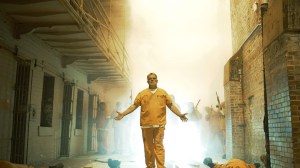
The movie was filmed in the Mansfield Reformatory, the same famously depicted in 1994’s Shawshank Redemption, but at points it sure doesn’t feel that way. I don’t know the exact budget-conscious decisions of the production or the shortcuts they had to work through, but there are several sequences inside and outside the prison that are obviously green screen. It made me start to meticulously examine the visuals and see if it was indeed the famous penitentiary or some other set meant to be stitched together through the power of editing. It’s possible the movie had a very limited availability to shoot inside the prison, so they took extensive pictures to recreate as a more convenient green screen background. I’m uncertain. The green screen work isn’t bad by any means but pretty obvious to the eye and limits the potential visual arrangements for staging the action, which can often resort to shot-reverse shot redundancy.
If the rest of the movie was like its concluding act, I would be recommending Escape from Death Block 13 to fans of low-budget schlocky action and fans of Charles Bronson. It’s strange to think part of the major appeal of this movie is that it stars a guy who strongly resembles another guy that was in movies decades ago that people mostly remember liking. The general association of other, better movies seems to be much of the creative backbone of this movie. The story isn’t packed with careful setups and payoffs, built upon a foundation of obstacles and mini-goals that need to be accomplished before the big escape finish. It relies too heavily on cliched genre moments, like multiple prison yard fights, and the riot ends in a hostage negotiation that could have been its own movie itself rather than a pat conclusion. The movie is weighed down by the acting limitations of its lead who looks the part but fails to do much more on screen. It’s an action movie that, even with caveats and understanding of its limits, manages to disappoint. I wish this had been crazier, or better plotted, or filled with more colorful and arresting characters, or bigger villains, or anything really. It’s an action movie that feels like the ghosts of other, better action movies starring a man who might as well be the living ghost of Charles Bronson.
Nate’s Grade: C
Share this:

Finch (2021)
 Delayed almost two years thanks to COVID and eventually sold to Apple, Finch is the story of Tom Hanks trying to survive the irradiated post-apocalypse with a dog and a robot. That’s the pitch and that’s actually about the extent of the movie. Tom Hanks plays a man dying from UV exposure and trying to create a provider for his beloved dog, who itself has a sad back-story. It’s a simple story but the movie succeeds on the detail of its world-building and the sincerity of Hanks and Caleb Landry Jones (Get Out) in a mo-cap performance as the nascent robotic helper who names himself “Jeff.” It’s a post-apocalyptic buddy film, a road trip movie, and a survival thriller against the new reality of supercharged weather elements and the threat other people can present. The set pieces are effectively developed and open up Finch as a character. Almost after every big moment we have a quiet one where Finch uncorks a monologue that explains more about his own tragic past, the tragic events that left much of Earth to be highly irradiated, or the relationship he had with his own absentee father. Hanks is nicely vulnerable and warmly paternal as a man teaching a robot how to be human in the pursuit of caring for others. This could have been a post-apocalyptic one-man show, a Cast Away meets I Am Legend, but Jones is an enjoyable foil as the clumsy robot who is trying to make his creator proud. The robot design is very minimal but Jones is able to find small ways to communicate the childlike emotions of the character. The movie doesn’t have any devastating moments of suspense, terror, or meaty character drama. It coasts on a pleasant and gentle spirit with a touch of melancholy but Finch mostly keeps things in a relatively heart-warming territory. Finch isn’t much more than its initial pitch, but I’m happy to spend two hours with Tom Hanks trying to teach a robot how to be nice and brave in order to save a dog (spoiler alert: the dog lives too).
Nate’s Grade: B
Share this:

Army of Thieves (2021)

So were you ready for the feature-length back-story for the safe-cracker character in Zack Snyder’s Army of the Dead so that you could feel more emotional involvement and understanding why he was so obsessed with cracking that special super vault in Vegas? Oh, you didn’t, well Netflix decided to spin off the goofy, energetic German character, once again played by Matthias Schweighöfer, who also directs the movie too, and now here it is. The character is too goofy to justify anything terribly dramatic, so the prequel becomes about how he was roped into a heist gang after becoming a star in the… underground safe-cracking betting ring. I would say that seems far-fetched but Netflix’s Squid Games pretty much explained its existence with, “Eh, the rich are bored and will bet on anything.” The most fun part for me was when the movie would take a few self-aware winks, as if it knew it was a movie, and characters would express how, if this were a Hollywood heist movie, this would happen, or that would happen, and then it inevitable does. It’s a small thing but it was something that slightly gave the movie its own identity because everything else is so rote and without charm or intrigue. The requisite gang has their requisite tensions and requisite betrayals and requisite unrequited romances. I just didn’t care much and the set pieces never elevated the suspense or interest level. The heist movie formula is ready-made for enjoyable setups and payoffs, as long as you see it through and hopefully give us fun characters and unexpected complications to overcome and improvise. Army of Thieves feels like a slapped-together action thriller that would have served as the years-later direct-to-DVD franchise ripoff except we got it the same year as its zombie franchise launch. And that’s the thing, this movie is literally taking place during a time there is a zombie outbreak and we’re just shrugging and going along with a standard heist that could have existed in any non-zombie outbreak universe? When even your supporting police characters say, “Hey, shouldn’t we pay more attention to that, you know, zombie apocalypse thing?” then maybe you heed their advice.
Nate’s Grade: C
Share this:

Last Night in Soho (2021)
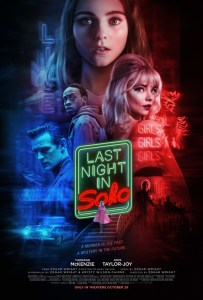
Edgar Wright’s Last Night in Soho is the writer/director’s first work of genuine horror and it’s in many ways unlike his previous movies, both in good ways and not as good. We follow an aspiring fashion student, Eloise (Thomasin McKenzie), as she leaves her small town for the bright lights of London. She has difficulty fitting in with the snobby city girls at school and her new apartment might be haunted. When she goes to sleep, under the alternating neon light filtering through her window, she wakes up back in the 1960s and takes the form of another woman, Sandie (Ana Taylor-Joy). Eloise investigates what happened to Sandie and grows increasingly consumed with solving the crimes of the past and possibly getting lost in it as well.
This is the least Wright-ian movie when it comes to his signature sense of frenetic visual decadence and creative, intuitive editing. This is a more modulated and patient movie, one that doesn’t ape the style of other flashy genre movies for post-modern, meta-textual in-joke commentary. If you had told me that Last Night in Soho was directed by another filmmaker, I would have believed you. It’s a different kind of story and movie, co-written by Krysty Wilson-Cairns (1917, Penny Dreadful), and while mysteries have factored into other Wright films, this one is built upon one. The technical recreation of the swinging ‘60s in London is impressive on every level. The film has an acute sense of style that doesn’t overshadow the unsettling mood of its horror. There’s a period of discovery that keeps your attention into the first half. When Eloise travels back in time, she’s attached as the reflection of Sandie, and this creates very beguiling and imaginative images, like watching Eloise keep pace with Sandie down a mirrored staircase. It made me start to mentally dissect the filming ingenuity, even though it was likely filming the scene in separate pieces, but part of me wondered if they just got the two actresses precise at timing one another’s movements. There are some knockout disturbing images to crank up the horror, like hands reaching out from all manner of spaces, and the grey faces of male phantoms blurring together. There is one visual shot that is so striking on multiple levels, watching the panic of eyes in the reflection of a knife and it plunges in and out of the frame, only increasingly bloodier. Even though I’d consider Soho to be perhaps less visually audacious as Wright’s past works, it’s still a cut above even the better giallo genre homages.

Last Night in Soho is a clear homage but the spooky story ultimately gets caught up in its own machinations and narrative off-ramps. Once the central premise is established by the end of Act One, I was ready for the movie to develop its plot by establishing further rules as we explore the mystery. Is it time travel? I thought if this was established the movie could go several different enticing routes. Perhaps Eloise is going to solve the 1960s tragedy by collecting evidence and investigating witnesses through two different time periods, including people and leads that are lost in present-day. Perhaps Eloise was going to steal the fashions of the 1960s she found as inspirations for her class assignments, becoming more and more dependent on taking the ideas of others rather than trusting her own creative instincts. Is it physical or psychic possession? Perhaps Eloise is finding a freedom in pretending to be someone else and gets addicted to that power and possibility. Perhaps it’s a partnership where both women interact to resolve an unresolved murder case and avenge a past wrong. Perhaps it’s Sandie who discovers the new freedom of being able to be alive in modern-day and it becomes a battle over who will have dominance over Eloise’s body and soul. What about Eloise seeing her dead mother? Does this mean she herself has a special connection to the dead? Will her mother follow her to aid in her safety? Or could Eloise use her trips to the past to find her grandmother? Could this be a manner of learning more about her grandmother while they were similar ages? There are many routes that Wright could have gone, and I would have been interested by any of them with careful plotting and natural development to layer the intrigue and complications. To my surprise, Last Night in Soho doesn’t really clarify or develop its out-of-body setup with more rules.
Without additional rules or development from the plot, it comes down to watching the personal impact this has on Eloise, and at least there the film provides enough of its attention. She’s becoming haunted by the tragic story of Sandie. The movie is very much about the horror of rape culture and how it can traumatize for decades after. It may have been postponed a year due to COVID but it feels very much in response to the Me Too movement that raised awareness of sexual harassment and assault. For Wright’s position, his last movie, 2017’s Baby Driver, starred two actors that have since had their careers affected by reports of predatory behavior, Kevin Spacey and Ansel Elgort, and it almost feels like Soho is a reflective response, in a manner of speaking. It’s Wright’s latent acknowledging how ensnared one can find themselves in an industry or system that profits from the exploitation, humiliation, and silencing of women. Naturally, Hollywood has been an exploitation factory from its very troubled start, with many young women arriving with stars in their eyes only to be taken advantage of by hungry men looking for their next fix. This acknowledgement is nothing new, but Soho feels like repackaging the woman-terrorized-by-unknown giallo films into something more socially relevant and reflective.

The story of Sandie is meant to be an intentional stand-in for thousands of other women who have suffered similar fates at the hands of predatory men promising fame and fortune. It has an undeniable horror, but it’s also somewhat limited with its impact or intrigue because Sandie is kept chiefly as symbol. I didn’t find the extended excursions with her in the past to be as interesting as I’d hoped because Sandie herself isn’t presented as a multi-dimensional figure. That doesn’t mean she’s undeserving of sympathy, it just means I found her to be rather boring. We don’t really learn more about her, until a third act twist that creates some very uncomfortable and potentially troublesome questions. There was a moment where I thought, “Is Wright really trying to make me root for…?” and it did not work. The ending twist feels more like the kind of thing you’d find in the hacky direct-to-DVD version of this kind of genre homage, not from the likes of Wright, a master study on genre recreation. The story of Sandie serves as an industry cautionary tale but by the end I don’t know if Eloise or the audience have learned anything more meaningful other than bad things happen to women.
This is Dame Diana Rigg’s last performance. She died on September 10, 2020 at the age of 82 (the movie opens with a dedication, “For Diana”). The woman who came to fame from the BBC’s Avengers spy series in the 1960s and renewed resurgence from playing the tart-tongued Queen of Thorns on Game of Thrones has a final role that lets her go out in grand style. By the end, it might not fully make as much sense, and invites all sort of questions that tear away the logic of staying in her living conditions for 50 years, but it’s fun to watch this octogenarian go all-in on the messy horror. She’s also the best actor in the movie. Too many other characters are meant as symbols, stand-ins, or conflations, and in fact I wish other characters had been conflated but that’s going into potential spoiler territory to detail. McKenzie (Jojo Rabbit) is a solid lead but not as much is asked of her that could have been. I was expecting her character to become more mentally and emotionally undone, though she sells her fear with effective wide-eyed terror. Matt Smith looks alarmingly identical in 2021 as he did in 2011 with Doctor Who.

I mean no great offense to say that Last Night in Soho is the least of Wright’s impressive and exciting filmography. It’s a solid genre movie with style and intrigue, and while it doesn’t live up to the tantalizing possibilities of its premise, as a horror movie, as a character study, and as a genre homage, it’s still plenty entertaining and with a relevant message about how often women in our society have been the sacrificial victims, not just in the movies.
Nate’s Grade: B
Share this:

The French Dispatch (2021)
 Wes Anderson’s latest quirk-fest is his usual cavalcade of straight-laced absurdity, exquisite dollhouse-level production design, famous faces popping in for droll deadpans, and the overall air of not fully getting it. The French Dispatch is structured like you’re watching the issue of a news magazine come to visual life, meaning that the two-hour movie is comprised of mainly three lengthy vignettes and a couple of short asides. This narrative decision limits the emotional involvement and I found myself growing restless with each of the three segments. I was amused throughout but each felt like a short film that had been pushed beyond its breaking point. Perhaps that is Anderson’s wry, subtle point considering the entire journalistic voice of the movie feels like somebody made a movie in the style of one of those esoteric, supposedly “funny” New Yorker cartoons. It’s occasionally so arch and droll that it feels too removed from actual comedy. This is not the most accessible Anderson movie for a newbie; it’s very bourgeois in the kinds of people it follows, the stories it pursues, and the intellectual and political conflicts it demonstrates. The first and best segment follows Tilda Swinton discussing a heralded but imprisoned experimental artist (Benicio del Toro) who is dealing with the pressure to produce. The second segment follows Frances McDormand as she investigates a Parisian student union revolting against the ignorant powers that be. The third segment follows Jeffrey Wright recounting an assignment where he investigated a master police chef (not “chief”) and gets in the middle of a wacky hostage negotiation. Each of them has the requisite charm and random asides we’ve come to expect from Anderson, including a leotard-wearing strongman that is called upon by the police to help during the hostage crisis, but it felt more like a collection of overlong short films than a cohesive whole. If you’re already a fan, by all means, step into The French Dispatch. If you’re new to the idiosyncratic world of indie film’s most precise curator, then I’d advise starting with a more digestible and earlier Anderson entry. I enjoyed myself during stretches, was getting frustrated during other stretches, and I hope Anderson focuses more on the big picture of his next picture.
Nate’s Grade: C+
Share this:

Mulholland Drive (2001) [Review Re-View]

Originally released October 19, 2001:
Mulholland Dr. has had a long and winding path to get to the state it is presented today. In the beginning it was 120 minutes of a pilot for ABC, though it was skimmed to 90 for the insertion of commercials. But ABC just didn’t seem to get it and declined to pick up David Lynch’s bizarre pilot. Contacted by the French producers of Lynch’s last film, The Straight Story, it was then financed to be a feature film. Lynch went about regathering his cast and filming an additional twenty minutes of material to be added to the 120-minute pilot. And now Mulholland Dr. has gone on to win the Best Director award at Cannes and Best Picture by the New York Film Critics Association.
Laura Harring plays a woman who survives a car crash one night. It appears just before a speeding car full of reckless teens collided into her limo she was intended to be bumped off. She stumbles across the dark streets of Hollywood and finds shelter in an empty apartment where she rests. Betty Elms (Naomi Watts) is a young girl that just got off the bus to sunny California with aspirations of being a big time movie star. She enters her aunt’s apartment to find a nude woman (Harring) in the shower. She tells Betty her name is Rita after glancing at a hanging poster of Rita Hayworth. Rita is suffering from amnesia and has no idea who she is, or for that fact, why her purse is full of thousands of dollars. Betty eagerly wants to help Rita discover who she is and they set off trying to unravel this mystery.

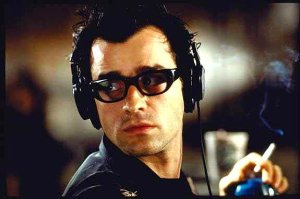
Across town, young hotshot director Adam Kesher (Justin Theroux) is getting ready to go into production for his new film. He angers his mob producers by refusing to cast their chosen girl for his movie. After some harassment, threats, and a visit by an eyebrow-less cowboy assassin (God bless you David Lynch), he relents.
In the meanwhile, people are tracking the streets looking for Rita. Betty and Rita do some detective work and begin amassing clues to her true identify. As they plunge further into their investigation the two also plunge into the roles of lovers. Rita discovers a mysterious blue box and key in her possession. After a night out with Betty she decides to open it, and just when she does and the audience thinks it has a hold on the film, the camera zooms into the abyss of the box and our whole world is turned upside down.
David Lynch has made a meditation on dreams, for that is at the heart of Mulholland Dr. His direction is swift and careful and his writing is just as precise. The noir archetypes are doing battle with noir expectations. The lesbian love scenes could have been handled to look like late night Cinemax fluff, but instead Lynch’s finesse pays off in creating some truly erotic moments. Despite the population of espresso despising mobsters, wheelchair bound dwarfs, and role-reversal lesbians, the audience knows that it is in hands that they can trust. It’s Lynch back to his glorious incomprehensible roots.
Watts is the true breakthrough of Lynch’s casting and she will surely be seen in more films. Watts has to play many facets of possibly the same character, from starry-eyed perky Nancy Drew to a forceful and embittered lesbian lover.
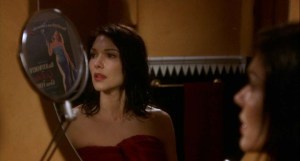
One scene stands out as a perfect example of the talent Watts possesses. Betty has just been shuffled off to an audition for a film and rehearsing with Rita all morning. She’s introduced to her leathery co-star and the directors await her to play out the audition scene of two kids and their forbidden love. As soon as the scene begins Betty vanishes and is totally inhabited by the spirit of her character. She speaks her lines in a breathy, yet whisper-like, voice running over with sensuality but also elements of power. In this moment the characters know, as the audience does, that Betty and Naomi Watts are born movie stars.
It’s not too difficult for a viewer to figure out what portions of the film are from the pilot and what were shot afterwards. I truly doubt if ABC’s standards and practices allows for lesbian sex. The pilot parts seem to have more sheen to them and simpler camera moves, nothing too fancy. The additional footage seems completely opposite and to great effect. Mulholland Dr. has many plot threads that go nowhere or are never touched upon again, most likely parts that were going to be reincorporated with the series.
The truly weirdest part of Mulholland Drive is that the film seems to be working best when it actually is still the pilot. The story is intriguing and one that earns its suspense, mystery, and humor that oozes from this noir heavy dreamscape. The additional twenty minutes of story could be successfully argued one of two ways. It could be said it’s there just to confound an audience and self-indulgent to the good story it abandons. It could also be argued that the ending is meticulously thought out and accentuates the 120 minutes before it with more thought and understanding.
Mulholland Dr. is a tale that would have made an intriguing ongoing television series complete with ripe characters and drama. However, as a movie it still exceeds in entertainment but seems more promising in a different venue.
Nate’s Grade: B
——————————————————
WRITER REFLECTIONS 20 YEARS LATER
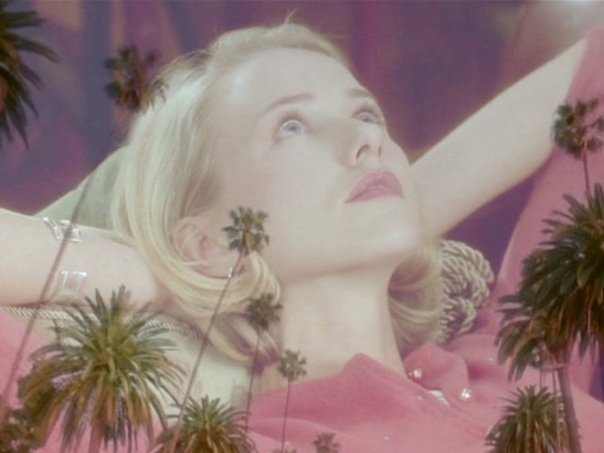
How much is a dream worth to you? That’s my main takeaway re-watching David Lynch’s surreal indie Mulholland Drive twenty years later from its release. Lynch has had plenty of his own run-ins with the dream makers of Tinseltown, from the difficulty to see his admittedly weird projects off the ground to the swift cancellation of his once zeitgeist, and deeply weird, TV series, Twin Peaks. It’s common knowledge now that Mulholland Drive began as a 1999 TV pilot that Lynch re-conceived as a movie, shot 30 minutes of additional footage, and earned a 2001 Best Directing Oscar nomination for his perseverance and creative adaptability. The movie has since taken on quite a reputation. The BBC and Los Angeles Society of Film Critics have both hailed it as the best film of the twenty-first century (so far). Lynch has retreated back to his insular world of weirdness with hypnotic, over-indulgent retreads, Inland Empire, and bringing back his signature TV series for a Showtime run in 2017. In 2001, Mulholland’s Drive’s success seemed to be the last point with Lynch working with the studio system he so despised. In a way, this is his farewell letter to chasing his own dreams of stardom, at least as far as a director can have creative control and a steady supply of protection and money to see his vision through. Watching Mulholland Drive is like stepping through a dream, which has been the hallmark of Lynch’s more celebrated, obtuse filmography from 1977’s Eraserhead onward. The movie is meant to operate on a certain dream logic, sustained with choices that seem artistically self-destructive, but the journey might feel as emotionally or intellectually fleeting as a dream as well, so I ask you, dear reader, to think as you continue, how much is a dream worth?

The failed pilot serves as a majority of the film’s running time and it’s filled with peculiar beginnings that will never pay off. There are actors like Robert Forster (Jackie Brown) and Brent Briscoe (Sling Blade) who show up for one whole scene and then are never seen again. Presumably, the roles would have been more significant as detectives snooping around from the peripheral. There are mysterious forces chasing after “Rita” (Laura Harring), an important-looking woman who has conveniently lost her memory and adopted her name after seeing a poster of Rita Hayworth. She’s got a bag filled with money, a gun, and blue key. One would assume over the course of a network season that we would get closer to discovering the real identity of our amnesiac leading lady. There are also scenes that seem to exist as their own short films, like the darkly comedic hapless hitman and the scared man detailing his spooky dream to a concerned friend in a diner. These characters, presumably, would come back for more significance or at least larger interplay. The same with the mysterious locked box and key. You can practically identify the J.J. Abrams “mystery box”-style of storytelling for future intrigue. The role of a TV pilot is to serve up a storytelling engine that can keep churning, as well as ensuring that there’s enough curiosity to hook an audience through commercial breaks. Lynch is used to inserting strange symbols and starts in his movies that potentially go nowhere, so the difference between a Lynch pilot and a Lynch movie aren’t terribly noticeable. These characters, clues, and moments were perhaps intended to be developed further, or perhaps they never were. It’s as if the movie itself is a nightmare of different television programs colliding incoherently.
There does seem to be a consensus interpretation for Mulholland Drive, one that synchs up the various doubles and symbols. For two hours, we’re riding along with Betty (Naomi Watts) as she moves to L.A. with big dreams and perky naivete. She finds the amnesiac Rita in her aunt’s apartment and takes it upon herself to give her a home and investigate her identity. They grow close together, Betty nails her big acting audition, and then Betty and Rita become lovers. They go to a club (Silencio) where performance artists insist “everything is recorded,” and thus already happened, phony, and a replication of memory, and then Rita inserts that mystery blue key into the mystery box and mysteriously vanishes. We next return to the scene of Diane, who at first was a dead body that Rita and Betty found during their investigation. Now it’s Betty, or at least Watts playing her, and she’s a struggling actress who is jealous of the success and favor her girlfriend, Camilla (also played by Harring), is indulging in from their seedy director, Adam (Justin Theroux). Overcome with torment, she hires a hitman to kill Camilla. From there, she’s attacked by a homeless monster, tiny versions of the people portraying Betty’s parents in the first part, and she takes her own life in grief and guilt. The most common interpretation is that the final twenty or so minutes with Watts as Diane is the real story and that the proceedings 110 minutes was Diane’s dream trying to process her guilty conscience and mixed emotions. The blue key, the symbol from Diane’s hired hitman of a job completed, is the point of transportation between the dream and returning to a living nightmare of regret. Adam’s prominence in the first two hours is explained as punishment from Diane’s mind, so this is why he is emasculated repeatedly, from being robbed of control over his movie, his marriage, and ultimately his future.
Just because this is the most prominent interpretation, and even perhaps the author’s intended one, doesn’t mean other viewers cannot find equally valid and differing interpretations. That’s the appeal or point of frustration with Lynch’s most Lynchian work. However, the problem with asserting that the first two hours of your two-hour-plus movie were all a dream can make it feel overindulgent and unsatisfying. The TV pilot segments are shot in a way that evokes the cliché storytelling stye that prevailed at the time, with overly lit scenes and flat acting. I cannot say for certain but it feels like Lynch purposely told Watts (King Kong) to try and be hammy. Lynch has been known to purposely ape the style of prime-time soaps to provide subtle satirical contexts. Is Watts doing a bad job with the purpose of making us think of other bad actors from soaps? The one scene Betty comes alive is during her audition scene. We’ve already seen her act it out once so we’re expecting more of the same, but in that moment, she comes alive with sensuality, taking control from the aged acting partner who was just there to exploit some young new starlets. The intensity she unleashes, a mixture of carnal desire and self-loathing, is nothing like bright-eyed Betty. Is the irony that when Betty is pretending to be someone else that’s when the performance excels? You can see the points for interpretation, especially considering the ending thesis, but if so, it’s such a bold gamble by Lynch that could prove so alienating. You’re deliberately having your lead actress act in a cliched and stilted manner to perhaps make a point fewer will grasp? Obviously, the ending wasn’t intended to pair with the pilot parts, so it feels like projecting an unintended meaning onto the intentions of acting decisions, but dreams are murky that way.
I wouldn’t be surprised if just as many people are tested by Mulholland Drive as they are mesmerized. It’s a combination of different genres and film iconography, from Manning as a living-breathing femme fatale, to dark whimsical comedy, to surreal mystery, to tawdry erotic drama, to industry-obsessed soap. As much as it feels like a pilot retooled into a new beast, it also feels like a collection of genres being retooled for whatever intended association Lynch wants to impart. It’s ready-made for dissection and ready to take apart the Hollywood studio system. I enjoyed some of the strange moments that felt most ancillary, like the mobster with the extremely refined taste for espressos, and the eyebrow-less cowboy assassin threatening Adam. That scene in particular still has an unsettling menace to it, as Lynch takes what could have been absurd and finds a way to make this man overtly threatening without ever explicitly doing anything threatening. His browbeating to Adam over the difference between listening and hearing is well written and ends perfectly: “You will see me one more time, if you do good. You will see me… two more times, if you do bad. Good night.” I wish more sequences like this could stand on their own. So much of Mulholland Drive seems intended to provide a skeleton for meaning to be provided later as the added meat that Lynch didn’t value as highly.
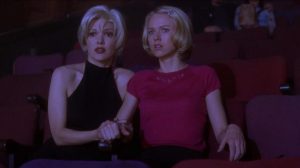
Watts became a star from this movie and was taken to another level with the success of 2002’s The Ring. From there, she was in the Hollywood system of stars and after toiling for ten years from rejected interviews to rejected interviews. She was thinking of quitting acting and going back to her native Australia at the time she got asked to play Betty/Diane. The audition scene, the later distraught and frail Diane, as well as the mannered Betty served as an acting reel for every casting agent that had rejected her. Here was Watts, capable of doing it all and then some (she was nominated for two Oscars – 2003’s 21 Grams and 2012’s The Impossible).
My original review in 2001 is also wrestling with the question over interpretation versus intention, with the genre mash-ups as symbolic satire or as laborious TV pandering. Mulholland Drive is like watching a dream and trying to dissect its many meanings. Some people will relish the puzzle pieces that Lynch has provided and finding further hidden mirrored meanings, and other people will throw up their hands and ask for a road map, or lose interest by then. I don’t think this is the best film of the first twenty years of this new century. I don’t even think it’s close. I think at its best it can be hypnotic and intriguing; it’s a shame that these are only moments for me, and twenty years later these moments felt even further spaced apart. I just didn’t find Lynch’s movie quite worth the long, surreal drive into the dark of his imagination.
Re-View Grade: B-
Share this:

Dune (2021)
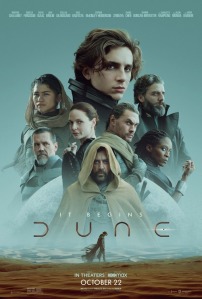
I attempted to read Frank Herbert’s novel Dune when I was in the seventh grade. I had begun to read more fantasy literature and was looking at older, heralded novels. I can still recall my frustration of reading those first five pages and having to repeatedly flip back and forth to a twenty-five-page glossary of terms so that I could even start to comprehend what was happening on the page. After those five excruciating pages, I gave up. Maybe I was too rash, and maybe my older present self would be more accommodating to the struggle, or maybe it just wasn’t worth the effort. I never watched the 1984 David Lynch adaptation that was met with great derision from critics and fans alike, although it does have its vocal defenders (Hindsight alert: Lynch turned down directing Return of the Jedi to helm Dune). So when acclaimed filmmaker Denis Villeneuve (Arrival, Blade Runner 2049) became attached to direct a big-budget, large-scale adaptation of Herbert’s novel, I was finally interested for the first time in my life. It was originally slated to be released in 2020, and after the studio planned to release Dune onto its HBO Max streaming service, Villeneuve and the production company negotiated to make sure a theatrical release would still be an important part of the plan. Alas, I watched the 2021 Dune at home, and I found myself enjoying the experience and development of the world building. However, it’s unlikely to watch this version of Dune and feel like you got a full movie for your money.
In the distant future, like 10,000 A.D., mankind has colonized worlds and the most important planet of them all is Arrakis. It’s a desert world inhabited by poor natives, Freeman, who live a moisture-preserving life mining the natural “spice,” a special substance that makes space travel capable as well as prolonging human life. The top family houses are vying for dominance and House Atreides has been assigned by the unseen Emperor to rule over Arrakis and bring it and its spice production back in line. Duke Leto Atreides (Oscar Isaac) sees great opportunity but also great danger. The other houses will scheme to engineer the failure and desolation of House Atreides, especially House Harkonnen, led by the Baron (Stellan Skarsgard), who is like a mixture between Marlon Brando from Apocalypse Now and Marlon Brando from The Island of Doctor Moreau (plus with levitation powers?). Paul Atriedes (Timothee Chalamet) is his family’s heir and much is expected of him, especially from his mother, Lady Jessica (Rebecca Ferguson), who believes he may be long-prophesied messiah. On Arrakis, Paul and his father must tackle this very delicate new mission while keeping the many adversaries at bay.
As anticipated, Dune is yet another visually stunning and gorgeously immersive visual experience from one of the greatest visual filmmakers working today. If you can watch the movie on a big screen, or at least a bigger screen, then you owe it to yourself to do so. The sweeping vistas and startling science fiction imagery have so much power and grandeur to them. If Lynch’s movie inspired a generation of devotees and impressionable children, I imagine that this superior modern version will do likewise. The production design and costumes are terrific and perfectly in keeping with the larger scope of the expansive visuals. You really feel the size of this world and its imposing weight. Villeneuve has such a natural keen eye for pleasing visual compositions, but he also has the patience many famous big screen stylists lack. He allows the moments to linger and to let scenes breathe in a way that feels more transporting and immersive. If you were simply looking for a visually resplendent movie-going experience, then Dune is the ticket. The sound design is also very smartly aligned and makes use of unconventional and alien sounds to make the movie feel even more like its own thing. When Dune came out in 1965, this was before much of the modern building blocks of our sci-fi pop-culture, so in a way while Dune was the influence it feels partially like an odd after-effect rather than a predecessor. The same thing happened with 2012’s John Carter, based upon a novel a hundred years old that influenced many sci-fi adventure serials and now seems derivative even though it came before the many imitations. I was happy with the first 90 minutes of Dune and felt like the slow pace of the first hour, and its heft of needed but spaced-out exposition, was paying off with a thrilling assault. The concept of the protective shields is a smart way to communicate the casualties of battle, where “kill shots” are illuminated in red, informing the audience of a mortal wound. It makes for an easy to read visual to keep up with the development of battle and stay in a safer PG-13 realm. The whole rescue sequence on the mining station is thrilling at every step.
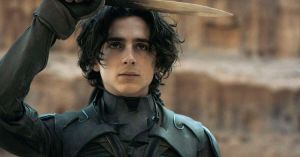
The cast is another major credit to the success of Dune. Chalament (Little Women) has a soulful yearning to him, to learn, to be his own man, to prove his father wrong and then prove worthy of his father’s faith. Surprisingly, the next biggest role isn’t Zendaya (Malcolm and Marie), the woman that Paul dreams about (prophetically?); it’s Rebecca Ferguson (Doctor Sleep) as Paul’s mother. She’s a woman with deep secrets belonging to a powerful religious sect that might be the real power behind the throne. Lady Jessica is more Paul’s mentor than any man. She teaches him to hone and focus his mind, to use the “Voice” to impart his will, and to prepare for the hardships to come. With every new exposition dump, and she has many, we learn about her growing concern for the fate of her son and her possible culpability for that fate. There’s a genuine warmth between them that serves as the film’s emotional core. I enjoyed watching Jason Momoa (Aquaman) and Dave Bautista (Army of the Dead) as opposite ends of Super Good Fighter Guy, though Momoa looked unsettling without a beard. Needless to say, the 2021 movie is far more diverse than the 1984 movie. It makes space feel more lived in when it’s reflective of a diversity of people that we already have at this point in our history.
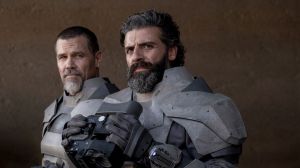
And then, after the hallway mark, Dune became a protracted sequence of chases and then I started to worry that things were just going to end in an unsatisfying manner, relegating the 150 minutes as setup for the as-yet-unplanned sequel, and that’s exactly what happened. My mood began to deflate somewhat during the last hour of Dune. I was still interested and the visuals were still mighty captivating, but the events had the unmistakable feeling of being stretched out to meet a frustrating stopping point, a pause that didn’t produce a satisfying endpoint. I just kept thinking, “Oh, they’re not going to resolve this,” and, “Oh, Zendaya is barely going to be in this movie,” and the movie proved my predictions correct. It’s hard to judge the movie as its own entity since it’s so dependent on a Part Two that has yet to be greenlighted (though its strong opening box-office returns are hopeful). This is an expensive movie, possibly pushing $200 million, so it’s quite a gamble to declare you would only be adapting roughly half of the story. Villeneuve’s Blade Runner sequel, a movie I loved, had a budget of $150 million and a worldwide gross that didn’t make the producers comfortable going forward with a Blade Runner 2050. To be fair, that was an original story, a sequel, and rather well contained. Still, it’s an expensive sci-fi movie that has as much in common with dry art house fare as it does blockbuster adventures, like Villeneuve’s Dune. The promise of a second movie is not secured. If Dune doesn’t do well enough, we’ll forever be left with a movie that feels designed to only be a teaser. It reminds me of the hubris of 2007’s The Golden Compass where the filmmakers had a whole 20-minute finale that they carved out with the intention of having it be the opening for the assumed sequel (welp). Even when designing a multi-movie arc, it’s necessary to plan each entry so that it can exist as its own beginning-middle-end and with a suitable intermediary climax. The Lord of the Rings movies each had their own climax, each moving the larger picture forward, and each had storylines and subplots that came to a head by film’s conclusion. Dune doesn’t. There are more dead characters by the end and certain characters are displaced, but it feels less like the end of the big-budget Dune movie and more like the conclusion of episode two of the Dune mini-series.
My resonance with the source material is minimal, but the world of Dune feels stuffed with stuff and not as deep in the realm of commentary. Fans of the book series will likely thrill at the level of minutia the 2021 movie luxuriates in, allowing fans to lap up the lore. For those of us uninitiated into the fandom, it feels like there could be more going on behind the scenes. The book was released in 1965 and has clear parallels to Middle East occupations and quagmires, a subject even more relevant in the first quarter of this new century. There’s the occupying force coming in to manage the supposedly primitive natives on a desert planet, replacing the last occupier who made bold promises that were unable to be met by the reality on the ground. The parallels of colonialism are there and obvious, but that’s because everything in Dune seems obvious to me. The bad guys are corpse-white and dressed in all black. They look like the alien zombies from 1998’s Dark City (itself referencing the silent sci-fi classic, Metropolis). The leader of House Harkonnen is this noxious man who bathes in black goo and sucks the life force from others. I don’t need my sci-fi to be ambiguous about its heroes and villains. We clearly recognize the bad guys because they’re grotesque. However, the lessons learned by the heroes seem a bit stilted. Its attacks on capitalism are a little more nuanced but not much. The planet of Arrakis could produce water but that’s not in the interest of the power brokers of the galaxy. They need the spice for the economy and thus keep the exploitative status quo. The parallels are there but there’s not much more to be had other than direct summations. The movie has more to say with religion and messiah figures but at this point we’re grading on a curve, and the more complex commentary attached to messiah figures seems reserved for a Part Two.
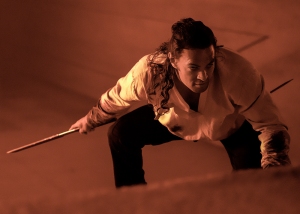
Another aspect I want to highlight that seems trivial but no less intriguing to me is how Herbert chooses his character names. We’re eight thousand years into the future, spanning multiple planets with names like Arrakis and Giedi Prime and Salusa Secondus, and then we have such anodyne twentieth-century names like… Paul and Jessica? It’s funny to me that Herbert goes to the trouble of coming up with so much jargon and terminology and alien-sounding names and then he says, “Hey, this guy’s name is… Duncan Idaho,” like he’s a supporting character in Point Break. I realize this is a very dubious criticism, and there are other character names to conflict with this assertion, but it made me laugh at the different levels of effort Herbert put into his world-building and universe than selecting character names for that same far away land.
After watching the new Dune, I went and watched the 1984 David Lynch version for the first time and was, quite simply, dumbfounded. I’ll credit Lynch for many of the weird choices in style and how it never stoops to even be accessible for a mass audience, despite having characters explicitly narrate their schemes and motivations out in the open (by scene one, the power play that took up 90 minutes of Dune 2021 is awkwardly explained in full). By the end of Lynch’s movie, it is an incomprehensible campy mess. I only have more appreciation for the 2021 Dune after watching the goofy (those eyebrows!) 1980s version that Lynch has disowned entirely, although that stirring guitar riff from the score still rocks thirty years later. The new Dune is only intended as Part One as its presumptive title promises, and because of this key artistic decision, there’s a feeling of padding and wear by the end. I found myself reflecting back on the first 90 minutes more fondly. It’s not that the last hour is absent great moments or audacious style, but it’s hard to fully judge this Dune when its last line is its own conditioning of expectations: “This is only the beginning.” The 2021 Dune is a visually remarkable movie experience with fantastic artists executing at some of the highest points of their talent. I’m eager to see if a Part Two can provide the satisfaction lacking in this beginning half. It’s a hell of a start but it feels too incomplete and in need of an ending.
Nate’s Grade: B
Share this:

Halloween Kills (2021)
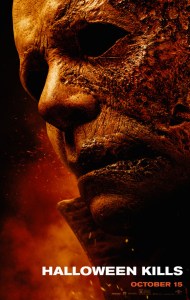 In 2018, versatile indie director David Gordon Green (Stronger, Pineapple Express) and actor Danny McBride (Eastbound & Down) rebooted the Halloween franchise with a monstrous box-office return for their efforts. From there, the studio planned two immediate sequels to cash in. Delayed by a year, Halloween Kills is the first sequel and coming out just in time for the spooky season. The problem is the only thing this movie is going to adequately kill is 100 minutes of your time.
Laurie Strode (Jamie Lee Curtis) and her daughter (Judy Greer) and granddaughter (Andi Matichak) have trapped Michael Myers into their basement and set the house ablaze. Unfortunately for everyone, a team of firefighters rescues the giant killing machine. Michael wanders the town of Haddonfield, killing whomever he encounters, eventually circling back to his childhood home, the site of his first murder. The townsfolk have decided that they are sick of living in fear from the legend of Myers. They form a violent mob, chanting “Evil dies tonight,” and break into armed clusters to snuff out Michael Myers and put him in the ground for good.
 There is one intriguing aspect of the movie that gives it some fleeting life. The 2018 predecessor tantalizing explored the idea of generational trauma from terror, with Laurie raising her daughter in a constant state of paranoia and anxiety to prepare her for the eventual return of the unstoppable menace. The fraught relationship between three generations of Strodes was deserving of far more attention than it ultimately received in the 2018 film, although at least the filmmakers were smart enough to realize having them join their multi-generational talents would be a natural payoff. With Halloween Kills, we get a similar concept of generational trauma but from the point of view the supporting townsfolk, many meant to resemble middle-aged versions of bit characters from the older Halloween movies from the John Carpenter era. That sort of dedication to furthering the mythology of this town seems misplaced for the fan base. I doubt many hardcore Halloween fans were chomping to find out what happened to the little kid Laurie babysat. However, these obscure Haddonfield characters become a support group for trauma, a lasting memory of the horrible history of their town, and when Myers returns, they’re the first to fight back and form a mob to round up the masked boogeyman. The town’s social order breaks down and people give into the mob mentality of ends-justify-the-means violence. Even though Halloween Kills was originally scheduled to be released a year ago, it has a different feel in a world after the 2021 U.S. Capital insurrection, watching a sea of angry, misinformed citizens run wild in misplaced fear and loathing. It leads to tragedy and mistakes as the Haddonfield mob sweeps up, gathers more momentum, and doesn’t stop to think who it may trample upon next.
It was enough that made me wish the entire movie had been told from this peanut gallery perspective. Rather than following the silent killer stalk and brutally slay, let’s focus on the lesser seen cost of terror. Let’s concentrate on the side characters, the kinds who would normally play out as Cop #3 or Concerned Mom #2 in a normal slasher movie. What if we elevated them and told a slasher story from their victimized perspective and we stayed with their fear and anxiety while they remained in the dark about a madman terrorizing their town? The earlier movie was about how trauma had racked Laurie Strode’s life and personal relationships. It’s fitting that a sequel would widen the scope and show how many others have also suffered and are still haunted by their own trauma and PTSD from their fateful experiences with homegrown evil. Maybe it’s the less cinematic approach, but it’s something new and different and looking at a more human perspective for a sub-genre better known as serving as a relentless conveyor belt for wanton vivisection.
 What I’m saying is that these standard genre slasher movies bore me unless they have some exhilarating style, fresh ideas, or clever perspective shifts. With Halloween Kills, I’m watching a dull silent killer slowly murder disposable supporting characters and none of it qualifies as interesting. I don’t care about these people. I don’t find Michael Myers to be interesting (even when Rob Zombie foolishly tried to establish a trashy childhood back-story). The only thing I found worthwhile from the 2018 movie was the mother-daughter drama with the Strodes, which has all but been sidelined for the 2021 sequel. Perhaps I’m not the right audience for these kinds of movies, or perhaps this one just simply isn’t trying hard enough where it counts. The kills aren’t particularly memorable, though several are quite brutal and even a bit mean-spirited. The suspense set pieces are rote. The movie just feels far too much like it’s on autopilot, trying to provide enough filler material until its eventual concluding chapter, 2022’s Halloween Ends (yeah, we’ll see about that, title). We’re still watching a man pushing 70 years of age defy multiple stab wounds, bullets, contusions and beatings, and any number of aggressive defensive violence. It gets irritating. He’s not some supernatural force back from the dead like a Jason Voorhees; he’s just a beefy AARP member.
Green has an affinity for the franchise and the gore can be downright gooey and wince-inducing. The opening segment is an impressive recreation of the filmmaking techniques John Carpenter used in the late 1970s, even down to the period appropriate synth score. It’s a fun inclusion that essentially gives added context to the adult versions of many supporting charterers, seeing their own youthful run-ins with Michael Myers that fateful Halloween night so long ago. It’s clever but it adds up to little else as the movie progresses. If these moments with these characters had been more meaningful, maybe their eventual deaths would have meant more, but just because we spent more time with Cop #3 doesn’t mean their ultimate demise feels more than the death of Cop #3. Ultimately, it feels like this early section, a superfluous reminder of the past, is just here as something to entertain Green as a returning director for a filler sequel to a so-so movie. The strange humor of the 2018 edition has been completely eliminated, so what we’re left with is a thoroughly redundant slasher movie with some intriguing ideas percolating but not coming to fruition.
 If you were a fan of Curtis (Knives Out) as the gritty survivalist, the Cassandra trying to warn others of the impending doom they seem so oblivious to, then you’ll be disappointed here. I don’t know if Green and his co-writers were making a purposeful homage to the 1981 sequel where Laurie keeps to a hospital for the entire movie. Either way, Laurie is stuck in a hospital bed because the movie only follows mere hours from the events of the 2018 movie and only goes forward mere hours from there. We’re stuck, and so is Curtis, as she practically sits this one out. Judy Greer is likewise wasted as Laurie’s adult daughter. If there’s a star of this 2021 sequel, it’s Anthony Michael Hall (Live by Night) as the leader of the town’s mob. He has an intensity to him that feels believable without crossing over into exaggerated cartoon zealot.
If you’re a sucker for the Halloween franchise, or the glut of slasher movies that have exploded in the age of streaming, then perhaps enough of the crimson stuff gets spilled to satiate your horror appetites. I’m just bored by another movie about another slow-moving guy in a mask at this point. I need more, anything more, and Halloween Kills gives me too much of the same old same dead.
Nate’s Grade: C
Share this:

Donnie Darko (2001) [Review Re-View]
 Originally released October 26, 2001:
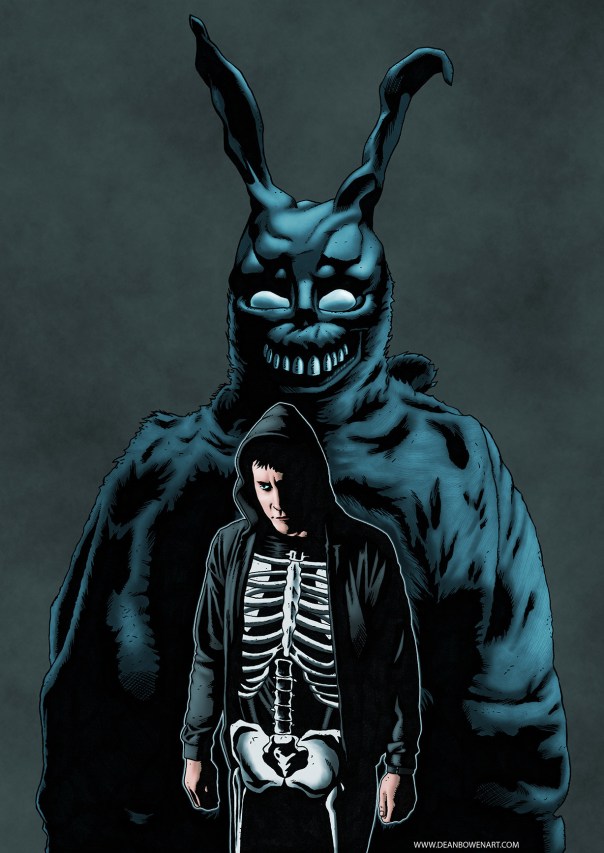
Donnie Darko (Jake Gyllenhaal) is your normal malcontent teenager in late 1980s Reagan America. He bickers with his older sister, worries over the right moment he’ll kiss his new girlfriend, and tries to ignore the advice of many imprudent adults. Donnie’s your typical teenager, except for his imaginary friend Frank. Frank is a sinister looking six-foot tall rabbit that encourages Donnie into mischief and gives a countdown to the impending apocalypse. And I haven’t even gotten to the time travel yet.
One night as Donnie wanders from his home at the behest of Frank, an airline engine mysteriously crashes through the Darko home and lands directly in Donnie’s room. The airlines are all at a loss for explanation, as it seems no one will take responsibility for the engine or knows where it came from. Donnie becomes a mild celebrity at school and initiates a relationship with a new girl, Gretchen Ross (Jena Malone). One of his classes consists of watching videos of self-help guru and new age enlightenment pitchman Jim Cunningham (Patrick Swayze). His school has even, under the persistence of self-righteous pain Kitty Farmer, persuaded Cunningham to speak and try to help students conquer their “fears.”
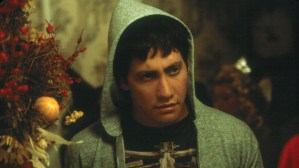 Donnie is also seeing a therapist for his emotional problems and taking medication for borderline schizophrenia. Around this time is when Donnie starts to inquire about a strange old woman, obsess over the possibilities of time travel, as well as see weird phosphorescent pools extend from people’s chests. He also floods his school at the urging of Frank. This is no Harvey-type rabbit.
The longer Donnie Darko goes on the more tightly complex and imaginative the story gets. First time writer-director Richard Kelly has forged an excitingly original film that is incredibly engaging with charm and wit. He masterfully mixes themes of alienation, dark comedy, romance, science fiction, and a sublime satire of high school. Donnie Darko is the most unique, head-trip of a movie unleashed on the public since Being John Malkovich. Kelly has a created an astonishing breakthrough for himself and has ensured he is a talent to look out for in the future.
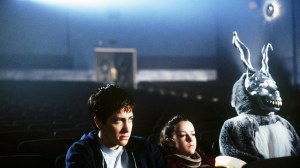 Gyllenhaal (October Sky) is superb as disenchanted Donnie, a Holden Caulfield for middle suburbia. His ghastly stare conveys the darkness of Donnie but his laid-back nature allows the audience to care about what could have merely been another angst-ridden teenager. Swayze is hysterical as the scenery-chewing Cunningham. The rest of the cast is mainly underwritten in their roles, including stars Drew Barrymore (who was executive producer) and ER‘s Noah Wyle, but all perform admirably with the amount they are given. Not every plot thread is exactly tidied up but this can easily be forgiven.
Donnie Darko is a film that demands your intelligence and requires you to stay on your toes, so you can forget any bathroom breaks. The film is one of the best of 2001 but also one of the funniest. You’ll be honestly surprised the amount of times you laugh out loud with this flick. The theater I saw this in erupted every half a minute or so with boisterous laughter.
Donnie Darko is a film of daring skill and great imagination. You don’t see too many of these around anymore.
Nate’s Grade: A
——————————————————
WRITER REFLECTIONS 20 YEARS LATER
Not to sound too annoying, but I’ll cash in my hipster points here and declare that I was on the Donnie Darko bandwagon from the start. The eventual cult phenom was originally released in October 2001, mere weeks removed from 9/11, dooming its commercial appeal considering a major plot point happens to involve deadly airline debris. I was a sophomore in college across from a little indie movie theater, the Drexel, that was like a wonderful escape for a budding cinephile looking for his next fix of weird and daring movie experiences. I recall seeing the trailer for Donnie Darko and being immediately intrigued, but its release date kept bouncing back month after month until it finally opened at the Drexel in February 2002, and I was there opening day. I saw it twice, brought friends with me, and I wrote about it as one of my earliest reviews as my college newspaper’s film critic. I wanted to get the word out that this was something special. The first day it was available on DVD, I went to Best Buy looking for a copy and the store employee was deeply confused about its existence. He probably knows now, as the movie achieved cult status on DVD and became an iconic indie fixture for many a Millennial.
Revisiting the films of 2001 has been reliving many films that made such formative impacts on my life: Memento and its airtight structural sleight-of-hand, Moulin Rouge and its ambitious and messy celebration of old, new, reverent and irreverent, and now Donnie Darko (this isn’t even counting films I never wrote reviews for and thus were ineligible for this re-watch, like Hedwig and the Angry Inch and Amelie – 2001 was an excellent year at the movies). I have probably watched this movie more than any other in the 2000s, with the late exception perhaps of The Room that came on strong for me at the end. My friends and I would debate it, quote it, and work toward bringing others into the cult of Darko. Looking back now twenty years, I’m happy to report the movie’s power is still just as alluring and transcendental. What earned this movie its fawning fandom? Why did writer/director Richard Kelly, only in his early 20s, find success with his weird little indie while others went painfully ignored? I think it comes down to Kelly’s ambiguous approach, threading a delicate needle so that there are enough pieces present to put together an interpretation that can prove satisfying while personal and potentially different from your friend or neighbor with an equally valid interpretation.
 What helps is that Donnie Darko doesn’t feel like it’s weird for weird’s sake, like a formless collection of strange ideas and confounding imagery operating on an unknowable surreal dream logic. What Kelly has done is mix and match parts of an intriguing apocalyptic puzzle. There’s relatable high school drama about pushing back against the hypocrites and phonies of the adult world, there’s a mystery about who or what is behind Frank the bunny, the creepy otherworldly figure serving as Donnie’s Virgil-like guide, and the character study of a lonely, troubled kid trying to find a better sense of understanding of himself, his place in the world, and his sense of what lies beyond. I could just as readily view Donnie Darko as a spiritual refresher, and I’ve always sided more with a divine interpretation than sci-fi. Donnie and his therapist talk about the question over God’s existence and Donnie says he doesn’t feel like he can get anywhere debating it, so he has simply agreed to give up. Donnie talks about dying alone and how if everyone is resigned to do so then this must be a condemnation of God. Kelly establishes these early conditions as the beginning of an arc that leads to Donnie not just accepting a messianic status but volunteering for one, dying alone but in a manner that serves as victory. This to me is why he laughs at the end after being transported back to a fateful spot. He rolls over in his bed and closes his eyes knowing an end for him is not an end but a vindication (the honking from Frank the second time serving as a “we did it” victory celebration). Through his sacrifice, the world will continue (“I hope when the world comes to an end, I can breathe a sigh of relief, because there will be so much to look forward to.”). Through bizarre circumstances, a young man has found spiritual renewal, bringing him to a personal fulfillment as well as the larger picture of averting a looming apocalypse for a tangent world.
This has been my preferred reading of Donnie Darko, with divine forces selecting Donnie as the universe’s lone hero and mysteriously guiding him along his journey, each intervention and urging from Frank leading to the culmination of events that would convince Donnie of his duty. When Donnie is talking to Frank the bunny in an empty movie theater (playing a double feature of Evil Dead and The Last Temptation of Christ, one of my favorite jokes), he asks Frank, “Why do you wear that stupid bunny suit?” Frank turns and asks, “Why do you wear that stupid man suit?” Under my interpretation, Frank is a supernatural force, call it an angel or whatever you want, but he is not human and only using the form of a doomed man as a necessary vessel. When Donnie breaks into his school and breaks the water main, under the hypnotic control of Frank’s urging, we see that the vandal has also spray-painted “They made me do it” on the school mascot. The school and police go class-by-class and have students rewrite the phrase on a chalkboard, analyzing their handwriting. Donnie’s handwriting is clearly different. Could it be that Donnie, under the influence of Frank, also wrote as him, adopting his handwriting? With that, perhaps instead of Donnie writing a would-be confession it was actually Frank. “They made me do it,” Frank writes in apology to Donnie, not just for prodding him along but ultimately for the pain and suffering the real Frank of this world will cause for Donnie. “I’m sorry that all of this has to happen to you, Donnie. It wasn’t my choice. They made me do it for their plan.” I think that’s a more intriguing examination than Donnie just saying he was told to flood the school by his imaginary friend.
 This is one reason why I was not a big fan of Kelly’s eventual director’s cut DVD release in 2004, which added twenty minutes to the film and changed many edits, song choices, and special effects sequences. The director’s cut went too far for me, specifically spelling out Kelly’s vision of time travelers from the future trying to coach Donnie as their variable. Whole sections from Roberta Sparrow’s book, The Philosophy of Time Travel, were printed on screen, explicitly connecting the various pieces in a way that had previously been left as ambiguous. My disappointment with the director’s cut reminded me of the disappointment Star Wars fans felt when George Lucas went back and tinkered with the original trilogy. Lucas has said the re-releases were the films he had always intended them to be, that the earlier theatrical editions were the imperfect versions of his creative intentions. The problem is that millions fell in love with those versions of the movie, even if they were an imperfect vision of their creator. Richard Kelly always intended for the opening song to be INXS’ “Never Tear Us Apart,” but hearing that felt wrong to me after watching the same scene played to Echo and the Bunnyman’s “The Killing Moon” with the theatrical cut. Kelly’s imperfect version was the one I fell in love with, the one that spoke to me as a 19-year-old and as a 39-year-old, and that’s the one I vastly prefer.
Another reason for Donnie Darko’s success is more than likely the appeal and performance of young Jake Gyllenhaal. Over twenty years, Gyllenhaal has become one of the best actors of his generation and criminally overlooked by the Academy. He’s only been nominated for one Oscar for 2005’s Brokeback Mountain, not for 2017’s Stronger, or 2007’s Zodiac, or, most egregiously, for his hypnotically disturbing portrayal in 2014’s Nightcrawler. Gyllenhaal has mesmerized for so long and handles the many confusing aspects of Donnie with aplomb. It would be easy to play Donnie as a cliched rebellious teenager, but Gyllenhaal really digs into his questioning nature; he’s hungry for answers, desperate even, and tired of being disappointed in the adults of his life. That’s why it becomes emotionally satisfying for me when Donnie appears to achieve some semblance of answers by the end, his laughter is victorious and cathartic.
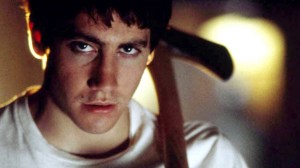 Jake Gyllenhaal is terrific but the rest of the cast is outstanding. This was the first time I saw Maggie Gyllenhaal, as Donnie’s older sister, one year before her star-making turn in 2002’s Secretary (stay tuned, 2022). Jena Malone (The Hunger Games sequels) was a remarkably downhearted presence, able to imbue teenage heartache and unease so preternaturally. Ever since her role as the snitty, judgmental gym teacher Kitty Farmer, I perk up whenever I see Beth Grant in a movie or show. To this day I still consider her wondrous line reading of, “Sometimes I doubt your commitment to Sparkle Motion” to be one of the greatest achievements in mankind’s history. Mary McDonnell (Battlestar Galactica) has two scenes that still get me as Donnie’s mother, where she fights back tears at the suggestion of Donnie’s therapist to up his medication as doing what she thinks is right for her son, and a final scene with that same son where she responds to his query that having a “weirdo for a son” is, in fact, wonderful. The parental care and empathy that she exudes is poignant. I still laugh when Holmes Osborne, as Donnie’s father, cannot contain his inappropriate titter to hearing about his son’s vulgar outburst directed at Ms. Farmer. The adult actors (Drew Barrymore, Patrick Swayze, Noah Wyle) all got the bigger headlines at the time, but it’s these actors that have stayed with me the most.
With so many people being launched into success and acclaim from this movie, it’s a sad surprise that Richard Kelly himself was never able to recreate his winning alchemy. He wrote the shooting draft for 2005’s Domino, a needlessly excessive and irritating movie. His big follow-up, 2008’s Southland Tales, was a disaster at the Cannes Film Festival and Kelly cut a half-hour before it was ultimately released stateside to head-scratching. I was eagerly anticipating Southland Tales and then I watched it and minute-by-minute the sinking realization set in that this was not going anywhere and anytime soon. It was like Kelly was trying to throw every dispirit idea he ever had into one movie for fear he’d never make another. I haven’t re-watched it since and feel no need to do so. The last movie Kelly directed was 2009’s The Box, an adaption of the William Matheson short story featured on newer incarnations of The Twilight Zone. It too failed at the box-office, suffered from a confusing and muddled narrative, and from there Kelly was radioactive to Hollywood. He hasn’t a credit to his name since. With each directorial effort, you can feel Kelly trying to recreate that formula from Darko, bringing the different weird pieces and tones together by the end to form a satisfying mosaic open to interpretation. Southland and The Box both feel over-extended, strained, and cluttered with too much salient junk. I truly wish Kelly has another shot to tell a big screen story after everything he’s been through. I’m sure he has more stories to tickle our brains. Maybe he just needs an editorial guidance.
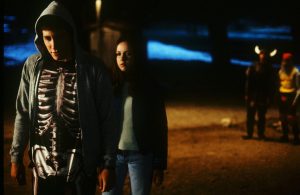 The other thing of curious note is that a sequel, S. Darko, was released in 2009 starring Donnie’s little sister Samantha, played by Daveigh Chase (The Ring). It’s not very good at all and strains to be an imitation of its predecessor, right down to Samantha having to be the sacrifice to go back in time and save her friend’s life. Kelly had nothing to do with the sequel, which was written by Nate Adkins, who would go onto create the Netflix franchise, The Christmas Prince. There is nothing of note in this cash-grab of a sequel to even reward your curiosity in watching it.
Donnie Darko was a movie I loved when I originally saw it and I’m happy so many others were able to become fans and share the good news of Darko. I’m happy this movie exists and has stuck with me all these years. It’s still transporting and invigorating and funny and soulful and tantalizing. I still love the lilt of Michael Andrews’ minimalist score. I love the scene of Donnie reaching out to Cherita Chen, the target of rampant bullying, to promise her one day everything will be better for her. I still get fascinated by the instant-iconic design of that Frank the bunny mask, an image that has lead to thousands of Halloween costume imitations. My original review was more driven by distilling its plot so that I could hook a reader into making the trip for themselves. Otherwise, my thoughts remain relative the same in twenty years of reflection. This is a gem of a movie that was never really recreated by its creator, which makes it all the more remarkable and special. If you haven’t joined the cult of Donnie Darko, there’s no time like the present, folks.
Re-View Grade: A


 nathanzoebl
You must be logged in to post a comment.