Rules of Engagement (2000)

Samuel L. Jackson and Tommy Lee Jones are old war pals who took separate paths after a cataclysmic ambush in Vietnam. Jackson went on to a prestigious career in combat but Jones was restricted to desk jobs the rest of his tenure. It appears Arabs are at their old tricks again, being that without Nazis or Communists they are Hollywood’s favorite misrepresented bad guys. Jackson gets dispatched to protect a U.S. embassy besieged by protests. During the melee of confusion Jackson orders fire on the crowds outside. Now he has to face the ramifications which include murder charges and a tangled web of conspiracy.

Jackson gives an electric performance as the Marine Captain full of sound and fury. Jones and Jackson exhibit great chemistry together under William Friedkin’s deft hand. Friedkin, known for classics like The French Connection and The Exorcist, whose last pic was Jade, has crafted exciting sequences of action and suspense. The problem is they all happen early and the film unwinds and unspools as it continues.

Bruce Greenwood seems to be making a career out of beguiling Jones. In last fall’s Double Jeopardy he was a slimy not-so-dead hubby, and in Rules he’s a slimy National Security adviser. These two look like they’ll be the Ben and Matt of the over forty crowd.

Rules of Engagement is a courtroom action/drama that plays closely to the rules established but coasts on terrific performances from its leads and some dynamite action sequences. But eventually the weight of the plot drags Rules from the potential it flashed.

Nate’s Grade: C+

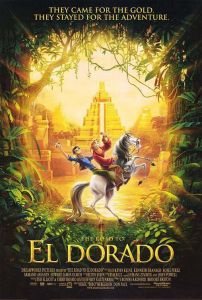
The Road to El Dorado (2000)

Tulio (Kevin Kline) and Miguel (Kenneth Branaugh) are two 16th Century Spanish con men who somehow speak in English accents and appear to have a secret gay relationship. I calls ’em as I see ’em people. Through a strange comedy of errors the boys end up marooned on a far off land with a horse in their possession as well as a mysterious map. The map leads to the unfold treasures of the mysterious fable of the city of El Dorado. They partner with a saucy native (Rosie Perez) with hips bigger than shoulders and a pining to be taken away.

Dreamworks has scored big with previous strong ink and paint outings, but El Dorado seems to be a disappointment. At times the banter between Kline and Branaugh is lively and humorous but the energy is never sustained for long. El Dorado lulls unexpectedly quite often. Katzenberg created the very successful Disney animated formula, and still sticks by it regrettably. The Iron Giant showed originality can work, so why is no one listening?!

The animation is surprisingly shoddy at times. The contrast between 3-D and 2-D animation is easily noticeable, unlike the work in Prince of Egypt. Perez seems miscast, what with her Puerto Rican accent, and close to all the characters are poorly underwritten, even the damn horse.

Elton John and Tim Rice buddy up after their successful pairing with the Diz blockbuster The Lion King to unleash wave after wave of senseless drivel. None of the monotonous songs are memorable, or even downright humable. After seeing these pop regurgitation it’s easy to see that everyone makes a bad step. Consider this one.

El Dorado is an animated attempt toward the bumbling road pictures of Hope and Crosby, but this tank is too low on gas for the entire trip.

Nate’s Grade: C+

Erin Brockovich (2000)

Julia Roberts is the female equivalent of John Travolta in last year’s A Civil Action — little guy/gal taking on the big/evil corporations that pollute our water. This is hands down what is likely her best performance of her long career. It’s a one-sided take and displays the title character’s ruthless tactics and intimidation in order to reach whatever goal she wishes to strive for. The story though, isn’t much for most to work with as it is essentially sap and predictability: the hero will win, justice will prevail, the bad guys who were alluding in the beginning will be punished… etc. etc. Julia’s “woman in a man’s world” business gruff will either prove sadistically humorous or simply wickedly mean-spirited to each viewer. You’ll either love this character or hate this character but either way it will keep you watching.

Nate’s Grade: B

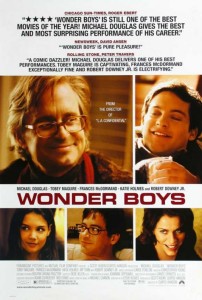
Wonder Boys (2000)

A rather warm but ultimately meandering tale of Michael Douglas as a college professor going through one crisis after another, Tobey Maguire as a creepy kid (again?!), and Robert Downey Jr. as an editor who seems to have a taste for transvestites. Though likable, Wonder Boys goes nowhere and nowhere slow. It carries the feel of a novel that was never intended to be brought onto the screen because of what it would lose in transition and it does. Douglas’ performance is sincere and syrupy but Wonder Boys is not a night out on the town.

Nate’s Grade: C+


Reviewed 20 years later as part of the “Reviews Re-View: 2000” article.

Mission to Mars (2000)

Mission to Mars begins with a team of astronauts making the first manned mission to the red planet. Unfortunately things go… um, bad, and thus with no knowledge of any survivors and the six month time period it takes to travel to Mars, NASA sends out a rescue mission. More things go bad.

The setting is supposed to be 2020 but everything looks exactly like 1980. In the future there seems to be heavy reliance on product placement. From Dr. Pepper, to M&Ms, to having the damn Mars buggy plastered with Penzoil and Kawasaki. Are these astronauts Earth’s interstellar door-to-door salesmen? I was half expecting them to nix the American flag and firmly plant one for Nike. Maybe the future’s just this way because they drink from square beer.

Director Brian DePalma unleashes fantastic special effect after another, but they can only sugarcoat the bitter taste Mars leaves in your mouth. Mission to Mars is tragically slow paced, full of interchangeable and indiscernible characters, and begging for some kind of insight. Don Cheadle and Gary Sinise prove that no matter how great an actor you are, when you’re given cheesy sci-fi dialogue, it’s still cheesy.

The fault lies with the more than three screenwriters and DePalma himself. Plain and simple, DePalma has lost his touch. His good days (The Untouchables) are clearly behind him on his new downward slide. Mars in any other director’s hands would no doubt be different — and that’s no bad thing. DePalma’s style of appropriations rips off the earlier, better, and more insightful 2001 and Close Encounters of the Third Kind.

Mars is surprisingly and sadly devoid of any tension or suspense. The suspense was likely killed in the efforts to portray an “accurate and realistic NASA manned planetary exploration.” Yet the scientific inaccuracies in this “accurate” portrayal are far too numerous to mention – let alone remember all of them. You cannot have tension during a problematic situation when the score is blaring church organs.

One can suspend belief and enjoy movies but Mars is a listless journey toward sentimental other-worldly beings that just want a hug. Can we have them destroying our cities again? Pretty please.

Nate’s Grade: C

Sleepy Hollow (1999)

Tim Burton’s latest is a ravishing world of intrigue and brooding awe. The action is note-for-note in Washington Irving’s classic revamped into a Burton Murder She Wrote episode. Sleepy Hollow has plenty of mystery to its credit as well as suspense and fantastic staging. The sets and mood will draw the viewer into a luscious world of cinematic delight. Beautiful to watch, and Burton scores again, though it lacks the depth his other movies had. And what the hell is with Walken’s teeth?

Nate’s Grade: B

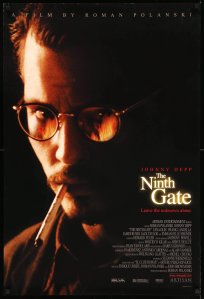
The Ninth Gate (1999)

The latest from old school horror pioneer Roman Polanski is a dark and brooding thriller that is… very long and brooding. What begins with noir charm and decadence grows thin by the movie’s over-bloated running time – giving new definition to the term “tedium.” The visuals are grim and noirish, but hang forever. Half of the movie is seeing Johnny Depp walk from Point A to Point B; and then the other half is watching him light up a cigarette usually already with drink safely in hand. Depp plays a librarian that doesn’t play by all the rules, or something or other. He’s set out to authenticate the last three books of a Satanic worshiper only to discover they lead to a path of devilish power. By the time Ninth Gate reaches its climax at an Eyes Wide Shut-style group gathering the audience has already hopelessly lost feeling in their ass. The vague ending is a cop-out after what the viewer is forced to go through to finally find out the secrets of these special 15th century books/doorstops. When it’s not carelessly lingering The Ninth Gate has some interest to it, but too often than not, it just rolls ahead forgetful of the audience that paid to come see it.

Nate’s Grade: C-

Reviewed 20 years later as part of the “Reviews Re-View: 2000” article.

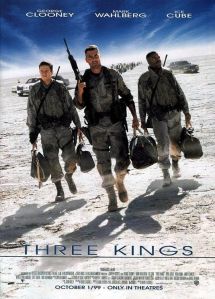
Three Kings (1999)

Action with actual thought. Surreal and marvelously shot, but the only qualm is that the characters shift far too easily from foolish gold-seekers to moral people crusaders. It’s too fast and too unbelievable. But the innovations visually and the pumped-up storytelling and action are marvelous. Spike Jonze steals the show, but it’s not hard to guess what happens to him when the title of the movie is called Three Kings, there are four characters, and you’re the only one name not above the marquis.

Nate’s Grade: A-

Topsy-Turvy (1999)

Mike Leigh’s latest might prove to be the old Brit’s most daring and ambitious spectacle of memory. It’s the tale of English musical maestros Gilbert and Sullivan chronicling their rocky yet firm relationship and the bustle of theater life. The period is set down exquisitely with massive amounts of elegant costumes and set designs, all of whom do well to distract you from the plot. Oh I forgot, there isn’t one. The drawback to Leigh’s Topsy-Turvy is that it is less a movie and more of a recreation of Gilbert and Sullivan musical numbers. Each musical piece lasts in its enduring entirety unyielding to be edited in the least. Thus in between each interlude is a snippet of theater life and the insanity displayed much more fluently by 1998’s Shakespeare in Love. Topsy-Turvy degenerates into a Fantasia style movie — a musical number here, a snippet in between, then another musical number, and repeat for two hours and forty minutes. To theater lovers, and especially Gilbert and Sullivan enthusiasts, Mike Leigh’s celluloid account should prove a triumph and brilliant in its startling recreation of 1880s English life. But to any other audience members out there, boredom will set in quickly enough and you’ll be asking yourself when you leave if you bought a movie ticket or a theater ticket.

Nate’s Grade: C

Fantasia 2000 (2000)

The first updating of long gone Walt Disney’s dream anthology hits the IMAX screens in a resounding fury of classical music and first rate animation. Like its predecessor though, it’s uneven in its quality. Some segments are more impressive or creative than others. In the 2000 redux the best of the best would be characterized by “Rhapsody in Blue,” a Gershwin blues number brought to stunning life by characters of simplicity yet definition. The animation on each is commendable and different from the next segment to follow it. “The Sorcerer’s Apprentice,” the only segment from the original to be included, shows its wrinkles and grain more than ever when blown to IMAX’s wide canvas. The standout, to me anyway, was clearly the final segment closing the just-over-an-hour animated orchestra called “The Firebird.” The imagery and animation are so sleek and beautiful that I thought I was going to break down by how stupendous the artwork was. This is a tale that leaps from the screen and lets you share some of the beauty with it – further enhancing the festival of the Mouse. Without these stand alone segments this ballet of song and ink would be rather adequate and nothing more, but with the addition of these two marvelous segments it becomes something worthwhile… at least for 20 minutes. Hey, it’s the most exposure classical music will get on the youth of today.

Nate’s Grade: B