Piranha 3D (2010)
 Truly missing out on seeing Piranha (as its home release now calls it) in 3-D will be one of my life’s greatest disappointments. This boobs-and-blood-soaked ode to 80s exploitation horror has its tongue firmly clenched in cheek. This is a gleeful gorefest that plays many of its absurd elements for laughs while squeezing in gratuitous nudity at every turn. There’s an underwater lesbian synchronized swimming sequence that I’m utterly certain would have been the greatest thing to witness in the third dimension. Regardless, this Jaws rip-off (Richard Dreyfuss even shows up in the opening dressed identically to his character and named “Matt”!) plays like an ironic parody of the genre while still satiating its red meat-hungry target audience of teenage boys. To this point, it succeeds admirably. It is crass beyond belief and delivers exactly what it promises. Watching actors like Elisabeth Shue, Adam Scott, Christopher Lloyd, and Jerry O’Connell ham it up alongside some fairly cheesy special effects critters, you never feel the waft of desperation. The movie ends too abruptly for my tastes, leaving too much open and unresolved for presumable sequels. As my friend Eric Muller said: “We watched a 3D movie in 2D that was really 1D.” While the movie is entirely one-dimensional in scope, that lone dimension is a blast. I know where I’m going to be when the rumored Piranha sequel is released. And this time, I’m seeing the campy carnage in 3D.
Nate’s Grade: B
Share this:

Source Code (2011)
 Captain Colter Stevens (Jake Gyllenhaal) awakes on a train. His mind has been transplanted into the body of Sean Fentress, a doomed train passenger. Fentress, along with 200 others, were killed in an explosion on a commuter train heading in to Chicago. But this has all happened in the past. Colter has been quantum leaped into a top secret government program known as the source code. It uses people’s brain waves to simulate a recorded reality. The last thing Colter can remember is a firefight in Afghanistan, and now he’s aboard a train looking for a mad bomber. Whatever info he can retrieve will help the officials (Vera Farmiga, Jeffrey Wright) prevent a second terrorist bombing scheduled that day. Colter only has eight minutes to interact with the train passengers and deduce who the bomber is. After eight minutes, the train explodes and the reality resets itself again. Things get even more complicated when he falls for Fentress’ fetching female friend Christina (Michelle Mongahan). Can he save her? Can he save anyone? Can he get out of the source code?
Source Code manages to be a twisty, trippy little film that doesn’t so much knock you out but definitely packs a bit of a punch. Its simplicity is its very best asset. There’s a bomb on a train (ignore the questionable movie sci-fi physics). Colter has exactly eight minutes to learn what he can before he and everybody else blows up. Then the fun starts anew. The movie is less a time-travel flick than an alternate reality sort of experiment. Personally, I love movies that present a timeline and then slowly thumb away at the edges, stretching the narrative space, showing the audience the various intricacies of this tiny world. Whether it’s Pulp Fiction, Groundhog Day, or the propulsive fun of Run Lola Run, I enjoy a story that expands outward into a greater foundational complexity. I enjoy the clockwork of a story that shows me how the different pieces work together. I enjoy that through the variations I can experience a richer world, seeing what happens to a passenger as they leave the train, seeing how a character’s actions can impact another, seeing how altering that character’s action alters other forces in the story. That kind of narrative trickery, perfected in Groundhog Day, makes the story feel like a living creature because you witness the interconnected relationships of everything and everyone. It also makes it pretty fun to watch.
 Director Duncan Jones makes slick use of tight spaces like he showcased in 2009’s celestial sci-fi thriller, Moon. The quick pacing and collective rhythm of the movie helps contribute to its entertainment factor. Source Code is playful enough in design and execution. It remains consistently clever with its plotting, but what’s really surprising is that Jones is able to find a personal human story inside all the thriller trappings. Colter is trying to make sense of his situation, but he’s also trying to reconcile the idea of life, death, fate, and getting to speak with his parents who assume he was killed in Afghanistan (he’s been with the source code project for over two months). There’s a human face to all this, and while the love story feels tacked on and underdeveloped, Colter’s emotional turmoil and existential struggles to reassert his identity and find some peace from his life ring true. Gyllenhaal (Prince of Persia) is an ever capable lead who takes a near Hitchcockian leading man role and plays it straight to fine effect.
At the same time, Source Code tries to have it all with an ending that I don’t truly believe it pulls off. Spoilers will lurk, so skip the next two paragraphs those who wish to remain pure and chaste. The film does a fairly nimble job of setting up an appropriate, if mostly downbeat, ending. Colter doesn’t want to be a brain in a box; he doesn’t want the government using him as their newest tool for the rest of his unnatural days. He was pulled from the brink of death and he now just wants to die in peace. In the recorded reality of the source code, he’s allowed the chance that most of us will never have – he can find closure. Whereas he would have died on a desert battlefield, now Colter has an opportunity to speak to his father one last time, to say goodbye. The entire denouement of Source Code seems to be establishing a memorial for the people who were lost on that train, because once the source code is erased so too will they be. They’re electronic recreations but in the end it reminds you that they were real people, and now they get something of a proper sendoff, a fairly touching memorial to the people who will just be seen as numbers in a news report.
 And then… just as Colter makes peace with passing over, he passes over into another reality. The train doesn’t blow up. The people are able to get off. He gets to walk hand-in-hand with his new sweetheart. Jones doesn’t make it clear what really happens, which can lead to some mounting confusion. Did they really alter the past? Did they create a parallel dimension? In one dimension is everyone on the train dead whereas in another everyone lives, short of Sean Fentress? And how crappy is that? Yes, Gyllenhaal is a charming and terrific looking guy, but does no one shed a tear for the fact that he stole another man’s body? Sean Fentress may not have had the courage to ask out his pretty friend, but that doesn’t mean he deserved to have his identity hijacked and his existence more or less erased from time and space. It’s a weird blemish that the filmmakers don’t truly want to address, and why would they? The ending lacks commentary of any sort strictly because the movie wants to have it all. It wants the sad, mournful ending, it wants the happy “Everything’s gonna be okay” ending. It almost let’s you choose. But Source Code doesn’t come across so much as a film that begs to be opened for different interpretations so much as a film that didn’t want to upset anyone by picking an ending.
Source Code is nicely paced, nicely plotted, and it produces just as many intriguing questions as it does substantial thrills. Jones finds interesting ways to make the same material different. The various characters, converging storylines, and science-fiction mumbo jumbo are all nicely woven into a satisfying bite-sized sci-fi thriller. It fumbles with the landing, in my view; it seems like a pandering appeal to please every faction of the audience, or at least to confuse them with the illusion that they have gotten what they wanted. This is an intellectual sci-fi potboiler in disguise as a thriller. Roll with it, play along, don’t think too hard about the moral implications of its murky ending, and enjoy the ride.
Nate’s Grade: B+
Share this:

Battle: Los Angeles (2011)
 It’s just your typical sunny, Southern California day. Blue skies, good vibes, and aliens wiping out the indigenous species (read: us) for our bountiful resources. Staff Sergeant Michael Nantz (Aaron Eckhart), literally a morning away from retirement, is pulled back into combat to be apart of a Marine platoon that must hold up in the city and fight back against our otherworldly intruders.
Well there is a battle, and it is set in Los Angeles, but that’s about all you’re going to get from this movie. If you were looking for something approximating character, you’re looking in the wrong place. The characters are purely defined by one-note superficial differences, like this guy’s a doctor from Nigeria, this guy has a pregnant wife, this guy has… glasses, etc. The characters were so powerfully indistinct that there were three separate times that a person appeared onscreen and I said aloud, “Hey, I thought that guy died.” Battle: Los Angeles is a military movie, a grunts-eye-view to an alien invasion. And we keep that limiting POV for the entire movie. Battle: Los Angeles has more in common with Black Hawk Down than it does with Independence Day. Replace the depiction of angry, faceless Africans with aliens and there you go. We move from house to house, rubble-filled street after another, shooting wildly, barking commands, and trying to make sense of the urban battles. I’m doing the film too much of a favor because that makes it sound thrilling, which it is not. While there is plenty of action kept at a fairly frenetic pace, that action consistently stays at the same level of intensity. Nothing truly builds or develops to add extra levels of tension. The action is consistent, shooting through one neighborhood after the next, and when the action is plentiful but fails to develop, then the entire movie feels stagnant. Sure it develops from a “We have to go here now” assembly of plot dominoes, but advancing from one location to another with fewer characters each time is not the same as a plot.
 These have got to be some of the dumbest aliens in the universe. These are the aliens that the other aliens pick on. Some scientist/exposition device pontificates that the aliens are after our water, which is a better reason than invading a planet to harvest our tasty brains (Skyline, I’m looking in your direction). The talking head says it’s a rarity to find a planet with liquid water and thus Earth is so attractive to outsiders. Okay, so you’re going to tell me that aliens lack the ability to take ice melt it? There’s an awful lot of ice in the universe that could be more easily obtained. That seems like a better solution than an interstellar road trip for a drink. The creature design is decidedly lacking as well. The aliens look like a cross between squids and a hardware store shelf; they have metallic weapons forged to their skin. At one point Nantz and his crew is dissecting an alien POW to look for vulnerable spots (this might violate some sort of treaty somewhere) and find a lone sack underneath about five layers of armor and exoskeleton. Then they relay the news about this “delicate” spot to all the troops and miraculously all of the aliens start to now go down easily by being shot at a great distance and having the bullets penetrate layers to hit one spot a half a foot in diameter on a moving target. Makes perfect sense now that they know. That info didn’t seem any more helpful than just blindly shooting at the area below the head, which was the previous method for killing. These alien spaceships look like someone attached rockets to the shantytowns from District 9. These ships look like something assembled over at a junkyard and I thought to myself, “You traveled through space in this heap?” It’s like an invasion from an impoverished alien race that also happens to be ignorant and uneducated, which might explain the whole coveting water thing. Battle: Los Angeles might secretly be a metaphor for class warfare. Or not. Probably not.
The movie transforms into a two-hour commercial for the Marines. Battle: Los Angeles espouses the selfless bravery and honor of our servicemen, which is commendable, but it should have been done in the ame of recognizable human characters. It does the honor of good men no justice when they are turned into statues. These aren’t people, they’re recruitment figures spouting poster slogans through gritted teeth. The valor turns just this side of jingoism, and that does a disservice to the sacrifice of the men and women of the armed services. It’s hard to watch Battle: Los Angeles and not come away with the impression that the Marines are superhuman badasses and let’s fight some aliens! What compounds this messy association is that the Marines have long featured TV ads where their square-jawed recruits battle fantastical monsters (I recall one of them being made of lava).
 Director Jonathan Liebesman (Texas Chainsaw Massacre: The Beginning, most famous for Jordana Brewster’s gravity-defying low-rise pants) is no great lensman. He gives shrift attention to the significance of geography in action composition, but he makes up in quantity what he lacks in quality. There is plenty of loud noises and the like, so you’ll be kept awake, that is until you heard the stilted dialogue and wish you could fall asleep. The film packs enough stuff into an overlong 110 minutes but it’s not terribly interesting stuff, which is saying something for an alien invasion movie.
Disappointingly, the movie makes no usage of its titular location. Los Angeles may be the battlefield in name, but this movie could have been set anywhere. It does not take advantage of any of the geographic features that are unique to Los Angeles, or even California. Why bother establishing a specific location in the title and premise when the execution means you could have set the story anywhere (Battle: Cleveland?). It’s a crumbling city; it could be Libya for all that matters. Some of this is likely due to the fact that the movie was almost entirely filmed in Louisiana, which seems like a rather unnatural double for Los Angeles pre and post-alien invasions.
Battle: Los Angeles is a studio film that gets its job in an efficiently empty-headed manner. The space invaders are dumb, the action is too limited and erratically framed, and the story exists only in a theoretical state. Eckhart grunts in his raspy Two-Face voice from The Dark Knight for the entire film. I suppose if you have low expectations and just want to fill up on special effects, Battle: Los Angeles should sate your desire for straight-forward shoot-em-up entertainment. It’s not brainless but it’s close to it. Near as I can tell, Battle: Los Angeles is devoid of political or topical commentary on contemporary conflict because that would just get in the way of its straight-laced heroics. Sorry District 9, what were you thinking?
Nate’s Grade: C
Share this:

Resident Evil: Afterlife (2010)
 I won’t pretend these movies are anywhere close to good, but each one has provided some mild, mindless thrills. However, the fourth film in a franchise going nowhere is the first of the series that just says, “To hell with trying to be even remotely real.” This is a living video game, especially the opening sequence where it’s a nonstop barrage of self-conscious visual tricks, hails of bullets, gore, and a general kick in the balls to the laws of physics. I’m not asking for much, but I’d like my mindless violence to be of a quality where it doesn’t feel 100 percent gratuitous and, frankly, boring. If every single scene involves someone doing something fantastic, over-the-top, and absurd, then where can my interest go but down? Director Paul W.S. Anderson returns to the series he begat in 2002. Get ready for more zombies, more weird mutant creatures that will act however they damn well feel like, and more Milla Jovovich confusing toughness with cold stares. The action is ripped purely from a video game with no regards for geography, setup, tension, development, or anything that would matter. It’s just all flashes of violence one after the other. It’s a mostly depressing enterprise. But where do they go from here? The second movie was subtitled “Apocalypse” (little too hasty there), the third “Extinction,” and now this one is subtitled, “Afterlife.” Is the next one going to be, “Reincarnation”? And the certainty of a fifth movie only adds to my depression level.
Nate’s Grade: C-
Share this:

The Spy Next Door (2010)
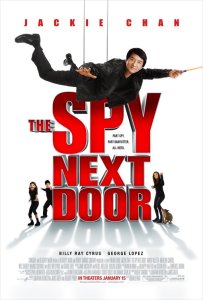 I have seen hundreds of movies go bad. I’ve seen plenty try and cram a ham-fisted saccharine, entirely phony message about family values or whatever hackneyed lesson needs to be delivered with the subtlety of a sledgehammer. Rarely have I seen a movie that tries to cram in EVERY banal family message possible into one exasperated running time. There was one point where I counted three clichéd platitudes in a row. Rarely have I seen a movie fail at comedy so badly, even the generous definition of comedy in family films, a subgenre that haunts all those who crossover into it. Rarely have I seen one single family film try to do so much and succeed so breathtakingly little. The Spy Next Door is that movie. Jackie Chan stars as a retired Chinese super spy who the American government wants to keep contracting. He’s also dating his neighbor (Amber Valetta) who has three rambunctious kids that fall into easy slots (surly teenager smarting from parent’s divorce, dweeby tech kid trying to learn to stand up to bullies, precocious little tyke who makes a mess). Chan agrees to watch over them for a weekend to convince those kids they should give him a shot, or else it’s splitsville between he and the mom. It’s the Vin Diesel Pacifier movie but done with even less finesse, if possible. The comedy is nonexistent, which is saying something for being as broad as it is, the physical action shows how badly Chan is aging, and the plot is painfully predictable. This is just a sad, uncomfortable viewing experience; it reeks of desperation and despondency. No one looks to be enjoying themselves for a single second. That’s probably because The Spy Next Door is a vacuum of fun; it’s lazy, incompetent, but worst of all, devoid of any effort to be something other than a mind-numbing, head-scratching waste of 90 minutes.
Nate’s Grade: D-
Share this:

The Adjustment Bureau (2011)
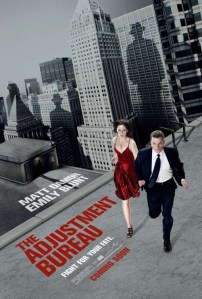 Gentlemen, if you were looking for an original excuse about not calling a girl back, try this one on for size: I couldn’t call because a team of men who control human destiny told me that if I did they would erase my memory and keep you from the fame that you are destined to achieve. She’ll probably at least give you points for originality before throwing a drink in your face (but it was all part of The Plan, or was it?).
David Norris (Matt Damon) has just lost a New York congressional election thanks to his frat boy ways of old resurfacing. As he composes his concession speech inside the men’s restroom, he meets Elise (Emily Blunt), a ballet dancer hiding out. They have one of those crazy only-in-a-movie conversations that manages to feel authentic. Then they kiss. She inspires him to ditch his prepared remarks and speak from the heart to the national TV audience, which eats it up. David spends the rest of his days trying to meet the enchanting Elise again. Then he runs into a big stumbling block. He’s late to a meeting and catches a group of mysterious men in suits and fedoras fiddling around with people frozen like statues. They are the adjusters, the ones who ensure that the participants of mankind follow The Plan. These are the people responsible for the illusion of choice in our lives. If we deviate too far from The Plan, causing ripple effects that too need to be accounted for and adjusted, they step in. Richardson (John Slattery) is the spokesmen for the group and decides to just level with David. He is not supposed to be with Elise. He has a different future ahead of him, so sayeth The Plan. They will throw obstacles between the two of them. David seeks out Elise and fights against the whole universe for the two of them to make a future together.
 Horrible title aside, The Adjustment Bureau is a sometimes corny but often deeply satisfying movie. It may distract with some efficient and just-smart-enough sci-fi leanings and magic tricks, but it’s really a unabashed romance at its core. Not just that, it’s a good romance, once that flutter the heart and causes the ends of your mouth to do that thing, you know – smile. It helps when you have movie tars as gorgeous as Blunt and Damon, and are such good actors that they can fill their roles with dangerous amounts of charm, but let’s credit writer/director George Nolfi (The Bourne Ultimatum, Ocean’s Twelve). He takes a fairly routine concept (powerful forces control our lives and choices) and turns it into a finely tuned character-driven romance. Immediately from their first meeting in a men’s room, Blunt and Damon have that electric dynamic that you can genuinely believe in. Their chemistry will knock you over. You feel the spark between these two, which is essential because the two characters spend years apart at times, forever hoping to reunite. In that brief encounter, you fall in love as well and realize that this character, and this actress, is worth waiting for. I think people are going to be surprised that The Adjustment Bureau is a big gooey, stars-in-the-eyes love story, and it’s actually good. It’s a really enchanting love story, tackling the question of whether whom we love is a result of choice or destiny. This central concept is what every sci-fi element and thriller sequence is spun from. Here’s a funny thought: it’s all in service to the story.
It’s rare to see a studio movie that mixes so many different elements together to such effective, satisfying results. The film doesn’t get overly dark despite the cosmically long-reach and determination of the adjusters. There’s never any real threat of danger, only a broken heart or dashed dreams. The film has many light moments throughout, creating a rather bouncy tone that suits the romance angle nicely. The adjusters aren’t very menacing, more so comically perturbed. John Slattery, all silvery Mad Men appeal, is a perfect foil as the face of the adjusters. He feels like an exasperated parent baffled by the thought-processes of his youthful charge. It helps that these cosmic accounting agents have a finite level of power. If they had unlimited power then the film would fail to have any hope for David and Elise. But we learn that there are only so many adjusters that there are limitations to their powers, and that they can be outsmarted with enough gumption. Mingling with that light touch is enough whimsical science fiction to engage your brain. The concept of the adjusters and their supernatural abilities is nicely teased, setup, and then developed, making sure never to rock the audience with too much weirdness at one time. It’s a gradual process of discovery and it leads to a somewhat goofy, but infectiously amusing, climax that involves multiple doorway portals and magic hats. Yes, I said magic hats, which means there is an honest to God good reason why that stupid fedora hat, seen so prominently in advertising that it feels like the third-billed star, is featured. Admittedly, a concept like a magic hat that allows you to teleport through doorways would seem silly, but Nolfi makes it all work. The hardest aspect to believe (in a film with, I repeat, magic hats) is that Blunt could be a ballet dancer, let alone a future star of the medium. I’m by no means saying that the British beauty has anything to worry about in appearance, but she does not have a ballet dancer’s dangerously minuscule physique. Natalie Portman in Black Swan looked like a real-deal ballerina of fragile frame. Blunt doesn’t have the movement or the physique.
 In his directorial debut, Nolfi does enough good things, and does them with a smooth sense of style, to impress. The visual trick of going in one door and opening to another world walks a dangerous line of over saturation, but it’s playfully utilized enough to forgive. Nolfi is not perfect with his plotting, falling to misstep that can push back momentum. Characters will be chatting, and then they’ll walk away and we’ll get a title card that says something like, “Three years later,” and it sort of makes it feel like we have to start all over again. The fact that this happens more than once means that Nolfi might have wanted to plot his story around a series of events that occurred more often than Senate election terms. If we have to begin with David losing one campaign at the start and then zoom ahead at several points through another campaign, then perhaps the timeline could have been condensed a bit in retrospect. The film manages to be religious and faith affirming without pushing an agenda or overstating its romantic cause. The ones behind the plan are only referenced in oblique business terms, never confirming a certain high power but definitely nodding in that general direction.
Damon and Blunt are a terrific team. This is easily Blunt’s finest role as an actress since breaking out in 2006’s Devil Wears Prada. The actress has taken many a role that makes use of her large crystalline eyes and her sometimes go-to acting response of simpering. But in this film, she finally finds that perfect role that makes use of Blunt’s modest, goofy charm. She’s never been a leading actress in a traditional set; there’s always been a delightful goofy appeal that set her apart. When Blunt offers her playful smiles and asserts those glassy eyes of hers, you too will be smitten. Her character is a charming woman thanks to Nolfi’s writing, but having an actress of Blunt’s ability fill her out is a blessing. Damon is at a point in his career where he just grinds out good-to-great performances that manage to be convincing in unassuming, dignified ways. Damon has never been an actor given to the superfluous. His character feels like a sincere sport, which is amazing considering he’s supposed to be playing a politician. He’s the kind of guy you’d actually stand in the rain to vote for, and you understand why Elise would keep a place tucked away deep in her heart for the dashing Damon.
While the movie hinges on the coupling of Damon and Blunt, the rest of the supporting cast does fine work matching tone and making the most of their roles. Actors like Anthony Mackie (The Hurt Locker), Terrence Stamp (Valkyrie), and Michael Kelly (Changling) can make any movie better.
 The Adjustment Bureau, on paper, should not work. A sci-fi fantasy that’s unapologetically grounded in romance. A tone that nestles firmly in a safe, bubble-wrapped whimsy. And those magic hats, need we forget them? On paper this should be one overly silly, dumb, tonally disjointed, cornball movie worth venomous mocking. And yet it works; it does better than “works,” it succeeds. Blunt and Damon are terrifically charming together and imbue the movie with a sense of cheerful optimism in the face of uncertainty (and perhaps heaven itself). You desperately want these two crazy kids to get back together; they’re good, decent, charming people, winning personalities apart and even better together. What might have fallen apart in other hands becomes this endearing, fizzy piece of studio entertainment that fulfills and exceeds most expectations. I was really taken by this movie, won over by its effusive charm offensive, and left buoyant with happiness by the time the tidy, perhaps too tidy ending, came rolling. The Adjustment Bureau is hooey but it’s my kind of hooey.
Nate’s Grade: A-
Share this:

Legend of the Guardians: The Owls of Ga’Hoole (2010)
 This lushly animated tale about good owls, and bad owls, but mostly owls feels indebted to Don Bluth’s The Secret of NIHM. There’s a legendary story about the guardians who would save the… remaining owls? The plot doesn’t ever really leap beyond the basic fantasy concepts of good and evil, heroic and manipulative. It’s hard for the tale’s drama to reach grandiose heights because, well, it’s owls. Not anthropomorphic owls, pretty much plain old owls. Some characters were just hard to distinguish between. I can firmly say that some things work better on page than screen, and descriptions of grand owl societies and owl-on-owl combat are definitely items that, when fully realized in such a literal fashion, just come across as goofy. Being directed by Zack Snyder (300, Watchmen), the movie looks gorgeously rendered but fails to leave any emotional mark for anybody who has ever seen a scrappy band of misfits topple the mean bad guys. The action follows the Snyder fast-slow-fast visual motif, which allows the audience opportunities to drink in the visual effects work. The mostly Australian vocal cast, plus Helen Mirren, provides some levels of amusement, but it’s the story that ultimately disappoints. Legends of the Guardians looks fantastic, but it’s story is far from legendary. And they needed to have a pop song by Owl City because the man has “owl” in his name, apparently.
Nate’s Grade: C+
Share this:

Client 9: The Rise and Fall of Eliot Spitzer (2010)
 Alex Gibney, the Oscar-winning documentary filmmaker behind Enron and Taxi to the Dark Side, rolls out his third 2010 entry in what must have been a rather exhausting year for the man. The focus is on former New York attorney general and governor Eliot Spitzer and his fall from grace after being linked to a high-end prostitution ring. Gibney charts the man’s rise and fall in a fairly straightforward and engaging manner, though you start to wonder if there’s really enough material to fill out a two-hour feature. Spitzer speaks candidly and will not humbly vanish as some may wish; the man is an intriguing mixture of righteousness, ego, and humility. What’s most fascinating about Client 9 (named after Spitzer’s name in the FBI sting) is that Spitzer gained a wealth of enemies when he went after Wall Street largesse and greedy shenanigans, and they all want to be on camera. No one with a serious grudge against Spitzer, including men who have since been convicted of crimes and ethics violations, refuses an interview. Gibney draws together a fairly convincing thesis on the take-down of Spitzer, a cabal of powerful execs, politically motivated prosecutors in the Bush administration, and government officials who reject accountability. It’s all circumstantial evidence, to be sure, but there’s a mountain of it. There is a definite conservative-backed coordinated effort to sully and embarrass the man. But ultimately, Spitzer admits that he is responsible for his sins. You will never get full satisfying clarity as to why he sought out the comfort of prostitutes in the first place. I don’t think even Spitzer knows for sure. But that’s an age-old mystery that can’t be tied up in two hours.
Nate’s Grade: B
Share this:

Unknown (2011)
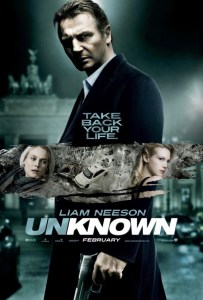 With Liam Neeson kicking ass in a European country, fighting a nefarious conspiracy, and trying to reclaim what has been taken from him, you’d be excused for thinking that Unknown is a sequel to the highly popular Taken. And the films do share plenty in common. Both involve Neeson trying to regain his life against a ludicrous conspiracy, and both are equally ludicrous in their action sequences, and yet both are fun, passably diversionary entertainment. Neeson gets into a car accident to find that his wife (January Jones, blankly Betty Drapier wherever she goes) doesn’t recognize him and enjoys the company of another man asserting the identity of Neeson. Is he really crazy? That idea lasts about ten minutes before the bad guys and their bad guy accents come to kill Neeson and tie up a loose end. The action is swift, well edited, and fairly exciting, a highpoint being a thrilling car chase through the streets of Berlin. The movie has enough clues and questions to string along an audience, though by film’s end you wish you got more scenes with Neeson in full-on attack mode, as seen in Taken from start to finish. What is it about losing one’s memory that always turns men and women into better people? Perhaps prison rehabilitation should consist of a Flinstones-esque treatment of knocks to the head to adjust moral consciousness for the better.
Nate’s Grade: B
Share this:

A Nightmare on Elm Street (2010)
 The next in an endless assembly line of vapid horror remakes, a new trip to the realm of Elm Street at least held some promise. The famous boogeyman Freddy Kruger was going to be played by Oscar-nominee Jackie Earle Haley (Watchmen). Has any other actor of Haley’s caliber played a blatant slasher villain in recent memory? And the playground of the Nightmare on Elm Street franchise was the world of dreams, which should be fruitful territory for some bug screen chills. I mean you don’t have to adhere to earth logic anymore, not that horror movies tend to. I didn’t expect much but I expected the movie to do more. Many of the signature moments from the first film are simply repeated. How does an entire school of young kids forget that Mr. Krueger molested them? What is the point of hiring Haley and giving him nothing to do? Lead actress Rooney Mara (soon to be seen in as the “girl” in David Fincher’s Girl with the Dragon Tattoo) looks as bored as somebody watching her movie. Her performance is lifeless for a film that requires energy and action. There is such wasted potential in the world of reams and personal fears. The whole movie just feels so rote and routine, following an established pattern of terrorizing the teens and knocking them off one-by-one; you get an overwhelming impression that everyone was just going through the motions, repeating someone else’s song and not bothering to make it their own.
Nate’s Grade: C-


 nathanzoebl
You must be logged in to post a comment.