Category Archives: 2009 Movies
X-Men Origins: Wolverine (2009)
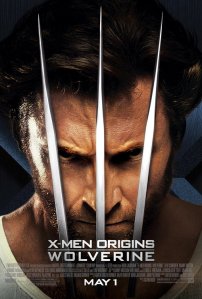 X-Men Origins: Wolverine has been slashed from all sides. First, the movie has not been able to shake bad buzz, from extra reshoots to rumors about conflicts between the studio and the director. There was even one rumor that the head of 20th Century Fox Studios ordered a wall repainted a happier color. Then in early April it got even worse. A DVD-quality print of Wolverine was leaked onto the Internet and spread like crazy, and once something finds itself inside the realm of cyberspace it cannot be put back. The reaction to the leaked copy was mixed, at best. The studio went into damage control mode, stating that the leaked copy was an unfinished work print, that they too were not thrilled with this version and paid millions for reshoots, and the final version that would be released in theaters had 20 minutes of new stuff and 10 minutes additionally edited out. But guess what? The wolverine’s out of the bag, it’s the same exact version minus some completed special effects shots. What amuses me about this whole situation is that the studio is on record trashing the movie, saying they were unhappy with this version, and yet this is the final release. After having seen Wolverine, at least I can say that those Fox execs know mediocrity when they see it.
We get to witness the storied history of Wolverine (Hugh Jackman), which goes all the way back to the pre-Civil War era. Born James Logan, and a mutant, the kid had the unusual ability to produce three jagged bone claws from his knuckles. Logan also had the ability to miraculous heal like his older brother, Victor “Sabertooth” Creed (Liev Schreiber). The two of them make use of their primal, animal instincts and near invulnerability by fighting in every major U.S. war, from Civil to Vietnam. Eventually that kind of thing gets noticed, and General Stryker (Danny Huston) recruits the brothers to be apart of a mutant mercenary group. The group also includes the likes of William “Deadpool” Wade (Ryan Reynolds), “The Blob” (Kevin Durand), and some other unimportant mutants (one of them played by a Black Eyed Pea, will.i.am). Wolverine walks away from the group when he decides that he isn’t cut out for a cutthroat life.
The man finds a quiet place to live along the Canadian Rockies. He’s found a hard-working job, lumberjack, and a good woman, Kayla (Lynn Collins), who loves him. All of this is ruined when Sabretooth comes back around, intent on eliminating the former mercenary members one by one. Stryker appeals to Wolverine to apply for the Weapon X program. He says he can give Logan the tools for his revenge. Wolverine then undergoes the famous procedure that bonds his skeleton with adamantium, an unbreakable metal, and his bone claws become extra sharp metal. Stryker has other plans, naturally, and Wolverine breaks out of the facility. Stryker tells his assassin, “Bring me back his head.” Sorry pal, but you’re the one that just spent half a billion dollars giving Wolverine an unbreakable spinal column.
 Is this origin tale worth telling? Short answer: no. The mysteries behind Wolverine’s back-story aren’t too involving and the answers make the character less interesting. I don’t really care why Wolverine got his metal skeleton or how he came to be an amnesiac, I just accept that the man has some mystique to him. I care even less that one of the answers to those mysteries is a murdered lover. The plot is incredibly thin; Wolverine meets one mutant who tells him to meet another mutant who tells him to meet another mutant, etc. Eventually the film heads for a mutant showdown that plays out like a lame video game, specifically the mid-90s Mortal Kombat (the Final Boss super villain resembles the blade-handed Baracka). What are Gambit (Taylor Kitsch) and Emma Frost doing in this? That?s not the end of the mutant cameos, either. I feel like the only thing we learn about Wolverine is that his super sense of smell cannot detect the difference between real blood and stage blood. The filmmakers think character development involves someone saying no to slaughtering innocents, and then other characters keep telling him, “You’re not an animal.” The movie meanders from one unimaginative special effects set piece to another, stopping at points to shove in various mutants that serve little purpose to the story other than diehard comic fans will be more forgivable.
Oh, but what to do when your main character is indestructible, your main villain is also indestructible, and your other lead villain cannot be killed because he?s due for an appearance in X-Men 2? Why you bring in a third, nigh indestructible being into the stakes, however, this being doesn’t already play into the established X-Men onscreen mythos, so this guy’s okay to kill off, that is, until he too gets a movie built around his character and then that movie has to backtrack to fill in on time before its capped ending. We already had a healing ability mutant with super claws vs. a healing ability mutant with super claws smackdown in X-Men 2, where Lady Deathstrike fought Wolverine. That fight was brutal and well staged. The fights in Wolverine’s big show are uninspired; how much stabbing can you watch between people who instantly heal? Also, apparently another side effect of the Weapon X program is that these metal claws are self-cleaning, because every single damn time Wolverine stabs someone there isn’t a droplet of blood to be found on his claws. It?s hard to get emotionally involved in characters that are fearless and have little at stake. Which, of course, is why Logan had to be given a cruddy romance where he gets to hold his dead lover?s body in his arms and bellow to the heavens for what feels like the 80th time. Seriously, twenty percent of all the dialogue in this movie is some combination of growling, spitting, and bellowing.
 Wolverine isn’t a terrible movie but it’s rather shoddy and thoroughly mediocre. I never thought I’d see this character do the beyond-cliché action movie motif of strutting in slow-mo while an explosion sizzles in the background. This is the kind of film that involves a super team standing shoulder-to-shoulder to walk down like they’re from The Right Stuff. This is the kind of movie that opens with a needless family squabble about Logan finding out the pointless identity of his real father. What was that about? (After killing his father, I remarked to myself, “I guess that he gets that whole healin’ thing from his mother’s side of the family.”) This is the kind of movie that hires Ryan Reynolds and then disarms the man of his greatest asset, his smart mouth. This is the kind of movie that theorizes the only thing to kill an adamantium-skeleton man is with an adamantium bullet, like a sort of werewolf. This is the kind of movie that sends a super assassin, with super bullet-bending powers, out to kill Wolverine but does not arm the super assassin with those special adamantium bullets. Why not shoot this guy in the eye? That is an open body cavity. This is the type of movie where the final super villain is controlled by, get this, key commands like “Engage.” This is the kind of movie where an assortment of characters refrain from killing super bad murderers out of the morally pretentious idea that they, too, would be no different from the super bad murderers. Excuse me, executing super bad murderers would be doing the world a favor here. This is the type of movie that fills the running time with pained dialogue like, “You wanted the animal, you got him,” and, “Nobody gets to kill you but me,” and the best line of them all: “I thought you were the Moon and I was your Wolverine. Turns out you’re the Trickster and I’m just the fool who got played.” Top that, screenwriters.
Whatever the budget was for this movie, well, apparently it wasn’t enough. The adamantium effects looked perfectly reasonable in the first X-Men film and that was nine years ago, so I cannot understand why the claws look astoundingly fake this go-round. They look like direct animation, like Wolverine is holding cartoon claws a la Who Framed Roger Rabbit? When did they become so thick too? These claws are like the size of the steak knives you get at restaurants.
Jackman deserves some of the blame here since he is listed as a producer and he hand selected director Gavin Hood (Tsotsi, Rendition) who does not have the interest or the eye for this kind of material. Hood lacks the finesse and vision to stage exciting action sequences, which explains why he falls back on tired genre tropes like the slow-mo strut in front of fireballs. I am dead certain that this stupid super assassin was pushed into the movie after film producers saw how much money the bullet-curving Wanted made the previous summer. The movie borrows heavily from recent Marvel Origin comics, or so I’m told, which is where the whole “Wolverine through the ages” storyline comes from. Personally, I don’t much care for the idea that Wolverine’s healing ability also deters aging until you hit that agreeable, desirable Hugh Jackman age range, but fine, whatever. The movie takes great effort to showcase Jackman’s flawless physique, and this dude is ripped to the point that you can see bulging veins. I just wished Jackman made more use of his acting muscles in this movie. He snarls and glares, and even has a softer moment or two with Collins, but rarely does Wolverine get to prove why he is such a beloved comics character.
 Thank goodness for Liev Schreiber (who actually also co-starred with Jackman in the forgettable romantic comedy, Kate & Leopold) because this man entertained me from start to finish, which is more than I can say about his movie. Schreiber has fun with his role and totally buys into the character’s animal instincts. He relishes the kill. The bizarre sibling rivalry between he and Wolverine is the best part of the movie, and the interplay between the two actors is when the movie has its few moments of life. Like Watchmen, the film finds its creative peak during the opening credits, as we watch Jackman and Schreiber claw and bite their way through American battlefields.
Here’s an easy solution to the Wolverine amnesia issue that doesn’t involve the use of admantium bullets. Kayla (Silverfox) has the power of hypnosis through touch, so why not in the emotional climax have her touch her dear lover Wolverine and wish, “Forget me. Forget all about me.” There, problem solved, and this way it works emotionally and organically with the story. It took me an hour after seeing X-Men Origins: Wolverine to come up with a better ending, so just imagine what more time will allow. Jackman and company are lost thanks to a mediocre script that sacrifices character for action beats, and even then the action is fairly mundane. There are a handful of cool moments, like Wolverine propelling himself onto a helicopter from an exploding car, but after four movies nothing has come close to producing the adrenaline rush that was the X-Men 2 sequence where Logan unleashes his berserker rage on the commandos in the mansion. By the end of his first solo outing, Wolverine is left without any memory. I won’t say we should all be so lucky but the X-Men filmmakers would be better off paying little attention to this origin tale, unless they want to bring Schreiber back, which they should do at all costs.
Nate’s Grade: C
Share this:

Ghosts of Girlfriends Past (2009)
 I maintain that no story has been redone, recycled, re-purposed, and parodied more so than Charles Dickens’ classic holiday tale, A Christmas Carol. Dickens’ tale of redemption aided by supernatural ghosts and time travel has appeared in everything from Muppets to the Odd Couple. Statistically, the odds are good that right now as you read this very sentence television is airing some adaptation of this story right now. I suppose it was only a matter of time before Dickens got reduced to a romantic comedy setup. Ghosts of Girlfriends Past is a charmless and mostly empty movie that makes you pine for the comparative masterpiece of A Muppet Christmas Carol.
Connor Mead (Matthew McConaughey, playing himself for the thousandth time) is a hunky fashion photographer for Vanity Fair magazine and, boy, is he in-demand. Everyone wants his photo services and every woman wants to rip his clothes off. Connor is a notorious womanizer and he travels to the country to attend his younger brother Paul’s (Breckin Meyer) wedding. Connor is intent on dissuading his brother on the prospect of marriage, which Conner dubs archaic and he feels love is “comfort food for the uneducated and lonely.” It just so happens that Connor’s ex-girlfriend from way back, Jenny (Jennifer Garner), is the maid of honor at the wedding. She hasn’t seen her dubious ex for some time, but that doesn’t stop him from trying to make his move. Jenny and Connor were childhood pals, but an early bout of heartbreak led Connor to become the disciple of his Uncle Wayne (Michael Douglas), a boozy playboy who taught the kid everything he knew about bedding the babes. During Connor’s stay, the ghost of Uncle Wayne informs him that three spirits will visit to showcase Connor’s checkered past, present, and dodgy future, Dicken’s-style.
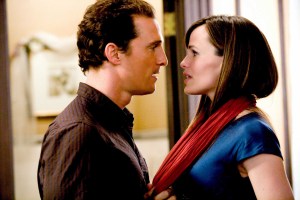 The movie is wholly unbelievable even for a contrived romantic comedy. The central romance between Connor and Jenny rests on the silly notion that after ten years apart, a lifelong selfish jerk can sweep his former girlfriend off her feet during a single crazy weekend. Connor’s redemptive arc is lackluster at best, and the movie just mimes the steps it feels that it needs to take to turn its lead insensitive jerk character into a sensitive jerk character. It doesn’t work. I refuse to believe for one second that a pretty, smart, confidant doctor such as Jenny would allow herself to get so completely suckered in by Connor’s “Baby I’ve changed” speech. It’s insulting and degrading. The compressed timeline reflects poorly on Jenny’s decision-making. The expedited timeline makes every human action seem far-fetched. There’s a scene where Connor opens a champagne bottle in the kitchen. The cork flies out and knocks one of the legs loose on the multi-tiered wedding cake. The cake is about to slip over when Connor slides in to stabilize it. Instead of redistributing the weight via the available legs, he tries reaching for the out of reach champagne bottle with his foot (the size of the bottle and the cake leg are not even close). A more believable situation would involve Connor trying to reach the fallen cake leg, not a champagne bottle, but alas. To make this example even worse, the filmmakers set up the disaster of a fallen wedding cake and then amazingly fail to show the goods. We only see the smashed aftermath. This is a comedy fundamental: set-up food disaster, let audience witness ensuing food-related disaster.
Ghosts of Girlfriends Past also doesn’t have one redeeming or marginally realistic female character. I would expect, given Garner’s star power and the natural importance of being the romantic lead, that Jenny would come across as a reasonable woman or someone worth fighting over. Sorry, Jenny is a powerfully underwritten character and Garner is left without much work other than serving as a reservoir of reaction shots. Seriously, that’s her main purpose in this movie; she is a cutaway image. Sandra (Lacey Chabert) is a shrieking high-maintenance shrew of a bride. The other female roles are largely one-note misogynistic fantasies (thanks male screenwriters Jon Lucas and Scott Moore). The trio of bridesmaids is gossipy chatterboxes and eager to get laid. Connor’s introduction to his future mother-in-law (Anne Archer) involves him casually groping her breasts, much to her prosaic approval. Connor has an irresistible way with the ladies, which makes everything without a Y chromosome want to sleep with the man. A young famous pop singer watches Connor dump three women simultaneously on an Internet conference call, insult them, and then she still strips off her clothes to bed the cad. She even states, “I don’t even know why I’m doing this,” and continues along. I’m just as confused what power Connor holds over the fairer sex because to me he’s just a twit.
 Here’s a telling example about how obvious this movie is written from an unenlightened male perspective: the central relationship dilemma is that Connor is afraid of cuddling. In the past, Jenny asked him to stay and cuddle but that was the breaking point, so he bolted. All of these women somehow manage to fall head over heels in love for a guy who willingly goes through women likes changes of underwear. It makes all the women comes across as emotionally needy, insecure, vapid bubbleheads who will sacrifice everything, including self-respect and dignity, to get a taste of McConaughey’s back sweat. Ghosts of Girlfriends Past is not a flattering movie for either sex.
The tone of this movie never finds an authentic and satisfying balance. Being a half-hearted tale of redemption during the period of a weekend, the movie crams in plenty of gooey sentimental claptrap. You’ll listen to characters talk about the true meaning of friendship, tear up over family memories, and then someone will make an inappropriate sex joke. There is a high level of semi-racy sex jokes that populate the world, appearing at odd moments, destroying any assembling emotions. Ghosts of Girlfriends Past will pretend like it’s building to something that actually matters and then it will throw it all away for a cheap sex gag — har har. There’s a moment where Douglas is illustrating how much ire Connor has wrought with visual metaphors. It begins to rain and he says that the downpour is made up of all the tears shed from ex-girlfriends and flings. Then it starts raining ripped pieces of confetti, and this we are told is all the tissues used. And then comes all the used condoms, and we watch Connor try and take cover before the aerial assault of used (and presumably “filled”) contraceptives annihilates him. It’s kind of gross and tonally disjointed from the rest of the sappy, happy PG-13 storyline.
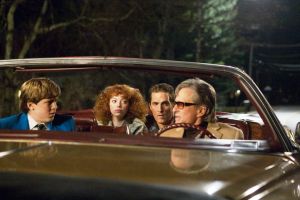 The movie is at its most amusing when it’s riffing on the expectations of following the Christmas Carol model. Connor is quite aware of the tried-and-true formula, so his comments along the way provide the movie’s only genuine laughs outside of Douglas. Really, Douglas’ character is the most entertaining character, and I kept wishing that the film would follow him even after death. Wouldn’t it be interesting to watch the life of a ghost involved in a Christmas Carol scenario? I imagine it would be a bit like a play rehearsal. I would enjoy seeing the behind-the-scenes work that goes into the scenario. I want to see ghostly foremen plot out unique scenarios for a list of real-life Scrooge cases, I want to see the ghost tryouts, I want to see the mechanics involved in the spiritual setup for this whole process. I enjoyed watching Uncle Wayne hit on his fellow spirits. But I suppose that approach would be too literary and break away from the cozy confines of the stillborn romantic comedy genre. And to prove that it is indeed a romantic comedy by the numbers, Ghosts of Girlfriends Past even includes the last minute dash to stop the romantic party from leaving via some method of transportation.
Ghosts of Girlfriends Past manages to squander every opportunity it has to be a better movie. The central idea could have worked but the execution is exceedingly lazy, charmless, and degrading to women in particular. The comic scenarios miss out on better laughs, and some of the better laughs are obvious and just around the corner, but the film routinely falls back on being a sexual farce. The characters don’t feel remotely like people and Connor is a terrible lead character with unfunny dialogue that reduces women to disposable pleasures. His transformation is contrived even for a romantic comedy. I’m not saying a cad character could not make for an entertaining lead here. Clearly Douglas is the best character, and his sleazy 1970s swinging sexpot has a fun Bob Evans vibe. Every moment he’s onscreen the movie comes alive in a new way, and Douglas is an actor that knows how to make lecherous appealing and appalling at the same time, like what Michael Caine pulled off in Alfie. This movie pales in comparison. Ghosts of Girlfriends Past should have been visited by the most important spirit of them all – the Spirit of Screenplay Rewrites.
Nate’s Grade: C-
Share this:

Disney Nature’s Earth (2009)
 The kind folks at the newly established Disney Nature division want to make sure those who missed out on the stunning 2006 Discovery Channel/BBC miniseries Planet Earth get another chance. Earth is a re-edited, recycled version of the globe-trotting miniseries, cutting down 8 hours to a bladder-friendly 95 minutes. Disney has given the film a family-friendly narrative, following the exploits of three families; a mamma polar bear and her cubs, a whale and offspring, and an elephant and its little thundering toddlers (note to parents: the film doesn’t shy away from death but you won’t watch any onscreen kills). The footage is jaw-dropping and to witness it on the big screen is a must-see. The mini-series, and by extension the new movie, is a powerful advertisement for conservation without having to get on-message or preachy. The gorgeous images speak volumes. The filmmakers spent over 5 years compiling mass amounts of footage, and some cameramen sat in isolated and harsh conditions for a year in order to snap rare moments on film. While the film cannot rival the mini-series, it’s still a highly watchable experience with eye-popping visuals and, really, little else. It serves as a tasty appetizer for the larger main course, the immersive and riveting Planet Earth mini-series. But hey, there is something God-like about listening to James Earl Jones detail the particulars of life on this spinning blue orb. Earth is mostly spectacle but ho boy, is it first-rate spectacle.
Nate’s Grade: A-
Share this:

17 Again (2009)
 My introduction to tween sensation Zac Efron came last fall. After hearing about the dominance of the High School Musical franchise I decided to finally watch the first made-for-Disney Channel film and see why exactly tween girls were screaming themselves hoarse. And after watching the musical I felt, well, how can I put this diplomatically? It sucked. Hard. First off, the plot only covered auditioning for a musical, not the actual show. What the heck is up with that? How does a movie musical climax around callbacks? Amidst the bland vanilla pop tunes, goofy hoofing, and painfully simplistic life lessons about class-consciousness, there was the overall dreadful acting by the cast. Efron wasn’t the worst actor of the lot but he seemed to go on autopilot, beaming dreamily and leaving his mouth agape long enough to stockpile flies for a long winter. I could not understand why young girls and the media were making such a fuss over Efron. I am clearly not in Efron’s core flock of fawning fans, but after catching his fairly nimble work in 17 Again I think perhaps this guy might be able to break out from the clutches of Disney and grow into his own, unlike Miss Miley Cyrus, who I believe has an ankle bracelet that will detonate if she travels further than 100 feet from the Disney execs. They don’t want another Hilary Duff getting away and sticking a scorpion down her shorts (see: War, Inc.).
Mike O’Donnell (Matthew Perry) hates his life. He’s 37, just been passed over for a promotion at his job, is getting divorced from his wife Scarlett (Leslie Mann), and his two teenage children (Sterling Knight, Michelle Trachtenberg) think dear old dad is a doofus. Apparently, everything was better 20 years ago, in 1989 when Mike was a 17-year-old basketball phenom who had his whole life ahead of him, until he walked out on a climactic game to tend to Scarlett, who just revealed that she was pregnant. Mike wishes he had one last shot to be 17 and have his whole life ahead of him again. Thanks to a magic janitor (I believe it’s really the magic hobo from The Polar Express, except now he’s gone through a work program and become a respectable community custodian), Mike transforms into the visage of his 17-year-old self (Efron). Mike seeks help from his childhood pal Ned Gold (Thomas Lennon), who poses as Mike’s father and enrolls him in the same high school his children attend. This leads to many awkward family encounters.
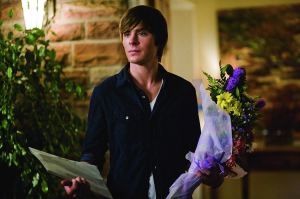 The body swap genre can be counted on for some decent fish-out-of-water laughs and some earned wisdom. Usually transporting young people into older bodies allows for more comedy because it leads to more socially awkward moments and the exaggerations of trying to be old before your time. 17 Again is consistently amusing enough and I was pleased that it found fun plot developments to explore from its body swap angle. So Mike is young once more but that doesn’t stop him from having, on the surface, inappropriate feelings for Scarlett. On top of that, teen Mike must beware the romantic advances of his own teenage daughter. Yes, the movie simultaneously explores robbing-the-cradle romance while dodging incestuous pratfalls al la Back to the Future. There is uncomfortable father-daughter sexual tension without getting too perverse. These two wrinkles nicely take advantage of the older person body swap premise and add some spice to an otherwise safe and sunny movie. Besides that, if you’ve seen any body swap movie from the past (and the 1980s were littered with body swap movies) then you’ll know exactly how everything will turn out with 17 Again. The movie is mostly silly, mostly the fun kind, but it doesn’t dip into being outrightly dumb. It’s derivative but it’s not fluff. I mean the essential premise revolves around a man regretting supporting his pregnant teen girlfriend/eventual wife. You won’t find that in the Hannah Montana Movie no matter how hard you try, perverts.
17 Again isn’t great art but it works as a showcase for its appealing star, the dewy-eyed, shaggy-coifed Efron. The filmmakers clearly know their target audience because Efron is shirtless and sweaty by minute one, displaying killer abs. By minute four, he’s dancing before his big basketball game (does this kid have a clause in his contract that he must play basketball in all his movies?). 17 Again asks little of Efron and he easily delivers on that mandate with a convincing performance that easily charms. He’s also adept at comic timing, particularly when he’s sparring with Lennon. Efron has a fabulous toothy grin and he’s a good-looking pup, but the jury’s still out on whether or not this kid can go the distance. He’s improved considerably since the first High School Musical launched his mug onto thousands of household products. He probably doesn’t have an Oscar in his future but he certainly will be headlining movies for years to come. He’s more movie star than actor, but let’s not mince words, the kid is a star (fun fact: Efron’s first acting credit is for an episode of Joss Whedon’s Firefly).
The supporting cast surrounding Efron greatly add to the film’s surprise enjoyment. The subplot involving adult dweeb Ned romancing the principal (Melora Hardin) is an amusing diversion that manages to make me like all of the characters more. Lennon (Reno 911!) steals every moment he’s onscreen and develops a kooky chemistry with Hardin (TV’s The Office). The more these two actors interacted the more I wanted the movie to ditch everyone else. Mann gets the thankless job as “upset wife” but brings a spark to the character without coming across as grating. Trachtenberg (Euro Trip, TV’s Gossip Girl) is actually 23 years old but her youthful looks seem to lock her into teenage girl roles. Look out for cameos by comedians like Jim Gaffigan and Margaret Cho. Perry must have enjoyed working for about a week and cashing his check. Also, Perry looks absolutely nothing like Efron and appears to be over a foot taller than his younger, more genetically blessed doppelganger.
 I feel sympathy for the editor of 17 Again, because clearly script supervisor Steve Gehrke must have been asleep for the entire film shoot. There are continuity gaps galore in this movie. Now, normally I don’t care so much about mild continuity errors in a movie because that’s just part of moviemaking. So if a character sits up in bed and the sheets are a few inches lower, or in a different ruffled state, well who cares? But when errors compile wildly and become flagrant distractions, then the movie has a problem and the script supervisor, the person in charge of catching those errors in progress, failed miserably. When teen Mike eats a hamburger in the school cafeteria it goes from being in his hands, out of his hands, having a bite out of it, and then magically reformed. Even worse is a moment when teen Mike is nursing a battle wound and his wedding ring keeps changing hands. Why would anyone even bother switching hands for a ring to begin with? That sounds like an easily avoidable hassle. To be fair, there are several factual errors that are not Gehrke’s total fault, though I’m dumfounded why no one else caught these. In 1989, the coach yells at Mike to quite dancing and refers to him as “Vanilla Ice,” but Vanilla Ice didn’t release his debut album until 1990 (apparently the coach knows his underground white hip-hop). What’s even more puzzling is that this pop culture reference is destined to sail over the heads of Efron’s target tween audience. All of this is easily verifiable. I won’t even get into Mike referring to “hippogriffs” 10 years before Harry Potter was published.
17 Again is a pleasant enough confection that is undemanding and yields some laughs and enough heart. The movie manages to be more mature than expected thanks to some kinky-for-PG-13 sexual tension and yet the movie is a harmless good time at the movies. Efron carries the movie ably but he’s got a great supporting cast to help carry the comedy load. Body swap movies are all invariably the same, and truly 17 Again must have been born with the sentence, “It’s reverse-Big.” It’s playful and light and cheery and pretty much an adept project for its star. It’s a small step in the right direction for Efron, and perhaps his fan base will start including more than squealing teenager girls primed to swoon at a moment’s notice. Swooning: it’s not just for the youngsters any more.
Nate’s Grade: B
Share this:

Tunnel Rats (2009)
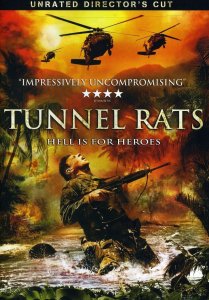 Uwe Boll does a Vietnam War film? It certainly sounds like a recipe for profound disaster. In 1968, as the intrusive prefix to the title tells us, the U.S. military had a unit of soldiers with the special mission to discover and infiltrate the miles-long underground tunnels by the Viet Cong. These “tunnel rats” were tasked with clearing out these deadly and cavernous mazes, where the Viet Cong ate, slept, and even walled up their dead within. Sergeant Vic Hollowborn (Michael Pare, who else?) heads the unit and has to shape up the new recruits into formidable fighters. Hollowborn lectures his young men on the dangers of “Charlie” and even orders them to execute an enemy prisoner. “Charlie’s gonna kill you just for being here,” he warns. “He doesn’t care if you’re a nice guy.” This nugget of wisdom is proven true over the 90-minutes of the film. The Tunnel Rats unit finds a new tunnel and this discovery eventually leads to the camp being decimated over the course of one hellish night in Vietnam.
When the action goes underground is when the movie gets, remarkably, pretty good. The labyrinthine tunnels dug out by the Viet Cong is an incredibly interesting subject that no Vietnam film has yet to cover with any substantial attention. Did you know that the Viet Cong could smell the smoke or aftershave of a man in those tunnels? They can even tell the brand of cigarette supposedly. Boll’s movie fails to take full advantage of its intriguing wartime setting. I wanted to know more about the particulars of the duties entrusted to the Tunnel Rats, a real unit of the armed forces with a high mortality rate. I wanted to know about the incredible construction of these tunnels and the dangers they posed to the U.S. armed forces. I wanted to know about the day-to-day lives of men who specialize in the tunnels, and I really wanted to learn about the unique minutia of hand-to-hand combat within such confined space. Fighting for your life in such limited space, now that’s interesting stuff.
 While Boll’s war movie fails to explore the tunnel setting in detail, Tunnel Rats has its fair share of quality suspense, mostly thanks to the claustrophobic quarters. It’s hard to make such limited space exciting for so long, but Boll manages to crank up the tension by pressing in on his actors. Watching the soldiers crawl on their hands and knees, possibly for miles, never knowing what trap might be in wait, well it makes for some intense feeling of dread. There are two standout scenes involved in the tunnels. The first involves a soldier that discovers a tautly wound tripwire leading to a grenade. Boll carefully follows the soldier steadily try to diffuse the booby trap and it almost reaches a nerve-wracking sense of unease. The second standout scene involves a solider that killed a Viet Cong member in the tunnel. The U.S. soldier has to use a simple knife to pulverize the corpse of the Viet Cong member just so he has enough room to pass by inside the tunnel. The scene is shot in tight close-ups as we watch the sickening repetitive motions of the soldier doing his best and bloodiest work just to move on by. It’s harrowing and empathetic. The above ground stuff has all the requisite chaotic explosions and soldiers being gunned down, but it’s the action underground that is surprisingly steady and consistently well designed.
The cinematography by Boll regular Mathias Neumann is a great strength. It takes a page out of Janusz Kaminski’s playbook, Spielberg’s long-time cinematographer, by layering in streams of milky light. The colors are muted and the camerawork is mostly handheld. Sure the visual aesthetic is a tad derivative (it made me wonder if Boll rented Tigerland before filming) but it’s a fairly good copy. The South African location shoot makes for a pleasing facsimile of Vietnam. Neumann also finds new and interesting ways to film the tunnels so that the setting doesn’t lose any of its unsettling power. Watching soldiers crawl along the inky blackness with but a flimsy flashlight provides for some spooky imagery that doesn’t even have to resort to cheap scare tactics. However, there are far too many spinning low-angle shots that do little more than stare at the tree canopies above. It’s like the cameraman is in the constant process of nearly passing out.
 The war as hell metaphor is familiar and potent, but Tunnel Rats lacks a deeper message. The film wallows in war clichés, particularly in its opening 20 minutes. The bland stock soldiers are interchangeable. They wax philosophically about the nature of God and war, talk about their hopes and dreams back home, and recount stories about laying under the stars and enjoying mom’s home cookin’. They bond, they share pictures of their respective sweethearts, and then they naturally meet a grisly end. One newbie even asks, in all seriousness, “You ever get scared out there?” The dialogue is pretty lousy and rife with clichés. The movie isn’t too subtle with some of its metaphors either, like when a Viet Cong woman literally tries washing the blood off her hands after executing a U.S. soldier. While the film is clearly told from the perspective of American soldiers, and the Viet Cong are antagonists, Boll takes time to show fairness to the enemy. One female warrior (Jane Le) fights to protect her young children. Another Viet Cong soldier fights to avenge the honor of a woman who was raped by American troops. The only message that appears to emerge from the movie occurs in the final minutes, when Boll seems to cram in a heavy-handed attempt at moralizing, a “we’re in this together, folks” kind of message that involves nearly four minutes of uninterrupted digging. But then Boll subverts that message and kills it, ending the film with the same sense of hopelessness. Tunnel Rats doesn’t bother to explore human insights and the nature of war and feels decidedly minor, following one all-out skirmish on one day of the Vietnam War. I wish Boll realized the potential his narrative had, which is not something you’ll likely often see me write. Tunnel Rats seems to be too content to be an effective horror movie dressed up as a war flick.
What is it about war movies that seem to excuse exploitation? It seems that a filmmaker can showcase tremendous gore and horrific bloody violence when they can cloak the material under the illusion of being true to life. Somehow filmmakers believe that wallowing in blood and guts is honoring the valor of those who served. This can be true, like the opening onslaught of Saving Private Ryan. But this can also be rubbish. War films can be just as exploitative as any other genre of film. Tunnel Rats has just as gruesome violence as Boll’s other horror movies, but because it has a war setting does not automatically give the violence and gore more integrity or meaning.
 Tunnel Rats is a resounding achievement for the talents of Uwe Boll. It cannot even be passive-aggressively complimented as being “competent.” No, this is actually a halfway good movie that has some unsettling moments amid the suspense and chaos. The underground tunnel sequences manage to find an eerie intensity and are the best part about the movie. Thankfully Boll seems to realize this, which is why a majority of the movie alternates between various soldiers finding their way amongst the underground maze. The acting is actually some of the strongest yet in a Boll movie. Tunnel Rats would have greatly benefited from more attention being spent on the details of the life of a tunnel rat (it seems like a suicide mission). The movie never really feels fully realistic but at the same time it eschews being campy. It’s not as nearly as serious and artistically daring as the pinnacle Vietnam War flicks, but then again the movie is also better than plenty of other recent war films that have the tendency to either be jingoistic or fetishize the brutality of war.
In a twist of fate, Boll is actually developing a first-person shooter video game based upon his Tunnel Rats movie. The man who takes video game properties and makes crummy movies out of them has now made a decent-to-somewhat-good movie and developed a video game from it. Now it’s only a matter of time before Boll adapts the game into another crummy movie.
Nate’s Grade: B-
Share this:

Duplicity (2009)
 This is the kind of slick, breezy fun that Hollywood seems to have forgotten how to make, or at least forgotten to make well. Writer/director Tony Gilroy has concocted an entertaining movie headlined by movie stars clearly having a blast. Gilroy’s narrative routinely folds back on itself with plot reversals, supplying new perspectives to the ongoing con/heist involving Clive Owen and Julia Roberts as ex-spies and current lovers. The movie itself is one long, pleasing con that manages to stay a step ahead of the audience without coming across as too confusing or dull. The tricky, twisty plot means that the audience must constantly reevaluate the movie, meaning that watching Duplicity can be described as less involving and more like an assignment. Gilroy is a sophisticated wordsmith and he has been knocking out crafty, intelligent adult movies, from the Bourne franchise to 2007’s Michael Clayton. The man probably spent too much effort trying to keep an audience on its toes. The audience becomes keenly aware of the plot structure, and we know it’s only a matter of time (usually 10-15 minutes) before another flashback reveals something else that will change the rules of the game. Still, the movie benefits from fantastic character interplay between Owen and Roberts and a superb supporting cast lead by Tom Wilkinson and Paul Giamatti as scheming corporate scoundrels (the opening credits slow-mo fight between the two men is delightful). Duplicity is an enjoyable romp with snappy dialogue, sizzling stars, and little re-watchability once all the plot machinations play out.
Nate’s Grade: B+
Share this:

I Love You, Man (2009)
 A thoroughly genial comedy, I Love You, Man is an easily enjoyable flick that has fun upending romantic comedy tropes. The movie follows Peter (Paul Rudd) and his search for a “bromance,” a heterosexual male friendship that follows similar dating patterns seen in typical romantic comedies. Peter finds his match with Sydney (Jason Segel), a semi-sophisticated slob. Rudd has been a superb smartass in so many movies, which makes it all the more surprising at how incredible awkward he plays Peter. This man seems embarrassed with every breath he takes. It becomes moderately endearing to see him break out due to his male bonding with Sydney; the nice guy comes of age by becoming impolite and vulgar. The plot takes some predictable turns, like when Peter’s fiancé (Rashida Jones) is upset that her man wants to spend more time with his new pal than with her. Rudd is the most charming actor on the planet, which makes it somewhat wasteful to stick him as a straight man in a comedy. Segel takes great advantage of his character’s boorish behavior and is consistently funny. The supporting actors lift their underwritten roles, especially Jon Favreau as an altogether asshole. I Love You, Man banks on plenty of pleasant vibes and amusing performances. It may never be a gut-buster when it comes to laughs and it may not be fully lovable but it’s certainly easy to like.
Nate’s Grade: B
Share this:

Knowing (2009)
 Knowing is a movie about the consequences of seeing the Eternal Plan. If you could know the exact day of your death, would you want to know? How would that impact your life? Would you feel motivated to live every other day to its fullest, or would it cast a pall over the rest of your time? One character in Knowing is told the day of her death and it destroys the rest of her life. I think this topic is interesting but perhaps I’m in the minority. Knowing has been savaged by film critics, and I can certainly see the validity of some of their complaints. It’s not a flawless movie by any means, but I found Knowing to be an effective and suspenseful B-movie.
In 1959, a Massachusetts school buried a time capsule with drawn predictions of what students though the world would be like in 2009 (lots of robots and rockets, how we’ve let them down). One girl, Lucinda Embry, wrote a series of numbers. Flash forward 50 years. MIT professor John Koestler (Nicolas Cage) is a widower raising his eight-year-old son, Caleb (Chandler Canterbury). When the school reopens the time capsule, the schoolteachers pass out the individual letters to students. Naturally Caleb is given the envelope with the number code. He brings it home to show his father, who becomes intrigued and looks for patterns. John reasons that the string of numbers is an eerie predictor for major disasters around the world. They predict the date, the number that die, and the location via longitude and latitude. All of the numbered disasters have already taken place (including the hotel fire that killed John’s wife), but there are three more numbered disasters that have yet to happen. It?s about this time that Caleb is visited by mysterious thin men in long black trench coats. John seeks out assistance from Lucinda’s daughter (Rose Byrne), whose daughter also hears the same voices that Caleb does about an impending doom.
 Count me genuinely surprised at how taut I found Knowing. This movie builds a good head of steam and I dreaded what was to follow (in the good sense). When John figures out the exact design of the numbers, pinpointing date and location of disasters, he feels compelled to try and prevent the loss of life. Would you do the same? I think if I had been given a secret celestial code that predicted cataclysmic disasters that I would make sure to steer clear from those locales, rather than running to them. Director Alex Proyas (Dark City, I, Robot) expertly stages the carnage, to the point that I was grimacing and wincing. The plane crash, all shown in one unending shot, is a realistic nightmare that gets more and more disturbing. John hops through the wreckage to attempt to save people and encounters one burning victims after another, all screaming in terror. There are subsequent explosions amongst the wreckage that engulf more people in flames. The scene is spellbinding and unflinchingly horrific. The same can be said about the second disaster sequence in New York City, indelicately evoking some 9/11 memories. After these sequences I was dreading every moment leading up to the next, yet I was also perversely interested to see what would happen next.
I?m glad that the screenwriters tackled the fallacy of numerology early. One of John’s MIT colleagues says that people see what they want to see in the numbers, and surprise then they find them. This was completely the case with the ridiculous 2007 thriller, The Number 23. Jim Carrey went crazy deducing everything to one number, but it was the human mind projecting what it desired to see. The same thing goes for psychics who express vague statements so that the poor saps paying can fill in the details and make it personally relevant (“I’m thinking of a grandfather who died… He was a man?”). I had less of a logic gap with the numbers in Knowing. Granted, I have no idea which set of numbers the code is going with. For example, it lists a set number of deaths for the 2004 tsunami that killed over 250,000 people. But with such a massive event, how do we calculate the dead? There could be loads of people missing and presumed killed by the tsunami. Do people that die as a result of injuries count as direct victims, or are they victims of infection? My point is either the number code is going by the reported estimate on the news or has the exact number, which would be different than what the estimate was in the press. Either way, it presents a mild discrepancy for John.
The movie paints itself into a corner and the astute viewer will realize that it?s only a matter of time before one of the two supernatural A-words gets dropped as the force behind the strange occurrences (or a hybrid of both options). While the movie gets somewhat silly toward the end with its apocalyptic resolution, Knowing refrains from getting stupid. Yes it’s weird that John somehow lives in a giant house decorated to look like some peeling haunted mansion. Yes it’s weird that some supernatural force could predict every man-made disaster yet decide not to intervene in the biggest one. Yes it’s weird when Cage screams, “We have to go where the numbers want us to go.” But here’s the thing, Knowing is packed with ideas, some of them derivative (the ending borrows liberally from Arthur C. Clarke’s novel, Childhood’s End), but there is an ongoing discussion over the nature of science, religion, destiny and free will, and this discussion does not pander. I would have expected a conventional movie to transform John back into a man of faith over the amazing course of events, but it never fully happens. The movie never deduces that religious faith is the right prescription for our ailing times, and it even questions the ideas of divine intervention, namely that we live in a universe of determination rather than randomness, though it won’t specify what that determination is. The movie adheres to its pessimistic viewpoint right down to the end, which result in some ballsy choices for a mainstream Hollywood thriller. The heavy-handed ending didn’t break the enjoyment of the movie for me, though I expect it will for many.
 Not that it was needed but Knowing offers some nice little moments of characterization. I really enjoyed John’s monologue about his wife’s passing. He laments what he was doing at the time of her death, mainly blowing leaves off the lawn. He thought you were supposed to know, to feel something when your loved ones are in peril. He was just tending to the leaves, unaware of his wife’s fiery death. I really appreciated this insight into John and also how realistic the scenario felt: the depressing realization that the universe let you down. This seems like a much more believable reason for John’s scientific atheism than anything Mel Gibson went through in Signs.
The acting is cranked up to an exaggerated level of screaming. Cage spends a good portion of the movie with his mouth agape. The rest of the time he’s frantically screaming, which could account for most of the acting. It alternates between catatonic and hysterical. Cage is rather decent as his life is consumed by mysteries. I must say though that the acting only made me raise my eyebrow a few times and never pulled me out of the movie. This is no Wicker Man embarrassment of monumental proportions.
[Knowing is a solid B-movie with some super special effects to go along with its haunting scenes of disaster. It?s a step above your average sci-fi flick thanks to a lack of pandering to easy answers. I’m somewhat amazed that a movie this fatalistic and bleak would be greenlighted and given the budget it has. Proyas make sure the movie doesn’t succumb to numerology hokum, though the movie does tilt a bit toward the silly by its conclusion. I went into Knowing knowing little beyond the fact that the movie was ripped apart by other critics. Perhaps my positive reaction is born completely out of low expectations, but I found Knowing to be a juicy bit of sci-fi escapism that diverted the time nicely
Nate’s Grade: B
Share this:

Watchmen (2009)
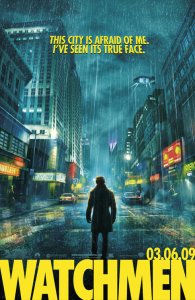 In the realm of comics, Watchmen is tantamount to the Bible. It consisted of 12 issues released between 1986-1987 but it arguable changed the medium forever afterward. TIME magazine listed the book, by author Alan Moore and artist Dave Gibbons, as one of the 100 greatest 20th century novels. Therefore, there has always been heavy trepidation within the geek community when Hollywood came courting the Watchmen property. Different directors have tried tackling the material, going back to the late 1980s when Terry Gilliam was hired to direct and producer Joel Silver was adamant about getting Arnold Schwarzenegger to portray Dr. Manhattan (back then, they totally just would have painted him blue — like they did when he was Mr. Freeze). The movie would seem like a tantalizing possibility and then the production would collapse, most recently in 2004 with director Paul Greengrass attached. Director Zack Snyder (300) understood all of the concerns from the notoriously vocal geek community and attempted to make the most faithful Watchmen film possible. He accomplished that goal. But was it the right goal?
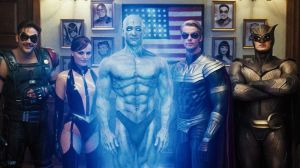
In this alternative account of history, masked crime fighters exist and were even bankrolled by the U.S. government. President Nixon is re-elected to a third term, thanks in part to superheroes winning the Vietnam War, and then he outlaws all masked vigilantes. Flash forward to 1985, and Nixon is on his fifth term and staring down Soviet aggression into Afghanistan. It appears that the world on is on the brink of nuclear annihilation by the dueling super powers engaged in a staring contest. Edward Blake, a.k.a. the Comedian (Jeffrey Dean Morgan), is thrown from his apartment window and killed. Blake used to belong to a second-generation superhero team in the 1970s called the Watchmen. The other members consisted of Dan Dreiberg, a.k.a. Night Owl (Patrick Wilson), Rorschach (Jackie Earle Haley), Adrian Veidt (Matthew Goode), a.k.a. Ozymandias, the glowing blue man Dr. Manhattan (Billy Crudup), who was transformed into a god-like figure of power after a laboratory accident, and then there’s Laurie Jupiter, a.k.a. The Silk Spectre (Malin Akerman), who was following in her mother’s (Carla Gugino) footsteps, the first Silk Spectre. The death of the Comedian brings the old team back together and rekindles some interest in putting on the super suits and fighting crime one more time. It seems someone out there is trying to knock off the retired superheroes, and Rorschach is convinced that a bigger conspiracy is unwinding.
 It’s difficult for me to formally express my feelings and reactions to the Watchmen film adaptation. Count me among the throng of fans that feels that Moore’s source material is a remarkably dense and witty deconstruction of the superhero mythos. Imagine a Superman that can’t be bothered to help out humanity because he feels life is overrated, or a group of super heroes that don’t necessarily do anything heroic; when they beat up the bad guys it’s because they get a sexual thrill from the rush of violence. My voice was among the cacophonous crowd screaming, “Don’t you dare butcher this great work! Keep it as close to the comic as possible!” And that’s pretty much what Snyder delivers. But now I’m left to wonder if a literal-minded interpretation is truly what I wanted all along. Watchmen is not like Sin City, a comic that was already a movie in panels. Frank Miller’s ode to film noir was ready and waiting to be a splashy action movie with style to spare. Watchmen is not a ready-made action vehicle, as it really only has about two extended pieces of action. Moore’s story examined what kind of people would become vigilante crime fighters if the government approved the practice. Surprise, it’s a bunch of sociopaths that are now getting checks from Uncle Sam! Watchmen is a nihilistic account of human behavior and far more cerebral than any superhero film that has ever graced the screen. Seriously, what other superhero movie opens with a fictitious episode of PBS’ political yak fest, The McLaughlin Group? So I suppose this paragraph is a sheepish way of admitting that perhaps Watchmen should have stayed place on the page unless, gulp, it was advantageously adapted for the medium of film.
It’s not that Snyder does a bad job or that the film itself is poor. While Snyder isn’t the best man to handle actors, he is certainly a skilled visual tactician and knows how to make some immensely pleasing imagery. He breathes great life into the images of the comic book and filled in the blanks nicely, and his one big artistic addition is one of the film’s best moments. In the opening credits we get a series of shots that perfectly establish this alternative universe, where JFK shakes Dr. Manhattan’s hand on the White House lawn only to be later gunned down by none other than the Comedian in Dallas. The segment is cleverly set to Bob Dylan’s “The Times They Are A Changin'” and is a terrific intro into a re-imagined America. I wanted to spend more time exploring the differences, like watching a giant Dr. Manhattan win the Vietnam War in one week’s time. In many ways, Watchmen is Snyder’s epic pop commentary on the history of the United States. Dr. Manhattan takes the first pictures of the astronauts on the moon. It is a female crime fighter that swoops a woman off her feet for that iconic celebratory kiss marking the end of World War II. The flick even has a period appropriate, synth-aided score, which is fine, though the use of period pop songs can be distracting. Watching Laurie and Dan make love to the raspy tunes of Leonard Cohen’s already overused tune “Hallelujah” is a deeply uncomfortable moment. Also, the aging makeup is horrendously bad. Gugino looks like she has a turkey waddle and the older Nixon looks like a freaking Halloween mask.
 At what cost did Watchmen make it to the screen? Wacthmen plays as an adaptation like the first two Harry Potter movies, like there was an assigned checklist rather than a fully developed script. I achieved a brief understanding with the characters and each central figure provides a glimpse of the trouble beneath the surface. Laurie is a girl with daddy issues who’s been pressured to follow her mother, a rape victim who still loves her rapist. Dan is a self-pitying putz who has never felt more alive than when he puts on a costume. Rorschach has the same pessimistic view of mankind that Travis Bickle did, viewing many people as vermin clogging the gutter. Yet Rorschach also is the most single-minded of all the characters and abides by an innate moral code and sense of duty, never mind the fact that he may have lost his mind. Dr. Manhattan has been turned into a supreme being and has lost his connection to humanity. The Comedian is a man of wanton desire who declares himself to be the epitome of the American dream: giving in completely to the id. Watchmen has been deemed as an unfilmable book, and perhaps they were right. It feels like Watchmen and looks like Watchmen, but the movie never seems to become anything grander than the sum of its parts. The Dr. Manhattan back-story, where we see him live life in the past, present, and future simultaneously may be one of the best moments in the movie, but it doesn’t add up to much more than an interesting aside. The trips to Mars and Antarctica provide nice visual landscapes but do little else. The other quandary is that everything Snyder cut from the comic (the side characters, the pirate comic, the alien squid) is something that ultimately was unimportant. All of the important and memorable moments from the comic are here, though abbreviated and truncated. Even a 2-hour and 40-minute movie feels like too much of a sprint through such rich material probably better suited to the more accommodating narrative confines of a glossy HBO miniseries. The movie ends up becoming a handsomely mounted and reverent homage to the source material, but I question if the movie serves any other purpose than as an advertisement to go read the book. Will people unfamiliar with the book enjoy a movie practically tailor-made to appeal to fans of the book? Who will watch the Watchmen?
Make no mistake, Watchmen is a hard R-rated movie and if any parent takes their child to this flick because it has men in capes, then that parent should have their child removed. Snyder has ramped up the book’s adult elements, which were originally a commentary on how comics flirt with sex and violence but never get their hands too dirty. Snyder has gotten his hands dirty all right. Instead of zapping others into poofs of smoke, Dr. Manhattan turns them into explosions of human goo that stick to the ceiling. Instead of the Comedian being thrown from the window, we see an extended fight sequence that seems to indicate that the Comedian’s apartment is full of nothing but breakable glass tables. When Dan and Laurie get into a street brawl where bones pop through skin. The sex scenes now involve an almost-agonizing level of thrusting. This is an adult tale in a very simple sense: there are boobs and blood. But the movie is also adult in the fact that it trades in complex political, psychological, and philosophic ideologies, asking hard questions that do not come with easy answers. Do the ends ever justify the means or is mankind destined to always destroy itself? Is humanity worth saving and at what cost? This is probably the most subversive studio-backed movie to come out of Hollywood since 1997’s pro-fascism melodrama, Starship Troopers.
 The three best performances in the movie all come from the three weirdest and most messed up characters. Haley (Little Children) fully inhabits the grisly character of Rorschach and growls his way through the movie. You can tell just by the man’s face how much he has weathered. Crudup (Big Fish) and his gentle voice make Dr. Manhattan an intriguing yet beleaguered super being. Morgan (TV’s Grey’s Anatomy) makes the Comedian one consummate bastard but a bastard that you cannot stop watching, nonetheless. The rest of the cast does suitable jobs and I don’t feel that Goode (The Lookout) or Akerman (27 Dresses) deserve the drubbings they’re getting through the critical community. I actually liked Goode’s portrayal of Ozmanydias, though he fails to express the heavy crown the smartest man in the world must bear. Gugino (Sin City) is terrific when she’s the young, spunky Silk Specter and the opposite of terrific when she’s the troubled, alcoholic older version on screen.
Snyder has served up the Watchmen that fans have been demanding for years, but is this really what everyone truly wanted? Snyder made an adaptation for the fans but what do the fans know except for lavish loyalty? The book utilized the medium of comic books to accentuated its story while commenting on the history of comics and superheroes, and when translated to the big screen as is Watchmen can feel like an artistic stillborn. I’m now more curious than ever to read the previous drafts out there, the ones that directors like Darren Aronofsky and Greengrass were going to film until the financing got pulled. One of the drafts transplants the world of Watchmen to modern day and replaces the nuclear brinksmanship with the Russians to the ongoing War on Terror. It may not be faithful to the fabulous source material, and it quite possibly would have made a terrible movie, but it would have been more interesting as a film project because it would have been an adaptation. Snyder’s Watchmen is reverent to a fault but I cannot complain too much. This is likely the most faithful recreation of a complex book that fans could hope for. I feel satisfied and yet unsatisfied with the finished product. It was everything I was looking for in a Watchmen movie and maybe, in the end, that was the problem. I think instead of buying the DVD I may just read the book again.
Editor’s Note: I have warmed up to this film much, much more on Blu-Ray, especially the 3-hour director’s cut. It’s Snyder’s best work to date.
Nate’s Grade: B
Share this:

Confessions of a Shopaholic (2009)
 Releasing a romantic comedy about a woman plagued by credit woes in the middle of a global financial meltdown? Doesn’t sound like the best example of escapist entertainment, but Confessions of a Shopaholic is infectious fun, and it’s all thanks to the delightfully funny lead performance by Isla Fisher. She seems like she stepped out of one of the old Hollywood screwball comedies from the 1930s. There’s a terrific hunger in her eyes and the woman knows how to punctuate a joke. The movie itself isn’t too shabby either. As far as formulaic romantic comedies go, this is one of the better ones in recent years. It has a little dash of everything, from slapstick to farcical thriller to romance to even some mildly potent drama. Director P.J. Hogan (Muriel’s Wedding) keeps the movie light and fun and even spruces up the flick with some interesting visuals, like animated CGI mannequins that come alive to tempt Fisher. Even though the movie holds onto a sitcom level plot for too long (mistaken identity), Confessions of a Shopaholic is a far worthier piece of entertainment than typically found in the rom-com genre, and Fisher is a comedian to rival the best.
Nate’s Grade: B+


 nathanzoebl
You must be logged in to post a comment.