Author Archives: natezoebl
The Magnificent Seven (2016)
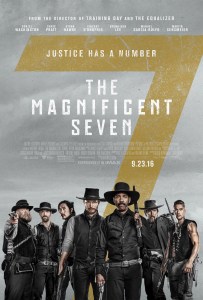 Obviously the new Magnificent Seven remake was never going to be as good a Western as the 1960 original, or as good an action movie as its source material, Akira Kurosawa’s legendary Seven Samurai. Once you accept that, the question becomes whether simply being an enjoyable Western action movie qualifies as a success given its storied pedigree. If you can’t do better than the original, why bother making it as my friend Ben Bailey would question. The answer is of course blunt (money) but the conundrum is how does one improve on classic film masterpieces? I think the new Magnificent Seven found its footing by accepting its unquestioned ceiling and instead going down a different path, instilling the essence of what made the older films so superb, and just trying to be the best B-student it can be with its new set of guidelines for broad entertainment.
The dusty town of Rose Creek falls under attack by ruthless industrialist Bartholomew Bogue (Peter Sarsgaard), who wants the land for his mining company. He installs loyal toadies as lawmen for the town and to ensure any troublemakers are put to “justice.” Emma Cullen (Haley Bennett) wishes to avenge her fallen husband and recruits a famous outlaw, Chisolm (Denzel Washington). He agrees to help and rustles up a powerful posse of gunslingers to defend the town from Bogue and his cruel forces.
There’s a reason this story still works as well as it does and that’s because the structure is ready-made for payoffs and audience satisfaction if the director and actors are capable. Act One establishes the threat and our two main roguish heroes, and then Act Two starts off with the gathering of the team, routinely one of the greatest sequences in screenwriting, and then the Act Two midpoint involves toppling the corrupt thugs controlling the town, and Act Three is the culmination between the forces of anti-hero good versus evil over the ultimate battle for the town. It’s an against-all-odds underdog tale with good but possibly doomed forces against a villain used to steamrolling through vulnerable citizens. I don’t care whom you are, that story structure worked then and it still works now. Fuqua and company don’t break a winning formula and know what strengths they have and how best to maximize them for top entertainment value.
 The biggest asset is this glorious cast, headlined by Washington and Chris Pratt (Guardians of the Galaxy). There isn’t admittedly much to these characters from a development standpoint. They’re given back-stories, though some of them are fairly airy and provide a bare minimum of effort. Red Harvest (Martin Sensmeier) in particular just kind of shows up and everybody shrugs and says, “Why not?” more or less. Also, while on this subject, it’s a bit contrived that when the bad side has their own villainous Native American that the script has to conspire for the only two Native Americans to face-off, especially when we’ve been given no history or connection between them prior to this climactic showdown. Back to the main cast, Washington settles into his suave badass persona we’ve come to expect from the man. He even fades into the background at times, ceding space for the other characters to have their moments. Make no mistake, though, because Washington’s character is a strong central anchor for this movie and even on autopilot this actor still produces attitude with style and gravitas. There’s also the simple pleasure of just watching Washington in a Western. The man was made for this setting of taciturn badasses. The brightest star of the picture is Pratt, expertly cast as a charming rogue with a big personality. What the characters lack in development they make up for in colorful personalities, which is acceptable in a genre that rewards memorably outsized figures of entertainment. Pratt is a fun rascal with a penchant for sarcasm and playing around with his prey. Every minute Pratt commanded the screen was a minute that captured my full attention.
The rest of the cast is solid and make the most of their screen time, putting in memorable supporting performances to compliment the stars. Vincent D’Onofrio (Jurassic World) is basically like a human equivalent of a bear or yeti. He’s this massive and animalistic creature and I appreciated D’Onofrio’s gusto in embracing the peculiarities. In a film of great casting and memorable characters, he nearly steals the movie. Ethan Hawke (Boyhood) has one of the more credible character arcs in the film as well as the best name (Goodnight Robicheaux). He’s haunted by a lifetime accumulation of killing. His flinty co-star Byung-hun Lee (RED 2) is the strong silent type and the two of them have a nice gunslinger chemistry, nicely contrasting but still a believable brotherhood in arms. Bennett (Hardcore Henry) is going to break out in a big way in 2016. She has a very arresting face (it’s her eyes) and an instant screen presence, which is hard to do with these guys soaking up much of the oxygen. She also gets to prove her mettle and not be treated as a romantic object, so hooray. My one concern with Bennett was that the costume designer had let her down, as it seemed the top of her gown was dangerously close to slipping off her shoulders at several key points. I understand this is designed to squeeze in a slight surge of sensuality for what is very much a PG-13 action flick but it became distracting with its obviousness. Bennett deserved better, though she might be another figure of T&A with her role in The Girl on the Train. We shall see (maybe much). The only sore spot is the villain, a wasted Sarsgaard (Black Mass) who never quite lives up to a diabolical nature worthy of the attention of our colorful cadre of anti-heroes. He’s a bully but he doesn’t seem formidable enough or that interesting.
 Fuqua (The Equalizer) hasn’t been the most consistent stager of action with his up-and-down career but he puts out all the stops with The Magnificent Seven to great effect. The action sequences are robust and shot with great attention to geography and escalation. I knew exactly what the stakes were with each sequence and gun battle, and I knew the different people and their placement and the goals. With a crew of seven and counting, it can be difficult to adequately find room for each of the fighters to be well utilized and have at least a moment that matters (just look at what happened with Suicide Squad). The second half of Act Two is our team plotting how to compensate for the overwhelming forces coming down their way, and the plotting produces plenty of opportunities as the audience watches the setups and waits for the payoff jamboree. There are little payoffs, big payoffs, crowd-pleasing payoffs, character arc pleasing payoffs; it’s an action movie that knows the climax should be the best part, and it doesn’t disappoint. The town may be in rubble and strewn with corpses by film’s end, but you’ll be happy and content from the wealth of tense and smartly directed action. Helping things along, Fuqua’s Wild West photography is often strikingly beautiful with its use of natural light.
The Magnificent Seven makes up for its lack of originality and rich characters in colorful personality and the sheer scope and intensity of its action. It can’t contend with John Sturgis and Akira Kurosawa, but what modern movie can? I don’t fault the movie for failing to live up to the standards of two classics in two different genres. I instead credit the movie for knowing its strengths and knowing how best to develop and deliver them for maximum mass appeal enjoyment. The cast is wonderfully selected and given fun characters to dig into, and the onscreen camaraderie of our seven might not rise to the level of magnificence but it’s pretty good by all accounts. That’s a rather keen summary of the movie writ large; with modestly recalculated expectations, the movie may not be magnificent but it’s plenty good and plenty entertaining. Washington and Pratt are stars making full use of their broad star appeal. The action sequences are well staged and peppered with payoffs, and it’s worth congratulating the team on having several parallel lines of action and keeping all of the shifting particulars understandable for its audience. The Magnificent Seven is about as good as I expected any remake to be, and while it doesn’t rise to those storied heights it does achieve its goals with vigor and style.
Nate’s Grade: B
Share this:

Sully (2016)
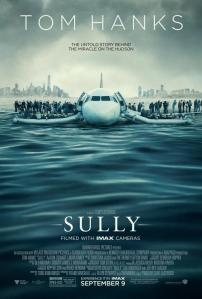 I think I had the same initial thought that most did when they saw the news that there was going to be a movie about the Miracle on the Hudson airline pilot: where exactly is the feature-length story? The flight itself lasted only about 200 seconds before landing on the river, and the sequence is thrillingly recreated and held off until halfway through the movie. The hero in the cockpit, Sully (Tom Hanks), is consumed with ensuring each and every last passenger is accounted for. When he gets the news that all survived, he can finally allow himself to breathe, to take in the full magnitude of the events, and it feels like a cleansing moment of deep emotional catharsis for him and the audience. But what’s the movie here? Apparently the NTSB and the airline insurance companies are disputing whether Sully could have safely landed the plane back at an airport instead. It’s exactly the kind of flimsy, manufactured conflict that sets itself up for moral grandstanding and a courtroom confrontation where our heroes will be vindicated, and we get all that. Sully’s unexpected spotlight wears on him as he feels like an ordinary citizen not worthy of the term “hero.” No other plane has successfully landed in water without a loss of life, so I’m sorry pal, but you’re a hero, even if you think you were just doing your job. Hanks is suitably low-key and humble and strong and emotionally resonant, though he was better on just about every front with Captain Phillips. The direction from Clint Eastwood is respectful without going into hagiography. The overall message is one of uplift, widening the focus from Sully to other heroes in New York City that day that came together to help others. It’s a moving message without having to resort to melodrama. At a mere 96 minutes, Sully gets you in and out and provides a solidly entertaining glimpse at the people who rose to the challenge when needed most. It’s a well-made movie that goes as far as it can without trying your patience.
Nate’s Grade: B+
Share this:

Bridget Jones’ Baby (2016)
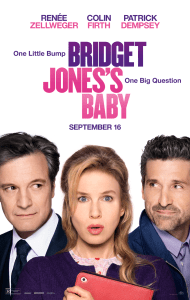 Coming 12 years after the last Bridget Jones outing, I was pleasantly surprised to discover how warm my feelings still were for this plucky, feisty heroine. Now in her mid/late 40s, Bridget is contemplating a life never becoming a mother when, surprise, she gets very pregnant and has two possible fathers: billionaire love guru Jack (Patrick Dempsey) or her newly available on-again off-again beau, Mark Darcy (Colin Firth). It’s a frothy plot contrivance but the screenwriters (including author Helen Fielding and co-star Emma Thompson) are able to produce fun comic scenarios that fully embrace the premise and its soapy conflicts. Bridget has two pretty appealing options, and when both men finally discover the possibility of the other, it becomes an entertaining game of one-upsmanship. The requisite romantic comedy elements don’t forget to be funny too, including an ending rush to the hospital that achieves some inspired slapstick. The film is swiftly paced and filled with zingers, and I just sat back for the two-plus hours and enjoyed the company of these silly yet realistic human beings. I enjoyed the adult humor and conversations that rarely get as much development in this genre. With all her self-sabotaging ways, you come to realize how much of a prize Miss Bridget is, and Zellweger slips right back into the role like no time has passed. However, plenty will grumble about Zellweger’s much-publicized plastic surgery, or the fact that she didn’t pack on the pounds for this picture, but I don’t see why any of that greatly matters in the interpretation of this character. The personality of Bridget is more than the alignment of her facial features. For fans of the series, Bridget Jones’ Baby is a welcomed return to form from 2004’s Edge of Reason and an extra dose of enjoyable fan service, tying up its tidy happy ending with a bow. Here’s something to chew over: my father had no prior knowledge of the Bridget Jones series, decided to see this movie, and enjoyed it thusly. Give Bridget Jones and her baby daddy drama a chance and you too may be surprised.
Nate’s Grade: B
Share this:

Blair Witch (2016)
 As is mandatory with all reviews, let us acknowledge the tremendous impact of the original Blair Witch Project, a full-borne cultural event that tapped into the zeitgeist. It was a rare indie movie that curated a must-see reputation and became a blockbuster. The found footage format was highly influential afterwards as were its low-fi thrills, community interactivity, viral marketing, and experimental construction. I remember having heated arguments with people about whether the movie was indeed real or a work of fiction. I pointed to the TV once and said, “Look, the actors are promoting it on MTV.” Naturally imitators followed suit and the studio looked to eagerly turn a curiosity into a franchise. 2000’s hasty sequel Book of Shadows was quickly rejected and just as quickly the Blair Witch phenomenon had slipped away. It remained dead until this summer. Director Adam Wingard (You’re Next, The Guest) and frequent screenwriting partner Simon Barrett had recently made a horror movie called The Woods, but at 2016’s Comicon the secrecy was finally dropped. It was a sequel to The Blair Witch Project, filmed in secret J.J. Abrams-style. It was a stunt that worked, and once again there was life in this franchise. This will only last until people see the new Blair Witch, a monotonous, confused jump-scare haven that’s too indebted to the original and discards anything interesting it stumbles onto.
Sixteen years after three backpackers went missing, footage has been posted that possibly shows one of these backpackers, Heather, still alive. James (James Allen McCune) is now an adult male and determined to find out if his sister is alive. Lisa (Callie Hernadez), a film student and maybe James girlfriend, tags along to record James’ hunt for the truth into her graduate thesis. Their friends (Corbin Reid, Brandan Scott) come along for the adventure into the woods, as well as a conspiracy couple (Wes Robinson, Valorie Curry) responsible for posting that new footage. The conspiracy couple leads them into the woods and it isn’t long before people get lost, tempers get heated, and strange disturbing noises materialize from the never-ending night.
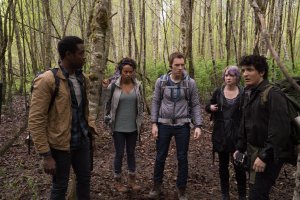 Much can be forgiven if a scary movie delivers the spine-tingling goods, and standing in the shadow of one of the biggest horror hits of all time is no easy proposition. It’s too bad then that Wingard’s Blair Witch is far more tedious than terrifying. I didn’t fall under the spell of the 1999 original but I could appreciate its slow-burn efforts and execution, which relied upon a lot of unsettling dread left to audience imagination. With the 2016 reboot, the filmmakers have upped the ante but don’t have patience. There are over six different jump scares, each punctuated by a loud, often shrill scream. At one point there are three in a row in a succession of mere minutes, enough so that a character provides a meta dose of commentary by saying in exasperation, “Why do people keep doing that?” Calling attention to the annoying trait doesn’t make it better. The sound design is also, in a word, amplified. It sounds like Bigfoot or a dinosaur is tearing through the woods and wrecking havoc. It was enough that I hoped the movie would just reveal the Blair Witch never existed and instead it was some other sizeable monster of legend. I’ll give Wingard credit for the found footage cinematography not being self-consciously overdone. The characters have an incredible stash of cameras, from GoPros to flying drone cameras, which makes the editing less choppy and the movie easier to watch.
There are exactly two scenes that unnerved me. One is the sheer numbers of an expected item upon waking up, the immense quantity and variation in size providing an eerie sight as it fills the screen. The other is a late sequence that involves squeezing in a tight space, which allows Wingard to employ some nice claustrophobic tension. Short of these two moments, and they are mere moments, the movie was boring me so profoundly that I considered just leaving, and I’ve never walked out on a movie before. It felt like it was going nowhere fast with characters I didn’t care about and without any relevant suspense. The found footage filming elements are even used to enhance the jump scares with sudden visual and sound glitches amplifying the tired attempts to constantly startle its audience. This is a movie more concerned with startling its audience than scaring it.
When the movie does start to tantalize your interest, it’s like a mirage that soon vanishes and you’re once again left in your dire predicament. Getting lost in the woods is not interesting minus interesting aspects. However, finding out that time is operating at a different level, now that’s interesting. The characters set their alarms for seven A.M. but it’s still dark out. The possibility of the Blair Witch manipulating time to trap hikers was the first moment in this entire movie that made me sit up in my chair. It took the movie in a different direction that demanded my attention, and it opened up the possibilities of what had been a rather lifeless enterprise up that point. Show me this movie. Alas, it’s an aspect that is quickly shoved aside and largely forgotten even with the timeline of events regarding the footage. There’s a scene where the stick figures directly communicate a powerful connective relationship, and yet this too is never touched upon again. There’s a new threat introduced that takes the movie in a body horror direction and raises questions about whether the woods themselves can become alive. It’s another intriguing moment that culminates in what promises to be a memorable gross-out image, and instead it too peters out and then unwisely abandons the body horror angle. It’s almost like the movie is so single-minded in its path that it ignores the intriguing and preferable detours.
Wingard and Barrett are trying to expand the Blair Witch mythology but their reboot operates on the assumption that there is even a base to work upon and that its audience is familiar with heretofore unspoken rules that appear arbitrarily and randomly. This reboot operates in a world that acknowledges the release of the first Blair Witch movie, yet nobody seems to be any different from this. Obviously James is different having to lie with the legacy of the movie, but why venture out into the woods on a whim of hope to find his long-lost sister who vanished 16 years ago? Does he think she’s just been living off squirrels and twigs in the ensuing time? Why doesn’t James try and question who edited the footage from his sister into a narrative? Why doesn’t he try suing the film production for profiting off his family pain? Why hasn’t Burkitsville, Maryland become a counter-culture tourist destination from taking ownership over its supernatural legend, much like Salem or Roswell? The town should be swamped with adventurous backpackers who want to live the experience. The much maligned Book of Shadows did far more to discuss the reality of the Blair Witch phenomenon and the tenuous hold on reality that the Internet age was ushering in. Wingard’s version eschews this world-building context for narrative immediacy. James wants to find his sister, he gets a clue that she might be out in those woods still, so they all go into the woods. Once the conspiracy theory couple insert themselves onto the trip it seems odd that we’ve ignored the larger context of the legend, instead rehashing how the Blair Witch died.
 As things begin to fall apart in the second half, the events start to feel arbitrary and poorly defined. There’s a sequence during the climax that I’ll try my best to describe with some discretion but be warned, folks (spoilers): the remaining characters eventually find that same shack in the middle of the woods, though the exact number of floors seems unclear. The witch looks to finally confront our characters, though why she/it waited until this moment is also unclear since she/it seems to be entirely overpowering. That’s when a character declares, with no prior guesswork to arrive at this conclusion, that they have to stand in corners and as long as they don’t turn around and look they will survive. And this works. It’s not explained why this Raiders of the Lost Ark closed-eyes routine is somehow the secret to supernatural survival (ignorance is bliss?). When the character unleashes this tidbit it’s treated like the audience knows the rules of the Blair Witch universe, and we sure don’t. At no point has a larger system been established, so when characters start spouting rules it feels like the movie is making it up as it goes. This don’t-look-back trick is played out almost to a comical effect, which culminates in the rising question of whether a character is going to backwards walk out of the whole stupid forest. The muddled world building (time dilation, voodoo sticks, tree monsters?) makes it feel like the doomed characters are ultimately trapped in a half-finished screenplay.
I was honestly expecting more from Wingard and Barrett after their previous genre collaborations. These guys know the underpinnings of enjoyable genre filmmaking and how and when t upend the conventions and expectations, zigging when others would zag. I felt these two would be able to take a studio gig like Blair Witch and find something new, something interesting, and certainly something scary with the property. I regret to say that this Blair Witch might be new but it sure fails to be interesting or scary. The characters are meaningless and interchangeable and boring. Their decisions are often illogical and stupid. The scares are stacked too high in favor of cheap jump scares, and the movie lacks the patience to develop its tension and horror. It can’t even properly establish rules for the audience to follow. It’s like the filmmakers are being upfront with their lack of faith in their final product. I think the key missing ingredient is, surprisingly, humor. Both You’re Next and The Guest balance along a delicate tonal line that can veer into macabre comedy any moment to lighten or heighten the tension. There are no (intentional) laughs to be had with this retread into the woods. I think the newest Blair Witch has done the unthinkable: it’s redeemed Book of Shadows.
Nate’s Grade: C-
Share this:

God’s Not Dead 2 (2016)
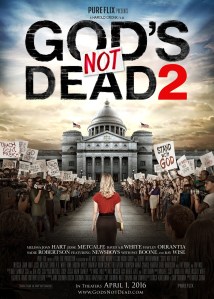 The creators behind God’s Not Dead 2 won’t admit it but their movie is pure science fiction; it exists in an entirely parallel universe that’s topsy-turvy where atheists want to stamp out the last signs of Christianity and will use their collusion of government and media power to marginalize and eliminate freedom in the name of “tolerance” and “diversity.” It’s another heavy-handed moral parable that feeds into the persecution complex of its target audience, the same people who made 2014’s God’s Not Dead a surprise hit. While the sequel isn’t nearly as mean-spirited and cruel (the godless characters don’t have to die or get stricken with cancer this time), it’s still speaking in code to stoke its audience’s unfounded fears of losing religious liberty. We follow an AP History teacher (Melissa Joan Hart) who gets into trouble from making a purely literary connection with the teachings of Jesus and non-violent revolutionaries Gandhi and MLK. The school board wants to “wash the blood off its hands” and she’s taken to court where her very faith is on trial and where her hunky lawyer has to prove Jesus historically existed. The entire premise is laughably preposterous given the context of her pedagogical reference. A student makes the Jesus connection and asks about it, and the teacher was not endorsing a religion but merely quoting a piece of literature as it pertains to those inspired from it. There’s no time for subtlety in this movie because we have a martyr that needs roasting, and in comes an ACLU lawyer played by Ray Wise (God bless this actor saying yes to everything) who may very well be the devil. Wise is the lone source of entertainment for me. There’s also a nasty TV pundit who says Christians are the real danger in this country (replace “Christian” with “Muslim” and the TV segments start to sound more familiar from our own world). Several characters from the first film pop back up but with very little to do. God’s Not Dead 2 is a pretty lackluster, laughable, and theologically simplistic morality tale but at least it isn’t as risible and offensively insincere as the original film. Like the first film, the credits close on a list of court cases the filmmakers say inspired the movie. Except, upon minimal research, not one of these cases echoes the movie I just watched. All of these cases involve intolerance against accepting gay marriage or fulfilling birth control and/or abortion services, all legal and protected aspects of our culture. I’m reminded of the quote “when you’re accustomed to privilege, equality feels like oppression.” I wonder if this kind of thinking would have lead an enterprising filmmaker telling the “brave story” of the segregationist standing up against government pressure to accept integrated schools. It’s not far off.
Nate’s Grade: C-
Share this:

Rampage: President Down (2016)
 In the close for my review of the awful 2014 hostage thriller Rampage: Capital Punishment, I was fairly prescient with a concern that sat in the pit of my stomach:
“I fear Uwe Boll thinks that there is a level of audience attachment to his spree killer that simply doesn’t exist. He’s not an anti-hero, he’s not a revolutionary, he’s not even an engaging character by any generous metric and that’s because he’s just a stand-in for tedious ideology. He’s a mouth and a trigger finger, and that’s all Bill (Brendan Fletcher) is, in no compelling manner. I worry that Boll will continue to insert Bill into new settings, have him round up some innocent people, and then we’ll watch him sputter for an hour about whatever cultural and political misdeeds are currently bugging Boll. I worry that the promise of “Capital Punishment” inherent in the title will really just lead to a third Rampage film with this promise actually, finally, followed through. Generally, I just worry that the world will have to suffer more abuse from further appearances by Bill, the world’s most irritating psychopath who loves to hear himself talk.”
Flash to 2015, and Boll and Fletcher are pushing a Kickstarter to raise funds in order to make a third (and final?) Rampage movie that will be guaranteed to be “the film we want to make, and you will want to see.” It seems that the requested $56,000 was to fund a climactic action sequence that would “leave the streets of Washington ruined, in a sequence more explosive than anything scene before in the Rampage trilogy.” It did not meet its target goal, and Boll’s response was titled, “F you all.” Those discerning folks of the Internet couldn’t stop Boll and his ridiculously misapplied love and devotion to the Rampage series, and so my dire warning has come true. The only good thing about Rampage: President Down is it might be the merciful end of this merciless franchise.
 Bill Williamson (Fletcher) has come out of hiding and made big news. He assassinates the United States’ president, vice president, and Secretary of Defense, and inexplicably goes back into hiding in the woods. FBI agents Vincent Jones (Ryan McDonell), James Molokai (Steve Baran), and Murray (Scott Patey) are on the hunt to find out who is responsible, and they’re shocked to discover Bill is alive and well. Not only that he’s a new father, sneaking in visits with his child and baby mama (Crystal Lowe, a Boll acting reappearance stretching all the way back to 2000’s Sanctuary). Bill is making one final stand and has deadly plans for the government agents looking to bring him to justice.
As much as the subtitle was misleading from 2014’s Capital Punishment, with a picture of the U.S. Capitol building that was never featured, this one may prove to be even more of a misleading promise. President Down makes it sound like the president is under immediate threat, and he was, at the ten-minute mark. At that point Bill has taken out the president, the vice president, and even the secretary of defense, which means they must have had the absolute least qualifies team of Secret Service agents. It’s never explained how exactly he accomplishes this feat or whether suspicions creep toward the Speaker of the House (line of succession, folks). You would expect the entire nation to be on high alert, that a manhunt would be under full swing with every agency utilizing very even means to capture the culprit and bring them to justice. If you worried about the NSA spying on people and the defense department’s predilection for of drone warfare, just imagine after a wave of high-profile assassinations at the top of the executive branch. And yet the frantic world of political instability is manifested by two or three mediocre FBI agents who then, when successfully identifying THE U.S. PRESIDENT’S KILLER, go at it alone and miserably. This world lacks any sense of urgency and any sense of reality. The only reason a writer would bump off the U.S. president in the story is to deal with the consequences, and weirdly the consequences almost feel entirely unrelated. The FBI is tracking Bill but they could have been doing that already after he murdered over 100 people. Oh, I’m sorry, he was so remarkably clever that he faked his own death. There is no real chaos at least as it pertains to the movie’s plot. We hear offhand news broadcasts about the world spiraling out of control, possibly nuclear attacks on ISIS. It’s all pretty vague. However, our characters just go about their duty like it was a boring Tuesday. What’s the point of toppling the president if it isn’t significant to the story?
The movie suffers from a plot that struggles to fill out a feature-length running time, stretching this manhunt and then providing a climactic confrontation that doesn’t so much feel climactic as it does a relief from the prior crushing monotony. The first hour is built around the FBI agents getting tracking down Bill but there’s no reason this manhunt even needs to be as long as it is, and that’s because of the contrivance of the magic facial recognition software. If you’re going to through in that device, it might as well find him immediately rather than stretch out this storyline and have to reboot the system to reach the inevitable recognition. It’s delaying what everyone already anticipates, so why wait? The manhunt isn’t even that interesting because it’s watching three stock FBI characters stare at computer screens and occasionally engage in their own political debate. I think one of them might have been a mole who was sympathetic to Bill, but I can’t say for certain because the copy I watched had German subtitles for the onscreen texts. If this is the case, and it might not be, then revealing this mole at the half-hour mark is far too early and robs the film of greater mystery and suspense. This isn’t The Departed. There’s far too little that happens for the first hour. Finally, once the FBI agents raid Bill’s cabin, something does happen, and it’s slow-mo combat and explosions. Why did only two agents try and take down America’s most prolific murderer? Why does the FBI not send out a drone and just blow up the entire area? The ensuing action is pretty pointless. Boll also opens the movie with a flash-forward of this cabin assault, which confuses the timeline of events but also pads out his otherwise meager running time. There’s not enough plot here to justify a feature film and adding more Bill rants is not the answer.
 The biggest problem with this series has been twofold: the empty void of its central protagonist and the lack of cohesive or, at times, even existent commentary. I reiterate what I said in my Capital Punishment review: “Bill is no different than your garden-variety college freshman that thinks they have suddenly come across amazing psychic insights into the rotten core of humanity after one political science class. I do find Bill’s moral championing of stricter gun control laws to be somewhat comically disingenuous.” Boll thinks he’s really saying deep things through his mouthpiece but his sputtering diatribes lack direction and articulation. It’s like making a trilogy of movies about the guy who yells at passing cars. Bill chastises the media and his online followers for losing sight: “You’re obsessed with violence. You focus on my body count rather than what I was telling you.” Gee, has there ever been a spree killer that enacted radical social change? I’m fairly certain Martin Luther King Jr. wasn’t gunning down innocent people for trivial crimes as practicing yoga (that freaking happened in Capital Punishment! — not the MLK part).
Bill is an attention-seeking hypocrite with a healthy martyr complex and an oversized ego, but where is he really fails is that he’s boring. There’s not one interesting thing about this guy even after three full movies. Boll tries to give him depth through the hackneyed addition of Bill becoming a father with a… fan? It’s not really explained, and Bill does fall into what comedian Paul F. Tompkins dubbed “new dad” sotto voice. Does having a child in this world cause him to reflect? Does it change his perspective? Does it make him think of the hundreds of fathers and mothers that he took from this Earth? There are no insights provided at all except that he occasionally cries. The entire baby mama storyline is a pathetic attempt to humanize a remorseless killer, but it’s even more pathetic as a last-ditch attempt to inject some semblance of life into this empty vessel.
The other major issue that goes directly back to the start of this terrible film franchise is that the violence lacks any sort of relevant commentary. The movie isn’t bereft of social commentary but it’s a messy shotgun blast without a clear direction. Boll has a lot of anger directed at government overreach with modern surveillance and he also takes time to re-litigate the Iraq War and ethically murky War on Terror. There are points to be made here, relevant, searing, and eye-opening points, but Boll cannot focus his thoughts beyond ire and brimstone. I think he wants Bill to be a wake-up call but for what exactly? He points to vague things about income inequality and the rights of the people being taken away, but there’s a dangerous opaque quality to these charges, especially when the end result is that The People are stirred to take up arms and become spree killers. Is random murder of innocent human beings the solution to income inequality? At the conclusion of the movie, a news anchor informs us that George W. Bush, the CEOs of Microsoft, GE, and Facebook have been murdered by The People, along with the likes of singers Rihanna, Taylor Swift, and Britney Spears (hey girl, you still got it). Regardless of what you think about their music, do these people deserve to be the first against the wall in a revolution? That seems pretty petty and a wasted grievance.
 Boll’s misguided view of his lead character can best be summarized by Bill’s baby mama. She’s tear-stricken to discover news that her man has been declared dead by authorities, and she takes great umbrage at their choice of vocabulary: “He wasn’t a terrorist! He was just doing what needed to be done!” It’s fortunate I wasn’t drinking something at the time of this dialogue line because it would have been spat all over my computer screen. What an immensely asinine rationalization. Of course this dude is a terrorist! He literally terrorizes the nation, mowing down dozens and dozens of innocent people, rising in infamy with a record-breaking body count of wreckage. This guy is a definition of a terrorist, although I guess he’s not Middle Eastern of Muslim and so might not fit the profile for some. The revolution was only one yoga-practitioner away from being realized, we just never knew about it before (non-terrorist) St. Bill.
I’ll never understand why Boll hitched his wagon to such a depraved and empty central figure. With the first Rampage film I wondered if Boll was trying to understand the disaffected angry male voice out there, to try and put the audience in the shoes of a human being who would commit horrifying acts of butchery as a means of lashing out against a system that made him feel inconsequential. That wasn’t Rampage, a nihilistic and tiresome exercise in shock value that was mistaken as commentary. The 2014 sequel only reinforced the flaws of Bill and his rise-up manifesto, and once again Boll’s story dawdled with contrived false tension until an explosive climax that lingered on the violence, celebrating the carnage. If Bill wants to complain about the people’s love of violence he might want to direct his fury at his own director. With President Down, Bill is dead and his message has inspired the populace to take control of their lives via the conduit of indiscriminate murder and terrorism. I think the message may have gotten a tad lost along the way. The Rampage films were never good movies but they were even worse intellectual exercises, and I worry about people who charitably refer to them as the “good Boll movies.” They’re not, and as one of the world’s foremost experts on the catalogue of Boll, I can legitimately say he has made some almost-good movies (Attack on Wall Street and Tunnel Rats). I beg audiences not to give Boll an easy pass. If this is the end of the franchise, it goes out with a whimper and no lasting impression beyond angry, misplaced rhetoric and violent nihilism masquerading as social commentary. Follow the lead of the Kickstarter folks and steer clear of this mighty mess.
Nate’s Grade: D
Share this:

The Light Between Oceans (2016)
 A melodrama through and through, The Light Between Oceans is at its core a pretty-looking movie about pretty-looking people being sad. The premise almost seems like a parody of prestige indie filmmaking in the 1990s. Tom (Michael Fassbender) is a shell-shocked WWI vet-turned-lighthouse keeper in Australia who falls in love with mainland lady, Isabel (Alicia Vikander). They marry and have difficulty conceiving, with Isabel enduring two grueling miscarriages. Then one day a dingy washes ashore with a crying baby inside and a dead man. Rather than alert the proper authorities, they decided to bury the man and raise the child as their own. Years later, the couple discovers the girl’s real mother, Hannah (Rachel Weisz), who has been racked with unanswered grief ever since. The couple is then thrown into an emotional crucible testing their ethics and moral compromises and the question of ultimately what’s in the best interest of this little girl. It’s a movie that’s geared to put you through an emotional wringer, and the actors do their part. Vikander (Oscar winner for The Danish Girl) is downright luminescent and dives deep into all of her character’s varied and heightened emotions. The scenes of her dawning realization of the miscarriages and her helplessness are heartbreaking without being maudlin. Weisz is shaken to the core when her identity is robbed from her; she’s so fragile and holding on to hope so hard you might think she’ll collapse any moment. Fassbender internalizes the most and fully communicates the inner struggle of his character’s guilt. Director and chief adapter Derek Cianfrance (The Place Beyond the Pines) has made an intimate relationship drama in a beautiful, sea-swept location, and the kind of Big Feeling classy melodrama you came to expect from Anthony Minghella. The problem is that Cianfrance’s characters are held too much at arm’s length for resonance. We empathize but not nearly as deeply as we could, and by the end the movie washes away like the surf.
Nate’s Grade: B-
Share this:

Yoga Hosers (2016)
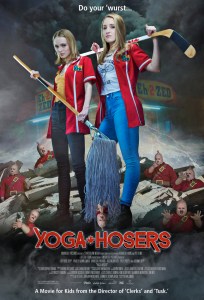 Kevin Smith has been a filmmaker who has flouted expectations. When people didn’t think the Clerks guy could make a religious thriller, he did it. When people said a movie about a man being transformed into a walrus creature was undoable, he did it. I was a moderate fan of Tusk, that man-as-walrus-as-Frankenstein movie that started as a joke premise from Smith’s popular podcast and then given strange cinematic life. Yoga Hosers is the second part in Smith’s “True North” trilogy of Canadian-set horror films. I wasn’t expecting much with Yoga Hosers and I felt like I got even less than that.
Colleen Collete (Lily-Rose Depp) and Colleen McKenzie (Harley Quinn Smith) are bored clerks at a Winnipeg convenience store. Their world is turned upside down when an attractive senior boy invites them to a “grade 12” party. Too bad they have to work, though even when on the clock the girls hardly work, instead preferring to jam in the back storage room as a fledging rock band. The girls have bigger threats than unruly customers. They’ll have to battle bad Satanists, forgotten Canadian Nazis, and tiny bratwurst men who leak sauerkraut when smashed. What’s a Canuck to do?
 The two areas that have always been the hallmarks of a Kevin Smith movie, his idiosyncratic characterization and ribald humor, are both strangely absent and desperately needed. Within the first ten minutes of the movie, I turned to my friend and confided, “I think I hate these girls already.” It’s somewhat ironic that Smith has gone back again to the bored convenience store clerks as the platform for his heroes. Where Dante and Randall were railing against pop-culture, adult responsibility, and a society that constantly made them feel inferior for their menial occupations, these girls aren’t railing against anything. If anything they’re retreating from the world, their noses constantly glued to their smart phones and social media. The excursions with youth culture feel rather inauthentic. The teen dialogue lacks comic snap and repeats phrases too often that it feels like set-up for T-shirt slogans (“Basic!”). Smith is far from his territory of dick and fart jokes and esoteric pop-culture detours. We’re introduced to many new characters with a slam edit of an Instagram-like cover page accompanied by an irritatingly chirpy 8-bit score. The intro graphics appear so quickly as to have little impact other than annoyance. The lead characters have no engaging personalities. They have an infatuation with older, cute boys, a love of yoga, a general attitude against authority, and a common level of self-involvement, but they’re not characters. They’re goofy but rarely are they grounded or better developed. One girl is daft and the other girl is… less daft. I’m not expecting these characters to have depth considering this is a movie with one-foot tall killer bratwurst Nazis, but some degree of personality is demanded. It’s the bare minimum.
Smith’s millennial satire is fairly toothless, which sadly is much like the comedy of Yoga Hosers. I hope you like puns and jokes about how funny Canadian accents are. The Colleens say “soory aboot that” and isn’t that hilarious? How about a convenience store called “Eh-2-Zed”? How about a yogi whose name is Yogi Bayer? How about an off-brand version of Lucky Charms called Pucky Charms? Why are there so many freaking puns? Then there’s the re-emergence of Johnny Depp’s wacky Quebec investigator, Guy Lapointe, allowing Depp to indulge his tendency for prosthetics and heavy accents. The shticky Lapointe character absolutely derailed Tusk and whatever unsettling momentum had been built, but he feels far more at home in the goofy world of Yoga Hosers. I might even say his presence is one of the highlights, as once more Depp gets to sink his teeth into all the Peter Sellers physical comedy tics he’s been holding back.
There’s just not enough comedy to go around here. There are goofy elements that crash into one another, like the Brat-Zis and a gigantic Goalie Golem, but it feels very much like Smith is just throwing a lot of dispirit elements together and expecting cohesion. He might even be expecting the audience to be satiated just in seeing something “different.” While Red State and Tusk were films that had sharp tonal shifts, Yoga Hosers never really settles into the silly supernatural teen comedy it desires to be. I laughed here and there but it was mostly attributed to Smith letting his more capable comic actors go off on tangents, like Justin Long’s yogi with his unorthodox poses. Ralph Garman, Smith podcast regular, shows up late as a Nazi who prefers to discuss his plans via celebrity impressions, a talent of Garman’s. It’s the kind of “hell, why not?” plotting that dominates the movie and makes you wonder if there ever was a finished script.
 I doubt any version of this story would have materialized if it wasn’t starring the daughters of Kevin Smith and Johnny Depp, and I don’t have a huge issue with this. Nepotism has been a core function of Hollywood for over a hundred years, and if Smith wants to create a vehicle for his daughter, by all means. The two young ladies have a pleasant chemistry and are believable BFFs. Their back-and-forth will occasionally elevate the jokes, like their insistent yet limited Batman impressions. Harley Quinn Smith has an enjoyable mugging quality that shows she’s studied her expressions from the school of Silent Bob. Her companion, Lily-Rose Depp, may be the real breakout. She’s the more consistent actor and the stronger anchor for the film. Even when the dialogue lets her down she still infuses a notable energy into her performance. There’s an emerging talent under the surface that looks ready for discovery, and perhaps the French film Planetarium with Natalie Portman will make others take notice. I get the impression that Kevin Smith and Johnny Depp are proud papas and just wanted to have fun together as a family. Consider the movie the equivalent of a quirky sweet 16 birthday party.
Yoga Hosers is a movie for a very select group of people, perhaps only Smith’s immediate family, friends, and most ardent of podcast listeners. I doubt that’s me. I’ve been a Smith fan since my own teens. His was one of the cinematic voices that awoke my own sense of what movies could be. I miss the caustic wit that separated Smith from the indie pack. The man was one of the few writers who could spin crass vulgarity into Shakespearean gold. He was a writing talent that many emulated but few could reproduce. Smith’s whip-smart comic perspective has always been his biggest cinematic draw, but with Yoga Hosers it feels decidedly neutered and wound down. I know he has gone on record saying he’s making the movies he wants to make without interference, but it doesn’t feel like the same Smith. Admittedly, a filmmaker in his early 20s is going to have a different perspective and creative impulses than a husband and father in his mid 40s. This apparently means that Smith has veered away from his conversational comedies and button-pushing topics and bought fully into genre filmmaking, mixing a pastiche of horror elements and varying tones. As an artist he doesn’t owe me or any other fan anything. Yoga Hosers might be a one-off, a love letter to his teen daughter and her bestie, or it could portend what is to come. Kevin Smith is making movies for himself at this point in his career. If you feel left out in that equation, like me, that’s okay. We can always go back and watch Clerks again. From my viewpoint, it feels like Smith is voluntarily erasing what made him a unique cinematic voice and choosing to disappear into the benign morass of schlocky genre filmmaking.
Nate’s Grade: C-
Share this:

The Neon Demon (2016)
 The prospect of a new Nicolas Winding Refn movie is akin to a trip to the dentist for me: long, painful, and full or regret over one’s life choices. The Neon Demon will not change this perception of mine. I hated this movie, and the more I think about it the more I hate it. Unlike Refn’s last film, the punishing, overwrought, and nihilistic Only God Forgives, there isn’t even a kernel of an idea of a movie here. I loathed Only God Forgives but I’ll at least credit Refn for crafting something with potential in its plot dynamics. In better hands, somebody could have done something with the setup for that movie. I don’t think anyone could work with what Refn offers in The Neon Demon because he offers nothing. That’s not entirely true. He offers pretty pictures and alluring shot compositions, bathing the screen in high-contrasting colors. What he fails to offer is a story, or characters, or any reason that this movie shouldn’t exist instead as a ten-minute short. Somebody enlighten me and tell me what exactly this vacuous and tedious art exercise offers.
Perhaps I’m being too cruel so allow me to explain the plot. Jesse (Elle Fanning) is a 16-year-old girl fresh off the bus to L.A. She gets hired at a modeling agency and makes friends with a makeup artist, Ruby (Jena Malone), who also works in a coroner’s office beautifying corpses. Jesse quickly rises through the ranks of the modeling world because of her fresh face and youthful, pure demeanor. She makes enemies with older models (Bella Heathcote, Abbey Lee) who feel threatened by her. And Keanu Reeves plays a sleazy motel owner who sticks a knife down Jesse’s throat for fun. Or that was a dream. I think. Then there’s a confrontation that includes necrophilia, murder, and cannibalism. And even after the cannibalism the movie still goes on for another fifteen minutes!
 There is not nearly enough plot or any substance to carry out Refn’s near two-hour running time, which becomes all the more obvious with one dreary, pretentious, artfully self-indulgent scene after another. There are long segments where I cannot even tell you from a literal level what is happening on screen. Is Jesse descending into madness? Is Jesse losing herself to the vanity of the industry in a heavy-handed visual metaphor? Does anything happening register with the slightest merit? Refn is possibly trying to tackle the same meandering dream logic that populates David Lynch’s more obtuse filmmaking entries, like Lost Highway and Mullholland Drive (recently voted the top film so far of the twenty-first century by the BBC). I’m not a fan of untethered David Lynch but he will at least keep things interesting. The Neon Demon is a powerfully boring enterprise in annihilating audience patience. There’s no there there.
Another problem I have with Refn’s movies is that he hangs much of his meandering on broad and obvious themes and assumes they’re revelatory. Only God Forgives was all about the pointless nature of vengeance and cyclical violence, and you felt the pointlessness with one grisly and uncomfortable moment after the next. With The Neon Demon, Refn falls back on the most general of broadsides against the fashion industry. Did you know that people working in a surface-level industry could be shallow? Did you know that young women are exploited for their beauty and then quickly cast aside? Did you know that succumbing to the appeals of vanity could be self-destructive? These are the most general themes and they are presented without able commentary. It’s like Refn thinks touching upon these shallow themes is enough substance to justify all the excesses.
This is borderline unwatchable cinema. The plot is like Showgirls without the camp but still following some of the basic plot beats. There is nothing interesting about these characters at all and that’s because they’re not people but robotic figurines at best. They’re dolls for Refn to pose and play around with his purple lights. It’s like watching two hours of somebody rearrange fancy-looking furniture. The characters are just as significant as the nearest love seat or coffee table. I’ve complained about all the empty space in Refn movies and The Neon Demon is no different. This movie is padded out exponentially to become Refn’s longest movie in his career. He cares far more about his shot compositions and cinematography than storytelling. At this point I don’t think Refn has any interest whatsoever in telling a story. He wants to construct a visually immersive film experience. The Neon Demon is little more than the misty atmosphere of the impermissible, the phantasmagorical. Refn deploys controversial imagery and plot elements but he deploys them in place of actual substance. Anybody can get a strong response by throwing in a necrophilia sex scene, but has that reaction been earned and has this moment been properly setup by careful development? Absolutely not. Things just happen.
 This was also billed as Refn’s horror movie but there’s nothing genuinely terrifying, at least from an intentional standpoint. You don’t feel any sense of danger or even a sense of uncertainty until the very end, and by then the movie has meandered far too much for the horror elements and gore to have an impact beyond lazy shock value. This is a movie where pretty people stand around and then, on the turn of a dime, do something outrageous. Refn hasn’t laid the groundwork for a descent into mental instability with our lead character, which seems like the most obvious solution. I could see a Black Swan-style psychosexual story about obsession with perfection and how this blinds one woman into making a multitude of sacrifices, driving her over the edge and into murder. Black Swan was a great, often brilliant movie. Go watch Black Swan instead, folks.
I think I have a solution that will benefit us all, dear reader. Nicolas Winding Refn should forgo the director’s chair and devote his career to being a cinematographer. He has an alluring eye for visual compositions and a great feel for atmospheric lighting, but with each passing movie I feel the man’s disdain for narrative filmmaking. His skill set is best utilized at making pretty pictures. Get him away from directing actors. Get him away from writing stories. Have adults in charge of the other aspects that help make a movie what a movie should be. The Neon Demon is a confounding, obnoxious, obtuse, intellectually destitute and monotonous movie experience. It’s frustrating to deal with the Cult of Refn in cinematic circles because I just cannot see what they see (I liked Drive well enough). The Neon Demon is too shallow and tortuous to be an insightful commentary on beauty, too oblique and maddeningly dreamlike to be an engaging story, and too devoid of interesting characters to hold your attention as they drift from one scene to the next. I’d be more forgiving of Refn’s indulgences if he was a short filmmaker. I’d allow more latitude for experimentation. The Neon Demon is not a movie. It’s a collection of half-formed, shallow ideas that Refn has thrown together, a whole lot of dead and empty space connecting them together, and an 80s synth score to underline the high-contrast colors. At this point I’d rather go back to the dentist than sit through another Refn film.
Nate’s Grade: D
Share this:

Don’t Breathe (2016)
 Alex (Dylan Minnette), Rocky (Jane Levy), and “Money” (Daniel Zovatto) are a team of burglars that use security codes to break into homes. They steal materials under $10,000 to keep them below larger charges. The trio hear about a visually impaired Gulf War vet (Stephen Lang) and his thousands of dollars he keeps inside his home. The naive burglars break into his home and sneakily search for his stashed cash, but the Blind Man (that’s how he’s credited) is a far more formidable victim than they ever could have imagined, and he’s keeping his own secrets that may be worth killing for.
The suspense in Don’t Breathe is deliciously developed and tautly executed, taking a premise that sounds silly on paper and wringing every juicy suspenseful morsel out of it. The crux of this movie is dramatic irony wherein the audience knows more than the characters, and once the Blind Man is activated, so to speak, it becomes an intense game of hide and seek with the audience in on the game. Director Fede Alvarez (Evil Dead) and company have established the layout and geography of the game space, the various rooms and hallways and hiding places, and we spend significant time in every location. A haven one minute might be endangered the next, and the way out or at least a momentary escape from immediate danger might be upstairs or downstairs, or in the walls. An essential part of effective suspense is fearing what happens to your characters, and Don’t Breathe achieves this often with clever setups. There’s one scene where a character falls out a window and lands unconscious on a skylight. The glass begins to crack underneath his weight, and then we see the Blind Man in the room below, anxiously looking for his target. Then there’s also the Blind Man’s attack dog, which you forget about and then pops back up, providing a new threat that changes the dynamics of the moment. The suspense sequences change up so frequently that there’s always something new going on every few minutes. The movie’s attention even seems to alternate between Rocky and Alex and their personal obstacles when separated. The technical merits are present without being overly flashy and self-indulgent. An opening tracking shot inside the house nicely establishes the general layout of the space. Alvarez doesn’t rush his suspense set pieces either, showcasing a wonderfully natural feel for teasing out the tension to make his audience squirm in their seats. With the variety of the suspense set pieces, their clever development, the clear understanding of the geography and stakes, and a swift pacing that doesn’t allow the audience to catch its own breath, Don’t Breathe is a small-scale case study in exactly how to maximize your premise for the most entertainment.
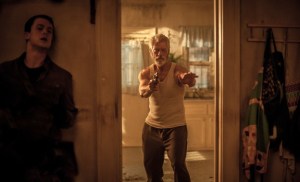 Don’t Breathe packs a punch and this is aided by how streamlined and clean the narrative proves to be, whittling down all unnecessary plot strands. I hated the Money character. He brought nothing to the burglary team besides perhaps some muscle (and a firearm), but I was worried that the movie was going to drag out his inevitable demise. Clearly Rocky and Alex were going to be the main participants and that meant that Money was the most expendable, and given the small number of characters, I worried he wouldn’t be given his merciful end until long into the movie. Well Alvarez must have heard my worry because Money is killed very early on, sparing the audience from dragging out the inevitable. I was appreciative but it also raised the stakes with the two remaining characters because now nobody was obviously next in line for death. A dead Money actually proves more useful than a living Money for the characters. I also appreciated that the movie didn’t dawdle when it came to setting up its trio of burglars and their goals. They’re breaking into the Blind Man’s house at about the 15-minute mark. There’s also no concerted effort at layering in larger social commentary. The economically depressed Detroit setting works to communicate the desperation of the characters, their desire to escape their trappings, and it also provides a tidy explanation for why the Blind Man can drag an unconscious girl by her hair down the middle of the road without alarm (it’s the opening image, so chill spoiler-phobes). This is not a movie that has larger things to say about The Way We Live Now, and to pretend otherwise would be a waste of valuable time. Also, having three white characters serve as the social commentary for Detroit’s ailments would seem rather tone deaf and ill advised.
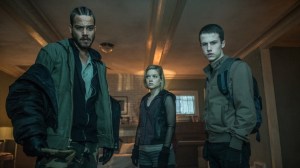 I think if the Blind Man had been a complete innocent that the movie would have been even more interesting as it forces the audience to test its loyalties and choose sides. As my friend Ben Bailey said upon leaving the theater, once they introduce a third act twist involving the Blind Man’s true goal, he ceased having any sympathy and “just needed to die.” I’ll concur mostly, but man I fell out of favor with our trio of young burglars and the best way I can explain is by making an analogy to the Howie Mandel prime time game show, Deal or No Deal. Contestants would randomly choose briefcases hoping that they contained low amounts of money, furthering the odds that their briefcase would contain a larger and joyous amount. It’s really just a game of odds and averages. It’s mildly fun but with every contestant there was a breaking point for me, a point where they really should have cashed out but instead chose to go forward against unfavorable odds. Once a contestant crossed this imagery point of no return in my mind I was rooting for their downfall (probably to just confirm that I was right all along). Horror movies are the same, and once the main characters make too many stupid decisions, then my sympathies generally gravitate elsewhere. With Don’t Breathe, the young characters have multiple opportunities to escape the house but make too many bad choices. They want to keep the stolen money above their own lives, and after the third missed chance I felt my loyalties wavering. Their first mistake was when they were casing the man’s house in broad daylight and see him walking his dog. Hello, here’s a golden opportunity to break into the home where you know he and his pooch will be absent. Why wait when they’re both back at home and needing to be dealt with? If the Blind Man had been an innocent, or even if they had simply omitted the insidious third act twist, I would have been rooting for this visually impaired war veteran to smite these punk-nosed kids but good.
Earlier this year Netflix debuted Hush, a home invasion thriller featuring a deaf protagonist. Now we have Don’t Breathe with a blind man trying to thwart home invaders. Let’s continue this trend: Don’t Taste, about a man that has to flick his tongue out to sense his hiding home invaders, or Don’t Smell, a pulse-pounding race-the-clock thriller where a scent-disabled man must match wits with attackers while his home, unbeknownst to him, fills up with carbon monoxide. It’s an easy punch line but credit Don’t Breathe for taking its potentially silly premise and treating it with deadly seriousness while still knowing how to have fun with its audience. There are several moments designed to get an audience to jolt or groan, and it all contributes to a skillful, above average experience at the movies that wears down your nerves. The film is terrifically tense, well developed, well paced, and not too stupid, veering in new directions and upping the ante with new twists to amplify the stakes. If you’re looking for a solid way to close out was has been an otherwise mediocre summer movie season, give Don’t Breathe a chance, sit back, and try to keep up with the fun.
Nate’s Grade: B+


You must be logged in to post a comment.