Author Archives: natezoebl
Joe Dirt 2: Beautiful Loser (2015)
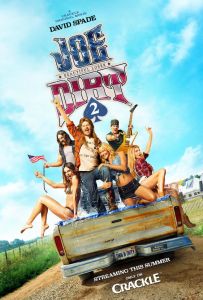 How bad does bad get? That’s the question with Joe Dirt 2: Beautiful Loser, a sequel 14 years in the making to a one-joke character from an actor now in his 50s. It’s so bad that this movie is a Crackle original, a streaming service that I don’t think people know exists. You can feel every degree of sad desperation while you watch. There are so many scenes that just seem to prattle on indefinitely, varying from one or two angles, as if they only had time to film one take and kept encouraging their actors to just keep throwing things out there in the misplaced hope that somehow somebody would strike gold. It does not happen once. David Spade returns and he’s whisked away Wizard of Oz-style into the past where he watches his beloved girlfriend choose his rival (Mark McGrath) over him. It’s a weird Back to the Future Part 2 alternative timeline and one where McGrath also plays his character’s father in an inexplicable scene where he allows his family to unknowingly jerk him off. I hope that last sentence begins to reveal the true depths of comic despair that is Joe Dirt 2. It’s not that it’s powerfully unfunny, it’s not that the plot is completely inconsequential, it’s not that the jokes end up being weird pop-culture references dating back to the 90s (Buffalo Bill in 2015?), it’s not that Spade looks like he’s fulfilling some deal with the devil, it’s not that the movie has no purpose and no reason to exist, it’s that Joe Dirt 2: Beautiful Loser is like a communal funeral. You watch it and you mourn; for those involved and for your lost time. If you can find a more pointless, depressing, past-its-prime sequel, then I think the seventh seal has been opened, spelling the doom of mankind. I figured Adam Sandler would be responsible somehow.
Nate’s Grade: F
Share this:

Race (2016)
 In 1936, Jesse Owens (Stephen James) is an American track star that seems destined for magnificent glory. Under the guidance of his coach, Larry Snyder (Jason Sudeikis), from THE Ohio State University, Owens is smashing track and field records. The culmination of his athleticism occurs at the Berlin Olympics, where Owens earns multiple gold medals and shows Adolph Hitler just how masterful his master race is.
It’s difficult to declare Race a bad movie but it’s so formulaic and by-the-numbers that I walked away thinking that Jesse Owens deserved a much better movie. I kept waiting for the movie to properly communicate the totality of what Owens accomplished, let alone in a time period where the culture at home told him he was an inferior American citizen, and it just never coalesced into a stronger message. We’re talking about a man who bested the best of the world in front of Hitler. This is ready made for cinematic drama, and perhaps that’s the problem with the screenplay by Joe Shrapnel and Anna Waterhouse (Frankie & Alice) because it always seems to fall back on the lazy and expected choice. Part of this is the reality that Owens was just that good as a runner; we only see him lose once in the entire movie. This anticlimax makes it difficult to stir up plenty of suspense around the larger and larger stages for the sports triumphs. The knowledge of Owens’ wins may be commonplace but we should still feel the stirrings of good storytelling and payoffs to well-established work, and that’s just not there. I loved watching the deluge of unhappy Nazi reaction shots to Owens’ victories (never enough footage of unhappy Nazis) but that doesn’t count as a satisfying conclusion to Owens’ story.
 The character of Owens is somewhat lost in Race. It’s reminiscent of the Jackie Robinson biopic 42 where the character of Robinson was kind of, well, boring. He’s a character who endures the suffering and indignities of others and perseveres, and this is likely why both films turn their stories of African-American tales into buddy pictures with Strong and Supportive White Men. Much of Race is presented as a buddy picture with Owens and Snyder, and both actors have such an amiable chemistry that they sort of treat the entire movie like a laid back adventure. They’re easing on through a segregated America. Too much of the movie is Owens and Snyder just cracking wise and going from scene to scene. James left a stronger impression as John Lewis in last year’s Selma. He’s too often merely stoic without more to work with. Sudeikis (We’re the Millers) is right in his comfort zone with his performance and doesn’t stray far from his range. I credit the film for not ignoring some of the messier parts of Owens’ story, namely his out-of-wedlock young daughter and him cheating on his hometown girl with a fame-seeking starlet. He’s allowed to be seen making mistakes, but the movie doesn’t allow him to live with them (note: not referring to his daughter as a “mistake”). Whenever Owens might be in a horrible predicament from his own internal decision-making, the movie almost callously breezes by without much contemplation. It’s as if every conflict is in service to the Main Conflict – sticking it to Hitler. The pressure to bow out of the Olympics to make a statement about the treatment of black people in America could have been a soul-bearing moment, but we just move along and barely feel the weight of the pressure. Yes, we know that Owens will travel abroad and win golden glory, but make the decision count.
Another aspect that dooms Race to its limited appeal is the mediocrity of its direction and, in particular, how shockingly terrible the movie is edited. Director Stephen Hopkins seems to have been in movie jail ever since 1998’s Lost in Space. He’s only shot one movie between that bomb and Race, which happened to be The Reaping, a 2007 movie I almost liked by its twist ending. He doesn’t exactly bring much to the material to elevate the races or seem that interested in taking advantageous of the suspense opportunities. There’s one great sequence where Owens first enters the Olympic stadium and the camera tracks his movements where you feel the awe. There aren’t enough moments like this that take full advantage of telling Owens’ story in a visual medium. The other technical misstep is that this is one of the worst edited movies I’ve ever watched in a theater. If you generally pay attention to the editing, it’s generally a bad sign since it’s a facet of filmmaking that is best made invisible. There is one sequence where Owens sits in Snyder’s office and the 180-degree rule is broken over ten times… in one scene! The editing will frequently flip is scene orientation, jumping back and around and creating subtle visual compositions that create incongruity in the brain. Part of this blame deserves to be laid with Hopkins, who chose to shoot his film at these uncooperative angles. It was something that bothered me throughout and would rip me out of the movie.
 The most perplexing storyline in Race involves the very positive treatment reserved for a controversial filmmaker, Leni Riefenstahl (Carice van Houten), best known for her propaganda films declaring the power and righteousness of Hitler’s Third Reich. Huh, why does a movie celebrating American heroes spend do much time positively portraying a Nazi propagandist? She becomes a translator for Goebbels and the American Olympic committee, but she’s also determined to have her vision respected when it comes to her Olympic documentary that is being produced by the Nazis. She doesn’t seem to mind about Owens trouncing the Aryan myth of racial superiority because she just wants to make the best movie and Owens is her storyline. She is portrayed as a sympathetic go-between for the Americans, someone fighting within a corrupt system to maintain her dignity and ownership in an industry that is dominated by men (she’s criticized for wearing “masculine” clothing). I’ll admit a general ignorance to Riefenstahl’s life and career outside of her most famous documentaries, which I should continue to stress are Nazi propaganda films, but this woman was a member of the Nazi party and responsible for some of the most indelible and damaging imagery justifying Hitler’s genocide, and to prop her up as a character worth rooting for and a champion to Owens just felt wrong.
Has there ever been a more self-satisfied yet facile title than Race? The double meaning is a bit too obvious and yet simple enough to be annoying. In a way, the title encapsulates the movie as a whole. It’s well-meaning but far too by-the-numbers and satisfied that it’s doing Important Work honoring an American sports legend when it’s barely giving us much of a reason to care about him as a person and less reason to root for him other than added Nazi discomfort. Owens becomes a boring centerpiece in his own movie, and his relationship with Snyder feels too ill defined, repeatedly approaching buddy comedy. The historical asides are momentarily interesting but don’t add up to much. The movie has some strikingly awful editing and lackluster direction that hobbles the storytelling. It’s a movie that hits all the checklists for sports biopic but won’t veer too far from its predicated formula. There’s a short scene at the very end that hints at what kind of better movie Race might have been. After his worldwide validation at the Berlin Olympics, Owens comes home to America and is forced to use the service entrance for his own honorary dinner. This American hero has to shamefully take the back entrance to be celebrated. It’s a stark wake-up call just how far the country had to go as far as race relations. This national cognitive dissonance, celebration and segregation, would be ripe for a searing human drama with plenty of emotion. That would be a good movie. Race is only an okay movie, and given Owens’ place in history, that’s not good enough.
Nate’s Grade: C+
Share this:

Deadpool (2016)
 Deadpool is easily the most fan service of comic characters, so it makes sense that his big screen spotlight is a movie that feels a fan service movie. The “merc with a mouth” is a character that doesn’t take himself seriously and neither does his big screen adventure, which is the biggest appeal of an otherwise standard super hero formula hiding under waves of winking irony, crass humor, and gleefully bloody violent mayhem. Ryan Reynolds plays Wade Wilson, a hired gun that undergoes a risky experimental treatment by a shady black ops organization to cure his terminal illness. It makes him generally indestructible with a rapid healing ability but his flesh is also horribly scarred and Wade is afraid his girlfriend Vanessa (Morena Baccarin), a hooker with a heart of gold, will reject him. Even in the opening credits, you know this isn’t going to be a typical super hero movie. The time is ripe for a film that knowingly ridicules the tropes of the super hero film industry, and Deadpool scores some big laughs when its making fun of itself and its super peers. The dark humor can often surprise with how go-for-broke it can get, like Wade and his Vanessa’s flirty one-upsmanship of hypothetical sexual trauma. There’s a clever montage of Wade and Vanessa’s romantic history told through sexually-specific holiday celebrations, and the inclusion of a couple of low-rent X-Men provides a comic foil for Deadpool to bounce off from. The action is fun and the movie is entertaining from its opening credits to the now-mandatory post-credits bonus. Reynolds is spiritually attuned with the irreverence of the anti-hero, finally plugging into a part that makes full use of his charm, motor mouth, and physicality. Deadpool’s runaway box-office success (grossing more than any X-Men film and on at least half the budget) will hopefully allow Hollywood to feel comfortable allowing their less than family-friendly comic titles to stay true to their intentions. Then again maybe they’ll just take all the wrong messages and think that audiences just want to hear more swearing from people in spandex. Deadpool is a super hero movie that prioritizes fun over everything else, and while it may not be for everyone, at least it’s trying to be for someone different.
Nate’s Grade: B
Share this:

Jem and the Holograms (2015)
 Jem and the Holograms was one of the biggest bombs of 2015. It was pulled from theaters after only two weeks in wide release. That practically never happens. What made it so terrible? Well to start with, it seems to have jettisoned everything that fans of the original 80s Saturday morning cartoon might recognize in an attempt to appeal to a new generation. It missed the campy tone of the series, instead inserting lots of unearned serious drama that veers wildly, while trying to set up Jem as an inspirational leader. But really, it just sucks. It sucks a lot. If you’d like to learn more in vivid detail then please continue reading, but for those who desire the truly outrageous, you’ll only find the outrageously bad.
Jerrica (Aubrey Peebles) is a shy performer until her younger sister Kimber (Stefanie Scott) uploads a song of hers to YouTube. Within hours, everyone wants to know who “Jem” is, which is just Jerrica donning a pink wig. A shady music exec (Juliette Lewis) snatches the girls up and forms a band with Jerrica’s foster sisters, Aja (Hayley Kiyoko) and Shana (Aurora Perrineau). The girls immediately make a splash but they find themselves fighting against the influences of the industry that wants to tear them apart.
 Jem is a very confused movie and it’s a very stupid movie, and its most stupid mistake is completely abandoning any appeal this otherwise out-of-time 80s pop-culture relic might have had with its nostalgic core audience. If you grew up with the cartoon on Saturday mornings, like millions of American kids (including my sister), then you’ll be surprised to discover that the movie version bears little resemblance to its source material. I’m not saying that every property has to be slavish to its origins, and there are certain elements that just will not work as a movie that are unquestioned in the realm of cartoons; however, why even make a Jem movie if it hardly resembles Jem the TV show? That would be like producing a Brady Bunch movie and have them be a ragtag crew aboard a salvage ship in space that comes across a mysterious alien entity (honestly, I’d watch the hell out of that, but I’m not what you’d describe as a “normal” audience). Unless your name is Charlie Kaufman, that’s probably not a route you want to experiment with and purposely turn away your core fanbase. I think the time is right for a silly throwback to the 80s that celebrates and lovingly tweaks the culture of that era. The Jem dynamic was a fantasy alter ego where girls could cut loose. What did the producers of the Jem feature film give us? It’s a pretty bland rags-to-riches story in the era of instant YouTube celebrity and every single moment feels phony, sappy, and calculated. Hell, the “Holograms” of the title aren’t even mentioned until the very end and it’s literally just an incidental stage decoration for the band.
The story is pap to leap from one musical montage to another, and when Jem does try and remind you that these singing sisters are supposed to be, you know, characters with, like, feelings, it uses the full misplaced force of a sledgehammer. The characters are components of a thinly veiled checklist to lure in a wide audience of pre-teen girls. There’s Jerrica who is musically talented but shy. Her sister Kimber is obsessed with sharing everything on the Internet. Then there are the foster sisters of Aja and Shana, giving the unit a diverse ethnicity and little other dimension. These girls are annoyingly one-note, each defined by a key interest. Oh, Kimber records everything and can be pushy. Does she herself have any other hopes, dreams, fears, and conflicts? I can’t even remember between Aja and Shana which was the gearhead and which was the budding fashion designer. Does it even matter? These aren’t characters on screen deserving your attention and empathy; they are the deposits of focus-grouped research and they are ciphers for pre-teen wish-fulfillment fantasy. I’m not going to pretend that the characters on the Jem cartoon could rival the likes of Tolstoy, but at least they felt integrated in an appropriately goofy universe. These ladies feel like placeholders that are waiting to be filled in later. They’re glorified backup performers who occasionally get to quip or cry. They are human beings in a generous sense but they are not characters.
 The message of the movie seems to be about finding your voice, and believe it or not Jem becomes a symbol to inspire millions of others, though inspire them to what ends is never specified (modern John Hinckley?). “Jem is anybody who has something they want to express and they need the courage to be heard,” Jerrica proclaims to a sold-out crowd, and it was at this climactic moment that I wanted to vomit. The movie wants to project the success of one poorly written teenager as a movement, giving agency to others, but what exactly did Jem do? She got a recording contract, made some flashy music videos, and then bested the evil record exec and still gets to play with her sister bandmates. Excusing the this-could-be-you aspect of her tale being plucked from obscurity, what exactly is there to inspire anyone? During Jem’s first show, which is crammed with people that are far too old to be rollicking fans of a band of 16-year-old girls, the power goes out while they perform “Youngblood.” What will the girls do? Jerrica gets the crowd to whip out their cell phones to illuminate the small music club, then they direct the crowd into a series of foot stomps for percussion (did the power kill the drums?), and as Jerrica opens her mouth to sing, she sounds EXACTLY like she did from the microphone. Her voice curiously sounds identical to the same voice being run through a sound system and a mixing board. Does nobody in this club take this as strange? There is nothing truly, truly outrageous about these bland performers.
The structure of this movie also drove me mad, compounded by being 118 goddamn minutes long. Why is this movie two measly minutes short of a full two hours? Why is this movie only 39 less minutes than The Revenant? If ever there was a 90-minute movie, it’s Jem and the Holograms. It’s not like the screenplay is filled with so many important plot moments. Before the thirty-minute mark there are two dress-up montages, and the second act break involves the girls upset with Jem because she was forced into a solo career to save their childhood home from being foreclosed. It’s hilariously overwrought and then, I kid you not, less then five minutes later the girls all reconcile and forgive one another. There was still 40 minutes to go at this point! How? There’s even a post-credit scene setting up a sequel with a rival band. Another pointless throughline is Jem’s search for hidden clues left behind by her deceased father. He apparently was building a robot that communicates through music (mostly beat boxing… sigh) and programmed messages for his daughter to grow up and find. Why does the father have to be this obtuse about telling his daughter he loves her? His final fatherly words of wisdom include the eyeroll-inducing cliché, “You were my greatest creation.” Can the guy not write a letter instead of organizing a scavenger hunt guided by a robot that resembles the alien from Earth to Echo? Is this what good parenting looks like?
There’s another aspect of the editing that I want to single out for ridicule. Throughout the film, we’re constantly cutting homemade YouTube footage into scenes to amplify them. This makes sense when it’s a montage of fans talking about their love for Jem, this makes far less sense when the movie uses a guy drumming on his knees to score a silly heist sequence. Yes, the movie outsources moments of its musical score to a musical mélange of online artists, repeatedly inserting them into the action in distracting manners. It’s further proof of the failure of the movie to tie in Internet culture and the democracy of music in any meaningful way. It’s literally background music.
 Let’s also talk about the music of Jem and the Holograms, which, dear listener, for the purpose of this review I’m re-listening to. It’s not like the music is awful. In fact it sounds fairly indistinguishable from much of the pop music currently airing on modern radio stations. They even name-check “Quentin Tarantino” in one song, so there’s that. The songs are competent and won’t make your ears bleed but they don’t exactly stand out, which further complicates the illusion of the movie. The fawning praise from online commentators is overdone and unearned. Here’s the deal: if people go crazy over some artist, the reality better meet the hype. If you have a poet who everyone adores, then they better have some breath-taking poetry. If this reality is not met, meaning if the art is qualitatively mediocre or unmemorable, then it takes me immediately out of the movie. I’ll even deconstruct Jem’s rise to fame. Jerrica records a simply acoustic song and sings her tune of sadness, “Alone Out Here.” Immediately after Kimber uploads it, the YouTube likes go through the roof and the next morning she’s a star. The song is pretty and Peebles has a nice voice that conveys emotion well. It’s a nice song, but in no way is it star-making more than any other the thousands of other girls-with-guitars on YouTube. My proof: the total number of views for “Alone Out Here” is… 33,000 (the tune with the most views is what I would call the best, “The Way I Was,” at 132,000). That’s not exactly scintillating numbers speaking to making connections with a larger fanbase. The best song in the movie isn’t even theirs; it’s Marian Hill’s “Got It.”
Jem and he Holograms is the kind of inspirational movie that will inspire nobody, a musical coming-of-age film with terribly and terribly underwritten characters that are a note-note collection of adjectives and different fashions (this one has colored hair, oooo). The music is passable but nothing that justifies the rocket success and intense devotion we witness on screen. The story is so emotionally sappy yet phony, the structure maddeningly padded out and given the idiotic daddy scavenger hunt, and the editing insertion of cutaway clips of YouTube artists drove me mad. After an hour I realized what I was watching: the Josie and the Pussycats movie absent any of the social satire. This movie makes Josie and the Pussycats look like Doctor Strangelove.
Nate’s Grade: D
Share this:

Lazer Team (2016)
 What makes a disappointing comedy? It’s a question I kept thinking about while watching the sci-fi comedy Lazer Team from the online comedy collective better known as Rooster Teeth, responsible for the longest running online Web series, Red vs. Blue. These are people who know how to be funny. They have a fine resume of shorts to prove their comedy bonafides, but what was it about their first foray into features that diminished their funny? I’ll try my best to provide a critical autopsy for the case subject of Lazer Team, a disjointed and disappointing buddy comedy that died on screen.
A concerned alien species has sent a warning to Earth. A hostile alien race is heading toward our planet with the intent to conquer, pitting their champion fighter against a champion from Earth. This gladiatorial showdown inspires Earth’s military and scientists to train a select warrior (Alan Ritchson) from birth for this mission. The problem is that the wrong people get hold of that alien technology. Disrespected sheriff Hagan (Burnie Burns), his old high school has been pal Herman (Colton Dunn), redneck moron Woody (Gavin Free), and insufferable quarterback Zach (Michael Jones) come across a downed alien ship that they happened to knock out of the sky with drunken fireworks. Each of the foursome puts on a piece of the alien armor, which attaches permanently. Herman gets a pair of super fast boots, Woody a helmet that instantly makes him smarter and British, Zach an arm canon, and Hagan a retractable shield. The bickering idiots are forced to work together over the fate of the planet, and the warring alien species has sent a few of its parasitic infantry to retrieve the special suit.
 To be fair, Lazer Team is not an atrocious comedy that singes your eyeballs with pain, something along the likes of InAPPropriate Comedy or any Friedberg/Seltzer suckfest. You can tell that the Rooster Teeth squad understands the tenets of comedy and what makes for a good joke, which is what makes their final product all the more baffling. For my pal George Bailey, there’s nothing worse than a bad comedy (his worst film for 2015 was Mortdecai). A comedy has one job to do and that is to make people laugh. This should be obvious but you’d be surprised at how often this principle seems to get lost. Rarely does a larger budget make a comedy funnier, a lesson learned the hard way over and over again with Hollywood. With Rooster Teeth’s first movie, they wanted to make a throwback to the sci-fi buddy comedies of the 80s. They raised almost two and a half million dollars via the crowd-source site Indiegogo, a record until Broken Lizard’s Super Troopers 2. It feels odd to say that what amounts to a meager budget by most productions could be at fault for the ultimate disappointment, but I think it leads into the chief problem of the movie: prioritizing the action over the humor.
It’s not uncommon for the comedy to get obliterated by the action in action-comedies, but from a comedy collective I was hoping for more emphasis on the ha-ha and less on the kablooey. Lazer Team has a solid comic premise that pays homage to a pastiche of 80s inspirations and pop-culture. I wanted to laugh. I think I even compelled myself to give it some pity laughs, but after 40 or so minutes a realization could no longer be ignored, and that was that Lazer Team just wasn’t that funny. The enthusiasm of its key cast members and their amiable nature go a long way to disguise the threadbare nature of too many of their first-draft jokes. The foursome never stretches beyond the entrenched lines of their formulaic archetypes. You come to expect specific jokes delivered from them, assigned by type in a way that reminds me of TV’s The Big Bang Theory. The character will rarely surprise you, which is also because their character arcs are so transparent. Hagan will atone for his failure to act and protect Herman while Herman will learn to move on from a past misfortune. Zach will learn to be less selfish. Woody will… well he doesn’t so much have an arc because he’s instantly made smarter thanks to the lien tech. The expected is a deathblow for comedy; if you can anticipate the joke, it’s rarely funny. Lazer Team so rarely subverts your expectations, playing things too safe.
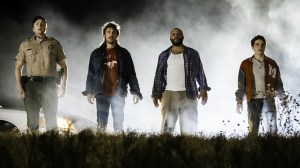 The central conflict of four losers learning to work together as a team to save the world is rife with comic possibilities, even with the locked-in archetypes, but there’s far more attention spent on the sci-fi action and special effects. It’s a low budget film but there are plenty of action set pieces and special effects, many done in-house by the Rooster Teeth team. The effects range in effectiveness but are generally passable and even impressive at turns, especially with properly calibrated expectations. The problem is that the action sequences that are eating up so much creative space aren’t remotely memorable. There’s one car chase in the middle of the film where it feels like the guys have found a tone that works, one where the action incorporates the comedy and they work. For a fleeting moment I thought, “Maybe the whole movie will resemble this new shift.” The other problem is that it feels like the Rooster Teeth squad was stuck with how to get this story to feature-length. Structurally, this thing sure feels padded with additional set pieces that lurch and fail to justify the added time, especially the ex-wife cabin sequence.
The acting foursome is the best aspect of the movie and their amiable interaction is the one thing that Lazer Team has that got me through to the end. These actors know how to sell jokes, when to mug, and their amped-up enthusiasm helps sell the lesser material. I wish this foursome had a better script. Imagine something more low-key in concept that involved less explosions and more emphasis on utilizing their comic talents? I wish less time had been spent on Jones’ obnoxious egotistical quarterback and more on Free’s redneck-turned-British genius, a setup that seems to have far more potential than just being an expositional device. The slobs vs. snobs approach only gets the movie so far, and after that we have to care about the characters, and I just didn’t. Because of how one-note the characters are it’s hard to care about them. After your good will depletes with the actors, you’re left with a bunch of running around but little funny.
Lazer Team is a movie that’s hard to hate, especially if this kind of genre comedy is a favorite launching ground for jokes. It’s nowhere near as wretched as The Watch but it can’t come close to the sci-fi comedies that influenced the Rooster Teeth creative unit. What’s even more frustrating is that these guys have the talent to tell an original and hilarious movie and are creative enough to engineer some fun sci-fi set pieces. They have the talent and expertise to do better than this, to do better than Lazer Team, a movie that is too safe, too predictable, too padded, too formulaic, and just not funny enough. I demand more from people who specialize in comedy.
Nate’s Grade: C
Share this:

The Boy (2016)
 The scariest thing about The Boy is how much potential it wastes, foolishly abandoning a horror direction that was eerie, supernatural, and with one leg rooted in a psychological breakdown, and instead cheerfully dives headfirst into an unwanted new direction of cheap campy thrills. I haven’t seen a decent movie unravel with this high-speed velocity and tone-shift since Danny Boyle’s Sunshine, an intelligent sci-fi vision that decided, hey, let’s just make the entire final act a slasher movie in space. The Boy is about an American nanny who travels abroad to care for an elderly couple’s young son Brahms, a son who happens to be a porcelain doll. There are rules to be followed and consequences if they are disobeyed. I liked that our heroine (Lauren Cohan, The Walking Dead) doesn’t try and ignore what she’s seeing for a majority of the movie and instead embraces the unusual circumstances, testing Brahms and discovering more. It kept the film moving in more engaging directions rather than denying the obvious and padding out its run time. I wish that the script opened up more about the domestic violence that haunts our heroine, literally and figuratively, but for a solid hour I was fairly entertained by the supernatural parlor games and lead performance by Cohan. Then the last act occurred, which just swiped away all the good will. I groaned aloud when the shift happened. I won’t go into detail but suffice to say it feels distinctly like two different movies clumsily grafted onto one another at the behest of exec. What once could be excused or forgiven in a supernatural realm cannot when trying to ground the story in reality, and it only unleashes a horde of nagging questions that don’t add up, especially concerning Brahm’s parents and the implications of its ending. The Boy is a cautionary tale about leaving well enough alone, understanding the strengths of your spooky story and tone, and committing to the best idea rather than one that “surprises” while laying waste to your larger story.
Nate’s Grade: C
Share this:

13 Hours: The Secret Soldiers of Benghazi (2016)
 Michael Bay is the kind of filmmaker that naturally attracts negative attention and derision, so when he fast-tracked a movie about the Benghazi embassy attacks, and in a presidential election year too, there were plenty that cried foul. Bay’s not exactly known as the subtlest filmmaker, and many feared a Benghazi movie under his guidance would only reaffirm the worst. 13 Hours: the Secret Soldiers of Benghazi (a subtitle that never appears in the movie, by the way) is a surprisingly serious and generally apolitical action movie that reaffirms the strengths and weaknesses of Bay as a filmmaker.
On September 11, 2012, an armed mob stormed an American outpost in Benghazi, an attack that left four Americans dead. After Libya had toppled its decades-long autocrat, a power vacuum emerged and militants filled its place. An unclassified CIA annex in Benghazi was established to track the possible sale of munitions from the old regime. The CIA chief, Bob (David Constabile), has been forced to hire a security team of former Army Rangers and Navy Seals to protect his agents. Jack Silva (John Krasinski) is a family man reuniting with his old pal Tyrone “Rone” Woods (James Badge Dale), the head of the hired security team. The other guys (Pablo Schreiber, David Denman, Dominic Fumusa, Max Martini) welcome Jack, explaining the rising tensions in Benghazi and how they’re generally frustrated by the CIA know-it-all attitudes. They’re wary of the State department outpost for Ambassador Chris Stevens (Matt Letscher), wary of the security detail watching him, and wary of the Libyan local forces providing assistance. Flash forward to the night of the attack and Rone and his team are stymied in their early attempts to rescue the ambassador. Afterwards, the focal point of the fight shifts to that very CIA annex and one hellish night of intense combat.
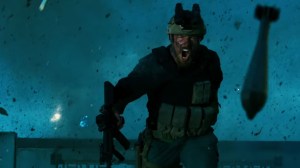
 This is Bay’s return to the realm of more “serious filmmaking,” a world he hasn’t considered since 2001’s lackluster Pearl Harbor, and while the standard Bay elements of boom are present and accounted for, the drama doesn’t stack up to the action. First, the good news is that the action in 13 Hours is often thrilling, beautifully staged and photographed by Dion Beebe (Collateral), and unlike Bay’s Transformers films, easy enough to follow along. It’s a chaotic incident where plans and communication are broken down, but Bay is able to keep the geography and the immediate and secondary goals of each action sequence clear. While the storming of the embassy isn’t quite as nerve-racking as Argo, it’s still plenty thrilling and communicates the fog of war and dawning horror of those trapped on the inside. The centerpiece is the attack on the CIA annex, which both sides anticipate and prepare for. It establishes the geography of the field of combat, the different access points, and the most likely ambushes. From there, it’s our outnumbered professionals versus a horde of armed Libyans, a standoff reminiscent in classic Hollywood action cinema. Over the course of those titular 13 hours, our security force faces wave after wave of attacks, each once becoming more sophisticated and bringing heavier firepower. Bay’s camera captures the explosions and gunfire in his usual balletic decadence. Say what you will about the man and his jingoistic tendencies, but he’s an ace visual stylist who bathes a sheen of popcorn entertainment to visceral struggle. When the action is heated, that’s when 13 Hours packs its most powerful punch.
Unfortunately, there are lulls in between the fighting, and it’s during these moments that we realize how poorly written our characters are. With the battle looming ahead, the mitigated character development emphasizes easy clichés we’ve come to expect, like the family man who needs to realize his family should come first, etc. These six guys are little more than stock characters on the screen, differentiated more by appearance and the occasional reading material than any significant personality differences. The dialogue is also rather clunky, falling too often upon tough guy speak to make up the difference. The way I was able to separate them in my head was through the actors’ previous roles (“There’s Pornstash, there’s Roy from The Office, there’s the guy from The Pacific who was the bad guy in Iron Man 3, and boy did Jim from The Office get buff”). Krasinski (Aloha) is the audience’s entry point into this world and given the most attention, so he’s ostensibly our main protagonist. He’s a strong presence to anchor the film despite the character’s shortcomings. I enjoyed watching Krasinski in such a different sort or role and started thinking about he and his wife, Emily Blunt, must have traded workout regiment advice. “Jim from The Office” with a six-pack is a surprising sight.
There’s a strange defining conflict for the first hour of the movie, namely Bay and Hogan narrowing personal clashes down to a slobs vs. snobs mentality of war. Bay has a history of fetishizing machismo and military hardware, so it should be no surprise that his movie lionizes the beefy, strapping military men serving as security. They’re placed against the eggheads of the CIA, who take every moment to remind our burly, bearded security guys that they were educated at Ivy League schools and know so much more about the Middle East. They often sound haughty when they’re scolding the security force for interfering even when it’s clear they’re saving their lives. The perspective aligns with the idea that the military-experienced, no-nonsense men of action are being ignored and looked down upon by the CIA ninnies who look at them as unnecessary babysitters. Naturally, with the hindsight of history, we know the concerns of Rone and his guys will be vindicated and the CIA snobs will be grateful they had these blue-collar American heroes. The entire role of Bob is to condescend and ignore our guys and their warnings. Bob even says early in his introduction that he’s on the brink of retirement and they won’t ruin it for him. Until the attack on September 11, we’re stuck with this reductive class warfare clash.
Another interesting aspect is that the movie makes use of its audience’s relative ignorance when it comes to the specific people involved in the Benghazi firefight. I doubt that many people know the names of the four victims excluding Ambassador Stevens. Because of that uncertainty we don’t know which of our six security characters will live, and the screenplay seems to know this, which is why it takes time to present each of the six with some sort of looming tragic back-story. We have multiple characters sending loving messages to their young children, learning they’re wife is pregnant, and making all sorts of “final” decisions, the kind that set up these characters in most movies for an early demise (if you write your girl during war or talk about your post-retirement plans, you’re guaranteed to die). I was slightly amused that the movie established each character to have a moment where it potentially sets up this tragic outcome.
 One of my big questions walking into Bay’s Benghazi movie was exactly whose version of events was the story going to follow. After eight congressional investigations, and a prominent Republican slipping by admitting one of the guiding purposes is to tarnish Hilary Clinton as a presidential candidate, I was worried that the movie was going to be a hacky, manipulative promotion of propaganda. There’s a reason that eight congressional investigations, including one that has lasted longer than Watergate, don’t seem to satisfy those calling for blood: they keep coming to the same inconvenient conclusions, namely that there was no stand down order, no conspiracy, no cover-up. There’s been a flurry of rightwing fury brewed over stoking unfounded rumors of conspiracy with Benghazi; it’s a fundraising industry unto itself for politicians. Therefore, I was initially worried that the movie was going to reinforce a version of events that eight (and counting?) congressional committees have refuted. I was relieved then that Bay’s movie keeps its focus pretty much squared on the heroism of the security team. In a way it reminded me of Black Hawk Down as it strived to recreate a series of harrowing life-and-death events with its focus more on the brotherhood and bravery of the ones in harm’s way rather than the broader political context. There is the infamous “stand down” order; however, it’s played almost incidentally, as Bob is trying to process all the chaos unfolding and the best recourse. As presented, it doesn’t sound like “stand down and let them die,” and more, “wait and let me think for a minute.” The fight to get air support from Italy doesn’t mention the fact that those Italian fighter jets sitting on the runway were not combat ready and were for flight training. There’s only one other passing dialogue exchange that touches the political, when the guys recount that the news is telling them it was a protest, which they scoff at and then let it go. That’s it. I imagine the audience that would be most excited for a Benghazi movie will be deflated. For everyone else, the sidestepping of politics lets the movie stand on its own better.
An article from Vox.com raises the issue of whether any movie about Benghazi can possibly be apolitical. It appears like the topic of Benghazi has been so cravenly politicized that any rendition of the events of that fateful day will reinforce or contradict some narrative, be it the security contractors, the CIA, the politicians on both sides of the aisle. And the absence of what others declare with certainty will only make those same people cry “cover-up.” It’s a shame that this topic is so radioactive that an objective approach celebrating the courage of those involved, mourning the loss of life, and asking for better from those in power seems impossible given the current divisive political environment. Did it have to come to this? Bay’s Benghazi is easily his most restrained movie in his bombastic career, paying reverence to the people who paid the ultimate sacrifice. The action is well staged and often visually striking, but Bay wants this movie to be more than a series of escalating action sequences. You feel he wants this to be his version of a Zero Dark Thirty-style thriller. Except it’s not. You watch the movie and sense there’s a more intelligent, nuanced, and ambiguous movie here that can make cogent points about foreign policy and the state of the Middle East. This is an action movie where the good guys shoot the relatively faceless bad guys. 13 Hours is an acceptable action movie but that’s all it ever asserts to be. Is that enough after all?
Nate’s Grade: B-
Share this:

Carol (2015)
 Have you ever watched a movie that was so understated you wanted to jump into the onscreen world and push the characters around? That’s exactly how I felt with Carol, an unrequited lesbian romance set against the closeted and intolerant era of 1950s America. Carol (Cate Blanchett) is a rich wife who meets Therese (Rooney Mara), a department store employee who assists with her Christmas shopping. They are both drawn to one another in the strange way that love works, and their possible relationship could jeopardize Carol’s custody of her young child. Because of the time period, so much of this romantic liaison is internalized and thus we get longing looks, small gestures that are meant to speak volumes, and plenty of starting and stopping, leaving the audience to fill in the blanks. I don’t have an issue with unrequited romances but Carol is one that feels like its entire world, painstakingly recreated, has been placed under glass for study. There’s no passion evident throughout the movie and I was left wondering what exactly Therese saw in Carol and vice versa. Neither woman has a particularly strong personality, though that could be a side effect of having to live publicly as a different person. I couldn’t get into them as characters and so felt little interest in seeing them together, which made the constant circling and nervous indecision even more belabored. Blanchett and Mara are quite good and director Todd Haynes (I’m Not There) handles the material with respectful subtlety, I just wish that Carol could have shaken off some of that subtlety and given me a better reason to care about these women. It’s understated to death.
Nate’s Grade: C+
Share this:

The Forest (2016)
 The Forrest is an initially promising horror-thriller that abandons every interesting possibility with every turn, becoming another interchangeably shortsighted and mediocre movie that only manages to scare an audience with how bad it becomes.
Sara (Natalie Dormer) is investigating the disappearance of her twin sister, Jess (also Dormer). Jess was working as a teacher in Tokyo when she visited the Aokigahara forest at the base of Mt. Fuji. This forest is nicknamed the “suicide forest” because of its reputation for being a favored location for Japanese citizens to kill themselves. Sara tracks down her sister to her campsite in the forest, with the help of a guide (Yukiyoshi Ozawa) and Aiden (Taylor Kinney), a journalist interested in writing her story. The guide stresses they must stay on the path at all costs and not trust the sounds they hear. There are plenty of unhappy spirits inside and they’re looking for permanent company.
The problem with dumb characters behaving stupidly is that it obliterates any investment the audience has in them, which is highly important in the horror and thriller genre. If you don’t care about the characters then you don’t care what happens next to them. With The Forest, we have characters that are wildly veering in the logistics of their decision-making that it becomes nigh impossible to care about what befalls them. They break the rules fairly early about staying on the path but the knowledge that everything they see is only a ghostly manifestation should register more. I understand that when you’re in the middle of a fraught experience that perhaps fear can cloud the mind, but perhaps you should start second-guessing things like lost Japanese schoolgirls miraculously finding you in the woods, or the fact that your childhood home is recreated in Japan. It’s scary, sure, but shouldn’t these characters no better? Also, the second-guessing of what is real causes Sara to view Aiden with great suspicion, except when she remarkable forgets. We’ll have a scene where she runs away from him out of paranoid fear, and then the next scene they’re back hiking through the woods together. It starts to feel like no two scenes connect or build off one another and The Forest is just an aimless sprint through random spooky genre grist that keep scaring our dimwitted characters.
 There’s so much that is left unexplained, but not in some tantalizing way meant to provoke a greater sense of realism through ambiguity, but because the screenplay just can’t be bothered. The premise of The Forest is great and the setting should be mined for all the unsettling dread that it could manage. The little details of this unique place sink in, like the lines of rope and string that lead off to, presumably, suicide victims hoping to lead others to their fateful resting places. There’s something so brilliantly creepy about this place, and every length of rope that ventures deep into the woods has its own story and its own larger significance, symbolizing a life taken. Why does The Forest so rarely make use of the unique details of its setting? This location could have been any patch of woods with your standard unhappy ghosts to roam. That’s the biggest failure of the movie, wasting the potential of its special location and making it indistinguishable from hundreds of other cheap horror settings.
Let’s talk about some of those scares as well. The Forest abandons the unsettling atmosphere of its setting and the possibility of the fraying psychology of its character (coherent unraveling, I should say) for what amount to a relentless assault of cheap jump scares. The jump scare is the bottom of the barrel, utilizing sudden appearance to startle. It is ultimately empty and any movie that relies on a diet heavy on jump scares is essentially admitting that it could not build a tense environment on its own. It is admitting defeat, and that is what The Forest admits when it relies on a jump scare, I kid you not, like every five minutes. Oh no, something suddenly popped up and Sara jolted out of a dream. Oh no, something suddenly popped up and flew at the camera and Sara jolted out of a dream. Repeat as needed to pad the running time. It’s tiresome and leads to diminishing returns. The only way jump scares work is when they are unexpected. If you start to anticipate them then they lose all of their power and relevance.
 As the movie continued running in one direction and then suddenly running in another, I was reminded of 2014’s Occulus. I wasn’t completely taken with that horror movie but it is far better than The Forest. The premise of Occulus involves a brother and sister trying to prove a cursed mirror is responsible for a history of murder. The mirror would play with the minds of its victims by putting them in false settings and scenarios, thus creating illusions to trick them into deadly behavior. The difficult part of Occulus was that you couldn’t trust what you were watching, which either forced the audience to pay more attention or to just give up and wait for the eventual reveals. The Forest is similar in that a good portion of its running time is a series of hallucinogenic tangents. Are there really maggots crawling under Sara’s skin? Is that water in the creek running the wrong way? It becomes frustrating when the characters don’t respond with nearly enough skepticism, especially when they’re fooled again and again. Occulus, while purposely hard to follow, was worth watching and ultimately felt well developed. The Forest feels lost in the woods.
Unless you’re a sucker for the kind of genre, there’s nothing that The Forest does well enough to warrant a theatrical viewing. It’s so frustrating because there are elements and potential there and the movie just continues to not care, falling back on the same-old same-old cheap jump scares and indistinguishable hackneyed genre tropes, losing sight of the inherent awe and fright of its special location. Dormer (HBO’s Game of Thrones) gives a suitably spooked performance but does little to stand out among the scenery. If you’re contemplating watching The Forest, just watch Occulus instead and be grateful.
Nate’s Grade: C-
Share this:

The Human Centipede 3 (2015)
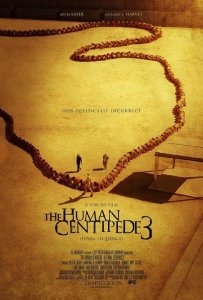 Sometimes as a critic I seek out the worst of the worst so you don’t have to, America. And you really owe me big time for sitting through all 100 torturous minutes of the regretful-in-every-aspect horror… “comedy,” Human Centipede 3: Final Sequence. I’ll confess that horror is a genre I’ve grown to enjoy and I genuinely liked the first Centipede film, finding its premise near ingenious and that writer/director Tom Six developed his horror grotesquerie in a way that turned it into an accessible survival thriller with some gonzo edges. The sequel was pretty repulsive and the third film, with the hopeful promise of being the “final sequence,” is even worse. This is a horrifying endurance test not unlike Tom Green’s abysmal lone directorial affront, Freddy Got Fingered. It is that bad. Scenes just seem to go on and on and exist for no purpose. It’s like Dieter Laser was just told to do whatever he wanted as long as he yelled as loud as he could and based his performance after the Looney Tunes cast. It’s cheap vulgarity masquerading as edgy provocation; it’s transparently lazy and insufferable. It’s not funny no matter how weird or loud or garish or bloody or dumb it gets. The premise is basically an insane prison warden (Laser) is going to create his own human centipede, the biggest ever, linking over 100 inmates. Ignoring the escalation of all the Centipede sequels, it’s a facile plot device and it doesn’t even happen until the very end. Until that awful reveal, you will have to endure, no a better word is survive, extended “comedy” bits like Laser sticking his tongue out and roaring in orgasm while his secretary (Bree Olsen) is forced to felate him while others are in the room. The movie is trying so hard to be shocking and irreverent that you can see all the pained efforts. It’s tedious and boring. Human Centipede 3 is 100 minutes of pathetic flop sweat that could more or less end with the throwaway punchline, “The Aristocrats!”
Nate’s Grade: F


 nathanzoebl
You must be logged in to post a comment.