Daily Archives: July 14, 2026
Toy Story 5 (2026)
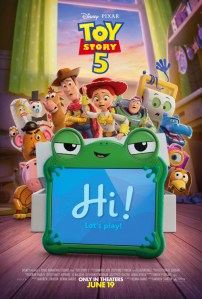
Every time Pixar resuscitates the storied Toy Story franchise, going on three decades now, I get a little wary of them upending the good will. The series had a perfect ending in the third edition in 2010, but being Pixar’s golden and most bankable franchise, it wasn’t allowed to remain an ending. I quite enjoyed the fourth edition in 2019 and consider it a fitting and poignant sendoff for Woody, if, of course, they could accept this as his settled ending. Now in 2026, here comes a fifth Toy Story, and my emotions are decidedly mixed, excited for the creative possibilities of another entry in Pixar’s flagship series and girding myself in anticipation of whether or not these fitting and earned endings are disturbed. Perhaps I’ve been overly protective of these endings, or perhaps it’s just a reflection of our modern IP-revivial cycles that studios cannot accept anything that makes money having finite story endings. Well, while I believe Toy Story 5 to be likely the weakest of the five films, it’s still a marvelous movie that elicited tears from my grown-up eyes on more than one occasion.
Now that Woody (voiced by Tom Hanks) has settled into a new life, the plucky leader of Bonnie’s toys has become the next cowgirl in line, Jessie (voiced by Joan Cusack). Life is good until Bonnie’s parents introduce an educational tablet device, Lilypad or “Lily” (voiced by Greta Lee). They want Bonnie to socialize more and make friends with the neighbors, something she’s having difficulty achieving. Bonnie becomes enthralled with her first smart screen, spending hours upon hours with it inches away from her unblinking face. Jessie sees the new tech as an enemy to traditional play time, as Bonnie’s toys have been chiefly neglected as she devotes all of her attention to this new shiny device. She plots to remove the Lilypad; however, Lily has her own ideas about what Bonnie needs, and it involves getting rid of the outdated toys of childhood so she can be better accepted by her more tech-adopting peers.

Right away, Toy Story 5 provides a meaningful reason for its own existence, examining the immersion of technology and in particular screen time into the development and maturation of children. It’s a substantial issue today for millions of parents, and a genuine worry about whether or not these magical electronic devices are helping or hindering childhood development. Are we building synapses with these games and social media apps or are we building a dependency and despondency when un-synched? It’s an age-old question over whether technology is facilitating growth or substituting for it, an especially pertinent question in the realm of education that ruling parties go back and forth with. This is a fabulous and thorny issue to explore in the Toy Story universe, and with co-writer/co-director Andrew Stanton (WALL-E, Finding Nemo) at the helm, there’s an assurance that all will be handled with wit and warmth (Stanton has co-written all five Toy Story movies, though this is his first directing credit). I actually think this movie utilizes its central premise better than Toy Story 4 did with the murky existential questions with Forky over what constituted play and thus was granted existence and consideration. Now, that movie transformed into a different and more emotionally resonant theme about broken toys still having purpose and dignity after being cast off from their owners, a disability empowerment message that was beautifully handled, so much so that I forgave the dropped exploration of thorny prior themes. With Toy Story 5, the question over the role of tech is front and center throughout.
At the core of this movie is the question of growing up and the malignancy of time. Lily wants Bonnie to be accepted and thus happy, and her reasoning is that these other toys are a detriment to this goal. In her view, they are dragging Bonnie down and imprisoning her in a juvenile state that her peers have already graduated from. For Lily, growing up is a process to be hurried, to become more like a “grown kid,” and thus more like everyone else on the block who has adopted tech and screens earlier in their lives. For Lily, Bonnie, even only at a mere eight years old, is already behind in her maturation process and she’s desperate to get her caught up. For Jessie, it’s about holding onto the status quo as long as possible. For three sequels now the movies have explored the nature of change, acceptance, and identity, and it’s still a wellspring of insight and emotional and intellectual relevance. Having Jessie be the primary protagonist of this sequel was a brilliant choice because she’s the toy who has been defined by abandonment issues. She’s been left behind by two other kids, first Emily and then Andy, and she’s afraid history is repeating with Bonnie’s dwindling attention now that tech has entered the home. There’s a clear parallel with the original Toy Story when Woody became jealous and insecure about the shiny new toy of Andy’s fascination, Buzz Lightyear (voiced by Tim Allen). Oh, and thanks to 2022’s Lightyear, we now know all these toys were the discount knockoffs of Chris Evans’ voice and that this original movie that Andy declared his favorite was not quite worthy of his adoration. Anchoring the major theme onto Jessie’s existing emotional attachment issues is smart, and it allows the fifth film to serve as a means of long-delayed closure for the cowgirl much as Toy Story 4 was a means of closure for Woody. It’s about confirmation that these relationships they build with their kids are not one-way, and that even after they end, and everything has an ending whether we like it or not, we know that they have mattered. No one, not even toys, wants to feel disposable.

I especially loved the imaginary play sequences in the film, highlighted by a different animation style. It’s painterly and with pastel colors, and it’s a great artistic choice to visually code the imaginary sequences from the standard reality. I loved how chaotic and silly these sequences were, converging escalating threats, dramatic twists, and ridiculous double crosses and resolutions, perfectly embodying the wild mind of a child in the midst of imaginary play. These little interludes were welcomed at every turn.
I did say Toy Story 5 was the weakest entry in the franchise, again no shame being a bronze medalist at the Olympics, so to speak, as you’ve gotten ahead of so many others to attain this honor. I enjoyed the lowered stakes of simply trying to tell a story about two factions fighting over what they felt was best for the mental well-being of a child. There’s something inherently sweet about a movie whose big goal is to just help a shy little girl make some friends. I do wish there was more persistent commentary on what screen-addiction has done to a generation of kids at an important time besides turn the neighborhood girls catty and mean. Bonnie, you are not the “weird kid” just because you prefer playing outdoors. At no point is Jessie really threatened with annihilation, and even as she’s lost she still finds a new and nurturing owner that could possibly even replace Bonnie. Because of those lowered stakes, the script can feel a little like an expanded TV episode where a character learns a valuable lesson. The supporting characters are sidelined with few exceptions. This is the second movie in a row that merely gives Buzz a jokey storyline, this time working up the courage to ask Jessie to be his wife. It’s more a recurring joke at his fumbling awkwardness. It feels like Pixar knew it was giving the character such a short shrift, which is why they also included an ongoing subplot of a group of Buzz Lightyear action figures bandying together to go searching for “star command.” Until finally tied into the action at the very climax, they’re a diversion that is never really as funny as it could have been. I will also firmly proclaim my stance that Woody should not have returned for this sequel. He offers little to the story, beyond to once again reflect upon how old he has gotten, which itself is just turned into a repeating joke. Woody’s involvement is wasted and his perspective isn’t different enough that some other toy, perhaps Buzz, could have fulfilled his role and left the former sheriff in retirement with Bo Peep.

Does Toy Story 5 upend the cherished endings of its predecessors? No, not really. Those endings still have meaning because the audience has invested relationships with these characters over thirty years. The latter sequels, in my mind, have served as closure vehicles for individual characters, and I think that’s a smart way to handle the franchise. Of course, I also think just telling original stories with new characters in this universe would be even more appealing, but the likelihood of that seems slim when Disney wants to sell another billion dollars in merch with their established and beloved characters. It’s probably naive to think this movie will ultimately be the franchise’s last, so instead I’ll just hold out hope that its ongoing quality will persist, and as long as Stanton and other Pixar brain-trust remember its innate and lasting appeal, I have a buoyant sense of hope that newer editions can still capture that initial magic that began in 1995.
At the conclusion of Toy Story 3, which I still gauge as the best in the series, it made me reflective and want to break out my old neglected toys, giving them one more hurrah of play. At the conclusion of Toy Story 5, it made me reflective, but I didn’t want to reach for any old toys and give them an extra dose of affection; it made me want to grab my toddler and soak up the time I have available with him, now, in this moment, while there’s a childhood to relish before it too vanishes at the mercy of time. This movie is all about the struggle over childhood, one side hoping to elongate it and the other hoping to rush through. From a different perspective, like a parent, it’s inevitably a losing battle, but it makes me reflect more on cherishing those moments while they are available. That’s pretty deep for a movie with a talking electronic poop assistant voiced by Conan O’Brien. Not too shabby, Pixar. Here’s your billion dollars.
Nate’s Grade: B+


You must be logged in to post a comment.