Blog Archives
The Killer (2023)
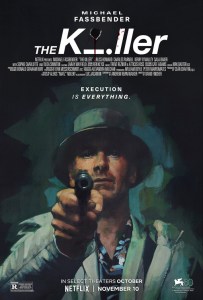 Were you even aware that David Fincher had a new movie? The celebrated director has been very mercurial since 2014’s Gone Girl, only helming one other movie. His partnership with Netflix has afforded the notoriously perfectionist director a lot of creative latitude, though sadly not a third season of Mindhunter. But even the artistic cache of a new Fincher movie isn’t enough for Netflix to change its business model. The Killer only played in theaters for two weeks before beaming into millions of homes. You would think this streaming giant would want to leverage its big names and their new projects, but I’m reminded of how much money Netflix likely left aside forgoing Glass Onion’s theatrical run. Alas, The Killer is an intriguing if cold and unsatisfying thriller that epitomizes the limits of surface-level living.
Our titular killer (Michael Fassbender) is hired to kill a Parisian businessman and botches the job. He’s on the run and fears for his well-being from his employers wanting to eliminate any loose ends. His girlfriend in the Dominican Republic is beaten and threatened, and the lead killer realizes he’s going to have to out-kill all the other killers after him if his loved ones don’t get killed. Through five chapters, each ending in a death, the killer works his way up the food chain.
 Fincher is attempting to strip out the movie-cool mythos of the world of hired assassins, to subvert the entertainment value that can come with expert murderers leading to blood and death. The Killer is Fincher’s stubborn subversion of what a trained assassin movie should be, and his main takeaway, beyond stripping the misplaced glamor from the profession, is how tedious it would all be in real life. In the movie world, being a trained killer involves all sorts of exciting derring-do and acrobatics and the like. In the possible real world, being a trained killer is more like a paid security guard; it’s a lot of protracted sitting and waiting and watching, and it’s easy to understand just how overwhelmingly boring all this would be. The opening twenty minutes quite convincingly strips the cool factor away from this profession. It doesn’t make you feel the weight of the culpability, like 2018’s You Were Never Really Here (more on that later), but what it makes you feel is just how maddening and boring this whole job must be and what kind of dedicated people would succeed. It’s like Fincher is making a bet with a mainstream audience that he can find a way to make a boring assassin movie, and while doing so can be seen as subversive to some degree, bleeding much of the thrills out of the picture, it also feels like a bet gone wrong. You made the main character boring on purpose to prove a point, but regardless of intent, your protagonist is still boring. Victory?
As physically inactive as Act One proves, watching our title killer sit and wait and watch, it is conversely hyperactive in narration. This is wall-to-wall narration as our lead character expounds upon his regiment to keep his mind and body ready when his eventual window materializes. It reminded me of the narration of Patrick Bateman from American Psycho, about his methodical lifestyle routines. Except that character was being satirized from their first moments, whereas the emptiness of our killer here is the larger point, that he’s fashioned himself into an unfeeling weapon. Here is a character that feels he is only effective if he strips everything human away, if he only focuses on the job regardless of politics or consequences, and lives his spartan existence. I’m sure he envisions himself as some noble modern-day samurai, living a code others cannot keep. Except the movie reveals throughout that he might not be the best killer in the phone book. First off, he misses shooting his target, which sets everything into motion. All his narration about focus and yoga and dedication and even I know you shouldn’t fire while someone else is in front of your target. There’s a jarring scene where he fires nails into the lungs of a character and theorizes the man has six or seven minutes left to live before his lungs fill up. Nope. The man dies within one minute max. For all his resourcefulness, which is benefited by the long reach of capitalism, the man also doesn’t live up to his self-image. His paranoia keeps him from returning to his home on time and allows the attack on his girlfriend to happen in his absence. There might be an even deeper commentary on how even the lead is confusing his life for a movie.
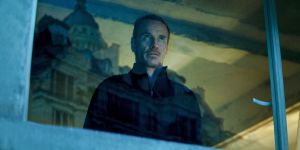 My favorite scene is a sit down with a competing hired hitman played by Tilda Swinton (Three Thousand Years of Longing). She’s one of the two competing assassins responsible for targeting his girlfriend, so she presents a threat. He meets her at a fancy restaurant and she already accepts that she will not be making it to dessert. She is the exact opposite of our main character, a woman who has found a way to live a normal life in the suburbs, marry a man, and enjoy the luxuries of a life afforded by her wealth. She’s not living out of storage units or purposely dressing like a German tourist to stay under the radar. In some ways, this has allowed our more single-minded assassin to get the jump on her, to take advantage of her complacency. However, it’s also an indictment on the stripped-down, isolationist life our lead killer has prioritized. Here is a woman who has embraced allowing herself to enjoy things. She’s not eating McDonald’s breakfast sandwiches minus the slimy egg patty. She’s not slumming it for her “art.” She sees no value in abstinence. This stark contrast, as well as a sustained conversation between two foes, is the highlight of the film. It’s also interesting to watch Swinton’s character go through her own mini-grieving process accepting the likelihood that this will be her final meal, and so she savors it without fear.
Being a David Fincher movie, you can rightly assume that the technical elements are nearly flawless. The visual arrangements are beautiful, the cinematography is chilly and atmospheric, and the editing is precise and smooth. The first attempted kill has a nice degree of tension simply from shifting audio levels, going from diegetic to narration, never allowing the viewer to properly adjust during such a heightened point of paying attention. It’s naturally unsettling and effectively raises the tension of a moment we’ve been waiting over twenty minutes to arrive. There is an extended hand-to-hand fight sequence that’s exceptionally well choreographed and carries on from room to room, transforming with each new location and utilizing the geography of each space nicely (the John Wick folks would approve). The overall movie feels more in keeping with the likes of Fincher’s Panic Room or The Game, a more straightforward thriller that lacks simply extra levels and commentary, like Zodiac or Gone Girl. There’s nothing wrong with a well-executed and developed thriller purely designed to be a good time. It’s just at this stage of Fincher’s career, the expectations are raised, fairly or unfairly, with every new release. The Killer is a polished thriller meant to be pared down to its essential parts and can be enjoyed as such.
There is little to hold onto here emotionally though, so we’re left with the intellectual curiosity of watching a so-called professional go about their business and see how he gets around obstacles. Very often it’s dressing up in a delivery outfit and simply waiting on other polite strangers to open doors for his unassuming facade. One could argue that the character arc is about a man who rejects empathy, argues that it is weakness, comes around to accept empathy, and embraces it on his way out. I can see some of this, as the motivation for his trail of vengeance is to protect his loved one from being harmed again. There’s even a moment where he demonstrates a sliver of sympathy to a victim, albeit still utilizing gruesome violence. Except I don’t believe that easy assessment of this being a journey of embracing empathy. This doesn’t come across as a character changing who they are but instead as a character cleaning up their own mess. The main character keeps reiterating to “stick to the plan, don’t improvise,” but I don’t think he’s reflecting at any point on his actions beyond a clinical cause-effect relationship. He’s stripped all the complexities of humanity out from himself but recognizing fault isn’t the same as building and maintaining a sense of empathy. I also think the reading that many critics are making of Fincher standing in for the main character, a dedicated tactician who tries to do it all, is a little too cute and desperate for meta-narratives to derive a better lens to analyze the overall vacancy of the lead character.
 This is very different from Lynn Ramsay’s You Were Never Really Here, a film that also subverted the same hitman sub-genre and made the audience re-examine its own bloodlust. As I wrote in 2018: “The focus of the movie is on the man committing the acts of violence rather than how stylish and cool and cinematic those acts of violence can be. …Ramsay offers discorded images and brief flashes and asks the audience to put together the pieces to better understand Joe as a man propelled and haunted by his bloody past…. It’s not all tragedy and inescapable dread. Amidst Joe’s tortured past and troubled future, there’s a necessary sense of hope. You don’t know what will happen next but you’re not resigned to retrograde nihilism.” This is not the feeling I took from The Killer, and I recommend everyone watch Ramsay’s movie too.
The problem with making a boring assassination thriller on purpose is that, at the end of the day, you still have a boring assassination thriller. Fassbender (who hasn’t been on screen since 2019’s Dark Phoenix killed the X-Men franchise) can be compelling for two hours doing just about anything, and a performance that is minimal in spoken dialogue does not mean a minimal performance. He’s great to sit and watch, the running commentary of his narration serving as a starting point to assess all the concentrated, nuanced acting under the surface. The Killer has sheen and skill, much like its title character, but it too also misses the mark where it counts.
Nate’s Grade: B-
Share this:

Asteroid City (2023)
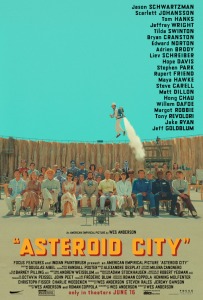 It’s not a good sign that a week after watching a movie I was racking my brain to try and remember what I had watched, and it’s even worse when it’s a movie by Wes Anderson, a filmmaker with such a distinct sense of intricate style it’s now become a go-to A.I. test for untalented people. Asteroid City has the makings of an appealing comic escapade set in a Southwest small town known for its tiny asteroid, and once aliens make their presence known, the entire town and its tourists and wanderers and scientists are quarantined. The problem comes almost immediately, as the movie is presented through several added layers of obfuscating framing devices. The story itself is a play, and we’re watching a movie version, but then also the play of the movie, and the behind the scenes of its now-deceased playwright toiling with his authorial messages and stubborn actors, and it feels like two different movies at odds with one another. The Asteroid City sequence is the more engaging, with some sweet storylines like Jason Schwartzman as a widower processing loss with his family, including his father-in-law (Tom Hanks) who never liked him, while beginning to find a possible romantic kinship with a struggling actress and single mom (Scarlett Johansson). I enjoyed weird little asides about the history of this little town, like a vending machine for land ownership, and s science fair with brainy whiz kids finding their own comradery. There’s even a nice moment in the meta-textual framing where the Schwartzman actor recites an exorcised dialogue scene with the actress who played his deceased wife in the play. It’s elegantly heartfelt. However, the added layers don’t really add extra insight or intrigue but serve as muddy trappings, making meaning less likely rather than more. It feels like Anderson didn’t have enough material with the central story so he added on the meta to make up the difference. There are too many moving pieces and too many characters, and versions of characters, here to settle into something grander. The whimsy and visual style of Anderson is still evident throughout every highly-crafted and pristine arrangement in the movie, so if you’re an Anderson diehard, he still has his charms. This is two Anderson movies in a row that felt disorganized, distracted, and chiefly under-developed, and I’m starting to worry that the form has taken over the function as storyteller.
Nate’s Grade: C+
Share this:

Guillermo del Toro’s Pinocchio (2022)/ Pinocchio (2022)
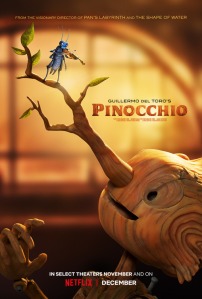 It seems 2022 has unexpectedly become the year of Pinocchio. The 1883 fantasy novel by Carlo Collodui (1826-1890) is best known via the classic Walt Disney animated movie, the second ever for the company, and it was Disney that released a live-action remake earlier in the year on their streaming service. Now widely available on Netflix is Guillermo del Toro’s stop-motion Pinocchio, so I wanted to review both films together but I was also presented with a unique circumstance. Both of these movies were adaptations of the same story, so the comparison is more direct, and I’ve decided to take a few cues from sports writing and break down the movies in a head-to-head competitive battle to see which has the edge in a series of five categories. Which fantastical story about a little puppet yearning to be a real boy will prove superior?
1. VISUAL PRESENTATION
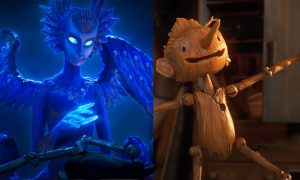
The Netflix Pinocchio is a lovingly realized stop-motion marvel. It’s del Toro’s first animated movie and his style translates easily to this hand-crafted realm. There is something special about stop-motion animation for me; I love the tactile nature of it all, the knowledge that everything I’m watching is pain-stakingly crafted by artisans, and it just increases my appreciation. I fully acknowledge that any animated movie is the work of thousands of hours of labor and love, but there’s something about stop-motion animation that I just experience more viscerally. The level of detail in the Netflix Pinocchio is astounding. There is dirt under Geppetto’s fingernails, red around the eyes after crying, the folds and rolls of fabric, and the textures feel like you can walk up to the screen and run your fingers over their surfaces. I loved the character designs, their clean simplicity but able readability, especially the sister creatures of life and death with peacock feather wings, and the animation underwater made me question how they did what they did. del Toro’s imagination is not limited from animation but expanded, and there are adept camera movements that require even more arduous work to achieve and they do. I loved the life each character has, the fluidity of their movements, that they even animated characters making mistakes or losing their balance or acting so recognizably human and sprightly. There’s a depth of life here plus an added meta-textual layer about puppets telling the story about a puppet who was given life.
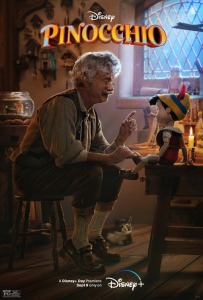 In contrast, the Disney live-action Pinocchio is harsh on the eyes. It’s another CGI smorgasbord from writer/director Robert Zemeckis akin to his mo-cap semi-animated movies from the 2000s. The brightness levels of the outside world are blastingly white, and it eliminates so much of the detail of the landscapes. When watching actors interact, it never overcomes the reality of it being a big empty set. The CGI can also be alarming with the recreation of the many animal sidekicks of the 1940 original. Why did Zemeckis make the pet goldfish look sultry? Why did they make Jiminy Cricket (Joseph Gordon-Levitt) look like a Brussel sprout come to life? It might not be the dead-eyed nightmare fuel of 2004’s The Polar Express, but the visual landscape of the movie is bleached and overdone, making everything feel overly fake or overly muddy and glum. The fact that this movie looks like this with a $150 million budget is disheartening but maybe inevitable. I suppose Zemeckis had no choice but to replicate the Pinocchio character design from 1940, but it looks remarkably out of step and just worse. When we have the 1940 original to compare to, everything in the 2022 remake looks garish or ugly or just wrong. The expressiveness of the hand-drawn animation is replaced with creepy-looking CGI animal-human hybrids.
Edge: Netflix Pinocchio
2. FATHER/SON CHARACTERIZATION
The relationship between Pinocchio (voiced by Gregory Mann) and Geppetto (David Bradley) is the heart of the Netflix Pinocchio, and I don’t mind sharing that it brought me to tears a couple of times. As much as the movie is about a young boy learning about the world, it’s also about the love of a father for a child. The opening ten minutes establish Geppetto’s tragedy with such surefooted efficiency that it reminded me of the early gut punch that was 2009’s Up. This Geppetto is constantly reminded of his loss and, during a drunken fit, he carved a replacement child that happens to come to life. This boy is very different from his last, and there is a great learning curve for both father and son about relating to one another. This is the heart of the movie, one I’ll discuss more in another section. With del Toro’s version, Geppetto is a wounded and hurting man, one where every decision is connected to character. This Pinocchio is a far more entertaining creature, a child of explosive energy, curiosity, and spitefulness. He feels like an excitable newborn exploring the way of the world. He’s so enthusiastic so quickly (“Work? I love work, papa!” “I love it, I love it!… What is it?”) that his wonder can become infectious. This Pinocchio also cannot die, and each time he comes back to life he must wait longer in a netherworld plane. It provides even more for Pinocchio to understand about loss and being human. This is a funny, whimsical, but also deftly emotive Pinocchio. He points to a crucifix and asks why everyone likes that wooden man but not him. He is an outsider learning about human emotions and morals and it’s more meaningful because of the character investment.
 In contrast, the Disney live-action Pinocchio treats its title character as a simpleton. The problem with a story about a child who breaks rules and learns lessons by dealing with the consequences of his actions is if you have a character that makes no mistakes then their suffering feels cruel. This Pinocchio is simply a sweet-natured wannabe performer. He means well but he doesn’t even lie until a sequence requires him to lie to successfully escape his imprisonment. The relationship with Geppetto (Tom Hanks) is strange. This kindly woodcarver is a widower who also has buried a son, but he comes across like a doddering old man who is quick to make dad jokes to nobody (I guess to his CGI cat and goldfish and multitude of Disney-tie-in cuckoo clocks). I don’t know what Hanks is doing with this daffy performance. It feels like Geppetto lost his mind and became stir crazy and this performance is the man pleading for help from the town, from the audience, from Zemeckis. It’s perplexing and it kept me from seeing this man as an actual character. He bounces from catalyst to late damsel in distress needing saving. The relationship between father and son lacks the warmth of the Netflix version. Yet again, the live-action Pinocchio is a pale imitation of its cartoon origins with either main character failing to be fleshed out or made new.
Edge: Netflix Pinocchio
3. THEMES
There are a few key themes that emerge over the near two-hours of the Netflix Pinocchio, which is the longest stop-motion animated film ever. Sebastian J. Cricket (Ewan McGregor) repeats that he “tried his best and that’s the best anyone can do,” and the parallelism makes it sound smarter than it actually is. The actual theme revolves around acceptance and the burdens of love. Geppetto cannot fully accept Pinocchio because he’s constantly comparing him to Carlo. When he can fully accept Pinocchio for who he is, the weird little kid with the big heart and unique perspective, is when he can finally begin to heal over the wound of his grief over Carlo, allowing himself to be vulnerable again and to accept his unexpected new family on their own terms. There’s plenty of available extra applications here to historically marginalized groups, and del Toro is an avowed fan of freaks and outcasts getting their due and thumbing their nose at the hypocritical moral authorities. By setting his story in 1930s Italy under the fascist rule of Benito Mussolini, del Toro underlines his themes of monsters and scapegoats and moral hypocrites even better, and the change of scenery really enlivens the familiar story with extra depth and resonance. All these different people want something out of Pinocchio that he is not. Geppetto wants him to strip away his individuality and be his old son. Count Volpe (Christoph Waltz) wants Pinocchio to be his dancing minion and secure him fame and fortune. Podesta (Ron Perlman) wants Pinocchio as the state’s ultimate soldier, a boy who cannot die and always comes back fighting. When Pinocchio is recruited to train for war with the other young boys to better serve the fatherland’s nationalistic aims, it’s a far more affecting and unsettling experience than Pleasure Island, which is removed from this version. In the end, the movie also becomes a funny and touching exploration of mortality from a magic little child. The Wood Sprite (Tilda Swinton), this version of the Blue Fairy, says she only wanted to grant Geppetto joy. “But you did,” he says. “Terrible, terrible joy.” The fleeting nature of life, as well as its mixture of pain and elation, is an ongoing theme that isn’t revelatory but still feels impressively restated.
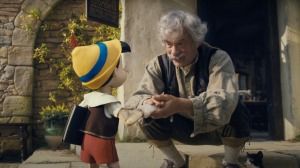 I don’t know what theme the Disney live-action movie has beyond its identity as a product launch. I suppose several years into the Disney live-action assembly line I shouldn’t be surprised that these movies are generally listless, inferior repetitions made to reignite old company IP. For a story about the gift of life, the Disney Pinocchio feels so utterly lifeless. I thought the little wooden boy was meant to learn rights and wrongs but the movie doesn’t allow Pinocchio to err. He’s an innocent simpleton who gets taken advantage of and dragged from encounter to encounter like a lost child. The Pleasure Island sequence has been tamed from the 1940s; children are no longer drinking beer or smoking cigars. They’re gathered to a carnival and then given root beer and told to break items and then punished for this entrapment. The grief Geppetto feels for his deceased loved ones is played out like a barely conceived backstory. He’s just yukking it up like nothing really matters. By the end, when he’s begging for Pinocchio to come back to life, you wonder why he cares. If you were being quite generous, you might be able to uncover themes of acceptance and understanding, but they’re so poorly developed and utilized. That stuff gets in the way of Pinocchio staring at a big pile of horse excrement on the street, which if you needed a summative visual metaphor for the adaptation, there it is.
Edge: Netflix Pinocchio
4. EMOTIONAL STAKES
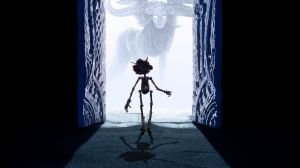 One of these movies made me cry. The other one made me sigh in exasperation. The Netflix Pinocchio nails the characterization in a way that is universal and accessible while staying true to its roots, whereas the Disney live-action film feels like a crudely packaged remake on the assembly line of soulless live-action Disney remakes. By securing my investment early with Geppetto’s loss, I found more to relish in the layers of his relationship with Pinocchio. In trying to teach him about the world, Geppetto is relying upon what he started with his past son, and there are intriguing echoes that lead to a spiritual examination. Pinocchio is made from the tree from the pinecone that Carlo chased that lead to his death. Pinocchio hums the tune that Geppetto sang to Carlo. Is there something more here? When he visits Death for the first time, the winged creature remarks, “I feel as though you’ve been here before.” These little questions and ambiguity make the movie much more rewarding, as does del Toro’s ability to supply character arcs for every supporting player. Even the monkey sidekick of the villain gets their own character arc. Another boy desperately desires his stern father’s approval, and he’s presented as a parallel for Pinocchio, another son trying to measure up to his father’s demands. Even this kid gets meaningful character moments and an arc. With this story, nobody gets left behind when it comes to thoughtful and meaningful characterization. It makes the movie much more heartwarming and engaging, and by the end, as we get our poignant coda jumping forward in time and serving as multiple curtain calls for our many characters, I was definitely shedding a flurry of tears. Hearing Geppetto bawl, “I need you… my boy,” to the lifeless body of Pinocchio still breaks me. Under del Toro’s compassionate lens, everyone is deserving of kindness.
As should be expected by now, the Disney live-action movie is lackluster at best when it comes to any kind of emotional investment. The characters stay as archetypes but they haven’t been personalized, so they merely remain as grubby facsimiles to what we recall from the 1940 version. Jiminy Cricket is meant as Pinocchio’s conscience but he vacillates from being a nag to being a smart aleck who even breaks the fourth wall to argue with his own narration. I hated every time he called the main character “Pee-noke” and he did it quite often. He’s far more annoying than endearing. There’s also a wise-cracking seagull that is just awful. The Honest John (Keegan Michael-Key) character is obnoxious, and in a world with a talking fox who dresses in human clothing, why would a “living puppet” be such a draw? He even has a joke about Pinocchio being an “influencer.” The only addition I liked was a coworker in Stromboli’s traveling circus, a former ballerina who injured herself and now gets to live out her dancing dreams by operating a marionette puppet. However, the movie treats the puppet like it’s a living peer to Pinocchio and talks directly to the puppet rather than the human operating the puppet, and the camera treats her like she’s the brains too. Safe to say, by the end when Pinocchio magically revives for whatever reason, just as he magically reverted from being a donkey boy, I was left coldly indifferent and more so just relieved that the movie was finally over.
Edge: Netflix Pinocchio
5. MUSIC
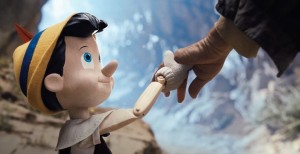 This was one area where I would have assumed the Disney live-action film had an advantage. Its signature banger, “When You Wish Upon a Star,” became the de facto Disney theme song and plays over the opening title card for the company. It’s still a sweet song, and Cynthia Erivo (Harriet) is the best part of the movie as the Blue Fairy. It’s a shame she only appears once, which is kind of negligent considering she sets everything in motion. The Netflix Pinocchio is also a musical and the songs by Alexandre Desplat (The Shape of Water) are slight and low-key, easy to dismiss upon first listen. However, the second time I watched the movie, the simplicity as a leitmotif really stood out, and I noticed the melody was the foundation for most other songs, which created an intriguing interconnected comparison. While nothing in the Netflix Pinocchio comes close to being the instantly humable classic of “When You Wish Upon a Star,” the songs are more thoughtful and emotionally felt and not just repeating the hits of yore, so in the closest of categories, I’m going to say that Netflix’s Pinocchio wins by a nose (pun intended).
Edge: Netflix Pinocchio
CONCLUSIONS
One of these Pinocchio movies is a visual marvel, heartfelt and moving, wondrous, and one of the best films of 2022. The other is a hollow vessel for corporate profit that copies the imprint of the 1940 animated film but only more frantic, scatalogical, and confused. In the year of our lord Pinocchio Two Thousand and Twenty-Two, there is only one movie you should see, and at this point ever see as it concerns this old tale. Guillermo del Toro has harnessed magic, and we are all the better for his bayonet imagination and enormous heart for his fellow outsiders.
Nate’s Grades:
Guillermo del Toro’s Pinocchio: A
2022 Pinocchio: C-
Share this:

Vanilla Sky (2001) [Review Re-View]
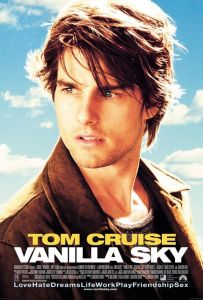 Originally released December 14, 2001:
Talk about a film’s back story. Tom Cruise signed on to do a remake of the 1997 Spanish film Abre Los Ojos (Open Your Eyes) which was directed by Alejandro Amenabar. During the filming the romance between Cruise and Penelope Cruz (no relation) got a little hotter than expected onscreen and broke up his long-standing marriage to Nicole Kidman. At the time she was finishing filming The Others which is the second film by Amenabar. This, by the way, is much more interesting than Vanilla Sky unfortunately.
Cameron Crowe’s remake starts off promising enough with Tom Cruise running around an empty Times Square like a Twilight Zone episode. Afterwards the film begins to create a story that collapses under its own weight. David (Cruise) is a rich boy in control of a publishing empire inherited through his dear old deceased dad. He has the time to throw huge parties where even Spielberg hugs him, and even have crazy sex with crazy Cameron Diaz, whom he tells his best friend (Jason Lee) is his “f*** buddy.” David begins to see a softer side of life with the entrance of bouncy and lively Sophia (Cruz) and contemplates that he might be really falling in love for the first time. But this happiness doesn’t last long as jealous Diaz picks up David in her car then speeds it off a bridge killing her. Then things get sticky including David’s disfiguration, his attempts to regain that one night of budding love and a supposed murder that he committed.
 Crowe is in over his head with this territory. His knack for wonderful exchanges of dialogue and the perfect song to place over a scene are intact, but cannot help him with this mess. Vanilla Sky is an awkward mish-mash of science fiction. The film’s protagonist is standoffish for an audience and many of the story’s so-called resolutions toward the end are more perfunctory than functional. The ending as a whole is dissatisfying and unimaginative. By the time the wonderful Tilda Swinton shows up you’ll likely either be asleep or ready to press the eject button yelling “cop out!”
Seeing Vanilla Sky has made me want to hunt for Amenabar’s Abre Los Ojos and see what all the hype was about, because if it is anything like its glossy American counterpart then I have no idea why world audiences went wild for it.
Nate’s Grade: C
——————————————————
WRITER REFLECTIONS 20 YEARS LATER
Movies have long resorted to being interactive puzzles, inviting audiences to unravel the mystery and hunt for clues as detectives. That’s essentially what Vanilla Sky is at its best, a messy mishmash of a movie that aims a little too high and pins its hopes with a generally unlikeable lead. This psychodrama is meant for dissection, not in a dreamy, obtuse way that David Lynch films invite but more in a canny re-calibration of pop-culture homages and fantasies. The big twist of the movie is that David (Tom Cruise), a rich publishing scion recovering from a savage accident, has elected to live in a simulation, a lucid dream that has been his home for the last hundred-plus years (how kind of the multiple generations of knob-turners to keep things operating). Other stories have followed a similar Twilight Zone-esque twist on the same territory, including the beloved “San Junipero” episode of Black Mirror (that’s right, spoilers, spoilers all around for older sci-fi). Writer/director Cameron Crowe has stated there are over 400 pop-culture connections and references to be had with this movie. The movie is wall-to-wall cultivated jams, as expected from a Crowe picture, but the homages and recreations go beyond simply placing a piece of music to a scene or name dropping an artist. The visual language of the movie is intended to be deconstructed, built upon twentieth-century album covers, music, movies, and plenty more. It’s a dense artistic gamble and, ultimately, I question who is even going to care enough to dive into this movie? Who is going to want to watch Vanilla Sky as a detective?
 This American remake of a 1997 Spanish movie was, in hindsight, the beginning of the end of Crowe’s career as a major director of studio movies for adults. Crowe had just experienced the apex of his career with 2000’s luminescent Almost Famous, a warm hug of a movie, and he had won the Oscar for Best Original Screenplay. It makes sense to try for something big, reunite with his Jerry Maguire star, and go outside his comfort zone with a wide artistic berth of freedom. The 2001 movie just did not work, though not strictly because of Crowe’s game efforts. This is not a miscalculated folly, an artist flying too close to the sun and getting burnt by their arrogance. I think the major flaw comes down to pinning the mystery on the recovery of the romantic and social life of a disagreeable lead character. Early on, David is established as rich, careless, and smug. He keeps his responsibilities as fleeting as his relationships with women. When his on-again-off-again paramour, Julie (Cameron Diaz), drives off a bridge with David inside, part of you might be thinking he deserves what he got for being so callously indifferent with other people. That’s harsh, I realize, but people will not like David, and this is amplified by the general public’s diastase for Cruise himself. Therefore, watching a movie where he tries to overcome him disfigurement and disability and stop being a jerk to everyone in his life is not a journey that invites the viewer to come aboard. He’s just not that interesting as our centerpiece. What’s happening to him can prove interesting, especially as the movie plays with our mind, but at no point will the extended pity party for poor rich David feel compelling as its own drama.
This is the problem with movies that are built around Big Twists: limited replay value. After you know the super twist, very often these movies fail to justify another two-hour investment. Take for instance 1997’s The Game, the forgotten David Fincher movie. It’s a thriller where Michael Douglas is on the run and doesn’t know who is responsible for chasing him. Then the movie says, “Surprise, it’s [blank],” and then it ends. Not every twist unlocks a new and exciting prism of how to view the preceding hours, like a Sixth Sense or Fight Club. Most movies built upon a big reveal as their conclusion tend to deflate immediately. There’s no real reason to watch The Game a second time if you already know what is happening. There’s no real reason to watch 2003’s Identity again once you know all the ridiculous secrets. There’s no real reason to watch Vanilla Sky once you know the explanation for all the strange little hiccups along David’s fraying mental state.
 Look, tons of movies are built around extended mysteries, from Agatha Christie to Knives Out, but the pleasure goes beyond simply solving of the puzzle. It’s the characters, the red herrings, the inspectors or detectives or chief solver of mystery. There is more there for entertainment. With Vanilla Sky, what we’re left with is a lackluster romance of a former pretty boy moping over his slightly adjusted privilege. It’s not like David’s character arc is illuminating or insightful. It’s not like we’re watching the battle over his soul here. He’s just kind of an affable jerk, and then David becomes a scarred jerk, and then he decides to wake up and be a jerk in real life. Progress?
There is a discussion to be had about how much of the movie is a dream, or where real life ends and the dream begins, and apparently even Crowe has determined there are six general interpretations, from the movie’s true and when Tech Support (Noah Taylor) says he switches over is when the dream occurs, to the unfulfilling “it was all a dream” interpretation. I suppose this could be fun for others but again I don’t think there are enough enjoyable components in the movie to incentivize the debate.
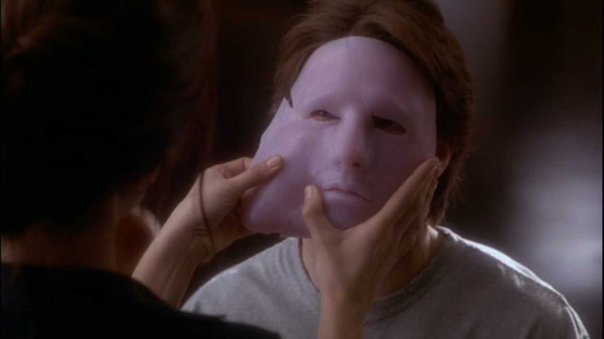
In some ways, this is one of Cruise’s most vain-free performances, yet there is an undercurrent that only seems even more vain. First the obvious; he plays a womanizer who also wears a mask for half of the movie to cover his scarred Phantom of the Opera visage. There’s a lack of vanity playing an annoying, arrogant, unpleasant person, something Cruise has done before and quite well, especially in his extraordinary Oscar-nominated turn in 1999’s Magnolia. He’s even played characters with physical disabilities before, like 1989’s Born on the Fourth of July. However, this “lack of vanity” really plays out as a vain attempt to be even more impressive as a respected thespian. The movie was positioned for a mid-December release, and with Crowe and Cruise on board, it seemed like a legitimate awards contender, until that is it opened wide. While Cruise’s performance is fine, his time under the mask doesn’t proverbially unmask his character for our better consumption.
 Vanilla Sky is mostly known as the big American debut of Penelope Cruz. She was already a muse for Spanish director Pedro Almodóvar and known well in the indie circuit, but from here she became Hollywood’s newest It Girl, only to be stranded in mediocre studio movie after mediocre studio movie (Does anyone remember Captain Corelli’s Mandolin?). It wasn’t until Almodóvar’s 2006 film Volver that studio execs seemed to finally understand how best to utilize her great talent. She won an Oscar for 2008’s Vicky Christina Barcelona and was nominated the following year for the musical Nine. She recently reunited with Almodóvar for 2021’s Parallel Mothers and again is wowing audiences. From early on, she definitely has a spark, an effervescence to her performance in Vanilla Sky. She’s also fighting against being forcibly elbowed into the swampy Manic Pixie Dream Girl category, a term that was originally coined for Crowe’s follow-up film, 2005’s Elizabethtown. Crowe loves writing women under these quirky conditions, however, the movie is told from a flawed male dream perspective, so it also makes sense if its portrayal of David’s idyllic dream woman happens to flatten her down.
It’s true that the story behind the scenes of Vanilla Sky proves more intriguing than the film itself. Cruise and Nicole Kidman were the Hollywood power couple. The ensuing tabloid feeding frenzy over their breakup and Cruise/Cruz relationship outlived the legacy of Vanilla Sky. This was the most ambitious and experimental movie in Crowe’s tenure as a writer/director, and he would never again return to science-fiction as a genre, keeping to the familiar lane of prestige dramas declining in prestige with each new film. My original review in the closing weeks of 2001 was pretty minimal in analysis. I knew this movie didn’t quite work then and it still doesn’t work now. If you’re eager for a dissertation-level analysis on its pop-culture fantasia, then God’s speed to you and your infinite free time.
Re-View Grade: C
Share this:

The French Dispatch (2021)
 Wes Anderson’s latest quirk-fest is his usual cavalcade of straight-laced absurdity, exquisite dollhouse-level production design, famous faces popping in for droll deadpans, and the overall air of not fully getting it. The French Dispatch is structured like you’re watching the issue of a news magazine come to visual life, meaning that the two-hour movie is comprised of mainly three lengthy vignettes and a couple of short asides. This narrative decision limits the emotional involvement and I found myself growing restless with each of the three segments. I was amused throughout but each felt like a short film that had been pushed beyond its breaking point. Perhaps that is Anderson’s wry, subtle point considering the entire journalistic voice of the movie feels like somebody made a movie in the style of one of those esoteric, supposedly “funny” New Yorker cartoons. It’s occasionally so arch and droll that it feels too removed from actual comedy. This is not the most accessible Anderson movie for a newbie; it’s very bourgeois in the kinds of people it follows, the stories it pursues, and the intellectual and political conflicts it demonstrates. The first and best segment follows Tilda Swinton discussing a heralded but imprisoned experimental artist (Benicio del Toro) who is dealing with the pressure to produce. The second segment follows Frances McDormand as she investigates a Parisian student union revolting against the ignorant powers that be. The third segment follows Jeffrey Wright recounting an assignment where he investigated a master police chef (not “chief”) and gets in the middle of a wacky hostage negotiation. Each of them has the requisite charm and random asides we’ve come to expect from Anderson, including a leotard-wearing strongman that is called upon by the police to help during the hostage crisis, but it felt more like a collection of overlong short films than a cohesive whole. If you’re already a fan, by all means, step into The French Dispatch. If you’re new to the idiosyncratic world of indie film’s most precise curator, then I’d advise starting with a more digestible and earlier Anderson entry. I enjoyed myself during stretches, was getting frustrated during other stretches, and I hope Anderson focuses more on the big picture of his next picture.
Nate’s Grade: C+
Share this:

The Dead Don’t Die (2019)
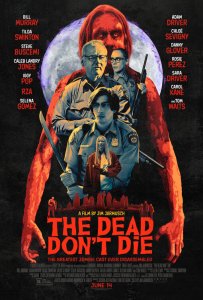 If you’re a Jim Jarmusch fan, you can probably stop reading now. I encourage you to continue but I don’t know if anything will be of help for you from here on out because, frankly, I don’t understand you. Jarmusch is a longtime staple of indie film and I’ve watched three of his films (Only Lovers Left Alive, Broken Flowers, Ghost Dog) and disliked all three to varying degrees, and that’s fine. There are plenty of hallowed names in filmmaking that are just beyond me, like Terrence Malick and Nicolas Refn, but I can at least partially understand what the fans of those auteurs value, an immersive visual, sensory experience at the sacrifice of narrative and coherency. When it comes to Jarmusch, I just don’t understand the appeal whatsoever. This is a man who found a way to make vampires crushingly boring, and now he finds a way to do the same with zombies. The Dead Don’t Die is the widest release of his career and it might be the worst movie I’ve seen in a theater all this year. It certainly feels like the longest.
In a sleepy small Ohio town, the police force consists of Chief Robertson (Bill Murray), Ronnie (Adam Driver), and Mindy (Chloe Sevigny). They’re going about their typical day, warning Hermit Bob (Tom Waits), listening to the alarmist worries of Farmer Frank (Steve Buscemi), and picking up supplies at the hardware store run by Hank (Danny Glover) and Bobby (Caleb Landry Jones). There’s a traveling group of students, lead by Zoe (Selena Gomez), as well as a group of kids in a juvenile detention center. Then the dead come back and small-town life will never be the same.
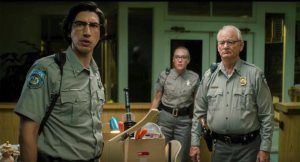 Anyone walking in expecting a zany comedy from the premise and cast, not to mention marketing materials, will be sorely disappointed, because what The Dead Don’t Die better resembles are the humorless anti-comedies of late-night Adult Swim blocs. It’s not so much that there are jokes, it’s more the absence of jokes, and somehow that might be the joke? The humor is stuck in one mode throughout the film. A character will slowly say something understated or obvious (Example: “That’s not good”) and then the reaction of others will be delayed, and then after that nobody will say anything for several painful seconds later. That’s about it, folks. It’s hard to find humor with that. The deadpan jokes are too obvious and too uniform to really strike any potent comedy targets. The consumer “satire” is brittle to the point of breaking. Various zombies will shamble around and say one-word items of whatever was important to them, ranging from “Coffee,” to, “Fashion,” to, “Chardonnay.” It’s like the one-word utterances are the entire joke (Hey, this dead guy liked fishing, isn’t that a riot?). It’s not satire and it’s not funny. How about the characters of Rosie Perez and Tilda Swinton being named Posie Juarez and Zelda Winston? Is that the kind of humor that sounds appealing? How about Tilda Swinton flexing a samurai sword to slice and dice the undead. Is that supposed to be cool? Is it supposed to be funny? Is it supposed to be funny that it’s trying to be “cool”? What is anything?
Later, the film inserts a new comedy element with meta asides where people seem to know they’re in a movie, and yet again the jokes are obvious and uniform, except now it’s even lazier, relying upon the meta recognition to simply stand in the place of a joke. If anything can happen in the small town, especially toward its crazy end, then why do these things have to happen? Or better yet why don’t better things happen? Because of the deadly pacing it makes every attempted bad joke feel that much more unbearable.
This movie is only 105 minutes but it felt so much longer. the pacing not just as a whole but scene-to-scene and even line-to-line from conversations is deadly still. Every moment feels stretched out but it doesn’t ever feel like you’re going anywhere. Characters will be introduced and given meet-cute moments and little indicators they might be significant players later, and then we’ll just find them dead. Other characters will be introduced and then never leave their locations, having no bearing on the larger story. It’s rare that I could honestly say there are entire supporting swaths of this movie that could be cut completely and not impact the story at all. It makes the many storylines we hopscotch across feel like they don’t matter and are generally wasting our valuable time.
 Then there’s the ending where Jarmusch just instructs Tom Waits to unleash a torrent of narration bemoaning how society deserves whatever downfall it incurs and that we’re all just zombies anyway. It’s so clumsy and overbearing and unearned after an entire movie where the cultural criticism amounted to a racist saying he doesn’t like his coffee black and then pointedly staring at the only black man in the movie. Even if we got more moments like that I might say some of the ending vitriol is justified, but the commentary gets muted in the middle until Waits has to finally tell us what the point is. There are scant political and environmental references but they feel like tossed asides themselves.
I don’t blame the cast for any of this although I can’t say what on the page must have seemed attractive. Murray is always going to be an amiable screen presence and Driver is a fun partner, slipping into a skillful deadpan and straining to find humor where there is precious little. Everyone feels wasted on screen because even if you’ve never seen these actors before you know, instantly and instinctively, that they have been far better.
The Dead Don’t Die is further proof that I am not a Jim Jarmusch fan. I can’t fathom how someone can actually be a fan of this writer/director. I was tempted to walk out at several points but I held in there. The jokes are too obvious and barely jokes, the pacing is awfully slack, and the whole movie is reprehensibly boring. Even when it has moments of weirdness it finds ways to make it boring. The structure does little to nothing with a large ensemble of very good actors. The movie and premise had potential. The idea of a zombie outbreak in a small town where everybody knows everybody is ripe for comedy and tragedy. Ultimately The Dead Don’t Die feels like one egregiously long in-joke that the audience isn’t privy to. The joke’s on us, folks.
Nate’s Grade: D
Share this:

Avengers: Endgame (2019)
 This may prove to be the most difficult review I’ve ever written in my twenty years (!) of reviewing movies. How do I ever begin to describe the events of Marvel’s culminating blockbuster Avengers: Endgame without stepping too far into the dark and dangerous territory of the accursed spoilers? I thought it would be difficult talking about last year’s Infinity War considering the shocking plot events and general secrecy, but this concluding chapter to a 22-movie journey is even more secretive (the trailer accounts for only footage roughly from the first twenty minutes). I’ll do my best, dear reader, to give you the clearest impression I can of this unique experience while respecting your need to be un-spoiled. In short, Avengers: Endgame is unparalleled in our history of modern popular blockbusters because it needs to work as a clincher to a decade-plus of hugely popular blockbusters for the Marvel Cinematic Universe (MCU), and boy do they ever stick the landing.
The film picks up with our surviving Avengers picking up the pieces following the events of Infinity War, namely Thanos (Josh Brolin) eliminating half of life throughout the universe. The original six Avengers are all suffering through guilt, depression, and degrees of PTSD following their failure to defeat Thanos. Scott Lang a.k.a. Ant-Man (Paul Rudd) arrives after having spent time in the quantum realm and has a potential solution that will involve traveling through time to correct the mistakes of the past and bring everyone who vanished back to life. The remaining teammates assemble at the behest of Steve Rogers a.k.a. Captain America (Chris Evans), including Bruce Banner a.k.a. Hulk (Mark Ruffalo), Black Widow (Scarlet Johannson), Thor (Chris Hemsworth), Hawkeye (Jeremy Renner), Rocket Racoon (voiced by Bradley Cooper), Nebula (Karen Gillan), and War Machine (Don Cheadle). However Tony Stark a.k.a. Iron Man (Robert Downey Jr.) needs the most convincing, as he is most afraid of making things even worse and losing more people he feels are too precious to be casualties to their failures once again.
 The thing to know ahead of time is that Endgame is not for the casual fan. This is a long love letter to the fans that have pored over all 22 preceding films, not just a scant one or two. Infinity War was accessible to relative newcomers because of the structure and focus on Thanos as the main character, providing a self-contained arc that lead up to his finger-snapping triumph. It also benefited from the fun factor of simply watching a bunch of popular characters interact and team up for the first time in MCU history. Now that a majority of those characters have turned to dust, the emphasis falls back on the original core of the Avengers, bringing things full circle. In several ways, Endgame is about bringing to a close this mammoth project that began with Iron Man, this decade of storytelling ambition that has stretched out into multiple inter-connected franchises. If you love these characters, then Endgame is a movie made specifically for you. There is a long stretch in Act Two that relies upon a decent amount of fan service and sentimentality, but I don’t think either is an automatically negative attribute. Before we reach the finish line it’s important to take stock of how far we’ve come and this goes for the essential characters and their long arcs. There are several fun cameos strewn throughout and the filmmakers even take an interesting tack of trying to reclaim and re-contextualize the MCU movies that fewer people enjoyed. It makes for a filmgoing experience that is heavy in references, in-jokes, Easter eggs, and cozy nostalgia, which will confuse and frustrate those not well versed in this big world.
The other thing to know, especially if you’re a long-standing fan, is that there will be tears. Oh will there be tears. I lost count of the amount of times I was crying, which was pretty much on and off nonstop for the final twenty minutes. I was even tearing up for supporting characters that I didn’t know I had that kind of emotional attachment for. The film is done so well that the first third actually could play as the MCU equivalent of HBO’s The Leftovers, an undervalued and elegant series about the long-term recovery of those that remain in a post-rapture world. The opening scene involves a character having to go through the loss of loved ones via Thanos’ snap, and it’s brutal as we wait for what we know is coming, dread welling up in the pit of your stomach. The Russo brothers, the returning directing team from Infinity War, know what scenes to play for laughs (the line “That’s America’s ass” had me in stitches), what scenes to play for thrills, what scenes to play for fist-pumping cheers, and what scenes to play for gut-wrenching drama. They allow the movie to be an existential mood piece when it needs to be, actually dwelling on the repercussions of a life post-universe culling. There’s a character who frantically searches to see if a loved one was among the missing, and that eventual reunion had me in tears. With the three-hour running time, the Russos have the luxury of allowing scenes to naturally breathe. This might be the most human many of these characters have ever seemed, and it’s after recovery and grief. Needless to say, the conclusion feels very much fitting but also unabashedly emotional, unafraid of diving deep into its feelings. I sobbed.
 I was worried once the film introduced the time travel plot device that everything was simply going to be erased and invalidate the struggles that came before. The worst use of time travel is when it eliminates any urgency or danger, allowing an endless series of do-overs to correct the past. Fortunately, returning screenwriters Christopher Markus and Stephen McFeely (Civil War, Winter Soldier) realize that in order for there to be a reversal, a glint of a happy ending, there must be a cost or else it all meant little to nothing. There are finite events in the movie that cannot change (as of now) and losses that will be permanent (as of now, if they don’t want to cheapen the journey). People died with Infinity War but we all knew, at least when it came to its dreary conclusion, that it wasn’t going to be too long lasting, which allowed the communal grief to be short-lived. After all, there’s a new Spider-Man film coming down the pike two months from now, so it’s highly unlikely the teenage web-head will remain dead. However, with Endgame, the deaths serve as the cost for resurrecting the MCU, and they will be felt for years. The screenplay provides limitations to the time travel mechanics, though I don’t think the collective hand-wave to the nagging paradoxes was as successful as the movie thinks it was. The film barrels ahead, essentially telling you to forget about the paradoxes and enjoy the ride, focusing on the characters and remembering what is really important.
Suffice to say Downey Jr. is once again his charming, self-effacing, and enormously entertaining self. The MCU began with this man and his contributions cannot be overstated. He is the soul of this universe. Evans is compelling as the straight-laced inspirational figure who takes stock of what he’s sacrificed over the years, Hemsworth showcases a potent mixture of comedic and dramatic chops, Johannson is definitely the Avenger going through the “bargaining” phase to try and make things right and she has some subtle emotional moments that belie her desperation and guilt, and Renner makes a welcomed return in a way that made me appreciate Hawkeye like I never had before. Brie Larson does reappear as Captain Marvel but the movie smartly puts her back on the sidelines protecting the many other worlds in the universe needing assistance because of how overwhelmingly powerful she can become. Larson filmed her scenes for Endgame before her own solo movie, released a month prior, so forgive the different hair and makeup, Twitter nit-pickers. I will say there is one scene that is a bit convoluted how it gets there but is destined to make women in the audience cheer with excitement as the MCU says, “Hey, that whole ‘strong female character’ thing? Yeah, we’ve had all that for years, and here you go.”
 How does one properly assess a movie like Avengers: Endgame, a conclusion not just to an Infinity War cliffhanger but to a twenty-two movie prelude over the course of eleven years? The emotional investment in these characters, their journeys, has to come to something to be ultimately meaningful when it’s time to close the chapter on one massively ambitious story before starting the next. And there will be a next chapter; the MCU’s unparalleled financial success assures the fanbase they’ll have plenty more high-flying and wild adventures to come in the years, and more than likely, decades to come. Marvel had the unenviable task of wrapping up a major narrative in a way that would prove satisfying without devaluing the individual films and overall time investment. Hollywood is filled with trilogies that messed up their conclusions. Nailing the ending is just as important as getting things going right, because without a satisfying conclusion it can feel like that level of emotional investment was all for naught. Endgame reminds you how much you’ve grown to love these characters, what fun you’ve had, and genuinely how much you’ll miss these characters when they depart for good. It’s hard not to reflect upon your own passage of time with the ensuing eleven years, how you’ve changed and grown from the MCU’s humble beginnings in the summer of 2008. These heroes and anti-heroes can begin to feel like an extended family for many, and so fans desperately need the ending to do them justice. Avengers: Endgame is the ultimate fan experience.
Nate’s Grade: A
Share this:

Suspiria (2018)
 The idea of remaking Dario Argento’s horror classic Suspiria seems like movie heresy. How could any filmmaker attempt to come close to the Italian master’s original? Though that has not stopped Hollywood from remaking other horror classics of yore. Italian director Luca Guadagnino (Call Me By Your Name, A Bigger Splash) tempts the unwise with a new version of Suspiria, this time following the exploits of Susie (Dakota Johnson) in Cold War Germany as she is seduced by a private dance company lead by Madame Blanc (Tilda Swinton) that’s really a front for the occult. The new Suspiria is a worthy, splashy artistic endeavor but it suffers from too much airy meandering in the name of redundant atmosphere, vague and arbitrary plotting, and poor characters.
We’re told up front this is a story in six acts and a resolution but frankly the first two acts could have been completely eliminated. Their bearing on the overall story is minimal, but then I could say the same thing about much of the characters. Chloe Grace Moritz’s role could have been entirely cut. The majority of the story is strange things happening very slowly in the background of a dance school. The characters that do investigate aren’t our protagonists, which then traps us with people who know too much and won’t share, people who don’t know anything, and people who don’t want to know anything. It gets frustrating spending that much time with them, especially when the end destination (coven conspiracy sacrifice) is obvious even if you haven’t watched the 1977 original. I was told that Guadagnino edited an hour out of the final movie. How? What in the world was left out? It feels like everything they could have shot found its way into the finished film, whether it needed to be there or not. There’s an ongoing subplot about the Red Army Faction (a.k.a. Baader-Meinhof Gang) that we keep returning to as if there’s supposed to be larger relevancy. It’s a left-wing conspiracy that translated post-war anger into violence against the government. If I work really hard I can make a larger thematic connection to witches and women, but I won’t. With Suspiria 2018, it’s really just historical atmosphere that adds little but yet is returned to again and again. There is even a post-credit scene of a character doing something unclear while looking toward the camera. Why include any of that? It’s arbitrary and superfluous to the very end.
 The new Suspiria toggles through three tepid lead characters: 1) Johnson’s new dance recruit, 2) Swinton’s artistic director at the school, and 3) Swinton in old-age makeup as a grieving psychiatrist trying to make sense of his life (yes, “his,” as she plays a man). Two of these characters matter in strict plot terms and only one of them are granted some degree of characterization. Susie is essentially an empty vessel who is extremely passive, going along with whatever she’s told (there is a reason for this but it falls under the category of contrived dues ex machina). There are hints of the connection she has to some occult force at play, but we don’t really see any transformation on her part because she’s so opaque to start with. Madame Blanc is the most interesting character, somewhat by default, but she only becomes that in the last third of the film when her personal feelings for Susie make her doubt how far she’s willing to go to achieve the coven’s goal. It’s the only character with a direct internal conflict that seems to matter to the story. The old man has no reason to be in this movie. By the end, it feels like the film has found a significant story reason for his inclusion, one that will actually produce some thematic relevance for Swinton also playing this role, but nope. He serves no purpose other than exposition and to hammer home a tangential historical context of generational guilt. There is a nice character moment between two characters in the resolution but by then it’s too little too late. Even this nice moment doesn’t really need to happen. I think the reason the film toggles between these three characters is even it knows you will get bored with them.
When the horror hits, that’s when Suspiria is at its most rattling. Watching a woman’s body betray her, one excruciating limb convulsion after another, culminating in her own jaw seeming to rotate out of her head, is wince-inducing and terrifying. The sudden jolts of violence made me gasp and squirm every time. This culminates in a third act that is heavy on blood and lunacy, so much so that it feels like the finale to another movie. If the proceeding two hours was understated, atmospheric horror, the last thirty minutes feels like the splatterific Sam Raimi Evil Dead 2. There’s an explicit campiness that feels at odds with the self-serious meanderings of earlier. There are also moments that cannot be described as any other word than “goofy.” There’s an ongoing shot of characters being dispatched in a very exaggerated and theatrical manner, and the fact that we watch thirty of these in a row just invites some degree of laughter. I know I laughed. The final act and confrontation is my favorite part of the film, delivering some long-sought vengeance, but it feels like a different movie. It’s also where Guadagnino’s “put the camera anywhere” stylistic approach betrays him. It’s hard to tell what exactly is happening on a literal level, let alone understanding it, and that’s not even taking into account the muffled sound design of several characters when they hoarsely whisper aloud whatever.
 I would be more forgiving if the new Suspiria had not been as exasperatingly long, a full hour longer than the 1977 original. Long movies only feel long when they haven’t fully engaged you, and there are generally only so many ways to keep an audience’s sustained attention and investment. I understand wanting to allow a movie to breathe or wanting to create an uncertain atmosphere of intoxicating dread, but there has to be more than that. There’s also what I’ll affectionately coin the Nicolas Refn Trap, meaning where all of that breathing space ultimately exposes a lot of empty indulgences and vamping. Suspiria 2018 falls into this trap too often; there simply isn’t enough of anything to spread over those 150 minutes. The odd comparison I would make is to the notorious 1980 Western disaster, Heaven’s Gate, a movie I watched for the first time two years ago and actually appreciated. Let me be more specific: I appreciated the 100-minute very good movie somewhere inside there suffocated by the artistic excesses and peculiar and mercurial artistic demands from its uncompromising director (the man refused to shoot anything for ten hours until he got a cloud positioned exactly where he wanted). I’m convinced there’s a potentially great movie in Suspiria but it’s going to require a lot of excavation to allow it to see the outside.
I was interested in re-watching Argento’s 1977 original for the first time in years, and some things have aged better and some things have aged worse. Argento is a first-class visual stylist and his famous use of color makes the cinematography often beautifully horrific as young women are terrorized. There is even less plot than I remembered, a series of surreal murders finally leading to the obvious reveal of the dance company being a coven of witches. The characterization is even thinner than the thin 2018 film, which means that Guadagnino and company had a lot of room to roam when it came to their grandly grotesque remake. Argento’s film is a remarkable example of the immersive power of the screen, with his gorgeous use of light and color, production design, and a pulsating score that is perhaps a bit too omnipresent and anxious. There is one reoccurring musical sting that sounded precisely like the beginning of “Footloose” and it made me laugh every time, imagining Kevin Bacon dancing through the hallways. It’s a testament to the transcendent power of style when done by a first-rate stylist, and it works so far as to create a nightmarish, oppressive atmosphere. However, that eerie atmosphere and technical craft are about all the original Suspiria has to offer since there is a gnawing scarcity when it comes to characters, structure, and story. That makes the 2018 Suspiria a little more confounding. While it clearly works as an homage to Argento it’s also radically different, and yet it still manages to also have underwritten characters and bad storytelling choices even when it could have ditched the original’s original sins. At least Argento’s version is only 90 minutes and a lot easier to watch in one sitting.
 The Suspiria remake was clearly a labor of love and not a soulless paycheck for all those involved. The technical craft is accomplished, and even though it lacks the vibrant colors of Argento’s original the cinematography is still highly evocative and unsettling. Guadagnino has put a concerted effort into making his movie operatic, lavish, and radically different from the source material. I think it’s different yet reverent enough that fans of the original will find something to enjoy as the film asserts its own identity. And yet the moody atmosphere is undercut by the shortcomings of the characters and the contrived nature of the overly padded and meandering plot. The more I think back on the movie the more it falls apart under further scrutiny. Suspiria is a tonally confused movie that doesn’t have enough substantial material to fill out its gargantuan 150-minute running time. There will be blood but what there needed to be was a more judicious editor.
Nate’s Grade: C
Share this:

Isle of Dogs (2018)
 The quirky imagination of Wes Anderson and his stylized, symmetrical, painterly approach to filmmaking has always seemed like a natural fit for the world of animation. Stop-motion has a wonderfully tactile and woebegone appreciation that furthermore seems like a natural fit, and 2009’s Fantastic Mr. Fox is one of Anderson’s best and most enjoyable films. If it were not for the considerable time it takes to make animated films, I’d be happy if Anderson stayed in this realm. Isle of Dogs is about a future where dogs are blamed for an infectious disease and as a result are banned and quarantined to a garbage island off the coast of Japan. One little boy dares to venture to this island to find his beloved missing dog. From there, he’s escorted by a pack of dogs, led by Chief (voiced by Bryan Cranston), across dangerous tracks of the island while avoiding the boy’s adopted family, the mayor of Nagasaki. This is a whimsical, beguiling, detail-rich world to absorb, but it also has splashes of unexpected darkness and violence to jolt (though the dark turns are consistently nullified). It’s a highly entertaining movie although the characters and story are rather thin. The different dogs are kept as stock roles, and the main boy, Atari, is pretty much a cipher for dog owners. However, the film can tap into an elemental emotional response when discussing the relationship between man and dog. If you’re a dog person, it’s hard not to feel a twinge of emotions when a dog is given a loving owner and sense of family. There is one element of the movie that feels notably off, and that’s the fact that the dogs speak English and the local Japanese characters speak their native tongue but without the aid of subtitles. it doesn’t exactly feel like Anderson is doing this as a source of humor, but I can’t figure out a good alternative reason for it. I’m sure Cranston’s distinctive growl would have sounded just as good speaking Japanese. Regardless, Isle of Dogs is a mid-pack Wes Anderson fantasia of inventive imagination and well worth getting lost within.
Nate’s Grade: B
Share this:

Doctor Strange (2016)
 After eight years and over a dozen movies, the unstoppable box-office juggernaut that is the Marvel Cinematic Universe (MCU) seems like it could successfully sell the public on any concept, no matter how undeniably bizarre. This is the same studio that made us weep over the death of a tree that said three words. At this point, I think I can argue that the MCU has a higher film-to-film consistent quality of excellence than Pixar, the other most trusted brand in cinema (Pixar’s creative/emotional highs are certainly higher but they’ve had their share of misses). Marvel has earned the benefit of the doubt. The common complaint is that their movies feel too formulaic and insubstantial. I would definitely argue against the latter and the former needs no real defense. Marvel has built an empire on a system that works because it delivers crowd-pleasing and character-oriented blockbusters that are packed with payoffs for fans and newcomers. The alternative, chiefly the dour bombast of the fledgling DC film universe, isn’t much more appealing, but then again I have been labeled a “Marvel shill” by those infuriated from my inconceivable pan of the very conceivably terrible Suicide Squad, so take my word with some skepticism. For any other brand, Doctor Strange could be too weird. With the MCU, it’s another comforting sign they really know what they’re doing.
Stephen Strange (Benedict Cumberbatch) is a brilliant New York neurosurgeon who loses full control over his hands after a horrible car accident. He travels to Nepal to seek out holistic remedies to aid his recovery and instead finds the Ancient One (Tilda Swinton), a powerful mystic. She takes a liking to Strange and invites him into their temple to train as a pupil of powerful sorcerers (Chiwetel Ejiofor, Benedict Wong). Former sorcerer, Kaecilius (Mads Mikkelsen), has gone rogue and believes the only way to survive the oncoming cosmic giant Dormammu is to join him. Doctor Strange must summon all the skills of multiple dimensions in order to save the day.
 Doctor Strange is at its core an origin tale and one that feels somewhat familiar at least for its first half. It’s likely not an accident that Stephen Strange bears more than a passing resemblance to Marvel’s other egotistical, arrogant charmer, Mr. Tony Stark. He’s a man who has to be humbled and learn the error of his ways and his outsized hubris, which makes for an effective character arc to structure an introductory movie around. It also makes fine work of Cumberbatch’s otherworldly sense of haughty superiority (I can’t wait to watch future Strange and Stark banter). The first half is essentially Training Montage: The Movie. Strange learns about the ancient mystic arts and, more importantly, super powers. The movie doesn’t follow Thor’s lead and argue that magic is another form of science. It declares magic as its own thing. Strange learns how to open portals, how to shift reality, how to astral project, and even how to stop time. Each new power is given proper attention and the learning curve adjusts as needed, allowing an audience to process the various rules and dramatic stakes. It’s a structurally smart assembly of mini-goals to keep an audience secure in what otherwise could be overwhelming for its New Age mumbo jumbo.
After the origin heavy lifting is taken care of that’s when Doctor Strange becomes everything I could hope for, namely a highly imaginative action movie with a breakneck pace and a boundless sense of imagination. This movie feels kinetically alive and unpredictable in ways that few Marvel movies even approach. Once Strange and Kaecilius meet at the halfway mark it becomes a gallop to the finish line with one highly entertaining action set piece after another, and even better they are wildly different. We don’t have battles about running and firing weapons or just punching bad guys extra hard; instead, it’s reality itself that bends to the will of the fighters. Characters walk on walls, shift the state of architecture, create teleportation portals to hop in and out of, shift the entire gravity of the world to force people away from said portals, and turn New York City into a kaleidoscopic playground. There’s an extended chase scene that literally feels like a series of M. C. Escher paintings come to starling life. The sequence is eye-popping in the best way and, shocking enough, it’s not even the climax of the movie. There are so many fun possibilities for crazy action sequences. There are other sequences that stand out, such as an out-of-body fight between two warring astral projection foes. The real climax of the movie is something I’ve never seen before, a battle that takes place as time resets. The smoldering ruins of a cataclysm are put together brick-by-brick and characters dodge the debris as it rapidly reforms. It’s visually thrilling to watch but it’s also a clever sequence because there are continuous opportunities for danger and in many ways that your brain cannot naturally suspect, like when a wall reforms and traps someone within. Whatever your feeling on the general MCU and its blockbuster formula calibrations, Doctor Strange is a great leap into something different, momentously exhilarating, and inventive.
Director Scott Derrickson (Sinister) was an intriguing choice considering his background in supernatural horror, but, as should be obvious, the MCU overlords score again with their foresight and risk-taking. Derrickson’s visual influences hew much closer to Christopher Nolan and the Wachowski Siblings than the greatest hits of the MCU, and that’s exactly what this world needed to stand out on its own. I cannot overstate just how enjoyable the last hour of the movie can be, though this isn’t meant as a backhanded slight against that first half. The action-packed hour only works because of the setup from before and laying a careful foundation for the characters, their dynamics, and the rules of this trippy universe that bends conventional physics. All the careful world-building and training montages set up the sprint through a fireworks factory of fun, and I had a smile plastered to my face the whole time, eagerly anticipating the next detour into crazy.
I’m even going to impart you, dear reader, with some advice I haven’t given since 2013: if possible, see this movie in 3D. The hypnotic visuals and elusively shifting reality demand to be seen with the added help of the third dimension. The movie will still obviously work in a non-3D format but why deny yourself the full impact of these incredible visual experiences? New York City contorting is worth the extra few bucks alone.
 The acting is another highlight for such an enjoyable movie. Cumberbatch (The Imitation Game) easily makes for a terrific lead actor, someone who can bring a sense of gravitas or dry sarcasm when called upon. His sense of comedy is underrated and this Sorcery Supreme gets his fair share of punctuating the weird and wild with a perfectly delivered joke. A bit with a sentient cape allows for great physical comedy. His American accent is also much improved from earlier far spottier efforts in 2013’s August: Osage County and 2015’s Black Mass, which featured perhaps the worst “Baustun” accent in recent memory. Cumberbatch is the charming smartass, the know-it-all who realizes how much he still has yet to learn, and his final showdown with the Big Bad Evil sheds large-scale disaster for something much more personal (no giant portal in the sky or faceless army of monsters/aliens, hooray!). His character arc of learning that it’s not about himself culminates in a brilliantly conceived sequence that satisfies. The other standout is Swinton (Snowpiercer) who once again melds with her character, who happens to be a mysterious Celtic mystic who may not even be human. The early half is instantly elevated when Swinton is on screen. She presents a matter-of-fact sense of the preposterous that is downright serene. It’s also a role that is more than just a requisite mentor as The Ancient One has some secrets that will be revealed. I was also genuinely pleased with how much screen time Mikkelsen (TV’s Hannibal, Rogue One) gets for his villain, who has a wicked deadpan. I pity Rachel McAdams (Spotlight) who plays the underwritten love interest role we’ve seen similar to Natalie Portman prior performances. She at least gets a few good scenes before being forgotten.
With each additional entry into the ever-expanding Marvel Cinematic Universe, the fan in me gets to reexamine and realign the pecking order of quality. In my own subjective rankings I would say that Doctor Strange is just below the top tier of the MCU (Guardians of the Galaxy, Civil War, Iron Man) and on par with Winter Soldier. This is a highly enjoyable and highly imaginative action movie teeming with eye-popping visuals. Many of the visual set pieces are stunning and demand to be witnessed on the largest screen possible. The movie never loses its sense of fun and wonder while still respecting the dramatic stakes of the cataclysmic events, and when it goes big it makes it matter. I have no previous attachment to this character and Doctor Strange was just about everything I wanted the film to be and then some. It’s another sign that Marvel can take any property and find the formula to make it a satisfying smash. I enjoyed Doctor Strange enough that I want to see it again, and this time even bigger to better soak up the strange.
Nate’s Grade: A-


 nathanzoebl
You must be logged in to post a comment.