Blog Archives
The Kingdom (2007)
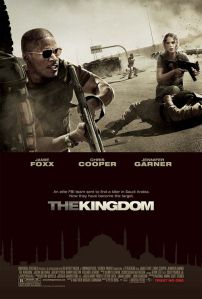 Now that summer is but a hazy memory, get ready for a roll out of serious minded movies Hollywood hopes vie for serious award attention. It may be five years into the current war, but the movies are now cranking out Iraq-themed dramas that will dominate the release schedule for the approaching months. Things are about to get heavy and somber. First out of the gate, though, is The Kingdom, a film about the nebulously termed War on Terror set within the confines of an action movie. Actor-turned-director Peter Berg (Friday Night Lights, The Rundown) knows how to create a stylized movie that feels organic to its genre, and The Kingdom is another example of his growing cinematic pedigree.
In Saudi Arabia, a housing enclosure of American contractors and their families is brutally attacked by terrorists that have infiltrated the Saudi security. Two hundred American lives are lost and FBI agent Ronald Fluery (Jamie Foxx) is intent on leading a team of experts (Chris Cooper, Jennifer Garner, Jason Bateman) to the soil of the Saudis, otherwise known as The Kingdom. The State Department refuses to authorize an investigation citing the jurisdiction of the Saudis as well as the danger of violent reprisals if agents are within reach of the perpetrators. Colonel Faris Al Ghazi (Ashraf Barhom) is assigned to baby-sit the American agents and keep them stuck in red tape during their five days allotted to them. Fluery refuses to take a subservient role and works with Al Ghaazi to get some answers.
 The animated opening credit crash course in Saudi history is fun and informative, however, it really doesn’t relate to The Kingdom even though the damn movie is set in that country. Curiously, the movie only makes cursory statements on the wary relationship between the Saudis and the United States, but otherwise this movie could have been dropped in any nondescript Muslim country in the Middle East. If The Kingdom was relocated to, say, Yemen, I doubt the script would need that much fine-tuning; snip some references to royalty here and there. This is a story about the balance between a moderate Middle East regime and radical elements within the country willing to buck Western influence by any destructive means necessary. I’m measurably disappointed that the movie didn’t tackle more about the unique and tenuous Saudi-U.S. relationship, but then I accepted the fact that The Kingdom wasn’t so much about a country but an ideology that knows no borders.
To that end, The Kingdom is one part CSI: Saudi Arabia, one part political thriller, and one part gung-ho Hollywood action extravaganza, and none of the parts seems to work well together as a whole. The film doesn’t work as a cohesive unit and perhaps tries to do too much. Now, this does not mean that any of those parts are not entertaining. The criminal investigating is rather interesting because of all the cultural barriers between the U.S. agents and the Saudi governing system (a miscast Jeremy Piven, as an ambassador, admonishes Janet, in a very Ari Gold way, to “dial down the boobies”). The central mystery of who is responsible is pretty thin and easy to solve, which may be why the film spends so much time finding obstacles to delay our FBI team from getting their hands on the evidence. The political thriller elements are expressed with the subtlety of a sledgehammer, and yet they feel like thoughtful counterpoints to any rah-rah jingoism that The Kingdom may instill in an American audience. The climax provides plenty of fist-pumping violence but it also ends on a note about the futility of violence as well as the durability of hate. I even appreciated devoting time to interdepartmental jockeying and watching agency heads seeing who will blink first in a public relations-dominated world. The Kingdom doesn’t have a desire to become Syriana 2: No Blood for Oil, but it does possess a greater deal of intelligence and relevance than most of what big budget Hollywood is spewing out (I refuse to believe the FBI would send an agent, with a personal family tie to Israel, into a Muslim country).
Strict action fans, however, are going to have a lot of downtime on their hands. The Kingdom opens with an action sequence and closes with an action sequence, and there’s a wide gap in between those bookends. The final 20 minutes are devoted to a nail-biting ambush and rescue that transforms our FBI agents into improbable action movie warriors. Berg’s restless camera isn’t as well honed as Paul Greengraas (The Bourne Ultimatum), and sometimes you just wish the jittery cameraman would allow you to see what’s going on. I don’t know if the docu-drama emphasis is fully needed, especially when the movie jumps between shots of just two people having a conversation. Berg is a terrific director and the action sequences hit hard; I just hope he doesn’t become trapped trying to fit himself into one style.
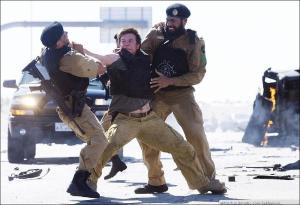
In truth, the most intriguing part of The Kingdom is the relationship between Fleury and Al Ghazi. They begin frustrated and fighting for control, but soon, in true buddy cop genre fashion, a mutual respect forms as they search for the bad guys. The script offers helpful examples of good Movie Arabs and bad Movie Arabs, and the audience is able to easily identify the two sides. The interplay between Fleury and Al Ghazi leads to some humorous exchnages as well as some reflective opportunities, like where the men recount their families and declare they do not care why such dastardly acts were done, they just want to inflict some punishment on the rightful parties.
The acting, like the film, is a bit all over the place. Foxx seems to be on autopilot. Foxx has bunkered into his acting troupes; intense, penetrating stare, whispery dialogue recitations, and a cocksure attitude. Cooper is cranky and incredulous older timer along for the ride. Garner does her best with a character that was written for the sole purpose of concocting culture squabbles over the role of the opposite sex. She does unleash a torrent of anger and power in one very hard-core and frighteningly extreme fight scene. Bateman is playing comic relief and does sarcastic quips with great ease, but his character also gets unexpectedly thrown into a very harrowing experience and Bateman makes you feel every drop of his fear. Barhom (Paradise Now) gives a convincing performance of a man torn apart by his moral compass and the path of his country. He feels a sense of duty to protect the innocent but at the same time he is scoffed at by colleagues for helping “them.”
The Kingdom is an action movie with more on its mind than blowing up the enemy real nice like, though that also plays a key component. The pieces don’t fully add up to a whole and the film’s politics are a little tricky to get a bearing on; is this a red state movie, a blue state movie, or something for both audiences? Berg’s ambition is admirable and his film never drags out a soapbox to preach. The Kingdom is a topical movie aimed at planting seeds of debate among a mainstream audience in between their handfuls of popcorn and gulps of soda.
Nate’s Grade: B-
Share this:

The Brave One (2007)
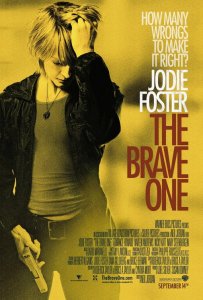 The Brave One, when distilled to its purest essence, is Jodie’s Foster’s Death Wish, but there isn’t anything necessarily wrong about exploring this scuzzy territory again with a fresh set of eyes. The film chronicles a New York City radio host (Foster) who is the victim of a brutal attack that leaves her boyfriend dead and her in a coma for three weeks. Shattered and hardened, she buys a gun for her own protection and finds herself in situations that require one. The Brave One features a lot of audience-approved ass kicking and an absurd amount of dangerous scenarios that Foster seems to casually find on a nightly basis. But what separates The Brave One from the usual grisly pap of the genre is that it refuses to pander to audience bloodlust. Director Neil Jordan (The Crying Game) complicates a simple case of vengeance by making an audience contemplate the true ramifications of violence and whether they are ultimately worth the price. Foster gives a ragged and emotionally raw performance. She discovers how easy killing comes to her and Foster struggles to keep her crumbling sense of humanity, with her last tie to the working world is her friendship with a deeply compassionate cop (Terrence Howard, terrific yet again). The most affecting moments are between Foster and Terrence as they construct a rather moving companionship where each feels out the other and Foster actively tries to avoid getting caught. The end of The Brave One certainly could have followed through with its morally ambiguous deliberations and open-ended questions, but while its climax does pull some punches it doesn’t wrap everything up with a bow either. This is high-end work for a guilty pleasure genre most noted for having its morals face down in the gutter. Now what the hell does the title refer to?
Nate’s Grade: B
Share this:

Premonition (2007)
 Linda (Sandra Bullock) is having a unique martial crisis. Her husband Jim (Julian McMahon) has died in a horrific car accident and she must now raise their two daughters by her lonesome. Or so she thinks, because she wakes up the next night and Jim is alive and well and enjoying a hot cup of java. Linda is perplexed and finds herself living the days of this week out of sequence. One day Jim is alive and the next day he isn’t. She plots to use her knowledge to save her husband if it’s even possible to defy fate.
Premonition is in hopeless want to be a modern-day version of Kurt Vonnegut’s Slaughterhouse Five with the added sprinkle of a Lifetime movie. Linda is, like in Vonnegut’s classic sci-fi novel, unstuck in her time, however, the time has been pared down significantly to a mere week. Thankfully the movie has enough sense not to implicitly try to make sense of why this is happening to her, though she does visit a priest who has conveniently studied this sort of crazy thing (short answer: God is testing your faith). The problem with limiting the timeline to just seven days is that when Linda makes her quantum leaps the audience is left scrambling to figure out when she is. This works in placing the audience alongside Linda in confusion, but it gives no sense of overview or clarity and the events aren’t significant enough to warrant being memorable enough to connect cause and effect. The narrative structure is purposely jumbled but it’s also missing suspense if we never know what’s going on. Hey, I’m not even asking for much either, just some titles indicating the days would be helpful.
 The people that populate this film behave in completely contrite ways because the half-baked story demands it of them. When Linda finds her daughter’s face covered in scratches for the first time, she asks what happened to her. Instead of actually answering, the child remains silent because apparently that would spoil the dramatic surprise of her running into a glass door. Wow, that was worth it, and it must have been something so traumatic that neither of Linda’s daughters could casually mention it. A child would not behave this way. The only way this would make sense is if the contriteness got kicked up a notch and the little girl got a sliding door-bound case of laryngitis. Like romantic comedies, Premonition is a movie that needs to survive due to no one ever having a rationale conversation explaining all that they know to dispel misconceptions. This whole dumb sliding door incident is made even worse when Linda’s mother wants to have the children removed from their mother’s custody because of those scratches. Huh? Would she not know too that it was an accident? And just one more reason to hate this plot point: when Linda tells her daughters that their daddy is dead the little girl does not have scratches, however, in the timeline, she ran into the door the day before. The day after the death, and two days after she broke the door, the glass is replaced because I suppose that took priority over mourning. The discontinuity is terrible.
Also, when Linda gets the tiniest whiff that her (sometimes dearly departed) husband was even contemplating infidelity, she performs a full 180 on the spot and coldly considers letting him die as punishment. The speed of her abrupt about-face is a cheap roadblock to squeeze more tension out of this dumb story. I won’t even mention how lazy it is to have a priest who’s an expert on “unstuck time” living nearby.
The plot may be maddening, but I think Premonition was meant to be a comedy because it’s not an effective thriller. The movie’s feeble attempts at attaching scares to its central puzzle are astounding bad. This is the type of film that not only thinks a dead crow is spooky but that the mystery of what happened to the dead crow is integral to audience satisfaction. It’s hard to believe that Premonition preoccupies so much time with the mini timeline of one dead bird. There are cheap jump scares in abundance but no lasting tension of sense of unease because the filmmakers have left the audience in the dark. There is one horrendous moment where the funeral pallbearers drop the casket and Jim’s head snaps and rolls out. You know they’re not getting any repeat business.
Premonition has an ending that just lays there in utter defiance of taste, causing the audience to upturn their nose in disbelief as if they had just discovered someone defecating in a store aisle. The ending is terrible and grasps for some kind of deeper Twilight Zone level of irony, but instead what comes across is a clumsy, irritating, and plain idiotic excuse at futility. It really calls into question whether or not the movie had any point. Premonition was beyond redemption but its stinker of an ending and Linda’s voice over summation will cause you to roll your eyes at incredible speeds.
 Bullock is in new territory with Premonition, though she dabbled with time travel in last year’s The Lake House. She’s in way over her head and cannot effectively convey any of Linda’s increasingly ragged emotions. I laughed out loud several times as Bullock tried to express her growing apprehension, and her take on the line, “Because we’re running out of time,” had me in stitches. Her performance isn’t particularly embarrassing but more of an exasperating reaction to all the mess surrounding her. Bullock may want to stick to her romantic comedy wheelhouse.
Personally, if I was unstuck through time and needed some help figuring out important events, I would leave a lot of Post-It notes for myself filling me in on what I know. That would make sense; this movie doesn’t in any capacity. Bullock, writer Bill Kelly, and director Mennan Yapo need to wake up the day before they ever started to make Premonition and then they can spare us all. Then again, I suppose we can only fight fate one sliding door at a time.
Nate’s Grade: D+
Share this:

I Know Who Killed Me (2007)
 We interrupt the nonstop barrage of Lindsay Lohan media coverage and speculation to bring you her movie, or, more accurately, further proof that Lohan is in desperate need of a career makeover. The tabloid target has a pretty shoddy track record of late when it comes to picking acting projects, so it’s no wonder that her splashy private life has overshadowed her cinematic duds. Thanks to a second summer DUI Lohan was unable to promote her new movie, I Know Who Killed Me. This may be a blessing in disguise because if I were her I would want to draw the least amount of attention possible to what is destined to contend for the worst film of 2007.
We open to Aubrey (Lohan) reading her story in her high school class. The story revolves around a stripper named Dakota and the amorous attention she earns from creepy older gentlemen. One night Aubrey goes missing and the police believe she may be the next victim of the local blue-gloved serial killer that hacks off the limbs of his victims. The last girl, currently residing in the morgue, is missing her right forearm and her right leg. Her parents (Neal McDonough, Julia Ormond) fear the worst. Then a motorist finds Aubrey’s mutilated body on the side of the road. She wakes up in the hospital and will survive, except the problem is that she has no idea who any Aubrey is; her name is Dakota and she worked as a stripper. She vows to find the “real” Aubrey.
This films is sleazy and tries to energize a lame straight-to-video thriller with some tawdry turns. Without Lohan’s name, I Know Who Killed Me would never have gotten a theatrical release. The torture sequences are drawn out to the soundtrack of Lohan’s muffled screams. The violence fails to excite or horrify, but instead it just seems like a sorry attempt to ape the success of recent torture-heavy horror flicks.
 The sex is even less believable. Aubrey/Dakota, fresh from the hospital, beds the quarterback in one of the least convincing, most unintentionally hilarious sex scenes of recent memory. She throws the jock onto her bed and pins him down for a good pumping. In the ensuing two minutes, the pair engage in exaggerated and noisy PG-13 sex where the woman stays on top and keeps her bra on the whole time (does any woman do that?). The whole time the movie cuts back and forth to Aubrey/Dakota’s mother listening and furiously cleaning the kitchen sink. I think the juxtaposition is intended to be funny, and it is, just not in the manner the filmmakers were probably hoping for.
The movie would be more revolting if it weren’t so incomprehensible. I Know Who Killed Me begins to disassemble at a fantastic rate of idiocy once it attempts to explain its central Aubrey/Dakota conflict. But the movie only presents two options: 1) Aubrey and Dakota are the same person and she just created a fictional persona as a means of post-traumatic stress (yawn), or 2) somehow there are TWO Lohans on this planet (what?). The first scenario is pretty dull and obvious and way too feeble for such a dank exploitation thriller. The second scenario requires a scheme so convoluted and ridiculous that it cannot be taken seriously. In the end, the movie becomes Saw meets The Parent Trap, and it’s every bit as terrible as you would concur from such a description.
For the sake of the morbidly curious, I will be discussing some heavy-duty spoilers to fully shine the spotlight on how ludicrous the movie gets. Don’t say you were not warned. Aubrey/Dakota keeps swearing she is indeed her own woman but no one seems to believe her. She researches the unexplainable via the Internet and it is here that she gathers the theory of stigmatic twins. The idea is that whatever happens to one twin will magically happen to the other, no matter the distance and no matter the situation. In the online example, a man with gambling debts is shot in the throat, and thousands of miles away his twin brother bleeds to death thanks to a perfectly placed and ill-timed hole in his own throat. I Know Who Killed Me tries to wrap up its questions with answers that would seem preposterous even in a soap opera. Not only does the film give us the old long-lost twin chestnut but it also goes the extra inane inning to say that one twin endures whatever happens to the other. So when Aubrey is losing limbs during her capture, Dakota is mysteriously waking up some considerable weight loss. If my limbs were disappearing I might consult a doctor. Essentially, if there’s any merit to this theory, the best way to get revenge on your twin (long-lost or not) is through extreme masochism.
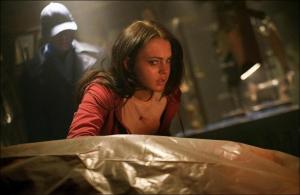 I Know Who Killed Me is littered with stupid behavior and stupid plot points that stick in your brain. A doctor fixes Aubrey/Dakota with a pair of prosthetics – a fake leg and a robot arm. He slides the robot hand onto her stump and it reacts to her nerve impulses. As soon as I saw this scene I blurted out, “Oh my God, Lindsay Lohan becomes the Terminator!” Where the scene earns its stupid wings is that the doctor says she’ll have to charge her prosthetic when not in use or else the battery will go dead. Naturally, I’m thinking he’s referring to the robot arm of doom, but no, he’s talking about her freaking leg. Aubrey/Dakota’s leg amputation is below her knee; therefore this fake leg is little more than a pole. There’s nothing mechanical to it. Why does it need to be plugged in? Will it hop away? It doesn’t matter because the leg and arm never pose any trouble or danger for Aubrey/Dakota. It’s a strange setup without any payoff.
The bloody ending to I Know Who Killed Me is such a mess that it takes special attention just to pick apart its awfulness for further clarity. Aubrey/Dakota figures out the whole complicated rigmarole and declares in titular fashion, “I know who killed me.” Given the silly stigmatic twin theory, even this statement is incorrect from a tense standpoint (if it was true she wouldn’t be able to utter the words). Aubrey/Dakota and her dad head off to the dismembering serial killer’s home without bothering to contact the authorities. She says they don’t have time because, apparently, cell phones do not exist in this universe. I don’t know how it’s possible for Aubrey/Dakota to dig up a grave with one arm. When she goes running into the woods she’s looking for an owl from a vision. That’s good. It’s not like the woods are big or have more than one owl. For that matter, how did Aubrey even get kidnapped in the first place when she was among a large crowd on a busy sidewalk? Would no one have noticed and done something? Even the identity of the serial killer cannot give the movie a sense of finality that it wants. This is your standard serial killer movie where the killer has no working motivation and their identity is relatively meaningless. The limb-slicing maniac might as well have been the janitor seen in the background of one scene for a fleeting moment.
 Lohan gives a performance that suits the material – dreadful. Her idea of a bad girl seems more like a perturbed and insolent child. Lohan gets to hurl her share of F-bombs but never seems adult in whatever she’s doing onscreen. I Know Who Killed Me is a depressing low point for such a once-promising young actress who had the world on a string.
Director Chris Sivertson seems to know he’s the captain of a doomed vessel. He overwhelms the movie with irritating lighting excesses. Sivertson takes a cue from Shyamalan and ramps up the color symbolism; there’s blue roses, blue gloves, blue killer tools, blue stained glass of blue roses. You may start to wonder if the Blue Man Group suddenly became a symphonic serial killing side project.
I Know Who Killed Me is a disaster in every sense of the word. The ineptness on display is staggering. The movie is trash from start to finish but it’s not even redeemable trash. The movie tries to cover its numerous plot holes with images of Lohan canoodling with a stripper pole. I Know Who Killed Me is a ludicrous, incomprehensible, and rather sundry thriller that won’t help Lohan’s troubled life. I have a lot of good will for Lohan after her performances in Freaky Friday and Mean Girls. I want her to succeed, but truthfully, if she needs to know who’s killing her career, the answer is in a mirror.
Nate’s Grade: D
Share this:

Sunshine (2007)
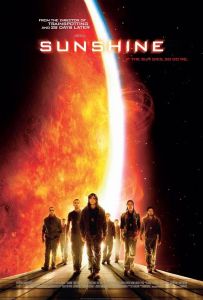 Danny Boyle is one of the more interesting film directors out there today. He seems to dabble in every genre. He’s done paranoid thriller (Shallow Grave), substance abuse drama (Trainspotting), zombies (28 Days Later), and a genuine family film (Millions). Boyle has a bountiful imagination. Now he and his 28 Days Later partner, writer Alex Garland, are going where many have gone before in the film world – outer space. Just don’t confuse the film with the 1999’s Sunshine where Ralph Fiennes plays three generations of a Jewish family with rotten luck. Come to think of it, both Sunshine movies fall apart in the final act. Note to filmmakers: just stay away from this title. It will doom your ending.
Fifty years into the future, the sun is dying. Earth is under a solar winter as it undergoes less and less light. The crew of the Icarus II has a very important mission: restart the sun. Attached to their spacecraft is a giant bomb intended to create a new star inside an old one. They have a giant reflective shield to protect them from the direct heat of the sun. The ship has eight crew members, including the physicist responsible for the bomb (Cillian Murphy), a botanist (Michelle Yeoh) with a garden to provide recyclable oxygen reserves, and a hotheaded handyman (Chris Evans) that believes nothing could be more important than their mission. As they drift closer to the sun they pick up a distress call that belongs to the previous Icarus I spacecraft which vanished under mysterious circumstances seven years ago. The crew decides that two bombs are better than one and changes course to intercept the Icarus I. anyone who has ever seen a horror movie knows you don’t go poking into the spooky place when you don’t have to.
 Boyle sure knows how to make things look pretty, or interesting, or pretty interesting, and this helps because Sunshine is rather shopworn with familiar sci-fi staples. The premise itself almost seems identical to a 1990 film called Solar Crisis, a movie I only remember marginally because of the female nudity my young eyes caught glimpse of (in those days we didn’t have any of yer fancy Internets). Besides this, the film borrows liberally from 2001, Solaris, Star Trek, Alien, Event Horizon, The Core, and the super crappy Supernova. Most every aspect of Sunshine can be traced back to a different science fiction film, but sci-fi is one of the few genres that don’t necessarily suffer from being derivative. A cookie-cutter sci-fi movie is forgivable as long as the filmmakers treat the audience with respect and attempt to be smart with their story. I don’t care that Sunshine reworks plot elements that have been worked since giant alien carrot people frightened necking teenagers in the 1950s, and that’s because the genre is built for being borrowed.
Sunshine is often beautiful to watch with awe-inspiring images of that great ball of fire, our sun, but even better is the fact that the film is pretty much the opposite of Armageddon – it’s smart. The movie discusses the realities of space travel, communication, oxygen levels, trajectories, sub-zero temperatures, sacrifice, and how to live so close to the sun where the human eye can only safely look at 3.1 percent of its light emissions for 10 seconds. It’s a bit slow but rather fascinating just to witness how day-to-day life functions for the crew and how the time, or lack of discernible time, plays with their psychology. This respectful intelligence helps when the crew debates altering their mission to inspect the mysterious space vessel. The audience knows that only bad things will happen but the crew argues with reasonably sound logic about the potential benefits.
Sunshine is a thinking man’s sci-fi treat for its first two acts and then it completely devolves with a disappointing turn of events; it becomes a slasher film in space. There’s genuine awe and intrigue, along with some brainy scientific discussions and some considerable religious/philosophical pondering… and it all just stops dead for a madman chasing people with pointy things. Sigh. It’s an artistic free-fall that Sunshine never quite fully recovers from. Boyle makes the strange decision to keep his space slasher out of focus so the audience never gets a clear look; even stranger are camera shots where the killer will walk into frame and then transform his area to an unfocused blur like a blurry infection. It’s an artistic choice that doesn’t quite work (“The blurry man’s coming to get you, Barbara!”). The film then morphs into your standard race-against-time and then balloons with trippy computer effects and snazzy light filters. Sunshine was exceedingly more entertaining prior to picking up the unwanted visitor.
 The cast does a fine job mulling their life-or-death options, but the two standouts are Murphy and Evans. Murphy and his piercing baby blues make for a strong lead. He provides soulful glimpses into his stock scientist role. Evans is the surprise of the film. Best known as the Human Torch in the dreadful Fantastic Four films, he exhibits a wider range of emotions from macho hardass to duty-bound soldier. This is a film heavy with noble sacrifices, and Evans is the reminder of all that is at stake.
Sunshine is visually pleasing and intellectually stimulating, especially for a sci-fi film built from the discarded pieces of other films. It’s a tense and exciting time, that is, until the movie just throws up its hands and transforms into a laughable slasher film. This movie did not have to go this tiresome route; there could have been an on-board mutiny when they discussed the idea of killing one of their own so they had enough oxygen to complete their mission, there could have been further psychological torments from within the crew, or even easier, the spaceship could just have undergone more malfunctions. Sunshine is a thoughtful, slightly meditative sci-fi thriller, but then it loses all of its better senses.
Nate’s Grade: B-
Share this:

Black Book (2006)
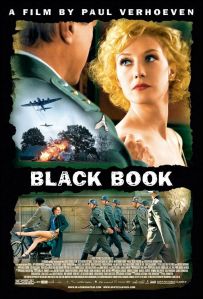 If there’s one thing you can say about Dutch filmmaker Paul Verhoeven, it’s that his films are never boring. He’s shameless when it comes to the amounts of sex and violence he squeezes into his films, and this isn’t typical bouncy violence but cold, serious violence that manage to have whiffs of dark comedy to it. The sex is sleazy and ridiculous, often outpacing the late-night flesh peddlers on Cinemax. I don’t think Verhoeven knows how to do anything subtle, and frankly I wouldn’t want him to. The man is responsible for brawny sci-fi (Total Recall, Robocop), killer lesbians (Basic Instinct), the most subversive mainstream Hollywood movie of the modern era (Starship Troopers is pro-fascism, people), and the most surreal visual effect I have seen in my life – a breast groping itself (Hollow Man). Verhoeven even shows up in person to accept his Razzie award for Worst Director for 1995’s camp classic, Showgirls. This man doesn’t have an off switch. The man makes enjoyable movies, both intentionally and unintentionally.
It’s been a long six years since Verhoeven’s last film and in that time off he’s settled back into his homeland. Black Book (Zwartboek) is a tale loosely based around true stories involving the Dutch resistance in the Nazi-occupied occupied Netherlands. And if there is anyone that can throw in some sex with our good old-fashioned WWII violence, it is Paul Verhoeven.
Rachel (Carice van Houten) is a Jew hiding out in the Netherlands. She and her family is trying to pass out of the country by river when they are ambushed by the guns of a Nazi boat. Rachel is the lone survivor and watches all of her family members get mowed down. She joins the underground resistance movement to find out who betrayed her family. She dyes her hair blonde, both above and below the waist to be thorough, and cuddles up to a stamp-collecting S.S. leader, Ludwig Muntz (Sebastian Koch). She works her way into his trust and along the way uncovers a twisty conspiracy to trick rich Jews into ambushed escapes.
 Black Book is skillfully made and pulpy enough to keep the viewer’s enjoyment level in a good place. From start to finish the movie presents enough trials and setbacks to keep an audience satisfied, and enough sex and violence to meet out the standard Verhoeven quota. Nazi occupation hasn’t been deeply explored from the Dutch point of view, and Verhoeven decides not to make everything so black and white. Muntz is a compassionate S.S. officer that wants to work negotiations with resistance fighters to stop further bloodshed. Rachel deeply falls for him, at the disgust of some of her fellow men at arms. On the other side of the coin, once the Nazis have been toppled there are several Dutch civilians and bureaucrats that can behave just as cruel. Those now with power strike out against those deemed to have sympathized and collaborated with German rule. Verhoeven is making a point that there was good and bad on both sides, which is admirable, though this point has been made better elsewhere. Black Book is filled with various twists and double-crosses, so the audience is involved until the very end. Plus, the sex and violence help too.
There’s terribly little below the surface when it comes to Black Book. It’s a thrilling, unabashedly entertaining movie but nothing beyond a sexed-up, suped-up version of a 1940s behind-enemy-lines potboiler. The characters have little to them beyond basic motivations like greed and lust and revenge, so it all can seem like an empty but high-spirited, fun-filled time at the movies. Verhoeven has never imbued his female roles with much characterization, more often showcasing them as ass-kicking vaginas on legs (whoa, now there’s a mental image for you). Another flaw is how Black Book is structured. We open on a tourist trip to Israel in 1954 and see Rachel teaching a class of schoolchildren. This colossal misstep drains the tension from whenever Rachel is in danger; we already know she has to survive to teach our little ones. [I]Black Book[/I] is a largely fictional take, a collection of various historical pieces and figures, so that means that the outcome for our heroine is not preordained. Rachel very well could die amidst her undercover infiltration, but alas the movie opening in flashback erases this threat.
Van Houten is an enticing screen beauty that brings to mind Hollywood stars of old. She has a very simple, prim, elegant look to her, and a presence that is coy and sensual but far from trashy or vulgar. This helps add traces of believability to a figure that does some incredible acts in the name of God and country. Hollywood would have cast Rachel as a tall, buxom bombshell, but it would all be wrong. If this girl turned heads she would be dead. Van Houten gets thrown through the wringer, and at one point literally shit upon, and she handles it with steely grit. The best moments are when we see how Rachel rebounds from setbacks, when she is forced to break from her resolve and think. Her first encounter with Muntz in a train car is a good example, but even better is how she reacts when Muntz accuses her of dying her hair and being a Jew. She grabs his hands and places them on her hips and finally rests them on her exposed breasts. “Are these Jewish?” she asks. She defuses the situation and lives another day, and it’s perfectly played by a nervous but nervy Van Houten. She makes two plus enjoyable hours even more enjoyable.
 Black Book is clearly and fairly rated R, but part of its rating piqued my curiosity. One of the items that help push the film into the restricted rating is “graphic nudity.” Now, what exactly is graphic nudity? I recall last year’s Babel also getting an R-rating for what was deemed “graphic nudity.” One thing the two films have in common is that they both show quick glimpses of exposed female genitalia. I suppose that the MPAA feels that nudity becomes graphic when we see pubic hair. This confounds me. What about pubic hair turns nudity into an extra, more offensive category of nudity? At the end of the day, it’s just hair, people. I did some quick research and [I]Basic Instinct[/I], infamous for Sharon Stone’s career-making leg crossing, is rated R for mere “strong sexuality.” For the record, when Stone flashes her naughty bits they were bare. So let the record show that hair seems to be the qualifier between what is nudity and what is graphic nudity. Maybe I’ll write a dissertation on this some day.
As for another aside, how freaking cool is the name Zwartboek? It sounds like some fun term I’d come across in the pages of Douglas Adams’ The Hitchhiker’s Guide to the Galaxy. The Dutch language is a tad bizarre for my American ears; it’s sounds like a mixture of English and German, and sometimes it seems like a subtitled sentence is actually direct English. I know I can’t stop saying “zwatboek” around my home in place of gasps and curses.
Black Book is Verhoeven’s first Dutch language film in over 25 years, and it also feels like he’s enjoying movies again after his bad experiences across the Atlantic. I welcome more entertaining Dutch films from their favorite filmmaking son. He may not be he most subtle man behind a camera, but we already have plenty Terrence Mallicks and Gus van Sants to bring confounding contemplation to movies. We need more people like Vanhoeven who know how to please the sense, kick you in the balls, and make you grateful for the experience.
Nate’s Grade: B
Share this:

The Reaping (2007)
 Forgive me father for I have sinned… I think The Reaping is not a terrible movie. Now, that would be damning praise in most circles, but when it comes to the notoriously implausible and awful genre of religious-based horror, well then “not terrible” is worthy of being brandished in the film’s ad. All of my fellow critics need to take a step down from the pulpit and see The Reaping for what it is: mild harmless fun.
Katherine (Hilary Swank) is a professor at Louisiana State who specializes in debunking claims of religious miracles. “38 miracles and 38 scientific explanations,” she says matter-of-factly. Katherine has something of a grudge against the Big Guy, being that she used to be a minister before her husband and daughter were murdered on an overseas missionary trip. Doug (David Morrissey) has a case only that only Katherine can crack. In the sleepy town of Haven, along the Louisiana Bayou, is being beset by Old Testament style plagues. The river has turned to blood and the Bible-beating townsfolk are itching to blame a little blonde girl (AnnaSophia Robb) who they feel could be the spawn of Satan.
 The Reaping starts off with tiny amounts of promise and intrigue because of Swank’s character. She?s a globetrotting spiritual investigator and a skeptic that an audience can get behind. She has a checkered history and Swank uses glances and moments to make her seem convincing. The Reaping isn’t complicated when it comes to its spiritual message. It’s all about renewal of faith, and I?m not exactly certain how all the pieces add up but that’s the gist. The Reaping isn’t too deep when it comes to thoughts of any kind, but that doesn’t mean much from a genre that requires a healthy suspension of rationale thought.
As a horror movie The Reaping relies on routine jump scares and the occasionally jump cut to a dream or a flashback in Africa with a lot of loud, abrasive sound effects to jolt the viewer. The plagues themselves are kind of weak, especially when plagues of maggots and frogs are seen as being so contained and limited. For maggots, we see a grill loaded with fish now covered in maggots. We never get any other anecdotes of what may have been reaped by the maggot plague. The frogs fall for about ten seconds and only in one part of the swamp. These pathetically isolated incidents don’t do much to ratchet up any scares and they certainly belittle the powerful wrath of the Almighty. Then again, maybe God is trying to tell people in unorthodox ways to eat less meat, thus the ruined fish and diseased cows. The plagues lack some oomph when they just happen to a handful of people, especially when it comes to lice or boils. I think the small-scale plagues really say, “We blew our budget on that river of blood, but hey, that was pretty cool right?”
 I don’t think I’ll ever utter these exact words again but here goes. The Reaping is a rather so-so movie that is mostly redeemed by an implausible and foreseeable twist ending. Yes, as horror and supernatural thrillers are go, twist endings seem pretty common place and often times forced, like the studio is dictating that they need something just a little extra to fool the audience into thinking they got their money’s worth. We as a movie watching society are so attuned to twist endings now that we can sniff them out like bad CGI. Twists generally become worked into the advertising campaign. The Reaping has some last-second turns to it, and even though I had my suspicions, I was quite pleased the movie walked the path it did. In fact, I would even go as far to say that it turned a spiritually thin schlocky horror movie into a moderately enjoyable spiritually thin schlocky horror movie. This is far from a good movie, but as a dumbed down genre flick it will be like home cooking for the right audience. Now, I cannot defend the gaps in logic brought about by the twists in The Reaping, and you will be spending the rest of your day coming up with a new problem every minute (the line ?some people just don’t wanna go to heaven? takes new life). The film takes one step too far with trying to up the ante. Just know that the upcoming crisis in Katherine’s life has been solved by a little thing called Roe vs. Wade.
Director Stephen Hopkins has some stinkers to his resume, chief among them 1998’s abominable Lost in Space, so he will take kindly to having his latest film deemed “not terrible.” Swank struts around in a tank top in the balmy South, gets knee-deep in blood, and convincingly sells this nonsense as only a two-time Oscar winner can. The scares are clunky and the story is rife with lots of explaining for a 90-minute movie built around the simple concept that the devil is nasty. The Reaping will play best for fans of the religious horror genre as well as those willing to lower their expectations. This isn’t a good movie, but then again, it’s not terrible.
Nate’s Grade: C+
Share this:

Grindhouse (2007)
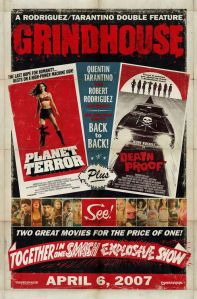 The movie going experience isn’t what it used to be, and Quentin Tarantino and Robert Rodriguez want to do something about it. There?s no denying that the joy of seeing a movie has been watered down a bit; there’s soaring ticket prices, floundering product, and let’s not forget the influx of teenagers with cell phones. Rodriguez and Tarantino grew up gorging upon the exploitation films at their neighborhood grindhouse, where they could see kung-fu, blaxploitation, gory Italian zombie movies, and nearly anything that promised to be titillating and shocking. These movies dealt in copious amounts of sex and violence on a shoestring budget and teenagers lapped it up. Grindhouse was designed to be a double feature with Rodriguez and Tarantino each writing and directing an 80-minute movie. This three-hour plus movie is stuffed to the gills with 70s reverence, right down to cheesy retro clips telling us the film rating via an animated cat. If Rodriguez and Tarantino could, they probably would make the floors stickier just to round out the experience. But that’s the marvelous thing about Grindhouse — it turns the filmgoing experience into an event once again.
First on the bill is Rodriguez’s Planet Terror. An outbreak is about to sweep across a small Texas town. A toxic green gas is causing people to break out in festering wounds that are spreading rapidly. Cherry Darling (Rose McGowan) is a go go dancer who runs into an old flame, Wray (Freddy Rodriguez), a badass drifter with a dark past. They get attacked by a group of “sickos” who take Cherry’s leg as a chew toy. At the hospital we’re introduced in rapid succession to Dr. Block (Mary Shelton) and her creepy husband (Josh Brolin) she plans on leaving for the lovingly massive cleavage of Fergie from the Black Eyed Peas (she gets eaten and can, one assumes, be described as being Fergilicious). The sheriff (Michael Biehn) has an unsettled score with Wray and refuses to trust him, even though the town is slowly being overrun by what appear to be zombies. The survivors take refuge at a Bar-B-Q joint, run by the sheriff’s brother J.T. (Jeff Fahey), located only two miles away from the military outpost that released the gas.
 Planet Terror is a great blast of fun, a perfect ode to schlocky B-movies. Rodriguez creates action movies closer to cartoons, and the more over-the-top and crazy things get the more joyous his films generally turn out. This is a gonzo world cranked up to a wonderfully weird wavelength, where Cherry can have a machine gun leg without any nagging question on how she even gets it to fire let alone why it would be more accurate. It doesn’t matter because this movie is all about 80-minutes of awesome, twisted, gloriously gory fun. Planet Terror isn’t the first zombie comedy, and its inspirations are quite plain, but the film establishes a wide-range of colorful characters effectively and then ramps up the chaos. Rodriguez amuses with even small touches, like a woman trying to operate a car with a anesthetized hands, a pair of skimpy babysitters who clobber a car with baseball bats, and a bio-chemical scientist (Naveen Andrews) that has a penchant for collecting and bottling the testicles of the men who fail him (hey, we all need hobbies). Even amongst an exaggerated canvas there’s still plenty of humor and adoration for the grindhouse experience, like when the beginning of a sex scene is interrupted with a “reel missing” sign. Rodriguez also intentionally downgrades the look of his film, adding hairs and scratches and pops in the film to look like it had been dragged across the floor. Planet Terror even has a dreadfully dated synth score to compliment the full-tilt celebration of splattery schlock.
Tarantino’s Death Proof is going to sharply divide audiences. The action in Planet Terror is relentlessly paced, which makes the adjustment to Tarantino?s half all the more hard. Rodriguez is all about genre relevance and making a film that would excel in the grindhouse era; Tarantino, on the other hand, is all about taking the genre and catapulting it into something ambitious and different and greater.
 Death Proof is Tarantino’s take on the slasher horror genre, with the unique twist being that Tarantino?s roving killer takes out his prey with his car. Stuntman Mike (Kurt Russell) is a stuntman of the old guard. The youth of the day have no idea of the TV shows he worked on or the celebrities he rubbed elbows with. The only lasting visages he has from those removed days are a long scar decorating the side of his face and his stunt car. The vehicle has been outfitted to be death proof, meaning that Stuntman Mike can get into any wreck and come out alive. A group of women are visiting Tennessee for a film shoot. Abernathy (Rosario Dawson) is a makeup artist, Lee (Mary Elizabeth Winstead) is an actress, and Zoe Bell (herself) and Kim (Tracie Thoms) are professional stunt women. The stunt ladies are interested in test-driving a Dodge Charger, the same iconic car used in Vanishing Point. Zoe wants to play a dangerous game known as “Ship’s Mast,” which entails strapping herself to the hood of the car as it speeds along. This is when Stuntman Mike comes roaring with his death proof material and plays an extreme game of chicken.
The narrative structure of Death Proof is deliberately slow. The focus is on a group of Texas girls (including Sydney Poitier’s daughter named, rather unoriginally, Sydney Poitier). They dance to jukebox jams and drink. And they talk, and talk, and talk, and talk. The dialogue is clever but you worry Tarantino has been hypnotized by his own pithy writing. The movie drags a bit but mostly because it follows a film that had the pace of a runaway train. The slow buildup is an intentional correlation to slasher films, which would spend their first half hour setting up characters for the eventual slaughter. I liked how Stuntman Mike was seen playing with his prey and interacting with them. The wait is worth it, though, but then Tarantino turns around and repeats this same setup with a new batch of girls. Many will grow impatient going through the same process all over again and become irritated that they have to endure another round of talky pop culture diatribes in order to get to some more vehicular manslaughter. And at this point, the only character the audience has any affinity for is Stuntman Mike, so it’s a little tough to wait so long for his reappearance. When he does appear, the movie takes some unexpected turns and transforms into a female revenge thriller that left my audience cheering by its conclusion. My wife loved it. I married the right woman.
The makeup work is outstanding. Most of the effect work gets its spotlight during Rodriguez’s half, and Greg Nicotero and KNB have created the most gut churning, sickeningly inventive makeup work since John Carpenter’s The Thing. Rodriguez’s Planet Terror is dripping in blood, and the gore is heightened to such an unrealistic, comical degree that it becomes more tolerable and, in the end, another element in the overall outrageous vibe of the film. Some memorable gore work includes makeup pioneer Tom Savini being ripped apart like a child’s jigsaw puzzle, soldiers whose faces undulate and bubble until they look like close relatives of the Elephant Man, and a truck smashing against bodies like they were made of paper and filled to the brim with Kool-Aid. This is the kind of movie where entire hoses of blood explode from single gun shot wounds. It is a gory, gruesome, sticky icky movie but that?s part of the fun.
 Whereas the makeup work shines in Planet Terror, the stunt work in Death Proof is stupendous. Bell was Uma Thurman’s stunt double in the Kill Bill tandem, so by writing a part specifically for her Tarantino knew he could get up close and personal during the scary moments. Seeing Bell struggling to stay atop the hood of a car zooming at 80 miles per hour is nerve-racking and exhilarating, and you know there isn’t any computer trickery given how Tarantino’s own characters bemoan how computers have blunted action cinema output. That really is Bell and even though it’s all a movie a part of you does think, “Oh my God, this woman is going to die for real.” This killer bumper-car sequence in Death Proof will have you holding your breath. It takes much longer for Tarantino to rev up his action, but when he does he puts the pedal to the mettle.
But don’t get up for pee breaks once Planet Terror is over, because you may miss some of the best parts of Grindhouse. In between the feature films are three fake trailers directed by friends of Tarantino and Rodriguez, who made a fake trailer himself for Machete, about a Federale (Danny Trejo) out for revenge. The Machete trailer gave me the everlasting gift of a line, “They f***ed with the wrong Mexican.”
The best trailer, hands down, is Shaun of the Dead director Edgar Wright?s trailer for Don’t, a Dario Argento style horror film where a narrator instructs the audience lots of items not to do (“If you are thinking about turning this door… DON’T! If you think about going into the basement… DON’T!”). What makes Don’t so wonderful is that the trailer builds a thick head of steam, to the point where all wee see are bizarre rapid-fire images and the announcing repeating the message, “DON’T!” The momentum builds to a great comic high that left me giggling.
Eli Roth, who gave us Hostel and Cabin Fever, one of my all-time favorite filmgoing experiences, runs a close second with his slasher trailer for Thanksgiving. The concept is rather straightforward, a person dressed as a Pilgrim picks off residents around Turkey Day, and a great showcase for Roth’s sense of tongue-in-cheek homage and his warped sense of humor. This trailer has some gasp-inducing moments, chiefly among them a topless cheerleader who performs the splits right onto a knife blade. Wow. Then there’s a guy humping a stuffed turkey with a human head attached. I’ve said it before and I’ll say it again, Roth is one sick bastard but he’s my kind of bastard.
 Rob Zombie’s trailer for Werewolf Women of the S.S. sounds better on paper than how it turns out. There’s a subgenre of Naziploitation films (did you know you could add “-sploitation” to damn near any word?), most famously popularized by Ilsa, She-Wolf of the S.S. Zombie’s trailer has got hairy wolf boobs, Nazis, shiny fetish outfits and S&M, but it feels too new and doesn’t work on the same vibe of Grindhouse. It feels too polished and too happy with itself; it spends more time telling you who’s in this fake movie than delivering anything juicy. The trailer is saved by a brilliant cameo by an actor whom I will not spoil, but suffice to say that I was left in stitches.
Honestly, I cannot say another movie released this year that provides more bang for your buck than Grindhouse. Tarantino and Rodriguez’s double bill will leave you giddy. This is the fastest 3 hours and 10 minutes of your life, folks. Unfortunately, the film hasn’t been doing as well at the box-office and this has caused the Weinsteins to contemplate splitting the films into two to make the most of their investment. I suppose Grindhouse was never going to have a 300-sized audience, since the idea of making a sloppy three-hour love letter to trashy cinema seems destined for a limited appeal. This is a high-art tribute to high camp, and you really do feel you get more than your money’s worth even if you pay, like I do, 10 bucks a pop for a show. I can’t imagine having a better time at the movies this year than the one I had during Grindhouse.
Nate’s Grade: A
Share this:

Zodiac (2007)
 Zodiac is something altogether different from a genre best known for cannibalism, skin suits, and express shipping of human heads. It has more in common with All the President’s Men than director David Fincher’s 1995 masterpiece, Seven. This is a serial killer thriller steeped in police procedural, closed door deliberations, and the slow drip of a decades long investigation into the Zodiac killings that terrorized California from the 1960s and 70s. Watching close to 3 hours of procedure with nary a car chase or a shoot-out may not sit right for fans of the genre, but I enjoyed the film for the same reasons people will decry it — the details. I loved how methodical this film is, how dogged and stubborn it is, and I found myself being enveloped into the minutia of the case.
It all began with a young couple looking for a bit of privacy in 1968. They park at a lover’s lane and nervously engage in a bit of the old “neckin.” A passing car interrupts them, and then that car returns with its headlights blasting into the couple’s faces. This man then takes out a gun and starts firing, killing the woman and badly injuring the young man. Robert Graysmith (Jake Gyllenhaal) is a political cartoonist for the San Francisco Chronicle when a curious letter has stirred up a lot of discussion. It’s a cryptic message with a puzzle attached made up of symbols and codes. The author demands his puzzle run in the newspaper, and if not, more will suffer at his hands. There are further attacks along the California coast and the mysterious figure finally gives himself a name at the end of one of his letters: Zodiac.
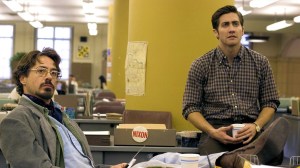 San Francisco detectives David Toschi (a great, raspy Mark Ruffalo) and William Armstrong (Anthony Edwards) are called in after Zodiac executes a cab driver in the city. The Chronicle‘s star crime reporter, Paul Avery (Robert Downey Jr.), pesters the police for details and eventually gets under Zodiac?s skin. Graysmith becomes obsessed with the case through a life-long love of puzzles and the case eventually consumes him, dooming his marriage to a pretty girl (Chloe Sevigny). Thanks to the tutelage of Avery, Graymsith becomes an amateur detective of his own, and his zeal to solve the case outlasts the actual police.
The Zodiac killer was really the first mass media serial killer. As the news of brutal attacks spreads, the media ate it all up and enlarged the figure of Zodiac to grand heights. And he was eager to help inflate his image, taking credit for crimes and slayings that were not his doing. The killer used the media age to terrorize the populace and increase his notoriety, similar tactics used by today’s stream of terrorists. The detectives didn’t just have to navigate all the shifting evidence but the formation of an urban legend.
This is before the day of DNA and super computers, so all progress comes from good old-fashioned police work. Long hours are spent pouring over mounting evidence while coordinating around bureaucracy; because Zodiac has struck in several different small communities it can take a saint’s patience to figure out the correct jurisdiction and compile the various parts in various offices. The film packs a lot in its running time introducing scores of information, suspects, witnesses, and varying theories, but the film cannot be faulted for pace; nearly every scene takes place weeks, months, even years after the last.
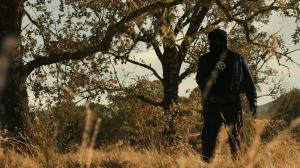 Zodiac is Fincher’s most restrained work even at a gargantuan running length. Fincher is a master tactician with slick visuals but has a penchant for getting too dazzled by needless visual flourishes (did the camera really need to zoom through the handle of a coffee pot in Panic Room?). He tones down the excess but still maintains a refined visual palate that makes the film feel fluid. The period detail is incredibly reconstructed, giving an authentic feel for a very serious story. But Fincher knows that with Zodiac the impetus lies with the story, and he devotes his considerable style to the service of the story. The mood balances nicely with intrigue, humor (after Zodiac singles out Avery fellow journalists start wearing “I’m Not Avery” buttons), and some truly terrifying moments involving the Zodiac attacks. The violence is sparse but when it does occur it is shocking, particularly watching a knife plunge repeatedly into the writhing body of a woman at a lake. One key element of sustaining such an ominous mood is fabulous song selection. Very often pop songs can be counter-productive to a movie, coming across as a lazy attempt to cobble together a soundtrack to shill. With Zodiac, “Hurdy Gurdy Man” becomes a powerfully haunting medley for the killer and the sonic linchpin for the film.
Fincher does an excellent job of transporting us back in time and recreating the sense of paranoia that grappled many. There is a great scene late in the film where Graysmith comes to the sudden realization that he may have walked right into the spider’s parlor. The scene plays out to an agonizingly uncomfortable length, and you too feel like running out the door as fast as your legs can take you. By not knowing definitively who the Zodiac may be, the film gets a boost of suspense from a multitude of creepy suspects. In an interesting decision, Fincher uses different actors of different shape during the Zodiac attacks, playing against the varying reports from witnesses and survivors.
There?s a sizeable danger trying to find a climax to a case that remains open to this day and where no one has been officially charged. Zodiac does as good a job as possible to present a fitting, mostly satisfying conclusion. The movie presents the best theory and points a convincing finger at who Zodiac perhaps really was.
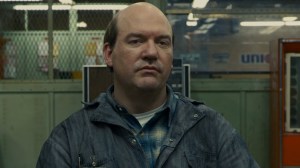 Zodiac is expertly crafted but has a handful of minor flaws that hold it back. The overall script is rather nimble with how it dishes new information to digest, however the intricacies can amass and become too great, and some scenes congest too much without needed forward momentum which causes the flow to get caught up in an expository pile-up. Still, the film is demanding but not overwhelming and not without reward. The film follows the ups and downs of the Zodiac investigation, and that means characterization runs short and simple. I fear the only false note amongst a vastly talented cast is Gyllenhaal, an actor I adore. He works fine in the portrayal of a young kid in the newsroom trying his hand at crime solving, but it’s the film’s second half where the actor falters. He fails to sell the obsession and desperation that dominates his life, instead looking wiped out but no worse for wear, like the temporary results of an all-nighter before a big test.
It was five years since Fincher’s last film, and he wasn’t sitting on his laurels when he crafted Zodiac, an exceptionally intelligent and demanding movie. Decades pass, suspects weave in and out, evidence and testimony contradict one another, it’s all a lot to keep track of but I found myself absorbed in the case just like Graysmith. This is a serial killer movie that could bring the smarts back and redefine the genre, that is, if fans are willing to sit through 3 hours of police work. If not, well they might get their kicks out of the more genre loyal The Zodiac, released in 2006. And that movie’s only 97 minutes long.
Nate’s Grade: A-
Share this:

The Number 23 (2007)
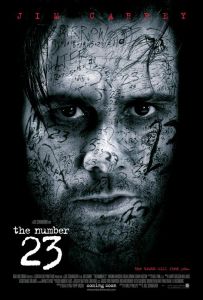 “Nobody likes you when you’re 23.”
-“What’s My Age Again?” by Blink 182
I know math scores have been systematically dropping with America’s youth, but have we gotten to the point where numbers themselves are scary? The Number 23 is a thriller built around the spookiness of a digit greater than 22 but a little less than 24. Does anyone have nightmares about walking down an empty hall only to have the number 23 pounce from the shadows and scream, “Boo?”
Walter Sparrow (Jim Carrey) is a dogcatcher that gets bit on the job. This event causes him to be late for a scheduled birthday rendezvous with his wife Agatha (Virginia Madsen). She wanders into a local bookshop and picks up a worn, self-published book called The Number 23 as a present for her hubby. The book seems to be littered with private details from Walter’s life and he’s left dumbfounded. The main character is haunted by the number 23, which seems to be everywhere and nowhere. Walter starts to see the number dominate his life and fears that he too will fall victim to its control. Walter is also worried that his life will start mimicking that of the book, including the part where he goes psycho and kills his loved ones.
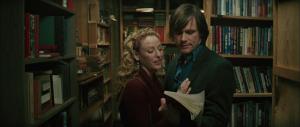 The film spends the majority of its time on two obsessions: the book and the number 23. Now, the number conspiracy is just ludicrous and silly, and it contorts and strains to prove its message. In the flick, someone will scream about some important date in, say, 1940, and then go theorize that it has eerie significance because 19+4+0 equals, tada, 23. But why not 1+9+4+0, or 19+40, or even 1+940? Because then it doesn’t work. Sometimes you take the date, sometimes you add up the numbers in the month, sometimes you need to add up the numbers in the month and the year, sometimes you add and then multiply and then divide numbers (like the contrived manner of making the word “pink” part of this theory); the point is that it’s all arbitrary and worthless. You could go through the same convoluted dance with any number. The same effect happens with cold readings where a “psychic” will spout some vague declaration (“I feel like someone with an ‘R’ in their name died in the last five years”) and rely on the sucker, in this case the audience, to imbue it with some personal meaning (“Oh my God, there was a guy on my street named Rick that died four years ago!”). And all of this relies on the assumption of accurate record keeping for time.
Being haunted by a reappearing number is just dumb, but reading a mysterious book that depicts your own life and predicts you will become a murderer, now that’s interesting. I wish The Number 23 had spent more time with this idea instead of the numerical nonsense. I wanted more questions and contemplation about a book that knows all instead of a number that people bend over backwards to locate in their daily lives. And yet, even this storyline needed a metaphysical jolt. The conclusion follows the most boring, tame, and predictable route that can be best explained. The second half of The Number 23 needed to be more Stephen King and less James Patterson. The psychological aspects of this conundrum are barely explored before the movie seems to lose interest even with its own brand of hokum. Debut screenwriter Fernley Phillips takes the path of least resistance to the finish line.
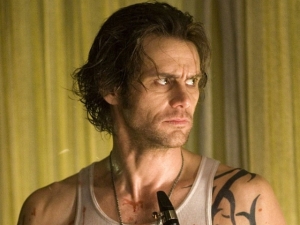 There are some leaps in logic and character motivation throughout. The Number 23 has a strange moral reminder, namely that of a dog that saw something bad and has convinced its doggy self to do something about it, which means spontaneously appearing all over town like a nagging ghost. It is just another plot point that goes too far and breaks credibility, especially since The Number 23 wants to be remotely plausible. Another example is a murder victim who berates her would-be killer while he holds a knife to her throat. She says, among other things, that he’s a freak, she never loved him, and then the final dagger is aimed straight at some long-suffering daddy issues. I doubt anyone picks “knife to throat” as the time to unload their personal grievances. The dialogue also suffers from being so serious to the point of hilarity: “Is 23 a blessing or a curse?” What? Huh?
Director Joel Schumacher (Phonebooth) seems to be having a fun time getting his hands dirty with the material. He can get carried away, and sometimes he uses a sledgehammer when he should have used a slight tap to establish mood. Still, this is one film that you cannot blame the oft-reviled director for ruining. He attempts to goose up this psychological thriller with some persuasive visuals, but all the tricks can’t hide the fact that The Number 23 needs a lot more bite to come across as edgy. It’s too plodding to be disturbing; it’s mostly dank.
Carrey seems an ill choice for this material. Dark brooding doesn’t come natural for America’s foremost manic funnyman; he has some dramatic skills, Eternal Sunshine of the Spotless Mind and a spot-on Andy Kaufman are proof of that, but this isn’t drama, it’s serviceable, gussied-up trash and Carrey doesn’t have the reservoir to show us the dark depths of the human soul. It is somewhat comforting to see Madsen getting more roles since her 2004 Oscar nomination, but she seems to be parlaying that nom into a permanent slot as “wife to lead.” She at least gets to vamp it up in the story within a story as a raven-haired femme fatale.
Even with the preposterous killer number thing, this is a movie with remarkable guilty pleasure potential upside. It’s equal parts interesting and frustrating, and builds a good head of steam before totally unraveling in the last act. The Number 23 is a psychological thriller that just needed better focus with its own obsessions.
Nate’s Grade: C


You must be logged in to post a comment.