Blog Archives
The Lives of Others (2006)
 A mesmerizing and piercing human drama that burns into your memory long after it’s over. This Oscar-winner for Best Foreign Film actually deserved to beat out Pan’s Labyrinth. This vastly intriguing, dense, and extremely moving film explores life inside East Germany before the Wall fell, a life not often seen in the movies. The crux of the movie follows a career officer (Ulrich Mühe) in the secret police who has been assigned to eavesdrop on a playwright and his actress girlfriend. It is this assignment that shakes the man’s blind faith in his government, and The Lives of Others becomes nerve-wracking when our silent listener decides to become active in trying to protect his subjects from his boss. This is masterful, artistically illuminating filmmaking with a tight, deeply felt story and superb acting and direction. Germany has been crafting some of the world’s finest cinema as of late, including Oscar-winner Nowhere in Africa and Oscar-nominees Downfall and Sophie Scholl. See this film before Hollywood remakes it and ruins it. Tragically, Mühe died of stomach cancer in July 2007 just as American audiences began to see The Lives of Others and witness the depths of his talent. He will be missed by the world of cinema but his work in The Lives of Others is a lasting testament.
Nate’s Grade: A
Share this:

Shooter (2007)
 A passable albeit mediocre action thriller, this humorless tale about an elite sniper framed for a presidential assassination is more interested in the nitty gritty of sharp-shooters than building a credible plot. Mark Wahlberg grumbles through uninspired action sequences but who really draws attention is a villainous Danny Glover. The man has a lisp and carries it until the end of the film, and it is never explained. It’s so weird and distracting and it feels superfluous, like Glover was hard-pressed to make his rote villain interesting, so he thought, “Why not a lisp?” Shooter is more proof to my ongoing assertion that Antoine Fuqua (King Arthur, Tears of the Sun) is a director with little interest in storytelling; he’s studied at the Tony Scott school of Visual Indulgence. The characters are either stock roles or superhuman, and how in the world does a man get pinned for almost taking out the President and then buy mass quantities of weapons with the clever disguise of sunglasses?
Nate’s Grade: C
Share this:

No Country for Old Men (2007)
 Joel and Ethan Coen are two of cinema’s most talented oddballs. Together, they’ve created some of the most intricate, eclectic, and best movies of the last 25 years. Their last two efforts, 2003’s Intolerable Cruelty and 2004’s remake of The Ladykillers, didn’t feel like Coen movies; they felt like they were compromised and missed the artistically deft touch. As a result, both movies were mild failures for filmmakers that have a series of genre-spanning masterpieces to their name. No Country for Old Men is the first time the brothers have adapted someone else’s work, in this instance Pulitzer Prize-winning author Cormac McCarthy’s 2005 novel. Not too shabby if I say so. Fortunately for all lovers of film, the Coens have embraced McCarthy’s blood-soaked tale and crafted an exciting, honest, and intensely provocative modern Western that stands out as one of the greatest films of the year.
In dusty West Texas, Llewellyn Moss (Josh Brolin) is out hunting the lonely plains when he discovers a blood trail. It leads him to four empty cars riddled with bullet holes, dead bodies collecting flies, and a sack containing two million dollars in cash. The signs are all there that this was a drug deal gone badly, and two million will never go unnoticed, but Moss sees this as an opportunity of a lifetime and takes the money. The men in power have hired Anton Chigurh (Javier Bardem) to find their drugs and money and exact retribution. Chigurh’s preferred method of killing involves a high-pressured air canister that can blow out doorknobs and human brains. Chigurh chases after Moss all the while Sheriff Ed Tom Bell (Tommy Lee Jones) is following the trail of death to try and save Moss or any future innocent victims.
 What a fine-tuned, nerve-wracking, and engrossing cat-and-mouse thriller this film is. The action is brief but the buildup can be nearly unbearable to endure. The tension is magnificent. Chigurh chases Moss from hideout to hideout and some of the tensest moments are just waiting. There’s a moment where Moss is calling the front desk of his newest motel and we hear the phone ringing unanswered again and again from the hall, all the while Chigurh’s footsteps inch closer. But it’s the moments of silence that cause the most dread. When Moss is trying to recover his loot, all the while Chigurh is in the opposite motel room, it becomes a balancing act of sound and silence. No Country for Old Men is expertly orchestrated to involve the use of sound as a tool for high suspense. None of our main three characters inhabit a scene together. Sure Moss and Chigurh shoot at one another but even then it’s short and focused on waiting for response and counter response. Moss is no dummy and he sets up some traps for his would-be dispatcher. No Country for Old Men is unnerving, intelligent, near flawless entertainment.
Chigurh, as masterfully played by Bardem, is the stuff of nightmares. I was literally afraid to go home after seeing this movie and it is because No Country for Old Men fashions a villain so methodical, so cold-blooded, and so downright deadly and cunning that I felt as if he could very well be residing under my bed at night waiting. Bardem is hypnotically horrifying and the Coen brothers establish early on how ruthless their cinematic boogeyman is. The very first moment we’re introduced to Chigurh he escapes from police custody and strangles the inattentive officer on duty. He drags him to the floor and chokes the life out of him, but the Coens position the camera not on the last desperate kicks of the officer but on the face of Anton Chigurh, and it is nasty. His eyes are bugged out and his intensity comes across as sadistically jubilant. He seems like a caged animal finally let loose. It’s a scary yet fascinating introduction to a deadly character.
Chigurh is a humorless and determined man, and every scene he steps into instantly changes. A gas attendant casually asks Chigurh about the weather and gets on his bad side and the stone-faced killer in the Dutch boy haircut proceeds to press the poor man with increasing agitation, yet Chigurh always speaks in such a placid tone that makes him far creepier. He’s a maniac that never raises his voice. Chigurh then corrals the man into one of his signatures, having a victim decide their fate by the flip of a coin. Before the man can say anything the coin is flipped, Chigurh intones to “call it,” and the man nervously repeats that he needs to know what he’s at stake to win. “Everything,” Chigurh responds. This scene starts off so innocuous but becomes monumentally unsettling thanks to the rising dread and Bardem’s deeply committed portrayal. Bardem is alarming, ferocious, grimly efficient, mesmerizing, and deserves an Oscar win, not just a mere nomination, for what is his finest performance to date.
 There are many ways to describe Chigurh, but it seems most appropriate to speak of him as nothing short but the full-tilt vengeance of God. He’s a hired killer, yes, but that doesn’t stop him from killing indiscriminately. He murders several innocent victims, he murders his competition sent out to nab Moss just because it insults him, and even after the money no longer becomes a concern, Chigurh still plans to continue his wrath out of sheer moral principle. He made a promise of swooping vengeance and he will stick to it. This means that anyone could die at any moment while onscreen with Chigurh, and No Country for Old Men has plenty of surprises as it toys around with our baited anticipation. When Chigurh gets the drop on his competition he doesn’t shoot the man immediately; instead the scene plays out for an agonizing length even after we listen to the room phone ring several times, and then blam! Chigurh answers the phone and casually raises his boots so the pooling blood doesn’t touch his feet. This is the most memorable incarnation of soulless evil I have seen in the movies since Hannibal Lector came to iconic form in 1991’s Silence of the Lambs.
Brolin is having quite a career year for himself after compelling turns in American Gangster (where he also shoots a dog), In the Valley of Elah, and Robert Rodriguez’s Planet Terror half of Grindhouse. Brolin gives the audience a figure to root for even though he never actually displays true heroism, just survival instincts. Jones serves as a wise and guiding father figure that feels out of place in a world that is becoming increasingly, shockingly violent. It’s a role that Jones has performed before but it’s a role that fits the actor exceptionally well. Woody Harrelson pops up as a charming and laid back handler trying to convince Moss to give up before things get worse. Kelly Macdonald, as Moss’ wife, cuts through the darkness in a refreshing performance.
The technical craftsmanship is on par with previous Coen excellence. Roger Deakins’ cinematography is exquisite, Carter Burwell’s score barely makes its presence felt, and the editing is tight and focused. The sound design, which I’ve already discussed in detail, deserves an Oscar. This being a Coen brothers’ film, it wouldn’t be complete without some dark humor to punctuate the bleakness. They have a perfect ear for local vernacular and Texas shorthand, so the dialogue feels sharp but realistically twangy without being condescending as some had accused Fargo (I do not agree with this accusation).
 What works in the favor of No Country for Old Men may perhaps be its undoing for a mainstream audience. The film works against conventions and this provides for some stellar surprises and upheavals, none of which is bigger than killing a certain character off-screen. No Country for Old Men definitely seems like it’s laying stage for a climactic showdown and then one key figure has been bumped off by a group of ancillary characters that have little overall bearing over the plot (I have read that the same gap happens in McCarthy’s novel). If this doesn’t perturb audiences then the final 10 minutes ought to do it. There’s no sense of closure for the movie and this will frustrate many, but it all fits rather nicely with the movie’s highly nihilistic tone. Like Chigurh’s coin, the film focuses much on the randomness and cruelty of fate. By sticking to this ethic, the Coen bothers are eschewing the traditional Hollywood rulebook and playing around with our expectations for characters and plot. The outlook isn’t too sunny for many involved. It works and demands an audience remain on edge for fear that anything could happen at any moment. However, don’t say I didn’t warn you if you walk out of No Country for Old Men and say, “What was that all about?”
No Country for Old Men is exactly the kind of material the Coen brothers needed to return to form. This is a lean and stirring thriller that plays to their strengths and echoes some of their most riveting and twisty work, like Blood Simple and Fargo. In many ways the film feels like a Western, a high-stakes drama, and a tragedy that takes its time to unravel. It may have taken some time but the Coen brothers are back, baby, and No Country for Old Men is fit to stand beside their hallowed pedigree of cinematic classics.
Nate’s Grade: A
Share this:

Before the Devil Knows You’re Dead (2007)
 Sidney Lumet is 83 years old and still directing movies, God love him. The man is behind cinematic milestones and classics like The Pawnbroker, Serpico, Dog Day Afternoon, Network, and 12 Angry Men, which goes back all the way to 1957 – 50 freaking years ago! The longevity of this man is admirable. He hasn’t pulled together a compelling film in some time, but Before the Devil Knows You’re Dead is a stirring, character-driven crime drama that reveals itself to be a first-rate melodrama.
The film is anchored by two huge performances by Philip Seymour Hoffman and Ethan Hawke, playing a pair of brothers both on hard times. Hoffman’s character, Andy, has been living well outside his means to keep up appearances and to sate his taste for a local heroin den. He’s in charge of company payroll and an internal review just discovered a pair of terminated employees still drawing checks, the source of Andy’s cash to pay for his lavish lifestyle. Hawke’s character, Hank, is behind on child support and belittled by his ex-wife. He’s having a hard time even finding the dough to pay the 100 bucks for his daughter to go see The Lion King in New York City. Andy hatches a scheme to solve both their money woes: they’re going to knock over a mom-and-pop jewelry store. It just so happens that the store belongs to Andy and Hank’s mom (Rosemary Harris) and pop (Albert Finney). The plan goes hopelessly awry and both brothers feel intense pressure in the aftermath.
 Lumet and debut screenwriter Kelly Masterson really know how to ratchet up the suspense. The nonlinear timeframe keeps the audience on its toes and continuously rewriting what we think we know. Unlike movies like Babel and 21 Grams, the plot is actually assisted by skipping around time and telling the story out of order. We get the basics and then the details begin to take shape, but because of the prior knowledge the film packs an increasing sense of dread that builds in intensity. As the brothers sink lower trying to cover their misdeeds, Lumet and Masterson crank up the tension to a peak. The knotted and twisty narrative exposes the fragile dynamic of this family and keeps the audience alert and hungry for more.
Hoffman is at his sleazy, duplicitous best with this performance. His character is a man accustomed to getting what he wants and he knows all the manipulative tricks to get there, be it bullying or cajoling. He’s a pusher with so much anger and desperation just below the surface. Andy never feels respected or loved by his father, and he has a great scene where he breaks down in a fit of rage and tears in response to his father apologizing for the bad upbringing. Hoffman imbues great emotional complexity to a man whose world is crashing down. It is enthralling to watch.
Not to be outdone, Hawke puts forth his finest effort of his career. He’s the baby of one very corrosive family; he misplaces trust and admiration in his big brother. Hank isn’t the sharpest tool in the shed but he has a distinct weariness to his worries, living day-to-day with the knowledge that the world sees him as a loser or a screw-up, losing the respect of his own daughter. When things go bad he unravels rapidly while still holding to his secrets. It’s a performance brimming with nervous anxiety, mounting regret, and self-effacement.
 The secondary characters don’t get nearly the attention and consideration. Marisa Tomei is more a plot device than a character; she’s Andy’s wife but has been having an ongoing affair with the more nurturing Hank. She spends most of her scenes in some form of undress and feels more like another notch in the complicated relationship between the brothers.
Finney is fine with a rather small role that merely requires him to be aghast or incredulous with the slow police work. I don’t know if a suitable Finney performance can compensate for a staggering leap of character late in the movie, but I suppose I’d rather have any Albert Finney performance in a movie than none at all. Before the Devil places Finney’s character on a perch and just doesn’t give him much outside of his own dawning realization of who was responsible for the botched robbery.
Before the Devil Knows You’re Dead is a gripping family tragedy that takes on a Shakespearean quality as it comes to a somber, chilling close. The wordy titles comes from an Irish drinking toast that states, “May you have food and raiment, a soft pillow for your head; may you be 40 years in heaven, before the devil knows you’re dead.” The message declares the inescapable consequences of our actions. This is a film about the disfiguration of one family; it’s bleak, tragic, but whole-heartedly entertaining and extremely focused in its aims. Lumet has returned to smashing form and reminds an audience that there’s still plenty of vigor left in this 83-year-old director.
Nate’s Grade: B+
Share this:

Perfect Stranger (2007)
 What starts as a pretty poor thriller goes absurdly over the top by the tired Hollywood convention of a forced twist ending, and this one isn’t just forced, no, it contradicts everything that happened before it for 100 minutes. The movie piles up red herring after red herring trying to keep the audience guessing, but I think this is because Perfect Stranger had no idea how to end and who would be deemed the killer. As a result, the hedging feels like a lousy board game of Clue until the awful, ludicrous, inconceivable twist ending. It’s the kind of ending that is supposed to somehow make sense because the filmmakers flashed short bursts of a childhood incident that lacked context and clarity. Perfect Stranger really has one of the worst twist endings of recent memory because it makes no sense and defies all logic. If the ending were right why would someone wait years upon years to plan a murder to hide something that seems inconsequential? Why does someone think their friend is a killer because their computer memory recalled that they visited a company website despite the fact that this person is a journalist and going undercover at this same company? And why, stupid Hollywood characters, do you recite how you’ve figured out their deeply convoluted plan to the murderer only to get murdered? Halle Berry gives a rather embarrassing performance; she’s all over the map and I question much of her character’s actions and anxiety, especially when seen ALONE, if the twist ending holds. Perfect Stranger is ridiculous junk that tries to outsmart an audience by confusing them and then openly negating their story thanks to a twist ending that is intended to blow minds but will simply leave people scratching their heads and pitying everyone involved in this disposable dreck. And no, this has nothing to do with Cousin Larry and Balki.
Nate’s Grade: D
Share this:

The Black Dahlia (2006)
 Hey, I got an idea. How about we make a Black Dahlia movie and hardly involve anything having to do with the notorious Black Dahlia murder? I’ve got an even better idea; let’s center the action around a love triangle involving cops who are, say it with me, too close to the case. And then we’ll have a wacked out rich family where the mother (Fiona Shaw, God bless her) gives a performance that isn’t three-sheets-to-the-wind drunk, she is staggering, cataclysmically, powerfully, off-the-wall drunk. Watching her sway and sneer and hiccup is like watching Daffy Duck in this Brian DePalma mess. The central actors feel too young for their parts (the best actor is Mia Kirshner, seen briefly in an audition reel as the soon to be eviscerated Elizabeth Short), and the ending is an insipid caper to an ongoing, unsolved murder mystery. The Black Dahlia is appallingly boring and yet also appallingly dimwitted, but it does occasionally look good thanks to the technical proficiency of its director. DePalma has had a very up and down career. Consider this one of his valleys.
Nate’s Grade: D
Share this:

Eastern Promises (2007)
 Director David Cronenberg is an idiosyncratic director who explores Big Ideas through the context of creepy horror movies where the body is violated. He’s covered everything from evil gnome-like children, ravenous monsters in Marilyn Chambers’ armpit, and Jeff Goldblum’s face unfortunately peeling away. But then Cronenberg struck it big with 2005’s A History of Violence, giving him the highest profile of his long Canadian career. The auteur of ick is now back in a similarly themed tale of the true impacts of bloodshed with Eastern Promises, a gripping and thoughtful work.
Anna (Naomi Watts) is a midwife working in London and come across a young Russian girl who dies in childbirth. She leaves behind a diary that Anna seeks to have translated so that she can find family members to contact about the newborn. This brings her unknowingly to the doorstep of Senyon (Armin Mueller-Stahl) who runs a restaurant in London’s Russian district. She inquires if Senyon or any of the employees knew the dead girl, and as soon as Senyon hears about the reality of a diary he becomes more concerned. And he should be since he is the head of one of London’s most notorious organized crime families. His loose canon of a son, Kirill (Vincent Cassel), has authorized a hit behind his father’s back and repercussions may soon be approaching. Nikolai (Viggo Mortensen) serves as the family’s chauffeur but takes an interest in Anna and is willing to assist her as she stumbles into impending danger the more she translates from the diary.
 Much like writer Steven Knight’s excellent previous film Dirty Pretty Things, this is a film that shines a light on the underbelly of London and focuses on the immigrant experience and how apt they are to be exploited. Eastern Promises is both a straightforward crime thriller with an intriguing, albeit simple central mystery, but then as it moves along it transforms into something far richer. Through the diary, we uncover the hidden inner workings of the Russian mafia, which is a truly global enterprise. Women are promised with great riches and freedoms in their Slavic homeland, and then once transported will spend the rest of their lives behind the bars of a whorehouse, kept dependent thanks to a drug habit forced upon them. We’re immersed in the culture of this crime family. Eastern Promises takes its noirsh sensibilities and then gives us the foreboding and enigmatic Nikolai, a mysterious figure that the audience, like Anna, is drawn to. He spent time in a Siberian prison and is covered in telling tattoos that serve as a resume for the mafia. Nikolai is such a dominating presence and proves to be more intriguing than the central diary mystery, and it’s here where the film performs a balancing act and transfers our attentions fully to this brooding brute.
Cronenberg subverts his usual irony and weirdness to stay true to his tale, and this may well be, even more so than A History of Violence, the most accessible Cronenberg movie yet. We’re a long way from flesh-eating-monster-in-Marilyn-Chambers’-armpit. He still works with such compact efficiency so that no scene feels wasted, and Eastern Promises is a brisk 1 hour 40 minutes. Where Eastern Promises really succeeds is by layering in strong characters within a relatively genre movie. People are not exactly who they seem and the actors do their best to give remarkable depth to their roles.
Cronenberg seems to have found an actor that shares his artistic sensibilities. Scorsese has Leonardo DiCaprio, Wes Anderson has Bill Murray, Kevin Smith has Ben Affleck, and now Cronenberg has Viggo Mortensen. I never thought much of Mortensen as an actor until Cronenberg unlocked something deep and mesmerizing in their first pairing. With Eastern Promises, Mortensen establishes himself as an extremely capable actor. Nikolai is a complex figure and he Mortensen displays a mastery of understatement; his stony silences and piercing stares speak volumes, but you can practically watch the decision-making of the character pass through the face of Mortensen. He skillfully displays the good inside a man bred for evil.
 Watts is an actress with few equals and she dazzles once more in a role that requires her to do a lot of legwork. And yet, there’s a sad, haunting quality to her thanks to the back-story where she lost a child due to miscarriage. Cassel is also impressive in a complicated role that requires a lot of internal languishing. He’s at one an impudent child willing to live high off the power of his family name, and at other times he comes across as a severely wounded man who cannot thrive in his hostile family (both little and big F) environment. There are interesting revelations that make Kirill a much more complex and captivating figure, and Cassel plays the many dimensions very well. Personally, I’m happy to see Armin Mueller-Stahl in another high profile movie. There was a time shortly after his 1996 Oscar nomination for Shine where if you needed an old guy for a movie, you got the Armin. Lately, it seems James Cromwell has taken his place as go-to old guy. In Eastern Promises, he has such a sly menace to him from the moment his ears prick up at the notion of a diary. He insists upon inserting himself into Anna’s life and casually makes remarks like, “You know where I work, now I know where you work,” with just the right amount of finesse to sound intimidating and yet potentially harmless.
One scene I will never forget is when Nikolai is ambushed in a bathhouse by two revenge-hungry thugs. He sits there naked and exposed and these two unhappy gentlemen descend upon him (fully clothed) with knives. Nikolai fights like a wounded animal and manages to successfully take down both men even though he is unarmed and un-clothed. Up to this point the character has been something of a gentle giant, knowing the vicious ways of the Russian mob but seemingly at distance from them for whatever ethical decision. But it’s at this moment that we bare witness, no pun intended, to the cagey survival instincts of a man who must live his life looking over his shoulder. It’s a bravura scene that is played out in agonizing detail. Nikolai is slashed and thrown against tiled walls (much penis-related mayhem is glimpsed), but he keeps coming back and knows precisely when to strike. It really is the actors doing all the hard knocks and brawling, which heightens the tension. Cronenberg stages the violence in his realistic drawn-out style, which horrifies an audience while simultaneously fascinating them. This is by far one of the most indelible film moments of the entire year.
 Eastern Promises is an engaging character-based thriller, and yet I wish it finished as strongly as it began. This is the kind of movie where much is implied or said in silence, which works great at respecting the intelligence of an audience as well as staying consistent with a believable reality where everyone in such dangerous positions is not explaining everything aloud. However, one of the drawbacks of a film where much is implied is that when it’s over you may wish that they implied less and showed more. The climax to Eastern Promises is a little weak, especially when it comes shortly after the incredible bathhouse attack. There’s a very hazy sense of a resolution. From an artistic standpoint, I suppose I can appreciate a thriller that doesn’t feel the need to end with a pile of dead bodies and much blood being spilt, but at the same time, from an audience point of view, I was really left wanting for more when the film finally comes to a halt.
Thanks to a smart, twisty script, Cronenberg’s sharp yet quirk-free direction, and some stirring performances, Eastern Promises is a first-rate thriller with the added benefit of strong characterization to add richer depth to this tale of mobsters, retribution, and sex slavery. Mortensen is the real deal when it comes to acting, folks. Cronenberg may have found a true match with Mortensen, and the added cache may give the director greater financial opportunities to tell more intriguing tales that may or may not feature ravenous armpits.
Nate’s Grade: B+
Share this:

Disturbia (2007)
 This Rear Window for the Facebook generation starts off strong with a solid performance by Shia LeBouf, but then quickly unravels once the filmmakers think they’re desperately running out of time. The teasing mystery is set up well and elicits some interest, but then, as if afraid of lulling an audience to sleep with a story that takes its damn time, Disturbia throws everything and the kitchen sink at you in the last 20 minutes. The movie falls on its face (the metaphors are flying today) trying to make up for lost time with jump scares and lame thriller conventions. The end gets a tad absurd as well as Shia discovers his serial killer neighbor isn’t just a murderer, but he’s a home decorator on par with the creature from Jeepers Creepers. By the time Shia falls into an underground water cavern filled with corpses, I wanted to scream myself for such wasted potential to a film that seemed like a formless rip-off on the surface.
Grade: C+
Share this:

Fracture (2007)
 This is a genre movie, pure and simple, but it has a tricky plot and is aided by two exceptionally high caliber performances from Anthony Hopkins, once again personifying evil and confidence, and Ryan Gosling. He imbues such meaty resonance to a character that would have seemed flimsy and altogether stock in another actor’s hands. Gosling and Hopkins have great tit-for-tat moments where each is trying to outwit the other, and their verbal chess match provides the best scenes in this procedural thriller. The disintegrating murder case keeps the audience guessing, but it’s Hopkins and Gosling that elevate the material into delicious crackling Southern-fried entertainment.
Nate’s Grade: B
Share this:

Breach (2007)
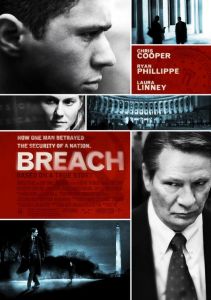 Chris Cooper is masterful in an unnerving and deeply contradictory role as a man of God, country, patriotism, and family. He was a respected FBI expert eventually discovered to be the biggest mole in U.S. intelligence history, directly responsible for the deaths of U.S. spies and interests in Russia during the Cold War. Writer/director Billy Ray infuses the film with the same stoic, controlled calm of his exceptional earlier effort Shattered Glass, and the movie unwinds like a great political thriller from the 1970s. The story is smart and engaging but it is Cooper that turns Breach into one of the best films of 2007. His performance is as varied and complex as the man he is portraying; frightening and intimidating but also empathetic and bound by a sense of honor, Cooper gives a performance that plays upon ambiguity and understatement. Watch the way he even drives people into walls when he walks alongside them in hallways. It’s that kind of intense, highly focused, and morally challenging work that deserves an Oscar nomination.
Nate’s Grade: A


You must be logged in to post a comment.