Blog Archives
The Invasion (2007)
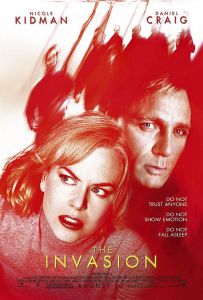 The fourth remake of The Invasion of the Body Snatchers is a more interesting behind-the-scenes story than as a film. German director Oliver Hirschbiegel (Downfall) created a movie that was described as more psychological thriller than action chase movie. The studio and producers scrapped many pieces of the film, hired the Wachowski brothers to rewrite portions of the story and cram in some action, and then James McTeigue (V for Vendetta) directed the reshoots. As a result, the movie is wildly displaced and hacked together and never feels whole. There’s a slow burn of intrigue and mob madness and paranoia that gives way to chase scenes, car wrecks, and a ridiculously contrived happy ending. I’m sorry, but when you do The Invasion of the Body Snatchers, you cannot have humanity win; that destroys the entire point of the story. It’s like having King Kong climb the Empire State Building and deciding to live there and dance for peanuts. Nicole Kidman and her lithe frame seem like an odd choice as humanity’s last hope with a gun. The Invasion flirts with some philosophical ideas about free will, assimilation, and the cost of peace, but then it speeds headfirst into an abrupt finish. This movie is unsatisfying to all parties.
Nate’s Grade: C
Share this:

Vantage Point (2008)
 Vantage Point presents a terrorist strike and a presidential assassination from six different perspectives (though the advertising credits 8 perspectives). The Rashoman-style idea presents enough intrigue to sustain viewer involvement, but then it seems like the movie gets tired of its own gimmick, throws its hands in the air after the fifth trip down memory lane, and says, “Ah, forget this. Here’s what really happened,” and spells it out. The perspectives are too short and there are frankly too many; the idea is good but the execution is flawed. I think having possibly three perspectives play out for around 40 minutes each would have beefed up the plot and allowed for more intriguing criss-crossing. Not all of the perspectives are equally compelling (Forest Whitaker as a tourist with a camera seems like a lame way to bridge plot points) but they do link together and each submits a bevy of new questions and surprises. The swift, 90-minute running time means there’s precious little screen time to be doled out to the many characters, so don’t get used to seeing most after their main appearance. Vantage Point careens toward a finish that ties everything and every perspective together with a fairly nifty car chase. The movie could use some extra time spent on the flaccid characters (I’m at a total loss as for the motivation of several of them), and the film strains credibility, and yet it works as a passable thriller with enough of an edge to pass the time agreeably.
Nate’s Grade: B-
Share this:

Michael Clayton (2007)
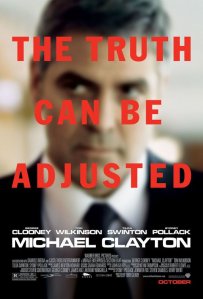 A smart, suspenseful, terrifically acted corporate thriller, this movie hums along with great precision thanks to a deeply articulate screenplay by writer/director Tony Gilroy. The acting trio (George Clooney, Tom Wilkinson, Tilda Swinton) delivers sensational performances muddled with doubt and weary, nervy complexity; each comes across a full human being in what could have come across as a dull Law and Order episode. I don’t understand why Gilroy plays around with the film’s timeframe, because he spends nearly ten minutes at the end in a suspenseful car chase where we already know the outcome. There is a murder that is played against Hollywood convention; it’s quick, grimly efficient, and scary in how soon it’s all over. Michael Clayton is a first-class movie that respects the intelligence of an audience.
Nate’s Grade: A
Share this:

Untraceable (2008)
 The Internet can be a scary place, no question. There’s plenty of weird crap in wide-open world of the World Wide Web. There are sites devoted to teaching people how to make bombs in the privacy of their own kitchen. If you can name a fetish, chances are there’s a pay sex site already built for it (I tried “clown porn” and was not disappointed, and by that I mean that I found a site for it and WAS deeply creeped out). According to the ongoing Dateline specials, everyone wants to “talk” to adolescent girls while they’re home alone. In short, the Internet can be a scary place. Untraceable, a barrel-scrapping genre movie, taps into our fears of the unknown in cyber space.
Agent Jennifer Marsh (Diane Lane) is a member of the Portland, Oregon office of the FBI. She specializes in tracking down cyber criminals and bringing them to real-world justice. There’s a new Web site called “Kill With Me.com” that invites anonymous users to serve as executioners. The site creator creates death traps that increase in deadliness the more users click onto the site; so a man bleeds out faster the more people that want to catch a glimpse of it. Lucky for the FBI, the cyber killer is doing all this nasty business in Portland. Marsh and her cyber assistant (Colin Hanks) try finding the location of the IP site but, somehow, it skips around the world and cannot be pinpointed. The victims of the site are specifically chosen, and Marsh is struggling to put it all together. Then the cyber killer begins stalking her and lets others join in on the fun.
 Untraceable is rather hypocritical in nature. It wants to titillate an audience but then shame them for embracing the titillation; the movie is purveying the same crap that it derides. The premise of a digital age serial killer that transforms murder into an online democratic act sounds nifty. Plenty of insightful questions generated by this premise like the nature of exploitation, media, and the culpability on the account of the insatiable viewing public. It’s too bad, then that Untraceable just uses the premise as a jumping off point to create a half-assed Saw. The movie is mostly concerned with reworking the familiar tropes of the serial killer genre, this time with some extra dashes of torture and Saw-style death traps. But the movie doesn’t fully commit to horror so much of the gore is implied. The extra attention to torture seems timidly tacked on to the framework of a thriller, likely grossing out the older folk that came to the movies thinking they were going to watch Diane Lane assert justice on this new fangled Internets thing. The movie has a vague fear of technology and computers and seems programmed to scare people that don’t know any better, namely the people who think computers are bigger toasters.
The script by relative neophytes is where the movie treads water. The villain is revealed fairly early, like a half hour in, and this revelation does nothing to help build tension. The culprit responsible for the laughably implausible death traps is a gangly eighteen-year-old twerp (Running with Scissors‘ Joseph Cross; yes that kid). I understand that in serial killer movies the villain usually takes on some form of supernatural abilities, like the ability to be everywhere and never be seen, or the ability to draw super strength at opportune times. When Untraceable apathetically reveals its villain the movie seems like it’s already giving up and conceding, “Okay, this is the big bad dude and he weighs about 110 pounds soaking wet. We know he could never outmatch anyone that is over five feet tall.” Marsh’s home life is also given obligatory screen time, including Marsh’s mother keeping watch of the home, but it never matters. In this world, birthday parties just get in the way of FBI manhunts.
The film also requires character to act inexplicably stupid at a moment’s notice in order for the plot to hum along. Marsh is such an expert on cyber crime, and yet she doesn’t bat an eyelash when her young daughter downloads a mysterious computer program sent to her by a “friend”? Never mind that this FBI expert logs onto the “Kill With Me” site on her home computer, allowing the killer to hack into her computer and look through all her personal information and cyber dirty laundry. The worst lapse occurs after our tech-savvy killer has effectively hacked into Marsh’s OnStar computer system in her car. The engine shits down and the car slows to a halt. Marsh leaves her car to use a roadside telephone to tell another cop that the killer has hijacked her car. The cop on the phone advises her to be on alert. Right after she hangs up, the car’s engine and lights become operational once again. Marsh trots over to her car, whose door had been open since she left, and simply hops back inside without checking the vehicle at all. She is swiftly tazed and kidnapped by the killer who was routinely hiding in the back seat. It’s not like a trained FBI agent would be able to miss the inescapable sight of somebody hiding in a tiny backseat with little room to crouch. I can excuse smart people making stupid decisions, but when a movie like Untraceable has experts not following through on situations that require their expertise, then it comes across as contrived. Really, a cop wouldn’t even peek in the backseat?
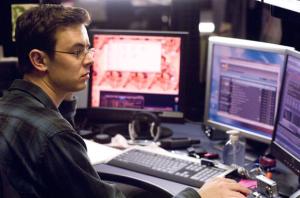 Lane holds her own, and even that is an accomplishment for something so rote. She’s an actress easing into her forties and finding a new tap of talent. Frankly, she should have won the Best Actress Oscar for 2002 with her fabulous work in Unfaithful. That movie came out five years ago, and yet the Diane Lane in Untraceable looks so much older. I think the filmmakers were trying to make her look more harried by not applying makeup or utilizing soft focus. You can see her wrinkles and her age, and these are all well earned for a great actress, and Untraceable wants to maker her look her age in a time where Hollywood seems to dump out an actress’ business card once she hits 40. I just thought that was interesting, but the most interesting facet of this entire movie is that the actor who plays the head of the FBI team (Peter Lewis) looks remarkably close to 2008 Republican presidential candidate Mike Huckabee. It’s uncanny. If Huckabee ever plans on contributing to a filmed biopic of his life, then Peter Lewis should be on his shortlist.
Untraceable scrapes the serial killer genre for some form of life. The novel premise gives way to predictably lackluster thrills and gaping plot holes. Lane saunters around with a gun for two hours, mixed in with some extended sequences of torture, including one that involves hundreds of heat lamps. Look, I know I’m no cop, but couldn’t someone simply trace the massive electric bill this guy is generating? It’s just sloppy police work all around. Why? Because the movie requires giant lapses in judgment so that it can continue. The world can be a sick place, but has it always been this way? A better movie would dig deeper; this movie just wants to fry a cat and call it a day.
Nate’s Grade: C
Share this:

Cloverfield (2008)
 I can think of no movie that has come out of virtually nowhere to build tremendous hype like Cloverfield. Before the summer of 2007 this movie didn’t appear on anyone’s radar whatsoever, and then came a teaser trailer before Transformers. The tease was nothing but party footage of well-wishers when, all of a sudden, explosions are in the distance, people are fleeing, and the Statue of Liberty’s severed head rolls to a stop in a street. Bam. Release date. Nothing else, not even a title. All of a sudden the world had an insatiable appetite for everything Cloverfield. Mega-producer J.J. Abrams had done it again. In one fell swoop he took control of geek nation. I never expected Cloverfield to live up to the massive hype, but this modern monster movie delivers more bangs than whimpers.
The first twenty minutes of the film introduce us to our cadre of yuppy characters. Rob Hawkins (Michael Stahl-David) is leaving for Japan to take a business promotion. His friends throw him a surprise going away party to celebrate and wish him the best. Rob’s brother Jason (Mike Vogel) and his girlfriend, Lily (Jessica Lucas), start videotaping the party. Jason hands off the taping duties to Hud (T.J. Miller) who, thankfully, has a much steadier hand. Hud walks around the party gathering interviews and he zeroes in on Marlena (Lizzy Caplan), a gal he’s been nursing a crush on. Rob is nervous to see if Beth (Odette Yustman) will come to the party. Beth and Rob are long-standing friends that took the plunge and had sex a couple weeks prior. Now Rob is hoping for something more but Beth isn’t on the same page; she brings a date to the party. Interrupting all this twenty-something relationship drama is a giant monster attacking New York City and dropping little baby monsters to scurry the streets and feed.
 While not entirely unique, Cloverfield is certainly a reinvention of the dormant monster movie. By seeing its gimmick through to the very end, the film gives a perspective rarely seen in movies that involve cataclysmic disasters. Usually films that involve space aliens, monsters, or some form of incredible destruction follow the people in power, the Army generals, the politicians, the President of the United States as he solemnly looks out his office window and says “God help us,” under his presidential breath. Cloverfield, however, eschews all of that. This movie is all about people caught on the peripheral of a disaster and just trying to survive. They have no idea what’s happening, they have no idea when they will be in danger, they have no idea where to go, they have no idea how long they have, and they definitely have no idea what it is that’s obliterating the city. The film dares to place us in the shoes of ordinary civilians as they document the fantastic. The “found footage” concept and the ordinary perspective are interesting though some will quibble that staying inside one point of view is too limiting for the scale of Cloverfield. This film is more than The Blair Witch Project meets Godzilla; this movie is a collective manifestation of the nation’s 9/11 anxieties. Cloverfield is the first 9/11 disaster movie. The shock and confusion of the situation take on even more resonance by triggering some of the same emotions many experienced on that fateful day in 2001. And yet Cloverfield doesn’t feel exploitative or disrespectful as it draws upon our 9/11 memories and fears, which is saying something substantial about the filmmakers’ skill and the remarkable healing power of time. Some images are unmistakable, like a white cloud of dust that blows through the city and also helps to shroud the monster. People scamper around the city yelling for some kind of explanation when some character, offhandedly, says, “Do you think it’s another terrorist attack?”
The film is also got some fabulously frightening moments that are not related to 9/11 anxiety. Cloverfield is a great, old school horror movie on top of a subversive social experiment. Talented writer Drew Goddard has had experience building tension on some of TV’s finest shows, like Buffy, Angel, and Lost. Now with his debut screenplay, Goddard cranks up the suspense and creepiness to maximum effect. Part of the horror is trying to find meaning in the madness but another equally enjoyable part is walking into perfectly executed classic horror moments. You will be on edge about what could possibly be around a corner. Our band of survivors decide to walk through the subway tunnels and discover that Hud’s camcorder has night vision; sure enough, you are waiting with baited breath for the second that night vision is shifted on and something pops out in view. There’s a distinct difference between cheap jump scares and spooks that, as I say, earn their boo. This tunnel scare is catapulted to frightening from the ominous buildup that comes from seeing hundreds of rats running away. When I saw the fleeing rats, I knew something very bad was coming from behind. The structure is clever as Goddard gives us back-story on Beth and Rob via the original footage of them canoodling that cuts in here and there. Goddard earns his stripes with a script swiftly paced, filled with genuine scares, and smart enough to keep an audience laughing with gallows humor at key moments (“Okay, so our options are… die here, die in the tunnels, or die in the streets.”).
 You the viewer are in the middle of the action with this film and there’s no getting out, no distancing yourself from the chaos, no watching men in lab coats and military uniforms dissect the situation over large boards. The gimmick of Cloverfield is flawlessly executed thanks to director Matt Reeves, who spectacularly resurfaces from movie jail after writing duds like The Pallbearer and Under Siege 2: Dark Territory. Reeves explores some dark territory of his own but never breaks the tenuous tone needed for the movie to succeed. The movie is constructed with many long takes and it never exposes its secrets. I watched spellbound by the artistry of maintaining the illusion from beginning to end. Watching the Brooklyn bridge collapse from the inside is exciting and terrifyingly real. Reeves and Goddard smartly decide not to show their monster for as long as possible. Catching glimpses of a shadow or the flash of a tentacle-like appendage are enough to register goose bumps; the human imagination will always be more capable of engineering horror. Eventually the film does give its monster the proverbial close-up and the giant, skyscraper-sized beast looks a little familiar in design (think Vin Diesel sci-fi movie).
Cloverfield is a well-executed genre movie with a clever concept that is fully realized. The constantly bouncing and roving handheld camera might make an audience queasy, but the perspective of the end of New York City as brought to you via YouTube is stimulating and a comment on our self-absorbed culture. The film works as a finely tuned fright film elevated by its stylistic concept and the filmmaking skill to pull it off. Cloverfield being “found footage” and evidence from the Department of Defense doesn’t exactly bode well for the characters onscreen, and the film dispatches them with cool malice. No one is safe and no one can stop what’s coming. If that doesn’t sound like the perfect summation of 9/11 fears, then I don’t know what else is.
Nate’s Grade: B+
Share this:

A Mighty Heart (2007)
 Good intentions and some proficient camerawork can only go so far to make a film worthwhile. Angelina Jolie gives the best performance of her career as kidnapped Wall Street Journal reporter Daniel Pearl’s wife (she’s French and Cuban, making for one really tricky accent). I wanted to like this movie more. The subject matter is serious and timely, the filmmaking has a sturdy docu-drama look, and the acting never comes across as phony, but alas, I think I mentally checked out because much of the film is a detective story that I already know the ending to. Daniel Pearl was infamously beheaded, so watching an hour of his wife, friends, and local police scramble to track down key figures, their allegiances and acquaintances, and the whereabouts of Daniels can come across as fruitless and somewhat cruel. This film doesn’t have the same cathartic feel that United 93 had because that moment was universal, and while I can admire the cinematography and superb acting I can’t ignore the fact that watching people search and fail gives me little emotional reward as a viewer.
Nate’s Grade: B
Share this:

The Invisible (2007)
 Forget whatever the advertising and the trailers had you believe this film was about. Instead of watching a ghost solve the mystery of his own death, almost all of The Invisible consists of following an obnoxious kid mope about. There is no mystery from the start because the audience witnesses exactly what happens, knows exactly who the murderer is, so much of the film is just waiting for other characters to piece things together. It’s the cinematic equivalent of sitting on your hands. The plot holes are massive and people have the irritating habit of acting out of character or being moronic (why does the best friend, who inadvertently got his friend killed but was not an accomplice, say nothing to the police?). When the film tries to shoehorn in a laughably contrived romance between murderer and murderee, I was about ready to kill someone myself. Whole sections and characters could be wiped out and nothing would be too altered. The ending is a cop-out and makes little sense given the facts of the case (it’s never really a murder, which makes the advertising even more wrong). Watching The Invisible feels like you’re chained to an annoying emo kid who won’t shut the hell up. This is one lame, snooze-worthy supernatural After School Special.
Nate’s Grade: D+
Share this:

I Am Legend (2007)
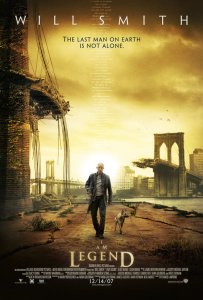 Ever wanted true and ever-lasting quiet? Be careful what you wish for. Super buff scientist Robert Neville (Will Smith) is the last known survivor of a virus that swept throughout the world in 2009. The U.S. government quarantined Manhattan and military jets blew up the bridges leading out from the island. Now in 2012, he and his lone companion, a German Shepard, must seek out supplies by day, because at night is when the “dark seekers” come out. These mutated creatures are what are left of those that fell prey to the virus; they can only come out at night and feed on blood. Smith has been capturing the creatures to run tests to see if he can crack the virus and offer a cure, except that the emerging creature hierarchy doesn’t exactly like having their members captured for scientific experiments.
Deeply unsettling, I Am Legend comes across like a post-apocalyptic Cast Away? but with vampires. I think they’re vampires, they kind of unhook their jaw like from The Mummy and have goopy gelatinous skin like from The X-Files Movie; they’re attracted to blood and burn in sunlight, therefore through my non-scientific analysis of fictional creatures, they’re vampires. Case closed. The movie shrouds the details of the end of the world in mystery that it doles out via flashbacks, and it works very well at keeping an audience intrigued without opening the door for distracting nit-picky questions. Being the last man to walk the planet presents all kinds of interesting scenarios, and simply watching Robert Neville go through his daily routine is entertaining. He picks up DVDs to watch, many of which he has seen so often he can recite line by line. He drives through the empty streets of New York trying to hunt stray deer. He tests his newest serums on infected rats. He sends out a radio message looking for survivors. The man even pumps his own gas. And then night comes and he barricades his home and sleeps in a bathtub listening to the voluminous howls of the creatures he now shares this world with. There’s a pleasing rhythm for an audience with routine, but it also helps answer the biggest question of adaptability. How would someone go about his or her daily life without another human (key word there) soul? The adjustment is part of the enjoyment. Many films and TV shows have walked this path before, hell half of the Twilight Zone episodes cover this scenario, but I Am Legend presents an awe-inspiring sight of desolation. Seeing birds-eye view angles of deserted Manhattan streets, overcome with encroaching grass and plants, is chilling and morbidly effective. The eerie quiet of the day may be even scarier than the dangers that lurk by nightfall.
 This is pretty heavy stuff for a Hollywood movie. After a taped TV interview that sets up how the virus began it immediately cuts to three years later and complete desolation. While there aren’t bodies strewn about, the lasting remnants of humanity are visible be it lines of empty automobiles or houses stockpiled with food and decorated for a new baby to arrive that never will. Death permeates every frame, and Neville dismisses the idea of “God’s plan” by declaring 90 percent of the population died immediately, 12 million proved immune and healthy, and 588 million turned into the “dark seekers.” Understandably, I Am Legend may be a bit too intense for younger kids and there are some late plot turns that will make animal lovers cringe.
Besides being an interesting what-if scenario, the movie is also a skillful, tense, and occasionally harrowing thriller filled with scares. The aforementioned moments of quiet are definitely eerie when presented on such a mass scale, and for a place as naturally noisy as New York City, but I Am Legend still has some classic spook moments that can still tingle a spine. When Neville’s dog runs into a dark building he follows, and every step becomes a great addition in terror. It’s your classic afraid-of-what-you-can’t-see scenario that horror milks, but I Am Legend invests the audience in Neville, and yes his furry companion, so that there’s genuine apprehension as we plunge into darkness. The CGI vampires won’t quicken the pulse alone, but add in the idea that every human being on the planet, your friends and family, has turned into a predatory creature and then the situation becomes more disturbing. When the vampires trick Neville and wait for the trickle of daylight to expire, the movie is downright nerve-wracking in the best way. The scene plays out at an agonizingly slow length that pins the viewer to the chair.
Smith gives a fabulous unnerved performance as, seemingly, the last man on Earth. Smith is an actor known for his wide grin and intense charisma, so plopping him down in a post-apocalyptic world doesn’t seem naturally ideal. There are long stretches where he is only acting alongside a German shepherd for companionship. Neville is dramatically lonely and befriending mannequins, including one female mannequin that he is working up the nerve to talk to in the video store. Smith is slowly breaking down from the void of human contact and he showcases how weary extreme loneliness can become. When he sees “Fred” the mannequin in an unexpected place, Smith just loses it. After such isolation, he has forgotten how to act around human beings and he is very much a casualty even as he survives. His strong relationship with his dog is occasionally touching and very reminiscent of Cast Away with Wilson the volleyball; I was more emotionally attached to this dog than I have been for entire slates of movie characters. Smith and the dog carry this movie and they both do outstanding work.
 I Am Legend is about 3/4 of an awesome movie, and then it takes a step into a more conventional direction with some new additions. The ending is satisfying and a ray of hope amongst a thoroughly bleak tale. I Am Legend flirts with the profound perspective shift of Richard Matheson’s original work but then opts for something a tad more redemptive and familiar to anyone that watched 2002’s Signs, and yet the ending still relatively works for the material. I didn’t feel cheated and I suppose that’s what counts the most when it comes to a big budget blockbuster action thriller.
I wasn’t expecting a sturdy survivalist parable mixed in with some semi-smart sci-fi and chills, so I Am Legend is a futuristic thrill ride that satisfies on different levels. Sure the last act change-up causes the movie to lose focus, and it’s not nearly as entertaining as watching Smith just go about his post-apocalyptic business. Director Francis Lawrence (Constantine) steers the movie away from camp and ramps up eerie set pieces and a strong visual command even if the CGI zombie-vampire-people look a little cheesy. The movie becomes a one-man-show and Smith, in all his quiet rage and mounting despair, is the key that holds this entire entertaining enterprise together. I Am Legend is short of legendary but it’s most certainly worth your time.
Nate’s Grade: B+
Share this:

National Treasure: Book of Secrets (2007)
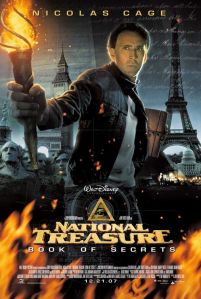 National Treasure: Book of Secrets is like a big dumb puppy that just wants love. It does a trick and thinks it deserves some form of recognition, and me with my cold heart just wants to shrug and move on with my day. How can I be so unmoved when there’s even a cartoon before the movie? For any prospective moviegoers, if you enjoyed the 2004 National Treasure, where I remind all that the U.S. Declaration of Independence had a secret treasure map on its other side, then chances are good you’ll enjoy Book of Secrets. That’s because they’re pretty much the same movie.
Ben Gates (Nicolas Cage) and his father (Jon Voight) are basking in their newfound respect from proving that their crackpot treasure schemes were in fact real. Their respectability is turned upside down, however, when Mitch Wilkinson (Ed Harris, with a dollop of a Southern drawl) has evidence that great-great-grandaddy Gates was responsible for planning President Lincoln’s assassination. He has a piece of John Wilkes Booth’s diary and a list of conspirators is jotted down, with great-great granddaddy Gates listed right there. The diary is authenticated and the Gates are devastated but ultimately unconvinced. They know their Civil War era ancestor would never betray his country and was unknowingly decoding a secret that could lead the Confederacy to an ancient golden temple, something that could help turn the tide of the war. This ancestor ripped pages out of the diary and threw them in a fire to protect the welfare of his country and was then shot by a secret Confederate soldier. In order to clear his ancestor’s good name, Ben Gates will have to find this hidden treasure, which is precisely what Mitch has wanted from the start.
 Gates re-teams with his pals from their first successful adventure, computer whiz Riley (Justin Bartha) and Abigail (Diane Kruger), who has thrown Gates out of their home due to his single-minded focus. Dating a treasure hunter is a certain path to a rocky relationship, ladies. Riley, who even wrote a book about his treasure exploits but still can’t get recognized, is game but Abigail has to be tricked into help. The group finally figures out that the only way to verify the temple’s hidden location is by getting their eyes on the mysterious President’s Book of Secrets, which only presidents can read. This means that Ben has no choice but to get the president (Bruce Greenwood) alone and beg to see a book not meant for outside eyes.
Book of Secrets is a little less dopey than the first preposterous National Treasure adventure, but that doesn’t mean it isn’t chock full of stupidity. According to these movies, apparently damn near everything in this country is built over an Indian burial ground or a giant cavern of treasure. I advise all readers to try digging in their backyards because it appears that the odds are in their favor (also: beware of your real estate company moving the tombstones but not the bodies). The clues are a little less mind-boggling, so instead of a single brick that’s been undisturbed for 200 years we get matching furniture for the Queen of England and the President of the United States. One doozey of stupidity is that one clue requires people to douse a large rock formation with water in hopes that they hit exactly the right spot and have an invisible eagle make its appearance. The plot is still structured on the clue-leads-to-other-clue template, which can be exhausting after a while because there’s never any indication of progress until the end arrives.
The subplot about kidnapping the president is ridiculous in the fact that, while already being dumb, it adds needless conflict. When Gates “”kidnaps” Mr. President he does so through a secret tunnel under George Washington’s Mt. Vernon estate. The passage closes behind them and cuts off the frantic Secret Servicemen. It is here where Gates makes his plea for the titular Book of Secrets, which the president confirms but cannot confirm publicly (well, it is a secret book of secrets). Instead of sensibly saying to his men, “Sorry guys, you know how old these places are, we got trapped, but Mr. Gates here helped get me out,” the movie tries to claim that the next course of action is that Gates will be on the run for kidnapping the leader of the free world. Huh? What makes this sequence stand out is how easily explainable it could all pass, and yet Book of Secrets figures the movie is better served by a contrived complication to add more outside pressure on Gates and his treasure hunting crew.
Of course all of the silliness and off-the-wall shenanigans would be acceptable if the film delivered some exciting action sequences that pinned you to your chair, but just like the first National Treasure, this movie is pretty much devoid of a well-thought out action sequence. Returning director Jon Turtletaub has no real visual flair and lets the material simply lay there on screen without much effort to jazz it up. Many action sequences are brief and never really flirt with complications. Usually, the script will propose a simple sequence of events like, say, “Good Guys on Run from Bad Guys” and then Turtletaub will show us exactly that, no better no worse. There’s nary a scene that actually utilizes its globetrotting destination to its advantage; most of the action is not geographic based, which means that it could happen anywhere because it doesn’t take advantage of the specifics of exotic locales. That is inexcusable to me, a big fan of good action sequences. A lengthy trip to an underground golden temple tries the patience as it rambles on and unabashedly apes the Indiana Jones series. Book of Secrets has a halfway decent car chase through the streets of London and that ends up being the highlight of the film. The trouble is that there’s more than an hour left at that point.
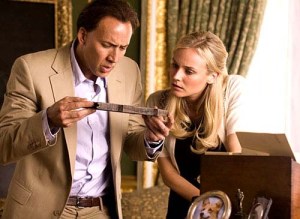 Book of Secrets is a slightly better film than the original. It jumps around in time through the lineage of the Gates clan and gives a better sense of the personal stakes for Ben and his father. Having their long-dead heroic family members linked to a dastardly assassination is good motivation for action, even if that action is ultimately finding an underground temple of gold (how A+B = C I will never know). The production design is skillful and the various European locations bring some sense of grander excitement that, sadly, will never be fully capitalized upon. The characters are still pretty shallow and one-note, but it seems like it’s less annoying this time because there’s less setup on who these characters are, which is, in short, shallow and one-note.
Cage is on autopilot and plays up his goofy mannerisms and William Shatner-esque line readings. This is a paycheck job for Cage and nothing more. Just because the first flick made tons of money is a lark to him and not an indication that he should try something different. He’s giving the people what they seemingly want, which is a wacky Nicolas Cage hamming it up with his patented version of kooky acting. Kruger is the exact copy of her character from the previous National Treasure, meaning she’s the bickering blonde counterweight to the conspiracy theorists on the journey. I suppose she plays a damsel in distress adequately. Voight gets more screen time this go-around thanks to a plump subplot involving the team seeking out the assistance of his ex-wife, played by Oscar-winning actress Helen Mirren. Yes, that Helen Mirren. Harris is given a do-nothing part as the villain and then the movie can’t even follow through on that. Everyone seems to have fun with all the nuttiness and goofy stunts, so I can’t fault them too much for faking it in a big Hollywood blockbuster.
I understand the appeal of these movies, which have found a sizeable audience willing to lap up a Cliff Notes of History along with their popcorn thrills. I imagine the fans of the original will show up in droves and make sure that National Treasure 3: The Mystery of Franklin’s Syphilis is fast-tracked for a future holiday release. I don’t mean to be a killjoy (my mother really enjoys these films) but I cannot get behind the National Treasure movement when the movies are riddled with rampant stupidity, contrived situations, convoluted conspiracies, one-note characters, and inept action sequences that never amount to much of anything beyond teetering homage to better adventure films. Book of Secrets is essentially the exact same movie reheated to take the chill off. Replace Sean Bean for Ed Harris as rival treasure hunter, add another female character, and there you have it, a mostly undisturbed formula that proved profitable in 2004.
Nate’s Grade: C
Share this:

Next (2007)
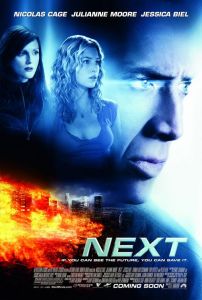 Nicolas Cage, channeling Tom Hanks’ greasy mullet in The Da Vinci Code, can see his own future but only two minutes ahead. Based on a Phillip K. Dick something or other (does it really matter at this point?), this half-baked sci-fi thriller keeps shooting itself in the foot by retreating back in time to reveal, over and over, that what was just shown was merely Cage seeing his future. Now it’s do-over time, hooray. This tricky concept is given little thought and Next hews close to tired thriller clichés and formulaic trappings. There’s the hot girl dragged into the fray (Jessica Biel, pretty but pointless), the shady government agents that need Cage’s help but don’t fully trust him, and the nondescript bad guys with a hidden nuke. Next had potential for disposable escapist entertainment, but man do they blow it big time. For a 90-minute film, there’s way too much setup and not nearly enough payoff. There’s about a grand total of two action sequences for the entire film, neither very good, and then the movie utterly collapses as half of it folds in on itself as one of Cage’s visions. In the blink of an eye, half of the movie we watch is erased; it’s a freakin’ cheat, especially when the movie slouches to a close right after. This easily forgettable sci-fi bobble is another nail in Cage’s coffin as a reliable actor.
Nate’s Grade: C-


You must be logged in to post a comment.