Blog Archives
The Eye (2008)
 This is a punishing and blandly mediocre movie, one that cannot inspire any strong feelings whatsoever. It’s a limp remake of a Korean horror movie where a blind woman gets an eye transplant and starts seeing ghostly creatures. The glossy American version stars Jessica Alba as said blind woman and watching her bump into furniture would have been more entertaining. The production values are competent, though the characters exist in a strange world where ordinary apartment buildings are designed like labyrinths. The horror elements are mostly of the “Boo”-variety and The Eye does little to establish whatever rules govern its spiritual universe. Why would closing a door stop a ghost in its tracks? It’s a ghost! The flick follows the tired plot device that ghosts have unfinished business and need flesh-and-blood humans to fix it. Come on ghosts, you’re dead, you got plenty of time on your hands. Eventually the movie transforms into a non-scary road trip to Mexico (there’s no way Alba would have gotten an international eye transplant) to learn about the poor eye donor’s unfortunate demise. This then leads into a contrived scenario where Alba must use her combined ghostly glimpses to save lives. The ending is just kind of pathetic as well. The Eye has a few nice stylistic touches, like what goes down in a Chinese restaurant, but the movie seems to exist as young male wish fulfillment. And by that I mean the concept of a beautiful woman who is blind and therefore doesn’t realize how beautiful she is. It’s the only way the majority of men can ever legitimately fantasize about having a shot with Jessica Alba.
Nate’s Grade: C
Share this:

88 Minutes (2008)
 Typically you can smell something wrong when a movie is continually delayed or held from release for well over a year. The serial killer thriller 88 Minutes actually began filming during the fall of 2005 (!). It was released in the United States well after it had been available on DVD in Europe for over a year. After watching all 108 minutes of 88 Minutes, it’s easy to see why the studio and the film’s astounding 20 producers (!!) were trying to hide this from public eyes.
Dr. Jack Gramm (Al Pacino) is the top forensic psychiatrist in Seattle. His testimony is responsible for convicting Jon Forster (Neal McDonough) of a death sentence. Many years later, Jon is now hours away from execution and still professing his innocence, claiming the real “Seattle Slayer” is still out there. Gramm works as a college professor and he can still woo the young ladies and beds them regularly. His assistant (Amy Brenneman) informs Gramm that a woman in his class has been murdered and her murder is patterned after the “Seattle Slayer” killings. Gramm believes that Forster is collaborating with someone on the outside to cast doubt on his conviction. Then as Gramm walks to class he gets an anonymous phone call that tells him he has 88 minutes to live. Gramm scrambles to try and use the time to figure out who is targeting him, framing him, and why. Could it be his assistant, his T.A. (Alicia Witt), his skeptical students (Benjamin McKenzie, Leelee Sobieski), the skeezy campus cop, or maybe the starting second baseman for the Seattle Mariners?
 First off, the time frame doesn’t work at all. 88 minutes is too short a time frame to do crack investigation, and Gramm runs all over the city of Seattle at least three times without getting caught in any gridlock. The movie establishes a real-time ticking clock but then decides to follow a different set of time. Occasionally the movie will be faster than real life, meaning that it says 10 minutes have passed when only say 6 have, and occasionally the movie will be slower than real life, like when the third act probably takes all of 10 minutes in the film’s universe. It’s not consistent and points out the flaw of the structure. The 88-minute countdown was supposed to add a feeling of suspense but what it does is add an extra level of incredulity. There is no way that 88 minutes would be a sufficient time for the killer to stage murder and mayhem around a large metropolitan city known for inclement weather. Seriously, is the killer trying to set unreasonable personal goals? Why not a three-hour window of time? That way the killer could have a healthy planning period without worrying that everything would collapse if they got stuck in traffic. Also, the 88-minute time frame allows glimpses into the anal retentive nature of our killer. Gramm is harassed by phone calls updating him on his declining time, but what’s truly special is when the killer defaces Gramm’s car saying how long he has to live to the minute. The killer must have known to the second when Gramm would come by his car because had the doc taken a different route, gotten a coffee, gone to the bathroom, or performed whatever other million actions then the death threat would be inaccurate.
Next, all the women are helpless sycophants. They think the world of Gramm and several of these twenty-something college girls have big time crushes on the aged Pacino. It’s hard to take seriously the idea that Gramm, in this context, is still a Lothario that he can bed any coed he sets his sleepy eyes upon. The fact that the movie opens with him waking up from his latest and naked conquest already gives the film a squeamish start, but when multiple characters all confess to having crushes on Gramm then the whole idea transforms into an uncomfortable stroking of Pacino’s vanity and virility. I suppose I shouldn’t expect too much from the plethora of female characters because they’re all in need of comfort and every one of them winds up a pitiful damsel in distress. We’re supposed to believe these are strong and capable women, all of them working alongside a criminal expert so perhaps they know a thing or two about self-defense. They fawn over the man and then inexplicably wind up in danger. Occasionally the women will experience dramatic setbacks and they all take a backseat toward getting a hug from Gramm. These women react to the sight of death in puzzling ways and then will just as easily move on to another topic.
 This is the kind of wretched movie where a flashback tragedy is defined by a memory so inane that it becomes insulting. Gramm keeps flashing back to a simple memory of his long deceased younger sister; she is running along the bank of a rather filthy looking river with a kite trailing inches behind her. Now, 88 Minutes is the type of movie where she has to giggle innocently and say something ridiculously non-descript, which in this case is, “[Giggle], dad look at the kite.” Of course Gramm is not her father (or is he?) and her call to look at the kite makes little sense because 1) its string is about three feet so it cannot go very high at all, and 2) it’s usually flying lower than the girl. I just find this image, this idea, this whole flashback construct to be emblematic of how truly awful and derivative and excruciating 88 Minutes can be.
I must confess there is one scene in 88 Minutes that I will remember for the rest of my life specifically because of how ridiculously appalling it is. Few scenes cause me to simultaneously stare in wide-eyed amazement and resist the urge to vomit. Here goes. Gramm is confronted by his FBI agent pal (William Forsythe) who has some bad news for Gramm. It turns out Gramm’s semen was found inside the “vaginal cavity” of the victim. We know Gramm wasn’t sexually involved with her because he was sexually involved with our opening naked escort lady, Sara Pollard (Leah Caims). Gramm then argues that someone out there framed him by killing Sara Pollard (oh don’t act surprised), retrieving Gramm’s semen from inside her, and then injecting it into the “vaginal cavity” of the victim. Hearing an actor of Pacino’s credit verbalize this theory is akin to having the “sex talk” with your parents, nay, grandparents — it’s just so intensely uncomfortable to watch. I just picture a lab tech with a long syringe that has to run around Seattle to make his semen import/export deadlines. This one icky moment stands out as the most ridiculously awful in a movie that is nothing but collective scenes of awful.
88 Minutes has no characters, only red herrings. Each of the numerous supporting characters is given the chance to act suspiciously and for no real good reason. Gramm takes his turn going through accusing nearly every supporting character he comes across as being in league with Forster. The screenplay even establishes characters like the painfully named Guy LaForge (Stephen Moyer, True Blood‘s Bill the Vampire) who serves no purpose other than to wear a leather jacket and squint in backgrounds.
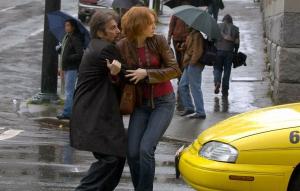 Forget anything approaching characterization because writer Gary Scott Thompson (The Fast and the Furious) has created a script that is woeful in every department, including thrills. The reveal of the killer is mishandled, as is most every plot point, and I’m at a total loss at the rationale of attempting to commit murder in a building the killer called in a bomb threat. Yeah there may not be students but there will be plenty of police sniffing around. More than half of the scenes involve people talking on cell phones. The dialogue is unintentionally hilarious more often than not, with lines like “Someone has penetrated my most secret place” and, “If I can’t forgive you I don’t deserve you,” and the killer taunting, “You see Jacko, I’m a true believer.” Need I remind you of the “vaginal cavity” conversation? This is a complete laughable mess that would have been just another half-rate direct-to-TV movies airing late nights on cable channels were it not for Pacino’s involvement.
Pacino doesn’t even try to hide his disillusionment with the movie. He comes across as sleepy-eyed to the point of being a zombie with a permanent case of bedhead (seriously, Pacino’s crazy hair steals the show). The man is going through the motions to collect a paycheck, and he even gets a couple scenes to work up the frothy barking Pacino voice that he has settled into for the past 15 years of acting. He never seems to be worried that he only has so many minutes to live, so why should we bother sweating? The rest of the cast is awful and they were likely lured to this doomed project because of the chance to work alongside Pacino. Leelee Sobieski must be singled out for being particularly atrocious, especially when she tries to play a tough girl. This has got to be her worst performance since she started speaking. Then again, she has worked with Uwe Boll (Fun fact: one of 88 Minutes‘ many producers is Boll’s longtime producer).
88 Minutes is bad in every possible manner of filmmaking. This is an embarrassment for everyone whose name’s is attached to this film. From the overly anxious musical score, to the choppy editing, to the lackluster cinematography, to the abysmal story and outlandish acting and the lazy direction, 88 Minutes is a cinematic catastrophe. It should only be watched at a safe distance and only with the intention of derisive enjoyment. Because while this movie fails at every level it may just end up becoming the funniest comedy of the year.
Nate’s Grade: D
Share this:

21 (2008)
 Glitzy, breezy, and 100 percent predictable, 21 is a simple con movie that goes through the motions with hyper realism. The most interesting part of the film, by far, is learning the systems that help these coeds fleece Vegas for thousands of dollars. In fact, the true story is far more interesting than this typical tale about a good kid who gets a big ego, pushes his true friends away, is humbled, and then learns a lesson while getting the girl too. What’s a MIT engineer want to go to Harvard med school for? And for that matter, you’re telling me there are no scholarships out there to brainy MIT students? Whatever the case, 21 will pass the time nicely without damaging your brain. The card games are ramped up with zooming camerawork and flashy special effects by director Robert Luketic (Legally Blonde), but it’s all window dressing to an interesting story that was white washed into a bland but undeniably commercial movie. It’s a fine time but, like Vegas, will leave you empty in the end. Still, you could do worse than overly stylized con movies about math whiz card sharks.
Nate’s Grade: C+
Share this:

Lust, Caution (2008)
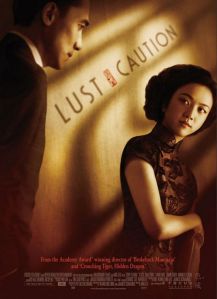 Ang Lee’s period romance is no Brokeback Mountain, though there is a heavy supply of thrusting. Lust, Caution is an NC-17 rated peak into life in China under Japanese occupation in the 1930s. Most of the film follows a school drama club that decides to become freedom fighters. They scheme to murder Chinese officials working with the Japanese government, and one gal (Wei Tang) is tapped to seduce and then kill a high-ranking official. For such a controversial movie, the sex scenes don’t even begin until 90 minutes into the flick (though our undercover heroine is deflowered by her drama club peer for the good of her mission). The movie is exquisitely shot, handsome in its details, and the lead performance by Tang is exceptional, simmering with conflicting emotions and some real sensual heat. The sex scenes doe have an erotic potency to them and they are more explicit than the kinder gentler fare found in typical Hollywood movies that consist of only seeing the slow-motion ecstasy result from a man on top. The offbeat love story gestates too late in the film’s run, leaving little time to delve deeper. Too much of the movie concerns back-story following the drama club’s road to becoming revolutionaries, and while it’s interesting it’s also rather needless on second thought. There’s a nine-minute difference between the R-rated version and the theatrical NC-17 cut; what’s in those nine minutes I do not know since I saw the edited version, but I’ve been told it’s a lot of thrusting. In lusty terms, the movie is heavy on foreplay and too short on a satisfying climax.
Nate’s Grade: B-
Share this:

The Dark Knight (2008)
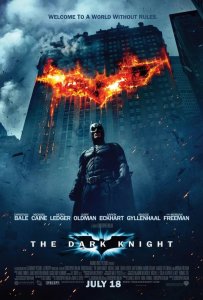 In 2005, Christopher Nolan’s reboot of the Batman series was a critical and commercial success. Gone were the campy and opulent sequences of old and the nipples on the Batsuit felt simply like a bad dream. Nolan served as director and screenwriter and brought serious psychological depth to his story and characters. As a life-long Batman fan, I loved it and wanted a sequel immediately with the exact same people responsible. The Dark Knight has been overshadowed by the passing of actor Heath Ledger, a gifted young actor nominated for a Best Actor Oscar for 2005’s Brokeback Mountain. He’s gone from gay cowboy to the criminally insane, and it’s all anyone can talk about. The buzz on Ledger and The Dark Knight is deafening and I am about to join that joyous chorus. This is a movie for grown-ups and makes lesser super hero adventures look downright stupid.
Bruce Wayne (Christian Bale) is dealing with the repercussions of his choice to assume the masked identity of Batman. He’s cracked down on Gotham City’s mobsters, and in their desperation they have turned to a crazed anarchist that likes to wear strange makeup. The Joker (Ledger) promises to return Gotham back to its old ways but even he knows this isn’t possible. “You’ve changed things,” he tells Batman. “There’s no going back.” The Joker wants to break the will of Batman and Gotham City and sets up elaborate and disturbing moral dilemmas that push many to the edge. His purpose is chaos, which isn’t exactly what the Mob had in mind when they subcontracted his services. Bruce must rely on his trusted butler Alfred (Michael Caine) and company tech guru Lucius Fox (Morgan Freeman) to help him combat a man that “just wants to watch the world burn.” Gotham also has a new district attorney, Harvey Dent (Aaron Eckhart), who is willing to put his name on the line to clean up the city. He’s butting heads with Lt. Gordon (Gary Oldman) because of Gordon’s secrecy and his reliance on Batman to do the things the law won’t allow. Dent wants to prosecute mobsters and is willing to put himself in jeopardy. He believes Batman is waiting for men like him to take the baton. Bruce’s old squeeze Rachel Dawes (Maggie Gyllenhaal replacing Katie Holmes — upgrade) has fallen for Dent. He’s an emotionally available man who wants to do good. Naturally, Dent and Rachel will becomes targets of the Joker.
 First off, believe the hype because everything you’ve read and heard about Ledger’s performance is the gospel truth. The actor vanishes completely underneath the gnarly latex scars, stringy hair, and smeared makeup. He transforms into this menacing figure and he makes Jack Nicholson look like a circus clown in comparison. He’s creepy and funny in a totally demented and spooky way, but he almost comes across like a feral creature that enjoys toying with his prey. Ledger fully inhabits his character and brings a snarling ferocity to the role. The Joker is given no back-story and he takes a macabre delight in crafting differing versions of his sordid past depending upon the audience. Ledger’s Joker is like a mixture of sadist and intellectual, of Alex from A Clockwork Orange and Hannibal Lector; he finds a way to get inside your mind and unleashes torment. There’s a great scene where he’s left alone in a holding cell with a police officer. The Joker taunts the man, getting little reaction from the trained lawman, but then he hits a nerve. The Joker asks how many of his friends, his fellow officers has he murdered. He then rhapsodizes the finer points of using knives instead of guns because guns are too quick. With knives he can see who people truly are in the final moments of existence. “So in a way, I know your friends better than you ever did,” he tells the officer. “Would you like to know which of them are cowards?” This triggers the officer to break his protocol and play into the Joker’s scheme. I’m not ready to say Ledger’s performance overtakes Javier Bardem’s Anton Chigurh (No Country for Old Men) as the most menacing villain of late, but Ledger certainly will make your skin do more than crawl.
Ledger gives a performance worthy of posthumous Oscar consideration. Toward the end of the film I found myself lingering on sadness that, well, this was it. This is all we are ever going to get of the Joker, such a fabulous character, but even more, this was the last full performance we are ever going to get from Ledger. His unnerving performance will stand the test of time when it comes to haunting screen villains, and I’m sure the actor had many more incredibly performances left in him before he passed away.
 The Dark Knight has less in common with other superhero series and should be considered a modern crime drama. It has more in common with Heat than with Spider-Man. Even compared to Nolan’s excellent Batman Begins, this is the first Batman film that feels like it occurs in a real city in our own reality. In Batman Begins, we had the CGI ghetto that happened to be conveniently where all the city’s scum lived, an ancient league of ninjas that wanted to wipe an entire modern city off the map, and then a super microwave that zapped water molecules in the air. Even though it was the most realistic Batman yet, it still had some fantastic elements that kept it from feeling fully believable. This newest Batman adventure feels more like a real city and a city that is being torn apart. You get to see a lot of Gotham City’s moving parts and different social circles and then see the Joker tear them apart. The knotty screenplay by Christopher Nolan and his brother Jonathon is dense and packed with subtext and ambiguity not seen in the likes of other spandex-clad super hero movies. This isn’t a super hero movie so much as an enthralling crime thriller with better gadgets.
Whereas Batman Begins focused on the psychology of a man that dresses up in a costume and fights crime, now the attention turns into examining the impact of Batman. There has been escalation, just as Gordon hinted at the close of the last film. Batman has stepped up law enforcement and now Gotham’s criminal element has placed their trust in a psychopath that promises results. This is a movie about symbols and ideals and about the tenets of civilization. The movie presents an arsenal of mature questions and rarely gives absolute answers. Batman I supposed to be a hero but does he play by the law? Can he make decisions that no one else can? Batman believes in the goodness of others and serves as a symbol for the city to stand up against corruption, but can Batman be corruptible? Does he have a breaking point? Is implanting hidden surveillance and spying on 30 million people in the name of security overstepping? Is it acceptable to cross a line if your enemy crossed it first? The Joker lives at the other ideological end and believes that human beings are selfish and will eat each other when the chips are down. He devises disturbing social experiments that test the limits of ordinary citizens and how far they are willing to go out of self-interest. The Joker is an anarchic force that seeks to tear down civilization itself, and that is a far more interesting and devastating plot than vaporizing water molecules with ninjas. When the movie covers the tired “we’re one in the same” territory that most super hero flicks hit (the Joker responds to Batman with, “I don’t want to kill you. What would I do without you? You complete me.”), it even makes sense given the psychological and philosophical complexity at root.
And oh boy, is The Dark Knight dark. This flick racks up a body count that could compete with movies usually involving some cataclysmic act of nature. The Joker’s unpredictable nature, and the dark twists the film plumbs, creates an atmosphere where you dread anything happening at any time, and mostly bad things happen. Batman must come face to face with his limitations and the realization that his actions, no matter how altruistic, will have negative consequences. This is not a movie for young children. If any parent buys their child a Joker doll and takes them to see this movie then expect years of therapy bills down the line. Much of the violence is implied but the overall effect is still chilling. It’s difficult to call The Dark Knight a “fun” movie. Batman Begins was fun as we followed Bruce Wayne tinker and become his crime-fighting avenger. This movie watches much of what he built get taken away. The movie makes gutsy decisions and for a super hero movie, let alone a summer blockbuster, and this is one decidedly dour flick where no character ends in a particularly pleasant place, especially poor Harvey Dent.
 Speaking of Mr. Dent, while Ledger is deservedly getting all the buzz and plaudits, Eckhart’s excellent performance is going unnoticed. Dent gets just as much screen time as Batman and is the white knight of Gotham, the man unwilling to break the boundaries of the law to merit out justice. Like Batman, he serves as a symbol for Gotham City and its resurrection from the stranglehold of crime. Batman fights in the shadows and serves as an anonymous vigilante but Dent is the face that can inspire the city. That’s what makes his transformation into Two-Face all the more tragic. You really do care about the characters in this movie, so when Dent turns on his principles and seeks out vengeance you feel a weighted sense of sorrow for the demise of a truly decent man. Eckhart and his lantern jaw easily sell Dent’s idealism and courage. After his horrific transformation, Eckhart burrows deep enough to show the intense hatred and mistrust he has even in fate. He gives a terrific performance that plays a variety of emotions and does justice to them all.
The rest of the cast, just to be mentioned, is excellent yet again.
Nolan has also stepped up his directing skills and delivered some high-intensity action. His first foray with Batman had some dicey action sequences that suffered from choppy editing, but he pulls back his camera lens and lets the audience see the action in The Dark Knight. The explosive high point is a long car chase where the Joker tries to attack an armored police car via an 18-wheeler truck. The police look for safe detours to escape the Joker’s line of fire, and when Batman surfaces with the sleek Batpod motorcycle thing get even cooler. What makes the sequence even better is that all of the peripheral characters behave in semi-logical ways, meaning that your secondary cop characters are respectable decision makers. Nolan also shot several sections of the film in IMAX, which boasts the highest resolution possible for film stock. The panoramic views of Batman atop buildings are breathtaking and may strike vertigo in some moviegoers. The movie looks great and it delivers the action goods but it’s really more of a tense thriller with more tiny moments of unease than an out-and-out action flick with gargantuan explosions and blanket gunfire.
Despite the undeniable brilliance of The Dark Knight, the movie is rather exhausting. After a decent 45 minutes of establishing the characters and setting up the stakes, the movie is essentially two hours of climax after climax, and you will be perched on the edge of your seat and tense until the end credits crash onto the screen. It’s exciting and overwhelming but you will feel wiped out by the end of the movie. There are a lot of characters and a lot of subplots and while I’m thrilled the movie has so much intricacy it also makes it hard for the film to come to a stop. The climax with Two-Face and Gordon’s family also feels misplaced. At a tremendous 2 hours and 30 minute running time, The Dark Knight will test your endurance skills in the best way.
 I honestly have no idea where Nolan and crew can take the story now. The Dark Knight seems unlikely to be topped. This is an intense, epic crime thriller with a labyrinthine plot that is packed with emotion, subtext, philosophy, penetrating open-ended questions, and genuine nerve-racking tension. It’s hard for me even to think of this movie as a super hero flick despite that fact that it’s about a billionaire in a rubber suit. This is an engrossing modern crime drama that just so happens to have people in weird costumes. Nolan and his brother have crafted a stirring addition to, not just the Batman canon, but to cinema as a whole. Ledger’s character is the driving force behind the film, the man that makes everyone else react, and his incredibly daring and haunting performance will stand as a last reminder of what talent was lost to the world when he passed away. I for one will be amongst the throng crying out for Oscar recognition but not just for Ledger, for The Dark Knight in general. And I may not be alone. The Dark Knight is currently breaking every box-office record imaginable and seems destined to finish as the number two highest grossing movie of all time, steadily behind James Cameron’s Titanic. If the Academy is looking for a way to shore in better ratings for the Oscars, it might seriously consider nominating The Dark Knight in some key races. It certainly deserves recognition.
Nate’s Grade: A
Share this:

Hancock (2008)
 Hancock is perhaps the first movie that looks at the consequences of being a super-powered do-gooder. I’m not talking the self-doubt or placing your loved ones in danger. I’m talking about money. A super hero can rack up super amounts of damage to a city, and the titular character often causes millions of dollars in destruction as he sloppily combats crime. In some ways, the super hero is more costly than the criminals. As you can imagine, the public at large isn’t too taken with Hancock (the film misses the opportunity to have neighbors worry their property values will plummet if Hancock moves into town). It’s too bad that Hancock, the film, doesn’t stay as original.
John Hancock (Will Smith) is a disgruntled man. He likes to drink, sleep, and keep to himself. Unfortunately, people keep bugging him for help. This may have something to do with the fact that Hancock is a man with the abilities of a super hero. He can fly, has incredible strength, and appears to be physically impervious, but that doesn’t stop criminals from emptying their guns at him. One gang learns firsthand the anger of Hancock when they destroy his whisky bottle. The city doesn’t know what to do with the world’s lone super being because he causes so much destruction. Ray (Jason Bateman) is a PR man fighting a losing battle to convince major corporations to donate supplies to needy countries for free. Hancock saves his life one afternoon and Ray decides to use his skills to give the irritable super hero an image makeover. He’s going to use Hancock to help change the world for the better. The plan to reform Hancock involves sending him to prison and waiting until the city begs for his assistance with rising crime. Ray’s wife, Mary (Charlize Theron), is wary of her husband’s super hero project. She just wants to live a quiet life with regular meatball madness dinners with her family.
 I think I’m already starting to get sick of super heroes and there’s still more to come this summer. There are several good ideas rolling around inside Hancock, but at a scant 92 minutes there’s little time to develop them. The movie takes off in a mildly satisfying manner but then botches the landing.
Smith’s considerable charms at put at odds with a character that resembles an ornery bastard. It’s a bit of a wink to the audience because no Hollywood studio would let the most popular international movie star release a super expensive summer movie where he begins and ends as a total jackass. The film seems to be tailor-made to Smith’s strengths, which still include his ability to naturally command attention and likeability. The idea of a lone super hero who drinks heavily, destroys personal property, and whom the public vocally dislikes is a sound idea and allows Smith and the filmmakers to explore certain realities not seen in other super hero flicks. The public griping over the methods Hancock chooses to save the day seems rather believable, especially when those methods usually involve heavy-duty collateral damage consequences. I like the idea that every time Hancock lands from flying he takes chunks of concrete or tar with him. There are several interesting ideas that come from the conflict between society and a super hero who would rather sleep off a hangover. I think the idea of paring a disgruntled super hero with an idealistic PR man is a great concept, benefited by Bateman’s sterling comic abilities fine-tuned from Arrested Development (where he also romanced Theron). I really enjoyed the interaction between Hancock and Ray. For a decent 60 minutes, Hancock is a passable super hero excursion lifted by Smith and Bateman’s chemistry.
Hancock starts with some promise but then goes in a completely different direction for its third act (let me just say this: there’s a reason they’ve been hiding Theron from any advertisement). The film also overplays its hand early. When Hancock and Mary first meet they hang on to each other, then she looks at him suspiciously and continues to, then she says some very leading dialogue that is a bit on-the-nose. All an audience needs is one award, penetrating look to understand that something is up. Hancock ends up feeling pulled in too many directions. It begins as a sly satire on super heroes and is mostly confined to jaunty comedy, but then the movie gets dramatic and grim and a bit hard to follow. The film begins as a jokey riff and then gets gritty, finding room to fit in mythology, religious questions, age-old racism about interracial dating, and a terribly clunky villain (Eddie Marsan) who breaks out of jail so that he can seek improbable vengeance against an immortal. Hancock’s origin is muddled and as preposterous as most other super heroes. The third act shift seems to drain all the fun out of the movie and it gets too serious, too confusing, and too convoluted (what’s the distance rule here between super people?). Hancock ultimately has too many chefs in the kitchen and becomes a mess.
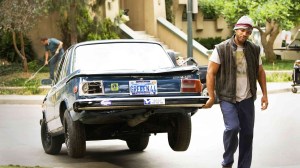 I’m sad to say but director Peter Berg really whiffs with this movie. His visual style is a hindrance to the film. I recently re-watched his first action film, 2003’s The Rundown, and Berg was able to craft stylish, highly playful action sequences without shaking the camera all over the place. A tripod served the film’s best interest and Berg tailored his visual style to the material. I expressed worry with his previous film, 2007’s The Kingdom, that Berg has become locked in to his handheld docu-drama style that bobs and weaves around his actors and employs numerous quick cuts and odd angles. His erratic style can improve and assist narratives but it can also hamper the storytelling. Nothing is really gained by Berg filming his tender moments at obtuse angles, extreme asymmetrical close-ups, and a hovering camera. It feels like a style completely unsuited for the material. I would have liked to fully watch the action sequences and enjoy the clever tweaks on the genre. Berg is an imaginative and underrated director, but his jittery docu-drama style he has embraced can also make his films seem cobbled together and overly rushed and, potentially, half-assed.
Hancock is much like the title character. It means well and wants to help but an audience can’t help but grumble about its methods. The concept of a super hero that is rejected by the people he saves is a subject ripe with subtext that could explore meaningful and insightful glimpses about guilt, the weight of expectation, the desire for human affection and acceptance, the frustration to be understood, the questions of personal responsibility and loyalty, and rejecting or heeding the call to do better. Hancock does not delve into any of these potent psychological areas. That’s fine, as long as the film delivers top-notch popcorn thrills and makes me forget about its wasted potential. Sadly, Hancock fails to deliver. The special effects are generally sub-par, the story misfires, and the whole film begins with promise but ends up turning into a mundane mess. Berg’s aesthetic doesn’t square with the material. Smith is still as charming as ever and will always be a genial presence onscreen, but Hancock turns into a movie that feels like a super hero hangover itself.
Nate’s Grade: C+
Share this:

Wanted (2008)
 Wanted isn’t so much a movie as a fetish vehicle for teen males, with sexy cars, sexy guns, and sexy tatted-up Angelina Jolie, daring the predominantly male audience to decide which is sexiest (I am not a car aficionado nor a gun person, so I’ll say that Jolie easily outpaced her competition).
Wesley (James McAvoy) is a pathetic office drone that sweats out his days never raising his voice. His best friend is constantly screwing Wesley’s bitchy girlfriend, his boss constantly harangues him into panic attacks, and, saddest of all, a Google search results in nothing for Wesley Gibson’s name. He tells us he has done nothing with his life. This all changes when a mysterious woman named Fox (Jolie) tells Wesley that the father he never knew has just died. Not only that, Wesley’s father was one of the world’s greatest assassins and he might just be a chip off the old block. Wesley is recruited into The Fraternity, a thousand year-old organization whose membership includes the best-trained killers. Sloan (Morgan Freeman) is the leader who assigns the targets. He gets his orders, literally, from the Loom of Fate, a weaving loom that writes binary letters via stitches. The Loom of Fate decides whom the planet would be better off without. Fox and her cohorts train Wesley to accept his destiny and avenge his father’s murder.
 The movie fails to establish any form of internal logic or continuity, so anything preposterous suddenly becomes accessible. That means people can jump from one skyscraper to another, you can outrun a moving train, cars will do the damndest things, and that you can curve a bullet simply by rotating your hand and shutting off that little part of your brain that says, “This is defying all laws of physics.” For some reason, people are able to shoot bullets down in mid-air as a defensive maneuver but they rarely take aim at the person, surely a bigger and slower target. It’s like The Matrix outside of the Matrix with no reason for being Matrix-y. The idea is that these super assassins have super hearts that beat like 400 times faster, which pumps more blood and allows their senses to heighten. This somehow allows them to slow down time, zoom in on subjects, and react extra fast. It doesn’t make any sense but then again this is a movie where the killers are taking orders from the Loom of Fate. While I’m on the topic, really, a loom that stitches targets in binary code? Isn’t there an easier way for fate to decree who should be bumped off than someone scrutinizing the stitch work of a rug? What happens when it lists a name with more than one owner? How many “John Smiths” must be killed to secure that the correct Mr. Smith has been erased? My father thought the Loom of Fate was the most bizarre and interesting aspect of the movie.
Despite the freewheeling action, there is something decidedly depraved about fully embracing Wanted. The premise of awesome killers demands awesome carnage, and Wanted dishes out violence as an act to be savored and glorified. Wesley’s self-actualization is linked with getting better at making others suffer, and in the end the film advances a questionable message to follow suit. The movie exists in a hyper-realistic video game universe devoid of consequences. I can see future news reports of idiot teenagers playing their own deadly game of curving bullets (they may have to establish a Wanted category for the Darwin Awards). But yet the most disconcerting feature of Wanted is its dismissive nature toward human life. I’m not even talking about the assassin premise, though trained killer flicks usually work better when the pros have some sort of personal code. Wanted is a fetishistic worship of human bodies being taken apart in loving, gory detail under the auspices of being “cool.” Innocent life barely merits a half-hearted shrug. When Wesley and Fox bring their fight on board a train the eventually force the vehicle off a cliff, and the movie makes no mention of all those innocent people plummeting to their doom. That would get in the way of the film being “cool.”
With all that said, Wanted can feel like a high-octane rush to the senses. This film is soaked in adrenaline. The stunt work is astounding and the action is ramped-up to ridiculous levels. I say ridiculous because the film never establishes any form of internal logic or continuity, but I also say ridiculous because the action can be tremendously exciting and embellished with stylistic flourishes. Wanted is a slick and imaginative action movie, and the fact that it often dances with satisfaction makes me sick for enjoying it so. Summer is the perfect opportunity for empty calorie movies with style to spare, and Wanted is a five-course meal of glossy, disposable artifice. Director Timur Bekmambetov previously directed the Russian vampire films Night Watch and Day Watch, but Wanted is a giant leap forward in budget and sheer scope. Life inside this man’s head must be crazy. He takes the outlandish and makes it seem common.
 The story is rather derivative and smashes the plots of Fight Club and The Matrix together, proving that not only were screenwriters Michael Brandt and Derek Haas alive in 1999 but they were also furiously taking notes. The whole notion has been done to death, a loser who secretly harbors superior talent and ability waiting to be realized. It still proves to be a popular and mostly pleasing storyline because it taps into a universal desire to be special. Brandt and Haas aren’t so much constructing a story as they are constructing a series of eye-popping moments. There is very little substance beneath all the fireworks (stand up for yourself and slay your antagonists?). Normally I’d take issue with a film’s trashy vapidity; however, when that film happens to be so good at being so good looking.
McAvoy is rather believable when he plays the dweeb eking out a miserable existence. He knows how to play meek and anxiety-riddled while maintaining a vulnerability that stops his character from coming across as a figure of annoying inaction. He sure gets beaten up a lot and I’m not quite sure why this is supposed to make him more inclined to join The Fraternity, but then again it hasn’t stopped thousands of college males from wanting to join their own fraternities. McAvoy is less believable when he suddenly transforms into a super soldier, like a pint-sized Rambo. Jolie relies on her exceptional sex appeal in lieu of acting, which is fine with me. It’s good to see her in a role where she can fully make use of her physical talents. Freeman is essentially in the Samuel L. Jackson role and even gets a chance to drop an MF-bomb.
Wanted is a crazy cool and mostly crazy action thriller that is more than a little sick in the head. Its video game universe covets beautiful bloodshed and exquisite carnage. It’s rather depraved and morally questionable not in approach but in execution (no pun intended, well maybe). Wanted is a gory, profane, darkly humorous action movie that secretes adrenaline with every frame. The imagination on display is impressive but you may wish that it had been used for better purposes.
Nate’s Grade: B
Share this:

The Happening (2008)
 M. Night Shyamalan is still reeling from the beating he took over 2006’s Lady in the Water, a colossal misguided attempt at a modern fairy tale. The man is trying to retain his cozy relationship with audiences that adored his earlier works like The Sixth Sense and Signs. Shyamaln’s latest, The Happening, isn’t going to dissuade the detractors. This man is a talented filmmaker and I think it’s finally time that he starts thinking of focusing on one creative job and one job only, either writing or directing.
There’s a pandemic sweeping across the Northeast United States. It first starts with disoriented speech, then moves to disoriented movement, and ends with people committing suicide. Nobody knows what is officially going on. High school science teacher Eliot Moore (Mark Wahlberg) tries to flee Philadelphia with his estranged wife, Alma (Zooey Deschanel). They travel out into the suburbs when their train stops. The conductor says that they’ve lost contact with everybody. Eliot eventually theorizes that what’s causing this pandemic isn’t terrorists, or the government testing some biological agent, but plants. Yes, plants. In their defense, the plants are releasing an airborne toxin that flips a neurological switch in human brains. Instead of self-preservation the brain is pushed toward immediate self-destruction.
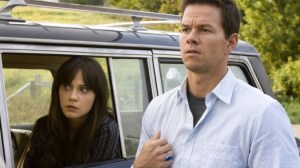 The Happening is no Lady in the Water, thankfully. The premise is pretty interesting in a feature-length Twilight Zone kind of way. Shyamalan does know how to spin an interesting idea and watch social paranoia explode. The best moments of The Happening take place during its beginning where confusion and panic reign. Shyamalan then takes a page from 2005’s War of the Worlds and follows the perspective of a handful of normal folk as the experience an apocalyptic event. We even spend the third act hiding out in the home of a crazy person (the creepy Betty Buckley). Unfortunately, we in the audience feel no involvement with the poorly written main characters. Once again Shyamalan utilizes a horrific and unique encounter as the impetus for reconciling the pains in a marriage. At a scant 99 minutes, there isn’t much time set aside for building characterization. There is not a whiff of personal connection to this tale.
Shyamalan doesn’t seem to explore the psychological ramifications of his premise. Suicide is very traumatizing and it would have swept over the East Coast in waves; millions would be dead. Yet the characters and Shyamalan never seem to focus on this point. Perhaps they’re in shock but no one seems to actually react realistically to the possible end of the world. Normal people would be freaking out. I would be freaking out. The idea that the country goes back to normal after three months is preposterous. Would anyone want to live on the East Coast again after all that death? People would be finding bodies for many months after the “happening;” just look at the slow recovery of New Orleans. Never mind the hit the economy would take from millions of people expiring.
The ecological message can also be incessantly heavy-handed. Characters run past a sign for a housing development that advertises the slogan, “You deserve this.” Oh, gee, I get it. A TV host at the very end interviews a scientist theorizing that what happened was a warning from the environment to shape up and change our ways. The TV host is so incredulous that he actually says, “Well, I’d like to believe you doc, but maybe if it just happened somewhere else again, maybe then I could believe you.” You idiot, millions of people died and there are how many witnesses? I know exactly what message Shyamalan is trying to say (wake up, we can’t ignore the signs) but having a character denying the obvious is too ludicrous given what happens in the story.
 But the story does invite further inquiries. How exactly do the plants communicate with each other? I can understand root structures but how does a bush talk to a tree unless they share root structures? Do plants speak different languages? Can a bush talk with a tree, and do French bushes speak differently than their English brethren? The plants seem to react to large numbers of people, but how do they know when there’s say enough folk running around to kill? Do they smell people? That toxin seems to not affect animals but I don’t see how that could be possible given that, as far as I know, animals inhale the air as well. Of course, if all surrounding animals and insects were to keel over then that would irrevocably harm the ecosystem and endanger the plants. This must be why the “happening” lasts a little over a day, coincidentally ending just when our protagonists are about to give up. And if Mother Nature, as a form of population control, triggers this toxin release then wouldn’t it stand to reason that some place like China or India would be hit first instead of the Northeast United States? Shouldn’t a science teacher know that still air would be filled with more toxins than when the wind blows? I’ll give Shyamalan this — he was able to make me fear a tree. There was one moment where a little girl was on a swing that was bolted into a tree limb and the constant creaking made me nervous that they would anger the tree.
Despite the flaws in storytelling, this narrative still could have worked as is if it just had a better director at the helm. Shyamalan lets everyone down on this one. Much of the marketing angle was how The Happening is Shyamalan’s first foray into R-rated material, but you can tell he doesn’t feel comfortable showing more than implying. One sequence follows a police officer’s gun as different individuals take turns shooting themselves in the head. Shyamalan shoots this sequence like the camera weighed 800 pounds, so the shot never rises above people’s feet. We see the gun fall on the ground, feet walk over to the gun, hands pick it up and lift it off screen, then a very unconvincing gunshot sound effect, then the process repeats. By not actually seeing the deadly aftermath Shyamalan risks the sequence becoming unintentionally funny and it almost happens. This directorial technique does not raise suspense, and in fact, Shyamalan botches most of the potential suspense in The Happening. Given the premise, Shyamalan doesn’t find too many sequences that make the audience squirm. A man wandering around in a lion’s cage is so fake and played in the wrong tone that it just becomes goofy even when his arms get ripped off. There’s only one protracted horror sequence that shows true gore, where a man lies down in the path of a giant lawnmower and we start to see the machine ride over him and whirl its blades. However, even this scene could have gone longer to fully draw out the shock and terror. Shyamalan just doesn’t have the temerity for R-rated material, and as a result the movie could have been a lot more terrifying had the man embraced the gruesome potential of a more mature rating.
Shyamalan’s visual storytelling is pretty rote. I kept thinking to myself how poor everything seemed to be looking. The cinematography is lackluster and the shot compositions are rather bland. Part of what makes a horror movie effective is clever visual setups that slowly leak tension like air from a balloon. Shyamalan’s idea of drawing out tension is to watch tress blow in the wind. After a while, when you realize this is the one trick Shyamalan has, it gets old and extremely boring. The Happening would have benefited from a stronger visual storyteller who could also goose the narrative with better-constructed scares. It’s disappointing because Shyamalan was able to elicit top-notch suspense in 2002’s Signs with simple sounds and the imagination. Now, when he’s given the chance to show terror he falls on his face.
 Another dent to Shyamalan’s direction is the fact that the actors all give bad performances. Wahlberg and Deschanel have given great performances in other movies so I know they are capable of more, and the blame must lie at the feet of Shyamalan. They overact with gusto and always seem to never be fully immersed in the reality of the drama. Even Wahlberg’s first line delivery raises your eyebrow because it seems too amateurish and flat. Deschanel is even worse and whatever emotion she is playing in a scene is the wrong emotion. She’s whiny and overly childlike when she should be reflective and contemplative, she’s wide-eyed and weepy when she should be tender, and she’s bad with just about every line. Alma is a weak character and seems to turn everything back to an injustice against her, even when people are killing themselves en mass. Part of the actors’ woes is complicated by Shyamalan’s wooden dialogue, which includes gems like, “We’ve just got to stay ahead of the wind” (how exactly does one do that?) and, “We’re not going to stand around like uninvolved bystanders” (who says that?). The most shocking aspect of The Happening is that Shyamalan totally betrays the trust of his very competent actors.
M. Night Shyamalan would be best served in the future by focusing on one role. He could direct someone else’s material or he could write and have someone else direct. If he had gone the latter route I’m convinced that The Happening would have worked even with a flawed script. The movie is too timid to push the horror boundaries available to a mature rating, the suspense is minute, and Shyamalan completely leaves his actors hanging out to dry. There is some laugh out loud moments of unintentional hilarity (like when Wahlberg calmly says “Oh no” upon hearing suicidal gunshots), but the movie also has moments of intrigue amidst its heavy-handed environmental message. Statistically, if there were a killer toxin there would be those who would be genetically immune to it, much like the scenario in I Am Legend. I have to say that if I was fortunate enough to survive I would whisper some threatening words to some choice flora and then I would set lots and lots of fires out of revenge. Take that, you stinking vegetation!
Nate’s Grade: C
Share this:

The Counterfeiters (2007)
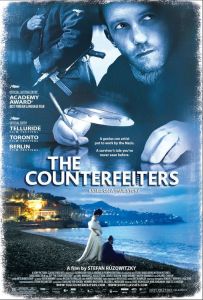 The Oscar-winner for 2007 foreign film is certainly a fine film and a respectable winner, but let’s be honest, the foreign film category was watered down a tad. France nominated Persepolis over The Diving Bell and the Butterfly because a country is only allowed to nominate a single film (sucks to be you, countries with good movies). This rule has resulted in past incidents like Spain nominating Tuesdays in the Sun over Pedro Almodovar’s Talk to Her, which ended up winning the 2002 Best Original Screenplay Oscar despite Spain’s snub. The hard decision by France was moot because Persepolis didn’t make the Academy 2007 shortlist of nine nominees. The biggest snub from that shortlist was Romania’s 4 Months, 3 Weeks, and 2 Days, a harrowing film about two college-aged women seeking an illegal abortion in 1980s communist Romania. It won the Palme d’Or at the Cannes Film Festival and also won the Best Picture award by the European Film Awards (Austria’s The Counterfeiters wasn’t even nominated). Then there was Israel’s amusing and touching film, The Band’s Visit, about an Egyptian band that takes a wrong bus and finds itself in an Israeli town. But the Academy’s foreign films ruled that The Band’s Visit had too much spoken English and therefore could not be ruled as a foreign film. Also left out were Germany’s Edge of Heaven and Spain’s The Orphanage. Nothing against The Counterfeiters but the foreign language field had already snubbed most of the main contenders.
The Counterfeiters is a deeply fascinating true-story about the world’s largest counterfeiting ring. Sal Sorowitsch (Karl Markovics, with a face as hard as flint) is a master forger leading a life of luxury in Berlin until the police capture him and send him to a concentration camp with his fellow Jews. As World War II carries on, the Nazis recruit Sal to lead a team to forge the British pound and the American dollar. The Nazis hope to destabilize their enemies’ economies. Sal is given greater freedoms in the camp and the S.S. officers try to become his chums. But he has to ask himself what his cost his actions will have. He could be prolonging the conflict and actually helping Germany win, but if he doesn’t assist the Nazis then he will surely be murdered as will his team.
Write/director Stefan Ruzowitzky creates great tension from scene to scene but it is the moral dilemmas that stick. What are principles worth? Are they worth dying for? Are they worth endangering others’ lives? The movie takes a docu-drama approach with bobbing handheld camerawork; even the film stock looks like it was soaked in grime for authenticity. And yet I wish The Counterfeiters had chosen to be less enigmatic. The main character is a criminal that keeps his emotions close to the vest, but Ruzowitzky cheats the audience by keeping Sal mostly in his head. The story is filled with factual intrigue and the natural tension given the situation, but after it’s over there isn’t much that’s memorable for a genre that expects more of itself. The Holocaust genre (and let’s not kid ourselves, it is a genre at this point) has some pretty high dramatic expectations and produces films that sear into our brains. The Counterfeiters is a very well told tale with great acting and some interesting character relationships but it can’t fully measure up to other Holocaust parables.
Nate’s Grade: B+
Share this:

The Ruins (2008)
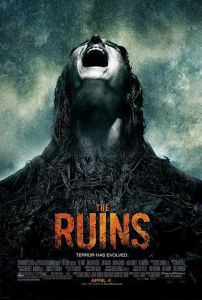 Author Scott Smith is from Ohio, my home state, which makes me like him. What made me respect him was his adaptation of his own novel, A Simple Plan. The movie version was splendid and taut, well acted and riveting and disturbing. Smith even received an Oscar nomination for his screen adaptation. When Smith released The Ruins, his second book, in 2006 I was mildly intrigued but never got around to reading it. Something about tourists, and Mayan temples, and bad things, and it got plenty of good reviews. Then I saw that Hollywood was producing a film version and that Smith had written the screenplay himself. Well, I figured, I’m going to be in for a chilling treat. Let’s just say my opinion of Smith has been slightly diminished.
Four over privileged American tourists are enjoying their final hours of a vacation to Mexico. Jeff (Jonathan Tucker) is studying to be a doctor. His girlfriend Amy (Jenna Malone) is best friends with Stacy (Laura Ramsey), and the two pal around together. Stacy’s boyfriend Eric (X-Men’s Shawn Ashmore) is along for the ride and enjoying every sun-soaked, boozy second. Lounging around the hotel pool, the group comes across a German (Joe Anderson, Across the Universe) who has a map to a hidden Mayan ruin. It’s a bit off the beaten path but the group decides to witness some genuine history. They take a taxi 12 miles into the jungle, hoof the rest, and discover a not very well hidden path to a not very well hidden Mayan temple (seriously, you’re going to have to do better than a couple of palm leaves if you want to obscure the path and keep people out. Try a fence next time). As soon as they arrive so do a band of armed Mayans that really insist the tourists do not leave the site. The Mayans chase the tourists onto the ruins and then they set camp around the perimeter. The Americans are being kept quarantined. Why? Inside and atop the ruins are a deadly plant that has a powerful hunger.
 For a horror movie filled with unremarkable and generally unlikable characters, I must say that they at least don’t do anything incredibly stupid as is accustomed to the genre. Once they are chased to the top of the ruins you, the audience, are now put in their shoes. Every choice they make seems decently reasoned and cautious, exploring their surroundings and testing their boundaries. The Ruins features cheesy killer plants, yes, but the more interesting element to me was the survival game. These characters are quarantined in a remote area with little water, armed guards, and a handful of useful tools. What will they do next? This scenario grabbed my interest, as I played out my own personal survival scenario step-by-step and it wasn’t too different from what befalls the characters onscreen. However, I’m surprised no one tried setting the freakin’ plants on fire. The eventual psychological meltdowns and increasingly grim outlook help The Ruins maintain some level of credible drama.
But I think in the end I just couldn’t get over the fact that the main culprit was killer fauna. I can accept carnivorous plants, but seeing them is a whole different matter. Somewhere from pages to screen a step was forgotten to make them believable. The ancient plant system inhabiting the ruins looks like an overgrown swatch of ivy and marijuana leaves, and the vines would slowly inch forward to retrieve fallen pieces of meat. It’s downright comical to see a stringy piece of a vine trying to discreetly drag a dead body away, and frankly that’s where the movie fails. I shouldn’t be giggling at the killer plants. The execution comes across as way too goofy and made me shudder that I could be watching Little Mayan Shop of Horrors. I’m also wary that this highly localized plant has evolved to the point that it can duplicate exact sound. It mimics a specific cell phone ring tone to lure our vacationers deeper inside the ruins. Now, how in the world would it know well enough to do that? I can’t imagine in its potentially thousands of years of existence that it was come across a significant amount of cell phones. How would it know that exact sound would effectively lure others? I did enjoy the notion that the indigenous birds and insects have wised up and learned generations ago not to go anywhere near the ruins. Let this be a lesson to you, backpackers of America, that when insects refuse to go somewhere then perhaps you should take note.
 The Ruins should play out with a slow-burn sense of dread where the characters sadly realize with setback after setback that they are doomed; to be played right the plot needs to be methodical. Instead, Smith’s adaptation is more like a haunted house tale with crummy, obvious jump scares and lackluster spook setups. It seems like most of the film is intended to be a setup but the payoff is badly muffed, like seeing the stupid thin, twisty vines creeping out to sneak inside people’s open wounds. The Ruins has some fittingly disturbing scenes where something is moving and growing under the surfaces of people’s skin, but then you remember it’s just a plant vine and your mind starts racing with questions that illuminate how inane this whole situation comes across (How does a plant stem continue to grow inside a human body? What purpose does having an offshoot inside the prey serve? How does it penetrate open wounds without anyone noticing at all? Why should I be watching this?). I would have preferred if the under-the-skin creatures were some kind of insect or worm that had a symbiotic relationship with the plants. That would be cool and far creepier than stupid ivy vines.
From a gore standpoint, The Ruins has a few squirm-inducing moments. One character is badly injured and needs to have their legs amputated to survive. Oddly enough, this amputation sequence comes across as the most memorable part of a movie dealing with killer vegetation that can mimic cell phone ringtones and, later, lovemaking noises (now who goes out to have sex atop Mayan ruins?). The imprecise nature of the amputation is what makes it so gruesome. In one feel swoop, this character has to have leg bones crushed, then legs sliced off, and then have the stumps cauterized with a frying pan. And the only anesthetic is a bottle of Jack Daniels. Yikes. The amputation is played out with a deliberate pace and allows a satisfying buildup of nervous, queasy anticipation. Aside from that, there isn’t anything notable from the makeup department.
 None of the characters approach anything closely resembling characterization, but the acting is a notch above what you might expect from a horror movie populated with expendable, good-looking twenty-somethings. Tucker makes for a capable lead and projects a cool and controlled persona, never rising to hysterics. When he does realize the inevitable he begins to crack and it’s more effective because of how stoic he was before. The actor who gets tested the most is Ramsey, and this isn’t because she started her career in the derided “reality TV documentary” The Real Cancun. Her character is put through an emotional wringer and she sells the distress and Stacy’s fraying mental state. I never once was tempted to laugh even as she sliced herself open and fished around her insides. Malone and Ashmore are stuck being in the stock roles of whiny girlfriend and horny carefree dude.
The Ruins is a horror movie that’s far from horrible but not scary or perverse or funny enough to be recommended. The setup of isolation in unfamiliar territory could definitely produce some chills and thrills, however, when you throw in a ridiculous carnivorous plant that looks as menacing as your mother’s flower bed, well then, things just fall apart. I’m sure The Ruins worked well on the page, since it demands the reader create their own version of what goes bump in the night. Too bad that when you see it fully realized on the big screen it comes across as stupid. I really expected a lot more from Smith than this. The Ruins doesn’t justify why it should be treated any different than cheap, straight-to-DVD cheesy horror flicks (If there are multiple horror movies about killer snowmen, then there has to be an entire sub-genre of killer plants). I know M. Night Shyamalan’s upcoming summer release The Happening also features plants turning on humans. Let’s hope the creative force that brought us Lady in the Water can do more with the subject.
Nate’s Grade: C


You must be logged in to post a comment.