Blog Archives
Taken (2009)
 From La Femme Nikita to District B13, the French know how to make a rollicking action movie, and Taken is no different. Liam Neeson plays a former covert government agent who has his daughter (Maggie Grace) kidnapped by the Parisian sex trade. He tells his daughters abductors to let his daughter go, and if they don’t he will find them and he will kill them. “Good luck,” says the abductor. And we’re off! At this point, the movie completely had me and I was ready to watch Oscar Schindler kick all kinds of ass. Having an actor of Neeson’s caliber involved in the rigorous derring-do helps ground the fantastic coincidences and leaps of logic inherent with an action movie. The action is briskly paced (the movie barely clocks in at 91 minutes) and fairly consistent, though I admit that the movie never felt like it was building in intensity, only changing locations. There’s some lip-service paid to topical issues like sex trafficking, but really Taken is all about watching Neeson karate chop dudes in the neck, which he does a lot. I started fearing for the safety of my own neck, like Neeson would jump out of the shadows and give my neck a good punch. You may need to shut your brain off at parts, but Taken is an undeniably fun experience and I look forward to the inevitable sequels (Neeson: “What, something else has been taken… from me!”). Taken is a rock-solid action movie with plenty of terrific and thrilling set pieces that pack more punch than plenty of expensive Hollywood summer capers.
Nate’s Grade: B
Share this:

Repo! The Genetic Opera (2008)
 In a dystopian future, organ failure has become an epidemic. Fortunately, the GeneCo Corporation and its CEO Rotti Largo (Paul Sorvino) have devised a solution. They will loan out new organs to those in need. However, if the customer happens to be late on a payment then GeneCo sends out the Repo Man. This hooded figure will track you down and surgically remove GeneCo’s property, and perhaps they’ll harvest the rest of you too. People become obsessed with surgery upgrades (just think what wonders a third kidney could do for you). Blind Mag (Sarah Brightman) is a famous opera singer that signed a contract for new corneas. She’s now reconsidering retiring from the stage, no matter what that means. There’s also a powerful pain killer known as Zydrate that can be extracted from fresh corpses. Anyone caught robbing graves will be shot on sight.
One repo man, Nathan Wallace (Anthony Stewart Head), is working to keep his daughter safe. Shilo (Alexa Vega) has a rare blood disease she inherited from her mother, who died in childbirth. Nathan must keep her locked away in order for her to survive. His daughter must never know his true identity as a repo man. Rotti is informed that he is dying from inoperable cancer. His trio of bratty, homicidally crazy children (Paris Hilton, Bill Moseley, Nivek Ogre) are all fighting over who will get to run GeneCo once dad’s dead. Rotti plans a big bloody finale for everyone at the Genetic Opera’s final curtain call.
To answer the most burning question, yes it is an opera. There are perhaps five spoken lines and the rest of the movie is completely sung; you will get a solid 85 minutes of people singing while they engage in plenty of questionable acts. To say that Repo is unique is a disservice to the flick. I cannot imagine watching another movie that combines opera, vivisection, surgery addiction, Gothic costuming, and Paris Hilton actually doing a credible performance. Knowing that it is indeed a full-fledged opera, it mostly eliminates the snickers that arise from watching actors break into song at curious moments; when they’re singing all the time you’re more aware when they stop. It’s a futuristic rock opera that exists in the realm of a horror movie. There are several dispirited elements that can be occasionally awkward but that isn’t necessarily the flick’s fault. I just haven’t witnessed too many folks singing while arm-deep inside an exposed chest cavity. The movie isn’t as bloody or gory as repulsed film critics have lead you to believe. There are about four sequences of horror gore, though the film does resort to casual violence that can be off-putting, like stabbing extras. Repo possesses a wickedly entertaining and gleeful spirit.
 But how is the music for such an avant guard enterprise? It’s pretty solid, actually. It won’t be everyone’s cup of tea, naturally with some vulgar lyrics, but the music is certainly well crafted, with strong melodies, catchy hooks, squealing guitars, and some rather impressive singing. The music is reminiscent of industrial rock acts but it also has some pretty flavorful pop styling (the pounding hard rock beats reminded me of the underrated band, kidneythieves). These are tunes that will stick in your grey matter. Some of the highlights include “Infected,” where Shilo laments her condition and says, “I’m infected/By your genetics!/Mother can you hear me?/Thanks for the disease!” The tune is likely the catchiest of them all and has a fun pop-punk melody that becomes a leitmotif. Vega also proves immediately that she can sing. “Zydrate Anatomy” is led by the charming vocals of the Graverobber (Terrance Zdunich, who co-wrote the music and lyrics) as he exposits to the audience the ins and outs of the drug market. The guitars careen and the backup junkie chorus (“A little black vial? A little black vial!”) add some depth to the tune. But least you think it’s all Goth rock, Repo mixes in traditional arrangements as well, including plenty of harried violins, cellos, and some classical opera music. There are also subdued ballads like “I Didn’t Know I’d Love You So Much” and “Genetic Emancipation” that conclude the film on a high note. It all blends together into a unique soundscape that’s well worth singing along to.
Unlike the big screen version of Mamma Mia, the cast of Repo can actually sing, and they sing quite well. Vega (Spy Kids) sounds like a better Avril Lavigne than Avril Lavigne. She’s an ingénue that actually gets some good songs. Fans of Buffy the Vampire Slayer will recall that Head gave a standout performance on the TV show’s musical episode, and here he shows his amazing lung capacity. Head has a rich tenor voice that is lovely to hear. He howls with soulful anguish and holds onto notes for long duration. It’s tricky to present a performance only through song and Head has the most complex role (in one song he laments that “I’m the monster!/I’m the villain!”). Head also switches over into a gravely demonic voice, like his maniacal “I’m on the job” voice to frighten his victims. The personality shift is a credit to Head’s vocal range. The rest of the cast includes singers with actual opera experience (Sorvino, Brightman) and musicians (Skinny Puppy’s Ogre), and then there’s Hilton. She’s already proven with one flop album that the hotel heiress is not the surest singer in the world. However, she works with the material as a spoiled rich kid consumed by her vanity (at one point her face literally falls off).
 Repo! The Genetic Opera plays better as a soundtrack than as a movie. The story is mostly simple but still manages to be confusing at points because of unresolved subplots. The characters are given glimmers of outgrowing their stock roles, but most of them just accept their underwritten fates. Repo seems like it’s on the verge of making social commentary on vanity, man’s compulsion to destroy himself to live outside one’s means, the disposable nature of beauty, destiny versus free will, but it never really delves deeper. The surface is barely skimmed and then the movie kind of chugs along at a super brisk pace. The movie has a trashy, campy atmosphere that can wear thin at times, especially under director Darren Lynn Bousman’s lackluster lens. I know this is low budget but Bousman doesn’t conceal the budget limitations too well and his shot selections can seem rather redundant and mundane for a music video, let alone a feature length film. With that said, this is still worlds more ambitious than Bousman punishing audiences with another Saw sequel (he directed Saw 2-4 and took time off from 5 for this flick). Some of the songs, while fun, seem out of place given the narrative, like the punkish “Seventeen” where Vega declares her womanhood and pretends to be a rock star and pounces around her bedroom, complete with dancing stuffed animals. It’s almost like a Miley Cyrus/Hannah Montana moment of strange daydreaming. The finale at the opera is a tad overwrought and yet it seems appropriate given the operatic backdrop.
I’m dumbfounded that some critics would cite Repo! The Genetic Opera as the worst film of 2008. How could something this ambitious, with such a killer soundtrack, be worse than 88 Minutes, The Hottie and the Nottie, and the atrociously harmful Meet the Spartans? The movie is far from perfect and is bizarre, messy, and somewhat shambling, but I have a healthy appreciation for a film that tries something different, whether or not it succeeds. A bloody rock opera seems like it’s begging to be considered midnight movie material, but it’s better than that. This curious experiment works better as a soundtrack than a movie, but it’s well worth seeing because, really, when are you going to catch another freaking movie like this? If you ever venture inside a Gothic-themed club, you can expect to see this movie playing on a TV somewhere until the end of time. My advice: buy the soundtrack and get ready to have the songs take root in your brain.
Nate’s Grade: B-
Share this:

The Bank Job (2008)
 An intelligent and rather crackling heist movie that also happens to be based on a true story. The 1971 British bank heist has so many characters involved that you may need a helpful cheat sheet, especially when it comes to varied loyalties. There are three separate groups all playing their own game, and when the heist doesn’t go exactly according to plan, and then the movie gets even more complicated. It’s a flavorful and funny heist movie that also doesn’t ignore the severe repercussions and life-and-death stakes. The Bank Job is an engrossing crime caper that still manages to thrill and surprise an audience.
Nate’s Grade: B+
Share this:

The Day the Earth Stood Still (2008)
 The 1951 original The Day the Earth Stood Still is considered a sci-fi classic for a reason. Versatile director Robert Wise (West Side Story, The Sound of Music) used a robot and an alien invader to help hold a mirror up to the world, asking how humanity was treating its brethren. The technology is easily dated and the tone a bit stately, but the movie is a complex, thoughtful, and relevant tale that begs for caution and kindness. It still holds up much better than most sci-fi chestnuts from yesteryear. And of course anything that film audiences have warm feelings for will be repackaged by Hollywood into a new more mass-appealing product. That means that big-budget Day the Earth Stood Still remake is likely to have no real improvement over the original. Well, it is in color. That’s an improvement for some.
A giant glowing spaceship lands in New York City’s Central Park. A glowing figure exits the craft and enters our world. This figure is Klaatu (Keanu Reeves) who is an alien creature in the guide of a human body. He has been sent by a community of planets to judge the inhabitants of the Earth. You see, the universe is an awfully large expanse of space but it has a limited number of habitable planets. The rest of the universe is taking note of how human beings have treated their home, and they may just decide that the planet is better off without us. Klaatu is helped out by a sympathetic scientist, Helen Benson (Jennifer Connelly). Eventually the alien escapes and the entire U.S. government is on high alert. Helen is trying to convince Klaatu to not rush to judgment. She’s also trying to connect with her angry step-son Jacob (Jaden Smith) after his father died in war. He’s not very trustful of Klaatu and, like plenty of other people, wants the alien dead.
 Whereas the original was a cautionary tale about the Cold War and mutual destruction, and Klaatu was a peaceful Christ-like figure, the new version skips all this. It would rather recycle a message that human beings need to be nicer to Mother Nature. Now, this is an important concern but it’s harder to take seriously when the movie pretends it’s all about doom and gloom and then basically wimps out on an ending. The film is ready to wipe humanity off the globe and even gets a head start with what looks like swarms of microscopic metallic locusts. But then Klaatu looks out at mother and child, embracing as the world they know may come to an end, and concludes that human beings deserve yet another chance because they have the ability to “change.” That’s all it takes? This kind of cop-out ending reminds me of The Happening, another eco-horror movie that wanted to kill off all those pesky humans but then decided they could walk the Earth a tad longer and hopefully wiser. I’m sorry but this is weak. Profess an environmental message but do something with it, don’t thump your chest about taking personal responsibility and then skimp on repercussions. Remember filmmakers that this is fiction. You have the ability, nay the right, to destroy mankind on screen while I safely watch and consume popcorn.
You know what else keeps hurting the weight of the environmental message? The lousy relationship between Helen and her step-son Jason. This entire storyline needs to not exist. I recognize that the original movie had a substantial storyline where a single mom and her precocious son befriend Klaatu, but that doesn’t mean this remake has to reignite old storylines if they just simply won’t work in this retelling. Every time the movie spends significant time with Helen and Jason I felt like the Earth was standing still. This storyline just does not fit. The kid comes across as bratty and dumb and I actually wanted him to be micro-locust food at some points. He’s angry because his father died and that makes him argue that “Kill them all” is a serviceable foreign policy position. Whatever. This storyline is handled so terribly that every moment of drama it is intended to evoke hits with a resounding thud. When the little kid suddenly turns on a dime and helps his alien fugitive, there’s no explanation. He says he’s afraid of being alone. Well what did you think would happen when you called the U.S. government to come and abduct you? I swear that I do not have a heart of stone, and I love children, but every moment of this character felt false and annoyingly so. That’s why The Day the Earth Stood Still grinds to a halt whenever it switches back to this kid. It makes the whole alien threat a lot less menacing when we spend more time with this kid. Don’t we have far more significant things going on in this story than one kid working through his grief and learning to be less bratty?
 Director Scott Derickson (The Exorcism of Emily Rose) doesn’t have a firm handle on how to establish an exciting action set piece, and he also makes his points very bluntly, though that’s also due to the script by David Scarpa. The beginning is the best part of the film, as scientists are whisked away by government authorities who can only say that the threat to the planet is grave. Interest is piqued at this point, as we, like the scientists, try and discover with a mixture of curiosity and anxiety what exactly the Earth is facing. It doesn’t much improve after the 15-minute mark. The movie just looks so drab. There is a discerning lack of action or excitement in a movie that threatens to eliminate the human race. The movie has long boring stretches that almost kill all momentum, and then the movie tries to compensate with an avalanche of special effects.
There are plenty of intriguing concepts and conflicts that fall by the wayside. In the original Klaatu hid among human beings and came to understand people, but in this new version he’s on the run from the start. I don’t necessarily need some tired fish-out-of-water comedy with Keanu, but seeing him learn about humanity before making a judgment is vital to his character. The remake opens in 1928 with aliens taking a DNA sample from a mountain climber (also Keanu Reeves) and then they use his blood to create a human host. What if that guy is still alive and sees his face on the news? What about his family going through and wondering what connection they might all have to the fate of mankind? Wouldn’t it have been easy just to swap Connelly’s character into this role and thus she is the descendant of that mountain climber and has to look in her grandfather’s face as he proclaims humanity’s end? That storyline would be more interesting and playful than anything with the step-kid.
Occasionally sci-fi movies can be partially redeemed by superior special effects. The Day the Earth Stood Still has some pretty shoddy effects that didn’t look much better when I watched the film in IMAX. The aliens have scrapped the older model flying saucers and decide to travel in giant glowing spheres, which may be awe-inspiring to see in person but it’s mostly lame to watch on screen. It’s not even that hard of a CGI effect to perform. The new likeness is completely wrong for Gort, one of the most famous movie robots of all time. In the 1951 original, Gort was a teen foot tall robotic guardian for Klaatu. Derickson has made Gort 40 feet tall and he looks weirdly like an Oscar statuette. The awesome robot is ridiculously captured by the U.S. military so that they can try and drill into it, which makes no sense at all. Then the robot transforms into that swarm of robo-locusts and that’s the last we see Gort in action. That’s just dumb. I would much rather see a giant robot wrecking havoc than a swarm tear apart Giants Stadium. The filmmakers decided that a hazy cloud would be more visually interesting than a giant robot. Give me more Gort!
 I must say that hiring Reeves was the smartest move that the movie made. Reeves’ naturally stiff and aloof line delivery works nicely as an alien trying to some to grips with his new flesh and blood body. Reeves consistently entertains and adds a dash of fun that is mostly missing in this humorless and stubborn remake. Connelly works with what little she’s given, and man can she make her eyes glisten in the most beautiful manner, tearing up at a moment’s notice. Most of the other actors are wasted in stock roles, including Kathy Bates as the Secretary of Defense and Mad Men‘s Jon Hamm as a man who only serves to spout exposition. That’s the dashing Don Drapier, and you give him exposition? I won’t belittle Smith’s performance because in all honesty the kid is a fairly good actor. It’s not his fault he got stuck playing a dumb character that routinely hijacks the movie.
The newest Day the Earth Stood Still does little to justify its existence. This remake would have been better served either cribbing more of the superior original film or just cut off all ties. The remake tries to incorporate plot points that don’t work while also trying to tell its own environmental tale with bigger effects, which also doesn’t fully work. The Day the Earth Stood Still is a plodding and unnecessary remake that fails to stumble into an exciting scenario despite the fact that it involves aliens threatening the planet. But hey, it is in color.
Nate’s Grade: C
Share this:

Gran Torino (2008)
 Clint Eastwood is an icon but he’s also proven to be a remarkable and thoughtful director in his twilight years. When the star first traveled behind the camera he mostly stuck with the action films that were his cinematic bread and butter. Then he showed something grander with 1992’s Unforgiven and rebounded back to that quality with a string of critically lauded flicks like Mystic River, Million Dollar Baby, Flags of our Fathers, and Letters from Iwo Jima. Three of those films were nominated for Best Picture, including three Best Director noms, and Baby won. The prolific screen icon has taken his directing skills up to another level in his older age and Eastwood has chosen to work on somber, mature, and meditative tales. Gran Torino is a movie caught between two different eras of Eastwood direction. It has the sheen and intentions of one of the recent loftier works and the film also taps into the suspense of his earlier action vehicles. It’s the only non-Batman movie targeted for Oscars this year that features ass kicking.
Walt Kowalski (Eastwood) is a retired Korean War veteran living in Detroit. He worked on the Ford factory lines for over 30 years and now has the pleasure of seeing his spoiled children driving foreign cars. His neighborhood has been inundated with Hmong immigrants from South East Asia. It seems the Hmong people sided with the Americans during the Vietnam War, and when the Americans left, well, it didn’t turn out so well for them. One old Hmong lady chastises Walt as a stupid old man and doesn’t know why he hasn’t fled like the other whites that used to live in the neighborhood. Things aren’t like they used to be. Gangs run rampant and terrorize the people into silence. We’re told that when it comes to the Hmong, the women go to college and the men go to jail. A Hmong gang keeps trying to recruit Tao (Bee Vang) into their ranks. He is looked down upon as a weakling and for doing women’s work, like gardening and the dishes. His initiation into the gang is to steal Walt’s pristine 1972 Gran Torino, the old man’s prized possession and one he helped build on the assembly line. Walt catches Tao in the act and eventually the boy works for Walt to repay the offense. Together, Walt and Tao form an unlikely bond. His Hmong neighbors cherish Walt for saving Tao from the gangs and the community opens its arms to him. Walt helps Tao find a job and stand up for himself, but the pull of the gangs is too strong. Walt realizes that Tao and his bright sister Sue (Ahney Her) will never be allowed to have a future as long as the Hmong gang is around.
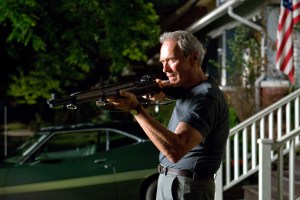 It’s hard to take the movie purely on the surface without some preparation. Because in synopsis, Gran Torino sounds like a ham-fisted after school special where Old Man Dirty Harry teaches the youngsters about the dangers of gangs and violence. The film is hard to fully describe without it sounding like a parody. Yet Gran Torino manages to come together along the journey. The movie balances gracefully even when it seems like it is going to dip into self-parody. Simply put, having Eastwood point a gun and growl, “Get off my lawn,” the quintessential geezer line, is almost calling out for ridicule. The gang storyline feels at times incredibly natural in approach and its casual, realistic dialogue, and at other times the storyline, like the film, feels like it is leading you by the nose. Some of the stock characters are sketched so thin, like the self-centered granddaughter who wears a midriff-bearing outfit to her grandmother’s funeral (all the better to witness your navel piercing, my dear). The spoiled children and grandchildren come across as too broad to be believable. The messages are all familiar, the characters are even somewhat familiar, but Gran Torino emerges as something more understated and perceptive than “Archie Bunker with a gun.” It’s a moderately rich character piece that follows one man resorting to his better nature in his golden years. Walt’s redemption may be predictable from the first minute but that doesn’t make Gran Torino any less satisfying. In fact, the movie on a whole is an embarrassingly entertaining experience. Sure, there’s a certain primal rah-rah vengeance angle to it, and watching a 78-year-old man kick around some youngster is always worth watching. But the novelty of the movie is not cheap xenophobic wish fulfillment, watching an old white war vet eliminate the immigrants in his neighborhood. The draw of this movie is an old-fashioned tale told well, which is equally earnest and glum.
The dialogue can be forcibly blunt as it spits out every offensive racial epithet, slur, and stereotype known to human ears (it’s practically the comedy routine of the unfunny Carlos Mencia). The screenplay by Nick Schenk confuses racist pabulum with comedy gold, like hearing an old lady cuss, but Eastwood manages to make it work. The rampant racist dialogue tends to get tiresome unless it begins to chip away and reveal more about a character. Naturally, Walt shuns being politically correct because he is uncompromising. He shakes his head and glowers at what the kids today have turned into. He’s meant to make others feel the same discomfort he feels in today’s world, and words are his weapons at his old age. The backbone of the script is the friendship Walt forms with Tao and his family. Because it begins so reluctantly and moves at a steady pace, the audience is emotionally invested and the friendship is rewarding to witness. The movie presents a fairly universal message about the redemptive power of human kindness, of helping one’s neighbor. It’s a petty big melting pot out there and there’s no reason to dig in and combat change. Gran Torino lacks the forced sanctimony and transparent manipulation of other “important” race-relations movies, like 2005’s Best Picture-winning Crash.
 The movie is impossible to view without it also becoming a commentary on an iconic actor’s screen legacy. What does a retired Dirty Harry at 80 look like? I imagine something like Walt, an embittered war vet grumbling about the change all around him that he is powerless to ignore. Eastwood takes great pains to be an angry curmudgeon even until the end, which allows the actor to tap his little seen comic ability. There’s a funny scene where Walt takes Tao to the barbershop for a lesson in how to “talk like a man,” which naturally involves playfully insulting your fellow man. Eastwood knows how to make a racist and standoffish character sympathetic and engaging. It’s a pleasure watching Walt become affectionate and protective, and yet the character’s redemption doesn’t ever feel contrived. His character is scarred and weary and wears his pants up to his armpits, but Clint makes it work. He can be sad and badass and appalling all at the same time. The character is somewhat similar to his character in Million Dollar Baby, a grumpy man closed off to the world who mentors a young kid. The flick presents a semi-dignified swan song to what happens when men of action grow old.
Eastwood directs with his typical steady hand and cool decision-making. The camerawork is intimate and sparing, never yanking the audience out of the story. The visuals mimic the characters in that nothing feels over polished. I enjoyed the small bits that pointed to something deeper, like Walt pointing his finger, a pistol and lining up his antagonists. I also enjoyed that Walt refrains from ever spilling his guts about his guilt during the Korean War except in a way that feels true to the character. Eastwood also shows a bit of his directorial prowess by hiring a bunch of Hmong actors that have had no acting experience. Some of them fare better than others, and some are in fact kind of bad, but this decision makes the movie feel more authentic. Now, it’s rare for me to cite sketchy acting as a plus for a movie, and that should be a testament to Eastwood’s directing skills. The man has a way with people; since 2003 he’s directed four different actors to Oscars. It must have been what Angelina Jolie was hoping for when she signed up for Changeling, the earlier Eastwood directorial effort from the fall. I think the biggest mistake Eastwood makes as a director is singing the closing song that unrolls right before the credits. Clint’s raspy singing voice is not the best way to close a movie.
 Gran Torino isn’t among the same ranks as Eastwood’s other output, like Letters from Iwo Jima or Mystic River, but it’s a small-scale story told with fortitude. Even as I write this review, and you dear reader read them, I feel like I’m failing in my attempt to make the movie sound good. True, on the surface it sounds like a bizarre after school special that would be destined to slip into self-parody and open mockery. Eastwood as star and director makes the material click. Walt’s journey from grumpy bigot to grumpy bigot who has opened up and made amends is greatly entertaining and humorous throughout. Gran Torino can be seen as a deconstructionist take on the fading era of Dirty Harry and Eastwood’s cinematic tough-guy legacy. Clint fans will eat all of this up.
Nate’s Grade: B+
Share this:

Let the Right One In (2008)
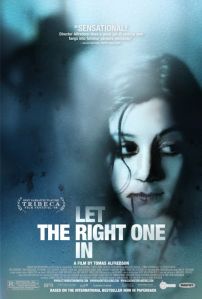 This is a pre-teen vampire love story that is miles away from Twilight folks; it’s solemn, mature, stark, violent, tense, and astoundingly ambiguous. Director Tomas Alfredson pares down the emotions and the entire film takes on a very reserved and curious atmosphere, which I feel heightens the sense of wonder and dread about a supernatural romance. The relationship between 12-year-old Oskar (Kare Hedebrant) and 12-year-old looking vampire girl Elie (Lina Leandersson) is entirely believable and constantly intriguing, as key information is doled out like breadcrumbs. Oskar is negotiating puberty and Elie is well aware of what awaits. The movie works as an example of methodical horror where emphasis is placed upon anticipation and the imagination. The climax at a community pool is one of the best film finishes of the year. I was a tense ball of nerves, and I love the movie’s closing shot. Even better, the movie works as an intriguing and intricate drama about human relationships. I can revisit Let the Right One In and dub it an unconventional and moving romance. Or I can revisit the film and dub it a melancholy examination of a manipulative and parasitic relationship, as Oskar might be doomed to a fated life like Elie’s former guardian. I can keep revisiting this Swedish horror film and discover more to discuss and diagram each time. And I didn’t need a single scene where the vampires played super hero baseball games.
Nate’s Grade: A-
Share this:

The X-Files: I Want to Believe (2008)
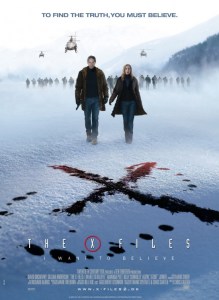 To all fellow X-Files fans out there, the movie is not nearly as bad as you may have been lead to believe. That said, it’s pretty much a so-so standalone episode of the TV show needlessly expanded. And yes, for all concerned fans, Mulder (David Duchovny) and Scully (Gillian Anderson) kiss on more than one occasion. The plot that reunites the characters is fairly mediocre, something about a ring of mad scientists that want to be a modern-day Dr. Frankenstein. You don’t need a two-headed attack dog to know that plot is way too hokey. The most intriguing aspect of the film is a priest (Billy Connolly) who also receives psychic visions, cries tears of blood, and, oh yeah, is a convicted pedophile. Could God be responsible for his special abilities as well as the abhorrent sexual urges? There is so much great conflict and human drama in this character worth examining, so it’s a pitiful shame that he just gets shoved off so the third act can concentrate on the lame mad scientists. A majority of the flick occurs in snowy West Virginia, which doesn’t translate into anything too special to look at. I’ll admit, my rating is inflated because I was an ardent fan of the TV show until the last years when it felt like they weren’t even trying any more. If you stripped away my allegiance, I’d say that the second X-Files movie serves little purpose other than to add a tiny coda to a TV show that went off the air in 2002. The characters are worth revisiting, just not in this tepid tale.
Nate’s Grade: C+
Share this:

The Eye (2008)
 This is a punishing and blandly mediocre movie, one that cannot inspire any strong feelings whatsoever. It’s a limp remake of a Korean horror movie where a blind woman gets an eye transplant and starts seeing ghostly creatures. The glossy American version stars Jessica Alba as said blind woman and watching her bump into furniture would have been more entertaining. The production values are competent, though the characters exist in a strange world where ordinary apartment buildings are designed like labyrinths. The horror elements are mostly of the “Boo”-variety and The Eye does little to establish whatever rules govern its spiritual universe. Why would closing a door stop a ghost in its tracks? It’s a ghost! The flick follows the tired plot device that ghosts have unfinished business and need flesh-and-blood humans to fix it. Come on ghosts, you’re dead, you got plenty of time on your hands. Eventually the movie transforms into a non-scary road trip to Mexico (there’s no way Alba would have gotten an international eye transplant) to learn about the poor eye donor’s unfortunate demise. This then leads into a contrived scenario where Alba must use her combined ghostly glimpses to save lives. The ending is just kind of pathetic as well. The Eye has a few nice stylistic touches, like what goes down in a Chinese restaurant, but the movie seems to exist as young male wish fulfillment. And by that I mean the concept of a beautiful woman who is blind and therefore doesn’t realize how beautiful she is. It’s the only way the majority of men can ever legitimately fantasize about having a shot with Jessica Alba.
Nate’s Grade: C
Share this:

88 Minutes (2008)
 Typically you can smell something wrong when a movie is continually delayed or held from release for well over a year. The serial killer thriller 88 Minutes actually began filming during the fall of 2005 (!). It was released in the United States well after it had been available on DVD in Europe for over a year. After watching all 108 minutes of 88 Minutes, it’s easy to see why the studio and the film’s astounding 20 producers (!!) were trying to hide this from public eyes.
Dr. Jack Gramm (Al Pacino) is the top forensic psychiatrist in Seattle. His testimony is responsible for convicting Jon Forster (Neal McDonough) of a death sentence. Many years later, Jon is now hours away from execution and still professing his innocence, claiming the real “Seattle Slayer” is still out there. Gramm works as a college professor and he can still woo the young ladies and beds them regularly. His assistant (Amy Brenneman) informs Gramm that a woman in his class has been murdered and her murder is patterned after the “Seattle Slayer” killings. Gramm believes that Forster is collaborating with someone on the outside to cast doubt on his conviction. Then as Gramm walks to class he gets an anonymous phone call that tells him he has 88 minutes to live. Gramm scrambles to try and use the time to figure out who is targeting him, framing him, and why. Could it be his assistant, his T.A. (Alicia Witt), his skeptical students (Benjamin McKenzie, Leelee Sobieski), the skeezy campus cop, or maybe the starting second baseman for the Seattle Mariners?
 First off, the time frame doesn’t work at all. 88 minutes is too short a time frame to do crack investigation, and Gramm runs all over the city of Seattle at least three times without getting caught in any gridlock. The movie establishes a real-time ticking clock but then decides to follow a different set of time. Occasionally the movie will be faster than real life, meaning that it says 10 minutes have passed when only say 6 have, and occasionally the movie will be slower than real life, like when the third act probably takes all of 10 minutes in the film’s universe. It’s not consistent and points out the flaw of the structure. The 88-minute countdown was supposed to add a feeling of suspense but what it does is add an extra level of incredulity. There is no way that 88 minutes would be a sufficient time for the killer to stage murder and mayhem around a large metropolitan city known for inclement weather. Seriously, is the killer trying to set unreasonable personal goals? Why not a three-hour window of time? That way the killer could have a healthy planning period without worrying that everything would collapse if they got stuck in traffic. Also, the 88-minute time frame allows glimpses into the anal retentive nature of our killer. Gramm is harassed by phone calls updating him on his declining time, but what’s truly special is when the killer defaces Gramm’s car saying how long he has to live to the minute. The killer must have known to the second when Gramm would come by his car because had the doc taken a different route, gotten a coffee, gone to the bathroom, or performed whatever other million actions then the death threat would be inaccurate.
Next, all the women are helpless sycophants. They think the world of Gramm and several of these twenty-something college girls have big time crushes on the aged Pacino. It’s hard to take seriously the idea that Gramm, in this context, is still a Lothario that he can bed any coed he sets his sleepy eyes upon. The fact that the movie opens with him waking up from his latest and naked conquest already gives the film a squeamish start, but when multiple characters all confess to having crushes on Gramm then the whole idea transforms into an uncomfortable stroking of Pacino’s vanity and virility. I suppose I shouldn’t expect too much from the plethora of female characters because they’re all in need of comfort and every one of them winds up a pitiful damsel in distress. We’re supposed to believe these are strong and capable women, all of them working alongside a criminal expert so perhaps they know a thing or two about self-defense. They fawn over the man and then inexplicably wind up in danger. Occasionally the women will experience dramatic setbacks and they all take a backseat toward getting a hug from Gramm. These women react to the sight of death in puzzling ways and then will just as easily move on to another topic.
 This is the kind of wretched movie where a flashback tragedy is defined by a memory so inane that it becomes insulting. Gramm keeps flashing back to a simple memory of his long deceased younger sister; she is running along the bank of a rather filthy looking river with a kite trailing inches behind her. Now, 88 Minutes is the type of movie where she has to giggle innocently and say something ridiculously non-descript, which in this case is, “[Giggle], dad look at the kite.” Of course Gramm is not her father (or is he?) and her call to look at the kite makes little sense because 1) its string is about three feet so it cannot go very high at all, and 2) it’s usually flying lower than the girl. I just find this image, this idea, this whole flashback construct to be emblematic of how truly awful and derivative and excruciating 88 Minutes can be.
I must confess there is one scene in 88 Minutes that I will remember for the rest of my life specifically because of how ridiculously appalling it is. Few scenes cause me to simultaneously stare in wide-eyed amazement and resist the urge to vomit. Here goes. Gramm is confronted by his FBI agent pal (William Forsythe) who has some bad news for Gramm. It turns out Gramm’s semen was found inside the “vaginal cavity” of the victim. We know Gramm wasn’t sexually involved with her because he was sexually involved with our opening naked escort lady, Sara Pollard (Leah Caims). Gramm then argues that someone out there framed him by killing Sara Pollard (oh don’t act surprised), retrieving Gramm’s semen from inside her, and then injecting it into the “vaginal cavity” of the victim. Hearing an actor of Pacino’s credit verbalize this theory is akin to having the “sex talk” with your parents, nay, grandparents — it’s just so intensely uncomfortable to watch. I just picture a lab tech with a long syringe that has to run around Seattle to make his semen import/export deadlines. This one icky moment stands out as the most ridiculously awful in a movie that is nothing but collective scenes of awful.
88 Minutes has no characters, only red herrings. Each of the numerous supporting characters is given the chance to act suspiciously and for no real good reason. Gramm takes his turn going through accusing nearly every supporting character he comes across as being in league with Forster. The screenplay even establishes characters like the painfully named Guy LaForge (Stephen Moyer, True Blood‘s Bill the Vampire) who serves no purpose other than to wear a leather jacket and squint in backgrounds.
 Forget anything approaching characterization because writer Gary Scott Thompson (The Fast and the Furious) has created a script that is woeful in every department, including thrills. The reveal of the killer is mishandled, as is most every plot point, and I’m at a total loss at the rationale of attempting to commit murder in a building the killer called in a bomb threat. Yeah there may not be students but there will be plenty of police sniffing around. More than half of the scenes involve people talking on cell phones. The dialogue is unintentionally hilarious more often than not, with lines like “Someone has penetrated my most secret place” and, “If I can’t forgive you I don’t deserve you,” and the killer taunting, “You see Jacko, I’m a true believer.” Need I remind you of the “vaginal cavity” conversation? This is a complete laughable mess that would have been just another half-rate direct-to-TV movies airing late nights on cable channels were it not for Pacino’s involvement.
Pacino doesn’t even try to hide his disillusionment with the movie. He comes across as sleepy-eyed to the point of being a zombie with a permanent case of bedhead (seriously, Pacino’s crazy hair steals the show). The man is going through the motions to collect a paycheck, and he even gets a couple scenes to work up the frothy barking Pacino voice that he has settled into for the past 15 years of acting. He never seems to be worried that he only has so many minutes to live, so why should we bother sweating? The rest of the cast is awful and they were likely lured to this doomed project because of the chance to work alongside Pacino. Leelee Sobieski must be singled out for being particularly atrocious, especially when she tries to play a tough girl. This has got to be her worst performance since she started speaking. Then again, she has worked with Uwe Boll (Fun fact: one of 88 Minutes‘ many producers is Boll’s longtime producer).
88 Minutes is bad in every possible manner of filmmaking. This is an embarrassment for everyone whose name’s is attached to this film. From the overly anxious musical score, to the choppy editing, to the lackluster cinematography, to the abysmal story and outlandish acting and the lazy direction, 88 Minutes is a cinematic catastrophe. It should only be watched at a safe distance and only with the intention of derisive enjoyment. Because while this movie fails at every level it may just end up becoming the funniest comedy of the year.
Nate’s Grade: D
Share this:

21 (2008)
 Glitzy, breezy, and 100 percent predictable, 21 is a simple con movie that goes through the motions with hyper realism. The most interesting part of the film, by far, is learning the systems that help these coeds fleece Vegas for thousands of dollars. In fact, the true story is far more interesting than this typical tale about a good kid who gets a big ego, pushes his true friends away, is humbled, and then learns a lesson while getting the girl too. What’s a MIT engineer want to go to Harvard med school for? And for that matter, you’re telling me there are no scholarships out there to brainy MIT students? Whatever the case, 21 will pass the time nicely without damaging your brain. The card games are ramped up with zooming camerawork and flashy special effects by director Robert Luketic (Legally Blonde), but it’s all window dressing to an interesting story that was white washed into a bland but undeniably commercial movie. It’s a fine time but, like Vegas, will leave you empty in the end. Still, you could do worse than overly stylized con movies about math whiz card sharks.
Nate’s Grade: C+


 nathanzoebl
You must be logged in to post a comment.