Blog Archives
Obsessed (2009)
 When it comes to derivative, generic, formula-laden movies, usually you can predict every step of the plot with great accuracy from the trailer. Obsessed may be the first movie I could predict every moment based just from seeing the poster. This poor man’s Fatal Attraction follows a surprise-free trip to the end credits. Idris Elba is a family man who is harassed and stalked by his increasingly psychotic temp/temptress (Ali Larter). The movie doesn’t even have the temerity to have its lead cheat on his wife. There?s an interracial angle that is never really dealt with, meaning that the lone plot detail separating Obsessed from its peers is also swept under the rug. Everything here is borrowed from better movies with more style, substance, and heat. Larter doesn’t work as an antagonist or a figure of lust. She acts like a disinterested and icy when she should be flirty and smoldering. The plot quickly gets ludicrous as Larter’s repeated seduction attempts get brazen and confrontational. It strains credibility that Elba would keep trying to keep things under wraps. This girl needs to be referred to the police. Alas, I suppose these stalker thrillers wouldn’t be as interesting if people reacted realistically to psychotic behavior. Beyonce Knowles is the angry wife who gets to exact vengeance during the movie?s all-out, hair-pulling climactic catfight. But it’s a long slog until that catfight.
Nate’s Grade; C
Share this:

The Taking of Pelham 123 (2009)
 This needless remake is yet another nail in the coffin for the filmmaker that is (was?) Tony Scott. The director seems to have a love affair with irritating and superfluous visual artifice. Scenes will jump into slow-mo, or stutter-stop speed, or the visuals will all of a sudden turn into blurry shadows. Scott proves yet again that he’d rather fiddle around with film stocks and random jarring effects than aid his narrative. The story of Pelham is rather mediocre, as a tattooed gunman (John Travolta) and his crew take a subway car hostage. A train dispatcher (Denzel Washington) becomes the only one allowed to speak to the gunman. Travolta is wholly unconvincing as a profane criminal mastermind. The villains are gruff idiots, some of whom think at the end that maybe, just maybe, they can get the jump on 30 armed policemen surrounding them. They were not the top of their class at Henchmen School. The story is frustrating and the character motivations for Travolta remain vague and unclear. Sure, he gets financial gain, but what else? What about his shady past? Why this specific route to this mundane goal? It’s like Scott and the movie simply just didn’t care anymore because they knew it was time for the film to end in a big chase scene. Also, the movie seems to make a case that NYC cops are the worst drivers in the world. They crash more cars than Billy Joel (joke brought to you by the year 2003). This is one train to miss.
Nate’s Grade: C
Share this:

Sin Nombre (2009)
 Part immigrant drama and part crime thriller, this stirring film is one of the rare instances where I was begging it to be longer. Writer/director Cary Fukunaga intertwines two tales, a southern Mexican family riding atop a train car to reach the U.S. border and the moral journey of a gang member who turns on his brothers during a crisis of conscious. Everybody is on the run, from the border patrols to the blood-thirsty gang members seeking vengeance. Fukunaga gives this tale startling realism without diverting to self-consciously docu-drama camerawork. I was fascinated by the details of life atop a train, the determination of these family members for a better life, and I was thrilled with the many near misses and escapes. Sin Nombre is such an accomplished movie that it’s hard to believe that it is Fukunaga’s first feature film. It mixes social commentary with film noir, an unlikely romance and plenty of naturalistic performances. The cinematography is gorgeous and crisp, beautifully showcasing the squalor and arresting countryside. My one complaint is that the movie gets into a new gear of added conflict, and then it quickly comes to an end at an all too brief 96 minutes. I really could have done with another 20-30 minutes of our main characters on the run for their lives. Sin Nombre roughly translates to “the nameless” and I can all but assure you that Fukunaga is a filmmaker who will most definitely not remain nameless.
Nate?s Grade: A-
Share this:

Drag Me to Hell (2009)
 Sam Raimi returns to his spook roots in this delightfully disgusting horror flick. Drag Me to Hell has such a gleefully playful and perverse personality, alternating between being scary, being gross, being funny, and circling back for more. This is camp of the highest hokey order, and Raimi infuses every moment with inspired schlock. Poor Alison Lohman, the bank loan officer cursed to be dragged to hell in three days time. She gets a lot of fluids sprayed into her face (there’s an oral obsession to this movie; lots of mouth stuff) and she takes it like a trooper. She’s put through a physical wringer here and maintains her dignity and believability among staples to the head, grave digging, and talking goats. The ending seems to be coasting to a predictable finish and then it hits you in the head, upsetting your sensibilities. I loved it. Drag Me to Hell, ultimately, is little more than a glossy, entertaining blow-off, a reminder what an inventive director can do with the horror genre. It doesn’t all have to be nubile teenagers escaping a knife-wielding maniac. If there is one lesson I’ve learned from movies and television, you do not anger the gypsies. They have a monopoly on curses and they are not afraid to use them.
Nate’s Grade: A-
Share this:

Max Payne (2008)
 I have no idea whatsoever what the point of this movie was. Adapted from the popular video game, Max Payne follows a hardened police officer played hysterically super serious by a grumpy Mark Wahlberg. He scowls, he grumbles, he chews over laugh-out-loud “tough guy” dialogue as he searches for his wife’s killer. For whatever reason, this storyline dovetails with a super drug on the streets that makes people see hallucinations of winged demons/angels. The entire storyline has no merit except to squeeze in some semi-cool effects shots. But when you know they’re all just hallucinations, what does it matter? Can that really be scary? But then these creatures seem to interact with reality and pull people to their deaths, so what are the rules here? There’s not an ounce of fun to be had amidst this drabby neo-noir landscape. The plot is a formulaic revenge tale, where every turn is easily telegraphed and every character is a one-note stock role, complete with the video game favorite of doe-eyed pixie girl who carries huge guns (Mila Kunis, why?). Even the action sequences are dour and dull. Max Payne is a movie that was built to exist in moments and not as a whole. The most troublesome aspect of this whole sodden adventure is how much the film openly fetishizes guns. The end credits are like a reel of money shots, watching glistening CGI guns rattle off. What better way to end such a thoughtless exercise in pseudo entertainment.
Nate’s Grade: D
Share this:

The International (2009)
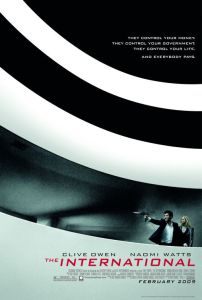 How much does one fantastic sequence count? Can it save an otherwise so-so movie? This is the case with The International, a plodding conspiracy thriller that is shockingly action-free sans two sequences. One sequence is a lackluster foot chase that serves as a frustrating anticlimactic climax. The other is a gripping shootout inside the Guggenheim museum in New York City between Clive Owen and some mercenaries. It is a fantastic piece of action cinema, expertly handled so that the geography is clear, the stakes get more fraught, and the twists and turns arise naturally. It feels like something out of one of the Bourne movies except with extra firepower. It is a terrific ten-minute sequence; the trouble is that is comes at about minute 70 and there isn’t much worth watching afterwards. The International is slow and fairly uninteresting. The flick thinks that by taking its time the movie will be more intriguing and involving. It?s not. The movie has one good sequence and it places it directly in the middle, just enough to snap you out of a stupor and get your hopes up that something equally entertaining will reemerge later. It doesn’t. The International is a snooze-worthy conspiracy thriller that just careens toward an incomplete ending. Take my advice: zip to the 70-minute mark and enjoy what you can.
Nate’s Grade: C
Share this:

The Hurt Locker (2009)
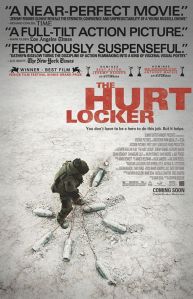 The Hurt Locker is an action movie on a very human scale. Sure there is a time and place for your Michael Bay-esque action vehicles, the type that scorch square miles and leave recognizable world cities in ruins. However, those kinds of action movies are never the kind where storytelling ever enters the fray beyond a meager question of how to get from Point/Explosion A to Point/Explosion B. In fact, Bay openly admits to planning the story of Transformers 2 by working on various action sequences during the 2007 writer’s strike and then tasking screenwriters to connect the dots. The Hurt Locker exists in a frighteningly believable world. This isn’t a movie about explosions but about the extinguishing of explosions. It follows the Explosives Ordinance Disposal (EOD) unit, tasked with detecting and detonating bombs and other improvised incendiary explosives (IED) in the field of combat. You will not be restless for loud “booms” while watching The Hurt Locker. In fact, you will be on pins and needles hoping that you never hear another loud “boom.”
Delta Company are the men responsible for protecting the other soldiers by disposing of bombs. The new team leader, Staff Sgt. William James (Jeremy Renner) has defused over 800 bombs during his tour of duty. He knows he’s the best and he’s addicted to the thrill of being so close to death. He will make occasionally reckless decisions putting himself, but not his fellow company men, at higher risk. This does not sit well with Sergeant JT Sanborn (Anthony Mackie), a by-the-book type that doesn’t appreciate his officer chasing a thrill. The other EOD unit member, Specialist Owen Eldridge (Brian Geraghty), is a man more accustomed to taking orders than giving them, and his indecision may have actually cost the life of the former head of the EOD. Both Sanborn and Eldridge worry that their new team member is going to get them all killed.
 Director Kathryn Bigelow (Near Dark, Point Break) has been directing male-centered action flicks for over two decades; it’s been seven years since her last feature, the regrettable Harrison Ford submarine flick, K-19: The Widowmaker. The Hurt Locker is her finest work to date by far. Her action sequences are visceral and downright agonizing to sit through. She is masterful at setting up the geography of the set piece, ratcheting up the suspense, adding organic obstacles and complications, and then makes sure with her camera and editing that an audience knows exactly what’s happening to whom for every minute that ticks off the clock. Bigelow takes her time to establish the particulars of her locations and sequences, allowing the audience to, surprise, understand what is happening and better engage in the movie. Bigelow chose to shoot the movie in Jordan, the neighboring country to Iraq, and the locations and actual refugee extras add an unvarnished sense of realism. The movie goes without music during much of the action, which makes it all the more uneasy. There isn’t any over eager composer telling you how you should feel, no direction that now things will get even more hairy. You will feel every second of danger, and Bigelow crams in a whole lot of danger. Things can go wrong very, very quickly.
There’s nothing to action cinema quite like the bomb that’s only a few tick-tocks away from doing its dirty work. Do you cut the yellow wire or the green wire? Never cut the red wire. The bombs found in Iraq are a stark range of death. There’s the crude incendiary device just wrapped up in garbage, but then there’s also the fiendishly clever devices with multiple charges and there are grotesque devices as well. At perhaps the film’s most guttural and shocking moment, Staff Sgt. William James finds the corpse of an innocent stuffed with explosives. The easiest thing would be to simply detonate the bomb, but that would also desecrate the body of someone we have come to know. Watching James snip open the crude stitching and dig inside the chest cavity, if we didn’t know then we know now, Bigelow has made sure that The Hurt Locker is the most emotionally resonating contemporary war film in memory.
 Bigelow and screenwriter Mark Boal, an Iraq War journalist, create a vivid sense of dread, antipathy, and most of all, paranoia. Is that a kite flying in the air or is that a signal? Is that a nondescript observer with a cell phone or is that a terrorist with a remote detonator? Is that child being friendly or collecting intelligence? Your mind will race through all these possibilities because Bigelow teases out her action sequences to an unbearably taut level. The audience cares about these soldiers and wants to see them make it back home (we’re informed how many days Delta Company has left on their tour throughout the film), which Bigelow uses to her advantage at every turn. What happens matters. My nerves were frayed during several sequences, including one where the soldiers are pinned down by distant enemy gunfire. The moment turns into a duel and a chess game, as each side tries to adjust their gaze in the searing heat and measure their long-range shot before the other side beats them to it. Then the sequence turns into a waiting game. This is the kind of movie that keeps you poised on the edge of your seat fearful that at any moment something disastrous will suddenly happen. Every time Staff Sgt. William James went back out to defuse another bomb, my sense of dread intensified. I began to doubt everything that I would ordinarily take for granted in other movies.
While being a top-notch action movie, Boal (In the Valley of Elah) has also crafted a great character study. In between the bomb episodes we learn more about these men, which makes it all the more hard to see them then head out to defuse another explosive. The film opens on a quote equating war as a drug, and we explore this notion through the character of Staff Sgt. William James and the weight his unique duty bears. It takes a special person to volunteer for defusing roadside bombs. The defuser must be extremely intelligent, be extremely cool under pressure, and be able to work in a giant suit that makes them look like a chubby astronaut, while enduring debilitating desert temperatures of 110 degrees. It sounds like a suicide mission. James is an adrenaline junkie and war is his drug. He exudes a Zen-like calm in the heat of the moment and this is now the only life for him. Shopping for cereal back home has lost its meaning. Being a husband has lost its meaning. His life now has one purpose. Renner (28 Weeks Later, North Country) gives a stirring performance laced with cavalier confidence and resignation. Mackie (Eagle Eye, We Are Marshall) is also another standout in the pared down cast. When he laments about the dishonor of having no one to remember you in death, you feel the man’s existential sorrow.
 Ignore the political cranks that decry The Hurt Locker as another partisan anti-war film from Hollywood. The American public has been mostly indifferent to any contemporary movie that aims to tackle our current military conflicts in Iraq and Afghanistan, but The Hurt Locker eschews the politics of war to focus on the realities and dangers of its characters. These guys are more concerned with surviving the next bomb than the politics of why they’re in the Middle East. The public has voted with their wallets and does not want to see the reality of war onscreen, or at least the Hollywood version of war reality, but I pray that those same people give The Hurt Locker a fighting chance. There is no preaching to be found here. The Hurt Locker could just have easily taken place during other wars, though the current Iraq War allows for added cultural dissonance (Is the central goal of bomb-defusing a metaphor for our conflict in the region?). This is a film that transcends politics and genre.
The Hurt Locker is more than an action movie, more than a war movie, more than a psychological study; this is an outstanding movie. This movie is a drug to the adrenaline senses and I need another hit. This is one of the finest films of the year and as it expands across the nation, I highly encourage everyone to seek out The Hurt Locker.
Nate’s Grade: A
Share this:

Tell No One (2008)
 Now this is a thriller made with surgical precision. This French film traces a doctor trying to uncover the mysterious murder of his wife, who may be alive after all. The doc needs to stay one step ahead of the police, who still think he’s responsible for his wife’s murder, and he has to also watch out for other shady figures who may be responsible for his wife’s disappearance. This engrossing thriller is character-based and while the twists and turns could induce whiplash, nothing feels totally out of place or unbelievable. This is a movie that holds up upon reflection. All the pieces fit together. Tell No One is exciting, intellectually stimulating, and it keeps you guessing, and yet the movie has a deep emotional core and resonates with palpable feeling. This is a terrific movie that should appeal to just about everybody with a pulse.
Nate’s Grade: A
Share this:

Angels & Demons (2009)
 Angels & Demons works better as a movie. It is a better movie than The Da Vinci Code, but since I found that film to be one of the worst of 2006 you should know this is not high praise.
Professor Robert Langdon (Tom Hanks, with a better haircut) is the world?s foremost expert on ancient symbols and texts, which is why the Vatican recruits him for a very important mission. The Pope has recently died and Vatican City is in the middle of the cardinals deliberating who will be the newest leader of the Roman Catholic Church. Four of the cardinals, top candidates for the Pope position, have been kidnapped. The Illuminati, a centuries-old secret society, says that a cardinal will die every hour, from 8 PM to 11 PM, and then at midnight Vatican City will be destroyed. The Illuminati was made up of followers who felt the church was rejecting science, and so we?re told that in the 16th century the Catholic Church responded reasonably by branding the Illuminati followers and executing them. 400 years is a long time to wait for revenge. To make matters worse, antimatter was stolen from the CERN facility in Switzerland and placed somewhere within Vatican City. The battery holding the antimatter is scheduled to die about, conveniently, midnight, and the antimatter will result in a huge explosion (science note: antimatter is real but it is entirely harmless and not combustible). With the help of Carmenlengo Patrick McKenna (Ewan McGreggor), acting church leader until there’s a new Pope, and particle physicist Vittoria Vetra (Ayelet Zurer), Langdon must race against time to save the Catholic Church.
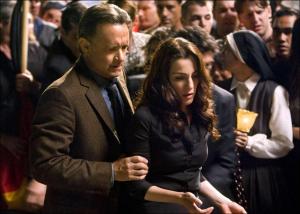 The time element gives the movie a sense of urgency that was missing before, and a kidnapping plot provides a firm structure and supplies more chances for action than unraveling a 2000-year old church conspiracy on the divinity of Jesus. The plot of Angels & Demons works out like a high-stakes scavenger hunt, shuttling Langdon across the many sights of Rome to find the next clue. However, the narrow timeline of killing a cardinal on the hour every hour makes for some tight squeezes, both for Langdon and the cardinal-killing man. I never understand why the villains give themselves such a small window to work with. I know the whole “dead cardinal every hour” thing has a nice ring to it, but is it wholly practical? There’s all that driving around Rome and the Vatican, which has got to be crowded since millions are awaiting news about a new Pope. Beyond this, why must Langdon and crew always show up to a site with like five minutes before the cardinals will be murdered? Are they stopping to get subway sandwiches in between? The timeline and plot setup provide more action sequences that make the movie fleetingly entertaining in spurts.
What doomed the Da Vinci Code movie was not the endless blather, though that certainly bored me to tears, but the fact that the film wanted to have its cake and eat it too — it wants to be a brainy thriller but get away with hokey thriller shortcomings. Angels & Demons suffers more or less the same killing blow. The flick wants you to shut your brain off and swallow these trite lapses in judgment and reality, forgiving the movie for zero character development and polluting the narrative with stupid genre stock roles, but then it also wants you to pay close attention and activate your brain to untangle the origins of symbols, conspiracies, and church doctrine. Angels & Demons introduces the idea of a ticking clock so it’s a far better paced affair than the previous film, but the movie still finds ways to get bogged down. Once again, Dan Brown’s novel has been adapted to a series of chases and sit-down chats, although this time Langdon does a lot of speed walking while he dishes out the minute history of church doctrine and architecture. To borrow from my own review of The Da Vinci Code: “You can?t be a brainy thriller and fill the story with hokey moments and lapses in thought, and likewise you can?t be an enjoyably straight forward thriller if you bookend all your action sequences with talky sit-downs to explain the minutia of your story.”
These stories are just meant to work better on the page than on screen. Puzzles and word games work when the audience can take a moment to pause but film is a medium of images and cannot simply go dead waiting for the audience to posit a guess. Movies don’t have time for you to chew things over. So then the puzzles just devolve into waiting for Langdon to explain everything, which he will do at great length. This can get tedious at a rapid rate. Langdon is less a character in this movie and more a walking, talking encyclopedia of exposition. He is robbed of anything that could be charitably described as characterization. Symbol decoding just does not work on the big screen, and Langdon is an expert whose profession is limited in application. I can’t foresee too many instances where a top-notch symbologist will be needed at a moment’s notice. Sure, it’s nice to get a history lesson and see plenty of those swell ancient churches, even if the filmmakers had to recreate them as sets because the Vatican refused them entry to film, but what point do these Dan Brown thrillers serve as movies? There is an intriguing discussion between science and the role of the church somewhere in this movie, but good luck finding much to stir your intellect. I confess never having read one of Brown’s tomes, including the super colossal mega-selling do-it-all Da Vinci Code, but surely the man deserves a better fate than to have his works die on the big screen as lamentably lame thrillers.
 There are no characters in Angels & Demons, only stock roles and suspects. Langdon’s female sidekick (Zurer,Vantage Point) serves no other purpose but to translate Latin and Italian. Really, if Langdon is a scholar on the conspiracies revolving around the Catholic Church then perhaps he should put in the time and money to learn the language. The Vatican police are there as escorts and little else. Stellen Skarsgård (Mamma Mia!) serves as the chief of the Swiss Guard, the Pope’s security team, and Armin-Mueller Stahl (Shine, Eastern Promises) is a German cardinal running the ongoing recounts for a new pontiff. Both men are presented as sly, untrustworthy suspects. Stahl’s character routinely dresses down McKenna as well, saying the young pup in the collar is not fit for church hierarchy. It?s not much to go on but the “characters” are just figures that occasionally get in the way of the film’s long-winded art history tour.
I think a lifetime of watching movies has just made my mind too analytical to be surprised by the twists in these kinds of dead weight thrillers. I?m already thinking ahead from the first minute and I don’t think I’m alone. When we are introduced to two characters, one gruff and unhelpful and one kindly and overly helpful, it is rather obvious which character will be revealed as being treacherous to provide the biggest jolt. Does anyone still suspect that Hollywood would produce a pointedly obvious evil suspect and then have it actually be that person? Not in today’s class of Hollywood thriller. You see kids, today’s Hollywood thriller is more concerned with piling on the twists than constructing a story that sticks together upon reflection, which is why many a Hollywood thriller simply falls apart as a jumbled mess by the time the end credits roll. Sometimes the endings sabotage everything logically that happened before. For an example of a textbook modern thriller, go rent the French film Tell No One and marvel at how the movie manages to be mysterious without being ludicrous. Angels & Demons doesn’t quite suffer from this screenwriting malady, but the essential evil plot by the eventually revealed evildoer is the most convoluted, ridiculously complicated scheme I have seen since that terminal 2005 thriller, Flightplan.
Director Ron Howard is able keep the film moving, almost distracting the audience away from the plot holes, but Angels & Demons is an adaptation that was doomed to fail from the start. The film plays like a lecture on tape with the fast forward button stuck. I might find more of the blitzkrieg of acts and anecdotes more intriguing if I could verify that they were all accurate. This is a thriller that wants to be seen as smart, so it empties exposition without haste, but it also wants to get away with narrative cheats common in your direct-to-DVD idiotic thrillers. You cannot simultaneously tell me to engage my brain and then a second later tell me to shut it off, sorry. Angels & Demons would have been better served without the Illuminati conspiracy and just plunged fully into the debate about bringing religion into the modern age, the friction between science and religion. Any substance the movie does present ends up being window dressing to an average potboiler mystery. This isn’t an awful movie but it never rises above “acceptable waste of time.” Hanks and Howard will probably be back in due time with the movie version of Brown’s upcoming new novel, The Lost Symbol, which will be released in September 2009. I just hope the duo, and screenwriter Akiva Goldsmith, have learned enough from their mistakes. I myself have little faith.
Nate’s Grade: C
Share this:

X-Men Origins: Wolverine (2009)
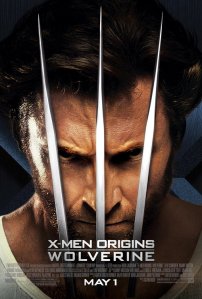 X-Men Origins: Wolverine has been slashed from all sides. First, the movie has not been able to shake bad buzz, from extra reshoots to rumors about conflicts between the studio and the director. There was even one rumor that the head of 20th Century Fox Studios ordered a wall repainted a happier color. Then in early April it got even worse. A DVD-quality print of Wolverine was leaked onto the Internet and spread like crazy, and once something finds itself inside the realm of cyberspace it cannot be put back. The reaction to the leaked copy was mixed, at best. The studio went into damage control mode, stating that the leaked copy was an unfinished work print, that they too were not thrilled with this version and paid millions for reshoots, and the final version that would be released in theaters had 20 minutes of new stuff and 10 minutes additionally edited out. But guess what? The wolverine’s out of the bag, it’s the same exact version minus some completed special effects shots. What amuses me about this whole situation is that the studio is on record trashing the movie, saying they were unhappy with this version, and yet this is the final release. After having seen Wolverine, at least I can say that those Fox execs know mediocrity when they see it.
We get to witness the storied history of Wolverine (Hugh Jackman), which goes all the way back to the pre-Civil War era. Born James Logan, and a mutant, the kid had the unusual ability to produce three jagged bone claws from his knuckles. Logan also had the ability to miraculous heal like his older brother, Victor “Sabertooth” Creed (Liev Schreiber). The two of them make use of their primal, animal instincts and near invulnerability by fighting in every major U.S. war, from Civil to Vietnam. Eventually that kind of thing gets noticed, and General Stryker (Danny Huston) recruits the brothers to be apart of a mutant mercenary group. The group also includes the likes of William “Deadpool” Wade (Ryan Reynolds), “The Blob” (Kevin Durand), and some other unimportant mutants (one of them played by a Black Eyed Pea, will.i.am). Wolverine walks away from the group when he decides that he isn’t cut out for a cutthroat life.
The man finds a quiet place to live along the Canadian Rockies. He’s found a hard-working job, lumberjack, and a good woman, Kayla (Lynn Collins), who loves him. All of this is ruined when Sabretooth comes back around, intent on eliminating the former mercenary members one by one. Stryker appeals to Wolverine to apply for the Weapon X program. He says he can give Logan the tools for his revenge. Wolverine then undergoes the famous procedure that bonds his skeleton with adamantium, an unbreakable metal, and his bone claws become extra sharp metal. Stryker has other plans, naturally, and Wolverine breaks out of the facility. Stryker tells his assassin, “Bring me back his head.” Sorry pal, but you’re the one that just spent half a billion dollars giving Wolverine an unbreakable spinal column.
 Is this origin tale worth telling? Short answer: no. The mysteries behind Wolverine’s back-story aren’t too involving and the answers make the character less interesting. I don’t really care why Wolverine got his metal skeleton or how he came to be an amnesiac, I just accept that the man has some mystique to him. I care even less that one of the answers to those mysteries is a murdered lover. The plot is incredibly thin; Wolverine meets one mutant who tells him to meet another mutant who tells him to meet another mutant, etc. Eventually the film heads for a mutant showdown that plays out like a lame video game, specifically the mid-90s Mortal Kombat (the Final Boss super villain resembles the blade-handed Baracka). What are Gambit (Taylor Kitsch) and Emma Frost doing in this? That?s not the end of the mutant cameos, either. I feel like the only thing we learn about Wolverine is that his super sense of smell cannot detect the difference between real blood and stage blood. The filmmakers think character development involves someone saying no to slaughtering innocents, and then other characters keep telling him, “You’re not an animal.” The movie meanders from one unimaginative special effects set piece to another, stopping at points to shove in various mutants that serve little purpose to the story other than diehard comic fans will be more forgivable.
Oh, but what to do when your main character is indestructible, your main villain is also indestructible, and your other lead villain cannot be killed because he?s due for an appearance in X-Men 2? Why you bring in a third, nigh indestructible being into the stakes, however, this being doesn’t already play into the established X-Men onscreen mythos, so this guy’s okay to kill off, that is, until he too gets a movie built around his character and then that movie has to backtrack to fill in on time before its capped ending. We already had a healing ability mutant with super claws vs. a healing ability mutant with super claws smackdown in X-Men 2, where Lady Deathstrike fought Wolverine. That fight was brutal and well staged. The fights in Wolverine’s big show are uninspired; how much stabbing can you watch between people who instantly heal? Also, apparently another side effect of the Weapon X program is that these metal claws are self-cleaning, because every single damn time Wolverine stabs someone there isn’t a droplet of blood to be found on his claws. It?s hard to get emotionally involved in characters that are fearless and have little at stake. Which, of course, is why Logan had to be given a cruddy romance where he gets to hold his dead lover?s body in his arms and bellow to the heavens for what feels like the 80th time. Seriously, twenty percent of all the dialogue in this movie is some combination of growling, spitting, and bellowing.
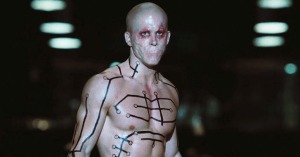 Wolverine isn’t a terrible movie but it’s rather shoddy and thoroughly mediocre. I never thought I’d see this character do the beyond-cliché action movie motif of strutting in slow-mo while an explosion sizzles in the background. This is the kind of film that involves a super team standing shoulder-to-shoulder to walk down like they’re from The Right Stuff. This is the kind of movie that opens with a needless family squabble about Logan finding out the pointless identity of his real father. What was that about? (After killing his father, I remarked to myself, “I guess that he gets that whole healin’ thing from his mother’s side of the family.”) This is the kind of movie that hires Ryan Reynolds and then disarms the man of his greatest asset, his smart mouth. This is the kind of movie that theorizes the only thing to kill an adamantium-skeleton man is with an adamantium bullet, like a sort of werewolf. This is the kind of movie that sends a super assassin, with super bullet-bending powers, out to kill Wolverine but does not arm the super assassin with those special adamantium bullets. Why not shoot this guy in the eye? That is an open body cavity. This is the type of movie where the final super villain is controlled by, get this, key commands like “Engage.” This is the kind of movie where an assortment of characters refrain from killing super bad murderers out of the morally pretentious idea that they, too, would be no different from the super bad murderers. Excuse me, executing super bad murderers would be doing the world a favor here. This is the type of movie that fills the running time with pained dialogue like, “You wanted the animal, you got him,” and, “Nobody gets to kill you but me,” and the best line of them all: “I thought you were the Moon and I was your Wolverine. Turns out you’re the Trickster and I’m just the fool who got played.” Top that, screenwriters.
Whatever the budget was for this movie, well, apparently it wasn’t enough. The adamantium effects looked perfectly reasonable in the first X-Men film and that was nine years ago, so I cannot understand why the claws look astoundingly fake this go-round. They look like direct animation, like Wolverine is holding cartoon claws a la Who Framed Roger Rabbit? When did they become so thick too? These claws are like the size of the steak knives you get at restaurants.
Jackman deserves some of the blame here since he is listed as a producer and he hand selected director Gavin Hood (Tsotsi, Rendition) who does not have the interest or the eye for this kind of material. Hood lacks the finesse and vision to stage exciting action sequences, which explains why he falls back on tired genre tropes like the slow-mo strut in front of fireballs. I am dead certain that this stupid super assassin was pushed into the movie after film producers saw how much money the bullet-curving Wanted made the previous summer. The movie borrows heavily from recent Marvel Origin comics, or so I’m told, which is where the whole “Wolverine through the ages” storyline comes from. Personally, I don’t much care for the idea that Wolverine’s healing ability also deters aging until you hit that agreeable, desirable Hugh Jackman age range, but fine, whatever. The movie takes great effort to showcase Jackman’s flawless physique, and this dude is ripped to the point that you can see bulging veins. I just wished Jackman made more use of his acting muscles in this movie. He snarls and glares, and even has a softer moment or two with Collins, but rarely does Wolverine get to prove why he is such a beloved comics character.
 Thank goodness for Liev Schreiber (who actually also co-starred with Jackman in the forgettable romantic comedy, Kate & Leopold) because this man entertained me from start to finish, which is more than I can say about his movie. Schreiber has fun with his role and totally buys into the character’s animal instincts. He relishes the kill. The bizarre sibling rivalry between he and Wolverine is the best part of the movie, and the interplay between the two actors is when the movie has its few moments of life. Like Watchmen, the film finds its creative peak during the opening credits, as we watch Jackman and Schreiber claw and bite their way through American battlefields.
Here’s an easy solution to the Wolverine amnesia issue that doesn’t involve the use of admantium bullets. Kayla (Silverfox) has the power of hypnosis through touch, so why not in the emotional climax have her touch her dear lover Wolverine and wish, “Forget me. Forget all about me.” There, problem solved, and this way it works emotionally and organically with the story. It took me an hour after seeing X-Men Origins: Wolverine to come up with a better ending, so just imagine what more time will allow. Jackman and company are lost thanks to a mediocre script that sacrifices character for action beats, and even then the action is fairly mundane. There are a handful of cool moments, like Wolverine propelling himself onto a helicopter from an exploding car, but after four movies nothing has come close to producing the adrenaline rush that was the X-Men 2 sequence where Logan unleashes his berserker rage on the commandos in the mansion. By the end of his first solo outing, Wolverine is left without any memory. I won’t say we should all be so lucky but the X-Men filmmakers would be better off paying little attention to this origin tale, unless they want to bring Schreiber back, which they should do at all costs.
Nate’s Grade: C


You must be logged in to post a comment.