Blog Archives
A Perfect Getaway (2009)
 The movie looks gorgeous thanks to the pristine Hawaiian scenery. What is not as pristine is the overactive plot. This is a clever “who dunnit” thriller that isn’t as clever as it thinks it is. This murder mystery sets up a premise about killers on the loose in paradise and then introduces suspect couples. Every moment and every line of dialogue is overdone with foreboding to make you think every single moment is filled with suspicious intrigue. It pretty much becomes a parody of a suspense movie thanks to writer/director David Twohy. Then a second act twist retroactively rewrites the movie’s shortsighted history that doesn’t make sense. Why would the characters behave as they do when nobody’s around to watch them? Commitment to Method acting? It’s a harebrained twist up there with Perfect Stranger where it negates everything beforehand. There’s a 15-minute flashback that doesn’t need to be nearly that long and it breaks up the momentum. A Perfect Getaway does elicit some thrills and interest but you may grow tired of being beaten with overactive suspicion.
Nate’s Grade: C
Share this:

Edge of Darkness (2010)
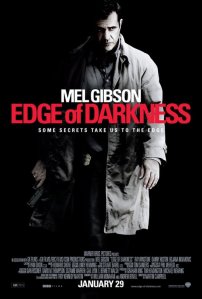 While I was watching Edge of Darkness, a conspiracy thriller that hearkens the return to acting for Mel Gibson, one thing kept sticking out to me, and no, it wasn?t the protracted ear-splitting “Bahstun” accents. One character makes comment about the current lowly state of affairs and says, “Everything’s illegal in Massachusetts.” That perked my ears, and then a second character says the exact same thing later in the movie, like it’s this flick’s summary, “It’s Chinatown.” What exactly does that mean specifically about Massachusetts? That the Bay State is somehow a nanny state, dictating behavior? Or is this a resigned admittance toward the futility of competing against the long arm of the law? I’ll tell you something that isn’t illegal in Massachusetts — gay marriage. They got a leg up on that one. This is the kind of internal conversation I had with myself while Gibson unraveled a fairly ho-hum conspiracy-of-the-week plot.
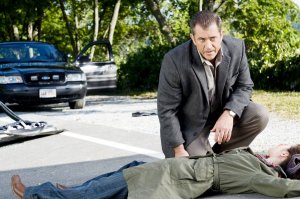
Detective Thomas Craven (Gibson) is a decorated Boston lawman. His grown daughter, Emma (Bojana Novakovic), is visiting from her job when she starts throwing up blood. She needs to tell her father some important secrets about her workplace. But as the two are about to leave for the hospital, a man cries out “Craven,” and follows it with a thunderous shotgun blast. Emma gets the full force and dies in her father?s arms. The media assumes Thomas was the target and the gunman had an old score to settle. However, the more Craven investigates the more convinced he is that his daughter was the real target. He looks into Emma’s connection to some dead environmental activists caught breaking into her place of work. The head of the company (Danny Huston) has plenty of important defense contracts and suspicious behavior. As Craven tracks down the truth he is assisted by the mystifying Mr. Jedburgh (Ray Winstone), a man normally hired to cover up any messy loose ends of governmental business. Jedburgh decides to work with Craven instead of against him, and the two men must fight for their lives.
 The real reason to see this fairly pedestrian police thriller is because of Gibson. It’s been a long eight years since his last onscreen role, and I must say I’ve forgotten about what a great actor the man can be. When this guy gets mad, you can practically feel the intensity. Gibson is terrific at playing a man with simmering emotions that often get the better of him. The lines and wrinkles give him a new canvas to play with, letting his age help tell the story of his character. Gibson seems to have this inner insanity to him, an admirable bent of crazy manic anarchic energy (I highly suggest checking out some of the Jimmy Kimmel Show shorts he’s been apart of). It makes him hard to ignore. He peppers in what he can with his character, a long-standing member of the law thirsting for answers and vengeance. What’s enjoyable is that he doesn’t go about knocking down every door to make people pay. Craven plays each interrogation differently depending upon his prey; sometimes he uses a soft touch and sometimes he opts for the tried-and-true punch to the nose. It’s little touches like this that bring out details in the character, and Gibson knows how to exploit them for maximum drama. Does anyone play instantly bereaved better than this man? He has a real knack for nailing scenes where a character is confronted with the sudden death of a loved one. His face is full of tics, his eyes glass over, it’s like he has lost all control and given over to the amassing and conflicting emotions. This clearly isn’t one of Gibson’s best performances, but after eight yeas of absence I’m more than willing to give the man a little latitude. An angry and bereaved Gibson is a Gibson I can enjoy watching on the big screen no matter how rudimentary the caper.
Edge of Darkness belongs to Gibson, but Winstone pretty much comes out of nowhere and hijacks the movie. Every time his character leaves the scene you’re anxiously awaiting his return. He’s an intriguing character, which makes me wonder why he’s gotten such a languished subplot. He could have been better involved in the story but the script keeps him to the narrative’s edges until the climax. Though a bit hard to understand thanks to a severe case of the mumbles, Winstone is by far the most interesting character in the movie. He’s an expert on fixing problems who tires of the long hours of shadowy, dastardly work. This is surely a character worthy of his own tale, or at least equal placement in the narrative, but instead Jedburgh functions as a sly informant when he should be running the show.
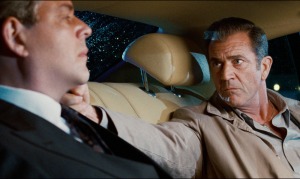 The script pretty much treads water. It’s not anything that’s particularly bad, but this story is pretty much content to stick with the basics. This isn’t a dumb movie per se, thanks to screenwriters William Monahan (The Departed) and Andrew Bovell (Lantana) adapting from the acclaimed BBC mini-series. Those guys know something about a crackling crime thriller, which this is not. The lizardly Huston couldn’t be any more obvious of a villain, but he’s not alone. The burly henchmen drive around in dark, tinted SUVs that seem to say that somebody got their nefarious goon driver’s license. This is the kind of movie that plays its hand early, telegraphing future revelations and double-crosses. When we’re introduced to a character right after Emma’s death, and the camera takes a deliberate amount of time hanging on that character’s pained expression, obviously we’ve been informed that this person is somehow connected. No prolonged reaction shot is ever meaningless in an action thriller. Every time Craven ties to gain information from a person of interest, they say, “I can’t talk. They’ll kill me,” and then that person is promptly killed as prophesied. You basically expect something “shocking” to happen every time a person leaves Craven’s presence (FYI: check both ways before crossing the street).
There’s a really engaging and politically active whistler blower story somewhere in here that could have used better attention. It seems the line between whistle-blower and activist is a thin one, and Craven must assemble enough evidence to make sure that his case cannot be dismissed as a kook. It’s an interesting dilemma, trying to assemble a compelling case that will hold up on objective scrutiny, that can’t be tossed out. That’s an interesting predicament considering the many eyes and ears of a large, legally autonomous corporate entity. Alas, that movie is not Edge of Darkness.
Gibson’s return to movie acting is definitely welcomed, even if it’s something as disposable as this. Edge of Darkness is a by-the-book conspiracy thriller that offers glimpses of something superior that could have been worked out. More attention could have been given to Winstone’s character. The whistleblower aspect could have been heightened and clarified. There could have been a bit more action and a little less blood. The bad guy could have been less obvious from the get-go. But in the end, there’s Gibson tapping into his mad Mel streak of appealing intensity. Not everybody can offer what Gibson does. It’s too bad then that Edge of Darkness fails to realize this virtue.
Nate’s Grade: B-
Share this:

Legion (2010)
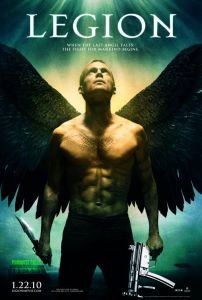 Just to be upfront, I am a big fan of action movies making use of Christian mythology (sorry if the use of the word “mythology” offends some). You tell me a tale about angels, demons, in a contemporary setting no less, and I’m hooked. You give those two sides weapons and have them fight over the fate of mankind, and I’m already revving my engines. So please know that no matter what the artistic achievements of Legion may be, I was predisposed to enjoying a movie that features the angel Michael (Paul Bettany) on the poster with a sword in one hand and an automatic weapon in the other. The premise of Legion is that God has finally had it with mankind and is making good on his threat to “turn this thing around right now.” He’s sending a host of heavenly angels to … eliminate humanity. Michael rebelled, believing man was still capable of making good on its promise. So he fights alongside a handful of characters shacked up in Dennis Quaid’s greasy spoon diner in the middle of nowhere. The action isn’t really involving but the movies does have some cool moments, like when Michael goes mano-a-seraphim with Gabriel (a marble-mouthed Kevin Durand). Legion deals with an antagonist (God) that is so powerful that there have got to be arbitrary limits placed on that power. So the attacking angels don’t overwhelm the tiny diner with their superior numbers, nor does the Almighty just blink the troublemakers out of existence. The end doesn’t really give much in the way of clarity but I got what I wanted from a movie like Legion. Though, in retrospect, I really didn’t want sizzling acid popping from boils.
Nate’s Grade: C+
Share this:

The Cove (2009)
 I never really wanted to watch the documentary, The Cove, and judging by its anemic box-office gross, I wasn’t the only one. A movie about dolphin slaughter felt like it was going to be a hard chunk of medicine, and I can’t really blame anybody who read about this acclaimed Sundance doc and said, “You know, I don’t feel like spending eight bucks to watch dolphins get harpooned to death.” I can’t argue with that and it was with great trepidation that I put the DVD into my player, hiding behind a blanket, dreading the animal cruelty and self-righteousness that would soon wait. And then a funny thing happened. In the first five minutes I really got into the movie, my nervous tension disappeared, and I was captivated by one of the best-edited and most thrilling movies of the year. For the squeamish, rest assured, the dolphin death footage isn’t graphic and used rather sparingly and tastefully. This is not just a PETA snuff film.
The Cove has two storylines at play that converge with a unified goal. The first explores the life of Ric O’Barry, the world’s premier dolphin trainer responsible for all those playful porpoises on TV’s Flipper (he even lived in the TV family’s house by the dock). It’s because of that popular TV show that the dolphin craze began where people wanted to see them do tricks and people wanted to swim with the cute dolphins. Sea parks sprouted up around the world and many dolphins were sold into captivity. O’Barry then drastically changed his mind about dolphins living in captivity after the death of one of the Flippers. Dolphins need to consciously breath, so they can actually hold their breath and die, which is what happened. The Flipper dolphin committed “suicide” in O’Barry’s arms, or so he says (he may be projecting a bit of his own guilt). He has been fighting ever since for dolphins to be freed and often O’Barry gets arrested for his activism efforts.
O’Barry’s biggest target is Taiji, Japan. It is this small coastal town that supplies dolphins to most of the world. Researchers and entertainment trainers will take their pick of the litter and the rest aren’t so lucky. The remaining dolphins get transferred to a small inlet where coastline bystanders cannot see and where large “Keep Out” signs are met with barbed wire. Then the waters run red. Tens of thousands of dolphins are slaughtered every fall and O’Barry has been trying to get the word out for years but has been stymied by the local fishermen, the meat corporations, and the Japanese government. Director Louie Psihoyos, a critical member of the Ocean Preservation Society, intended to make a film about depleting ocean reefs and intended to have O’Barry be one part of an overall bigger picture. Then, while traveling in Taiji, he became convinced that the real story was exposing the secret dolphin killings and why what goes on in that deadly cove matters to the rest of Japan and the world.
 What hooked me was that The Cove is structured like a real-life espionage thriller. Psihoyos and his technical crew wanted to go the legal route but were blocked by opposing forces. So he assembles a team of experts to infiltrate the Taiji cove and document what exactly is going on there. He recruits the best deep diver who can plunge to record-breaking depths on a single breath of air. He recruits a model maker at special effects studio ILM to make convincing rocks that will house hidden cameras. They recruit a man who knows all about cameras and body imaging technology. They even get an expert on flying toy helicopters so they can plant a camera on one. The director says it himself on camera, that he was gathering a real-life Ocean’s Eleven team. The tone of the movie follows suit, making for some great suspense. As soon as O’Barry enters Taiji, he’s tailed by several police officers and they even interrogate him in his hotel lobby to ascertain the purpose of his visit (caught on hidden camera). The billion-dollar dolphin entertainment/meat industry hires people to do nothing else but to film O’Barry himself, keeping track of his movements and trying to provoke an emotional reaction to disparage his cause and boot him from town. We then chart how far the connections go, all the way through to Japanese government officials bribing other Pacific island nations to join their fight to overturn whaling laws. It’s fascinating and frustrating as hell to watch.
Psihoyos is a rather accomplished filmmaker in his own right, spicing up an intriguing tale with some visual pizzazz and a great sense of pacing. This thing just flies by. It’s strange to say that a documentary about killing dolphins is one of the most gripping thrillers of the year, but there it is. This is an impeccably crafted opinion piece with a dash of espionage excitement. The movie is indignant, yes, but refrains from being self-righteous or condescending. At no point did I feel beaten over the head with some activist propaganda, though the film is clearly one-sided. Psihoyos manages to weave in a lot of useful information. I was dreading the actual dolphin slaughter footage even though, from a structural standpoint, that was the climax of the movie people have been waiting for. The footage is mostly at long angles, though you do see Japanese fishermen repeatedly jabbing harpoons into dolphin shapes. The most disturbing moments are earlier when a mortally wounded dolphin spaces past the nets and tries to swim for freedom. It’s spitting blood and wildly trying to break free but it eventually drowns. The final image of the hard-won footage is the blood-soaked shores of the cove, which are a deep, unsettling red that reminds you of a full-on Biblical plague. An easy plea to emotional appeals, perhaps, but effective nonetheless. I have no shame in admitting that The Cove put me to tears on three separate occasions.
 So is there really a difference here between killing and eating dolphins and the West’s industry of killing and eating cows? Is this all just a matter of cultural insensitivity? That’s a harder question. Which animals do we draw the line at eating? Is there a moral disparity between eating a hamburger and eating a dolphin, or eating a cat or a dog? I don’t know. Personally, given my Western biases and everything, I become repulsed when it comes to inhumane treatment to animals and when self-aware creatures are used for food. I am a content meat-eater but that doesn’t mean I want to snack on a dog sandwich. Certain animals are just more self-aware than others, which muddy the moral waters. When an animal reaches that sense of awareness then it becomes an even stronger ethical dilemma when it comes to killing them, because they are more cognizant of what is happening and the life being taken from them. It may all sound like semantics to some, but that’s my personal stance. To literally quote George Orwell’s famous novel: “All animals are equal but some animals are more equal than others.” That may seem hypocritical to people but I’d argue it’s a reigning opinion among a majority of Americans. The counter argument is that Westerners know that cows are being led to the slaughter, whereas the Japanese are purposely kept in the dark about the nature of the dolphin massacres. To make matters worse, dolphin meat is incredibly high in levels of mercury and the meat is labeled as other fish. The majority of the Japanese do not know that they are consuming poisoned dolphin meat. Americans at least know what they’re biting into (the jury’s still out with hot dogs).
The Cove only gives you the Western perspective on the subject because that’s what fits its agenda. It does take a few swipes at the arguments for dolphin hunting. The Japanese government views them as pests needed to be dealt with and blames the porpoises for declining fish levels, which to any rational thinking person would sound absurd. Which seems like the more likely scenario: pollution and over fishing lead to declining levels, or the sea creatures that have lived on the planet for millions of years are now to blame? The other token argument is that whale and dolphin killing is a part of traditional Japanese historical culture. This might hold true for some people; however, upon some minor research you find that the whaling tradition goes back only a couple centuries, no further than it did for European countries that have given up the practice.
But what the movie really fails to explore is why. Why do the Japanese fishermen, when offered the same money NOT to kill dolphins, decide to keep killing them? What is the psychology at foot in Taiji that links the town with annual slaughters? It’s a shame that Psihoyos devoted the entire bulk of the film to getting the footage. The focus of The Cove is a bit limited but I understand why. There needed to be an attainable goal: get the secret footage and spread the word. The movie is too entertaining and harrowing to really knock its limited scope, but The Cove could have been a much fuller depiction of this bloody reality.
The Cove builds a compelling, if one-sided, case condemning the ongoing actions of Taiji, Japan and the greater government. The conspiracy unfolds layer by layer and the movie ends up rallying others to action (O’Barry says you’re either an activist or an “inactivist”). I don’t know if anything will actually change now that the footage is out there, but at least people can be more aware of the annual dolphin slaughter. And after a year of wrangling, it appears that The Cove will be released in Japan this spring. Let’s see what kind of response comes out then and whether the Japanese are willing to pay the yen equivalent of eight bucks to watch dolphins die.
Nate’s Grade: A
Share this:

Final Destination 4 (2009)
 I felt that this franchise was creatively exhausted after the third film in 2006, and I see no reason to change that opinion. The fourth film has the added feature of being in 3-D, which means you get the luxury of having entrails exploding in your face. I watched the movie in the limits of two dimensions, which may be why I wasn’t thrilled having every other visual thrown at the screen. Regardless, the cruelly elaborate deaths are the draw. This is a horror movie built from the inside out, finding the thinnest of tissue to connect all the gory gross-out moments. A documentary set in writer’s room for a Final Destination movie would be more interesting than the finished product. It seems like the producers aren’t even trying any more; the one-note characters exist in a world bereft of adults, cops, media, and anybody with a brain. The film doesn’t waste any time on characters because they’re all just meat for the grinder. The film does, literally, the bare minimum just to move the plot along to the next fiendish death trap (this flick has a franchise record 11 death sequences). At one point, a character says, “Don’t make fun, but we Google-ed ‘premonitions,'” and then they explain the rules of the series like somebody handed them a manual. Later, the teens celebrate because they think they broke death’s chain, and I’m yelling at the screen, “That hasn’t worked for three movies, you stupid kids!” They’re all running through the same worn-out patterns that the audience already knows by heart. The big question is whether the gruesome death sequences deliver the goods. Flaming escalators and killer car washes? Clever or desperate, you be the judge. For me, the fun of this franchise was killed long ago when it gave over to the cynical bloodlust of its target audience. Since Final Destination 4 made the most money out of any of the previous films, expect more entrails in glorious 3-D.
Nate’s Grade: C-
Share this:

12 Rounds (2009)
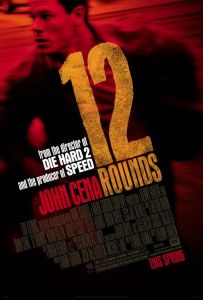 This action flick bankrolled by World Wrestling Entertainment is an empty and aggravating movie. Let me list the ways this lamebrain action movie fails and flounders. And to be charitable, I’ll do it in only six rounds of concise action.
Round 1: John Cena is not an actor, like at all. The famous pro wrestler has a face that looks to be chiseled from granite.
Round 2: The movie strains credibility even for an action movie. The villain reappears with no explanation and begins a series of clever traps that must have involved massive man-hours to conceive and put into order, especially with every last variable taken into account like bus schedules.
Round 3: The villain is totally non-threatening in every capacity. He acts like an impish teenager instead of a devilish rogue. At one point, I kid you not, he’s rolling around on a bed while he taunts Cena over the phone, like he’s gabbing to a girlfriend. The fact that this dude is a criminal mastermind makes everybody dumber.
Round 4: The villainous M.O. is a shameless rip-off of Die Hard with a Vengeance. I repeat: a rip-off of the third freaking Die Hard movie, which isn’t terrific anyway. Every little game, every little round, is a puzzle that leads to the next puzzle, and Cena must figure it all out before his time runs out. And it’s all an elaborate ruse to distract the police so that our bad guy can pose as a Federal Reserve moneyman and steal from a bank, more or less just like Die Hard with a Vengeance.
Round 5: The director is Renny Harlin, whose last watch-able movie involved super intelligent psycho killer sharks. His action choreography relies all too heavily on ridiculously tired action tropes, like having Cena leap hundreds of feet from a helicopter to land safely in a rooftop pool. The erratic camerawork does no favors, aping the visual style of better movies. Even Harlin himself has done everything here before and better.
Round 6: The bad guy blames Cena for his girlfriend’s death and thus puts him through this day from hell. He blames Cena instead of blaming the driver of the car that plowed into her, his girlfriend for choosing to run right into the path of an oncoming vehicle and for being complicit in a murderous jewelry heist, or even himself for putting everybody in danger in the first place. His motivation is fairly faulty. He might as well blame the manufacturer of the automobile for lackluster brakes.
I’ll cut it off from there to be merciful. 12 Rounds is a classic example of a cookie-cutter, brainless, preposterous, and un-inventive action movie that typifies the Hollywood assembly line. It’s ludicrous from start to finish and your eyes will glaze over from watching such stolid action scenes without a hint of creative impulse.
Nate’s Grade: D
Share this:

Sherlock Holmes (2009)
 Sherlock Holmes as a gritty pub-brawler? Before you dismiss the big-budget Hollywood retooling of the literary detective, look back at author Arthur Conan Doyle’s source material. Appearing in over 50 stories, Holmes was a bit of a rude rapscallion who would get into brawls and recreationally use cocaine. It was only until Dr. Watson stepped into his life that Holmes cleaned up and became a proper, respectable gentleman and the figure we know. With stylish director Guy Ritchie (RocknRolla) attached, it appears that this Holmes for a new generation is actually a throwback to his roots.
Famous detective Sherlock Holmes (Robert Downey Jr.) and his assistant, Dr. Watson (Jude Law), are at an impasse. Watson wishes to leave Holmes establishment and start a new life with a woman he loves. Holmes is also threatened by Lord Blackwood (Mark Strong), an aristocrat in prison for killing women in ritualistic manners of the dark arts. He’s about to be executed when Lord Blackwood promises he will return from the dead, and his murders will continue. Sure enough, after Blackwood is hung by the neck and pronounced dead by Watson, the murders resume and the dead man himself is seen walking among the living. Holmes is on the trail of his resurrected foe when he meets Adler (Rachel McAdams), the woman who broke his heart. She’s employed by a mysterious stranger and becomes mixed up in the deadly hunt to stop Lord Blackwood.
 As is quickly becoming commonplace, Downey is the best part of the movie. His combative relationship with Law makes the movie worthwhile. They have a feisty, squabbling chemistry that generates a lot of humor, and they interact like a 1980s buddy cop movie. Their verbal jousting practically saves the movie from collapsing due to the overwrought plot. At its best moments, Sherlock Holmes feels like a buddy cop movie transplanted to Victorian England. Downey is having a hoot as the character and brings a vibrant energy to his role, turning Holmes into an eccentric who gets buggy if he cannot obsess over a case, taking several cues from the Monk playbook of eccentric detective genius. Downey is cocksure and a charming cad, enjoying every moment he can outsmart the competition. Law is more equal than sidekick and plays the straight man to Downey’s neurotic detective. I’m not usually one to bemoan foreign accents, but this is one movie that would benefit from subtitles. The actors don’t necessarily talk in thick accents but they speak so fast that it begins to sound like an unintelligible mumble.
The romantic subplot is a non-starter as Holmes reunites with both The One That Got Away and his Crafty Equal. McAdams is a fine actress with a luminescent smile, but her involvement is really an afterthought. She’s the old flame that always re-enters in those 1980s buddy cop movies. She stays long enough to rekindle some old feelings and provide a figure in need of rescuing. Her storyline is one of several that could have been completely eliminated. The same could be said for Watson’s girlfriend, the steamboat accomplice, the put-upon maid, and many of the conspirators.
The plot for Sherlock Holmes feels like three screenplays were crudely sewn together. There are so many junky side stories and characters that need to be eliminated. It’s just far too busy without anything making real traction. The story is weighed down with expository dialogue and mounting subplots. There are a few sequences that jump forward in time but don’t inform the audience, so we’re left a tad discombobulated. The film jumps immediately into the fray without any pertinent flashbacks or setup, daring the audience to pay attention. At some point in the middle I gave up, having disengaged from the plot and determined to simply wait it out for Holmes to explain what I was missing. I think at one point I was even starting to nod off to sleep, which is a deadly sign for an action movie. The central occult conspiracy has a lot of men in cloaks but no discernible outcome. The movie is littered with conspirators and locations and details that all seem meaningless until Holmes can tie all the jangled pieces together. The script is overloaded and half-cocked and bides its time waiting for Holmes to provide relative clarity. It gets old after a while when only Holmes knows the clues and he won’t share.
 You don’t usually think of the intellectual detective in the deerstalker cap as a man of action, but this brash reinterpretation would be acceptable if Holmes found himself in some action sequences that would befit his legendary stature. Ritchie?s hyperbolic shooting style makes for a lot of fast whooshing and quick spinning but it doesn’t add up to many satisfying sequences; the best is probably a battle with Holmes and a giant that destroys a shipyard plank by plank. Ritchie introduces an intriguing action device for this beefed-up Holmes; he mentally envisions the steps of his attack, going from punch to counter punch. This technique is a fun peek into the mind of Holmes and it makes the action easier to follow for the audience. The fact that this narrative action device is used twice in the 30 minutes made me alert. Surely this cool little stylish flourish would come into play during a climactic moment. Nope. This visual quirk is done twice and then curiously never resurfaces. Instead, the movie ends in a climax dotted with the tired routine of atop high places. The showdown is rather weak. Watching Holmes and Watson beat their way through thugs has its meta-literary appeal but Ritchie and his screenwriters fail to summon entertainment amidst the cluttered chaos.
I am a self-described Ritchie fan, though he hasn’t made a good movie since 2001’s Snatch. He lathers on the style right from the opening studio titles being integrated into the cobblestone streets of London. The production design is impressive and the actors seem to be having a game go with the literary legend, but it all comes back to the murky story. Sherlock Holmes could have succeeded on a crackerjack story or on being an entertaining thrill-ride, but it fails in both areas. The nonsensical conspiracy plot feels like a leftover from a bad Dan Brown novel (redundant?) with secret societies and mystic orders and blah blah blah. The characters feel less than real because they aren’t given time to be fleshed out, so they resort to being stock archetypes locked into well-defined place by the fact that the plot gallops from the start. The action is uninspired and occasionally incoherent. Sherlock Holmes as a man of action is an acceptable premise but he needs to be placed in strongly constructed, inventive action sequences. I like Downey and Law, and I especially like their time together, but the movie lets them down. Maybe I was just holding out hope that Holmes would come back and explain the whole movie, providing compelling evidence for mass entertainment that I had been missing. It was never to be.
Nate’s Grade: C+
Share this:

The Lovely Bones (2009)
 The Lovely Bones, based upon Alice Sebold’s 2002 best-selling blockbuster, is about some heavy stuff. It’s told entirely from the point of view of a dead teenage girl. She was raped and murdered by a skeevy neighbor, and now she gets to watch her family get torn apart through grief. For most filmmakers, this material would not be considered a “breather,” but then most filmmakers are not Peter Jackson (to my knowledge, only one is). The man known for epic fantasy adventures and lavish special effects applies his skills to bringing Sebold?s beyond-the-grave drama to life. The Lovely Bones has enough skill and craft to its merit, but Jackson’s rep as a filmmaker cannot save this poor adaptation. Who would have thought that the lord behind those Rings pictures could be felled by a teenage girl?
“I was fourteen years old when I was murdered,” Susie Salmon (Saoirse Ronan) informs the audience. In 1973, young Susie Salmon (like the fish, we will be told many times) is walking home from school one night. Mr. Harvey (Stanley Tucci) approaches her and asks her to be the first kid in the neighborhood to see his underground clubhouse he built. She follows inside and will never make it back out alive. The police discover Susie’s knit hat and massive amounts of blood in the earth but no body. Susie’s family is a wreck. Jack Salmon (Mark Wahlberg) consumes himself with the mission of finding his daughter’s killer, alienating his wife, Abigail (Rachel Weisz). Mr. Harvey watches the stalled police investigation with growing pleasure, knowing he has gotten away with yet another child murder. As the years pass, he sets his sights on Susie’s younger sister, Lindsey (Rose McIver). But Susie is not completely absent during this period of time. She awakens in a magical, CGI-attuned spiritual realm known as the “in-between.” It is here that she spies on her family and her murderer and tries to pass time.
 Since most of this story is told after her death, and because Susie died when she was a blossoming teenager, apparently she’s doomed to live the rest of her quasi-afterlife in that awkward visage. Imagine being a 14-year-old for eternity, and the only clothes you have to wear are ugly mustard-colored corduroy pants? That sounds more like hell than heaven. So Susie gets to interact in an afterlife built upon the mind of a teenager, which means that the afterlife involves pretending to be on magazine covers and dancing to disco music (again, heaven or hell?). I know that Jackson was asking for trouble by even attempting to interpret the ethereal, but his candy-colored version of Susie’s afterlife comes across like a bright, shiny doctor’s waiting room (“God will be with you in just a few minutes. Please enjoy our magazine selection in the meantime.”). It’s like you have to find peace before going through them pearly gates. Heaven doesn’t want your negativity so you are forced to chill in a screensaver.
There’s going to be some natural disconnect in trying to showcase a realm beyond human comprehension. I accept that, but why does Susie even bother staying in this “in-between” world? She spies on her family in grief through the years but she has no power to change things; that is, until she does for some inexplicable reason. And what does she do with that inter-dimensional power? She inhabits some girl’s body so she can snag her first kiss that her murder denied her. She passed up heaven and chose not to tell people about her body being disposed of. That doesn’t sound like she really reached any sense of enlightenment. But I digress. Why would Susie stay in this “in-between” when it only makes her sad? She’s fairly powerless and, honestly, does anybody really want to delay entering into heaven? Why does Susie get to pal around with all the other Mr. Harvey murder victims like some celestial support group? None of this can be explained because we’re dealing with a topic that defies rationale explanations. However, this “in-between” spiritual land feels like a visual leftover from the 1998 film, What Dreams May Come. That was another movie where I could never explain why anything happened.
 Actually, the entire movie lacks any cause-effect continuity. The Lovely Bones feels bereft of any connective tissue. Characters will make huge decisions or be granted epiphanies because the plot demands it. I have no idea why Jack suddenly figures out that Mr. Harvey responsible for his daughter’s death. He thinks back to a memory and then all of a sudden everything makes sense, but only for his character. For me, none of it made sense. The entire investigation of Mr. Harvey doesn’t really hold up upon reflection. Jack personally looks into every shifty person in town but somehow overlooks the creepy loner across the street that builds meticulous dollhouses for fun? Mr. Harvey also likes to sketch out his murder pits, but just stop and think about Susie’s deathly hobbit hole. The man digs an entire underground lair in a cornfield. Wouldn’t it take hours if not days to refill the whole thing to cover his tracks? For a prolific serial killer, Mr. Harvey seems to be somewhat careless about leaving behind evidence (a safe filled with your victim’s remains?). I guess this is why Susie has to tell us at the onset that people were ignorant to all this unpleasantness in 1973 (I guess that means common sense was acquired in 1974). Why does Abigail all of a sudden desert her family? She can’t take the grief, so she ditches her two other younger children to live the life of a migrant worker. And why does she come back? How can two brown-eyed, brown-haired parents have three blue-eyed, blonde-haired kids? The entire movie lacks vital coherency and context.
From a tonal standpoint, The Lovely Bones never quite settles down and figures out what film it?s going to be. It veers from sentimental melodrama, to thriller, to headache-inducing camp (Sarandon’s boozy grandmother is terrible at housework — hilarious!). Jackson and crew jettison large amounts of Sebold’s text, leaving behind a New Age-y heaven and a fairly lame murder mystery where we already know the guilty party. The drama then pretty much boils down to whether or not Mr. Harvey will get caught.
You can tell that the serial killer segments grabbed Jackson’s interest the most because every sequence with Mr. Harvey feels more predicated and textured, like Jackson is applying more skill to showcase the twisted mind of a sick man. Jackson exerts far more energy into exploring the dark reaches of Mr. Harvey than he does the mourning of the Salmon family. We are denied the complexity of grief and remembrance. As presented, the Salmon family gets to weep and shout but nobody really tackles the issues or moving forward and acceptance of loss. Instead, we watch Mr. Harvey twitch and squirm and plot his next move. Tucci is appropriately scary, aided by an ominous comb-over. The segment when a ghostly Susie stumbles into Mr. Harvey’s bathroom is the best moment of dread. The bright white room is splattered in trails of dirt and streaks of hardened, dark blood, while Mr. Harvey rests in his bath with a washcloth covering his face. It seems like Jackson decided that what fans really wanted from a Lovely Bones movie was more serial killer screen time. If the family drama was going to be this boring, then I say devote the whole movie to the creep.
 The acting is another curious detraction. Ronan (Atonement) fits the part but Jackson forces her to speak in this annoying, pseudo-spiritual whisper, like once you?ve attained the knowledge of the afterlife you become very soft-spoken. She shows a decent range of emotions but even she can?t quite figure out her character. Wahlberg seems miscast in his role and pretty limited in his depiction of obsessive grief. Weisz gets to cry her eyes out the most but then her character sits out the second half of the flick. Sarandon is only playing the role she was given, so I’ll be fair in my criticism, but her brassy, alcohol-swilling grandmother is like an unwelcome party crasher. She’s broad and loud and mostly cartoonish. I understand Sarandon was serving as comic relief amidst all the heavy drama, but it doesn’t count as relief when you wince at her presence. Tucci gives the mot layered, nuanced performance. He tries to relive each kill but soon enough the memory fades, and he feels the unstoppable impulse to feed his demons. Tucci is deeply scary, though he kind of talks like the roof of his mouth is stuffed with peanut butter.
Heavenly Creatures showed the world that Jackson could do so much more than campy, splattery gore and crude humor. It beautifully dealt with the scary, bewildering world of fantasy and budding feminine sexuality. Now after four grandiose movies, The Lovely Bones was supposed to be a trip back to that smaller, character-driven territory that Jackson first charted in Heavenly Creatures. Now I wonder if Jackson has the ability to return to smaller scope pictures. He and his screenwriting brain trust, Philipa Boyens and Fran Walsh, have softened the harder elements from the novel, completely eliminating any sexual emphasis. This PG-13 take is heavy on ponderous acid trip visuals and light on coherence, and when you can?t understand why things are happening after a while you stop caring why. After a while, I just stopped caring about Susie Salmon (like the fish).
Nate’s Grade: C
Share this:

Big Fan (2009)
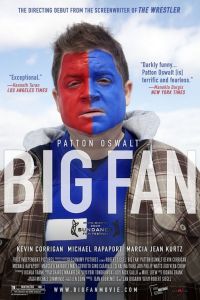 The directorial debut from the screenwriter of The Wrestler follows another down-on-his-luck loser. Patton Oswalt gives a surprisingly dark and affecting performance as Paul, a 35-year-old tollbooth worker that still lives with his mother. Paul’s life is devoted to his favorite sports team, the New York Giants. He spends his evenings meticulously planning his call-in statements to the nightly sports radio show. He’s so devoted to his team that when Paul gets brutally beaten by his favorite Giants player he blames himself. The player gets suspended and the Giants start piling up losses, and Paul can’t deal with the crushing guilt he feels. Big Fan is an intriguing exploration of how absorbed people can get with fandom; I always thought it a bit odd when people refer to a team’s accomplishments with “we” like they had something to do with it. Paul’s fragile world is coming apart and he breaks down with it. Obviously, Paul has a few screws loose in order to make him unpredictable, which gives the last twenty minutes some serious unease. Paul goes undercover as a Philadelphia Eagles fan (his disgust at putting on the enemy jersey is palpable) to hunt out his gloating sports radio nemesis Philadelphia Phil. Big Fan is occasionally funny in an under-your-breath kind of way, but really it’s more of a small-scale psychological study on a hapless individual whose religion is sports and who feels he has sinned before his almighty God. At a mere 86 minutes, the movie doesn’t press too hard into the twisted psychology, nor does Paul leave much of a dent as a character as the film doesn’t make judgment on his obsessive behavior. This isn’t as poignant as The Wrestler, pure and simple. Yet, Big Fan is buoyed by a strong performance by Oswalt and some interesting insights into a flawed fan willing to go all the way for his team.
Nate’s Grade: B
Share this:

The Box (2009)/ Capitalism: A Love Story (2009)
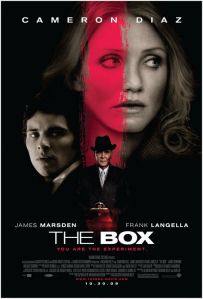 Both films on the surface seem so radically different and yet I found lots of common ground between a sci-fi conspiracy and a muckraking documentary about the biggest financial meltdown of the modern era. Both are centered around the concept of greed and whether humanity can forgo selfishness for empathy of their fellow man. Would you kill a stranger for a million bucks? Would you rig a financial system so that the richest one percent can gamble the life of a nation? Both movies also bite off more than they can chew and both movies exist as interesting yet dispirit elements that could use more cohesion and resolution.
You have been given a box with a button. If you press the button tow things happen: somebody you do not know will die and you will receive a million dollars. Do you press it? That’s the hook of writer/director Richard Kelly’s sci-fi morality tale based upon a short story by Richard Matheson. The Box is a messy and outlandish conspiracy sandwiched between two moral tests, the second a consequence of the first and a means to wipe the slate clean. There’s plenty of weird unsettling moments, including the horrendous wallpaper of the 1970s, but not everything really hangs together. Kelly’s intergalactic conspiracy can get readily outlandish with all the variables and needed participants, but like in Donnie Darko, he lays out enough tantalizing info to keep your attention and then keeps the narrative vague enough for personal interpretation. However, unlike Darko, this movie needed to cleanup its loose storylines. It just sort of ends in perplexing rush, and I sat in silence through the end credits waiting for some kind of scene to help tie together dangling storylines that were left to dangle for an eternity. The Box has a nicely tuned foreboding atmosphere, and it certainly keeps you guessing, but it will also keep you scratching your head to try and make sense of everything from button boxes to teleportation pools to Mars probes to sudden nosebleeds to Satre’s No Exit. Kelly, as he has done with his previous movies, packs a lot in two hours. Whether or not it all formulates is up to the viewer’s wearying patience. I’d rather have more movies like The Box than more thoughtless drivel from the Hollywood assembly line.
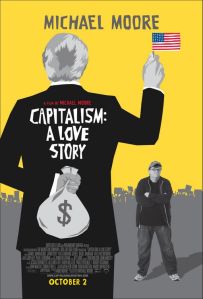 After 20 years, you pretty much know at this point what you’re going to get from a Michael Moore documentary. There’s the anecdotal evidence, emotional interviews of the downtrodden, the one-sided arguments, the nods to the depressive state of Flint, Michigan, and Moore trying to bully his way to see the powers that be that have no interest seeing him. In a way, Capitalism: A Love Story is like a greatest hits collection for Moore that reminds you of his better moments and better films. Despite all the outrage, Moore wants to throw the baby out with the bath water. He cites capitalism as an evil that needs to be eradicated. His thesis isn’t very cohesive and consists of a series of related and unrelated anecdotes, some of them grossly offensive like companies profiting from the death of employees thanks to “Dead Peasant” life insurance policies. But at no point do you walk away thinking, “Let’s start from scratch. What has capitalism gotten us?” Several of his points are easy to agree with. There is a flagrant disregard for the well being of others on Wall Street, who carelessly gambled the nation’s fortunes and then got the taxpayers to cover the loss. The bailout is a crime of pure capitalism and in a true capitalistic society there is no such thing as “too big to fail,” there is only fail. It’s not following an ideology built upon greed that has hurt the U.S., it’s unchecked greed, capitalism run amok without any oversight or regulation that has endangered the nation’s livelihood, and I’m surprised Moore didn’t emphasize the process of deregulation from Reagan to Bush more. The story of our financial meltdown is too large for a confined two-hour narrative window, and it’s too important a lesson for a man like Moore to use it as fire to ignite a people’s revolution.
Both movies: C+


You must be logged in to post a comment.