Blog Archives
The Final Storm (2009)

Famously detested film director Uwe Boll finally tackles a subject that many film fans, and video game aficionados, felt he could possibly be the harbinger for – the apocalypse. Yes, in our apocalypse-drenched times with the bottoms falling out of economic markets and civil unrest, it was only a matter of time before Boll decided to put his unique German stamp on the end of the world. Usually we associate a feeling of dread with the apocalypse, akin to the feeling of dread whenever somebody turns on a Boll movie. Except Boll’s apocalyptic entry, The Final Storm, is a direct-to-DVD oddity that actually works for a while but ultimately fails like other Boll movies. But here’s the funny thing – it’s not Boll’s fault.
Tom (Steve Bacic) and Gillian Grady (Lauren Holly) ditched their big city lives to raise live on a farm out in the country. The TV is filled with apocalyptic flair: riots, fires, strange weather, radiation leaks, power outages, etc. Over the night, a ferocious storm knocks out the family’s power. Their dog runs off into the night and a mysterious stranger collapses on their doorstep. Silas (Luke Perry) says his family used to live on the Grady farm, but he can’t remember much else. Tom is convinced (somehow) that Silas is no good, whereas Tom’s wife is happy to accept a guest that will agree to do housework. When the Grady clan, plus Silas, enters into town they find it deserted. People seemed to have vanished overnight, except for the violent gang roaming the town. Silas, a man of faith, is pretty confidant that God’s Rapture is upon mankind, but Tom goes back into town once more to seek answers about the world and about Silas’ family past.
 For a while there, The Final Storm actually presents a pair of intriguing mysteries that keep the mind occupied: 1) Who is Silas, and 2) What has happened to the outside world? The world has pretty much disappeared; neighbors are gone, the police station has half-drunk cups of coffee and half-eaten donuts. Tom keeps trying to find a rational explanation for what is happening, arguing that the empty town was evacuated as a precaution. But a precaution against what exactly? Something major is underway or has already taken place. Ever since the heavy storm, there have been no birds singing or circkets chirping, no real noises of any kind. Silas is pretty confidant that it’s the end of the world and says that all they have to do is “stack up the chairs and turn out the lights.” Boll places us in the family’s camp; we only know as much as the beleaguered family trying to make sense out of the unexplainable. Canadian screenwriter Tim McGregor (Bitten) is telling a worldly event from a small perspective, trying to personalize the apocalypse. There are no big special effects sequences a la 2012 where the earth swallows cities whole. There is only uncertainty and an overall dread that something is coming but must be waited for. It’s an unsettling thought and played out with enough Twilight Zone –level ambiguity to keep the audience guessing and sticking around for answers.
A general complaint is that nobody seems to react about, you know, the End of Days. Animals and people disappeared over night. Certain townspeople are left behind. Why? Why were others taken and others not? How exactly does that one get explained (in the Left Behind movies, they comically tried to explain the Rapture as “radiation”)? The only one who shows any sign of concern is Gillian, probably because she’s slotted into the thriller female role and thus needs to express concern and eventually need saving. Tom is too preoccupied with his paranoia over Silas, and Silas is supposed to be mysterious so he reacts like he always knew the apocalypse was right around the corner. Even Graham (Cole Heppell), the Grady’s son, seems to be more concerned with his missing dog than the end of all existence. If only everybody was this blasé about the End of Days.
But then there’s that other mystery. Silas shows up at the Grady family home the night of the intense thunderstorm. He says he can’t recall how he got there, per se, and his body is covered in Biblical tattoos. Silas also appears to have some sort of insight into what’s happening in the world. He even tells Graham that his dog, which ran away during the storm, is dead. He’s so certain and preoccupied with making a nice grave marker for the dog that I almost started guessing that Silas was the dead dog incarnate. Seriously, the movie really tries hard to present the illusion that Silas has some sort of ephemeral connection to what is happening, some sort of understanding that goes beyond knowledge of Scripture.
And then the last 20 minutes of the movie reveal that Silas is … (spoiler alert) just some dude who killed his dad and escaped from prison. The Grady home is Silas’ old family home. So the guy who Tom kept saying was dangerous, who showed no real signs of being unbalanced or anything other than courtly and helpful, is revealed to be your standard killer on the loose. This is where The Final Storm utterly falls apart. These characters should be reacting with more alarm about the end of the world. Perhaps McGregor was trying to illustrate how extreme situations affect us, and how jealousy and paranoia can take hold as a means of comfort and survival. But I don’t buy that. First off, it rewards Tom for his unchecked paranoia that had no basis in reality. Silas fixes the roof, helps fend off attackers in town, and chops wood, but it all just makes Tom angry. The last 20 minutes is Silas fully embracing his villainy, the stuff that didn’t show any previous signs of existing. Silas is one big red herring and the movie shifts gears so quickly and absurdly to fit in “super able killer terrorizes family clan” mode. Silas gets frisky with Gillian, asking her to bring in hot water for his bath while he’s in the tub (it’s like an Amish Body Heat). Then he goes full crazy and tries to hang Tom in a tree. Eventually, Silas is set on fire and stabbed with a pitchfork. Then the family stares into the sky and watches as stars get blotted out and the universe collapses. Where is the connection to the apocalypse? The two storylines don’t seem to mix when there is no greater connection. It feels like an ordinary “dangerous drifter” story weirdly set against the backdrop of the apocalypse. Why connect these stories if there is no relevancy, McGregor? It seems like an awfully big waste of time.
Luke Perry (TV’s first Beverly Hills 90210) and Lauren Holly (Dumb and Dumber) don’t seem too shocking to star in a Boll movie when you remind yourself that this isn’t 1996 and neither star has exactly been in high demand since their zeniths. That’s the Boll casting way: catch a falling star. Perry is actually pretty good. He has this serene nature to him that regrettably makes him seem knowledgeable, until you realize that his secret he’s hiding is mundane. He has a slight creepiness brought out through his serenity, but then he gives in fully to malice when his character indulges the dark side. Holly’s character is mostly the worried mother figure, the concerned type who widens her eyes and dribbles her lips to denote said worry. There’s little else to her character, though McGregor tries to come up with some weak back-story. Holly goes in and out of a Southern accent but is generally decent at being wary. What is perhaps the most perplexing is that Holly agrees to get naked for a Uwe Boll movie. Anyway, it’s a point of excitement for any NCIS fans out there that can still feel something below the waist.
 As for Boll, this is one movie that I can honestly say is not his fault. His direction doesn’t exactly elevate the material but at the same time he doesn’t get in the way of the mysteries. I was genuinely interested in discovering what has happened. I figured a religious explanation was going to be the climax, especially after we witness a blood-red moon. But it’s not Boll’s fault that the movie collapses at the end when it feels the need to endanger the family by cribbing from slasher movie rules. Boll’s direction is fairly invisible, though a few shots seem to go on much longer than necessary. The entire production feels like a TV-movie just with a few more naughty words. I feel like Boll is getting a better command of how to direct actors because Holly, Perry, and Bacic (TV’s Big Love), who actually is the best actor of the bunch, all give decent if underwhelming performances. But it wouldn’t be a Boll movie without some form of imitation. I think McGregor and Boll were trying to create their own version of Cormac McCarthy’s widely revered, The Road. There’s an unidentifiable apocalypse, a father and son, roaming bands of desperate gangs, and the general unease of futility creeping up. Too bad that Boll’s movie
The Final Storm isn’t necessarily a good movie by most standards but by Boll’s standards it rises to the top of the junk heap. The supernatural apocalyptic mystery is clearly the most interesting aspect, far more interesting than Silas becoming your standard movie maniac terrorizing a family. Has he no consideration? It’s the end of the world, man. Leave land squabbles for the day after the apocalypse. This unrelated side story pretty much derails the movie during the last act, jettisoning the apocalypse for lousy thriller fare. Boll’s direction lets the story play out to its potential and we feel the pull of the mystery, the longing for discovery and answers, and then the answers end up being far less than satisfying. The Final Storm is probably a little too slow for its own good, which furthers my hypothesis that McGregor had half a story about a crazy drifter and thought, “Well, I can’t finish this. I’ll throw together some end of the world stuff and call it a day.” Boll seems to be advancing as a director; the last few movies have become more capable. This is the first of his thirteen movies (and counting) that I’ve reviewed that I can say, without a hint of seething irony, that this movie sucks and it’s not Boll’s fault. Of course, you’re still left with a movie that sucks.
Nate’s Grade: C
Share this:

Stoic (2009)
 Until recently, it would have been unthinkable to associate Uwe Boll with the idea of social activist. This is the same man who has caused people so much pain and with his movies, ranging from bad to ridiculously bad to “You cannot unsee what you have seen” bad. The German director who has caused so many film and video game fans suffering seemed an unlikely candidate to seriously explore the suffering of others. And yet Boll’s heart grew three sizes and he directed a slate of movies with a social conscience. His movie about the genocide in Darfur is still circling around, awaiting a release date, but let me stop to remind you that Uwe Freaking Boll directed a movie about a topical humanitarian crisis. This is akin to… Eli Roth directing an Edith Wharton adaptation (“From the director of Cabin Fever comes … Ethan Frome!”). It just doesn’t seem like an organic pairing. Boll is used to blood and boobs (both of the mammary kind and of the idiot variety), not social relevancy. You don’t expect an exploitation filmmaker to shine a light on exploitation. While we await his Darfur movie, in the meantime is Stoic, a quick and cheap movie about three prison inmates (Edward Furlong, Sam Levinson, Steffen Mennekes) brutalizing their cellmate, Mitch (Shaun Sipos) when a bet goes wrong. It’s based on a true story from a German juvenile detention center, or so we’re told.
So what kind of movie is Stoic, actually? Well, for starters it’s an uncomfortable one. The movie aims to show the capability of human cruelty and how easy it is to become compliant within a group, to go along with the flow despite some murky moral hazards. The three cellmates end up kick starting a cycle of violence, each trying to top the last so as not to appear weak or to damage ego. Can this cycle of cruelty be stopped? The dehumanization leads to some rather brutal and disgusting acts of violence and degradation including forcing Mitch to eat his own vomit, dumping urine on the guy’s face, raping him, and sodomizing him with a broom handle (“Just curiosity, I guess,” explains one of his attackers). Despite all this, there are actual moments of restraint on Boll’s part, particularly during the rape sequence. The audio drops out, the edits become jump cuts stuttering ahead through time, and I thought perhaps Boll was maturing. Needless to say this thought was torpedoed a tad when Boll later showcased the inmates rubbing the bloody broom handle over Mitch’s unconscious mouth. Stoic is essentially a torture movie; it’s 80 minutes of literal torture with some extra psychological justification tagged along for safe measure.
 Where Stoic comes into issue is whether or not it possesses any merits to justify watching 80-some minutes or torture. The movie doesn’t offer much in the way of psychological insights or rich characters. Watching people become increasingly hurtful is not the same as exploring the habits that make such escalating acts of barbarity occur. Boll and the actors pound us with the message that we’re in prison and prison has its own operating system and everybody jockeys for position; Peter (Levinson) repeatedly tells us that he feels sorry but felt he had to participate or else they’d turn on him. It’s all about having somebody weaker to take the fall. I’ll give Boll credit that the amplification of events seems plausible given the circumstances, to the point that the three guys have come to the conclusion that there will be serious consequences for their actions unless they convince Mitch to go along with a fake suicide. The movie maintains believability even as things get more and more out of hand, which is commendable. But what isn’t commendable is that there seems little reason for Stoic to exist. Narratively the movie is simple: three guys pick on another guy. The characters are all slight variations of one another based upon the level to process guilt and deception. During the interviews, we’re given fleeting glimpses at denial and coping mechanisms, mainly lying (“I would’ve remembered something like that.”) to self-rationalization (“I kept saying to myself, ‘As long as it’s not me.’”). There aren’t many insights to be gleaned from the brief interviews, which serve as commentary.
Boll decided to make Stoic his Mike Leigh film, meaning that he had the basic outline of a story and told his actors to run with it while he filmed them. There was no script and all the dialogue was completely improvised. This does allow Stoic to maintain a naturalistic feel, however, it also means that the actors are beholden to tough guy clichés. The dialogue, particularly during the interrogation scenes, keeps falling back to a “you don’t know what’s it’s like, man!” mantra. Here are some examples of bland dialogue that the actors came up with:
“What choice did I have?”
“You’re either with them or against them.”
“What don’t you understand? If I didn’t seem like I was apart of it, they’d kill me.”
“I had no choice. They forced me.”
“I want to lie because I don’t want to be that person.”
“I felt like there was no way out.”
And because you knew it had to happen:
“I’m just as bad as the two of them because I didn’t do anything to stop it.”
 You’ll note that most of these dialogue examples belong to the Peter, the chattiest and most remorseful interviewee. Improvisation has its virtues but it can also lead to actors falling back on stuff they’ve seen in countless other genre examples, which means that the banal, cliché dialogue all gets stirred together one more time.
In defense of Stoic, it may prove to be Boll’s finest directorial effort yet. The handheld camera, sharp edits, and close angles copy the Paul Greengrass (The Bourne Ultimatum, United 93) style of visuals, and yet the docu-drama copy works. The visual aesthetic improves the quality of the film and allows Boll many opportunities for interesting compositions and smart stylistic decisions with the economical space of the set. The interviews are shot as one static camera shot to contrast with the shaky, reactionary movement from within the cell. It may not be an original style, but then again Boll seems to adopt (some might say rip-off) a new style with every film. For Stoic, Boll’s direction makes you feel in the middle of these awful incidents, and the pain feels even more real.
But is there any reason to really watch Stoic? The acting is mostly good, and maybe fans of Edward Furlong would like to see what he’s been up to since 1998’s Pecker and American History X. Perhaps the declaration of “Boll’s best directorial effort” will appeal to maybe six or seven curious, and questionably masochistic, film fans. Due to Boll’s German background, I can’t help but wonder if his country’s history influenced him to try a narrative experiment hat explores how easy it is to go along with something awful, how difficult it is to make a moral stand against the grain, and how easily circumstances can find momentum and get out of control. I wonder if Stoic is Boll’s personal act of penance, of trying to understand a nation’s actions (and inaction) and working through a lingering shroud of shame. Then again, I may be reading way more into this movie than was ever intended. It could have just been a lark for a quick buck/deutschmark. Stoic is a mildly interesting little filmic experiment from Boll. Due to its narrative simplicity and limited characterization, it can’t offer much more than another voyeuristic slideshow of human degradation.
Nate’s Grade: C
Share this:

The Girl with the Dragon Tattoo (2010)
 Heating up the art house cinemas, The Girl with the Dragon Tattoo is two and a half hours, Swedish, in subtitles, and is absent any familiar faces, and audiences can’t seem to get enough. Based on the international best-selling novel, this independent thriller was the highest grossing European film for 2009 and deceased author Stieg Larsson’s two sequels, The Girl Who Played with Fire and The Girl Who Kicked the Hornet’s Nest (sounds like a lot of risky behavior for this girl) have also been made into movies with the same cast. So now that America is caught in the midst of Dragon mania, we all won’t have to wait long for the ongoing adventures of the journalist and the Gothic investigator. Both sequels are planned for release this summer, meaning that the entire trilogy will unwind in theaters over the course of only a few brief months. That’s one thing that has to please American audiences — instant gratification. For those unhip to the world of Lisbeth Salander, get ready to take notes because she’s likely to become an indie film icon, at least for an older, well-read demographic (think: your parents).
Mikael Blomkvist (Michael Nyqvist) is an investigative journalist sentenced to jail for 6 months after losing a libel case against a large shady corporation. Before he serves his prison sentence, Mikael is approached by a wealthy businessman, Henrik Vagner (Sven-Bertil Taube), convinced that his niece, Harriet, was murdered and her murderer is still taunting him 40 years later. Henrik Vagner lives with various other family members on a remote island. The mysterious clan has some serious skeletons in their closet, and Henrik believes ones of his family members, apart of the powerful Vagner Group, is guilty. Mikael takes refuge on the island and begins to comb over old police documents looking for any overlooked clues. Meanwhile, Lisbeth Salander (Noomi Rapace) inserts herself into the case. She’s an expert computer hacker and hired by Henrik Vagner to compile a background check of Mikael. But her interest did not end with her assignment. She has hacked into Mikael’s computer and furtively spies on Mikael’s progress. She e-mails him some key breaks in the case and joins Mikael on the island. Together they make rapid progress finding out what happened to Harriet all those years ago, and a serial killer makes note of their encroaching progress.
 Thankfully, The Girl with the Dragon Tattoo is a thriller that respects its audience’s intellect by not having to spell out every damn detail, and people, there are a lot of damn details. While the movie feels complete, it still leaves much to the imagination to fill in character back-stories, connect the plot dots, and interpret all those silent glances and meditative stares (granted, it might all get filled in following two sequels). A prime example is when Mikael covets Lisbeth’s photographic memory, telling her what a terrific advantage that must be, and a small pensive look from Lisbeth says all we need. It’s enough to make us re-examine what we think we know concerning her background, and the rest of the movie follows this model. I also appreciated that every break in the case came from good detective work and not some swishy super computer stuff. Though Lisbeth is an expert hacker, nothing these characters do is out of the realm of reality unlike other tech-heavy detectives. The plot is tied in knots and we have all sorts of various suspects and angles. The central mystery needs to be interesting for this movie to work, and it is … after it gets into a second gear. A girl’s disappearance 40 years ago isn’t enough to grab you until the more sinister and sordid elements come out into the fray. It also hurts that there’s a clear disparity when it comes to character interest. Mikael isn’t a blah character by any means but he seems to serve as an expository device, the guy who uncovers the secrets and gets to be the helpless foil to Lisbeth. I suppose for maximum narrative effect a straight man would be required to be paired with Lisbeth.
Lisbeth is an unorthodox choice for a researcher given the fact that she’s pierced, punky, and full of attitude and ink, including a certain titular dragon tattoo. But she’s also fiercely intelligent, resourceful, intuitive, and wounded, which makes her a fairly fascinating character. She’s an exciting mystery of a character. She’s wounded and defensive but cavalier and intentionally confrontational at the same time, an exciting conflict. Her attitude is roughly, “So what if I dress as I do? So what if I have a healthy sexual appetite? So what if I am a woman? I demand to be treated with respect.” Lisbeth commands attention even though she feels uncomfortable being gazed at. She’s more than some female fantasy protagonist, though a punky, bisexual ass-kicking gal will fit the bill for some, she is a full-bodied character and a terrific break from the traditional investigative heroes of mysteries.
 I asked myself midway through if the aesthetics were standing in for character; if you stripped away all that punk rock glamour and the shock value of a “Goth PI” than would there be anything compelling left (I was sort of thinking of the Gothic lab tech on America’s quizzically #1 TV show of the moment, the alphabet soup-friendly NCIS)? The answer, I found, was a resounding yes. There’s much more to this girl than a dragon tattoo and a spiked collar. Rapace doesn’t let the outfits overwhelm her. There’s a certain joyful recklessness to her character hidden beneath a veneer of steely coolness. Rapace has to play many different elements through a specific prism of emotional reserve, which makes her character, and her performance, less showy. It makes for a very good performance but ultimately leaves the final judgment of Rapace in question. Despite the international acclaim, Lisbeth isn’t exactly a star-making role. Yet, at least.
The story is awash in details, which is both a positive and negative reflection of the screenplay. There’s likely too many plot details for one screenplay and several elements feel like they may be integral when they really turn out to be incidental, like Nazi ancestry and the lone bridge off the island. Don’t get me all excited with Nazi ancestry and then have it become incidental to the plot. Nonetheless, it takes a good deal of time to process and familiarize all the numerous expository groundwork of the case, and time is what The Girl with the Dragon Tattoo has to offer. At 150 minutes, the movie follows a pretty languid pace and doesn’t get moving until an hour in when our two leads join forces. Echoing that deliberate sense of pacing are the sparse and snowy landscapes of Sweden communicating isolation and looming danger. I can pretty much guarantee that the Hollywood adaptation in the works will not be nearly as leisurely with its pacing. The film’s resolution is very drawn out but that’s due to the many niggling plot threads that need to be attended to. It makes for a satisfying albeit mildly exhausting conclusion.
 The book’s original title was “Men Who Hate Women” and that seems apt given what occurs on screen. Sure there’s a serial murderer on the loose but that’s par for the course. Even the grisly ritualistic killing stuff. But Lisbeth encounters a lot of malice and hostile male aggression, some of it very sickening. There’s a startlingly extended rape sequence, followed by some sadistic, if justifiable, revenge. It all contributes to an overall tone of queasy misogyny that seems to waver between intentional and unintentional. I’m not sure tone-wise whether the movie ever creeps into unsettling voyeurism at the behest of women in explicit sexual peril, but it certainly is a distraction. It can get pretty hard to watch at times in this disturbing Swedish thriller. I hope the eventual sequels don’t follow this same queasy, upsetting tone but I also worry that this may be unfortunately part of the books/movies appeal.
The Girl with the Dragon Tattoo is an arresting and entertaining thriller that occasionally ducks a little too low into the gutter for my tastes (I’m really taken aback at how rape-heavy it is). The mystery works, though it’s more complicated thanks to an excess of detail and not necessarily a complex narrative. The characters, in particular Lisbeth Salander, are what make this movie work. Lisbeth is a captivating lead character and only promises to get more interesting in those future sequels. In many ways, this is a mystery for grown-ups, not just in content but also in approach, with the relaxed pace, subtlety, and moral ambiguity. Having never read the books, I can now see what all the fuss is about, and most of it is warranted. Still, I’m holding out my final judgment until those other two editions of the Adventures of Lisbeth and Crew hit theaters. The movie adaptation of The Girl with the Dragon Tattoo is an exciting opening entry into the world of Lisbeth Salander, international woman of extreme ass kicking in fine fashion to boot.
Nate’s Grade: B+
Share this:

The Ghost Writer (2010)
 Ewan McGregor (Angels & Demons, Big Fish) stars as The Ghost (no, he never earns a name even in the closing credits). He’s an expert ghost writer for best-selling autobiographies, and his services have been enlisted for his biggest client yet. Adam Lang (Pierce Brosnan) is a former British prime minister currently embroiled in a legal scandal. He’s being accused of handing over British citizens to the United States to be tortured, all in the name of the War on Terror. Lang and his wife (Olivia Williams) have holed up in a fabulous house along Cape Cod, hiding from swarms of international media. The book’s due date is soon approaching and nobody is really pleased with the first draft. Mike, the first ghost writer, can’t help with the revisions on account that his abandoned car was discovered on a Massachusetts ferry and his body washed ashore the next day. The Ghost begins to suspect that Mike somehow stumbled across some very potent and damaging information, and the secrets are hidden somewhere in that manuscript.
Consider me pleasantly surprised at how effective this small little political thriller turned out to be. It doesn’t have an overworked narrative agenda, but the few things it does it does quite well. Firstly, it’s a pleasure for a thriller to actually make the audience feel as paranoid as the main character. He treats the idea of a conspiracy as nonsense to begin with, but then he starts to second-guess that car traveling behind. What about that guy two blocks down talking to himself? The screenplay achieves a palpable sense of paranoia, nicely placing you in the emotional state of our lead. You may run questions through your head as well, wondering who can ultimately be trusted, who to turn to next, what information to divulge and to whom, whether to get into the mysterious car or not. The best “thriller” moment is the Ghost waiting in his car and driving for cover, but even that is done in a style that doesn’t feel ripped from an action blockbuster. I’ve watched so many thrillers that get by on studious attention to the routines of the genre, and while The Ghost Writer doesn’t exactly break new ground, the movie keeps the threat of danger real. Actually, on that very note, The Ghost Writer does something unexpected, which is that it begins to lull you into a false sense of security or complacency, and then it robs you of that sense of security in the end. I enjoyed the film’s climax, though even at my screening I heard dissatisfied grumbles on the way out.
 The movie is without exchanges of gunfire, explosions, or any nefarious, shadowy individual pressing a red button and laughing maniacally. The Ghost Writer exists in a world very similar to our own. It’s a conspiracy thriller in the same vein as The Constant Gardener or Michael Clayton. The menace is far more subdued; the danger getting tighter as we push forward yet the threat feels deceptively relaxed. It’s the kind of conspiracy thriller that feels like a workable conspiracy, which means that most of the dirty work is implied or done behind the scenes. This means that you have to work a little harder to engage with The Ghost Writer because it chooses not to spell out its litany of danger and those who are dangerous, but it also makes for a more effective experience of paranoia. The film even seems to follow this edict in its visual presentation. The movie has an eerie cool feel to it thanks to the downcast, icy blue-hued cinematography and sleek, sparse art direction, suggesting something is amiss but you can’t quite put your finger on what. It’s also continuously raining, a favorite, if overused, cinematic metaphor.
The Ghost Writer intelligently explores a current international imbroglio, making the political crisis relevant without reaching for a soapbox. The politics of torture is a topic that doesn’t appear to be disappearing any time soon. Torture also provides a fine, morally queasy subject matter to dive into and pick apart. Willful involvement in torture presents several ethical challenges for a character (unless you’re Jack Bauer), which can prove to be a meaty area to watch gifted actors chew over all that rueful decision-making and hand wringing. But alas, this is not a message movie like the slew of 2007 Iraq/torture films that fell flat, mostly because those lukewarm-to-awful movies felt a message supplanted entertainment. The Ghost Writer is a piece of entertainment first, an adult and a cerebral movie that has a striking sense of humor. The dialogue is surprisingly quippy, full of great one-liners amidst all the peril and uncertainty. So while the movie has some points about global politics, ownership and responsibility, the role of media and rewriting history, the movie doesn’t commit entertainment suicide trying to service a message.
Personally, I found the behind-the-scenes work of a ghost writer to be just as interesting, if not more so, than the conspiracy unraveling. The editing process can be fascinating for such a high profile political leader; deciding what moments to emphasize, what moments to forget, what narrative will be fashioned to make sure that a politician comes out on top, spiting his enemies without looking bitter. It’s a delicate balancing act and a precarious responsibility for the ghost writer, controlling a human beings life story for the annuls of mass market history. And these ghost writers get no recognition, even after mimicking the speaking/writing styles of their subject, and these are often subjects who are used to having their thoughts and opinions groomed, tested, and prepared by others, so what difference does their autobiographies make? I believe Sarah Palin could not write her own name without the aid of a ghost writer and/or a bevy of trained subordinates. While this storyline pretty much expectantly falls by the wayside once the conspiracy stuff emerges, I felt that the movie did a respectable service to honor ghost writers everywhere (Palin’s own ghost writer was Lynn Vincent).
 The cast all seemed to dig their juicy roles, judging from the performances. Brosnan and Williams are obviously playing versions of Tony and Cherie Blair, so it’s fun to watch both actors enjoy their thinly veiled roles. Brosnan (Mamma Mia) is terrific and Williams (An Education) has this disquieting calm about her that only breaks in a handful of telling moments. Many actors have these small, sometimes one-scene, parts but they make the most of them. Kim Cattrall is spunky as Lang’s loyal personal assistant (her accent isn’t flawless, but that alone is better than her work in the Sex and the City movie). Tom Wilkinson (Duplicity) also shows up as an Ivy League professor with a mysterious background, and the man knows exactly how to play a treacherous gentleman. You may be shocked to see a bald-headed, bulldog-looking Jim Belushi appear on screen, and he’s good too as a publishing exec with no patience for niceties. But the movie is McGregor’s and the actor does not disappoint. It’s pleasing to watch his character transform from observer to actor. He’s a charismatic guy that speaks his mind and a worthy hero to root for.
And it took until the final paragraph for me to mention director Roman Polanski’s current legal woes. The Ghost Writer was Polanski’s last film he directed before being obtained by Swiss authorities and set to be expedited back to California for a 30-year-old rape charge. It’s hard not to read somewhat into the premise: a man hiding from authorities with a charge hanging over his head. This may well prove to be the last film we’ll see from the 77-year-old director judging from the pending legal issues. If it does indeed serve as the last piece in the career of a talented director, it will at least be a high point. At least Polanski’s last film wasn’t the abominable Ninth Gate.
Nate’s Grade: B+
Share this:

Green Zone (2010)
 I have noticed that I’ve really been dragging my feet when it comes to writing a Green Zone review. I’ve prioritized it only to have something more necessary (catching up on VH1 reality shows) come to the forefront of my attention span. It’s not like the movie is bad. It may have been misleadingly advertised as Jason Bourne’s tour of Iraq, bringing back together Matt Damon and director Paul Greengrass (The Bourne Supremacy), but it’s not bad. It’s a perfectly fine movie, except in this instance, given the politically explosive and monumentally relevant subject matter, “perfectly fine” sounds like a missed opportunity. This movie should be incendiary, shocking, aggravating, enlightening, and if it happens to be entertaining then that ain’t bad either. The subject matter –the false rationale for war, WMDs– deserves a sober examination. Green Zone is not that movie. Green Zone is about uncovering and righting the mistakes of the Iraq War, and I believe I figured out what keeps Green Zone from being a better, more powerful, more engaging movie — it fictionalizes a story that is already wroth telling. This is a true story that could have stood well on its own merits.
Shortly after the fall of Baghdad in 2003, Chief Warrant Officer Roy Miller (Damon) is on the hunt for those weapons of mass destruction (WMD), the chief argument for invading Iraq. His team investigates suspected weapons sites but they keep coming up empty. The intelligence appears to be in sharp contrast with the reality on the ground. Miller butts heads with shady government officials (Greg Kinnear) and finds aid in a state department realist (Brendan Gleeson) and a reporter (Amy Ryan) who put her reputation at stake parroting the government intelligence as fact. The Iraqi army is disbanded and now the former generals under Saddam Hussein are conferring what the next steps should be. General Al Rawi (Yigal Naor, who played Saddam in a TV mini-series) is waiting for the Americans to extend a hand, and if not then they will become an insurrection. Miller is racing to track down Al Rawi because he knows the truth in the lead up to the war, which is why those shady government officials are also trying to kill him.
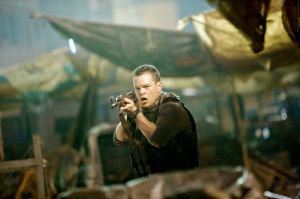 Based upon reporter Rajiv Chandrasekaran’s book Imperial Life in the Emerald City: Life Inside the Green Zone, the filmmakers have resorted to a fictional narrative informed by the real events. My biggest gripe is this: the true story is far more interesting, complicated, and relevant than concocting a story about one military man’s search for answers. The film is laid out like a conspiracy thriller, where our hero gains a small sliver of information that leads to another piece, and another and another, until finally a picture emerges. I get it. With Damon as a soldier, the audience has an obvious rooting point, a protagonist who we can easily be labeled as good. And then when he uncovers the truth, and alerts the media, it provides a tidy, satisfying end for the movie. Except that’s not what happened. In the real world, the hunt for those phantom WMDs carried on for months, and the news trickled drip by drip. There were no smoking guns, no white knights to shine the light of truth (Joe Wilson and Valerie Plame might be the closest in consideration), and there wasn’t anything as conclusive as a military officer writing a report and sending it the mainstream media.
Green Zone attempts to craft a satisfying close to the WMD hunt and likewise the war itself. This is nothing more than revisionist wish fulfillment, wanting to insert a hero of conscience and ability during a time where we had a malaise of responsibility from those in the realms of higher command. And just to make sure they don’t make too many waves, Greengrass and screenwriter Brian Helgeland (Mystic River) wrap their crusading character in the uniform of America’s finest, making it difficult to criticize his noble hunt, striping away politics. The trouble is that the Bush Administration rarely made apolitical decisions; everything was steeped in politics, even the truth about weapons of mass destruction. So Green Zone does the audience a disservice by trying to play nice, setting up a villainous fictional straw man, and forgoing naming the names of those that led this country astray. Because of placing the film’s point of view squarely with Miller, we never get to examine the bigger picture, the manipulations and machinations that led to war. We are stuck in a very limited focus of finding the WMDs.
 Now, I must ask whether or not I’m unfairly judging the movie. Hollywood has often taken fascinating and momentous true-life stories and redirected them toward fiction. Green Zone is certainly a technically proficient film. Greengrass’ trademark shaky camera is ever vigilant, always roving and looking for the action; although in a realistic war setting, the kinetic handheld camerawork can come across as potentially hyperactive. Conversations between two people can come across like intense linguistic battles. Walks down hallways can appear to be speedy jaunts brimming with purpose and anxiety. The tension just doesn’t materialize. Without a nervy story, the Greengrass visual staple can seem over the top, antsy, nervous, and also annoying. This is one narrative for Greengrass that could have improved by the dedicated use of a tripod.
Green Zone is not Bourne at all. The Universal marketing team was trying to hoodwink the public into seeing an Iraq War movie. Damon isn’t as polished and in command as Bourne. Those who argue that Green Zone is anti-American or anti-troops are grossly missing the point. Reactionary, bellicose rhetoric, without a wit of substance, is part of the reason the U.S. is currently in Iraq. You can argue against policy, including war policy, and still be considered a patriot. Patriotism is not synonymous with warmongering. It’s too bad that the filmmakers felt that the true story wasn’t good enough to be told, instead settling for a decent if unmemorable political thriller. This adaptation takes the most significant foreign policy event in modern American history, one where the ramifications will be felt for over a generation, and clears all the hard-boiled details to attach a conventional one-man-fights-for-truth tale. It’s hard to get self-righteous when the movie keeps trying to cover its own ass.
Nate’s Grade: B-
Share this:

Repo Men (2010)
 It’s not unheard of for different writers to independently create similar projects. Remember back in 1998 when there were two animated bug movies and two apocalyptic asteroid flicks? Granted, those were big budget studio movies and the final films had little in common other than concept or premise. Repo Men takes place in a world where people open contracts on new organ transplants, but if the buyer is late on the payment then a repo man will come and take back the merchandise. This gory premise might sound familiar for fans of the Goth opera, Repo: the Genetic Opera, which was released a whole 18 months earlier. The makers of Repo Men and Repo have engaged in a he-said/she-said argument over who originated the idea. Repo Men‘s screenwriters claim they came up with the concept in 2003, though the book the film is based was only released in 2009. The Repo team point out that their funky little musical began as a theatrical show that was first performed in 2002. The songwriters behind Repo say that the idea itself goes back to 1999 and began as a 10-minute opera experiment. I suppose we’ll never know who really had the idea first, though I’m inclined to side with the Repo musical fellas because they can back up their claims with evidence. It seems like a whole lot of squabbling over so little, but hey, that’s Hollywood for you.
In the not-too-distant future, one corporation, The Union, seems to hold sway in the world of organ transplants. Remy (Jude Law) is an expert repossessions officer who will slice open anybody 90 days late on his or her payment. His wife wants him to transfer to sales; it’s less messy. Remy’s partner (Forest Whitaker) is an old childhood friend and doesn’t want to lose his butcher buddy. One night, Remy is sidelined by some malfunctioning equipment that fires his heart. He has no choice but to get his own organ transplant. Following the operation, Remy finds that he no longer has the stomach for his old line of work. Remy’s newfound moral compass comes at a cost. He quickly falls behind in his payments and his old bosses plead for Remy to refinance. Reluctantly, they sic the repo men, including Whitaker, on Remy to retrieve company property.
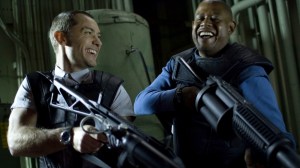 Repo Men takes some nice commentary on predatory lending, pushing the hard sell knowing that the customer can never stay ahead of the mounting fees and payments. The allegory has some sharp moments. However, the movie would have benefited from being pushed further in pretty much every regard. The side characters are horribly shallow. I’m fairly certain that Carice van Houten (electrifying in Black Book), as Remy’s beleaguered wife, could have been replaced with a cardboard cutout boasting a disapproving look. She gets to glare and complain and talk about family issues and then she’s gone, replaced entirely by Beth, a mysterious organ replacement junkie. Beth could have an intriguing back story, and the concept of surgery addiction could dwell upon the human cost of beauty and “upgrading,” but alas, her real purpose is to become an oddly implacable love interest for Remy. She gets to hold his hand while they run. That’s her main contribution (except for one key scene detailed below).
The entire concept of a future world held hostage by a greedy health care corporation could use more contemplation. What is happening with society? No epidemic is ever mentioned, so why do people start contracts on million dollar organs? Do the heavy debts pass on to the next of kin? What is the legality of organ repossession? What level of competition is there out there in the market? What does the government have to say about all this? Does this mighty company supersede the U.S. government? How come Remy can’t even get an employee discount on the merchandise? Has anybody had enough surgeries to become the six million dollar man? There is a wealth of questions born from this premise, but the movie only scratches the intellectual surface and sets its standard change-of-perspective morality storyline into gear. I actually would have found the life of an organ salesman to be more dramatically appealing. What kind of ethical rationalizations take place in the mind of a man who makes his living signing saps into modern indentured servitude? I find that story direction to be more compelling than following the guys who bring back the company merchandise.
But then something weird happens. The movie gallops to a satisfying close, and then it somehow gets even better in its closing moments. I was certain that I was going to write off Repo Men but then 4 things happened to make me sit up straight in my chair (I’ll refrain from any large spoilers):
1) In a film relentlessly aping the visuals of other, superior dystopian films, there’s not much new to look at. You’ve seen this future society thing before, just with more flying cars or jet packs. I came to terms with this; it’s not every movie that reinvents how we interpret the future short of some calamity. Then when Remy breaks into the Company HQ, which is awfully easy by the way, he stumbles into the genetic organ hatchery, if you will. Rows and rows and rows of scientists tinker with organ replacements. The entire environment is a strikingly sterile white, including the scientists wrapped in bulky white biohazard suits. Then Remy and Beth make a run for it, and they are covered head to toe in black. It’s a fabulous visual image, watching the color contrasts. It’s debut director Miguel Sapochnik’s high point.
2) Once Remy and Beth move beyond this laboratory, they get caught in a hallway, and Remy proceeds to take out a mob of employees. The fight sequence is several minutes long and a clear nod to the memorable extended hallway fight in Oldboy (Remy takes out a hammer as his final weapon). Weirdly, Remy’s opponents are suit types, middlemen, office employees, numbers crunchers, but they all leap into battle to take out the corporate intruder. The fight sequence is bloody and stylish enough to please the senses, like when Remy swings a hacksaw and we get Swinging Hacksaw POV as characters duck out of the way lest their jugulars get sliced.
 3) Following this, Remmy and Beth must deposit their corporate-licensed organ replacements. This involves cutting each other open, taking a bar code scanner (think a grocery check-out), and digging inside each other to get those subcutaneous scans. What’s amusing is that the scene is blatantly juxtaposed as a sex scene; Remmy and Beth intimately penetrate each other, the editing cuts to close-ups of moaning, and the other tries to soothe the pain with physical assurances, and it’s all set to a slow jam. It’s something of a bizarre sequence, especially upon further review (how effective can scanning for bar codes be inside the gook-filled human body?), but man is it interesting.
4) Just as I had come to terms with the movie settling for a conventional conclusion, the movie pulls the rug out from under you. It offers up a last-minute ending that upends the conventional framework, and, actually, presents the easy coast to a conventional stop in a new light. This is one of those rare instances where a last-minute ending twist actually improved the film. More often than not, a last-second twist is forced and the nail in the coffin of lasting entertainment.
Repo Men is a competently looking, competently entertaining sci-fi thriller that miraculously stumbles into a final act that not only works, it elevates the rest of the movie. My mild boredom vanished and I started wondering why they made me wait so long for the good stuff. Repo Men is a mixed marriage of overall tone. One second it will be darkly humorous, the next it will be satirical, the next it will pine for serious drama, and occasionally it goes for Guy Richie-styled slapstick. A sequence where Remy describes the three occasions he’s been knocked out, with visual interludes, feels like a deleted scene from an entirely different movie. The movie never really settles, touching upon a lot of areas but mostly poorly. The script desperately needed to be fleshed out to make any lasting impact. Now that I’m living in a two-Repo world, I’ll probably stick with the campy musical fun of Repo: the Genetic Opera. At least that movie left you humming.
Nate’s Grade: C+
Share this:

Whiteout (2009)
 I was expecting bad but this is shockingly bad, notably in its lapses in basic filmmaking fundamentals. For instance, there’s a scene where Kate Beckinsale talks with a superior, and the editing cuts back and forth in the middle of every damn line between a medium shot of the actress and a close-up. The jarring effect feels like the movie is punching you in the face. The movie can’t even get watching conversations right! This Antarctica-set murder mystery seems like a neat idea until you realize it’s just another lousy slasher movie, albeit in an exotic location. The Antarctica location is mostly used to make sure that nobody can tell what the hell’s going on. Furious white flurries of snow pretty much make the onscreen action oblique, like you’re trying to look through a dirty window and comprehend what’s happening. The plot sets up a wealth of disposable characters and patently obvious suspects (Gee, will the weird, tattooed pilot have something to do with a body dropped from a plane? Stay tuned). It’s all pretty stupid with no real room for brain-dead thrills because the technical craft is so shoddy. However, the movie did make it clear that when, not if, the CSI franchise expands, they need to set it in Antarctica.
Nate’s Grade: C-
Share this:

Law Abiding Citizen (2009)
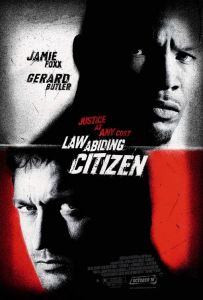 Taking a few lessons from the grisly Saw franchise, this revenge thriller follows Clyde (Gerard Butler) track and kill the men responsible for murdering his wife and child. Except that pretty gets resolved in 15 minutes. The rest of the movie is Clyde’s misguided, morally queasy assault on the justice system; the judges, lawyers, police officers that keep a dying system going, letting guilty murderers walk. Clyde is specifically targeting the prosecutor (Jaime Foxx) that made a plea bargain instead of risking his conviction percentage at a trial. This is a violent vision that wants to rewrite our very Constitution, questioning giving accused murders the same considerations as soccer moms. The movie can come across as a conservative, Death Wish-style fantasy against the judicial system and those pesky civil liberties afforded to everyone. While shrouded in the guise of being a bloody thriller, the movie’s idea of moral ambiguity is pretty thin. Its ethical arguments don’t stand a second line of questioning. Sure, director F. Gary Gray (The Italian Job) can put together an exciting and tense sequence, and the film is filled with surprise, and Butler arguably gives his best performance since 300, but while I was entertained I was also offended at being expected to cheer every time Clyde knocked off another innocent citizen.
Nate’s Grade: C
Share this:

Bad Lieutenant: Port of Call New Orleans (2009)
 This is a crazy movie. It is not weird, it is not bizarre; it is not silly. Werner Herzog’s whacked-out movie is a remake of a 1992 movie that wasn’t that good to begin with. This certifiably crazy movie mostly involves Nicolas Cage as a corrupt cop playing all sides and snorting everything that isn’t bolted down in the Big Easy up his nose. For a stretch during the middle, he starts to sound like Jimmy Stewart with lockjaw. The central murder investigation plot is pretty much an afterthought in an environment like this. You want the crazy, and with Cage and Herzog, it is in no short supply. There’s Cage threatening an elderly woman at gunpoint, crawling reptile POV shots, a man’s “soul” break-dancing after the man lies dead, and neon iguanas that may exist only in Cage’s drugged-out mind. The film has been described as a trippy parody of standard cops-and-robbers fare, or as a seriously demented anti-drug message, but I think the best description is just “crazy-ass movie.” It has moments that make you do nothing but shake your head and laugh, like when Cage is about to hit rock bottom and EVERY case/storyline gets solved in a matter of seconds to his bemused disbelief. The comedy is straight-faced but it is definitely there. Cage harnesses his eccentricities and delivers an insanely entertaining performance that reconfirms that there is indeed an actor underneath his Hollywood veneer. He is compulsively enjoyable and the movie is compulsively watchable, every crazy freaking second of it. Iguanas!
Nate’s Grade: B
Share this:

Saw VI (2009)
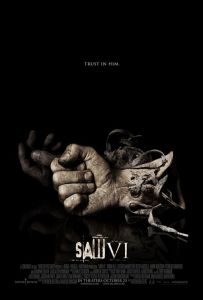 I checked out on Saw 4 and Saw 5 feeling like this horror series had grown stagnant, plus its central villain was killed off by the conclusion of the third movie. I thought the series wouldn’t go on for much longer, and oh how wrong I was. Jigsaw (Tobin Bell) has a second apprentice now fulfilling his departed master’s bidding, capturing even more people and trapping them into the franchise-favorite death traps. This means that there are yet even MORE recorded messages and vast, abandoned warehouses out there. FBI Agent Hoffman (Contas Mandyor, an amazingly horrible actor) has taken up the contrived contraption mantle. Of course it’s all preposterous and overly gory, but that never stopped the series before. Saw 6 boasts the franchise’s fourth director (the editor of all the previous movies just graduated to the big leagues). But this is mainly a franchise built around the hardened desires of its fans, indoctrinated in the gospel of gore. As I said before with Saw 3: “Just like the collapse of the Final Destination franchise, these movies started big but then bottomed out when their audiences had the rules memorized. At that point the only thing left is curiosity in what fiendishly outlandish ways people will get horribly killed.” This pretty much still holds true.
The real interesting draw for the sixth entry, and the only reason I drifted back in curiosity, is because Saw 6 is the weirdest participant yet in the current health care debate. The victims in this installment are health insurance employees. The people in charge of deciding who live and who dies are now put through morally challenging, queasy challenges. It’s a lot harder to kill somebody deliberately rather than by omission, by denying coverage or finding a loophole to get out of paying for a perfectly reasonable, and much needed, procedure. There’s a macabre enjoyment in watching health insurance officials put through Jigsaw’s battery of tests, though some of his victims seem pitiable — one guy is thrown in just because he’s a smoker (I suppose Jigsaw didn’t consider giving the guy a nicotine patch first). The main character going through the funhouse of horrors is an insurance company CEO (Peter Outerbridge) who has his mathematical equation about who earns coverage put to the test. Jigsaw is exacting vengeance after the CEO denied him coverage on an experimental treatment for cancer. It’s easy to see what side of the issue Jigsaw is on; he says that insurance companies put profits over human lives and get in the way between doctors and patients. This is a Saw movie even Michael Moore could cheer. I wish at the recent health care summit on Capitol Hill that the president had said, “Gentlemen, we’ve heard what the Democrats had to say about health care, we’ve heard what the Republicans had to say. I’d now like us all to see what Saw 6 has to say on the matter.”
 The story again is cut into two halves: the health insurance CEO going from death trap to death trap, and Agent Hoffman trying to stay ahead of the FBI investigation into the new Jigsaw killer. Guess which is more interesting? The FBI agents in this movie are those classical trained bumbling FBI goons that always come in late, take things over, and properly muck everything up. These people are lousy detectives and even worse at hiding their suspicions about Hoffman. It’s no surprise then that he manages to outsmart these idiots when Hoffman is, in fact, a dolt. This is not a smart man. Case in point, he’s using the severed thumb of a dead agent (Scott Patterson, apparently on Hoffman’s trail for the previous two films) to mark up bodies and frame the guy. Problem is that he’s framing a dead man, which means Hoffman has a really small window of plausible time to make this frame credible. It’s not going to work months later when the FBI wonders how a dead agent keeps kidnapping new people and putting them through hell. Then again, given the intelligence level of these onscreen agents, I’d assume that the FBI would blame zombies.
The apprentice aspect has always been the worst part of this series. I do not care whatsoever about the ins and outs of how Jigsaw set up his traps and who helped build the damn things. This isn’t some Discovery Channel series. I don’t need to watch the behind-the-scenes look at the grisly garage of doom. Just like the third Saw film, this is another entry that wants to play around with the bigger Saw picture. Scenes are introduced that retroactively alter the Saw timeline of events, causing characters to grow different motivations. I swear, the Saw movies all start to feel like they’ve been built from the rotting leftovers from each previous and less effective movie.
The only thing of note as far as acting goes is that the opening player (Tanedra Howard) won a VH1 reality show competition for a spot in this movie. Ladies and gentlemen, we now live in an age where people will compete for the luxury of being the first to cut open their insides in the SIXTH movie of a flagging horror franchise. You don’t want to know what they’re willing to do for a spot in the next flick.
 The draw of this franchise are its clever yet queasy death traps where the audience can place itself in the victim’s position and wonder what they would do given the life-and-death circumstances. How far would we all go to live? Well, in Saw 6 the traps aren’t that fiendish or memorable. The best one involves a group of six insurance actuaries (experts at finding loopholes to deny and cancel coverage) tied to a carousel with a shotgun pointed at them. One by one they swing by the kill zone, making it the most proverbially deadly game of musical chairs ever. Even better is the fact that the CEO is given the opportunity to “save” two on the carousel from the shotgun blast, so they each start screaming little arguments why they are worthy and their peers are not. It’s a neat little pressure-cooker of a scene, especially when one guy on the carousel realizes he’s the last to die. The thing slowly reels back around as he uses his final seconds to demand that the CEO look at him (“You look at me when you kill me!”). That defiant little moment manages to pierce through the ponderous personal growth edict the series has foolishly heralded as its purpose. The rest of the death traps are just cruel and labored and not nearly as interesting. You ca only watch people singe their skin on hot burners so many times before the body begins to involuntarily yawn.
Saw 6 is certainly no better than the other movies but neither is it worse. It’s the topical subject matter that makes this the only Saw movie worth a dubious look after the first flick. It taps into a populist rage against insurance companies that makes it vicariously satisfying and truly bizarre. It would be questionable to say that the franchise has recaptured any sort of creative juice, but I wouldn’t mind catching a future Saw film take on other big issues plaguing our country. Imagine Saw tackling predatory lending and the negligible banking industry resisting reform tooth and nail. Wait until the heads of Goldman Sachs and AIG get a load of Jigsaw.
Nate’s Grade: C


You must be logged in to post a comment.