Blog Archives
Black Swan (2010)
 The prissy world of prima ballerinas and tutus doesn’t seem like a natural fit for sex, murder, lunacy, and mayhem. Director Darren Aronofsky (Requiem for a Dream, The Wrestler) is used to exploring the punishments of the human body and the strain of the mind, so you know that Black Swan isn’t going to be your traditional dance movie.
Nina (Natalie Portman) has been a company ballerina in New York City for years. She spends her hours at home practicing the grueling routines in hopes to break out for a lead role. Her mother (Barbara Hershey) is a former ballerina herself who gave up her shot at the big time when she had Nina. Then the head of the dance company, Thomas Leroy (Vincent Cassel), has decided that Tchaikovsky’s Swan Lake will be the first show of the season. It’s a bit tired, he admits, but he has a plan to juice it up: the same dancer will portray both the swan queen (tragic protagonist) and the black swan (villainous temptress). All of the dancers are committed to doing what they can to earn that coveted lead role. Nina’s primary worry is Lily (Mila Kunis), a dancer who is imperfect in technique but honest and free in her movements, garnering the attention of Thomas. In the process, Nina is losing her grip on reality. She’s hearing weird things, seeing weird things, and something dark wants to take center stage.
 Black Swan is a grade-A mind freak of the first order, a tonal fusion of sight and sound that echoes earlier masterworks of the eerie psychological horror like Rosemary’s Baby and The Shining. This is a movie that gets under your skin; I literally had a nightmare the night after watching it, though I don’t want to give people the wrong impression. Black Swan is not a horror film by the traditional standard we’re accustomed to today. The entire film has a downright Kubrickian vibe, from its devoted tracking shots, to the overdose on classical music underscoring the dramatic tension, and the unraveling of the human mind toward eventual psychosis. Aronofsky keeps the audience tethered to Nina, at times literally. The camerawork will rarely stray away from Portman, like we’re caught within her orbit and forced to see the world through her fractured perspective. She is our eyes to the world but, as becomes increasingly apparent, we cannot trust what we see. The unreliable POV leads to some fantastic freak-out moments that will consistently leave you scrambling. The diligent pacing marvelously matches the dissolution of Nina’s psyche. As her paranoia and delusion take control, Nina comes undone one thread at a time, with Aronofsky on the other end providing the tugs. The spiraling mental determination culminates with a glorious 20-minute finale that manages to be tense, beautiful, haunting, and powerfully moving. There are moments in this film that gave me goose bumps (a blood red-eyed Portman growling, “It’s my turn” is a chilling highpoint). I became determined to see Black Swan again even before the closing credits arrived.
Aronofsky makes use of every tool at his disposal to heighten the intense atmosphere. The attentive editing and camerawork create a shifty mood, communicating Nina’s desperate groping for direction. But beyond that, Aronofsky employs subtle sound effects to rattle you, keep you off guard. Routinely there will be the fluttery sound of wings flapping or hushed whispers. It’s enough to make you shudder time and again. It’s a small touch that elevates the mood and instantly snaps you to attention whenever you hear the eerie echoes. The disquieting sound effects are coupled with equally subtle visual effects. As Nina absorbs herself in her ballet role we occasionally will witness the pores of her skin raise, as if invisible hair, or fathers, are protruding. Sometimes these raised bumps will wash over her body in waves. As Nina becomes more consumed with her darker impulses, the special effects take a surreal role in conveying her madness.
 The film is also rather sensual without becoming trashy, late-night Cinemax fodder. Portman’s descent is linked with loosening up her own sexuality. She can portray the innocent and delicate white swan, but she’s having significant problems portraying the ominous and seductive black swan. She’s told to let go, lose herself to her physical impulses, and explore the confines of her nubile body. Black Swan is probably the artiest high profile film to feature prominent female masturbation since 2001’s trippy Mulholland Drive (the two movies have plenty of similarities in ambition). Nina’s suspicions about her rival transform into confusing erotic fantasies that will delight the teenage males in the crowd. Black Swan treads the erotic terrain with a European sense of maturity and candidness. The sex and masturbation and bisexual smooches don’t feel like gross, gratuitous shots at cheap titillation.
Portman ably takes the frazzled lead and gives an enthralling performance that will be hard to beat come Oscar time. The role is a lot more than screaming and crying. Although to be fair, Portman cries a whole lot. You may lose count the amount of times Portman is seen crying on screen. Her character is fragile but not fighting for sympathy. She can be distant and a little cold, obsessed with reaching the unattainable state of perfection. This pushes her to the extreme, goaded by her somewhat loopy mother. Portman has always been an attractive presence on screen, but she is also fairly transparent when she’s bored with her material (watch those Star Wars prequels and argue differently, I dare you). With Black Swan, she throws herself into a role like I’ve never seen before from Portman. I did not think the kewpie-dolled actress was capable of such heights. The immersion is entrancing. She physically trained for over a year before production to be able to do most of those pirouettes and fouettés. I’m not being overly generous with the dancing accolades; Portman comes across as smooth as a professional. The fact that Portman is capable of expressing so much devastating emotion through dance is astounding. My eyes were glued to her every movement. This is the performance that officially lifts Portman to the acting big leagues. She dances circles around the acting competition for 2010.
While it’s certainly Portman’s show, the supporting cast all shine in their small roles. Kunis (Forgetting Sarah Marshall, Book of Eli) is made to exemplify the edgy opposing force in Nina’s life. Kunis’s natural charm and alluring presence might make her the most likeable character in the film, even though her wild ways will keep you guessing about her true motives. Hershey (Hannah and Her Sisters) seems like a doting and supportive mother at first glance, but the actress reveals shades of desperation and mania. Winona Ryder (Star Trek, Girl, Interrupted) makes a welcomed near-cameo as the ballerina pushed out of the spotlight. And then Cassel (Ocean’s Twelve, Eastern Promises) plays lecherous creep like few others.
 The film manages to make ballet feel like a contact sport. These people punish their bodies, their artistic vessels. The rigorous routines require dancers to be in sleek form, which often leads to abuse via bulimia. The excruciating balance and coordination required places unusually high demands on the human body, particularly on the feet that must support the body in extreme positions. Broken toes and split nails are the least of the worries. Black Swan succeeds in showcasing the fierce brutality of dance; however, the movie also showcases the intrinsic beauty. I am a self-described novice when it comes to dance, especially ballet at that, but even I was spellbound by watching the dancing, notably the exhilarating Swan Lake opening night performance. The camera is positioned to be like another dancer, so we’re swooping and spinning around the stage with the featured performers. This gives the audience an intimate glimpse into the fluid movements and, just as importantly, the nuanced and sensual expressions of the performers. I would have scoffed at the idea of a ballet performance being anything more than frou-frou-ness, but Black Swan made me a believer. Witnessing the beauty and gracefulness of the dancing is proof that all that hard, punishing preparation is worth it.
Probing the stress of the body and fraying endurance of the mind, Black Swan richly explores the sacrifices we make for art and ambition. The world of ballet is highlighted as a hotbed for scandal and intrigue and female sensual desire. Not bad for all that hoofing around in frilly tights. Black Swan is anchored by Portman’s captivating descent into madness, a performance that will surely be awarded in the ensuing months to come. Aronofsky has fashioned a riveting psychological thriller with enough artfully crafted chills and spooks to make for one visceral experience at the art house. Beyond bringing the tingles of spine and bumps of goose, Black Swan digs into the psychological underpinnings of competition, devotion to art, and personal glory. There’s much more going on here than ballet. It’s a grade-A mind-freak but under Aronofsky’s skilled direction and Portman’s transfixing acting, Black Swan is also a grade-A piece of art and one of the most stunning works of cinema this year.
Nate’s Grade: A
Share this:

The Girl Who Kicked the Hornet’s Nest (2010)
 The worldwide publishing phenomenon comes to a close with the third and final film, The Girl Who Kicked the Hornet’s Nest. In the span of nine months, all three Swedish films, based on the late Stieg Larsson’s best-selling books, have been released stateside. Hollywood is already filming the first of three remakes directed by David Fincher (Fight Club), with Fincher’s Social Network star Rooney Mara in Lisbeth’s chunky shoes. Releasing three films in one year, mere months apart, has given the series the feeling of an event. The Girl Who Played with Fire left a lot to tie up, but audiences steeped in the Larsson’s sordid particulars should find something rewarding, albeit unspectacular, in this final chapter.
The third film picks up immediately after events from the previous story. Lisbeth Salander (Noomi Rapace), punky computer hacker and international badass, is being airlifted to a hospital. She is recovering from a brawl with her father that left her with a bullet in her skull and him with an axe lodged in his (surprisingly, both live. Credit Swedish healthcare). Her father, Zalachenko (Georgi Staykov), was a Soviet spy that defected to Sweden in the 1970s. He is a high-value informant, which means that anyone who would compromise or expose Zalachenko needs to be dealt with. And if Zalachenko is going to speak his mind, perhaps he needs to be silenced as well. Mikael Blomkvist (Michael Nyqvist), muckraking journalist and Lisbeth’s staunch ally, is trying to protect his friend and one-time lover by exposing the corrupt and powerful. Lisbeth is trying to be silenced, and if assassins don’t work then the state will try her for attempted murder and lock her away in a mental institution, the same institution that Lisbeth was committed to at 12 when she tried to save her mother by setting her abusive father ablaze. The sinister Dr. Teleborian (Anders Ahlbom) admitted Lisbeth when she was a child and is eager to have her back in his clutches. He and the other crooked government officials will stop at nothing to put her away and stop Mikael from publishing the truth.
 So at the axe-swingin’ conclusion of Girl Who Played with Fire, I felt that some of my conclusion had to be put on hold until I could see the third film, the conclusion to what seemed like one larger film. For Fire I wrote: “As such, it’s hard to fully analyze certain storylines at play. I imagine that the sex trafficking storyline will carry on with the third film because of the tease that high-profile figures in government and police offices were involved. It already establishes a conflict and a set of antagonists ready for the third film. Then again, I may be too hopeful and the storylines of interest in Part Two may be completely dropped or mishandled by Part Three (see: Matrix sequels, Pirates of the Caribbean sequels).” Guess what happened? Dropped storylines abound as well as a lack of follow-through on most everything but the major storylines involving Lisbeth’s tortured personal history.
Now that we can all witness how Lisbeth and Mikael have walked off into that Swedish sunset, I can finally and conclusively say that the second film is incomplete and will never be complete. The loose ends abound and characters are completely forgotten, like Lisbeth’s Asian friend/sometime-lover and her boxing pal who took a beating. Apparently their narrative purpose was to take Lisbeth’s licks (could this be the greatest double entendre in the history of film criticism? Yes). The brute that dished out those bruises is a blonde baddie named Neidermann who looks like he was ripped from a bad James Bond flick. He is a straggling loose end that circles the narrative like a lost child in a supermarket (“Are you my mother?”). The high-reaching sex trafficking ring featured in Fire has a tenuous connection to Hornet’s Nest; in Fire we talk about an Evil Shadowy Government and in Hornet’s Nest we see the faces of that Evil Shadowy Government Agents.
If the first film was a slow-burning and lurid thriller, the second film a preposterous action film, then the third film falls clearly into the genre of legal thriller. The majority of the plot revolves around the People vs. Lisbeth Salander. The sluggish opening gives way to a sluggish series of pre-trial preparations. Mikael assigns his sister to serve as Lisbeth’s attorney, and thus we see the behind-the-scenes arrangements as far as gathering evidence, building a case, plotting arguments and counter-arguments, preparing Lisbeth to confront the men who have caused her such suffering and anguish. And being a courtroom thriller, we also get a heavy dose of new characters, almost all of them elderly and somewhat menacing (a guy with cancer even becomes a hired gun for One Last Job). There are a lot of liver-spotted faces to try and sort through, so it helps when the filmmakers add touches to set them apart (one of them wears a bow tie, another has glasses). Given the lethargic nature of assembling a court case, the pacing can get pretty slack. Then there’s the issue of Lisbeth. She spends almost the entire movie in police custody and the first hour or so confined to a hospital bed. It doesn’t make for pulse-pounding stuff. Lisbeth is a willful, defiant, quick-witted creature so it feels like she’s like a caged bird in this third and final film.
 Rapace is starting to catch serious Hollywood heat and deservedly so because once again she commands the screen. At first when the series began I was unsure of her acting abilities considering her mysterious character is forced to respond through a prism of emotional reserve. She doesn’t speak much but her intense, cold stares speak volumes to the turmoil she has bubbling under the surface. Restrained to a hospital bed or a jail cell, Rapace is given even less to work with. The part is nearly mute for long stretches of plot. Yet Rapace finds new and interesting ways to channel her character’s intensity and allow the audience to view her thought process. It’s a sign of a talented actor when a character’s internal thinking can become transparent without the need for hyperactive expressions. Lisbeth Salander is a complicated character and the audience deserves to have such an intriguing presence fleshed out into three dimensions. I wrote about the disappointing downgrade of Lisbeth’s character in Fire: “We project the interest we felt for her from the first film to the Salander stand-in represented in the second film. She’s still a resourceful, loyal, and cavalier presence, but the plot corners her into being a creature of action. She becomes the fantasy bisexual ass-kicking protagonist that was merely hinted at previously. That sounds like a good thing, but trust me, it does the audience a disservice to box in such a fascinating character.” With Hornet’s Nest, we discover the extent of how men have damaged her, which focuses more attention on the person of Lisbeth rather than the Gothic aesthetics. It’s a return to form even if Lisbeth is still remote.
Luckily, The Girl Who Kicked the Hornet’s Nest does manage to offer a satisfying sense of closure. The series has several bad men doing bad things, so it’s rewarding that after sitting through close to seven hours of material yields some long-awaited justice for Lisbeth Salander. We yearn desperately for this pint-sized gal to get her vengeance and for the powerful to find their comeuppance. Watching the antagonists fall would be more fulfilling if they weren’t only introduced a mere hour ago in this movie. Salander doesn’t get to put on her Gothic war paint until her first court appearance. It feels like a triumphant return, complete with a towering and imposing mohawk. Blomkvist’s storylines will always be the movie’s weak point considering he has to compete with the likes of the audacious Salander. In Hornet’s Nest, his magazine team is threatened but you never really take any of it seriously, because of course the crusading journalist will stick by Lisbeth. The ending is less than desired and tries to recycle some of the same action tropes that lead Girl Who Played with Fire astray. The final scene leaves you with a sense of, “Oh, so that really is it? Better get my coat then.”
 The Girl Who Kicked the Hornet’s Nest works as a mostly fitting capper to a long-standing mystery series. The bad guys are punished, the good guys prevail, there’s an open-ended resolution that leaves you squirming for more, especially now that Lisbeth is a free woman. At a bloated 145 minutes, Hornet’s Nest can often feel like an overextended Swedish episode of Law and Order. There’s a good 45 minutes that probably could have been left on the cutting room floor. At times the movie feels like it’s lurching along, caught up in the mountain of details. But then it generally finds a way to regain momentum and head to a satisfying close. Still, it’s disappointing that for the majority of the two sequels Lisbeth and Blomkvist have rarely been onscreen together. They worked so well as a team in the original Girl with the Dragon Tattoo. I never would have thought that the sequels would take that concept and keep them apart for as long as possible. Too bad author Stieg Larsson isn’t around to write new adventures for his characters, though there are rumors about an unfinished fourth manuscript left on Larsson’s laptop. Until that gets sorted out between Larsson’s widow and his family in Swedish court, I guess the world will have to settle for the forthcoming Hollywood remakes.
Nate’s Grade: B-
Share this:

Buried (2010)
 Spending 90 minutes trapped in a cramped space with a sweaty Ryan Reynolds? Doesn’t sound like a bad start for large swaths of the population. Buried is a small indie experiment that places Reynolds in exceedingly tight quarters. Paul is an American contractor driving trucks over in Iraq. Insurgents ambushed his convoy. He awakens to find himself trapped in a coffin and buried under the earth. Packed away inside with him are a lighter, a pen, and most importantly, a cell phone. Can your carrier get you coverage buried under the Iraqi desert? Time to switch, my friends.
For those left curious, yes, it really does take place entirely within a coffin. The entire 95 minutes are spent inside the small space. There is nary a flashback or even a visual insert to be had. You are trapped in that box just like Paul. The film is effectively claustrophobic. Director Rodrigo Cortes (The Contestant) gets terrific mileage out of his ultra confined space. The creative combination of angles, lighting, and nimble camerawork ensure that audiences do not grow tired of seeing the same 6 x 3″ of set. You can practically taste the sweat and dank air on screen. Buried has the most inspired camerawork I’ve seen in a film since 2006’s Children of Men. Cortes has only so much space to room to work and yet he does a magnificent job of manipulating the space to accentuate Paul’s fears and isolation. There are a few shots where the camera seems to keep zooming out, further and further, much further than the ceiling of that box would allow, like Paul is sinking below the sand.
 The script by Chris Sparling is agile and resourceful and keeps finding news ways to keep your eyes glued to the screen. The movie is consumed by that nerve-wracking sense of urgency. The first minute and a half of the film is in darkness, and we awaken to the terror of the situation just as Paul does. Including a cell phone seems like a necessary screenwriting plot device. If Paul awoke by his lonesome, the movie would turn into 90 minutes of watching a guy screaming himself hoarse and clawing away at the wooden walls. A cell phone opens up the narrative. Now Paul has something of a fighting chance to survive. It gives him the motivation to survive and adapt to his surroundings during his limited last moments. The cell phone also allows the bad guys to terrorize Paul over and over. They can make increasingly hostile demands even with their hostage lodged six feet under ground. The demands for money get more and more aggressive, leading to one-sided negotiations, like Paul filming a plea for help that terrorists can exploit and upload to the Internet. The people that Paul does get through to offer little in assistance. To them, it’s just another day going through the same motions, taking down the same messages. Cries for help may not rise above the fray.
The political commentary is, in a word, indelicate. The Iraq War commentary can feel a tad ham-fisted at times in how it wants to boil down and extrapolate Paul as a symbol of the war’s untold hidden human costs. Paul is a contractor paid to ferry supply along the dangerous roads of Iraq. He’s supposed to be seen as “just any guy,” that is, any American Joe. He symbolizes the lost lives that don’t manage to make the news because they don’t have stars and stripes on their uniforms. The Iraq War made use of hundreds of thousands of privet industry contractors, supposedly easing the burden of the U.S. military. Paul is intended to represent the forgotten casualties of war, the people who were merely punching a clock in a foreign land to help their families. The officials that Paul does get through seem more concerned with personal agendas then retrieving an entombed man. The military is concerned, sure, but more interested in locating and killing the terrorists/insurgents that ambushed Paul’s convoy. The State Department is more concerned about containing Paul’s story and ensuring media outlets don’t find out. They’re really worried that any ransom video Paul records will become an Internet sensation, particularly in the dry, dusty part of the world, and become a recruitment tool. Paul’s company is more worried about weaseling out of paying his insurance policy. The movie aims to ask what is the price of one life. Is it just a numbers game? Is losing an American contractor every few weeks worth the price of freedom? What is the definition of an acceptable loss?
 The movie is really a one-man show, so it’s fortunate to have an actor of Reynolds capabilities. He’s used to playing charming, self-effacing, fast-talking rascals; he has an innate ability to command your attention and interest. Reynolds gives a deeply empathetic performance. He goes through different stages of emotions, from shock and horror to anger and frustration, to impotence and self-pity, and all the way back again. You will think step-by-step with him as he tries to assess his situation. It’s a performance rooted in manufactured seclusion, something akin to the one-man show that Tom Hanks shared with a scene-stealing volleyball. Except Reynolds’ commitment seems even greater than what Hanks endured; Reynolds face is in every frame of this film. It would have been very easy for an actor to use the situation as an excuse to bounce off the walls, chewing scenery as an effective means of escape. But Reynolds dials down the histrionics. His character feels awkwardly real under the extreme circumstances.
I really enjoyed the concept, execution (the ending is note perfect), but I also found many of Buried‘s smaller moments to be more than worthwhile. When Paul begins to doubt he’ll ever be found in time, he mentally prepares himself for the inevitable. He films a last will and testament to be found with his corpse, whenever he is eventually unearthed. He leaves messages trying to reach out to love ones one last time. And perhaps most heartbreaking of all, Paul tries to reach his elderly mother, an Alzheimer’s patient in a rest home. He desperately wants to hear one last “I love you” from his mother’s voice, but the woman’s brain is a mental carousel and she is unable to comply. I thought about my own acceptance process if I was in Paul’s exact situation, and I know how much significance I would place on achieving some form of saying goodbye. In order to let go I would need to speak to the people closest to me and tell them how important they were, how much they meant to me. To be denied something so vital to acceptance is cruel. And Paul is denied his one last meaningful goodbye, and I found it to be aching and emotionally terrifying.
If you have any minute fear of tiny spaces or being trapped and helpless, then Buried will get under your skin big time. Add the general race-against-time nature of the script and the flick hums with nervous tension. This film is taut like a drum. It’s ridiculously tense. You may start to feel your feet moving, as if you’re trying to push away the space and dig your way out. It’s hard to believe but a movie that takes place entirely inside a box is one of the most inventive, visually appealing, and enjoyable films of the year.
Nate’s Grade: A
Share this:

Paranormal Activity 2 (2010)
 The real draw for the first Paranormal Activity was that it was a word-of-mouth secret that became a sensation. You just had to see what all the fuss was about. It was the super cheap little indie that could and took the nation by storm. Of course, with any product that makes money a sequel must come. But it’s hard to repeat a phenomenon, just ask the makers behind Book of Shadows: Blair Witch 2 (an odd, fascinating failure). Paranormal Activity 2 is a decent slow burn horror movie but it can’t escape the long shadow of its predecessor. There isn’t enough new or interesting to justify this redundant exercise in standard low-wattage terror.
The first film involved the haunted bedroom of a couple, Katie (Katie Featherston) and Micah (Micah Strout). They filmed their nightly haunted shenanigans and it all didn’t end so well. Now we have Katie’s sister and her husband. They’re welcoming home a brand-new baby boy, Hunter, when they find their home has been trashed. Rooms have been upended but no valuables are missing. The family gets a home security system installed with multiple surveillance videos to spy for intruders. Of course these cameras also begin catching strange occurrences in the house. It seems a sinister presence is after the baby. Apparently demons love children, did you know this? Hell has a really fantastic T-ball team.
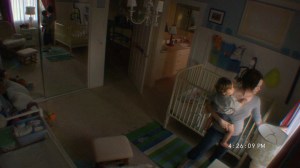 Like most other gimmick movies, duplicating the same effect leads to diminishing returns. Part of what made the first film work was its relative freshness and creative ingenuity. For a measly $11,000, director Oren Peli was able to fashion and sustain a mood of mounting dread that also stayed within the confines of the “found footage” concept. He built up suspense gradually and lead to some terrific “boo” moments. I’m still amazed how Peli was able to pull off some of his tricks sight unseen with such a minuscule budget. Part of the appreciation of Paranormal Activity was the level of skill for the craft. Now along comes a sequel with a $3 million budget, which is still chump change by Hollywood’s standards. However, it’s a large enough figure that I never once questioned how they were ale to pull anything off. I expected more from the sequel given the budget and the general nature of sequels to inevitably up the ante. You’ll still be scanning the frame of those surveillance camera angles, looking for any sign of something amiss or strange. The whole process can be maddening in both a good and bad way. Much of whatever tension does build is in these moments of uncertainty waiting with baited breath. It can seem like an interactive group game of Where’s Waldo. You’re sort of relieved when something actually does happen to break the nothingness.
As a whole, Paranormal Activity 2 doesn’t work as well when it comes to the construction of their scares. The first film primarily took place in one location, the bedroom, the sanctity of the modern man’s domicile. Whenever we got to beddy time we knew what waited. A visual vocabulary had been built to get the audience sweating as soon as the characters sleep. And isn’t disrupting our sleep the ultimate home invasion? With the sequel, there are multiple cameras to work through, always opening with the same shot of the pool cleaner busy at work. We start with pool cam, then after a while we add one more, kitchen came, then stair cam, etc., but we always cycle back to the original before moving forward. It can become an especially tiring pattern, especially when early camera angles prove to have nothing going on within. The pool-cleaning robot emerges as the breakout star of the film (evidently the first sign of a haunting is a dirty pool). There are some effective scares but it’s all in the jump scare/gotcha variety. The film toys with the possibility of a night vision mode for the ever-present camcorder tossed around the home. This possibility is woefully underutilized and only saved for a mad dash through the house at the conclusion.
 Repeating the same haunting elements may work in a narrative sense but it also mitigates the impact. You know what to expect. Hearing loud noises or watching doors slam shut does not offer the same jolt the second time around, especially on a larger budget. It’s unavoidable that Paranormal Activity 2 will become a victim of the first film’s success. Unless it raises the stakes, the movie is just going through the same paces with different faces. This time there’s a baby that’s being sought after by a malicious spirit. If all you’re doing is raising the “innocent quotient” of the victims then the film might as well be set in a impoverished Bangladesh orphanage where the kids all have terminal diseases as well. Paranormal Activity 2 tries to repeat the same tricks to mixed results. The scares are too few and far between and none have the same power as in the first film. The climax is lazily similar as well.
Unlike the first film, much of the movie feels like it’s just filling time to space out its scares. You won’t feel any true sense of attachment to these people nor will you get excited when they parcel out morsels of back-story (the first mom died and… what?). Instead of a young couple we now have a young couple… with a baby! And a teen daughter too but really it’s all about the baby. The family members sit and talk at length rationalizing the weird phenomenon. They even perform research on the Internet and make sure to record themselves with a camera they set down. Who does that? Who records simple conversations? The family’s main dilemma is that dad is unreasonably skeptical despite strong video evidence. Why do these people still let the baby sleep alone? Why haven’t they brought the baby’s crib into their own bedroom? The family pet, a trusted German shepherd, is good protection. The dog growls and barks because animals, just like Hispanic housekeepers the film asserts, innately know when evil spirits are afoot. Why do Hispanic women all have fine-tuned demon radar in the movies? Is this a feature that a Caucasian male can upgrade to? Apparently, the best protection you can afford your home is multiple dogs and multiple Hispanic housekeepers to stand guard.
Paranormal Activity 2 attempts to deepen the mythology of the franchise. It takes place both before and after the events of the first movie, providing some explanation as to what the demon is really after and how it came to terrorize Katie. It’s nice to watch how the two movies fold on top of each other and guess what areas will next connect. Katie makes numerous appearances and ironically offers the sage advice to her sister to just ignore those bumps in the night. When Micah makes an appearance he is accompanied by onscreen text that informs us that this is 3 weeks before his dead body is found. Why? We already know thanks to Katie’s early presence that the film is a prequel, so we already know the doomed fate of Katie and Micah. What does spelling it out have to offer the audience?
 Paranormal Activity 2 runs into problems when it imitates what worked previously but doesn’t add any new flavor, escalation, or variety. The freshness of the concept is quickly turning stale. What was new and exciting is now being written into rote rules for the franchise. I can only surmise that the Paranormal Activity franchise will follow the same downward slide as befell the Final Destination franchise once the audience became hip to all the rules. Surprise goes out the window when films are made to meet genre expectations. You’re still relying overall on your imagination for much of the scares in Paranormal Activity 2, which will vary depending upon the individual. I just think it’s harder to trick you the second time around. My brain kept saying, “I’ve already seen this movie. Been there, done that.” I had no actual rebuttal for my brain, so I ate some popcorn and scanned the screen looking for more weird stuff.
Nate’s Grade: C+
Share this:

Shutter Island (2010)
 This was a pulpy B-movie put together with A-movie artistry. In a year that had some artistically polished genre movies, Shutter Island was Martin Scorsese’s return to genre filmmaking and he brought with him an entire team of experts and professionals. The movie is playful and intriguing, engaging the mind enough for a crime thriller that appears to be a straight-forward mystery but then shows flashes of being about something more, something darker. And when you’re dealing with a movie with Holocaust flashbacks, dead kids, Nazi doctors, mental asylums, well you know you’re not going to be reaching subtlety even with a stick. But the way Scorsese orchestrates all these foreboding elements, tying together various plotlines, and working at different levels to satisfy the informed and uninformed, right before delivering a dynamite twist that calls for further investigation and rewatching, well it’s nothing short of masterful. Shutter Island may not be anything more than a souped-up B-movie, but with this level of artistry, it’s also one of the most entertaining films of the year.
Nate’s Grade: A-
Share this:

The Town (2010)
 There are many people who think they can direct. It just looks easy to people. You get to tell everybody what to do all day. Who wouldn’t want that, right? And actors always think they know everything already, so there’s a litany of actors who feel like they can make the jump from in front of the camera to behind it with ease. Not everybody is going to be a Clint Eastwood, or a Robert Redford, or even the best of the current crop, a George Clooney. Every now and then you’ll find a true surprise, like Todd Field (In the Bedroom, Little Children) or Sarah Polley (Away From Her), but most actor/director projects come across like indulgent one-time pet projects (see: Drew Barrymore’s Whip It). Ben Affleck has easily endured his slings and arrows as an actor, though I’ve always found the man to be likeable, charming, and intelligent. Even so, nobody can excuse Gigli. When Affleck tried on the director hat for 2007’s Gone Baby Gone, it was easy to be skeptical. But then critics and audiences saw the film, which Affleck also co-wrote, and realized that this guy might have some serious chops after all. The Town, Affleck’s second directorial effort, proves that Affleck has found his rightful place in movies.
Doug (Ben Affleck) is a lifelong criminal living in the working class Boston neighborhood of Charlestown. We learn that this one-square mile produces more bank robbers than anywhere else in the world. It is a neighborhood seeped in the lifestyle of crime, the silent omissions of sin. Doug and his crew’s latest heist went according to plan except for one detail. Jem (Jeremy Renner), fresh from doing a nine-year prison stint, has taken the bank manager hostage in a moment of panic. The men blindfold Claire (Rebecca Hall) and deposit her along the Boston shoreline. Doug and his guys then become alarmed when they spot Claire in their neighborhood. She lives in Charlestown. Will she recognize them? FBI Agent Frawley (Jon Hamm) check up on her and requests interviews. Is it only a matter of time before she discovers the truth? Jem wants to handle it quick and dirty, but Doug insists that he take the lead. He watches her from afar and can’t help but feel sorry for the trauma he has caused her. He asks her out for a drink after meeting her and Doug can’t stop himself from falling for her. Jem is incensed and convinced she’ll give them all away. Doug must reconcile his life?s choices and Claire now gives him a reason to finally walk away from the only life he’s known.
 It didn’t take long for me to know I was in for something good. The pre-title opening sequence sets the tone and informs you that Affleck will be firmly settled in the director’s chair for some time. The opening bank heist crashes your attention. It’s filmed in quick cuts, swift camera movements, mimicking the ambush of the criminals as they throw people to the ground, upturn desks, and smash general office supplies. Then the scene cuts to a security camera footage of the same scene, and it’s static, and eerily silent and the contrast is fantastic. Then we smash right back into the fray and the chaos. Affleck refrains from the film turning into senseless genre junk. The violence in this film hurts. You feel its impact and wince at its approach, and you already get this sense before the credits even show up. Affleck wants his visceral violence to mean something, and these men of violence become more intimidating. Then there’s a scene about an hour in that had me gnawing my hand in anxiety. It all revolved around the possible reveal of an identifiable neck tattoo, where the only character who knows all the particulars of danger is Doug. He’s trying to nervously watch the eye line of the conversation, and I was physically trying to instruct the characters onscreen. The fact that I could get so caught up in a sequence of stellar tension that doesn’t involve cars, guns, or even overt threats of violence is a testament to the abilities of Affleck the director.
Doug’s crew is not a fly-by-night operation. They are honed professionals, knowing the timing codes for bank locks, how to dismantle security camera systems, and splash bottles of bleach all over the premises to eliminate usable fingerprints. And yet, when is enough enough? It feels like only days before Jem is pushing everybody for another job. They’ve barely had time to launder the money through drugs and gambling, given a cut to the local crime boss (Pete Postlethwaite), and they?re anxious for another score. Doesn’t anybody want to lie low for a while before the heat dissipates? Either this is just a conceit of only being able to work in a two-hour narrative or indicative or what a consistently dangerous life these men lead. These men know exactly where they?re headed; in fact, they seem resigned to their fate. Perhaps the expedited schedule is just another form of self-destruction or an impatient death wish, or perhaps it’s just an inflated sense of invincibility by guys who are good at what they do.
 The area where The Town could have been better is with its higher ambitions. The Town dutifully delivers the goods when it comes to a crime picture. The three holdups are all satisfying, taut, well paced, and the action is choreographed in a manner that’s easy to comprehend. The middle holdup creates some dynamic images as the men speed through Boston dressed in plastic nun masks and armed with machine guns. There are several standout moments and images that prove Affleck knows how to frame an exciting action thriller. The climax is great, though the denouement leaves something to be desired. You pretty much anticipate what beats the movie has to hit as a genre piece. These brothers in arms will likely follow the path of doomed protagonists. But Affleck clearly wanted his second feature to be more than a slick genre flick. He had his sights set on examining systemic and cyclical nature of crime and abandonment. The opening informs us that bank robbing is a trade passed down in Charleston from fathers to sons. Doug’s crew are all second-generation criminals, their long absent fathers serving sentences in federal prisons. Affleck wants to explore the nature of what separates good people who make bad decisions, digging into the limited lifestyles afforded to these blue-collar lugs who have lived in brutality. The Town doesn’t quite succeed in this regard. The somewhat saggy middle touches upon these ideas but fails to spend enough time for anything substantial to stick. Gone Baby Gone was a better study of class and moral ambiguity. With The Town, you readily identify who the good bad guys are and who the bad bad guys are.
Just like Gone Baby Gone, Affleck’s second feature excels with a glorified group of actors all given room to find their characters and show off their skills. Each actor kind of gets their own space to work and they all, from top to bottom, give stirring performances. The standouts among the cast include Renner and Lively, both barely recognizable in their parts. Renner (The Hurt Locker) is channeling James Cagney from his 1930s gangster pictures. Renner is a live-wire and creates bundles of nervous tension whenever he enters a scene. He doesn’t even have to say a word. His intensity radiates and keeps all the other actors on their toes, rightfully wary of the short-fused Jem. He’s magnetic, steals the film, and even gets a slightly touching sendoff that has managed to stay with me. Lively, best known as the fabulous face of the fabulous high-end TV show Gossip Girl, is going to open plenty of eyes about her potential. She plays Krista, Jem’s sister and damaged love interest to Doug before Claire comes onto the scene. Lively has levels of makeup and hard living coating her magazine-friendly good looks. Lively just doesn’t rely on makeup tricks to stand in the way for her character. She feels like the most tragic soul in the film. She has a kid, likely destined to be removed from her at some point, she operates as a drug mule, and she’s hitched her wagon to Doug as the man that will save her. When that comes apart, Lively herself disintegrates as well, but it’s never in a showy style. She barely conceals the pain consuming her very being. Her eyes are dead of life. Plus, her accent is spot-on.
 The other performers give strong work just at a level slightly below Renner and Lively. Directing himself, Affleck gives a fine if overly whispery lead performance. Hall (Frost/Nixon, The Prestige) is effectively broken as she works through the post-traumatic stress and uncertainty her character suffers from. She’s highly empathetic, though you’re left wondering what she sees in Doug. Hamm (TV’s Mad Men) is so damn handsome but I wish he had more to do than running around and barking orders. His character always seems to be a mouth for exposition and chews over his righteous indignation. Chris Cooper (Breach) has one total scene in this movie as Doug’s imprisoned father but he nails it. His antipathy for his son and his late mother spills over but the moment never screams what can be expressed with subtlety. To Affleck notable credit, nobody in a movie about cops and robbers gives a performance that could be labeled as over-the-top or campy. These are genre roles but they are treated like real, muscular characters.
The Town cements Affleck’s status as a director. This is a more accessible, streamlined yet sturdy genre picture that has real reverence for working class Boston neighborhoods. I love the faces Affleck peoples his films with, real people. It’s small touches that add to the authenticity and visceral nature of the movie, touches that help make The Town more than just another run-of-the-mill crime movie. While there may not be anything groundbreaking on display (though I think Renner may get remembered when it comes time for awards season), Affleck’s directing credentials are only strengthened. This isn’t as good a movie as Gone Baby Gone, but what this film showcases is Affleck’s ongoing journey as a director, the shaping of his Michael Mann-esque style, and his intent to marry great drama with great characters played by great actors. I can genuinely say that I look forward to whatever Affleck picks to be his next feature. He?s here to stay, baby.
Nate’s Grade: B
Share this:

Salt (2010)
 Congrats to the Columbia marketing team for what is by far the most imaginative advertising campaign ever. Weeks before Salt was going to open nationwide, the most bizarre story broke this summer. A dozen American citizens were revealed to be deep cover Russian agents. Apparently, their purpose, as given in the mid-to-late 1980s, was to infiltrate American society and get cozy with policy makers (and yet not one became a lobbyist). Instead they mostly raised families and lived in the suburbs of New Jersey. It’s unclear exactly what they accomplished. This hearkens back to a simpler age where we had clearly identifiable “enemies” that existed as nation states. Things are just too complicated in the post-9/11 age of the War on Terrorism. The dozen Russian spies were deported to Russian in an exchange for three American spies. I feel somewhat sad for these dozen Russian spies, especially Anna Chapman, the red-haired femme fatale that became the face of the scandal. These people grew up in the United States and for many that’s all that they know, and now they have to live in picturesque Russia. I wonder how long before they themselves defect back to the States.
Evelyn Salt (Angelina Jolie) is a CIA agent who?s just about to go home after a long night of CIA stuff. An old Russian agent has defected, and Salt is the best interrogator they have to separate the real from the nutso. As she?s about to leave, the Russian talks about a plot to assassinate the Russian president, and the killer will be a Russian spy posing as an American, Evelyn Salt. Her superior (Liev Schreiber) wants to clear things up with nervous government officials, but Salt bails. She’s concerned that her German national husband (August Diehl from Inglorious Basterds) has been abducted. She races to find her husband, outrun U.S. agencies on her trail, and maybe assassinate the Russian president as foretold.
 Believability is a fluid reality. When it comes to action thrillers, if they’re hitting the right numbers hen you give them a bit of a pass. What might normally kill a mortal can merely incur a flesh wound. Salt is packed with thriller absurdities, especially toward the end, but I posit that this movie is no less believable than most of what we see in the Bourne trilogy. The trick with Salt is that the pacing doesn’t ever let up; as soon as she?s slotted as a potential Ruskie spy, she goes on the run and the movie doesn’t slow down. It hops from action sequence to chase sequence to real-life Frogger sequence on a busy highway, all the while Evelyn performs miraculous feats of derring-do, impervious to normal rigors that would severely injure the rest of humanity. But you see, she’s a trained spy, and therefore can handle it all with aplomb. She can create her own missile thanks to an office desk and a fire extinguisher and some ordinary household chemicals (don’t try this at home, kids). In the opening seconds of the movie, Evelyn is being harshly tortured and interrogated in a North Korean prison (in her bra and panties for extra exploitation value). If she can survive that, surely this Superwoman Spy could survive escaping a batch of really lousy guards and National Security agents who seem bewildered by such art of deception like the masterful Putting on a Hat, or the more dangerous Dying One’s Hair a Darker Color (that can stain, you know).
Let?s briefly talk about the entire premise of Salt. Before this summer, naturally, this Cold War holdover plot device would seem ludicrous. Such deep cover Manchurian Candidate-like operations that take decades upon decades of time seem like a crapshoot. As proven by this summer’s most bizarre story, people who go deep under cover for extended periods of time are rarely able to snake their way into the corridors of power. It’s not like these people are planted to marry ambassadors or up-and-coming politicians. It’s essentially like a horse race, except you have to bet on which pony 25 years down the line will be the winner or spawn the winner. The odds of success seem remote at best and a waste of resources. This Cold War program also stipulates that these sleeper agents would still hold allegiance to Mother Russia nearly 20 years after the dissolution of the U.S.S.R. It’s this same mistaken idea of delayed national allegiance that surfaces when Chinese politicians try and justify how they will solve the guy/girl population disparity in their country. The Chinese politicians feel that the men of their country will come to America and find all those Chinese orphans that were adopted by American parents. Somehow these former Chinese orphans who have grown up in a different culture, in a different family, and with different gender rights and freedoms, will suddenly say, “Of course I will go back to the country that gave me up as valueless!” It’s this same basis at work for the Russian sleeper agent plan. But yet these super sleeper agents have miraculously found their ways in high positions of power. Maybe that’s the secret to educational reform. Students are more likely to be self-starters when they’re determined to bring down the infrastructure of another country.
What saves Salt is that the action sequences are good. Director Phillip Noyce has extensive experience in Hollywood and working with large stars. Noyce directed the stellar Jack Ryan thrillers Patriot Games and Clear and Present Danger; he even has experience with Jolie, having helmed 1999?s boring Bone Collector. Noyce has a great presence of mind and knows how to fill the frame up to please the senses. He knows how to compose a nice action sequence and, here?s the shocker given modern action cinema, allows the audience to fully understand what is going on. The chases have genuine excitement and the escapes come across as organic instead of contrived, which is something of a compliment for a spy film. Evelyn Salt hopping from car to car across a highway is cut together into one smooth sequence to rattle the nerves. There are some spectacular car crash images in the film, particularly when Salt escapes from police custody by driving off an overpass. Noyce finds a way to make the screen both frenetic and oddly pretty, without being self-conscious about its popcorn purposes.
 Jolie has proven herself to be more than capable when it comes to handling action. She doesn’t look as spookily thin as she did in 2008’s Wanted, which is good when you want to believe that she can be a world-class brawler. She’s tough as nails and plenty easy on the eyes. The role doesn’t require much of Jolie’s exceptional sex appeal. In fact, she’s rather maternal and her driving motivation is to rescue her husband. There are all sorts of needless flashbacks to her wedding day, little snippets to remind you that she loves her husband, in case you forgot. Jolie’s character is a bit of an enigma by design. Obviously given the star power and the fact that it?s a summer movie, you expect Jolie and her character to be in the right by the time the end credits roll. And yet the movie and screenwriter Kurt Wimmer (Thomas Crown Affair, Equilibrium) spends about half of its running time letting you fully believe that Evelyn is a turncoat (though if she was originally Russian, would she be a turncoat?). The most interesting aspect for me regarding Salt’s character was when we flashed back to the 11-year-old version (Cassidy Hinkle) of her after a car accident. Her head is bandaged, and because the girl is the younger version of Jolie, her lips look like those wax novelty lips to match Jolie’s signature pillowy pout.
Salt is a rather nuts-and-bolts thriller that balances absurdities with efficient action. With pacing so swift, you don?t have time to start nit-picking the small things, and the big things you just swallow as part of the overall package. Salt needs you to be caught up in the moment, in the chase, and not second-guessing all the plot fallacies. The film pretty much follows Jolie’s lead and is straight-faced nerve. It provides the thrills you’d want in a summer popcorn blockbuster without getting too serious. As a spy thriller it goes down like a shamelessly entertaining beach read. After all, what are the odds that your friends and neighbors of twenty years could actually be decades-in-the-making Russian sleeper agents? Well, do they look like Anna Chapman?
Nate’s Grade: B
Share this:

Inception (2010)
 Without a doubt, no movie has piqued curiosity like Christopher Nolan’s Inception. After breaking all sorts of box-office records with The Dark Knight, Nolan earned some capital. He wanted to make an expensive, intellectually demanding, high-concept movie that takes place mostly in the realm of dreams. The studio said yes, anything to keep their golden goose happy before a third Batman can roll out. Nolan has been tinkering with the script for Inception for almost ten years, trying to scale it down but never being content. This is a story that called for the biggest stage, which required a heavy price tag, and could only be fulfilled once Nolan was an established hit-maker. Early images of shifting gravity and folding cityscapes got people buzzing but then the concern was whether Inception would be too smart for audiences to embrace. You know, the same public that made two Alvin and the Chipmunks films blockbusters. Two weeks running, Inception has made a sizeable portion of money and become the “must-see” movie of the summer. Score one for the public.
Dom Cobb (Leonardo DiCaprio) is an expert extractor. He can sneak into your dreams and discover whatever secret you’re hiding from your self, your wife, even your shrink. All for a tidy sum, of course. He’s on the run from U.S. authorities because they believe he killed his wife Mal (Marion Cotillard). A rich businessman, Seito (Ken Watanabe), promises to clear away the pending charges if Cobb can perform one important job. Instead of stealing an idea, Cobb will have to plant an idea, known as inception. A young upstart (Cillian Murphy) will inherit his dying father?s empire, and Seito wants the guy to break up that empire and sell it off. Cobb enlists the help of a skilled team to pull off what is believed to be impossible; Arthur (Joseph Gordon-Levitt) as the point man, Ariadne (Ellen Page), as the architect of the dream world, Eames (Tom Hardy), a forger who can convince the mark he?s other identities, and Yusuf (Dileep Rao), a chemist that creates a compound to put the team under a deep sleep. They’ll need it because Cobb plans to go three levels deep, a dream within a dream within a dream in order for inception to take root. The only way out is a “kick,” the sensation of falling that will awaken the dreamer. The team is under great risk not just from the dream world, but also from Cobb. He?s been secretly keeping memories of his dead wife alive and she keeps intruding into shared dreaming, causing havoc, relying on the same info that Cobb knows. The deeper they go into the dream the deeper they also go into Cobb’s memories.
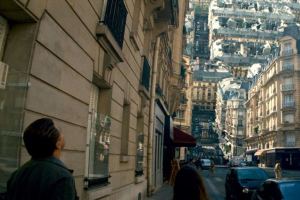 Inception can be many things to many people, as is the nature of dreams. I found the movie to be a master class mousetrap. Watching Nolan and his origami-like script fold and bend and connect is a true pleasure. However, the movie is not a great character piece. Cobb is the only person on the entire team allowed any sort of back-story or inner lives or even personality traits. What do we know about Arthur, Ariadne, Eames? Nothing. They are all members of the team, but it is Cobb who is the only one allowed to have supporting details. Despite Cobb’s tragic past with his wife, emotionally the movie can best be described as a bit distant (not cold, distant). Nor does Inception deal with the psychology of dreams or the interpretation of the subconscious and its links to our own reality; this movie does not have Freudian psychoanalysis in mind. What Inception does deliver is a brilliantly staged heist that takes place in the realm of dreams, and if that doesn’t sound like a fun concept then I don?t know what does. To get to that heist, the audience must slosh through about 90 minutes of solid set-up and exposition (Pages character is essentially an exposition device). There are a lot of rules to digest in order for the final hour to have the impact that it does. If you nod off for a portion of that time, like my father, you will be lost as to why anything is exactly happening. Having seen the film a second time, I can say that once the hyperactive “Oh my gosh, this is awesome!” haze of newness wears off you do realize that the pre-heist portion of the movie can be a bit slow. I think that for future DVD-viewings I will skip to the start of the heist and sit back and relax (much like skipping the first hour of King Kong).
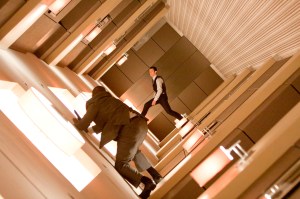
After talking about what Inception is not, let’s focus on what Inception is. It is a massively entertaining, brain-tickling thriller with eye-popping visuals that verge toward the iconic. Nolan isn’t the greatest orchestrator of action (a foot chase in Mombassa is pretty lackluster short of a narrow alleyway) but the man knows how to put together tremendously memorable set pieces. From Paris folding upon itself to a fistfight in a revolving hallway, Inception is packed with stimuli to ignite the senses. It’s the first movie in years that I walked out and thought, “How did they do that?” It renewed my sense of mystery and wonder with the movies. And the last hour is ridiculously fraught with tension as the movie descends level after level of subconscious, juggling four separate action set pieces with mounting climaxes. The revolving hallway fight is perhaps my favorite action scene in years. I still got goose bumps the second time. Gordon-Levitt hops from ceiling to floor like he’s Spiderman, or Gene Kelly, all while the camera remains fixed. Gordon-Levitt gets a lot of zero gravity experience in this movie. He might have qualified for a free ride on the space shuttle.
Like the alternate reality of The Matrix, people can manipulate the world of dreams, which allows for some imaginative visuals. Aside from the dreams-within-dreams impacting one another, there aren’t really playful distortions of reality. There?s a few M. C. Escher-inspired staircases but nothing too out of bounds. Nolan devises a reason for this since the dreamers do not want to call attention to altering the dream. They want to hide among the subconscious projections; get in and get out without being noticed. You do wish that Nolan played to the potential of his flexible reality, but on the other hand, it’s still fairly mind-bending to reach inside a magician?s hat into another magician?s hat and so on. I wonder if there was another story that could have succeeded in this setting, namely competing thieves that have to race against time within the world of dreams. Think about it next time, Nolan. That one?s on me.
 But the most exciting aspect of the movie is how intellectually stimulating it is. The movie is jam-packed with ideas like Nolan’s other works, so much that it’s hard to fully process everything the film offers in one sitting. The pieces do fit together and the movie follows its own internal logic, so if you didn’t skip out on any bathroom breaks, you should be able to follow along reasonably. On first viewing, Inception is bristling with intelligence and narrative complexity, and it rarely stops to pander to an audience. It expects you to keep up for the rewards that will follow, and they are indeed rewarding. The movie isn’t as complicated to follow but it can definitely get complicated when you try and explain action beyond a literal level. Nolan laces all sorts of narrative stops and peculiarities that can be targeted for an alternative thesis statement on the ending. The very ending shot is ambiguous perfection. It keeps the mystery of what constitutes reality while providing an out for people that want to formulate a happy ending. There’s plenty of room for interpretation and analysis but it doesn’t get in the way of telling a good story. Hollywood is pretty risk averse when it comes to anything that makes people think, let along anything expensive that requires active synapses. Nolan has long been a filmmaker of intellectual heft and non-linear narratives. His narratives are complex puzzles that snap together with airtight precision. The joy of a Nolan film is surrendering yourself to his narrative origami and waiting to see the Big Picture. There are new insights to discover with every viewing. Nolan may not be the second-coming of God, as those frothing at the mouth on Internet message boards proclaim, but I can think of no other director working today who harnesses Big Ideas on such a big stage.
Inception is a $160-million dollar studio film with substance, but it also looks like money well spent. The film looks amazing. The cinematography by Wall Pfister (Dark Knight) is gorgeous without being self-consciously arty, pleasing the senses without drawing too much attention away from the story. But with a screenplay that makes all kinds of leaps, you need the help of a good editor to guide the proceedings. Lee Smith (Truman Show, Master and Commander) is that man. While the repeated cutbacks to the van falling in slow motion can be giggle-inducing, Smith gamely holds everything together thanks to his skill in juggling all the parallel storylines/dreamscapes. Finally, the score by Hans Zimmer (The Lion King, Gladiator) is full of ominous, blaring horns that send shivers and get your blood pumping. Johnny Marr (The Smiths, Modest Mouse) even added an assist by strumming the guitar licks on the score. Apparently Zimmer’s key score themes are actually the tune “Non, Je Ne Regrette Rien,” the Edith Piaf signature song used to signal “kicks,” played at a slowed speed. At the risk of sounding like one of those frothing from the mouth on the Internet, that’s insanely cool.
 The acting is uniformly good with a few bumps. DiCaprio (Shutter Island) might need to do something light after continuous roles where he inhabits mean weighed down by guilt and dead wives (three in a row for those counting). He’s a good emotional anchor. Watching the star of 500 Days of Summer and Brick as a suave, cool-as-can-be action star is improbably awesome. Hardy (Bronson) is a scene-stealer mostly because he?s the only member of the team that has a sense of humor. Cotillard (Nine, Public Enemies) who won an Oscar playing Edith Piaf in 2007’s La vie en Rose, gets her best part since then. She gets to do many things as Mal, a projection of a character. This means that she must be limited in how she fills out the character because she is defined by Cobb’s fading memory. Yet she can be malicious, playful, spiteful, loving, vulnerable, and more. Cotillard and her big, glassy eyes do a great service in selling a romance we only see after the fact. Page (Juno) just feels out of place. She seems like the kid among a group of adults. And while the elfin actress will always look youthful until she applies for an AARP card, Page just seems in over her head. Her performance is fine if a bit mealy-mouthed but she still feels miscast.
Inception. Expect it to become a fanboy religion in a matter of weeks. It wears its influences on its sleeve, from The Matrix to Abre Los Ojos (or the American remake, Vanilla Sky). Thrilling, stimulating on different levels, and supremely engrossing, Inception is just about everything you could wish for in a summer blockbuster, except when it can also feel mechanical, distant, and free of emotion and character development save DiCaprio (perhaps this is further evidence that it was all a dream?). Regardless, Inception is easily the brainiest movie of the year, and usually those don?t get packaged as big-budget Hollywood spectacle. Just make sure to bring your totem the second time you watch the movie.
Nate’s Grade: A
Share this:

The Girl Who Played with Fire (2010)
 So in the few short months since The Girl with the Dragon Tattoo opened in the spring, the book series has catapulted to even new reaches of fame. It even appeared on the cover of Entertainment Weekly under the headline, “The hottest books on the planet.” I’ll take their word on that one. The Girl Who Kicked the Hornet’s Nest, the third book in late Swedish author Stieg Larsson’s series was finally released stateside, and depending upon when you read this, is probably still on the best-seller list. Larsson’s trilogy of novels is a global publishing phenomenon. The first film in the series made over $10 million dollars in the United States and was the top-grossing film in Europe last year. That says something about a 150-minute Swedish thriller with no-names attached. The Girl Who Played with Fire is the second film in the series and naturally couldn’t live up to expectations after the first smash movie. The second film is good, not great, but really whets the appetite for the concluding movie to come.
It’s been one year since the events of Girl with the Dragon Tattoo. The titular tattooed-girl, Lisbeth Salander (Noomi Rapace), has been living abroad. Her ally and one-time lover, Mikael Blomkvist (Michael Nyqvist), has been trying to get in contact with her but to no avail. Blomvist is about to publish a damning report about sex trafficking with some pretty high-profile names attached as members. The authors of the article are then executed and Lisbeth’s fingerprints are found on the gun left at the crime scene. Salander’s court-appointed guardian, the one who viciously raped her in the previous film, is also found murdered. Blomkvist is certain his companion is innocent and goes about investigating who is truly responsible. Salander comes out of hiding and back to Sweden where she tries to clear her name the best way she knows how. All roads seem to lead to a figure known as “Zala,” a Soviet spy who defected to Sweden ages ago but who has been carrying on in the shadows ever since.
 The focus with Fire in on Lisbeth Salander, which is exactly the character the audience wants to spend the most time with. Salander split duty with Blomkvist in the first film. They were equals, but a crusading journalist just isn’t as interesting as a five-foot Gothic ass-kicking computer hacker. As I wrote: “Mikael isn’t a blah character by any means but he seems to serve as an expository device, the guy who uncovers the secrets and gets to be the helpless foil to Lisbeth. I suppose for maximum narrative effect a straight man would be required to be paired with Lisbeth.” She is the star of the series so it’s a great pleasure to watch her receive oodles of screen time. The second film is significantly devoted to the history of Salander, her back-story, her father, what she did to get locked away in a mental ward (which was hinted at before). The sex trafficking murders are merely a narrative smokescreen. Being framed for the murders puts Lisbeth on defense, but the sex trafficking stuff and the high-profile johns quickly dissolve in the wake of a standard investigation into the mysterious “Zala.” The mystery of this film is really the mystery of Salander’s back-story and family tree. However, being focused primarily on Lisbeth Salander also means that everybody else gets sidelined. She’s on the run and trying to clear her name, but that doesn’t give much room for other people to contribute to the narrative. Blomkvist gets to pensively look at his computer screen a lot and always show up one step behind our heroine. The two are kept apart for nearly the entire movie.
Rapace is still the best reason to see the series. She inhabits the character with tremendous intensity and skill. If you stripped away all the aesthetics, the Goth trinkets, you would still have a vital character. As I wrote before: “There’s much more to this girl than a dragon tattoo and a spiked collar. Rapace doesn’t let the outfits overwhelm her. There’s a certain joyful recklessness to her character hidden beneath a veneer of steely coolness.” Because of her mysterious nature and painful past, Rapace must play all emotions through a prism of emotional reserve. Even though we get a lot more of Salander’s past explained, I felt like we got to know her as a character better in the first flick where she could breathe and behave “normally.” Thanks to being on the run for murder, it’s hard to argue that Lisbeth ever gets a chance to simply be her complicated self, which robs the audience of an appealing character. We project the interest we felt for her from the first film to the Salander stand-in represented in the second film. She’s still a resourceful, loyal, and cavalier presence, but the plot corners her into being a creature of action. She becomes the fantasy bisexual ass-kicking protagonist that was merely hinted at previously. That sounds like a good thing, but trust me, it does the audience a disservice to box in such a fascinating character.
 Girl Who Played with Fire is nowhere near the complete film experience that the first film offered. This movie feels like one half and the continuing half, The Girl Who Kicked the Hornet’s Nest, won’t be out until later in the fall. As such, it’s hard to fully analyze certain storylines at play. I imagine that the sex trafficking storyline will carry on with the third film because of the tease that high-profile figures in government and police offices were involved. It already establishes a conflict and a set of antagonists ready for the third film. Then again, I may be too hopeful and the storylines of interest in Part Two may be completely dropped or mishandled by Part Three (see: Matrix sequels, Pirates of the Caribbean sequels). Girl Who Played with Fire does a decent job of setting up a narrative base and establishing a one-shot villain, somebody to be dispatched by episode’s end. But the movie feels far from complete, and sadly I won’t know until later whether that incomplete feeling is from breaking up a continuing storyline or from deficits of filmmaking. There are too many loose ends with Girl Who Played with Fire for it to feel complete, and thus it cannot help but suffer in comparison to its predecessor.
Where the movie goes haywire is in its adoption of action tropes. The Girl with the Dragon Tattoo was more of a slow-burning thriller with some nasty flashes of violence. The second in the trilogy seems to take place more in the realm of action cinema, which means that things get a little preposterous. There are a lot more car chases, henchmen, fistfights, shootouts, and it almost unravels at the end. Slanader seems to transform into the Bride, sharing two key abilities from Uma Thurman?s character in the Kill Bill series (that’s about as spoilery as I want to get). Salander just becomes like a pint-sized Terminator; she’s indestructible and capable of amazing feats. It’s like the Swedes took the Hollywood edict that every sequel had to be bigger and better than the original. There’s even a lesbian love scene before the 20-minute mark, in case the audience was already getting bored (presented like something out of Cinemax late-night TV). I appreciated that the original film respected the intelligence of the audience, giving a deluge of information and characters to sort and trusting that in time we could follow along. The Girl Who Played with Fire is far less complicated in scope. In fact, it’s a fairly rote detective story that only dishes out clues when the characters need to progress. The first film actually utilized good detective work; the second film just has everything fall into people’s laps at predetermined points of need. The tension doesn’t manifest as ferociously as it did in Dragon Tattoo. For goodness sake, the chief antagonist has a hired goon that is actually a rip-off of a James Bond villain from The World is Not Enough, which was an awful Bond movie! The end focuses too much on the bloody confrontation between Lisbeth and a chief antagonist and an axe that apparently fails to mortally wound people when swung at their craniums.
 I think the switch in directors, from Niels Arden Oplev to Daniel Alfredson, has something to do with the slip in quality. To American audiences, this might not ever register, but the films have completely different tones. The turnover feels less abrupt thanks to the cast reappearing. The direction feels less focused, more casual and pedestrian, relying on that grimy green/orange cinematography that Dominic Sena (Gone in 60 Seconds) always favored so much. Here’s another thing I learned. When it’s not a snowy winter, Sweden looks pretty much like Canada. Seriously, the landscapes do nothing in this movie to distinguish it.
Now that sounds like a lot of quibbles, like I’m quibbling Girl Who Played with Fire to death. In short, it’s not as good as the first one, and the final 20 minutes proves it, but it is still a finely entertaining movie. Even with a less complicated plot, the movie manages to be smarter than most of its Hollywood brethren. It’s more an action movie than a dark, lurid thriller like its predecessor, which means there will be certain limitations on the use of your brain. But the movie plays off our residual good will from the last one, it’s interesting enough, and Lisbeth Salander is rightly the star, so it’s enough to forgive. We’ll see in the fall whether The Girl Who Kicked the Hornet’s Nest can provide a satisfying close to the popular series. As proven, never count Salander out.
Nate’s Grade: B
Share this:

After Last Season (2009)
 After Last Season is a little movie that most people wrongly mistook for a joke. Writer/director Mark Region pulled off something rarely witnessed in modern movies: he put together a low budget movie all on his own and got it released nationally. The movie even has a Quicktime trailer on Apple’s website. It was released last summer in only four cities for a limited trial run, which explains why nobody has every heard of Region’s creative opus. It also might have to do with the fact that After Last Season is so appallingly terrible that the distributor reportedly called the theaters to advise burning the film prints rather than returning them. Naturally, given my cinematic tastes for the finest trash and my keen knowledge of the baddest of bads, I instantly had to see this film for myself. The website After Last Season boasts an Amazon.com customer review (nary a good sign of accomplishment) saying that the movie is unlike any you have ever seen. There’s a good reason for that. After Last Season approaches a near Manos level of ineptitude. That should speak volumes.
The plot, as can best be described, involves a university conducting scientific experiments. Sarah (Peggy McClellen) and Matthew (Jason Kulas) are interns conducting their own investigation into a recent string of murders. They have access to a device that allows the connection of minds, and so Sarah and Matthew link brains and get caught in the wavelengths of the campus killer, who now begins to target them. This plot synopsis is actually too kind and might mislead some into thinking the movie has drama or action or suspense. What really happens are characters who you don’t know doing things that aren’t fully explained followed by unexplained location changes where the whole process repeats itself. You haven’t lived until you’ve listened to Sarah’s roommates engage in senseless conversations about going to the North Market.
 When I say that this movie is awful, I really mean it with all sincerity. This movie is so awful, so off-the-charts painful to watch that there is not an ounce of derisive fun to be had. After Last Season does not fall into that coveted category of “so bad it’s good,” no, this movie is simply disastrously, regrettably, incomprehensibly bad. I would not recommend it to my friends or enemies. From a plot standpoint, there’s about 15 minutes of stuff stretched out to a short but far too long length of 93 minutes. The opening 10 minutes concern characters explaining how an MRI machine operates. It’s like Region once wrote a paper on an MRI machine and wanted everybody to know the work put into it. The characters just keep rehashing the ins and outs of this machine, and the machine is clearly made of cardboard and in the middle of somebody’s living room (is it unusual for a metallic ceiling fan to be placed directly above a Magnetic Resonating Imaging machine?). Then there’s a 30-minute stretch in the middle that is nothing more than two people sitting across a table and dreaming about geometric shapes. 30 minutes! I doubt that I even have the ability to adequately explain the amount of mind-numbing torture that this sequence was. My friend Eric and I just kept looking at one another with hopeful expressions, silently pleading, “Will our pain and suffering soon be over?” 30 freaking minutes! One third of the entire movie is like watching somebody’s annoying screensaver from 1987. I can’t wait for the sequel where it looks like a bunch of windows are flying.
The rest of the script isn’t filled with intriguing character dynamics or challenging drama. It’s almost completely built from non-related scenes with non-identified characters having frivolous conversations about nothing. Most of the dialogue is driven by linked non-sequitors, which prompted me to repeatedly yell at the screen, “Why the hell was that important?” Characters will drone on in useless babble, never once circling a subject that seems to be related to the plot at hand. The small group of actors (you will be amazed that the end credits lists over 15 characters) feels like people awaiting an execution. True, the pitiful direction leaves them unmoored, fighting to find meaning in anything they say, but these people just suck at acting. The general range of acting goes from impassive monotone to somewhat less impassive monotone. It’s the acting equivalent of rounding up random people at the bus station and hoping for a miracle.
 I have seen low budget productions before but this movie looks like it was made for the cost of a lottery ticket. For whatever reason, the current info has the budget at five million but there’s no way in hell that can be true (some producer must have ran off with like the whole sum minus twenty bucks). Reportedly the movie cost $40,000, which I can believe barely, and the special effects cost 4.95 million dollars, which I find baffling. The sets are all overly lit basements disguised by the clever decorative abilities of pegboards and sheets of paper. There are scenes where actual paper is taped to the walls like it was shingles, just like what a child might devise as a means of decoration. There’s even a supposed college class that takes place in this same low-rent location, which means that this particular university is really struggling for endowment funds. This utilitarian approach to locations is what I’d expect from a public access show or a student’s video project. These locations make it seem like every person is one moment away from being gutted by a serial killer just off screen. Did Region have only one abandoned office basement to work with? The visitations by the ghost/mind spirit/whatever are just as bad. We have the embarrassment of watching plastic tubs being pulled across the floor with fishing line. Having a low budget should force Region to be more creative with his use of resources, to work around his limitations. Instead, he just continually shines a bright light illuminating every possible limitation in the movie.
From a technical standpoint, After Last Season is an abysmal entry. It fails not just because of its lack of funds but it fails because Region lacks any filmmaking ability whatsoever. Sure, apparently the man was able to pose actors, have them recite lines, and keep the cameras running, but I expect more from my movies than the same criteria I have for family vacation videos. Region’s directorial style is, ostensibly, to have no discernible visual sensibility at all. Actors will routinely be cut out from the camera frame or the spatial relations will be completely out of whack, allowing for tremendous space above heads or showing the actor’s complete body except the upper half of the face. Characters will be bunched in one tiny section of the screen, or Region will suddenly cut back and forth between two different shots that conflict from a geographic standpoint; they don’t visually match up. There isn’t a single shot anywhere in After Last Season that couldn’t have been credited to a tripod for complete creative inspiration.
Here’s a terrific example of how creatively bankrupt this movie is, and no, I will restrain from making reference to the sheets of paper as decoration. The website for After Last Season actually touts its use of special effects. What special effects, you may very reasonably be asking yourself. Evidently, several scenes had less background coverage, so the special effects gurus took a sample background object and copied it to cover the space (like taking one sheet and making a wall out of them). Okay, fine, except that this special effects wizardry doesn’t always work. The website itself even showcases a scene where Sarah goes in for her job interview and on the right hand side we can see the special effect trick of covering up the empty space. However, the left side is completely untouched, leaving exposed all the set shortcomings and extension cords. Why cover one side but not the other? Too expensive? Here’s the best question of all. Why spend any money whatsoever on lame special effects when you could have simply zoomed in so that the two characters filled the screen? That’s a much more cost-effective option and wouldn’t break the perilous illusion of the movie. It is examples like this that condemn Region as an artist with zero creative ingenuity.
 Now it’s at this point where I have to call into question the integrity of After Last Season. Was this entire project created on purpose to be terrible, and if so, does it even make a difference? Is a bad movie more acceptable if it’s intentional or unintentional? From my perspective, you cannot intentionally make a campy movie. The derisive pleasure must come from the fact that the filmmakers thought they were making compelling cinema at some point. If After Last Season is fake (I hesitate to use that word given its connotation) then it’s an even bigger waste of time (Update: I just read online interviews with Region, and the movie is for real). As it stands, the movie is technically inept on every level of filmmaking with a bad script, bad actors, bad pacing, bad direction, bad sets, bad sound coverage, bad “special effects,” and really bad editing. If Region was dreaming of creating a midnight-movie sensation like The Room then he missed the mark. This movie isn’t any fun whatsoever to watch because there’s not enough going on to make laugh at. With The Room, every scene had like eight things wrong with it; that film was a 1000 brushstrokes of bad. With After Last Season, it’s the same forehead-smacking flaws repeated ad nauseam. There’s no derisive joy to be had here, folks.
I’m not shocked that something as unrepentantly bad as After Last Season exists. There is plenty of crap on the Internet and in this modern age of user media, there’s no shortage of poorly executed ideas finding a wider audience. It’s the same with the infamous 1979 blotch on cinema, Caligula. I’m not surprised that something so debased and wildly salacious exists, what shocks me is that a movie with incest, bestiality, necrophilia, hard-core sex scenes, and gallons of blood would star such a celebrated cast of thespians like John Gielgud, Peter O’Toole, Malcolm McDowell, and Helen Mirren (though if you’ve seen Zardoz you know that Mirren wasn’t too picky in those days). What shocks me is not that Caligula exists but the level of involvement and exposure. What truly shocks me is that After Last Season got a theatrical release over the likes of thousands of other movies fighting for a release. Yes, this only played on four screens in four different cities, but how does anybody justify After Last Season even being in the same consideration of cinematic art? I am faint to even refer to this as a movie. It almost seems like a social experiment with disturbing psychological implications. After Last Season isn’t a movie so much as an endurance test of how much pointless garbage a person can consume before they relentlessly cry, “Enough! You have officially destroyed my soul!” I never thought I’d say these words, but After Last Season makes The Room look competent. Your apology letter is in the mail, Tommy Wiseau.
Nate’s Grade: F


You must be logged in to post a comment.