Blog Archives
Frozen (2013)
 Enough time has passed that a revival of the 1990s Broadway formula that Disney stuck so aggressively to for so long is actually a welcome treat, especially when Frozen is this good of a movie. An extremely loose retelling of Hans Christian Anderson’s The Snow Queen, we follow two sisters and princesses, one of whom, Elsa, is gifted with magic powers controlling ice. She’s lived a life of solitude out of fear and penance for endangering her sister when they were kids. Ana has no idea, having her memory wiped through magic, and so she desperately wonders why big sis gives her the cold shoulder. After another accident, Elsa lets her powers loose, refusing to try and fit into the confines of society no longer. Ana is the only one who can save her and the town. Did you read any mention of a man in that plot breakdown? While there are significant male characters, including romantic suitors, Frozen is the story of a different kind of love, a familial love between sisters. It also generously pokes fun at Disney’s admittedly spotty record of heroines giving up their dreams for the first man they meet. Even the comedic side characters work wonderfully. Josh Gad (Jobs) as a magic snowman had me cracking up throughout with his dopey line reading and enthusiastic inflections. Idina Menzel (Rent) as the voice of Elsa is enthralling, and she gets the film’s “Defying Gravity”-esque showstopper, “Let it Go.” Kristen Bell (TV’s Veronica Mars) is terrific as the voice of Ana, vulnerable, heartfelt, and a little bit goofy, and she sings great. All the actors sing great (look what happens when you hire musical theater alums). Even better, the songs are catchy, well composed, and critical to the plot, short of a silly troll tune that should have been cut. The movie also looks gorgeous, which is surprising considering I thought the color palate would be limited with the film mostly taking place in the snow. But what makes the movie truly enjoyable is how emotionally engaging it is, the somber opening twenty minutes setting up just how much tragedy and misunderstanding there is between Ana and Elsa (the melancholy end to their song killed me). Their eventual reconciliation and the selfless acts of bravery might just make you misty. Frozen is a holiday treat for families, animation aficionados, and those hoping Disney could make a film with positive messages for young girls. In a weak year for animation, this rockets to the top of 2013. Just make sure you get the Disney version for your family and not, you know, the horror movie of the same name about people stranded on a ski lift. Though that’s a pretty good survival thriller itself, so, your call.
Nate’s Grade: A-
Share this:

The Lone Ranger (2013)
 With the director, star, and writers from Disney’s original Pirates of the Caribbean trilogy, you’d likely expect The Lone Ranger simply to be Pirates in the West, and it pretty much is, for better and worse. The pieces don’t nearly come together as well, and the characters aren’t anywhere close either, but I was mostly pleased with the finished results after coming to terms with the flaws of the execution. This is a semi-supernatural reinvention of the Lone Ranger and Tonto, prankish and proudly peculiar.
In 1869 Texas, John Reid (Armie Hammer) is the new district attorney for a small outpost along the railway run by tycoon, Mr. Cole (Tom Wilkinson). John’s brother (James Badge Dale) is the sheriff and the more accepted hero. This all goes awry when the nefarious criminal Butch Cavendish (William Fichtner) kills the sheriff, his posse, and leaves John for dead. He’s brought back thanks to Tonto (Johnny Depp), a Native American with his own quirks. Together, the duo struggle with the idea of justice versus vengeance and taking responsibility.
Thanks to screenwriters Justin Haythe, Ted Elliot, and Terry Rossio, it still follows the summer movie blockbuster blueprint while maintaining its own sense of self. I enjoyed the 1933 framing device and the sense of commentary it added to the legend of Wild West tall tales. Many of these story elements will be painfully familiar, from the unrequited love interest that needs saving, her plucky son, to even the villainous railroad baron, but the film finds ways to keep all these formula figures at least integrated and satisfying, doling out payoffs to several storylines. More so, the film just has a wild sense of fun to it, enlivened by Verbinski’s exuberant feel for action. When he gets things going, the man has a touch for inventive action orchestration akin to Steven Spielberg. He is a director who knows how to add scale and scope to action and make it felt. The movie feels constantly alive and full of surprises, stepping outside itself for some non-linear asides, adding bizarre examples of nature undone (In the words of Nicolas Cage: do not touch the bunny), and a heavy dose of magic realism. It’s just too funky and weird not to be interesting even when it threatens to be boring. Disney put crazy money into something this crazy, folks, reportedly $200 million.
 There are serious problems here much as there were in the Pirates sequels, notably a lingering sense of bloat. At 149 minutes, there could have been a lot of cuts. The saggy middle seems to almost derail all momentum, as Reid and Tonto stumble about the desert, filling in a majority of Tonto’s tragic back-story. Most of the supporting characters are chiefly underwritten. I pity the great Ruth Wilson, so nerve-fryingly awesome on the BBC’s Luther as an enthralling sociopath, and here she’s basically Love Interest/Single Mom for Reid. At least she does a decent job with her Texas twang. There’s plenty of overindulgence all around, and I won’t even entertain the argument that its handling of Native American displacement, while not as clumsily racist as feared, was anything other than schlocky. There are also three villains of different stripes that need to be juggled. There are a lot of storylines and characters to keep active and the movie just cannot keep up. The tone can be somewhat jarring as it dances around dark comedy, earnest sentimentality, tragic drama, and cavalier heroism. It feels like the movie never settles down, which can keep an audience from being fully engaged, fully invested. It hurts even more when the characters are nowhere near as charismatic as Captain Jack Sparrow.
Perhaps I’m being overly generous after coming from Man of Steel, and perhaps, nefariously, Man of Steel is still going on, locking me forever in some sort of parallel mobius strip where I’ll never be able to leave, but I greatly enjoyed the action sequences in Lone Ranger. Verbinski is one of the most talented visual filmmakers working today but, more importantly, he knows how to orchestrate large-scale action sequences in a way that they matter. Yes, like most things in The Lone Ranger, they can go on a bit too long, but here the situations develop naturally with organic complications, the sequences move the plot forward, and they escalate in excitement. The concluding twenty minutes involves a sumptuous dual train chase that keeps shifting and changing, going from atop to parallel trains, to cars being dislodged, people jumping from one to the other, all racing toward a bridge triggered with explosives. It’s a thing of beauty, this final action sequence, and Verbinski’s shot compositions allow things to play out so artfully while the audience still maintains its sense of orientation. It’s a finale that feels exhilarating, and the playful whimsy and sense of danger that the movie had been flirting with before comes together, enough for you to wish the whole movie had tonally coalesced with the skill shown toward the end. As an action fan, I was lapping it up, and the playful non-linear jumps, as well as the satisfying ends to some satisfying villains (Fichtner is terrific), left me grinning and hopping with excitement. A strong finish went a long way toward improving my opinion on the film and minimizing my misgivings.
Who is this dark, weird, somewhat clunky movie really appealing to? The Lone Ranger had its cultural peak back in the 1950s and thus the people actually excited for a Lone Ranger movie must be slim. And those people are probably going to be turned off by something as jokey and unfaithful to the source material as this movie. It does utilize the Ranger’s theme song, the William Tell Overture, but saves it for the end. What about kids? The movie is released under the Disney imprimatur and has the stamp of “from the creators of Pirates of the Caribbean.” Everybody loved the first movie and the sequels were also huge global hits, but this movie is even darker and somewhat grisly. There’s a moment when Cavendish literally cuts open a dude’s chest and eats his heart (mostly off-screen and implied mine you, but still). I can already hear the parental uproar. And while it’s somewhat implied that Cavendish and his men are cannibals, this storyline is never really touched upon again. Did we need the heart-eating scene to fully communicate how nasty our villain is? The true audience for the big-screen Lone Ranger may very well only be the mega fans of 2011’s Rango, Vernibski’s Oscar-winning foray into animation. If you like a somewhat weird, somewhat anarchic, tonally uneven movie with personality and eye candy, then perhaps Lone Ranger is for you. Problem is that this potential audience is going to be meager, but it does include me.
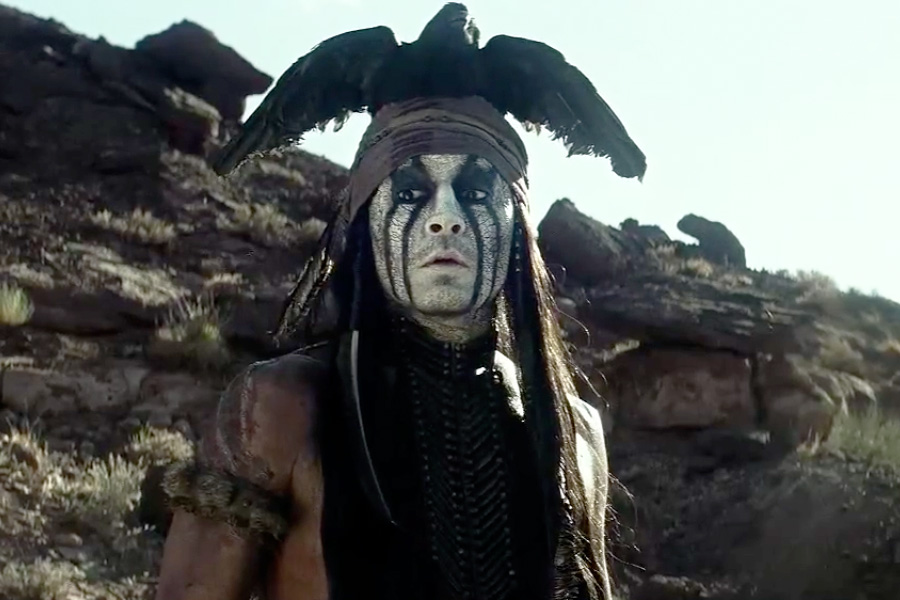 I know there are many people out there experiencing stage four Depp fatigue, and I can’t blame them. His penchant for peculiar character construction can get somewhat tiresome if the movie doesn’t have more going on. In something like Alice in Wonderland, a movie I didn’t even like, at least his weirdness fit with the weird world unlike, say, Dark Shadows, a movie best forgotten by everyone involved. Here his Tonto is as head scratching as he is humorous. And is there an inherent awkwardness having a white actor, in this day and age, playing a Native American? According to the Internet, Depp has said he “probably” has some Cherokee ancestors because he’s from Kentucky. The funny (awful?) thing is that Tonto is often in white face with his special face painting (red face in white face?). I just don’t think he can apply the same bug-eyed, swishy, eccentric sensibility to every character and call it a day. Just when you think he’s gotten away from starring in every movie with Helena Bonham Carter, surprise, here she is. And it’s not even a Tim Burton movie, people! Tonto is seen less as side kick and more of a co-lead if not the real star, and part of that is the bankability of Depp as a box-office draw, part of that is Depp as an executive producer on the project, and part of that is just because the kooky Tonto is just far more interesting than the straight-laced Reid. Hammer (Mirror, Mirror) has the jaw line, the look, and an engaging yet square appeal to him, and if anyone saw The Social Network you know the handsome lad can act. Too often he ends up being a minor foil to Tonto; it takes him far too much hemming and hawing before he accepts his masked outlaw status. As a result, he’s something of a bland fuss bucket.
Disney’s big-budget reworking of The Lone Ranger will probably be held up as the prime example, in a non-Michael Bay summer, of everything wrong with studio filmmaking, the punching bag for blockbusters. Some may even invoke a comparison to another costly Disney endeavor, last year’s flop, John Carter. There are plenty of faults the movie exhibits, namely an extended sense of bloat and an uneven tone, but I’d be lying if I said I was obsessed with the faults by its spectacular end. The movie does enough right, and enough semi-right with enough style and verve, that I left my screening feeling giddy and satisfied. It might be too dark, too glib, too weird, or too self-indulgent, but those are all reasons that made me like this movie even more. There’s a character with a wooden leg that doubles as a rifle, and not only that but one of our villains, a cavalryman, has a clear fetish for prosthetic legs. And this is a Disney film! I can’t help but love the spirit at large. Thanks to a fine supporting cast, Verbinski’s high wire visual stylings, and some strange sensibilities, not to mention a grand finish, The Lone Ranger is as entertaining in what it does right as with what it does wrong.
Nate’s Grade: B
Share this:

Evil Dead (2013)
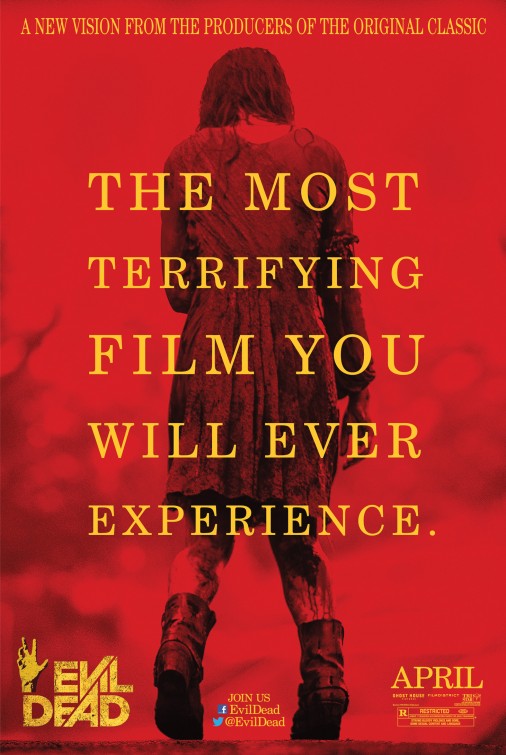 Upping the gore quotient considerably but having little else of merit, the remake of Evil Dead loses just about everything that made the original special. Gone is the sense of humor, unless you just count the quantity of gore to be the qualifier for “humor,” and gone is any real sense of a creative spark. It looks good thanks to director Fede Alvarez, and the practical gore effects can be memorable and truly disgusting in the best possible way, but it just doesn’t feel like an Evil Dead movie. It makes the same mistakes that your typical dumb horror movies do, from a lack of clarity to one-dimensional characters (I think Blonde Girlfriend had one line of dialogue for the first hour) to repeated rule breaking. There are a bunch of callbacks to the original Evil Dead but they serve little other purpose. The finale, after a series of fake-outs, involves a weak showdown with a Big Bad that’s anything but. I expect better from a remake sanctioned and produced by the original director, Sam Raimi, and star Bruce Campbell. Maybe they knew it was only a matter of time before their 1981 film, and its superior 1987 sequel, would be remade by a cannibalistic Hollywood, so they wanted to cash in while they could. Or maybe they just argued, if anyone was going to make a poor remake, it might as well be them. If you’re hungry for gore, then Evil Dead may suffice, otherwise it’s a horror movie that’s too familiar, too mediocre, and ultimately too disappointing to recommend.
Nate’s Grade: C+
Share this:

Movie 43 (2013)
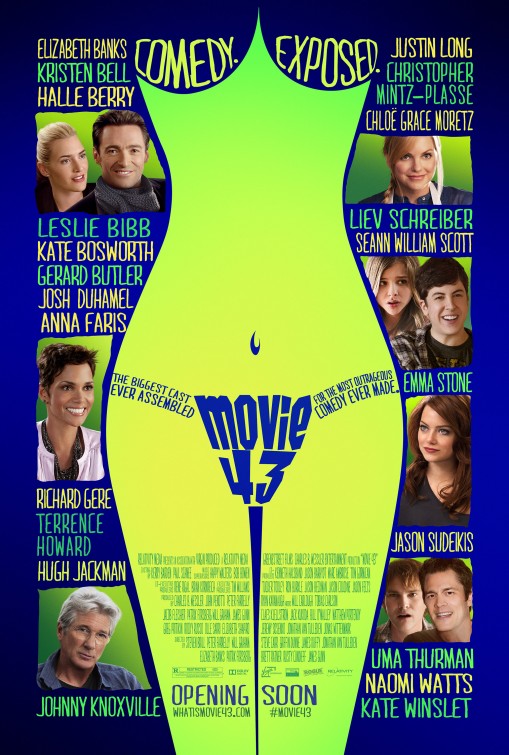 There were two driving reasons why I chose to go see Movie 43, the collection of 13 comedy sketches from different writers and directors. First, the red band trailer made me laugh, so I figured it was worth a shot. If one sketch didn’t work, there was always another ready to cleanse my comedic palate. The other reason is that I have been compiling sketches written by myself and my friends with the intent to make my own sketch comedy movie in 2013. Part of me was also concerned that something so high-profile might extinguish my own project; maybe we came up with similar material with sketches. After watching Movie 43, a tasteless, disconnected, and ultimately unfunny collective, I have renewed hope for my own project’s success.
Like most sketch comedy collections, Movie 43 is extremely hit or miss. This ain’t no Kentucky Fried Movie or even the Kids in the Hall flick. Rating this worth viewing depends on which side racks up the most. Unfortunately, there’s more terribleness than greatness on display, but allow me to briefly call out the film’s true highlights. The best segment in the movie, the one that had me laughing the longest, was a bizarre fake commercial that does nothing more than presuppose that machines, as we know them, are really filled with small children to do the labor. Seeing little urchins inside a copy machine or an ATM, looking so sad, with the faux serious music welling up, it made me double over in laughter.
 With the actual vignettes, “Homeschooled” and “Truth or Dare” where the standouts that drew genuine laughter. “Homeschooled” is about a mother and father (real-life couple Naomi Watts and Liev Schreiber) giving their son the total high school experience, which amounts to degrading humiliation. Dad makes fun of his son’s penis in the shower. Mom and Dad throw a party with the cool kids but don’t invite their son. Dad tapes his son to a flagpole. The kid gets his first awkward kiss thanks to his mom. It’s outrageous without falling victim into being crass for the sake of crass, a common sin amongst many of the vignettes. “Truth or Dare” starts off innocuously enough with Halle Berry (Cloud Atlas) and Stephen Merchant (Hall Pass) on a blind date. As the date progresses, they get into an escalating game of truth or dare that each has them doing offensive acts, like blowing out the candles on a blind kid’s birthday cake. This segment knows when to go for broke with it silliness and it doesn’t wear out its welcome, another cardinal sin amidst the other vignettes.
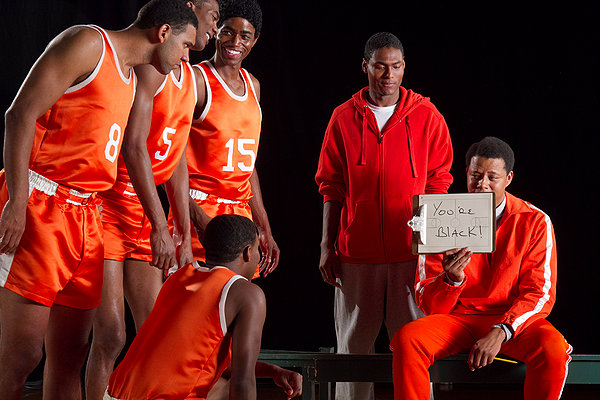
But lo, the unfunny sketches, or more accurately the disappointing sketches, outnumber the enjoyable. Far too often the sketches are of the one joke variety and the comedy rarely leaves those limited parameters. So a sketch about a blind date with a guy who has testicles hanging from his chin (Hugh Jackman) is… pretty much just that. There’s no real variation or complications or sense of build. It’s just that. A commercial about an iPod built to model a naked lady is… exactly that and nothing more. A speed dating session with famous DC superheroes like Batman (Jason Sudeikis), Robin (Justin Long), Supergirl (Kristen Bell) and others should be far cleverer than what we get. While I laughed at the sports sketch “Victory’s Glory,” it really all boils down to one joke: black people are better than white people at basketball. That’s it. “Middleschool Date” starts off interesting with a teen girl (Chloe Grace Moritz) getting her period on a date and the clueless men around her freaking out that she is dying. However, this is the one sketch that doesn’t go far enough. It really needed to increase the absurdity of the situation but it ends all too quickly and with little incident. “Happy Birthday” involves two roommates (Johnny Knoxville, Sean William Scott) interrogating an angry leprechaun (Gerard Butler) for his gold. It pretty much just sticks to slapstick and vulgar name-calling. That’s the more tiresome aspect of Movie 43, the collective feeling that it’s trying so desperately to be shocking rather than, you know, funny.
The worst offenders of comedy are the scathingly unfunny “Veronica” and “The Proposition.” With “Veronica,” Kieran Culkin tries to woo his lady (Emma Stone) with a series of off-putting sexual remarks, delivered in an off-putting “bad poetry delivery” manner, while the film is off-puttingly shot with self-conscious angles that do nothing for the comedy. It’s a wreck. “The Proposition” is just one big poop joke. It’s far more gross than gross-out.
 The frame story connecting the varied vignettes is completely unnecessary. Well, I suppose there is one point for its addition, namely to pad out the running time to a more feature-length 94 minutes. The wraparound storyline with Dennis Quaid pitching more and more desperate movie ideas never serves up any good jokes. Its only significance is to setup an ironic counterpoint that gets predictable and old fast. Example: Quaid says, “It’s a movie with a lot of heart and tenderness,” and we cut to a couple that plans on pooping on each other. See? You can figure out its setup formula pretty quick. I don’t understand why the people behind Movie 43 thought the perfect solution to pad out their running time was a dumb wraparound. These sketches don’t need a frame story; the audience is not looking for a logical link. For that matter why is the guy also pitching commercials? I would have preferred that the frame story was completely dropped and I got to have two or three more sketches, thus perhaps bettering the film’s ultimate funny/unfunny tally.
There will be a modicum of appeal watching very famous people getting a chance to cut loose, play dirty, and do some very outrageous and un-Oscar related hijinks. The big name actors do everything they can to elevate the material, but too many sketches are one joke stretched too thin. I suppose there may be contingents of people that will go into hysterical fits just seeing Hugh Jackman with chin testicles (I think the Goblin King in The Hobbit beat him to it), just like there will always people who bust a gut when a child or an old person says something inappropriate for their age, or when someone gets kicked in the nuts (the normal ones). I just found the majority of Movie 43 to be lacking. It settles far too easily on shocking sight gags and vulgarity without a truly witty send-up. It wants to be offensive, it gleefully revels in topics it believes would offend the delicate sensibilities of an audience, but being offensive and being funny are not automatically synonymous. You have to put real work into comedy. Movie 43 isn’t it.
Nate’s Grade: C-
Share this:

Mama (2013)
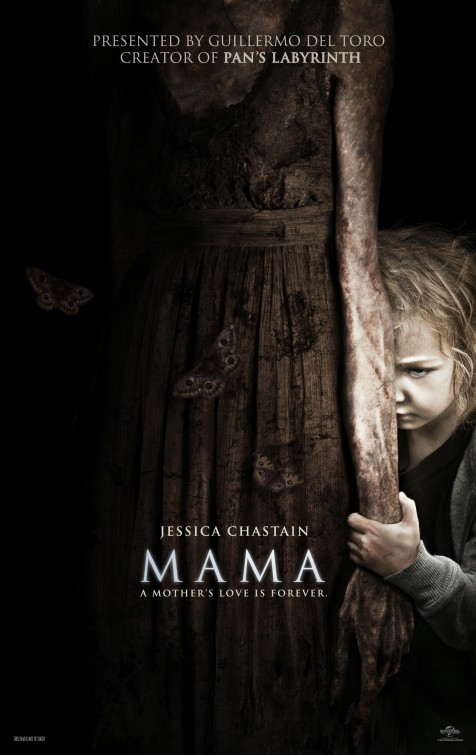 Guillermo del Toro is no stranger to the things that go bump in the night. He helped shepherd the horror film Mama to the big screen, and his love of heavy atmosphere and creepy, agile, lithe figures of terror is still evident. This is a rather effective and very creepy little horror movie that has enough little scares, big screams, and plain skin-crawling moments to recommend. The plot involves two little girls left to fend for themselves out in the wilderness. The two young actresses are fantastic, with terrific physical command of their bodies, able to slink and hop around like feral beasts. They help emotionally ground what could have been an otherwise ordinary ghost story. Oh yes, the girls prayed to a protector known as “Mama” who happens to be a malevolent and jealous spirit. Pity Jessica Chastain (Zero Dark Thirty), not just for her Gothic haircut and heavy eyeliner, but also as the girl’s reluctant foster mom. I’m shocked at how disturbing it is to watch a highly articulated physical specimen bend and snap and scurry at odd angles, broken arms bouncing like insect mandibles. And director/co-writer Andrés Muschietti knows how to properly tease an audience with just enough show and tell. The end is rather rote and familiar but, due to the emotional connection, has moments of genuine poignancy. Credit the considerable talents of the little ones as well as the devious vision of Muschetti and the guiding hand of del Toro. Give Mama a look.
Nate’s Grade: B
Share this:

Brave (2012)
 Perhaps after a series of ambitious, mature, celebrated animated works, we just hold Pixar to unrealistic expectations. Their latest film Brave isn’t bad by any means, but it’s certainly second-tier Pixar among their cherished catalog of hits (somewhere along with Monsters Inc. and A Bug’s Life, I’d say). The movie is an eye-popping beauty to watch; the Scottish highlands look gorgeous and teaming with life, and our heroine, Princess Merida (voiced by Kelly Macdonald), has a signature mess of red tresses that look incredibly real. The hair practically blazes onscreen. Even though the independent-minded young heroine has been a staple of stories, and particularly animation, since the 1990s, Merida is still a feisty, engaging, and relatable lead. Her friction with her mother (Emma Thompson), who wants Merida to accept royal responsibilities and marry a suitor, creates some nice sparks, and the mother-daughter dynamic is an exciting new avenue for Pixar to explore. Without spoiling too much, Merida, in a moment of anger, has a spell cast with disastrous results. It’s here, at about the 30-40 minute mark, where the movie goes in a completely different, and unwelcome, direction. The rest of the film becomes a series of chases and comical close calls and lots and lots of slapstick humor. The timeframe of the movie, about 36 hours as near as I can tell, is too short for substantial character growth. And so, by the film’s end, the character development feels facile and forced and just unbelievable. Rather than keep its focus on Merida making her own way against a patriarchy, the film devolves into a supernatural buddy comedy and then concludes in a clumsy, dues ex machina fashion. The tone is uneven, and some points are a bit scary for young children, and I kept thinking that this was more a Dreamworks release. I may sound overly critical but that’s because we’ve come to expect the best from Pixar. Brave is an entertaining, funny, and often visually astounding movie, and while it’s second-tier Pixar, that’s certainly better than most.
Nate’s Grade: B
Share this:

Abraham Lincoln: Vampire Hunter (2012)
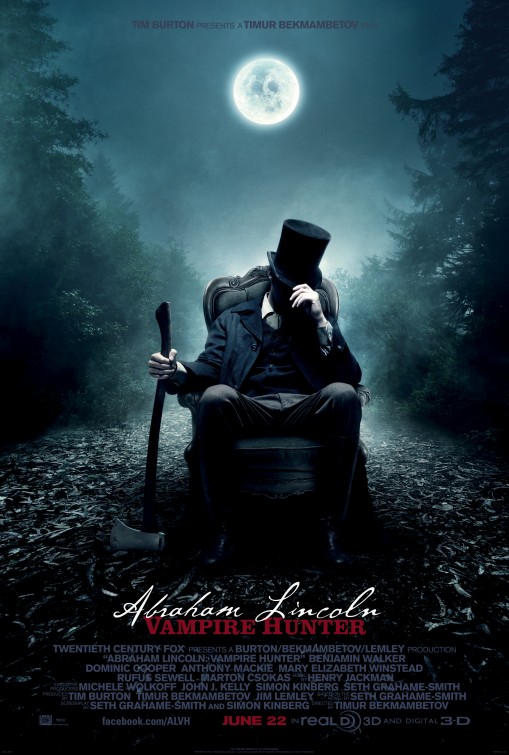 Did you know that our sixteenth president had a rather unorthodox hobby, and it was really the purpose that drove him into politics and later the White House? That’s what the gonzo best-selling book Abraham Lincoln: Vampire Hunter purports. When he was talking about a house divided not being able to stand, he was secretly talking about vampires, you see. The film version, under the tutelage of producer Tim Burton, looks like it’d be an axe-swinging good time. I realize the absurdity of wishing the filmmakers had hewn closer to the source material, a radical reinterpretation of American history, but there it is. I cannot tell a lie.
Abraham Lincoln (Benjamin Walker) is a man determined to rid this new country of the scourge of vampires. His mother was murdered by a vampire landlord, Jack Barts (Marton Csokas), when Lincoln was only a little boy. As an adult, Lincoln tries to avenge his mother’s death but Barts is too strong. Henry (Dominic Cooper) saves Lincoln and teaches him all about vampires and, more importantly, how to hunt and kill them. They strike up a partnership: Henry will provide names of vampire targets and Lincoln will dispatch them with extreme prejudice. Lincoln tries to live a solitary life but keeps building attachments; to his co-worker Joshua Speed (Jimmi Simpson), to his childhood friend Will (Anthony Mackie), who needs Lincoln’s help to forge some slave papers, and the enchanting Mary Todd (Mary Elizabeth Winstead). Abe realizes the limitations of killing vampires one by one. The vampires are exploiting Southern slavery as an all-you-can-eat buffet. Lincoln realizes the only way to foil the vampires is to eliminate slavery, and to do so he must be in a high government position, and so Lincoln retires his axe to turn to abolitionist politics.
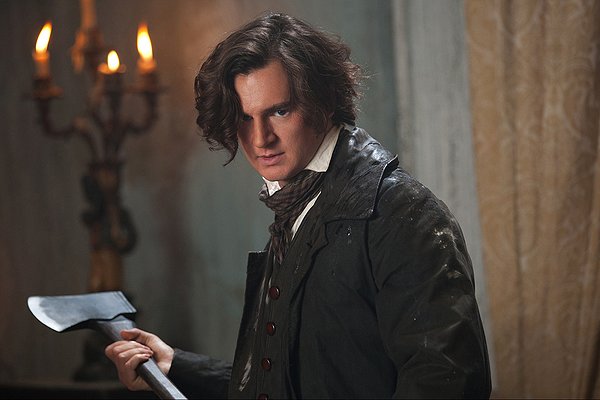 It feels that rather than embrace the courage of its convictions, the movie is trying to please as many mass markets as possible. So many characters and storylines are inserted wholesale without any connection to the book. The film is almost unrecognizable from the book. Now, I’ll quit my bemoaning for the time being because a movie has to exist on its own merits, but Abraham Lincoln: Vampire Hunter is just a mess. As far as new characters included only to appeal to broad audiences, there’s the Black Best Friend, long a staple in movies meant to say, “Hey, our lead character is hip and has no problems with race,” but really it’s always been a depressing act of pander and I always feel sympathy for the thousands of black actors who have to compete over the limited best friend parts. Giving Lincoln a black best friend seems to remind the audience that Lincoln was against slavery, you know, in case anyone didn’t know anything about the man nicknamed the Great Emancipator. Then there’s the ascension of Mary Todd Lincoln into a feisty, strong-willed, formidable ally rather than the insular, clinically depressed woman she was in real life and in the book. Mary even gets some grand hero moments taking out a vampire in slow-mo coolness. The transformation of Mary feels just as big a pander as the character of Will. Then there’s the idea that Lincoln and his small inner circle of pals are placed in the center of action, like they alone and their heroic escapades single-handedly turn the tide of war. It’s handled so ham-handedly that it all plays out like they’re the Scooby Doo gang solving the Case of the Vampire Insurrection.
Lincoln’s history is given such shrift attention, just enough to fill out the standard tortured hero’s backstory for the aims of the story. We see Lincoln as a child but just enough to establish his tragedy and hunger for revenge. Then we cut to him as an adult and going to kill Barts. That’s quite a big leap in time with little careful setup. The time before Lincoln’s presidency is just enough to supply him with a stock character posse and a plucky love interest, and then it’s right to the Civil War. So much time in between the main events just gets squeezed out, and so Abraham Lincoln: Vampire Hunter feels like it’s always one scene away from a clumsy montage.
The vampire threat, as presented, also feels too insurmountable. Not only can these vampires walk in the daylight, they’re super strong, super fast, and can make themselves invisible, a neat new trick. When they ally with the South they seem nigh unbeatable. The movie makes the mistake of making the adversary seem too powerful, so the eventual thwarting of the vampire Confederacy feels too easy and far-fetched given the magnitude of the threat. Adam (Rufus Sewell) is hinted at being like the first vampire, but then this idea is never picked up again. Why even hint at something significant if you have no intention of pursuing it? There’s another new wrinkle where vampires are incapable of killing their own kind. If this is the case then why aren’t the vampires turning every single person they can find into vampires? It shores up their side and guarantees less potential people that could kill them. I’m curious how certain swaths of southerners are going to react to seeing their beloved Confederacy teeming with devilish creatures. Then again, I think the romanticism of the Confederacy is hogwash. When insurrections win we call them revolutions of independence, and when they lose we call them treason. Guess what? The South lost.
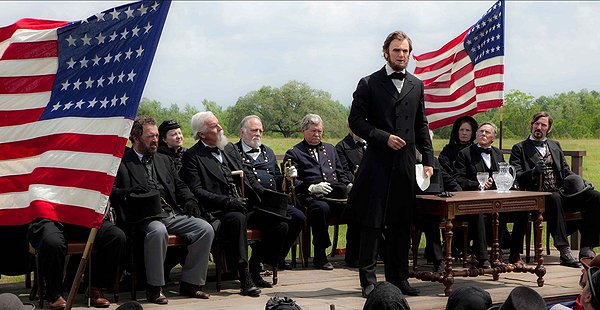 As much as I enjoyed his book, I have to lay the blame at the hands of Seth Grahame-Smith, who adapted his book into the screenplay (he’s 0-2 this summer after his disastrous screenplay for the other vampire movie this summer, Burton’s Dark Shadows). Granted, I’m sure he got intensive notes on how to alter his story for the big screen; the whole projects reeks like it had too many cooks in the kitchen. The interconnection from the book, finding clever ways to marry history and alternative history together, have been ground down to stream line Lincoln into an American super hero. Not only is he handy with an axe, this Honest Abe can leap from racing horse back to racing horse back, and even get clobbered by a horse and keep on going. The coda at the end feels like a missed opportunity to carry on the Lincoln tradition into our modern age. With the clever reworking replaced by blockbuster superficiality, the film merely takes history and has it perform the outrageous rather than finding smart ways to connect all the outrageousness to the established facts.
What the movie has to the credit of director Timur Bekmambetov is a strong visual pulse. Bekmambetov directed 2008’s testosterone-soaked Wanted, so you know you’re going to get some crazy and eye-catching images on display. The action sequences do pack a punch and I’ll admit that seeing an axe utilized as an inventive martial arts weapon is considerably cool. There are two standout set pieces. The first is a fistfight between Abe and Barts in the middle of stampeding horses. You feel right in the thick of the action, horses stampeding all around, the sun setting to offer an eerie yet beautiful glow to the ordeal. It’s one of the more reality-stretching moments, as I noted above, but man if it isn’t thrilling and lovely to watch. The other standout sequence is a climax aboard a speeding locomotive itself atop a large wooden bridge engulfed in flames. Abe and Will stand back to back, swapping the axe to kill vampires, and then hey have to outrun the collapsing train. In these moments, the movie is joltingly alive, bursting with excitement and that rare yet glorious feeling of watching something beautifully different. I just wish this sensation wasn’t so fleeting in the movie.
Abraham Lincoln: Vampire Hunter is a violent historical reworking that isn’t good enough to be properly entertaining and it isn’t bad enough to be considered camp. The film is mostly disappointing because it should feel far more engaging given its whacked-out premise the very cheeky promise of its title, and strong source material, a pulpy, ripsnorter of a read. The movie has some stellar standout moments but I think what ultimately hinders the entertainment value is how dumb everything comes across. This is not dumb in the winking, self-aware, satiric sense, but dumb in more of the blockheaded, Michael Bay, formulaic blockbuster sense. I wouldn’t even classify this movie as an enjoyably dumb, a silly summer slice of escapism like Battleship, which is looking better every week after new, disappointing summer releases (and it’s not even July yet!). The spirit of this movie is missing, the cleverness of the conceit drained, and the fun is bottled up. What this movie reminds me of is the stupid 2003 film The League of Extraordinary Gentlemen, which took classic literary characters and threw them into a genre movie. Both movies figure the exercise alone, seeing classic literary or historical figures in absurd contexts, was enough to justify entertainment. I say that you have to work harder.
Nate’s Grade: C+
Share this:

Harry Potter and the Deathly Hallows: Part Two (2011)
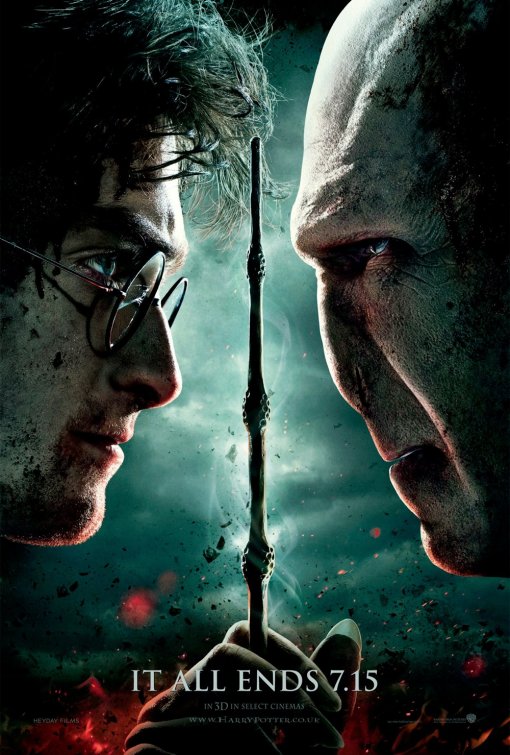 While not the best film in a series spanning ten years, part two of the final chapter of Harry Potter is a solid, satisfying close that’s fittingly grandiose but also sneakily emotional at points. The plot finally gets simplified once all those silly magic items are found, and what we have is a war at the Hogwarts School of Magic between good vs. evil. The action sequences are the best in the film’s series and some very dark events take place, including the deaths of many characters, some children, though too many critical deaths occur off camera. Harry (Daniel Radcliffe) faces off against Voldermort (Ralph Fiennes) for the fate of the world, and after the protracted, wearisome setup of Part One, it’s a relief to say that the final film moves like it’s on fire. There’s very little downtime and a great pull of urgency to the flick. So what if Ron (Rupert Grint) and Hermoine (Emma Watson), Harry’s best pals since the start, are completely forgotten and useless in the movie’s final hour. The focus is all on Harry and his messianic sacrifices. Alan Rickman shines again, showing a depth of emotions not available to Snape until the character’s final revelations. In fact, there needed to be more Rickman, but I can lay this same charge with every film. I wish the resolution, spanning forward 19 years, would have slowed down a bit and accept the paternal/maternal changing-of-the-guard as the emotional payoff billions of people have been waiting for. Harry Potter and the Deathly Hallows: Part Two is a thrilling, gratifying capper to a series that, while to me was never as magical as the Potter die-hards have claimed, was, over eight movies and almost 20 hours, an enchanting franchise that stayed consistent in quality and entertainment. Here’s to you, Potter. Now maybe I can finally stop hearing people badgering me about how the books were better.
Nate’s Grade: B+
Share this:

Pirates of the Caribbean: On Stranger Tides (2011)
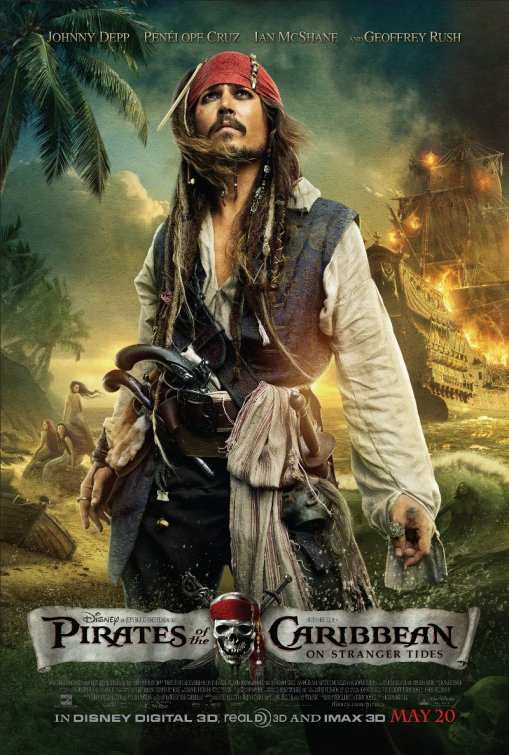 The public reaction to the two previous Pirates of the Caribbean sequels, 2006’s Dead Man’s Chest and 2007’s At World’s End, were decidedly mixed, though that didn’t stop them each from earning a bazillion dollars. Fans didn’t care for the darker tone, the confusing interlocking of the story, and especially the bloated running times. It feels like Disney’s uber-producer Jerry Bruckheimer must have taken notes from the sequel backlash and they amounted to: “Less of everything.” Welcome to less plot, less character, less involvement, and far less entertainment. Welcome to Pirates of the Caribbean: On Stranger Tides.
It’s been a few years since the non-world-ending events of At World’s End, and Jack Sparrow (Johnny Depp) has been in London putting a new crew together. Except, it’s a Sparrow imposter. Turns out it’s Angelica (Penelope Cruz), a former lover of Jack’s who woud still like to settle some scores. She and her father, the feared pirate captain Blackbeard (Ian McShane), force Sparrow to lead them to the Fountain of Youth. Apparently, Jack at one point had the map. King George II (a delightfully hammy Richard Griffiths in one of the film’s best scenes) is in a race against the Spanish crown. The English monarch hires Barbossa (Geoffrey Rush), Sparrow’s occasional enemy and ally, to find the fountain as well. It’s a race to see who can benefit from eternal youth first because, apparently, no one can share a source of water. Second grade teachers nationwide are very disappointed, Disney.
The entire enterprise just lies there on the screen, devoid of all energy or danger. The entire picture is just so shockingly inert, lazy, phoned in from every angle, missing any resonance of magic. Rob Marshall was the wrong man to be tapped as the new director of this series. Marshall has a fine eye for visuals, but the man couldn’t stage an action sequence to save his life. The Oscar-nominated director of musicals like Chicago and Nine stages his action sequences like dance sequences, which on paper don’t sound too far off. That’s until you realize action needs to incorporate story, location, build in tension, create organic obstacles, and be easy to follow. The action sequences in On Stranger Tides aren’t outlandish enough. It’s all so dull, a sword fight here a sword fight there. Short of a mermaid attack sequence, there’s no excitement to be found onscreen. That is disastrous for a franchise that has built a reputation for its anarchic, wild action and storylines. Marshall’s action angles and editing don’t communicate urgency. There’s no mood to these set pieces. The editing feels like it’s always catching up, always too late, needing a myriad of trims. Action cinema has been lambasted when it’s hyper edited and the audience cannot see what is happening; On Stranger Tides is not edited enough. One of the reasons these half-baked action sequences can never get going is because they always seem to be starting and stopping with the lackadaisical editing, always a step behind. The shots linger when they shouldn’t. The ingredients are there for a tasty meal but the chef (Marshall, screenwriters) doesn’t know what to do. The musical score by Hans Zimmer tries very hard to compensate and rattle the audience, compelling them to think what is transpiring on screen is exhilarating. It is not, and the music is just loud and annoying.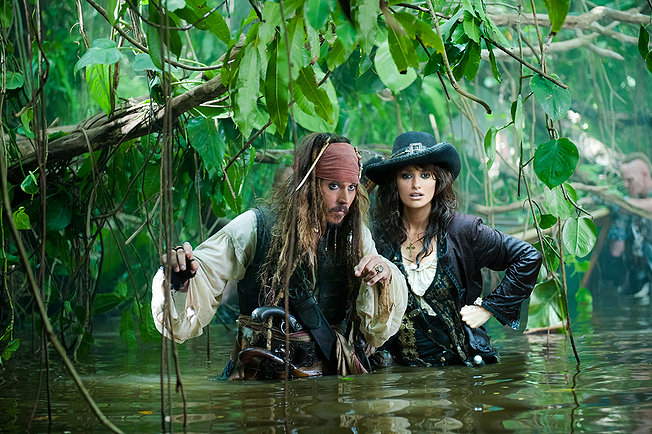
One of the chief criticisms of the two Pirates sequels were that they were overstuffed with storylines, characters, setups, and were just far too convoluted and confusing for their own good. So with On Stranger Tides we get a simplified, pared down one-off movie. Much of the film is just characters walking in circles and, likewise, talking in circles. Motivations are flimsy. The dialogue is stilted; Sparrow’s malapropisms and one-liners feeling sloppy (“I agree with the missionary’s position,” he quips. Groan). The entire premise is to get to the Fountain of Youth, and then they get there and, well, very little happens. The characters will talk about little, walk a few feet, talk about little more, and this process repeats. Barbossa should be an interesting foil, going from fop to pirate by film’s end, and yet his every appearance in the movie feels like when the next-door neighbor appears on a TV sitcom. It’s an intrusion meant to remind you that you, the audience, like this character, even if they don’t serve any point in the story. The plot lacks any twists and turns, ultimately having every competing force converge on the Fountain of Youth at exactly the same time for a slapdash climax that involves more lackluster sword fighting, just like all the other sequences. On Stranger Tides is a full half-hour shorter than the third movie, and yet it still feels like an eternity at two hours and seventeen minutes because it spends so much time doing so little.
At least the other three Pirates movies found clever ways to mingle their sci-fi mythology into an old-fashioned Errol Flynn swashbuckling adventure. With On Stranger Tides, the sci-fi fantasy elements are just as underdeveloped as the characters. The Fountain of Youth is another of those magic do-hickeys that involve gathering magic tokens and blah blah blah, mermaid tears, silver chalices. Hey, if you wanted to drink up some mermaid tears, have them watch 2009’s Oscar-winning best documentary, The Cove. That ought to do it (a scene driving the mermaids into nets oddly reminded me of The Cove). Blackbeard and Angelica have a Jack Sparrow voodoo doll, which is highly effective, and yet this plot device is nearly forgotten for the entire film. There is no clever application of this unique device. Blackbeard has a magic sword that makes ships come alive. Why? How? It’s just another magical Macguffin, like Jack’s compass. Man-eating mermaid temptresses is an interesting idea, and a great way to squeeze in a lot of obfuscated nudity in a Disney film for teen boys who have not discovered the Internet. Too bad the mermaids are confined to one scene, albeit the highpoint of an otherwise bad film. Their feeding frenzy is the only moment in the film that channels that high-flying sense of verve that made the original so memorable. Don’t even get me started on the fishy romance presented between the captive mermaid (played with all the acting capability of a French perfume model) and a missionary (Sam Claflin). The whole experience feels like a shambled, draggy, inarticulate rip-off of Last Crusade, complete with a climactic drink from a magic chalice. I appreciate Marshall’s emphasis on practical special effects but if these are the results then bring back the previous sequels’ CGI vomitorium. This franchise feels like every ounce of energy and danger has been squeezed out of it.
So does that means that this Pirates venture is more character-based now that it has jettisoned side characters and complex plots? Fat chance. The problem is that Jack Sparrow is not a good lead protagonist. He’s not meant to be a classic good guy. He’s a libertine, somebody who makes selfish choices but will revert to do something proper when his conscience nags him enough. Sparrow is more of the dashing rogue at best. Does anyone remember how he was going to trick doomed men into signing their souls to Davy Jones? He also needs a foil, a striaghtman to bounce off of. I almost miss the wooden performance of Orlando Bloom. Without a do-gooding striaghtman, Jack Sparrow plays like a man adrift, searching for his groove. Unfortunately, Sparrow never finds it in this vehicle, which just asks him to go through motions and mannerisms. Blackbeard makes for one very bland villain. McShane (TV’s Deadwood) can glower and chew scenery with the best of them, but his baddie never seems too menacing. He burns one guy alive and threatens to kill his own daughter in order to keep Jack in line. I’m sorry, but that doesn’t even compare after the previous films included a monstrous ship captain who would readily slice prisoners’ throats and a British bureaucrat who hanged an eight-year-old before the freaking opening credits. Blackbeard, in contrast, just comes off like a crusty old man in need of a shave.
 The film’s biggest addition was bringing in Jack’s former flame Angelica, a woman he robbed of her virtue and personally betrayed. But is there any tension? No, because Jack and Angelica don’t have any old feelings for one another they rehash (oh how I was even pleading for a trope like that), and the characters don’t really feel any antagonism either. Sure they will parry and threaten one another, but it’s so devoid of danger or tension or interest. This is no screwball romance. They feel like a couple that can’t be bothered working up any notable feelings toward one another. Therefore, all their shared scenes, and there are many, sink the film’s flow. Their bickering should bring some sparks. She should be exciting; she’s the daughter of a notorious pirate, she was going to be a nun until Jack Sparrow came sailing into her life. She should be sore. She should be angry. She should be a lot of things that ultimately the character is not. Cruz (Nine, Vicky Cristina Barcelona) doesn’t come across as an equal or love interest, she just feels like an annoying sidekick, harping on “Yack.” At one point, Jack tells her, “If you had a sister and a dog, I would take the dog.” When she’s got a personality like this, I’d agree.
Depp (Alice in Wonderland, Sweeney Todd) is obviously a comic gift and his Sparrow character will go down in the ages as one of the most universally beloved figures in cinema history. Everyone adores this character, a loveable scoundrel. But that doesn’t mean the screenwriters can just strand him in a crummy story with nothing to do. Depp will always be enjoyable when he puts on his Captain Jack eye liner and does that funky, swishy walk of his, but even he feels like he’s phoning this one in. He realizes that his character is trapped in a sodden adventure that offers little to do as a character and an actor.
I never thought I would say this, but On Stranger Tides makes me positively reevaluate the other Pirates sequels (I admit to being one of the few critics who liked Dead Man’s Chest a good deal). If this is what a simplified Pirates of the Caribbean film gets you, bring me back the messy, maddening plots of the previous films. Bring me back the scope, the danger, the clever mingling of genre elements, the adventure, the sizzle, the anarchy, and bring me back director Gore Verbinsky. Marshall has no feel for this material or how best to serve story. I never expected a movie with this kind of budget to be so lifeless. It all just sits there on screen, expecting the pieces to come together through ardent wishful thinking. On Stranger Tides suffers not because it strips away some of the excess and convolution that plagued the other films, it suffers because it gives no reason for its existence. It does not enrich the characters, the Pirates universe, or provide a rip-roaring story. Obviously, the film exists to line the coffers of Disney. It may earn plenty of booty this summer, but this is no way to rejuvenate a sinking franchise.
Nate’s Grade: C
Share this:

The Adjustment Bureau (2011)
 Gentlemen, if you were looking for an original excuse about not calling a girl back, try this one on for size: I couldn’t call because a team of men who control human destiny told me that if I did they would erase my memory and keep you from the fame that you are destined to achieve. She’ll probably at least give you points for originality before throwing a drink in your face (but it was all part of The Plan, or was it?).
David Norris (Matt Damon) has just lost a New York congressional election thanks to his frat boy ways of old resurfacing. As he composes his concession speech inside the men’s restroom, he meets Elise (Emily Blunt), a ballet dancer hiding out. They have one of those crazy only-in-a-movie conversations that manages to feel authentic. Then they kiss. She inspires him to ditch his prepared remarks and speak from the heart to the national TV audience, which eats it up. David spends the rest of his days trying to meet the enchanting Elise again. Then he runs into a big stumbling block. He’s late to a meeting and catches a group of mysterious men in suits and fedoras fiddling around with people frozen like statues. They are the adjusters, the ones who ensure that the participants of mankind follow The Plan. These are the people responsible for the illusion of choice in our lives. If we deviate too far from The Plan, causing ripple effects that too need to be accounted for and adjusted, they step in. Richardson (John Slattery) is the spokesmen for the group and decides to just level with David. He is not supposed to be with Elise. He has a different future ahead of him, so sayeth The Plan. They will throw obstacles between the two of them. David seeks out Elise and fights against the whole universe for the two of them to make a future together.
 Horrible title aside, The Adjustment Bureau is a sometimes corny but often deeply satisfying movie. It may distract with some efficient and just-smart-enough sci-fi leanings and magic tricks, but it’s really a unabashed romance at its core. Not just that, it’s a good romance, once that flutter the heart and causes the ends of your mouth to do that thing, you know – smile. It helps when you have movie tars as gorgeous as Blunt and Damon, and are such good actors that they can fill their roles with dangerous amounts of charm, but let’s credit writer/director George Nolfi (The Bourne Ultimatum, Ocean’s Twelve). He takes a fairly routine concept (powerful forces control our lives and choices) and turns it into a finely tuned character-driven romance. Immediately from their first meeting in a men’s room, Blunt and Damon have that electric dynamic that you can genuinely believe in. Their chemistry will knock you over. You feel the spark between these two, which is essential because the two characters spend years apart at times, forever hoping to reunite. In that brief encounter, you fall in love as well and realize that this character, and this actress, is worth waiting for. I think people are going to be surprised that The Adjustment Bureau is a big gooey, stars-in-the-eyes love story, and it’s actually good. It’s a really enchanting love story, tackling the question of whether whom we love is a result of choice or destiny. This central concept is what every sci-fi element and thriller sequence is spun from. Here’s a funny thought: it’s all in service to the story.
It’s rare to see a studio movie that mixes so many different elements together to such effective, satisfying results. The film doesn’t get overly dark despite the cosmically long-reach and determination of the adjusters. There’s never any real threat of danger, only a broken heart or dashed dreams. The film has many light moments throughout, creating a rather bouncy tone that suits the romance angle nicely. The adjusters aren’t very menacing, more so comically perturbed. John Slattery, all silvery Mad Men appeal, is a perfect foil as the face of the adjusters. He feels like an exasperated parent baffled by the thought-processes of his youthful charge. It helps that these cosmic accounting agents have a finite level of power. If they had unlimited power then the film would fail to have any hope for David and Elise. But we learn that there are only so many adjusters that there are limitations to their powers, and that they can be outsmarted with enough gumption. Mingling with that light touch is enough whimsical science fiction to engage your brain. The concept of the adjusters and their supernatural abilities is nicely teased, setup, and then developed, making sure never to rock the audience with too much weirdness at one time. It’s a gradual process of discovery and it leads to a somewhat goofy, but infectiously amusing, climax that involves multiple doorway portals and magic hats. Yes, I said magic hats, which means there is an honest to God good reason why that stupid fedora hat, seen so prominently in advertising that it feels like the third-billed star, is featured. Admittedly, a concept like a magic hat that allows you to teleport through doorways would seem silly, but Nolfi makes it all work. The hardest aspect to believe (in a film with, I repeat, magic hats) is that Blunt could be a ballet dancer, let alone a future star of the medium. I’m by no means saying that the British beauty has anything to worry about in appearance, but she does not have a ballet dancer’s dangerously minuscule physique. Natalie Portman in Black Swan looked like a real-deal ballerina of fragile frame. Blunt doesn’t have the movement or the physique.
 In his directorial debut, Nolfi does enough good things, and does them with a smooth sense of style, to impress. The visual trick of going in one door and opening to another world walks a dangerous line of over saturation, but it’s playfully utilized enough to forgive. Nolfi is not perfect with his plotting, falling to misstep that can push back momentum. Characters will be chatting, and then they’ll walk away and we’ll get a title card that says something like, “Three years later,” and it sort of makes it feel like we have to start all over again. The fact that this happens more than once means that Nolfi might have wanted to plot his story around a series of events that occurred more often than Senate election terms. If we have to begin with David losing one campaign at the start and then zoom ahead at several points through another campaign, then perhaps the timeline could have been condensed a bit in retrospect. The film manages to be religious and faith affirming without pushing an agenda or overstating its romantic cause. The ones behind the plan are only referenced in oblique business terms, never confirming a certain high power but definitely nodding in that general direction.
Damon and Blunt are a terrific team. This is easily Blunt’s finest role as an actress since breaking out in 2006’s Devil Wears Prada. The actress has taken many a role that makes use of her large crystalline eyes and her sometimes go-to acting response of simpering. But in this film, she finally finds that perfect role that makes use of Blunt’s modest, goofy charm. She’s never been a leading actress in a traditional set; there’s always been a delightful goofy appeal that set her apart. When Blunt offers her playful smiles and asserts those glassy eyes of hers, you too will be smitten. Her character is a charming woman thanks to Nolfi’s writing, but having an actress of Blunt’s ability fill her out is a blessing. Damon is at a point in his career where he just grinds out good-to-great performances that manage to be convincing in unassuming, dignified ways. Damon has never been an actor given to the superfluous. His character feels like a sincere sport, which is amazing considering he’s supposed to be playing a politician. He’s the kind of guy you’d actually stand in the rain to vote for, and you understand why Elise would keep a place tucked away deep in her heart for the dashing Damon.
While the movie hinges on the coupling of Damon and Blunt, the rest of the supporting cast does fine work matching tone and making the most of their roles. Actors like Anthony Mackie (The Hurt Locker), Terrence Stamp (Valkyrie), and Michael Kelly (Changling) can make any movie better.
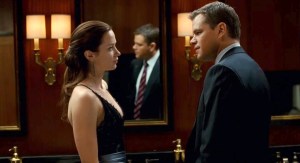 The Adjustment Bureau, on paper, should not work. A sci-fi fantasy that’s unapologetically grounded in romance. A tone that nestles firmly in a safe, bubble-wrapped whimsy. And those magic hats, need we forget them? On paper this should be one overly silly, dumb, tonally disjointed, cornball movie worth venomous mocking. And yet it works; it does better than “works,” it succeeds. Blunt and Damon are terrifically charming together and imbue the movie with a sense of cheerful optimism in the face of uncertainty (and perhaps heaven itself). You desperately want these two crazy kids to get back together; they’re good, decent, charming people, winning personalities apart and even better together. What might have fallen apart in other hands becomes this endearing, fizzy piece of studio entertainment that fulfills and exceeds most expectations. I was really taken by this movie, won over by its effusive charm offensive, and left buoyant with happiness by the time the tidy, perhaps too tidy ending, came rolling. The Adjustment Bureau is hooey but it’s my kind of hooey.
Nate’s Grade: A-


 nathanzoebl
You must be logged in to post a comment.