Blog Archives
Yoga Hosers (2016)
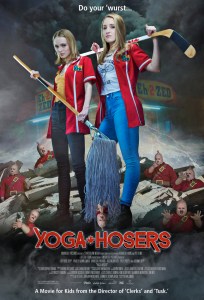 Kevin Smith has been a filmmaker who has flouted expectations. When people didn’t think the Clerks guy could make a religious thriller, he did it. When people said a movie about a man being transformed into a walrus creature was undoable, he did it. I was a moderate fan of Tusk, that man-as-walrus-as-Frankenstein movie that started as a joke premise from Smith’s popular podcast and then given strange cinematic life. Yoga Hosers is the second part in Smith’s “True North” trilogy of Canadian-set horror films. I wasn’t expecting much with Yoga Hosers and I felt like I got even less than that.
Colleen Collete (Lily-Rose Depp) and Colleen McKenzie (Harley Quinn Smith) are bored clerks at a Winnipeg convenience store. Their world is turned upside down when an attractive senior boy invites them to a “grade 12” party. Too bad they have to work, though even when on the clock the girls hardly work, instead preferring to jam in the back storage room as a fledging rock band. The girls have bigger threats than unruly customers. They’ll have to battle bad Satanists, forgotten Canadian Nazis, and tiny bratwurst men who leak sauerkraut when smashed. What’s a Canuck to do?
 The two areas that have always been the hallmarks of a Kevin Smith movie, his idiosyncratic characterization and ribald humor, are both strangely absent and desperately needed. Within the first ten minutes of the movie, I turned to my friend and confided, “I think I hate these girls already.” It’s somewhat ironic that Smith has gone back again to the bored convenience store clerks as the platform for his heroes. Where Dante and Randall were railing against pop-culture, adult responsibility, and a society that constantly made them feel inferior for their menial occupations, these girls aren’t railing against anything. If anything they’re retreating from the world, their noses constantly glued to their smart phones and social media. The excursions with youth culture feel rather inauthentic. The teen dialogue lacks comic snap and repeats phrases too often that it feels like set-up for T-shirt slogans (“Basic!”). Smith is far from his territory of dick and fart jokes and esoteric pop-culture detours. We’re introduced to many new characters with a slam edit of an Instagram-like cover page accompanied by an irritatingly chirpy 8-bit score. The intro graphics appear so quickly as to have little impact other than annoyance. The lead characters have no engaging personalities. They have an infatuation with older, cute boys, a love of yoga, a general attitude against authority, and a common level of self-involvement, but they’re not characters. They’re goofy but rarely are they grounded or better developed. One girl is daft and the other girl is… less daft. I’m not expecting these characters to have depth considering this is a movie with one-foot tall killer bratwurst Nazis, but some degree of personality is demanded. It’s the bare minimum.
Smith’s millennial satire is fairly toothless, which sadly is much like the comedy of Yoga Hosers. I hope you like puns and jokes about how funny Canadian accents are. The Colleens say “soory aboot that” and isn’t that hilarious? How about a convenience store called “Eh-2-Zed”? How about a yogi whose name is Yogi Bayer? How about an off-brand version of Lucky Charms called Pucky Charms? Why are there so many freaking puns? Then there’s the re-emergence of Johnny Depp’s wacky Quebec investigator, Guy Lapointe, allowing Depp to indulge his tendency for prosthetics and heavy accents. The shticky Lapointe character absolutely derailed Tusk and whatever unsettling momentum had been built, but he feels far more at home in the goofy world of Yoga Hosers. I might even say his presence is one of the highlights, as once more Depp gets to sink his teeth into all the Peter Sellers physical comedy tics he’s been holding back.
There’s just not enough comedy to go around here. There are goofy elements that crash into one another, like the Brat-Zis and a gigantic Goalie Golem, but it feels very much like Smith is just throwing a lot of dispirit elements together and expecting cohesion. He might even be expecting the audience to be satiated just in seeing something “different.” While Red State and Tusk were films that had sharp tonal shifts, Yoga Hosers never really settles into the silly supernatural teen comedy it desires to be. I laughed here and there but it was mostly attributed to Smith letting his more capable comic actors go off on tangents, like Justin Long’s yogi with his unorthodox poses. Ralph Garman, Smith podcast regular, shows up late as a Nazi who prefers to discuss his plans via celebrity impressions, a talent of Garman’s. It’s the kind of “hell, why not?” plotting that dominates the movie and makes you wonder if there ever was a finished script.
 I doubt any version of this story would have materialized if it wasn’t starring the daughters of Kevin Smith and Johnny Depp, and I don’t have a huge issue with this. Nepotism has been a core function of Hollywood for over a hundred years, and if Smith wants to create a vehicle for his daughter, by all means. The two young ladies have a pleasant chemistry and are believable BFFs. Their back-and-forth will occasionally elevate the jokes, like their insistent yet limited Batman impressions. Harley Quinn Smith has an enjoyable mugging quality that shows she’s studied her expressions from the school of Silent Bob. Her companion, Lily-Rose Depp, may be the real breakout. She’s the more consistent actor and the stronger anchor for the film. Even when the dialogue lets her down she still infuses a notable energy into her performance. There’s an emerging talent under the surface that looks ready for discovery, and perhaps the French film Planetarium with Natalie Portman will make others take notice. I get the impression that Kevin Smith and Johnny Depp are proud papas and just wanted to have fun together as a family. Consider the movie the equivalent of a quirky sweet 16 birthday party.
Yoga Hosers is a movie for a very select group of people, perhaps only Smith’s immediate family, friends, and most ardent of podcast listeners. I doubt that’s me. I’ve been a Smith fan since my own teens. His was one of the cinematic voices that awoke my own sense of what movies could be. I miss the caustic wit that separated Smith from the indie pack. The man was one of the few writers who could spin crass vulgarity into Shakespearean gold. He was a writing talent that many emulated but few could reproduce. Smith’s whip-smart comic perspective has always been his biggest cinematic draw, but with Yoga Hosers it feels decidedly neutered and wound down. I know he has gone on record saying he’s making the movies he wants to make without interference, but it doesn’t feel like the same Smith. Admittedly, a filmmaker in his early 20s is going to have a different perspective and creative impulses than a husband and father in his mid 40s. This apparently means that Smith has veered away from his conversational comedies and button-pushing topics and bought fully into genre filmmaking, mixing a pastiche of horror elements and varying tones. As an artist he doesn’t owe me or any other fan anything. Yoga Hosers might be a one-off, a love letter to his teen daughter and her bestie, or it could portend what is to come. Kevin Smith is making movies for himself at this point in his career. If you feel left out in that equation, like me, that’s okay. We can always go back and watch Clerks again. From my viewpoint, it feels like Smith is voluntarily erasing what made him a unique cinematic voice and choosing to disappear into the benign morass of schlocky genre filmmaking.
Nate’s Grade: C-
Share this:

Pete’s Dragon (2016)
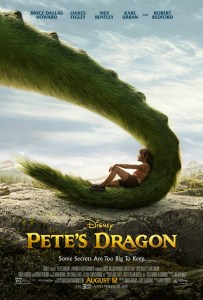 I have no personal love for the original 1977 Pete’s Dragon. I thought you, dear reader, deserved to know this morsel. I never felt a sense of wonder from the animated dragon creating mischief while a town tried to rid itself of an orphan and a bunch of hillbillies sang an ode to child abuse (it was a different time?). Disney has gotten into the self-cannibalizing habit of dipping into its own past and remaking its animated hits for a new generation of moviegoers. It worked splendidly with last spring’s Jungle Book, and the new version of Pete’s Dragon is further proof that when Disney aligns the right artist with a vision and gives them latitude to express that vision, rewards are generously reaped. This is a delightful, heartwarming, and enchanting summer movie that got me crying.
Pete (Oakes Fegley) is a young boy who lives in the wooded reservations with one very special friend, a furry green dragon he has named Eliot. He’s been living in the woods for six years after Eliot rescued him following a car accident that claimed the lives of Pete’s parents. One day a park ranger, Grace (Bryce Dallas Howard), comes across Pete and brings him back into town for medical evaluation. He’s a mystery child, a bit feral, and demands to return home into the woods. Grace incites Pete into her home and her family, but there are worries about the boy acclimating to society. All the while Eliot is looking for his best friend and mournful that they might have to part ways after all.
 Pete’s Dragon is a simple story but this is not a detriment to its ultimate effectiveness. Rather the filmmakers take care to treat this childhood fable with enough heart and earnest emotion that the movie feels fully developed to its aims. The characters and their journeys aren’t exactly revolutionary, but I didn’t mind at all. This is an old-fashioned family film told without irony and set in a nondescript past that adds to the universal appeal of its message. It’s elegantly simple but there are poignant themes running under the surface, namely an unmistakable level of melancholy with Pete’s process of growing up. This feels like Disney’s version of Spike Jonze’s Where the Wild Things Are, a movie that examines the hard but necessary transitions of childhood and the acceptance of a sort of loss among the fantastic. This movie isn’t consumed with a dour interpretation of childhood as an oppressively hellish existence of misunderstanding (I didn’t connect with Where the Wild Things Are if you couldn’t tell) but it does acknowledge a loneliness of being absent a family to call your own. Pete’s life with Eliot is filled with boyish excitement and adventure but he knows he can’t hold onto that world much longer, and this realization magnifies the remaining time with Eliot. From start to finish, Pete’s’ Dragon is bursting with warmth and resonant emotions.
I was unprepared for the emotional wallop that this film delivered. Not since perhaps Pixar’s Up has a movie so effectively triggered my sympathies in its opening ten minutes. In a beautiful yet tastefully restrained sequence, Pete becomes an orphan and is rescued by Eliot, and the vulnerability and compassion of this moment already had me tearing up. Full disclosure: I’m a sucker for the “boy and his dog” stories, and while Eliot is a special dragon by design he is, at his core, a rendition of man’s best friend. Their relationship is one of love, companionship, and protection. They’re a pack. When Eliot spots Pete cozy in a family house, he’s crestfallen but accepts that a placement in the human world is where Pete belongs. And then at the end after a fraught situation, Pete instinctively runs to Eliot and leaps into his arms, and Eliot takes him in, holding him dearly, and it was at this point that I couldn’t stop the flow of tears even if I wanted to. Happy tears, people. The takeaway of the film is the formative bonds of family and the need to reach out for that nourishing companionship. While it’s highly emotional, it’s all earned and avoids cheap maudlin, manipulative theatrics, short of one extended sequence of Eliot’s capture.
I never would have expected such an old-fashioned yet preternaturally charming movie from the team responsible for the somber indie Western Ain’t Them Bodies Saints. Director/co-writer David Lowery is locked-in with its goals and finds ways to build its characters through small, cumulative actions. The film also has a marvelous sense of place as get a strong feel for everyday life in this foggy Pacific Northwest environment. Contributing to that sense is a terrific soundtrack of low-key folk songs that thrum with a lovely homespun gentleness that taps into the earthy magic of its setting. The score strings-heavy by Daniel Hart is perfectly attuned to the emotional rhythms of the film without becoming overbearing. The photography is often gorgeous and the editing near invisible with how effortlessly it presents its story with room to breathe. There’s a standout sequence that highlights just how well all of these individual elements come together to form a greater whole. Pete escapes from the town’s hospital and desperately runs outside. He is dazed by the activity of the modern world and the geography of the town, and the residents of this town are just as dazed about Pete, a wild child exploring his alien surroundings. He hops aboard a school bus and the children inside are amazed at Pete’s daredevil antics. The chase sequence is set to the Lumineers’ “Nobody Knows” and it builds upon the sense of discovery, community, and mutual awe. It’s a wonderful sequence that develops patiently.

Part of the success of the movie is also due to the skill and implementation of the special effects team. Eliot is a cuddly creature you want to take home with you yet he can still be intimidating under the right circumstances. He’s on screen a lot but his magical qualities don’t diminish. This is one highly communicative dragon and it’s easy to empathize with him (those exquisitely emotive canine eyes help). There’s a tenderness to him that convinces the audience early on to take a journey with Eliot and see what happens next.
The human specimens are heartfelt and enjoyable as well. Ostensibly the main character, his name is in the title after all, the role of Pete rests on the tiny shoulders of actor Oakes Fegley, and he aces the part, tapping into the rougher, wilder edge while also selling the dramatic moments in a clear relation to his interpretation of the character. The next main character is Howard (Jurassic World) and she’s quite good. She gives a maternal performance that doesn’t go overboard while still allowing her to come across as an independent, thinking woman with her own desire for proof of the fantastical. She has several tender moments with Fegley. The actors all perform ably. Even Wes Bentley (TV’s American Horror Story) works well in the movie, and when was the last time that could be said? Karl Urban (Star Trek Beyond) is enjoyably hammy as the villain who’s not much of a villain. I wish Redford (Captain America: The Winter Soldier) was in more scenes because his grandfatherly presence is so enjoyable to watch and he so easily slides into the part.
Disney is two-for-two when it comes to 2016 live-action remakes of its old catalogue, and if The Jungle Book and now Pete’s Dragon are any indication, then bring on the remakes. The original Pete’s Dragon was never a memorable or enjoyable film for me, so there was already much to improve upon, which is what the new version does in every way. It’s poignant, heartwarming, earnest, and bursting with feeling. It’s a simple story told exceptionally well with artistry and grace. There’s a dash of indie flavor to the mainstream filmmaking. I think this movie will appeal to people of all ages, grown ups that are looking for some magic in their movies, as well as families looking for a movie that will entertain children but won’t rot their brains. It’s fortunate that we can end such a mediocre summer at the movies on a high note, and Pete’s Dragon is a wonderful infusion of the old and new, magic and reality, heartache and triumph. It’s a movie dripping with purity, and one that demands to be seen and hopefully cherished.
Nate’s Grade: A-
Share this:

Lights Out (2016)
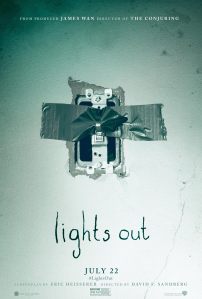 When it comes to horror, concept is king, but what’s just as important is fully developing that concept to meet its potential, and that’s where Lights Out succeeds. This is a low-budget horror movie that taps into a primal fear of the dark with a supernatural entity named Diana that can only be seen outside light sources. Thankfully, director David F. Sandberg smartly thinks of fun and interesting ways to play with this concept, like Diana disappearing in bursts of muzzle fire and a frantic, life-saving use of a car alarm. There’s a great suspense sequence where an off screen light from a flickering neon sign, switching off and on steadily, sets up audience expectations and lingers, drawing out the fear. The editing is terrific. There’s also a surprising subtext tackling the issue of mental illness and depression, as Diana, the malevolent spirit tethered to Maria Bello’s character, only seems to appear during the rougher patches of her life, and Diana fights against Bello getting “better” which weakens her existence. Theresa Palmer (Warm Bodies) settles in as a capable heroine that genuinely cares for her younger brother in danger from her mother and her “friend.” I cared about the people in this. The movie also subverts some genre clichés and treats its handful of characters with credibility. While the very end leaves some questionable final statements on mental illness, Lights Out is an elevated B-movie that takes its fun premise and executes it with aplomb. It’s worth 90 minutes in the dark.
Nate’s Grade: B
Share this:

Suicide Squad (2016)
 After watching the debacle that was Batman vs. Superman, I said it had killed my hope for the larger DC film brand. Thanks to writer/director David Ayer, and by extension Zack Snyder’s ongoing influence, Suicide Squad reconfirms every bad step they’re down on this bad road of anti-entertainment.
Amanda Waller (Viola Davis) is worried about national security in a world where a certain Kryptonian has upended our sense of priority. She wants to assemble a team of bad guys who can do some good. Rick Flag (Joel Kinnaman) is placed as the commander of a “suicide squad,” a black ops team of super villains that are injected with devices to make their heads go kablooey if they disobey. Among the ranks is Deadshot (Will Smith), a paid assassin who never misses, Harley Quinn (Margot Robbie), the former psychiatrist and lover to The Joker (Jared Leto), an Aussie named Boomerang (Jai Courtney), Diablo (Jay Hernandez), a guy with the ability to control fire, a human-crocodile hybrid named appropriately Killer Croc (Adewale Akinnuoye-Agbaje), and the Enchantress (Carla Delevigne), a thousands-year-old spirit inhabiting the body of Dr. June Moone, who also happens to be Flag’s girlfriend. Assisting Flag is Katana (Karen Fukuhara), a masked swordfighter with a tragic and mystical past. The Squad is thrown into harms way and have to work together as a group if they plan on surviving.
The tone and structure of the movie is like an unholy marriage of Stephen Sommers’ (The Mummy) sense of careless plotting and archetypes, mish mashing tones, and Joe Carnahan’s (Smokin’ Aces) sense of wanton violence, killer cool killers, and militaristic fetishism. It’s a problematic pairing of tone that almost sort of works in the opening twenty minutes as it sets up the various bad guys with their requisite little slices of backstory. Primarily Deadshot and Harley Quinn are the spotlight characters, and it helps that the two most charismatic actors play them. The first twenty minutes doesn’t exactly push the narrative forward in a meaningful way as it involves Davis digressing with an armada of high-energy flashbacks, but it’s almost forgivable. Her pitch to the government for a black ops team of super villains seems credible enough in this anxiety-ridden world, so Ayer has at least started off not quite well but well enough. And then it all goes downhill so fast into a vortex of suck and cannot recover.
 It was at the first act break that I knew this movie wasn’t going to recover and get better. You see the advertising has been very secretive about who the true antagonist is for this movie, which is none other than the Enchantress. The introduction of this Jekyll/Hyde character and her power is initially interesting, though she certainly stands out in a world of meta-humans. The problem is that this character is obviously far more powerful than everyone else in the movie, as evidenced by Waller’s “show off” moment having the Enchantress teleport and bring back nuclear secrets from a hostile foreign nation. I think Ayer realizes this and so he quickly, and I mean quickly, positions the character as the Big Bad of the film. Dr. June Moone whispers the word “Enchantress” and she appears, and then she whispers it in her sleep and, oh no, the wicked witch lady is out and nobody seems to have any contingency for this. How has nobody thought about the risk of her accidentally saying this one word? Should she be sleeping with some sort of gag?
Enchantress steals the other ancient idol containing the spirit of her brother, which is just hanging around for some unknown reason, and the two of them are distraught that mankind, which once worshiped them, has moved on. They’re going to destroy the world by making a vague world-destroying machine, which basically comes across as a giant energy portal. The brother becomes the primary villain, a giant heavy with dumb tentacle weapons, and the two of them take human beings and turn them into a faceless army of disposable soldiers thank to the power of Enchantress kissing them. It’s at this point that the movie reminded me of Sommers’ Mummy Returns sequel where the goofy tone and careless development swallowed the movie whole, shrugging and saying, “What more did you want from us?” The villains are quasi-Egyptian gods who want to destroy the world. The last act finally positions the Enchantress as the one to topple, and our anti-heroes are attacking her with guns and baseball bats. It’s just laughable and not in the good way. The entire Enchantress as villain storyline is a swirling CGI mess and her army of faceless henchmen inspire no interest or dread.
You would rightfully think that a movie about a ragtag team of kooky anti-heroes would be darkly comic and have a whimsical sense of fun, much like what James Gunn achieved with Guardians of the Galaxy. I walked out of Suicide Squad dumbfounded and muttering to myself, “How… how do you screw this up?” I think the movie has confused snark with humor. There is precious little that comes across as funny. The characters have some one-liners but that’s about it, and they grow tiresome after a while. Suicide Squad is a classic example of trying too hard; it’s all empty posturing and posing, asking for plaudits about how edgy this cut-and-dry PG-13 movie must be with its mall Goth aesthetic and irreverent sense of good and evil. It tries so hard to be edgy that you can see the onscreen flop sweat. Case in point: the avalanche of music selections. In the first ten minutes or so it feels like there is one needle-drop music selection mere seconds after another, and Ayer chooses a mixture of artists for their on-the-nose lyrics. “You Don’t Own Me” for Harley Quinn especially, “Come Baby Come” just for a scene involving a bat with the choice lyrics, “swing batter batter batter,” a cover of Nirvana’s “Lithium” because it has “friends in my head” as a lyric, “Sympathy for the Devil” for many obvious reasons, “Spirit in the Sky” when the gang is airborne, “Seven Nation Army” when the gang is put together, and so on. If there were a handful of on-the-nose music selections, it would be passable, but it’s almost like the overzealous music director worked overtime to provide as many selections as possible to cover-up the movie’s empty sense of fun.
 No character symbolizes the film’s ethic of trying too hard more than Leto’s (Dallas Buyers Club) rendition of the Joker. Admittedly Heath Ledger’s performance was iconic and cannot be replicated, but Ayer’s script doesn’t even justify the character’s presence. There is no standout or memorable scene with the Joker to help signify just what kind of character he is, how he’s far different and more dangerous than your everyday psychopath. If you called this guy a different name you would swear it’s a different character because they fail to make his inclusion meaningful. We see Joker in flashbacks relating to Harley Quinn, and it’s in these short moments that the character plays best, in particular a high dive into a vat of chemicals all in the name of twisted love. Through Harley, we get a fleeting sense of a Sid and Nancy sort of courtship that could be interesting. However, alone, Leto’s Joker is a wash, intimidating guards with lackluster “crazy talk” and maniacal giggles. There’s a shot of him lying on the ground surrounded by a carefully constructed circle of weapons. It’s a small moment but it makes him seem more OCD than scary.
Joker’s storyline is trying to free his girl from prison, but the larger problem is that Harley Quinn is a worse character when she’s with her “puddin'” Mr. J. She loses her independence and just becomes arm candy and settles into The Girlfriend in Short Shorts. She elevates him and he drags her down. That’s a direct problem with characterization. The Joker is a distraction to the other characters and his small scenes tracking her down do not excuse the detour. Leto snarls and struts but it feels over conscious and dull. There is a better way to use the Joker: make him the target of the Squad. That pushes Harley Quinn directly into the center of the story and provides plenty of internal conflict for her to wrestle with her tortured psyche and sense of adoration for a man who had tortured her and abandoned her. That would be more interesting. In the Snyder universe, we have a Batman who has no compulsion against killing his enemies, so why the hell is the Joker still alive to terrorize? It seems bizarre that Affleck’s Batman would let this guy go unless the fan conspiracy theory that the Joker is secretly a disturbed Jason Todd, a former Robin, was accurate. That would make the character instantly more intriguing and provide some needed depth to what is a shallow character that is all exaggerated attitude. He’s the worst modern Joker but not the worst part of the movie.
The characters are just not that interesting and the far majority of the Squad teammates are meaningless background players. Killer Croc, Boomerang, Slipknot, and Katana are utterly useless in this movie. They fill out space and kill some faceless bad guys, but their plots could just as easily been attached to the other Squad members. Katana in particular is another one that feels like she’s been pulled in from a different movie entirely. She’s introduced as this killer assassin and Flag says, offhand to the point of hilarity, that her sword captures the souls of the men it kills. There’s a later moment where she’s swearing her love to the trapped soul of her husband in the glowing blade, and I just couldn’t hold back and started laughing. I’m sure this point is directly taken from the comics, but it’s thrown in without any care, any setup, and its tone is directly conflicting with the snarky nogoodniks. Diablo is given a boring and predictable arc but he at least has a dollop of characterization outside “zany” or “menacing” because he wants to not use his fire-starting powers. These characters just don’t matter to the story, and the actors aren’t given anything close to resonant character moments to make them matter to us. The Batman cameos are completely superfluous as well. There’s no reason that our criminals couldn’t have been brought in from other circumstances. Batman also has a creepy moment where it seems like he’s forcing himself on Harley Quinn to give her mouth-to-mouth resuscitation. It’s such an off-putting and curious moment I kept waiting for Bruce Wayne to wake from another dream sequence.
I think back on Captain America: Civil War again and how the filmmakers were able to deftly integrate a bevy of heroes and make them matter, giving each one a small moment to be fleshed out, providing arcs, and incorporating them in exciting and satisfying ways into combat that would let them show off their stuff. Suicide Squad is not that.
 There isn’t one good action sequence in this whole movie, and with the Enchantress army of monster goons, it starts to feel like an extended episode of the Power Rangers but with an oversight of firearms. What’s the point of bringing in a bunch of weird characters with super powers if all they get to do is one gunfight after another? Once the Squad lands in Raccoon City, er, I mean whatever city ground zero is, the movie is one long slog to eventually confront the Enchantress. It’s one abandoned street filled with goons to get shot down after another. Repetition settles in and Ayer doesn’t use the opportunity to have his characters do something fun or different. The action doesn’t excite and the characters don’t excite, and everyone trudges, head down, to their dire destination in the sky. It feels like a shadowy warzone without a clear objective, direction, or understanding of the threat. There is one interesting aspect of the action that’s never developed as it should be, and it’s the Squad’s vulnerability to losing Flag. Not only does he have the control to make their heads burst, if he is killed in action then the Squad dies too. Deadshot realizes that the team has to defend Flag and out-rightly rescue him a couple of times. It reminds me of a video game escort mission but Ayer never really does much more than having his characters recognize this dynamic. As much thought is put into the action as put into the antagonists, which is to say little. Some of the action is so poorly edited and choreographed that I just hit my head against the back of my chair and waited for it to be over.
There are a few bright spots in the film, mostly provided by the lead actors. Smith (Focus) is still one of the world’s most charismatic actors even if he’s saddled with the rote “I wanna see my daughter” storyline to humanize his remorseless assassin. Smith relishes his anti-authority figure and settles into a comfortable and appealing groove. Robbie (The Wolf of Wall Street) is delightful and her character’s zany non-sequiturs are more often funny than grating. You can tell Ayer is also a fan, as his camera lovingly oogles her body. It’s a performance that whets your appetite for more Harley Quinn that the movie doesn’t seem to be able to deliver, especially when it starts to go down a route that presents her almost sentimentally. Davis (The Help) does a fine job selling her badass tough guy moments as the leader of the program. I don’t quite buy the “government/jailers are the real bad guys” angle the movie consistently presents to elevate its Dirty Dozen. The “worst of the worst” can’t be all that bad considering we’re working under the mandate of a mainstream PG-13 rating. They’re villains with gooey centers and moral codes.
It’s not at the punishing level of disaster that Batman vs. Superman wrecked, but this is a movie that is plenty bad, and not in the good way, or the fun way, just in the bad way. Even things that should be saving graces for a comic book movie about antiheroes, the fun personalities and visuals, are lacking. Ayer doesn’t know what to do with his overabundance of characters once he gets them assembled and he doesn’t have the visual dynamism of a Snyder. Ayer has talent with writing machismo characters and can even be a fine director of action as he proved with the sturdy WWII tank movie, Fury. It certainly feels like this movie got away from him. If this is trying to be an over-the-top B movie, it fails. If it’s trying to be a flashy and stylish diversion, it fails. If it’s trying to be a subversive take on super heroes, it fails. It just doesn’t work. It wants to thumb its nose at super hero movies and dance to its own anarchic, nihilistic beat, but you never believe the movie’s own convictions. It feels like empty posturing, confusing attitude and costuming for edge. It felt like some film exec pointed at Guardians of the Galaxy and said, “Make us one of those.” The sad thing is that Batman vs. Superman wasn’t good but it was at least ambitious, having to set up multiple franchises, serve as a sequel and reintroduce Batman. Suicide Squad had to do considerably less with the easy task of making a group of crazy anti-heroes as popular entertainment, and it flounders. It’s going to be a long wait until 2017’s Wonder Woman, the next DC movie in their larger plan to compete with the Marvel big boys, and the howls from dissatisfied moviegoers will echo until then, providing a pessimistic landscape for every new scrap of footage and trailer. Remember that the Suicide Squad trailer looked mighty good too and the actual movie is well and truly awful. Sometimes the packaging is the best part and sometimes it’s the only part.
Nate’s Grade: C-
Share this:

The Conjuring 2 (2016)
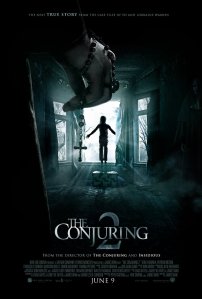 Horror is one genre where sequels rarely if ever satisfy. Usually the repetition is mind numbing and what was once scary has been eradicated. The true signs of great horror is the dread of what’s coming next, and to this end James Wan has shown tremendous skill at playing an audience and their fears. The Conjuring 2 isn’t quite the thrilling success that its predecessor was but it still upholds the best parts of what made the first movie frightening. We follow the Warrens once more, the husband and wife paranormal investigators, and this time to England where a malevolent spirit is haunting a family. One of the few miscues is delaying the meeting of the Warrens with the beleaguered family to almost an hour, pushing the running time to a needlessly overblown 133 minutes. The movie seems to be stretching out the ghost set pieces. Fortunately, Wan knows exactly how to build tension and let it simmer. The demon nun imagery is effectively unsettling, and there’s a brilliant sequence where Mrs. Warren (Vera Farmiga) has to slowly pull a light cord, all while the portrait of the demon nun hangs visibly in the dark. It’s a small scene that explains in full the clever construction of the whole. It sets up the parameters, develops them, and then lets the audience dread what it knows is coming. These are not cheap scares or lame jump scares but genuinely earned terror within a carefully constructed atmosphere. It might not be as good as the first one but The Conjuring 2 is still plenty good, which by default makes it possibly one of the greatest horror sequels of all time. Let’s hope the demon nun spinoff goes better than Anabelle.
Nate’s Grade: B+
Share this:

The Forest (2016)
 The Forrest is an initially promising horror-thriller that abandons every interesting possibility with every turn, becoming another interchangeably shortsighted and mediocre movie that only manages to scare an audience with how bad it becomes.
Sara (Natalie Dormer) is investigating the disappearance of her twin sister, Jess (also Dormer). Jess was working as a teacher in Tokyo when she visited the Aokigahara forest at the base of Mt. Fuji. This forest is nicknamed the “suicide forest” because of its reputation for being a favored location for Japanese citizens to kill themselves. Sara tracks down her sister to her campsite in the forest, with the help of a guide (Yukiyoshi Ozawa) and Aiden (Taylor Kinney), a journalist interested in writing her story. The guide stresses they must stay on the path at all costs and not trust the sounds they hear. There are plenty of unhappy spirits inside and they’re looking for permanent company.
The problem with dumb characters behaving stupidly is that it obliterates any investment the audience has in them, which is highly important in the horror and thriller genre. If you don’t care about the characters then you don’t care what happens next to them. With The Forest, we have characters that are wildly veering in the logistics of their decision-making that it becomes nigh impossible to care about what befalls them. They break the rules fairly early about staying on the path but the knowledge that everything they see is only a ghostly manifestation should register more. I understand that when you’re in the middle of a fraught experience that perhaps fear can cloud the mind, but perhaps you should start second-guessing things like lost Japanese schoolgirls miraculously finding you in the woods, or the fact that your childhood home is recreated in Japan. It’s scary, sure, but shouldn’t these characters no better? Also, the second-guessing of what is real causes Sara to view Aiden with great suspicion, except when she remarkable forgets. We’ll have a scene where she runs away from him out of paranoid fear, and then the next scene they’re back hiking through the woods together. It starts to feel like no two scenes connect or build off one another and The Forest is just an aimless sprint through random spooky genre grist that keep scaring our dimwitted characters.
 There’s so much that is left unexplained, but not in some tantalizing way meant to provoke a greater sense of realism through ambiguity, but because the screenplay just can’t be bothered. The premise of The Forest is great and the setting should be mined for all the unsettling dread that it could manage. The little details of this unique place sink in, like the lines of rope and string that lead off to, presumably, suicide victims hoping to lead others to their fateful resting places. There’s something so brilliantly creepy about this place, and every length of rope that ventures deep into the woods has its own story and its own larger significance, symbolizing a life taken. Why does The Forest so rarely make use of the unique details of its setting? This location could have been any patch of woods with your standard unhappy ghosts to roam. That’s the biggest failure of the movie, wasting the potential of its special location and making it indistinguishable from hundreds of other cheap horror settings.
Let’s talk about some of those scares as well. The Forest abandons the unsettling atmosphere of its setting and the possibility of the fraying psychology of its character (coherent unraveling, I should say) for what amount to a relentless assault of cheap jump scares. The jump scare is the bottom of the barrel, utilizing sudden appearance to startle. It is ultimately empty and any movie that relies on a diet heavy on jump scares is essentially admitting that it could not build a tense environment on its own. It is admitting defeat, and that is what The Forest admits when it relies on a jump scare, I kid you not, like every five minutes. Oh no, something suddenly popped up and Sara jolted out of a dream. Oh no, something suddenly popped up and flew at the camera and Sara jolted out of a dream. Repeat as needed to pad the running time. It’s tiresome and leads to diminishing returns. The only way jump scares work is when they are unexpected. If you start to anticipate them then they lose all of their power and relevance.
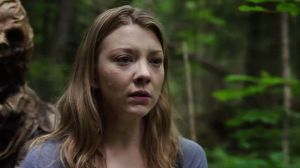 As the movie continued running in one direction and then suddenly running in another, I was reminded of 2014’s Occulus. I wasn’t completely taken with that horror movie but it is far better than The Forest. The premise of Occulus involves a brother and sister trying to prove a cursed mirror is responsible for a history of murder. The mirror would play with the minds of its victims by putting them in false settings and scenarios, thus creating illusions to trick them into deadly behavior. The difficult part of Occulus was that you couldn’t trust what you were watching, which either forced the audience to pay more attention or to just give up and wait for the eventual reveals. The Forest is similar in that a good portion of its running time is a series of hallucinogenic tangents. Are there really maggots crawling under Sara’s skin? Is that water in the creek running the wrong way? It becomes frustrating when the characters don’t respond with nearly enough skepticism, especially when they’re fooled again and again. Occulus, while purposely hard to follow, was worth watching and ultimately felt well developed. The Forest feels lost in the woods.
Unless you’re a sucker for the kind of genre, there’s nothing that The Forest does well enough to warrant a theatrical viewing. It’s so frustrating because there are elements and potential there and the movie just continues to not care, falling back on the same-old same-old cheap jump scares and indistinguishable hackneyed genre tropes, losing sight of the inherent awe and fright of its special location. Dormer (HBO’s Game of Thrones) gives a suitably spooked performance but does little to stand out among the scenery. If you’re contemplating watching The Forest, just watch Occulus instead and be grateful.
Nate’s Grade: C-
Share this:

Krampus (2015)
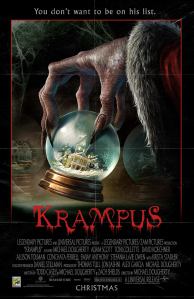 Not quite funny enough and not quite scary enough, Krampus is a holiday antidote that wants to be a modern-day Gremlins but needed to be nastier, darker, or some variant with the suffix of –er. Writer/director Michael Dougherty has been down this holiday road before with Trick ‘r Treat, a superb horror anthology genre gem that was buoyed by a twisted sense of humor and a clever criss-crossing set of storylines that pollinated plenty of payoffs. Krampus begins with a brilliant opening credit sequence that sets a high bar o promise the movie will ultimately be unable to deliver, watching slow-mo stampeding shoppers fighting over Black Friday discounts set to a classic Bing Crosby yuletide tune. From there it’s more a Griswald dysfunctional family gathering until one of the young boys rips up his letter to Santa in disillusionment, calling forth Krampus and his minions. From there the family is terrorized and come closer together in struggle, trying to understand their predicament. There are a few great character designs for the minions, especially a jack-in-the-box whose face unhinges into a sarlac pit of teeth. The PG-13 rating keeps the film from getting too gory or too wicked, which also belies the fact that at heart it’s really an old-fashioned Christmas morality play about loving one another. I was ready to groan with what appeared to be the ending but Dougherty at least subverts the expected and makes sure that there are lasting consequences for bad behavior. This isn’t going to be remembered as a holiday classic but if you’re looking for a fun horror comedy, Krampus at least has something to offer before you feel left wanting.
Nate’s Grade: B-
Share this:

Macbeth (2015)
 It’s a mighty task to boil the Bard’s classics down to a tight yet meaningful running time and maintain a degree of cinematic quality. You don’t just want to film a stage play with the mighty parameters of film, and yet giving in to the visual majesty means less time for Shakespeare’s stirring words and complex characterization. Woe unto thee who attempt an adaptation. It requires more skill than thou would believe. I had hopes for the latest version of Macbeth from its top-shelf cast, Michael Fassbender as the titular ambitious murderer-turned king and Marion Cotillard as his wife and co-conspirator. It didn’t take long for my hopes to be dashed. First, the good: the rolling hills of Scotland are lushly photographed, and the concluding battle is set amid a roaring hellish fire and flying embers that makes for a stunning backdrop. The actors are fairly fine. If you couldn’t tell from this faint praise, there’s not much to credit as an achievement with this Macbeth. It’s strangely narcotized and often listless. It doesn’t help that the actors speak 80% of their dialogue in whispers or mumbles, even when they discover the former king has been murdered. Director Justin Kurzel (the upcoming Assassin’s Creed movie, also with Fassbender) falls back on monotony, whether it’s an overabundance of mist, similar and low-rent locations, and a plodding score that feels like scorpions are in your mind. Some of the changes are also for the worse, especially making Lady Macbeth more “sympathetic” and neutering one of Shakespeare’s great characters. She no longer sleepwalks and instead confesses her unshakable guilt to a cross. Also Macbeth is haunted by the ghost of his dead son with the witches. And there’s some brief inclusion of awkward sex amidst monologues. The final showdown comes at the 90-minute mark and the entire proceedings feel rushed and yet miraculously boring. Even the bloody violence is pretty tame considering its R-rating. If you’re looking for a truly cinematic Macbeth that enlivens Shakespeare, check out the Masterpiece Theater version with Patrick Stewart adapted into a 1930s Stalinist era. Now that was brilliant. Kurzel’s version of the “Scottish play” is one that only signifies disappointment.
Nate’s Grade: C
Share this:

It Follows (2015)
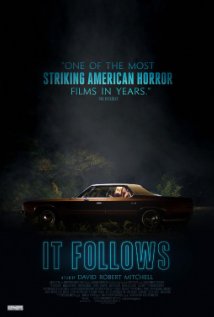 Indie horror is always looking for the Next Big Thing, and at the start of 2015, that movie was It Follows. Coming out of relatively nowhere, the second film by writer/director David Robert Mitchell was dubbed the real deal, and audiences flocked to see what all fuss was over. I would have been intrigued before the positive word-of-mouth namely because Mitchell made one of my favorite films of 2011, the understated and perfectly yearning ode to adolescence, The Myth of the American Sleepover. I dearly hoped that Mitchell was not another flash in the pan. In retrospect, I did not have need to fear. It Follows is unsettling, suspenseful, and borderline ingenious with its concept, but it also has some faults that mitigate its concluding power.
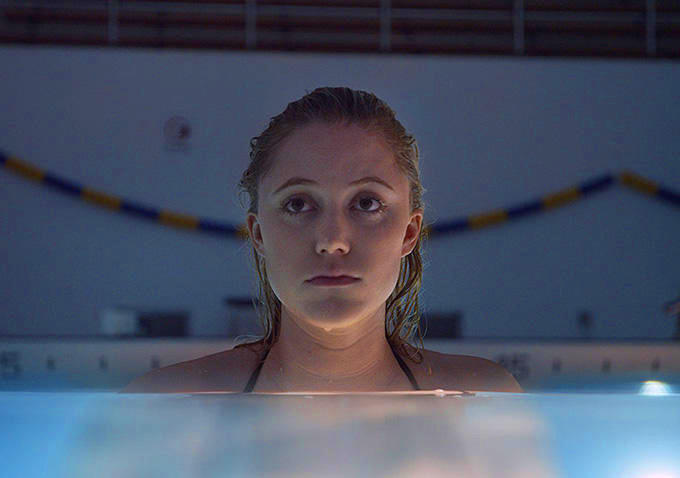
Jay (Maika Monroe) is a normal 19-year-old girl going to college in Michigan until the night she sleeps with her object of desire, Hugh (Jake Weary). In her post-coital mediation, he drugs her, ties her to a wheelchair, and then waits. He wants to show her something, or more accurately someone (perhaps something is actually more appropriate). A woman slowly trudges toward them, the embodiment of a curse he passed on to Jay through sex. It will keep following her until it gets her and kills her. The only way she can protect herself is to sleep with someone else, to pass the curse onto a new recipient. Then the monster goes after them; however, once this newest curse-holder is murdered, the monster moves back up the ladder, attacking the next curse-holder. Once you have it, there’s no getting rid of this curse, only delaying it.
 The top question with a horror movie is whether it provides enough suspense, spooks, and scares to jolt an audience, and in this regard It Follows is quite good; not as unsettling as last year’s Babadook but still plenty unnerving and extremely well executed and developed. The opening hooks you, with a teen girl constantly looking in the direction of the camera and clearly scared out of her mind. The camera has adopted the identity of the monster. The central premise is wonderful, rich with thematic potential about the alienation and anxiety of being a teenager navigating the world, but also intriguing enough that I always wanted a large expository info dump scene just to learn more about the rules or its history. Rare is the film, let alone a horror film, where I’m left desiring lengthy exposition. One of the clever developments of its monster is that it can adopt the appearance of anyone, including people close to you (though it rarely does this for an unexplained reason). That means anyone can be your doom and the only way to know is to double-check whether other people can see this menacing phantom as well. Imagine going the rest of your life always having to look over your shoulder, always having a little nagging doubt in your mind about whether or not this person or that person is real. The premise is well developed with sequences that draw out the tension and make us dread what’s coming next or what may or may not be real. Now, slow-trotting fully naked people might not be a scarier monster than, say, Leatherface, but it’s still alarming.
The premise also allows the audience to imagine what course of action they would do if they were stuck in this situation. Would you doom an innocent human being to protect yourself? If so, would you be upfront about it and the ensuing danger? Would you formulate a plan like Hugh and drive long distances to provide further distance? If you thought you were being followed, would you immediately find a sexual partner? The clever premise gets your brain thinking of what you would do to survive and at what cost.
There’s a distinct Stanley Kubrick and John Carpenter vibe with the filmmaking, which will enhance the overall mood of the film or drive certain viewers crazy. The camera movements fall into very few selections, mostly slow pans, slow zooms, or long tracking shots with the subject routinely framed in the center. It’s hard not to evoke feelings with The Shining, an all-time great horror film that likewise built a sense of foreboding terror, and Halloween. You’re conditioned to feel that something bad is about to happen as the camera turns or hovers, waiting for the creepy thing to pop around the corner. It plays into second-guessing everything you see, taking away the illusions of safety, and the steady and controlled camerawork enhances this mood. The entire movie feels vaguely out of time, notably a capsule from the 1980s save for one strange inclusion of a wireless reading device. The musical score by Disasterpeace (nee Rick Vreeland) is another throwback to the 80s, and its fuzzy synth-drenched soundtrack smoothly blends in and enhances the atmosphere.
 If anyone caught Mitchell’s previous film, you’ll know that besides a wonderful eye for framing visual compositions, the guy has a very natural feel for developing realistic teenage characters milling about their relatable existences. It Follows is no different, and while I would stop short of saying that the characters have depth to them, they are realistically drawn and portrayed by actors who look and act like scared teenagers. The relatablility of unrequited feelings, or going out on a limb and getting your heart broken, of trusting the wrong people who have ulterior motives, are universal pains that makes it all the easier to put ourselves in these unfortunate character’s shoes. It also helps that, up until the final act, the characters defy the arc of rampant stupidity in horror. After realizing the danger she’s trapped in, Jay actually seeks out the one person who she can get answers from, even if he’s the same person who doomed her with the curse.
It’s unfortunate that the movie loses steam when it creeps into its third act and forces a solution and showdown with the monster that makes no sense whatsoever. I understand the need to feel like the teens can regain the upper hand or somehow outsmart the curse that doggedly follows them, but with everything presented, it’s just not believable. For the entire movie, we’ve seen that this supernatural force doesn’t really have a loophole in its system of rules. The only way to stave off annihilation is to pass it along and create a series of firewalls as protection with other sexual partners. Otherwise, it’s relentless and like zombies the eventuality is what helps magnify the sense of dread. We even see it get shot in a hasty defense from the teens and the gunshots do nothing. And yet, this vital information doesn’t seem to register with our band of teenagers. Their third act solution (spoilers): they’re going to lure the following terror into a pool and… electrocute it. Huh? Why would a supernatural entity that has not shown any weakness to electricity, or any mortal dangers, be able to be killed? This plan makes no sense and not one character voices a counter-argument to what is proven to be a very bad plan. Maybe the point is that it’s supposed to be bad, that it’s an example of how desperate these characters have become that they would hold out hope for something that is completely inaccurate. After this failed plan, Jay does exactly what you’d expect with the boy who’s been itching to jump her bones for the entire movie. He gets what he wants (physical copulation, being the white knight), she gets what she wants (flimsy security), and then the movie just kind of peters out and ends. I understand that Mitchell’s extended point is that there is no happy ending possible and the characters will have to uneasily look over their shoulders for the rest of their lives. However, the point could have been made even without the third act. I wish It Follows could have found a better landing than just shrugging and saying, “Well, what are you gonna do with curses, you know?”
 Before the movie hits the skids in the third act, I was pondering the greater implications and logistics of its sexually transmitted curse. Does “passing” it along require some form of genital contact? Does it require fluid exchange? If you wear a condom, does the prophylactic also protect your sexual partner from the transmission? Does the curse function relatively the same for same sex couples? What about people with non-functioning parts below the waste? Can someone who suffers from erectile dysfunction pass the curse along? Can it be transferred onto inanimate objects? Can men ejaculate into some sort of container and then send the container into space via the space shuttle and be protected? Actually, banging an astronaut who’s about to live on the space station or go to Mars might be the smartest move. I enjoyed thinking of a stratagem to best protect myself if I was caught in this scenario; even after passing it along and providing a buffer, you still always have to be on guard for the curse to move back up the ladder. My solution: have relations with a prostitute. This is probably a guarantee that the curse will be passed on within a 24-hour period, and even if that john is found and killed, chances are this prostitute may have already passed the curse along to a new client. If one cannot inoculate themselves from a supernatural STD-like curse with the aid of prostitutes, then there’s no hope for the rest of us poor mortals. Anyway, my mind wandered a tad.
It Follows may suffer due to the hype, the inconclusive resolution, and a third act that deflates, but it’s still an extremely well executed horror thriller with a terrific concept at heart. The sense of dread is stark and the camerawork and storytelling draw out the tension until you feel you’re about to break. It’s more unnerving than traditionally scary, but it has a power that does stay with you, particularly its fascinating premise and the natural relatability of the characters and their choices. I don’t know if this premise could sustain a sequel, especially with a villain that appears to be unstoppable, but that hasn’t thwarted the horror genre before in its stampede at cashing in on success. It Follows is a solidly entertaining and creepy movie, but it’s even more confirmation for me that David Robert Mitchell is going to be a filmmaker who has staying power. I’ll be following him.
Nate’s Grade: B+
Share this:

Annabelle (2014)
 The Conjuring was one of the breakout hits of 2013, so it’s no surprise that Hollywood fast-tracked a spin-off to take advantage of Conjurin’ fever. Enter John R. Leonetti, the accomplished cinematographer on The Conjuring and director of bad sequels like Butterfly Effect 2 and Mortal Kombat: Annihilation. Now in the spotlight, little Annabelle is proving to be a star of her own as far as box-office grosses are concerned. It’s too bad her new movie is about as lifeless as she is.
In the late 1960s, Mia (Annabelle Wallis) is pregnant with her first child when murderous cultists terrorize her home. They are dispatched but not before one young woman slices her own throat holding one of Mia’s expensive porcelain dolls, the Annabelle one. Her husband (Ward Horton, who looks like a living Ken doll) is afraid to leave her alone and reaches out to the church to help his wife. Strange things are going on in their home, mostly concerning the infamous Annabelle doll.
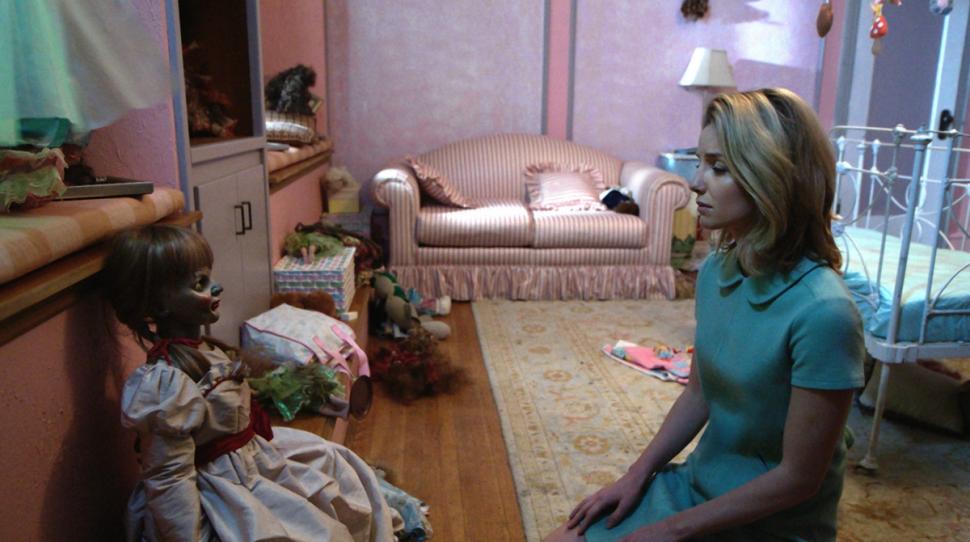
 The impact of Annabelle will depend directly upon your good will concerning The Conjuring and what your law of diminishing returns is with a creepy doll. To be abundantly clear, the Annabelle doll is one creepy looking thing. But how much can an audience take of a creepy looking doll that doesn’t have any articulation or expression? The character, and it feels like a stretch to label the doll as such, worked effectively as a prologue to The Conjuring due to the relative brief appearance. The doll was creepy enough for ten minutes and then the audience moved on. Now in a starring vehicle all to herself, Annabelle risks overexposure and the realization of just how limited this little demonic figure might be. A killer doll that comes to life is a genuinely unsettling proposition, one richly explored in a classic Twilight Zone episode that’s still spooky to this day. However, Annabelle doesn’t really do anything, and I suppose that’s the point. The doll is a conduit for the larger, invisible demonic force at play. We already know that it’s not the doll or a ghost but a demon posing as such. Ultimately, the doll isn’t anything more than a device to go back to again and again, a horror staple in place of true unnerving tension and dread. Hey, it’s hard to carefully manufacture and ratchet suspense, so why not just keep going back to a creepy looking doll instead?
With a lackluster antagonist, it’s no surprise then that Annabelle has to rely on all the hoary tropes of horror just to fill out its running time. The plot by writer Gary Dauberman plays out like the filmmakers watched Rosemary’s Baby, a documentary special on Sharon Tate, and said, “That’s it, we got out movie.” The Manson family-like cult is a plot element cast aside too quickly. They bring the demon to the doll, but the followers of this demonic presence never terrorize the couple again. It seems like one of many missed opportunities. Instead we get a slow series of events of the doll/demon messing around with Mia. There’s the kindly older priest that’s called into service, who does nothing. There’s a helpful neighbor mourning the loss of her own child who ends up an insulting plot device (more on this later with spoilers). And oh are there characters behaving stupidly, chief among them our heroine. She’s rather slow to realize the danger she is in and often leaves her baby alone to investigate said supernatural shenanigans. You know, the baby that is the object of desire for this demonic force. Rather than be proactive and have any sense of agency, Mia is that older type of horror heroine who runs around screaming and cowering in corners. It gets tired. There’s one scene where she’s trying to escape via an elevator that keeps opening on the same haunted floor. She literally hits the elevator button four times each time expecting something different, and the camera angle remains the same, leading to titters from my audience.
 While The Conjuring certainly wasn’t a brave new direction in the realm of cinematic horror, it was skillfully executed and masterfully setup its scares. Annabelle does have a few decent boo moments, many of which were showcased in the trailer, but it cannot overcome the burden of all its clichés and wooden characters. Audiences are used to characters making poor decisions in horror films, but you still should have some level of believability or internal logic to their decision-making that doesn’t make your brain hurt. Sadly, Annabelle cannot rise above the limitations of its titular “monster” and so it has to rely upon an assemblage of familiar horror tropes to make due.
This paragraph is going into spoilers concerning the ending so I’d advise any reader wishing to remain pure to skip to the next paragraph. The great actress Alfre Woodard plays that grieving neighbor lady, the one who is joyously buying Mia baby clothes for her little one. During a climactic confrontation, Mia demands to know what the demon entity wants. It communicates via crayon scrawls on the ceiling: “Her soul.” One of the film’s creepier moments. Then the baby disappears and she wants to know what it will take to save her child. Mia looks to a window and written on it is, “Your soul,” just as it gently pushes itself open. Again, a creepy moment. I was starting to get the impression the film was picking up momentum. She’s about to sacrifice herself when she’s pulled back inside. This is where the film goes from bad to insultingly bad. I kept repeating under my breath, “Don’t do it, don’t do it,” and wouldn’t you know, they did it. Woodard realizes her purpose: she must sacrifice herself so this nice white couple will be safe. She dives out the window and evil is vanquished… sort of. It’s a stupid character arc made all the more unpleasant by the racial casting choices. I’d rather Woodard just save herself.
This small prequel has proven to be a smash at the box-office, so where does Annabelle go from here? Another prequel seems unlikely considering the events of this movie cover the birth of the demonic doll and lead directly to the prologue of The Conjuring, where this spunky little doll met her match with the married paranormal investigators played by Vera Farmiga and Patrick Wilson. The real Annabelle is encased in a glass prison. The only direction seems to be forward, with Annabelle breaking free of her prison and having a night on the town. Maybe she can locate Chucky and that Twilight Zone doll. I just hope future adventures with Annabelle, and its box-office grosses almost assure there will be, veer away from the overload of uninspired genre clichés. There’s not enough effort on display to warrant this solo side project for a creepy doll that mostly just remains creepy. Annabelle the film could have used less of Annabelle the doll. Then again an unblinking and silent doll was still the most interesting character on screen.
Nate’s Grade: C-


You must be logged in to post a comment.