Blog Archives
The Fantastic Four: First Steps (2025)

Apparently there must have been an ancient curse that brings forth a new attempt at a Fantastic Four franchise every ten years, even further if you want to include the 1994 Roger Corman movie that was purposely made and never released just to hold onto the film rights (I’ve seen it, and once you forgive the chintzy special effects and shoestring budget, it’s actually a pretty reverent adaptation). The 2000s Fantastic Four films were too unserious, then the 2015 Fantastic Four gritty reboot (forever saddled with the painful title Fant4stic) was too serious and scattershot. Couldn’t there be a healthy middle? There has been an excellent Fantastic Four film already except it was called The Incredibles. That 2004 Pixar movie followed a family of superheroes that mostly aligned with the powers of the foursome that originally made their debut for Marvel comics in 1961. It makes sense then for Marvel to borrow liberally from the style and approach of The Incredibles because, after all, it worked. There’s even a minor villain that is essentially a mole man living below the surface. Set on an alternate Earth, this new F4 relaunch eschews the thirty-something previous films of the Marvel Cinematic Universe (MCU). You don’t need any prior understanding to follow the action, which is kept to under 105 minutes. The 1960s retro futurist visual aesthetic is a constant delight and adds enjoyment in every moment and every scene. The story is a modern parable: a planet-eating Goliath known as Galactus will consume all of Earth unless Reed Richards (Pedro Pascal) and Sue Storm (Vanessa Kirby), a.k.a. Mr. and Ms. Fantastic, give over their unborn son. The added context is that they have struggled with fertility issues, and now that at last they have a healthy baby on the cusp of being theirs, a cosmic giant wants to call dibs. It makes the struggle and stakes much more personal. It makes the foursome genuinely feel like a family trying to resolve this unthinkable ultimatum. I cared, and I even got teary-eyed at parts relating to the baby and his well-being, reflecting on my own parenting journey.

From a dramatic standpoint, this movie has it. From an action standpoint, it leaves a little to be desired. It incorporates the different powers well enough, but there are really only two large action set pieces with some wonky sci-fi mumbo jumbo. There’s a whimsical throwback that makes the movie feel like an extension of a Saturday morning cartoon show except for the whole give-me-your-baby-or-everybody-dies moral quandary. While I also appreciated its running time being lean, you can feel the absence of connective tissue. Take for instance The Thing (The Bear‘s Ebon Moss-Bachrach) having a possible romance with a teacher played by Natasha Lyonne (Poker Face). The first scene he introduces himself… and then he appears much later at her synagogue seeking her out specifically during mankind’s possible final hours. We’re missing out on the material that would make this personal connection make sense. The same with the world turning on the F4 once they learn they’ve put everyone in danger. It’s resolved pretty quickly by Sue giving one heartfelt speech. The movie already feels like it has plenty of downtime but I wanted a little more room to breathe. I was mostly underwhelmed by Pascal, who seems to be dialing down his natural charm, though his character has some inherently dark obsessions that intrigued me. He recognizes there is something wrong with him and the way his mind operates, and yet he hopes that his child will be a better version of himself, a relatable parental wish. There are glimmers of him being a more in-depth character but it’s only glimmers. The family downtime scenes were my favorite, and the camaraderie between all four actors is, well, fantastic (plus an adorable robot). Kirby (Napoleon) is the standout and the heart of the movie as a figure trying to square the impossible and desperate to hold onto the baby she’s dreamed of for so long.
The Fantastic Four: First Steps is an early step in a better direction. It’s certainly better than the prior attempts to launch Marvel’s first family of heroes, though this might not be saying much. It does more right than wrong, so perhaps the fourth time might actually be the charm.
Nate’s Grade: B-
Share this:

Superman (2025)
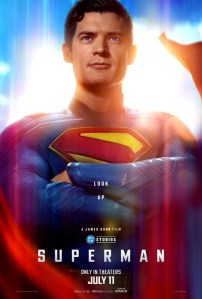 Has the world ever needed Superman more? I don’t know about you, but I could really use a symbol of good right now who represents the best of us, fighting for justice and protecting the innocent against the diabolical in power that seek to profit and prey upon the vulnerable. Vulture film critic Allison Wilmore has a fantastic headline for her review: “Superman [the movie] isn’t trying to be political. We just have real-life super villains now.” James Gunn, the quirky filmmaker who made us fall in love with a raccoon and a tree in the Guardians of the Galaxy trilogy, ascended to be head of DC movies in 2022, and he eyed reigniting Superman as the top priority, selecting himself as writer and director. It’s a lot of pressure to rebuild the DC movie brand by yourself, as there are only two other movies with scheduled release dates currently. This movie could make or break the fledgling DC Universe (DCU) rebuild soon after the smoking demise of the DC Extended Universe (2013-2023), informally dubbed the Snyderverse. Fortunately, Gunn’s take on the boy in blue is a reminder why this character has lasted so long and why the world still needs a symbol of hope.
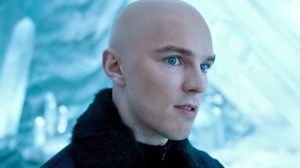
Superman (David Corenswet) a.k.a. Clark Kent, has been a defender of Metropolis for three years now. He’s romantically involved with ace reporter Lois Lane (Rachel Bosnahan), who knows his secret identity but still chides Clark on somehow getting all those “exclusive interviews” with Superman. He’s also been a thorn in billionaire industrialist Lex Luthor’s (Nicholas Hoult) side and become an obsession of his. The world is still debating Superman’s unexpected intervention, thwarting a powerful military from invading its neighbor’s sovereign border (very reminiscent of Russian aggression). The U.S. government needs actionable proof that Superman is a threat, and Lex is determined to eliminate the alien for good.
 Amazingly, this movie feels like the second in a series rather than a reboot kickoff. From the opening text, Gunn drops us into this world already in progress. We’re skipping over the origin story, the character introductions, and all the table-setting that comprises many first films in franchises. It’s usually that second film that really takes advantage of the setup and patience of the first movie, expanding the world and deepening the character relationships and conflicts. Gunn has mercifully skipped over all that and gotten us right to the good stuff. The opening minutes of the movie drop us into a super-powered battle with the declaration that this is the first time our Superman has lost, and that beginning follows the most powerful alien on Earth having to patch up his injuries. I think that’s a very intriguing first impression, but I’ll detail more of that in a later paragraph. The world that Gunn establishes already feels well underway but the story is still accessible and the supporting characters have meaning within this world. This is a world that has been used to super heroes, a.k.a. metahumans, for some time, so when Superman finally dons his red underwear it’s not a complete shocker. This is not necessarily a reality where one super-charged character has reconfigured mankind’s entire sense of identity. The world is accustomed and adapted to extraordinary figures and monsters. This is where the Justice Gang comes in (Green Lantern, Hawkgirl, and Mr. Terrific). They’re the corporate supes, the ones called in to sign autographs, smile for pictures, and save the day for good P.R. Perhaps that’s too flippant, but the trio of established heroes doesn’t feel the same call to activism like Superman. It’s hard to fully articulate, so bear with me dear reader, but Gunn’s Superman already feels fully established, with the figure known, his relationship with Lois already in play, and Lex having already put nefarious time, research, and lots of money into combating this super obstacle with his own lethal experiments. With Gunn, there’s no time to waste. It’s already fully formed from his imagination, and the parts have their reasoning and meaning, making the whole much more satisfying.
Another way to differentiate this Superman is less from his strength than his vulnerabilities. This is a character long regarded as overly powerful, too indestructible and therefore lacking realtability. Well with Gunn’s version, here is a Superman that gets beat up. A lot. Ben Affleck’s Batman pointedly asked Henry Cavill’s Supes, “Do you bleed?” Gunn has answered in the affirmative. Much like Matt Reeves’ 2022 Batman, we get a work-in-progress superhero that is still feeling out how to best be a superhero. It’s a version that takes lots of lumps and Gunn finds interesting ways to test Superman’s limits, both emotionally and physically. The introduction of nanites into orifices certainly provides nods to Gunn’s body horror roots. While this is a Superman that gets knocked around quite a bit, his biggest vulnerability is his doubt. He’s simply trying to do good and save lives regardless of the political ramifications, but the world and its people, and especially their fears and paranoia of an Other, are more complicated. Superman explains he intervened in an international border war for the simple reason of saving lives. When Lois pushes him in a practice on-the-record interview, during one of the better scenes, about his decision-making, thinking through the consequences, consulting with world leaders and the like, he gets flustered and says there wasn’t time. All he wanted to do was save lives that would have been lost, so why is the rest of the world having a hard time with that? Over the course of those two hours and change, we watch this Superman battle through his self-doubts in a very real and compelling way that I don’t feel like any other Superman movie has better demonstrated. This is a world already rife with heroes, but is it better with a Superman? Is his existence a net positive?
 Gunn truly understands the character in a way that Zack Snyder never did. With Man of Steel and the subsequent film appearances, we were given a Superman that didn’t really want to be Superman. He was an overburdened superior being tasked with serving as mankind’s savior, and came across as annoyed. That version of Pa Kent famously told his super son that it might have been best if Clark had just let a bus full of kids die to keep his secret. Thanks for the life lesson, dad, and oh, by the way, your sacrifice was ultimately meaningless when your entire worldview was proven wrong by the end of Man of Steel. Regardless, here is a Superman that is unabashedly sincere and even a little corny. That’s who this character is, a do-gooder wanting to inspire others and wanting to save all life, even the villains, even the wildlife (my theater took special note when Superman saved a squirrel from being crushed). Snyder’s Superman was part of an entire Metropolis 9/11 of horrible collateral damage disaster porn. Gunn’s Superman works hard to make sure the giant kaiju monster, when teetering over, doesn’t fall on any building to protect the people inside. This is also a Superman that feels compelled to be a hero, to do better with his super gifts, and to keep trying even when he fails, that there can be dignity in losing a fight but continuing on because you know that fight is worth it. The depiction of Superman/Clark makes him feel much more a character worth closer examination. He’s not a detached god feeling above these petty mortals always needing saving. The real super power is his empathy and desire to help others, and that may sound corny, but Superman is too, and that’s completely fine in a world that would be better if we had more Supermans and fewer wannabe super villains.
The big question for me was whether Gunn could adapt his cheeky, irony-rich goofball sensibilities from the Guardians movies and make a Superman movie that was earnest and restrained. He has, and let this be a lesson that Gunn does not disappoint when it comes to superhero projects. There are still unmistakable elements of Gunn’s humor and style, like the ironic distance from action serving as an extended joke while characters discuss an unrelated topic, the bouncy and specific needle-drops that cue extended fight or action sequences, and of course the quippy sense of humor. I don’t agree with some of the early reviews I’ve come across that accuse Gunn of undercutting his drama with too many jokes. That is exactly why I was afraid that Gunn would be too insecure with straight drama and earnestness that he would have to rely upon an awkwardly squeezed-in ironic joke to, in his mind, balance the tone. There are jokes, some of them wild and unexpected, but this is most certainly not a movie in the same tonal space as anything Gunn has done before either as a director or a screenwriter. I did not feel that the comedy ever undercut the stakes or the sincerity of the scenes and the movie as a whole. Gunn has shown he can re-calibrate his style and comedic voice while at the same time still making things his own without copious slow-motion. The action is refreshingly staged to be immersive, with few cuts and wide camera swings in order to present everything on the screen in an easily oriented field of vision.
 Corenswet (Pearl, Twisters) has some big tights to fill, as I would argue while there have been iffy-to-bad Superman movies there hasn’t been a bad Superman. Obviously the one that all others are defined by is Christopher Reeve who was the greatest special effect the original movie had (I know the flying sequences were groundbreaking for their time, but they play out so cheesy and dated, complete with sudden Margot Kidder poetic resuscitation). Watching him switch from suave hero to clumsy Earthling in a split-second was the best. Corenswet certainly looks the part, clean-cut All-American looks, even though he’s British. He really channels the character’s big heart with his struggle to be accepted, by the public, by the media, by Lois, by even his enemies. He’s got the presence to fill out that suit but the emphasis is not on the contours of his abs but on the unfailing dedication and goodness of a character trying to do right. He won me over early, and it doesn’t hurt hat he has terrific chemistry with Brosnahan, who has been readying herself for this part for years with The Fabulous Mrs. Maisel. She’s great too. Hoult (Nosferatu) channels his smarm perfectly as a very punchable Lex who might make you think about a certain DOGE-master and his team of flunkies wreaking havoc on the rest of the country through unchecked hubris. I loved his pettiness and thinly-veiled vanity, like during an approaching apocalyptic cataclysm and he says to screw the people of Metropolis. “They chose him, let them suffer.” It sounds a lot like, “Your state voted against me, so you won’t get immediate emergency assistance.” You will cheer hard for Lex’s defeat, even more so when his plan involves literal extra-judicial forever confinement.
However, the real brreak-out star of the movie will most certainly be Krypto, the adorably jumpy super dog. Every time this pooch makes an appearance it is welcomed and he’s utilized as more than just easy comic relief. I expect a sharp uptick in the number of good boys named “Krypto” afterwards.
 James Gunn has alleviated all of my fears about him tackling the Man of Steel, and he’s created a Superman that soars above the superhero field. It’s so vibrant and funny and accessible to anyone regardless of their prior feelings or understanding of Superman. It’s also a clear-cut example of what a Superman movie can and should be, sincere and bright and, yes, a little bit corny too. We need this character, and we especially need film artists that know how to craft engaging stories with this character who’s existed for almost 90 years. There’s an inherent lasting power to Superman, and it’s his sheer goodness as an outsider, a feared alien, who has all the powers in the world but just wants to help others. Many have long viewed Superman as boring, a Boy Scout in a world that has grown too morally murky to maintain such a morally unwavering figure of truth, justice, and the American way (what does that last part even mean any more in the bleak environment of 2025?). Gunn has shown us how necessary the character can be, a balm to our troubled times, and the reality that do-gooder figures can be inspirational and aspirational no matter the circumstances. He’s made a Superman movie with an intriguing, lived-in world, one that I now believe can easily support a fuller universe of stories and side characters. He’s also made what I consider the best Superman movie to exist yet (apologies to the nostalgia of the fans of the Richard Donner/Christopher Reeve originals). I have some minor quibbles, like how Lois fades into the background for the second half, but they are only quibbles. This movie was exactly what I needed. I’m sure there are millions of others yearning for the same. Superman is proof that the DC film universe might actually have the perfect person in charge of charting their cross-franchise courses. Kneel before Gunn.
Nate’s Grade: A-
Share this:

Thunderbolts (2025)
 I will tell you right now, dear reader, that I’m never going to include the asterisk when I type the title of the Marvel Cinematic Universe’s (MCU) newest epic entry, Thunderbolts. The reveal one week into its theatrical release that the team was rebranded “The New Avengers” seemed at best like a peculiar marketing gimmick to try and boost ticket sales after its opening weekend. “Oh, there’s an ‘Avengers’ in this movie title? Well I’ll go see that now,” said likely nobody ever. It just felt like a marketing ploy and the presence of the asterisk in the title, meant to symbolize and facilitate that identity transition, is just a symbol of trying to be too cute by half. Just be the Thunderbolts. Accept yourself as the Thunderbolts. Isn’t that part of the lesson of the movie, finding acceptance despite your misgivings and doubts? Refreshingly, while there are the occasional action sequence and general fisticuffs, Thunderbolts proves to be a much more probing and psychological MCU entry and entertaining beyond just the escapism.
Yelena (Florence Pugh) feels adrift as a secret black ops agent doing the government’s dirty work. Her handler, Valentina Allegra de Fontaine (Julia Louis-Dreyfus), has promised to let her retire after one last job. It just so happens that job is a scheme to have all of Valentina’s black ops killers to take each other out to spare her any embarrassing details coming out while she’s under Congressional investigation. That includes John Walker (Wyatt Russell), a disgraced Captain America place-holder, and Ghost (Hannah John-Kamen), the villain of Ant-Man and the Wasp who could phase through matter, and some mysterious man named Bob (Phillip Pullman) who suffers from amnesia and seems out of place. Along the way they’ll pick up other characters, like Bucky Barnes (Sebastian Stan), who is serving as a freshman Congressman, and Alexei a.k.a the Red Guardian (David Harbour), Yelena’s adopted father who is eager to support his daughter and bridge a divide that has grown between them recently. The constantly bickering group of malcontents, antiheroes, and misanthropes band together to survive as well as figure out Bob’s importance for a person as dangerous and manipulative as Valentina.
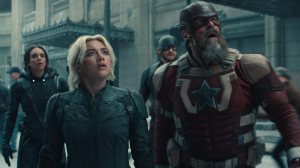 Thunderbolts is about a group of screw-ups who know they’re screw-ups, who know the world sees them as screw-ups, trying to be something more, and it doesn’t take much to see larger themes surrounding depression, loneliness, and community. There’s long been a pleasure in watching oddballs, let alone an unorthodox team of them, find solace and camaraderie they have been missing. It’s satisfying under most circumstances. It also helps when we are given the understanding of why these characters feel so alone and so useless. I’ll freely admit, in the first months of 2025 with the current government doing everything in its power to make people feel scared and alone and useless, I connected with the themes and eventual uplift of Thunderbolts perhaps at a level I might not have had the movie been released in 2023 or, say, under a President Harris. Regardless, I found this movie engaging because it focused less on the literal and metaphorical strengths of its characters and more on their weaknesses and fragility and needs. There is no giant sky beam, nor any faceless easily disposable swarm of CGI robots or aliens, nor any real world-ending apocalypse they have to thwart in that final climax. It really all comes down to combating an epidemic of loneliness, and the only way to do so is to willingly open one’s self to the possibility of pain, of disappointment, of embarrassment, or rejection, and to do so anyway because the alternative is just too grim and self-defeating an option. It forces characters with very real pain and regrets to confront that pain and to still keep trying. The scary enemy is not resolved through a punch but through a genuine hug. You can’t punch out depression. For me, that’s far more engaging and emotionally resonant for the thirty-sixth movie in the MCU than just more punching and explosions amidst a CGI-laden morass.
This is proof that Florence Pugh (Dune: Part Two, Oppenheimer) can power anything with her acting chops and charisma. Her character was a breakout scene-stealer in 2021’s Black Widow, and I’ve been glad every time since she’s popped onscreen. I find Pugh to be such a compelling actor, but she’s driven by movies that tend to put her through an emotional wringer so much I’m worried her face will permanently lock into a sob. She’s great, but it’s also just nice to watch her cut loose and have fun playing a character too. Even though Yelena has a darkness to her, and I would argue qualifies as depressed, this is still a role that allows Pugh to play with lighter elements, giving her a sardonic bounce that makes her even more appealing. This is a character worthy of headlining the team, and Pugh shines once again given an even bigger Marvel spotlight. I also want to sing the praises of Dreyfus (HBO’s Veep) and Harbour (Stranger Things) as near-perfect encapsulations of their respective characters. She’s all blistering cynicism and he’s a blustery teddy bear.
 Another refreshing aspect for Thunderbolts is how it feels like a real movie. Obviously the other 35 MCU entries are movies by definition, but here is a movie that feels more authentic. It looks and sounds better in presentation. You can tell there are real locations. The cinematography is by Andrew Doz Polermo, the same man who photographed The Green Knight. The musical score is by Son Lux, the same composer responsible for the eclectic and sensational music for Everything Everywhere All at Once. The co-writers are from Netflix’s acclaimed miniseries Beef, as is the director, Jake Schreier, whose first film was the 2012 amiable indie dramedy Robot & Frank. There is a genuine effort to do something a little different from the factory setting of modern Marvel movies. It was just nice to actually take in real surroundings, real terrain, natural light, and composed by such a skillful director of photography. The technical elements are blockbuster level but also infused with a little indie sensibilities, bringing a different visual flavor to this studio tentpole. It might sound like a backhanded compliment (“Oh, a movie that is, gasp, made outside a giant green screen warehouse or LED screen”) but I am genuinely grateful. This is a Marvel movie whose Act Three chase takes more notes from Being John Malkovich and its jaunt through repressed memories than any standard superhero action climax. After so many MCU entries, you celebrate the ones that not only try something different but succeed, especially after the impulse to be more of the same is so strong.
That’s not to say that there still isn’t more that could have been done to better shape and develop Thunderbolts. Ultimately it feels like a more solid idea with some good characters and themes than a fully realized screenplay making the best use of its two hours. The movie isn’t quite the ensemble it may appear from the outside. One of the characters is removed so unceremoniously early that I question why this character was even brought back, especially since nobody would qualify this specific character as a favorite. I suppose it’s to present the appearance of elevated stakes, but it just reminds me of the 2016 Suicide Squad that introduced Adam Beach (Windtalkers) as Slipknot, the man “who could climb anything,” who just gets his head blown off so casually before their first mission even begins. However, with Thunderbolts, the movie really has a top tier of characters, primarily Yelena and John Walker and Bob. There’s another lower tier of characters that kind of come and go and provide moments, either levity or convenience, like Ghost and Red Guardian. Then there’s another lower tier of characters with even less time who pop in to scramble things or remind everyone of the exposition or stakes, like Bucky and Valentina. It doesn’t feel as fully integrated as an ensemble as the best Marvel team movies, like James Gunn’s Guardians films, so it can be a little frustrating when we’re celebrating the value of a community but not everyone is pulling their own narrative weight. I’m sure I could fall in love with Ghost as a character, but when she just poofs in and out and her whole arc is, “Hey, she came back,” that’s not going to do it. I also find the whole superhero science experiment a little late in the MCU to be introduced. We have characters talking about being in grade school when the Battle for New York, the centerpiece fight of 2012’s Avengers, took place, like Millennials today speak about where they were on 9/11, so it seems very late for the government to be trying to produce their own superheroes they can control. Weren’t they already making superheroes in the 1940s anyway with the likes of Captain America? This is old hat.
 The MCU has been in a bit of a slump since the conclusion of Endgame, though I would also maintain the “death of the MCU/superhero fatigue” storyline has been over-dramatized and beaten to death. Thunderbolts has some very appealing and refreshing elements, focusing more on its characters and their faults so that their eventual triumphs will feel even more emotionally resonant. It’s nice for the action to support the characters and their drama rather than the other way around, and especially refreshing for the climax to be one about acceptance and vulnerability rather than over-powering some physical menace. I liked the Thunderbolts characters and their combustible energy and banter and would have liked them even more if more of them felt more fully integrated into the movie and given richer arcs. Still, it’s hard to reinvent any franchise thirty-six movies deep, and Thunderbolts, or The New Avengers depending upon what Disney decides to do with its titling from here out ( a real Live, Die, Repeat situation), takes what works with quirky oddball team-ups and makes it work with refreshing artistic sensibility. It won’t be for everyone but it’s got enough going for it that, damn, these crazy kids might just make something of it.
Nate’s Grade: B+
Share this:

Captain America: Brave New World (2025)

After seventeen years of constructing interconnected fables, not every Marvel movie is going to be exceptional, as each one serves as a mighty oar to propel the larger entity that is the Marvel cinematic Universe (MCU) forward. With over thirty movies, there are going to be duds and there are going to be movies that get lost in the machinery of the cinematic universe grinding onward. Consider Captain America: Brave New World one of those sacrificial offerings that nobody will remember in short order.
Sam Wilson (Anthony Mackie) has taken over the mantle of Captain America in the wake of the original, Steve Rogers (Chris Evans), retiring. General Ross (Harrison Ford) has recently been elected president and he wants Sam to reconstitute the Avengers. However, someone is triggering sleeper agents to try and kill Ross, and Sam is entrusted to get to the bottom of this conspiracy.
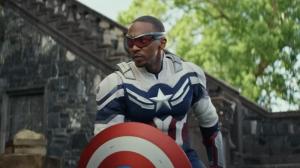
Brave New World is certainly trying to relive the formula that made 2014’s Winter Soldier such a genre standout, upending the status order of good versus evil through the prism of a political thriller. There’s an assassination attempt on the newly elected president, and it also happens to be brainwashed sleeper agents that can be activated at a moment’s notice. What helped make that 2014 movie work was that the sleeper agent happened to be Steve Rogers’ former best friend he thought had died back in WWII. There was a personal connection to the mystery and especially the figure of destruction. With this movie, the personal connection that Sam has to the mystery is almost immediately locked away, made to be an objective needing to be saved by eventually capturing the real bad guy in the shadows. Rather than having to face down a ghost from the past, a personal friend gone rogue, now we have Sam just chasing one shady bad guy to link to the next shady bad guy to a conspiracy that doesn’t even involve him. That was another aspect that made Winter Soldier excel, Steve’s allegiance and sense of patriotism running in direct conflict with the wishes of his government. It was personal and meaningful and challenged his perception. With Brave New World, it could have literally been any character uncovering this very limited conspiracy. That’s not a great start, making your lead character practically superfluous to the larger plot.
Much of this lingering conspiracy also hinges upon the identity of the Red Hulk, which might have been mildly surprising had Red Hulk not been such a vital element of the movie’s marketing. He’s in the TV ads, he’s in the trailers, he is the poster. This movie had more Red Hulk advertising than its titular hero. Unless you’ve walked into the theater blind, and congrats to you, for all intents and purposes this has been sold as the Red Hulk movie, and even if you’re walking in hoping for some wall-to-wall Hulk smash, then you’ll be sorely disappointed. There’s perhaps ten minutes at most of Red Hulk action, and it’s saved for the very end. It’s a climax that feels more perfunctory than satisfying, with the obvious reveal being held as something revelatory and meaningful when it’s just going through its basic blockbuster dance moves.
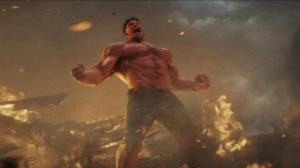
As is typically the case with movies that undergo many delays and re-shoots, Brave New World feels like it has far too many things going on and also simultaneously not enough going on. This is an unexpected sequel to 2008’s Incredible Hulk, generally regarded as one of the weakest MCU movies. The only thing that survived that movie was William Hurt (R.I.P.) as General Ross. I don’t think too many Marvel fans have been dying to have those characters and storylines picked back up after 17 years, but at long last you can see Tim Blake Nelson’s character again. Do you know what his character’s name is? Unless you’re the keeper of the 2008 Incredible Hulk fan wiki, I strongly doubt it. Quick, what’s his name without looking it up? It’s Samuel Sterns. Did you even remember Tim Blake Nelson being in the 2008 movie? The movie also has a global resource land grab to finally explain the frozen celestial body rising from the ocean ever since the events of 2021’s Eternals, a movie I fear we’ll wait an additional 17 years to get its own conclusion. This colossal being is the source of a new all-purpose element – adamantium, and that name should be instantly familiar for fans of the X-Men, as this movie pushes their inclusion that much closer. If The Marvels gave us Kelsey Grammar and Patrick Stewart’s return as Beast and Professor Xavier, this one boldly gives us… an elemental alloy (at this rate, two movies from now will introduce the X-Men’s jet as another sign to those in the know about what’s to come). It’s taking the leftovers from another movie to set up the larger scope of a branch of new movies down the road, while also tying back elements and characters from the earliest days of the MCU. It’s all a lot of table-setting unless there’s a compelling storyline with engaging characters and relatable conflicts and drama, and Brave New World does not. As a result, it’s all like watching a fast-moving assemblage of familiar parts trying to package itself together as a cohesive movie, and it just cannot. It’s one of those sacrificial movies at the altar of larger stories.
Which is a shame because there was a really fascinating and thought-provoking story at the core of Brave New World that barely gets any recognition amidst the explosions and gunfire, namely what does it mean for there to be a black Captain America? How does society respond when their patriotic symbol of American might now has more melanin? Considering how the Internet has throngs that lose their mind whenever a traditionally white male character gets changed into something different, I have to imagine there would be waves of people grumbling that this new “thuggish” Cap isn’t “their Captain America.” This is epitomized in the character of Isaiah Bradley (Carl Lumbly), a veteran who was also selected for the Army’s experimental super soldier project that gave birth to Captain America. Except because he was black during a time of segregation as the norm, he never got the adoration of Steve Rogers, and his accomplishments were ignored. In our current political climate, where diversity has become a convenient boogeyman, it would have been interesting to explore how the culture responds to a black man picking up the shield and being the next Captain America. It also would have invited a worthy conversation about where this country has let down its black populace, symbolized with Bradley’s past. Some of these themes were explored in the 2021 Disney Plus TV series Falcon and the Winter Soldier, but that doesn’t mean they couldn’t be meaningfully revisited given the elevated platform of the Captain America moniker. This was also the TV show that argued refugees could be terrorists, so there was room to grow. Unfortunately, this is only ever given passing mention, as institutional racism gets in the walk of Hulk smashing.

There was possibility with Brave New World but it too often seems to run aground with too many conflicting directions, underdeveloped ideas, and unfocused themes. The political complications, as well as evaluating the sins of the country’s past, could have made for a poignant and relevant movie with bigger things on its mind rather than getting to the next CGI slug-fest. It’s a Captain America with a new Captain America, so let’s explore what that means. It’s the franchise’s opportunity to begin anew with a different hero at its helm, and yet it feels more like an over-extended, disappointing finale to the Falcon/Winter Soldier TV series. It feels like an unneeded epilogue to an epilogue, and tying in so many disparate elements from films that people have forgotten or care less for seems like a strange creative choice when Marvel is looking to find its way in the wake of its post-Endgame walkabout. The worst crime with Brave New World is merely how boring all of it turns out to be. Far from brave, far from new.
Nate’s Grade: C
Share this:

Joker: Folie à Deux (2024)
 Movie musicals can be sweeping, invigorating, and at their very best transporting, They mingle the high-flying fantasies and visual potential of cinema, and we’ve gone through many waves of kinds of musicals. Today, we’re in an outlandish world of the outlandish musical, an experience in ironic air quotes, where stories that you never would have thought could be musicals would then dare to be different and attempt to be musicals. The much-anticipated Joker sequel, Folie a Deux, dares to be a challenging jukebox musical of old favorites. The French movie Emilia Perez tells the story of a cartel leader that undergoes a sex change and tries to do good with her second life. Both movies are deeply interesting messes as well as experiences I don’t think actually work as musicals.
Joker 2, which I will be referring to it as for the duration of this review mostly because I don’t want to type out Folie a Deux, and not due to some explicit dislike of the French, is a fascinating misfire that comes across as downright disdainful of its audience, its studio, and its very existence. The last time I felt this way from a sequel was 2021’s Matrix Resurrections, another fitfully contemptuous movie that was alienating and self-erasing and also from Warner Brothers. The first Joker movie in 2019 was a surprise hit, grossing over a billion dollars, which meant that the studio wasn’t going to sit idly by and not force a sequel for a movie clearly intended to be one complete movie. While the first movie cost a modest $50 million, the sequel cost close to $200 million, with big pay days for Joaquin Phoenix, Lady Gaga, and co-writer/director Todd Phillips, who I have to remind you, dear reader, was actually nominated for a Best Director Oscar in 2019. Having gotten their paydays, it feels like Phillips and his collaborators have set out to scorch all available earth, going so far as to even insult fans of the earlier movie. Add the bizarre musical factor, and I don’t know how else to describe Joker 2 but as an alienating and miserable protracted exercise in self-immolating artistic hubris. It’s so rare to see this level of artistic clout used to proverbially stick a finger in the eye of every fan and studio exec who might have hoped there could be something of value here.
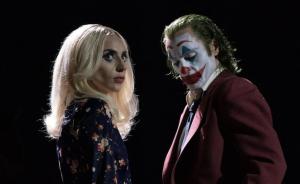 Let’s tackle the plot first, as we pick up months after the events of the 2019 film where lowly Arthur Fleck (Phoenix) is being tried for the murders he committed, most famously on a TV talk show where he debuted his stand-up comedian persona as Joker in full regalia. There’s an (un)healthy contingent of the rabble that idolize Arthur, finding the Joker to be some kind of mythic hero of class-conscious revolution, pointing out how society is failing all the little guys getting crushed by the rich and powerful and privileged, like that dead Wayne family. One of those fans is Lee (Gaga), a.k.a. Harleen Quinzel, a disturbed young woman obsessed with getting closer to Arthur, and he is extremely appreciative of the fawning attention. The defense case hinges upon whether or not Arthur was acting on his own accord or had a psychotic break, disassociating as “Joker,” and thus cannot be held accountable for the murders. Except it seems “Joker” is all the people of Gotham want to talk about, whether it’s the media or the public, and what about poor lonely Arthur?
If I had to fathom a larger thematic point, it feels like Phillips is trying to put our media ecosphere and comics fandom into judgement. He’s pointing to his movie and saying, “You wouldn’t have cared nearly as much about this project had it just been some other spooky, disturbed man losing his sanity and lashing out. You only care because he would eventually become the notorious Batman villain or lore, and that’s why you’re back.” Well, to answer succinctly, of course. When your movie’s conceptual conceit is all about providing a gritty back-story for a famous supervillain, don’t be surprised when there’s more attention and interest. This would be the same if Phillips had made a searing drama about teenage nihilism and easy access to guns and then called it Dylan Klebold: The Movie (one half of the Columbine killers, if you forgot). Stripping back layers to provide setup for a famous killer will always generate more interest than if it was some fictional nobody. It’s an accessible starting point for a viewer and there’s an innate intrigue in trying to answer the tantalizing puzzle of how terrible people got to be so terrible.
I found the 2019 movie to be a mostly interesting experiment without too much to say with its larger social commentary. It felt like Phillips relied a bit too heavily on that assumed familiarity with the character to fill in the missing gaps of his storytelling. It was a proof of concept for that proved successful beyond measure (a billion dollars, 11 Oscar nominations, including THREE for Phillips). This time, Phillips is taking even less subtlety with his blowtorch as he actively annihilates whatever audiences may have enjoyed or appreciated in the first movie.
 And in order to fully appreciate the scope of this movie’s active distaste for its own existence, I’ll be treading into some major spoilers, so jump forward a paragraph if you wish to remain unspoiled, dear reader. The conclusion of this sequel is a miserable succession of hits that degrades Arthur. At the conclusion of the 2019 original, at least you could say he was becoming a more realized version of what he wanted to be, albeit a disturbed murderer, but one who became the face of a revolution and gained a legion of adoring followers that he desperately craved. At the end of Joker 2, Arthur pathetically admits in his trial there is no alternate Joker persona and that he’s just a sad loser. Then Lee admits that she was only ever interested in “Joker” and wants nothing to do with Arthur the sad loser. And then upon returning to prison, another inmate confronts Arthur, apparently feeling personally betrayed for whatever reason. This irate prisoner stabs Arthur to death and then laughs in a corner, slicing a smile into the sides of his mouth, Heath Ledger-style. The movie literally ends with Arthur laying in a pool of his own blood, staring dead-eyed into the camera, with Phillips metaphorically painting emphatically at his corpse and defiantly saying, “Look, he’s not even the Joker now! Do you still care? Do you?” These movies were designed to be the untold history of the man who would be Joker, and they now have ended up being four hours about the guy whose idea maybe inspired a criminal lunatic to improve upon what he felt was another guy’s brand. What’s even the point? We followed two movies about the guy who isn’t the Joker? Seems pretty definitive there won’t be a third Arthur Fleck movie, as there’s nothing left for Phillips and his anarchic collaborators to demolish to smithereens.
When I heard that Joker 2 was going to be a musical, I actually got a little excited, as it felt like Phillips was going to try something very different. Now the curse of many modern movie musicals is trying to come up with an excuse for why the world is exploding in song and dance, like 2002’s Chicago implying it’s all in Roxy’s vivid imagination. Joker 2 takes a similar approach, conveying that when Arthur is breaking out into song that it’s a mental escape for him, that it’s not actually happening in his literal reality. Except… why are there sequences outside Arthur’s point of view where other characters are breaking into song, notably Lee? Is this perhaps a transference of Arthur’s perspective, like he’s imagining them on the outside joining him in tandem? The concept fits with his desperate desire to forge meaningful human connections with people that see him for who he is, and having another character harmonize with him provides a fantasy of validation. Except… there’s no meaningful personal connection between Arthur and the allure of movie musicals. It’s not like he or his domineering mother, the same woman he murdered if you recall, were lifelong fans of musicals and their magical possibilities. It’s not like 2001’s Dancer in the Dark where our lonely protagonist dreamed of being in a movie musical as an escape from her depressing life of exploitation and poverty. It just happens, and you’re listening to Phoenix’s off-putting, gravelly voice straining to recreate classics like “For Once in My Life” and “When You’re Smiling (The Whole World Smiles With You).” It’s also a criminal waste of a perfectly game Gaga.
 Phillips’ staging of his musical numbers are so lifelessly devoid of energy and imagination. Most of our musical numbers are merely in the same setting without any changes besides now one, or occasionally two, characters are singing. There’s one number that becomes a dance atop a roof, and several duets that appear like a hammy Sonny and Cher 1970s variety TV show, and that’s all you’re getting folks in the realm of visual escapism and choreography. In retrospect, it feels like the musical aspect of the sequel might have been a manner to pad it to feature-length, adding 16 performances and over 40 minutes of singing old standards. There’s a good deal of repetition with this sequel, as much of the plot is restating the events of the first film; that’s essentially what the courtroom drama facilitates as it trots out all the previous characters to recap their roles and point an accusatory finger back at Arthur.
There is one lone outstanding scene in Joker 2, and it happens to be when Arthur, in full Joker makeup, is cross-examining his old clown entertainer work buddy, Gary Puddles (Leigh Gill). Arthur admonishes Gary, saying he spared him, and Gary painfully articulates how hellish his life has been as witness to Arthur’s killing, how little he sleeps, how it torments him and makes him so afraid. For a brief moment, this character shares his vulnerability and the lingering trauma that Arthur has inflicted, and it appears like Arthur is wounded by this realization, until he settles back into the persona he’s trying to put forward, the “face” for his defense, and goes back to ridiculing Gary’s name and turning the cross-examination into an awkward standup session. It’s a palpable moment that feels raw and surprising and empathetic in a way the rest of the movie fails to.
Is there anything else to celebrate with Joker 2’s troubled existence? The cinematography by Lawrence Sher can be strikingly beautiful, especially with certain shot compositions and lighting contrasts. It makes it all the more confounding when almost all the musical numbers lack visual panache. The Oscar-winning composer returns and while still atmospheric and murky the score is also far less memorable and fades too often into the background, like too many of the technical elements. Joker 2 has plenty of talented people involved in front of and behind the camera, but to what end? What are all their troubles adding up to? It practically feels like a very expensive practical joke, on the audience, on the studio, and that is genuinely fascinating. However, it doesn’t make the end product any better, and the film’s transparent contempt sours every minute of action. Even if you were a super fan of Joker or morbidly curious, steer clear of Folie a Deux, a folly on all of us.
Nate’s Grade: D
Share this:

Deadpool & Wolverine (2024)
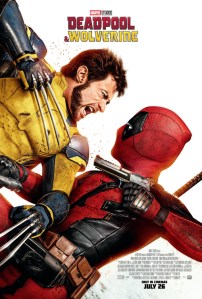 Thanks to some release shuffling, there was only one Marvel movie being released in 2024, the fewest since 2012 (excluding the COVID punting of 2020). There’s been a lot of ink spilled over “superhero fatigue,” especially the recent downturn of certain Marvel movies like Quantumania and The Marvels, though as I’ve written before, I don’t think audiences have become sick of superhero cinema, they have become more demanding from mediocre superhero cinema. Audiences just want something more than the same old same old. Enter Deadpool & Wolverine, resurrecting one of the greatest Marvel heroes and transplanting the first new Fox hero into their new corporate landscape. It’s the least serious Marvel movie yet by design and, judging by its runaway box-office success, that was what the people wanted in a summer blockbuster that made them remember the escapist joys of men in tights with anger issues.
Wade Wilson (Ryan Reynolds), a.k.a. the merc with the mouth Deadpool, is a man out of time. His universe is scheduled for elimination by the Time Variance Authority (TVA) because of the demise of Logan (Hugh Jackman) who served as an anchor being. Apparently, for reasons that don’t seem to make sense if you think of universes lasting longer than one human lifespan, once the anchor being goes, the universe dies out. Wade is thus in search of another Wolverine, but the one he finds is “the worst Wolverine,” a tragic hero drowning his sorrows and refusing to help. The two bickering mutants get cast to a dimensional dumping ground where they run into all sorts of castoffs and forgotten figures, chief among them Cassandra Nova (Emma Corrin), the twin who ate Professor Xavier in the womb rather than the other way around. She holds dominion in this strange realm, and Wade has to appeal to her, or eliminate her, to get out of this ashy purgatory and convince this wounded Wolverine to be a hero.
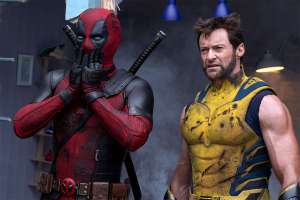 The Deadpool half of the title means that this movie is interested in serving as a meta-satire of superhero cinema, which means its breezy, surface-level charms can feel after a while like a fanboy sugar high. It’s hard to maintain the novelty of a fourth-wall breaking vulgar superhero with the third movie, but now we have Deadpool closing the book on the Fox era of twenty-first century superhero cinema as well as getting to play in a new sandbox of pop-culture references and superhero cliches. Welcome to the Marvel Cinematic Universe (MCU), Wade Wilson, though, as stated on-screen, you’re entering at a bit of a low point. For a while, at least, the movie can get by by having its resident prankster mug his way through the MCU catalog, fawning like the biggest fanboy (he did unsuccessfully audition for the Avengers). The opening sequence literally involves Deadpool digging up the adamantium corpse of Logan and using his unbreakable bones to inflict bloody carnage. It’s quite an attention-getter as well as something of a promise: we’re not going to undo the dramatic conclusion of 2017’s Logan, and even though this is the MCU, this movie isn’t going to go soft as it wades in its signature off-color comedy and bloody chaos.
Your mileage will vary depending upon what the hit-to-miss percentage is with the comedy. I found a lot of the homoerotic/homophobic banter to be dull and repetitive, but this kind of comedy ethos has been present from the first movie, the more-is-more approach. There’s an extended series of cameos that are fun castoffs from Fox comics universes, and the actors are definitely having a blast reliving their characters, or in one very special case, getting to live it once and for all. I wish there was more specific MCU commentary, but I cackled loudly when Reynolds turns to Jackman and taunts, “Disney’s going to make you keep doing this until you’re 90!” I really wish there was an extended critique of the state of post-credit scenes introducing new characters that we all know will never be seen again (remember Harry Stiles or Brett Goldstein?). Deadpool could have gotten stuck in an endless loop of end credit sequences. I enjoyed that a car’s product placement was subject to constant abuse and destruction, while still trying to maintain that sleek car commercial framing. The angry/shouty dynamic between Wolverine and Deadpool makes up for a lot, so even if the jokes are less than stellar, the cranky buddy dynamic still delivers.
 However, much like the 2022 Multiverse of Madness, the actual multiversal trips are quite few and quite disappointing. There’s a silly montage of Wade approaching the different Wolverines of different universes (no Dougray Scott, huh?) but almost all of the movie is spent between a dusty netherworld and a subway station. Again, with the promise of great possibility, these movies seem to say, “Will you settle for maybe TWO gray locations?” I was let down by the main setting reminding me of 2009’s Land of the Lost dumping ground for the nexus of discarded universes. When this whole multiverse phase comes to its inevitable conclusion, it’s going to feel like a promised epic family vacation that went about an hour down the road, visited two gas stations, a McDonalds, and then hastily turned around.
On the other side of the titular ampersand, Jackman is acting in a completely different movie, perhaps giving one of his most dramatically rich performances as the superhero. This is a different Wolverine than the one we saw in 2017’s Logan, so it allows Jackman the freedom to be able to hit some of the essential elements of the character while also getting a new opportunity to follow a different direction. This is a Wolverine haunted by his own sense of cowardice and blaming himself for the death of his X-Men. This is less the grumpy antihero we’ve grown to love over twenty years and more akin to the main character in 2023’s Godzilla Minus One, a war veteran who folded under pressure and attempts to live through their guilt and shame, ultimately finding solace in seeking the noble sacrifice but on the bigger stage now. This is a genuinely traumatized character working through the different dimensions of his trauma, and Jackman doesn’t for a second treat it like a joke. He’s set up to be the cranky straight man to Reynolds’ chatty goofball, and there is comedy to be had with that dynamic, but Jackman is so convincing with his portrayal, again twenty-four years into this character, that he made me tear up at a few points. That’s right, dear reader, Hugh Jackman is so great in his role, that he almost made me cry. Yes, in a third Deadpool wankathon movie. And that is why Jackman is such an incredible actor. The attempt at heart has never felt authentic for me with Deadpool, no matter how many side characters he collects and assures us that they “mean something.” However, by including Wolverine, the filmmakers allow the viewers to import our decades of accrued feelings onto him. It’s a cheat, but it works with an actor of Jackman’s caliber. Plus, who wouldn’t want to see more of this man in the role that he defined for a generation?
 Look, the movie operates more so than any other MCU enterprise on an expectation reflection system, likely supplying what you want out of a project like Deadpool & Wolverine. If you’re looking for a darker, sillier jaunt, there’s probably enough to serve as a diversionary change-of-pace. If you’re looking for a low-stakes reset, you’ll likely find it, though much depends on Where We Go From Here. If you’re looking for the same brash sense of humor and vulgarity from the two previous Deadpool movies, you’ll be satisfied. If you’re looking for something a little more thematically rich and rewarding, well this is the third Deadpool movie and I would ask why that’s a priority, but Jackman practically delivers just that. If you’re looking for a movie that rewards impish fan service, then here’s your winner, rewarding viewers who can even recall the vague minutia of the rise and fall of studio projects of old. I’ll always wish that more of the jokes hit their marks, or that the action could be a little more stylish, or that Reynolds and company had more trenchant satire for their corporate overlords rather than an occasional naughty tweaking that feels pre-approved, like writing a roast of a host. I would say it’s no more than the sum of its parts, but it almost made me cry and ended in such a jubilant fashion that I didn’t really care about the wishy-washy timey-wimey nonsense that the movie barely wants to pay attention to as well. Deadpool & Wolverine is an unexpected elegy for the Fox universe but also a reminder of the appeal of both of its titular stars.
Nate’s Grade: B
Share this:

Madame Web (2024)
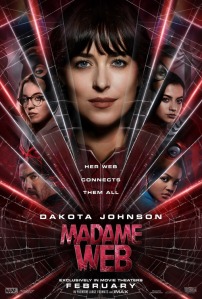 What even is this movie and who is this for? I think the real answer is to help Sony’s bottom line, but that’s generally the real reason for most studio blockbusters, the opportunity for the parent company to make more money. Sony has the rights to Spider-Man and they’re not going to let those things lapse, and while Marvel is shepherding the Tom Holland-lead Spider-Man franchise, Sony is left to their own devices to build out the Spidey universe with lesser-known solo vehicles meant to launch an interconnected web of Spidey’s rogues gallery. It’s about growing more franchises, and it worked with 2018’s Venom, a favorite Spidey villain with a sizable fan base and benefiting from the goofiness of its execution with Tom Hardy and company. It didn’t work out for Morbius in 2022 because nobody cares about Morbius as a character, just like nobody cares about Kraven the Hunter as a character (coming August 2024!), and just like nobody cares about Madame Web, who wasn’t even a Spidey villain and instead an old blind lady that saw the future. The far majority of Spider-Man villains are only interesting as they relate to Spider-Man, so giving them solo vehicles absent Spider-Man is a game in delayed gratification. Madame Web is the latest in this misguided attempt to create an enriched outer circle of brand extension. It’s a promise of a continuity of superhero movies that will never come to pass. It’s a bland return to early 2000s superhero heroics with some substantial structural flaws to its own tangled web.
Cassandra “Cassie” Web (Dakota Johnson) is an EMT in New York City and frustrated by her humdrum life until after an accident she starts seeing the future. You see her mother was researching spiders in the Amazon before she died, and she was researching them with Ezekiel Sims (Tahar Rahim) who killed her because he needed a special spider with special properties. Her dying mother gave birth to Cassie thanks to some… mystical Amazonian spider-people? It’s rather confusing but so are Cassie’s visions. A trio of young students (Sydney Sweeney, Isabela Merced, Celeste O’Connor) is in danger of being killed by a 30-years-older Ezekiel, so she takes it upon herself to save them, as they one day will become Spider-laden superheroes themselves. This Ezekiel, however, has super strength, agility, and the ability to walk on walls, so overcoming a Spider…man’s abilities might be too much for one EMT driver/psychic.
 This movie is more Final Destination or That’s So Raven than a big superhero adventure, and that leads to lots of structural and narrative repetition. Cassie’s power involves her getting glimpses of the future, generally warnings of things to avoid or to intervene. It also makes for a very annoying structure because the movie never gives you clues about what is a vision and what is the real timeline of events. This leads to many repetitions of scenes and fake-outs, and after a while the story feels like it’s mostly jerking you around as well as treading in place. We don’t really know why these flashes happen and what larger meaning they may have. They just happen because the plot needs them to, and so they do. Early on, Cassie gets a vision of a bird flying into her window, and she chooses to open the window, signifying that she can avoid these fates. Why couldn’t Ezekiel Sims think likewise? He’s devoted his whole life to killing these mysterious girls because they’re destined to murder him, but if he’s known for years, why not strike when these girls were younger and more vulnerable, Skynet-style? Or maybe try just not being evil too? I guess that one was too difficult for him as he’s cryptically profited off his Amazon spider steal. More work needed to go into the story to make these characters important and for the fake-out scenes to feel more like horror double-takes. It just gets tiring, and you’ll likely start second-guessing anything of import is merely a vision about to rip away the consequences.
I think a big problem is our protagonist. She’s just so boring and we don’t really understand why she’s so compelled to save these three girls more than anyone else. Her entire back-story with her mother is merely the setup for how she might have super magic powers to kick in at a convenient yet unknown combination of elements and to provide motivation why she might want to kill Ezekiel. It’s all so rudimentary and mechanical, designed just to supply enough connective tissue of plot. As an EMT, finding out how to better save lives could be really useful, although I wish the movie had the gall to make her disdainful of her job beforehand and actively bad at saving lives so that way it would feel like the universe was interjecting and saying, “Here, be better.” You would think if she’s trying to prevent death, and especially the deaths of the people she knows, that it might kick in for her to warn a couple Spider-Man-related characters of note (more on this later). Instead, the Spidey girls have an extended moment learning CPR that feels forever and then tell Cassie, “Wow, you’re a really good teacher” after a rather unimpressive learning session with a motel room pillow. This character just isn’t that interesting even with her new psychic vision powers.
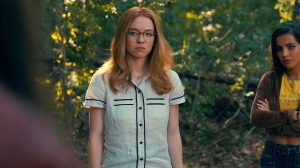 The Spidey girls are also rather uninteresting and given one note of characterization. One of them likes science. One of them has a skateboard and… attitude. One of them is Hispanic. I may have even confused about the characterization, that is how meaningless these characters are. They’re simply a glorified escort mission, a challenge for Cassie to simply keep alive. The scene where they stumble into a brightly lit diner in the middle of nowhere, after Cassie saved their lives and warned them to lay low for their own self-preservation, is immensely irritating. They take it upon themselves to stand on a table of letter jacket-wearing jocks and dance because that’s laying low. They’re annoying characters that never convince you why Cassie should go through such valiant efforts to keep alive. The flashes of them in Spider costumes are only brief glimpses of a possible future, one I can guarantee we’ll never see coming to fruition in this discarded universe.
The strained efforts to transform Madame Web into a disjointed Spider-Man prequel are distracting and generally annoying. It also reveals the doubts the studio had that anyone would be interested in a Madame Web story without additional connections to Peter Parker. Why do we need to have a pregnant Mary Parker (Emma Roberts) in this movie? Why does the climax also involve her giving birth? Are audiences going to wonder whether or not Peter Parker might be born? There’s also the prominent role of Uncle Ben Parker (Adam Scott) as Cassie’s EMT partner. He’s practically the third-leading character. The movie makes several ham-handed meta references about his eventual role in crafting Spider-Man’s development (I also guess he gets to marry Marissa Tomei, so good for you). “Ben can’t wait to be an uncle,” one person says, with, “All of the fun and none of the responsibility.” They might as well just turn to the camera and point-blankly state, “This man will eventually die and inspire Peter Parker to be a hero.” The worst moment of all this forced connectivity is when Mary demurs on picking a name and says she’ll determine when he’s born, even though the film has a “guess the name” baby shower game. Does this mean she saw her newborn babe and the first thing she thought was… Peter? The entire Spider-Man lineage feels so tacked-on and superfluous as glorified Easter eggs.
 I’m generally agnostic when it comes to product placement in movies. People got to eat and drink and drive cars, and as long as it’s not obnoxious, then so be it. However, the product placement needs to be mentioned in Madame Web for its narrative prominence, and this leads to some spoiler discussion but I’d advise you read anyway, dear reader, because this movie is practically spoiler-proof by its very conception. Ezekiel Sims is battling Cass and the Spider girls atop a large warehouse with a giant Pepsi sign built onto scaffolding. Then the engineer of Ezekiel’s doom is none other than the falling “S” from Pepsi. That’s right, the villain is dispatched through the help of Pepsi, as well as a literal sign falling from above (cue: eye-roll). Without the assistance from Pepsi (or “Pep_I”), these women might not have lived. You can’t expect that kind of divine intervention from any other cola company. Coke was probably secretly working with the villain, giving him aid and comfort from being parched (begun these Cola Wars have). Deus ex Pepsi. It’s just so egregious and in-your-face that I laughed out loud. Is it also a reference to the original Final Destination ending or am I myself reading the signs too closely?
For those hoping for a so-bad-it’s-good entertainment factor, I found Madame Web to be more dreary, bland, and confusing than unintentionally hilarious. Johnson is an actress I’ve grown to enjoy in efforts like Cha Cha Real Smooth and The Peanut Butter Falcon, also the much-derided but still enjoyable Netflix Persuasion, but she sleepwalks through this movie. I don’t blame her. I don’t blame any of the actors (poor Rahim’s performance seems entirely replaced by bad ADR lines). The character’s nonchalance already zaps the low stakes of a movie where a psychic character we don’t really have fond feelings over is trying to save a trio of annoying teenagers before a vague hodgepodge of a villain succeeds in killing them before they can kill him, which means they all need to kill him before he can kill them before they are destined to kill him. No wonder the executives decided to crassly cram in some Spider-Man relatives to make people care. Madame Web is less a bad movie and more a poorly executed and confused movie, one that doesn’t understand the desires of its intended audience. It’s barely even a superhero action movie, with few scenes of elevated action, though the director enjoys her ceiling perspective flips. There’s a moment where our villain flat-out says, “You can’t do [a thing],” and literally seconds later, through no setup or explanation, suddenly Cassie can do [that thing]. The whole movie feels like this moment, arbitrary and contrived and desperately reaching for an identity of its own. It should have stayed in the Amazon researching spiders before it was destined to die.
Nate’s Grade: C
Share this:

Aquaman and the Lost Kingdom (2023)
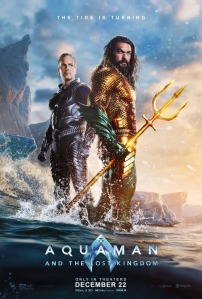 Aquaman and the Lost Kingdom is he last of the Zack Snyder-then-not-Snyder-verse DCU movies, and with that the ten years of mostly middling super hero heroics comes to an end not with a bang but with a whimper. I was a fan of 2018’s original Aquaman thanks to the self-aware craziness and visual decadence from its wily director, James Wan (Malignant). This is still the major appeal of the franchise, a universe that feels pulled from a child’s imagination and recreated in loving splendor on the big screen. The problem with this tone is that it’s a delicate balance between silly fun and silly nonsense. The goofy charm of these movies is still alive and well as they open up an even bigger undersea world of lore (Martin Short as a fish lord!), but this time it feels like a movie that is making it up as it goes, and all that “and this happens next” storytelling begins to feel like a monstrous CGI mess needing to be tamed. This might have something to do with the fact that Wan finished filming the movie over two years ago and it’s endured several re-shoots, including featuring two different Batman actor cameos at different points, to now bring to a close a decade of interconnected movies that are going to be blinked out of larger continuity in 2025 (excluding Margot Robbie’s Harley Quinn, I guess). Lost Kingdom has plenty of enjoyably weird undersea nightmare creatures, a specialty of Wan given his horror roots, but the ultimate villain spends most of his time sitting on a throne in wait and is laughably dismissed so easily in the climax. The whole evil magic trident that corrupts from its evil influence has a very Lord Sauron ring to it. I give the movie points for transforming into a buddy movie between Arthur Curry (Jason Momoa) and his brother Orm (Patrick Wilson) halfway through. The jail break sequence is fun and different, and their bickering dynamic makes for winning comedy. However, the drama feels too overworked, with holdovers from the first film (Black Manta, Amber Heard’s unremarkable love interest) repeating their same beats with robotic dedication. The opening reveal of Arthur being a new dad and it cramping his macho-cool style made he fear we were headed for Shrek 4 territory, where the new dad needs one more adventure to realize the importance of family, etc. Because even when you’re riding a mechanical shark, fighting alongside the crab people, and tunneling through worm prisons, it’s all about recognizing the importance of family, kids (the real undersea treasure after all). I defy anyone not to laugh at the literal concluding speech and its enigmatic “sure, fine, whatever”-energy. As a mere movie, Lost Kingdom is silly escapist entertainment that could enchant a few with lowered expectations, and as the final entry point in a universe of super heroes, it’s a fitting nonsensical end.
Nate’s Grade: C
Share this:

The Marvels (2023)
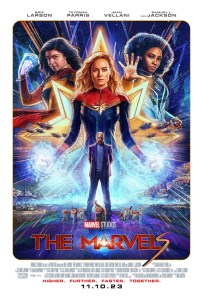
No Marvel Cinematic Universe (MCU) movie has had a bigger trail of negative buzz than The Marvels, the supposed sequel to not just 2019’s Captain Marvel but also an extension of two Marvel television series from the Disney streaming service. The film has had its release delayed three times, rumors abound that heavy portions were re-shot, and its own director, Nia DeCosta (2021’s Candyman), had already moved on to starting her next project while her last movie was still being finished in post-production (to her defense, the movie was delayed three times). The opening weekend wasn’t kind, setting an all-time low for the MCU, and the critical and fan reception was rather dismal, with many calling the movie proof that Marvel was in trouble. There is a lot going against this movie, and yet when I actually sat and watched The Marvels, I found it a flawed but fun B-movie that doesn’t deserve its intense pile-on. Although, caution dear reader, as I’m also one of the seemingly few critics who enjoyed Black Widow and most of Eternals as well.
Carol Danvers a.k.a. Captain Marvel (Brie Larson) has been absent for most of the past 30 years, trying to do right by the universe’s many alien civilizations in need. The people of Earth also feel a little left behind, notably Monica Lambeau (Teyonah Parris), who knew Carol as a child in the 1990s and is now acclimating to her own light-based superpowers (see: WandaVision). A power-hungry Kree warrior, Dar-Benn (Zawe Ashton, Tom Hiddelston’s wife in real life), is seeking a way to restore a home world for her people. She finds one super-powerful weapon, a bangle she wears on her arm that opens interstellar portals. The other bangle happens to belong to a New Jersey teenager, Kamala Khan (Iman Vellani), a first generation Pakistani-American who also moonlights as the bangled-powered hero, Ms. Marvel (see: Ms. Marvel). Through strange circumstances, Kamala, Monica, and Carol are all linked by their powers, so if one of them uses said powers they happen to swap places in space, teleporting from three different points. It makes it really hard when you’re supposed to save the day and work together to defeat the bad guy.
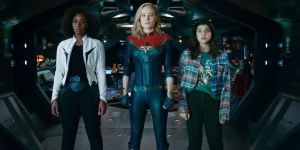
The core dynamic of the movie is this trio of powerful women learning to work together, and while that might sound trite for the thirty-third movie in a colossal franchise, it’s a serviceable arc for a movie that only runs 100 minutes, the shortest in MCU history. The swift running time is both a help and a hindrance, but it allows the film not to overstay its welcome while juggling three lead characters and multiple space-time-hopping action set pieces. I wish Marvel could return to an era of telling smaller stories that don’t have to feel so grandiose, with personal stakes tied more to their characters than saving the planet yet again (2017’s Spider-Man: Homecoming is a great example). Even though this too falls into the trap of world-destroying-energy-hole, it still feels lighter and breezier, and I think that is a result of its pacing and lowered ambitions. That’s not an insult to the filmmakers, more a recognition that The Marvels doesn’t have to compete with the likes of Endgame or the Guardians for emotional stakes. It can just be fun, and simply being a fun and well-paced action movie is fine. That’s what the MCU diet can use more of, especially considering the Ant-Man movies have transformed from palate cleansers to same-old bombast.
On the flip side, the speedy running time is also a very real indication of its troubled production and the attempt to salvage multiple versions into one acceptable blockbuster. There are signs of heavy editing and re-shoots throughout, from lots of ADR dialogue hiding actors visibly mouthing these patchwork lines, to world-building problems and solutions that can seem hazy. The rationale for why these three women become linked is so contrived that even Nick Fury (Samuel L. Jackson) bemoans Carol not to touch a strange unknown space light because it’s shiny. The concept of the three heroes being linked by their powers offers plenty of fun moments, of which I’ll go into more detail soon, but the execution left me questioning. Which superpower use qualified and which did not? It seems a little arbitrary which powers using light trigger the switcheroo. I don’t think the movie even knows. There’s also a late solution that feels so obvious that characters could have been like, “Oh yeah, we could have tried that this whole time.” A reasonable excuse was right within reach, blaming the inability to attempt the solution on not having sufficient power before assembling both of the bangle MacGuffins. It also, curiously, allows the villain to win in spite of her vengeful indiscriminate killing, but don’t think too much about that or its possible real-world parallels as that will only make you feel dramatically uncomfortable.

There are remnants of what must have been a fuller movie of Marvels’ past, as each character has an intriguing element that goes relatively under-developed. Monica was gone thanks to Thanos while her mother died and is also trying to square her feelings of resentment for Carol, a woman she felt so close to as a child who flew away and didn’t return for decades. So we have attachment issues and issues of closure. Carol is likewise trying to rebuild her relationship with this little girl she let down, and she has to also consider the unintended consequences of being a superhero. The Kree worlds refer to Carol as “The Annihilator,” a powerful being that doomed their civilization. She’s become a culture’s nightmare. That re-framing of heroism and perspective, as well as the larger collateral damage of the innocents from defeating villains makes for an interesting psychological stew of guilt and doubt and moral indecision. Then there’s Kamala, who worships Captain Marvel as her personal hero and wants nothing more than to join the ranks of superheroes. Her rosy version of the duties of being a hero could be seriously challenged by the harsher reality, like when Carol has to determine that saving “some lives” is more important than losing all life to save more. She could become disillusioned with her heroes and re-examine her concepts of right and wrong. And there are elements of all these storylines with our trio but they’re only shading at best. There’s just not enough time to delve into this drama when the movie needs to keep moving.
However, the fun of the body-swapping concept leads to some of the more enjoyable and creative action sequences in the MCU. DeCosta really taps into the fun comedy but also the ingenuity of characters jumping places rapidly. It begins in a disorienting and goofy way, as characters jump in and out of different fights and have to adapt. It makes for a fun sequence where at any moment the action can be shaken up, as well as forcing there to be enough action going on for three people. This also leads to some interesting dangers, as Kamala gets zapped high above her neighborhood and plummets to the ground, as these are the dangers when your two other linked superheroes can fly. The use of the powers into the action feels well thought through, and the combination of the women working together and strategizing when and where to swap places makes for creatively satisfying resolutions. The action sequences are also very clearly staged and edited without the use of jarring and confusing edits. You can clearly see what is happening and what is important, and the choreography is imaginatively spry.

There are some asides to this movie that had me smiling and laughing and just plain happy. The Marvels visit a planet where the only way to communicate with the locals is through song, and it starts out like a big old school Hollywood musical with some Bollywood flourishes. I wish the movie had done even more with this wonderfully goofy rule, possibly even setting a fight sequence that also plays into the musical quality of the weird setting. Oh well, but it was pure fun and forced the characters outside of a comfort zone (though this too had some hazy rules application). There’s also a montage involving alien cats and a life-saving and space-saving solution that had me giggling like crazy (my extra appreciation for the ironic use of “Memory”). It’s because of these sequences, the delightful exuberance of Vellani, and the above-average action sequences that make it impossible for me to dismiss the movie as a waste.
The Marvels has problems, sure, with its lackluster villain, some hazy rule-setting and application, not to mention an overstuffed plot that feels a bit jumbled from the likes of twenty other stories trying to appear as one semi-unified whole. But it’s also fun, light, and entertaining in its best moments, and even the good moments outweigh the bad in my view. I would gladly re-watch this movie over the likes of Multiverse of Madness, Love and Thunder, and Quantumania. While it can seem initially overwhelming to approach, the movie does a workable job to catch up its audience on who the other Marvels happen to be just in case you didn’t watch 17 episodes of two different TV shows. It’s mid-tier Marvel but refreshingly comfortable as such, only aiming for popcorn antics and goofy humor with some colorful visuals. It all feels like a special event from a Saturday morning cartoon, which again might be faint praise to many. Blame it on my lowered expectations, blame it on my superhero fandom, or simply call me a contrarian lashing out against what seems a very ugly strain of vitriol for this movie to fail, but I found The Marvels to be a perfectly enjoyable 100 minutes of super team-up tomfoolery.
Nate’s Grade: B-
Share this:

Guardians of the Galaxy vol. 3 (2023)
 It’s taken me longer to review the third, and reportedly final, installment of the Guardians of the Galaxy trilogy because I didn’t think that I nor my family had the emotional bandwidth when the movie was originally released to herald the summer. I’ve been a big fan of writer/director James Gunn’s comic book escapade efforts with the Marvel Cinematic Universe (MCU), as well as his first DC entry, 2021’s The Suicide Squad, the best DC film of the new era, so I’ve been highly anticipating a third Gaurdians ever since the second ended six years ago. Of course all fans have had to wait a little longer after Disney fired Gunn in 2019 for offensive social media posts they already knew about before the first Guardians film in 2014, and then they came to their senses and re-hired one of the most unique voices working within their giant sandbox of superheroes. The reason I decided to wait even longer is because I had been warned by many of my critical colleagues about the heavy thematic nature of the third entry, namely the frequent sequences of animal abuse. My family had to put down their household dog of over ten years in late April, and having to re-open that wound by watching pretend animals get abused was not the best for any of our emotional states. And so I waited until it was available on digital and in the comfortable sanctity of my home, and I alone in my family watched Volume Three, partly as a harbinger of future warning over what scenes to skip over for them. It’s a fitting end to a strange and funky series of movies that taught us to feel real emotions over racoons and trees, and even though I’d rate this as last in its respective Guardians standing, it’s still a winner and a topical reminder that these big-budget blockbusters are only ever as good as when the passion is evident.
The Guardians are on a mission to save their friend, Rocket (voiced by Bradley Cooper). He’s been incapacitated and is sought after by his creator, The High Evolutionary (Chukwudi Iwuji), a maniacal man with a god complex who is trying to create a perfect life form. This forces the Guardians to learn more about Rocket’s tragic past as a cruel science experiment, and it brings back Gomorrah (Zoe Saldana), though she’s not the same woman who fell in love with Peter Quill (Christ Pratt), and he’s having a hard time reconciling the different green girls. They’ll have to work together to rescue Rocket and stop the High Evolutionary from further harm.
 This is a movie built around the back-story and emotional connections of Rocket, a character that, prior to Gunn’s first film, had fewer than a dozen comic appearances but has had an outsized influence over the movies. If the first movie was about the formation of our team, and the second was deepening the supporting characters, as well as exploring Quill’s daddy issues, then the last movie is all about how we say goodbye to the ones we love. Volume Three is clearly structured like Gunn’s fond farewell for these characters rather than merely a pause in their contractually obligated appearances (whether Marvel overrules Gunn is another matter). It makes the interaction more meaningful and also more emotionally rich, not just because certain characters might perish, but because of the journey we’ve been privileged to hop along for, how far they’ve come and how much they matter to others, and by extension us, the audience.
Case in point: the emotional evolution of Rocket Racoon. He began as a surly visual joke, a teeny mammal with a big gun and a big attitude. It wasn’t until a drunken outburst in Volume One that you got a glimpse of the trauma and pain beneath that antisocial demeanor. With Volume Three, he gets sidelined pretty early, which means the majority of the time we spend with Rocket is through a series of flashbacks with baby Rocket and his cute pals, all ongoing science experiments (one needs only to recognize the absence of these childhood friends as grown-ups to anticipate where this is inevitably heading). In some ways, it is cheap and manipulative. It’s not hard to make an audience feel extreme emotions by introducing a slew of adorable animals as well as a villain who hurts them and sees them as expendable experiments undeserving of sympathy. I wish Gunn hadn’t gone so hard in this direction because it feels excessive in the ideas that the film bluntly communicates. Yes, a storyteller will need time to establish a baseline of relationships, conflicts, and looming change, but do we need six or seven flashbacks to settle the concept of animal testing and animal cruelty being a bad thing? I credit Gunn with making his thematic intent unambiguous; this is wrong, and you will feel it explicitly. However, sidelining Rocket for a majority of the movie and having characters project onto his unconscious body, while providing more insight through a system of excessive and heavy-handed flashbacks, might not be the best model for ensuring this character gets his due when it comes to this showcase. Quill keeps calling Rocket his “best friend” and I’m trying to remember when this happened. I re-watched Volume Two this summer, and now consider it the best of the trilogy, and I cannot recall the specific events that bonded these two bickering alphas into inter-species BFFs.
 Another facet of Gunn’s relevant themes is personified in the romantic realizations of Quill. Not to get too complicated, the current Gomorrah is a past version of herself and not the one who joined the Guardians, fell in love with Quill, and died in Infinity War. She’s back, but from her perspective she never left, and this moon-eyed dolt keeps projecting his feelings onto her. I respect that Gunn doesn’t try and wave away this complication, nor does he mitigate the agency and importance of this Gomorrah not having to follow the same path as her predecessor. The easy thing would have been for Quill to wait and for this new/old Gamorrah to see the same qualities that made the old/dead Gomorrah fall in love. It would be like one of those soapy romances where a person suffers amnesia and gets to fall in love with their spouse all over again. Gunn doesn’t do that. These are different people, and despite the aching desire of Quill to rekindle what he had, it has been lost, and this needs to be acknowledged and accepted. “I bet we were fun,” she says, and it’s a bittersweet summation that extends beyond the Guardians.
There is still Gunn’s signature sense of style and humor while checking the boxes of a big-screen action blockbuster. There’s an infiltration set piece that plays like a goofier Mission: Impossible setup but in a squishy bio-mechanical facility that reminded me of the eccentric and schlocky sci-fi diversions personified in the Lexx movies and TV series. There’s an entire planet of animal-human hybrids that feels wasted as further proof of the High Evolutionary’s already established evil. The entire character of Adam Warlock (a beefed up Will Poulter) is a himbo that definitely feels lacking in larger purpose now that the Infinity Era is over. There is one signature action scene involving a protracted fight through a crowded hallway, and it’s exciting and fun. The jokes are mostly contained to sardonic banter, which can be hilarious depending upon the combination of characters, though it also can be grating when it feels forced, like Mantis (Pom Klementieff) and Nebula (Karen Gillan) butting heads. The celebrated dad rock soundtrack has moved onto 90s and early 2000s music, and as a 90s kid, it gave me a personal nostalgic lift watching scenes jamming to dreamy whoo-hoo alt-rock acts like Radiohead and Spacehog and The Flaming Lips.
 This also might be the grossest MCU movie yet, and not just from the animal abuse but a face-peeling scene that will startle most. I had to pause the screen and drag my 12-year-old stepdaughter into the room with the promise, “Want to see the grossest thing ever in a Marvel movie?” She agreed that it was indeed that. It’s reassuring that no matter the budget, Gunn’s sensibilities that make him the unique storyteller he is, the same man who began with Troma, will be there. Though this point also concerns several of my friends wondering if Gunn can abandon these silly and schlocky tendencies to tell an earnest and tonally appropriate tale for his 2025 Superman reboot.
Guardians of the Galaxy volume 3 is the end of an era for Gunn and for the MCU. As the new head of the DC film and TV universe, it’s unlikely he’ll be lending his talents to Marvel any time soon, although the characters he made us fall in love with could carry on. Gunn clearly loves these characters, and especially identifies with Rocket, the angry malcontent lashing out in pain, so it’s fitting to give this character the big stage for a final outing, and if he can throw in some animal cruelty messaging along with silly humor and pathos, then so be it. This practically feels like Marvel is giving Gunn even more leeway as an apology for firing him. The Guardians trilogy stands out from the prolific MCU assembly because of how much Gunn has personalized these movies to make them special. They have permission to be weird, to be heartfelt, and to be reflections of their idiosyncratic creator, a much more benevolent force than the High Evolutionary. Perhaps there’s even a parallel to be drawn there, a filmmaker trying to endlessly tinker with their creation in the futile pursuit of perfecting it whereas the imperfections and rough edges are often the lasting appeal of a movie. I don’t know if the MCU will contain a series quite like this again, and that adds to the feeling of this serving as a farewell. It was a fun, messy, ridiculous ride, and it was all Gunn.
Nate’s Grade: B


 nathanzoebl
You must be logged in to post a comment.