Blog Archives
War of the Worlds (2005)
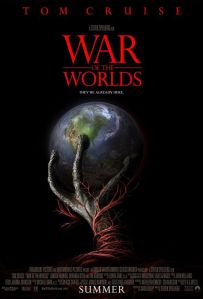 Steven Spielberg is America’s favorite director. He’s made films about alien encounters before (hell, it was most of the title of one movie), but Spielberg has never tackled evil aliens. Alien movies either involve cuddly little green men or the kind that want to destroy our planet. The latter is usually more interesting and finally Spielberg takes the trip with War of the Worlds.
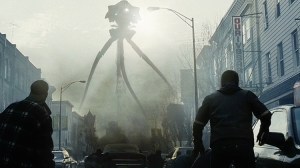
Instead of focusing on high-ranking government officials, War of the Worlds concentrates on an everyday man just trying to save his family. Ray (Tom Cruise) is a New Jersey dock worker and a divorced pop. His ex-wife (Miranda Otto) has dropped off the kids (Dakota Fanning, Justin Chatwin) for the weekend. Ray isn’t exactly father of the year and his sullen kids remind him of this fact. Meanwhile, there seems to be a series of lightning storms hitting the world that then leave an electronic magnetic field that eliminates all the electricity in the area. A storm hovers over New Jersey and lightning strikes not once but over twenty times in the same spot. Ray goes to investigate the site. The ground beneath trembles and caves in. A giant machine with three tentacle-like legs emerges from the earth and starts zapping any humans it can find. Ray escapes, packs up the kids in the only working car in town, and runs, runs, runs, all with the aliens just a step behind ready and waiting for a people zappin’.
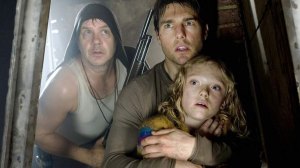 There are three things an audience will have to put behind them in order to enjoy what War of the Worlds has to offer.
1) The film has no plot. War of the Worlds spends the first 15 minutes setting up its handful of characters and their misery with each other. After that, it’s nothing but all-out alien attacks. That’s really it. Ray and the kids run to one place and think they’re safe. The aliens come and attack. Ray and the kids escape to a new place. The aliens come and attack. Lather, rinse, repeat. There is little more to War of the Worlds.
2) Spielberg has pretty much forgotten how to make good endings. I think A.I. was the nail in the coffin. Routinely Spielberg films seem to run out of gas or end rather anticlimactically, but A.I. really cemented the glaring fact that Spielberg cannot sit still with an unhappy ending. So, yes, War of the Worlds both ends anticlimactically and with an abrupt happy ending. Of course the H.G. Wells novel ends in the same fashion so there’s less to gripe about, until, that is, until you reach the implausible reunion. Spielberg can’t keep well enough alone and forces the story to be even happier at the cost of logic.
3) Ignore whatever feelings you hold about Tom Cruise. Off-screen, many feel that Cruise is becoming an obnoxious, pampered, self-involved, couch-jumping cretin. No matter what your feelings about Cruise and his self-taught knowledge about the history of psychiatry, that is not who is in War of the Worlds. He is playing a character. I never understood the argument that because you dislike an actor as a person it invalidates all their acting. I’ve read magazines that actually say people are staying away from Cinderella Man because people think Russell Crowe is a grump. In War of the Worlds, Cruise plays a deadbeat dad who finds his paternal instincts during the end of the world. The character isn’t deep and acts as a cipher for the audience to put themselves in the scary story. Plus it’s not like Cruise is a bad actor; he has been nominated for three Oscars.
 Since this is a large Hollywood horror film, the acting consists mainly or healthy lungs and frightful, big-eyed expressions. So it seems natural that little Dakota Fanning would play the role of Child in Danger. Cruise somehow finds some points in the story to exhibit good acting. There’s a moment right after Ray and his kids escape to their mother’s home. He tries making them food out of whatever they saved which amounts to little more than condiments and bread. His kids rebuff his offer and he throws the sandwiches against a window and repeats to himself to breathe. In lesser hands this moment would just be some light comedy, but Cruise turns it into an opportunity to see the character’s desperation. Tim Robbins shows up late playing a nutball going through some self-induced cabin fever.
War of the Worlds, at its core, is a post-9/11 horror film on a mass scale. Spielberg plays with our paranoia and anxiety and creates a movie that is fraught with tension and an overriding sense of inevitable annihilation. The aliens are so advanced and so powerful. The deck definitely seems to be stacked against Earth. I felt great amounts of dread throughout the film knowing that the aliens will find you, they will get you, and it’s only a matter of time. And that’s the recipe for a perfectly moody horror film. War of the Worlds is chilling in its depiction of worldly destruction, and yet it becomes even more terrifying by how realistic everything seems as the world falls apart when its under attack. The introduction of huge, human-zapping aliens is expected to be scary, but who knew human beings at their wit?s end could be just as scary? A crowd of people turns into a violent mob fighting for any last bit of space in Ray’s working car. A man sitting on top of the hood is actually ripping away chunks of windshield with his bare, bloody hands.
War of the Worlds really benefits from awesome special effects. As stated before, we live in a jaded age where most special effects have lost feeling special. Computer advancements have also created a more advanced audience able to point out the big screen fakery at a faster pace. If you don’t believe me, look back at some movies from 1995 or so and see if you’re still wowed. War of the Worlds marvelously displays destruction on such an incredible scale. City streets ripped apart, houses blown up, cars flipping through the air, ferries plunged into the water, and it all looks as real as can be. There are moments I know that have to be computer assisted, like seeing miles and miles of stranded vehicles and people on the side, but it looks like they filmed it for real. The only thing that seemed hokey was people being vaporized by alien ray guns and having their clothes remain. I don’t know if Spielberg was going for a veiled Schindler’s List reference or they thought anything more grim could rock their PG-13 rating.
 Due to all of this realism, War of the Worlds is not a film to take young children to see. The startling realism and suffocating sense of dread will keep kids up for weeks with nightmares, maybe some adults too. There’s more than a passing reference to 9/11, and that may be a wound too fresh for some. Thousands of people walk the streets as homeless refugees. There are large tack boards with hopeful missing fliers of relatives. One of the most horrifying images consists of a flowing river filled with floating corpses. There’s also a grand set built around the remains of a downed airplane. When Ray is trying to explain the situation at first, his son interjects, “Were they terrorists?” Spielberg calculatingly uses our memories of 9/11 to create a true-to-life horror story that doesn’t feel exploitative. “War” implies some kind of even ground. This is a massacre, and one parents should be wise not to bring youngsters to.
With War of the Worlds, Spielberg has crafted a chilling, realistic, post-9/11 horror movie. The action is big, the destruction is bigger, and the dread is at a near breaking point. Sure the movie is plotless and the ending is anticlimactic and forcibly happy, but War of the Worlds should appeal to those looking for the safe way to witness the end of the world. Spielberg invented the big summer movie and War of the Worlds is a taught return to form. It’s not much more than watching aliens destroy things but for many that will be plenty for a summer movie.
Nate’s Grade: B
Share this:

Catch Me If You Can (2002)
January at the theaters is a tale of two kinds of films. One type are the studio bombs (take Just Married and Darkness Falls, please take them far away). The other type are the prestige pictures expanding their releases in hopes of garnering some of that Oscar magic. A lot of prestige films were released around the holidays and though not every one could be a winner, they were all better than Kangaroo Jack. Well, except for The Hours.
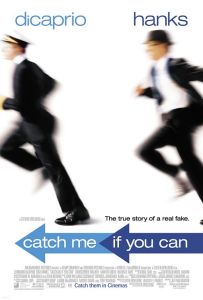 Catch Me If You Can (2002)
Premise: Successful true-life con artist Frank Abagnale Jr. (Leo DiCaprio) zips across the world posing as a pilot, doctor and lawyer all before the age of 18. A mousy Tom Hanks provides the chasing.
Results: Breezy and light-hearted, Catch is an entertaining and fun romp that works with a charming Leo (unlike in Gangs), a jazzy score and a skillful recreation of the 1960s life and mood. Spielberg hasn’t made a film under two hours since 1989, so Catch is a tad long.
Nate’s Grade: B
Share this:

A.I. (2001)
 A.I. is the merger of two powerhouses of cinema – Stanley Kubrick and Steven Spielberg. The very mysterious film was given to Spielberg by Kubrick himself who thought ole’ Steven would be a better fit to direct it. The two did keep communication open for like a decade on their ideas for the project until Kubrick’s death in March of 1999. What follows is an imaginative futuristic fairy tale that almost grabs the brass ring but falls short due to an inferior ending. More on that later.
In the future technological advances allow for intelligent robotic creatures (called “mechas”) to be constructed and implemented in society. William Hurt has the vision to create a robot more real than any his company has ever embarked on before. He wants to make a robot that can know real love. Flash ahead several months to Henry and Monica Swinton (Sam Robards and Frances O’Conner) who are dealing with their own son in an indefinite coma. Henry is given the opportunity to try out a prototype from his company of a new mecha boy. His wife naturally believes that her son could not be replaced and her emotions smoothed over. Soon enough they both decide to give the boy a try and on delivery comes David (Haley Joel Osment) ready to begin new life in a family. David struggles to fit in with his human counterparts and even goes to lengths to belong like mimicking the motions of eating despite his lack of need to consume. Gradually David becomes a true part of the family and Monica has warmed up to him and ready to bestow real love onto their mecha son.
 It’s at this point when things are going well for David that the Swinton’s son Martin comes out of his coma and returns back to his parents. Sibling rivalry between the two develops for the attention and adoration of their parents. Through mounting unfortunate circumstances the Swintons believe that David is a threat and decide to take him away. The corporation that manufactured David had implicit instructions that the loving David if desired to be returned had to be destroyed. Monica takes too much pity on David that she ditches him in the woods and speeds off instead of allowing him to be destroyed.
David wanders around searching for the Blue Fairy he remembers from the child’s book Pinocchio read to him at the Swinton home. He is looking for this magical creature with the desire she will turn him into a real boy and his human mother will love him again. Along David’s path he buddies up with Gigolo Joe (Jude Law), a pleasure ‘bot that tells the ladies they’re never the same once he’s through. The two traverse such sights as a mecha-destroying circus called ‘Flesh Fairs’ complete with what must be the WWF fans of the future, as well as the bright lights of flashy sin cities and the submerged remains of a flooded New York. David’s journey is almost like Alice’s, minus of course the gigolo robot of pleasure.
There are many startling scenes of visual wonder in A.I. and some truly magical moments onscreen. Spielberg goes darker than he’s even been and the territory does him good. Osment is magnificent as the robotic boy yearning to become real, but Jude Law steals the show. His physical movement, gestures, and vocal mannerisms are highly entertaining to watch as he fully inhibits the body and programmed mind of Gigolo Joe. Every time Law is allowed to be onscreen the movie sparkles.
 It’s not too difficult to figure out which plot elements belong to Spielberg and which belong to Kubrick, since both are almost polar opposites when it comes to the feelings of their films. Spielberg is an idealistic imaginative child while Kubrick was a colder yet more methodical storyteller with his tales of woe and thought. The collaboration of two master artists of cinema is the biggest draw going here. A.I.‘s feel ends up being Spielberg interpreting Kubrick, since the late great Stanley was dead and gone before he could get his pet project for over a decade ready. The war of giants has more Spielberg but you can definitely tell the Kubrick elements running around, and they are a gift from beyond the grave.
I thought at one point with the first half of A.I. I was seeing possibly the best film of the year, and the second half didn’t have the pull of the first half but still moves along nicely and entertained. But then came the ending, which ruined everything. There is a moment in the film where it feels like the movie is set to end and it would’ve ended with an appropriate ending that could have produced lingering talk afterwards. I’m positive this is the ending Kubrick had in mind. But this perfect ending point is NOT the ending, no sir! Instead another twenty minutes follows that destroys the realm of belief for this film. The tacked on cloying happy ending feels so contrived and so inane. It doesn’t just stop but keeps going and only gets dumber and more preposterous form there. I won’t go to the liberty of spoiling the ending but I’ll give this warning to ensure better enjoyment of the film: when you think the movie has ended RUN OUT OF THE THEATER! Don’t look back or pay attention to what you hear. You’ll be glad you did later on when you discover what really happens.
The whole Blue Fairy search is far too whimsical for its own good. It could have just been given to the audience in a form of a symbolic idea instead of building the last half of the film for the search for this fictional creature’s whereabouts. The idea is being pounded into the heads of the audience by Spielberg with a damn sledge hammer. He just can’t leave well enough alone and lets it take off even more in those last atrocious twenty minutes.
A.I. is a generally involving film with some wonderfully fantastic sequences and some excellent performances. But sadly the ending really ruins the movie like none other I can remember recently. What could have been a stupendous film with Kubrick’s imprint all over turns out to be a good film with Spielberg’s hands all over the end.
Nate’s Grade: B
Reviewed 20 years later as part of the “Reviews Re-View: 2001” article.


You must be logged in to post a comment.