Blog Archives
Closer (2004)
 A funny thing happened to me when I sat in a theater to see Closer. It was packed, surely due to the film’s heavy star power. As the film played out I began to notice that my audience was laughing consistently, at moments that weren’t necessarily meant for humor. I don’t think they were laughing at the film, instead I think it was a defense. You see, I’m sure the majority of those couples read Closer to be a much different film than it is. They saw the pretty faces of Jude Law, Natalie Portman, and America’s sweetheart Julia Roberts. They were expecting something, let’s say, lighter than the cruel savagery of Closer. When America’s sweetheart Julia Roberts compares the taste of two men’s semen, you know this isn’t any Gary Marshall movie (forgetting Exit to Eden, and please do).
Dan (Jude Law) is an obituary writer planning to pen a novel one of these days. He locks his eyes on Alice (Natalie Portman), a stripper from the States, while walking one day. She gets hit by a car and Dan takes her to a hospital. Flash forward and Dan and Alice are dating but his eyes are already wandering. During a photography session with Anna (Julia Roberts) he kisses her but is spurned. He takes his revenge on some soul in cyberspace, pretending to be Anna and arranging a meeting. That sap turns out to be Larry (Clive Owen), and they actually do start dating. Then things get messy. Couples leave one another, get back together, swap lovers, and come crawling and begging for forgiveness or punishment. The rest of Closer is like a long game of relationship Red Rover.
 Director Mike Nichols has a definite affinity for his four actors (they are the only ones in the film with speaking parts). He shoots Closer as an actor’s showcase, with constant close-ups and no handheld camerawork. He places the emphasis on his actors. The results are more familiar to Nichols’ early films like Who’s Afraid of Virginia Woolf? and Carnal Knowledge. However, Closer isn’t as insightful as it thinks it is. It presents cruel characters doing dastardly acts, but this is stuff that wouldn’t impress Neil LaBute (In the Company of Men). There is intelligence to the film?s dialogue but it’s wasted on a ramshackle story.
The acting of Closer both helps and hurts the film. It seems that the two primarily wronged characters (Larry, Alice) give the better performances.
Owen is the standout performer of the ensemble. Playing the Dan role onstage has given him an intimate feel for the story’s characters. He’s the most decent of all four until the weight of circumstances finally pushes him to the limit. He’s the character the audience sees themselves in, so it helps that Owen gives a great performance of quiet dignity and slow self-destruction. He expresses more emotional turmoil in his eyes than most actors do with their whole body. Portman is having a breakthrough year for herself. First she showed pluck and grace in Garden State, and now with Closer she has graduated to the adult table. She radiates a fragility that makes you want to hug her. Portman will probably always look like a little doll (which works for her role as a stripper).
The beauty of Roberts and Law hurts the ugliness of their characters. I make no bones about my general dislike of Roberts as an actress. Her acting in Closer is like a soft-spoken, pouty child. She jumps from man to man, looking sullen or pensive, but comes off more petulant. Law is better, but his handsome devil is not in the details. Dan is a womanizing cad but we never get any understanding for why he acts as he does. Law can be hypnotizing, but like Roberts, his pretty facade takes away from the impact of Dan’s ugly behavior.
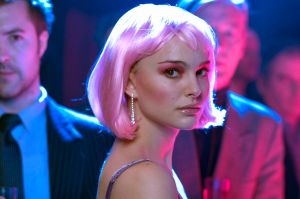 Despite the title, you get no closer to getting to know or understand the characters. It’s really almost a stretch to call them characters because they’re more accurately different positions in an argument. The only characterization Closer has to offer is suffering and inflicting suffering. Closer really has one voice coming out of the mouths of different pretty actors.
The film has the annoying habit of skipping ahead in time and not telling the audience. We’re left to catch verbal asides that time has passed. After a while you’ll get the hang of it simply by assuming that the beginning of every new scene is the start of a new date in time. Closer is nothing but a string of uncollected scenes, usually involving people leaving a lover or starting a new fling. The actors come on, do their part, then they leave and we move on to a different scene. This is not staged as a movie.
The trouble with Closer is that it never really feels like it’s going anywhere. There’s no progression. Sure, couples swap, people get revenge, but the connection of sequences is lacking. The way it is, Closer could have gone on forever. It’s a series of scenes smashed together, not a story that rises and falls and builds to a climax.
Closer is an exploration into the darkness of human behavior starring some of the prettiest actors Hollywood can spare. The story goes nowhere, the ending doesn’t accomplish much, the characters lack convincing depth, but some of the acting is good and there is a ray of intelligence to the film. Fans of the above-the-title actors should enter Closer with caution. It’s a dark film with little to feel good about. Closer is brooding, moody, and probably the first and last time we?ll hear Julia Roberts talk about the taste of semen. Unless, of course, Gary Marshall starts pre-production on Exit to Eden 2: Rosie O’Donnell’s Bondage Boogaloo.
Nate’s Grade: C+
Share this:

Kinsey (2004)
 Bill Condon’s probing, fascinating biopic of Indiana University sex pioneer Kinsey (Liam Neeson) could not come out at a more important time. Kinsey lived in the Dark Ages of sexuality and fought against what he saw as “morality disguised as fact.” Kinsey broke barriers studying the science of sexuality and gathered nationwide statements to amass the first thorough book on what’s under the sun and what’s going on under the sheets. Today, we live in a splintered world where people listen to information that affirms their beliefs, and tune out contradictory evidence even if it’s fact (look at the latest report on abstinence-only programs dishing out highly erroneous information). Kinsey railed against this dangerous line of thinking. The man was no saint and had issue comprehending some of the more complicated human emotions. Kinsey is exceptionally well acted and Neeson gives a career best performance. Kinsey is fearlessly graphic in its frank discussion but also enormously intelligent. The fact that conservative groups are actually protesting it shows that Kinsey’s work is far from over.
Nate’s Grade: A-
Share this:

Sex and Lucia (2002)
 “Put lots of sex in it. Thats always good,” says a character in Sex and Lucia, the steamy Spanish import now playing. And Sex and Lucia is true to its very title. There are many scenes with Lucia, our heroine, and there’s also oodles of sex. This is the type of movie where if people can walk around without a stitch on, they will. This is the type of movie where a babysitter will masturbate to her mother’s porno. This is the type of movie where shower heads are not used for their intended purpose. No wonder this movie went unrated.
Sex and Lucia is a genuinely erotic movie. And when it comes to eroticism in cinema, the Europeans make us look like sickly amateurs. After exploring whatever late-night stimuli is offered on Showtime or Cinemax youll get an idea of how poor American eroticism is. Usually they involve an adventurous couple, or a sex therapist, or a Jacuzzi/swimming pool, or a lonely stewardess/waitress/secretary and usually Shannon Tweed stars. What disarray the state of our erotic union is in. But for all its shocking and stimulating moments, Sex and Lucia is an intriguing tale of loss, love and sexuality, of course, even if it’s told rather obtusely.
Lucia (Paz Vega) is a waitress in Madrid. She enters into a fiery relationship with a writer named Lorenzo (Tristian Ulloa). Their passion seems to burn as fast as the many cigarettes in the film. Their relationship is full of joyous sex, impromptu strip teases, and blindfolded foreplay. But Lorenzo has a secret he hides from Lucia. Six years ago he fathered a daughter he has never seen when he had a tryst on the beach of a Mediterranean isle. The mother has sent their daughter, Luna (named after the full moon on her conception), into the care of a former porn star and Belen, her randy teenage daughter, in Madrid. Its here that Lorenzo first meets his daughter and then Belen starts coming onto him.
 After learning some disconcerting news about her boyfriend, Lucia leaves to take some refuge on the same sunny Mediterranean island where Luna’s mother lives. Lucia actually takes refuge with her and looks back upon her stormy relationship with Lorenzo. The island has many deceiving holes that fall into caverns all along its beach, directly echoing the rabbit hole for Alice.
This, believe it or not, is the most easily understandable part of the movie. I’ve told you what took place but after seeing it even I dont know what happened. The story has several moments, even entire subplots, that could be the truth, fantasy, sections of Lorenzo’s story, an exaggerated dream, or maybe all of them combined. Your guess is as good as mine, reader.
Writer/director Julio Medem utilizes about every narrative trick in the book to create an alluring puzzle. He washes out the colors of the film (also seen in Three Kings) and seems to correspond to the surreal quality of many story lines. The cinematography is a gorgeous delight. Vega has a smolder and can act circles around her Spanish competition. She gives a brave performance, partially for being as nude as often as she is, and also for displaying the fragile emotions of Lucia so well.
Sex and Lucia is indeed quite sexy but it’s more than just art house porn. The film’s story is an intimate tangle that just might stimulate the largest organ: the brain.
Nate’s Grade: B
Share this:

Eyes Wide Shut (1999)
 There’s a certain awe one has to this film. It’s Stanley Kubrick’s last movie, took over two years in development, has the big name star couple, and no one knows ANYTHING about it. All I can say Eyes Wide Shut the movie is a challenging and engaging work from a titan of a director that will sorely be missed.
The first movie from Kubrick in over a decade comes sweeping in and I couldn’t take my eyes off it. The steady cinematography is gorgeous, coupled with the dream like lighting that seem glowing about on the frames. The story captured my attention and drew me in quickly as I was enthralled. It’s all about the tale of a husband and wife with sexual inadequacies, fantasies, delusions, and jealousy. It’s about the trust in a marriage, and how sex can be used not only as an intimate showing of feelings but as a weapon and as a tool. Journey with Tommy Cruise as he ventures through the city exploring all the different characters and how sex has influenced, controlled, or manipulated their lives.
 The movie is adult, yes, but not pornographic. Those who argue it’s expensive porn don’t know what they’re saying. Though there are probably more butt shots of Kidman then necessary the movie never becomes exploitative or gratuitous. The sex here is portrayed more like a Victorian era arrangement instead of the hard-core stuff of today. In fact the sex is far more creepy than erotic. The actors all contribute nicely to the ensemble, even though Nicole Kidman is the slowest talker in the world here. But I couldn’t wait to see what she’d say next; she had me. The movie as well had me mostly.
The movie will certainly not go over well with audiences planning to see a Basic Instinct sequel in this. I blame the poor marketing that made it into something it was far from: a sexy and steamy adult thriller with TONS o’ nudity. So when people file in and find out it’s a two and a half hour art movie with depth, symbolism, and layers they are no doubt disappointed. Especially those who show up in raincoats. The movie is a fitting final work to Kubrick’s collection. Rest in peace Stanley.
Nate’s Grade: B


You must be logged in to post a comment.