Blog Archives
Seven Psychopaths (2012)
 Writer/director Martin McDonagh only has one movie to his name but the man has already accrued legendary status in some circles. The 2008 dark comedy In Bruges didn’t create much of a blip at the box-office, but its blend of absurdist comedy, dark drama, shocking violence, and languid contemplation found a rabid cult following. I have several friends who regard In Bruges as the best film of 2008 (WALL-E still reigns supreme for me but I quite enjoyed In Bruges).McDonuagh’s latest, Seven Psychopaths, reminds me of Barton Fink: both are about struggling writers, both are satires of the film industry, and both have sudden splashes of violence and a serial killer who pushes the protagonist to artistic completion. In other words, Seven Psychopaths is a fun film and a great time at the movies.
Marty (Colin Farrell) is experiencing some killer writer’s block. He’s stuck on his new screenplay titled “Seven Psychopaths.” His buddy Billy (Sam Rockwell) is eager to help out. The guys run afoul of another psychopath, mob boss Charlie (Woody Harrelson), due to Billy’s side business. He kidnaps rich people’s dogs and then his partner, Hans (Christopher Walken), returns them and collects a reward. Billy and Hans have kidnapped the wrong shih tzu, and now Charlie and his muscle is going to make them pay.
 The refreshing thing about the bloody, wickedly entertaining Seven Psychopaths is that it constantly surprises you. This is such a rarity with modern movies, particularly Hollywood movies that attract as notable a cast as this one. McDonagh is wonderfully adept at throwing narrative curveballs. There were a few surprises where I literally jumped in my seat. You constantly think you have the movie figured out, and then it goes down a different alley and becomes more interesting. One of the pleasures of having psychopathic lead characters is that they are impulsive and do not have to follow the normal purview of logical decision making. They might just call the bad guys and divulge where they are hiding. They can do anything at any moment, and part of that unpredictability is what makes the movie feel so electric, so creatively alive. I must stress that McDonagh surprises in ways that feel satisfying and yet believable given the world he’s concocted. Part of the fun in the first half is just figuring out who the seven psychopaths will be. It’s not like it’s some laconic chamber piece mystery but the psychopaths are an eclectic mix from the real to the fictional to real characters doubling as inspiration for fictional ones. I think in the end there may only be six psychopaths, unless McDonagh is counting himself amongst the numbers.
McDonagh also has a blast deconstructing the very kind of movie that he’s providing. Marty bemoans writing another rote psychopathic killer movie where the violence is fetishized and the bad guys are mythologized into idols. You think the film is headed in one direction, in the Guy Ritchie-style standoffs and shootouts, and then it takes a less traveled path, one where it criticizes these sorts of movies and ponders existential questions about the nature of self-expression and death. It began as a care-free movie about thugs and writers and transformed into a movie that manages to have something to say about life, philosophy, and the cyclical nature of vengeance. Two of our three main protagonists are pacifists and remain so to their imperilment. At one point, a character narrates how this story as a proper movie would end, and it covers all the nihilistic clichés of vengeance and epic body counts. But then Marty, and McDonagh as well, wants to turn away from the expected, from violence for the sake of violence, from the exploitation of stylized suffering. McDonagh doesn’t forget to entertain while he’s making you think in between those handfuls of popcorn. The female characters in the movie (Abbie Cornish, Olga Kurylenko) are generally wasted, in different senses, but McDonagh uses this as another charge against this type of film (a boy’s night out of carnage). This is an accessible movie that can be enjoyed on a whole other meta level. I loved the various gear changes. For me it took the pulpy action material and elevated it to another level of genius.
 McDonagh still maintains his darkly sardonic streak of humor that made In Bruges such a riot. I was laughing throughout Seven Psychopaths; chortles, snorts, giggles, big belly laughs. With its heedless violence, obviously this will not be a film that runs on every person’s wavelength of funny. The very opening involves two mafia hitman debating whether shooting somebody in the eye takes actual precision or just dumb luck. It’s the sort of mundane conversation you’d see in a Quentin Tarantino movie, and also the precursor to something nasty and ironic. McDonagh’s sense of humor is similar to Ritchie or the Coen brothers, but the man establishes his own sense of wicked whimsy. The absurdist dialogue is always a hoot and can generate serious malice, especially when delivered by stern psychopaths. Rockwell (Moon) in particular is outstanding and delivers a virtuoso performance of the unhinged. The man just radiates energy. You’ll feel jacked up just watching him. I keep waiting for this underrated actor to break out with each star-making turn, and his comedic zing is played to perfection in Seven Psychopaths. In contrast, Walken (Hairspray) is rather reserved as he underplays his character, one of the saner men he’s played. It feels like the passing of the torch from the older generation of psychopath to the newer generation.
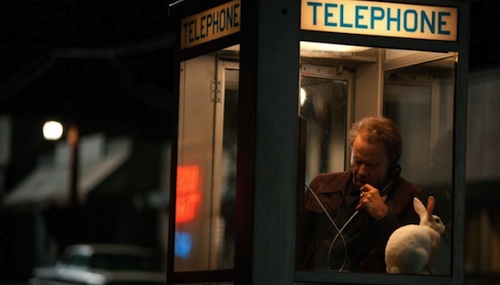
Being a colorful movie about colorful bad guys, and girls, you’d expect there to be some grade-A oddballs, and McDonagh does not disappoint. Some of the psychopaths in question have little bearing on the story plot-wise. There’s Zachariah played by the impeccable Tom Waits (The Imaginarium of Doctor Parnassus). He answers an ad that Billy set up for psychopaths to share their stories to Marty. His tale involves cross-country spree killing of serial killers, rabbit petting, and the love of his life, and partner in crime, leaving him. As far as plot, this little aside has little significance to the plot other than setting up a superb joke to end the movie with. But the character is so interesting, multidimensional, and played with equal parts aloofness and sincerity by Waits, that you can’t imagine the movie without him. Several of these psychopaths could have been the stars of their own movie, from the vigilante killing mob thugs to the tale of one father’s long path to vengeance. Even the fictional psychopath, the Vietnamese man (Long Nguyen) seeking vengeance against G.I.’s, could have enough weight to carry a feature film. The amazing part of the movie is that you don’t feel like any of these characters are shortchanged. McDonagh finds ways to emotionally ground his characters, allowing the audience to empathize amidst the bloodshed and loony characters. We care about Hans and his ailing wife; we care about the friendship between Marty and Billy. It’s real for these characters and so it feels real to us, despite the hyper-real flourishes of the movie.
If you’re a fan of In Bruges, or just dark comedies mixed with sudden violence, then you’ll probably find something to enjoy with Seven Psychopaths. You don’t have to be nuts but it helps. McDonagh has crafted another winner with sharp dialogue, a twisty plot full of surprises, incisive commentary on movies and movie expectations, as well as some sincere soul-searching and poignancy. This baby has it all, folks. Above all else, it’s just a blast of fun. the actors all seem to be having the times of their lives, notably Rockwell, and the morbid laughs and off-kilter thrills should cement another McDonaugh film for cult status. Seven Psychopaths is a palyful movie along the lines of Kiss Kiss Bang Bang and even Adaptation. It’s bursting with ideas and comments and jokes. when you leave the theater you almost want to get back in line and start the ride all over again.
Nate’s Grade: A-
Share this:

Iron Man 2 (2010)
 Iron Man was a fresh surprise in the summer of 2008, offering a superhero movie dominated by a middle-aged man’s personality and not the special effects. The story was not overwhelmed by all the demands of what we expect in a glorious summer popcorn experience. Marvel was smart to sign on the same team behind the first film, including director Jon Favreau, but setting a deadline exactly two years after the first film made me worry. There wasn’t much time to get everything together, and it should be no shock that Iron Man 2 feels rushes and absent the finesse of the first film. As much as it pains me to say it, Iron Man 2, while fun in spots, doesn’t come close to the original. You can trace much of it back to the sequel ethos that you take what worked in Part 1, make it much, much bigger and louder, and now you have Part Two. But what worked so exceptionally well in the first Iron Man movie was not the action sequences but the characters, so guess what happens when you pollute the narrative with more characters and disposable action sequences?
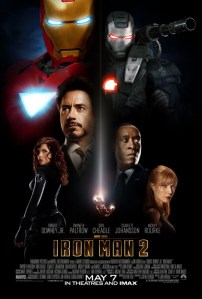
Tony Stark (Robert Downey Jr.) is a self-made superhero and now the world knows that he is indeed the metallic warrior, Iron Man. Stark refuses to hand over his technology to the government, saying he has “successfully privatized world peace.” He appoints his girlfriend/loyal assistant Pepper Potts (Gwyneth Paltrow) to CEO so he can devote his time to ridding the world of evil and lapping up the fame that goes with being Iron Man. Lt. Col. James Rhodes (Don Cheadle replacing Terrence Howard) is concerned for his buddy but also eager to help play around with that super suit. But not everybody loves Tony Stark, notably Justin Hammer (Sam Rockwell), a rival weapons dealer aiming for a Pentagon contract, and Ivan Vanko (Mickey Rourke), a Russian scientist who blames his father’s exile from America and Siberian internment on the Stark family. When Hammer sees Vanko’s attack at a Monaco speedway, he knows he has found an ally against Stark. Hammer whisks his newest Russian friend to New York and enlists his expertise in creating an army of super mechanical fighting suits.
 The screenplay by actor-turned-writer Justin Theroux (Tropic Thunder) is overstuffed with people and events all fighting for screen time and narrative dominance that it starts to become unintentionally comical after a while. There are too many storylines jostling for control when any one of them could have comprised a whole movie: military demands to have the suit, Tony deals with blowback from being the most famous man in the universe, and escalation (others trying to top Stark). Don’t even get me started on how Iron Man 2 bends over backwards to advertise that future Marvel Avengers movie lead by Nick Fury (Samuel L. Jackson). I mistakenly believed that the trailers ended before my movie started. There’s a storyline where Tony’s blood is becoming infected with a dangerous chemical every time he uses the Iron Man suit, so being a superhero is literally killing him. You can work with that for some pathos, debating the needs of one man vs. the needs of society and the greater good, personal sacrifice, mortality, legacy, but it all gets way too easily resolved in an absurd way (all I’ll say is, thanks Mad Men‘s Roger Sterling!). It tries to up the ante when less would have been considerably more.
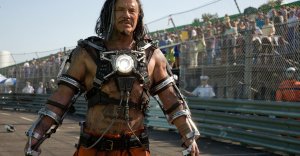
Most of the new characters feel poorly integrated, further causing distraction to any attempts at narrative cohesion. Iron Man 2 also pushes Johansson into the mix so that she can shake up the Tony/Pepper relationship and, plus, she looks good in a skintight cat suit. But her third wheel/love triangle status is barely touched upon and Johansson gets one solid action sequence where she takes out a litany of goons in a hallway with the amazing power of her spinning thighs. Johansson is mostly just another assistant to take notes in the background, although she does it beautifully. The Rourke scenes are few and far between. They establish him as an intimidating force and then he pretty much sits in a room tinkering with stuff, garbling Russian, and feeding his cockatiel for the rest of the movie. He never feels like a real threat or a true match for Tony. Rockwell is the more appealing, slimy villain of the duo, aided by Rockwell’s exasperated bellowing and desperation for the spotlight. Hammer is more interesting to me than a Russian ex-con that rarely speaks, let alone speaks in English. He’s given so little opportunity to develop Vanko as a character. And yet Gary Shandling, as a smug senator trying to make Stark accountable to the U.S. military, might be the film’s best villain of the bunch (curious side note: Shandling and Rourke look oddly similar).
 The personal relationship between Tony Stark and Pepper Potts was the heart of Iron Man. They had that snappy, droll, screwball comedy-esque give-and-take, with hints of something more underneath. This time, the movie doesn’t even speak about their relationship at all, like it never happened in the first film. That scene where she kisses his Iron Man helmet, tosses it out the belly of a plane, and he dives off uttering, “You complete me”? Not in the film. You start to wonder why the movie is being purposely vague and it gets maddening. Their relationship lacks the frustration tinged with flirtation and replaces it with agitation. Both Tony and Pepper are harried and on each other’s last nerve, which doesn’t make for much romantic traction. Their chemistry seems to have dampened. I’m kind of with Pepper on this one because Tony Stark might be even too obnoxious in this movie. Following the sequel-it is code, Tony’s egotistical behavior is expanded and he becomes prone to self-destructive behavior, getting riskier and riskier, pushing others away including, perhaps, decent portions of the audience. He’s stopped being the cocky, likeable arrogant playboy and transformed into a bit of a rich douchebag. Part of this is related to the storyline about the suit literally killing Tony, and his character’s alcoholism featured heavily in the comic books, but it’s just another plot element that feels like it was put in for momentary conflict and then easily resolved or dropped. I understand Tony will be his biggest antagonist but that didn’t stop the first Iron Man film from flying high in entertainment.
The first Iron Man had an unexpected low level of action for a summer movie, but because of the characters you didn’t care. It was that rare comic book movie where you wanted more dialogue and fewer sound effects. To be fair, Favreau and crew saved a pretty nice Iron Mano y Iron Mano fight sequence at the end. Following that narrative lead, Iron Man 2 is structured pretty much like the first when it comes to action. There’s the attack at the Monaco raceway, which features an unrealistic, cartoonish tone that conflicts with the rest of the flick. But the film’s biggest moment of sustained action is the climax involves Tony Stark versus a bunch of silly killer robots. Soulless robot drones don’t get very compelling, plus haven’t we seen a thousand movies where people combat killer robots? What’s more disappointing is that Favreau incoherently stages the action. It’s not due to any sort of hyperactive editing, no, the culprit is that the onscreen action is just moving way too quickly. As a result, much of the action feels like whooshes of color. It’s hard to adjust your eyes to the rapid movement and process what exactly is going on. Because we can’t follow the action the whole thing lacks tension, danger, and drama. I wanted to be blown away by the action, which has several trailer-ready moments of awesome, but mostly I just wanted to be able to understand what I was watching.
 Despite all my complaints, Iron Man 2 still manages to be a fun time out at the movies. Downey is always immensely talented and brings great amounts of energy to the role, centering the movie on his witty charms. While his character is less engaging this go-round, Downey is still on top of his game. Rourke, Rockwell, Paltrow, and Johansson all contribute fine performances when they’re on screen. The low output of Iron Man in suit is compensated by having TWO Iron Men, thanks to Rhodes donning the metal gear and fighting alongside his pal. The opening of this movie captures your interest fairly well, though it loses it again thanks to slack pacing and an influx of new faces. The tone of the movie takes a cue from Downey and the movie as an agreeable, comedic feel without seeming overly glib. And hey, the special effects are pretty nice, too. Iron Man 2 is an adequate popcorn movie but the tragedy of the movie is that the first film was much more than adequate. I think the Iron Man film franchise is in need of a slight upgrade.
Nate’s Grade: C+
Share this:

Moon (2009)
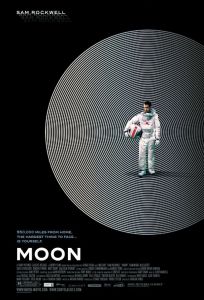 David Bowie’s son, Duncan Jones, directs two Sam Rockwells in this steely mood piece. Rockwell plays a lunar astronaut about to complete his three-year tour of duty when he finds another him. Is he hallucinating? Is this other Rockwell a clone? Who is the clone? The mystery unravels at a nice pace and Rockwell a pair of great performances, fully giving each character a different personality. Jones uses his small space to great use, multiplying the feeling of cabin fever more so than claustrophobia. Some will chafe that Moon doesn’t spell everything out, but the movie is smart enough to leave other things to the imagination. Moon tells a very specific, very select story and it does so with great economy that serves the story. This is Rockwell’s showcase and he carries the movie and nails the nervous breakdowns. For people let down by Hollywood’s slate of sci-fi duds, here is a satisfying small-scale sci-fi story told with intelligence and subtlety.
Nate’s Grade: B+
Share this:

Snow Angels (2008)
 Director David Gordon Green is likely the most observant auteur today when it comes to exploring the realities of life in small towns. Snow Angels is a somber drama that follows an estranged couple (Sam Rockwell, Kate Beckinsale) going through the hard times of life in a snowy rural town. The couple is also beset by some tragic accidents that come in at the appropriate time, an hour into the film, which means that we’ve gotten to know the characters enough to build a relationship with them and also that there will be plenty of time left to watch these characters react. The movie has a handful of interrelated characters that don’t all sustain the same level of interest. Watching a band geek lose his virginity to a smart girl (Oliva Thirlby, deflowering her second 2008 virgin) is just not comparable to other storylines. Snow Angels has an astute sense of resignation throughout, like the characters know they will forever be stuck in dead-end jobs and live the rest of their lonely lives as fated. The movie takes some very dark turns but they feel authentic to the drama. Green creates such a rich portrait of despair and the inequities of small town life.
Nate’s Grade: B
Share this:

The Assassination of Jesse James by the Coward Robert Ford (2007)
 This is a harrowing, haunting, beautiful, mesmerizing movie that is easily one of the best films of 2007. Casey Affleck is an acting revelation as Robert Ford, the man who worshipped Jesse James and obsessed over him before eventually turning sour and killing his hero. This languid Western, paced at 2 hours and 40 minutes, establishes a mood of gnawing paranoia as the law closes in and Jesse suspects his gang members will betray him. The day-to-day worry and dread of a life of crime really translates, and Jesse James proves an intelligent, unstable leader to mix the pot. The movie builds slowly but the tension grows unbearable and puts knots in your stomach. The acting is outstanding all around, and Brad Pitt proves a great choice for a 19th century American icon weary of his legendary status. The movie presents a fascinating peek into Jesse James’s gang and presents a wealth of historical information, none more intriguing than when the public turned on Robert Ford for terminating one of American’s folk legends. The narration provides sharp, illuminating details in brief expository scenes, and thanks to Roger Deakins’ stunning cinematography, Jesse James is an authentic period picture that is a marvel to view. I was awed by this artistic achievement that still resonates with me long after I finished watching. This film simply envelops you.
Nate’s Grade: A
Share this:

The Hitchhiker’s Guide to the Galaxy (2005)
 I’m a big fan of the late Douglas Adams’ series, so going in I had a slate of expectations but also a working knowledge of this kooky universe. I really don’t think this film will work for anyone but the fans. The movie isn’t even structured like a screenplay, it has more of the novel’s loose loopy feel. Some things work wonderful, like the Vogons, giant marvelous looking puppets made by Jim Henson’s studio. The cast is mostly excellent (Alan Rickman steals the show as the voice of Marvin, a very depressed robot). The animated guide entries in the Hitchhiker’s book are colorful, stylistic, and witty. Somethings, however, don’t work at all. The additions to the story, an increased romantic angle between our lead Arthur Dent (Martin Freeman) and Trillian (Zooey Descehanel) as well as a flat happy ending that rewrites all the opening danger. The Hitchhiker’s Guide to the Galaxy occasionally serves up some juicy bits of wacky humor or visual fantasy (John Malkovich’s bit part is weird) but unless you were a fan of the book series, you’re really not going to be able to follow along or have any interest in keeping up.
Nate’s Grade: C+
Share this:

Confessions of a Dangerous Mind (2002)
 The premise is undeniably amusing: game show host and creator Chuck Barris (Sam Rockwell) in between escorting Dating Game couples and introducing Gong Show losers, was a hired killer for the CIA. The directorial debut by George Clooney is impressive on a technical level. Clooney is inventive with scene changes, camera angles, lighting, editing, color palettes … I don’t know whether to champion him or credit his excellent cinematographer, but hats off to whomever designed the look of this movie. Rockwell is great and carries the film well, though I think he lacks the proper ability for self-loathing that the character needs. The brilliant weirdness of the story is tempered by famed scribe Charlie Kaufman’s astute sense of the intricately bizarre. Kaufman is a master of the offbeat, but he does more with his story structures and the ability to keep surprising than any other screenwriter. Confessions of a Dangerous Mind is a cheeky diversion into the unauthorized autobiography written by Barris himself. The movie itself is one big joke and Clooney tells it like a pro.
Nate’s Grade: B+
Share this:

Charlie’s Angels (2000)
 These angels aren’t exactly what your father was enjoying when your mother was away fulfilling errands. These angels aren’t delegated as mere sex objects running around providing the jiggle entertainment that is (or was) supplied by today’s Baywatch. The 90s is a different decade after our minority movements and today’s woman is just as apt to do a flying kung-fu face plant into a baddie as any man. The angels of the film are action heroes for an armada of small girls needing some female empowerment when their only other choices consist of a barely clothed Britney or a barely covered Christina. These angels aren’t just the sex objects that the classic assortment of angelic 70s stars were; these angels are also tough-as-nails, resourceful, and not afraid to tussle or tango. Now that this exposition is out I can concentrate on the scattershot film Charlie’s Angels.
The film has been rumored to have at a minimum of 17 writers who tried shaping a story for Cameron Diaz, Drew Barrymore, and Lucy Lui. The story is pretty much shelved toward the back so the forefront is our trio of ladies kicking ass then shaking it with zig-zaggy and wild camera movements from debut filmmaker and video director McG.
Charlie’s Angels is whiz-bang dumb fun. The overall feel of the film is something more difficult to get a grasp on. At times it shows itself as tongue-in-cheek and satirical but then at other times it seems overly serious or overly dumb. The characters are non-existent and basically only discernible by hair color. The characters are very wooden and I actually found more enjoyment watching the villains and seeing more of them; call it the Austin Powers dilemma. Diaz makes the only notable attempt as her goofy and light-hearted angel connects with the audience best. Lui plays a techno-babe dominatrix but is easy to see that she was the last angel chosen and doesn’t exactly gel with the others as much as she could have.
 Charlie’s Angels is best when the action is pumping. The scenes are cut together in a jam-packing sequential way adding distinct flavor and style. McG is a true surprise in the effectiveness he can orchestrate his action motifs even if the Matrix effects and moves make absolutely no sense in the real world.
Crispin Glover shows himself as a silent assassin nicknamed “the thin creepy man.” Glover is so suave and slick in his role of the non-verbal Oddjob henchman role that he exhilarated me with every presence he made on screen. Goodness, he was too cool in this film and everyone gets brownie points for allowing him. He has such energy and charisma that I wanted the film to veer off into him and desert our angels. Seeing our ageless McFly perform action scenes and choreographed fights is something I will be pleased with until my grave. seeing Crispin in the excellent Nurse Betty and now huge exposure in this is a true joy. And man… he smokes a cigarette way too cool every time he’s in this film. Some people can smoke cool some of the time but Crispin does it all of the time. His mere presence almost cancels out the annoyance of Barrymore.
The line is drawn with Charlie’s Angels in that it’s sex-kitten jiggle and an acrobatic arrangement of (light) feminism and humor. These gals know they’re sex objects and they’ll use it to their advantage delighting in every second of it. Therefore, you could argue successfully that Angels is exploitation hiding as meaningful but hell… why think about this stuff? The movie rolls along at a fast pace where you don’t keep track of these issues. It’s just an easy sit down.
The gigantic success of Charlie’s Angels makes sequels and a possible franchise all but certain. I’d be happy for McG to hop back in his directorial chair but have a unique idea for Angels 2: Bigger, Longer, and Uncut… it involves Glover kicking a lot of ass really cool like.
Nate’s Grade: B-
Reviewed 20 years later as part of the “Reviews Re-View: 2000” article.
Share this:

The Green Mile (1999)
 A prison in the heart of the deep South during the era of the Great Depression is not usually the locale you’d find a somber tale of earnest discovery and passionate awareness to the follies of life. Yet here arrives the long anticipated The Green Mile, the second in tag-team efforts from director Frank Darabont and novelist Stephen King in their own genre creation of nostalgic feel-good prison flicks. All the swelling hype could manage to make the movie seem overbearing, but if you’ve got a free afternoon and a butt made of steel then try The Green Mile.
Darabont seems like the perfect visual interpreter to King’s epic narrative spinning of good, evil, and all that fall between. The movie moves at the pace of molasses and clocks in at over three hours in length. Not exactly audience friendly fodder but one and all will be grateful for the decisions taken to build character development and tension instead of blindly rushing through.
Tom Hanks plays a prison guard on the Death Row block of a Southern penitentiary. Despite the bleak and grim surroundings his humanity still shines through. He escorts and oversees the final moments of many men’s remaining breaths along the final walk of green linoleum tile to the electric chair. Enter one mysterious morn John Coffey (Michael Clark Duncan), a towering giant that seems to break all the rules each of the guards on cell block E has come to realize through their years. Coffey has been convicted of the rape and murder of two little girls, but as Hanks soon learns things aren’t always what they seem. The 7-foot miracle worker displays scenes of empathetic healing like to Christ himself. Hanks views are turned and his eyes open, and that’s just the beginning of the heartstrings being pulled. To release anymore of the plot would be a crime punishable by Ole’ Sparky himself in the Green Mile.
 The pacing is smooth and wrings out every droplet of mystery and drama needed. The Green Mile‘s comprehensive fable quality transcends the period just like The Shawshank Redemption did as well prior. ‘Mile’ should be expected to be a front-runner for Oscars when balloting begins.
The ensemble acting is magnificently eclectic and truly inspiring. Hanks’ name is so synonymous with Oscar that he might as well shave his head and paint his body gold because come nomination time this man’s name is going straight to the ballot. Other stars give thoughtfully deep and refreshing performances guaranteed to turn a few heads. Duncan’s gentle child-like giant is serene and a benevolently touching figure of innocence and warmth. But one can not forget the presence of a very special rodent by the name of Mr. jingles that deserves billing above the credits itself for the quality performance it puts on.
The Green Mile is a sad, touching ,and rather powerful movie that speaks to the viewer’s emotions and gladly earns every one of them. In the end The Green Mile is nothing beyond a long yarn of a fairy tale; but one told so exceptionally, one performed so extraordinarily, and one directed so deftly that you’ll gladly journey down that mile with ease.
Nate’s Grade: B


You must be logged in to post a comment.