Blog Archives
Emancipation (2022)
 There is a question with every new movie depicting the Holocaust or slavery or some other horror of the past, why do we need this still? It’s a suitable question but one that rests upon the fleeting assumption of history being settled upon. “We all agree slavery was bad,” some opponent might say, “So why do we need another movie to convince us what we already know?” One need only look at the last couple years and the diverging controversies over teachers covering the ills of America’s past with clarity, and it’s clear that the idea of settled-upon history is an illusion. There will be people arguing slavery wasn’t as bad as history has perpetuated, that even the Irish experienced something similar as indentured servants (but they were still legally viewed as people). Some will erroneously argue that slaves were there by choice, or that their masters weren’t all cruel, and that even by having a roof over their head and the bare minimum for sustenance that they were “looked after.” There are battles happening all over the country, with one side trying to present the evils of slavery in an unvarnished manner and the other trying to obfuscate, mitigate, or distract from the facts because accepting a reality that your country has made mistakes somehow means being unpatriotic or loving your country considerably less. So to answer the question, as long as we have others denying history for political expediency, then yes, we need more media to remind us that the horrors of the past were indeed horrific. With that in mind, Emancipation is meant to be a rousing spectacle about one man’s incredible fight for freedom, but what it really comes across is a fumbling awards movie as awkward action movie.
Peter (Will Smith), or known as Gordon, is separated from his family and forced to work on the Confederate railroad in 1863 Louisiana. He hears about President Lincoln’s Emancipation Proclamation freeing the slaves and believes if he can just get to a Union camp, then he can return to his family. Peter fights back and escapes into the swamps and heads for Baton Rouge, a five-day journey. On his trail is the dangerous slave catcher Jim Fassell (Ben Foster), who will stop at nothing to secure Perter and prove his racial superiority to his fugitive.
 There are two competing impulses running through Emancipation that never seem to coalesce, always pulling the movie in opposite directions or at least undercutting its value in entertainment or substance. On the surface, Emancipation looks like an awards-ready spotlight. It’s got Will Smith playing a real-life historical figure who suffered greatly but triumphed in the end, a man whose image lives on in our history books (well, depending upon your state) and contributed to the abolitionist movement. He was a real person who made a real difference during a tumultuous time. I get a strong sense that Smith was following the 2015 template of Leonardo DiCaprio’s The Revenant for this project, and especially the Academy-friendly model of physical torment equaling Oscar gold as it did for Leo. It’s hard not to feel like the movie was formulated as an awards gamble, that sizing up all the elements, Smith saw a fast track back to the Oscars (this was in production before Smith did win his first acting Oscar for 2021’s King Richard). Naturally, Smith isn’t the first person to select Oscar-friendly roles for the purpose of earning some serious acting trophies. Nor should he be inordinately penalized for that ambition. All that matters is the end result, and it’s there where Emancipation struggles with its own identity crisis and where its transparency becomes a hindrance.
This movie wants to be a substantive drama that can enlighten us about the perseverance of the human spirit, and for the first thirty minutes Emancipation feels honed from the likes of 12 Years a Slave. Then at the Act One break, Peter and several other slaves break free, and from there the story becomes a tense chase movie for an hour, only to conclude its final half hour as a war movie akin to Glory. It’s a tonal balancing act that doesn’t quite work. I was interested in the first 30 minutes, which establishes the brutality of slavery in a way that feels empathetic but tasteful. It’s a question whether or not historical horrors should be watered down, made palpable to a wider audience, and if in doing so dilutes the power of history, but that’s another debate. When the movie becomes an elongated chase sequence is where my patience began to wane. This is where director Antoine Fuqua really seems to settle in, playing into his background of action movies (Training Day, The Equalizer, Olympus Has Fallen, The Magnificent Seven). Fuqua’s instincts are for action movies, and that’s what Emancipation becomes, but it so clearly wants to also be Something More and doesn’t quite accumulate into that. The Revenant stretch is reliant upon episodic survival and the final half hour is about a war charge. I suppose one can be generous and say that Peter’s canny survival skills are overt characterization, or that the environmental threats are representative of a larger hostile world, but the action movie parts were pretty to look at but also emotionally inert for me.
 I considered the lead character in 12 Years a Slave to be the least interesting person in his own story, but the movie found plenty of space for more immediately compelling figures. Not so with Emancipation, as once Peter goes on the run, it feels like overall characterization is put on hold. Smith is perfectly reasonable as a determined and dehumanized individual pushing back against the monstrosity of slavery, restricting much of his performance to the physical realm. The sheer intensity of his eyes can convey plenty that the script characterization lacks. Smith lowers his voice modulation, adopts an inconsistent Haitian accent, and gives a rather subdued performance given the sensational material. I think it’s because the film is geared more as an action movie rather than as an in-depth character study, so when we’re left with the characters, their limitations emerge.
This paucity also extends to the supporting characters. At first I thought that Charmaine Bingwa (The Good Fight) was going to be relegated as the suffering wife for our protagonist to get home, but then the movie keeps cutting back to her like she’s having prophetic dreams. What is happening here? The check-ins with Peter’s wife all deliver the same obvious information, namely his family misses him. This woman doesn’t even get a storyline of her own in the meantime, a conflict to overcome to keep her family out of further harm in the absence of Peter. The biggest supporting character is the villain, and even he is boring. Foster made a name for himself playing psychopaths in late 2000s cinema and has matured with more nuanced roles in The Messenger, Hell or High Water, and Leave No Trace. He’s one of our best actors, and yet he’s given so little here. His slave catcher gets a monologue that’s meant to provide insight into his admiration for the intelligence of black people. I kept waiting for something more with this guy to define him beyond a stock racist. I guess maybe the movie is saying he’s not as racist because he begrudgingly concedes that slaves aren’t stupid, but he’s still massacring them, so it feels like a minimal distinction of character. He also gets defeated in such an anticlimactic manner. If he’s only a stock villain, at least give us the thrill of defeating him.
 The cinematography by Robert Richardson (Once Upon a Time… in Hollywood) is at once gorgeous and also confounding. The emphasis is on deep focus, so you can see lots of rich details in elegantly framed compositions. There are sweeping camera movements, especially during the war-torn finale worthy of Matthew Brady, that are breath-taking, again calling attention to its handsomely mounted pedigree. However, the color palette has taken notes from Zack Snyder and drained away all color to the degree of looking monochromatic. Repeatedly throughout the movie, I would comment to myself about how beautifully filmed a scene was… and then complain about how the dour color grading sucked the life out of it.
Emancipation is a genre movie that envisions itself as a high-minded Oscar contender, and when it attempts to be something more than a crisp-looking chase movie, that’s where it exposes itself as lacking the substance it so desires. The life of Peter, or Gordon, is meaningful, the person behind the famous photo of the scarred back that made the cruelty of slavery a vivid picture. The experiences of every person who endured the hell of slavery is an indictment worthy of being told, but the personal story becomes grounded down into familiar B-movie pap. If the production was content to be a thrilling B-movie, that would be one thing, but it’s clearly engineered to be Something More, which is usually adjacent to Something Important. I think following The Revenant as a model was a mistake, and I think giving the reins to Fuqua was a mistake, and I definitely think the limited characterization and color palette was a mistake. Emancipation is a strange movie to watch. It’s about the horrors of slavery, and it’s also at the same time about a man wrestling a gator in the swamp. Emancipation is a movie that wants to pretend to be something it’s not but also won’t fully trust its deeper instincts and impulses.
Nate’s Grade: C+
Share this:

Bones and All (2022)
 What do you get when you team up Oscar-nominated director Luca Guadagnino, twee handsome man Timothee Chalamet, and the ravenous consumption of human flesh? You get the new indie drama Bones and All, a literal love story between cannibals. It’s boy-meets-girl-meets-dinner.
It’s 1980s Reagan America, and Maren (Taylor Sheridan) is in high school and not allowed out to parties for a good reason. Her father (Andre Holland) nails her bedroom window shut, and we soon realize why when, at a slumber party, Maren eats one of her friend’s fingers. It’s back on the run except Maren’s father has finally had enough. He leaves her behind one morning with a tape recorder to explain. Maren travels to the Midwest and discovers other Eaters, those afflicted with her same impulses. One of them is the young man Lee (Chalamet), who Maren decides to follow. They can look out for one another, but what’s to be done when the hunger strikes, and how far will they go to feed?
 Bones and All is a doomed Romeo and Juliet romance with its own provocative subversion. I was hooked for the first half of the movie, as the script slowly revealed that these cannibals are born this way and their compulsion may also give them super powers, like the ability to smell their own kind as well as key characteristics, like a last feeding or even when a person may be close to death. The movie plays along the fringes of a monster or superhero formula, where we have people with extraordinary abilities, or a curse they must keep hidden depending upon your perspective, and how this challenges their vulnerability and sense of self. It’s reminiscent of vampirism, the need to feed, so we’ve seen aspects of this kind of story dozens and dozens of times, but the world and rules can still be engrossing to learn. Maren and Lee trade stories of their “first time,” though in this context it’s the first time they fed on human flesh, and it so happens both are with a traumatized babysitter. It’s a morbid bonding experience but such is partnering with a person who shares your unorthodox appetites. I was getting shades of Bonnie and Clyde, with our cross-country duo keeping on the run, and also Let the Right One In, where a man is reluctantly killing in order to feed and protect his ward. There’s also the 2017 French film Raw with a young woman discovering her family trait of cannibalism. The source material of Bones and All is a 2016 YA novel by Camille DeAngelis and the script feels very much like the total of its many pop-cultural and literary influences.
There’s still something compelling here about two oddballs finding a person who understand their unique situation. The addiction analogy is apt and provides an interesting discovery, as both Maren and Lee inherited their eating habits from a parent similarly affected. Maren’s search for her biological mother is a solid direction as it also promises a search for answers. Russell (Netflix’s Lost in Space, Escape Room) is an understated but captivating lead. Her character has never been out on her own and doesn’t know much about a larger world of Eaters, so every encounter is her stretching her boundaries and discovering what she is capable of. She also needs to learn how to better live with her impulses, or whether she even can, and being paired with a more experienced companion allows her to explore those feelings with better understanding. Chalamet (Dune) is part scraggly drifter, part twink prostitute, part deceitful vampire, and part sensitive boyfriend. In other words, he fits right in as a brooding Byronic love interest that Maren questions how close she can allow herself to be in his presence. The us-against-the-world sensibility of young and/or forbidden love is amplified with the extra genre trappings. In many ways, Bones and All feels like a strange amalgamation of Guadagnino’s last two movies, the 2018 gory remake of Suspiria and the 2017 tender gay romance, Call Me By Your Name.
 Where the movie starts to lag is its second half, which is built upon two conflicts that feel inadequately developed. The first, and biggest, is the relationship between Maren and Lee. It’s natural for Maren to be wary of Lee early on, especially with how much is at stake if either one of them. There’s also the danger of being alone with a cannibal, much like befriending a wild animal and always having to keep one eye open. It becomes a guessing game of trust and compulsion, can either control their urges? However, the romantic coupling between Maren and Lee felt very distant, as if the movie intended for them to be these star-crossed lovers and instead both of them looked at each other and shrugged and settled on being friends. It’s not that there isn’t really any heat or chemistry there. I can ignore that when both members are struggling to control how much of themselves they offer to the other. It’s a relationship built upon mutual survival and the occasional make out, but the difference between the two of them is at once emphatically stated and then casually ignored. The big hiccup for a Maren/Lee relationship seems to be that Lee will kill people in order to feed and Maren disagrees with this. You would think over the course of their time together the movie would follow one of two directions: 1) Lee’s willingness to kill for food becomes more extreme and Maren is pushed away, or 2) Maren begins to share in Lee’s willingness to kill and changes her moral outlook. Neither of these really happen, so when Maren considers leaving Lee’s company, I was left wondering what changed. He’s presented as dangerous, but he doesn’t become more unhinged, and there isn’t a point of no return for their relationship. I didn’t feel much when this union was arbitrarily was put on pause.
The other conflict is an external one and a nag. I thought there would be more attention about Lee and Maren having to hide from encroaching law enforcement. Instead, it’s another Eater who becomes a stalker, and this character would have been best served as a one-sequence passing weirdo. The reappearances feel contrived and poorly integrated once the fledgling Lee/Maren relationship takes center stage. There isn’t enough to the character to deliver with multiple appearances. The fact that this character plays such a big role in the second half is a letdown. If Lee and Maren were worried about people coming after them, why not the police tracking them for the murders they leave behind? Why not even a gang of Eaters that have decided there is even more security in number and have no compunctions over eating their own kind? That topic isn’t even explored, whether eating an Eater would be even more compelling. You could even have someone deem themselves a Super Eater who seeks out other Eaters to consume, either because he or she feels they are an even more exquisite taste/addiction, or because they have a self-righteous sense of purpose and feel eliminating other Eaters will protect the innocent they feed upon. It’s not even expressed whether they have to eat living people or if old corpses could suffice. There are different external threats that could have been better developed and integrated, so it’s a shame that the one we have is given so much more attention than deserved.
 With every movie, it’s important to judge what you’re presented rather than what could have been; it would be unfair judging a hamburger at a restaurant for not being a pizza. Still, I felt like the more compelling perspective to tell this cannibal love story was a parent protecting a child rather than as disaffected teenagers. I thought following Maren’s father from raising her and realizing she had a problem but ignoring it until he couldn’t, and then his challenges to reign in her impulses, would be the more compelling and dramatically charged point of view. It doubles down on the theme of what a parent would do for their child, as well as the personal fear of every parent whether they are capably raising the child to be a moral and self-sufficient adult. Then you mix in the possibility of the genetic lineage for cannibalism, and you can have the parent trying to pass down their knowledge to their progeny or the parent feeling immense guilt for bringing this would-be innocent into a situation that may spell their doom. Every time the narrative went back to Maren listening to her father’s audio narration, I felt like I was getting a bigger picture of the weight of the years of raising Maren. I suppose that also might lean a little heavily into a similar Let the Right One In dynamic. I understand that Bones and All is an adaptation of a YA novel and young outsider lovers is par for the course with the genre, so I wouldn’t expect such a radical adaptation even if it feels like a superior story perspective for drama.
Even as things didn’t fully come together for me, I was always interested in Bones and All for its two-hour duration. It’s not every day that genuine artists are putting their all into a love story that also involves chewing the nipple off a dying man. It didn’t really work as a romance for me because I didn’t really feel invested in the coupling of our main characters. There is so much more intriguing dramatic potential here with these story particulars that I can’t help but feel slightly disappointed by the end results hewing very closely to YA staples. More could have been explored in the romance, especially what nourished the attraction and what would compel Maren to rethink her feelings. As a gauzy, young lovers-against-the-world drama, it has its melancholic pleasures and diversions, one of which is that it was filmed primarily in southern Ohio. It was also filmed in Columbus, so I got to point to the screen and say, “Hey, I recognize that Greyhound bus station” (that was the extent of the Columbus filming, one five-second external cutaway). Bones and All can surprise plenty of viewers, and I’m positive many will be swooning from its mixture of romance and depravity, but the bigger surprise for me was that it left me ultimately hungry for more of everything.
Nate’s Grade: B-
Share this:

Rosaline (2022)
 Rosaline is a new romantic comedy in the vein of the meta Rosencratz and Guildenstern are Dead, playfully re-imagining Shakespeare’s doomed romance in a much more light-hearted rom-com tone. For you see, dear reader, Rosaline (Kaitlyn Dever) was the young woman who Romeo (Kyle Allen) was infatuated with… until he met Juliet (Isabela Merched), and then it was all Juliet 24/7. Rosaline is the spurned lover trying to regain her former boyfriend with the help of a handsome suitor and her gay best friend, Paris (yes, the one supposed to marry Juliet away from Romeo in the end). Rosaline is a delight for several reasons, chief among them the quick-witted screenplay by the Oscar-nominated pair Scott Neustadter and Michael H. Weber (The Disaster Artist, 500 Days of Summer) and the eminent charms of Dever as a forward-thinking, snarky, exasperated woman bumping against her society’s demands. Dever makes every joke that much better and is so charmingly diffident. We may know the story of Romeo and Juliet, but the fun of the movie is how it subverts our expectations or presents goofy answers around the peripheral of the main story, like how Rosaline was manipulating actions from afar, sometimes unintentionally. The tragic tone is replaced with something much more cheery and amusing, and that might irk diehard fans of the Bard. I found it to be a winning and irreverent low-stakes re-invention of a literary classic, elevated by charming performances and a beguiling and clever screenplay (I’m giving credit more to the screenwriters than the source material novel, as it had many one-star reviews on Good Reads). For fans of Shakespeare adaptations with a feminist twist, check out Rosaline and fall under its star-crossed spell.
Nate’s Grade: B
Share this:

Catherine Called Birdy (2022)/ Sharp Stick (2022)
Lena Dunham is a controversial creator, even more so since the conclusion of her hit HBO comedy Girls back in 2017. I’ve been a fan of her creative voice from the very first episode of Girls, and I appreciated how well she could write self-involved, self-destructive, myopic characters and her directing instincts as well, all at the age of 25. From her zeitgeist-tapping TV success came Lena Dunham the brand, the industry, and with that her feminist newsletter, book deals, personal appearances, and a perennial case of foot-in-mouth syndrome. It makes it more difficult to carry that fandom when the figure says cringey things like she wished she had had an abortion to better understand the plight of those who have. Some of the early criticisms against Dunham were simply mean-spirited, like gross insults regarding her body and her penchant for nudity on her own TV series, as if women don’t exist who resemble Dunham’s shape. However, with each new public example of bourgeois entitlement, I began to wonder whether Dunham’s satirical skills at sizing up self-involved characters was maybe a little less satirical. I’ve been curious what creative projects Dunham would gravitate to next. Her first was Camping, a short-lived 2018 remake of a British comedy that was cancelled after one season. But aside from producing some more HBO shows, and occasional acting appearances like in Once Upon a Time in Hollywood, Dunham has been relatively silent. And then in 2022, she had two new movies as writer and director. I thought it would be telling to review them both together, as they share many similarities, and as further insight into Dunham as an artist still exploring her voice.
 Sharp Stick was released first, though only a couple months before Catherine Called Birdy. Both movies are coming-of-age comedies about young women finding their place in a world that is all too ready to package them into tidy offerings for male desire. Both movies are about their plucky heroines pushing social boundaries and being exploited by lustful men, but one of these films is far better developed, more charming, and with clear ideas and consistent commentary. In short, watch the delightful Catherine Called Birdy and skip the rather dulled Sharp Stick.
Catherine Called Birdy is based on the 1994 children’s book by Karen Cushman and modeled as a young girl’s diary from thirteenth century England. Catherine (Bella Ramsey) is the only child of the lord of a small village. Her mother (Billie Piper) has suffered five miscarriages or stillborn births, and her spendthrift father (Andrew Scott) is bewildered at what to do with his headstrong daughter. She’s 14 and rejecting her father’s assembly of suitors, as he tries to marry her off and recoup some money to stabilize the family’s looming debt. Catherine narrates her very important year where she starts her period, hides it, and learns about love and life and finding her place.
Right away, I was taken with the sprightly energy and strong personality of our narrator, who would prefer to go by Birdy, thank you very much. We open with her literally slinging mud with the neighborhood kids and laughing and wilding out, enjoying the thrills of being young. The contrast of the movie will hinge upon the distinction of what is childish and what is mature, as these youngin’s are thrust into adult roles because society says that as soon as they can menstruate, they are ready to be married off and become baby factories. Birdy is angry with her mother for continuing to try and have children, especially after the painful recuperation of burying sibling after sibling. She resents the idea of being a mother, and especially so early into a life that still feels bound by the stirrings of being a child. Girls should be allowed to be girls, she demands, and by that she means running around, talking with her friends, and absent the pressures and limitations of adulthood. She’s defiant against the larger Medieval system of valuing women for their fertility. Dunham is smart enough to frame the movie in credible terms. It’s not like Birdy, through her tenacity, is going to overthrow an entire centuries-old system of gender norms, but the story is positioned in more personal terms, in breaking through to her father to see her on her own terms rather than as a convenient investment portfolio. That’s more achievable and will be more gratifying for us because of what winning him over will mean.
 The movie is also fast-paced and funny, with Birdy’s casual and catty observations delivered in quick succession. In some ways this reminded me of a Medieval version of 2011’s Submarine, another charming indie coming-of-age movie with an eccentric pop-culture obsessed teenage weirdo. There’s Medieval covers of contemporary pop songs strewn throughout for a youthful energy, and lots of onscreen titles and graphics that have their own jokes. The disconnect between Birdy’s viewpoints of the world and the common ways of thinking provide snarky commentary and plenty of progressive attitude. It’s a constant entertainment to watch this precocious little lady tweak the gender and social norms, riling up buffoonish and fragile male psyches. She’s an upstart, and there’s joy in watching her upset those in power and privilege, though she too is reminded of her own privilege considering she is the daughter of the lord and not merely some dirt-poor peasant. If it wasn’t for the sharp character-focused writing, Ramsey’s performance wouldn’t achieve the same comic and emotional heights.
Ramsey was a supreme scene-stealer on Game of Thrones, so much so that producers turned a one-scene part into a multi-season role, even giving her a badass death scene. Ramsey is the anchor of Catherine Called Birdy and perfectly in tune with her character’s feisty yet limited worldview. She’s such a winning character and represents our more modern worldview chaffing up against the very real reality of Medieval life. In some ways, she’s a case study in having to grow up too soon, and surely not the only woman to have done so. Ramsey is heartfelt and hilarious and headed for stardom (she’ll be co-headlining the HBO Last of Us series along with Pedro Pascal).
 Attaching the audience to this character is a rewarding experience, and Dunham as screenwriter has balanced the adaptation of going from a first-person diary-based narrator into a film world where we can get outside viewpoints that complicate and challenge our perceptions. I appreciated the widened scope of the narrative. It’s not just the women who are expected to perform their social duties. Birdy’s beloved older uncle, George (Joe Alwyn), is definitely in love with Birdy’s best friend, but that marriage will not do. He’s expected to marry from an established pecking order to better protect his family. There’s a village boy who is also clearly gay but will never be allowed to marry whom he loves, again emblematic of plenty of people who would be left behind in this system. Sophie Ookonedo (Hotel Rwanda) appears as a widowed noble lady who speaks about the freedoms she enjoys having “played the game” and waiting her turn, speaking to a possibility for Birdy working within a broken system. She’s savvy but graceful, with the hint of sadness just on the outer edges of her words. Birdy’s mother, Lady Aislinn (Piper), is similar, hoping to make the best of limited options, and trying to ready her daughter for a life she knows she will be ill-prepared for. It’s what any parent feels, trying to ease your child for the reality to come while still holding onto their innocence as long as possible. She has some heart-rending moments especially during a difficult childbirth scene, and it’s that moment that really showcases Birdy’s father, Lord Rollo (Scott). Until this point, her father has been frustrated by his impetuous daughter, but it’s this moment where she, and by extension us, see the depth of his caring for his family. It’s wonderfully played by Scott, and it reminds us that even the stooges and fools of this world have their own hidden depth.
Catherine Called Birdy is also something of a Game of Thrones reunion, pairing Ramsey with David Bradley, Dean-Charles Chapman, Paul Kaye, and Ralph Ineson. It’s like Dunham used the HBO series as a quick casting cheat sheet since she’s already seen them in a Medieval setting. Special mention to Russell Brand (Death on the Nile) who also just kills it in one scene as a confused and easily swayed suitor. I would have loved more appearances from this man but having him continually foiled by Birdy and never learning from his gullibility.
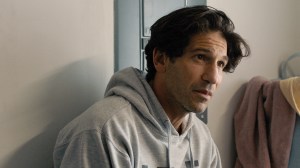
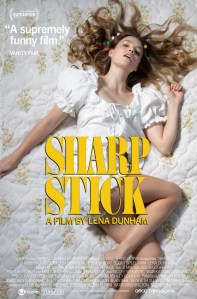 Moving onto Sharp Stick, an original story from Dunham, you can see points of similarity immediately, framing the narrative around the self-discovery of Sarah Jo (Kristine Forseth). She’s 26 years old and still a virgin, a point she feels more uncomfortable about because of how open her half-sister Treina (Zola’s Taylour Paige) and mother (Jennifer Jason-Leigh) are about their own sexuality and their many paramours. Sarah Jo has her sights set on Josh (Jon Bernthal), a seemingly kind stay-at-home dad taking care of his special needs son that Sarah Jo babysits. If she’s going to lose her virginity to someone, she wants it to be him, but with this comes consequences as well as a steep learning curve for Sarah Jo on the realities of intimacy.
My issue with Sharp Stick is that it feels far more dawdling and confused about what it wants to say and explore with its brief 86-minute running time. This feels more like a handful of ideas or short story beginnings that Dunham inartly smashed together, and the proceeding movie has moments of levity and insight but is overall too messy and shambling and underdeveloped. Let’s start off with the main character who I would have assumed was a teenager by the way that she was acting. When the script tells me she is 26 years old, I was flabbergasted. She was behaving like a much less mature adult, not to say 26 is the height of maturity or that everyone matures at the same speed. Still, Sarah Jo comes across as very naïve and infantilized about adult relationships and human sexuality, which is confusing considering how open her family is about sex and pleasure. It’s not like she’s growing up in a conservative or repressive environment. She’s literally helping her sister record twerking videos for her social media account. The chief reason I think Dunham made an explicit reason for aging our protagonist 26 was to remove some of the ickier consent issues from coming-of-age stories about inappropriate relationships between underage teens and adults (American Beauty, Towelhead, The Diary of a Teenage Girl). She wanted to preemptively remove those criticisms, and so she made Sarah Jo 26, and she also had her uterus removed, something meant to make her seem more adult, at least on paper. Except this is the most childish 26-year-old I may have ever seen. The problem is that Sarah Jo’s naivete has shackled her character, so her sexual awakening feels more akin to a teenager’s than a mid-twenties adult.
Update: I did some research and discovered that Sarah Jo was originally written to be autistic, which would explain more of her social awkwardness. Dunham reached out to an expert on compassionate representations of autism and physical intimacy but then reportedly cancelled on her. I guess she just decided to make Sarah Jo neurotypical but didn’t change anything else. Needless to say, this was not the best decision and its impact is all over the oblivious sense of naivete that pervades the character and her choices.
 I found it hard to take Sarah Jo that seriously as a character, as her education seemed to be obvious and a little too arch and twee in delivery for the rest of the movie. Once she has her sights set on Josh, Sarah Jo looks to Internet pornography to learn about what she may do to better please her partner. She is titillated by watching porn but less from the simple carnal activity and more from her fixation on one very commanding actor, played with nonchalant exuberance by Scott Speedman. Sarah Jo studies the annals of porn and creates a colorful construction-paper-heavy checklist of sexual acts she would like to experiment with, and she even alphabetizes it. It’s stuff like this that paints Sarah Jo as being infantilized. It’s not like we were shown her penchant for arts and crafts or taking larger tasks and breaking them down into cutesy checklists before. She even starts soliciting men online to better help her check things off her list, although this doesn’t come to any danger beyond a few lackluster men not living up to her expectations. And that’s the big takeaway here, that what porn promotes is more fantasy than reality, that actual intimacy between consenting adults is its own very different thing. This is too simple a revelation to rest the entire movie upon wuthout a more in-depth character, which Sarah Jo is not. Again, it’s confusing because this character will seem like she is ignorant to the world of sexuality and yet her family is so direct. The Sarah Jo character feels like she’s been ported from another story about a sheltered wallflower learning about her body and her pleasure versus how she’s been told to act to better turn on men.
I don’t fully understand what the entire storyline with Josh was meant to add up to. He’s her first sexual experience, and while he’s awkward and hesitant, he eventually gives in to this young woman’s ego-stroking infatuation, and then they embark on an affair behind the back of his pregnant wife (played by Dunham). I’m going to go into spoilers to better assess this storyline, so be warned dear reader. He eventually confesses to his wife about the affair and breaks down into tears, apologizing and saying he couldn’t help himself, and the moment is squarely to make us see Josh as a pathetic loser. His tears are performative, and he’s throwing around shifty excuses like that he did it for them. He admonishes himself but it’s not contrition we see but manipulation, meant to provoke forgiveness or at least mitigation of his actions by his wife. That’s when she shakes her head and talks about the many, many other women that Josh had had affairs with, proving that this tryst was not out of character. In fact, this seemingly “good guy” dad is actually a creep. Okay, but then Dunham’s character stays with him and they continue living their lives, obviously with the absence of Sarah Jo now. She even returns to them to yell to Josh that she’s getting much better at sex, like she will win him back as a lover. I suppose Dunham was setting up Sarah Jo’s object of desire being less than her expectations and instead as another scuzzy and coddled man-child. That’s fine. But then why does Sarah Jo still seem so determined to win him back? It’s like she hasn’t learned from this.
 There are moments that work in Sharp Stick, little pieces that click together with insight or well-honed character writing. I enjoyed Sarah Jo’s mom going into full monologue mode to describe how she met and fell in love with Treina’s father. When Sarah Jo asks about her own father and her story about meeting him, her mom just shrugs and says her dad was just some guy. The disappointment is palpably felt. I also appreciated that children with special needs are presented in a straightforward and un-stigmatized fashion as just being kids. I thought the conclusion with life advice from Speedman was a great scene-stealing deluge of wisdom from the most unexpected place. I just wish it felt more earned for Sarah Jo and her awkward personal odyssey.
Dunham hasn’t directed a movie since her indie breakout in 2010, Tiny Furniture, and now she has two movies within weeks of one another. Catherine Called Birdy is the much stronger outing, allowing Dunham to adapt her voice and talents into a PG-13-firendly universe while still keeping her sharp wit and attention to character detail. Sharp Stick, in contrast, feels like several ideas that never fully coalesce, and the messy decisions with the main character makes the entire enterprise feel strange and lacking better-earned wisdom from her journey. After six seasons of Girls, I’ll always be intrigued about a new Dunham creative project, but they are not all equal. Catherine Called Birdy is Dunham flying far above the routine criticisms about her writing and her perspective, as well as showing her adaptability in an unfamiliar setting. Sharp Stick, sadly, is a reconfirmation of those criticisms and the sloppy execution of bigger ideas.
Nate’s Grades:
Catherine Called Birdy: B+
Sharp Stick: C
Share this:

Licorice Pizza (2021)
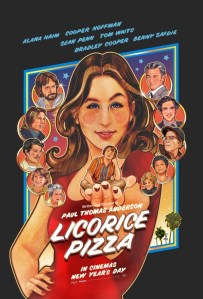
It took me many months but I’ve finally watched the last of the 2021 Best Picture nominees, and now I can safely say, I just don’t understand all the love for Licorice Pizza. It’s writer/director Paul Thomas Anderson’s (Phantom Thread, Boogie Nights) nostalgic L.A. hangout movie, but the axiom of hangout movies is that they only really work if you actually want to hang out with the participants. I’m not certain I needed or wanted to watch either of our lead characters navigate the curious bounds of their possible romantic entanglement. Alana Haim plays Alana, an under-achieving 25-year-old looking to better define herself, and Cooper Hoffman, son of the late Phillip Seymour Hoffman, who appeared in five prior PTA movies, plays an over-achieving 15-year-old that is in a hurry to grow up and conquer the adult world. He’s crushing on her, she’s flattered but says it’s not appropriate, and over two hours we watch a series of meandering episodic adventures that test their will-they-won’t-they determination. I found Haim’s character to be generally unlikable and, worse, uninteresting. She’s petulant, needling, prone to jealousy but also clearly likes the attention but doesn’t know how far to test it. Hoffman’s character, based in part on Tom Hanks’ childhood friend and producing partner Gary Goetzman, is like a human puppy dog, so overwhelming and sunny and anxious to be liked, but I can’t see any more depth to him or her. They’re just kind of annoying and maybe that’s the point about looking back. I don’t see the larger thesis or theme in many of Anderson’s small and unfunny asides. He’s trying so delicately to recreate a feeling of time and place of early 1970s Los Angeles, but the movie doesn’t succeed in answering why anyone else should really care about this personal PTA slice of nostalgia. The best part of the movie, by far, is the segment where Bradley Cooper plays the lascivious and self-absorbed hairdresser-turned-producer John Peters. Too many of the other misadventures feel like table anecdotes brought to overextended life with technical pizazz and minimal emotional accessibility. Licorice Pizza left me cold and unfulfilled.
Nate’s Grade: C+
Share this:

Prey (2022)
 Prey is the kind of Predator movie I have been clamoring for years to make. The franchise was in some major need of a mojo rejuvenation, and instead of constantly repeating the same stories to lesser and lesser effect (see: 2018’s sloppy release), the filmmakers finally saw the obvious and exciting answer. By placing the Predator into different points and places in world history, the producers have finally tapped into the creative potential of the equation of [cultural warriors] vs. alien bounty hunter. Each new movie allows a new selling point jumping from famous warrior to famous warrior. Imagine samurai versus the Predator, or Crusaders versus the Predator, or Vikings versus the Predator, or a Wild West showdown against the Predator. It would be like an intergalactic Deadliest Warrior franchise. It’s a super advanced alien species, so why can’t we establish that they’ve been flying to Earth for centuries for their recreational sport? Each movie can establish a larger mythology, but it also just supplies the fun of seeing history’s greatest warriors and different settings and cultures versus a powerful alien monster. Prey is the best Predator sequel, by far, and arguably as entertaining and engaging as the 1987 original.
In 1719, we follow a tribe of Comanche in the Northern Great Plains. Naru (Amber Midthunder) wants to be a respected warrior like her big brother, Taabe (Dakota Beavers), who cautions her about the weight of responsibility. She discovers strange tracks and is convinced that their tribe is not safe from a new predator. How little does she know how right she is.
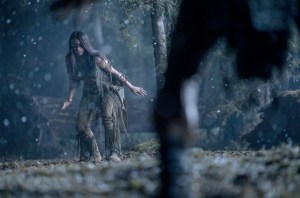 Within minutes, Prey had me. I’ve seen complaints that the first half is slow, but I think people are discounting the time needed to establish the ordinary baseline life of this community, their relationships and conflicts and goals and hopes, before introducing the change agent. That takes time if you want to be able to understand this different life but also if you want to really connect with the characters. The first half provides the foundation for the second half to run with and have bloody mayhem that counts as more than surface-level entertainment. The best compliment I could provide for screenwriter Patrick Aison (plus director Dan Trachtenberg) is that had the Predator never beamed down, I still would have found the story to be interesting. The details are rich and build an authentic picture of life 300 years ago before European colonists would completely upend indigenous life. The Predator series, at its core, has been a nativist underdog tale, where the primitive people of Earth have battled against the technologically superior alien warrior. The dynamic makes it easy to root for the Earthly heroes, but it’s even easier when you have a protagonist like Naru, fighting for respect as a woman already. The character is shown as headstrong but capable, and her mistakes provide opportunities for her to learn and better strategize later. I genuinely gasped when certain indigenous characters died. I’ve never had an emotional response to any Predator film.
The reveal of the Predator is cautiously handled, with the big guy taking time to explore his own surroundings. I enjoyed that this Predator also isn’t as advanced as his more modern ilk. He wears an intimidating alien skull mask and has more limited, though still high-tech, weaponry. I also enjoyed that this Predator feels like he has more of a personality. It’s not just a mirthless tall guy in a thick suit. The actor, Dane DiLiegro, is still providing a tactile, physical performance, and he has moments that reveal the cruelty of this alien but also its volatile temper, which is kind of hilarious. He encounters the wildlife and goes from snake to bear to man, right up the food chain, but some of his more violent kills demonstrate an almost petulant attitude. This is a Predator that doesn’t quite have it all together, and it makes the eventual battle with the Comanche feel like a conflict that has two sides that are worthy but also with their vulnerabilities. It makes the final showdown more interesting. It also allows us to take perverse pleasure in the big guy mowing down a team of predatory French fur trappers that imprison Naru and use her as bait. Oh boy, the gory comeuppance is fun.
 The action sequences are smoothly handled by Trachtenberg (10 Cloverfield Lane) who favors verisimilitude without sacrificing the visual artifice. The photography is gorgeous, and the emphasis on natural light and environments add so much the overall authenticity. Trachtenberg also knows what visual style will work best with which moments. There’s one scene where Naru sneaks back into the trapper camp and her vengeful fury is portrayed in a breathless long take to make the moment even more intense and enjoyable to appreciate the beat-by-beat fight choreography. The scenes with the Predator stalking in the fog play with claustrophobic suspense. The action has a very pleasing sense of construction that clearly presents the pieces that are needed for the scene-to-scene goals, and then the characters will adapt as necessary through organic complications. This is just good action construction, and Trachtenberg fields each like an expert.
Another fun addition with Prey is that they filmed it with two audio tracks, an English-language track and one fully in the Comanche language. It’s not the most necessary option since most viewers will likely simply watch it in English, or not know about the alternative until after watching, such as myself, but it’s an impressive addition that can make the movie even more immersive and authentic and generally considerate of another culture and language.
 Now, with all my points of praise for Prey, why oh why did Disney shunt this movie straight to its secondary streaming arm with Hulu? After the Fox merger, I understand that the Mouse House doesn’t quite see the same level of value in every Fox property not named X-Men or Avatar. This was restarting a franchise that still has some life in it, but even more than that, this is a good movie with plenty of artistic acumen that would have played splendidly on a big screen and an excellent sound system to really sell every fleshy slice and alien gurgle. It seems preposterous to me that a new Predator movie, let alone an actually great one, is denied theatrical release. I know the domestic box-office is still not what it was before the COVID-19 pandemic. I understand that Fox’s leftovers don’t have the same sexy appeal to the new bosses. It just puzzles me that nobody thought that they would make money off of Prey, which has proven to be a big hit on Hulu with critics and fans (ignoring cranky misogynists questioning the physical ability of women). Prey is a great action movie built upon solid characters and patient, clear plot and action development. When it comes to gore, I wish it wasn’t as heavily CGI and a more memorably gruesome, but that’s my only real criticism of what is fundamentally a fun and exciting movie. Give me more like Prey.
Nate’s Grade: B+
Share this:

Persuasion (2022)
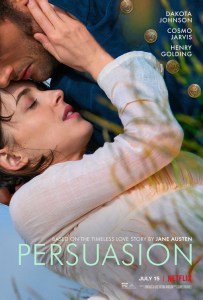 Jane Austen is one of those name brand institutions, and yet the pioneering author only has six actual titles to her name (a seventh was unfinished; two were published after her death, including Persuasion). There have been five previous adaptations of Persuasion, including one from 2021, so I wasn’t rankled when the early trailers for Netflix’s Persuasion took a chance with their adaptation. There are plentiful fourth wall breaks where our protagonist, Anne (Dakota Johnson), and handheld camerawork that makes it feel more faux documentary at points, and there is more modern jokes and modern rom-com sense and sensibilities, and judging by the social media response, there are a lot of angry Austen purists who loathe these changes (could this movie be more heretical than Pride and Prejudice and Zombies?). I found the 2022 Persuasion to be perfectly pleasant and easy to watch. Johnson is tailor-made for the headstrong, intelligent, yearning lead of an Austen movie, and with her directly speaking to the camera, I felt a kinship with her, and this stylistic choice also allowed the screenwriters to sneak in more of that flowery Austen prose. Some of the jokes are a little clunky but I laughed or smiled at most of the comedic elements, especially Richard E. Grant as Anne’s foppish and status-obsessed father. I enjoyed Henry Golding (Crazy Rich Asians) as the caddish Mr. Elliot, a man born with a Cheshire grin. I enjoyed plenty of this movie, including its racial diversity, and the staples of these Regency romances like the exquisite production design, costumes, and English countryside. I can understand some grumbling that this isn’t “their Persuasion,” but not every movie is for every person, and there’s nothing about the 2022 movie that retroactively cancels out other adaptations that fans would prefer. For 100 minutes, it felt like Austen had been re-framed as a rom-com blueprint, and Persuasion had renewed charm for me.
Nate’s Grade: B
Share this:

The Black Phone (2022)
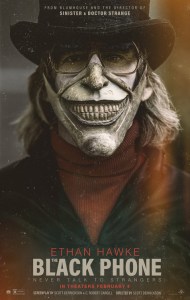 This is the movie that director Scott Derrickson made after departing Marvel over “creative differences” with the Doctor Strange sequel, differences I feel like I can agree with. Based upon Joe Hill’s short story, The Black Phone is a return to Derrickson’s horror roots, along with regular screenwriting collaborator C. Robert Cargill, and you can feel the director’s reflexes resetting. It’s like three movies in one, not all of them needed or entirely coherent. It’s about generational trauma and abuse, a survival thriller about escaping a psychotic serial killer, and a little kid trying to hone her nascent psychic powers. The stuff with Ethan Hawke as “The Grabber,” a kidnapper of children who imprisons them in a locked basement dwelling with a broken black phone attached to the wall, is great, and Hawke is fascinating and unsettling. Each mask he wears seems to come with a slightly different persona attached, so with each appearance we get another sliver of who this disturbed man may have been. The story of survival is made even more intriguing when our protagonist, young Finney (Mason Thames), learns that the past victims can communicate with him through the mysterious black phone. The scene-to-scene learning and plotting is fun and efficient and requires Finney to be a little bit of a detective, exploring his dank surroundings and the failed escape attempts of the other kids to utilize for his own hopeful plan. The ghost kids also have limited memory of their experiences, which is smart so that he isn’t given a clear advantage without limitations. The parts that drag are where Finney’s little sister tries to convince the skeptical police officials that her dreams are real and can help find her missing brother. There is one hilarious moment where she prays to Jesus for guidance and then profanely expresses her disappointment, but otherwise it feels like a Stephen King stereotype leftover (Hill is his son; apple meet tree) that doesn’t amount to much besides padding the running time. It doesn’t even lead to big breakthroughs for Finney to be rescued. As a small-scale creepy contained thriller, The Black Phone is an engaging survival story with a supernatural twist that works as well as it does. It doesn’t have much more depth or meaningful characterization, it’s really just about a kid using the power of neighborhood ghosts to escape a crazy man, and that’s enough at least for a passably entertaining 100 minutes.
Nate’s Grade: B
Share this:

Elvis (2022)
 Elvis the movie is exactly what I would have hoped for from a Baz Luhrmann film, which is an experience that no one else can provide, a messy, chaotic, crazy, sometimes tin-eared yet audacious and immersive kaleidoscope of sight and sound that feels like a theme park ride. As with all Luhrmann films, the first 20 minutes is a rush of tones, characters, and near constant frenetic movement; it’s so much to process before the movie eventually settles down, at least marginally, or the viewer becomes better acclimated to the madcap storytelling style of this mad Aussie. I feel completely certain that people will call Elvis brilliant, and people will deem Elvis to be ridiculous and campy, and I would say it defiantly manages to be all of these identities at once. It is ridiculous, it is campy, it is emotional and sincere, it is, at points, even brilliant, and in a way, this shambolic style perfectly symbolizes Elvis himself, a performer that seems to be anything that the viewer projects onto him, a trailblazer who suffered for his art before becoming an irreplaceable industry and edifice of pop-culture obsession unto himself.
We chart the rise of Elvis Presley (Austin Butler) from a young crooner in the 1950s to the best-selling solo artist in recording history. Colonel Tom Parker (Tom Hanks) discovers Presley, granted after he’s been a chart-topping local hit in the South, and sees a grand opportunity. With Elvis, there is no limit to where they both can go, and so Parker becomes Elvis’ manager for over twenty years for better and worse, engineering Elvis’ tour of duty in the military to take him away from negative headlines, only for him to meet and marry Priscilla (Olivia DeJonge), to locking him into a Vegas headlining gig to erase the mystery man’s heavy debts to the mob. Under Luhrmann’s guidance, you’ll experience it all and then some in the frenzied 160 minutes.
 Elvis was many things for many people. He was a smooth crooner, he was an electric live performer, he was the benefactor of being a white vessel for music that was built upon the less heralded work of black performers, he was a victim, he was selfish, he was devoted to his fans and the stage, he was… America. In 2022, I would have asked if contemporary culture even cared about Elvis anymore, a man who died over 40 years ago, and whether we even have a lens to appreciate the man. Was he simply coasting off the hard work of other black performers? Did he groom his eventual bride considering her age upon their meeting? Was Elvis too old fashioned to even be anything other than a musical touchstone that other artists have surpassed? Is he just a joke? Luhrmann does a fine job of re-contextualizing Elvis, what made him unique for his era, and what made him still captivating to watch to this day. Even the archival footage the closes the movie is a reminder of the unmitigated power the man put into his singing.
It wouldn’t be a Luhrmann movie without a narrator, and this time we get the story’s main antagonist as our prism to view Elvis, marking him chiefly as victim. Tom Parker is a cartoon of a character especially as portrayed by Hanks. I love me some Tom Hanks, the man is an American treasure, and I appreciate that the man is definitely going for broke, but I don’t know at all what he was going for with this performance (the makeup does him no favors also). Hanks is fascinating because he is playing a villainous character that is constantly trying to re-frame their villainy, telling his side of the story but being careful, though not that careful, to always have an answer for an accusation. It feels like Hanks has stepped off the wacky Moulin Rouge! stage and everyone else in the movie is playing things completely straight. The entire acting troupe is all playing under one direction, and then there’s Hanks in his fat suit, who is breaking through the fourth wall, compulsively narrating our story, and acting like a loquacious Loony Tunes figure any second away from his own song and dance. His repeated use of the term “snow job” and “snowman,” which he dubbed himself as a showman, is overused to the point of being a verbal crutch, reminiscent of how often Jay Gatsby had to say some variation of “ole sport” in the 2013 movie or else he might irrevocably burst into glitter (or so I assume). It’s such a bizarre performance of wild choices that I can subjectively say it might be Hanks’ worst and yet it also feels like Hanks is giving Luhrmann exactly what he wants. It’s such a bold move to essentially cede your famous biopic to the most ridiculous character to tell from their ridiculous perspective. Imagine I, Tonya being told from Paul Walter Hauser’s character or House of Gucci being told from Jared Leto’s character, and that’s what we have here. I almost kind of love it, and in doing so, we see from the manipulator how he worked his magic to keep financial control over Elvis. Even Elvis’ later years are provided with a perspective that re-frames the man as a victim of a moneymaking machine that wouldn’t stop until it had drained every last drop of blood from this hard-working man.
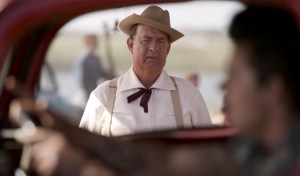 I think this is smart because, on the surface, Elvis might not be the most complicated person to devote two hours to unpacking his character dimensions. He liked to sing, as it touched something deep inside him, and he wanted to be true to himself, but this framework isn’t any different from any number of famous musician biopics we’ve become more than accustomed to. He dealt with drug addiction and erratic behavior but, again, even this is musical biopic basics. Even his doomed relationship with Priscilla is familiar stuff, as she could rarely compete with the demands and the allure of the stage. I think Luhrmann and his co-writers wisely saw that the best storytelling avenue with Elvis is through the lesser-known Colonel, a bizarre and calculating figure cackling in the shadows. There are significant questions over who this proud huckster really is and what he did to bully and cajole Elvis into his favor. There’s inherent conflict there as well as an angle that I would argue most are unfamiliar with. I didn’t know much about the history of Elvis the man but I knew even less about this would-be Colonel.
The most Luhrmann of sequences is Elvis’ breakthrough live performance where it feels like every woman in attendance is catching a fever of combustible hormonal fury. The way the man shook his hips, moved his body, his gyrations that so many adults felt were dangerously subversive, were part and parcel of the younger Elvis. He really was a born performer, and even says he can’t sing if he isn’t allowed to move how he feels he must with the music. During this crazy sequence, Luhrmann’s camera is trained on the emotional response of the audience experiencing a sensation that cannot be contained, bubbling to the surface into tears, shrieks, and convulsions, and it moves through the crowd like waves. It’s such an enthusiastic experience that plays right into the stylistic and tonal wheelhouse of Luhrmann. It’s also an unsubtle reminder, not that much is subtle in a Luhrmann movie, that part of the man’s appeal was his raw sexual magnetism.
In a modern era, the condemnation of Elvis as a corrupting influence on the youth feels comically quaint, until you remember that all of this was also filtered through a very racist paranoia. Elvis was deemed a danger because he was an accessible introduction to music and culture that was associated with black people. The accusations of Elvis corrupting the youth are all tinged with racial implications about his source of inspiration, never mind that Elvis was also influenced by a religious revivalism. The movie doesn’t say that Elvis was a sham, only succeeding off the work of other esteemed yet unfairly unheralded black artists. With the many onscreen performances, he is clearly talented, and offers his own versions of others’ songs, but he’s also deferential to the people he grew up with and the music he clearly loves and wants to be a part of to the detriment of whatever Tom Parker and his handlers believe is commercially viable. B. B. King (Kelvin Harrison Jr.) even remarks about Elvis’ own privilege when he thinks about bucking politicians demanding that he perform safe songs without his signature dancing (“They’ll arrest me for just crossing the street. You are a famous white boy who makes them too much money.”).
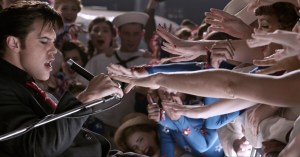 I’ve purposely delayed from discussing the best reason to go see all 160 ungainly minutes, and that is Butler’s glorious performance. The young man simply dissolves into the role and makes you forget you’re watching an actor. The way he captures the cadence, the drawl, the presence of Elvis, and not just his jerky movements, is phenomenal, and then you remember that it’s Butler doing all his own singing as well, and the spell is near complete. He is Elvis. It’s a performance guaranteed to win as many plaudits as awards season has to offer. Through Butler’s performance, a younger generation can understand what all the hubbub was about. The man brings the character to life but he especially brings Elvis the performer to startling life. Even if you hate Luhrmann’s other movies, and he is definitely divisive, and even if you couldn’t care less about Elvis in the year 2022, this movie is well worth watching for the sheer brilliance of Butler alone.
In some ways, Elvis the movie feels like a perfect assignment for director Baz Luhrmann. His unconventional stylistic approach livens up an otherwise conventional rise-and-fall tale, broadening the appeal of Elvis for an audience that might have otherwise shrugged at a movie chronicling the man’s exploits. The subject matter is also the squarest for Luhrmann, which makes it also the safest movie of his career, which is truly saying something considering some of the imaginative highs of this movie. There will be just as many people put off by the excessive, in-your-face style of the movie as drawn in by that Luhrmann razzle dazzle. Watching Elvis feels like you’re watching two movies simultaneously atop one another. Luhrmann can be exhausting even at his best but he’s also one of the few filmmakers that makes watching a movie such a textual experience, where sight and sound are layered in such meaningful and granular details to better immerse the viewer. The way even the sound designs ebbs and flows, braids musical notes and themes and older selections of influential resources as it all composes a wonderful soundscape. Few put this kind of thought into every nanosecond that Luhrmann does, himself a natural showman who cannot help himself. While plenty will wish for restraint, I say, much as others asked for restraint from Elvis’ gyrations, to let Baz be Baz, and he lets Elvis be Elvis to the giddy entertainment of the audience.
Nate’s Grade: B
Share this:

Downton Abbey: A New Era (2022)
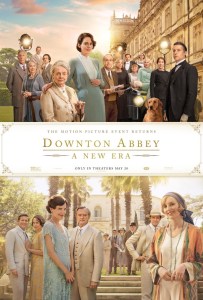 I have only watched the first movie, released in 2019, and know precious little about this widely successful BBC television series detailing the rich aristocrats and their plucky servants, so take my assessment with a whole serving tray of salt. The first Downton Abbey movie served as an epilogue for the series, providing extra resolution to several characters and coupling up others to provide a happy ending. Then it was wildly successful (a worldwide gross of almost $200 million) and so creator/writer Julian Fellowes (Gosford Park) got to come upon with yet another epilogue, this time finding even more happy endings and couplings for the those left out from the first cinematic victory lap. As someone new to this world, I was amused by its understated wit, puffery and pomp, and class conscious dramatics, plus it had a killer cast, most notably Maggie Smith as the tart-tongued Dowager Countess. The second cinematic offering is mostly more of the same, splitting the cast in two locations. One half are inspecting a picturesque villa in the south of France left to the Dowager, to the buttoned-up surprise of her son who questions what relationship his mother had with the former owner. The other half are stationed at the Downton estate while a Hollywood film crew decamps to make a movie. The inclusion of the movie-within-a-movie allows for some dishy moments, starstruck characters, and opportunities for a few Downton residents to make their mark in the pictures. These scenes are fun and provide some interesting conflict as the production has to quickly adapt from being a silent movie to one of them newfound all-the-rage talkies (with a lead actress better suited without sound). It’s a fluffy side story but allows many characters to shine. While the movie is mostly low-key and charming, much like its first big screen effort, by the end there might be some real tears, especially if you’ve been with these characters from the start. If you’re a Downton fan, you’ll eat this all up. I did have two questions that lingered: 1) where is this baby that was the entire story line for Edith in the first movie?, and 2) where in the world is Lady Mary’s husband (Matthew Goode) by the end when he should definitely be in attendance? My pitch for Downtown Abbey 3: Stiff Upper Lip begins with Lady Mary divorcing her racecar-obsessed hubby and moving to Hollywood for a new adventure.
Nate’s Grade: B


 nathanzoebl
You must be logged in to post a comment.