Blog Archives
Pan’s Labyrinth (2006)
 Fantasy has a naturally cheerful tone. Someone did not tell that to Mexican writer/director Guillermo del Toro. The Hellboy director is obsessed with all things creepy, crawly, and gooey, and his films all seem to revel in the things that go squish in the night. Pan’s Labyrinth is a children’s tale not intended for children. It’s more in line with the fairy tales of old that were violent, sickening, and something to strike fear in disobedient kids.
Ofelia (Ivana Baquero) travels with her pregnant mother to live in a cottage along the Spanish countryside. Her mother has remarried The Captain (Sergi Lopez), a brutal officer in the ruling fascist government. He’s a stern and unforgiving man and plotting to eliminate the remaining scattered resistance soldiers. Ofelia discovers a series of stone stairs that lead to an underground labyrinth. Inside is a faun (the titular Pan) who recognizes the spirit of his world’s missing princess inside Ofelia. He gives her tasks to complete that will prove whether or not she can return to the other world.
This is a fabulously dark Alice in Wonderland for a more mature set. Pan’s Labyrinth is very similar to del Toro’s 2002 The Devil’s Backbone, a smart and affecting ghost story set against Spain’s bloody civil war. del Toro has set his supernatural fantasies against some very real and very dangerous backdrops. The Devil’s Backbone was more than just a ghost story, and now Pan’s Labyrinth is more than just a fairy tale. The real world is a violent and cruel place and worthy of a magical escape. However, the fairy tale creatures are not from the Disney school of kinder, gentler folklore. The faun is evasive and prone to outbursts when he/it does not get his hooved way. The other creatures, like a giant slimy toad, are all after their own gain and don’t much care for a little girl’s interference. There is no escape to safety.
 There are plenty of staples commonly found in fairy tales. Ofelia has to complete three tasks before the cycle of the moon. She has to complete trials of courage and prove her purity of heart. The characters look familiar but they definitely don?t behave the same. Pan’s Labyrinth has a continuing sense of dread. People die vicious deaths and the threat of violence is ever present.
The real world segments are just as engaging as the grander flights of fantasy. del Toro spins a very worthy tale of secrecy and suspicion at the dawn of Franco’s Spain. Several members of The Captain’s quarters are aiding the remaining resistance officers and risking their lives to hide their allegiance. It also draws the viewer in because these characters are the kind ones that look after Ofelia, who accidentally stumbles upon their secrets. The Captain is an earthly monster equal to the horrors of the fairy tale world. He has a deadly fixation with wasted time and punctuality (another Alice in Wonderland homage – the ticking pocket watch). Whether he’s torturing or shaving, the man seems peeved in all that he does. He tells the doctor that if a choice must be made, save the baby over the mother. His legacy demands an heir.
del Toro straddles differing genre lines like few artists out there. He has a great love for monster movies and horror but he also has great feel for human drama and a child’s wide-eyed point of view. Ofelia rests her head on her mother’s pregnant belly and speaks to her unborn brother. When her mother is experiencing complications she implores her brother to be gentle. It’s a little action but comes across as so honest and heartfelt from a child. The film is touching and exciting and pretty scary when it wants to be. Pan’s Labyrinth is a genre-bending gem that?s exceptionally well executed. The production design and make-up effects are terrific and lend to the otherworldly feel. The special effects are mostly a mix of practical designs and creepy make-up work, especially with the “Pale Man.” I especially enjoyed how the fawn moved and sounded, all clicks and creaks like he hadn’t moved his bones in ages. del Toro and his movie magicians do an excellent job of transporting you to two distinct worlds.
I could have used more labyrinth in my Pan’s Labyrinth. As it stands, the movie is divided as 15% fantasy world and 85% real world. That?s not enough for me. Maybe I just loved the fantasy elements too much or was expecting more of a live-action Spirited Away. Then again, del Toro has his mind set on an ambiguous ending that will divide the skeptics from the believers. Are there opposing worlds? Is Ofelia just making it up to escape reality? Whether what’s happening is real or not is irrelevant; Ofelia believes it is real. I feel that the movie could have been even greater had it utilized its fantasy side more.
 Take for instance the “Pale Man,” a grotesque monster that has to place its eyeballs in the palms of its hands to see. When Ofelia enters his realm its covered in ancient art showing this faceless creature devouring children. A giant pile of shoes sits in a corner as a constant reminder of the creature’s appetites. However, the creature sits at the head of a table motionless, unless some irresponsible child takes a bite from the illustrious feast of food at the table. Then the “Pale Man” springs to life. The imagery is horrifying but beautifully sickening, and it’s just too regrettable that Pan’s Labyrinth only gives such a memorable monster one single scene. I kept hoping that the movie would revisit the world it had begun establishing, all for not. I thought at least del Toro would have a fascist officer chasing after Ofelia and she would trace a portal back into the “Pale Man’s” world. Then she would escape but the officer would be trapped. He’s take a bite from the feast and then our occularly-challenged friend would go, “Well, you’re a little older than I like, but hey, beggars can’t be choosers.” CRUNCH! You must judge a movie for what it is, not what it could be, but I am certain Pan’s Labyrinth would have been even more remarkable had it just done more with its wild imagination. Oh well.
2006 has been something of a revelatory year for Mexican directors working within the Hollywood system. Alejandro Gonzalez Inarritu released Babel (bleh); Alfonso Curaon released Children of Men (wonderful), and now del Toro’s dark fantasy Pan’s Labyrinth is just starting to get a wider release. The film straddles the lines of genre, touching upon horror, human drama, fairy tale, historical action, and still finds time to be invigorating and moving. The production design and make-up effects do wonders to bring del Toro’s mordant imagination to chilling life. del Toro reigns supreme in the realm of sticky and icky things. Had the film actually spent more time interacting with its twisted fantasy creatures, I would gladly call Pan’s Labyrinth the best film of 2006. But alas we can’t all have our wishes comes true no matter how many fauns we encounter.
Nate’s Grade: A
Share this:

Apocalypto (2006)
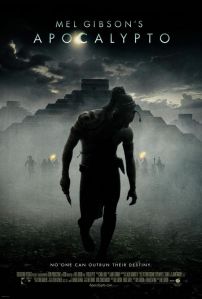 Apocalypto is an action movie set 500 years in the past with a cast of entirely unknown actors, some of who have never acted before. But what does everyone want to talk about? Mel Gibson hates Jews. He’s been in a heap of trouble ever since a DUI where he said some very unkind things about God’s chosen people. He’s made the apology tour and checked into alcohol rehab, the new go-to defense whenever a celebrity screws up. The public finds it hard to separate art from the artist; Frank “It’s a Wonderful Life” Capra was anti-Semitic but few seem to bring that up. Some people have sworn off Gibson thanks to this disgraceful incident. That’s a shame because Apocalypto is brilliantly filmed and Gibson’s finest directing effort yet.
The Mayans seem pretty at ease 500 years ago. We open on a hunting party dividing up a recent kill and playing a prank on one of their members that is having trouble making little Mayans with the wife. Jaguar Paw (Rudy Youngblood) is the son of the tribe?s leader. In the forest they encounter a group of survivors from a different village. They warn of a group of mercenaries that razed their town, killed their people, and took the rest. Jaguar Paw?s father warns not to speak of what they have seen to their people. Fear is contagious, we?re told. That night the same mercenaries attack Jaguar Paw?s village. He scrambles to lower his pregnant wife and young son into a cavern for safety. The surviving men and women are tied up and sent marching. The village?s children are left to fend for themselves and most likely perish without any adults.
 Jaguar Paw and his fellow captives are headed for a Mayan temple. The women are sold into slavery. The men are painted blue and guided to the top of the temple to become sacrifices to an unhappy god. The men are held on a slab, have their hearts cut out, finally then have their heads sliced off and kicked down the stairs. Through a fortunate set of circumstances Jaguar Paw breaks free and races into the forest to return to his family, who is in danger of drowning if the cavern fills with rain water. The mercenaries are not far behind and willing to go to any length to kill Jaguar Paw.
From an anthropological standpoint, Apocalypto is fascinating. Gibson has turned back time and immerses the viewer in a world unseen for 500 years. The details are astounding, and whether they are note-for-note historically accurate or not is inconsequential. You are seeing a living, breathing world right before your eyes. I loved soaking in the new-ness of the experience, seeing how this forgotten world operates, and the power struggles within. These people have great faces, great hulking muscular frames, and great expressions needing to be seen. Gibson has crafted a film that you’ve never seen before, at least with this kind of budget and filmmaking prowess. Apocalypto can quite often be breathtaking to behold. The production design and costumes (yes, there are more than just loin cloths) are incredibly rendered and add greatly to the authenticity and mood. I loved visiting the Mayan temple city (“down town” I guess you could call it) and seeing the different factions intersect, like green painted upper-class harpies being carried around the crowd.
The parallels Gibson puts out there seem tenuous at best. The Mayans have lived beyond their resources, experiencing plague, and feel that the need to pacify the masses, and turnaround their bad luck, is a whole slew of human sacrifices. There’s an Iraq War reference in there if you want to go looking for it and perhaps an ecological one as well. I don’t know if Gibson is using the Mayans as a cautionary example of a society that crumbled. We are treated to an opening quote detailing that no great society can be conquered from outside until it has become corrupt from within. Maybe this is Gibson’s way of telling America to sit up and fly right. Or maybe it’s just an intellectual glob toweled over the blood and guts to make everything seem more meaningful.
The acting is a surprise. Many of these people are really good, especially Youngblood who has a soulful face and a terrific presence onscreen. Gibson creates a great sense of community in the early moments. People feel natural and in touch with their surroundings. Their interaction and the visual shorthand feel like storytelling tricks from classic silent movies. Gibson manages to tell us a lot with little. There are some gut-churning moments, and some of them are because of character. A man from Jaguar Paw’s village hopes his wife did not give up fighting before she perished, because if she did then she will be sent to hell. He pleads that when he dies he might endure the tortures of hell, just so he can be with her again. That hits hard. A cranky mother-in-law also provides a shining emotional moment completely played in solemn silence. A little girl surrounded by crying children tries to assure the adult captives, “They are mine now. I will take care of them.”
 The last hour of the movie is a non-stop foot race as Jaguar Paw valiantly attempts to escape his enemies and return to his swatch of the jungle. There are some fantastic escapes and imagery, like Jaguar Paw outrunning an actual jaguar. The ending is fantastic and a fitting climax for the title. I would have enjoyed just a little shove further, like a new character marveling at some gold trinket Jaguar Paw had gotten from the Mayan temple. “This is gold. Can you tell me where there is more?” he would say. “Tell you?” Jaguar Paw would say in a hearty laugh. “I’ll SHOW you where to get more. Follow me.” The resolution is pretty obvious but left to the imagination. I guess after much derring-do I just prefer more finality with my comeuppance.
This may be about a dead culture and spoken entirely in a dead language, but Gibson’s bloody art house flick is a lively macho action movie at its core. It’s structured exactly like a typical Hollywood action movie, and I don’t know if this adds another level of brilliance to the final product or makes it seem more ordinary taken apart from its historical context. Gibson’s trade is misery. He’s been a martyr onscreen and he prefers to tell stories about the anguished and tortured. Jaguar Paw is beaten, wronged, and has to race against time to save his family. When Jaguar Paw moves onto his own turf he turns his knowledge of the land to turn the tables on his enemies. The movie presents familiar archetypes like the wise father, well-meaning oaf, and impetuous hothead villain, Super Biggest Bad Guy (he does wear the most skull trophies, that has to count for something). The villains are larger than life and have great menace to them. Even better, they’re highly memorable and despicable, and yet they seem to operate within a tribal code of their own honor. They scowl with the best of them.
This familiarity makes viewing Apocalypto less jarring, This is an independent movie high school jocks could enjoy. That may sound dismissive but it’s a compliment. Gibson has great technical skill and after decades of shoot-em-up pictures, he definitely knows how to build and sustain exciting and rewarding action sequences. You know when the bad guys with personality are going to have big deaths, and you know when you see a hunting weapon in Act One that it is going to be put to awesome use in Act Three. The lines of action are well structured and smartly played. When you boil it down, it may just be an action movie, but because of Gibson it’s a good action movie.
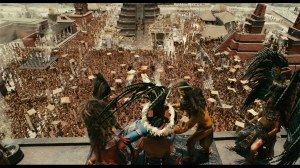 With The Passion of the Christ, I was appalled by the violence, more so how Gibson fell in love with the blood and gore, turning it into pornography. That was the message of The Passion — Jesus sure knew how to take a lickin?. But with Apocalypto, the violence is savage but the appeal of this project is on recreating a world, not sadism. Apocalypto is more interested in opening eyes than shutting them because of nauseating and relentless gore. This isn’t exactly a movie fit for nuns and missionaries, though. Gibson embraces the cruelty of man and showcases some real horrors. The temple sacrifices are fitting and gruesome, but never seem exploitative. There are moments that I wish Gibson would have pulled back, like an extended scene of a jaguar chewing a man’s head or a gusher of blood spritzing out of a man’s temple like a broken sprinkler. I think Gibson loses control of his story and gives in to his own bloodlust in these moments, which serve to take you out of the movie and go, “Ick.”
The violence is also easier to stomach because the audience is more invested in story and character. Everyone that paid a ticket in 2004 knew Jesus was going to die in the end, at least, I really hope they did. That might have been a shocker to a remote few. It was all about witnessing suffering and testing how much you could watch. You felt the pain, all right. Apocalypto, in contrast, is tame and more focused on escape than futility.
After The Passion of the Christ made heaven and earth move at the box office, Gibson can afford to make any movie he wants. If he wants to make a movie about Mayans in Mayan, so be it. At least Gibson knows how to tell a good action story. Apocalypto is beguiling and often breathtaking to behold. The details create a rich environment that feels wholly alive. It’s a typical action movie plucked down in a different historical setting, creating the most unique movie experience of the year. It’s a man’s man independent movie but also manages to hit key emotional notes. I don’t care what he thinks of Jews or anyone else. His art speaks for itself, and Apocalypto is fascinating. It’s an art film for jocks, it’s an action movie for science geeks. Bless you Mel Gibson, you’ve brought us all together in the weirdest way possible.
Nate’s Grade: B+
Share this:

Flags of Our Fathers (2006)
 Clint Eastwood’s WWII epic is all about scaling down legend, deconstructing myths, and illustrating how truth can become hazy in the name of the greater good. It’s very well made, noble, reverent, intelligently written but somewhat empty at its center, feeling far too mechanical to become one of the great war movies of modern times. The structure is needlessly scattered into three interconnected storylines: 1) the ongoing battle of Iwo Jima between Japan and the United States, 2) the stateside bond tour by three of the six men responsible for raising the flag in the iconic photograph, and 3) a son in present day writing a book about his father’s war experiences in the Pacific. I really don’t feel that splintering the narrative added anything to the story; in fact, there’s a late segment that’s a barrage of character deaths that would have been far more powerful had it not been assembled into an afterthought of a montage. The battle moments are tense and bloody, with just a tinge of Saving Private Ryan familiarity (shaky cam POV, washed out colors, chaotic editing, graphic gore). I would have actually preferred more battle action but oh well.
Most of the film focuses on our three soldiers (Ryan Phillippe, Jesse Bradford, Adam Beach) dealing with the pressure of a spotlight they feel is undeserved. You see, the raising-the-flag picture, perhaps the most famous war photograph of all time, was a group of men replacing a flag. There were no bullets buzzing over heads, no bombs blasting; it isn’t even the first flag. The men wince at being called heroes. They’re made to become U.S. military shills, encouraging the nation to keep buying those war bonds. This segment provides lots of moments of interest by illuminating a chapter few know — the story behind the story. These moments of insider info have some juice to them, led by a suave SOB performance by John Slattery as the man in charge of drumming up dollar signs.
Phillippe is an actor I’ve been keeping tabs on ever since 2000’s Way of the Gun, and he is the moral center of the movie, showing grit and humility. It’s mostly a performance of stoic silence, but he has a very strong scene when he confronts a war widow wanting the truth and he lies between his teeth to comfort her. Beach (Wind Talkers) gets the best role as a solider of Native American blood that is still seen as a second citizen in his own nation. There are plenty of revealing moments of casual racism (people call him “chief” more than his actual name) that explain why he took to the bottle with such ferocity. Beach is an emotional wreck and deeply haunted by the disturbing memories of war. He has to be practically pried off of a widow he is clinging to and crying uncontrollably. The cast is full of young Hollywood actors and it might due some good to become acquainted with their faces before stepping into a theater. It can get confusing. Yet another reason a disjointed narrative is a bad idea.
Where Flags of our Fathers cannot make the leap from good to great is in the area of character. After two hours, you don’t really feel like you know anyone better. There’s a distance that stops the audience from fully investing. I think Eastwood and the film have such noble aims that the movie becomes more of a statement than entertainment. There isn’t any conclusive climax; the film seems to directly go right into a voice-over heavy resolution. On a technical front, Flags is very impressive and Eastwood has created his most visually lush film to date. From a human standpoint, it falters and flags. It’s admirable and attractive but I doubt come Oscar time that this war-weary ode to heroism will have many followers.
Nate’s Grade: B
Share this:

Running with Scissors (2006)
 Ever since author James Frey imploded into a million little pieces, the memoir has come under intense scrutiny. At issue is the validity of the written word, whether these people are being honest as they recount their tortured yet inevitably redemptive lives. What is the difference between nonfiction and memoir, and does it implicitly imply personal bias? Running with Scissors is the 2002 best-selling book detailing the bizarre childhood of Augusten Burroughs. It’s a book with lots of out-there claims but they’re all held in check by Burroughs’ tart observation and witty writing. When translated to the silver screen, Running with Scissors loses credibility without the author’s voice. I doubt many people going in cold will even believe what they’re seeing.
In the 1970s, Augusten (Joseph Cross) is a gay teen growing up in the care of his alcoholic father (Alec Baldwin) and his deeply delusional, bipolar, wannabe poet mother (Annette Benning). When their marriage hits one of its many slags they seek out a therapist, Dr. Finch (Bryan Cox). He has a room he dubs his “masturbatorium,” a resemblance to Santa Claus, and a family just as whacked as he is. His oldest daughter, Hope (Gwyneth Paltrow), helps him in his practice and thinks that pets talk to her, even from beyond the grave. Natalie (Evan Rachel Wood) is the rebellious daughter who likes to play doctor via electric shock therapy. Agnes Finch (Jill Clayburgh) is the matriarch of this cracked family that also enjoys eating some dog kibble here and there. When Augusten’s mother signs over adoption papers he becomes the reluctant newest member of this dysfunctional family.
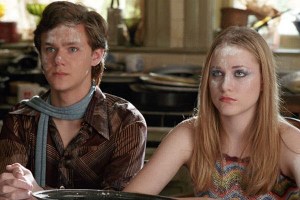 The trouble with translating a book is that you lose the author’s voice and commentary. Running with Scissors maintains the horrifying living conditions for Augusten and the stable of oddballs, but lost is the author’s snappy humor that carried him through this tumultuous time. It’s definitely weird but it’s far from engaging. Without the wit and dark humor from Augusten’s voice we’re left with a series of loosely bandaged scenes about crazy characters and crazy anecdotes, little of which contains further importance. This is a fan of the book talking here, and I’m afraid that the film adaptation has heightened some of the weaknesses of the book, namely the loose storyline. When pieced together as a film, Running with Scissors can become slightly tiresome and overly reliant on background details. The film treats its wild, kitschy production design and 70s nostalgia as a character on par with anyone. It makes for great production design, true to the spirit of the book, but also serves as a narrative distraction. Too much attention seems to be put on getting things to look right than getting the screenplay to feel right.
Without the author’s voice the results lose credibility. It’s funny to see a Christmas tree up year round, and it’s funny when Dr. Finch is convinced God is communicating to him through his bowel movements, but it all just comes off as another joke like the art direction and nothing more. When fully added together without any sense of pathos, it all seems like a joke. The subplot involving Augusten’s sexual relationship with a much older schizophrenic patient (Joseph Fiennes) seems mishandled without much insight. Running with Scissors presents all examples of dangerous, sometimes illegal, behavior and doesn’t bat an eye, nor does it pass judgment. While this may irk some and seem irresponsible it’s just another case of little mattering. Running with Scissors, as an adaptation, presents little of consequence.
Director Ryan Murphy also adapted the screenplay and knows a thing or two about dysfunction and trashiness, having created the risky TV show Nip/Tuck. His adaptation has a blunted feel, but it also seems too broad. Then again, maybe only fans of the book would notice. He has a good feel for his actors and can stage some nice shot selections, but man, someone needs to slap his hand away from the AM radio. Running with Scissors is crammed with so many popular 70s tunes that it becomes a crutch, with Murphy hitting the soundtrack button whenever he needs some kind of character catharsis. It doesn’t work and comes across as indulgent and simplistic. There are so many zippy classic pop songs you may think Elton John is owed a writing credit.
 The acting is one of the elements that help give life to this adaptation. Benning has been generating Oscar buzz for her deeply self-involved portrayal of a mom held hostage by her illness. Benning digs deep and displays a comic range of absurd behavior and wild paranoia. She’s all over the place and you can’t help but loathe her, that is, if you ever take her seriously. But then, once overly medicated, she gives an entirely secondary performance as an emotionless zombie, and we feel a sliver of sympathy, a true surprise. It’s a good, meaty role, however, I actually think Clayburgh gives the more Oscar-worthy performance. In a lot of ways she’s resigned to her fate and yet manages to be the gauzy heart of the picture. She tells me more with her wrinkles than Benning does in her gesticulating outbursts.
The rest of the cast work admirably. Cross is our focal point of the story and does a fine job of, essentially, gawking and looking perplexed. He’s like a blank, gangly canvas, and I wonder what else Cross is capable of than a performance built around indignant reactions. Wood is developing into a lovely adult actress and has some of the best foul-mouthed lines. It’s just nice to see Paltrow in a movie again. Baldwin has transformed from leading man into incredibly versatile supporting actor that excels as comedic lunkheads. Cox remains one of my favorite character actors of all time. There’s nothing this man cannot do. The actors all do a good job of filling out their zany characters while leaving their own imprint.
The issue with Running with Scissors is that when you strip away the author’s caustic voice, then the movie strains credibility, even with the knowledge that it?s based on a personal memoir. The movie gets all the wackiness but misses out on some of the finer points and humor that helped save Augusten from his unorthodox housing. The story feels dulled and stretched too broad, and yet it still manages to be intermittently entertaining despite these flaws. The actors range from good to great and the art direction is fantastic, even if Murphy expects it to do more work than his screenplay. Running with Scissors isn’t as nervy, engaging, or provocative as its source material. Then again little else is. Consider the film Running with Safety Scissors.
Nate’s Grade: B-
Share this:

Marie Antoinette (2006)
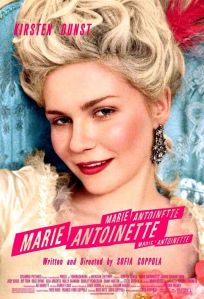 From its opening 80s New Wave soundtrack, you know Sophia Coppola’s Marie Antoinette is a period piece like none other. The famous daughter of Francis Ford Coppola has long been planning a movie around the famous queen that lost her head during the French Revolution. She premiered it at the Cannes film festival where it was booed by the homeland critics. This cast a shadow of doubt over Coppola’s dreamy pop confection of a biopic. Maybe the French don’t like having one of their most iconic historical individuals turned into a bouncing, troubled teenager. Too bad because this is the most interesting and, later, the most frustrating accomplishment Coppola achieves.
Marie (Kirsten Dunst) is a young Austrian girl married away by her family with the hopes of strengthening an alliance between France and Austria. She’s intended to wed Louie August (Jason Schwatzman, Coppola’s cousin), a rather goofy young man more comfortable with hunting than women. Their marriage is arranged by Louis XV (Rip Torn) with the intent on keeping the family line with a male heir. Trouble is, Marie’s husband is more interested in locks than her in a nightie. She’s warned in letters by her family at home, and by a caring ambassador (Steve Coogan), that her only leverage is a child. Without a child her marriage could be annulled. Life at the Versailles palace is a vortex of gossip and attention, and the idea that the queen cannot interest the king is most stressing.
 Marie Antoinette is a feast for the eyes, and that’s saying nothing about Dunst. The costumes are gorgeous, the multitudes of food look delectable, and the sets are the real deal, filmed at the actual Versailles palace for that extra oomph. I’d let them eat cake too if I got the stuff she had. Expect Marie Antoinette to at least get several Oscar nominations for its lavish technical merits; it very well might win too. There’s a really neat sequence that informs the audience through a series of family portraits about a death in the family.
Anyone looking for a strict biography on the famous queen will be left scratching their head. Coppola has thrown historical accuracy to the wind and produced a movie less about plot and character and more about an impression. She really nails the insular palace life, from its ridiculous and rigid traditions to the importance placed on blind formality. There’s a very amusing scene where Marie has to be dressed by handlers, and her clothes must keep getting swapped to the current highest-ranking person in the room. Coppola also smoothly handles this extravagant, opulent world from the point of view of her young teenage girl, betrothed by the age of 14. The world of royals and Versailles was one of constant gossip where everyone’s eyes were glued to the new girl. In many ways, Coppola’s world mirrors high school existence, just with far better clothes. When Marie is ignored yet again by her clammy husband, she goes on a wild shopping spree with fabulous shoes and fabrics in bright, sticky colors. She stays up late with a close circle of friends to watch the sun rise over the palace. Coppola firmly reminds us that Marie Antoinette was still a teenage girl and perhaps was still fighting to be one. The movie is good at stripping away the context of history and showing us the awkward lives of two kids selected to be leaders of their country. Better yet, the film is good at exploring what it?s like for teenagers to have the world at their fingertips and have no clue what to do with it. Besides shoe shopping, that is. The film is an excellent mosaic that reiterates the breezy sensation of being young and trapped in the world that never seemed big enough.
But, alas, the trouble with establishing an impression is that we get the idea pretty quickly, and yet the movie keeps going on and on without anything else to interest us. You can watch Marie lay in the field, host a tea party in her garden, marvel at sumptuous food, try on different clothes, play with her puppies, and, hell, the woman even sings an opera in one moment. I don’t know if Coppola intended to establish the tedium of life in Versailles but the audience will definitely start to feel suffocated by it. At least she never steers into a Terrence Mallick danger zone (the man would have sat in a forest with a camera in his lap and called the results a “movie”). That’s the issue with the movie. Like her 2003 Oscar-winner Lost in Translation, Coppola is more interested in mood and silence than character and plot. This approach worked splendidly in the sparely beautiful and moving Translation, but it cannot fully save this film. After a while it just all gets too repetitious and feels slight, like Lizzie McGuire’s Fabulous Versailles Vacation.
The figure of Marie Antoinette is too big to just be dressed up and put in a room. Coppola doesn’t seem to care about the politics or historical anxieties of the time. That’s a shame since France was going through one of the most amazing turnarounds in all of history. There’s no social commentary and the last quarter of the film seems to go off track. When the peasant mob does appear at the very end it feels like a misplaced subplot instead of a world-changing event. Likewise, the affair Marie Antoinette embarks on feels all too shrift and meaningless, like a high school crush of the week (might she doodle his name on her diamond-encrusted notebook?). Marie Antoinette is an interesting, ambitious period drama trying to be a youthful fantasy turned nightmare. It just doesn’t have enough going on to justify a prolonged experience.
Dunst is an actress I’ve been really hot and cold with. Sometimes she dazzles me but more often she bores me. As the title monarch, Dunst totally comes across like a vibrant teen girl still feeling out the world. She seems impetuous, sensual, and naive, all hallmarks of a growing girl that just so happens to be the queen of France. She does a lot of communication with her face. Sometimes she comes across like a silly, vapid little girl playing dress-up, but then that seems within the scope of Coppola’s aim.
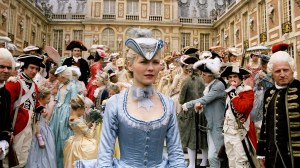 Schwartzman’s portrayal makes the king look like an aloof adolescent, but he make me laugh very easily at his pained awkwardness. Judy Davis is a hoot as the palace’s liaison of policy and manners, tsk-tsk-ing whenever etiquette is broken. The rest of the cast mostly have moments but it’s surprising to me that I’d see Marianne Faithfull, Rip Torn, Molly Shannon (!), and Asia Argento in a period piece movie. Like I said, Marie Antoinette is a costume drama like none other.
Much was made about the anachronistic soundtrack of 1980s tunes set amongst the pomp and circumstance of 18th century France. I like it because it works in engineering the breezy, bubbly youthful impression Coppola wants. It shouldn’t be that big of a deal because the music is not incorporated into the story unlike 2001’s tandem Moulin Rouge and A Knight’s Tale. It provides some of the more fun moments in the movie, though at times the lyrics become all too transparent; “I Want Candy” during a spending spree, “Fools Rush In” when Marie goes to her affair, The Strokes screaming “I want to be forgotten,” as Marie runs off.
Coppola’s luscious period piece feels more like a dreamscape in a daze. Her focus relies less on linear storytelling and character than on creating an impression of youthful decadence and emptiness. Marie Antoinette manages to simultaneously be fluffy and vague. After a while it all just gets repetitious and a bit dull watching scene after scene of Marie being indulged and bored. Perhaps some of that boredom will translate over to the audience. Coppola reminds us that Marie Antoinette was still a teenage girl beneath her powdered wig and bustle, but after two hours you might wish Coppola had more on her agenda.
Nate’s Grade: C+
Share this:

The Illusionist (2006)
 The Illusionist is a satisfying, well-staged period piece con game. It’s set in 1900 Vienna (though everyone’s accents sound British to me) and revolves around Eisenheim (Edward Norton), a magician that truly dazzles the crowds and leaves his skeptics guessing. He becomes a monstrous hit with tricks like making an orange tree grow from a seed and having butterflies carry handkerchiefs. The city’s Chief Inspector (Paul Giamatti) is a fan but also inquiring on counts of fraud. Prince Leopold (Rufus Sewell) is planning to marry the beautiful duchess Sophie (Jessica Biel). Little does the prince know that Eisenheim and Sophie were childhood friends forbidden to see each other because of class differences. It’s been 15 years since they last saw one another but they’re making up for lost time. The Prince sets the Inspector to ensnare the lovers and shut down Eisenheim.
The movie has a very interesting character relationship between Eisenheim and the Chief Inspector. They have a friendly, respectful relationship, with the Inspector pleading with Eisenheim not to force his hand. The Inspector enjoys magic and showmanship, but he also knows what backs he has to scratch to keep his title. I found the frustrating friendship and admiration between Eisenheim and the Inspector to be meatier than the forbidden love angle that drives the story. The Illusionist has the air of a historical romance, but it’s really more about these two men and their bond.
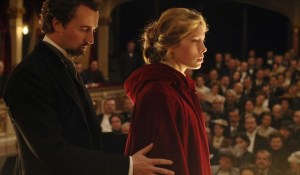 Giamatti has a very strong role and plays all the different shades of his well-trodden man who still keeps hold of his ethics when he’s told to look the other way. He’s just as an important a character and Giamatti has completely wiped my memory of Lady in Water (not that he had to atone for it). Norton is easily one of our greatest actors, but in The Illusionist he underplays too much, slightly smiling his way through an altogether stale performance. I know part of his acting requires a reserved knowledge, since he is setting up those around him. I just felt that anyone else could have played the role the same, with or without a teenage goatee. Biel holds her own, which is something I never would have thought possible amongst celebrated Oscar-nominees. Her role is pivotal but small and doesn’t require much speaking, but all things considered she does pleasantly surprise. Maybe there is an actress somewhere in that pinup body.
The Illusionist, like its title practitioner, knows that an audience loves to be fooled, but only for so long. A magician is the perfect profession to showcase a con game, and writer/director Neil Burger crafts an intriguingly enjoyable tale where we do want to know how they did it. Burger knows how to misdirect but also how to stretch a small budget to create a rich dramatic environment. I don’t know if the explain-a-lot-in-a-minute ending does a disservice to the film or not, but I was happy to get some answers even if they were a tad predictable. That’s the whole thing with magic — we want to know but we love being confounded.
This is an extremely well made indie period film. The production design is astute and often times foreboding, like the Prince’s hallway completely filled with deer heads whose antlers form a really creepy canopy. The special effects are used judiciously and have more impact than the mega budget Hollywood summer spectacles. The Illusionist is a nice example of a character driven mystery that seems to be overlooked all too often today. This is an engaging, satisfying, and handsome movie that entertains by hooking into our curiosity to know how the trick is done.
Nate’s Grade: B+
Share this:

Pirates of the Caribbean: Dead Man’s Chest (2006)
 America loves its pirates, plain and simple. We as a nation are infatuated with the characters and the high-seas adventure of 2003’s Pirates of the Caribbean: Curse of the Black Pearl. We?re starving for more, and when the first in a two-part sequel was released it only became one of the biggest movies of all time. Pirates of the Caribbean: Dead Man’s Chest has shattered box-office records, rolling up $100 million in two days and a record $135 million weekend gross, easily surpassing former champ Spider-Man‘s supposedly invincible $118 weekend tally. America loves its pirates more than Spiderman, Star Wars, and who knows, maybe even Jesus. After all, Dead Man’s Chest did just kick out The Passion of the Christ from the top ten all-time grossers. Mel Gibson sure has a lot of grief at this moment.
Jack Sparrow (Johnny Depp) is a wanted man on the high seas. The East India Company, whose emissary now controls the Caribbean town of Port Royal, is after Jack and his special compass. But Captain Jack has bigger fish to fry. Davey Jones (Bill Nighy), ruler of the seas, wants what was promised to him: Jack’s soul. Jack made a bargain with the sea creature and now his time is running out. He must assemble a crew and track down the whereabouts of a buried chest. Inside this chest is the still-beating heart of Davey Jones, and he who controls the heart controls Jones, and thus the seas. That is why the East India Company is so interested in Jack. They’ve made an arrangement with groomis interuptis Will Turner (Orlando Bloom), who had his wedding hijacked and his bride (Keira Knightley) locked away. If he can retrieve Jack’s compass, then he and Elizabeth will be pardoned for aiding and abetting a known pirate. Will and Elizabeth each set off to find Jack Sparrow and to gain their freedom.
 The filmmakers have taken notes in the school of sequels from The Empire Strikes Back. Like the second Star Wars chapter, we’re left with the heroes separated and licking their wounds, evil appears to have the upper hand, and the lives of some beloved characters are left in doubt. Just as long as there’s no Ewoks, Disney has guaranteed my place in line on opening day 2007 for Pirates 3.
It?s hard to fully judge this Pirates sequel because it’s part one of a two-part story. I’m holding out my final say, especially if this movie just turns out to be an expensive 150-minute teaser trailer for Pirates of the Caribbean 3. I can?t fully judge many story and character arcs because we don?t know where movie #3 will carry them. Maybe it’ll end up being like the middling Matrix sequels, where subplots and characters were dropped as if the Wachowski brothers had screenwriting butterfingers (it’s a film critic’s unwritten duty to deride the Matrix sequels at any chance). At least this movie ends with a jolt that I did not see coming.
Most surprisingly, Dead Man’s Chest suffers little from the creative deadlock of sequels. Dead Man’s Chest is more a sci-fi monster fantasy than a swashbuckler. The supernatural edge has swallowed the series whole. Take for example Jack’s broken compass. What once was an oddity befitting its owner is now seen as another element of magic. Some of the interest seems lost if things are simply explained away as being magical. The story, unlike the Matrix sequels (See: above), expands and enriches its universe. Some leftovers from the first film made me cringe. I thought we were headed for a bad track, where the movie uses the audience’s memory as a cheap storytelling device. Familiar characters might pop up every which way, smiling, and saying, “Hey ho, remember me?” Miraculously, the leftovers are integrated so well with the new tale that they really do matter and don’t come across as cheap shortcuts. Norrington (Jack Davenport) and the two comic relief cursed pirates are all smartly woven back into the troupe, and each impacts the story in a non-obtrusive manner. Even the undead monkey is used well.
I made it a point to keep my expectations in check for Pirates of the Caribbean: Dead Man’s Chest. It would be naive to think that you could catch lightning in a bottle again. Yes, now with audience expectation we lose the originality and unpredictability that made the first Pirates adventure so joyously delicious. And yet I found myself getting riled up just the same and being whisked away by spirited entertainment. My expectations may have been tempered for Dead Man’s Chest but I still greatly enjoyed the ride. It seems that my opinion sharply differs from my overly negative critical colleagues; my own sister said Pirates 2 was one of the worst movies she’s ever seen. That seems a bit rash. She hasn’t even seen any Uwe Boll movies.
 There are moments that seem to stretch the credibility of the story. It’s been said before that it’s not the impossible that bugs you but the improbable, and this holds true for Dead Man’s Chest. I’m able to believe Davey Jones and his creepy crawly crew, but I’m not able to believe that Elizabeth Swan could single-handedly best them all at once in sword fighting. The movie becomes dangerously close to eye-rolls in parts, but generally steers clear of moments that rip you out of the story. Of course a Pirates film would be nothing without Johnny Depp. He’s the main reason the first film was so memorably embraceable and entertaining. It?s not every day someone gets nominated for a Best Actor Oscar playing an addled, swishy comic pirate. He’s truly the star and has been one of our finest actors long before he had any box-office clout. He’s created a character so beloved that he’s crossed over into the cultural lexicon. How many Jack Sparrow outfits do you see come Halloween? I had a friend directing a high school performance of A Midsummer Night’s Dream and every young actor wanted to audition as Captain Jack interpreting Shakespeare. Come to think of it, Jack Sparrow would certainly liven up some of the bard’s dusty works.
Depp is still hilarious and likeable even when he’s being a scoundrel. We simply love this character; I love this character. The unpredictable nature of Jack feels squeezed dry by the demands for familiarity with sequels, but Depp finds new ways to enthrall in Dead Man’s Chest. Some people are going to be uncomfortable with Jack being more dastardly, willing to trade others’ lives to save his own hide. I think desperation is an interesting place to put this character. Besides he has his big hero moments as well.
New dimensions are added to the other characters. Knightley gets to be shrewd and try her hand at pragmatic treachery. It eats her up inside at the end and Knightley, a nice comedic actress, allows us to see the rough seas of guilt within her. Bloom will always be Bloom, meaning he’ll be handsome, British, and seemingly too little for grownup movie stuff. Will is given a whole new set of daddy issues when he actually gets to spend time with dear departed dad (Stellan Skarsgard). Best of the rest (“the rest” being everyone other than Depp) is an unrecognizable Nighy, who saunters his deck with the fiery air of a preacher. Nighy manages to make Davey Jones even more interesting. Naomie Harris (28 Days Later) makes her presence felt as a witchy woman responsible for Jack’s compass.
The action sequences are gigantic and well constructed. They expand with organic complications and a lively, graceful sense of humor. An already fun sword fight atop a watermill wheel gets even more pleasing when the giant wheel breaks free and the fight continues. Three characters climb inside and out, all vying for a key that keeps changing hands thanks to gravity. A human-sized fruit-kabob tied to Jack has a wonderful payoff for something that seemed completely random. The special effects are gorgeous. You can practically taste the slime and sea salt from the creatures. Davey Jones is a fantastic design and I’m dying to know how they did his tentacle beard. Whether it be motion capture, CGI, or puppetry (was someone billed in the credits for “operating” Bill Nighy? Does that sound like a fluffer?), it’s all dazzling to behold. The Kraken is ferocious and so well designed that it’s destined to give an entire nation?s children nightmares for weeks. Coupled with the equally super expensive Superman Returns, it seems that nowadays if you want special effects that will retain their wow-factor, it helps to have a $200 million dollar budget. Director Gore Verbinsky has a terrific eye for shot compositions; I am convinced that if you give this man good material then he will give you popcorn gold. If you give him bad material, well, then you get shiny but pointless stuff like The Weather Man.
 I know this movie, at its center, is empty. It’s grand throwaway entertainment, a true popcorn romp, but yes, when you get down to it the film has little to it. It’s an explosion for the eyes and has some great characters and action choreography, but Dead Man’s Chest is nothing more than very pricey, very tasty cotton candy.
Pirates of the Caribbean: Dead Man’s Chest feels less like a rehash and more like the start of an exciting new voyage. It’s darker, bigger in scale, scarier, louder, brasher, but still barrels of fun. Time will tell whether the back-to-back sequels will support enough intrigue to cover two very long, very expensive action movies. But Dead Man’s Chest has the key Pirates ingredients returning: clever screenwriting duo Terry Rossio and Ted Elliott, and, naturally, the irreplaceable Johnny Depp. An early eye gouging might set the icky tone, but this is one sequel that compares favorably to its source. We’re left in a very Empire Strikes Back position, but not after running out of breath keeping up with the many treasures of Dead Man’s Chest. Nothing will recapture the magic of the 2003 original but this is one summer sequel that delivers without letdown. Then again, after Pirates 3, it could all be for naught. See you in 2007!
Nate?s Grade: B+*
*Final grade pending the outcome of Pirates of the Caribbean 3.
UPDATE: Having just seen the third film, I’m somewhat conflicted. Many items from Dead Man’s Chest have little payoff in the third film, At World’s End. So while I wouldn’t grade Dead Man’s Chest any higher after seeing where it concludes, I still find it to be too fun to rate any lower. Its final grade stands.
Share this:

Bloodrayne (2006)
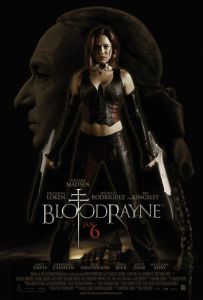 Bloodrayne is based on a video game of the same name that follows a svelte, red-haired vampire with two long pairs of swords she wields on her arms. In the video game she fights against Nazis in World War II. Now that is a movie I would love to see. Everyone hates Nazis (well, most everyone), and to see a sexy half-naked vampire run around and kill them … that just spells awesome. But then along came director Uwe Boll and his German financiers. Boll has turned back the clock and made his Bloodrayne an origin tale set amongst some old European landscape dotted with castles and vampires. He filmed in the real Transylvania in Romania. I don’t know if this location added any more authenticity. It couldn’t have made the film any worse.
In some place centuries ago, there’s a dhampir named Rayne (Kristanna Loken). A dhampir is a half-human, half-vampire hybrid, and we’re told most do not survive conception. Rayne has become a circus sideshow, where her captors torture her and then feed her blood, observing her nimble body heal itself. The Brimstone society is an organization devoted to fighting vampires. Vladimir (Michael Madsen) leads a small group, including Katarin (Michelle Rodriguez), on the hunt for Rayne. They believe she could help them defeat Kagan (Ben Kingsley), the most fearsome vampire in the land for some reason. Kagan is on the hunt for three guarded objects (an eye, a heart, and a rib) that will give him power beyond imagination. Rayne breaks free from her circus life, thanks to killing just about all of them, and joins the Brimstone group. You see, she’s got a score to settle with Kagan. He raped her mother and years later returned and killed her while Rayne watched. Complicating matters is the fact that he’s also Rayne’s biological father.
 If Bloodrayne had merely been a straight-faced, mystical, Medieval gore fest, I might have even credited it for being a decent genre flick. But it’s the assorted anachronisms and rudimentary scope that chafe Bloodrayne, never letting it settle. Take for instance the weirdest scene in the entire movie. Now, for a movie about vampires, prophecy, secret orders, and Michelle Rodriguez even attempting a British accent (one word of advice: don’t), the strangest moment is Billy Zane’s “special appearance.” The opening credits in Bloodrayne call it that, but how does someone have a “special appearance” in an open-and-shut narrative? This isn’t an ongoing TV series. Zane has two scenes. The first has him dictating a letter like a mid-level executive, straining and stretching to fill an inter-office missive. He actually says modern phrases like “No, scratch that,” and “et cetera, et cetera, et cetera, signed Your Father.” That’s it. That’s the scene. It serves little purpose other than to make you think Billy Zane sucks when it comes to personal skills.
Boll fails to curtail these anachronisms that hurt Bloodrayne’s tone and execution. His lack of interest in details or sense also puts the film at a disadvantage. There’s a late scene where Katarin suddenly is wearing a modern purple women’s jacket, like she just got it off the rack from TJ Max. Why does Vladimir wave his sword around all the damn time, but when it comes to actual combat he tosses it back and forth in his hands like a hot potato? A character has a hidden room of weapons, but it’s not much of a secret room when the lever to open this space is dubiously displayed for all to see. Domastir (Will Sanderson, making his fifth appearance in a Boll film) has a hilariously bad haircut that looks like crop circles were shaved into his head. Why, after Rayne has joined the Brimstone fighters late in the film, do we need her in a training montage? I’m pretty sure by that point Rayne can hold her own.
Kagan is never examined as to why he is so dangerous. We have no understanding why the film’s villain should even be feared. He’s on a quest for super power but what Bond villain isn’t? In fact, Bloodrayne has an altogether ho-hum view on vampires. In this movie they’re vulnerable to water as well as sunlight, but they’re also just as vulnerable to steel. The vampires fight with swords and die by them just as easily. One wonders what the allure of vampirism even is if this is all you get. There’s a scene early on where Rayne spots a female vampire chatting away in the open. She makes a come-hither motion with her finger and the lady vamp follows along obediently. Then Rayne bites her neck and drinks her dry, while the lady vamp does nothing but gets bug-eyes and goes limp. Apparently, the lack of sunlight must have negative effects on brain power and deductive thought. What Boll needs to learn is that if you’re going to have a movie where humans and vampires battle, at least give the vampires something beyond pointy teeth and bad hair. Seriously, was there a mullet discount at the wig store?
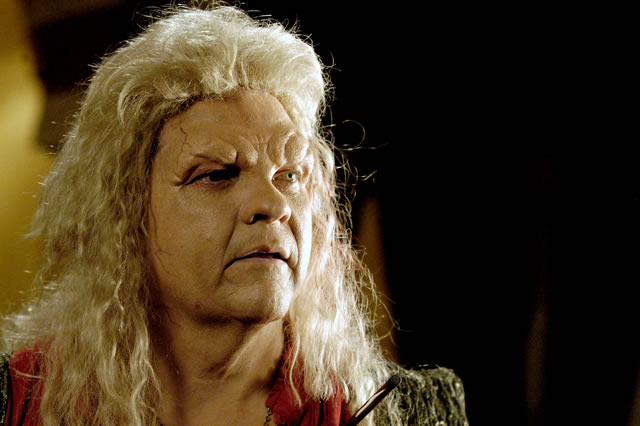 Then there’s the goofy series of one-scene actors. Meat Loaf appears as slovenly vampire pimp Leonid, surrounded by nubile nude women. He speaks like he’s taken a bottle of Quaaludes and has, what can best be described as, a dead and bleached muskrat on his head. The scene gets worse when Leonid is battling our Brimstone fighters. They take out several of the windows in his parlor and destroy Mr. Loaf by the influx of natural light. Now how stupid of an interior decorator did Leonid have? You would think a vampire running a blood parlor and place of otherworldly gathering would attempt to obscure very breakable windows. It’s the ignorance of these details and more that makes Bloodrayne ridiculous while still being pitiful of scope. If Boll is going to tell such a dull and cut-and-dry story, it’s not encouraging that he can’t even be bothered to get the details right.
The movie is poorly plotted from the start. Bloodrayne is aimless and doesn’t so much conclude as it does run out of bodies to kill. The ending will leave most scratching their heads not because it’s confusing but because the movie just peters out. More than most, Bloodrayne feels structured like a video game, with its plot points regarding the search and acquisition of super items that Kagan is after. The screenplay is credited to Guinevere Turner, co-writer of the American Psycho adaptation and frequent collaborator with director Mary Harron. I refuse to believe Turner’s responsible for the mess left on screen since Boll has the habit of rewriting whole scripts. The dialogue is unintentionally hilarious, with clichéd nuggets like, “Keep your friends close and your enemies closer,” and, “He wants a fight and a fight he shall get.”
The direction is shamelessly derivative. There’s a lot, and I mean a lot, of long exterior scenes where we see people on horseback riding along the substantial wilderness. It’s like Uwe Boll watched the Lord of the Rings series and said, “I can do that … but crappy.” These long exterior scenes conflict with the movie’s small playing field. Every town and every castle feels like a stone’s throw away, and the world feels like it’s populated by about 100 people. Boll never makes it clear what the setting of Bloodryane is. It feels like Vague Europe Land.
Boll doesn’t even manage to get his action sequences right. He’s got a bigger stage this time and some more money for effects but the results are still the same. To hide the fact that his actors had no time for fight training, Boll edits his fight scenes to the disorienting millisecond. The intent is to hide the stunt performers doing all the work. The result is that you can’t even tell what the hell’s going on in Bloodrayne. This also hamstrings his action choreography making it little beyond two figures clashing and one falling dead. The explosions of blood are overdone, with every gash shooting showers of red like the human body was connected to an off camera fire hose. Agreeably, there are a lot of splashes of blood but nothing too memorable or gruesome. It kind of has the feel of what bored teens would come up with during a sleepover with their dad’s camcorder. The violence and vampire angle are the two things that will appeal most to teenage men, but neither aspect is properly explored or satisfying. Bloodrayne presents a simple fable and doesn’t even bother to control its simple world of extraordinary creatures.
 I thought the sex scene in Boll’s Alone in the Dark was preposterously out-of-the-blue, but the gratuitous sex scene in Bloodrayne puts it to shame. Rayne is plagued by nightmares of her vampiric urges, as well as her mother being killed by Kagan. One night she has a vivid nightmare where she relives slaughtering her circus. She’s startled awake. What’s her first instinct? She grabs Sebastian (Matthew Davis), pins him against her cell bars, and proceeds to ride him like she has the upper body of a weight lifter. Maybe this is the lone benefit of being a vampire: a wider selection of sexual positions. The sex is sloppy and unerotic in its ludicrousness. Boll also manages to make sure his camera gets every loving detail of Loken’s nipples being lapped at. Boll figures that this gratuitous sex scene (it really couldn’t get any more gratuitous if they were skydiving) is meant to bond the characters into a romantic relationship. This forced romance is, like many elements in Bloodrayne, also inept. It stretches believability when this moment is all we have to go on why Rayne and Sebastian feel for one another. When they part Sebastian is crestfallen, though I think it’s more because he just lost the only girl he’ll ever meet that can perform gymnastic sex. Talk about a perfect score on the parallel bars.
The acting in Bloodrayne is about what I’d expect from a Uwe Boll movie. Loken (Terminator 3) is an attractive woman, yes, but the figure of Rayne is more a fetish fantasy than a flesh-and-blood character. There’s more attention to her revealing wardrobe than her character. Loken overplays her one facial expression, which looks precisely like she just caught wind of a fart. Her English accent is also very droning. Madsen (Species, Kill Bill) seems drunk the whole time. Rodriguez (SWAT) can do little more than scowl, but in Bloodryane she gets to scowl with a comically bungling British accent. And then there’s Sir Ben Kingsley. He spends most of his screen time confined to a throne as if he’s subconsciously trying to pass this movie like a stubborn bowel movement. He looks more like a terminally ill founding father with a penchant for silks than the evil Lord of Vampires. Kingsley hasn’t exactly been judicious with some of his film choices (Thunderbirds, A Sound of Thunder, Suspect Zero) but you’d think an Oscar-winning actor would have better sense than to work with Dr. Boll.
Bloodrayne is the best of Boll’s troika of video-game adaptations, but even that statement is without praise. This lame sword-and-sorcery tale is merely bad, instead of absurdly bad like most of Boll’s oeuvre. The difference is one tiny adverb, folks. The film is limited in scope but still careless and absent-minded with its details. The action sequences are heavy on blood and short on orientation, edited within an inch of their life. Bloodrayne is full of Boll’s typical lapses in plot and characters, and there’s plenty of stupid to go around for everybody. The plot is made up of nonsensical guest shots by slumming actors, and the villain himself seems as menacing as someone’s toilet-bound grandpa. In the world of film it’s tricky to judge films on a scale of badness, because that scale is surprisingly varied. Bloodrayne is clearly bad, but it’s also more entertaining than his previous films. Maybe Boll is learning after all, though at this rate of progression he’ll reach “mildly tolerable” by the time the sun explodes.
Nate’s Grade: D+
Share this:

American Haunting (2006)
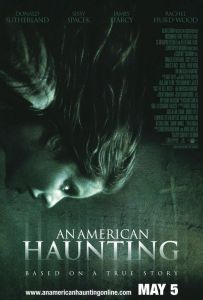 Courtney Solomon made one of the worst movies I have ever seen, 2000’s abomination Dungeons and Dragons. It is bad on a rarely seen cataclysmic scale. The shot selections were awkward, the handling of the actors was cringe-worthy, the story lightweight but ridiculously stupid, and the special effects were like something a third grade diorama contest could best. Dungeons and Dragons holds my record, in all the many films I’ve seen, as having the worst line readings of all time. Fortunately, the film is one of those so-bad-it’s-hilarious entries to stop it from being an absolute wash. Now six years later Solomon is back with An American Haunting. Normally his name alone attached to a movie would guarantee my avoidance, but I checked this out for you, dear readers. Let’s just say Solomon has a looooooong way to go before he even reaches the competence of Uwe Boll
In 1818 Tennessee, the Bell family moves into a new residence. John Bell (Donald Sutherland) has cheated an outcast woman on her land loan. This woman, branded a “witch,” curses the Bell family. Things are fine for a while, but then young Betsy Bell (Rachel Hurd-Wood) is being attacked by an invisible spirit night after night. Her father and mother, Lucy Bell (Sissy Spacek), are powerless to stop the haunting. Before you can ask, “Why don’t they let their daughter sleep in a different room?” they’ve reached out to a preacher and schoolteacher (James D’Arcy) romantically curious with Betsy. No one can stop this haunting and John Bell searches to gain atonement for his sins to spare his family.
 So, let’s get this whole thing straight, spoilers be damned. An American Haunting is marketing itself as a film based on the only medically credited murder to a ghost. Never mind how you verify that, just go with it for a second. This couldn’t be any more wrong. We learn at the end (“learn” wouldn’t be the right word since the film requires voice over to explain itself) that Betsy had been raped by her father. But wait, it gets better. Betsy had subconsciously developed a protector spirit to guard off further molestation and to punish her father. So right there the ghost in An American Haunting isn’t even a ghost, just the angry manifestation of an abused girl. There is one death accredited to the ghost, that of John Bell. However, the movie presents his wife poisoning him, not the ghost. So then the murderous ghost is neither. Plus, one has to wonder how shocking John’s loss is if he was willing to kill himself to lift the curse from his family. How believable is a “true account” of a medically documented haunting death when people were blaming demons for things for ages? I mean, there must be written accords from medical professionals of the day attributing the Black Plague to man’s sins. Just because an official said so centuries in the past does not make it medically sound today. If that were true no one would last through puberty without flogging themselves to death (and I did NOT mean it like that). An American Haunting is not true, is not about a ghost, and isn’t about a ghost committing murder.
Writer/director Solomon has made some strides in his filmmaking, but the results are still laughably the same. He’s gotten a better feel for actors and … that’s about it as far as improvement goes. An American Haunting is a creaky old timey ghost story that couldn’t scare a soul. It feels more attune to a 1970s made-for-TV flick. Solomon cribs all his scare tactics from Spook 101, which means lots of stagy jumps and creaky noises. The most annoying decision Solomon makes is that when he wants to convey the point of view of our ghost, he quickly swoops the camera down and up, spinning around the room like a paper airplane. I’m surprised more ghosts don’t get motion sickness if this is how they roll. You’ll either grab your stomach from the camerawork or the story.
 Solomon’s story is just painfully uninteresting. Some good actors do their best to liven up a pretty run-of-the-mill haunting tale. An American Haunting is insufferably boring and lame. The first half is also exceedingly repetitive, as we watch the spirit creep into Betsy’s room and beat the daylights out of her. I don’t know how many times Solomon expects us to still be entertained, let alone scared, by just repeating this scene verbatim. Apparently, if a ghost keeps smacking you it won’t wake up the people sleeping right beside you. I always did wonder. An American Haunting is lackluster and boring, but it’s the arbitrary current day scenes that open and close the film that makes it truly awful. A modern-day mommy discovers Richard’s diary of the haunting and sits herself down for a good read. Then once she gets to the end she sends her little daughter off to spend time with her ex-husband/daughter’s father. And then Betsy’s protector spirit pops up in the car, looking very sad as she’s driven away. An American Haunting is trying to make us connect that the modern-day woman’s husband is molesting her daughter, but the movie expects you to make a lot of jumps to get there. I don’t think “spirit pointing” will hold up in the court of law. And truly, if the Betsy protector spirit was really trying to be helpful, shouldn’t it be less vague and just spell it out? These modern segments feel tacked on and needless if the whole of the film is spent on the 19th century ghost story. An American Haunting requires gobs of text at its conclusion to explain that it was, technically, a ghost story by its new and expanded definition.
The only nod I can give Solomon and his tale is that they cover my number one complaint of all haunted house movies: why the hell don’t the people just leave? Your house is haunted with the spirits of the damned, so you’re just going to wait it out? MOVE people. Find another place to live! An American Haunting features a spirit that can travel outside the bounds of its house and attack carriages, no less.
An American Haunting is marketed as a true-life ghost story, the only in our nation’s history where a murder was credited to a spirit. However, this movie doesn’t have the foggiest idea how to scare an audience beyond stagy high school theatrics. It’s not a ghost story, unless you swallow whole the film’s flimsy recanting of what a ghost is, it doesn’t feature a murder by haunting, and it isn’t even true, unless you can additionally swallow ye olde folksy, biased medical accounts. I’m sorry, but I don’t buy this. This movie isn’t so bad that it’s funny; it’s just boring. People as a whole should steer clear from this dull, amateurish fright flick. The only screams you’ll hear during An American Haunting are unintentional laughter.
Nate’s Grade: D
Share this:

The New World (2005)
 I’m not a Terrence Malick fan. There, I’ve said it. I think he’s got a great eye for visuals, however, I’ve never been impressed by any of his films. I hated 1998’s The Thin Red Line and its exhausting supply of narrators so much that I wanted to walk out of the theater. The only other movie I felt the same impulse, at the time, was Lost in Space. As you can see, not good company. It’s been a long time since that nightmare so I figured it would only be kind to give Malick another chance. His new film, The New World, looks to deconstruct the mythic relationship between settler John Smith and Native American princess, Pocahontas (perhaps best known for painting with the colors of the wind, or so Disney would have me believe). To my non-surprise, The New World is everything I thought it would be, namely ponderous, pretentious, and quite bad.
It’s 1606, and the world is about to change forever. A cadre of ships bound from England ground ashore on the Virginia coast in search of a settlement and, hopefully, a vibrant colony. The Captain (Christopher Plummer) warns that his men must treat the “naturals” with care; after all, this is their homeland. The Native American inhabitants treat the new settlers with curiosity, poking them, smelling them, and then tolerating their existence … for now. John Smith (Colin Farrell) comes to America in chains, the result of an ill-fated mutiny, but the Captain gives him new life. He commissions Smith to send an envoy deep into the Native American village to seek trading partners. Along the way he is captured and about to be executed when he’s saved by a young girl (Q’Orianka Kilcher), a.k.a. Pocahontas though the name is never spoken once. Smith is allowed to stay with the tribe and he deeply grows fond of Pocahontas. The two are blocked by culture and language, but their feelings persist. Smith is ordered to go back to his people. If they do not leave the land there will be war. The two civilizations are set to butt heads, and the love between Smith and Pocahontas is precariously trapped between.
 Oh yeah, and after Smith leaves to go on an exploratory mission for the king, John Rolfe (Christian Bale) comes to the Jamestown settlement to woo Pocahontas himself.
Let’s get this bit of semantics out of the way. Terrence Malick doesn’t make movies, he makes nature documentaries. He doesn’t so much involve a plot as he does a large open space for his characters to pontificate about the world around them, mostly through whispery voice over. Malick fans will take in his artistic capture of sight and sound, but the rest of us out there will be scratching our heads, that is, when we’re not falling asleep. Seriously, how do you edit something like this? How does Malick know that THIS shot of a tree blowing in the wind needs to be slotted here, while this OTHER shot of a tree blowing in the wind needs to definitely come later? Malick is a stubborn mystery. He’s less interested in crafting a good movie than he is breaking the rules of what film can be. That’s all well and dandy when you put out an entertaining product. The only way I think The New World could be entertaining is if: 1) you adore long, poetic scenes of nature, or 2) you hate yourself.
It seems needless to talk about the acting. Farrell (Daredevil, Minority Report) seems like a good choice for a hardluck man overwhelmed by his new environment. Kilcher could be a fine actress, she certainly is rather beautiful, but the jury’s still out on her emoting. Plummer is so good that you’ll miss him dearly when he’s gone. Most of the acting revolves around silence and reactions, which is not the most captivating material.
The cinematography by Emmanuel Lubezki (Sleepy Hollow, Lemony Snicket) is obviously beautiful, taking great pains to showcase Virginia in a near mythic quality. But a film built around pretty pictures and idling characters can only go so far. Your attention span is so strained you may start doing your checkbook in your head. Oh ye God is The New World’s score terrible. It’s like James Horner collapsed on his keyboard, they recorded it, looped it, and just made it get louder and louder.
 It seems like Malick wrote his story on the back of his hand. So very little happens. I’m not as distraught about the immense lack of dialogue, because venturing into a foreign land with foreign people likely doesn’t produce a lot of conversation when no one can understand you. However, the only things we have to push the story forward are some repetitive, junior high-esque poetry disguised as introspective voice over. Pocahontas keeps waving her arms about like she’s directing airplanes, and then she ponders, “Mother, are you there? Are you in the wind?” She even hugs a tree at one point, perhaps thinking it’s her mother. What do you want; she’s the baby of like 100 kids. Malick is so frustrating and pretentious that he will bludgeon to death an audience rather than invite them into his artistic world. He definitely doesn’t make it easy or rewarding.
As far as romance is concerned, the relationship between John Smith and Pocahontas is curiously platonic. Both fall hard for the other but nothing ever dares to rock the PG-13 rating. The furthest these crazy kids get in expressing their love is hugging. I realize that Kilcher was only 14 years old when this was shot, but that doesn’t stop Malick from turning her into pseudo-artistic jailbait. When he’s not filming nature he spends an awful long time on Kilcher prancing around; the camera is practically fawning over her. I get it; we’re supposed to feel the spirit of this girl and her connection with the world around her. That’s why John Smith falls for her. But then nothing seems to happen in their puppy love courtship. It’s all too chaste to be epic or even slightly memorable. Then at the start of the third act Farrell leaves and in pops Bale, and the audience is going, “Oh, c’mon, we have to go through all that again?!” Sure enough, The New World starts all over and another man goes through the same courtship steps with Pocahontas. They touch the grass. They share looks. They talk to the wind. They murder my patience. The New World is a love story suffocated by hesitation and Malick’s own disinterest.
The New World is emblematic of why I’ll never be a Terrence Malick fan: it’s long, drifting, unfocused, ponderous over entertaining, and just plain friggin’ boring! If you’re a scenery buff you’ll garner some enjoyment from Malick’s images, but people looking for story, character, and any sort of movement will be lost with this 135-minute rumination on man, nature, and man touching nature …. very…. slowly. If this is all you are going to do then stop making movies and just make nature specials, Malick. The New World is pretentious, dull, and stubborn down to its very last second. It once took Malick 20 years in between movies. I wouldn’t mind if he took another 20-year hiatus.
Nate’s Grade: C


 nathanzoebl
You must be logged in to post a comment.