Blog Archives
The Hateful Eight (2015)
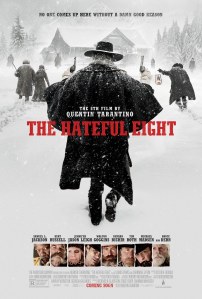 The Hateful Eight almost didn’t happen thanks to our modern-day views on copyright and privacy. Writer/director Quentin Tarantino sent the first draft of his newest script to three trusted actors, and within days it had spread to the outer reaches of the Internet. Tarantino was so incensed that he swore to shelve Hateful Eight and never film it. After a staged reading in L.A. with many of the eventual actors for the film, he changed his mind, to the relief of his sizable fanbase and actors everywhere. The Hateful Eight is a drawing room mystery with plenty of Tarantino’s signature propulsive language and bloody violence, but it’s also the director’s least substantial film to date.
In post-Civil War Wyoming, famous bounty hunter John “The Hangman” Ruth (Kurt Russell) is taking the outlaw Daisy Domergue (Jennifer Jason Leigh) to hang for her crimes. Along the way, he meets up with Major Marquis Warren (Samuel L. Jackson), a bounty hunter who served in the North and carries a letter written to him from none other than Abraham Lincoln. They’re both heading to Red Rock to extract their bounty earnings. Due to an oncoming blizzard, they’re forced to make a stay at Minnie’s haberdashery, except Minnie isn’t anywhere to be found. There’s Bob the Mexican (Demian Bichir) who says Minnie left him in charge, a foppish hangman Oswaldo Moblay (Tim Roth), a quiet cattle driver Joe Gage (Michael Madsen), a Confederate general, Sandy Smithers (Bruce Dern), and Chris Mannix (Walton Goggins), the son of a Confederate rebel who claims to be the newly designated sheriff of Red Rock. Over the course of one long night, everyone’s true identity will be learned, because someone is not who they seem to be and is secretly waiting to free Daisy and kill the rest.
 Even as lesser Tarantino, The Hateful Eight is still an entertaining and talky stage play put to film. The setup is strong and invites the audience to play along, to scrutinize the assorted characters and determine who is telling the truth. There are plenty of twists and turns and some violent surprises to keep things interesting. The conversations of the characters are such a pleasure to listen to; I want to luxuriate in Tarantino’s language. His wordsmith abilities are unparalleled in Hollywood. There’s a reason every star is dying to snag a part in a Tarantino movie, especially now that they’ve caught Oscar fire as of late. That’s somewhat crazy to think about. Cinema’s ultimate indie voice with his encyclopedic knowledge of the medium, high and low art, has become an institution within the system and his violent period films are now looked at as year-end prestige pictures. Tarantino’s M.O. has been to take B-movies and to transform them into A-movie level talent and intelligence. Never has a Tarantino flick felt more B-movie than The Hateful Eight. It was inspired from episodes of TV and it’s easy to see that genesis in its execution. It’s a self-contained mystery that comes to a head. It’s a limited story that’s likely taken as far as it could possible go, pushing three hours. I’m a tad befuddled why this was the movie Tarantino insisted on filming in “glorious Panavision 70 millimeter.” It’s almost entirely set in that one-room interior location. The extra depth that 70 millimeter affords would appear to be wasted, unless you enjoy looking at general store items on shelves in the background. Still, The Hateful Eight is a movie that doesn’t feel like three hours and harbors enough intrigue and payoffs to hook.
I tried to diagnose why this felt like lesser Tarantino, and it’s because over the course of almost three hours we don’t have much at stake because the people inhabiting the movie aren’t really characters but tough-talking facades. Tarantino is often cited for his uniquely florid dialogue, and nobody writes dialogue like Tarantino and his naturally stylized cadences, but another of the man’s skills is how great he can write a coterie of colorful characters that pop from the big screen. You might not be able to remember many lines from Hans Landa or Vincent Vega or Django, but you remember the vivid characters. Tarantino is preternaturally skilled at building characters that feel fully realized with their own viewpoints and flaws and prior experiences. He can make characters stand out but he also has the great ability to make the larger-than-life characters feel real, which is truly genius screenwriting for characters so flamboyant. The older romance in Jackie Brown is perfectly captured and felt. It’s downright mature. This is the first time I would say Tarantino has disappointed when it comes to his characters.
There are broadly drawn folk aplenty onscreen and they still talk in that wonderfully florid language of Tarantino’s that actors must savor like a fine steak, something they can sink themselves in for and enjoy every morsel. However, the characters onscreen have never felt this empty before. They are what they are and the only real change that occurs is that many will be dead before the end credits. They don’t have arcs per se but end points. It’s all about unmasking and identifying the rogues in a room full of rogues. Beyond Warren and Mannix, we’re left with precious little for characterization beyond bravado and nihilism. The effect of how empty they are would be felt less if we weren’t stranded with them for near three hours. Trapped in a room with a group of suspicious characters can only go so far, and ultimately it’s a parlor game that cannot sustain longer staying power. I doubt I’ll ever watch this with the frequency of other Tarantino flicks.
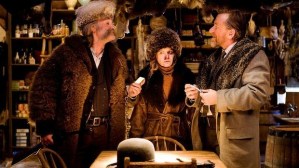 “You keep talkin’. You’re gonna talk yourself to death,” says one of those hateful numbers to another member. I’d pay to listen to Tarantino rewrite the phone book, that’s how excellent the man is with his dialogue. The man likes to hear his words and I like listening to them too. The problem is that The Hateful Eight has no reason for its gargantuan running time. As stated above, the characters we’re getting are nowhere near as complex or interesting as previous Tarantino escapades, so the talking can grow weary. Tarantino has patented a new formula from 2009’s Inglorious Basterds that involves characters playing a game of I-know-you-know-I-know while they suss out the truth, all the while the tension finely simmers until it blows. It’s a long fuse of suspense that can pay off rich rewards, like the near-perfect tavern scene in Basterds. The dinner table scene with Candie and the skull of his favorite house slave is another good example. Once our titular eight have gathered at Minnie’s, the entire movie is this sort of scene. It may be broken up into chapters and flashbacks but it feels like one long scene.
There’s also far less at stake than there was with Basterds or Django Unchained, even Reservoir Dogs, and that’s because the protagonists had goals and we had built up far more allegiance and time with them. When they were in danger, it mattered. The danger doesn’t feel as immediate because so little else is happening. There are plenty of comparisons to Dogs, which also utilized a hidden identity and a confined location. I think the difference was that, besides it being Tarantino’s first foray as a director, the tension was felt more because the danger was immediate from the start and we cared about character relationships. I cared about Mr. Orange and Mr. White and their bond. I can’t say I cared about any of the characters in Hateful Eight. I found them interesting at points, sure, but they were all a bunch of rotten bastards with little variation short of a burgeoning understanding between Mannix and Warren. The wait at Minnie’s feels like the Basterds tavern scene on steroids, pushed to the breaking point, and yet absent the urgency.
The acting is yet another tasty dish served up by Tarantino, and it feels like the actors are having the time of their lives playing their lively scoundrels. Jackson (Kingsmen: the Secret Service) settles in nicely and always seems to elevate his game when he’s reciting Tarantino’s words. He’s icy cool in scenes where the other characters are trying to do whatever they can to fire him up. He’s less bombastic than we’ve come to expect from Jackson. For bombast, there’s Russell (Furious 7) who cranks his performance to the broad heights of his bellicose lawman. Goggins gives a sly and extra caffeinated performance that answered the question of what it would sound like if you dropped his character from TV’s Justified into a Tarantino movie. Roth (Selma) feels like he’s doing his best manic Christoph Waltz impression. Dern (Nebraska) is a racist codger with a soft spot for his kin. Madsen (Kill Bill vol. 2) seems somewhat wasted as a taciturn “cow puncher.” Bichir (The Heat) gets some laughs as a seemingly aloof caretaker. It’s Leigh (Anomalisa) who steals the show, especially in the film’s second half. Daisy is a character that relishes being bad, and Leigh takes every opportunity to enjoy the fun. Her character plays a bit of possum during the first half but it’s the second half where she lets loose and becomes unhinged, and her exasperated and grotesque responses are often played for great sputtering comic effect. It’s a boys movie but it’s the lone woman who will prove most memorable. Tarantino’s last two movies have won acting awards and Leigh just might make it three-in-a-row.
 There are also some uncomfortable elements that can deter your viewing enjoyment, which isn’t exactly a foreign charge against Tarantino’s career. At this point you can probably repeat the oft-cited accusations: flagrant use of the N-word and exploitative violence. At least the historical background provides a context for the other characters unleashing the N-word, and I’d argue it tells us something about the characters as well. The characters that use the N-word when referring to Warren are the ones with allegiances to the Confederacy and those viewpoints don’t vanish even after you lost a war. They’re dismissive and intolerant and view Warren as sub-human. It also doesn’t approach Django Unchained-levels of excess, so I let it slide (I know my perspective as a white male makes my opinion on this effectively meaningless). It was the violence that got to me, specifically the violence directed at Daisy. Tarantino’s penchant for violence goes all the way back to his ear-slicing debut, so it’s nothing unexpected. He often tells stories about violent men and women fighting their way in a world governed by violence. I accept that these characters are bad to their core. That doesn’t excuse behavior. Violence on screen can be tempered with authorial commentary, but it’s the association that bothered me with Hateful Eight. For the entire movie, Daisy is put through the physical wringer. Our very first image of her is with a black eye. She’s a nasty woman and Ruth often expresses his distaste of her by punching her in the face, which is played as dark comedy. This happens repeatedly. We’re meant to recoil from much of the bloody violence on screen but repeatedly we’re meant to laugh at the violent suffering of Daisy. Tarantino has often used over-the-top violence as dark humor, and I’ve laughed along with it. This was one instance though where I stopped laughing and starting shifting uncomfortably in my seat.
Even lesser Tarantino can still be plenty entertaining and superior to most of what Hollywood usually cranks out as product. The Hateful Eight can be exciting, funny, surprising, and plenty of things, but what it can’t be is more than a lark. Tarantino has taken stories that would seem like larks, particularly the Kill Bill series, and infused them with pathos and meditation and soul to go along with all that snazzy genre stuff. It’s disappointing that Hateful Eight isn’t more than what’s on screen, but what’s on screen is still worth watching, though I don’t know whether it’s worth watching a second time.
Nate’s Grade: B
Share this:

In the Heart of the Sea (2015)
 In 1822, the men aboard the Essex, a whaling ship sailing from Nantucket, Massachusetts, encountered a beast unlike any they have ever seen. Captain Pollard (Benjamin Walker) and his first mate, Owen Chase (Chris Hemworth), were at odds throughout the voyage, that is until they encountered a 100-foot long white whale. The creature destroyed the Essex, forcing the crew to drift at sea and hope to find land, but the whale follows them as well. Tom Nickerson (Tom Holland as a young man, Brendan Gleeson as the older version) recounts this traumatic survival tale to author Herman Melville (Ben Whishaw), who is desperate to write this true story.
There’s an old-school throwback vibe to In the Heart of the Sea with its high seas adventure, but there’s just not enough attention to adventure, character, or even plot for this movie to really set sail properly. The first act feels so sluggishly long. It’s trying to set up life on a whaling vessel in the early 19th century but I didn’t feel like we got a coherent sense of life aboard the seas or how the various components worked. I didn’t know that whalers row out from the main ship, so there’s that. The opening act sets up the dull conflict between Chase and Pollard, which can be summarized as blunt upstart vs. unchecked privilege. The conflict doesn’t evolve from this dichotomy. Both men are boring in their unyielding simplicity. Hemsworth (Avengers: Age of Ultron) made a stronger impression in Rush, but a humorless movie role is not in his best interests as an actor. When the action does arrive, it can be genuinely thrilling. Director Ron Howard does a slick job of conveying the danger and destruction of the whale attack. Sadly, it’s over too soon and then the remainder of the movie is 45 minutes of a survival drama adrift in the ocean reminiscent of last year’s Unbroken. This period of isolation forces the characters to make some hard choices, yet we don’t feel the impact of those choices because the narrative, too, feels adrift. Implausibly, the giant whale has followed them for thousands of miles. Are whales really this vindictive? The documentary Blackfish makes me wonder but it still feels unbelievable. What was the whale waiting for? For the men’s spirits to be completely broken before it might attack again? We’re told this whale is a “demon” but who exactly are the bad guys in this story?
 I believe another stopping point for this story is that the culture has moved beyond the acceptance of whaling as an honorable profession, to the point that I, and I assume others, was on Team Whale after witnessing a bloody hunt. It’s pretty gross, especially when they’re harvesting the whale body for the precious oil. Perhaps modern audiences, so far removed from hunting as an essential component of life have become more squeamish, or perhaps modern audiences just recognize something as barbaric when they see it. As a result, it’s hard to root for these guys. When the giant whale attacked it felt like retribution. My sympathies were more for the large mammal than the bipeds on ship. At the end of the film (some spoilers), the white-haired moneyed men of Big Whale Oil are worried what the truth will do to their industry. They want the surviving crewmen of the Essex to deny the existence of this gargantuan whale. This makes little sense to me other than awkwardly forcing a Big Business cover-up for relevancy. First off, whaling seems like a pretty unsafe working environment to begin with, especially considering voyages could last up to three years. Would the reality of one big bad whale destroy an industry? I doubt it since there is such money to be had. If anything it might rejuvenate the timber industry to reinforce the ships to make them more durable against larger whale attacks.
At first I thought a framing device was entirely superfluous; why do we need to watch Melville elicit this tale rather than simply just watching the tale itself? It seemed like a distraction, but as the movie progressed I understood that this framing device was its own sub-story and had its own complexity, namely the older Tom coming clean to the decisions that still haunt his soul. It’s an unburdening for both gentlemen, as Melville admits his deep fear that he is a mediocre writer (he’s no Nathaniel Hawthorne) and that he will be unable to tell this story as well as it truly deserves.
As these two men are allowing themselves to become more vulnerable and sharing their demons and doubts and worst fears, I started to realize that this framing device was weirdly more compelling than all the whale action. That’s because older Tom and Melville are the best drawn characters in the movie, which seems like a screenwriting mistake of sizable proportions. Obviously the nautical survival stuff should be the most compelling, and yet I as more taken with two men sitting by an oil lamp discussing their lives. Older Tom is infinitely more interesting than younger Tom; part of this is because young Tom hasn’t experienced the full effect of the events that shape older Tom, but most of this is from the very clear fact that young Tom is kind of a mute witness in this movie. He rarely speaks and is just kind of there, taking up space. There’s one personal harrowing moment when he’s thrust inside a hollowed out whale carcass to extract more blubber, but that’s the only personal perspective offered through young Tom. A question concerning the framing device: how is older Tom retelling events he had no participation or witness to? Another issue is that the characters on board the Essex are bereft of anything that would allow us to feel for them beyond simple human survival. Chase and Pollard are given one note to play and their eventual understanding and cooperation is fine but it feels like fleeting details in a story, lost to memory or disinterest.
 From a purely technical aspect, this is one of the better Howard films. The cinematography by Anthony Dod Mantle (Slumdog Millionaire) is rich and often breath taking, with plenty of stunning aerial and underwater images. The whale attack sequence is harrowing and thrilling. Howard finds ways to imply the harsher aspects of this life without going overboard, maintaining that PG-13 rating. While the look of the film has an enhanced color palate thanks to the extra boost of CGI filters, I still appreciated the vibrancy of the on screen images. As I said with the similarly boosted Mad Max: Fury Road, I’d rather have vibrant and bright colors than a drab and washed-out color palate. Even as the movie drifts and the characters fail to grab you, at least the visuals are pretty. While sitting through the second half, I started to rethink my own prejudices concerning Howard as a filmmaker, a man who lacks a distinctive style but has a definite feel for how to tell a story. I’m not going to excuse him for The Grinch and other misfires, or his tendency to settle for maudlin in place of subtlety, but the man is a born filmmaker.
In the Heart of the Sea is an old school movie that feels too sluggish, too underdeveloped, and too free of characters for the audience to invest in. When the framing device scores the biggest emotional pull, you better start rethinking your rip-roaring high-seas adventure. Master and Commander this is not. As the inspiration for Moby Dick, I wish I had just watched a remake of Melville’s actual novel (now with extra chapters about rope!). If you ever wanted a movie that ends on a blurb by Nathaniel Hawthorne as a payoff for Melville’s artistic neurosis, then your wait is over. In the Heart of the Sea feels like a whale of a tale that is hard to believe, which ends up inspiring a far greater story, which made me yearn for just watching that superior tale. Sometimes the “truth” behind famous stories is less interesting.
Nate’s Grade: C+
Share this:

Macbeth (2015)
 It’s a mighty task to boil the Bard’s classics down to a tight yet meaningful running time and maintain a degree of cinematic quality. You don’t just want to film a stage play with the mighty parameters of film, and yet giving in to the visual majesty means less time for Shakespeare’s stirring words and complex characterization. Woe unto thee who attempt an adaptation. It requires more skill than thou would believe. I had hopes for the latest version of Macbeth from its top-shelf cast, Michael Fassbender as the titular ambitious murderer-turned king and Marion Cotillard as his wife and co-conspirator. It didn’t take long for my hopes to be dashed. First, the good: the rolling hills of Scotland are lushly photographed, and the concluding battle is set amid a roaring hellish fire and flying embers that makes for a stunning backdrop. The actors are fairly fine. If you couldn’t tell from this faint praise, there’s not much to credit as an achievement with this Macbeth. It’s strangely narcotized and often listless. It doesn’t help that the actors speak 80% of their dialogue in whispers or mumbles, even when they discover the former king has been murdered. Director Justin Kurzel (the upcoming Assassin’s Creed movie, also with Fassbender) falls back on monotony, whether it’s an overabundance of mist, similar and low-rent locations, and a plodding score that feels like scorpions are in your mind. Some of the changes are also for the worse, especially making Lady Macbeth more “sympathetic” and neutering one of Shakespeare’s great characters. She no longer sleepwalks and instead confesses her unshakable guilt to a cross. Also Macbeth is haunted by the ghost of his dead son with the witches. And there’s some brief inclusion of awkward sex amidst monologues. The final showdown comes at the 90-minute mark and the entire proceedings feel rushed and yet miraculously boring. Even the bloody violence is pretty tame considering its R-rating. If you’re looking for a truly cinematic Macbeth that enlivens Shakespeare, check out the Masterpiece Theater version with Patrick Stewart adapted into a 1930s Stalinist era. Now that was brilliant. Kurzel’s version of the “Scottish play” is one that only signifies disappointment.
Nate’s Grade: C
Share this:

Brooklyn (2015)
 If you’re looking for an Oscar movie this award season that will be perfect for grandparents, I direct you to the perfectly pleasurable Brooklyn. Beyond the throwback to the 1950 setting, it’s a movie that can appeal to multiple generations of audiences. There’s an admirable classical sense of filmmaking with Brooklyn, a delightful and charming movie with a healthy dose of nostalgia and heartfelt sincerity that should find a wide range of appeal to all ages.
Eilis (Saoirse Ronan) is an Irish immigrant who leaves her sister and mother to start a new life in Brooklyn. Thanks to a kindly Irish priest (Jim Broadbent) who had settled from her village, Eilis finds housing and a job. New York takes some getting used to, especially the density. Eilis is attending night classes to become a bookkeeper, but by day she works at a department store counter. It’s at one of the socials in her new Irish neighborhood where she meets Tony (Emory Cohen), a smitten yet confident Italian boy. She agrees to go on a date, actually two upfront, and it’s no time before Tony is walking her home from her night classes and talking about all his dreams. Eilis must return to Ireland for a family emergency. While she’s there, a bookkeeping job opens that needs her help, and a nice boy named Jim Farrell (Domhall Gleeson) grows closer to her with affections that aren’t exactly unwarranted. Eilis must decide which place to call her home and which life she wants to seek.
 While the story is set in the early 1950s, this movie could have been made in any decade of the film industry. It would not be out of place with the films of the 40s and 50s, hopeful and romantic odes about women finding new lives in the land of opportunity. There’s a classical sense to its storytelling that is rather universal about the struggles of self and independence. While this movie is awash in the period details of 50s New York City, it really could be told anywhere. The personal struggles of Eilis are completely relatable, which makes her an instantly engaging heroine. She’s a kind-hearted woman who’s trying to step out and discover who she wants to be, and this promising reality is a pleasure to watch. We’re watching the maturation of a person, watching her find her footing and gain confidence small victory after small victory. There aren’t any large or arch plot events to navigate. It’s the small moments in life, from starting a job, to becoming more sure of one’s self, to knowing whom to open up and trust. The movie is kept at a pleasantly low simmer of intensity, which works just fine. The gentle tone does not imply a lack of urgency but more so the beguiling and romantic spell. Thanks to writer Nick Hornby, who is becoming an ace screenwriter, the movie tells such a heartfelt and emotionally rich and resonate story in 100 carefully paced minutes. There’s a general joyous sensation that washes over you, elongating smiles naturally. The dialogue is often clever without being glib and the characters come across as realistic and humane. There’s only one character that is thinly drawn to approach being stock (well two counting the precocious “tells it like it is” kid). The others are hopeful, yearning, and fundamentally decent people. There’s something quite nourishing about watching decent people try and navigate their desires while maintaining their decency.
I think that’s what makes the love triangle work as well as it can, the fact that both options, not just the gentlemen at the center, are appealing. New York and Ireland both present options that afford Eilis opportunities in a career she wishes to pursue, both have compassionate men who have expressed an interest in her and are supportive of her education and goals, and both locations have a support system of friends. It may sound boring that Eilis can’t really go wrong with where and whom she chooses but I think that makes the ultimate decision that much more engaging. If these options weren’t so appealing then it wouldn’t be so interesting to watch. The mistake is that because the choices are good that there is less at stake when the opposite is true. She could rightfully be happy with either choice but which representation of Eilis will she decide? One life represents the old, the other he new. As I stated above, the characters in Brooklyn have an commendable decency to them, which makes the love triangle more difficult. Tony loves her completely but fears she may not come back, and yet he knows he has to let her go and she has to decide on her own where to call home. Jim is thoughtful and even though he obviously has feelings for her Jim knows that now is not the right time to ask, and so he too waits and hops he presents enough worth staying over. It’s a love triangle where you like all three participants, which happens so rarely in movies.
 Another strength of the film is that Ronan (The Grand Budapest Hotel) delivers a wonderfully felt performance. Much is placed upon her shoulders as our entry point into this world, and Hornby doesn’t resort to his characters explaining everything they’re thinking and feeling. Eilis is a woman who doesn’t speak in paragraphs but in short succinct sentences. She’s guarded but observant, and Ronan’s face is our great tapestry for understanding Eilis and her changing demeanor. We can watch her process the intimidating and invigorating world and read her thinking. It’s the most realistic Ronan has come across on screen as she has a habit of coming across slightly robotic, whether it’s as a pint-sized killer (Hanna), slain teenager (The Lovely Bones), or whatever the hell they were going for with the atrocious Violet & Daisy. With Ronan’s care, Eilis comes across like a resourceful young woman who is growing her sense of self. She’s a deserving lead for our simply story told with excellent care.
The only problem with a simple story told well is that it can also be predictable, which is a minor fault that doesn’t negate the impact of Brooklyn’s conclusion but does make it easy to anticipate. I’ll dance around spoilers but in a way I feel like even discussing the topic is going to be sufficient for you, dear reader, to accurately infer what direction the movie takes and which choice Eilis makes in the end. In short, Eilis makes a decision before leaving back to Ireland that somewhat stacks the deck in the favor of one of the two locations. This kept me from feeling like the choices were evenly considered. In the end, it’s a decision for Eilis about embracing her home and native culture and sense of community or branching out on her own and building something new and exciting. It’s possibility and independence versus comfort and family. It’s what can be versus what she’s known. It’s a decision that is universally relatable. Few of us have had romantic suitors and prosperous situations to vie over but many people have to make the normal decision of what path to embark, whether it’s the risk of something different or the reassurance of what is familiar and what has been earned. These aren’t the life-and-death stakes we see typically in the movies but they’re the decisions that often dictate fates.
Brooklyn is an easy movie to be carried away with. It’s full of honest and earned emotions that resonate from its reletability, tender heart, and gentle observations of watching a woman navigate the choices of her life. It’s an immigrant story and a coming-of-age tale, a romantic triangle with some fish-out-of-water elements. It’s a lot more than the sum of its parts, but with actors this good and with a script this tailored to deliver emotional uplift and satisfaction, those are some mighty impressive parts. If you’re on the hunt for a feel-good movie that won’t make you roll your eyes or overdose on sap, then I advise you and your family take a trip to Brooklyn and enjoy the sights.
Nate’s Grade: A-
Share this:

The Danish Girl (2015)
 While you watch The Danish Girl, you can feel the full weight of everybody’s good intentions. The filmmakers and cast all seem to realize that they are telling a story that will humanize and help others better understand trans issues. It’s the first sexual reassignment surgery and a community that is still fighting for wider acceptance. Nobody wants to screw up this story and do a disservice to representing the stories of the trans community. You feel the earnest good intentions with every frame, and yet I would argue those same good intentions end up paralyzing the movie and its impact.
Lili Erbe (Eddie Redmayne) is living her life as Einar Wegener, a Danish landscape painter of some renown in the 1920s. His wife, Gerda (Alicia Vikander), is a portrait artist trying to be more than the wife of a famous painter. One day, Gerda’s model is absent and she asks Einar to step in. He puts on stockings, holds a gown to his body, and it’s a revelation. Soon after Einar is wearing women’s garments under his clothes and Gerda dresses him up with makeup and a wig. It’s a fun diversion and something of a turn-on for Gerda, and then her husband informs her that Lili isn’t the costume, Einar is. Lili tries to find a sense of explanation with disdainful psychiatrists and doctors but is deemed aberrant. Lili is struggling with this crisis of identity and self-acceptance, and then a new beginning emerges with a helpful doctor who can physically transform Lili from a man into a woman. The surgery is not without risk but Lili is willing to do whatever it takes to feel whole (note: since Lili is the chosen gender identity for the film’s subject, I shall be referring to her as Lili and using feminine pronouns).
 Redmayne (The Theory of Everything) gives a suitably affecting performance that is full of empathy and a halting sense of fragility. He seems like he’s about to crumble at any moment, his nervous smile and pleading and confused eyes communicating Lili’s trepidation and flights of exciting discovery. Redmayne’s delicate androgynous features and long-limbed dancer’s body play to his strengths, as he adjusts his physicality to reflect his mind’s experimentation of what it would be like to be a woman. There’s a rather lovely visual where Lili visits a peep show in Paris. After a few minutes of bashful eye contact, she begins to mimic the peep show model’s physical poses, and the camera’s focus melts between the two. It feels like a dance between the two and in this simple visual much is communicated. Unfortunately, the majority of the movie lacks the impact of this poignant visual. Redmayne too often retreats into his stable of nervous gesticulations and halted speech. It’s a performance that feels too detached and too opaque to make you feel the full turmoil of Lili. There’s an interesting moment when, dressed as Lili, a smitten man kisses her without permission. Lili is upset at the lack of consideration, to which the man replies, “I couldn’t chance you saying no.” That little moment highlights the challenges of women in a society that doesn’t respect their agency. It’s too bad the movie doesn’t present more scenes that explore this new dynamic that Lili will have to adjust to. Instead the move repeatedly falls back on her as Brave and Strong. As presented, Lili is more catalyst than a fleshed-out character, which is remarkable considering the movie is reportedly about her struggles. Rather, the real focus of the story seems to be Gerda, who, incidentally, is the only person on screen referred to as “the Danish girl.”
Gerda is given equal attention in the screen adaptation by Lucinda Coxon (The Crimson Petal and the White), which is generous and will likely leave several viewers confused. First, Gerda is given the most complete character arc and a surprising amount of consideration for her perspective. I suppose she could be the audience’s entry point into this story, the relatable position for many audience members trying to better understand a loved one saying they were born in the wrong body. The movie presents greater empathy for Gerda’s plight than it does Lili, which is definitely unexpected and perhaps misplaced. Surely finding the courage to embrace a controversial identity that precious few will even acknowledge, let alone the bastions of contemporary medical science declaring such thinking to be signs of a degenerative brain, is a bit more of a risk than being a supportive spouse. I don’t want to mitigate Gerda’s own personal struggles dealing with the outward transformation of Einar into Lili. It’s a position that deserves deep empathy and the movie has it in spades, as we watch Gerda try to be supportive while the person she fell in love with erases himself. Vikander (Ex Machina) also kills it. Her performance is full of the breadth of emotions that I found wanting in her screen partner. Vikander’s face registers all the complicated emotions; she’s in a sense saying goodbye to her husband and a specific life they shared, and while for her it can feel like mourning, for Lili it is a rebirth. Viankder’s compassionate and nuanced performance as Gerda is the exclamation on one hell of a year for the Swedish actress.
Director Tom Hooper (Les Miserables, The King’s Speech) gives everything the proper stately appearance with his signature visual indulgences (the man loves his asymmetrical one-shots and generous head room in the camera frame). There are several landscapes or venues that look gorgeous or given a dream-like sense just from Hooper’s framing. His handling of his actors is first-rate, and there’s a comfortable sensuality to scenes between Einar and Gerda, further communicating just how enraptured each is with the other. The musical score by Alexandre Desplat (The Grand Budapest Hotel) is a bit over excited to explain all the many emotions you should be feeling, but other than that the technical aspects of The Danish Girl are pleasing to the senses and enhance the story. I just wish the screenplay gave us so much more to think about when it comes to Lili.
 As a strange aside, I’d like to question what the MPAA is referring to with its disclaimer that The Danish Girl is R-rated for such content as “full nudity.” I understand the concept of partial nudity since you’re only seeing a fraction of the form, but what exactly makes one’s nudity full? Do they mean “complete” as in you see everything, front to back? If so, I thought that content was already covered in the oft-used term of “graphic nudity.” For you ratings aficionados out there, or people who are intrigued with arcane movie trivia like myself, I’ve discovered that “graphic” often means two things: the sight of a penis or pubic hair. If its breasts, bottoms, or female genitals absent the appearance of hair, it’s commonly categorized plainly as “nudity.” There’s likely a larger essay on why male genitals are thought of as “graphic,” and especially why seeing pubic hair on women is somehow a sight in need of more forewarning than simply “nudity,” but I’ll set that bit of cultural soul-searching aside for a later day. If you must know, there’s a brief shot of Redmayne tucking his genitals behind his legs and creating the image of a woman. I double-checked and the MPAA hasn’t revised the rating rationale for 1991’s Silence of the Lambs (also a prominent film tuck display), but I’ll let you know, dear reader, if any more information comes across my news desk on this very weird subject.
Tasteful to a fault, The Danish Girl is a reserved biopic that goes about its story with a sincere and earnest sense of responsibility. It wants to tell its story correctly instead of telling its story in the best-developed and executed fashion, and there is a difference. The performances are strong, though Viankder is the standout as the film’s surprising focus. Redmayne feels too timid and fragile to make Lili’s story resonate beyond common human compassion. The screenplay doesn’t place us insider her mind. Instead, we’re treated more to how Lili’s choices are impacting her supportive but anguished wife. In 1930, a mere four months after the fourth and final surgery, Lili died from complications related to the operation, lending a greater sense of tragedy (this fact is left out of the concluding text). It’s a movie that feels too distant even from itself. Everything is so reserved, so tasteful, so artfully opaque, so afraid of making the wrong step that The Danish Girl ends up being an Oscar-bait biopic that feels too hesitant and bloodless.
Nate’s Grade: B-
Share this:

Bridge of Spies (2015)
 An intriguing behind-the-scenes negotiation during a heightened period of danger, Bridge of Spies relies upon its history to do the heavy lifting and it’s plenty enough for a handsomely made, reverent, and engaging legal procedural that’s also hard to muster great passion over. Tom Hanks is again a noble everyman, this time an insurance lawyer, James Donovan, called in to defend a mild-mannered Russian spy (Mark Rylance) captured during the Cold War. Things get even more complicated when spy pilot Francis Powers is shot down over Soviet airspace. The movie’s civil liberties arguments are pretty clear and still applicable to our modern era, but the movie becomes exponentially more interesting once Powers is captured and Donovan travels to Eastern Berlin to negotiate a prisoner swap while trying to work three sides, the Americans, the Russians, and the Eastern Germans who were hungry for legitimacy. It’s during these back-and-forth negotiations and posturing that the movie really hits its stride, pulling incredible facts together while forcing our protagonist to be the world’s greatest poker player. It’s the details of this story that makes it feel more fulfilling from spy techniques to the new life on the other side of the Berlin Wall. The acting is robust and Rylance (TV’s Wolf Hall) makes a strong impression in a role that requires him to be cagey to a fault. Hanks is his usual determined, inspirational self, which plays all the right emotions in a way that still feels expected and a little boring. Bridge of Spies is a slighter Steven Spielberg affair, a good story well told with good actors but a movie missing essential elements to plant itself in your memory. It’s a fine movie but sometimes fine is just not enough, and considering the talent involved in front of and behind the camera, I expect better.
Nate’s Grade: B
Share this:

Pan (2015)
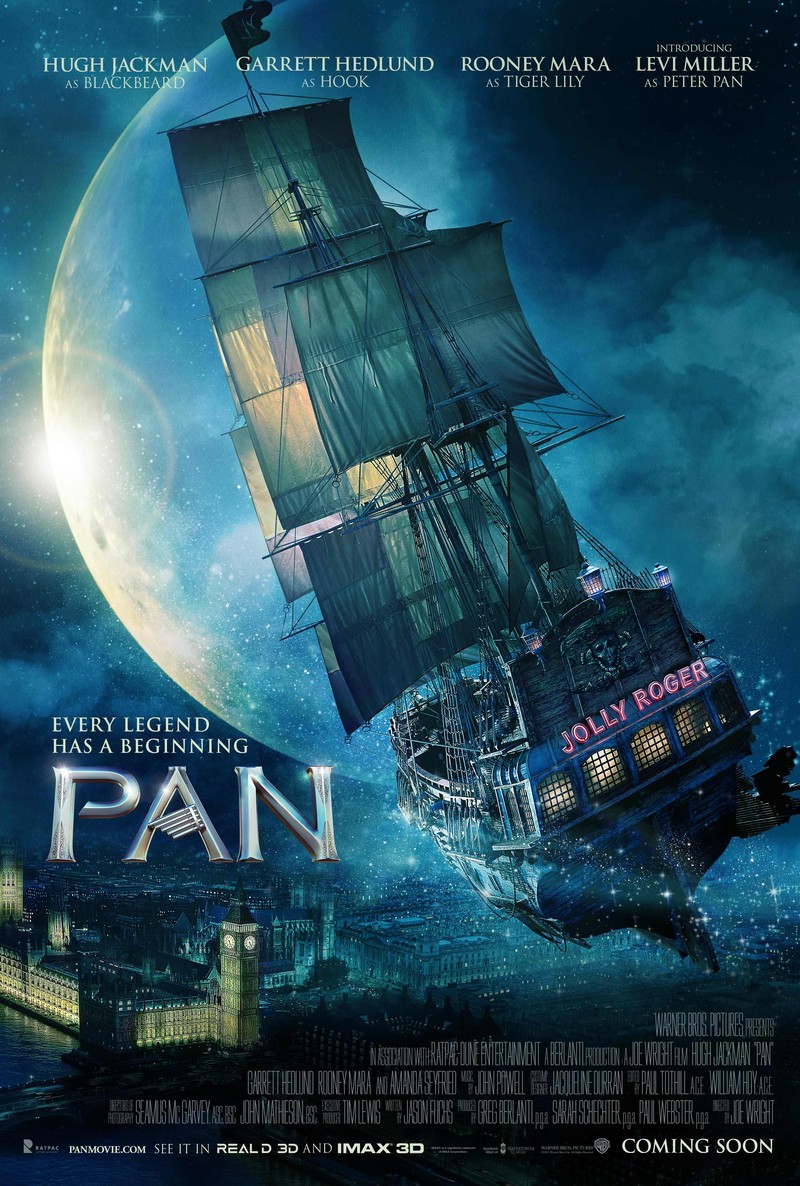 Reminiscent of the Patton Oswalt bit concerning The Phantom Menace, often fans rarely need the “before” when it concerns the characters they love; did anyone really need to know what Peter and Hook were up to before they became mortal enemies? Pan attempts to tell the story before we know it about how Peter Pan became the character we know. It was originally planned for a summer 2015 release and was pushed back until the fall, ostensibly for more time to finish visual effects. the studio, Warner Brothers, pulled a similar move with Jupiter Ascending, and we know how that turned out.
Peter (Levi Miller) is an orphan living in London during World War II. He and a few of his best parentless pals are abducted in the middle of the night by a group of pirates and their flying pirate ship. He’s taken to Neverland to work in the mines belonging to Blackbeard (Hugh Jackman), who has an addiction to fairy dust. During a scuffle, Peter discovers he has the ability to fly, though he can’t exactly master it. There has been a prophecy that The One would be able to fly and they would topple Blackbeard. Peter and another miner, James Hook (Garrett Hedlund), escape, finding their way into the land of the “natives,” which includes Tigerlily (a miscast Rooney Mara). The “Pan” has been prophecized to help lead their people and discover the bridge into the world of the fairies, and Blackbeard won’t stop until he finds the source of his pernicious pixie smack.
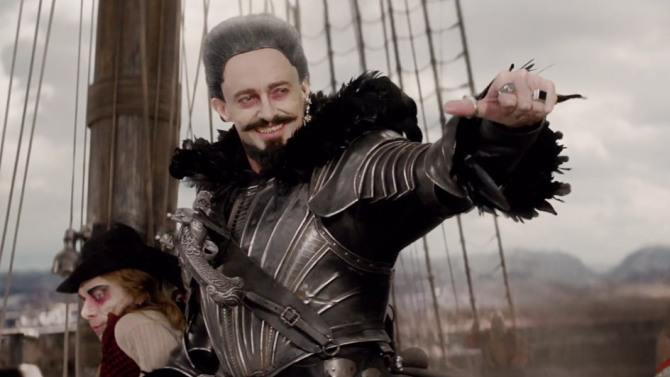 Who exactly is Pan intended for or what story needed to be told prior to our introduction to the world of Neverland? The first act sets the stage for the miscalculated tonal mishmash that never truly settles: we jump from a cruel orphanage, with Peter comically plucky, to the horrors of the London bombing during the Blitz, to a bunch of pirates kidnapping the orphans (tacitly with the approval of the evil head nun running the orphanage), and from there we’re whisked away across space to a mine of slave workers digging for pixie dust minerals who serenade their pirate slave lord with the lyrics to Nirvana’s “Smells Like Teen Spirit” for… some reason. Is this a movie intended for younger children and families? Is it intended for teenagers? The tone veers wildly, sometimes within the same scene, going from serious and gritty to colorful and ridiculous. It’s a campy experience that makes me wonder who exactly was supposed to enjoy an attempt to open the Peter Pan mythos, a world that is generally shallow.
At no point does Pan justify its existence beyond a flimsy corporate attempt to take a familiar world and expand upon it for sweet franchise money. When you get down to the world of Neverland, at least as represented on film, what exactly is there? There are pirates, “natives,” mermaids, and fairies, and that’s about it. They all kind of exist in their own individual movie that fails to blend together, making the new groups of characters feel like little more than a new theme park attraction before moving on to the next autonomous ride. The fantasy figures themselves just aren’t that interesting because there just isn’t much to them beyond superficial descriptions. I suppose then that this would allow plenty of opportunity at world building to take these familiar staples and give them greater depth, and that’s Pan’s biggest missed opportunity. Far too often, the movie feels on Fantasy autopilot and what we’re given is the old clichés of the Great Prophecy and the Chosen One meant to bridge worlds, etc. the events in the film do little to explain how Peter became Peter Pan, besides learn to fly. The problem with the prophecy trope is that it robs characters of agency in place of just accepting their capital-D destiny.
You learn nothing new about Peter or Hook as people, and the nods to the greater Pan lore are annoying at best with how unsubtle and clunky they are. The movie doesn’t even lay the groundwork to explain what conflicts will eventually drive Peter and Hook apart. Peter is a bland hero who is defined by the mystery of his absent mother and her own lineage. He’s special because his mom was special and if he just believes hard enough then perhaps he can be even more special. It’s pretty simplistic stuff. The references to the Pan lore always seem to stop the movie dead in its tracks. The relationship between Peter and Hook isn’t explored in any capacity other then they appear to have both escaped together and been running side-by-side. It’s a relationship not out of bonding but out of sheer proximity. The concluding lines are literally Peter saying, “We’re going to be friends forever,” and Hook replying, “What could possibly go wrong?” Oh my goodness is that one hacky groan-worthy wink to the future.
 Pan is made serviceably watchable from director Joe Wright and the campy performance of Jackman. Wright is a premier visual stylist in cinema though his artistic instincts can lead him to try and smash as many ill-fitting square pegs as he can into round holes, last evidenced by the 2012 Anna Karenina adaptation that made all the world a literal stage. The visuals are often splendid to behold and Wright has a wonderful feel for color hues. The final act feels climactic and visually alive in ways the movie doesn’t even deserve, and Wright’s vision, weird as it can be at points (Nirvana?) gives the movie an energy that keeps its worth an initial viewing. For a movie filed with fantasy realms, I enjoyed the scenes in the orphanage and with the wicked head nun the best (is she knowingly selling the boys into slavery on a magic pirate ship or is it just extreme negligence on her part?). The other aspect that at least held my attention was Jackman. In a movie filled with bland and the occasionally bizarre performance, Jackman offers an anchor to lean upon. It’s not a good performance by normal circumstances but it provides a sense of life and feels in place. Hedlund (On the Road) is amazing in just how strange his rakish Harrison Ford-esque performance persists. Why didn’t anyone tell him to stop? His speaking voice fascinated me and I spent the entire moving trying to figure what it sounded like and my best description is Heath Ledger’s impression of Al Pacino.
While not being a colossal disaster of artistic self-indulgence, Pan is a disappointing and mostly tedious experience because of its failure to capitalize on expanding upon the Neverland universe and exploring what should be formative experiences to central characters. If this was going to be a crazy artistic romp then it needed to be crazier. If you’re going to have two brief anachronistic songs, then do more or at least draw in more influences from other timelines. If you’re going to be a straight-laced pilot for a budding fantasy franchise, at least give us more flights of fancy and wonder. Make us fall in love with this world or at least some of the characters. Instead Pan uses the audience’s pre-existing association with the characters and the environment in place of doing anything meaningful with a story. Peter becomes Peter Pan, so he doesn’t have to be a character he just has to be the pre-Pan Peter. The same for Hook and Smee and Tigerlily and that’s really the only characters worth mentioning until those Darling children come visit. I thought I was going to ridicule Pan with the glee I had taking apart Jupiter Ascending but I couldn’t muster much effort. It didn’t feel like the Pan filmmakers did either.
Nate’s Grade: C
Share this:

The Diary of a Teenage Girl (2015)
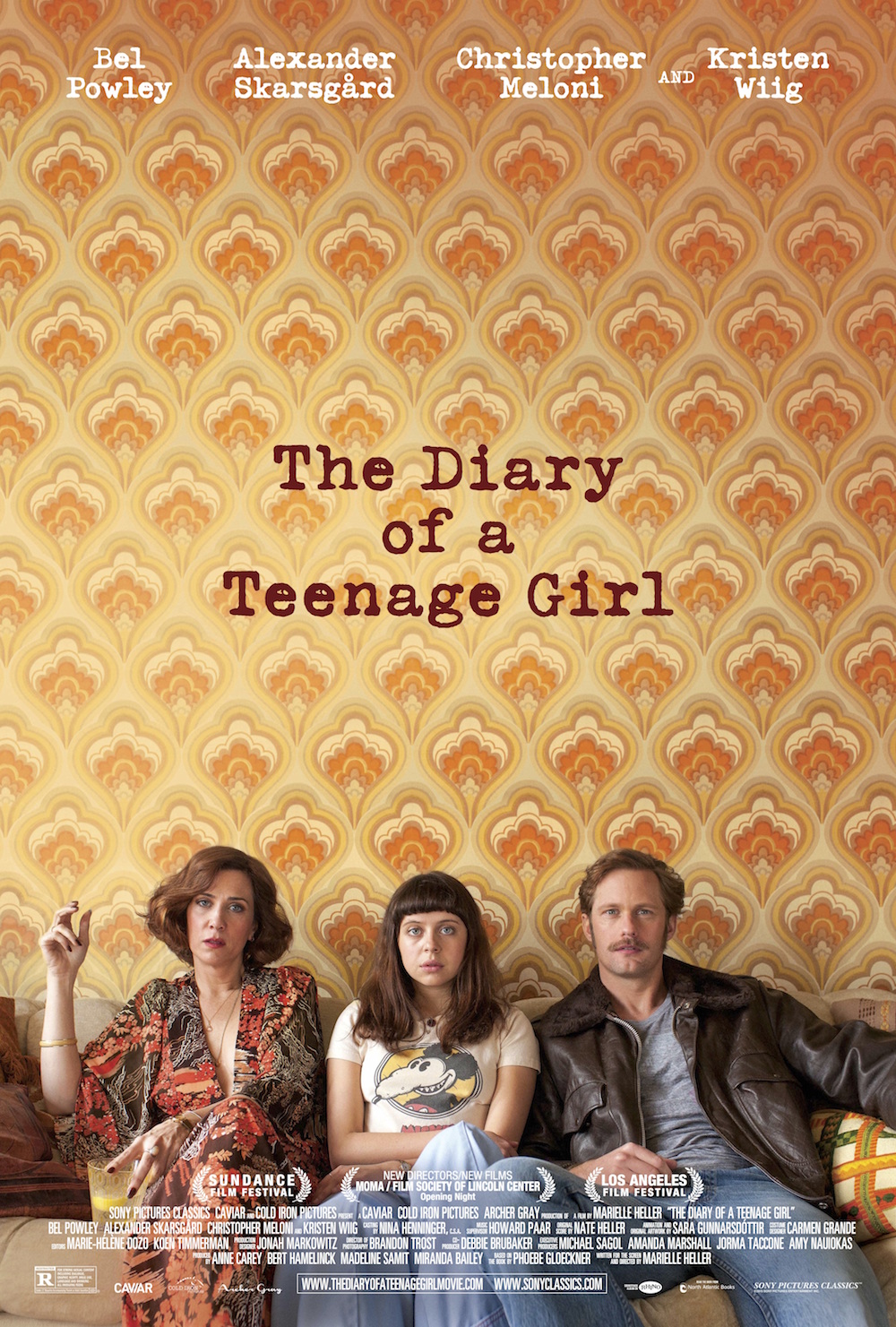 In 1976 San Francisco, Minnie (Bel Powley) is trying to navigate the world of boys and her teenage feelings. She’s 15 years old and wants to be an artist. She lives with her mother, Charlotte (Kristen Wiig), and her mother’s boyfriend, Monroe (Alexander Skarsgard), and her little sister. Minnie has always exhibited a desire to be touched, and the accidental touches of Monroe are exciting her mind. One night, their sense of play crosses a line and the two kiss, and from there Minnie and Monroe carry on a secret tryst.
Refreshingly, The Diary of a Teenage Girl may be one of the few coming-of-age films about a teen woman discovering her sense of sexuality without extolling an overpowering sense of moral judgment. The movie is frank and honest and allows its characters to make mistakes but also learn from them, and the kind of activities others might deem as mistakes or pitfalls might not be deemed as such by our characters, at least at their current point in time. Minnie is such a starkly interesting character, cheerfully independent and naively romantic. Her very first words in the film are, “I just had sex today.” Minnie is a character that enjoys sex and the movie does not punish her for her hormonal impulses. It’s encouraging to see a portrait of a woman who takes agency over her own sexuality. Once she’s discovered sex, it’s like a new world for Minnie. She feels like she’s discovered the secret handshake to being an adult. The world looks different to her. There’s a funny scene where she’s in a record shop and eyeing some of the varying male patrons, imagining what their respective penises might look like, which are depicted with colorful onscreen animation. It’s a nice change of pace to have a movie adopt a female point of view and the Female Gaze, if you will. We see the world as Minnie does, bursting with possibility, pleasure, and excitement. And yet, at the corners, we can sense the contours of doubt, the life lessons that will eventually present themselves to our restless heroine (the audio diary of her sexual escapades with Monroe is a time bomb waiting to happen). These lessons are not one of punishment but one of experience and understanding reminiscent of 2009’s An Education.
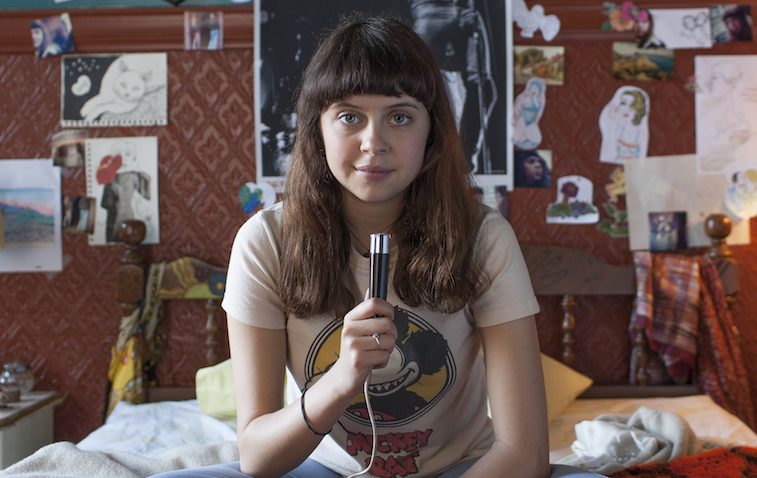 Its bracing sense of honesty and its finely attuned perspective also help elevate the film. Minnie’s voice is all over this movie, and not simply because she provides narration. She’s not over precocious or hyper literate; she speaks like an average teenager bursting with feelings and ideas that she has trouble putting into words. There is a sprightly sense of humor that runs throughout, a sense of comedy that get can get naughty while still feeling wonderfully immature. Minnie’s point of view and the way she processes the world, aided with often-animated fantasy and dream sequences, provides plenty of entertainment. Some of the humor is derived from her naiveté and how brashly straightforward she can be about her wishes, but even these moments are free of judgment. Minnie is allowed to be the funny, flawed, and complex creature she is.
Teenage Girl is also a remarkable spotlight for two artists, Powley and debut director Marielle Heller (wife to Lonely Island Boy Jorma Taccone). Powley is a terrific lead and gives Minnie an appealing mixture of curiosity, angst, attitude, and humor. She’s thrown into a different world and trying to adjust as she goes, which leads to plenty of vulnerability and honest reflection. She’s looking for more than sex but doesn’t quite know how to find the companion she desires yet in a culture that values her most as a figure of desire. Powley, it should also be noted, is British (though you’d never know) and 22 at the time of filming. There are several sex scenes and nude sequences for Minnie that can be uncomfortable to watch given the age of the character. I never felt the movie was being exploitative with its lead actress and character. There’s a moment when Minnie stands naked before a mirror, touching her body, and openly hoping for someone who will love her as a whole. These moments are meant to be awkward and raw and they achieve that power without feeling exploitative. Powley’s performance is such a natural and cutting teenage performance with touches of Maggie Gyllenhaal in her voice. This is the kind of character that a young actress desperately hopes for and luckily Powley was gifted the right director.
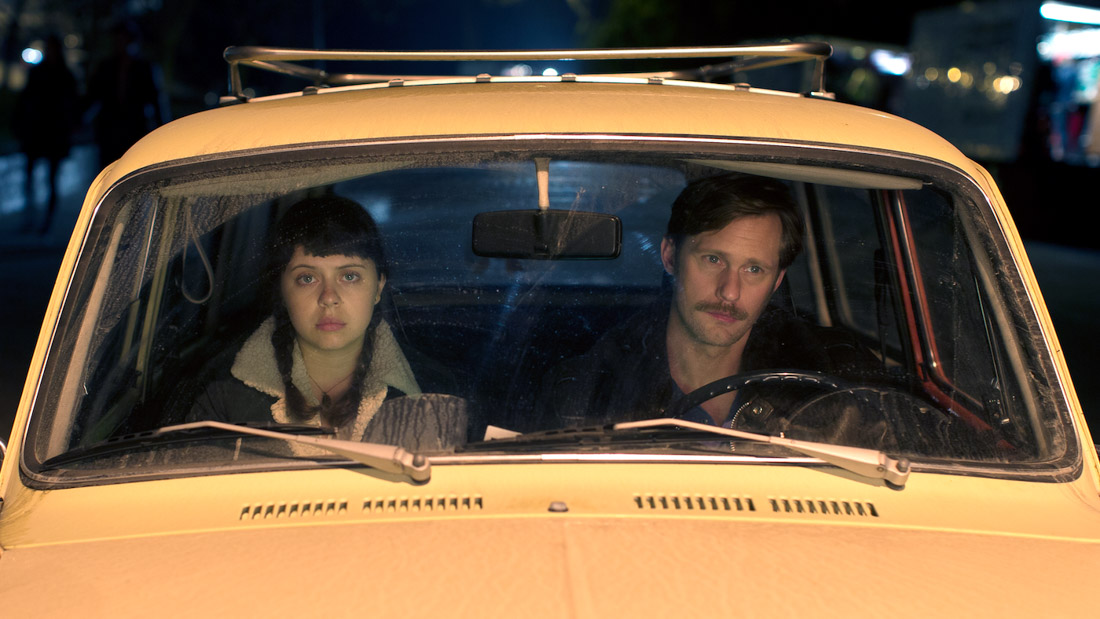 Heller, who also adapted the script based upon the semi-autobiographical graphic novel by Phoebe Gloeckner, has a definite feel for the material and keeps the tone controlled. It would be very easy for this story to veer into tawdry with its sensationalist elements, and yet it feels far more grounded in the reality of a teenage girl discovering how to interact with men and the power she has within her. There are some cringe-worthy moments between Minnie and Monroe but the movie doesn’t tell us how to feel and instead challenges the audience. Monroe isn’t presented as some leering and lascivious pederast. He is presented as yet another flawed individual who is wrestling with conflicted feelings; he knows what he’s doing with Minnie is wrong but he can’t quite quit her. There’s a level of sympathy toward his character that doesn’t excuse his actions and weaknesses. Charlotte, in contrast, is a character that speaks the language of the 1970s enlightened feminist but has shackled her subconsciously, setting up reoccurring failures for herself because she has difficulty taking responsibility for herself. When she gets a big check from her concerned ex-boyfriend (Christopher Meloni), she frivolously spends it on drugs. By the end of the movie, Minnie acknowledges that her mother will always think she needs a man, a provider, to simply get by in this life. Heller’s feel for these characters is sharp and the ambiguity she affixes is appreciated.
The Diary of a Teenage Girl is a coming-of-age drama that sits unique amongst the burgeoning subgenre of teen angst and broken hearts mostly because it is female-focused and free of judgment or moral castigation. Our heroine learns about the world, learns the power and pitfalls of sex and the potential enjoyment, and yet she still gets to be herself, free of long-term scarring punishment usually befit a Lifetime original movie on the sordid subject. Even better, Minnie is an intensely interesting and entertaining character that freely shares her frank perspective. The film adopts her perspective and Teenage Girl comes across and far more honest about its characters and about growing up. Powely is a standout and destined for further great things, and the supporting cast all perform ably. There isn’t a bad or misplaced actor in a beautiful looking film. The Diary of a Teenage Girl (man do my fingers really confuse this title with the name of that cheesy ABC Family TV show starring a young Shailene Woodley) is a smart, funny, provocative yet mature and welcomed slice-of-life story that feels painfully honest and praiseworthy. It’s a story that doesn’t excuse or condemn the actions of any of its characters. It’s a film that takes chances and reaps rewards from its risk-taking. It can feel like watching a slow-moving car slide into a ditch, but you’ll be glued to the screen throughout.
Nate’s Grade: A-
Share this:

The Man from U.N.C.L.E. (2015)
 Guy Ritchie’s big screen reboot of the 1960s TV show is the right kind of fizzy summer escapist entry that goes down smooth and entertains with just enough swanky style to pass the time. The Man from U.N.C.L.E. is equal parts spy thriller and straight-laced genre satire, hewing closer, and more successfully, to a marriage between Ritchie early cockney gangster flicks and his big-budget Sherlock Holmes action franchise. It’s often fun and surprising at how well it holds its tone between comedy and action; it almost feels like a screwball romance with guns and bombs. The trio of leads, Henry Cavill as the American agent, Armie Hammer as the KGB agent, and Alicia Vikander (Ex Machina) as the German asset, make an engaging group with plenty of conflicts to explore. It’s surprisingly more character-based than driven by its action set-pieces. Cavill shows far more life and personality than I’ve ever seen from him on screen. Vikander and Hammer have an amusing chemistry together and the movie allows them to roughhouse without pushing either character in a direction that feels too safe. Their series of will-they-won’t-they near misses will drive certain portions of the audience mad. The movie gets into danger when Ritchie and his co-screenwriter Lionel Wigram get too cute, especially with a narrative technique where the movie doubles back or highlights action that was in the background at least four times. The world of this movie is also another asset, as the period costumes, soundtrack, Italian locations and production design are terrific and further elevate the swanky mood. It’s an ebullient throwback that serves up enough entertainment with its own cock-eyed sense of throwback charm.
Nate’s Grade: B
Share this:

Little Boy (2015)
 I was expecting to bury Little Boy in an avalanche of negativity once I found out a late plot point that made my jaw drop. This inspirational Christian independent film is set during World War II and features a pint-sized moppet, Pepper (Jakob Salvati), whose only real friend is his father (Michael Rapaport), who is now serving in the fight in the Pacific. He’s told that through the power of belief he can accomplish great things, and well, he really wants his dad to come home. So through the power of belief he causes… the dropping of the atomic bomb (WWII aficionados will recognize the nickname of the bomb). I was waiting for the moment and amping my sense of dread and moral outrage. A funny thing happened on the way to a nuclear bomb detonation, and that is that Little Boy is a fairly agreeable and effective family film that conveys a message with a welcomed degree of ambiguity and complexity and tolerance. This is a Christian-themed film about the power of belief but at no point does it make explicit whether it’s coincidence or the power of Pepper channeling God. Part of Pepper’s list of good deeds given to him by a priest (Tom Wilkinson) is to befriend a Japanese neighbor who returned home from an internment camp. The movie shows how casual these small-town folk indulge in racism and bullying. The Japanese man is also an atheist and I was legitimately astonished that the movie never makes a judgment about this. He’s treated as a complex man with his own system of thinking, and he’s not viewed as lesser or wayward because of his lack of belief in a higher power. Little Boy is no God’s Not Dead. The melodrama is well paced, the acting is solid if a bit heavy on long bouts of weeping, and the movie undercuts what normally would be the inspirational apexes with harsher reality. The bomb is dropped, and Pepper is initially celebrating until he discovers the total horror of Hiroshima. His “wish” may have even backfired with his father getting further punishment in a POW camp. While I still find the development tacky, I have to reluctantly credit the filmmakers for refusing to pander in a style that removes the complexity and ambiguity of real life. It’s still a movie and it still has a rather predictable albeit emotionally earned ending, but Little Boy might just be one of the biggest surprises of this year for me at the movies.
Nate’s Grade: C+


 nathanzoebl
You must be logged in to post a comment.