Blog Archives
Friendship (2025)
 If you’re a fan of Tim Robinson’s brand of weird, cringe-inducing comedy that can accelerate in intensity or abrasiveness at a moment’s notice, then Friendship may indeed be the comedy of the year for you. I’ve never watched Robinson’s popular Netflix sketch comedy series, so consider me a novice to the man’s style of locked-in irony and chagrin. To say I “enjoyed” Friendship would be inaccurate. It exists on a comedy plane where I can mentally step back, assess the particulars, and often the sheer commitment to the bit, and think, “This is schematically funny.” Do I actually laugh out loud? Rarely. It’s a comedy that might be easier to admire for its jaunts into sudden weirdness and discomfort then it is to say you love the movie. Robinson plays a boring middle-aged man starting a new adult friendship with his new neighbor, played by Paul Rudd. It’s a comedy of errors as Rudd wises up to how weird and potentially unstable his newest friend can be, and he decides to end their brief friendship. Imagine taking a broad studio bromance like I Love You, Man, also starring Rudd, and mixing it through the perspective of Big Fan, the obsessive loner drama. There are a few amusing sidesteps, like when Robinson’s wife (Kate Mara) literally gets lost in the town’s system of sewers, or when he tries licking a psychedelic toad only to hallucinate a trip to Subway and feeling cheated from a better trip. The actors are all on the same wavelength, committed to selling the jokes by pretending no such jokes exist in this universe. I laughed occasionally but mostly shrugged my shoulders, hoping it would hit a new gear that never came.
Nate’s Grade: C+
Share this:

Death of a Unicorn (2025)
 Unfortunately, this never became the glorious B-movie its premise promises, a monster movie with ghastly gore that also satirizes the rich business elites. Death of a Unicorn has enough appealing elements, from the father/daughter relationship between Paul Rudd and Jenna Ortega, to some ridiculous gore and kills, to impressive creature prosthetics to bring the unicorn to life (and death). The setup has Rudd and Ortega run over a unicorn in a secluded nature reserve on their way to meet dad’s boss. They discover the unicorn blood can be miraculously healing, which is a fortuitous discovery considering Rudd’s boss runs a pharmaceutical company. You can see where this goes, especially when you learn that there are more unicorns out there and they are not happy. It becomes a wily creature feature from there, with unicorns picking off the characters one-by-one as they try and escape. The satirical broadsides are a bit too broad, thus only really glancing in their pointed attacks that the people in charge of medical care are themselves venal and selfish. Got it. Much of the humor is related directly to the absurdity of watching a unicorn as a blood-thirsty monster. If you replaced the unicorn with, say, a yeti, would the situation still be amusing? Maybe, but I seriously doubt it. Death of a Unicorn could have been a little scarier, funnier, even freakier, and maybe carried through on the courage of its convictions.
Nate’s Grade: C+
Share this:

The 40-Year-Old Virgin (2005) [Review Re-View]
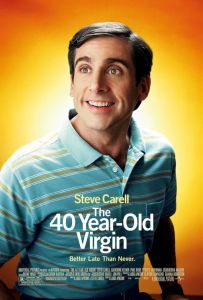 Originally released August 19, 2005:
Yes it’s an uproarious sex farce, that’s a given from the ads, but this movie is also surprisingly sweet and genuinely moving. A lot of credit goes to star/co-writer Steve Carell and co-writer/director Judd Apatow, creator of some of the best, most honestly funny TV series unjustly cancelled. Apatow is a master at mining human comedy for pathos, where you get a great sense of character and really feel for those onscreen, and yet nothing feels cheap or unwarranted, all the while deriving comedy from the situations. We need more men like Apatow in the film industry. Carell can do it all whether it’s deflecting his insecurity, which we feel so bad when he comes up with outrageous things he’s overheard to make himself seem like one of the guys. The supporting cast is top-notch. They’re basically the stock roles in a sex comedy and yet they bring so much more to the table, with a true-to-life boys-will-be-boys camaraderie that you can identify with. The character relationships in The 40-Year-Old Virgin really elevate the story and the jokes and make the film something really special. It’s not merely a barrage of gross-out humor; it’s a nice story with some very tender moments. This is a movie that goes well beyond its gimmick premise, never feeling like a skit blown up into a feature film. It mixes in psychology, heartbreak, awkwardness, but also insights into loneliness and human connection. The best character-based comedy in years.
Nate’s Grade: A
——————————————————
WRITER REFLECTIONS 20 YEARS LATER
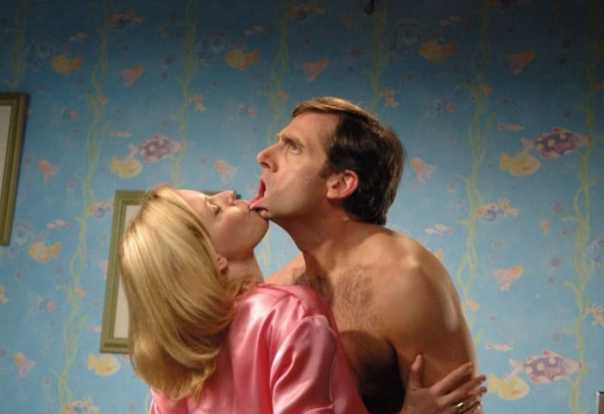
It’s always an interesting prospect to revisit beloved comedies decades after their impact. Comedy is, by its nature, a form of entertainment with the shortest shelf life. What one generation and time considers funny may prove antiquated or offensive the next or, just simply, not funny. I challenge readers to watch the old vaudeville routines and really try to laugh, not just snicker or titter but laugh, the kind of laughter where you have to hold your sides and worry about losing bladder control. Shakespeare wrote many comedies but I would argue most would view them today as clever rather than gut-busting. That’s just the nature of funny, which is in constant flux. One day you’re a popular comedian building your brand on copious “I hate my wife” jokes, and the next you’re a has-been who has transparent issues hating women. I experienced this before when I revisited the movies of Kevin Smith, a filmmaker who made a significant formative impact on my burgeoning sense of comedy and indie cinema. I found that the same movies that proved so funny and outrageous in my teenage and young adult years now, in the light of distance and decades, felt painfully dated and grasping, gassed and flailing. Comedy is a cultural time capsule.
The 40-Year-Old Virgin was a delightful surprise when it was originally released twenty years ago, but it wasn’t only a popular sex comedy, it began a new era of dominant comedy, the Judd Apatow Era. The prolific producer had been responsible for critically acclaimed TV series that always got cancelled too soon, like Freaks and Geeks (created by Paul Feig), Undeclared, and The Ben Stiller Show. He was a well-regarded writer with a sharp eye for talent, but it wasn’t until 2004’s Anchorman that Apatow had a hit under his name, a comedy that crossed over from a small cult audience into the zeitgeist. After The 40-Year-Old Virgin’s reign, the Apatow style of comedy became hip and desirable. It was a winning mixture of broad body humor and character-driven pathos, usually following lonely men suffering from arrested development and finding kinship, agency, and a fuller sense of who they are by the end. There were regular set pieces like traditional comedies but these were more focused on character moments and vibes, which lead to roaming running times and loose-goosey, improv-heavy jam sessions. It was the combination of salty and sweet that proved a winning combination, starring less conventional leading men like Steve Carell, Seth Rogen, Jason Segel, and Jonah Hill, many of whom also wrote or co-wrote their own movies. The Apatow factory created a comedy coaching tree of influential big screen storytellers.
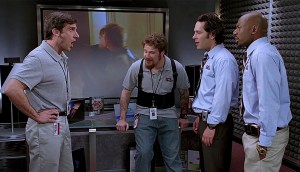 It was the apex of studio comedy and then… it wasn’t. This isn’t so much a tale of the world growing fickle to the Apatow formula, though with time any formula can start to wear out its novelty. Apatow went on a cold streak for me, first with 2009’s misanthropic and misshapen Funny People and then again with 2012’s This is 40, a sequel to Knocked Up that was obnoxiously wallowing in its sense of woe-is-me rich privilege (it definitely wasn’t my life turning 40). After that, he became something of a shepherd for exciting new comic voices, creating starring vehicles for Amy Schumer (2015’s Trainwreck) and Pete Davidson (2020’s The King of Staten Island) and Lena Dunham (HBO’s Girls). Then he made 2022’s The Bubble, a limp COVID-era satire of studio filmmaking that was painfully unfunny. It felt like Apatow had run out of things to say and even things to laugh about. It was pretty depressing for this comedy giant.
However, the downturn in Apatow’s influence also coincided with the downturn in studio comedies. These mid-budget vehicles used to dominate the box-office and then by the end of the 2010s, they seemed to vanish, seemingly folded into larger-budgeted superhero movies and/or ceded to streaming venues. This became even more entrenched in the theatrical environment during and “after” COVID. Even the occasional A-list starring vehicle, like 2023’s No Hard Feelings with a brassy Jennifer Lawrence performance and the selling point of a full-frontal nude fight scene, could only muster so much attention. Take for instance a Will Ferrell and Reese Witherspoon comedy released just this year directed by Nicholas Stoller (Neighbors). Can anyone even remember the title? I had to look it up myself and I watched it. Have moviegoers grown to expect comedies being lesser or have people lost their sense of humor in the Trump Era where every day can feel like a burdensome weight on your very soul.
I genuinely enjoyed most of the Apatow-related comedies of the 2000s, and The 40-Year-Old Virgin holds up because its central appeal is on the engaging characters, their winning camaraderie, and the relatable vulnerability and awkwardness of sex and dating. While some of the jokes and attitudes have changed in twenty years, there is a timeless quality to the inherent vulnerability of feeling like you cannot connect with others and the steps taken to rectify that, risking shame. Dating is still a minefield for awkward yet relatable observational comedy just as it was and just as it always will be. Apatow and co-writer Carell anchored their movie on a repressed man’s awakening, taking the formula of a sexual awakening we usually see in teen/young adult movies and applying it to an older man. It redefines a sub-genre but also provides a little sadness and sweetness, as we can’t help but hope that Andy (Carell) will luck in on pleasurable experiences denied him. He’s not a creep, and the explanation for how a man could hold onto his virginity for 40 years (the CDC stats say 0.3% of women and 1.2% of men aged 40 to 44 are indeed virgins) is painfully plausible. After a few embarrassing experiences, he just waited with the expectation it would happen eventually, and the longer it took, the more shame built, and the less certain he was to pursue a romantic relationship. He knows once his secret is out that people won’t just look at him differently, they’ll look at him as if he’s a freak and think less of him. That’s why it’s genuinely sweet how involved his co-workers get to help Andy get over this hump, so to speak. While each co-worker has a different perspective of advice, they open up about their own troubles with women and self-confidence. It’s not like this is a searing relationship drama, but the fundamentals that make it worth investing are there, and that begins and ends with the characters and their conflicts and their camaraderie.
 Each of Andy’s co-workers is giving him bad advice because each one of them wants him to be someone else. Cal (Rogen) advises Andy to be inscrutable and standoffish, turning everything into a question while revealing nothing personal. It’s reminiscent of those smug 2000s pick-up artists that trained a generation of young men into thinking the way to a woman’s heart was to insult her. He does have a hilariously specific note (“Be like David Caruso in Jade”) that still made me laugh hard. Jay (Romany Malco) advises Andy about it being a numbers game, to embrace a bravado to ensnare women, and to pick them up where they are most impressionable. David (Paul Rudd) is still hung up on his ex and is lovelorn, so his advice is often coated in reflexive bitterness. He’s the friend who advises Andy to explore more about his own desires, leading to a very funny sequence where Andy sets up his home environment for his attempt at masturbation, turning around family pictures to spare their eyes. It’s actually through the character of Marla (Kat Dennings, Thor), the teen daughter of his girlfriend, that Andy finds a level of self-acceptance for being a novice to human sexuality. I think it’s telling that the best advice he receives on the subject is from a teenage girl rather than his horndog pals who consider themselves female experts.
The movie pivots into a more focused romantic comedy by its second half once Andy finally works up the nerve to ask out Trish, played by Catherine Keener (Get Out, Being John Malkovich). This is a natural transition because now Andy has a person to practice all the advice and prove himself. They have a chummy and self-deprecating chemistry together, so the challenge becomes how long he can hide what amounts to his secret shame. Things are going so well he throws out obstacles to delay their physical copulation because he’s afraid that’s when she’ll realize he isn’t worth it. You’re rooting for Andy to get over his hangups and recognize he’s actually a nice guy and that Trish would be really happy to have sex with him, especially after waiting over twenty-plus dates. This is one of Keener’s warmest performances in her storied career. This was Carell’s star-making role. He had been a notable scene-stealer before in Bruce Almighty and Anchorman, but now he was a leading man, further solidifying that same year with the role that would define him, as Michael Scott on the American version of The Office. The both of them are a winning pair and you want their shared adorkable energy to work out for the best.
Much of the comedy still works very well, like the famous chest-waxing scene where Carell really had his chest hair ripped out, but there are some elements that would have been scuttled had The 40-Year-Old Virgin been released today. It’s hard to conceive of a modern studio comedy that would allow two straight guys insulting each other with the many ways they are irrefutably gay. The 2000s was a time rife with gay panic jokes. What has aged the worst is the advice to prey upon “drunk bitches” because they have fewer defenses. Given the term, “prey upon,” you’ll no doubt surmise that this advice is predatory. This dubious thinking is something that would set up a guy as one of the bad men in Promising Young Woman, and it would have proven fitting had one of those women gotten one over on the guys. Frustratingly, Jay has a brief moment of recompense and self-reflection when his long-suffering girlfriend has had enough of his cheating ways, but then she goes right back to him and reveals she’s pregnant. We’re missing a scene that would help solidify how this event changes Jay, but instead he’s basically rewarded for his bad behavior with a baby and a woman forgiving him once again.
 You’ve probably heard about the loneliness epidemic of modern men, a media-friendly term exploring how many of today’s available men are having difficulty making connections with women and some of them using this rejection and/or fear of rejection as the excuse to radicalize themselves. There’s been so much written on the subject, but I think most of it really just comes down to empathy. When you care about other people, and allow yourself to think about their needs and desires, it communicates an openness to others and that their time and emotional investment is worth it. It’s hard to fathom a swath of young men, the ones who identify as reactionary incels, deigning to view empathy as a strength rather than character defect. Empathy communicates two important self-realizations: 1) other people matter, and 2) being vulnerable and possibly being hurt is worth the risk. You can’t have one without the other. When young men reach that epiphany and acceptance, they will discover women are, amazingly, much more open to seeing them as a romantic partner worth their time, affection, and their bodies. Nobody owes anyone their bodies or emotional bandwidth. Sharing your life with others should be valued, not entitled.
This is also a perfect spot to talk about one of the minor co-stars, Shelley Malil as co-worker Haziz, who was charged with stabbing his girlfriend 25 times in 2008. He was released from prison in 2018 after serving eight years of a twelve-years-to-life prison sentence, which doesn’t sound very close to “life” for me, but on the flip side, “12 years to all years” seems like too expansive of a window of time to serve.
Twenty years later, The 40-Year–Old Virgin still funny and sweet and entertaining because it nails the tenets of what makes movies worth coming back to again and again, our connection to the characters and their relatable plights. Even two decades later, we can still see elements of ourselves in these characters, though maybe fewer. This was the announcement of the Judd Apatow Era of big screen yuks, and frankly I’d be happy to return to it if we got more movies like this and Knocked Up, a comedy I liked even more upon release. My original review was correct for all the accolades The 40-Year-Old Virgin deserved and still deserves, and so it remains a comedy classic with more on its dirty mind than many adult dramas.
Re-View Grade: A
Share this:

Ghostbusters: Frozen Empire (2024)
 I am a lifelong Ghostbusters fan, I enjoyed the 2021 reboot, and I come to the sequel, Frozen Empire, as one of those fans that grew up with the cartoon series in the 1980s. There is a contingent of Ghostbusters fans who dismiss the movie as merely a comedy about a bunch of schlubs who resort to paranormal shenanigans to make a buck, and these fans dismiss anything larger in world-building, mythology, or direct sincerity as missing the point. I disagree. There can be a vivid, flourishing world of supernatural beings and connections to the human world, if you can tell a compelling story with characters we want to follow. Frozen Empire is an okay TV episode expanded into movie form, finding little for most of the voluminous characters to do. There’s an ancient evil and tying back the legacy characters, who don’t present much meaning beyond extended cameos. The 2021 movie had me on an emotional level, saying goodbye to a character and seeing how that loss has affected multiple generations of his estranged family. The closest thing Frozen Empire features to emotion is young Phoebe Spangler (Mackenzie Grace) wanting to be treated like a responsible adult and making friends with a ghost girl. It’s kind of sweet, and it’s smart to tie this friendship into the larger threat. The movie has several side plots littering the peripheral, from Finn Wolfhard trying to catch Slimer and being trusted to drive the Ecto-One, to Paul Rudd trying to find his footing as a stepdad, to Kumail Nanjiani as a junk dealer learning to follow his family’s noble mission of protecting others. I liked learning more about Winston’s (Ernie Hudson) Men in Black-style secret agency of studying ghosts and testing out new supernatural tech, and it presents a fun new setting where we can learn more. The ultimate story about defeating an evil spirit, coming together as a team, and learning to give others room to succeed or fail all seem a little pat, a little too familiar. It’s fine that this movie has lower stakes, even with a would-be apocalyptic threat of ancient evil. Not every movie needs to avert the apocalypse. It feels like little thought has been given to extending the new characters from the 2021 movie. There are too many characters to service here, which is why everyone other than Phoebe feels like a nascent supporting character or overextended cameo at worst (did we need the return of Podcast?). It’s still a fun movie that any Ghostbusters fan will likely find enough to enjoy, but it also feels like it might be the last Ghostbusters movie, at least this iteration, and it ends with a reminder of what the franchise can be, at its best, but also a warning of what it can be without careful development and vision.
Nate’s Grade: B-
Share this:

Teenage Mutant Ninja Turtles: Mutant Mayhem (2023)
 As an elder millennial, the Teenage Mutant Ninja Turtles have been a formative franchise for me. I grew up on the cartoon, got the toys for Christmas, died endlessly during the shockingly hard underwater stage of their Nintendo video game, and generally have a soft spot in my 80s nostalgia for the likes of Leonardo, Donatello, Raphael, and Michelangelo, plus their surrogate father, Master Splinter. Apparently Seth Rogen felt the same way, and he and his writing partner Evan Goldberg have spearheaded a new animated variation of TMNT that just so happens to also be co-written and directed by the man behind my favorite film of 2021, The Mitchells vs. The Machines. It was a recipe to guarantee my personal enjoyment, and Mutant Mayhem thusly delivered. The biggest selling point for me was how lovingly realized the “teenage” part of the title was, getting a foursome of actual adolescents to portray our heroes, and using high school experience about acceptance and fitting in as effective and even poignant parallels. I loved just hanging out with these characters, who view their surrogate dad (voied by Jackie Chan) with a mixture of love and embarrassment, and who want to be accepted by a world predisposed to finding them monstrous. Naturally, becoming crime-fighting heroes is their best method for winning over the public, with a young and aspiring journalist April O’Neil (The Bear‘s Ayo Edebiri) hoping to improve her own social standing at school by breaking the existence of these unknown mutants. The comedy is robust and layered while allowing for nice character details and moments, giving each turtle their own satisfying arc. The action is fun and inventively staged while still being thematically relevant. The vocal cast is great, and the young actors are tremendous together, sparking an enviable improvisational energy that made me smile constantly. The art style has an intentional messiness to it, like smeared colored pencil drawings, and the imperfections are themselves part of the vast visual appeal. It’s a family movie that will succeed with old fans and new, and Mutant Mayhem is the best film depiction yet of the famous heroes in a half-shell.
Nate’s Grade: B+
Share this:

Ant-Man and the Wasp in Quantumania (2023)
 Phase Four of the Marvel Cinematic Universe (MCU) has had a bumpy ride, coming after the significant climax of 2019’s Avengers Endgame and releases shifting thanks to COVID, with plenty of think pieces and pundits waiting to seize upon the possible decline of the MCU’s box-office and pop-culture dominance. This was still a phase with several enjoyable blockbusters with stars of old (Black Widow, Loki, Black Panther 2, Spider-Man No Way Home) and stars of new (Shang-Chi, Ms. Marvel), but it’s been defined by movies and series that have not engendered the same level of passion with fans and audiences, and left many questioning whether audiences are finally suffering from dreaded Marvel Fatigue. I cannot say, because even movies people were so-so on have generated tons of money, and it’s not like I even have to travel far in the past for a good-to-great Marvel movie with Wakanda Forever last November. However, after the muddled response to a third Ant-Man movie, as well as a bland Shazam sequel within weeks, then the old media narrative reignites the Marvel Fatigue question. I think the better question is aimed at the studio and whether we’re entering into Marvel Complacency.
Scott Lang (Paul Rudd) is trying to live a normal life, at least for a superhero that helped save the world. His adult daughter Cassie (recast as Kathryn Newton) is a social activist and a burgeoning scientific genius, and with the help of her grandad, Hank (Michael Douglas), they’ve developed a way to communicate into the Quantum Realm, the metaphysical world of subspace where Janet (Michelle Pfeiffer) was lost for decades. The entire family gets sucked into the Quantum Realm and separated, fighting to make their way in a strange new land. Among all the unorthodox beings is Kang (Jonathan Chambers), a banished interdimensional conqueror. He’s looking to break free of his prison and thinks Scott can be persuaded to help under the right pressure.
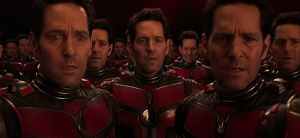 Ant-Man and the Wasp in Quantumania is blatantly weird and shapeless, which allows for some of the most silly character designs in the MCU yet, and it also adds up to so precious little. From a character standpoint, we get minimal forward progress, which is strange considering Scott was deprived of years from his daughter, missing out on her growing up into an adult. When you have a villain who can manipulate space and time, and this scenario, wouldn’t you think that the ultimate appeal would be to regain that lost time? Maybe Scott feels like this older Cassie is a version of his daughter he doesn’t recognize, and he misses the innocence of her younger self, and therefore he wishes to experience those moments he had missed. Mysteriously, this doesn’t factor in at all with Ant-Man 3. I suppose it’s referenced in vague terms, but you would think the thematic heft of this movie would revolve around lessons learned about thinking in the past, of trying to recapture what is gone, of moving onward and trying to be present for those we love, you know, something meaningful for the characters besides victory. Nope, as far as Cassie is concerned, she serves two story purposes: 1) being a plot device for how we got into this crazy world, and 2) being a damsel in distress. Kang’s threats to withhold Cassie or harm her are the motivating factor for him to collaborate with the villain. How truly underwhelming. I did enjoy a sequence where a plethora of Scotts across multiple timelines come to work together with a common goal, with every one of the many Scott’s love for Cassie being their top ambition.
As for the universe existing between space, the Quantum Verse of our title, it’s the highlight of the movie, so if the characters and their personal conflicts aren’t hitting for you, like me, then at least there’s some fun diversions to be had with every new locale and introduction. There’s an enjoyable sense of discovery like a new alien world where the possibilities seem endless. The strange quirks were my favorite. I adored the exuberant goo creature Veb (David Dastmalchian) fascinated by other creatures having orifices. There’s also a mind reader played by William Jackson Harper, who was comically brilliant on The Good Place, and just repeating the same lazy joke here about people’s minds being gross. There’s even Bill Freakin’ Murray as a lord. I enjoyed how many of the new characters, many of them strange aliens, had prior relationships with Janet, and her hand-waving it away explaining that over thirty years she had certain needs. This subplot itself could have been given more. time, with Janet having to deflect Hank’s sexual inadequacies in the face of so many virile lovers (“How can I compete with a guy with broccoli for a head?”). I think this reunited couple confronting their discomfort would be far more entertaining than yet another massive CGI face-off with thousands of soulless robots. There are interesting moments and characters in this strange new world, but they’re all so fleeting, meant to be a goofy supporting character or cameo or simply a one-off joke and not what matters.
 Like Multiverse of Madness and Love and Thunder, this feels very much like a table-setting MCU movie, meant to move the pieces along and set up other movies, chiefly the next Thanos-level big bad with Kang, first portrayed in Loki’s season one finale in 2021. I found this character version underwhelming. Part of this is that Kang’s first appearance was so memorable, spirited, anarchic, but also subversive, going against the audience expectations of what the final confrontation with the puppetmaster was going to involve. With Ant-Man 3, this version of Kang is an overly serious, well-poised castoff in a secondary Shakespeare play, which would work if the screenplay gave the guy anything interesting or memorable or even really threatening to play. He’s just another authoritarian who speaks in grand speeches of their greatness and then proves not to live up to his much-hyped billing. I worry that the next few years of the MCU will feature a rotating set of Kangs to topple with every film, which will make the villain feel less overwhelming and powerful and more like a reoccurring Scooby Doo villain (“I would have gotten away with it too, if it wasn’t for you meddlin’ heroes, and YOUR ANTS!”). This isn’t to say that Majors (Creed III) gives a poor performance. It’s just so stubbornly stern and shouty and rather boring in comparison to He Who Remains from his Loki appearance. Note to Marvel: given the serious charges that have surfaced against Majors, if you do wish to recast the role, a character who is different in many universes should be a pretty easy explanation for any change.
Is Ant-Man and the Wasp in Quantumania the beginning of the end of the country’s love affair with the MCU? Well… probably not. Just three months later, Guardians of the Galaxy vol. 3 hit it big, so maybe it’s less fatigue with big screen superhero escapades and more fatigue with mediocre movies. Maybe the public won’t be so forgiving of less-than-stellar efforts, but at this point the MCU in a moving train and some movies seem to get caught in the churning wheels of “progress.” After thirty movies and counting, some of the novelty is gone, that means just delivering the same old won’t deliver the same old results. Too much of Ant-Man 3 feels like the characters are inhabiting a large and empty sound stage. The visuals are murky and gunky and less than inspiring, and while some of the special effects are occasionally dodgy, they aren’t the travesty that others have made them out to be (though MODOK is… something, I suppose). It’s such a dank-looking movie that it feels like somebody put the light settings on power saving. There were things I enjoyed but most of Quantumania left me indifferent, and that’s the feeling I got from the cast and crew as well. I dearly missed Michael Pena’s Luis, who should have gone along for the ride just for his commentary for all the weirdness. At this point, you’re along for the MCU ride or not, and this won’t deter your 15-year investment, but coasting on its laurels will also not satisfy anyone. Not every MCU entry will be great, but they can at least try harder.
Nate’s Grade: C+
Share this:

Ghostbusters: Afterlife (2021)
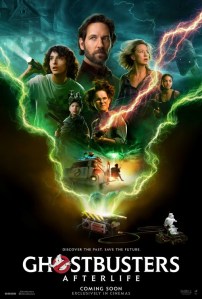
As I stated in my review for the 2016 Ghostbusters, allow me to wax nostalgic and explain my own private history with the franchise: “Growing up in the 80s, other kids had Transformers, or G.I. Joe, or He-Man, but I was a Ghostbusters kid. I fell in love with the 1984 original movie, slept below the poster for most of my childhood, and obsessively collected all of the action figures and toys, watched with glee the animated TV series, and hold the world and its characters in a special personal place.” This franchise means something to me. I think about the hours I spent playing in this world and my imagination and my own stories illustrated with marker and crayon, and it makes me extremely happy as well as reminds me how I fell in love with weird storytelling and macabre, ironic humor. I’ve been waiting for more Ghostbusters movies for my adult life. The 2016 movie was fine, I wasn’t enraged by it in the slightest, but it didn’t scratch that itch. While replicating some of the same plot beats, the 2016 movie was not reverent to its source material. Now the 2021 Ghostbusters, delayed over a year and a half from COVID, goes completely in the other direction. Ghostbusters: Afterlife is reverent to a fault, and while it has been met with mixed reviews and complaints of overdosing on slavish fan nostalgia, I found it to be a charming and fun family adventure that left me laughing, cheering, and even crying.
Egon Spangler (Harold Ramis, R.I.P.), original Ghostbuster, is dead, killed by a malevolent spirit. His estranged adult daughter, Callie (Carrie Coon), and her two teen children, Trevor (Finn Wolfhard) and Phoebe (Mackenna Grace), are shocked to learn of his death and their unexpected inheritance: a dirt farm in small-town nowheresville Oklahoma. They don’t know much about their grandfather and the kids are not exactly excited about relocating to a secluded mining town. Phoebe starts discovering weird pieces of technology hidden in the old house of her grandfather’s. A presence seems to be reaching out and trying to get the family to understand their real legacy. It appears that Gozer the Gozerian was not fully defeated on top of that New York City skyscraper in 1984, and Phoebe and her family must learn about the past in order to make sure we all have a future.
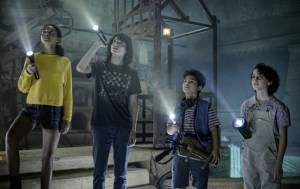
I can understand the charges of Afterlife being too nostalgic, but I don’t understand the charges of it being so enamored with its past that it poses a disservice to the movie standing on its own. This movie is intended at its very DNA to live within the shadow of the original films. The director and co-writer, Jason Reitman, is the son of the original films’ director, Ivan. It’s going to be reverent but that’s not an automatic bad thing. Whereas the 2016 reboot shrugged at past convention and went completely comedic, this edition takes the opposite approach, hugging onto the lore and past of Ghostbusters with heartfelt affection. If you’re a fan of the franchise, this adoring approach will likely be more favorable, not that the 2016 film is wrong for eschewing the established canon of the franchise and trying something new. If Afterlife had been a completely original story set in a Ghostbusters universe, I would have happily accepted that. However, just because something is outwardly nostalgic, or taps into fan service, does not mean it is destined to be an exclusive retread that only satisfies the hardcore base. I didn’t need the gratuitous Easter eggs of passing shots of a twinkie or Crunch bar, but they’re blink-and-you’ll-miss-them moments that don’t really relate to anything of consequence, so I can excuse them. Afterlife is similar to The Force Awakens in that it uses familiar plot beats to mirror events of its predecessors to ease back fans and new members to the fanclub, most especially in Act Three where Gozer’s demonic pooches are unleashed. I can understand many chaffing at this, but I feel that Afterlife does enough to justify its own creative existence even in facsimile rather than as some insular, facile, fan-stroking cash-grab.
This is, by far, the most dramatic of the Ghostbusters movies, a series that has existed in the realm of comedy. The prior movies were never spooky on adult terms, but they reached back into a primal, childlike curiosity and anxiousness over the unknown that made them creepy when they wanted to be. I don’t understand the umbrage some have expressed over Afterlife being more of a drama. First, the comedy is present throughout the movie with the characters making specific and wry observations that feel fitting for their situation. The humor is not as forced as the loping line-a-rama improv jazz riffs of Paul Feig’s 2016 film. I think this universe can sustain different kinds of stories being told, and I think that drama is perfectly acceptable as long as it’s earned, just like the comedy or horror elements. The central premise involves an estranged family coming to know the secret life of an absentee relative who abandoned them, so the more they learn about his Ghostbusting past and responsibilities, the closer they come to uncovering a clearer picture of who this man really was as well as their connections to him. Reitman and co-screenwriter Gil Kenan (Monster House) have smartly connected the investigation of the past into the development of personal relationships. We in the audience know the significance of the Ecto One and the ghost traps, but the new characters do not. We await them to understand the knowledge we already attain, but the movie doesn’t play this as characters dawdling. Each discovery unlocks new potential for the characters to shape who they choose to be, and each one gets them closer to their grandfather and reshaping their conception of the man who they wrongfully believed abandoned them for folly.
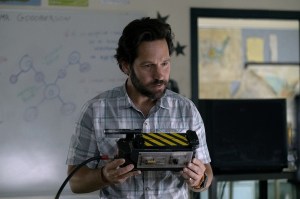
This all leads to a climax that had me genuinely in tears. I won’t exactly spoil it but Afterlife’s conclusion is less concerned with beating the Big Bad Gozer yet again and saving the universe. Reitman and company have smartly placed the real climax as an emotional catharsis; it’s more in keeping with Field of Dreams than some huge Marvel apocalyptic showdown. The ending is personal, emotional, and reaches into our universal desire for closure, for having that one last moment with a beloved who we no longer have any moments left to share, Reitman is clearly missing Ramis, a close family friend and inspiration who died in 2014, and this is his own way of processing his personal grief, offering an emotional output for the fans to share in, and allowing a grieving character/surrogate to find that needed release. It serves as a fitting conclusion and a special end note for any Ghostbusters fan who has held this franchise close to their heart for several decades, especially if shared with a paternal figure who may be gone.
The film also successfully channels a childhood perspective of awkward and awesome. It’s hard to create a story where a group of precocious adolescents discover strange things cooking in their sleepy small town without suggesting Stephen King and Stranger Things, but this isn’t necessarily a total negative. The earlier movies were always from a more cynical adult perspective. Yes, there were characters like Ray (Dan Ackroyd) and Egon who were true believers, but they were often set up for easy laughs. The tone of the series was mostly tied to the irony of the character of Peter Venkman (Bill Murray) that looked at the supernatural with droll detachment. This is the first Ghostbusters entry where the primary perspective is from children, and there’s something hopeful and heartfelt about a younger point of view with the supernatural material. These kids are excited and eager to learn more about the somethings strange in their neighborhood. It becomes endearing to ride along with them as they get to jump into the action. I loved the concept of a sidecar gunner seat for the Ecto One and how it felt like a childhood dream coming true. But it’s more than fan service because it serves as a point of progression for Phoebe’s sense of self, of embracing her scientific interests and roots, and taking charge in the face of unknown danger. It’s a coming out of sorts. When the kids are driving through (the always empty?) town and chasing a runaway ghost, wrecking storefronts from the boom of the proton pack, it’s a blast for them and us.

This is Reitman’s most commercial and mainstream film of his Oscar-nominated career. It’s interesting to me that this indie darling, who was on such a hot streak in the late 2000s, hit some speed bumps with the critical misfires of 2013’s Labor Day, 2014’s Men, Women, and Children, and 2018’s The Front Runner, so the next movie is a retreat to a big-budget franchise film. Reitman doesn’t necessarily have the best feel for large-scale spectacle, but he knows intimate character dramas and guides his actors well. Grace (Gifted, Haunting of Hill House) is wonderful as our plucky lead. Unfortunately for Wolfhard (It, Stranger Things), his dull character has nothing to do but pine for a local girl, scoff at his family, and then fix up the old ghostbustin’ mobile. Paul Rudd (Ant-Man) is as charming as ever as the school science teacher, especially as he nerds out over interacting with the Ghostbusters paraphernalia like an excitable fanboy living out his childhood dream. I wish Coon (The Leftovers) had more to do, but that’s my primary complaint in any movie where Carrie Coon is a supporting actress. Her chemistry with Rudd is strong and they could have done so much more together as adults trying to make sense of madness. They could have eliminated Wolfhard’s mopey older brother character entirely and given us more time with the goofy adults too. One feels like there is some secret contract where anything relating to 80s nostalgia requires the hiring of Wolfhard on hand.
Ghostbusters: Afterlife will not be the best movie of 2021. There are areas that could have been improved and streamlined and better developed. However, Ghostbusters: Afterlife will most assuredly be my favorite film experience of 2021. It’s a heart-warming continuation for fans with enough wit and whimsy to charm while owning its obvious and intended connections to the original. I may not be the most objective source on this particular matter, but I know what I like, and this movie had moments of pure happiness that just shot right through to my dopamine center. We’ll see if this movie can restart the dormant franchise, and strike more on its own, but even if this lone 2021 entry is all that we eventually get, I’m happy I got to experience this magic once again. I can’t wait to see it again with my dad.
Nate’s Grade: B+
Share this:

Avengers: Endgame (2019)
 This may prove to be the most difficult review I’ve ever written in my twenty years (!) of reviewing movies. How do I ever begin to describe the events of Marvel’s culminating blockbuster Avengers: Endgame without stepping too far into the dark and dangerous territory of the accursed spoilers? I thought it would be difficult talking about last year’s Infinity War considering the shocking plot events and general secrecy, but this concluding chapter to a 22-movie journey is even more secretive (the trailer accounts for only footage roughly from the first twenty minutes). I’ll do my best, dear reader, to give you the clearest impression I can of this unique experience while respecting your need to be un-spoiled. In short, Avengers: Endgame is unparalleled in our history of modern popular blockbusters because it needs to work as a clincher to a decade-plus of hugely popular blockbusters for the Marvel Cinematic Universe (MCU), and boy do they ever stick the landing.
The film picks up with our surviving Avengers picking up the pieces following the events of Infinity War, namely Thanos (Josh Brolin) eliminating half of life throughout the universe. The original six Avengers are all suffering through guilt, depression, and degrees of PTSD following their failure to defeat Thanos. Scott Lang a.k.a. Ant-Man (Paul Rudd) arrives after having spent time in the quantum realm and has a potential solution that will involve traveling through time to correct the mistakes of the past and bring everyone who vanished back to life. The remaining teammates assemble at the behest of Steve Rogers a.k.a. Captain America (Chris Evans), including Bruce Banner a.k.a. Hulk (Mark Ruffalo), Black Widow (Scarlet Johannson), Thor (Chris Hemsworth), Hawkeye (Jeremy Renner), Rocket Racoon (voiced by Bradley Cooper), Nebula (Karen Gillan), and War Machine (Don Cheadle). However Tony Stark a.k.a. Iron Man (Robert Downey Jr.) needs the most convincing, as he is most afraid of making things even worse and losing more people he feels are too precious to be casualties to their failures once again.
 The thing to know ahead of time is that Endgame is not for the casual fan. This is a long love letter to the fans that have pored over all 22 preceding films, not just a scant one or two. Infinity War was accessible to relative newcomers because of the structure and focus on Thanos as the main character, providing a self-contained arc that lead up to his finger-snapping triumph. It also benefited from the fun factor of simply watching a bunch of popular characters interact and team up for the first time in MCU history. Now that a majority of those characters have turned to dust, the emphasis falls back on the original core of the Avengers, bringing things full circle. In several ways, Endgame is about bringing to a close this mammoth project that began with Iron Man, this decade of storytelling ambition that has stretched out into multiple inter-connected franchises. If you love these characters, then Endgame is a movie made specifically for you. There is a long stretch in Act Two that relies upon a decent amount of fan service and sentimentality, but I don’t think either is an automatically negative attribute. Before we reach the finish line it’s important to take stock of how far we’ve come and this goes for the essential characters and their long arcs. There are several fun cameos strewn throughout and the filmmakers even take an interesting tack of trying to reclaim and re-contextualize the MCU movies that fewer people enjoyed. It makes for a filmgoing experience that is heavy in references, in-jokes, Easter eggs, and cozy nostalgia, which will confuse and frustrate those not well versed in this big world.
The other thing to know, especially if you’re a long-standing fan, is that there will be tears. Oh will there be tears. I lost count of the amount of times I was crying, which was pretty much on and off nonstop for the final twenty minutes. I was even tearing up for supporting characters that I didn’t know I had that kind of emotional attachment for. The film is done so well that the first third actually could play as the MCU equivalent of HBO’s The Leftovers, an undervalued and elegant series about the long-term recovery of those that remain in a post-rapture world. The opening scene involves a character having to go through the loss of loved ones via Thanos’ snap, and it’s brutal as we wait for what we know is coming, dread welling up in the pit of your stomach. The Russo brothers, the returning directing team from Infinity War, know what scenes to play for laughs (the line “That’s America’s ass” had me in stitches), what scenes to play for thrills, what scenes to play for fist-pumping cheers, and what scenes to play for gut-wrenching drama. They allow the movie to be an existential mood piece when it needs to be, actually dwelling on the repercussions of a life post-universe culling. There’s a character who frantically searches to see if a loved one was among the missing, and that eventual reunion had me in tears. With the three-hour running time, the Russos have the luxury of allowing scenes to naturally breathe. This might be the most human many of these characters have ever seemed, and it’s after recovery and grief. Needless to say, the conclusion feels very much fitting but also unabashedly emotional, unafraid of diving deep into its feelings. I sobbed.
 I was worried once the film introduced the time travel plot device that everything was simply going to be erased and invalidate the struggles that came before. The worst use of time travel is when it eliminates any urgency or danger, allowing an endless series of do-overs to correct the past. Fortunately, returning screenwriters Christopher Markus and Stephen McFeely (Civil War, Winter Soldier) realize that in order for there to be a reversal, a glint of a happy ending, there must be a cost or else it all meant little to nothing. There are finite events in the movie that cannot change (as of now) and losses that will be permanent (as of now, if they don’t want to cheapen the journey). People died with Infinity War but we all knew, at least when it came to its dreary conclusion, that it wasn’t going to be too long lasting, which allowed the communal grief to be short-lived. After all, there’s a new Spider-Man film coming down the pike two months from now, so it’s highly unlikely the teenage web-head will remain dead. However, with Endgame, the deaths serve as the cost for resurrecting the MCU, and they will be felt for years. The screenplay provides limitations to the time travel mechanics, though I don’t think the collective hand-wave to the nagging paradoxes was as successful as the movie thinks it was. The film barrels ahead, essentially telling you to forget about the paradoxes and enjoy the ride, focusing on the characters and remembering what is really important.
Suffice to say Downey Jr. is once again his charming, self-effacing, and enormously entertaining self. The MCU began with this man and his contributions cannot be overstated. He is the soul of this universe. Evans is compelling as the straight-laced inspirational figure who takes stock of what he’s sacrificed over the years, Hemsworth showcases a potent mixture of comedic and dramatic chops, Johannson is definitely the Avenger going through the “bargaining” phase to try and make things right and she has some subtle emotional moments that belie her desperation and guilt, and Renner makes a welcomed return in a way that made me appreciate Hawkeye like I never had before. Brie Larson does reappear as Captain Marvel but the movie smartly puts her back on the sidelines protecting the many other worlds in the universe needing assistance because of how overwhelmingly powerful she can become. Larson filmed her scenes for Endgame before her own solo movie, released a month prior, so forgive the different hair and makeup, Twitter nit-pickers. I will say there is one scene that is a bit convoluted how it gets there but is destined to make women in the audience cheer with excitement as the MCU says, “Hey, that whole ‘strong female character’ thing? Yeah, we’ve had all that for years, and here you go.”
 How does one properly assess a movie like Avengers: Endgame, a conclusion not just to an Infinity War cliffhanger but to a twenty-two movie prelude over the course of eleven years? The emotional investment in these characters, their journeys, has to come to something to be ultimately meaningful when it’s time to close the chapter on one massively ambitious story before starting the next. And there will be a next chapter; the MCU’s unparalleled financial success assures the fanbase they’ll have plenty more high-flying and wild adventures to come in the years, and more than likely, decades to come. Marvel had the unenviable task of wrapping up a major narrative in a way that would prove satisfying without devaluing the individual films and overall time investment. Hollywood is filled with trilogies that messed up their conclusions. Nailing the ending is just as important as getting things going right, because without a satisfying conclusion it can feel like that level of emotional investment was all for naught. Endgame reminds you how much you’ve grown to love these characters, what fun you’ve had, and genuinely how much you’ll miss these characters when they depart for good. It’s hard not to reflect upon your own passage of time with the ensuing eleven years, how you’ve changed and grown from the MCU’s humble beginnings in the summer of 2008. These heroes and anti-heroes can begin to feel like an extended family for many, and so fans desperately need the ending to do them justice. Avengers: Endgame is the ultimate fan experience.
Nate’s Grade: A
Share this:

Ant-Man and the Wasp (2018)
 Coming off the cataclysm of Avengers: Infinity War, Marvel’s latest serves as a palate cleanser, a breezy and light-hearted comic adventure with little more on its mind than having fun with its possibilities and leaving the audience happy. The basic premise of a team of thieves that can shrink or expand at will calls for a light touch, and returning director Peyton Reed (Bring it On) and his team have a strong idea of what an Ant-Man movie should be. Ant-Man and the Wasp won’t blow anyone away with its story or characters but it hits a sweet spot of silly comic affability that kept me smiling.
Scott Lang (Paul Rudd) is close to ending his two-year house arrest following the events of the Berlin brawl in Captain America: Civil War. His old partner Hope Van Dyne (Evangeline Lily) a.k.a. the Wasp is working with her scientist father, Hank Pym (Michael Douglas), to discover the location of the missing Janet Van Dyne (Michelle Pfeiffer), lost for decades in the subatomic quantum realm. They need Scott’s help to steal the final parts necessary to complete their quantum field transporter. There are other forces looking to make use of Hank Pym’s technology, namely Ghost (Hannah John-Kamen), a woman who can phase through matter, and an unscrupulous local buyer (Walton Goggins) looking to profit. With the help of the Wasp, Scott Lang must protect his friends and allies so they can rescue Janet Van Dyne before she’s lost for good, and he cannot be caught before his house arrest period comes to an end or he’ll go to jail.
 When any action movie has unique circumstances, especially those in the superhero realm because of their unique powers, I crave the proper development of the concept and the action sequences to make clever and imaginative use of their available tools. If you have characters that can shrink, that can make other objects big or small, and there’s a villain that can phase, then I expect a thorough and fun implementation of these elements to separate the movie from others. It takes a while to get going, but once the streamlined exposition is behind us, including multiple instances of explaining the plot to the audience, Ant-Man and the Wasp zips by on its sheer sense of sprightly whimsy and visual wonder. Paul Rudd (Wet Hot American Summer) is still as effortlessly charming as ever and elevates every scene partner. When it’s moving, the film does a fine job at entertaining, with funny quips and charming actors and visual panache. When it slows things down to explain or introduce perfunctory characters (looking at you, Laurence Fishburne) that’s when it becomes less than mighty. Ant-Man and the Wasp kept me laughing throughout, especially with the triumphant return of series MVP Michael Pena (CHIPs) as the energetic, motor-mouthed Luis. There are enjoyable payoffs strewn throughout and solid comic asides. It doesn’t feel too jokey to the point that nobody involved cares. It feels like everyone is united with the same mission statement.
The final act in particular is a blast, as now we have our MacGuffin and all of the various teams vying for it in an elaborate series of chase scenes. The cars are racing back and forth, under and over one another, with characters constantly jockeying for top position. It’s an exciting flourish to a conclusion, and every time a car went tiny for a split-second escape, or an ordinary item like a Pez dispenser went huge to form an obstacle, I grew happier and happier. The screenwriters unleashed a flurry of fun and zippy action ideas. Some will balk at the lower level of stakes in the Ant-Man films, or their general aw-shucks silly charm, but I view both as a virtue. Just because it’s a superhero movie doesn’t mean there can’t be a healthy degree of amusement, if properly executed and applied.
 The villains are kept interesting enough, through concept or casting. With Ghost, here’s another character that can manipulate matter to her advantage. Her back-story is pretty ordinary (science experiment, looking for way to end pain/save her life) and kept mostly uncomplicated, as her plan is a matter of life and death. Hannah John-Kamen (Ready Player One) has a terrific look and physicality to her, but she’s lacking anything really memorable to do as a performer. Her character has some cool moves but that’s all. It feels like more could have been done with this antagonist. Then there’s genteel local criminal Sonny Burch who is given great gusto by Walton Goggins (The Hateful Eight). It’s like he simply plugged his Justified character’s smooth charisma. He’s a gentleman robber who has just enough self-awareness to acknowledge the absurd. A highlight of the film is an exchange between Goggins and Pena. He’s so good in such a relatively throwaway criminal role that I wish Marvel had saved Goggins for something grander down the line, something to really let his charisma seep into his wild, anarchic energy below the surface.
With all that said, the events involving the rescue of Janet Van Dyne are the weakest parts of the movie, and this saps the other Van Dyne characters as well. I just found myself caring very little for this excursion into the quantum realm, especially when we have fancy heists and opponents who can walk through walls. I understand the importance the rescue mission has with the other characters, but it didn’t feel that important to me. I was more invested in Scott’s ever-increasing near misses being caught breaking his house arrest, which was days away from being lifted by the FBI. Those scenes gave me the delightful Randall Park too (TV’s Fresh Off the Boat). Maybe it’s a casualty of the film’s genial tone, but I think the real culprit why I found myself unmoved is that the Janet rescue is the core storyline attached to Hope and Hank. Beforehand, Hank Pym served as a grumpy mentor figure for Scott, and now he’s mostly complaining about Scott’s exploits and how they invariably jeopardize the retrieval of his wife. Hope gets her spotlight, and name in the title, as Wasp, but she too is saddled with the same humdrum boring material. Lily (The Hobbit films) goes from scene to scene with a cloud of pinched annoyance. They’ve taken two characters who were more interesting in the first film, sanded off things that made them interesting, and bumped up their screen time, which is not a great formula. Everyone seems so irritable around this plotline, and when you haven’t invested much in it, that irritation becomes dangerously off-putting.
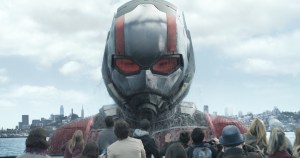 If you’re looking for silly, lighthearted escapism, Ant-Man and the Wasp is a superhero flick with entertainment as its top priority and enough infectious fun to achieve its more modest goal. It doesn’t follow the heist formula of the first film but it still finds room for comic asides and stacking payoffs for a lively, inventive final act. It’s definitely a lesser movie in the Marvel Cinematic Universe (MCU) but you need adventures in lower stakes too, especially after twenty movies and counting. Ant-Man and the Wasp could have used some fine-tuning and tightening, especially in its second act, and the quantum stuff definitely didn’t register for me, but it’s a mostly fun and acceptable summer escapade.
Nate’s Grade: B
Share this:

Sausage Party (2016)
 Following the “secret life of” Pixar story model, Seth Rogen and Evan Goldberg’s hard-R animated movie about anthropomorphic food literally uses just about every possible joke it can from its premise. I was expecting plenty of puns and easy sexual innuendo, but what I wasn’t expecting was a religious parable that actually has substance and some crazy left field directions the movie takes that made me spit out my popcorn. Sausage Party seems like a one-note joke as we follow Frank, a sausage (voiced by Rogen), and his girlfriend Brenda, a hotdog bun (Kristen Wiig) and their food friends over the course of the Fourth of July weekend. The supermarket items have been told that loving gods will take them to a wonderful promised land. The reality is far worse as the humans consume and “murder” the supermarket products. The messy food massacre sequences are some of the cleverest moments in the movie, which too often relies on a lot of easy profanity and vulgarity and broad ethnic stereotypes (it earns points for pointing out its lazy ethnic stereotypes too). However, when it veers into its religious commentary and the plight of the atheist, the movie becomes far more than the sum of its sex jokes. It’s consistently funny with some hard-throated laughs toward the end, especially in the jubilantly demented third act that takes an extreme leap first into violence and then into food-based sexuality. The concluding five minutes might be some of the most insane images put to film I’ve ever seen. The only equivalent I can even think of is the concluding act of Perfume. I credit Rogen, Goldberg and their team for taking a potentially one-joke premise and finding something more interesting and substantial, while still finding plenty opportunities for crass humor when called for and then some. Sausage Party is not a film for everybody but it’s also a film that is hard to forget, although you might feel guilty about munching on your popcorn at some point.
Nate’s Grade: B


 nathanzoebl
You must be logged in to post a comment.