Blog Archives
Thirteen (2003)
 No one said being a 13-year-old was easy. Tracy (Evan Rachel Wood, a dead ringer for a young Jennifer Garner) is a straight-A student living with her mother Melanie (Holly Hunter, nominated for an Oscar). Her family fights to get by with Melanies at-home hair salon. People, usually accompanied by wee kids, stroll in and out of their house like it was a bed and breakfast. Melanie’s previous boyfriend Brady (Jeremy Sisto) has sobered up and settled back into her life, despite Tracy’s wishes.
Evie (Nikki Reed, who co-wrote the film with the director) is that cool girl at Portola Middle School. Tracy desperately wishes to join Evies inner sanctum of friends, enough that shell steal the pocketbook of a stranger to impress Evie. Tracy is taken under Evies wing and learns how to flirt, dress, dance, kiss, and terrify her mother. Melanies concern is a slow simmer, but she cant ignore all the signs of what is happening momma’s little girl. The girls revel in bared midriffs, body piercing, and gallons of shiny make-up. Evie lives with her guardian Brooke (Deborah Kara Unger), herself a sad woman ravaged by booze and pills. When she tells Melanie that Brooke beats her, the maternal instincts overpower her concern. She invites Evie to stay with her family. Evie even calls Melanie mom. More disintegration of Tracy follows.
 Thirteen does exhibit a rare maturity in the displaying of teenage emotions, namely the pull to belong. It also pays incisive attention to our consumer society marketing teen sexuality and the implicit effects. Thirteen creates a more realistic teenager by showing the vulnerability that’s inherent in growing up.
Wood gives a strong performance as her character descends from goodie-good to teen vamp. Her square jaw and lanky frame are physically perfect at displaying a natural young awkwardness. She looks like a teenager I’d see on my block, not what Hollywood is trying to tell me. Wood gets a tad drunk on her characters emotions, like a scene where she tries to scare her mother by lurching forward and cooing, “No bra. No panties.”
Hunter’s depiction of Tracy’s mother is out to lunch about her daughter. This makes the character seem earnest yet stupidly naïve, and after the 200th request of we need to talk is met once again with a closed door, the audience begins to think that Melanie has some deep-seated issues herself.
The direction by first timer Catherine Harwicke starts off as annoying with self-gratifying camerawork. The handheld camera swoops in and out attempting to establish a fluid realism. She also utilizes muted or exaggerated colors to express Tracys highs and lows. What started as self-congratulatory direction actually warmed me over, and I began to take notice of how lovingly Hardwicke stuffs her frame and utilizes lighting. It seems like she could have a career ahead of her as a director.
Though the acting is strong and the direction grows on you, Thirteen never really rises above its ilk of cautionary tale. It’s your basic story set-up of good girl meets bad influence, gets bad, distances family and old friends, experiences highs and then crashing lows, usually capped off with some kind of lesson learned. This is Thirteen in a nutshell. Tracys change from good girl to pubescent trash occurs at an unbelievably fast speed.
 You could make an argument that the film is trying to be daring and shocking, but this whole ”what’s wrong with kids today” routine has been done better in lesser films, like Larry Clark’s Kids. Even though Clark has a fixation for lingering on nubile bodies, his film portrays wayward teenagers and their hedonistic behavior without the constraints of trying to frame sympathetic characters. Thirteen hedges its resources; it cant be fully shocking if it keeps trying to make us like the characters, thus giving glimpses of remorse and doubt. In today’s world, I dont think its shocking anymore to see 13-year-olds engaged in drugs and sex, especially after witnessing kids killing kids in the brilliant City of God earlier last year.
Thirteen is a noble effort but fails in any attempt in functioning as preemptive wake-up call. The acting is quite capable (Wood appears to be headed for junior star status) but the film is ultimately unimpressive. Perhaps the only way to be shocked by this movie is if you’re a negligent parent with a disposable income. It would be worth a rental, but there’s nothing overpowering enough in the film to justify full movie ticket price. While I was watching Thirteen I kept recalling a piece of dialogue the grandfather in Fargo said: You let him go to McDonalds at this hour? They do more than drink milkshakes, I guarantee you that. In the end the message of Thirteen is simply this: one bad apple can spoil the bunch.
Nate’s Grade: C+
Share this:

Pirates of the Caribbean: The Curse of the Black Pearl (2003)
 Johnny Depp is THE MAN. But then, we already knew this. Can’t wait to see more.
Nate’s Grade: A
Share this:

City of God (2003)
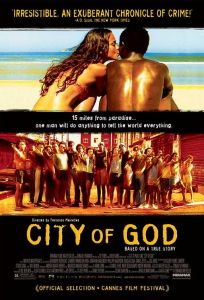 Looking for a film that really packs a genuine wallop? Take the visual panache of a pre-Madonna Guy Ritchie (Snatch) film, the juvenile delinquency and debauchery of a Larry Clark (Kids) film, the propulsive narration and bloody violence of a Martin Scorsese (Raging Bull) film and mix it with a cast of about 40 characters. What you get is City of God, a brilliant and vibrant film that pulsates with exhilarating action, thoughtful commentary and devastating power.
In the 1960s, the Brazilian government transported its impoverished citizens outside of Rio de Janeiro, a glamorous tourist magnet. This new place of residency was a distant housing project of shabby slums, ironically titled City of God. In this begotten neighborhood the police rarely emerge (except to occasionally pick dead people’s pockets) and crime has become rampant. A mixture of poverty and an overabundance of guns and testosterone have bred a culture of criminals where teenagers populate ruthless gangs.
 Our story focuses on Rocket (Alexandre Rodrigues) narrating the rise, and many falls, of all the flashy thugs of the City of God and the ripples they create in the community. Hes a young boy who is too scrawny to be a hoodlum like his older brother Goose. His brother belongs to a gang known as the Tender Trio, who are used to hijacking propane tanks for small gain. They get the idea to knock off a brothel at the urging of Lil Dice, a younger kid with ambition and a heart like a stone. After the successful robbery Lil Dice cleans up after the Trio, sifting through the brothel killing everyone inside and laughing insidiously.
The murder spree has long lasting effects, with each member of the Tender Trio finding an untimely end. Lil Dice grows from calculating child into a big-time burgeoning cruel gangster, who now calls himself Lil Ze (Leandro Firmino De Hora Phellipe). Ze has climbed to the level of kingpin the most pragmatic way possible: systematically eliminating all of the competition. Ze attains reign over the city. He instructs others not to do anything to arouse the outside police (the locals are paid off), and thus has made the City of God a safe place for rich tourists to drive in and purchase their drugs. It seems that Ze ruling by fear has brought newfound safety and prosperity.
Rocket’s path is quite different. As he matures into a teenager he discovers a love of photography. His attempts at a life of crime are short-lived; he simply likes his victims too much to rob them. Ze has Rocket take pictures of his gang strutting their machismo that eventually gets published onto the front page of a newspaper. Rockets reaction is that he thinks his death certificate has been signed. Ze’s reaction is delight. Lil Ze’s great weakness is his self-believed sexual inadequacy. When turned down by a girl he seeks out her good-looking boyfriend, Knockout Ned (Seu Jorge), and humiliates him. He terrorizes Ned, raping his girlfriend in front of him and inspiring him to long bloodthirsty battles of vengeance against Ze that will engulf the City of God.
 A complaint that could be levied against City of God is the numbing effect of its violence. The gangsters in this film aren’t the mustache-twirling types of Gangs of New York, but merely kids. This isn’t any kind of glamorized Hollywood gun battle. When these kids get hit their bodies go limp; they drop to the ground in weeping masses. The films message of the hereditary nature of barbarism is clear. One of the amazing parts of the film is that it was mainly filmed in the actual City of God and uses a cast almost entirely of non-actors.
City of God is a loud announcement to the world of the arrival of a fresh, invigorating and monumental talent with director Fernando Meirelles. The visual flair he utilizes to advance his storyline is amazing yet never falters into the land of gimmickry. The narrative folds in on itself time-wise (much like Tarantino films) yet rhythmically connects the numerous lives and history of the City of God in one lustrous and captivating tapestry of urban decay. A fantastic example is a scene that chronicles the entire history of one apartment and the origins of the entrance of drugs in one un-moving shot. Imagine the Natalie Imbruglia “Torn” video but with drugs and guns.
 There is one sequence of crushing emotional power that has been burned into my memory. The sequence involves a bawling child, no older than seven, being forced to decide where he would rather be shot, in his foot or his tiny trembling hand as punishment for his mischief. The reality of City of God is a harrowing one. As you can clearly see, City of God is not for the weak. The movie has its definite squirm-worthy moments of discomfort and will not be a good choice if you and your date are looking for that perfect weekend movie. This is a difficult movie to sit through at times, and the reality can be grim and uncompromising, but City of God is rewarding in respect to the amazing narrative and visual accomplishments. This is an unforgettable film.
The film piles on the body count while at the same time advancing a pacifist message between the bursts of adrenaline and bullets. Meirelles’ film will leave your jaw dropped to the floor by its sprawling complexity. This is what great filmmaking is all about. City of God is one of those movies that once you’ve left the theater you excitedly claim, “Now thats why I see movies.” City of God is simply a cinematic masterpiece and not only the best film I’d seen in 2003 but also one of the best movies I’ve seen in my life.
Nate’s Grade: A+
Share this:

Spellbound (2002)
 The field of super spellers heading to Washington D.C. is more varied than you could possibly imagine. What is truly amazing, and equally heart-rending, are the scenes showing working-class families encourage their children to excellence. Angelas parents fled Mexico to give a better life for their family in Texas. Her father has been a rancher for 30 years and does not speak a word of English. Its incredible to see the amount of pride her parents have when they see her compete. She says she’s doing it for them. Ashley lives in the projects outside of Washington D.C. She exudes confidence as she makes long treks from school to the cramp apartment her family lives in. Her mother had never expected her child, from her background, to compete for spelling contests but becomes her biggest and most vocal cheerleader.
Spellbound also shows the fanatical level of commitment some of these kids have. Neils father pushes his son to the extremes and the two go over 4,000-8,000 words a day. Neils parents even hire a spelling coach and he gets instruction from his schools foreign language teachers on the history and spelling of foreign words. The commitment most of these kids show is jaw-dropping and obsessive. Ted is the exact opposite. Hes so nonchalant about the spelling bees that it almost seems like hes battling complacency in his small town. His younger brother has the films best line: “It was so exciting. If I had blood pressure it would be through the roof!”
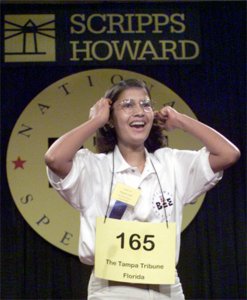 My favorite speller is April. She and her parents live in a dying town. Her father worked in a asbestos factory until it was shut down. He now operates a tavern across from the decaying factory. The family struggles to get by but has so much visible love for their daughter, so much undying support for April. I saw April’s parents as the type you might be embarrassed to say something weird to your friends (“Mom, you are so out of it, geez.”) but the same type that you secretly thank everyday you have. April declares herself a pessimist and doubts the distance she’ll go in the national bee. This is the kind of instantly likeable and compelling character Hollywood has forgotten how to create.
With Spellbound we get to know our hopefuls so well that were saddened before the national bee even begin because, at best, only one of them will win. And, as corny as it sounds, they are all exemplary examples of winners.
Spellbound is the most thrilling movie I’ve seen in ages, totally walloping the heady pretensions of certain action movies. This film will make your palms sweat and then some. Your heart races wildly when it isn’t in your throat. Several films like The Sweet Hereafter or American History X have brought me to tears through their adept expressions of sadness; Spellbound may be the first film thats ever brought me to tears (about five times) just for pure vicarious happiness and joy. To see these kids achieve will, and I know this is so cheesy and blurb-y, but it will make your spirit soar and want to cheer. I’ve since watched the film several times on DVD, and I must report how surprised I am that I end up crying every time, though at different spots. This is a joyous movie, pure and simple.
Spellbound is an uplifting movie for everyone that is guaranteed to have some lasting, triumphant resonance. If you cant feel for these kids I suggest you check if your heart is defective. This is a great example of what film can do, what the American dream can mean for people, and the great diversity an academic competition can inspire. Spellbound is thrilling, heartwarming, and sunnily satisfying. You’ll fall in love with these kids and their hopes and dreams.
E-X-C-E-L-L-E-N-T. Excellent.
Nate’s Grade: A
Share this:

Catch Me If You Can (2002)
January at the theaters is a tale of two kinds of films. One type are the studio bombs (take Just Married and Darkness Falls, please take them far away). The other type are the prestige pictures expanding their releases in hopes of garnering some of that Oscar magic. A lot of prestige films were released around the holidays and though not every one could be a winner, they were all better than Kangaroo Jack. Well, except for The Hours.
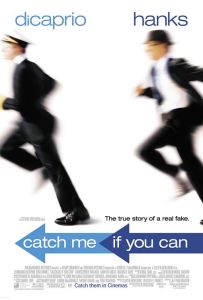 Catch Me If You Can (2002)
Premise: Successful true-life con artist Frank Abagnale Jr. (Leo DiCaprio) zips across the world posing as a pilot, doctor and lawyer all before the age of 18. A mousy Tom Hanks provides the chasing.
Results: Breezy and light-hearted, Catch is an entertaining and fun romp that works with a charming Leo (unlike in Gangs), a jazzy score and a skillful recreation of the 1960s life and mood. Spielberg hasn’t made a film under two hours since 1989, so Catch is a tad long.
Nate’s Grade: B
Share this:

Chicago (2002)
January at the theaters is a tale of two kinds of films. One type are the studio bombs (take Just Married and Darkness Falls, please take them far away). The other type are the prestige pictures expanding their releases in hopes of garnering some of that Oscar magic. A lot of prestige films were released around the holidays and though not every one could be a winner, they were all better than Kangaroo Jack. Well, except for The Hours.
 Chicago (2002)
Premise: Roxie Hart (Renee Zellweger), hungry for fame, finally grasps it when she kills her lover and is put on trial. Silver-tongue lawyer Billy Flynn (Richard Gere) stirs up the media in her defense, as well as for another starlet killer, Velma Kelly (Catherine Zeta-Jones).
Results: A song-and-dance picture thats quite toe-tappin with imaginative numbers, even if I can only remember like two songs. A surprisingly steady Zeta-Jones really shines and Gere can cut a rug. Chicago is just lively fun. Blink and youll miss Lucy Liu in it.
Nate’s Grade: B
Share this:

About Schmidt (2002)
January at the theaters is a tale of two kinds of films. One type are the studio bombs (take Just Married and Darkness Falls, please take them far away). The other type are the prestige pictures expanding their releases in hopes of garnering some of that Oscar magic. A lot of prestige films were released around the holidays and though not every one could be a winner, they were all better than Kangaroo Jack. Well, except for The Hours.
 About Schmidt (2002)
Premise: Retired and recently widowed, Warren Schmidt (Jack Nicholson) must learn to live his own life for the first time. Warren travels across the country to rediscover himself and stop his resentful daughter from marrying a man-child with a mullet.
Results: Nicholson downplays his usual shark grin to deliver one of his best performances in a funny, tragic, savage yet warm-hearted film. About Schmidt, from the creators of Election and Citizen Ruth, is one of the best films of 2002.
Nate’s Grade: A
Share this:

The Hours (2002)
 Okay, after watching the Golden Globes award show and seeing The Hours crowned with the highest prize, and hearing incessantly about Nicole Kidman’s fake prosthetic nose in the movie, it was time to venture into that darkened theater and see how good the awards-friendly The Hours was. Little did I fully realize what I was getting myself into.
Nicole Kidman plays Virginia Woolf, who is in the midst of writing her novel Mrs. Dalloway, where she proposes to display a womans entire life through the events of a single day. Julianne Moore plays Laura Brown, a housewife in 1951 having difficulty adjusting to a domestic life that she feels ill equipped for. Meryl Streep plays Clarissa Vaughan, a gay copy-editor in 2001 planning a party for a poet and former lover (an emaciated Ed Harris), who is suffering from the late stages of AIDS. These three storylines will be juggled as the film progresses, with each womans life deeply changing before the end of the day.
The Hours is a meandering mess where the jigsaw pieces can be easily identified. The attempt at a resolution for an ending, tying the three storylines together, is handled very clumsily. The film spins on and on that you start to believe the title may be more appropriate than intended. What this movie needed was a rappin kangaroo, post haste! The film is wrought with victimization and screams ”Give me an award already!” Before you know it youre being bludgeoned to death with what is profoundly the most over serious Lifetime network movie ever assembled. And there’s nothing fundamentally wrong with Lifetime movies but The Hours does not share the sensibilities of its TV brethren.
 Kidman, nose and all, gives a strong performance displaying the torture and frailty of a writer trapped within her own mind but too often relies on wistful staring or icy glares. Moore is effectively demoralized but cannot resonate with such a shallow character. Streep is the least effective of the three and fizzles among an over-stuffed assembly of characters.
The supporting cast is unjustly left for dead. The characters are seen as parody (Toni Collette as Moore’s un-liberated homemaker neighbor), extraneous (Claire Danes as Streep’s daughter, Allison Janney as Streep’s lover, Jeff Daniels as Harris ex-lover, you know what, almost anyone in the Streep storyline), one-note (the workmanlike John C. Reilly who plays yet another doting and demystified husband) or merely obnoxious (Moore’s brat child that refuses to separate from her). It appears The Hours is the three lead actress game, and everyone else is not invited to play along.
Stephen Daldry’s direction shows surprising stability and instinct after his art-house pandering Billy Elliot showed little. The technical aspects of The Hours are quite competent, especially the sharp editing and musical score, which just points out further how slickly hollow and manufactured the film is.
The Hours is an over-glossed, morose film that is too self-important for its own good. It sucks the life out of everything. And for all its doom and gloom and tsunami of tears, the only insightful thing The Hours is trying to pass off onto the public is that women are more depressed than you think.
Nate’s Grade: C
Share this:

Lord of the Rings: The Two Towers (2002)
 My countrymen and fellow Americans, I come here not to praise Lord of the Rings: The Two Towers but to bury it. I don’t know if it’s a result of being the bridge between the beginning and end of this saga (taking the role of neglected middle child), or a result of unmet sky-high expectations, but I may be alone here in saying that Two Towers was a letdown. I’ll try and frame my reasoning as to not be attacked by hairy hobbits and men with pointy hats and long flowing beards.
1) Story structure. Unlike Fellowship of the Ring, where were introduced to a rich world and have suitable character set-up, the second LOTR film puts almost all our characters on the backburner and gives us an insufferably long subplot involving a king and his brood. The movie peters out an ending and seems to throw its hands in the air saying, “See ya a year from now.”
2) Length. This wasn’t a problem with the previous film but man did Two Towers become unbearable as it went. Some described the first film as three hours of walking; well the second could be described as two plus hours of folks hyping a battle and then — a battle. Seriously, theres a lot of talk about a significant battle and that’s it. An hour could have easily been cut from this. It got to the point where my then-girlfriend was sprawled across my lap pleading for me to somehow make the movie end.
3) Characterization. So much time is spent doing nothing you think the film would further round the characters? Oh how stupid you would be. Nothing new seems to be drawn from any character, with the exception of the treacherous yet likable Gollum. Several people from Fellowship (Liv Tyler, Cate Blanchett, Hugo Weaving, Ian McKellen) have screen time that amounts to no more than a cameo, so why in the world aren’t we getting anything more from our already established heroes? Everyone just looks friggin bored. As was I.
4) Excessive dwarf jokes.
I re-watched Fellowship and all of the reasons Two Towers suffered were not evident. So what does this tell me? Nothing particularly, except not to see the movie in the theater again. Two Towers is by no means a bad film. The cinematography, production and special effects are all breath-taking and sweeping. I’ll still look forward to seeing the next, and last, installment in Peter Jackson’s Rings epic, but Two Towers has left a bitter taste of disappointment to linger upon.
Nate’s Grade: B-
Share this:

Talk to Her (2002)
 Before one can assess Talk to Her, the new Spanish import from famed writer/director Pedro Almodovar, one must come to grips with what they have seen. It’s not every film you see that has a giant vagina. Yes, you read correctly dear reader, a gigantic yet scalable recreation of the most sensitive part of the female anatomy. Was there also a giant penis you might reasonably ask? No, but there was an incredible shrinking man that burrowed into the enormous vagina and lived the rest of his days with the labia and clitoris as his next-door neighbors. And what may be even more surreal is that all of this, thematically and metaphorically upon retrospect, makes absolute sense.
So maybe this opening salacious salvo was a bit hyperbolic, but describing Almodovar’s unusual meditation on life, love and death can prove quite ponderous. To explain the story of Talk to Her is to miss its complexity and richness. This is a film destined to spark conversation afterwards.
Almodovar’s colorful melodrama centers on two sets of relationships. Benigno (Javier Camara) is the most attentive boyfriend a woman could have. He talks to former ballerina Alicia (Leonor Watling), washes her hair and makes sure she gets plenty of exercise and attention. Oh yeah, Alicia has also been in a coma for four years. Benigno carries on like he was involved in a normal relationship, except the woman of his heart cannot return a single glance.
 Marco (Dario Grandinetti) is recovering from a former relationship when he falls completely in love with Lydia (Rosario Flores), a female bullfighter. She is having trouble competing in a very male dominated “sport” (I don’t really consider stabbing animals a sport per se). At the start of a bullfight Lydia is horribly gored and dragged around the arena like a rag doll. The results leave Lydia lying in a coma with no hope of ever waking up. It is at the hospital where Marco meets Benigno, who is one of the most helpful nurses. He helps Marco overcome his grief over his fallen love. Benigno shows that unresponsiveness and death cannot deter a man’s love. The two men bond and become very close; however, dark clouds are on the horizon, as Benigno’s fantasy cannot last much longer.
Almodovar has routinely enjoyed tweaking the establishment, especially gender roles and religion (there’s a few tacky priest molestation jokes), but with Talk to Her he attempts to forge serious drama through odd circumstances (ballerinas, bullfighters, giant vaginas, oh my!) and all without the use of irony. The result is a quietly affecting film that burrows its way inside you, much like the shrinking man burrows into … well, you remember.
The movie is darkly comic in its portrayal of Benigno’s delusional relationship, and yet Talk to Her is also a celebration of love and friendship. The affection that is shown is perplexing but also transfixing with the ability to love someone who is mentally not even there. The film questions the compensations we make for love. Some people pretend that their mate is a different person and glaze over character flaws. Could it not be possible then that someone would compensate for an entire person?
Almodovar has created a very female-centric film despite our female leads spending the majority of their screen time lying perfectly still. Talk to Her is an engrossing and intriguing character-driven story. It may start out like a sick joke but the layers of humanity Almodovar effortlessly injects into his story create the most bizarrely touching movie of 2002.
Nate’s Grade: A


 nathanzoebl
You must be logged in to post a comment.