Blog Archives
The Electric State (2025)

The fire hose that has been the Netflix cash flow may be reigning in, but that didn’t stop the streaming giant from making another attempt at a huge blockbuster to rival those Hollywood designs for the big screen. The Electric State is a $320-million sci-fi adventure spectacle from the Russo brothers, Anthony and Joe, the team that gave us the highs of the Marvel Cinematic Universe (MCU) later Avengers movies, and the lows of, well, everything after their MCU movies. Netflix is actively trying to compete with the theatrical experience brought to you at home, so they take these big expensive swings on large-scale, quippy, action vehicles like Red Notice and 6 Underground every so often to mixed results. Netflix has become the go-to place for a kind of movie that has altogether vanished in the studio sphere, the mid-tier movie for adults. We need those stories. What Netflix hasn’t done as effectively is compete with the big studios for comparable expensive action spectacle. The Electric State is further proof.
In an alternate America, robots were created and given menial tasks by mankind. Naturally, they grew tired of this and attempted a revolution for their equal rights. Mankind was on the brink when an unlikely savior emerged. Tech CEO Ethan Skate (Stanley Tucci) created an army of humanoid drones controlled via VR helmets. This disposable army of avatars was able to beat back the robots and forced their leader, literally an animatronic Mr. Peanut (voiced by Woody Harrelson), to sign a “peace treaty.” The results exiled the robots into a walled off wasteland in the American southwest, and humanity went on its merry way, now with VR-controlled avatars that allowed every American the luxury of staying on their duff. Michelle (Millie Bobby Brown, contractually obligated to be in every Netflix original not starring Joey King) is an orphan WITH AN ATTITUDE. One day she’s greeted by a pint-sized robot looking like the Cosmo cartoon character her younger brother was obsessed with. The little robot says he is her brother and Michelle realizes that maybe she has some family left after all. She and the Cosmo bot are on the run from scavengers and bounty hunters trying to stop their fateful face-to-face reunion.
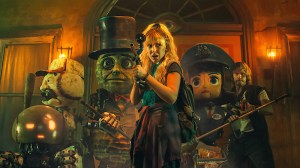
The Electric State is lacking such vital creative sparks to feel anything more than the ramshackle sum of its derivative sci-fi parts. It began as a melancholy mixed media book from the same Swedish author behind Tales From the Loop and it’s become a giant lumbering mess of mediocre and familiar elements. It kind of feels like the newer Ready Player One-era Steven Spielberg trying to emulate early E.T.-era Spielberg, but then that would give us an artist on the level of Spielberg, and that’s not what we have here. It’s standard adventure fare with a brother and sister crossing the country to save the day and thwart a big evil corporation along with scrappy, rakish rogues joining them along the way for fun and life lessons. Chris Pratt’s character is so transparently a Han Solo clone but he’s an empty vest with eye-rolling quips. This is an alternate history story with a literal robot uprising but it devotes so little interest in its own world building and history. The movie essentially castigates all the robots to a forbidden zone that naturally will be visited by our plucky heroes. The majority of the movie is watching these robotic avatars (reminded me of the Geth from Mass Effect) for people who can’t be bothered to leave their VR helmets. If this new world has devolved human interaction into a series of screens (commentary!) then maybe let’s explore that with meaning. If robots are going to be an exploited labor class (commentary!) then maybe let’s explore that too. If this is a future world where robots have been exiled and feared as an Other (commentary!) then let’s explore that too. There’s one moment where Evil Steve Jobs enjoys a VR recreation of his deceased mother, except he admits that this version is the version he wishes he had, and the real figure was far less doting and far more abusive. That’s an interesting concept, that VR offers users the ability to live in a reality of their own desires. But this isn’t a movie that wants to take time to explore interesting and relevant themes, because that would get in the way of action set pieces and goofy robot action. Seriously, there’s one fight where a U.S. postal service robot is literally hurling undelivered mail at a killer robot avatar and succeeds. Because this isn’t a deep movie, we have essentially good robots and bad robots, and if you’re shocked that the robots may have been misunderstood, well congratulations on seeing your first movie. I assure you, they mostly get better from here if you give them a chance.
The inclusion of robots is so underutilized, tapped for ready sidekicks and villains, that you could have replaced them with aliens or clones or any other disposable science fiction element. In this parallel world, Walt Disney created the robots for Disney World, so wouldn’t it be worthy of exploring that history and the sense of Victor Frankenstein-style paternal obligation? Wouldn’t the robots retreat to their ancestral home of Disney World? Or perhaps they view this as the birth of their enslavement? What about different generations of robots, especially older models being replaced with newer ones, thus creating class warfare within an exploited secondary class? What about looking at robots having to subsist off junk to continue with their meager existences? What about robots still living in forbidden zones that are hunted by the government and its armada of robot drones? There are so many possible ideas and stories and characters that are open through the inclusion of robots, but the movie doesn’t have the interest or drive to make them matter. As a result, it’s mostly a swift-moving travelogue with some ugly-looking or cranky guests riding shotgun. Occasionally The Electric State will remember, oh yeah, robots can do stuff people cannot, like having one of them hack into a server or having a smaller robot inside like a high-tech Russian nesting doll.
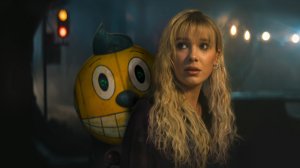
I think it was a combination of the uninvolved storytelling as well as the character design that left my emotional attachment to be null and void. I hated the Cosmo character design. He’s this big spherical head with little skinny limbs, but the head might as well be an un-moving mask. A giant toothy smile is drawn on the front and it’s so inexpressive. Also, the fact that the kid has to exclusively rely upon only using sound bytes from this canceled cartoon series makes for a quickly annoying little brother. I didn’t care about this kid, human or robot, and I didn’t care if Michelle ever reunited with her brother. Then the fact that the movie’s climax involves such a serious and emotional choice seems absurd considering what has been underdeveloped up until this abrupt shift in intended emotional stakes. It’s such an out-of-left field escalation that I almost laughed out loud at what the movie was asking me to feel, as well as what it was asking its protagonist to decide. Likewise, the betterment of robot-kind is given such little recognition, culminating in a showdown between the avatar of good robots and evil robots essentially going to revise a treaty that we don’t know much about. For a movie about how easy it can be to distance ourselves via technology, it sure fails to reasonably make the viewer care about robot equality.
Then there’s the fact that this whole enterprise cost an astounding $320 million for Netflix to platform it as its next hit movie to doze off to while in the middle of doing laundry. The Russo brothers have retreated back to Marvel to handle the next two Avengers movies, and it seems like at a time where both parties have missed and could use one another. Outside of Marvel, the Russos have delivered one super expensive action movie (The Grey Man), a super expensive spy action series (The Citadel), and one lackluster biopic that used every Scorsese stylistic trick they’ve been saving up (Cherry). With The Electric State, we have the brothers’ more familiar mixture of large-scale action and special effects in a mass appeal studio blockbuster space. However, every movie outside of Marvel has made me question their capabilities of handling these big movies. I know the Russos can be fantastic with comedy, as some of their TV episodes are the best of recent memory, and their stewardship of the big MCU movies in the wake of Joss Whedon’s departure was undeniably successful. So why isn’t The Electric State successful? It comes down to the screenplay which is so disinterested in its own ideas, world, and characters, held together by the familiarity of other adventure blockbuster staples like loose chewing gum. It’s a movie replete with famous faces and big effects but feels so devoid of life and creativity, a blockbuster automaton intended to hold the attention but rarely engage one’s imagination and emotions.
Nate’s Grade: C
Share this:

Damsel (2024)
 After a decade of having a creative partner who literally has compiled over 4,000 pitches for possible movie and TV concepts, it was inevitable that Hollywood would eventually get close to some of them. This has happened before a few times, again given the significant library of my friend’s imagination, but never has it gotten as close as Damsel, Netflix’s new action fantasy film flipping the script of the shrinking violet being sacrificed to the clutches of a monster. In my friend’s pitch, the young girl is presented to a dragon with the implication that this regular offering will spare her small town from angry dragon fire. Just as she’s waiting to be eaten, the dragon undoes her bindings and they talk, because the dragon can talk, and he’s very curious why these people keep leaving him young girls every so many years. The revelation is that the dragon is not savage but intelligent, and the two bond, forming a partnership where she brings the dragon back to her community and shows them the error of their long-standing prejudices. Of course it all gets bigger from there, with warring kingdoms wanting to harness the last dragon to capture this unparalleled weapon of mass destruction. There was even a budding romance between the dragon and the young woman, with the possibility of the dragon turning into a human Beauty and the Beast-style. The title: Damsel. While my friend’s Damsel and Netflix’s Damsel have some core similarities, they do tell different stories built upon the same premise of the virgin sacrifice and the killer creature being more than what they seem.
Unfortunately, Netflix’s version is too narrow to be fully satisfying with its fairy tale script flip. We have Millie Bobby Brown as our titular damsel, Elodie, a woman trying to do well for her family, notably her father (Ray Winstone), stepmother (Angela Bassett), and younger sister. The young prince needs a bride, and the Queen (Robin Wright) isn’t too shy to still turn up her nose at her new in-laws that she sees as merely a means to an end, nothing more. Of course it’s revealed that this end is as “human sacrifice” to a dragon that has reportedly stalked the kingdom for centuries. Elodie is thrown down a vast canyon into the lair of an angry dragon (voiced by the unmistakable Shohreh Aghdashloo). From there, Elodie must use her wits to survive the dragon, escape above ground, and save her younger sister from being doomed to a similar fate.
 The premise is so strong, upending ages-old tropes of the female sacrifice and the monstrous creature, as even with Netflix’s Damsel the dragon is a victim of historical slander. There’s so many places you can go with this, especially building upon the dynamic of the two of these discarded outcasts banding together to push back against the cruelty of society. However, that’s not the movie Netflix’s Damsel becomes. It sort of is, at the very end in resolution, with a latent promise of possible further adventures, but it’s mostly a locked-in survival thriller.
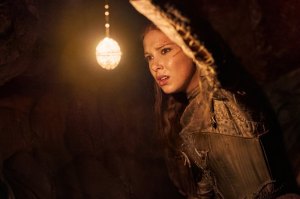
I was not expecting the majority of Damsel to be Elodie’s basic survival once she’s been hurled into the pit by her recently dearly beloved (just following orders from mom, he says). It works, but it feels very constrained creatively. Now, I am generally a fan of these kinds of stories, the step-by-step survival tales where we are thinking alongside the plucky protagonist. I find them fun and follow a satisfying structure of amassing payoffs. It’s naturally enjoyable to watch a character tackle problems and succeed. However, it’s also vital that the audience understands the problem to know the challenge. In a fantasy setting, this requires more time to establish new rules and circumstances. Here we have a few sequences like when Elodie discovers bio-luminescent slugs and uses them as a light source for exploring her captivity (bonus: their sticky slime is healing). The timeline is relatively short, maybe a day at most, so it’s not like Elodie has to think about long-term survival; it’s much more immediate about escaping from the wrath of the predator. Just finding a safe hiding spot is enough. It’s engaging but by limiting the focus to an almost real-time survival cat-and-mouse game, it caps the movie’s creative possibility. I was far more interested in the prospect of eventually moving beyond the initial amity between Elodie and the dragon, where they could share their royal rage together. I kept waiting for this initial battle to give way into a different level of understanding, something to deepen and alter this relationship, but this doesn’t arrive until the very resolution of an hour after Elodie first hides from the fearsome dragon.
While I was never bored by watching Elodie think how to get over a crevasse, or how to navigate a treacherous pass, I was reminded of 2022’s The Princess, a spirited and gleefully violent feminist romp with a similar starting point of a damsel taking matters into her own hands and fighting for her freedom. With that film, the upturned premise was simple, but each new floor down the tower revealed something about our heroine, each new challenge was different and relied upon a different skill or tactic. Unfortunately, that movie was “deleted” from the Disney/Fox/Hulu library for tax purposes, though you can still rent or purchase it on Amazon but, as of now, no physical media exists. This is an excellent example of a movie with a limited scope that knows how to play to the limitations of story while still revealing character through action. While that movie lost some momentum and clarity when the princess was kicked out of her tower imprisonment, I found much to celebrate with the movie’s ingenuity and spirit. With Netflix’s Damsel, I was getting antsy to leave the cave and move things along. The twist about the true nature of the dragon, and her past with the legendary royal hero, should be obvious to most.
 Let it be said that this is where Brown (Enola Holmes) graduated to being a steely and capable adult actress. She’s the star of the movie and has to command our attention and hold it for long stretches on her own. Brown throws herself into the physicality of the role with a relish that only makes her eventual triumph feel that much more worthy. The side characters don’t amount to much but have reliably winning actors to draw our attention. Aghdashloo (The Expanse) is a wonderful scene companion even with only a smoky voice. Wright (Wonder Woman) is haughty to the point of thin-lipped camp. Although this is a criminal under-utilization of the talents of Bassett (Black Panther: Wakanda Forever), who plays the concerned stepmother. That’s what happens when most of your movie is about one girl in a cave. The other characters are confined to the opening and closing of your survival thriller.
I suppose I’m being cheeky by referring to the movie as “Netflix’s Damsel” considering there isn’t any other version out there. I’m not accusing Netflix or screenwriter Dan Mazeau (Wrath of the Titans, Fast X) of ripping off my friend; it’s more an example of parallel thinking playing around with old fantasy tropes and giving them a new spin for modern times. I mostly enjoyed Netflix’s Damsel but couldn’t help but wonder what might have been, not just with my friend’s competing take on the material but with the story possibilities not taken here thanks to its limited scope. As a survival thriller in a fantasy setting, it works. There was just more that could have been, and while I should judge the movie that exists rather than the movie that could have been, Netflix’s Damsel is a fantasy action vehicle that swings its sword ably but had so much more potential to slay.
Nate’s Grade: B-
Share this:

Godzilla vs. King Kong (2021)
 Godzilla vs. Kong is the kind of movie where you need to question what your qualifications would be for its true entertainment value. Four films into the fledgling MonsterVerse, we’ve set up its Batman vs. Superman, its Infinity War, its climax, the biggest names on the biggest stage to settle the score once and for all. With indie director Adam Wingard at the helm, best known for peculiarly violent genre-defying movies like You’re Next and The Guest, the results with G vs. K (I’m not writing the full name every time) strictly fall into the realm of dumb fun. It’s up to you which of those categorical designations will reign supreme, the dumb or the fun.
The gigantic 100-foot tall ape Kong is being kept in a caged atrium by the Monarch organization. Godzilla is running amuck and attacking a shady company that may have a shady conspiracy afoot. Kong and Godzilla are two alpha predators, the last known titans, and it’s believed that Godzilla is seeking out Kong to put him down for good. The government is trying to protect its great ape, figure out why the big lizard is acting up, and maybe explore this kooky Hollow Earth theory. There’s a reason I haven’t mentioned any human character names because, once again, they don’t really matter.
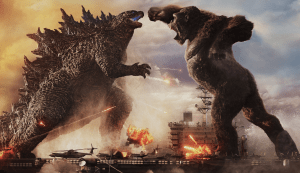 This movie is going to entirely depend on how much your love of monster brawls can, essentially, push aside crazy, incoherent plotting and meaningless human characters. If you’re the kind of fan going to G vs. K and expecting nothing else than bruising knockdown fights that decimate the landscape and ensure untold death, no matter how many times we’re told the entire city of Hong Kong has miraculously evacuated in minutes, then the movie delivers. There are three big brawls and each one of them is satisfying and has a weighty quality to them; they really do feel like heavyweight title fights, with each side giving it their all and then some. It’s an epic showdown and we demand the best from this clash of the titans, and Wingard comes alive during these sequences, finding stylish ways to demonstrate and develop the carnage so that the brawls feel unique rather than stale. Each of the three major battles takes place in a different location and uses that environment to its advantage when developing its action particulars. The first bout is at sea and Kong is chained to the galley of a warship, so Godzilla capsizes the ship, attempting to drown Kong. The water is also a far more friendly place for Godzilla, with Kong forced to jump from ship to ship like platforms in an old school video game. The rematch takes place in downtown Hong Kong and offers the traditional metropolitan cataclysm we’ve come to expect from disaster escapades (again, with vague reminders that somehow all these buildings are empty). Godzilla’s fire breath becomes a laser field that Kong must avoid with drastic escapes. Wingard’s camera finds fun ways to communicate the back and forth, at one point seemingly attached to the monsters as they pummel and move, like an arty Darren Aronofsky film. He finds ways to make two age-old creatures fighting still appear visually fresh and exciting. When the creatures are slugging it out, G vs. K is at its best as big-budget popcorn escapism.
I also must applaud that filmmakers that, four movies in, we finally have monster fights where the audience can see what is happening. 2014’s Godzilla reboot kept teasing the big lizard and giving glimpses, a foot there, a closing door here, that built anticipation but also tried audience patience. My biggest complaint was I wanted more Godzilla in my Godzilla movie, and 2019’s King of the Monsters answered this complaint, providing four different monsters to duke it out for monster supremacy. However, the supernatural slug-fests were undercut by sequences that were hard to see. Whether it was in the rain, at night, in a blizzard, in the fog or smoke, it was hard to tell what was happening because of all the annoying visual obfuscation. We had more monster fights, yes, but they weren’t that much easier to see than in 2014. Thankfully, this movie seems like a direct response to that chief criticism. The big fights take place entirely during the day, and not only that, it’s clear and even sunny, making sure we can soak up every loving CGI detail of these two giant pretend creatures having their big pretend rumble. It may sound like I shouldn’t be too congratulatory for a franchise that dares to allow its paying customers to actually see the spectacle that they paid to see, but after several other films of mitigating results, I’m happy we at least can enjoy the big brawls after so much build-up and delayed gratification.
 But if you expect more from a versus film other than predicated pugilism from your preferred participants, then G vs. K is going to disappoint. It is a vast understatement to say that this movie is extremely loony. It is so goofy that you will either shrug and go with the silly twists and turns, or you’ll be like several of my friends, and my girlfriend, who just stared stupefied and shook their heads, muttering how much more crazy-pants bananas things could possibly get.
For a franchise that started fairly grounded in 2014 from a science standpoint, and whose sequels have more or less hewn to that tonal vision, G vs. K says, “Hey, what if we…,” and injects whatever it deems might be insane and awesome, like an improv game that never meets resistance. Whatever you may be prepared for, this movie goes deeper and crazier. It literally goes to the center of the Earth and back. If I were to describe the parameters of the final fight, it would sound like I was drunk or needing of mental check-ups from concerned loved ones. It feels like the Asylum version of what a Godzilla and Kong match-up would be, and by that I refer to the low-budget studio known for its schlocky knockoffs and crazy all-you-can-eat buffet-style sci-fi plotting. There’s one solution that literally involves dumping alcohol onto a computer. Again, maybe your exact sensibilities will be a match for this wilder, sillier tonal wavelength; maybe you felt the earlier MonsterVerse entries took themselves too seriously. I’ll readily admit that they devoted far too much time to human drama I felt was, no pun intended, irritatingly small-scale. 2017’s Kong: Skull Island is the high watermark for this monster cinematic universe, and definitely better than you remember, and it didn’t take itself too seriously but found an agreeable baseline that allowed the film to have its spectacle while holding the human drama to be meaningful and entertaining itself. The movie was stylish, fun, and your brain didn’t melt when the big creatures were off-screen for long duration.
With G vs. K, any sense of established connectivity with the other movies is thrown out the window. Sure, there are faces that reappear (hey, Millie Bobby Brown), but they might as well be new characters. Even more than that, the tone of the movie is shifted so forcefully into self-parody, cheesy ludicrousness, including a spaceship serving as a moving defibrillator and psychic skulls, that it’s hard to take anything remotely seriously. I can already hear some detractors saying why should a movie about a giant ape fighting a giant lizard ever be taken seriously, and maybe you’re right you detractor you, but every movie needs an established baseline to provide a foundation of what is real, what is meaningful, and what is exceptional. If everything is crazy, it makes the monster action seem more mundane, and if anything can happen at any moment, it makes the plotting less important of careful setups and development, and satisfaction will be capped.
 If you’re just looking for a movie about a giant ape punching a giant lizard with top-notch special effects, well Godzilla vs. Kong has that aplenty, and if that’s enough for you, then enjoy. It’s far more of a Kong sequel with the occasional special appearance from Godzilla, so if you’re more a fan of the big lizard you may be a little miffed at the big guy being a second banana. The action is fun and splashy, and I wish I watched this titanic title match on the big screen where it belongs, and I’ll admit that likely has dulled some of my experience. The sharp tonal shift for the MonsterVerse, and the escalating silliness that climaxes into insanity is either going to be selling point or a breaking point for every viewer. You’ll either rock with glee and happy that this franchise has finally evolved into the schlocky spectacle you’ve been dying for, or you’ll be trying to hang on to the silly, over-the-top plotting to orient your staggered senses. Godzilla vs. Kong is everything the title suggests and little else, and for many that will be enough. For me, I think it kind of lost me somewhere between here and Albuquerque.
Nate’s Grade: C+
Share this:

Enola Holmes (2020)
 I’m shocked this isn’t the pilot for a new series, and maybe it one day will serve as such, because Enola Holmes is such a sprightly, effervescent, enjoyable rehash of the classic sleuth but this time from the girl power point of view of a younger sister. Millie Bobby Brown (Stranger Things) shines as the headstrong, quirky, loquacious Enola Holmes setting off on her own adventure to find her missing mother (Helena Bonham Carter) and to push against her older brothers Mycroft (Sam Claflin) and Sherlock (Henry Cavill) and their perceptions of what is appropriate for a lady. The best moments are when Brown gets to showcase her pluck and grit, proving presumptions wrong, and winning fans along the way. There is nothing new about this kind of movie where a young woman fights against sexism and proves herself capable and heroic. It’s a tried-and-true formula that works because, with enough polish, an underdog is always going to draw in the audience to watch them triumph over their doubters. Add a dash of feminism to boot and bake as necessary (not a joke on feminism, mind you). The actual plot is secondary to the situational mishaps and character bickering, which is good because there isn’t really a mystery to uncover. Enola gets pulled into protecting a young royal on the run from a wealthy family benefactor that wants to make sure he doesn’t live to collect his inheritance. Their interaction adopts a screwball romance sort of tone, which provides Brown ample opportunity to be sunny, exuberant, and overall delightful, a side rarely seen as the somber, alienated Eleven. I enjoyed the stylistic asides and visual inserts to better showcase Enola’s hyperactive thinking and sleuthing, borrowing a page from the new Benedict Cumberbatch Sherlock TV series to visualize the processes of rapid-fire thought in a pleasing and amusing manner. Cavill is perhaps the most dashing Sherlock put to screen and provides a suitable establishment stand-in of accepted masculinity and intelligence that serves as contrast for what Enola is pushing against. Given that almost all the main players are attached to ongoing Netflix series (The Witcher, The Crown) I feel like we should expect more adventures down the line with the irascible Enola Holmes, and with a bubbly Brown seizing the mantle, that’s fine by me.
Nate’s Grade: B
Share this:

Godzilla: King of the Monsters (2019)
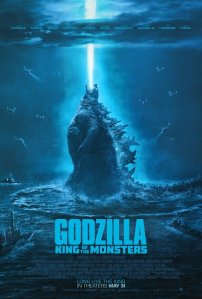 Godzilla: King of the Monsters is the sequel to 2014’s American re-launch, and the biggest complaint I had with that other film was how frustratingly coy it was with showing Godzilla. I wanted more Godzilla in my Godzilla movie, and King of the Monsters at least understands this need and supplies many of the most famous kaiju in the franchise, like Mothra, Rodan, and the three-headed King Ghidorah. The human drama is just as boring with characters I have a hard time caring about. Vera Farmiga plays a scientist who lost a child during the 2014 monster brawl in San Francisco. She develops a sonar device to communicate and domesticate the giant monsters (now totaling 17 plus). She and her teen daughter (Millie Bobby Brown) are kidnapped by eco terrorists that want to… destroy the world and leave it back to the ancient monsters? It’s a bit jumbled. I felt more for a monster than I did any living person. The plot does just enough to fill in time between the monster battles, which can be fun but are also lacking a few key items. Firstly, the sense of scale is lost. That’s one thing the 2014 film had in spades, the human-sized perspective of how enormous these beasts are. Also the fight scenes are shot in pretty dark environments that can make things harder to watch. There is a simple pleasure watching two giant monsters duke it out on screen, and King of the Monsters has enough of these to satisfy. It’s still a flawed monster mash but at least it sheathes the itch it was designed for, and if you’re a Godzilla fan and feeling generous, that might be enough to justify a matinee with a few of your favorite fifty-story pals.
Nate’s Grade: B-


 nathanzoebl
You must be logged in to post a comment.